SECTION 4-2
Angles ofTriangles
ESSENTIAL QUESTIONS
• How do you apply theTriangle Angle-SumTheorem?
• How do you apply the Exterior AngleTheorem?
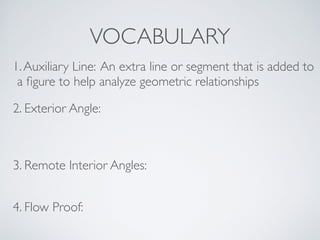
VOCABULARY
1.Auxiliary Line:
2. Exterior Angle:
3. Remote Interior Angles:
4. Flow Proof:
VOCABULARY
1.Auxiliary Line: An extra line or segment that is added to
a figure to help analyze geometric relationships
2. Exterior Angle:
3. Remote Interior Angles:
4. Flow Proof:
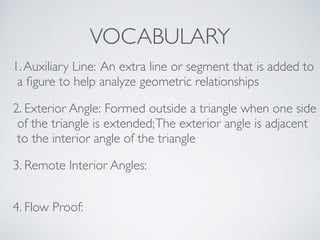
VOCABULARY
1.Auxiliary Line: An extra line or segment that is added to
a figure to help analyze geometric relationships
2. Exterior Angle: Formed outside a triangle when one side
of the triangle is extended;The exterior angle is adjacent
to the interior angle of the triangle
3. Remote Interior Angles:
4. Flow Proof:
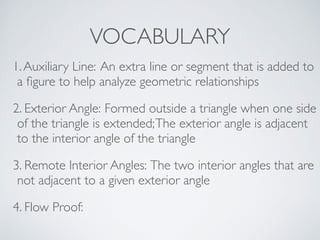
VOCABULARY
1.Auxiliary Line: An extra line or segment that is added to
a figure to help analyze geometric relationships
2. Exterior Angle: Formed outside a triangle when one side
of the triangle is extended;The exterior angle is adjacent
to the interior angle of the triangle
3. Remote Interior Angles: The two interior angles that are
not adjacent to a given exterior angle
4. Flow Proof:
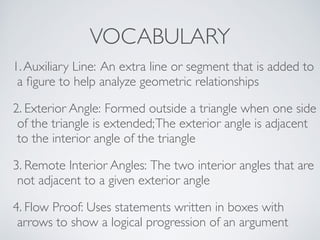
VOCABULARY
1.Auxiliary Line: An extra line or segment that is added to
a figure to help analyze geometric relationships
2. Exterior Angle: Formed outside a triangle when one side
of the triangle is extended;The exterior angle is adjacent
to the interior angle of the triangle
3. Remote Interior Angles: The two interior angles that are
not adjacent to a given exterior angle
4. Flow Proof: Uses statements written in boxes with
arrows to show a logical progression of an argument
THEOREMS & COROLLARIES
4.1 -Triangle Angle-SumTheorem:
4.2 - Exterior AngleTheorem:
4.1 Corollary:
4.2 Corollary:
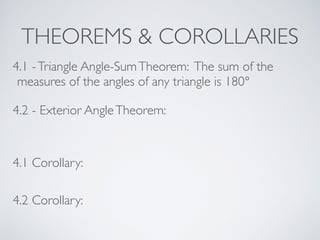
THEOREMS & COROLLARIES
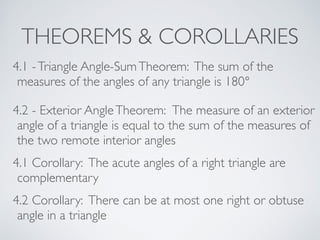
4.1 -Triangle Angle-SumTheorem: The sum of the
measures of the angles of any triangle is 180°
4.2 - Exterior AngleTheorem:
4.1 Corollary:
4.2 Corollary:
THEOREMS & COROLLARIES
4.1 -Triangle Angle-SumTheorem: The sum of the
measures of the angles of any triangle is 180°
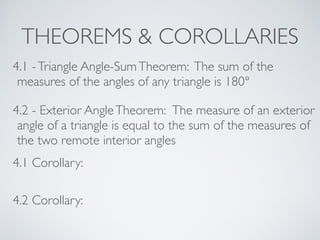
4.2 - Exterior AngleTheorem: The measure of an exterior
angle of a triangle is equal to the sum of the measures of
the two remote interior angles
4.1 Corollary:
4.2 Corollary:
THEOREMS & COROLLARIES
4.1 -Triangle Angle-SumTheorem: The sum of the
measures of the angles of any triangle is 180°
4.2 - Exterior AngleTheorem: The measure of an exterior
angle of a triangle is equal to the sum of the measures of
the two remote interior angles
4.1 Corollary: The acute angles of a right triangle are
complementary
4.2 Corollary:
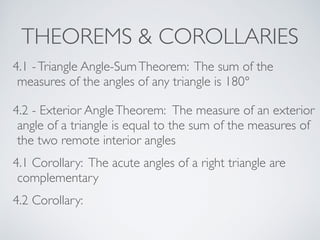
THEOREMS & COROLLARIES
4.1 -Triangle Angle-SumTheorem: The sum of the
measures of the angles of any triangle is 180°
4.2 - Exterior AngleTheorem: The measure of an exterior
angle of a triangle is equal to the sum of the measures of
the two remote interior angles
4.1 Corollary: The acute angles of a right triangle are
complementary
4.2 Corollary: There can be at most one right or obtuse
angle in a triangle
EXAMPLE 1
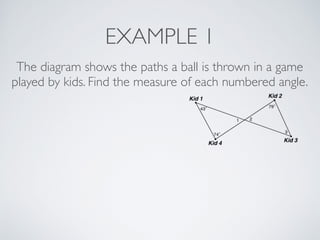
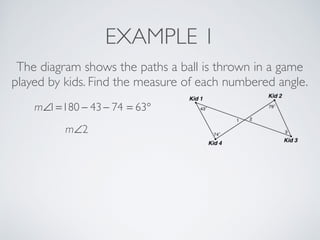
The diagram shows the paths a ball is thrown in a game
played by kids. Find the measure of each numbered angle.
EXAMPLE 1
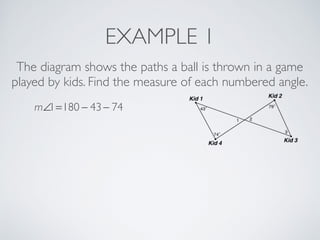
The diagram shows the paths a ball is thrown in a game
played by kids. Find the measure of each numbered angle.
m∠1=180 − 43− 74
EXAMPLE 1
The diagram shows the paths a ball is thrown in a game
played by kids. Find the measure of each numbered angle.
m∠1=180 − 43− 74 = 63°
EXAMPLE 1
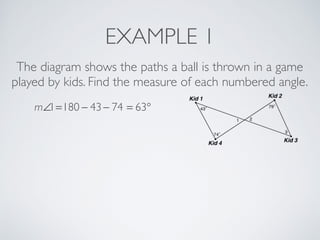
The diagram shows the paths a ball is thrown in a game
played by kids. Find the measure of each numbered angle.
m∠1=180 − 43− 74 = 63°
m∠2
EXAMPLE 1
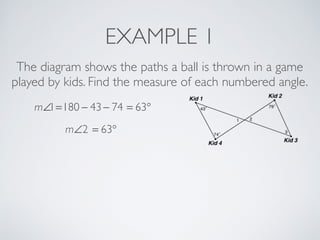
The diagram shows the paths a ball is thrown in a game
played by kids. Find the measure of each numbered angle.
m∠1=180 − 43− 74 = 63°
m∠2 = 63°
EXAMPLE 1
The diagram shows the paths a ball is thrown in a game
played by kids. Find the measure of each numbered angle.
m∠1=180 − 43− 74 = 63°
m∠2 = 63°
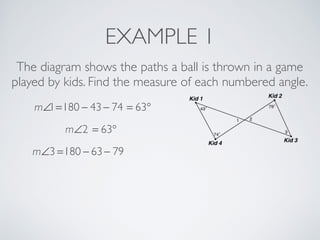
m∠3 =180 − 63− 79
EXAMPLE 1
The diagram shows the paths a ball is thrown in a game
played by kids. Find the measure of each numbered angle.
m∠1=180 − 43− 74 = 63°
m∠2 = 63°
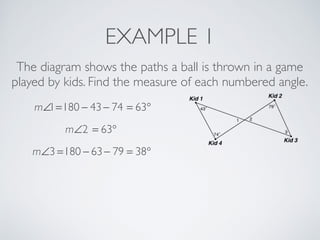
m∠3 =180 − 63− 79 = 38°
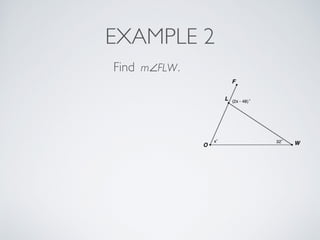
EXAMPLE 2
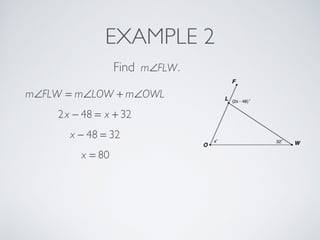
Find m∠FLW.
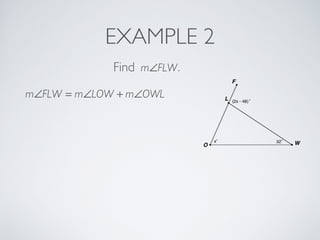
EXAMPLE 2
Find m∠FLW.
m∠FLW = m∠LOW + m∠OWL
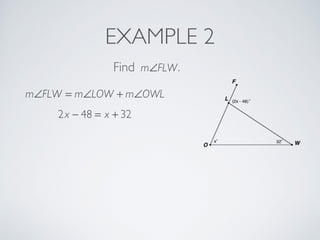
EXAMPLE 2
Find m∠FLW.
m∠FLW = m∠LOW + m∠OWL
2x − 48 = x + 32
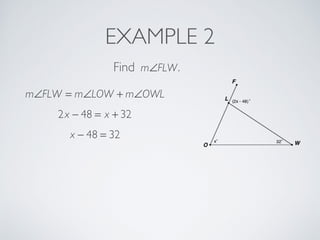
EXAMPLE 2
Find m∠FLW.
m∠FLW = m∠LOW + m∠OWL
2x − 48 = x + 32
x − 48 = 32
EXAMPLE 2
Find m∠FLW.
m∠FLW = m∠LOW + m∠OWL
2x − 48 = x + 32
x − 48 = 32
x = 80
EXAMPLE 2
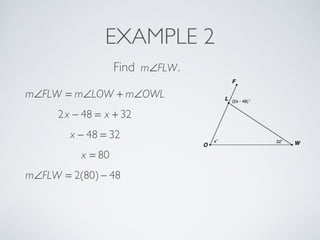
Find m∠FLW.
m∠FLW = m∠LOW + m∠OWL
2x − 48 = x + 32
x − 48 = 32
x = 80
m∠FLW = 2(80)− 48
EXAMPLE 2
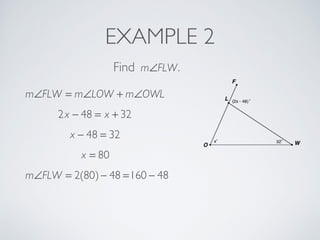
Find m∠FLW.
m∠FLW = m∠LOW + m∠OWL
2x − 48 = x + 32
x − 48 = 32
x = 80
m∠FLW = 2(80)− 48 =160 − 48
EXAMPLE 2
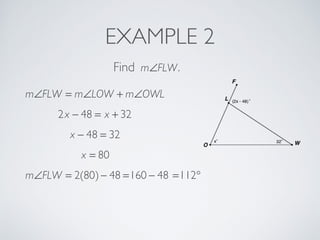
Find m∠FLW.
m∠FLW = m∠LOW + m∠OWL
2x − 48 = x + 32
x − 48 = 32
x = 80
m∠FLW = 2(80)− 48 =160 − 48 =112°
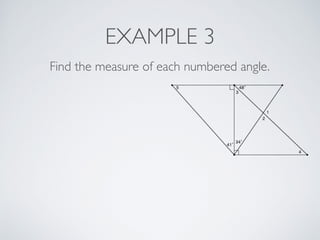
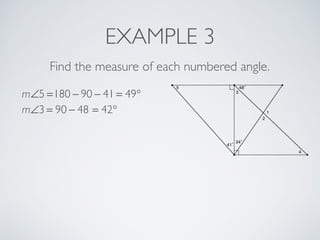
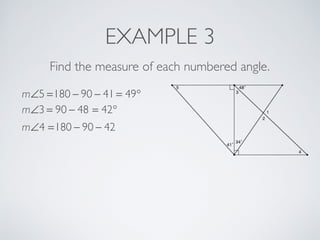
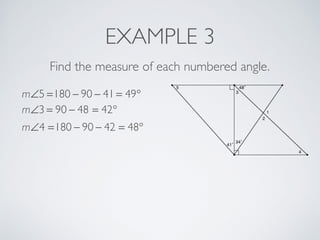
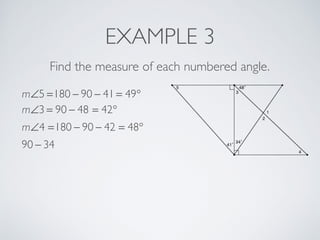
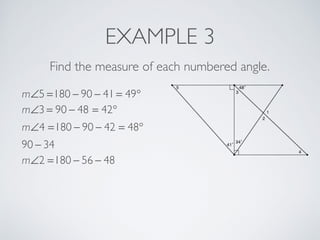
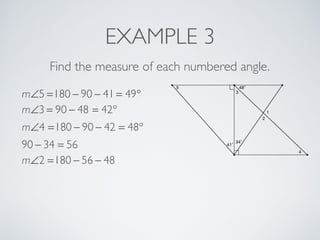
EXAMPLE 3
Find the measure of each numbered angle.
EXAMPLE 3
Find the measure of each numbered angle.
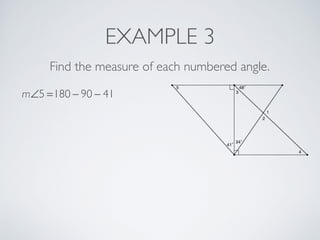
m∠5 =180 − 90 − 41
EXAMPLE 3
Find the measure of each numbered angle.
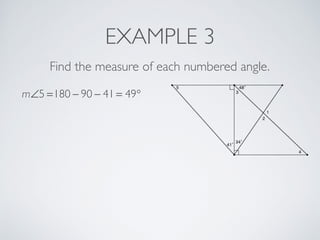
m∠5 =180 − 90 − 41 = 49°
EXAMPLE 3
Find the measure of each numbered angle.
m∠5 =180 − 90 − 41 = 49°
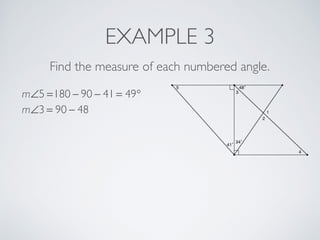
m∠3 = 90 − 48
EXAMPLE 3
Find the measure of each numbered angle.
m∠5 =180 − 90 − 41 = 49°
m∠3 = 90 − 48 = 42°
EXAMPLE 3
Find the measure of each numbered angle.
m∠5 =180 − 90 − 41 = 49°
m∠3 = 90 − 48 = 42°
m∠4 =180 − 90 − 42
EXAMPLE 3
Find the measure of each numbered angle.
m∠5 =180 − 90 − 41 = 49°
m∠3 = 90 − 48 = 42°
m∠4 =180 − 90 − 42 = 48°
EXAMPLE 3
Find the measure of each numbered angle.
m∠5 =180 − 90 − 41 = 49°
m∠3 = 90 − 48 = 42°
m∠4 =180 − 90 − 42 = 48°
90 − 34
EXAMPLE 3
Find the measure of each numbered angle.
m∠5 =180 − 90 − 41 = 49°
m∠3 = 90 − 48 = 42°
m∠4 =180 − 90 − 42 = 48°
90 − 34
m∠2 =180 − 56 − 48
EXAMPLE 3
Find the measure of each numbered angle.
m∠5 =180 − 90 − 41 = 49°
m∠3 = 90 − 48 = 42°
m∠4 =180 − 90 − 42 = 48°
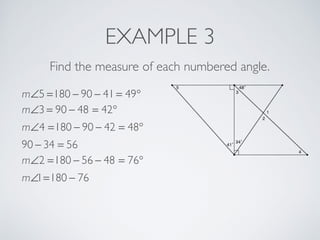
90 − 34 = 56
m∠2 =180 − 56 − 48
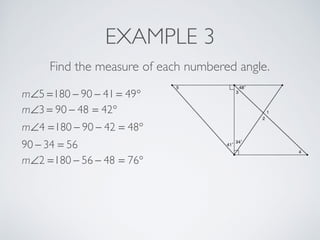
EXAMPLE 3
Find the measure of each numbered angle.
m∠5 =180 − 90 − 41 = 49°
m∠3 = 90 − 48 = 42°
m∠4 =180 − 90 − 42 = 48°
90 − 34 = 56
m∠2 =180 − 56 − 48 = 76°
EXAMPLE 3
Find the measure of each numbered angle.
m∠5 =180 − 90 − 41 = 49°
m∠3 = 90 − 48 = 42°
m∠4 =180 − 90 − 42 = 48°
90 − 34 = 56
m∠2 =180 − 56 − 48 = 76°
m∠1=180 − 76
EXAMPLE 3
Find the measure of each numbered angle.
m∠5 =180 − 90 − 41 = 49°
m∠3 = 90 − 48 = 42°
m∠4 =180 − 90 − 42 = 48°
90 − 34 = 56
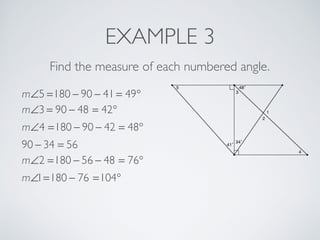
m∠2 =180 − 56 − 48 = 76°
m∠1=180 − 76 =104°
EXAMPLE 3
Find the measure of each numbered angle.
m∠5 =180 − 90 − 41 = 49°
m∠3 = 90 − 48 = 42°
m∠4 =180 − 90 − 42 = 48°
90 − 34 = 56
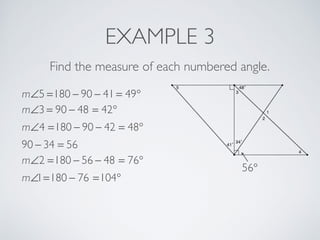
56°
m∠2 =180 − 56 − 48 = 76°
m∠1=180 − 76 =104°
PROBLEM SET
PROBLEM SET
p. 248 #1-37 odd, 46, 57
“We rarely think people have good sense unless they
agree with us.” - Francois de La Rochefoucauld

Geometry Section 4-2

  • 1.
  • 2.
    ESSENTIAL QUESTIONS • Howdo you apply theTriangle Angle-SumTheorem? • How do you apply the Exterior AngleTheorem?
  • 3.
    VOCABULARY 1.Auxiliary Line: 2. ExteriorAngle: 3. Remote Interior Angles: 4. Flow Proof:
  • 4.
    VOCABULARY 1.Auxiliary Line: Anextra line or segment that is added to a figure to help analyze geometric relationships 2. Exterior Angle: 3. Remote Interior Angles: 4. Flow Proof:
  • 5.
    VOCABULARY 1.Auxiliary Line: Anextra line or segment that is added to a figure to help analyze geometric relationships 2. Exterior Angle: Formed outside a triangle when one side of the triangle is extended;The exterior angle is adjacent to the interior angle of the triangle 3. Remote Interior Angles: 4. Flow Proof:
  • 6.
    VOCABULARY 1.Auxiliary Line: Anextra line or segment that is added to a figure to help analyze geometric relationships 2. Exterior Angle: Formed outside a triangle when one side of the triangle is extended;The exterior angle is adjacent to the interior angle of the triangle 3. Remote Interior Angles: The two interior angles that are not adjacent to a given exterior angle 4. Flow Proof:
  • 7.
    VOCABULARY 1.Auxiliary Line: Anextra line or segment that is added to a figure to help analyze geometric relationships 2. Exterior Angle: Formed outside a triangle when one side of the triangle is extended;The exterior angle is adjacent to the interior angle of the triangle 3. Remote Interior Angles: The two interior angles that are not adjacent to a given exterior angle 4. Flow Proof: Uses statements written in boxes with arrows to show a logical progression of an argument
  • 8.
    THEOREMS & COROLLARIES 4.1-Triangle Angle-SumTheorem: 4.2 - Exterior AngleTheorem: 4.1 Corollary: 4.2 Corollary:
  • 9.
    THEOREMS & COROLLARIES 4.1-Triangle Angle-SumTheorem: The sum of the measures of the angles of any triangle is 180° 4.2 - Exterior AngleTheorem: 4.1 Corollary: 4.2 Corollary:
  • 10.
    THEOREMS & COROLLARIES 4.1-Triangle Angle-SumTheorem: The sum of the measures of the angles of any triangle is 180° 4.2 - Exterior AngleTheorem: The measure of an exterior angle of a triangle is equal to the sum of the measures of the two remote interior angles 4.1 Corollary: 4.2 Corollary:
  • 11.
    THEOREMS & COROLLARIES 4.1-Triangle Angle-SumTheorem: The sum of the measures of the angles of any triangle is 180° 4.2 - Exterior AngleTheorem: The measure of an exterior angle of a triangle is equal to the sum of the measures of the two remote interior angles 4.1 Corollary: The acute angles of a right triangle are complementary 4.2 Corollary:
  • 12.
    THEOREMS & COROLLARIES 4.1-Triangle Angle-SumTheorem: The sum of the measures of the angles of any triangle is 180° 4.2 - Exterior AngleTheorem: The measure of an exterior angle of a triangle is equal to the sum of the measures of the two remote interior angles 4.1 Corollary: The acute angles of a right triangle are complementary 4.2 Corollary: There can be at most one right or obtuse angle in a triangle
  • 13.
    EXAMPLE 1 The diagramshows the paths a ball is thrown in a game played by kids. Find the measure of each numbered angle.
  • 14.
    EXAMPLE 1 The diagramshows the paths a ball is thrown in a game played by kids. Find the measure of each numbered angle. m∠1=180 − 43− 74
  • 15.
    EXAMPLE 1 The diagramshows the paths a ball is thrown in a game played by kids. Find the measure of each numbered angle. m∠1=180 − 43− 74 = 63°
  • 16.
    EXAMPLE 1 The diagramshows the paths a ball is thrown in a game played by kids. Find the measure of each numbered angle. m∠1=180 − 43− 74 = 63° m∠2
  • 17.
    EXAMPLE 1 The diagramshows the paths a ball is thrown in a game played by kids. Find the measure of each numbered angle. m∠1=180 − 43− 74 = 63° m∠2 = 63°
  • 18.
    EXAMPLE 1 The diagramshows the paths a ball is thrown in a game played by kids. Find the measure of each numbered angle. m∠1=180 − 43− 74 = 63° m∠2 = 63° m∠3 =180 − 63− 79
  • 19.
    EXAMPLE 1 The diagramshows the paths a ball is thrown in a game played by kids. Find the measure of each numbered angle. m∠1=180 − 43− 74 = 63° m∠2 = 63° m∠3 =180 − 63− 79 = 38°
  • 20.
  • 21.
  • 22.
    EXAMPLE 2 Find m∠FLW. m∠FLW= m∠LOW + m∠OWL 2x − 48 = x + 32
  • 23.
    EXAMPLE 2 Find m∠FLW. m∠FLW= m∠LOW + m∠OWL 2x − 48 = x + 32 x − 48 = 32
  • 24.
    EXAMPLE 2 Find m∠FLW. m∠FLW= m∠LOW + m∠OWL 2x − 48 = x + 32 x − 48 = 32 x = 80
  • 25.
    EXAMPLE 2 Find m∠FLW. m∠FLW= m∠LOW + m∠OWL 2x − 48 = x + 32 x − 48 = 32 x = 80 m∠FLW = 2(80)− 48
  • 26.
    EXAMPLE 2 Find m∠FLW. m∠FLW= m∠LOW + m∠OWL 2x − 48 = x + 32 x − 48 = 32 x = 80 m∠FLW = 2(80)− 48 =160 − 48
  • 27.
    EXAMPLE 2 Find m∠FLW. m∠FLW= m∠LOW + m∠OWL 2x − 48 = x + 32 x − 48 = 32 x = 80 m∠FLW = 2(80)− 48 =160 − 48 =112°
  • 28.
    EXAMPLE 3 Find themeasure of each numbered angle.
  • 29.
    EXAMPLE 3 Find themeasure of each numbered angle. m∠5 =180 − 90 − 41
  • 30.
    EXAMPLE 3 Find themeasure of each numbered angle. m∠5 =180 − 90 − 41 = 49°
  • 31.
    EXAMPLE 3 Find themeasure of each numbered angle. m∠5 =180 − 90 − 41 = 49° m∠3 = 90 − 48
  • 32.
    EXAMPLE 3 Find themeasure of each numbered angle. m∠5 =180 − 90 − 41 = 49° m∠3 = 90 − 48 = 42°
  • 33.
    EXAMPLE 3 Find themeasure of each numbered angle. m∠5 =180 − 90 − 41 = 49° m∠3 = 90 − 48 = 42° m∠4 =180 − 90 − 42
  • 34.
    EXAMPLE 3 Find themeasure of each numbered angle. m∠5 =180 − 90 − 41 = 49° m∠3 = 90 − 48 = 42° m∠4 =180 − 90 − 42 = 48°
  • 35.
    EXAMPLE 3 Find themeasure of each numbered angle. m∠5 =180 − 90 − 41 = 49° m∠3 = 90 − 48 = 42° m∠4 =180 − 90 − 42 = 48° 90 − 34
  • 36.
    EXAMPLE 3 Find themeasure of each numbered angle. m∠5 =180 − 90 − 41 = 49° m∠3 = 90 − 48 = 42° m∠4 =180 − 90 − 42 = 48° 90 − 34 m∠2 =180 − 56 − 48
  • 37.
    EXAMPLE 3 Find themeasure of each numbered angle. m∠5 =180 − 90 − 41 = 49° m∠3 = 90 − 48 = 42° m∠4 =180 − 90 − 42 = 48° 90 − 34 = 56 m∠2 =180 − 56 − 48
  • 38.
    EXAMPLE 3 Find themeasure of each numbered angle. m∠5 =180 − 90 − 41 = 49° m∠3 = 90 − 48 = 42° m∠4 =180 − 90 − 42 = 48° 90 − 34 = 56 m∠2 =180 − 56 − 48 = 76°
  • 39.
    EXAMPLE 3 Find themeasure of each numbered angle. m∠5 =180 − 90 − 41 = 49° m∠3 = 90 − 48 = 42° m∠4 =180 − 90 − 42 = 48° 90 − 34 = 56 m∠2 =180 − 56 − 48 = 76° m∠1=180 − 76
  • 40.
    EXAMPLE 3 Find themeasure of each numbered angle. m∠5 =180 − 90 − 41 = 49° m∠3 = 90 − 48 = 42° m∠4 =180 − 90 − 42 = 48° 90 − 34 = 56 m∠2 =180 − 56 − 48 = 76° m∠1=180 − 76 =104°
  • 41.
    EXAMPLE 3 Find themeasure of each numbered angle. m∠5 =180 − 90 − 41 = 49° m∠3 = 90 − 48 = 42° m∠4 =180 − 90 − 42 = 48° 90 − 34 = 56 56° m∠2 =180 − 56 − 48 = 76° m∠1=180 − 76 =104°
  • 42.
  • 43.
    PROBLEM SET p. 248#1-37 odd, 46, 57 “We rarely think people have good sense unless they agree with us.” - Francois de La Rochefoucauld