Section 1-3
Distance and Midpoints
Essential Questions
How do you find the distance between two points?
How do you find the midpoint of a segment?
Vocabulary
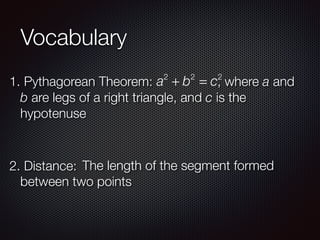
1. Pythagorean Theorem:
2. Distance:
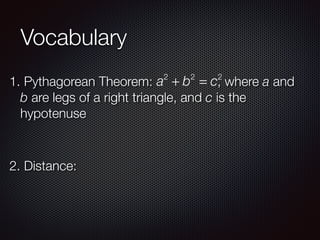
Vocabulary
1. Pythagorean Theorem: a2
+ b2
= c2
, where a and
b are legs of a right triangle, and c is the
hypotenuse
2. Distance:
Vocabulary
1. Pythagorean Theorem: a2
+ b2
= c2
, where a and
b are legs of a right triangle, and c is the
hypotenuse
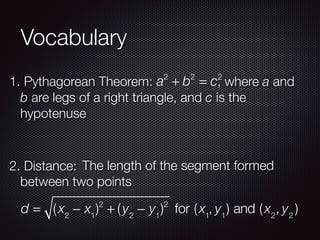
2. Distance: The length of the segment formed
between two points
Vocabulary
1. Pythagorean Theorem: a2
+ b2
= c2
, where a and
b are legs of a right triangle, and c is the
hypotenuse
2. Distance: The length of the segment formed
between two points
d = (x2
− x1
)2
+ (y2
− y1
)2
for (x1
, y1
) and (x2
, y2
)
Vocabulary
3. Midpoint:
4. Segment Bisector:
Vocabulary
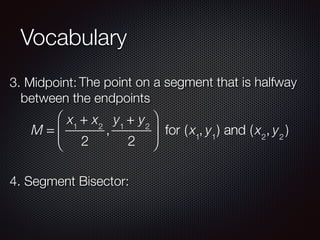
3. Midpoint: The point on a segment that is halfway
between the endpoints
4. Segment Bisector:
Vocabulary
3. Midpoint: The point on a segment that is halfway
between the endpoints
M =
x1
+ x2
2
,
y1
+ y2
2
⎛
⎝
⎜
⎞
⎠
⎟ for (x1
, y1
) and (x2
, y2
)
4. Segment Bisector:
Vocabulary
3. Midpoint: The point on a segment that is halfway
between the endpoints
M =
x1
+ x2
2
,
y1
+ y2
2
⎛
⎝
⎜
⎞
⎠
⎟ for (x1
, y1
) and (x2
, y2
)
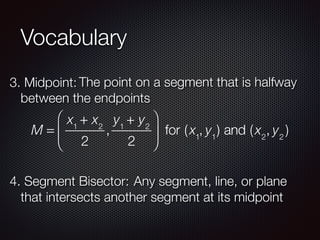
4. Segment Bisector: Any segment, line, or plane
that intersects another segment at its midpoint
Example 1
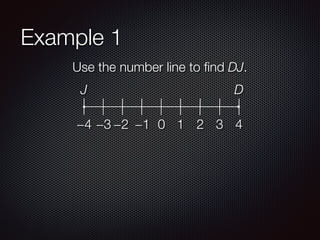
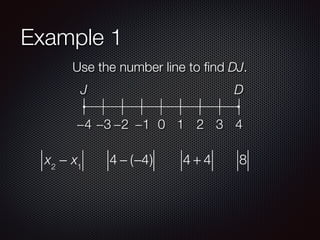
Use the number line to find DJ.
−4 −3 −2 −1 0 1 2 3 4
J D
Example 1
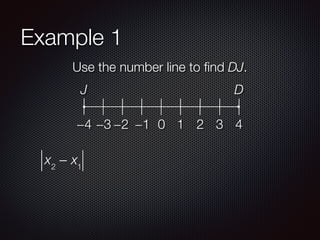
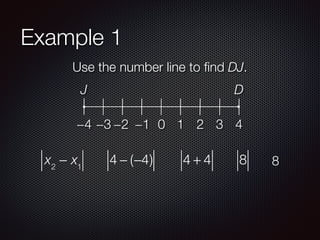
Use the number line to find DJ.
−4 −3 −2 −1 0 1 2 3 4
J D
x2
− x1
Example 1
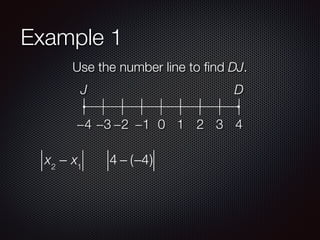
Use the number line to find DJ.
−4 −3 −2 −1 0 1 2 3 4
J D
x2
− x1
4 − (−4)
Example 1
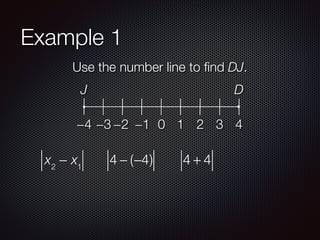
Use the number line to find DJ.
−4 −3 −2 −1 0 1 2 3 4
J D
x2
− x1
4 − (−4) 4 + 4
Example 1
Use the number line to find DJ.
−4 −3 −2 −1 0 1 2 3 4
J D
x2
− x1
4 − (−4) 4 + 4 8
Example 1
Use the number line to find DJ.
−4 −3 −2 −1 0 1 2 3 4
J D
x2
− x1
4 − (−4) 4 + 4 8 8
Example 1
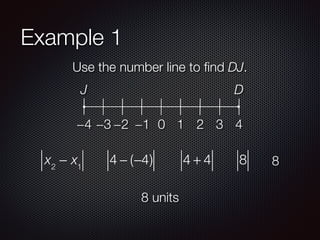
Use the number line to find DJ.
−4 −3 −2 −1 0 1 2 3 4
J D
x2
− x1
4 − (−4) 4 + 4 8 8
8 units
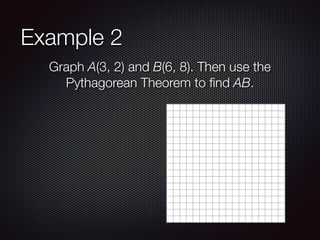
Example 2
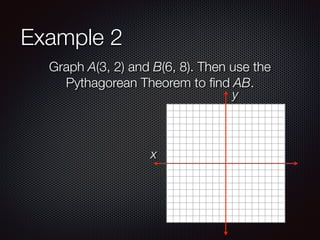
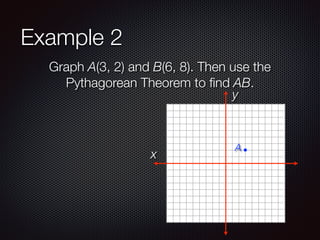
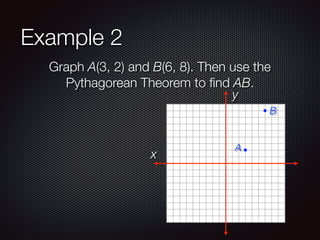
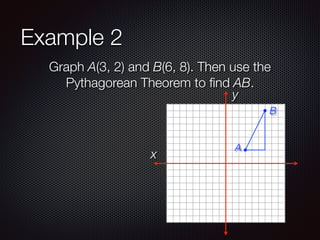
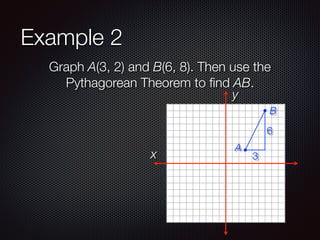
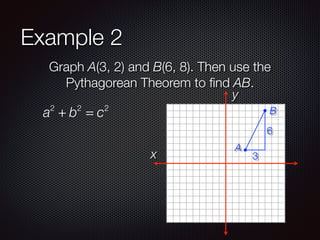
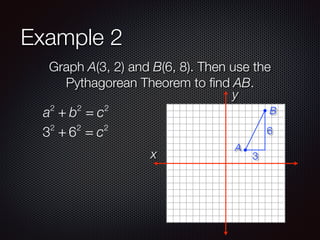
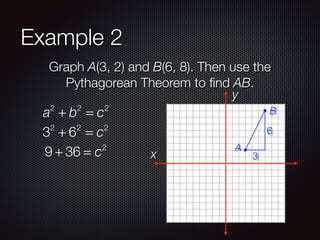
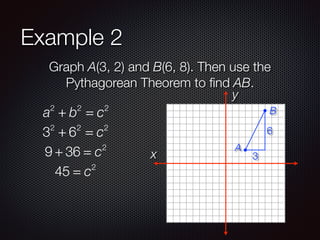
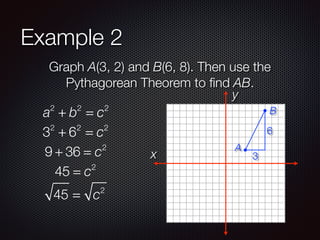
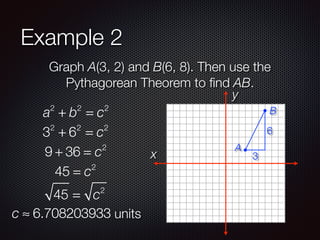
Graph A(3, 2) and B(6, 8). Then use the
Pythagorean Theorem to find AB.
Example 2
Graph A(3, 2) and B(6, 8). Then use the
Pythagorean Theorem to find AB.
x
y
Example 2
Graph A(3, 2) and B(6, 8). Then use the
Pythagorean Theorem to find AB.
x
y
A
Example 2
Graph A(3, 2) and B(6, 8). Then use the
Pythagorean Theorem to find AB.
x
y
A
B
Example 2
Graph A(3, 2) and B(6, 8). Then use the
Pythagorean Theorem to find AB.
x
y
A
B
Example 2
Graph A(3, 2) and B(6, 8). Then use the
Pythagorean Theorem to find AB.
x
y
A
B
3
6
Example 2
Graph A(3, 2) and B(6, 8). Then use the
Pythagorean Theorem to find AB.
x
y
A
B
3
6
a2
+ b2
= c2
Example 2
Graph A(3, 2) and B(6, 8). Then use the
Pythagorean Theorem to find AB.
x
y
A
B
3
6
a2
+ b2
= c2
32
+ 62
= c2
Example 2
Graph A(3, 2) and B(6, 8). Then use the
Pythagorean Theorem to find AB.
x
y
A
B
3
6
a2
+ b2
= c2
32
+ 62
= c2
9 + 36 = c2
Example 2
Graph A(3, 2) and B(6, 8). Then use the
Pythagorean Theorem to find AB.
x
y
A
B
3
6
a2
+ b2
= c2
32
+ 62
= c2
9 + 36 = c2
45 = c2
Example 2
Graph A(3, 2) and B(6, 8). Then use the
Pythagorean Theorem to find AB.
x
y
A
B
3
6
a2
+ b2
= c2
32
+ 62
= c2
9 + 36 = c2
45 = c2
45 = c2
Example 2
Graph A(3, 2) and B(6, 8). Then use the
Pythagorean Theorem to find AB.
x
y
A
B
3
6
a2
+ b2
= c2
32
+ 62
= c2
9 + 36 = c2
45 = c2
45 = c2
c ≈ 6.708203933 units
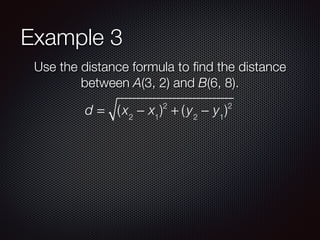
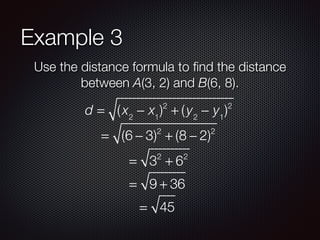
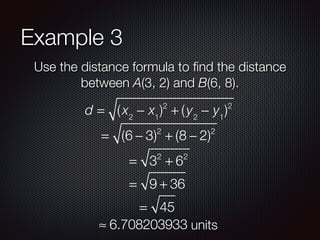
Example 3
Use the distance formula to find the distance
between A(3, 2) and B(6, 8).
Example 3
Use the distance formula to find the distance
between A(3, 2) and B(6, 8).
d = (x2
− x1
)2
+ (y2
− y1
)2
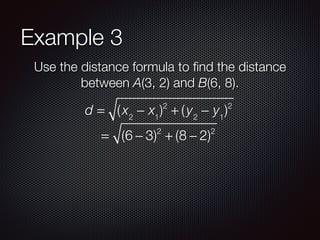
Example 3
Use the distance formula to find the distance
between A(3, 2) and B(6, 8).
d = (x2
− x1
)2
+ (y2
− y1
)2
= (6 − 3)2
+ (8 − 2)2
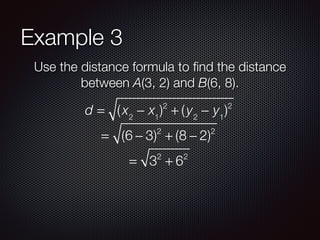
Example 3
Use the distance formula to find the distance
between A(3, 2) and B(6, 8).
d = (x2
− x1
)2
+ (y2
− y1
)2
= (6 − 3)2
+ (8 − 2)2
= 32
+ 62
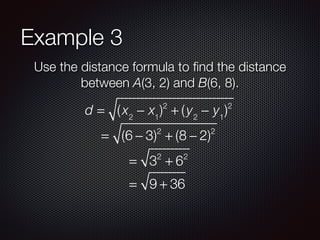
Example 3
Use the distance formula to find the distance
between A(3, 2) and B(6, 8).
d = (x2
− x1
)2
+ (y2
− y1
)2
= (6 − 3)2
+ (8 − 2)2
= 32
+ 62
= 9 + 36
Example 3
Use the distance formula to find the distance
between A(3, 2) and B(6, 8).
d = (x2
− x1
)2
+ (y2
− y1
)2
= (6 − 3)2
+ (8 − 2)2
= 32
+ 62
= 9 + 36
= 45
Example 3
Use the distance formula to find the distance
between A(3, 2) and B(6, 8).
d = (x2
− x1
)2
+ (y2
− y1
)2
= (6 − 3)2
+ (8 − 2)2
= 32
+ 62
= 9 + 36
= 45
≈ 6.708203933 units
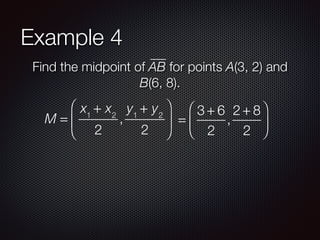
Example 4
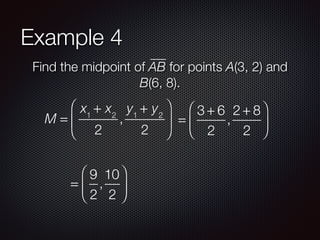
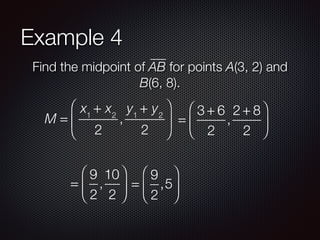
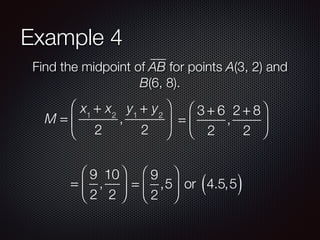
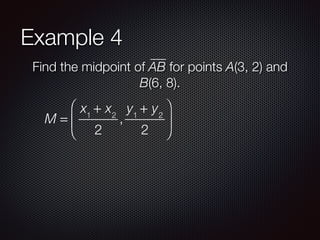
Find the midpoint of AB for points A(3, 2) and
B(6, 8).
Example 4
Find the midpoint of AB for points A(3, 2) and
B(6, 8).
M =
x1
+ x2
2
,
y1
+ y2
2
⎛
⎝
⎜
⎞
⎠
⎟
Example 4
Find the midpoint of AB for points A(3, 2) and
B(6, 8).
M =
x1
+ x2
2
,
y1
+ y2
2
⎛
⎝
⎜
⎞
⎠
⎟ =
3 + 6
2
,
2 + 8
2
⎛
⎝
⎜
⎞
⎠
⎟
Example 4
Find the midpoint of AB for points A(3, 2) and
B(6, 8).
M =
x1
+ x2
2
,
y1
+ y2
2
⎛
⎝
⎜
⎞
⎠
⎟ =
3 + 6
2
,
2 + 8
2
⎛
⎝
⎜
⎞
⎠
⎟
=
9
2
,
10
2
⎛
⎝
⎜
⎞
⎠
⎟
Example 4
Find the midpoint of AB for points A(3, 2) and
B(6, 8).
M =
x1
+ x2
2
,
y1
+ y2
2
⎛
⎝
⎜
⎞
⎠
⎟ =
3 + 6
2
,
2 + 8
2
⎛
⎝
⎜
⎞
⎠
⎟
=
9
2
,
10
2
⎛
⎝
⎜
⎞
⎠
⎟ =
9
2
,5
⎛
⎝
⎜
⎞
⎠
⎟
Example 4
Find the midpoint of AB for points A(3, 2) and
B(6, 8).
M =
x1
+ x2
2
,
y1
+ y2
2
⎛
⎝
⎜
⎞
⎠
⎟ =
3 + 6
2
,
2 + 8
2
⎛
⎝
⎜
⎞
⎠
⎟
=
9
2
,
10
2
⎛
⎝
⎜
⎞
⎠
⎟ =
9
2
,5
⎛
⎝
⎜
⎞
⎠
⎟ or 4.5,5( )
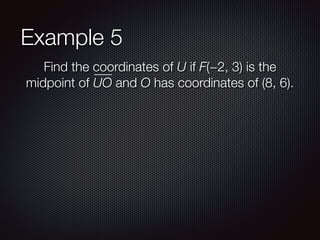
Example 5
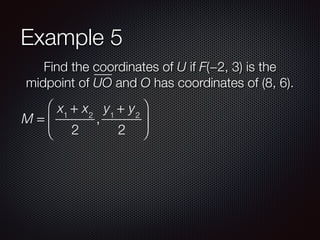
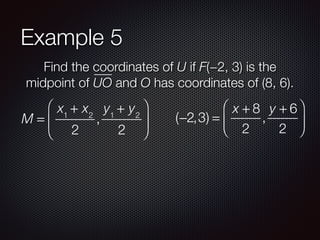
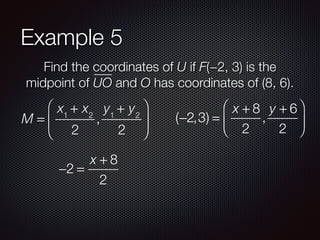
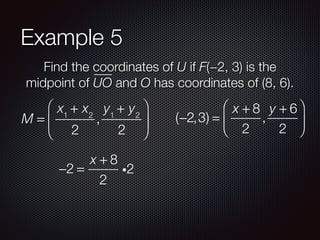
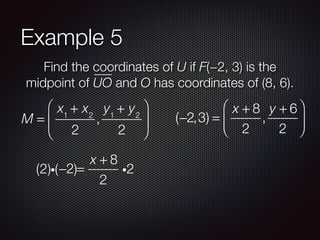
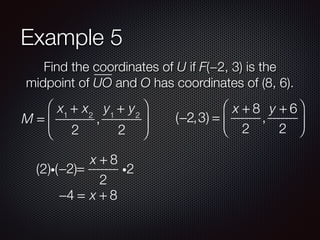
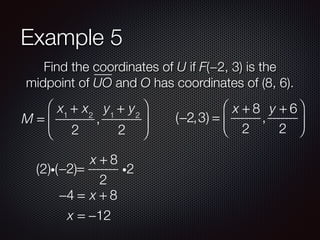
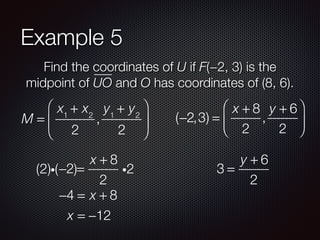
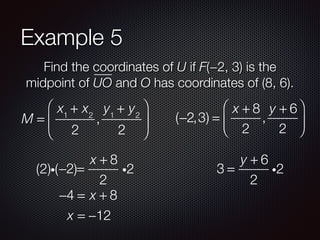
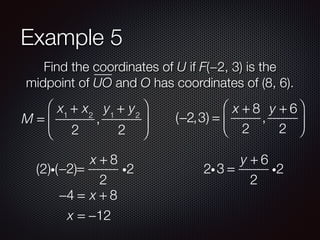
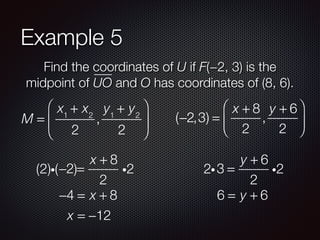
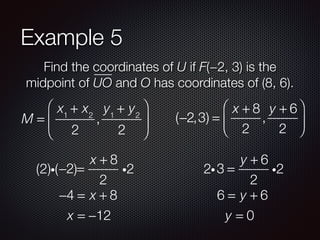
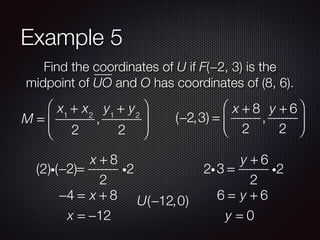
Find the coordinates of U if F(−2, 3) is the
midpoint of UO and O has coordinates of (8, 6).
Example 5
Find the coordinates of U if F(−2, 3) is the
midpoint of UO and O has coordinates of (8, 6).
M =
x1
+ x2
2
,
y1
+ y2
2
⎛
⎝
⎜
⎞
⎠
⎟
Example 5
Find the coordinates of U if F(−2, 3) is the
midpoint of UO and O has coordinates of (8, 6).
M =
x1
+ x2
2
,
y1
+ y2
2
⎛
⎝
⎜
⎞
⎠
⎟ (−2,3) =
x + 8
2
,
y + 6
2
⎛
⎝
⎜
⎞
⎠
⎟
Example 5
Find the coordinates of U if F(−2, 3) is the
midpoint of UO and O has coordinates of (8, 6).
M =
x1
+ x2
2
,
y1
+ y2
2
⎛
⎝
⎜
⎞
⎠
⎟ (−2,3) =
x + 8
2
,
y + 6
2
⎛
⎝
⎜
⎞
⎠
⎟
−2 =
x + 8
2
Example 5
Find the coordinates of U if F(−2, 3) is the
midpoint of UO and O has coordinates of (8, 6).
M =
x1
+ x2
2
,
y1
+ y2
2
⎛
⎝
⎜
⎞
⎠
⎟ (−2,3) =
x + 8
2
,
y + 6
2
⎛
⎝
⎜
⎞
⎠
⎟
−2 =
x + 8
2
i2
Example 5
Find the coordinates of U if F(−2, 3) is the
midpoint of UO and O has coordinates of (8, 6).
M =
x1
+ x2
2
,
y1
+ y2
2
⎛
⎝
⎜
⎞
⎠
⎟ (−2,3) =
x + 8
2
,
y + 6
2
⎛
⎝
⎜
⎞
⎠
⎟
−2 =
x + 8
2
i2(2)i( )
Example 5
Find the coordinates of U if F(−2, 3) is the
midpoint of UO and O has coordinates of (8, 6).
M =
x1
+ x2
2
,
y1
+ y2
2
⎛
⎝
⎜
⎞
⎠
⎟ (−2,3) =
x + 8
2
,
y + 6
2
⎛
⎝
⎜
⎞
⎠
⎟
−2 =
x + 8
2
i2(2)i( )
−4 = x + 8
Example 5
Find the coordinates of U if F(−2, 3) is the
midpoint of UO and O has coordinates of (8, 6).
M =
x1
+ x2
2
,
y1
+ y2
2
⎛
⎝
⎜
⎞
⎠
⎟ (−2,3) =
x + 8
2
,
y + 6
2
⎛
⎝
⎜
⎞
⎠
⎟
−2 =
x + 8
2
i2(2)i( )
−4 = x + 8
x = −12
Example 5
Find the coordinates of U if F(−2, 3) is the
midpoint of UO and O has coordinates of (8, 6).
M =
x1
+ x2
2
,
y1
+ y2
2
⎛
⎝
⎜
⎞
⎠
⎟ (−2,3) =
x + 8
2
,
y + 6
2
⎛
⎝
⎜
⎞
⎠
⎟
−2 =
x + 8
2
i2(2)i( )
−4 = x + 8
x = −12
3 =
y + 6
2
Example 5
Find the coordinates of U if F(−2, 3) is the
midpoint of UO and O has coordinates of (8, 6).
M =
x1
+ x2
2
,
y1
+ y2
2
⎛
⎝
⎜
⎞
⎠
⎟ (−2,3) =
x + 8
2
,
y + 6
2
⎛
⎝
⎜
⎞
⎠
⎟
−2 =
x + 8
2
i2(2)i( )
−4 = x + 8
x = −12
3 =
y + 6
2
i2
Example 5
Find the coordinates of U if F(−2, 3) is the
midpoint of UO and O has coordinates of (8, 6).
M =
x1
+ x2
2
,
y1
+ y2
2
⎛
⎝
⎜
⎞
⎠
⎟ (−2,3) =
x + 8
2
,
y + 6
2
⎛
⎝
⎜
⎞
⎠
⎟
−2 =
x + 8
2
i2(2)i( )
−4 = x + 8
x = −12
3 =
y + 6
2
i22i
Example 5
Find the coordinates of U if F(−2, 3) is the
midpoint of UO and O has coordinates of (8, 6).
M =
x1
+ x2
2
,
y1
+ y2
2
⎛
⎝
⎜
⎞
⎠
⎟ (−2,3) =
x + 8
2
,
y + 6
2
⎛
⎝
⎜
⎞
⎠
⎟
−2 =
x + 8
2
i2(2)i( )
−4 = x + 8
x = −12
3 =
y + 6
2
i22i
6 = y + 6
Example 5
Find the coordinates of U if F(−2, 3) is the
midpoint of UO and O has coordinates of (8, 6).
M =
x1
+ x2
2
,
y1
+ y2
2
⎛
⎝
⎜
⎞
⎠
⎟ (−2,3) =
x + 8
2
,
y + 6
2
⎛
⎝
⎜
⎞
⎠
⎟
−2 =
x + 8
2
i2(2)i( )
−4 = x + 8
x = −12
3 =
y + 6
2
i22i
6 = y + 6
y = 0
Example 5
Find the coordinates of U if F(−2, 3) is the
midpoint of UO and O has coordinates of (8, 6).
M =
x1
+ x2
2
,
y1
+ y2
2
⎛
⎝
⎜
⎞
⎠
⎟ (−2,3) =
x + 8
2
,
y + 6
2
⎛
⎝
⎜
⎞
⎠
⎟
−2 =
x + 8
2
i2(2)i( )
−4 = x + 8
x = −12
3 =
y + 6
2
i22i
6 = y + 6
y = 0
U(−12,0)
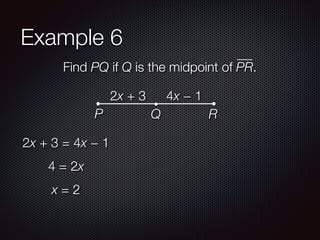
Example 6
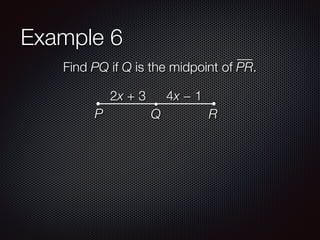
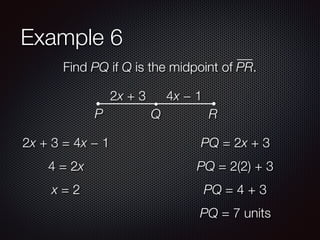
Find PQ if Q is the midpoint of PR.
2x + 3 4x − 1
P Q R
Example 6
Find PQ if Q is the midpoint of PR.
2x + 3 4x − 1
P Q R
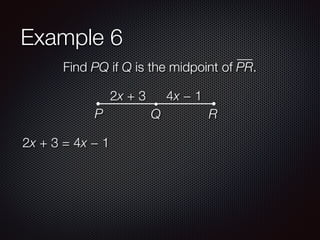
2x + 3 = 4x − 1
Example 6
Find PQ if Q is the midpoint of PR.
2x + 3 4x − 1
P Q R
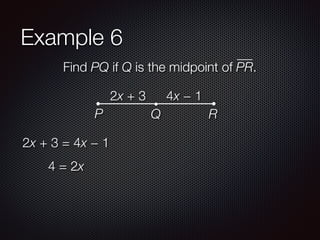
2x + 3 = 4x − 1
4 = 2x
Example 6
Find PQ if Q is the midpoint of PR.
2x + 3 4x − 1
P Q R
2x + 3 = 4x − 1
4 = 2x
x = 2
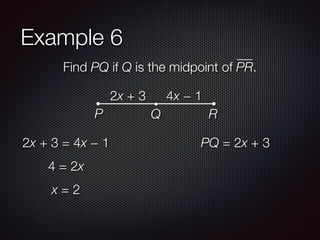
Example 6
Find PQ if Q is the midpoint of PR.
2x + 3 4x − 1
P Q R
2x + 3 = 4x − 1
4 = 2x
x = 2
PQ = 2x + 3
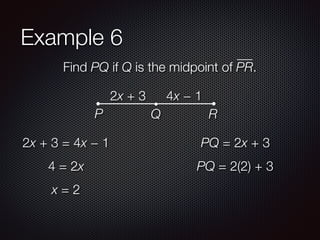
Example 6
Find PQ if Q is the midpoint of PR.
2x + 3 4x − 1
P Q R
2x + 3 = 4x − 1
4 = 2x
x = 2
PQ = 2x + 3
PQ = 2(2) + 3
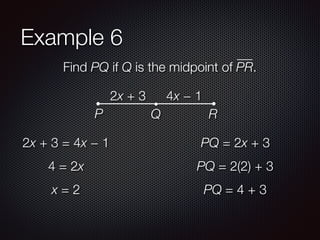
Example 6
Find PQ if Q is the midpoint of PR.
2x + 3 4x − 1
P Q R
2x + 3 = 4x − 1
4 = 2x
x = 2
PQ = 2x + 3
PQ = 2(2) + 3
PQ = 4 + 3
Example 6
Find PQ if Q is the midpoint of PR.
2x + 3 4x − 1
P Q R
2x + 3 = 4x − 1
4 = 2x
x = 2
PQ = 2x + 3
PQ = 2(2) + 3
PQ = 4 + 3
PQ = 7 units
Problem Set
Problem Set
p. 30 #1-11, 19-31, 47, 49, 53 (odds only)
“Learn from yesterday, live for today, hope for
tomorrow. The important thing is not to stop
questioning.” - Albert Einstein

Geometry Section 1-3 1112

  • 1.
  • 2.
    Essential Questions How doyou find the distance between two points? How do you find the midpoint of a segment?
  • 3.
  • 4.
    Vocabulary 1. Pythagorean Theorem:a2 + b2 = c2 , where a and b are legs of a right triangle, and c is the hypotenuse 2. Distance:
  • 5.
    Vocabulary 1. Pythagorean Theorem:a2 + b2 = c2 , where a and b are legs of a right triangle, and c is the hypotenuse 2. Distance: The length of the segment formed between two points
  • 6.
    Vocabulary 1. Pythagorean Theorem:a2 + b2 = c2 , where a and b are legs of a right triangle, and c is the hypotenuse 2. Distance: The length of the segment formed between two points d = (x2 − x1 )2 + (y2 − y1 )2 for (x1 , y1 ) and (x2 , y2 )
  • 7.
  • 8.
    Vocabulary 3. Midpoint: Thepoint on a segment that is halfway between the endpoints 4. Segment Bisector:
  • 9.
    Vocabulary 3. Midpoint: Thepoint on a segment that is halfway between the endpoints M = x1 + x2 2 , y1 + y2 2 ⎛ ⎝ ⎜ ⎞ ⎠ ⎟ for (x1 , y1 ) and (x2 , y2 ) 4. Segment Bisector:
  • 10.
    Vocabulary 3. Midpoint: Thepoint on a segment that is halfway between the endpoints M = x1 + x2 2 , y1 + y2 2 ⎛ ⎝ ⎜ ⎞ ⎠ ⎟ for (x1 , y1 ) and (x2 , y2 ) 4. Segment Bisector: Any segment, line, or plane that intersects another segment at its midpoint
  • 11.
    Example 1 Use thenumber line to find DJ. −4 −3 −2 −1 0 1 2 3 4 J D
  • 12.
    Example 1 Use thenumber line to find DJ. −4 −3 −2 −1 0 1 2 3 4 J D x2 − x1
  • 13.
    Example 1 Use thenumber line to find DJ. −4 −3 −2 −1 0 1 2 3 4 J D x2 − x1 4 − (−4)
  • 14.
    Example 1 Use thenumber line to find DJ. −4 −3 −2 −1 0 1 2 3 4 J D x2 − x1 4 − (−4) 4 + 4
  • 15.
    Example 1 Use thenumber line to find DJ. −4 −3 −2 −1 0 1 2 3 4 J D x2 − x1 4 − (−4) 4 + 4 8
  • 16.
    Example 1 Use thenumber line to find DJ. −4 −3 −2 −1 0 1 2 3 4 J D x2 − x1 4 − (−4) 4 + 4 8 8
  • 17.
    Example 1 Use thenumber line to find DJ. −4 −3 −2 −1 0 1 2 3 4 J D x2 − x1 4 − (−4) 4 + 4 8 8 8 units
  • 18.
    Example 2 Graph A(3,2) and B(6, 8). Then use the Pythagorean Theorem to find AB.
  • 19.
    Example 2 Graph A(3,2) and B(6, 8). Then use the Pythagorean Theorem to find AB. x y
  • 20.
    Example 2 Graph A(3,2) and B(6, 8). Then use the Pythagorean Theorem to find AB. x y A
  • 21.
    Example 2 Graph A(3,2) and B(6, 8). Then use the Pythagorean Theorem to find AB. x y A B
  • 22.
    Example 2 Graph A(3,2) and B(6, 8). Then use the Pythagorean Theorem to find AB. x y A B
  • 23.
    Example 2 Graph A(3,2) and B(6, 8). Then use the Pythagorean Theorem to find AB. x y A B 3 6
  • 24.
    Example 2 Graph A(3,2) and B(6, 8). Then use the Pythagorean Theorem to find AB. x y A B 3 6 a2 + b2 = c2
  • 25.
    Example 2 Graph A(3,2) and B(6, 8). Then use the Pythagorean Theorem to find AB. x y A B 3 6 a2 + b2 = c2 32 + 62 = c2
  • 26.
    Example 2 Graph A(3,2) and B(6, 8). Then use the Pythagorean Theorem to find AB. x y A B 3 6 a2 + b2 = c2 32 + 62 = c2 9 + 36 = c2
  • 27.
    Example 2 Graph A(3,2) and B(6, 8). Then use the Pythagorean Theorem to find AB. x y A B 3 6 a2 + b2 = c2 32 + 62 = c2 9 + 36 = c2 45 = c2
  • 28.
    Example 2 Graph A(3,2) and B(6, 8). Then use the Pythagorean Theorem to find AB. x y A B 3 6 a2 + b2 = c2 32 + 62 = c2 9 + 36 = c2 45 = c2 45 = c2
  • 29.
    Example 2 Graph A(3,2) and B(6, 8). Then use the Pythagorean Theorem to find AB. x y A B 3 6 a2 + b2 = c2 32 + 62 = c2 9 + 36 = c2 45 = c2 45 = c2 c ≈ 6.708203933 units
  • 30.
    Example 3 Use thedistance formula to find the distance between A(3, 2) and B(6, 8).
  • 31.
    Example 3 Use thedistance formula to find the distance between A(3, 2) and B(6, 8). d = (x2 − x1 )2 + (y2 − y1 )2
  • 32.
    Example 3 Use thedistance formula to find the distance between A(3, 2) and B(6, 8). d = (x2 − x1 )2 + (y2 − y1 )2 = (6 − 3)2 + (8 − 2)2
  • 33.
    Example 3 Use thedistance formula to find the distance between A(3, 2) and B(6, 8). d = (x2 − x1 )2 + (y2 − y1 )2 = (6 − 3)2 + (8 − 2)2 = 32 + 62
  • 34.
    Example 3 Use thedistance formula to find the distance between A(3, 2) and B(6, 8). d = (x2 − x1 )2 + (y2 − y1 )2 = (6 − 3)2 + (8 − 2)2 = 32 + 62 = 9 + 36
  • 35.
    Example 3 Use thedistance formula to find the distance between A(3, 2) and B(6, 8). d = (x2 − x1 )2 + (y2 − y1 )2 = (6 − 3)2 + (8 − 2)2 = 32 + 62 = 9 + 36 = 45
  • 36.
    Example 3 Use thedistance formula to find the distance between A(3, 2) and B(6, 8). d = (x2 − x1 )2 + (y2 − y1 )2 = (6 − 3)2 + (8 − 2)2 = 32 + 62 = 9 + 36 = 45 ≈ 6.708203933 units
  • 37.
    Example 4 Find themidpoint of AB for points A(3, 2) and B(6, 8).
  • 38.
    Example 4 Find themidpoint of AB for points A(3, 2) and B(6, 8). M = x1 + x2 2 , y1 + y2 2 ⎛ ⎝ ⎜ ⎞ ⎠ ⎟
  • 39.
    Example 4 Find themidpoint of AB for points A(3, 2) and B(6, 8). M = x1 + x2 2 , y1 + y2 2 ⎛ ⎝ ⎜ ⎞ ⎠ ⎟ = 3 + 6 2 , 2 + 8 2 ⎛ ⎝ ⎜ ⎞ ⎠ ⎟
  • 40.
    Example 4 Find themidpoint of AB for points A(3, 2) and B(6, 8). M = x1 + x2 2 , y1 + y2 2 ⎛ ⎝ ⎜ ⎞ ⎠ ⎟ = 3 + 6 2 , 2 + 8 2 ⎛ ⎝ ⎜ ⎞ ⎠ ⎟ = 9 2 , 10 2 ⎛ ⎝ ⎜ ⎞ ⎠ ⎟
  • 41.
    Example 4 Find themidpoint of AB for points A(3, 2) and B(6, 8). M = x1 + x2 2 , y1 + y2 2 ⎛ ⎝ ⎜ ⎞ ⎠ ⎟ = 3 + 6 2 , 2 + 8 2 ⎛ ⎝ ⎜ ⎞ ⎠ ⎟ = 9 2 , 10 2 ⎛ ⎝ ⎜ ⎞ ⎠ ⎟ = 9 2 ,5 ⎛ ⎝ ⎜ ⎞ ⎠ ⎟
  • 42.
    Example 4 Find themidpoint of AB for points A(3, 2) and B(6, 8). M = x1 + x2 2 , y1 + y2 2 ⎛ ⎝ ⎜ ⎞ ⎠ ⎟ = 3 + 6 2 , 2 + 8 2 ⎛ ⎝ ⎜ ⎞ ⎠ ⎟ = 9 2 , 10 2 ⎛ ⎝ ⎜ ⎞ ⎠ ⎟ = 9 2 ,5 ⎛ ⎝ ⎜ ⎞ ⎠ ⎟ or 4.5,5( )
  • 43.
    Example 5 Find thecoordinates of U if F(−2, 3) is the midpoint of UO and O has coordinates of (8, 6).
  • 44.
    Example 5 Find thecoordinates of U if F(−2, 3) is the midpoint of UO and O has coordinates of (8, 6). M = x1 + x2 2 , y1 + y2 2 ⎛ ⎝ ⎜ ⎞ ⎠ ⎟
  • 45.
    Example 5 Find thecoordinates of U if F(−2, 3) is the midpoint of UO and O has coordinates of (8, 6). M = x1 + x2 2 , y1 + y2 2 ⎛ ⎝ ⎜ ⎞ ⎠ ⎟ (−2,3) = x + 8 2 , y + 6 2 ⎛ ⎝ ⎜ ⎞ ⎠ ⎟
  • 46.
    Example 5 Find thecoordinates of U if F(−2, 3) is the midpoint of UO and O has coordinates of (8, 6). M = x1 + x2 2 , y1 + y2 2 ⎛ ⎝ ⎜ ⎞ ⎠ ⎟ (−2,3) = x + 8 2 , y + 6 2 ⎛ ⎝ ⎜ ⎞ ⎠ ⎟ −2 = x + 8 2
  • 47.
    Example 5 Find thecoordinates of U if F(−2, 3) is the midpoint of UO and O has coordinates of (8, 6). M = x1 + x2 2 , y1 + y2 2 ⎛ ⎝ ⎜ ⎞ ⎠ ⎟ (−2,3) = x + 8 2 , y + 6 2 ⎛ ⎝ ⎜ ⎞ ⎠ ⎟ −2 = x + 8 2 i2
  • 48.
    Example 5 Find thecoordinates of U if F(−2, 3) is the midpoint of UO and O has coordinates of (8, 6). M = x1 + x2 2 , y1 + y2 2 ⎛ ⎝ ⎜ ⎞ ⎠ ⎟ (−2,3) = x + 8 2 , y + 6 2 ⎛ ⎝ ⎜ ⎞ ⎠ ⎟ −2 = x + 8 2 i2(2)i( )
  • 49.
    Example 5 Find thecoordinates of U if F(−2, 3) is the midpoint of UO and O has coordinates of (8, 6). M = x1 + x2 2 , y1 + y2 2 ⎛ ⎝ ⎜ ⎞ ⎠ ⎟ (−2,3) = x + 8 2 , y + 6 2 ⎛ ⎝ ⎜ ⎞ ⎠ ⎟ −2 = x + 8 2 i2(2)i( ) −4 = x + 8
  • 50.
    Example 5 Find thecoordinates of U if F(−2, 3) is the midpoint of UO and O has coordinates of (8, 6). M = x1 + x2 2 , y1 + y2 2 ⎛ ⎝ ⎜ ⎞ ⎠ ⎟ (−2,3) = x + 8 2 , y + 6 2 ⎛ ⎝ ⎜ ⎞ ⎠ ⎟ −2 = x + 8 2 i2(2)i( ) −4 = x + 8 x = −12
  • 51.
    Example 5 Find thecoordinates of U if F(−2, 3) is the midpoint of UO and O has coordinates of (8, 6). M = x1 + x2 2 , y1 + y2 2 ⎛ ⎝ ⎜ ⎞ ⎠ ⎟ (−2,3) = x + 8 2 , y + 6 2 ⎛ ⎝ ⎜ ⎞ ⎠ ⎟ −2 = x + 8 2 i2(2)i( ) −4 = x + 8 x = −12 3 = y + 6 2
  • 52.
    Example 5 Find thecoordinates of U if F(−2, 3) is the midpoint of UO and O has coordinates of (8, 6). M = x1 + x2 2 , y1 + y2 2 ⎛ ⎝ ⎜ ⎞ ⎠ ⎟ (−2,3) = x + 8 2 , y + 6 2 ⎛ ⎝ ⎜ ⎞ ⎠ ⎟ −2 = x + 8 2 i2(2)i( ) −4 = x + 8 x = −12 3 = y + 6 2 i2
  • 53.
    Example 5 Find thecoordinates of U if F(−2, 3) is the midpoint of UO and O has coordinates of (8, 6). M = x1 + x2 2 , y1 + y2 2 ⎛ ⎝ ⎜ ⎞ ⎠ ⎟ (−2,3) = x + 8 2 , y + 6 2 ⎛ ⎝ ⎜ ⎞ ⎠ ⎟ −2 = x + 8 2 i2(2)i( ) −4 = x + 8 x = −12 3 = y + 6 2 i22i
  • 54.
    Example 5 Find thecoordinates of U if F(−2, 3) is the midpoint of UO and O has coordinates of (8, 6). M = x1 + x2 2 , y1 + y2 2 ⎛ ⎝ ⎜ ⎞ ⎠ ⎟ (−2,3) = x + 8 2 , y + 6 2 ⎛ ⎝ ⎜ ⎞ ⎠ ⎟ −2 = x + 8 2 i2(2)i( ) −4 = x + 8 x = −12 3 = y + 6 2 i22i 6 = y + 6
  • 55.
    Example 5 Find thecoordinates of U if F(−2, 3) is the midpoint of UO and O has coordinates of (8, 6). M = x1 + x2 2 , y1 + y2 2 ⎛ ⎝ ⎜ ⎞ ⎠ ⎟ (−2,3) = x + 8 2 , y + 6 2 ⎛ ⎝ ⎜ ⎞ ⎠ ⎟ −2 = x + 8 2 i2(2)i( ) −4 = x + 8 x = −12 3 = y + 6 2 i22i 6 = y + 6 y = 0
  • 56.
    Example 5 Find thecoordinates of U if F(−2, 3) is the midpoint of UO and O has coordinates of (8, 6). M = x1 + x2 2 , y1 + y2 2 ⎛ ⎝ ⎜ ⎞ ⎠ ⎟ (−2,3) = x + 8 2 , y + 6 2 ⎛ ⎝ ⎜ ⎞ ⎠ ⎟ −2 = x + 8 2 i2(2)i( ) −4 = x + 8 x = −12 3 = y + 6 2 i22i 6 = y + 6 y = 0 U(−12,0)
  • 57.
    Example 6 Find PQif Q is the midpoint of PR. 2x + 3 4x − 1 P Q R
  • 58.
    Example 6 Find PQif Q is the midpoint of PR. 2x + 3 4x − 1 P Q R 2x + 3 = 4x − 1
  • 59.
    Example 6 Find PQif Q is the midpoint of PR. 2x + 3 4x − 1 P Q R 2x + 3 = 4x − 1 4 = 2x
  • 60.
    Example 6 Find PQif Q is the midpoint of PR. 2x + 3 4x − 1 P Q R 2x + 3 = 4x − 1 4 = 2x x = 2
  • 61.
    Example 6 Find PQif Q is the midpoint of PR. 2x + 3 4x − 1 P Q R 2x + 3 = 4x − 1 4 = 2x x = 2 PQ = 2x + 3
  • 62.
    Example 6 Find PQif Q is the midpoint of PR. 2x + 3 4x − 1 P Q R 2x + 3 = 4x − 1 4 = 2x x = 2 PQ = 2x + 3 PQ = 2(2) + 3
  • 63.
    Example 6 Find PQif Q is the midpoint of PR. 2x + 3 4x − 1 P Q R 2x + 3 = 4x − 1 4 = 2x x = 2 PQ = 2x + 3 PQ = 2(2) + 3 PQ = 4 + 3
  • 64.
    Example 6 Find PQif Q is the midpoint of PR. 2x + 3 4x − 1 P Q R 2x + 3 = 4x − 1 4 = 2x x = 2 PQ = 2x + 3 PQ = 2(2) + 3 PQ = 4 + 3 PQ = 7 units
  • 65.
  • 66.
    Problem Set p. 30#1-11, 19-31, 47, 49, 53 (odds only) “Learn from yesterday, live for today, hope for tomorrow. The important thing is not to stop questioning.” - Albert Einstein