Section 6-5
Rhombi and Squares
Tuesday, April 29, 14
Essential Questions
• How do you recognize and apply the properties of
rhombi and squares?
• How do you determine whether quadrilaterals are
rectangles, rhombi, or squares?
Tuesday, April 29, 14
Vocabulary
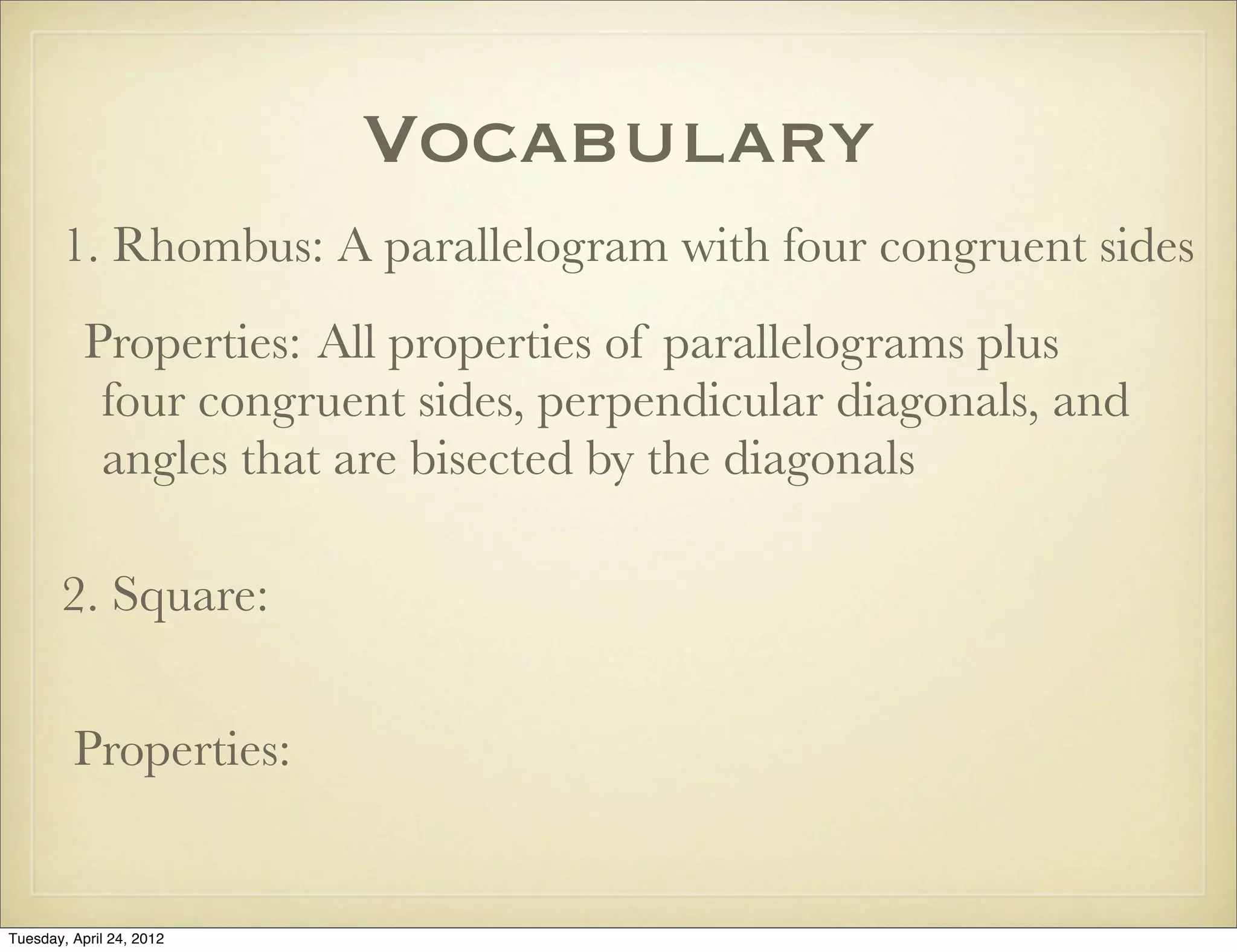
1. Rhombus:
Properties:
2. Square:
Properties:
Tuesday, April 29, 14
Vocabulary
1. Rhombus: A parallelogram with four congruent sides
Properties:
2. Square:
Properties:
Tuesday, April 29, 14
Vocabulary
1. Rhombus: A parallelogram with four congruent sides
Properties: All properties of parallelograms plus
four congruent sides, perpendicular diagonals, and
angles that are bisected by the diagonals
2. Square:
Properties:
Tuesday, April 29, 14
Vocabulary
1. Rhombus: A parallelogram with four congruent sides
Properties: All properties of parallelograms plus
four congruent sides, perpendicular diagonals, and
angles that are bisected by the diagonals
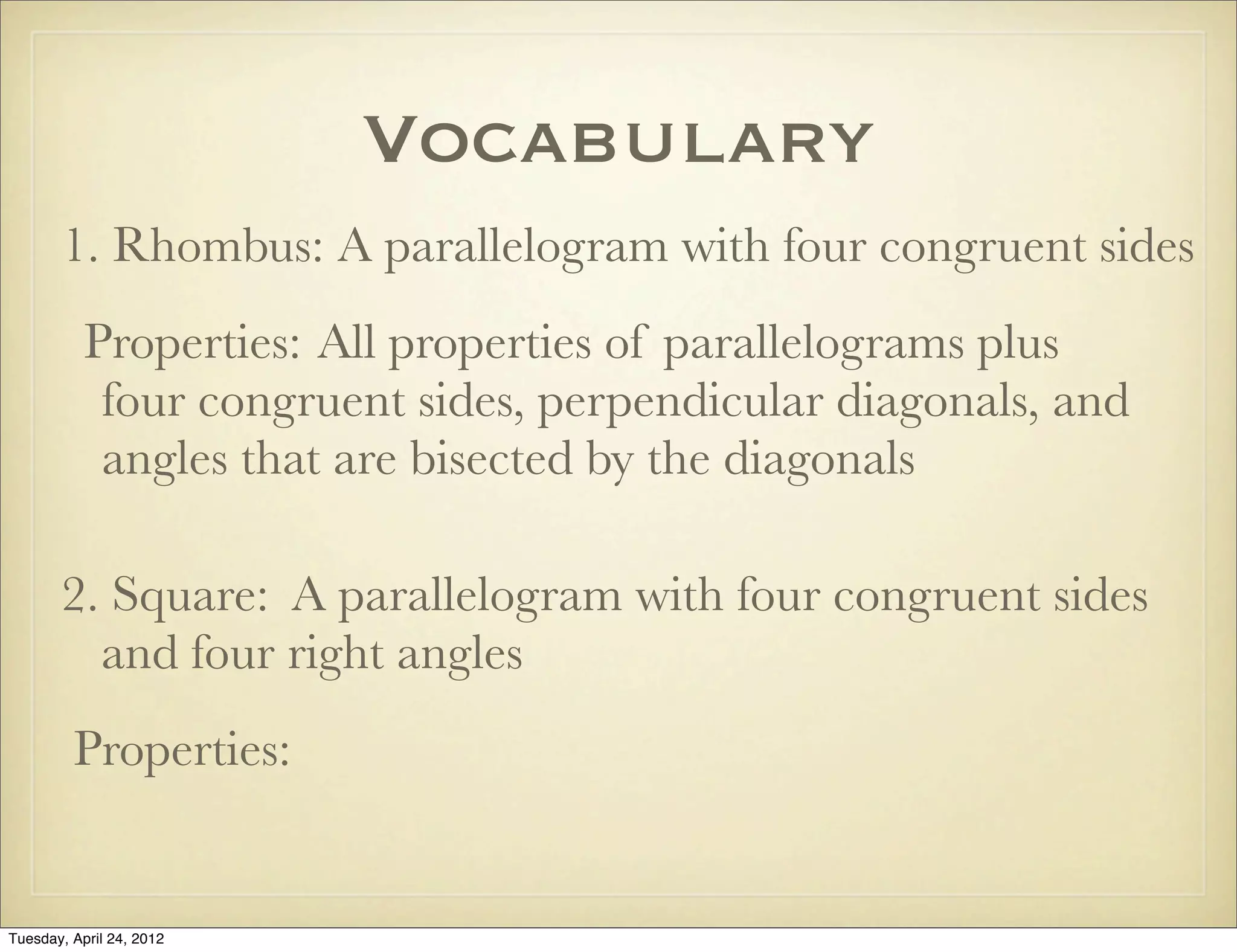
2. Square: A parallelogram with four congruent sides
and four right angles
Properties:
Tuesday, April 29, 14
Vocabulary
1. Rhombus: A parallelogram with four congruent sides
Properties: All properties of parallelograms plus
four congruent sides, perpendicular diagonals, and
angles that are bisected by the diagonals
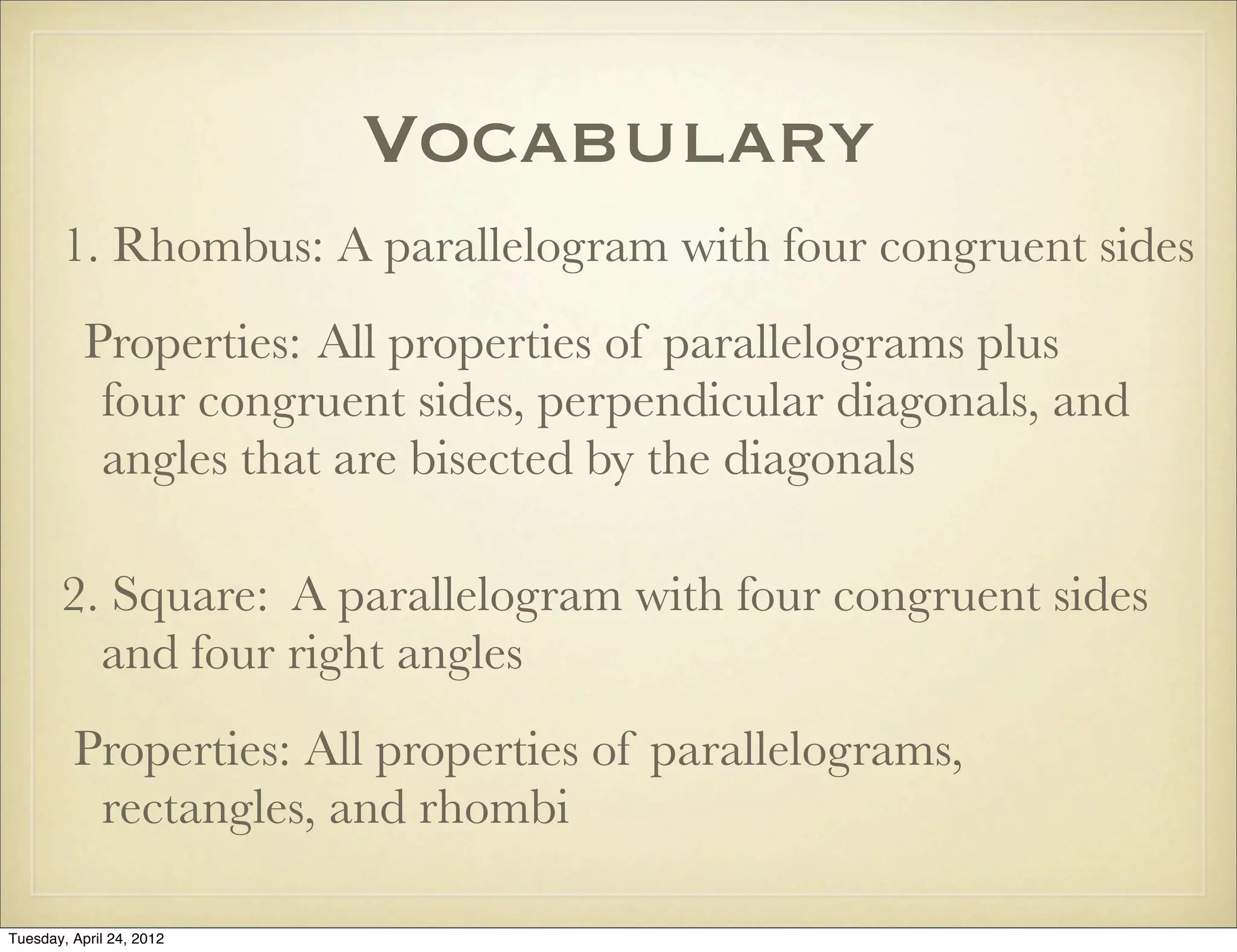
2. Square: A parallelogram with four congruent sides
and four right angles
Properties: All properties of parallelograms,
rectangles, and rhombi
Tuesday, April 29, 14
Theorems
Diagonals of a Rhombus
6.15:
6.16:
Tuesday, April 29, 14
Theorems
Diagonals of a Rhombus
6.15: If a parallelogram is a rhombus, then its
diagonals are perpendicular
6.16:
Tuesday, April 29, 14
Theorems
Diagonals of a Rhombus
6.15: If a parallelogram is a rhombus, then its
diagonals are perpendicular
6.16: If a parallelogram is a rhombus, then each
diagonal bisects a pair of opposite angles
Tuesday, April 29, 14
Theorems
Conditions for Rhombi and Squares
6.17:
6.18:
6.19:
Tuesday, April 29, 14
Theorems
Conditions for Rhombi and Squares
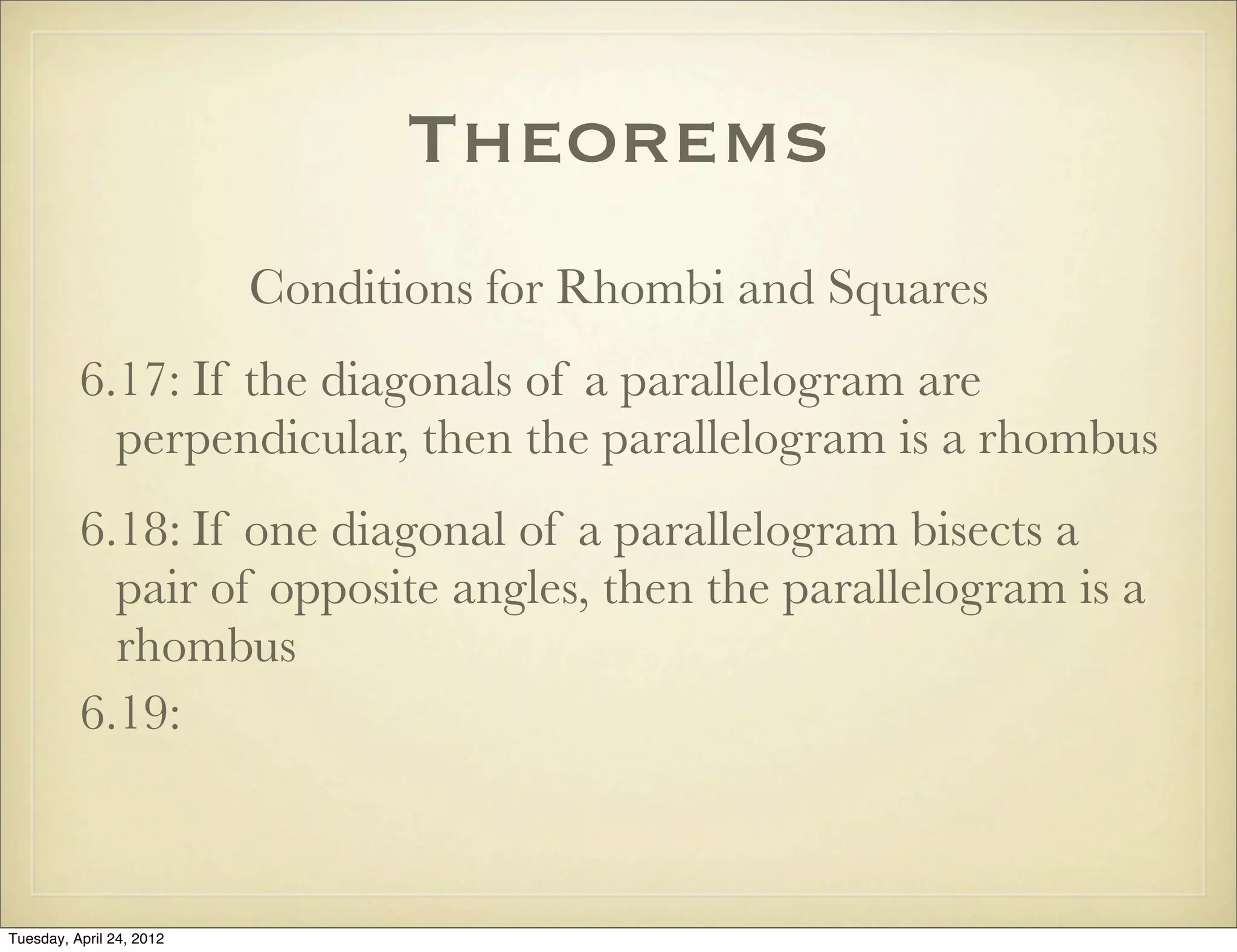
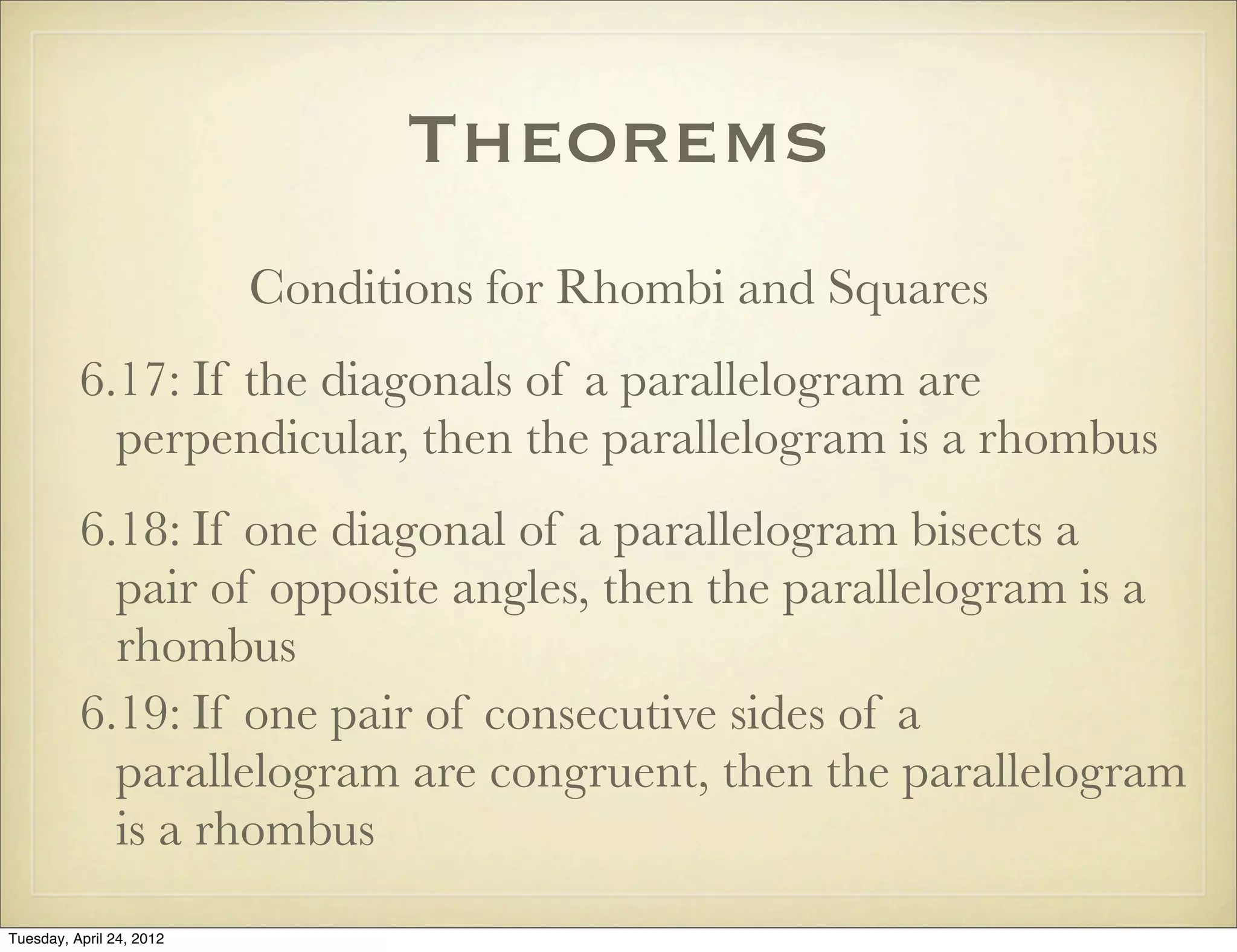
6.17: If the diagonals of a parallelogram are
perpendicular, then the parallelogram is a rhombus
6.18:
6.19:
Tuesday, April 29, 14
Theorems
Conditions for Rhombi and Squares
6.17: If the diagonals of a parallelogram are
perpendicular, then the parallelogram is a rhombus
6.18: If one diagonal of a parallelogram bisects a
pair of opposite angles, then the parallelogram is a
rhombus
6.19:
Tuesday, April 29, 14
Theorems
Conditions for Rhombi and Squares
6.17: If the diagonals of a parallelogram are
perpendicular, then the parallelogram is a rhombus
6.18: If one diagonal of a parallelogram bisects a
pair of opposite angles, then the parallelogram is a
rhombus
6.19: If one pair of consecutive sides of a
parallelogram are congruent, then the parallelogram
is a rhombus
Tuesday, April 29, 14
Theorems
Conditions for Rhombi and Squares
6.20:
Tuesday, April 29, 14
Theorems
Conditions for Rhombi and Squares
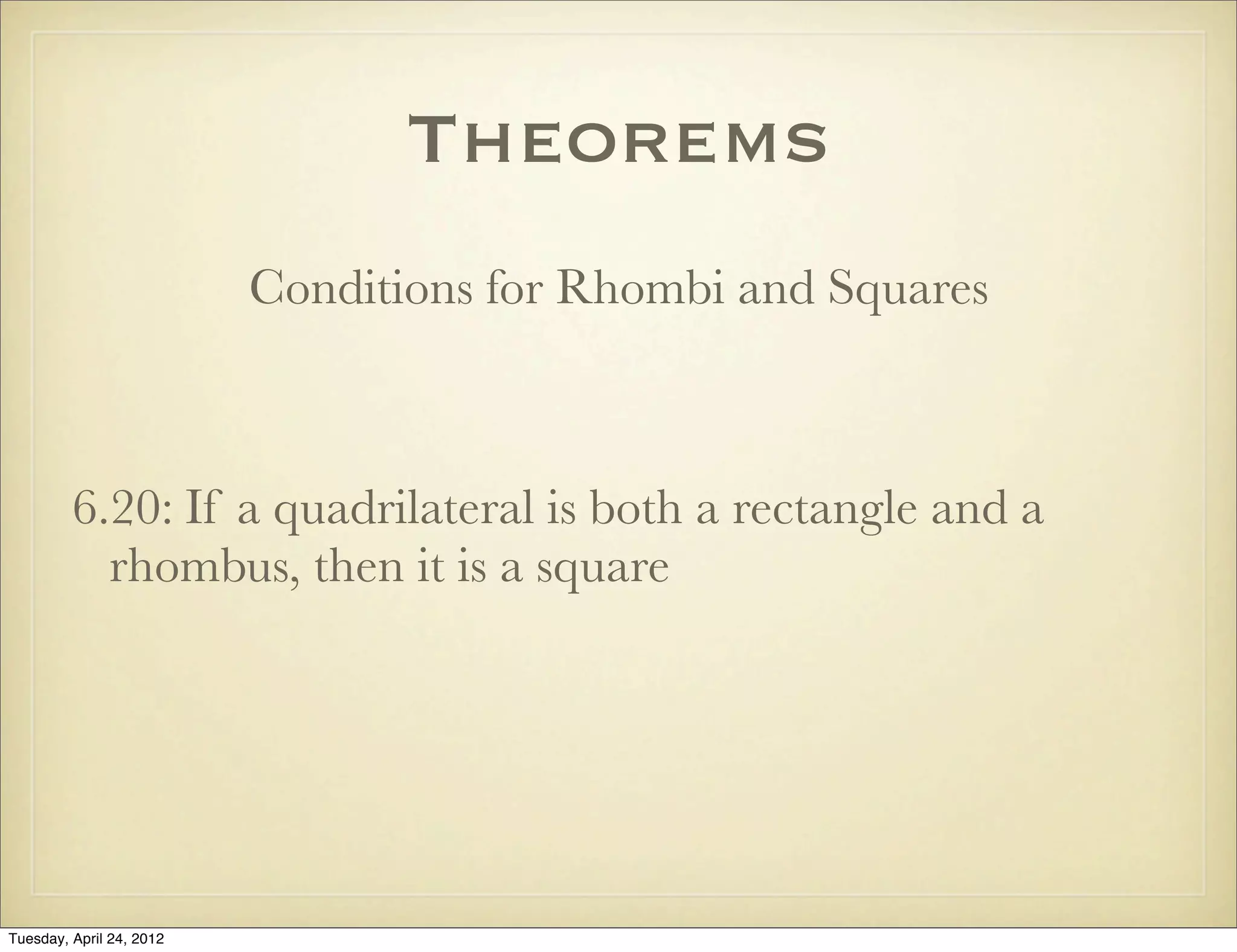
6.20: If a quadrilateral is both a rectangle and a
rhombus, then it is a square
Tuesday, April 29, 14
Example 1
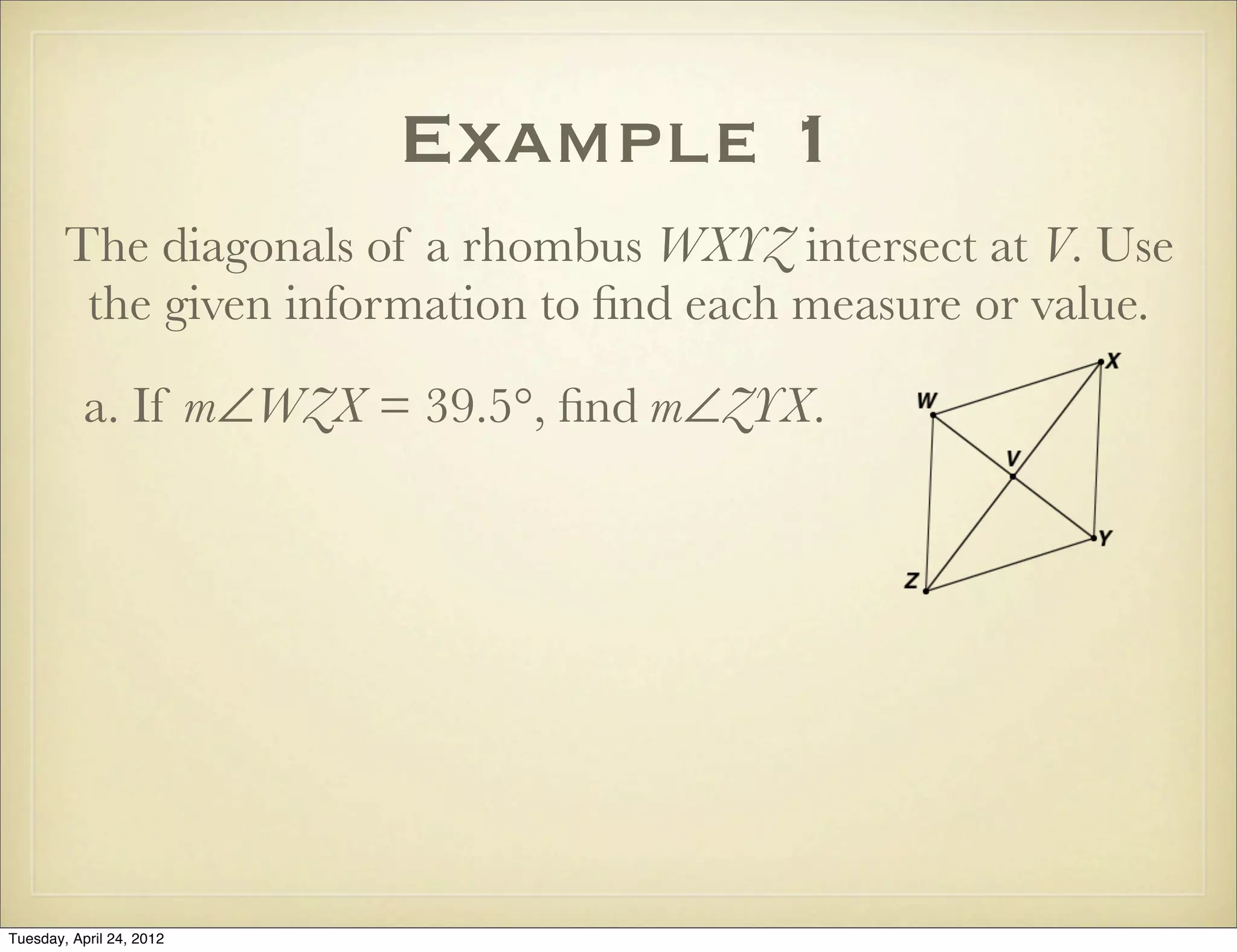
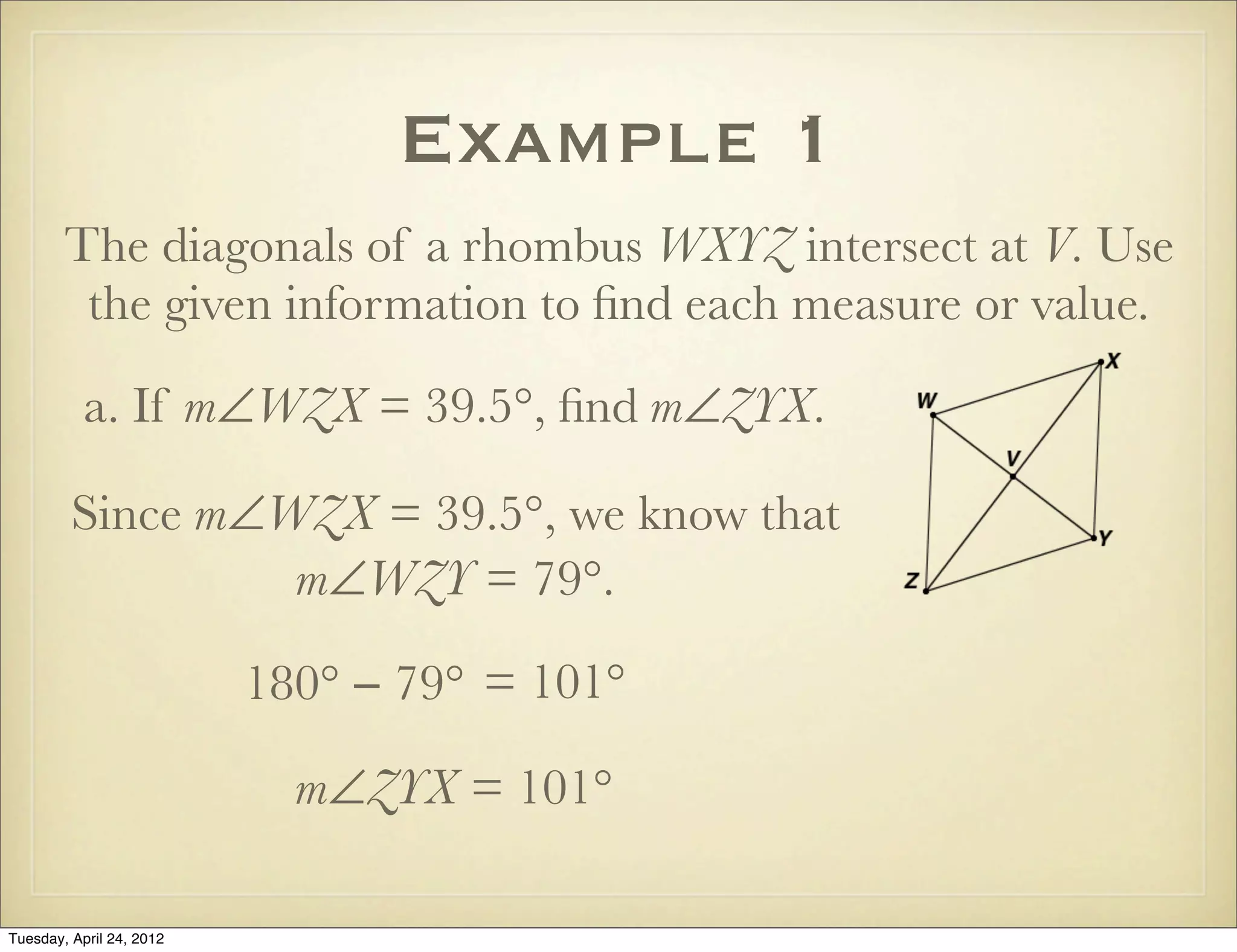
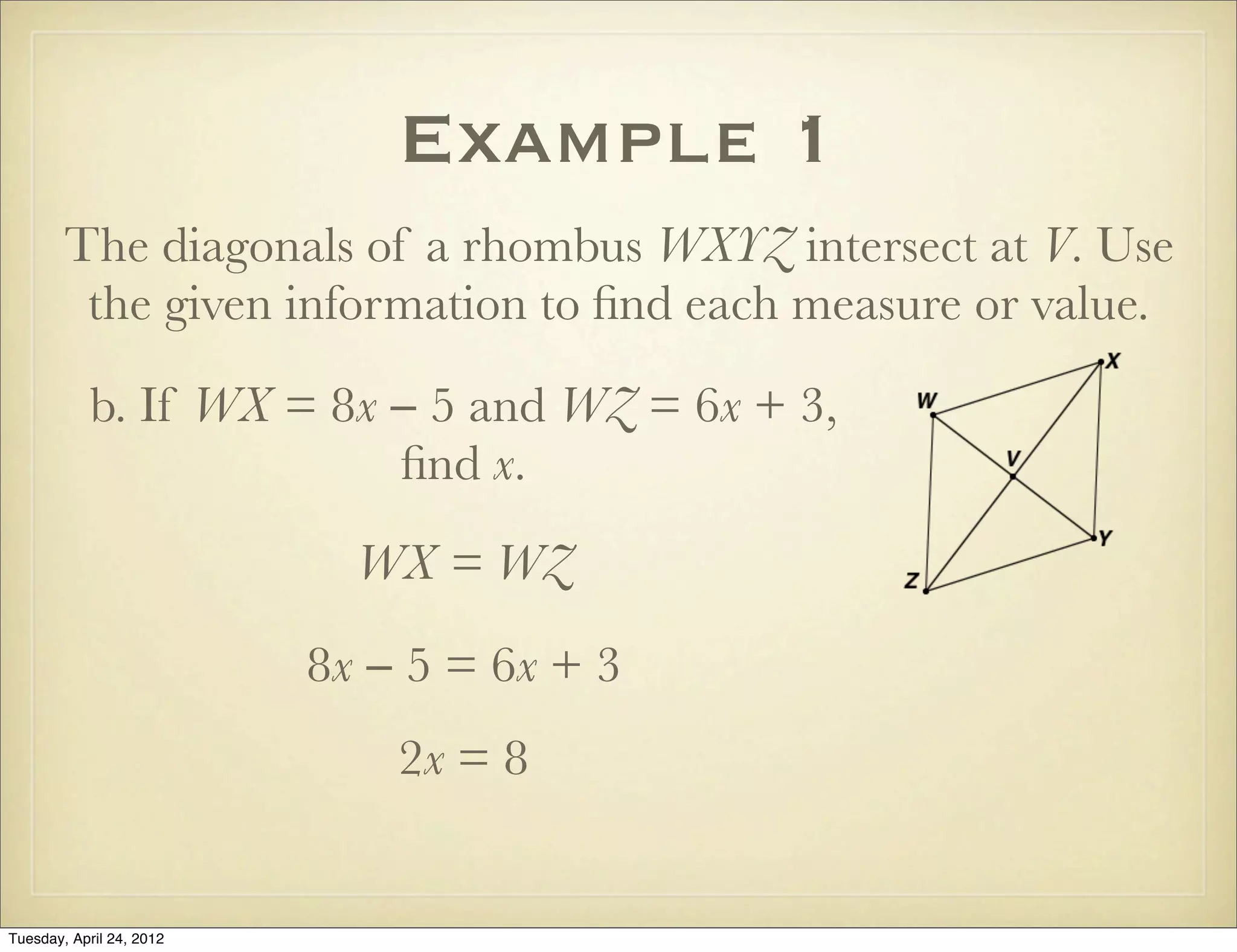
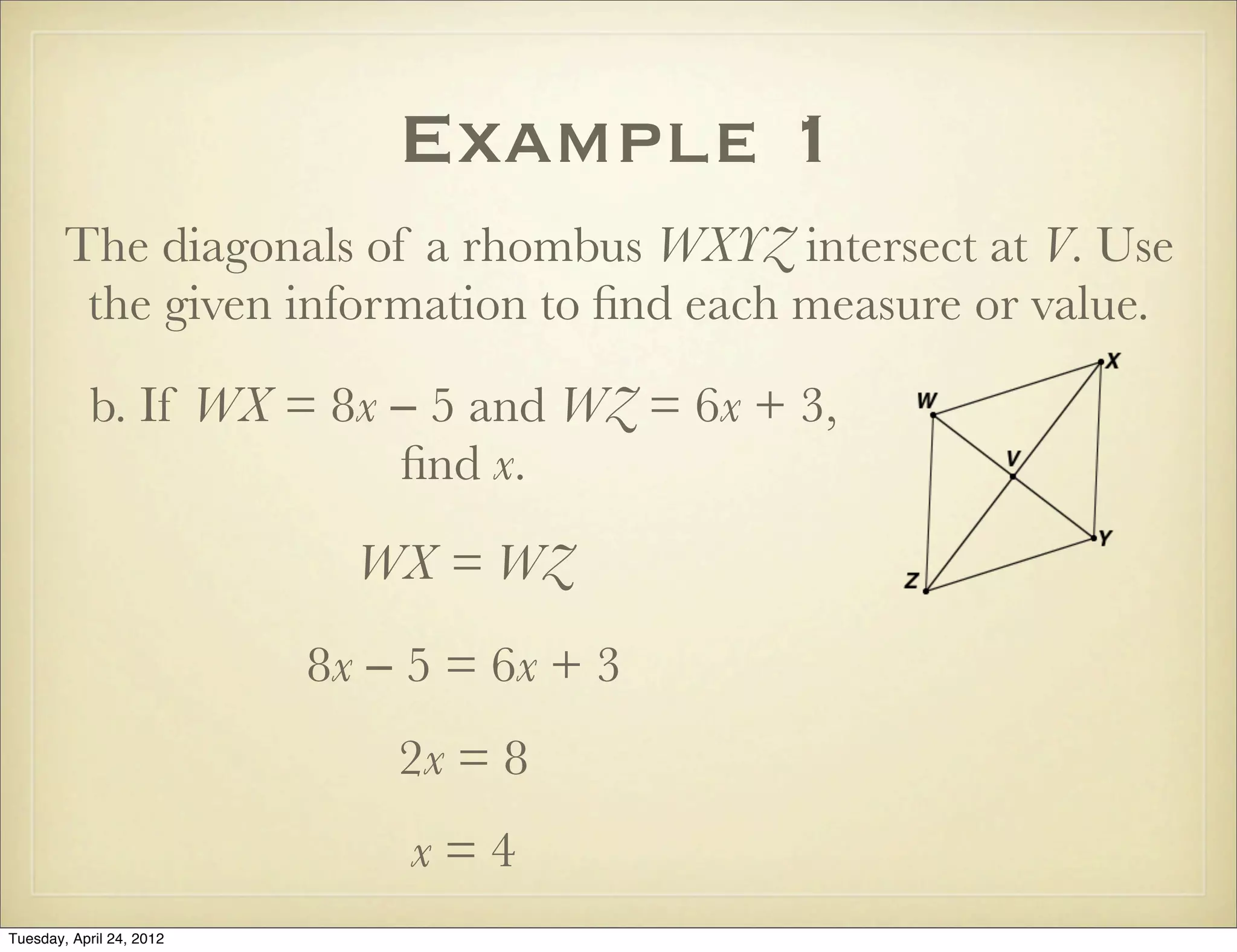
The diagonals of a rhombus WXYZ intersect at V. Use
the given information to find each measure or value.
a. If m∠WZX = 39.5°, find m∠ZYX.
Tuesday, April 29, 14
Example 1
The diagonals of a rhombus WXYZ intersect at V. Use
the given information to find each measure or value.
a. If m∠WZX = 39.5°, find m∠ZYX.
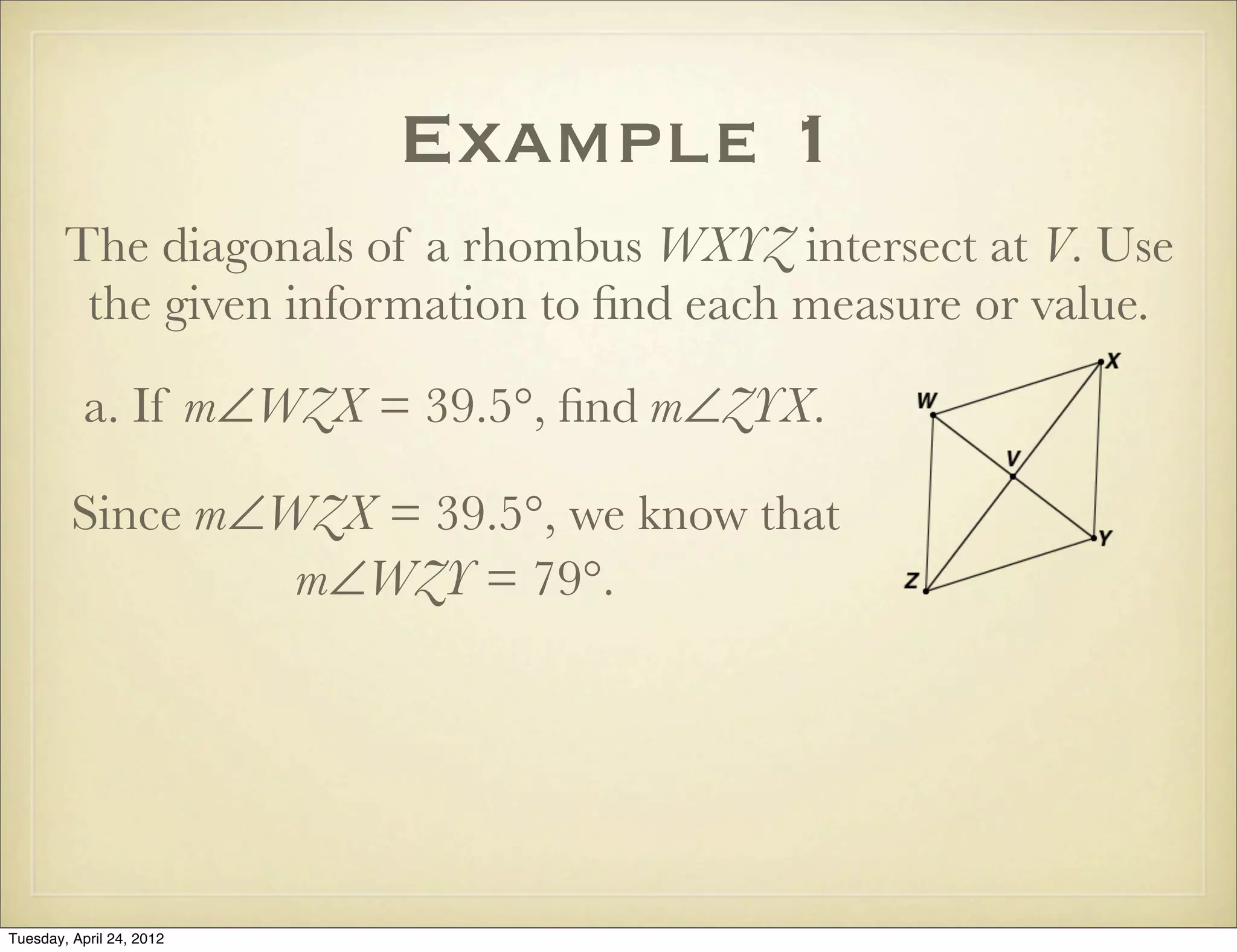
Since m∠WZX = 39.5°, we know that
m∠WZY = 79°.
Tuesday, April 29, 14
Example 1
The diagonals of a rhombus WXYZ intersect at V. Use
the given information to find each measure or value.
a. If m∠WZX = 39.5°, find m∠ZYX.
Since m∠WZX = 39.5°, we know that
m∠WZY = 79°.
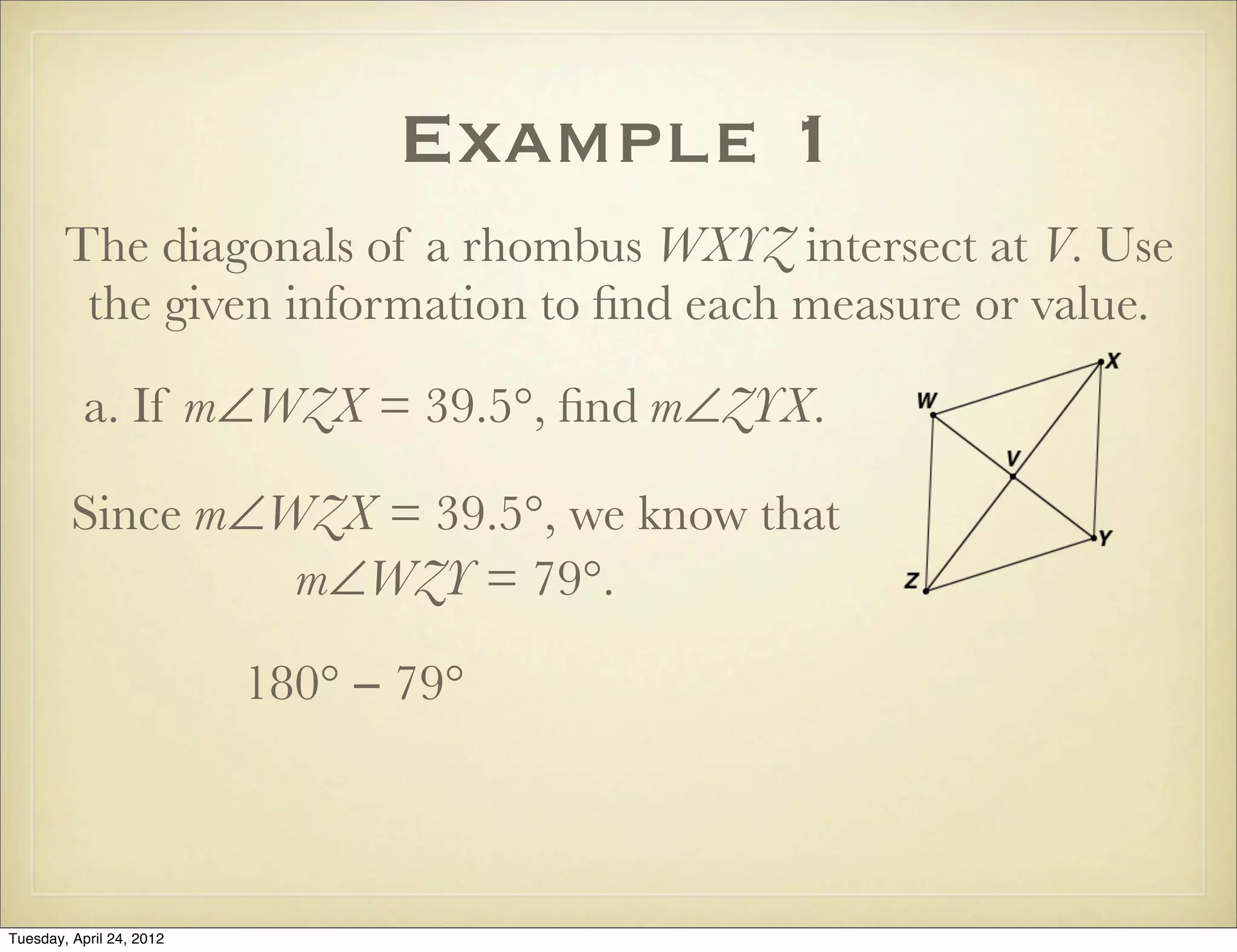
180° − 79°
Tuesday, April 29, 14
Example 1
The diagonals of a rhombus WXYZ intersect at V. Use
the given information to find each measure or value.
a. If m∠WZX = 39.5°, find m∠ZYX.
Since m∠WZX = 39.5°, we know that
m∠WZY = 79°.
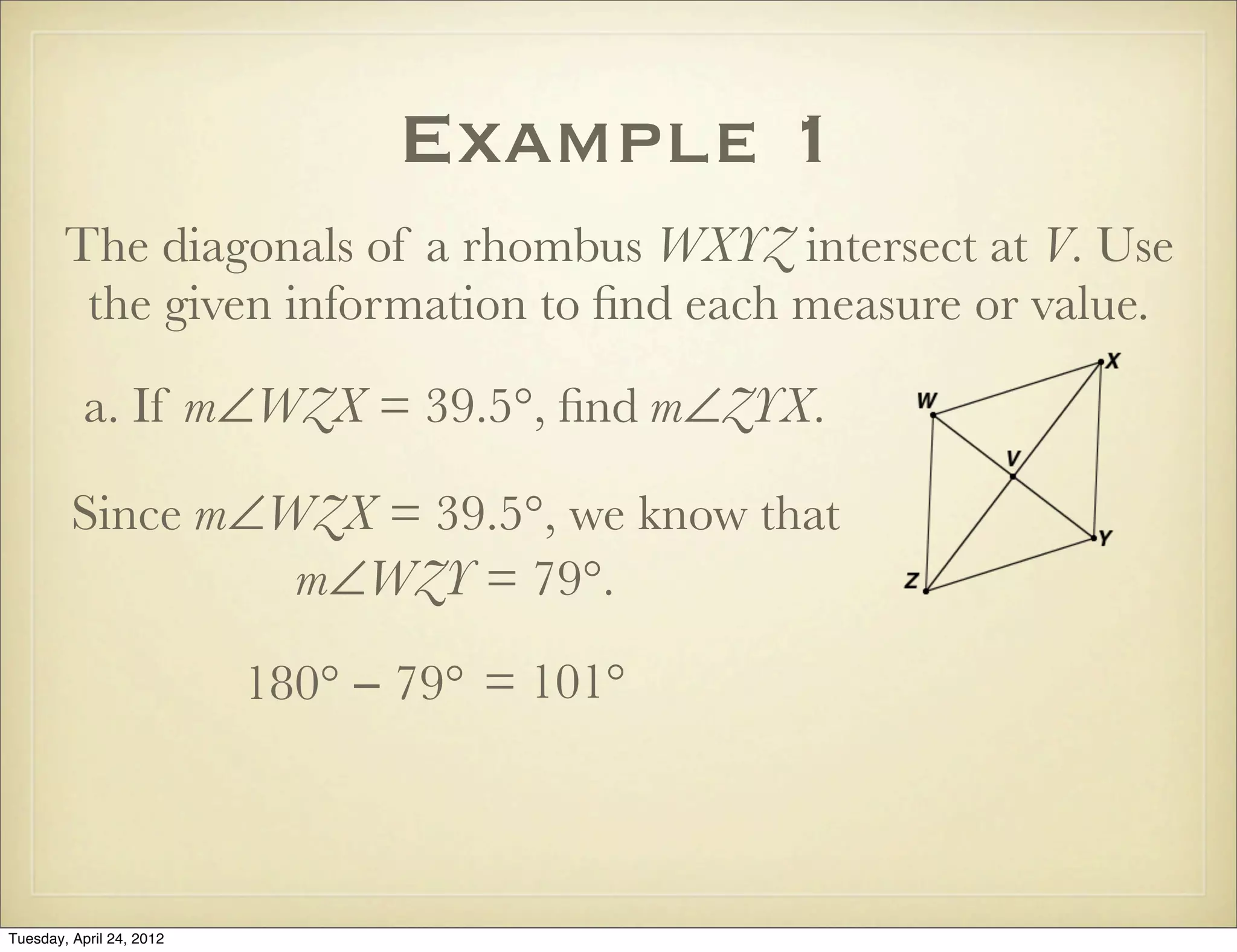
180° − 79° = 101°
Tuesday, April 29, 14
Example 1
The diagonals of a rhombus WXYZ intersect at V. Use
the given information to find each measure or value.
a. If m∠WZX = 39.5°, find m∠ZYX.
Since m∠WZX = 39.5°, we know that
m∠WZY = 79°.
180° − 79° = 101°
m∠ZYX = 101°
Tuesday, April 29, 14
Example 1
The diagonals of a rhombus WXYZ intersect at V. Use
the given information to find each measure or value.
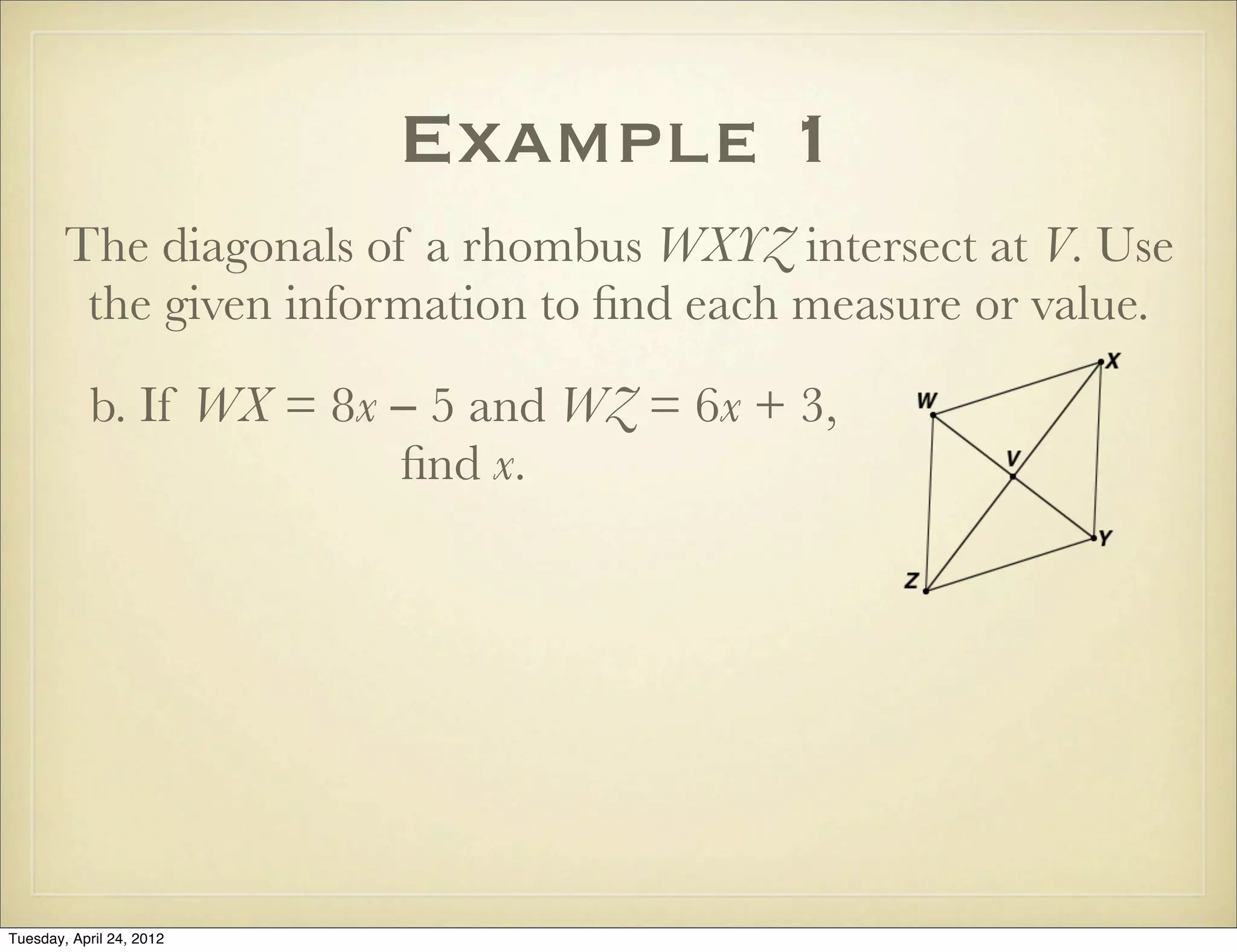
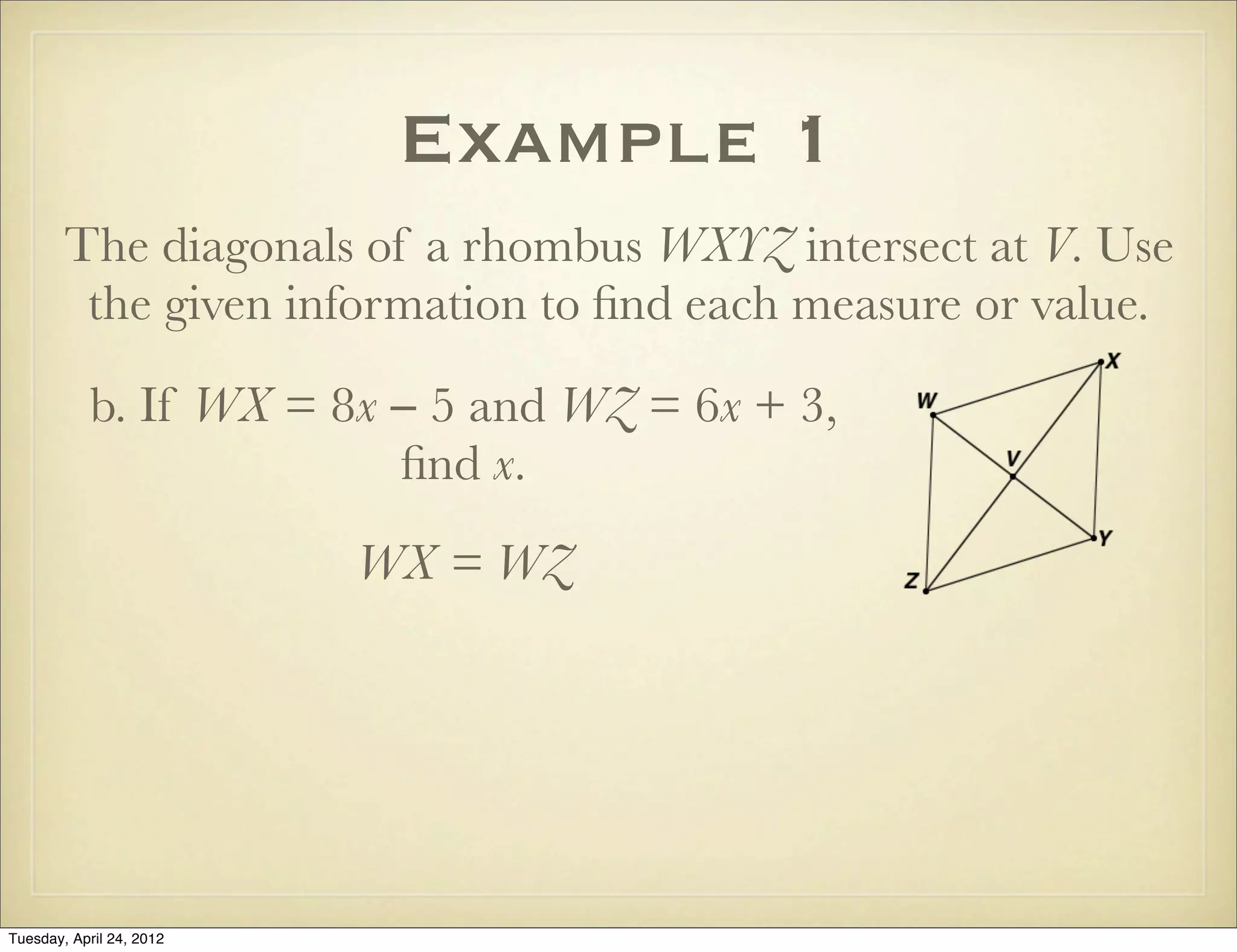
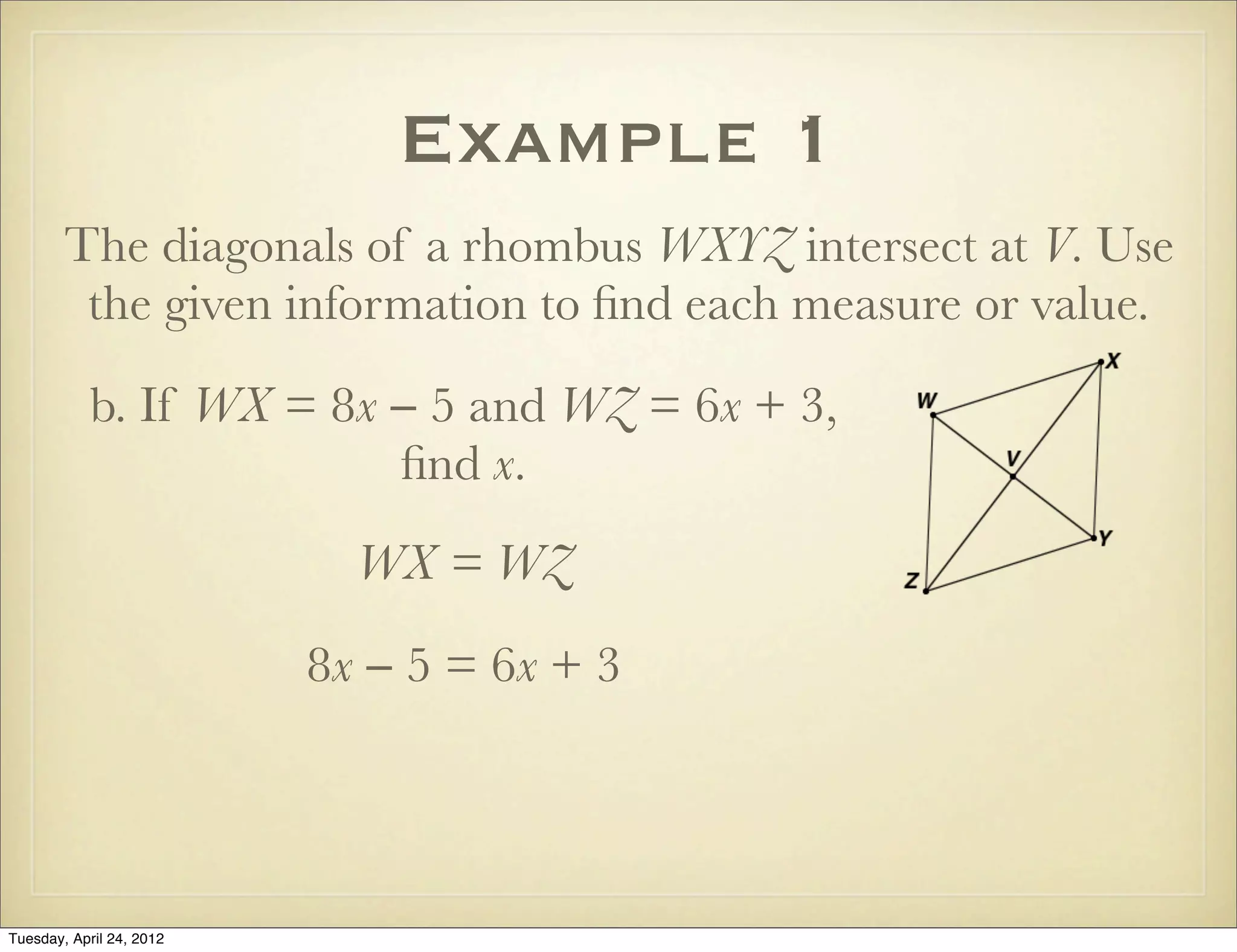
b. If WX = 8x − 5 and WZ = 6x + 3,
find x.
Tuesday, April 29, 14
Example 1
The diagonals of a rhombus WXYZ intersect at V. Use
the given information to find each measure or value.
b. If WX = 8x − 5 and WZ = 6x + 3,
find x.
WX = WZ
Tuesday, April 29, 14
Example 1
The diagonals of a rhombus WXYZ intersect at V. Use
the given information to find each measure or value.
b. If WX = 8x − 5 and WZ = 6x + 3,
find x.
WX = WZ
8x − 5 = 6x + 3
Tuesday, April 29, 14
Example 1
The diagonals of a rhombus WXYZ intersect at V. Use
the given information to find each measure or value.
b. If WX = 8x − 5 and WZ = 6x + 3,
find x.
WX = WZ
8x − 5 = 6x + 3
2x = 8
Tuesday, April 29, 14
Example 1
The diagonals of a rhombus WXYZ intersect at V. Use
the given information to find each measure or value.
b. If WX = 8x − 5 and WZ = 6x + 3,
find x.
WX = WZ
8x − 5 = 6x + 3
2x = 8
x = 4
Tuesday, April 29, 14
Example 2
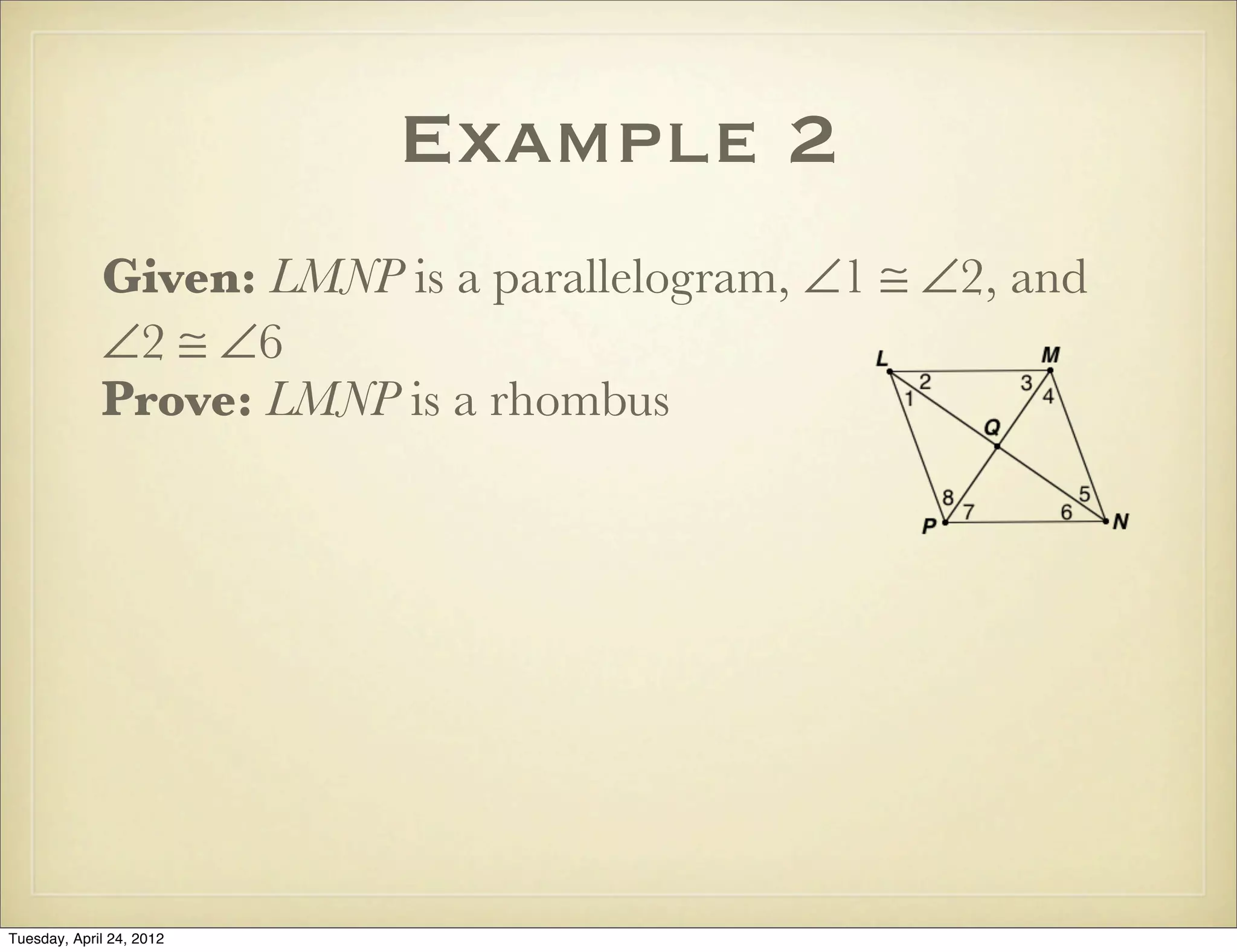
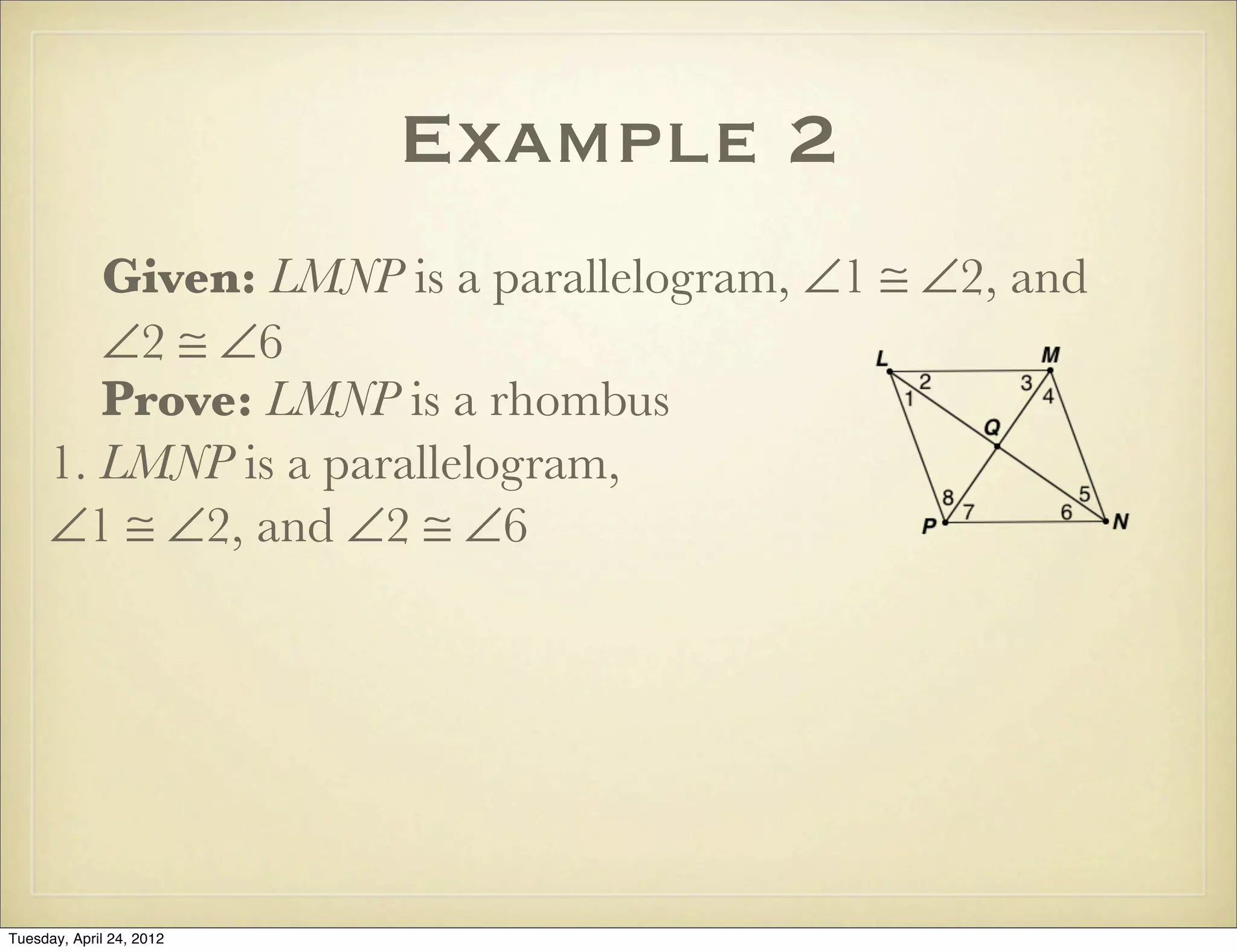
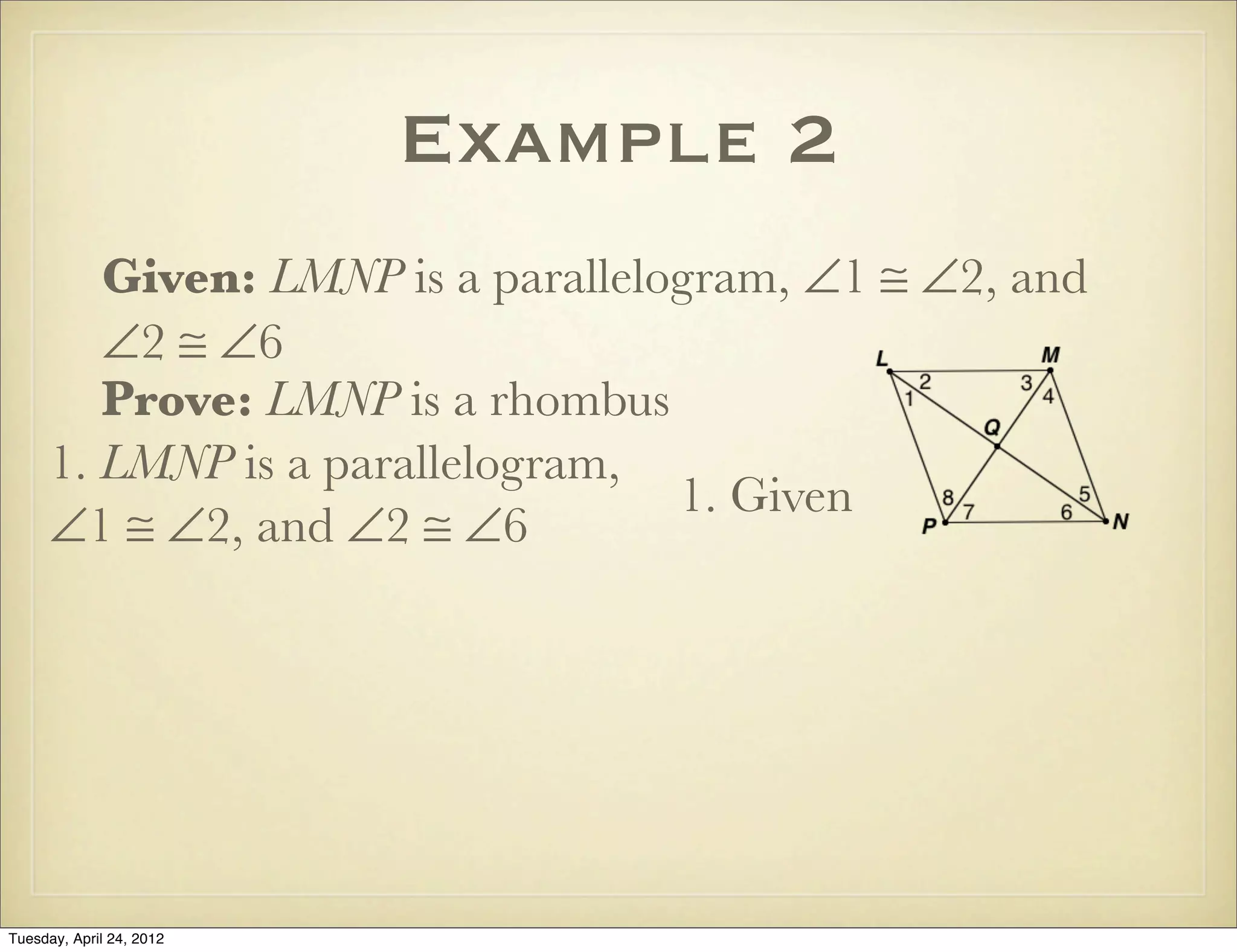
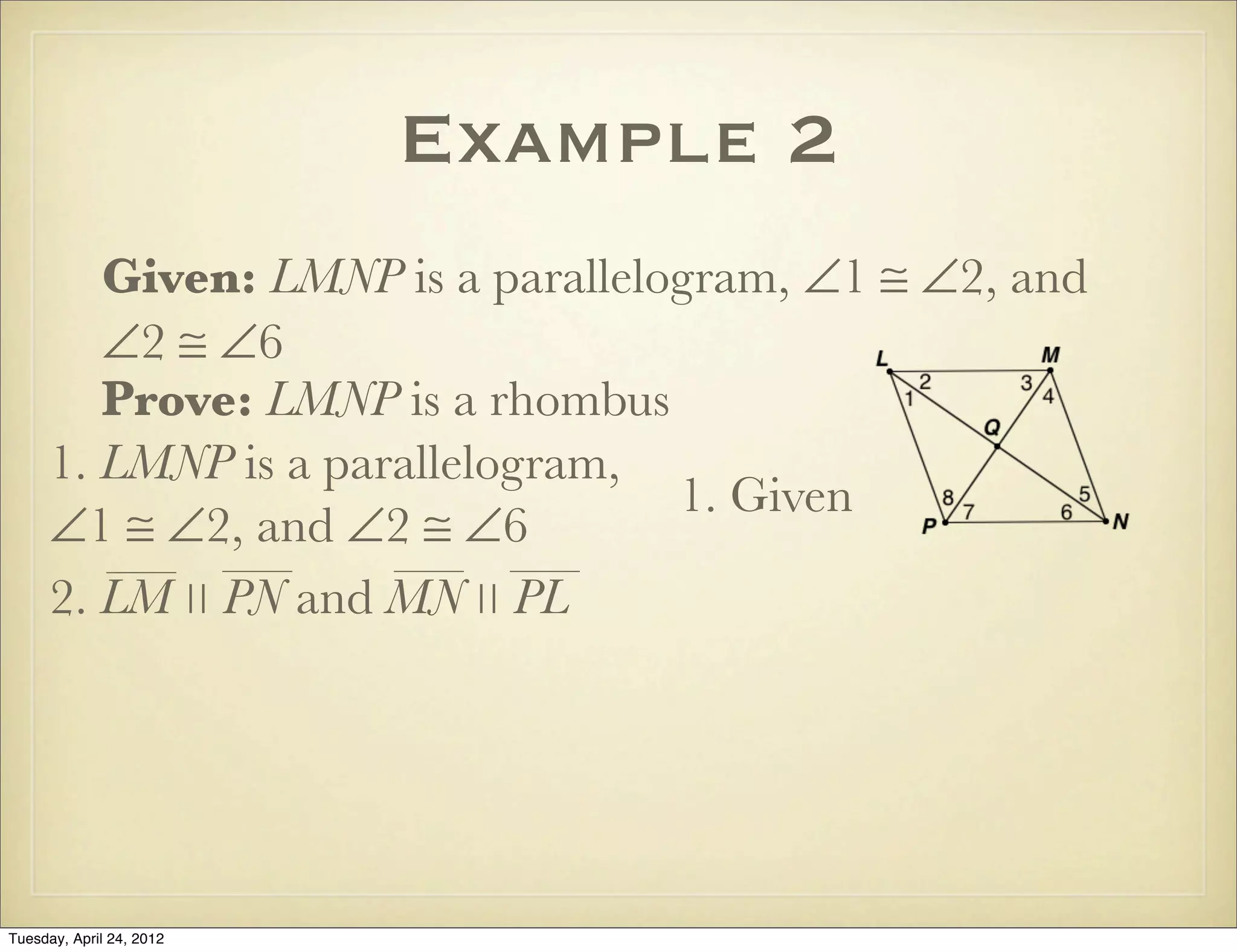
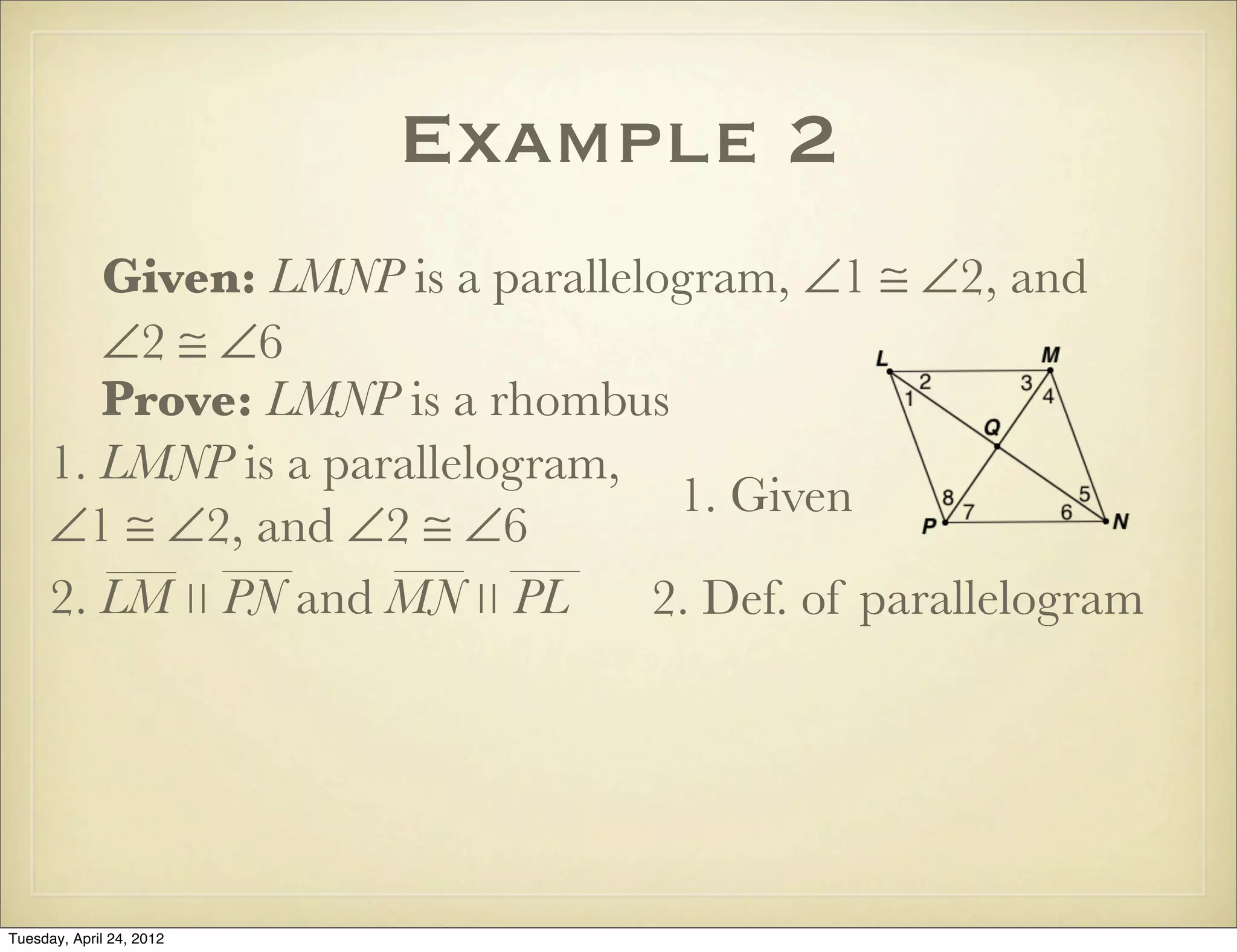
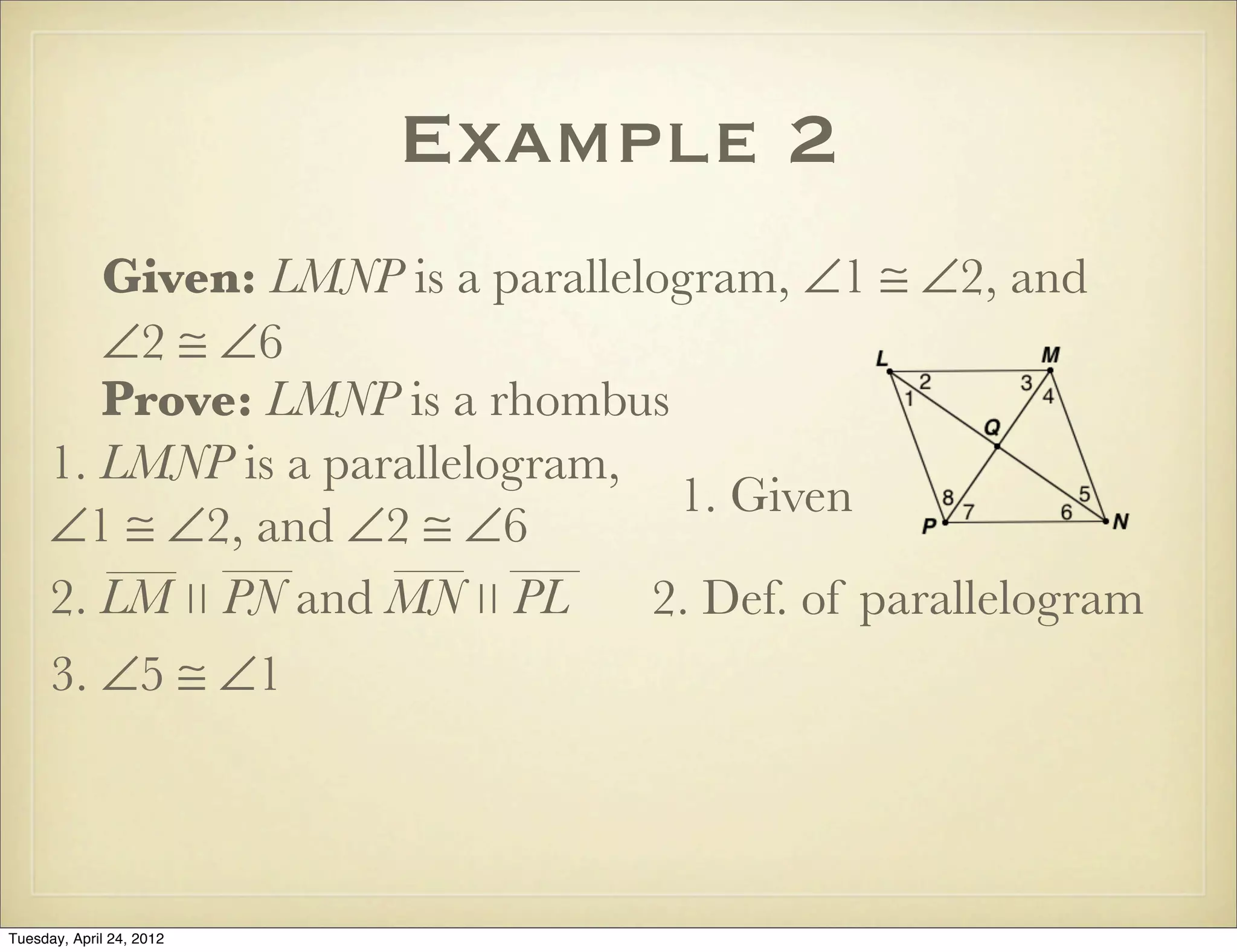
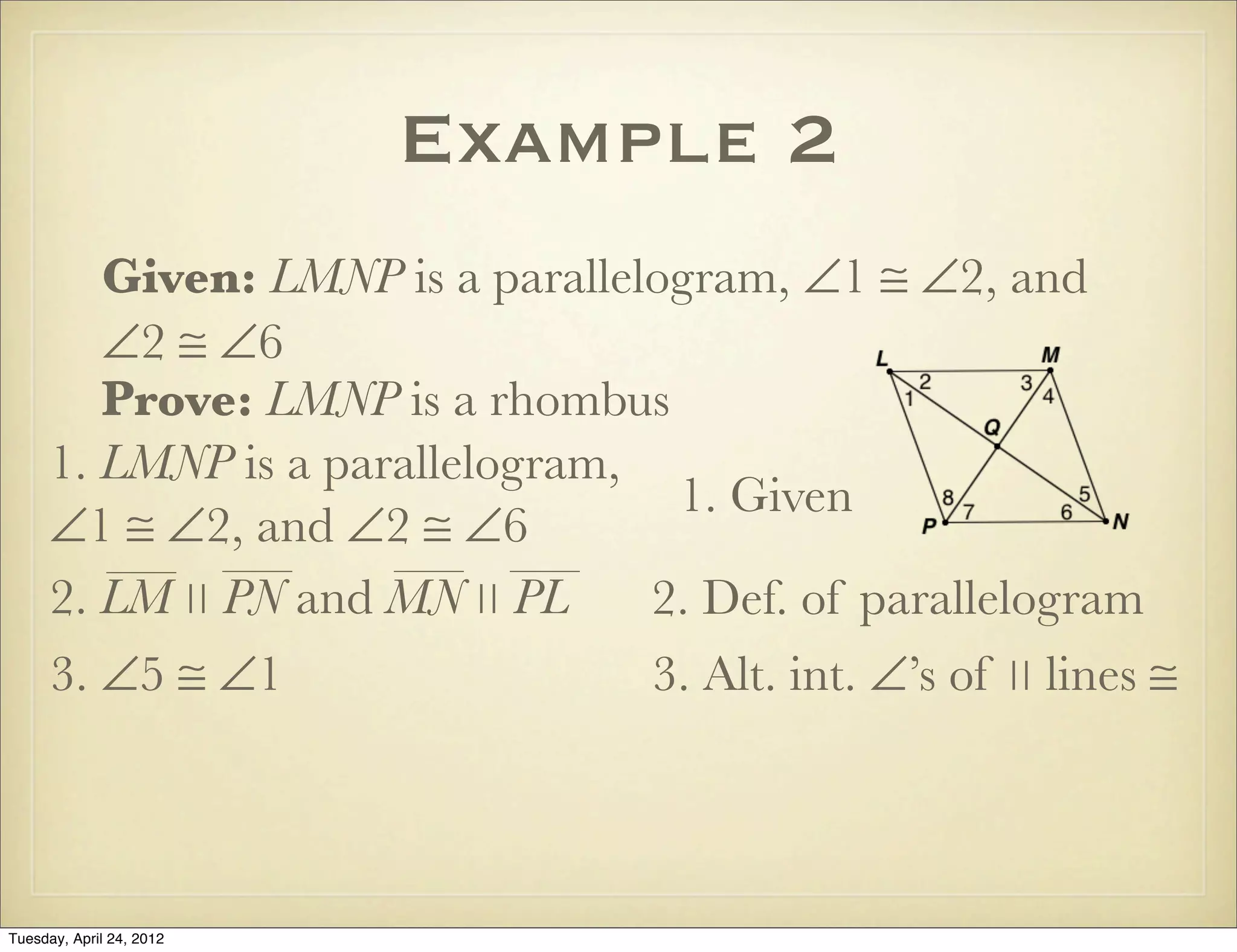
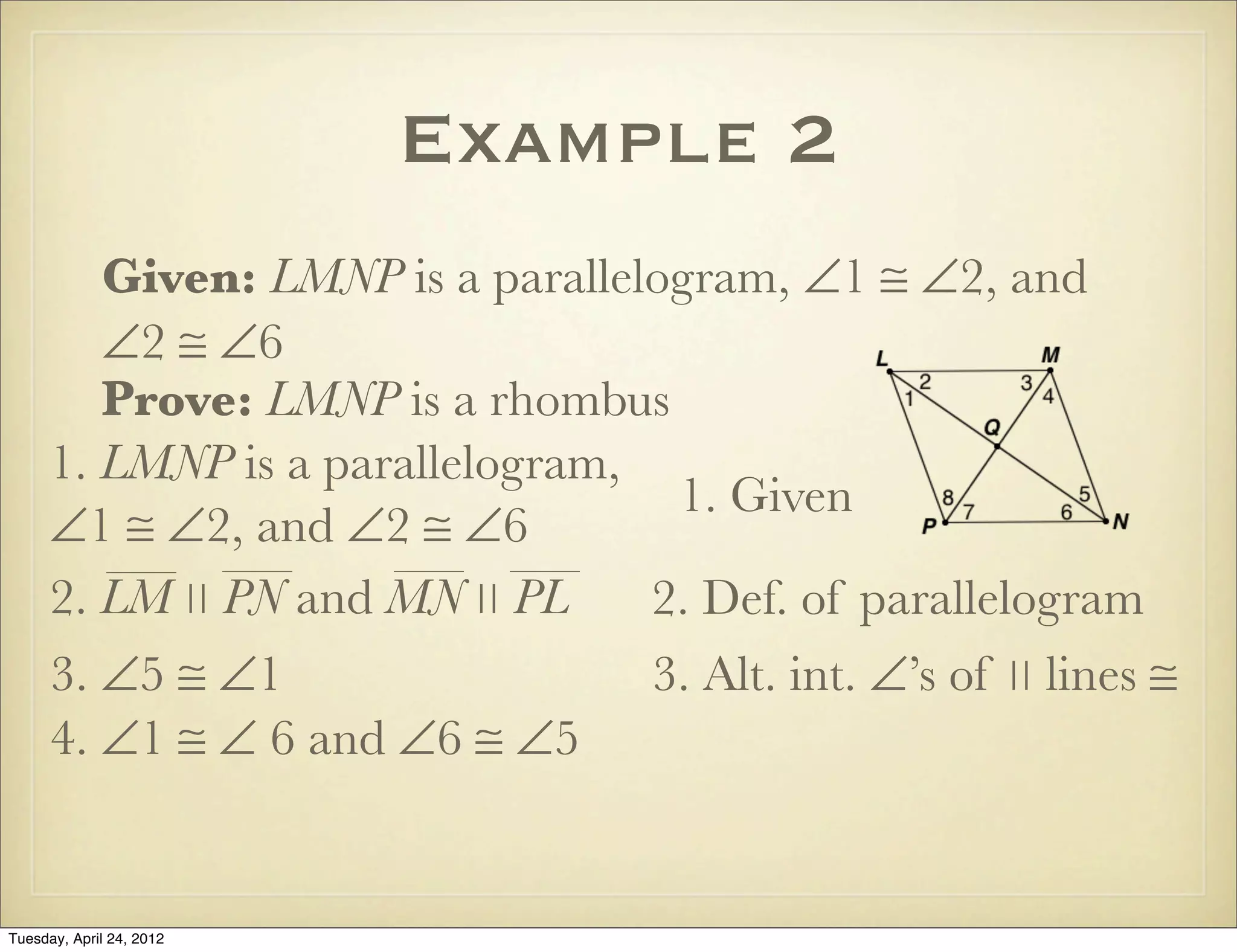
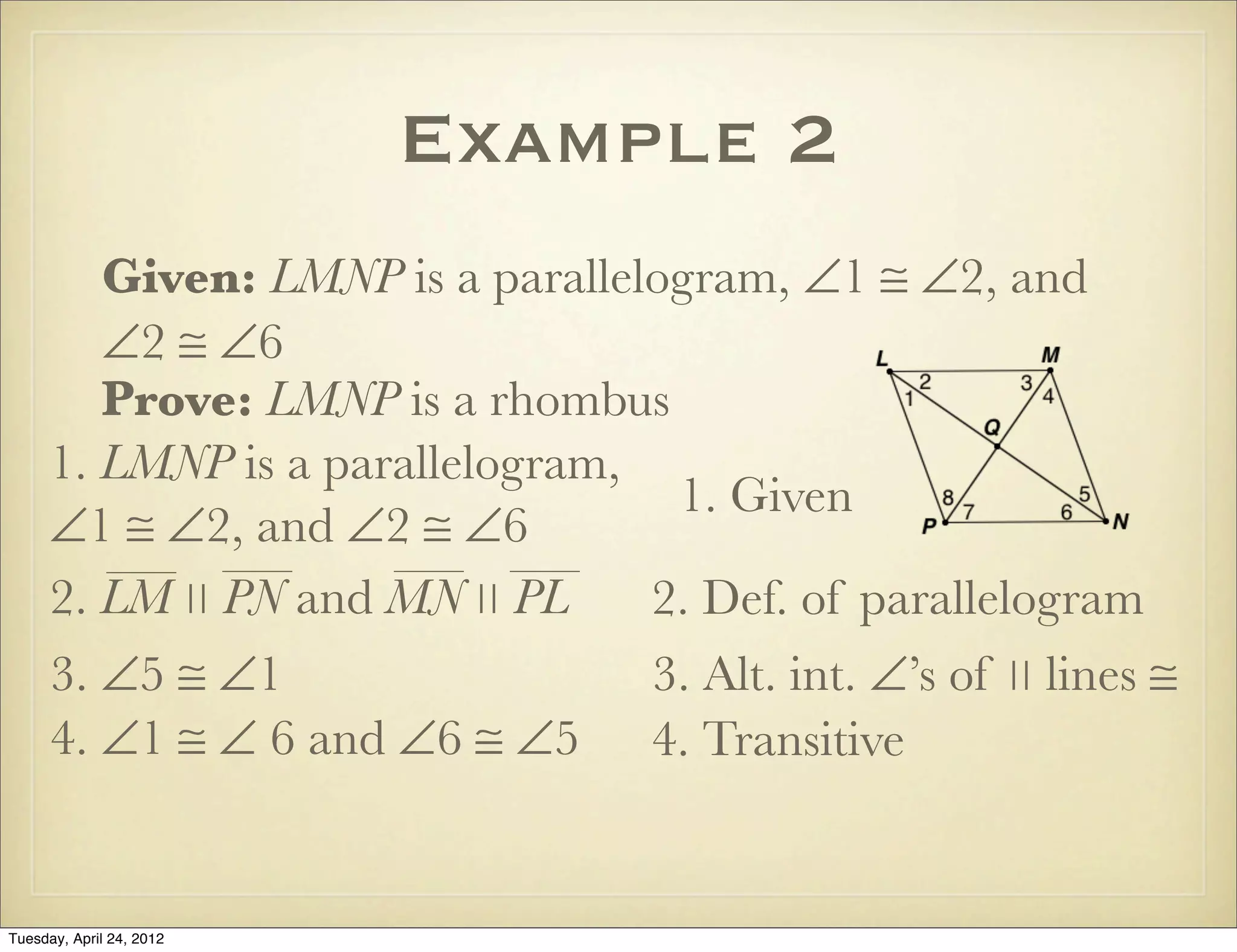
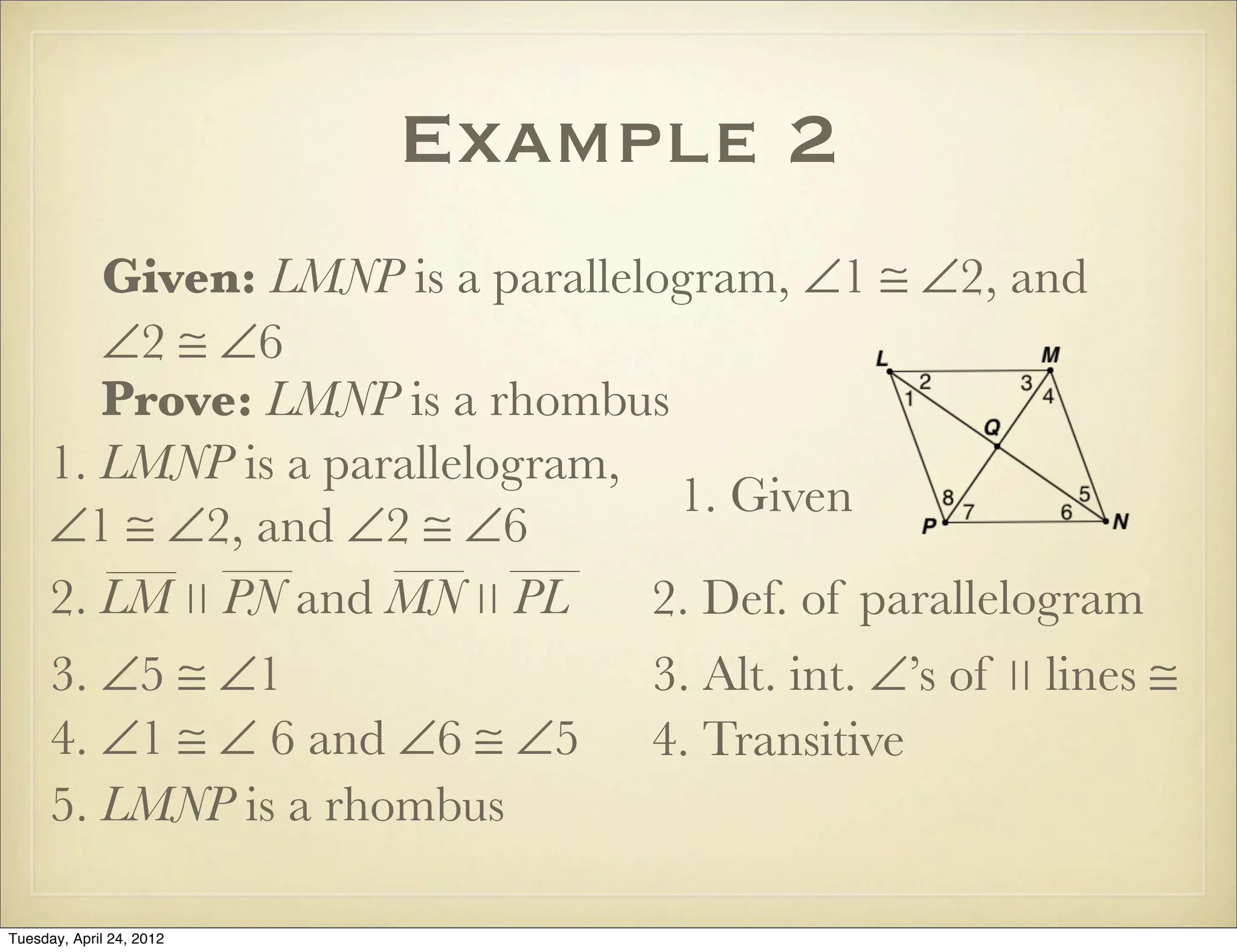
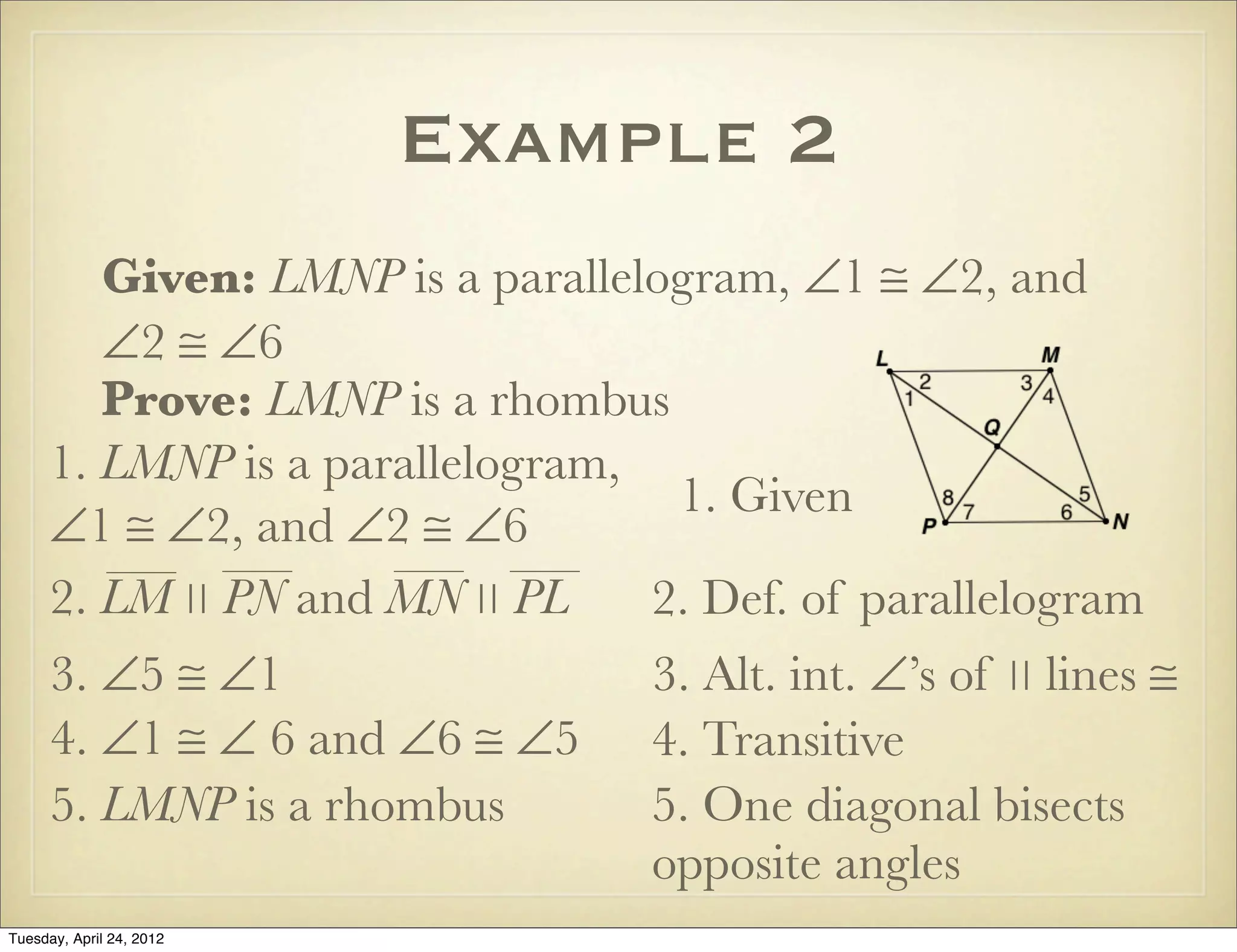
Given: LMNP is a parallelogram, ∠1 ≅ ∠2, and
∠2 ≅ ∠6
Prove: LMNP is a rhombus
Tuesday, April 29, 14
Example 2
Given: LMNP is a parallelogram, ∠1 ≅ ∠2, and
∠2 ≅ ∠6
Prove: LMNP is a rhombus
1. LMNP is a parallelogram,
∠1 ≅ ∠2, and ∠2 ≅ ∠6
Tuesday, April 29, 14
Example 2
Given: LMNP is a parallelogram, ∠1 ≅ ∠2, and
∠2 ≅ ∠6
Prove: LMNP is a rhombus
1. LMNP is a parallelogram,
∠1 ≅ ∠2, and ∠2 ≅ ∠6
1. Given
Tuesday, April 29, 14
Example 2
Given: LMNP is a parallelogram, ∠1 ≅ ∠2, and
∠2 ≅ ∠6
Prove: LMNP is a rhombus
1. LMNP is a parallelogram,
∠1 ≅ ∠2, and ∠2 ≅ ∠6
1. Given
2. LM ∣∣ PN and MN ∣∣ PL
Tuesday, April 29, 14
Example 2
Given: LMNP is a parallelogram, ∠1 ≅ ∠2, and
∠2 ≅ ∠6
Prove: LMNP is a rhombus
1. LMNP is a parallelogram,
∠1 ≅ ∠2, and ∠2 ≅ ∠6
1. Given
2. Def. of parallelogram2. LM ∣∣ PN and MN ∣∣ PL
Tuesday, April 29, 14
Example 2
Given: LMNP is a parallelogram, ∠1 ≅ ∠2, and
∠2 ≅ ∠6
Prove: LMNP is a rhombus
1. LMNP is a parallelogram,
∠1 ≅ ∠2, and ∠2 ≅ ∠6
1. Given
2. Def. of parallelogram
3. ∠5 ≅ ∠1
2. LM ∣∣ PN and MN ∣∣ PL
Tuesday, April 29, 14
Example 2
Given: LMNP is a parallelogram, ∠1 ≅ ∠2, and
∠2 ≅ ∠6
Prove: LMNP is a rhombus
1. LMNP is a parallelogram,
∠1 ≅ ∠2, and ∠2 ≅ ∠6
1. Given
2. Def. of parallelogram
3. ∠5 ≅ ∠1 3. Alt. int. ∠’s of ∣∣ lines ≅
2. LM ∣∣ PN and MN ∣∣ PL
Tuesday, April 29, 14
Example 2
Given: LMNP is a parallelogram, ∠1 ≅ ∠2, and
∠2 ≅ ∠6
Prove: LMNP is a rhombus
1. LMNP is a parallelogram,
∠1 ≅ ∠2, and ∠2 ≅ ∠6
1. Given
2. Def. of parallelogram
3. ∠5 ≅ ∠1 3. Alt. int. ∠’s of ∣∣ lines ≅
4. ∠1 ≅ ∠ 6 and ∠6 ≅ ∠5
2. LM ∣∣ PN and MN ∣∣ PL
Tuesday, April 29, 14
Example 2
Given: LMNP is a parallelogram, ∠1 ≅ ∠2, and
∠2 ≅ ∠6
Prove: LMNP is a rhombus
1. LMNP is a parallelogram,
∠1 ≅ ∠2, and ∠2 ≅ ∠6
1. Given
2. Def. of parallelogram
3. ∠5 ≅ ∠1 3. Alt. int. ∠’s of ∣∣ lines ≅
4. ∠1 ≅ ∠ 6 and ∠6 ≅ ∠5 4. Transitive
2. LM ∣∣ PN and MN ∣∣ PL
Tuesday, April 29, 14
Example 2
Given: LMNP is a parallelogram, ∠1 ≅ ∠2, and
∠2 ≅ ∠6
Prove: LMNP is a rhombus
1. LMNP is a parallelogram,
∠1 ≅ ∠2, and ∠2 ≅ ∠6
1. Given
2. Def. of parallelogram
3. ∠5 ≅ ∠1 3. Alt. int. ∠’s of ∣∣ lines ≅
4. ∠1 ≅ ∠ 6 and ∠6 ≅ ∠5 4. Transitive
5. LMNP is a rhombus
2. LM ∣∣ PN and MN ∣∣ PL
Tuesday, April 29, 14
Example 2
Given: LMNP is a parallelogram, ∠1 ≅ ∠2, and
∠2 ≅ ∠6
Prove: LMNP is a rhombus
1. LMNP is a parallelogram,
∠1 ≅ ∠2, and ∠2 ≅ ∠6
1. Given
2. Def. of parallelogram
3. ∠5 ≅ ∠1 3. Alt. int. ∠’s of ∣∣ lines ≅
4. ∠1 ≅ ∠ 6 and ∠6 ≅ ∠5 4. Transitive
5. LMNP is a rhombus 5. One diagonal bisects
opposite angles
2. LM ∣∣ PN and MN ∣∣ PL
Tuesday, April 29, 14
Example 3
Matt Mitarnowski is measuring the boundary of a
new garden. He wants the garden to be square. He
has set each of the corner stakes 6 feet apart.
What does Matt need to know to make sure that
the garden is a square?
Tuesday, April 29, 14
Example 3
Matt Mitarnowski is measuring the boundary of a
new garden. He wants the garden to be square. He
has set each of the corner stakes 6 feet apart.
What does Matt need to know to make sure that
the garden is a square?
Matt knows he at least has a rhombus as all four
sides are congruent. To make it a square, it must
also be a rectangle, so the diagonals must also be
congruent, as anything that is both a rhombus and
a rectangle is also a square.
Tuesday, April 29, 14
Example 4
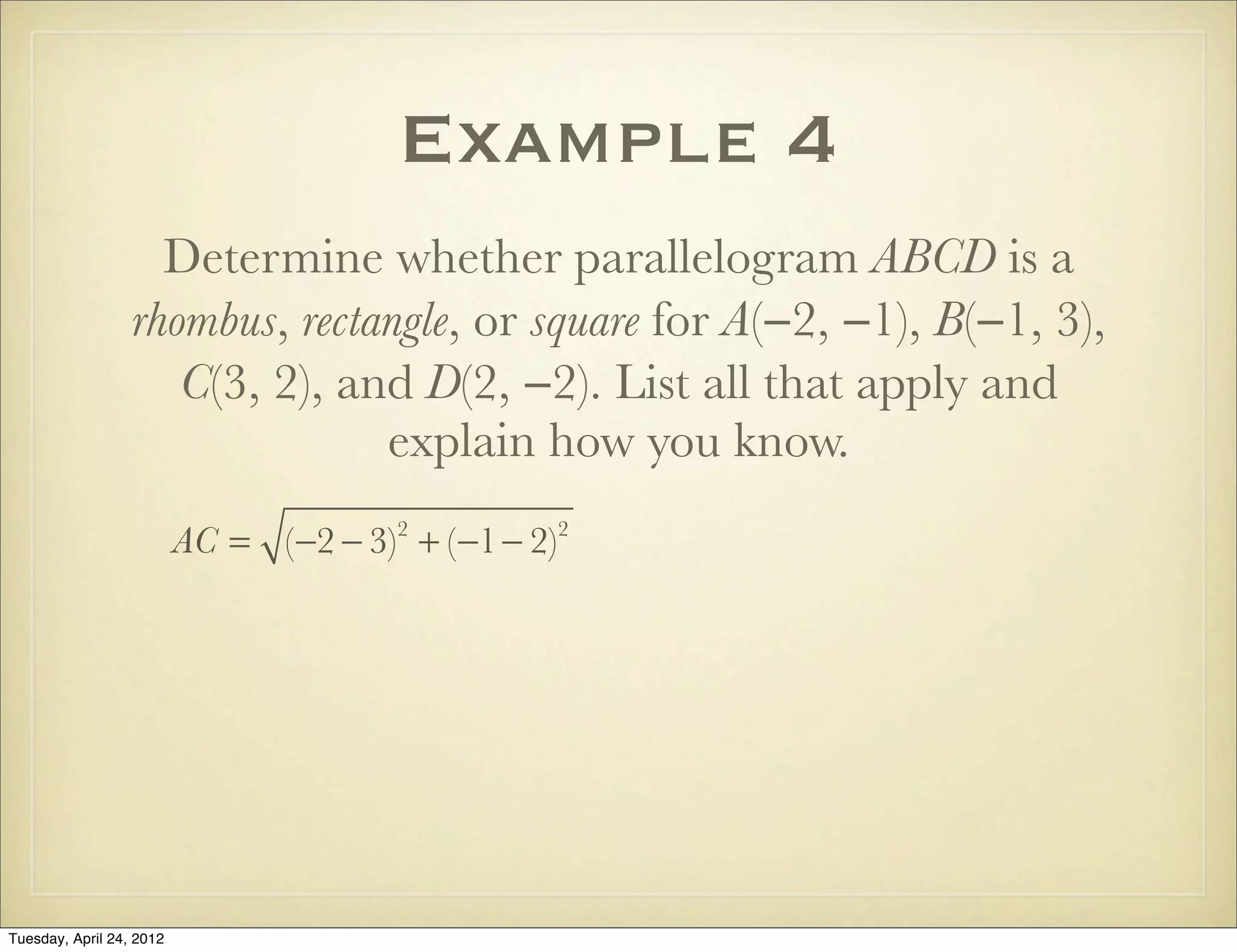
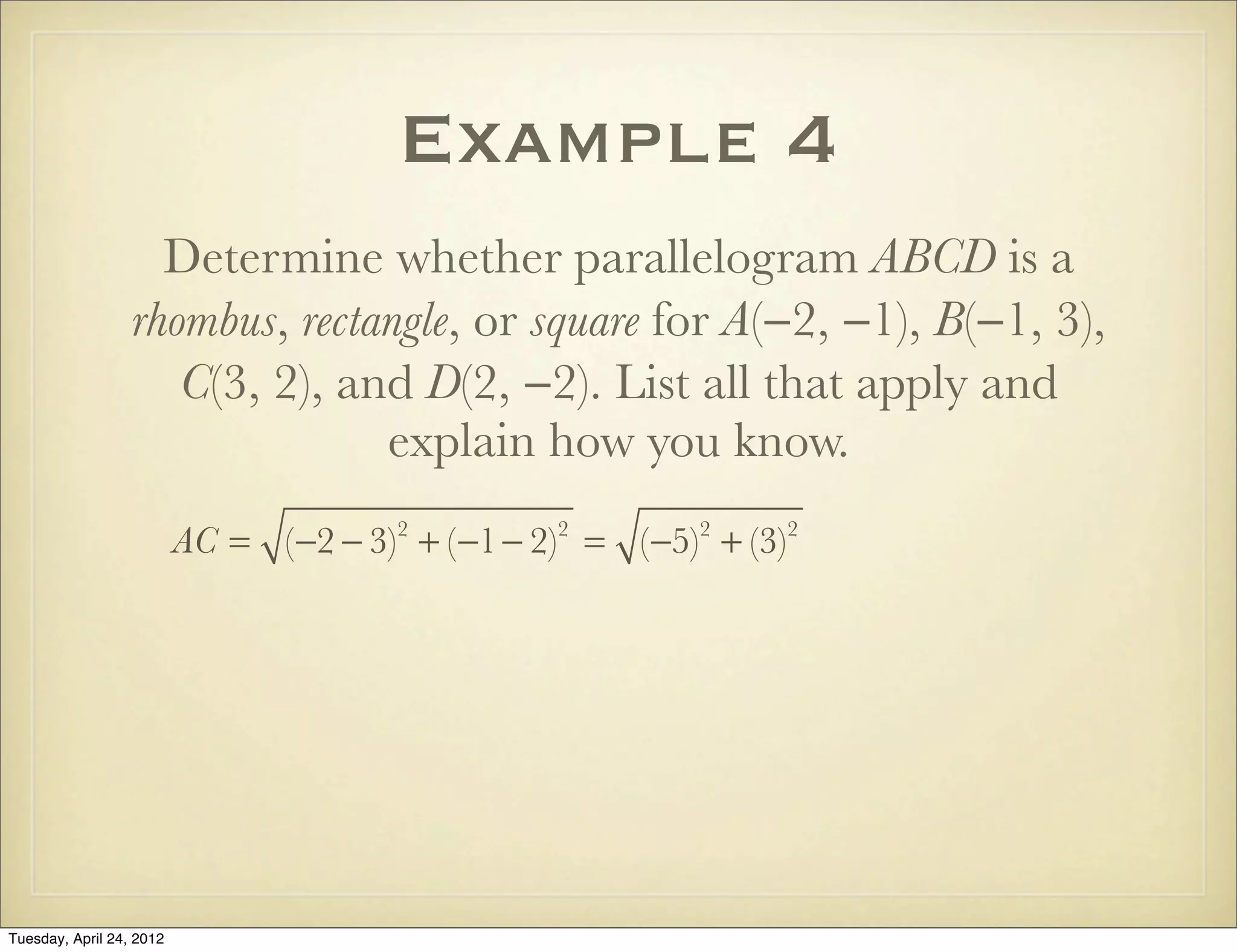
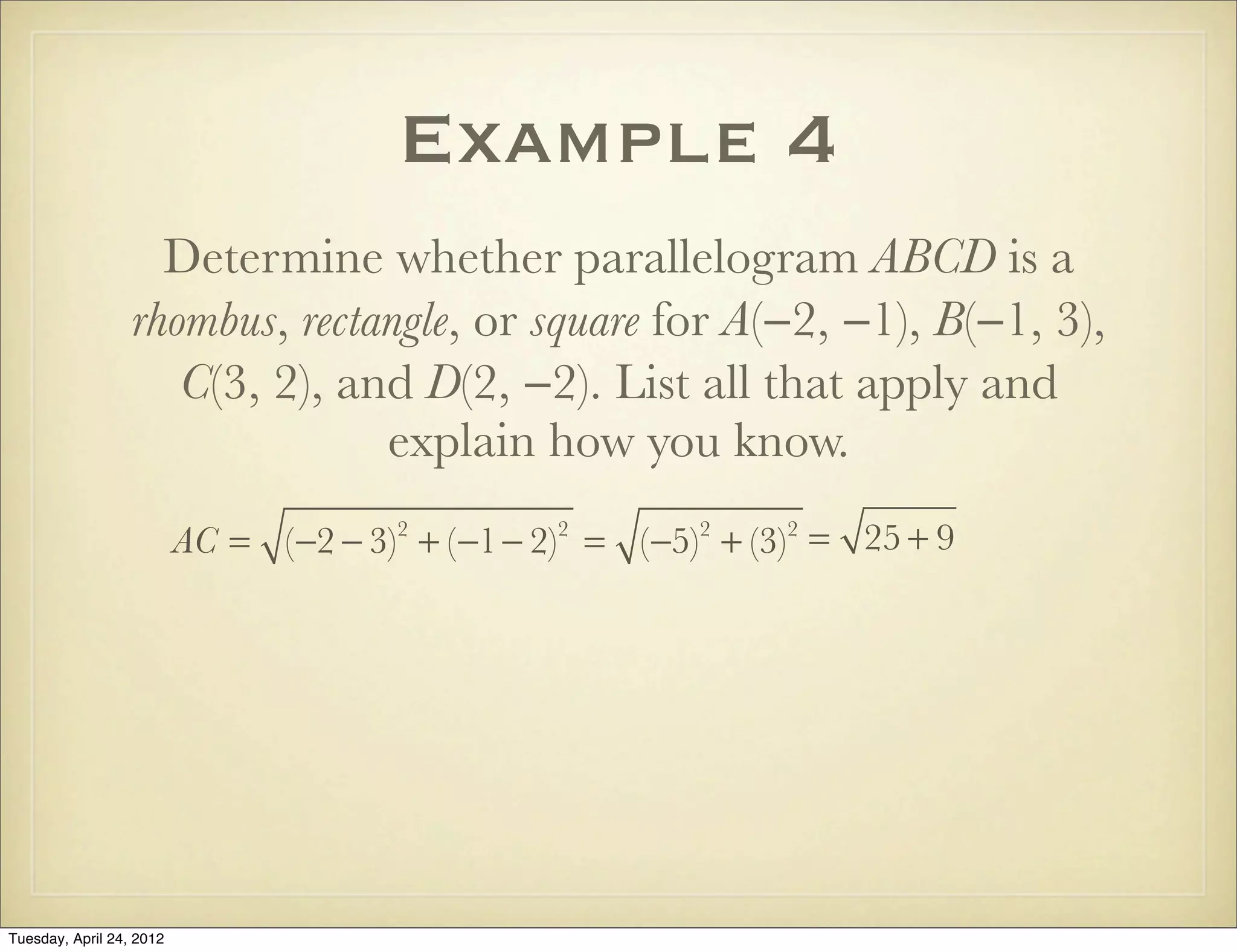
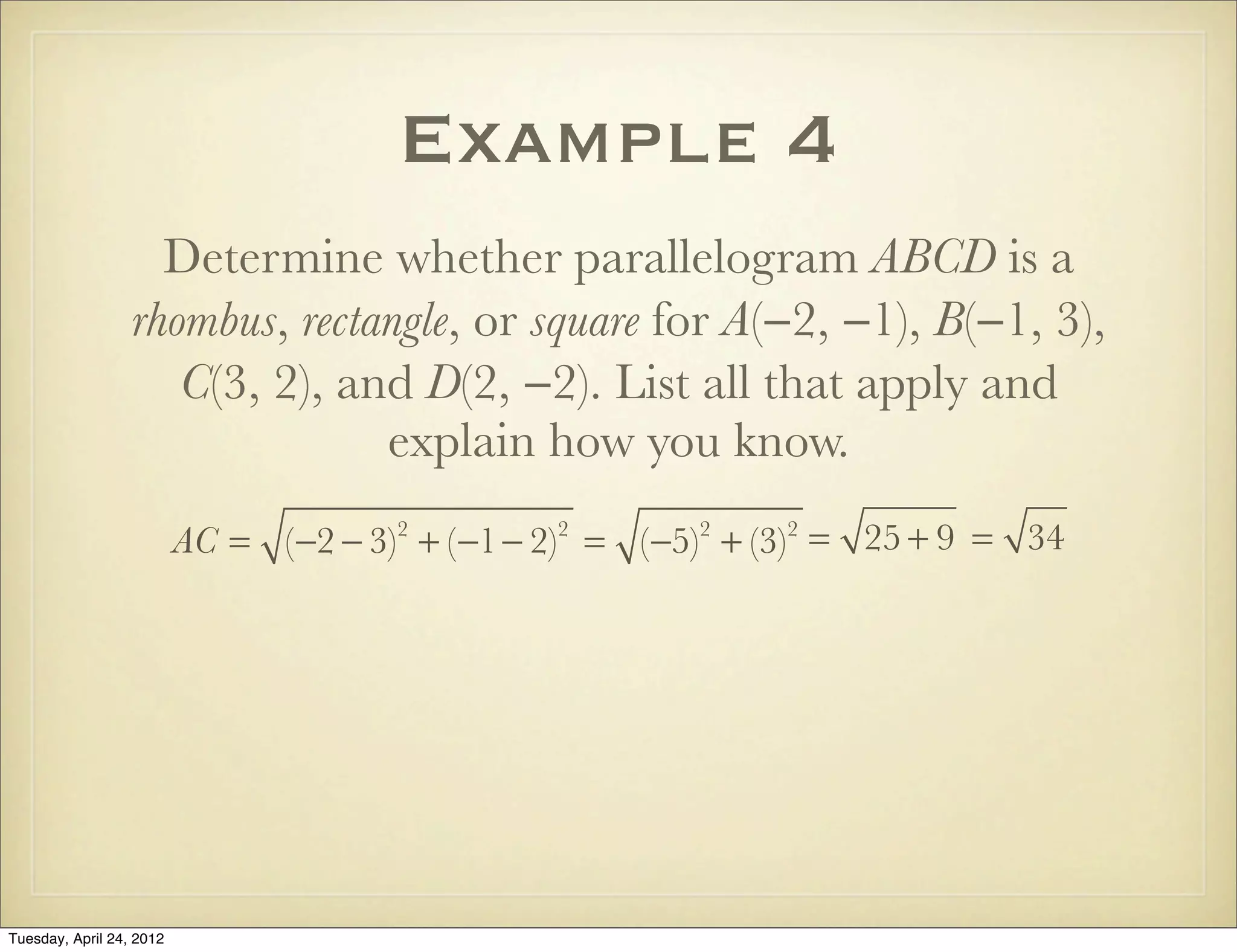
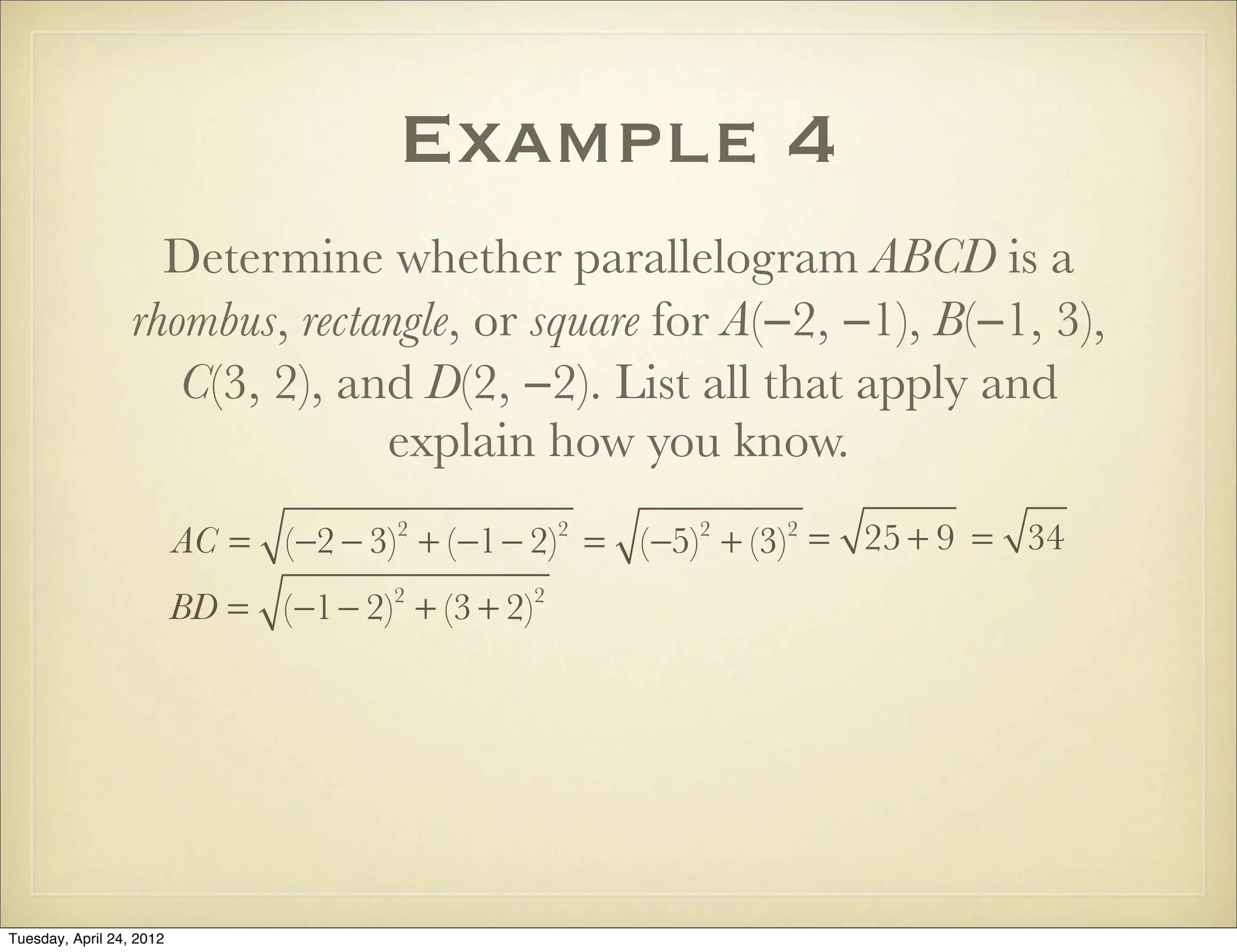
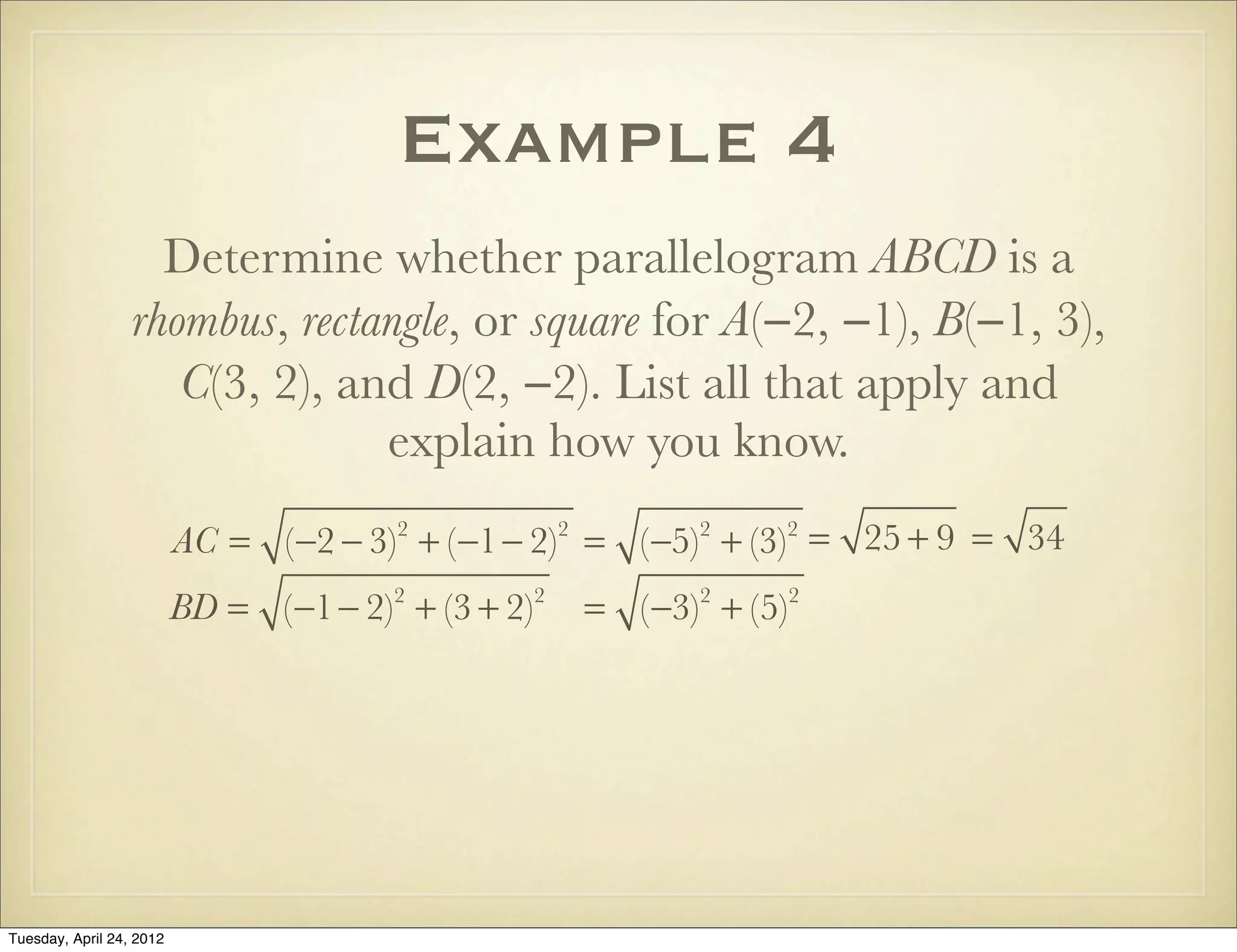
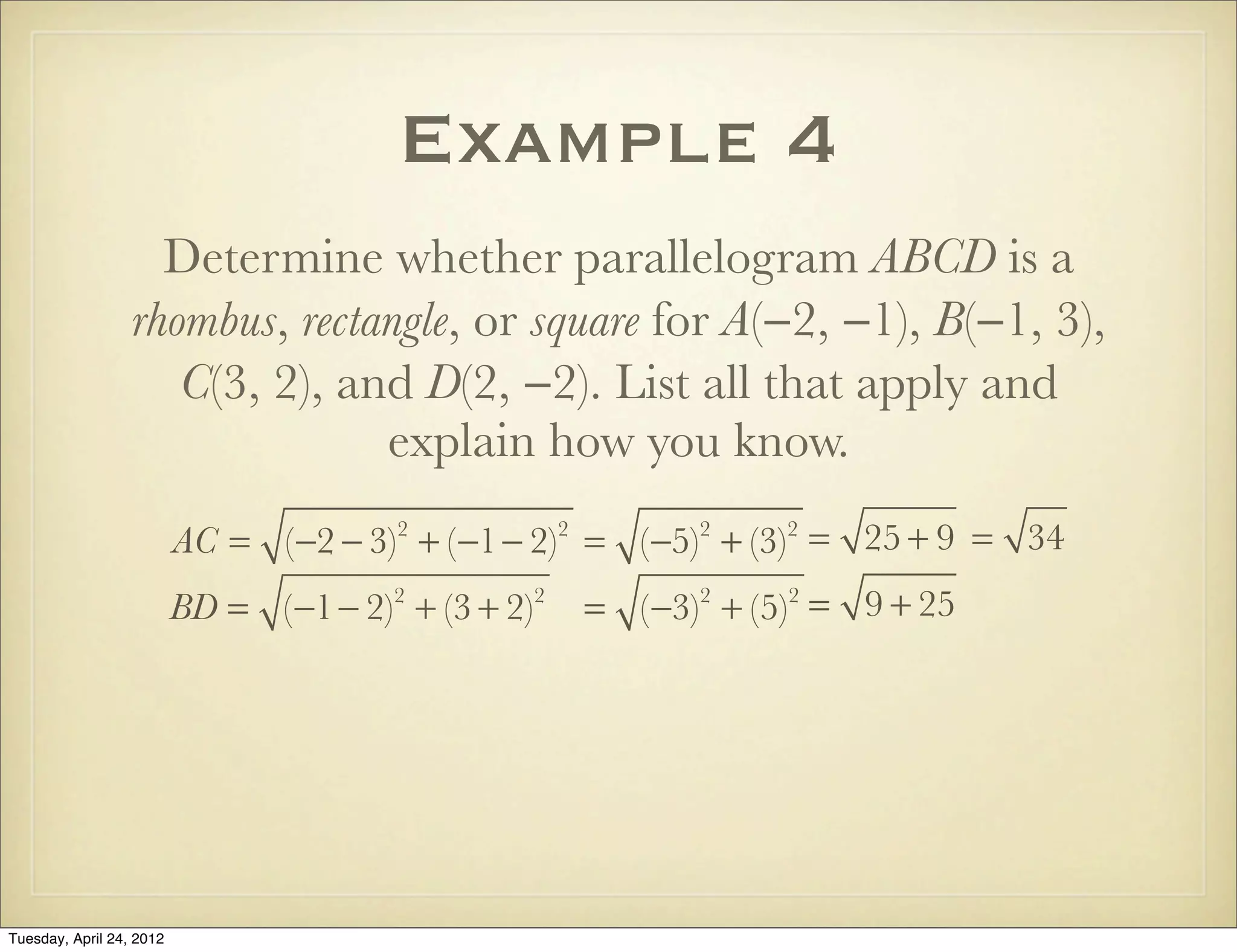
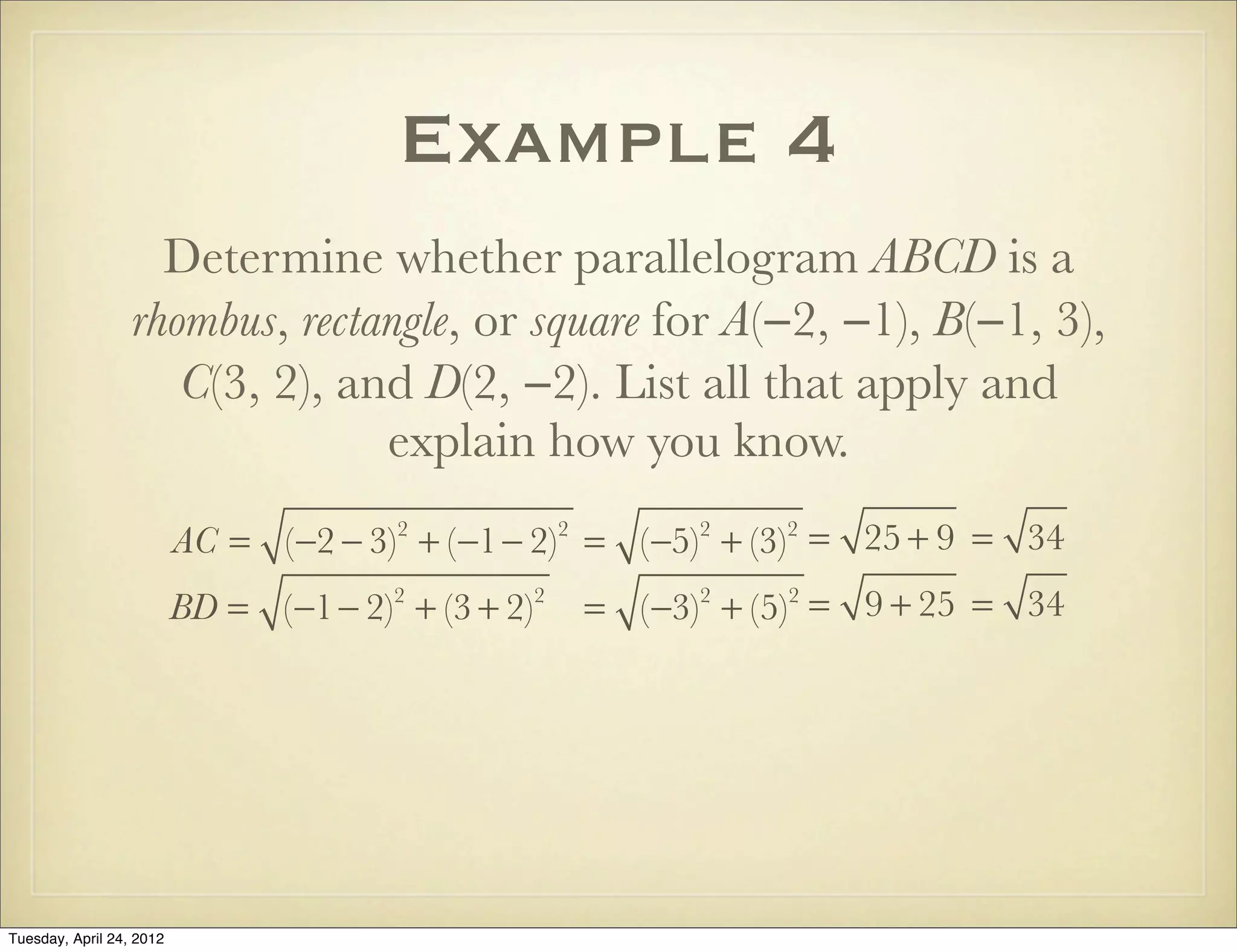
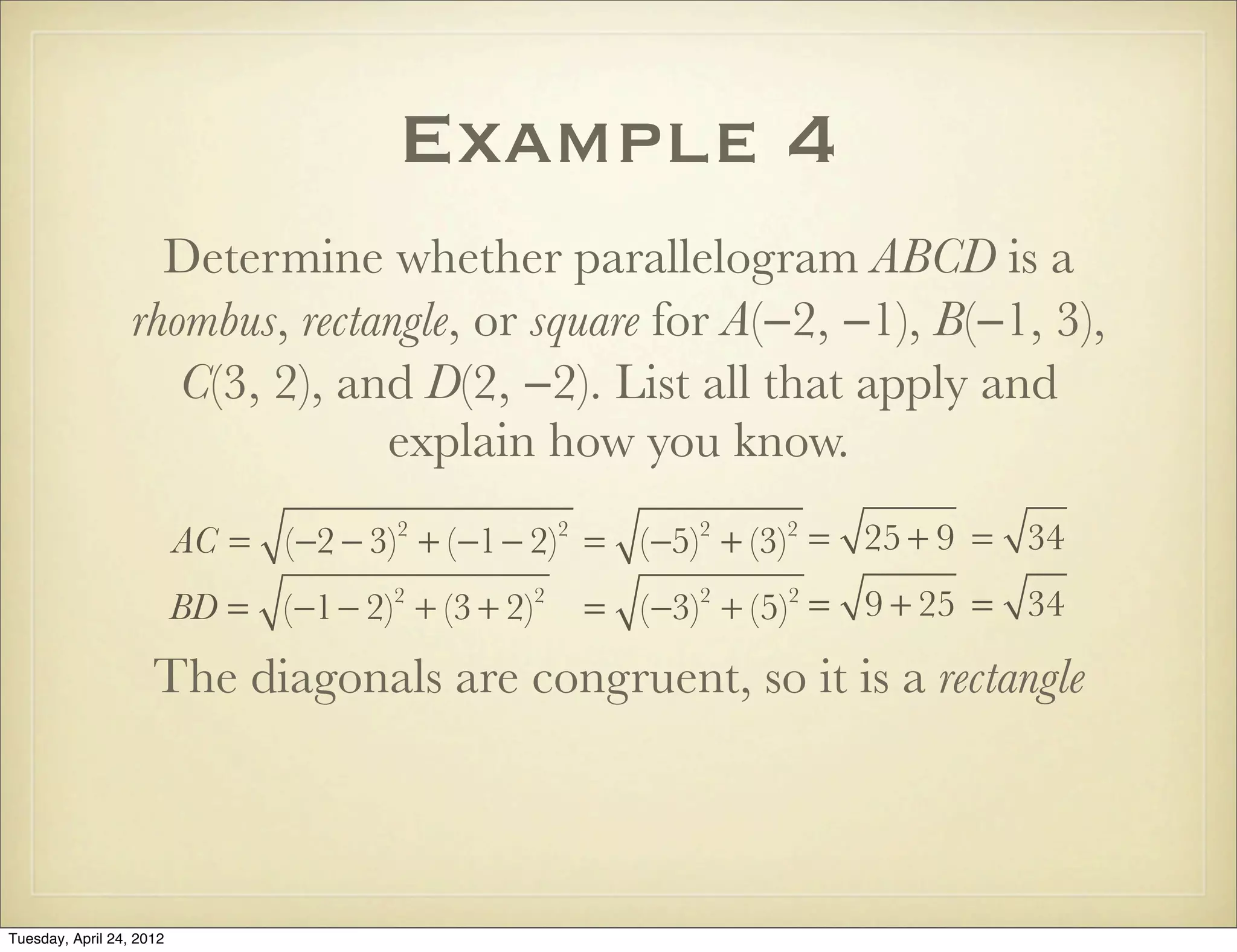
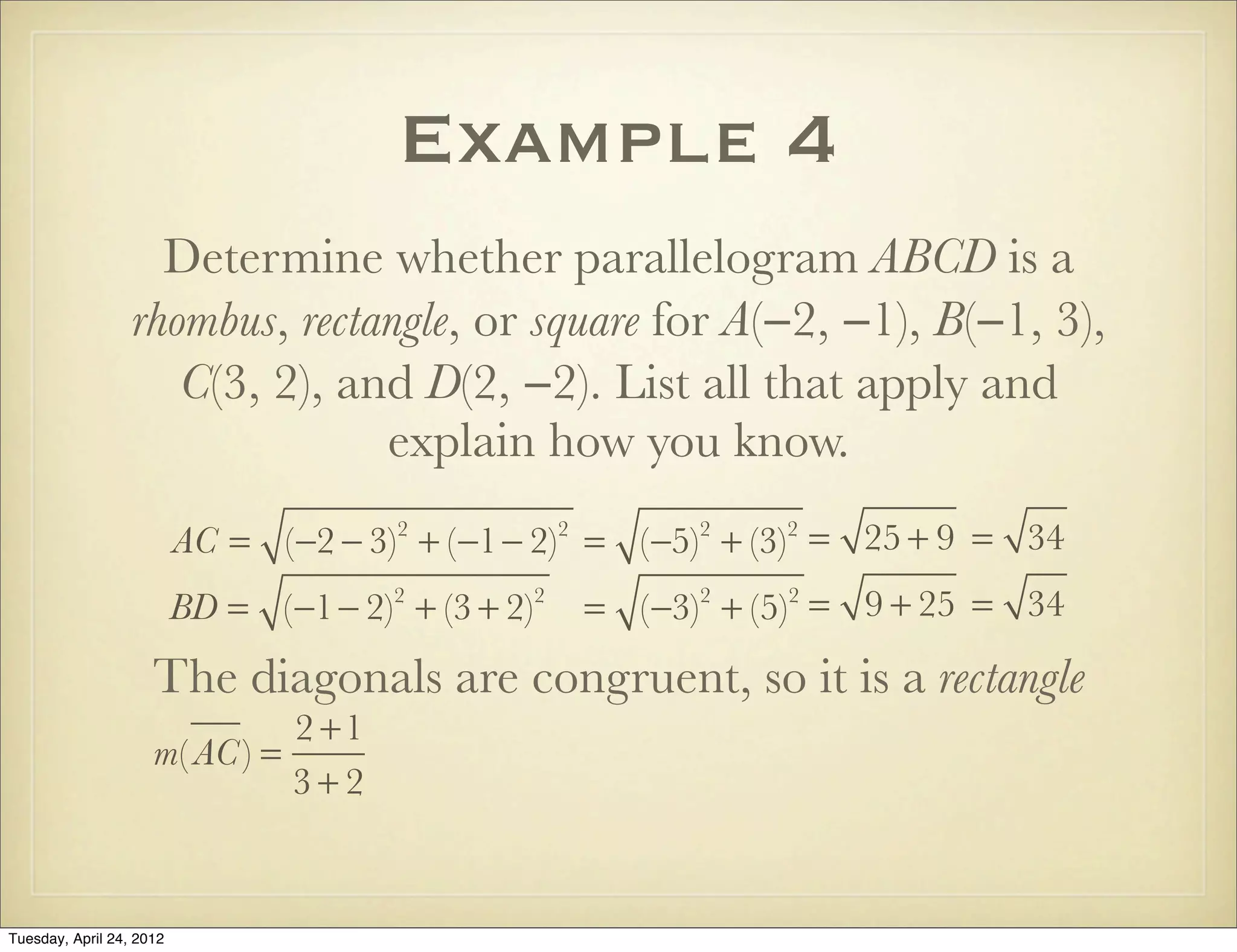
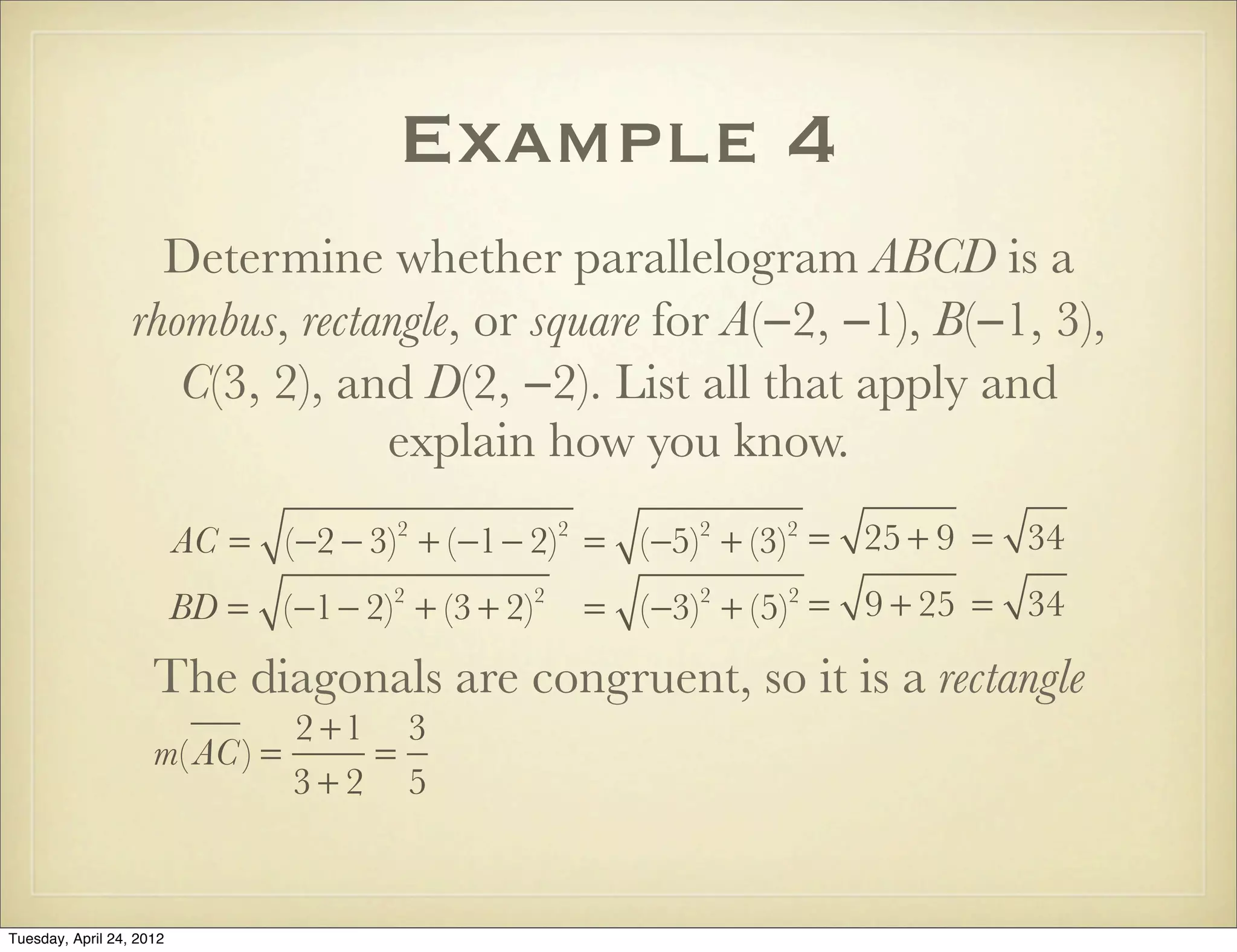
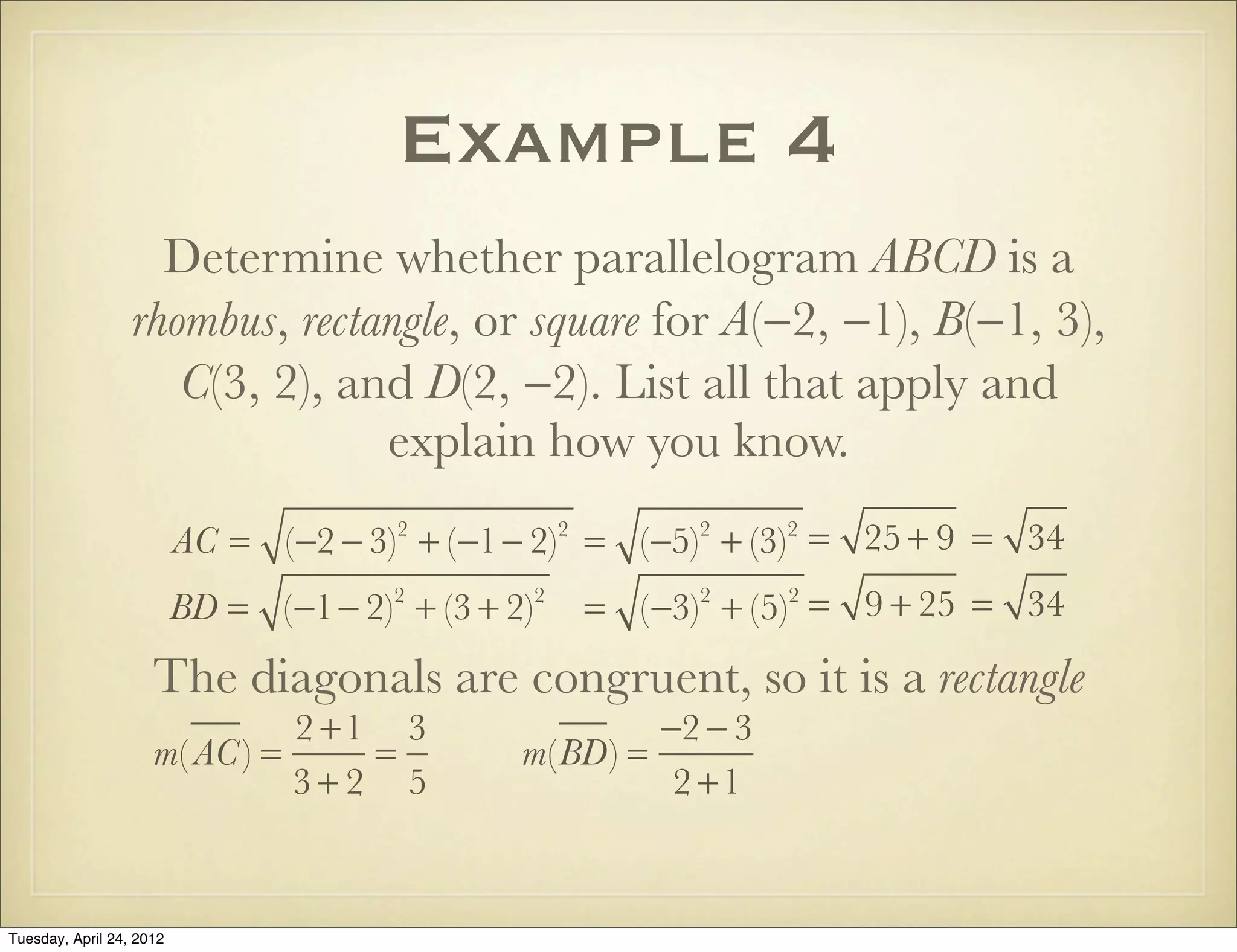
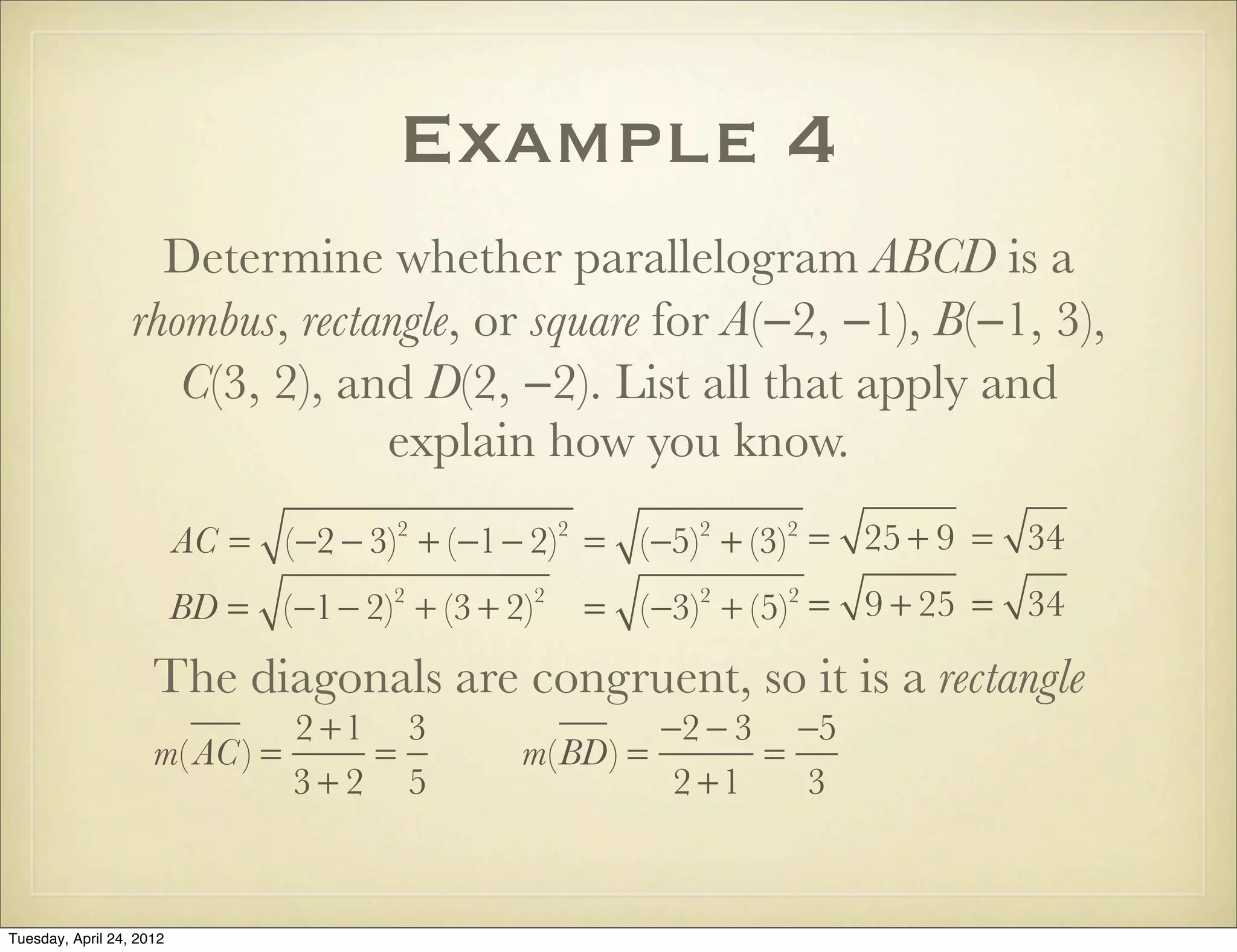
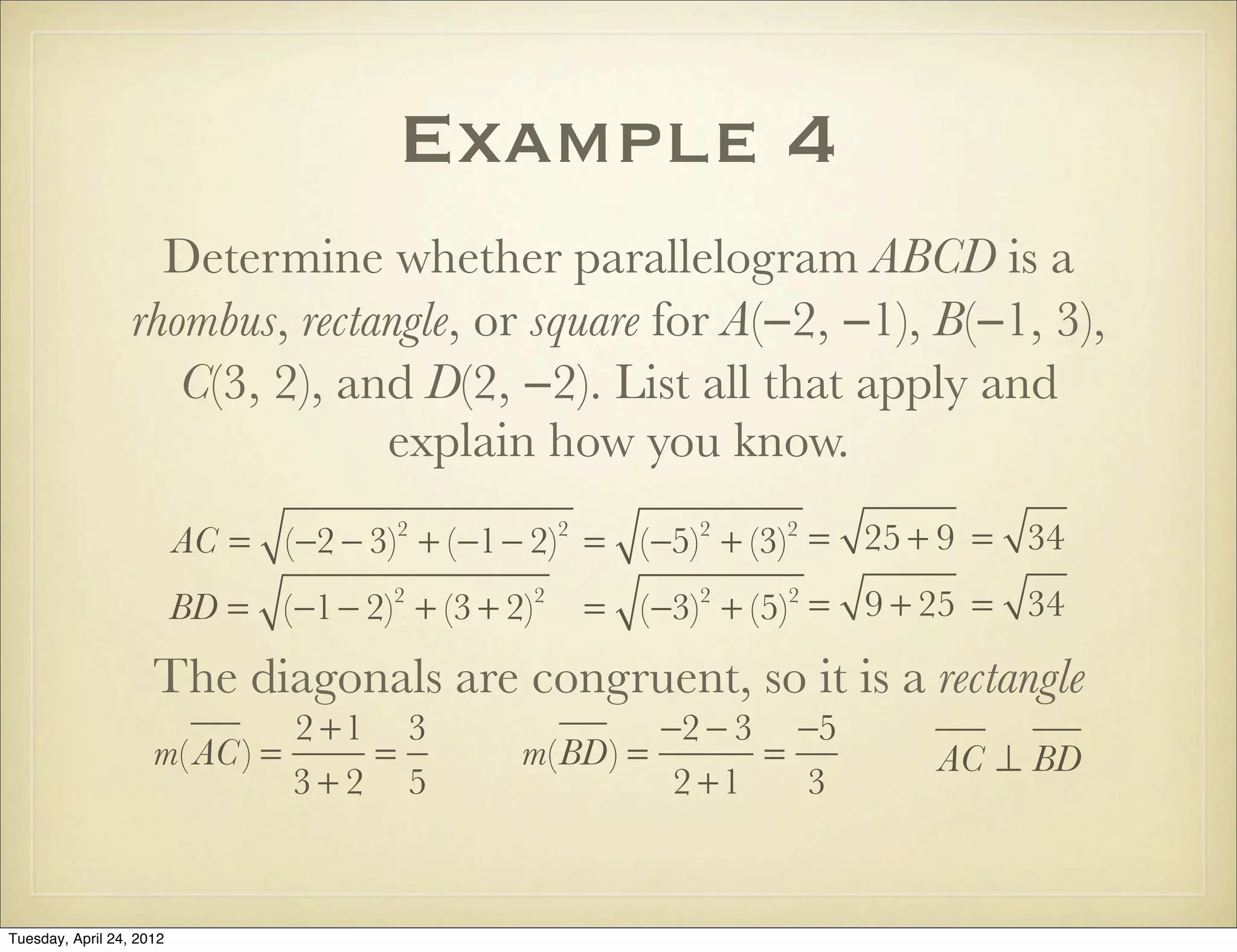
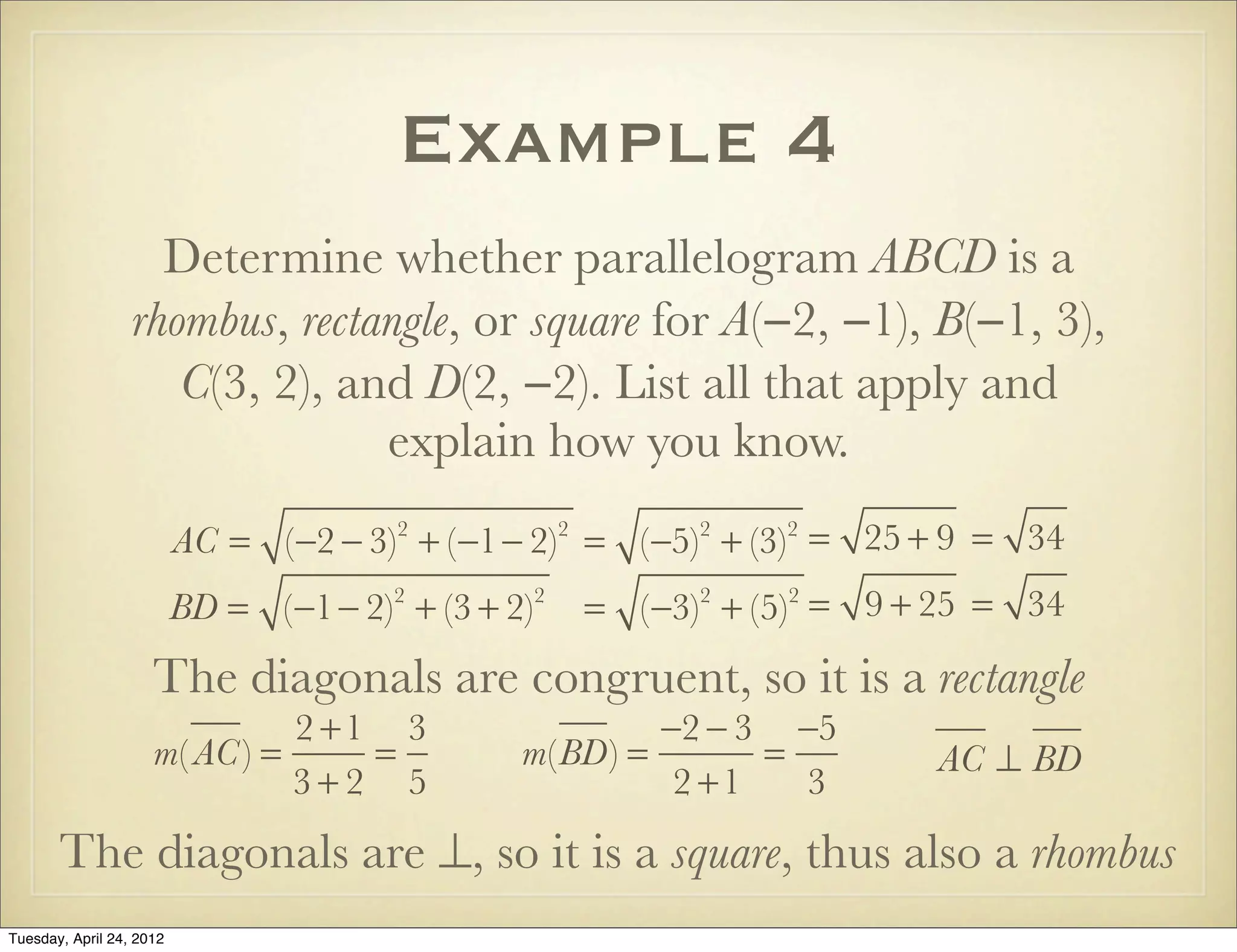
Determine whether parallelogram ABCD is a
rhombus, rectangle, or square for A(−2, −1), B(−1, 3),
C(3, 2), and D(2, −2). List all that apply and
explain how you know.
Tuesday, April 29, 14
Example 4
Determine whether parallelogram ABCD is a
rhombus, rectangle, or square for A(−2, −1), B(−1, 3),
C(3, 2), and D(2, −2). List all that apply and
explain how you know.
AC = (−2 − 3)2
+ (−1− 2)2
Tuesday, April 29, 14
Example 4
Determine whether parallelogram ABCD is a
rhombus, rectangle, or square for A(−2, −1), B(−1, 3),
C(3, 2), and D(2, −2). List all that apply and
explain how you know.
AC = (−2 − 3)2
+ (−1− 2)2
= (−5)2
+ (−3)2
Tuesday, April 29, 14
Example 4
Determine whether parallelogram ABCD is a
rhombus, rectangle, or square for A(−2, −1), B(−1, 3),
C(3, 2), and D(2, −2). List all that apply and
explain how you know.
AC = (−2 − 3)2
+ (−1− 2)2
= (−5)2
+ (−3)2
= 25 + 9
Tuesday, April 29, 14
Example 4
Determine whether parallelogram ABCD is a
rhombus, rectangle, or square for A(−2, −1), B(−1, 3),
C(3, 2), and D(2, −2). List all that apply and
explain how you know.
AC = (−2 − 3)2
+ (−1− 2)2
= (−5)2
+ (−3)2
= 25 + 9 = 34
Tuesday, April 29, 14
Example 4
Determine whether parallelogram ABCD is a
rhombus, rectangle, or square for A(−2, −1), B(−1, 3),
C(3, 2), and D(2, −2). List all that apply and
explain how you know.
AC = (−2 − 3)2
+ (−1− 2)2
= (−5)2
+ (−3)2
= 25 + 9 = 34
BD = (−1− 2)2
+ (3 + 2)2
Tuesday, April 29, 14
Example 4
Determine whether parallelogram ABCD is a
rhombus, rectangle, or square for A(−2, −1), B(−1, 3),
C(3, 2), and D(2, −2). List all that apply and
explain how you know.
AC = (−2 − 3)2
+ (−1− 2)2
= (−5)2
+ (−3)2
= 25 + 9 = 34
BD = (−1− 2)2
+ (3 + 2)2
= (−3)2
+ (5)2
Tuesday, April 29, 14
Example 4
Determine whether parallelogram ABCD is a
rhombus, rectangle, or square for A(−2, −1), B(−1, 3),
C(3, 2), and D(2, −2). List all that apply and
explain how you know.
AC = (−2 − 3)2
+ (−1− 2)2
= (−5)2
+ (−3)2
= 25 + 9 = 34
BD = (−1− 2)2
+ (3 + 2)2
= (−3)2
+ (5)2
= 9 + 25
Tuesday, April 29, 14
Example 4
Determine whether parallelogram ABCD is a
rhombus, rectangle, or square for A(−2, −1), B(−1, 3),
C(3, 2), and D(2, −2). List all that apply and
explain how you know.
AC = (−2 − 3)2
+ (−1− 2)2
= (−5)2
+ (−3)2
= 25 + 9 = 34
BD = (−1− 2)2
+ (3 + 2)2
= (−3)2
+ (5)2
= 9 + 25 = 34
Tuesday, April 29, 14
Example 4
Determine whether parallelogram ABCD is a
rhombus, rectangle, or square for A(−2, −1), B(−1, 3),
C(3, 2), and D(2, −2). List all that apply and
explain how you know.
AC = (−2 − 3)2
+ (−1− 2)2
= (−5)2
+ (−3)2
= 25 + 9 = 34
BD = (−1− 2)2
+ (3 + 2)2
= (−3)2
+ (5)2
= 9 + 25 = 34
The diagonals are congruent, so it is a rectangle
Tuesday, April 29, 14
Example 4
Determine whether parallelogram ABCD is a
rhombus, rectangle, or square for A(−2, −1), B(−1, 3),
C(3, 2), and D(2, −2). List all that apply and
explain how you know.
AC = (−2 − 3)2
+ (−1− 2)2
= (−5)2
+ (−3)2
= 25 + 9 = 34
BD = (−1− 2)2
+ (3 + 2)2
= (−3)2
+ (5)2
= 9 + 25 = 34
The diagonals are congruent, so it is a rectangle
m( AC) =
2 +1
3 + 2
Tuesday, April 29, 14
Example 4
Determine whether parallelogram ABCD is a
rhombus, rectangle, or square for A(−2, −1), B(−1, 3),
C(3, 2), and D(2, −2). List all that apply and
explain how you know.
AC = (−2 − 3)2
+ (−1− 2)2
= (−5)2
+ (−3)2
= 25 + 9 = 34
BD = (−1− 2)2
+ (3 + 2)2
= (−3)2
+ (5)2
= 9 + 25 = 34
The diagonals are congruent, so it is a rectangle
m( AC) =
2 +1
3 + 2
=
3
5
Tuesday, April 29, 14
Example 4
Determine whether parallelogram ABCD is a
rhombus, rectangle, or square for A(−2, −1), B(−1, 3),
C(3, 2), and D(2, −2). List all that apply and
explain how you know.
AC = (−2 − 3)2
+ (−1− 2)2
= (−5)2
+ (−3)2
= 25 + 9 = 34
BD = (−1− 2)2
+ (3 + 2)2
= (−3)2
+ (5)2
= 9 + 25 = 34
The diagonals are congruent, so it is a rectangle
m( AC) =
2 +1
3 + 2
=
3
5
m(BD) =
−2 − 3
2 +1
Tuesday, April 29, 14
Example 4
Determine whether parallelogram ABCD is a
rhombus, rectangle, or square for A(−2, −1), B(−1, 3),
C(3, 2), and D(2, −2). List all that apply and
explain how you know.
AC = (−2 − 3)2
+ (−1− 2)2
= (−5)2
+ (−3)2
= 25 + 9 = 34
BD = (−1− 2)2
+ (3 + 2)2
= (−3)2
+ (5)2
= 9 + 25 = 34
The diagonals are congruent, so it is a rectangle
m( AC) =
2 +1
3 + 2
=
3
5
m(BD) =
−2 − 3
2 +1
=
−5
3
Tuesday, April 29, 14
Example 4
Determine whether parallelogram ABCD is a
rhombus, rectangle, or square for A(−2, −1), B(−1, 3),
C(3, 2), and D(2, −2). List all that apply and
explain how you know.
AC = (−2 − 3)2
+ (−1− 2)2
= (−5)2
+ (−3)2
= 25 + 9 = 34
BD = (−1− 2)2
+ (3 + 2)2
= (−3)2
+ (5)2
= 9 + 25 = 34
The diagonals are congruent, so it is a rectangle
m( AC) =
2 +1
3 + 2
=
3
5
m(BD) =
−2 − 3
2 +1
=
−5
3
AC ⊥ BD
Tuesday, April 29, 14
Example 4
Determine whether parallelogram ABCD is a
rhombus, rectangle, or square for A(−2, −1), B(−1, 3),
C(3, 2), and D(2, −2). List all that apply and
explain how you know.
AC = (−2 − 3)2
+ (−1− 2)2
= (−5)2
+ (−3)2
= 25 + 9 = 34
BD = (−1− 2)2
+ (3 + 2)2
= (−3)2
+ (5)2
= 9 + 25 = 34
The diagonals are congruent, so it is a rectangle
m( AC) =
2 +1
3 + 2
=
3
5
m(BD) =
−2 − 3
2 +1
=
−5
3
AC ⊥ BD
The diagonals are ⊥, so it is a rhombus, thus also a square.
Tuesday, April 29, 14
Problem Set
Tuesday, April 29, 14
Problem Set
p. 431 #1-33 odd, 46, 55, 57, 59
"Courage is saying, 'Maybe what I'm doing isn't
working; maybe I should try something else.'"
- Anna Lappe
Tuesday, April 29, 14

Geometry Section 6-5 1112

  • 1.
    Section 6-5 Rhombi andSquares Tuesday, April 29, 14
  • 2.
    Essential Questions • Howdo you recognize and apply the properties of rhombi and squares? • How do you determine whether quadrilaterals are rectangles, rhombi, or squares? Tuesday, April 29, 14
  • 3.
  • 4.
    Vocabulary 1. Rhombus: Aparallelogram with four congruent sides Properties: 2. Square: Properties: Tuesday, April 29, 14
  • 5.
    Vocabulary 1. Rhombus: Aparallelogram with four congruent sides Properties: All properties of parallelograms plus four congruent sides, perpendicular diagonals, and angles that are bisected by the diagonals 2. Square: Properties: Tuesday, April 29, 14
  • 6.
    Vocabulary 1. Rhombus: Aparallelogram with four congruent sides Properties: All properties of parallelograms plus four congruent sides, perpendicular diagonals, and angles that are bisected by the diagonals 2. Square: A parallelogram with four congruent sides and four right angles Properties: Tuesday, April 29, 14
  • 7.
    Vocabulary 1. Rhombus: Aparallelogram with four congruent sides Properties: All properties of parallelograms plus four congruent sides, perpendicular diagonals, and angles that are bisected by the diagonals 2. Square: A parallelogram with four congruent sides and four right angles Properties: All properties of parallelograms, rectangles, and rhombi Tuesday, April 29, 14
  • 8.
    Theorems Diagonals of aRhombus 6.15: 6.16: Tuesday, April 29, 14
  • 9.
    Theorems Diagonals of aRhombus 6.15: If a parallelogram is a rhombus, then its diagonals are perpendicular 6.16: Tuesday, April 29, 14
  • 10.
    Theorems Diagonals of aRhombus 6.15: If a parallelogram is a rhombus, then its diagonals are perpendicular 6.16: If a parallelogram is a rhombus, then each diagonal bisects a pair of opposite angles Tuesday, April 29, 14
  • 11.
    Theorems Conditions for Rhombiand Squares 6.17: 6.18: 6.19: Tuesday, April 29, 14
  • 12.
    Theorems Conditions for Rhombiand Squares 6.17: If the diagonals of a parallelogram are perpendicular, then the parallelogram is a rhombus 6.18: 6.19: Tuesday, April 29, 14
  • 13.
    Theorems Conditions for Rhombiand Squares 6.17: If the diagonals of a parallelogram are perpendicular, then the parallelogram is a rhombus 6.18: If one diagonal of a parallelogram bisects a pair of opposite angles, then the parallelogram is a rhombus 6.19: Tuesday, April 29, 14
  • 14.
    Theorems Conditions for Rhombiand Squares 6.17: If the diagonals of a parallelogram are perpendicular, then the parallelogram is a rhombus 6.18: If one diagonal of a parallelogram bisects a pair of opposite angles, then the parallelogram is a rhombus 6.19: If one pair of consecutive sides of a parallelogram are congruent, then the parallelogram is a rhombus Tuesday, April 29, 14
  • 15.
    Theorems Conditions for Rhombiand Squares 6.20: Tuesday, April 29, 14
  • 16.
    Theorems Conditions for Rhombiand Squares 6.20: If a quadrilateral is both a rectangle and a rhombus, then it is a square Tuesday, April 29, 14
  • 17.
    Example 1 The diagonalsof a rhombus WXYZ intersect at V. Use the given information to find each measure or value. a. If m∠WZX = 39.5°, find m∠ZYX. Tuesday, April 29, 14
  • 18.
    Example 1 The diagonalsof a rhombus WXYZ intersect at V. Use the given information to find each measure or value. a. If m∠WZX = 39.5°, find m∠ZYX. Since m∠WZX = 39.5°, we know that m∠WZY = 79°. Tuesday, April 29, 14
  • 19.
    Example 1 The diagonalsof a rhombus WXYZ intersect at V. Use the given information to find each measure or value. a. If m∠WZX = 39.5°, find m∠ZYX. Since m∠WZX = 39.5°, we know that m∠WZY = 79°. 180° − 79° Tuesday, April 29, 14
  • 20.
    Example 1 The diagonalsof a rhombus WXYZ intersect at V. Use the given information to find each measure or value. a. If m∠WZX = 39.5°, find m∠ZYX. Since m∠WZX = 39.5°, we know that m∠WZY = 79°. 180° − 79° = 101° Tuesday, April 29, 14
  • 21.
    Example 1 The diagonalsof a rhombus WXYZ intersect at V. Use the given information to find each measure or value. a. If m∠WZX = 39.5°, find m∠ZYX. Since m∠WZX = 39.5°, we know that m∠WZY = 79°. 180° − 79° = 101° m∠ZYX = 101° Tuesday, April 29, 14
  • 22.
    Example 1 The diagonalsof a rhombus WXYZ intersect at V. Use the given information to find each measure or value. b. If WX = 8x − 5 and WZ = 6x + 3, find x. Tuesday, April 29, 14
  • 23.
    Example 1 The diagonalsof a rhombus WXYZ intersect at V. Use the given information to find each measure or value. b. If WX = 8x − 5 and WZ = 6x + 3, find x. WX = WZ Tuesday, April 29, 14
  • 24.
    Example 1 The diagonalsof a rhombus WXYZ intersect at V. Use the given information to find each measure or value. b. If WX = 8x − 5 and WZ = 6x + 3, find x. WX = WZ 8x − 5 = 6x + 3 Tuesday, April 29, 14
  • 25.
    Example 1 The diagonalsof a rhombus WXYZ intersect at V. Use the given information to find each measure or value. b. If WX = 8x − 5 and WZ = 6x + 3, find x. WX = WZ 8x − 5 = 6x + 3 2x = 8 Tuesday, April 29, 14
  • 26.
    Example 1 The diagonalsof a rhombus WXYZ intersect at V. Use the given information to find each measure or value. b. If WX = 8x − 5 and WZ = 6x + 3, find x. WX = WZ 8x − 5 = 6x + 3 2x = 8 x = 4 Tuesday, April 29, 14
  • 27.
    Example 2 Given: LMNPis a parallelogram, ∠1 ≅ ∠2, and ∠2 ≅ ∠6 Prove: LMNP is a rhombus Tuesday, April 29, 14
  • 28.
    Example 2 Given: LMNPis a parallelogram, ∠1 ≅ ∠2, and ∠2 ≅ ∠6 Prove: LMNP is a rhombus 1. LMNP is a parallelogram, ∠1 ≅ ∠2, and ∠2 ≅ ∠6 Tuesday, April 29, 14
  • 29.
    Example 2 Given: LMNPis a parallelogram, ∠1 ≅ ∠2, and ∠2 ≅ ∠6 Prove: LMNP is a rhombus 1. LMNP is a parallelogram, ∠1 ≅ ∠2, and ∠2 ≅ ∠6 1. Given Tuesday, April 29, 14
  • 30.
    Example 2 Given: LMNPis a parallelogram, ∠1 ≅ ∠2, and ∠2 ≅ ∠6 Prove: LMNP is a rhombus 1. LMNP is a parallelogram, ∠1 ≅ ∠2, and ∠2 ≅ ∠6 1. Given 2. LM ∣∣ PN and MN ∣∣ PL Tuesday, April 29, 14
  • 31.
    Example 2 Given: LMNPis a parallelogram, ∠1 ≅ ∠2, and ∠2 ≅ ∠6 Prove: LMNP is a rhombus 1. LMNP is a parallelogram, ∠1 ≅ ∠2, and ∠2 ≅ ∠6 1. Given 2. Def. of parallelogram2. LM ∣∣ PN and MN ∣∣ PL Tuesday, April 29, 14
  • 32.
    Example 2 Given: LMNPis a parallelogram, ∠1 ≅ ∠2, and ∠2 ≅ ∠6 Prove: LMNP is a rhombus 1. LMNP is a parallelogram, ∠1 ≅ ∠2, and ∠2 ≅ ∠6 1. Given 2. Def. of parallelogram 3. ∠5 ≅ ∠1 2. LM ∣∣ PN and MN ∣∣ PL Tuesday, April 29, 14
  • 33.
    Example 2 Given: LMNPis a parallelogram, ∠1 ≅ ∠2, and ∠2 ≅ ∠6 Prove: LMNP is a rhombus 1. LMNP is a parallelogram, ∠1 ≅ ∠2, and ∠2 ≅ ∠6 1. Given 2. Def. of parallelogram 3. ∠5 ≅ ∠1 3. Alt. int. ∠’s of ∣∣ lines ≅ 2. LM ∣∣ PN and MN ∣∣ PL Tuesday, April 29, 14
  • 34.
    Example 2 Given: LMNPis a parallelogram, ∠1 ≅ ∠2, and ∠2 ≅ ∠6 Prove: LMNP is a rhombus 1. LMNP is a parallelogram, ∠1 ≅ ∠2, and ∠2 ≅ ∠6 1. Given 2. Def. of parallelogram 3. ∠5 ≅ ∠1 3. Alt. int. ∠’s of ∣∣ lines ≅ 4. ∠1 ≅ ∠ 6 and ∠6 ≅ ∠5 2. LM ∣∣ PN and MN ∣∣ PL Tuesday, April 29, 14
  • 35.
    Example 2 Given: LMNPis a parallelogram, ∠1 ≅ ∠2, and ∠2 ≅ ∠6 Prove: LMNP is a rhombus 1. LMNP is a parallelogram, ∠1 ≅ ∠2, and ∠2 ≅ ∠6 1. Given 2. Def. of parallelogram 3. ∠5 ≅ ∠1 3. Alt. int. ∠’s of ∣∣ lines ≅ 4. ∠1 ≅ ∠ 6 and ∠6 ≅ ∠5 4. Transitive 2. LM ∣∣ PN and MN ∣∣ PL Tuesday, April 29, 14
  • 36.
    Example 2 Given: LMNPis a parallelogram, ∠1 ≅ ∠2, and ∠2 ≅ ∠6 Prove: LMNP is a rhombus 1. LMNP is a parallelogram, ∠1 ≅ ∠2, and ∠2 ≅ ∠6 1. Given 2. Def. of parallelogram 3. ∠5 ≅ ∠1 3. Alt. int. ∠’s of ∣∣ lines ≅ 4. ∠1 ≅ ∠ 6 and ∠6 ≅ ∠5 4. Transitive 5. LMNP is a rhombus 2. LM ∣∣ PN and MN ∣∣ PL Tuesday, April 29, 14
  • 37.
    Example 2 Given: LMNPis a parallelogram, ∠1 ≅ ∠2, and ∠2 ≅ ∠6 Prove: LMNP is a rhombus 1. LMNP is a parallelogram, ∠1 ≅ ∠2, and ∠2 ≅ ∠6 1. Given 2. Def. of parallelogram 3. ∠5 ≅ ∠1 3. Alt. int. ∠’s of ∣∣ lines ≅ 4. ∠1 ≅ ∠ 6 and ∠6 ≅ ∠5 4. Transitive 5. LMNP is a rhombus 5. One diagonal bisects opposite angles 2. LM ∣∣ PN and MN ∣∣ PL Tuesday, April 29, 14
  • 38.
    Example 3 Matt Mitarnowskiis measuring the boundary of a new garden. He wants the garden to be square. He has set each of the corner stakes 6 feet apart. What does Matt need to know to make sure that the garden is a square? Tuesday, April 29, 14
  • 39.
    Example 3 Matt Mitarnowskiis measuring the boundary of a new garden. He wants the garden to be square. He has set each of the corner stakes 6 feet apart. What does Matt need to know to make sure that the garden is a square? Matt knows he at least has a rhombus as all four sides are congruent. To make it a square, it must also be a rectangle, so the diagonals must also be congruent, as anything that is both a rhombus and a rectangle is also a square. Tuesday, April 29, 14
  • 40.
    Example 4 Determine whetherparallelogram ABCD is a rhombus, rectangle, or square for A(−2, −1), B(−1, 3), C(3, 2), and D(2, −2). List all that apply and explain how you know. Tuesday, April 29, 14
  • 41.
    Example 4 Determine whetherparallelogram ABCD is a rhombus, rectangle, or square for A(−2, −1), B(−1, 3), C(3, 2), and D(2, −2). List all that apply and explain how you know. AC = (−2 − 3)2 + (−1− 2)2 Tuesday, April 29, 14
  • 42.
    Example 4 Determine whetherparallelogram ABCD is a rhombus, rectangle, or square for A(−2, −1), B(−1, 3), C(3, 2), and D(2, −2). List all that apply and explain how you know. AC = (−2 − 3)2 + (−1− 2)2 = (−5)2 + (−3)2 Tuesday, April 29, 14
  • 43.
    Example 4 Determine whetherparallelogram ABCD is a rhombus, rectangle, or square for A(−2, −1), B(−1, 3), C(3, 2), and D(2, −2). List all that apply and explain how you know. AC = (−2 − 3)2 + (−1− 2)2 = (−5)2 + (−3)2 = 25 + 9 Tuesday, April 29, 14
  • 44.
    Example 4 Determine whetherparallelogram ABCD is a rhombus, rectangle, or square for A(−2, −1), B(−1, 3), C(3, 2), and D(2, −2). List all that apply and explain how you know. AC = (−2 − 3)2 + (−1− 2)2 = (−5)2 + (−3)2 = 25 + 9 = 34 Tuesday, April 29, 14
  • 45.
    Example 4 Determine whetherparallelogram ABCD is a rhombus, rectangle, or square for A(−2, −1), B(−1, 3), C(3, 2), and D(2, −2). List all that apply and explain how you know. AC = (−2 − 3)2 + (−1− 2)2 = (−5)2 + (−3)2 = 25 + 9 = 34 BD = (−1− 2)2 + (3 + 2)2 Tuesday, April 29, 14
  • 46.
    Example 4 Determine whetherparallelogram ABCD is a rhombus, rectangle, or square for A(−2, −1), B(−1, 3), C(3, 2), and D(2, −2). List all that apply and explain how you know. AC = (−2 − 3)2 + (−1− 2)2 = (−5)2 + (−3)2 = 25 + 9 = 34 BD = (−1− 2)2 + (3 + 2)2 = (−3)2 + (5)2 Tuesday, April 29, 14
  • 47.
    Example 4 Determine whetherparallelogram ABCD is a rhombus, rectangle, or square for A(−2, −1), B(−1, 3), C(3, 2), and D(2, −2). List all that apply and explain how you know. AC = (−2 − 3)2 + (−1− 2)2 = (−5)2 + (−3)2 = 25 + 9 = 34 BD = (−1− 2)2 + (3 + 2)2 = (−3)2 + (5)2 = 9 + 25 Tuesday, April 29, 14
  • 48.
    Example 4 Determine whetherparallelogram ABCD is a rhombus, rectangle, or square for A(−2, −1), B(−1, 3), C(3, 2), and D(2, −2). List all that apply and explain how you know. AC = (−2 − 3)2 + (−1− 2)2 = (−5)2 + (−3)2 = 25 + 9 = 34 BD = (−1− 2)2 + (3 + 2)2 = (−3)2 + (5)2 = 9 + 25 = 34 Tuesday, April 29, 14
  • 49.
    Example 4 Determine whetherparallelogram ABCD is a rhombus, rectangle, or square for A(−2, −1), B(−1, 3), C(3, 2), and D(2, −2). List all that apply and explain how you know. AC = (−2 − 3)2 + (−1− 2)2 = (−5)2 + (−3)2 = 25 + 9 = 34 BD = (−1− 2)2 + (3 + 2)2 = (−3)2 + (5)2 = 9 + 25 = 34 The diagonals are congruent, so it is a rectangle Tuesday, April 29, 14
  • 50.
    Example 4 Determine whetherparallelogram ABCD is a rhombus, rectangle, or square for A(−2, −1), B(−1, 3), C(3, 2), and D(2, −2). List all that apply and explain how you know. AC = (−2 − 3)2 + (−1− 2)2 = (−5)2 + (−3)2 = 25 + 9 = 34 BD = (−1− 2)2 + (3 + 2)2 = (−3)2 + (5)2 = 9 + 25 = 34 The diagonals are congruent, so it is a rectangle m( AC) = 2 +1 3 + 2 Tuesday, April 29, 14
  • 51.
    Example 4 Determine whetherparallelogram ABCD is a rhombus, rectangle, or square for A(−2, −1), B(−1, 3), C(3, 2), and D(2, −2). List all that apply and explain how you know. AC = (−2 − 3)2 + (−1− 2)2 = (−5)2 + (−3)2 = 25 + 9 = 34 BD = (−1− 2)2 + (3 + 2)2 = (−3)2 + (5)2 = 9 + 25 = 34 The diagonals are congruent, so it is a rectangle m( AC) = 2 +1 3 + 2 = 3 5 Tuesday, April 29, 14
  • 52.
    Example 4 Determine whetherparallelogram ABCD is a rhombus, rectangle, or square for A(−2, −1), B(−1, 3), C(3, 2), and D(2, −2). List all that apply and explain how you know. AC = (−2 − 3)2 + (−1− 2)2 = (−5)2 + (−3)2 = 25 + 9 = 34 BD = (−1− 2)2 + (3 + 2)2 = (−3)2 + (5)2 = 9 + 25 = 34 The diagonals are congruent, so it is a rectangle m( AC) = 2 +1 3 + 2 = 3 5 m(BD) = −2 − 3 2 +1 Tuesday, April 29, 14
  • 53.
    Example 4 Determine whetherparallelogram ABCD is a rhombus, rectangle, or square for A(−2, −1), B(−1, 3), C(3, 2), and D(2, −2). List all that apply and explain how you know. AC = (−2 − 3)2 + (−1− 2)2 = (−5)2 + (−3)2 = 25 + 9 = 34 BD = (−1− 2)2 + (3 + 2)2 = (−3)2 + (5)2 = 9 + 25 = 34 The diagonals are congruent, so it is a rectangle m( AC) = 2 +1 3 + 2 = 3 5 m(BD) = −2 − 3 2 +1 = −5 3 Tuesday, April 29, 14
  • 54.
    Example 4 Determine whetherparallelogram ABCD is a rhombus, rectangle, or square for A(−2, −1), B(−1, 3), C(3, 2), and D(2, −2). List all that apply and explain how you know. AC = (−2 − 3)2 + (−1− 2)2 = (−5)2 + (−3)2 = 25 + 9 = 34 BD = (−1− 2)2 + (3 + 2)2 = (−3)2 + (5)2 = 9 + 25 = 34 The diagonals are congruent, so it is a rectangle m( AC) = 2 +1 3 + 2 = 3 5 m(BD) = −2 − 3 2 +1 = −5 3 AC ⊥ BD Tuesday, April 29, 14
  • 55.
    Example 4 Determine whetherparallelogram ABCD is a rhombus, rectangle, or square for A(−2, −1), B(−1, 3), C(3, 2), and D(2, −2). List all that apply and explain how you know. AC = (−2 − 3)2 + (−1− 2)2 = (−5)2 + (−3)2 = 25 + 9 = 34 BD = (−1− 2)2 + (3 + 2)2 = (−3)2 + (5)2 = 9 + 25 = 34 The diagonals are congruent, so it is a rectangle m( AC) = 2 +1 3 + 2 = 3 5 m(BD) = −2 − 3 2 +1 = −5 3 AC ⊥ BD The diagonals are ⊥, so it is a rhombus, thus also a square. Tuesday, April 29, 14
  • 56.
  • 57.
    Problem Set p. 431#1-33 odd, 46, 55, 57, 59 "Courage is saying, 'Maybe what I'm doing isn't working; maybe I should try something else.'" - Anna Lappe Tuesday, April 29, 14