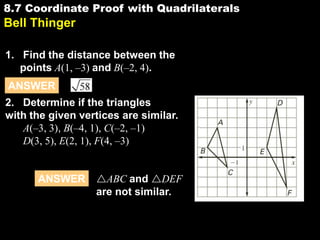
8.7 Coordinate Proof with Quadrilaterals

8.7

Bell Thinger
1. Find the distance between the
points A(1, –3) and B(–2, 4).

ANSWER
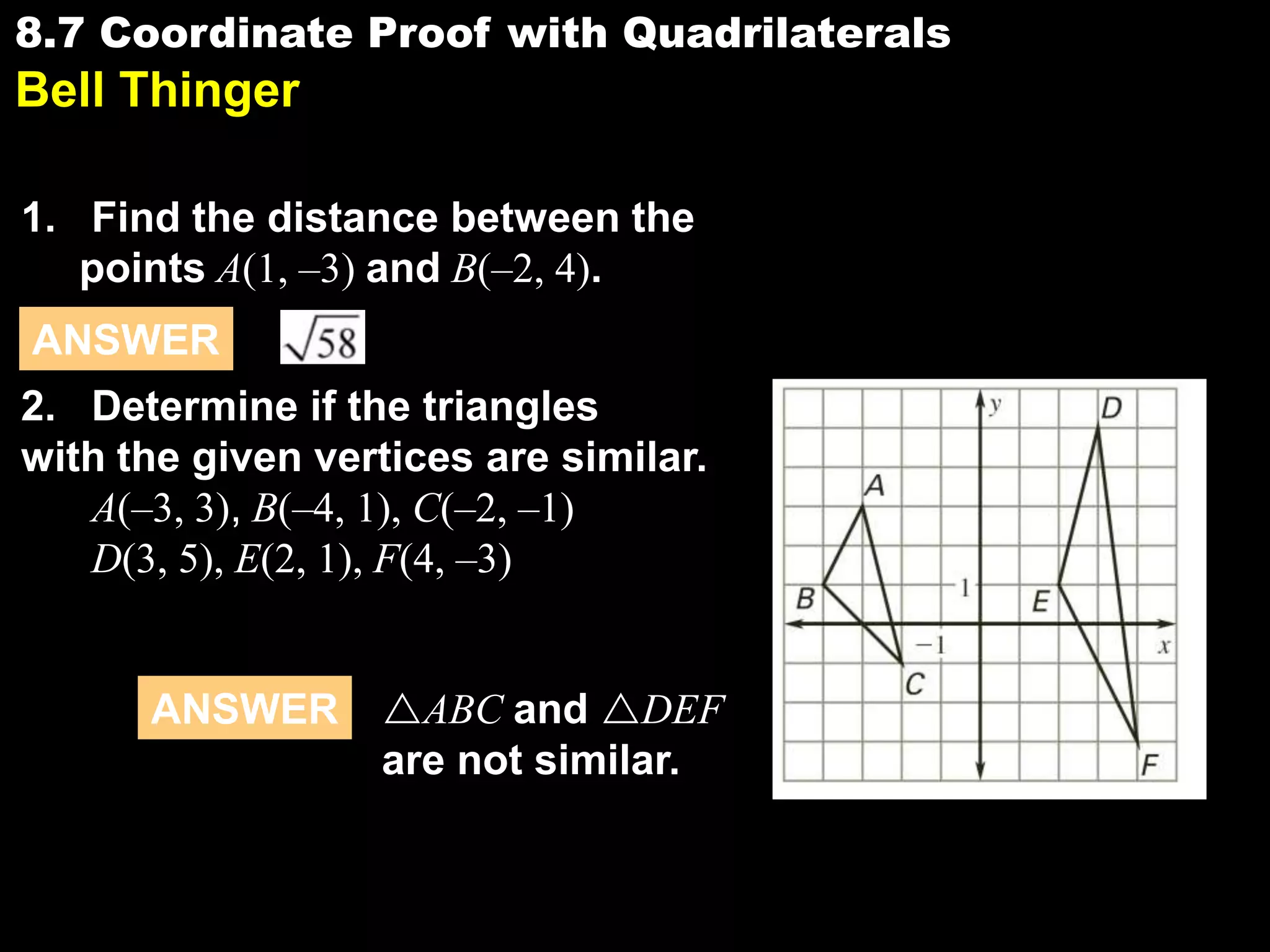
2. Determine if the triangles
with the given vertices are similar.
A(–3, 3), B(–4, 1), C(–2, –1)
D(3, 5), E(2, 1), F(4, –3)

ANSWER

ABC and DEF
are not similar.
8.7

Example 1

Determine if the quadrilaterals with the given
vertices are congruent.
O(0, 0), B(1, 3), C(3, 3), D(2, 0);
E(4, 0), F(5, 3), G(7, 3), H(6, 0)

SOLUTION
Graph the quadrilaterals. Show
that corresponding sides and
angles are congruent.
Use the Distance Formula.
OB = DC = EF = HG =
OD = BC = EH = FG = 2
Since both pairs of opposite sides in each quadrilateral
are congruent, OBCD and EFGH are parallelograms.
8.7

Example 1

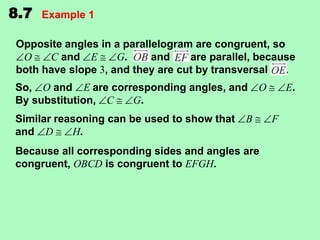
Opposite angles in a parallelogram are congruent, so
O
C and E
G.
and
are parallel, because
both have slope 3, and they are cut by transversal
.

So, O and E are corresponding angles, and
By substitution, C
G.
Similar reasoning can be used to show that
and D
H.

O

B

Because all corresponding sides and angles are
congruent, OBCD is congruent to EFGH.

E.
F
8.7

Guided Practice

Find all side lengths of the quadrilaterals with the
given vertices. Then determine if the quadrilaterals are
congruent.
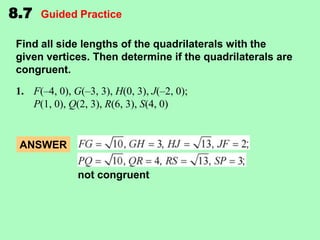
1. F(–4, 0), G(–3, 3), H(0, 3), J(–2, 0);
P(1, 0), Q(2, 3), R(6, 3), S(4, 0)

ANSWER
not congruent
8.7

Guided Practice

Find all side lengths of the quadrilaterals with the
given vertices. Then determine if the quadrilaterals are
congruent.
2. A(–2, –2), B(–2, 2), C(2, 2), D(2, –2);
O(0, 0), X(0, 4), Y(4, 4), Z(4, 0)

ANSWER

AB = BC = CD = DA = OX = XY = YZ = ZO = 4;
all angles are right angles; congruent
8.7

Example 2

Determine if the quadrilaterals with the given
vertices are similar.
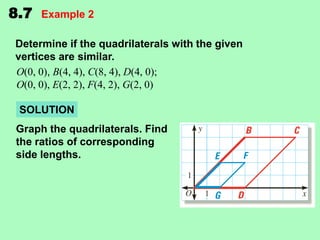
O(0, 0), B(4, 4), C(8, 4), D(4, 0);
O(0, 0), E(2, 2), F(4, 2), G(2, 0)
SOLUTION
Graph the quadrilaterals. Find
the ratios of corresponding
side lengths.
8.7

Example 2

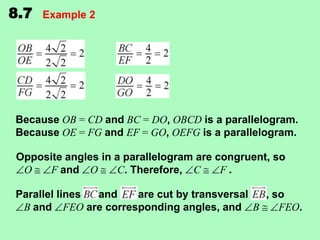
Because OB = CD and BC = DO, OBCD is a parallelogram.
Because OE = FG and EF = GO, OEFG is a parallelogram.

Opposite angles in a parallelogram are congruent, so
O
F and O
C. Therefore, C
F.
Parallel lines
and
are cut by transversal
, so
B and FEO are corresponding angles, and B
FEO.
8.7

Example 2

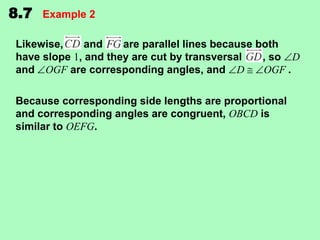
Likewise,
and
are parallel lines because both
have slope 1, and they are cut by transversal
, so D
and OGF are corresponding angles, and D
OGF .
Because corresponding side lengths are proportional
and corresponding angles are congruent, OBCD is
similar to OEFG.
8.7

Example 3

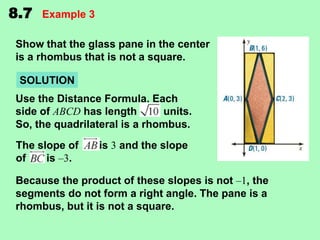
Show that the glass pane in the center
is a rhombus that is not a square.
SOLUTION
Use the Distance Formula. Each
side of ABCD has length
units.
So, the quadrilateral is a rhombus.
The slope of
of
is –3.

is 3 and the slope

Because the product of these slopes is not –1, the
segments do not form a right angle. The pane is a
rhombus, but it is not a square.
8.7

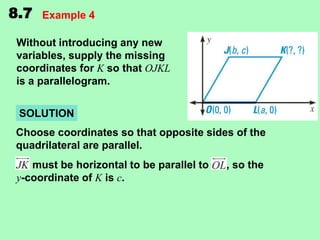
Example 4

Without introducing any new
variables, supply the missing
coordinates for K so that OJKL
is a parallelogram.

SOLUTION
Choose coordinates so that opposite sides of the
quadrilateral are parallel.

must be horizontal to be parallel to
y-coordinate of K is c.

, so the
8.7

Example 4

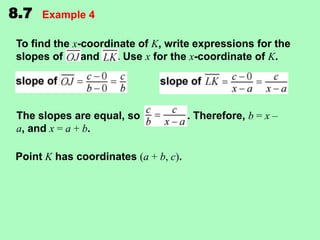
To find the x-coordinate of K, write expressions for the
slopes of
and
. Use x for the x-coordinate of K.

The slopes are equal, so
a, and x = a + b.
Point K has coordinates (a + b, c).

. Therefore, b = x –
8.7

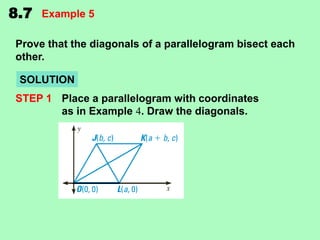
Example 5

Prove that the diagonals of a parallelogram bisect each
other.
SOLUTION
STEP 1 Place a parallelogram with coordinates
as in Example 4. Draw the diagonals.
8.7

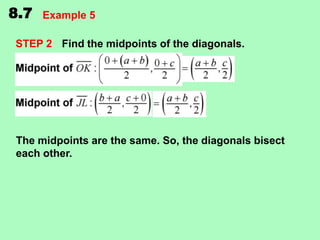
Example 5

STEP 2 Find the midpoints of the diagonals.

The midpoints are the same. So, the diagonals bisect
each other.
8.7

Guided Practice

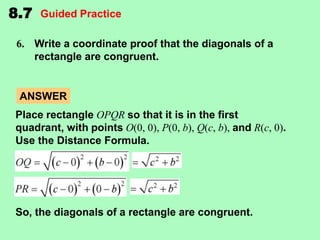
6. Write a coordinate proof that the diagonals of a
rectangle are congruent.

ANSWER
Place rectangle OPQR so that it is in the first
quadrant, with points O(0, 0), P(0, b), Q(c, b), and R(c, 0).
Use the Distance Formula.

So, the diagonals of a rectangle are congruent.
Exit
8.7 Slip
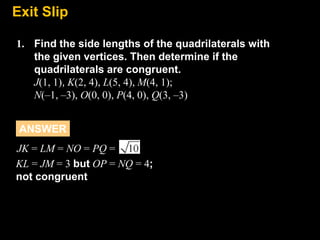
1. Find the side lengths of the quadrilaterals with
the given vertices. Then determine if the
quadrilaterals are congruent.
J(1, 1), K(2, 4), L(5, 4), M(4, 1);
N(–1, –3), O(0, 0), P(4, 0), Q(3, –3)
ANSWER
JK = LM = NO = PQ =
KL = JM = 3 but OP = NQ = 4;
not congruent
Exit
8.7 Slip
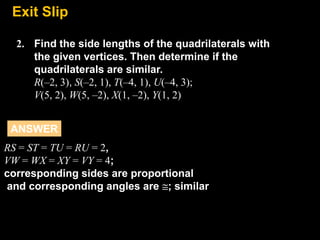
2. Find the side lengths of the quadrilaterals with
the given vertices. Then determine if the
quadrilaterals are similar.
R(–2, 3), S(–2, 1), T(–4, 1), U(–4, 3);
V(5, 2), W(5, –2), X(1, –2), Y(1, 2)
ANSWER
RS = ST = TU = RU = 2,
VW = WX = XY = VY = 4;
corresponding sides are proportional
and corresponding angles are ; similar
Exit
8.7 Slip
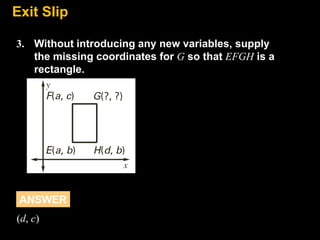
3. Without introducing any new variables, supply
the missing coordinates for G so that EFGH is a
rectangle.

ANSWER
(d, c)
8.7

Pg
#

8.7 coordinate proof with quadrilaterals

  • 1.
    8.7 Coordinate Proofwith Quadrilaterals 8.7 Bell Thinger 1. Find the distance between the points A(1, –3) and B(–2, 4). ANSWER 2. Determine if the triangles with the given vertices are similar. A(–3, 3), B(–4, 1), C(–2, –1) D(3, 5), E(2, 1), F(4, –3) ANSWER ABC and DEF are not similar.
  • 2.
    8.7 Example 1 Determine ifthe quadrilaterals with the given vertices are congruent. O(0, 0), B(1, 3), C(3, 3), D(2, 0); E(4, 0), F(5, 3), G(7, 3), H(6, 0) SOLUTION Graph the quadrilaterals. Show that corresponding sides and angles are congruent. Use the Distance Formula. OB = DC = EF = HG = OD = BC = EH = FG = 2 Since both pairs of opposite sides in each quadrilateral are congruent, OBCD and EFGH are parallelograms.
  • 3.
    8.7 Example 1 Opposite anglesin a parallelogram are congruent, so O C and E G. and are parallel, because both have slope 3, and they are cut by transversal . So, O and E are corresponding angles, and By substitution, C G. Similar reasoning can be used to show that and D H. O B Because all corresponding sides and angles are congruent, OBCD is congruent to EFGH. E. F
  • 4.
    8.7 Guided Practice Find allside lengths of the quadrilaterals with the given vertices. Then determine if the quadrilaterals are congruent. 1. F(–4, 0), G(–3, 3), H(0, 3), J(–2, 0); P(1, 0), Q(2, 3), R(6, 3), S(4, 0) ANSWER not congruent
  • 5.
    8.7 Guided Practice Find allside lengths of the quadrilaterals with the given vertices. Then determine if the quadrilaterals are congruent. 2. A(–2, –2), B(–2, 2), C(2, 2), D(2, –2); O(0, 0), X(0, 4), Y(4, 4), Z(4, 0) ANSWER AB = BC = CD = DA = OX = XY = YZ = ZO = 4; all angles are right angles; congruent
  • 6.
    8.7 Example 2 Determine ifthe quadrilaterals with the given vertices are similar. O(0, 0), B(4, 4), C(8, 4), D(4, 0); O(0, 0), E(2, 2), F(4, 2), G(2, 0) SOLUTION Graph the quadrilaterals. Find the ratios of corresponding side lengths.
  • 7.
    8.7 Example 2 Because OB= CD and BC = DO, OBCD is a parallelogram. Because OE = FG and EF = GO, OEFG is a parallelogram. Opposite angles in a parallelogram are congruent, so O F and O C. Therefore, C F. Parallel lines and are cut by transversal , so B and FEO are corresponding angles, and B FEO.
  • 8.
    8.7 Example 2 Likewise, and are parallellines because both have slope 1, and they are cut by transversal , so D and OGF are corresponding angles, and D OGF . Because corresponding side lengths are proportional and corresponding angles are congruent, OBCD is similar to OEFG.
  • 9.
    8.7 Example 3 Show thatthe glass pane in the center is a rhombus that is not a square. SOLUTION Use the Distance Formula. Each side of ABCD has length units. So, the quadrilateral is a rhombus. The slope of of is –3. is 3 and the slope Because the product of these slopes is not –1, the segments do not form a right angle. The pane is a rhombus, but it is not a square.
  • 10.
    8.7 Example 4 Without introducingany new variables, supply the missing coordinates for K so that OJKL is a parallelogram. SOLUTION Choose coordinates so that opposite sides of the quadrilateral are parallel. must be horizontal to be parallel to y-coordinate of K is c. , so the
  • 11.
    8.7 Example 4 To findthe x-coordinate of K, write expressions for the slopes of and . Use x for the x-coordinate of K. The slopes are equal, so a, and x = a + b. Point K has coordinates (a + b, c). . Therefore, b = x –
  • 12.
    8.7 Example 5 Prove thatthe diagonals of a parallelogram bisect each other. SOLUTION STEP 1 Place a parallelogram with coordinates as in Example 4. Draw the diagonals.
  • 13.
    8.7 Example 5 STEP 2Find the midpoints of the diagonals. The midpoints are the same. So, the diagonals bisect each other.
  • 14.
    8.7 Guided Practice 6. Writea coordinate proof that the diagonals of a rectangle are congruent. ANSWER Place rectangle OPQR so that it is in the first quadrant, with points O(0, 0), P(0, b), Q(c, b), and R(c, 0). Use the Distance Formula. So, the diagonals of a rectangle are congruent.
  • 15.
    Exit 8.7 Slip 1. Findthe side lengths of the quadrilaterals with the given vertices. Then determine if the quadrilaterals are congruent. J(1, 1), K(2, 4), L(5, 4), M(4, 1); N(–1, –3), O(0, 0), P(4, 0), Q(3, –3) ANSWER JK = LM = NO = PQ = KL = JM = 3 but OP = NQ = 4; not congruent
  • 16.
    Exit 8.7 Slip 2. Findthe side lengths of the quadrilaterals with the given vertices. Then determine if the quadrilaterals are similar. R(–2, 3), S(–2, 1), T(–4, 1), U(–4, 3); V(5, 2), W(5, –2), X(1, –2), Y(1, 2) ANSWER RS = ST = TU = RU = 2, VW = WX = XY = VY = 4; corresponding sides are proportional and corresponding angles are ; similar
  • 17.
    Exit 8.7 Slip 3. Withoutintroducing any new variables, supply the missing coordinates for G so that EFGH is a rectangle. ANSWER (d, c)
  • 18.