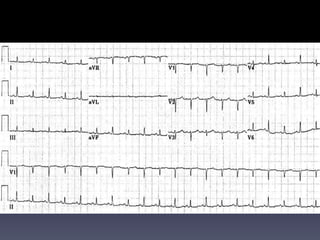
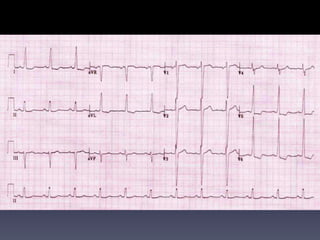
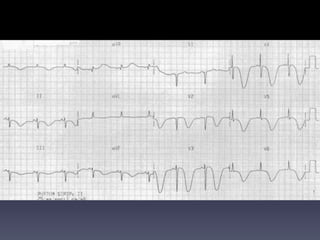
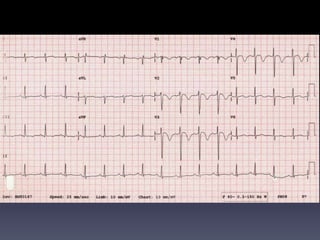
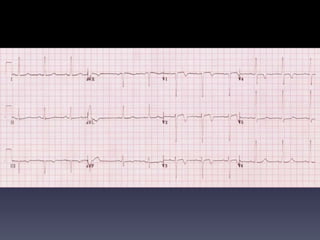
ECG Interpretation
Dr S. A. Medway
SCGH EDCMEThursday 12/03/2015
Original Presentation Credit to Dr. James Wheeler
Resources
• Original Presentation – Dr JamesWheeler
• Erics Medical Lectures –YouTube
• LITFL
• emin5.com
• Time on the floor
What is an ECG?
• Graphical representation of the electrical activity of the myocardium over
time
• Standard 12 lead ECG assesses this in various planes (coronal & transverse)
to give a roughly 3D view of the heart
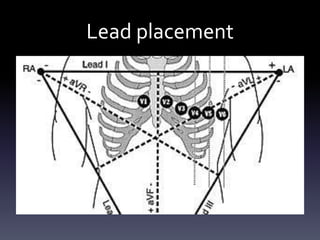
– 3 biploar leads I, II, III
– 9 unipolar leads aVR, aVL, aVF,V1-V6
– Can consider other unipolar lead placements
– V1-6R – look at RV
– V7-9 – look at post LV wall
Lead placement
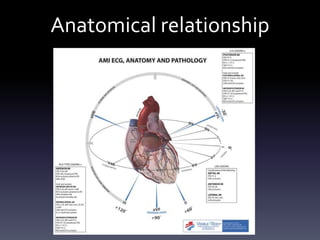
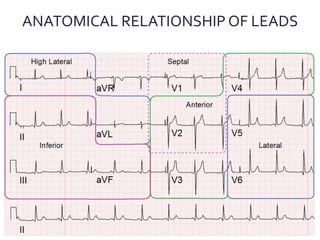
Anatomical relationship
ANATOMICAL RELATIONSHIP OF LEADS
Considerations
• Methodical systematic approach
– “More is missed by not looking than by not
knowing"[Thomas McCrae, 1870-1935]
• Consider patients clinical condition
• Obtain previous ECG’s for comparison
• Limitations of ECG – Electrical activity, not
contractility etc…
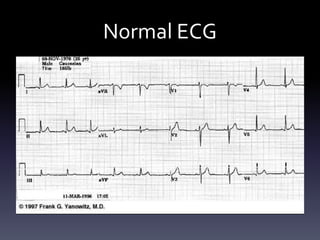
• The “ normal” ECG
– All normal ECG’s do not look the same
– But they do have features in common
ECG helps in detection of:
– Ischaemic heart disease, acute or chronic
– Dysrrhythmias
– Electrolyte disturbances
– Conduction abnormalities (HB, BBB)
– CAD (exercise stress test)
– Cardiac structural abN (LVH, RVH)
– Cardiac manifestations of non-cardiac disease
(PE, metabolic disorders, lung disease…)
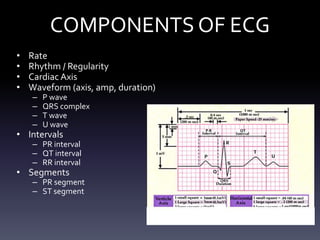
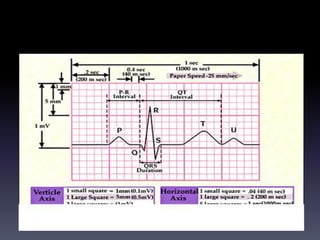
COMPONENTS OF ECG
• Rate
• Rhythm / Regularity
• Cardiac Axis
• Waveform (axis, amp, duration)
– P wave
– QRS complex
– T wave
– U wave
• Intervals
– PR interval
– QT interval
– RR interval
• Segments
– PR segment
– ST segment
ECG systematic evaluation
• Calibration / Speed
– N = 10mm/1mV, 25mm/sec
• Rhythm
– Regularity / QRS width / Rate
• Axis
– N / LAD / RAD
• P wave
– ?presence / relationship to QRS
– Axis
– Amp: RAA / LAA
• PR interval
– Duration / HB / Pre-excitation
• PR segment
– Depression
• QRS
– duration / amplitude / morphology
– Q waves
– R wave
• ST segment
– Depression / elevation / morphology
• T wave
– Axis / morphology / duration
• QT interval
• U wave
• Other waves (delta, osborne, epsilon, pacing
spikes, artifacts)
• ?other leads (V4R,V7-9, Lewis)
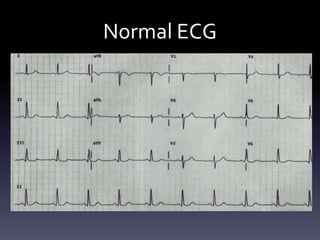
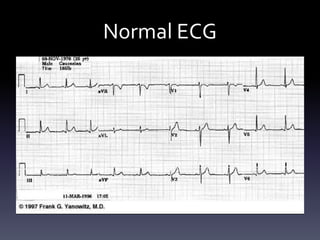
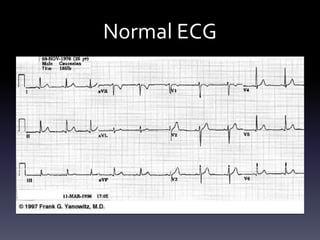
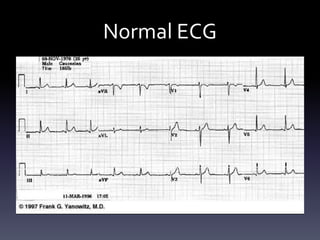
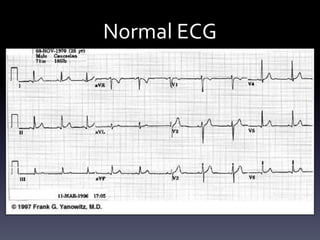
Normal ECG
ECG Rhythm
• Rate
– N / tachy / brady
• Regularity
– Regular / reg irreg / irreg irreg
• QRS morphology
– Narrow / wide (120ms)
• P waves
– Absent
– Present / morphology / relationship QRS / PR interval
ECG Rhythm
• Is it normal sinus rhythm (NSR)?
– Can you identify P waves
– P waves preceding all the QRS complexes
– QRS complexes after every P wave
– Normal PR interval
– Regular
• P waves most easily seen in II &V1
• If not – it’s not Sinus Rhythm. What is it??
Arrhythmias - Causes
• Abnormal impulse generation
– SA node
– Outside of the SA node
• Abnormal impulse conduction
– Damaged conduction pathways
– Re-entrant pathways
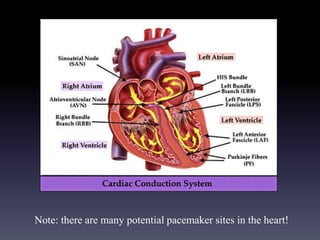
Note: there are many potential pacemaker sites in the heart!
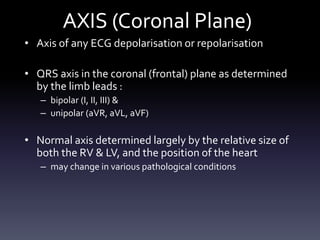
AXIS (Coronal Plane)
• Axis of any ECG depolarisation or repolarisation
• QRS axis in the coronal (frontal) plane as determined
by the limb leads :
– bipolar (I, II, III) &
– unipolar (aVR, aVL, aVF)
• Normal axis determined largely by the relative size of
both the RV & LV, and the position of the heart
– may change in various pathological conditions
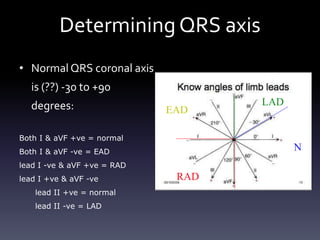
Determining QRS axis
• Normal QRS coronal axis
is (??) -30 to +90
degrees:
Both I & aVF +ve = normal
Both I & aVF -ve = EAD
lead I -ve & aVF +ve = RAD
lead I +ve & aVF -ve
lead II +ve = normal
lead II -ve = LAD
N
RAD
LAD
EAD
Normal ECG
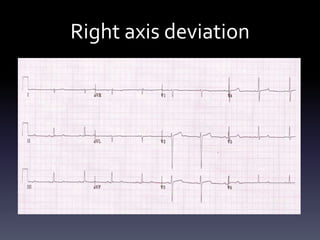
Right axis deviation
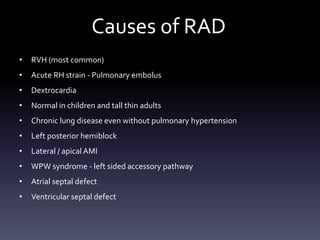
Causes of RAD
• RVH (most common)
• Acute RH strain - Pulmonary embolus
• Dextrocardia
• Normal in children and tall thin adults
• Chronic lung disease even without pulmonary hypertension
• Left posterior hemiblock
• Lateral / apical AMI
• WPW syndrome - left sided accessory pathway
• Atrial septal defect
• Ventricular septal defect
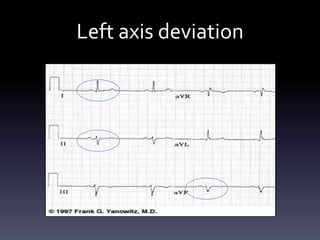
Left axis deviation
Causes of LAD
• ?LVH
• Left anterior hemiblock
• LBBB
• Q waves of inferior myocardial infarction
• Artificial cardiac pacing
• Emphysema
• WPW syndrome - right sided accessory pathway
• Tricuspid atresia
• Ostium primum ASD
Causes of extreme axis deviation
• Emphysema
• Hyperkalaemia
• Lead transposition
• Artificial cardiac pacing
• Ventricular tachycardia
Transverse axis of QRS / Rotation
• Normal transverse axis is leftward and posterior:
– Hence usually a progression in R wave height fromV1 to
V6
• Transitional lead (where R = S)
– usuallyV3 orV4
• Displacement of transition:
– Right (V1,V2) = counterclockwise rotation
– Left (V5,V6) = clockwise rotation
Normal ECG
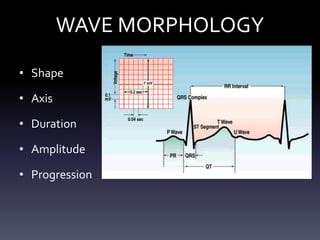
WAVE MORPHOLOGY
• Shape
• Axis
• Duration
• Amplitude
• Progression
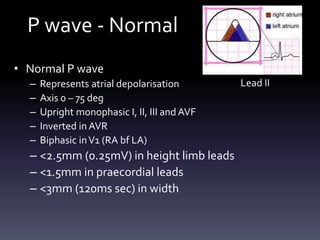
P wave - Normal
• Normal P wave
– Represents atrial depolarisation
– Axis 0 – 75 deg
– Upright monophasic I, II, III and AVF
– Inverted in AVR
– Biphasic inV1 (RA bf LA)
– <2.5mm (0.25mV) in height limb leads
– <1.5mm in praecordial leads
– <3mm (120ms sec) in width
Lead II
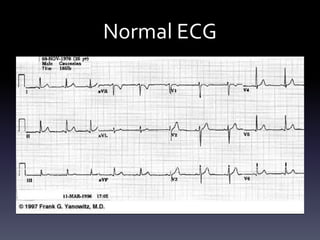
Normal ECG
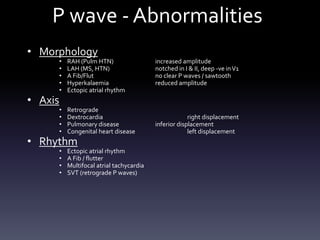
P wave - Abnormalities
• Morphology
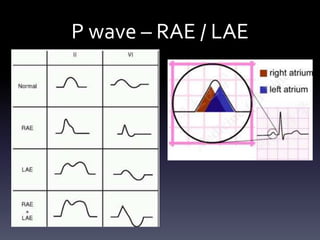
• RAH (Pulm HTN) increased amplitude
• LAH (MS, HTN) notched in I & II, deep -ve inV1
• A Fib/Flut no clear P waves / sawtooth
• Hyperkalaemia reduced amplitude
• Ectopic atrial rhythm
• Axis
• Retrograde
• Dextrocardia right displacement
• Pulmonary disease inferior displacement
• Congenital heart disease left displacement
• Rhythm
• Ectopic atrial rhythm
• A Fib / flutter
• Multifocal atrial tachycardia
• SVT (retrograde P waves)
P wave – RAE / LAE
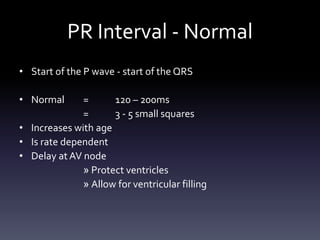
PR Interval - Normal
• Start of the P wave - start of the QRS
• Normal = 120 – 200ms
= 3 - 5 small squares
• Increases with age
• Is rate dependent
• Delay at AV node
» Protect ventricles
» Allow for ventricular filling
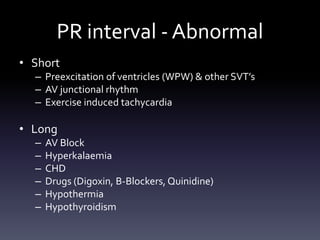
PR interval - Abnormal
• Short
– Preexcitation of ventricles (WPW) & other SVT’s
– AV junctional rhythm
– Exercise induced tachycardia
• Long
– AV Block
– Hyperkalaemia
– CHD
– Drugs (Digoxin, B-Blockers, Quinidine)
– Hypothermia
– Hypothyroidism
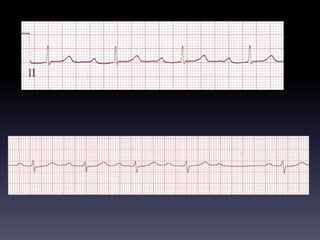
PR segment
• Normally isoelectric using theTP (not ST) segment as a
baseline
• Abnormal:
– Elevation
• Myocarditis (aVR,V1)
• Atrial infarction
– Depression
• Myo/pericarditis
• Atrial infarction
• Exercise induced tachycardia
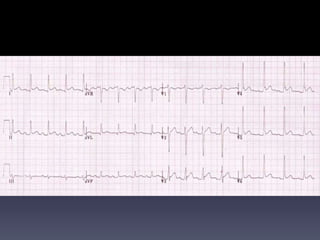
QRS parameters
• Q waves
– ?abnormal Q’s
• R wave
– Progression
– Dominant R wave in aVR /V1
• QRS amplitude
• QRS duration (<100ms)
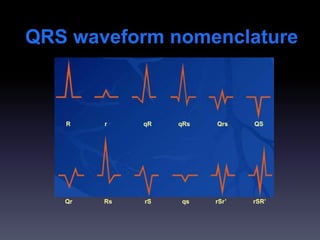
QRS waveform nomenclature
R r qR qRs Qrs QS
Qr Rs rS qs rSr’ rSR’
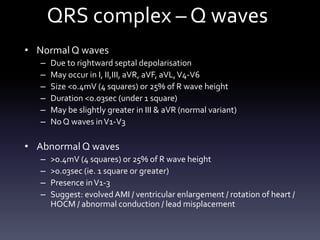
QRS complex – Q waves
• Normal Q waves
– Due to rightward septal depolarisation
– May occur in I, II,III, aVR, aVF, aVL,V4-V6
– Size <0.4mV (4 squares) or 25% of R wave height
– Duration <0.03sec (under 1 square)
– May be slightly greater in III & aVR (normal variant)
– No Q waves inV1-V3
• Abnormal Q waves
– >0.4mV (4 squares) or 25% of R wave height
– >0.03sec (ie. 1 square or greater)
– Presence inV1-3
– Suggest: evolved AMI / ventricular enlargement / rotation of heart /
HOCM / abnormal conduction / lead misplacement
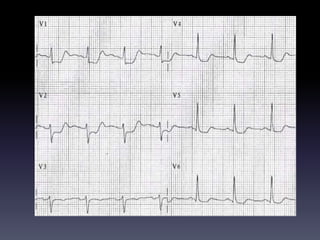
Normal ECG
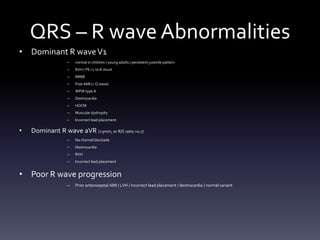
QRS – R wave Abnormalities
• Dominant R waveV1
– normal in children / young adults / persistent juvenile pattern
– RVH / PE / L to R shunt
– RBBB
– Post AMI (= Q wave)
– WPW type A
– Dextrocardia
– HOCM
– Muscular dystrophy
– Incorrect lead placement
• Dominant R wave aVR (>3mm, or R/S ratio >0.7)
– Na channel blockade
– Dextrocardia
– RVH
– Incorrect lead placement
• Poor R wave progression
– Prior anteroseptal AMI / LVH / incorrect lead placement / dextrocardia / normal variant
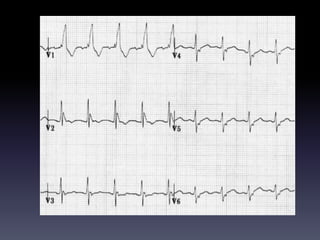
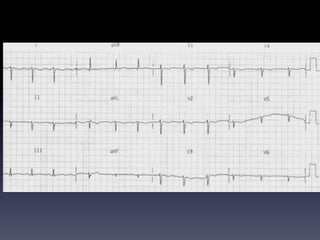
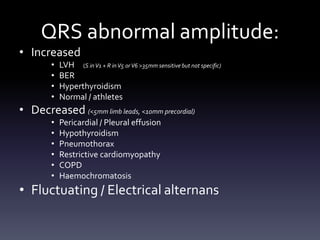
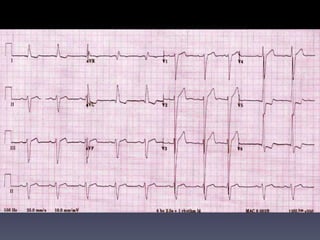
QRS abnormal amplitude:
• Increased
• LVH (S inV1 + R inV5 orV6 >35mm sensitive but not specific)
• BER
• Hyperthyroidism
• Normal / athletes
• Decreased (<5mm limb leads, <10mm precordial)
• Pericardial / Pleural effusion
• Hypothyroidism
• Pneumothorax
• Restrictive cardiomyopathy
• COPD
• Haemochromatosis
• Fluctuating / Electrical alternans
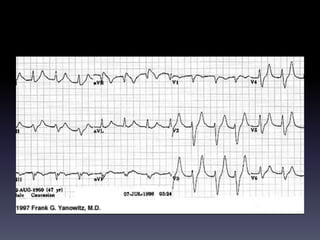
QRS prolonged duration:
• Causes
– BBB (may be rate related)
– Ventricular origin /Ventricular pacing
– Hyperkalaemia
– Na channel blockade
– Pre-excitation
– Hypothermia
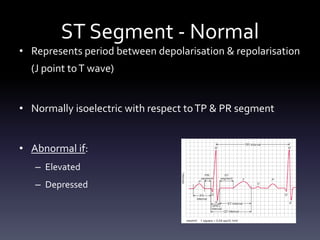
ST Segment - Normal
• Represents period between depolarisation & repolarisation
(J point toT wave)
• Normally isoelectric with respect toTP & PR segment
• Abnormal if:
– Elevated
– Depressed
Normal ECG
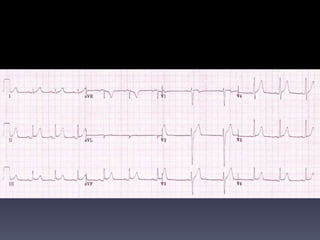
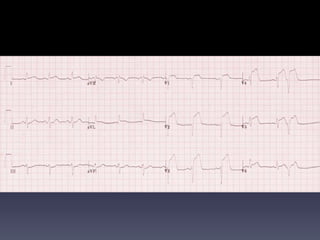
ST segment - Elevation
• Morphology
– Concave - some non-AMI causes
– Convex - suggestive of AMI
• Distribution
– Widespread - ?non-AMI
– Localised to anatomically contiguous leads - suggestive of AMI
• Magnitude
– Larger suggestive of AMI
• QRS morphology
– Large amplitude - consider LVH
– Widening - consider BBB or vent. paced rhythm
ST segment elevation causes:
• AcuteCoronary Syndrome
• Acute pericarditis
• Benign early repolarisation (BER)
• LV aneurysm
• LVH
• BBB
• Left - R to mid precordial leads
• Right - lateral leads
• Cardiomyopathy
• Acute myocarditis
• Hypothermia
• Hyperkalaemia
• Myocardial contusion
• CNS injury
• Brugarda Syn
• Paced vent. Rhythms
• Post-electrical cardioversion
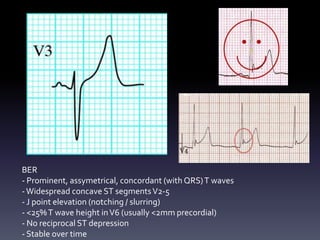
BER
- Prominent, assymetrical, concordant (with QRS)T waves
-Widespread concave ST segmentsV2-5
- J point elevation (notching / slurring)
- <25%T wave height inV6 (usually <2mm precordial)
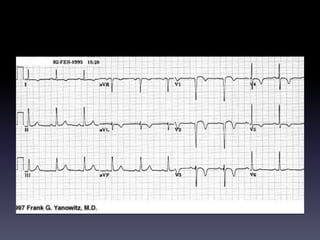
- No reciprocal ST depression
- Stable over time
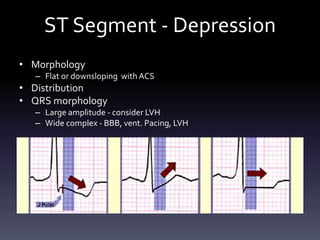
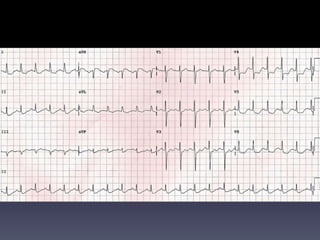
ST Segment - Depression
• Morphology
– Flat or downsloping with ACS
• Distribution
• QRS morphology
– Large amplitude - consider LVH
– Wide complex - BBB, vent. Pacing, LVH
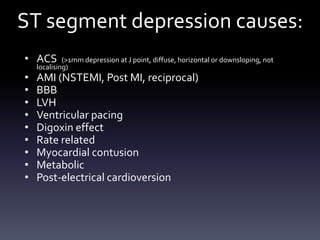
ST segment depression causes:
• ACS (>1mm depression at J point, diffuse, horizontal or downsloping, not
localising)
• AMI (NSTEMI, Post MI, reciprocal)
• BBB
• LVH
• Ventricular pacing
• Digoxin effect
• Rate related
• Myocardial contusion
• Metabolic
• Post-electrical cardioversion
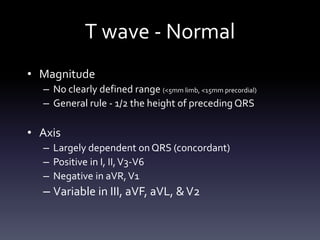
T wave - Normal
• Magnitude
– No clearly defined range (<5mm limb, <15mm precordial)
– General rule - 1/2 the height of preceding QRS
• Axis
– Largely dependent onQRS (concordant)
– Positive in I, II,V3-V6
– Negative in aVR,V1
– Variable in III, aVF, aVL, &V2
Normal ECG
T wave - Abnormalities
• Prominent
• AMI (hyperacute), Hyperkalaemia, BER, Myopericarditis (concave STE & PR
depression), BBB (esp. LBBB inV1-V3), LVH (similar to LBBB)
• Inverted
• ACS (all stages) NB may be flattened
• Wellen’s Syn. (critical prox LAD stenosis without MI) NB may be biphasic
• Past MI
• Pericarditis
• Children / Persisting juvenile pattern (V1-V3)
• CNS injury/ICH
• BBB
• PE, RVH, LVH, HOCM, Digoxin, toxic, metabolic
U wave
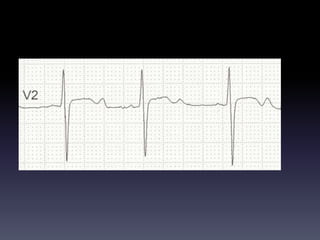
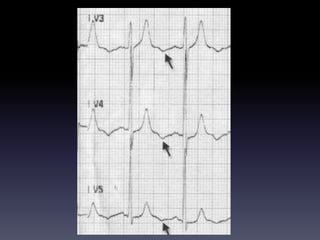
• Positive deflection that occasionally occurs afterT wave
• Most visible at slow HR’s inV1-V4
• The origin is uncertain (repol of the IVS)
• Presence or absence does not signify pathology
• Abnormal if:
– >1/3 precedingT wave height (N 1-2mm)
– Disconcordant withT wave
U wave - Abnormalities
• Increased amplitude
• Athletes
• Bradycardia
• HypoK+ / HypoCa2+ / HypoMg2+
• CNS event
• Hypertension
• Hypothermia
• Medications (digoxin, quinidine)
• Inversion
• Ischaemia
• LV overload
• RV overload
• PE
QT interval - Normal
• Measured from the start of the QRS to the
end of theT wave
– Measure in II,V 5-6
– use slope
– include U waves if continuous withT wave
• Represents the time required for ventricular
activation & recovery
• Range 330 - 440ms (460ms women)
• Rule of thumb < half RR interval
• QT interval corrected to the heart rate
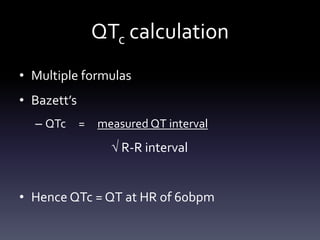
QTc calculation
• Multiple formulas
• Bazett’s
– QTc = measured QT interval
 R-R interval
• Hence QTc = QT at HR of 60bpm
QTc - Abnormal Duration
• Short
– Hypercalcaemia / Digoxin / Congenital
• Long
– lengthened repolarisation time
– ventricle more susceptible to early after depolarisation which can precipitate a variety of potentially fatal arrhythmias (VF, VT, torsades de
pointes)
– Congenital long QT syndromes
– CNS disease
– Metabolic syndromes (HYPO: K+, Ca++,T4)
– Hypothermia
– Drugs:
• erythromycin, cisapride, amiodarone, haloperidol, quinidine…
Overview
• Rate & rhythm
• Axis
• Wave morphology
• Intervals
• Segments
• In the context of:
– Look at the patient (hear the story)
– Compare to old ECG’s
– Get a second opinion

Systematic ECG Interpretation

  • 1.
    ECG Interpretation Dr S.A. Medway SCGH EDCMEThursday 12/03/2015 Original Presentation Credit to Dr. James Wheeler
  • 2.
    Resources • Original Presentation– Dr JamesWheeler • Erics Medical Lectures –YouTube • LITFL • emin5.com • Time on the floor
  • 3.
    What is anECG? • Graphical representation of the electrical activity of the myocardium over time • Standard 12 lead ECG assesses this in various planes (coronal & transverse) to give a roughly 3D view of the heart – 3 biploar leads I, II, III – 9 unipolar leads aVR, aVL, aVF,V1-V6 – Can consider other unipolar lead placements – V1-6R – look at RV – V7-9 – look at post LV wall
  • 4.
  • 5.
  • 6.
  • 7.
    Considerations • Methodical systematicapproach – “More is missed by not looking than by not knowing"[Thomas McCrae, 1870-1935] • Consider patients clinical condition • Obtain previous ECG’s for comparison • Limitations of ECG – Electrical activity, not contractility etc… • The “ normal” ECG – All normal ECG’s do not look the same – But they do have features in common
  • 8.
    ECG helps indetection of: – Ischaemic heart disease, acute or chronic – Dysrrhythmias – Electrolyte disturbances – Conduction abnormalities (HB, BBB) – CAD (exercise stress test) – Cardiac structural abN (LVH, RVH) – Cardiac manifestations of non-cardiac disease (PE, metabolic disorders, lung disease…)
  • 9.
    COMPONENTS OF ECG •Rate • Rhythm / Regularity • Cardiac Axis • Waveform (axis, amp, duration) – P wave – QRS complex – T wave – U wave • Intervals – PR interval – QT interval – RR interval • Segments – PR segment – ST segment
  • 10.
    ECG systematic evaluation •Calibration / Speed – N = 10mm/1mV, 25mm/sec • Rhythm – Regularity / QRS width / Rate • Axis – N / LAD / RAD • P wave – ?presence / relationship to QRS – Axis – Amp: RAA / LAA • PR interval – Duration / HB / Pre-excitation • PR segment – Depression • QRS – duration / amplitude / morphology – Q waves – R wave • ST segment – Depression / elevation / morphology • T wave – Axis / morphology / duration • QT interval • U wave • Other waves (delta, osborne, epsilon, pacing spikes, artifacts) • ?other leads (V4R,V7-9, Lewis)
  • 12.
  • 13.
    ECG Rhythm • Rate –N / tachy / brady • Regularity – Regular / reg irreg / irreg irreg • QRS morphology – Narrow / wide (120ms) • P waves – Absent – Present / morphology / relationship QRS / PR interval
  • 14.
    ECG Rhythm • Isit normal sinus rhythm (NSR)? – Can you identify P waves – P waves preceding all the QRS complexes – QRS complexes after every P wave – Normal PR interval – Regular • P waves most easily seen in II &V1 • If not – it’s not Sinus Rhythm. What is it??
  • 15.
    Arrhythmias - Causes •Abnormal impulse generation – SA node – Outside of the SA node • Abnormal impulse conduction – Damaged conduction pathways – Re-entrant pathways
  • 16.
    Note: there aremany potential pacemaker sites in the heart!
  • 21.
    AXIS (Coronal Plane) •Axis of any ECG depolarisation or repolarisation • QRS axis in the coronal (frontal) plane as determined by the limb leads : – bipolar (I, II, III) & – unipolar (aVR, aVL, aVF) • Normal axis determined largely by the relative size of both the RV & LV, and the position of the heart – may change in various pathological conditions
  • 22.
    Determining QRS axis •Normal QRS coronal axis is (??) -30 to +90 degrees: Both I & aVF +ve = normal Both I & aVF -ve = EAD lead I -ve & aVF +ve = RAD lead I +ve & aVF -ve lead II +ve = normal lead II -ve = LAD N RAD LAD EAD
  • 23.
  • 24.
  • 25.
    Causes of RAD •RVH (most common) • Acute RH strain - Pulmonary embolus • Dextrocardia • Normal in children and tall thin adults • Chronic lung disease even without pulmonary hypertension • Left posterior hemiblock • Lateral / apical AMI • WPW syndrome - left sided accessory pathway • Atrial septal defect • Ventricular septal defect
  • 26.
  • 27.
    Causes of LAD •?LVH • Left anterior hemiblock • LBBB • Q waves of inferior myocardial infarction • Artificial cardiac pacing • Emphysema • WPW syndrome - right sided accessory pathway • Tricuspid atresia • Ostium primum ASD
  • 28.
    Causes of extremeaxis deviation • Emphysema • Hyperkalaemia • Lead transposition • Artificial cardiac pacing • Ventricular tachycardia
  • 29.
    Transverse axis ofQRS / Rotation • Normal transverse axis is leftward and posterior: – Hence usually a progression in R wave height fromV1 to V6 • Transitional lead (where R = S) – usuallyV3 orV4 • Displacement of transition: – Right (V1,V2) = counterclockwise rotation – Left (V5,V6) = clockwise rotation
  • 30.
  • 31.
    WAVE MORPHOLOGY • Shape •Axis • Duration • Amplitude • Progression
  • 32.
    P wave -Normal • Normal P wave – Represents atrial depolarisation – Axis 0 – 75 deg – Upright monophasic I, II, III and AVF – Inverted in AVR – Biphasic inV1 (RA bf LA) – <2.5mm (0.25mV) in height limb leads – <1.5mm in praecordial leads – <3mm (120ms sec) in width Lead II
  • 33.
  • 34.
    P wave -Abnormalities • Morphology • RAH (Pulm HTN) increased amplitude • LAH (MS, HTN) notched in I & II, deep -ve inV1 • A Fib/Flut no clear P waves / sawtooth • Hyperkalaemia reduced amplitude • Ectopic atrial rhythm • Axis • Retrograde • Dextrocardia right displacement • Pulmonary disease inferior displacement • Congenital heart disease left displacement • Rhythm • Ectopic atrial rhythm • A Fib / flutter • Multifocal atrial tachycardia • SVT (retrograde P waves)
  • 35.
    P wave –RAE / LAE
  • 37.
    PR Interval -Normal • Start of the P wave - start of the QRS • Normal = 120 – 200ms = 3 - 5 small squares • Increases with age • Is rate dependent • Delay at AV node » Protect ventricles » Allow for ventricular filling
  • 38.
    PR interval -Abnormal • Short – Preexcitation of ventricles (WPW) & other SVT’s – AV junctional rhythm – Exercise induced tachycardia • Long – AV Block – Hyperkalaemia – CHD – Drugs (Digoxin, B-Blockers, Quinidine) – Hypothermia – Hypothyroidism
  • 40.
    PR segment • Normallyisoelectric using theTP (not ST) segment as a baseline • Abnormal: – Elevation • Myocarditis (aVR,V1) • Atrial infarction – Depression • Myo/pericarditis • Atrial infarction • Exercise induced tachycardia
  • 42.
    QRS parameters • Qwaves – ?abnormal Q’s • R wave – Progression – Dominant R wave in aVR /V1 • QRS amplitude • QRS duration (<100ms)
  • 43.
    QRS waveform nomenclature Rr qR qRs Qrs QS Qr Rs rS qs rSr’ rSR’
  • 44.
    QRS complex –Q waves • Normal Q waves – Due to rightward septal depolarisation – May occur in I, II,III, aVR, aVF, aVL,V4-V6 – Size <0.4mV (4 squares) or 25% of R wave height – Duration <0.03sec (under 1 square) – May be slightly greater in III & aVR (normal variant) – No Q waves inV1-V3 • Abnormal Q waves – >0.4mV (4 squares) or 25% of R wave height – >0.03sec (ie. 1 square or greater) – Presence inV1-3 – Suggest: evolved AMI / ventricular enlargement / rotation of heart / HOCM / abnormal conduction / lead misplacement
  • 45.
  • 47.
    QRS – Rwave Abnormalities • Dominant R waveV1 – normal in children / young adults / persistent juvenile pattern – RVH / PE / L to R shunt – RBBB – Post AMI (= Q wave) – WPW type A – Dextrocardia – HOCM – Muscular dystrophy – Incorrect lead placement • Dominant R wave aVR (>3mm, or R/S ratio >0.7) – Na channel blockade – Dextrocardia – RVH – Incorrect lead placement • Poor R wave progression – Prior anteroseptal AMI / LVH / incorrect lead placement / dextrocardia / normal variant
  • 51.
    QRS abnormal amplitude: •Increased • LVH (S inV1 + R inV5 orV6 >35mm sensitive but not specific) • BER • Hyperthyroidism • Normal / athletes • Decreased (<5mm limb leads, <10mm precordial) • Pericardial / Pleural effusion • Hypothyroidism • Pneumothorax • Restrictive cardiomyopathy • COPD • Haemochromatosis • Fluctuating / Electrical alternans
  • 54.
    QRS prolonged duration: •Causes – BBB (may be rate related) – Ventricular origin /Ventricular pacing – Hyperkalaemia – Na channel blockade – Pre-excitation – Hypothermia
  • 56.
    ST Segment -Normal • Represents period between depolarisation & repolarisation (J point toT wave) • Normally isoelectric with respect toTP & PR segment • Abnormal if: – Elevated – Depressed
  • 57.
  • 58.
    ST segment -Elevation • Morphology – Concave - some non-AMI causes – Convex - suggestive of AMI • Distribution – Widespread - ?non-AMI – Localised to anatomically contiguous leads - suggestive of AMI • Magnitude – Larger suggestive of AMI • QRS morphology – Large amplitude - consider LVH – Widening - consider BBB or vent. paced rhythm
  • 59.
    ST segment elevationcauses: • AcuteCoronary Syndrome • Acute pericarditis • Benign early repolarisation (BER) • LV aneurysm • LVH • BBB • Left - R to mid precordial leads • Right - lateral leads • Cardiomyopathy • Acute myocarditis • Hypothermia • Hyperkalaemia • Myocardial contusion • CNS injury • Brugarda Syn • Paced vent. Rhythms • Post-electrical cardioversion
  • 61.
    BER - Prominent, assymetrical,concordant (with QRS)T waves -Widespread concave ST segmentsV2-5 - J point elevation (notching / slurring) - <25%T wave height inV6 (usually <2mm precordial) - No reciprocal ST depression - Stable over time
  • 64.
    ST Segment -Depression • Morphology – Flat or downsloping with ACS • Distribution • QRS morphology – Large amplitude - consider LVH – Wide complex - BBB, vent. Pacing, LVH
  • 65.
    ST segment depressioncauses: • ACS (>1mm depression at J point, diffuse, horizontal or downsloping, not localising) • AMI (NSTEMI, Post MI, reciprocal) • BBB • LVH • Ventricular pacing • Digoxin effect • Rate related • Myocardial contusion • Metabolic • Post-electrical cardioversion
  • 68.
    T wave -Normal • Magnitude – No clearly defined range (<5mm limb, <15mm precordial) – General rule - 1/2 the height of preceding QRS • Axis – Largely dependent onQRS (concordant) – Positive in I, II,V3-V6 – Negative in aVR,V1 – Variable in III, aVF, aVL, &V2
  • 69.
  • 70.
    T wave -Abnormalities • Prominent • AMI (hyperacute), Hyperkalaemia, BER, Myopericarditis (concave STE & PR depression), BBB (esp. LBBB inV1-V3), LVH (similar to LBBB) • Inverted • ACS (all stages) NB may be flattened • Wellen’s Syn. (critical prox LAD stenosis without MI) NB may be biphasic • Past MI • Pericarditis • Children / Persisting juvenile pattern (V1-V3) • CNS injury/ICH • BBB • PE, RVH, LVH, HOCM, Digoxin, toxic, metabolic
  • 77.
    U wave • Positivedeflection that occasionally occurs afterT wave • Most visible at slow HR’s inV1-V4 • The origin is uncertain (repol of the IVS) • Presence or absence does not signify pathology • Abnormal if: – >1/3 precedingT wave height (N 1-2mm) – Disconcordant withT wave
  • 78.
    U wave -Abnormalities • Increased amplitude • Athletes • Bradycardia • HypoK+ / HypoCa2+ / HypoMg2+ • CNS event • Hypertension • Hypothermia • Medications (digoxin, quinidine) • Inversion • Ischaemia • LV overload • RV overload • PE
  • 81.
    QT interval -Normal • Measured from the start of the QRS to the end of theT wave – Measure in II,V 5-6 – use slope – include U waves if continuous withT wave • Represents the time required for ventricular activation & recovery • Range 330 - 440ms (460ms women) • Rule of thumb < half RR interval • QT interval corrected to the heart rate
  • 82.
    QTc calculation • Multipleformulas • Bazett’s – QTc = measured QT interval  R-R interval • Hence QTc = QT at HR of 60bpm
  • 83.
    QTc - AbnormalDuration • Short – Hypercalcaemia / Digoxin / Congenital • Long – lengthened repolarisation time – ventricle more susceptible to early after depolarisation which can precipitate a variety of potentially fatal arrhythmias (VF, VT, torsades de pointes) – Congenital long QT syndromes – CNS disease – Metabolic syndromes (HYPO: K+, Ca++,T4) – Hypothermia – Drugs: • erythromycin, cisapride, amiodarone, haloperidol, quinidine…
  • 86.
    Overview • Rate &rhythm • Axis • Wave morphology • Intervals • Segments • In the context of: – Look at the patient (hear the story) – Compare to old ECG’s – Get a second opinion