BASICS OF ELECTROCARDIOGRAPHY
Dr Mushfiq Newaz Ahmed
Medical Officer
Department Of Anaesthesia,
Comilla Medical College & Hospital
OUTLINE
1. Review of the conduction system & Action Potential
2. ECG leads and recording
3. ECG waveforms and intervals
4. Normal ECG and its variants
5. Basic Interpretation Steps of ECG
6. Arrhythmia & ECG
7. MI & ECG
8. EI & ECG
9. Thyroid Disorder & ECG
10. Emergency ECG
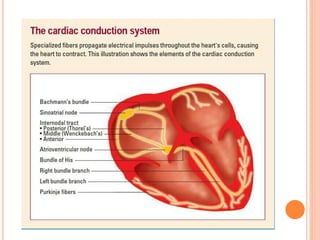
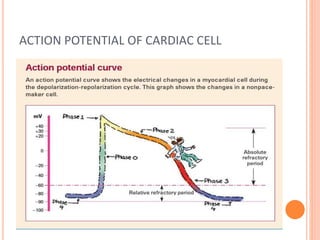
ACTION POTENTIAL OF CARDIAC CELL
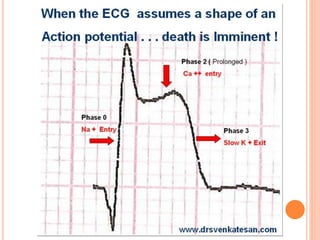
BUT THE IRONY OF FATE IS……
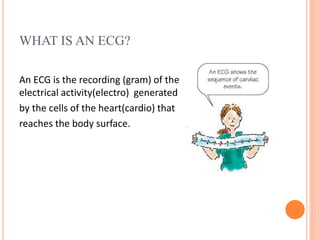
WHAT IS AN ECG?
An ECG is the recording (gram) of the
electrical activity(electro) generated
by the cells of the heart(cardio) that
reaches the body surface.
USEFUL IN DIAGNOSIS OF…
 Cardiac Arrhythmias
 Myocardial ischemia and infarction
 Pericarditis
 Chamber hypertrophy
 Electrolyte disturbances
ECG LEADS
ECG LEADS
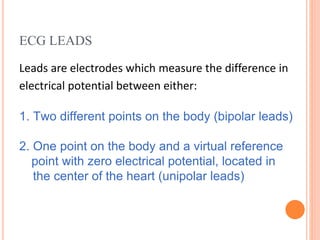
Leads are electrodes which measure the difference in
electrical potential between either:
1. Two different points on the body (bipolar leads)
2. One point on the body and a virtual reference
point with zero electrical potential, located in
the center of the heart (unipolar leads)
ECG LEADS
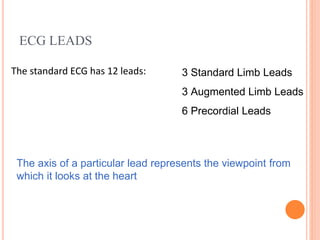
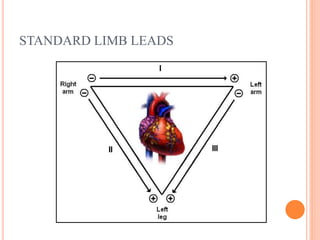
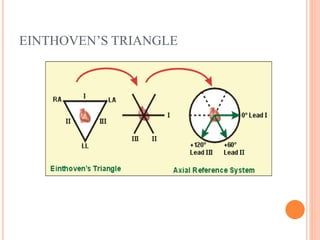
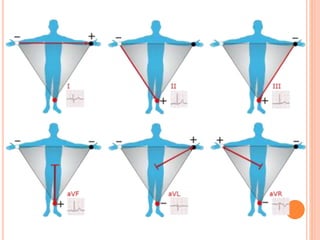
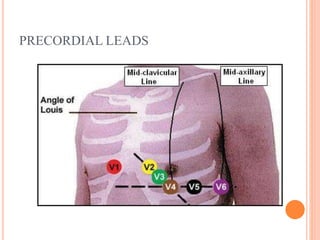
The standard ECG has 12 leads: 3 Standard Limb Leads
3 Augmented Limb Leads
6 Precordial Leads
The axis of a particular lead represents the viewpoint from
which it looks at the heart
STANDARD LIMB LEADS
EINTHOVEN’S TRIANGLE
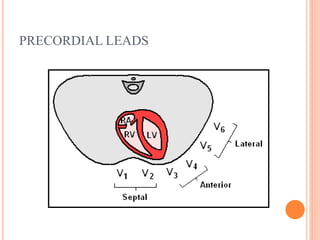
PRECORDIAL LEADS
PRECORDIAL LEADS
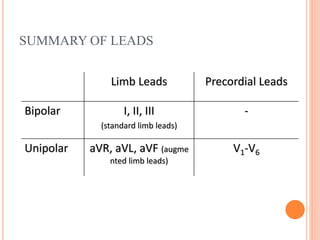
SUMMARY OF LEADS
Limb Leads Precordial Leads
Bipolar I, II, III
(standard limb leads)
-
Unipolar aVR, aVL, aVF (augme
nted limb leads)
V1-V6
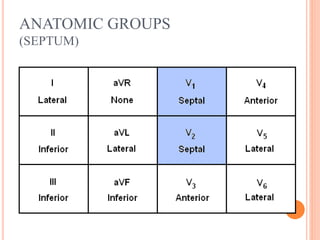
ANATOMIC GROUPS
(SEPTUM)
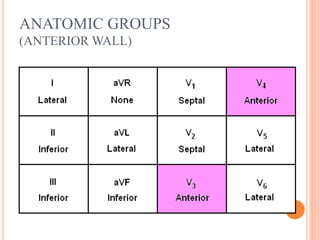
ANATOMIC GROUPS
(ANTERIOR WALL)
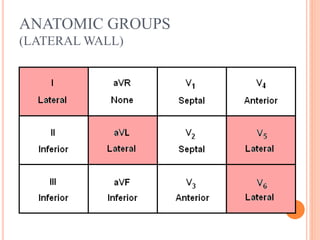
ANATOMIC GROUPS
(LATERAL WALL)
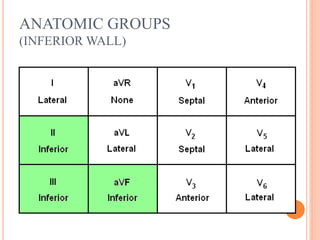
ANATOMIC GROUPS
(INFERIOR WALL)
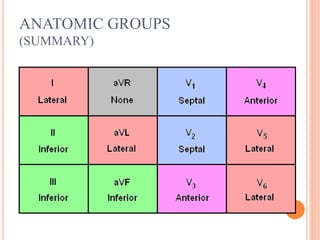
ANATOMIC GROUPS
(SUMMARY)
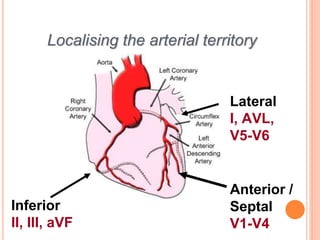
Localising the arterial territory
Inferior
II, III, aVF
Lateral
I, AVL,
V5-V6
Anterior /
Septal
V1-V4
SPECIAL SITUATION
 Amputation or burns or bandages should be placed
as closely as possible to the standard sites
 Dextrocardia right & left arm electrodes should be rev
ersed
pre-cordial leads should be recorded from V1R(V2) to V6
OTHER PRACTICAL POINTS
 Effective contact between electrode and skin is essential.
 Electrical Artifacts: external or internal
-External can be minimized by straightening the lead
wires
-Internal can be due to muscle tremors, shivering ,
hiccups
ECG PAPER
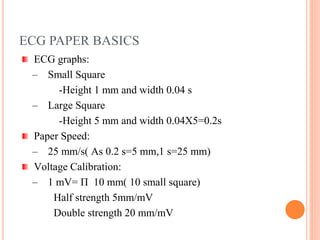
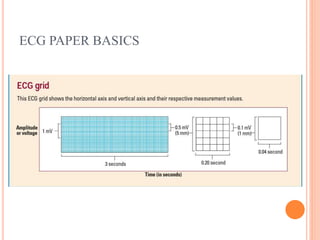
ECG PAPER BASICS
ECG graphs:
– Small Square
-Height 1 mm and width 0.04 s
– Large Square
-Height 5 mm and width 0.04X5=0.2s
Paper Speed:
– 25 mm/s( As 0.2 s=5 mm,1 s=25 mm)
Voltage Calibration:
– 1 mV= П 10 mm( 10 small square)
Half strength 5mm/mV
Double strength 20 mm/mV
ECG PAPER BASICS
ECG WAVES
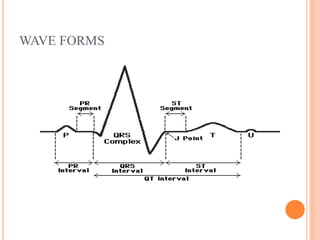
WAVE FORMS
P WAVE
 Denotes Atrial depolarization
 Shape-Rounded, neither peaked nor notched
 Width/Duration-2.5 small sq
 Height-2.5 small sq
 Better seen in Lead II/Lead V1
 Upright in every lead except aVR
 May be Biphasic in lead V1(Equal upward and downward
deflection)
PR INTERVAL
 Distance between onset of P wave to the beginning of Q
wave(in absence of Q wave beginning of R wave)
 Denotes time interval impulse travelling from SA node to
Ventricular muscle through AV node
 Normal Range:3 to 5 small Sq
 Short if ‹3 small sq and long if ›5 small sq
NORMAL QRS COMPLEX
 Denotes Ventricular depolarization
 Normal width of QRS-2 to ‹3 small sq
 Narrow complex if less than 2 small sq and Broa
d Complex if more than or equal to 3 small sq
COMPONENT OF QRS COMPLEX
o Q wave-width 1 small sq and depth 2 small sq and ‹25%
of following R wave
(Pathological if width›1 small sq,depth›2 small sq and
›25% of following R Wave)
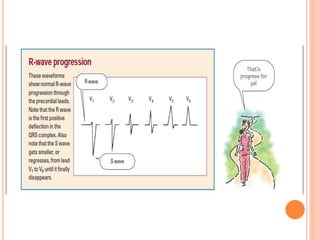
o R wave height varies, but must remember the thing that
R wave progresses from V1 to V6(2-3 small square to les
than 25 small sq/5 large sq)
(Pathological if height›25 small sq/5 large sq)
o S wave follow R wave, depth varies,progressively
diminishes from V1 to V6
T WAVE
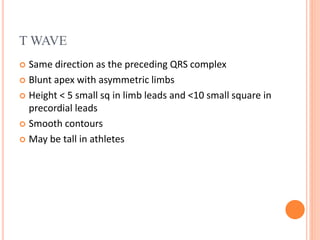
 Same direction as the preceding QRS complex
 Blunt apex with asymmetric limbs
 Height < 5 small sq in limb leads and <10 small square in
precordial leads
 Smooth contours
 May be tall in athletes
ST SEGMENT
 Merges smoothly with the proximal limb of the T wave
 No true horizontality
QT INTERVAL
 Distance between beginning of QRS to the end Of T wav
e
 Reciprocal relation with heart rate
 Normal 8-‹11 small sq
 If arrhythmia is present( HR less than 60 or more than 1
00 bpm) then QT interval should be corrected.
Corrected QT(QTc)=QT/√RR
U WAVE
 Best seen in midprecordial leads
 Height < 10% of preceding T wave
 Isoelectric in lead aVL (useful to measure QTc)
 Rarely exceeds 1 small sq in amplitude
 May be tall in athletes (2 small sq)
HEART RATE, RHYTHM AND AXIS
DETERMINING THE HEART RATE
Rule of 300
10 times/20 times method
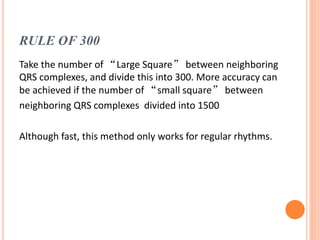
RULE OF 300
Take the number of “Large Square” between neighboring
QRS complexes, and divide this into 300. More accuracy can
be achieved if the number of “small square” between
neighboring QRS complexes divided into 1500
Although fast, this method only works for regular rhythms.
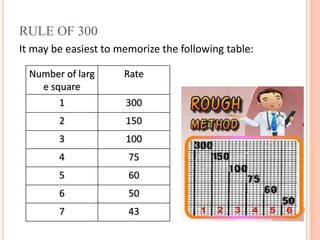
RULE OF 300
It may be easiest to memorize the following table:
Number of larg
e square
Rate
1 300
2 150
3 100
4 75
5 60
6 50
7 43
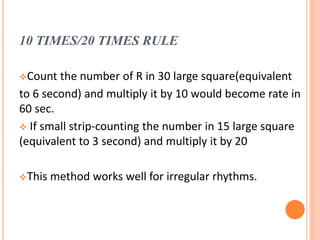
10 TIMES/20 TIMES RULE
Count the number of R in 30 large square(equivalent
to 6 second) and multiply it by 10 would become rate in
60 sec.
 If small strip-counting the number in 15 large square
(equivalent to 3 second) and multiply it by 20
This method works well for irregular rhythms.
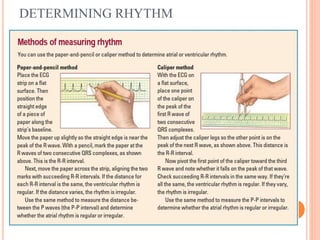
DETERMINING RHYTHM
AXIS DETERMINATION
The QRS axis represents the net overall direction of the heart’s
electrical activity.
Abnormalities of axis can hint at:
Ventricular enlargement
Conduction blocks (i.e. hemiblocks)
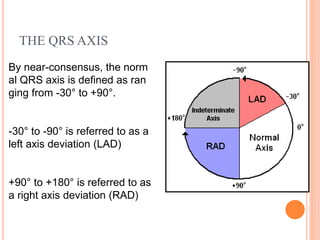
THE QRS AXIS
By near-consensus, the norm
al QRS axis is defined as ran
ging from -30° to +90°.
-30° to -90° is referred to as a
left axis deviation (LAD)
+90° to +180° is referred to as
a right axis deviation (RAD)
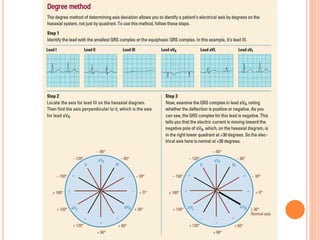
DETERMINING THE AXIS
 The Quadrant Method
 The Degree Method
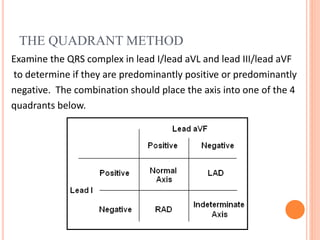
THE QUADRANT METHOD
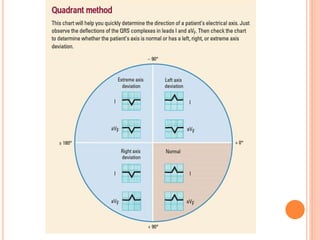
Examine the QRS complex in lead I/lead aVL and lead III/lead aVF
to determine if they are predominantly positive or predominantly
negative. The combination should place the axis into one of the 4
quadrants below.
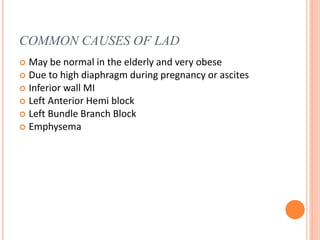
COMMON CAUSES OF LAD
 May be normal in the elderly and very obese
 Due to high diaphragm during pregnancy or ascites
 Inferior wall MI
 Left Anterior Hemi block
 Left Bundle Branch Block
 Emphysema
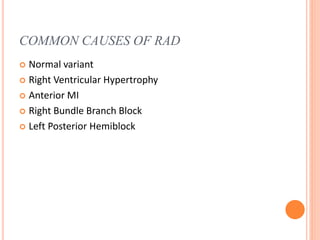
COMMON CAUSES OF RAD
 Normal variant
 Right Ventricular Hypertrophy
 Anterior MI
 Right Bundle Branch Block
 Left Posterior Hemiblock
THE NORMAL ECG &
VARIATION WITH RESPIRATION
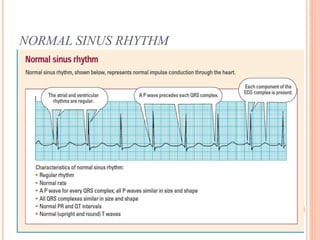
NORMAL SINUS RHYTHM
 Originates in the sinus node
 Rate between 60 and 100 beats per min
 Monomorphic P waves
 Normal relationship between P and QRS
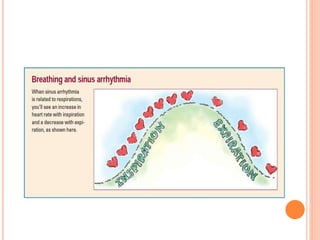
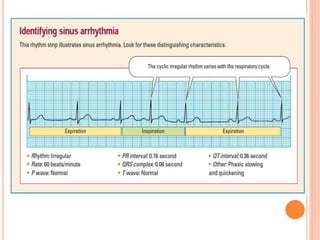
 Some sinus arrhythmia is normal
APPROACH TO INTERPRET
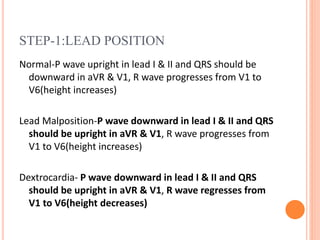
STEP-1:LEAD POSITION
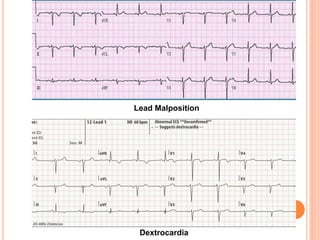
Normal-P wave upright in lead I & II and QRS should be
downward in aVR & V1, R wave progresses from V1 to
V6(height increases)
Lead Malposition-P wave downward in lead I & II and QRS
should be upright in aVR & V1, R wave progresses from
V1 to V6(height increases)
Dextrocardia- P wave downward in lead I & II and QRS
should be upright in aVR & V1, R wave regresses from
V1 to V6(height decreases)
Lead Malposition
Dextrocardia
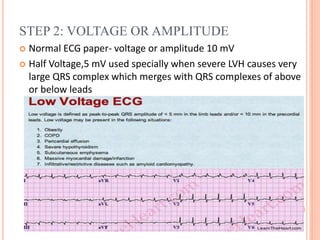
STEP 2: VOLTAGE OR AMPLITUDE
 Normal ECG paper- voltage or amplitude 10 mV
 Half Voltage,5 mV used specially when severe LVH causes very
large QRS complex which merges with QRS complexes of above
or below leads
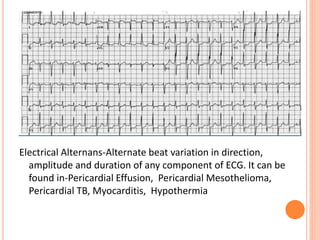
Electrical Alternans-Alternate beat variation in direction,
amplitude and duration of any component of ECG. It can be
found in-Pericardial Effusion, Pericardial Mesothelioma,
Pericardial TB, Myocarditis, Hypothermia
STEP 3:RHYTHM & RATE
 Rhythm Assessment- By Paper & Pencil Method or
Caliper Method
 Rate Measurement-By 300 times method/20 times
method
STEP 4: AXIS
 Normal- QRS of lead I(+aVL) and QRS of lead II+(III &
aVF) is in the same direction
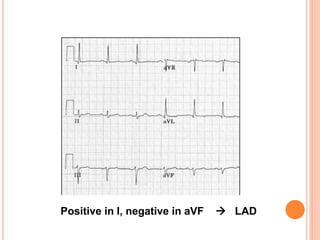
 LAD- QRS of lead I(+aVL) upward and QRS of lead II+(III
& aVF) downward
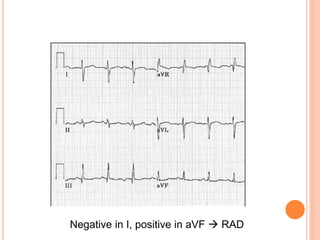
 RAD- QRS of lead I(+aVL) downward and QRS of lead
II+(III & aVF) upward
Negative in I, positive in aVF  RAD
Positive in I, negative in aVF  LAD
STEP 5: BUNDLE BRANCH BLOCK
(CLUE: WIDE QRS)
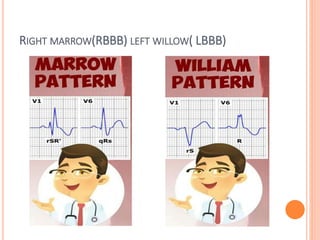
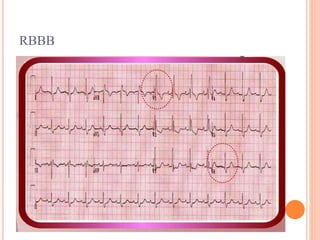
 RBBB- M pattern in QRS in Lead V1( or V2/V3). May be
normal
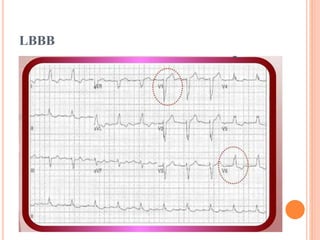
 LBBB-M pattern in QRS in Lead V6( or V4/V5). T inversion can
be found. New onset always Alarming
 Bifascicular block-
RBBB+ Left posterior Hemiblock----›features of
RBBB+RAD(Ostium Secundum ASD)
RBBB+ Left anterior Hemiblock ----›features of
RBBB+LAD(Ostium Primum ASD)
RIGHT MARROW(RBBB) LEFT WILLOW( LBBB)
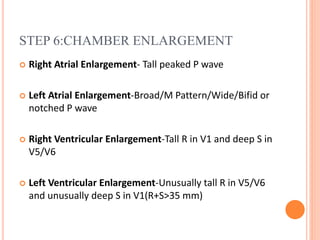
STEP 6:CHAMBER ENLARGEMENT
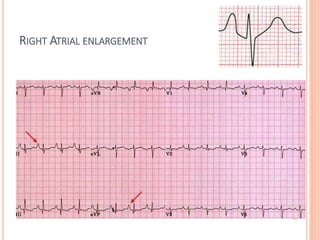
 Right Atrial Enlargement- Tall peaked P wave
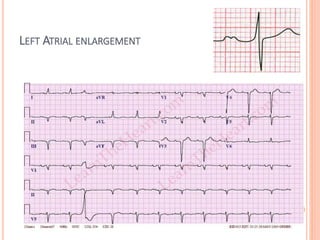
 Left Atrial Enlargement-Broad/M Pattern/Wide/Bifid or
notched P wave
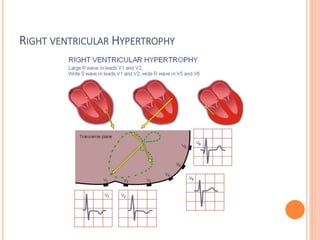
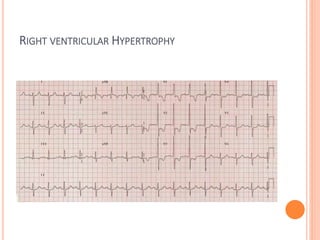
 Right Ventricular Enlargement-Tall R in V1 and deep S in
V5/V6
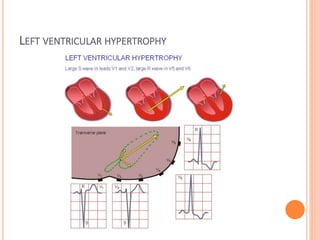
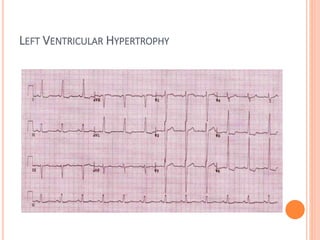
 Left Ventricular Enlargement-Unusually tall R in V5/V6
and unusually deep S in V1(R+S>35 mm)
RIGHT ATRIAL ENLARGEMENT
LEFT ATRIAL ENLARGEMENT
RIGHT VENTRICULAR HYPERTROPHY
LEFT VENTRICULAR HYPERTROPHY
7. WAVE & INTERVAL ABNORMALITY
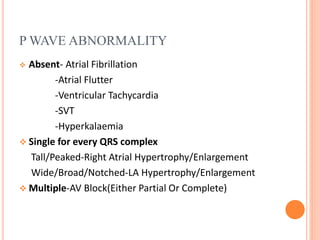
P WAVE ABNORMALITY
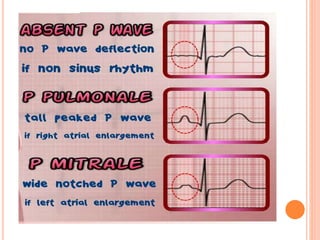
 Absent- Atrial Fibrillation
-Atrial Flutter
-Ventricular Tachycardia
-SVT
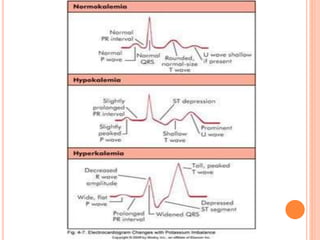
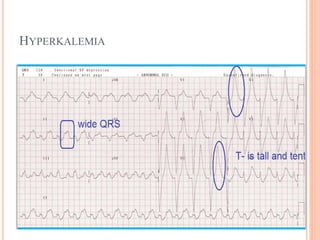
-Hyperkalaemia
 Single for every QRS complex
Tall/Peaked-Right Atrial Hypertrophy/Enlargement
Wide/Broad/Notched-LA Hypertrophy/Enlargement
 Multiple-AV Block(Either Partial Or Complete)
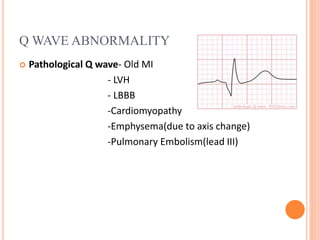
Q WAVE ABNORMALITY
 Pathological Q wave- Old MI
- LVH
- LBBB
-Cardiomyopathy
-Emphysema(due to axis change)
-Pulmonary Embolism(lead III)
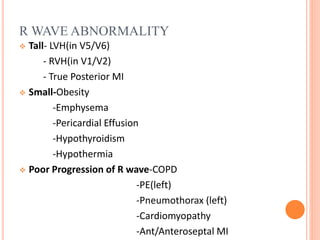
R WAVE ABNORMALITY
 Tall- LVH(in V5/V6)
- RVH(in V1/V2)
- True Posterior MI
 Small-Obesity
-Emphysema
-Pericardial Effusion
-Hypothyroidism
-Hypothermia
 Poor Progression of R wave-COPD
-PE(left)
-Pneumothorax (left)
-Cardiomyopathy
-Ant/Anteroseptal MI
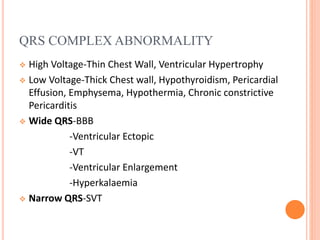
QRS COMPLEX ABNORMALITY
 High Voltage-Thin Chest Wall, Ventricular Hypertrophy
 Low Voltage-Thick Chest wall, Hypothyroidism, Pericardial
Effusion, Emphysema, Hypothermia, Chronic constrictive
Pericarditis
 Wide QRS-BBB
-Ventricular Ectopic
-VT
-Ventricular Enlargement
-Hyperkalaemia
 Narrow QRS-SVT
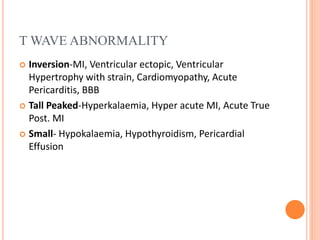
T WAVE ABNORMALITY
 Inversion-MI, Ventricular ectopic, Ventricular
Hypertrophy with strain, Cardiomyopathy, Acute
Pericarditis, BBB
 Tall Peaked-Hyperkalaemia, Hyper acute MI, Acute True
Post. MI
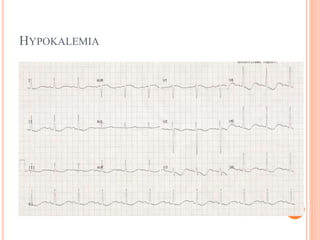
 Small- Hypokalaemia, Hypothyroidism, Pericardial
Effusion
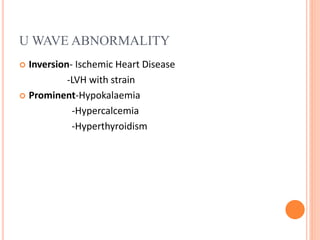
U WAVE ABNORMALITY
 Inversion- Ischemic Heart Disease
-LVH with strain
 Prominent-Hypokalaemia
-Hypercalcemia
-Hyperthyroidism
PR INTERVAL ABNORMALITY
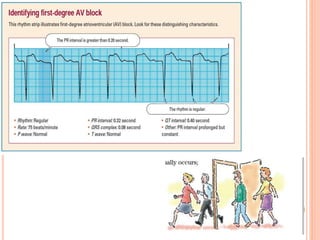
 Prolonged- First Degree Heart Block(Causes- IHD, Acute
Rheumatic Carditis, Myocarditis, Hypokalaemia, Atrial
Dilatation or Hypertrophy)
 Short- WPW syndrome
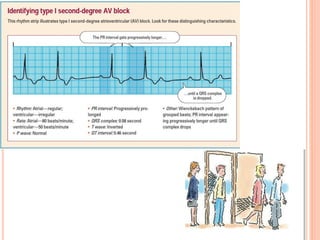
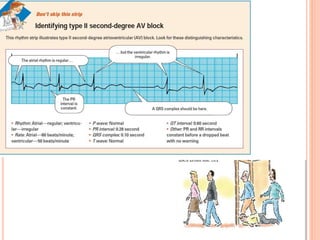
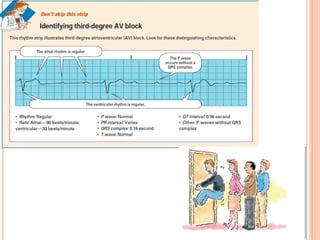
 Variable-Second Degree Block( Type I and Type II)
-Third Degree Block
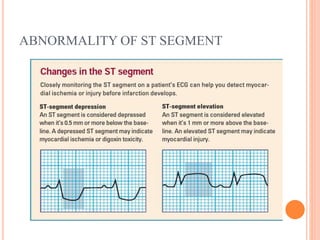
ABNORMALITY OF ST SEGMENT
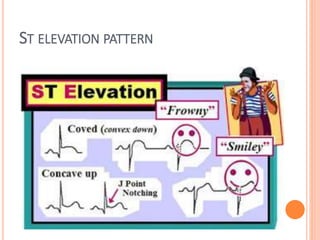
ST ELEVATION PATTERN
PROLONGED QTC (ABCDE)
 AntiArrythmic-Amiodarone,Flecainide,Disopyramide
 AntiBiotic-Macrolides
 AntiC(Psy)cotic-Chlorpromazine, Haloperidol
 AntiDepressant-TCA
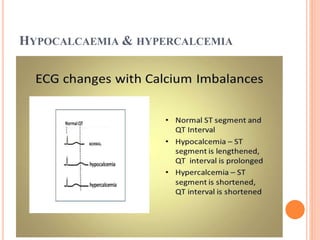
EI-Hypokalaemia, Hypomagnaesemia, Hypocalcemia
SHORTENED QT
 Digitalis effect
 Hypercalcemia
 Hyperthermia
 Vagal stimulation
ARRHYTHMIA & ECG
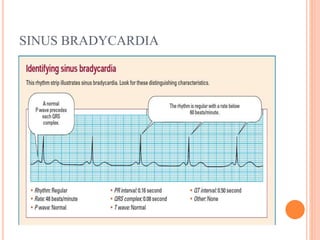
SINUS BRADYCARDIA
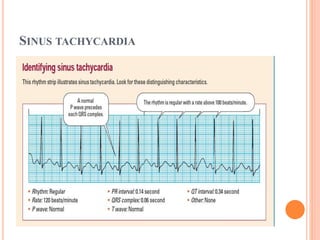
SINUS TACHYCARDIA
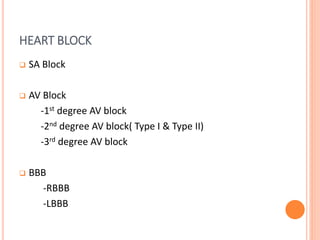
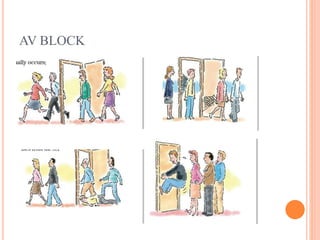
HEART BLOCK
 SA Block
 AV Block
-1st degree AV block
-2nd degree AV block( Type I & Type II)
-3rd degree AV block
 BBB
-RBBB
-LBBB
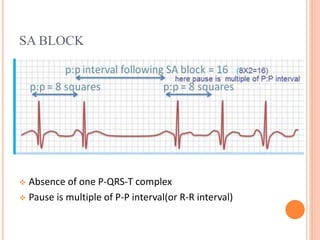
SA BLOCK
 Absence of one P-QRS-T complex
 Pause is multiple of P-P interval(or R-R interval)
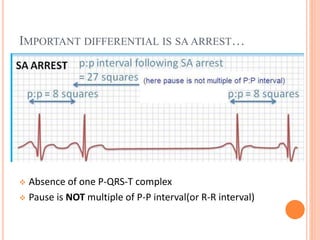
IMPORTANT DIFFERENTIAL IS SA ARREST…
 Absence of one P-QRS-T complex
 Pause is NOT multiple of P-P interval(or R-R interval)
AV BLOCK
RBBB
LBBB
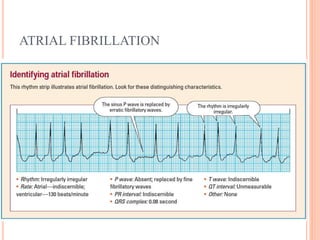
ATRIAL FIBRILLATION
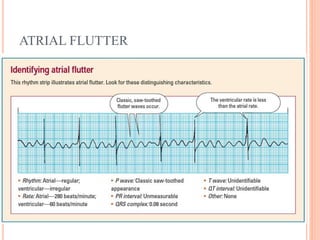
ATRIAL FLUTTER
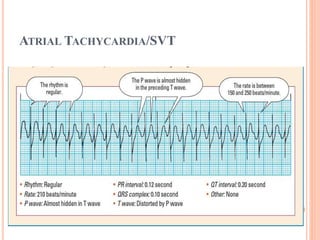
ATRIAL TACHYCARDIA/SVT
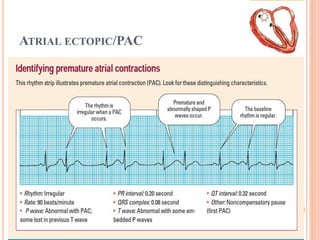
ATRIAL ECTOPIC/PAC
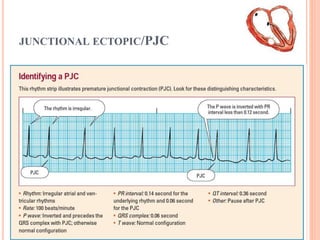
JUNCTIONAL ECTOPIC/PJC
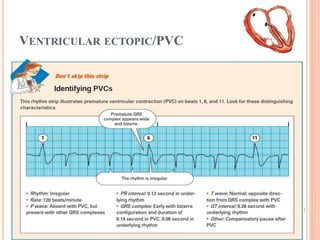
VENTRICULAR ECTOPIC/PVC
MI & ECG
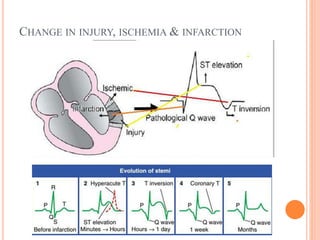
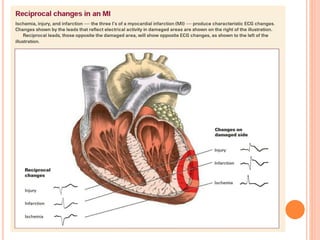
CHANGE IN INJURY, ISCHEMIA & INFARCTION
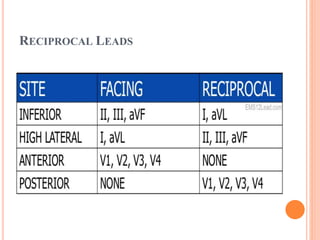
RECIPROCAL LEADS
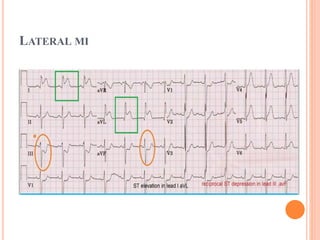
LATERAL MI
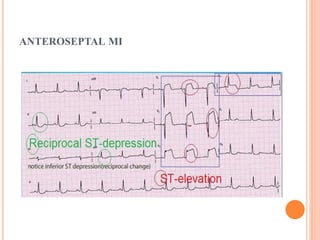
ANTEROSEPTAL MI
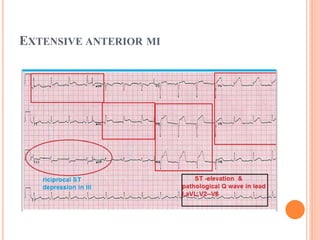
EXTENSIVE ANTERIOR MI
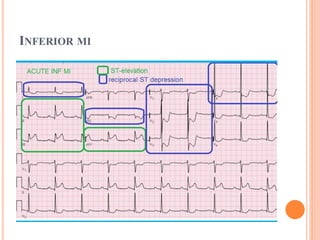
INFERIOR MI
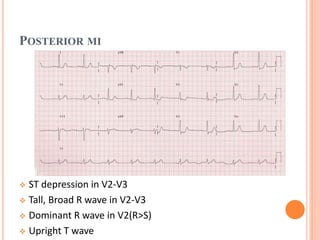
POSTERIOR MI
 ST depression in V2-V3
 Tall, Broad R wave in V2-V3
 Dominant R wave in V2(R>S)
 Upright T wave
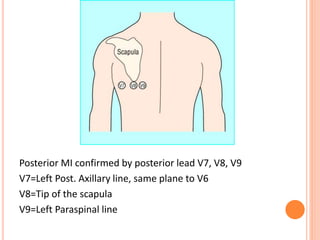
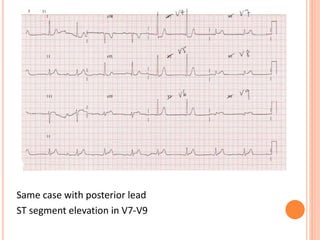
Posterior MI confirmed by posterior lead V7, V8, V9
V7=Left Post. Axillary line, same plane to V6
V8=Tip of the scapula
V9=Left Paraspinal line
Same case with posterior lead
ST segment elevation in V7-V9
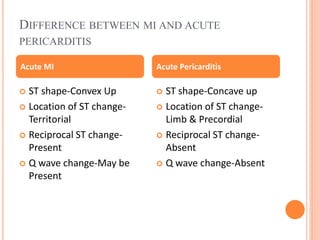
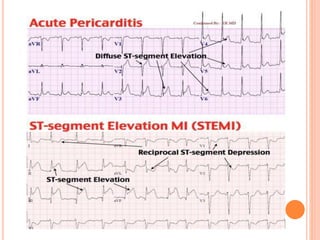
DIFFERENCE BETWEEN MI AND ACUTE
PERICARDITIS
 ST shape-Convex Up
 Location of ST change-
Territorial
 Reciprocal ST change-
Present
 Q wave change-May be
Present
 ST shape-Concave up
 Location of ST change-
Limb & Precordial
 Reciprocal ST change-
Absent
 Q wave change-Absent
Acute MI Acute Pericarditis
EI & ECG
HYPOKALEMIA
HYPERKALEMIA
HYPOCALCAEMIA & HYPERCALCEMIA
THYROID DISORDER & ECG
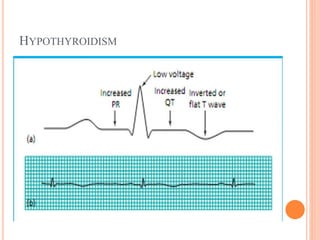
HYPOTHYROIDISM
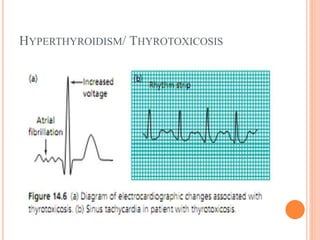
HYPERTHYROIDISM/ THYROTOXICOSIS
EMERGENCY ECG
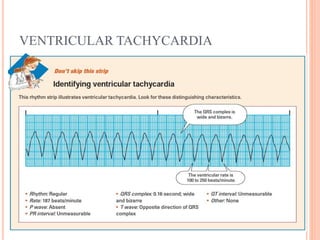
VENTRICULAR TACHYCARDIA
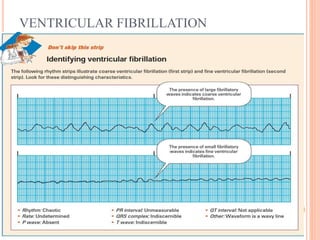
VENTRICULAR FIBRILLATION
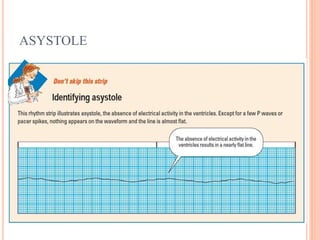
ASYSTOLE
THANK YOU….

Basic of ECG and Easy Interpretation

  • 1.
    BASICS OF ELECTROCARDIOGRAPHY DrMushfiq Newaz Ahmed Medical Officer Department Of Anaesthesia, Comilla Medical College & Hospital
  • 2.
    OUTLINE 1. Review ofthe conduction system & Action Potential 2. ECG leads and recording 3. ECG waveforms and intervals 4. Normal ECG and its variants 5. Basic Interpretation Steps of ECG 6. Arrhythmia & ECG 7. MI & ECG 8. EI & ECG 9. Thyroid Disorder & ECG 10. Emergency ECG
  • 4.
    ACTION POTENTIAL OFCARDIAC CELL
  • 5.
    BUT THE IRONYOF FATE IS……
  • 7.
    WHAT IS ANECG? An ECG is the recording (gram) of the electrical activity(electro) generated by the cells of the heart(cardio) that reaches the body surface.
  • 8.
    USEFUL IN DIAGNOSISOF…  Cardiac Arrhythmias  Myocardial ischemia and infarction  Pericarditis  Chamber hypertrophy  Electrolyte disturbances
  • 9.
  • 10.
    ECG LEADS Leads areelectrodes which measure the difference in electrical potential between either: 1. Two different points on the body (bipolar leads) 2. One point on the body and a virtual reference point with zero electrical potential, located in the center of the heart (unipolar leads)
  • 11.
    ECG LEADS The standardECG has 12 leads: 3 Standard Limb Leads 3 Augmented Limb Leads 6 Precordial Leads The axis of a particular lead represents the viewpoint from which it looks at the heart
  • 12.
  • 13.
  • 15.
  • 16.
  • 17.
    SUMMARY OF LEADS LimbLeads Precordial Leads Bipolar I, II, III (standard limb leads) - Unipolar aVR, aVL, aVF (augme nted limb leads) V1-V6
  • 18.
  • 19.
  • 20.
  • 21.
  • 22.
  • 24.
    Localising the arterialterritory Inferior II, III, aVF Lateral I, AVL, V5-V6 Anterior / Septal V1-V4
  • 25.
    SPECIAL SITUATION  Amputationor burns or bandages should be placed as closely as possible to the standard sites  Dextrocardia right & left arm electrodes should be rev ersed pre-cordial leads should be recorded from V1R(V2) to V6
  • 26.
    OTHER PRACTICAL POINTS Effective contact between electrode and skin is essential.  Electrical Artifacts: external or internal -External can be minimized by straightening the lead wires -Internal can be due to muscle tremors, shivering , hiccups
  • 27.
  • 28.
    ECG PAPER BASICS ECGgraphs: – Small Square -Height 1 mm and width 0.04 s – Large Square -Height 5 mm and width 0.04X5=0.2s Paper Speed: – 25 mm/s( As 0.2 s=5 mm,1 s=25 mm) Voltage Calibration: – 1 mV= П 10 mm( 10 small square) Half strength 5mm/mV Double strength 20 mm/mV
  • 29.
  • 30.
  • 31.
  • 33.
    P WAVE  DenotesAtrial depolarization  Shape-Rounded, neither peaked nor notched  Width/Duration-2.5 small sq  Height-2.5 small sq  Better seen in Lead II/Lead V1  Upright in every lead except aVR  May be Biphasic in lead V1(Equal upward and downward deflection)
  • 34.
    PR INTERVAL  Distancebetween onset of P wave to the beginning of Q wave(in absence of Q wave beginning of R wave)  Denotes time interval impulse travelling from SA node to Ventricular muscle through AV node  Normal Range:3 to 5 small Sq  Short if ‹3 small sq and long if ›5 small sq
  • 35.
    NORMAL QRS COMPLEX Denotes Ventricular depolarization  Normal width of QRS-2 to ‹3 small sq  Narrow complex if less than 2 small sq and Broa d Complex if more than or equal to 3 small sq
  • 36.
    COMPONENT OF QRSCOMPLEX o Q wave-width 1 small sq and depth 2 small sq and ‹25% of following R wave (Pathological if width›1 small sq,depth›2 small sq and ›25% of following R Wave) o R wave height varies, but must remember the thing that R wave progresses from V1 to V6(2-3 small square to les than 25 small sq/5 large sq) (Pathological if height›25 small sq/5 large sq) o S wave follow R wave, depth varies,progressively diminishes from V1 to V6
  • 38.
    T WAVE  Samedirection as the preceding QRS complex  Blunt apex with asymmetric limbs  Height < 5 small sq in limb leads and <10 small square in precordial leads  Smooth contours  May be tall in athletes
  • 39.
    ST SEGMENT  Mergessmoothly with the proximal limb of the T wave  No true horizontality
  • 40.
    QT INTERVAL  Distancebetween beginning of QRS to the end Of T wav e  Reciprocal relation with heart rate  Normal 8-‹11 small sq  If arrhythmia is present( HR less than 60 or more than 1 00 bpm) then QT interval should be corrected. Corrected QT(QTc)=QT/√RR
  • 41.
    U WAVE  Bestseen in midprecordial leads  Height < 10% of preceding T wave  Isoelectric in lead aVL (useful to measure QTc)  Rarely exceeds 1 small sq in amplitude  May be tall in athletes (2 small sq)
  • 42.
  • 43.
    DETERMINING THE HEARTRATE Rule of 300 10 times/20 times method
  • 44.
    RULE OF 300 Takethe number of “Large Square” between neighboring QRS complexes, and divide this into 300. More accuracy can be achieved if the number of “small square” between neighboring QRS complexes divided into 1500 Although fast, this method only works for regular rhythms.
  • 45.
    RULE OF 300 Itmay be easiest to memorize the following table: Number of larg e square Rate 1 300 2 150 3 100 4 75 5 60 6 50 7 43
  • 46.
    10 TIMES/20 TIMESRULE Count the number of R in 30 large square(equivalent to 6 second) and multiply it by 10 would become rate in 60 sec.  If small strip-counting the number in 15 large square (equivalent to 3 second) and multiply it by 20 This method works well for irregular rhythms.
  • 47.
  • 48.
    AXIS DETERMINATION The QRSaxis represents the net overall direction of the heart’s electrical activity. Abnormalities of axis can hint at: Ventricular enlargement Conduction blocks (i.e. hemiblocks)
  • 49.
    THE QRS AXIS Bynear-consensus, the norm al QRS axis is defined as ran ging from -30° to +90°. -30° to -90° is referred to as a left axis deviation (LAD) +90° to +180° is referred to as a right axis deviation (RAD)
  • 50.
    DETERMINING THE AXIS The Quadrant Method  The Degree Method
  • 51.
    THE QUADRANT METHOD Examinethe QRS complex in lead I/lead aVL and lead III/lead aVF to determine if they are predominantly positive or predominantly negative. The combination should place the axis into one of the 4 quadrants below.
  • 53.
    COMMON CAUSES OFLAD  May be normal in the elderly and very obese  Due to high diaphragm during pregnancy or ascites  Inferior wall MI  Left Anterior Hemi block  Left Bundle Branch Block  Emphysema
  • 54.
    COMMON CAUSES OFRAD  Normal variant  Right Ventricular Hypertrophy  Anterior MI  Right Bundle Branch Block  Left Posterior Hemiblock
  • 56.
    THE NORMAL ECG& VARIATION WITH RESPIRATION
  • 57.
    NORMAL SINUS RHYTHM Originates in the sinus node  Rate between 60 and 100 beats per min  Monomorphic P waves  Normal relationship between P and QRS  Some sinus arrhythmia is normal
  • 60.
  • 61.
    STEP-1:LEAD POSITION Normal-P waveupright in lead I & II and QRS should be downward in aVR & V1, R wave progresses from V1 to V6(height increases) Lead Malposition-P wave downward in lead I & II and QRS should be upright in aVR & V1, R wave progresses from V1 to V6(height increases) Dextrocardia- P wave downward in lead I & II and QRS should be upright in aVR & V1, R wave regresses from V1 to V6(height decreases)
  • 62.
  • 63.
    STEP 2: VOLTAGEOR AMPLITUDE  Normal ECG paper- voltage or amplitude 10 mV  Half Voltage,5 mV used specially when severe LVH causes very large QRS complex which merges with QRS complexes of above or below leads
  • 64.
    Electrical Alternans-Alternate beatvariation in direction, amplitude and duration of any component of ECG. It can be found in-Pericardial Effusion, Pericardial Mesothelioma, Pericardial TB, Myocarditis, Hypothermia
  • 65.
    STEP 3:RHYTHM &RATE  Rhythm Assessment- By Paper & Pencil Method or Caliper Method  Rate Measurement-By 300 times method/20 times method
  • 66.
    STEP 4: AXIS Normal- QRS of lead I(+aVL) and QRS of lead II+(III & aVF) is in the same direction  LAD- QRS of lead I(+aVL) upward and QRS of lead II+(III & aVF) downward  RAD- QRS of lead I(+aVL) downward and QRS of lead II+(III & aVF) upward
  • 67.
    Negative in I,positive in aVF  RAD
  • 68.
    Positive in I,negative in aVF  LAD
  • 69.
    STEP 5: BUNDLEBRANCH BLOCK (CLUE: WIDE QRS)  RBBB- M pattern in QRS in Lead V1( or V2/V3). May be normal  LBBB-M pattern in QRS in Lead V6( or V4/V5). T inversion can be found. New onset always Alarming  Bifascicular block- RBBB+ Left posterior Hemiblock----›features of RBBB+RAD(Ostium Secundum ASD) RBBB+ Left anterior Hemiblock ----›features of RBBB+LAD(Ostium Primum ASD)
  • 70.
  • 71.
    STEP 6:CHAMBER ENLARGEMENT Right Atrial Enlargement- Tall peaked P wave  Left Atrial Enlargement-Broad/M Pattern/Wide/Bifid or notched P wave  Right Ventricular Enlargement-Tall R in V1 and deep S in V5/V6  Left Ventricular Enlargement-Unusually tall R in V5/V6 and unusually deep S in V1(R+S>35 mm)
  • 73.
  • 74.
  • 75.
  • 76.
  • 77.
  • 78.
  • 79.
    7. WAVE &INTERVAL ABNORMALITY
  • 80.
    P WAVE ABNORMALITY Absent- Atrial Fibrillation -Atrial Flutter -Ventricular Tachycardia -SVT -Hyperkalaemia  Single for every QRS complex Tall/Peaked-Right Atrial Hypertrophy/Enlargement Wide/Broad/Notched-LA Hypertrophy/Enlargement  Multiple-AV Block(Either Partial Or Complete)
  • 82.
    Q WAVE ABNORMALITY Pathological Q wave- Old MI - LVH - LBBB -Cardiomyopathy -Emphysema(due to axis change) -Pulmonary Embolism(lead III)
  • 83.
    R WAVE ABNORMALITY Tall- LVH(in V5/V6) - RVH(in V1/V2) - True Posterior MI  Small-Obesity -Emphysema -Pericardial Effusion -Hypothyroidism -Hypothermia  Poor Progression of R wave-COPD -PE(left) -Pneumothorax (left) -Cardiomyopathy -Ant/Anteroseptal MI
  • 84.
    QRS COMPLEX ABNORMALITY High Voltage-Thin Chest Wall, Ventricular Hypertrophy  Low Voltage-Thick Chest wall, Hypothyroidism, Pericardial Effusion, Emphysema, Hypothermia, Chronic constrictive Pericarditis  Wide QRS-BBB -Ventricular Ectopic -VT -Ventricular Enlargement -Hyperkalaemia  Narrow QRS-SVT
  • 85.
    T WAVE ABNORMALITY Inversion-MI, Ventricular ectopic, Ventricular Hypertrophy with strain, Cardiomyopathy, Acute Pericarditis, BBB  Tall Peaked-Hyperkalaemia, Hyper acute MI, Acute True Post. MI  Small- Hypokalaemia, Hypothyroidism, Pericardial Effusion
  • 86.
    U WAVE ABNORMALITY Inversion- Ischemic Heart Disease -LVH with strain  Prominent-Hypokalaemia -Hypercalcemia -Hyperthyroidism
  • 87.
    PR INTERVAL ABNORMALITY Prolonged- First Degree Heart Block(Causes- IHD, Acute Rheumatic Carditis, Myocarditis, Hypokalaemia, Atrial Dilatation or Hypertrophy)  Short- WPW syndrome  Variable-Second Degree Block( Type I and Type II) -Third Degree Block
  • 88.
  • 89.
  • 90.
    PROLONGED QTC (ABCDE) AntiArrythmic-Amiodarone,Flecainide,Disopyramide  AntiBiotic-Macrolides  AntiC(Psy)cotic-Chlorpromazine, Haloperidol  AntiDepressant-TCA EI-Hypokalaemia, Hypomagnaesemia, Hypocalcemia
  • 91.
    SHORTENED QT  Digitaliseffect  Hypercalcemia  Hyperthermia  Vagal stimulation
  • 92.
  • 93.
  • 94.
  • 95.
    HEART BLOCK  SABlock  AV Block -1st degree AV block -2nd degree AV block( Type I & Type II) -3rd degree AV block  BBB -RBBB -LBBB
  • 96.
    SA BLOCK  Absenceof one P-QRS-T complex  Pause is multiple of P-P interval(or R-R interval)
  • 97.
    IMPORTANT DIFFERENTIAL ISSA ARREST…  Absence of one P-QRS-T complex  Pause is NOT multiple of P-P interval(or R-R interval)
  • 98.
  • 103.
  • 104.
  • 105.
  • 106.
  • 107.
  • 108.
  • 109.
  • 110.
  • 111.
  • 112.
    CHANGE IN INJURY,ISCHEMIA & INFARCTION
  • 114.
  • 115.
  • 116.
  • 117.
  • 118.
  • 119.
    POSTERIOR MI  STdepression in V2-V3  Tall, Broad R wave in V2-V3  Dominant R wave in V2(R>S)  Upright T wave
  • 120.
    Posterior MI confirmedby posterior lead V7, V8, V9 V7=Left Post. Axillary line, same plane to V6 V8=Tip of the scapula V9=Left Paraspinal line
  • 121.
    Same case withposterior lead ST segment elevation in V7-V9
  • 122.
    DIFFERENCE BETWEEN MIAND ACUTE PERICARDITIS  ST shape-Convex Up  Location of ST change- Territorial  Reciprocal ST change- Present  Q wave change-May be Present  ST shape-Concave up  Location of ST change- Limb & Precordial  Reciprocal ST change- Absent  Q wave change-Absent Acute MI Acute Pericarditis
  • 124.
  • 126.
  • 127.
  • 128.
  • 129.
  • 130.
  • 131.
  • 132.
  • 133.
  • 134.
  • 135.
  • 137.

Editor's Notes

  • #14 If the three limbs of triangle broken apart, collapsed and superimposed over the heart, then positive electrode for lead I=0º,lead II=60º,lead III=120º in relation to heart
  • #15 Single positive electrode that is referenced against a combination of other limb electrodes. Positive electrodes for LA=aVL, RA=aVR, LL=aVF
  • #16 V1-Right 4th ICS,V2-Left 4th ICS,V4-5th ICS in left MCL, V3-In between V2 & V4, V5-Left 5th ICS in AAL, V6-Left 5th ICS in MAL
  • #17 V1-V2=Septal or Anteroseptal( Right Ventricular), V3-V4=Anterior or Anteroapical, V5-V6= Anterolateral or lateral( Left ventricular)