ECG
Abnormal rate and rhythm
and other changes
Prof Vajira Weerasinghe
Professor of Physiology
Criteria for normal sinus rhythm
• P wave precedes every QRS complex
•The rhythm is regular, but varies slightly during respirations
•The rate ranges between 60 and 100 beats per minute
•The P waves maximum height at 2.5 mm in II and/or III
•The P wave is positive in I and II, and biphasic in V1
SDIN 2011
Sinus bradycardia Herat rate less than 60 bpm
May occur in healthy people at rest
or during sleep
Common finding in athletes
May occur in MI, sinus node
disease, hypothermia,
hypothyroidism, drugs
Sinus tachycardia
Heart rate >100, usually due to increase in sympathetic activity due to exercise,
anxiety, emotion, pregnancy. Also found in fever, anaemia, heart failure,
thyrotoxicosis, due to drugs
Sinus arrhythmia
• Heart rate accelerates during inspiration and decelerates during expiration
• Is a normal phenomenon
• During inspiration, impulses in the vagi from the stretch receptors in the lungs
inhibit the cardio-inhibitory area in the medulla oblongata
• Tonic vagal discharge that keeps the heart rate slow decreases, and the heart rate
rises
• Word ‘rhythm’ is used to refer to the part of the heart
which is controlling the activation
• The normal heart rhythm with activation beginning in
the SA node is called – sinus rhythm
• Rhythm of the heart is best interpreted using lead II
• Interference with the conduction process causes a
phenomenon called ‘heart block’
Conduction and its problems
Heart block
• May occur at any level in the
conducting system
• A block in the AV node or His
bundle
atrioventricular block
• A block lower in the conducting
system
bundle branch blocks
Atrioventricular blocks
• There are three forms
1. First degree AV block
2. Second degree AV block
3. Third degree AV block
First degree AV block
• Simple prolongation of the PR interval to more than 0.2 s
• Every atrial depolarization is followed by ventricular
depolarization
• Is mostly caused by a degeneration of the conduction system
• First degree AV block is relatively harmless
Second degree AV block
• Occurs when some P waves conduct and others do
not conduct
• There are several forms:
Mobitz type I block (Wenckebach
phenomenon)
Mobitz type II block
2:1 or 3:1 (advanced) block
Second degree AV block
• Progressive prolongation of PR until P fails to conduct to the
ventricle at all
• PR just before the blocked P wave is much longer than the PR
interval just after the block
• Generally the block is due to an AV nodal problem
Mobitz type I block (Wenckebach phenomenon)
Second degree AV block
• Usually when a dropped QRS is not preceded by progressive
PR prolongation
Mobitz type II block
Second degree AV block
• Every second or third P wave conducts to the ventricle
2:1 or 3:1 block
Third degree AV block
Also called complete heart block
• Occurs when all P waves fails to conduct to ventricles
• In this situation life is maintained by escape rhythm
• Idioventricular rhythm
• Block may be due to disease in the AV node (AV nodal block) or in the
conducting system below the node (infranodal block)
Bundle branch block
Depolarization wave moves to the ventricle through one of
these three pathways
 can have right bundle branch block,
left bundle branch block or fascicular blocks
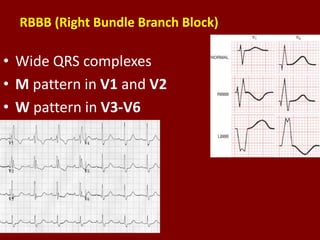
• Wide QRS complexes
• W pattern in V1 and V2
• M pattern in V3-V6
LBBB (Left Bundle Branch Block)
• Wide QRS complexes
• M pattern in V1 and V2
• W pattern in V3-V6
RBBB (Right Bundle Branch Block)
Normal P wave
• May be positive or negative depending on the lead
• In sinus rhythm
– P waves is always negative in aVR
– P wave is always positive in II
Can determine whether SA node is pacing the atria
by looking at aVR and II
Determination of a wave form in a lead
Abnormal P wave
• Shape of the P wave may alter in rhythm changes.
• The other abnormalities are:
1. Peaked P wave – in right atrial hypertrophy
2. Broad and bifid P wave – in left atrial
hypertrophy
Jan 2012
Normal QRS complex
• Waveform is more complex
• 1st phase – septal depolarization from left to right (small Q)
• 2nd phase – main ventricular mass depolarizes
inside to out. Left ventricle has a larger muscle mass
• V1 to V6 – S wave becomes smaller
R wave becomes taller.
Tallest in V4 /V5
(normal progression of R wave)
• Has four characteristics:
1. duration of QRS is not more than 120 ms (3 small squares)
2. In a right ventricular lead (V1), the S wave is greater than the
R wave
3. In a left ventricular lead (V5 or V6), the height of the R wave is
less than 25 mm
4. Left ventricular leads may show Q waves due to septal
depolarization, but they are less than 1 mm across and less
than 2 mm deep
Abnormalities of QRS complex
1. Abnormal width of the QRS complex
2. Increased height of the QRS complex
3. The appearance of new Q waves
Abnormalities of QRS complex
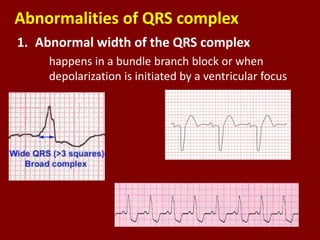
1. Abnormal width of the QRS complex
happens in a bundle branch block or when
depolarization is initiated by a ventricular focus
Abnormalities of QRS complex
2. Increased height of the QRS complex
An increased muscle mass in either ventricle will
lead to a tall QRS complex
Abnormalities of QRS complex
Right ventricle muscle mass increase
(Right Ventricular Hypertrophy)
V1 – complex is upright with R > S.
Also deep S waves in V6
Abnormalities of QRS complex
Left ventricular
muscle mass
increase (Left
Ventricular
Hypertrophy)
• Tall R in V5, V6 and
deep S in V1, V2.
• But also
associated with
other things like
left axis deviation
Abnormalities of QRS complex
3. The appearance of new Q waves
Q waves of septal origin are normal.
But larger Q waves appear when there is
a death of the muscle over an area.
(like an electrode placed in a cavity)
Q waves also give some idea about the
part of the heart that is damaged
eg. V2 - V4/V5 : infarction of
anterior wall
II, III, aVF : inferior infarction
I, aVL, V5/V6 : lateral infarction
• Generally isoelectric
May have slight deviations of < 1 mm normally
• Right chest leads V1 – V3 ST segments are
shorter
T wave takes off from
J point at times
Abnormalities of ST segment
• May be elevated or depressed from the isoelectric line
• ST elevation : indicates an acute myocardial injury
(localized to affected area leads) or
pericarditis (seen in all leads)
• ST depression : with an upright T indicates ischaemia
Can occur with exercise if there is a
reduction in blood supply (ischaemia)
• Wave is normally asymmetrical. Peak closer to the end
• Generally takes the direction of the main QRS deflection
in a lead
• Therefore, always negative in aVR and positive in II
V4 - V6 normally positive T
V1 V2 may be negative,
isoelectric
or positive
Abnormalities of T wave
• T inversion – can be normal
• Seen in ischaemia
ventricular hypertrophy
bundle branch block
Abnormalities of T wave
• Tall peaked T waves
in all leads – suggests hyperkalaemia
or
can be due to myocardial ischaemia when it comes
in some leads
Atrial Ectopics
Ventricular Ectopics
SDIN 2011
Atrial fibrillation
• Irregularly irregular RR intervals and absent organized atrial
activity
• Commonest tachycardia in patients over 65 years
• It is maintained by continuous rapid activation of the atria (300-
600 per minute)
• Only a proportion of these impulses are conducted to the
ventricles
Atrial fibrillation
Atrial flutter
• Often associated with atrial fibrillation
• Visible flutter waves at 300/min (saw-tooth appearance)
Usually with a 2:1 AV conduction
• Typically, ECG shows saw-tooth waves between QRS
complexes
Atrial flutter
Reentry
• if a transient block is present on one side of a portion of the
conducting system, the impulse can go down the other side
• If the block then wears off, the impulse may conduct in a
retrograde direction in the previously blocked side back to
the origin and then descend again, establishing a circus
movement
• In individuals with an abnormal extra bundle of conducting
tissue connecting the atria to the ventricles (bundle of Kent),
the circus activity can pass in one direction through the AV
node and in the other direction through the bundle, thus
involving both the atria and the ventricles
• This occurs in Wolff Parkinson White Syndrome (WPW)
• ECG changes:
– Short PR interval
– Delta wave
– Broad QRS complex
Long QT Syndrome
• In patients in whom the QT
interval is pro-longed, cardiac
repolarization is irregular and the
incidence of ventricular
arrhythmias and sudden death
increases
• K+ and Na+ channels are affected
Myocardial Ischaemia and Infarction
• When the blood supply to part of the
myocardium is interrupted, profound changes
take place in the myocardium that lead to
irreversible changes and death of muscle cells
• ECG is very useful for diagnosing ischemia and
locating areas of infarction
• Some of the changes seen in ECG sometimes
within minutes are
– ST segment elevation (ST segment elevation
myocardial infraction - STEMI)
– T wave flattening or inversion
– Prominent Q waves
– ST segment depression (ischaemia)
Ion changes and ECG
• Heart tissue is sensitive to ionic
composition of the blood
• Most serious are increases in K+
that can produce severe cardiac
abnormalities, including paralysis
of the atria and ventricular
arrhythmias
• Hyperkalemia
– Tall tented T waves
• Hypokalaemia
– U waves
• The description should be given in the following
sequence:
1. rhythm & rate
2. conduction intervals
3. cardiac axis
4. a description of the QRS complex
5. a description of the ST segment & T
wave
Note: whether the calibration is correct and check for
the paper speed

Ecg 2019 b

  • 1.
    ECG Abnormal rate andrhythm and other changes Prof Vajira Weerasinghe Professor of Physiology
  • 2.
    Criteria for normalsinus rhythm • P wave precedes every QRS complex •The rhythm is regular, but varies slightly during respirations •The rate ranges between 60 and 100 beats per minute •The P waves maximum height at 2.5 mm in II and/or III •The P wave is positive in I and II, and biphasic in V1
  • 3.
    SDIN 2011 Sinus bradycardiaHerat rate less than 60 bpm May occur in healthy people at rest or during sleep Common finding in athletes May occur in MI, sinus node disease, hypothermia, hypothyroidism, drugs
  • 4.
    Sinus tachycardia Heart rate>100, usually due to increase in sympathetic activity due to exercise, anxiety, emotion, pregnancy. Also found in fever, anaemia, heart failure, thyrotoxicosis, due to drugs
  • 5.
    Sinus arrhythmia • Heartrate accelerates during inspiration and decelerates during expiration • Is a normal phenomenon • During inspiration, impulses in the vagi from the stretch receptors in the lungs inhibit the cardio-inhibitory area in the medulla oblongata • Tonic vagal discharge that keeps the heart rate slow decreases, and the heart rate rises
  • 6.
    • Word ‘rhythm’is used to refer to the part of the heart which is controlling the activation • The normal heart rhythm with activation beginning in the SA node is called – sinus rhythm • Rhythm of the heart is best interpreted using lead II • Interference with the conduction process causes a phenomenon called ‘heart block’ Conduction and its problems
  • 7.
    Heart block • Mayoccur at any level in the conducting system • A block in the AV node or His bundle atrioventricular block • A block lower in the conducting system bundle branch blocks
  • 8.
    Atrioventricular blocks • Thereare three forms 1. First degree AV block 2. Second degree AV block 3. Third degree AV block
  • 9.
    First degree AVblock • Simple prolongation of the PR interval to more than 0.2 s • Every atrial depolarization is followed by ventricular depolarization • Is mostly caused by a degeneration of the conduction system • First degree AV block is relatively harmless
  • 10.
    Second degree AVblock • Occurs when some P waves conduct and others do not conduct • There are several forms: Mobitz type I block (Wenckebach phenomenon) Mobitz type II block 2:1 or 3:1 (advanced) block
  • 11.
    Second degree AVblock • Progressive prolongation of PR until P fails to conduct to the ventricle at all • PR just before the blocked P wave is much longer than the PR interval just after the block • Generally the block is due to an AV nodal problem Mobitz type I block (Wenckebach phenomenon)
  • 12.
    Second degree AVblock • Usually when a dropped QRS is not preceded by progressive PR prolongation Mobitz type II block
  • 13.
    Second degree AVblock • Every second or third P wave conducts to the ventricle 2:1 or 3:1 block
  • 14.
    Third degree AVblock Also called complete heart block • Occurs when all P waves fails to conduct to ventricles • In this situation life is maintained by escape rhythm • Idioventricular rhythm • Block may be due to disease in the AV node (AV nodal block) or in the conducting system below the node (infranodal block)
  • 15.
    Bundle branch block Depolarizationwave moves to the ventricle through one of these three pathways  can have right bundle branch block, left bundle branch block or fascicular blocks
  • 16.
    • Wide QRScomplexes • W pattern in V1 and V2 • M pattern in V3-V6 LBBB (Left Bundle Branch Block)
  • 17.
    • Wide QRScomplexes • M pattern in V1 and V2 • W pattern in V3-V6 RBBB (Right Bundle Branch Block)
  • 18.
    Normal P wave •May be positive or negative depending on the lead • In sinus rhythm – P waves is always negative in aVR – P wave is always positive in II Can determine whether SA node is pacing the atria by looking at aVR and II Determination of a wave form in a lead
  • 19.
    Abnormal P wave •Shape of the P wave may alter in rhythm changes. • The other abnormalities are: 1. Peaked P wave – in right atrial hypertrophy 2. Broad and bifid P wave – in left atrial hypertrophy Jan 2012
  • 20.
    Normal QRS complex •Waveform is more complex • 1st phase – septal depolarization from left to right (small Q) • 2nd phase – main ventricular mass depolarizes inside to out. Left ventricle has a larger muscle mass
  • 21.
    • V1 toV6 – S wave becomes smaller R wave becomes taller. Tallest in V4 /V5 (normal progression of R wave) • Has four characteristics: 1. duration of QRS is not more than 120 ms (3 small squares) 2. In a right ventricular lead (V1), the S wave is greater than the R wave 3. In a left ventricular lead (V5 or V6), the height of the R wave is less than 25 mm 4. Left ventricular leads may show Q waves due to septal depolarization, but they are less than 1 mm across and less than 2 mm deep
  • 22.
    Abnormalities of QRScomplex 1. Abnormal width of the QRS complex 2. Increased height of the QRS complex 3. The appearance of new Q waves
  • 23.
    Abnormalities of QRScomplex 1. Abnormal width of the QRS complex happens in a bundle branch block or when depolarization is initiated by a ventricular focus
  • 24.
    Abnormalities of QRScomplex 2. Increased height of the QRS complex An increased muscle mass in either ventricle will lead to a tall QRS complex
  • 25.
    Abnormalities of QRScomplex Right ventricle muscle mass increase (Right Ventricular Hypertrophy) V1 – complex is upright with R > S. Also deep S waves in V6
  • 26.
    Abnormalities of QRScomplex Left ventricular muscle mass increase (Left Ventricular Hypertrophy) • Tall R in V5, V6 and deep S in V1, V2. • But also associated with other things like left axis deviation
  • 27.
    Abnormalities of QRScomplex 3. The appearance of new Q waves Q waves of septal origin are normal. But larger Q waves appear when there is a death of the muscle over an area. (like an electrode placed in a cavity) Q waves also give some idea about the part of the heart that is damaged eg. V2 - V4/V5 : infarction of anterior wall II, III, aVF : inferior infarction I, aVL, V5/V6 : lateral infarction
  • 28.
    • Generally isoelectric Mayhave slight deviations of < 1 mm normally • Right chest leads V1 – V3 ST segments are shorter T wave takes off from J point at times
  • 29.
    Abnormalities of STsegment • May be elevated or depressed from the isoelectric line • ST elevation : indicates an acute myocardial injury (localized to affected area leads) or pericarditis (seen in all leads) • ST depression : with an upright T indicates ischaemia Can occur with exercise if there is a reduction in blood supply (ischaemia)
  • 30.
    • Wave isnormally asymmetrical. Peak closer to the end • Generally takes the direction of the main QRS deflection in a lead • Therefore, always negative in aVR and positive in II V4 - V6 normally positive T V1 V2 may be negative, isoelectric or positive
  • 31.
    Abnormalities of Twave • T inversion – can be normal • Seen in ischaemia ventricular hypertrophy bundle branch block
  • 32.
    Abnormalities of Twave • Tall peaked T waves in all leads – suggests hyperkalaemia or can be due to myocardial ischaemia when it comes in some leads
  • 33.
  • 34.
  • 35.
    Atrial fibrillation • Irregularlyirregular RR intervals and absent organized atrial activity • Commonest tachycardia in patients over 65 years • It is maintained by continuous rapid activation of the atria (300- 600 per minute) • Only a proportion of these impulses are conducted to the ventricles
  • 36.
  • 37.
    Atrial flutter • Oftenassociated with atrial fibrillation • Visible flutter waves at 300/min (saw-tooth appearance) Usually with a 2:1 AV conduction • Typically, ECG shows saw-tooth waves between QRS complexes
  • 38.
  • 39.
    Reentry • if atransient block is present on one side of a portion of the conducting system, the impulse can go down the other side • If the block then wears off, the impulse may conduct in a retrograde direction in the previously blocked side back to the origin and then descend again, establishing a circus movement • In individuals with an abnormal extra bundle of conducting tissue connecting the atria to the ventricles (bundle of Kent), the circus activity can pass in one direction through the AV node and in the other direction through the bundle, thus involving both the atria and the ventricles • This occurs in Wolff Parkinson White Syndrome (WPW) • ECG changes: – Short PR interval – Delta wave – Broad QRS complex
  • 40.
    Long QT Syndrome •In patients in whom the QT interval is pro-longed, cardiac repolarization is irregular and the incidence of ventricular arrhythmias and sudden death increases • K+ and Na+ channels are affected
  • 41.
    Myocardial Ischaemia andInfarction • When the blood supply to part of the myocardium is interrupted, profound changes take place in the myocardium that lead to irreversible changes and death of muscle cells • ECG is very useful for diagnosing ischemia and locating areas of infarction • Some of the changes seen in ECG sometimes within minutes are – ST segment elevation (ST segment elevation myocardial infraction - STEMI) – T wave flattening or inversion – Prominent Q waves – ST segment depression (ischaemia)
  • 43.
    Ion changes andECG • Heart tissue is sensitive to ionic composition of the blood • Most serious are increases in K+ that can produce severe cardiac abnormalities, including paralysis of the atria and ventricular arrhythmias • Hyperkalemia – Tall tented T waves • Hypokalaemia – U waves
  • 45.
    • The descriptionshould be given in the following sequence: 1. rhythm & rate 2. conduction intervals 3. cardiac axis 4. a description of the QRS complex 5. a description of the ST segment & T wave Note: whether the calibration is correct and check for the paper speed