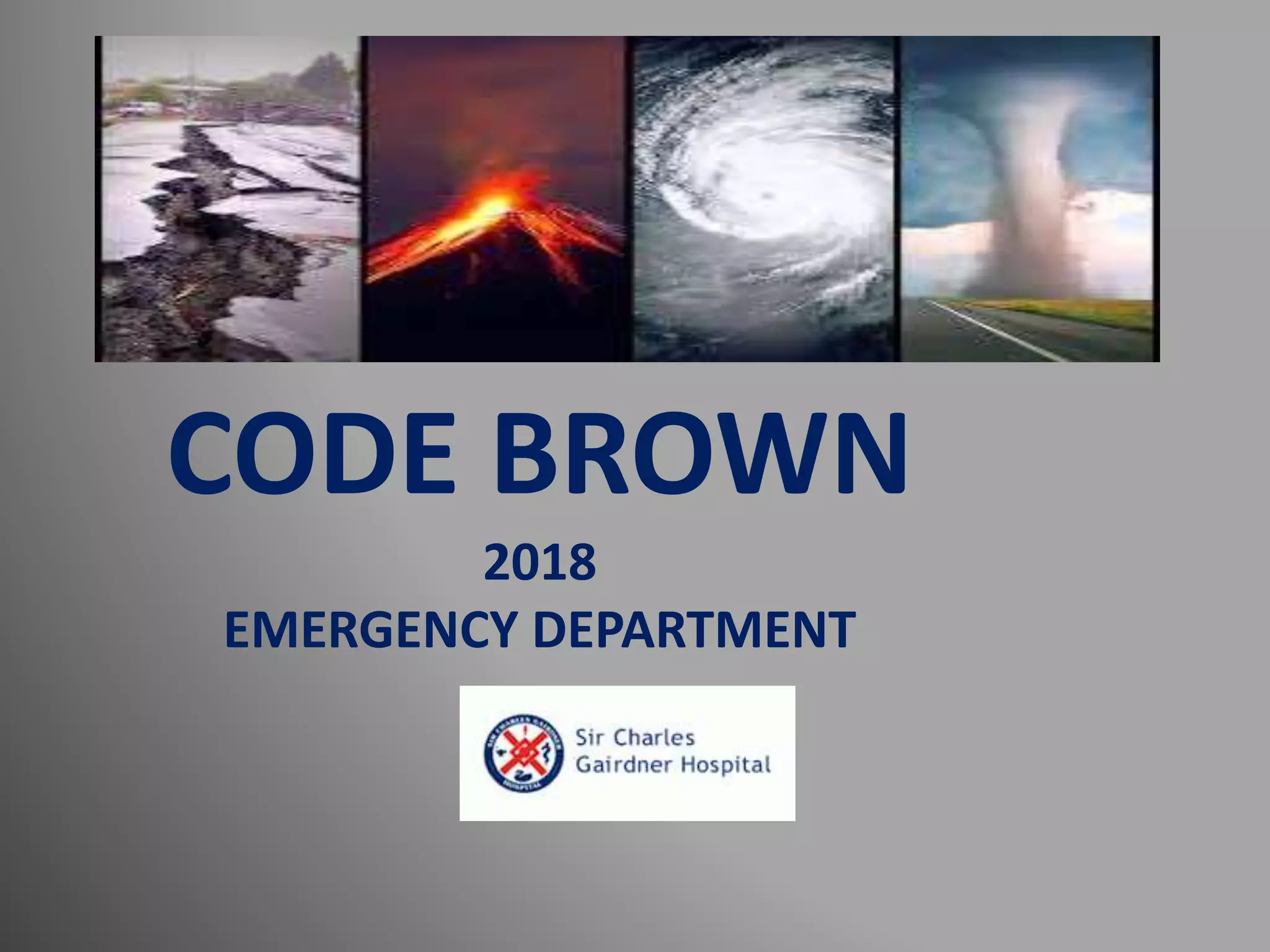
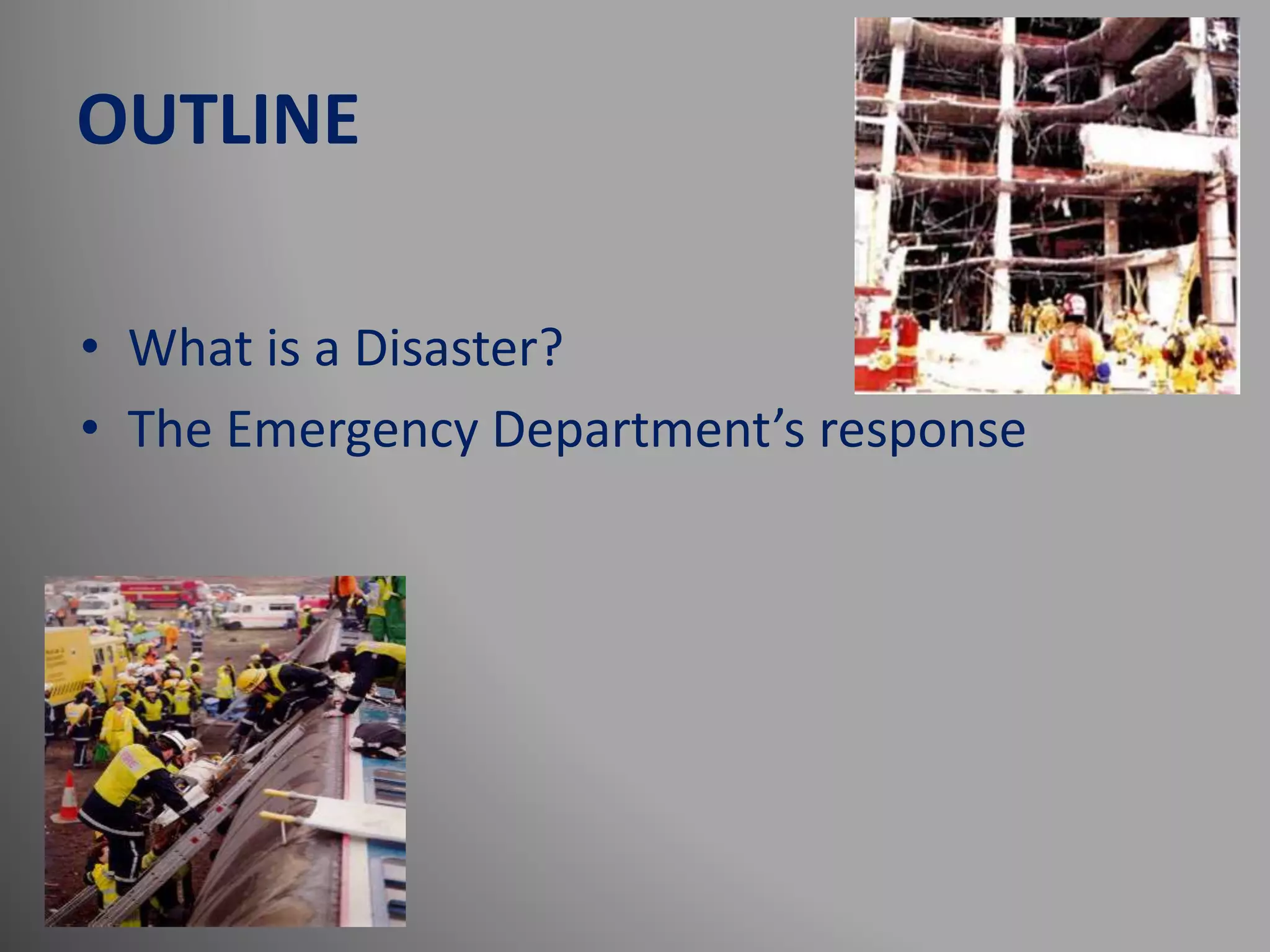
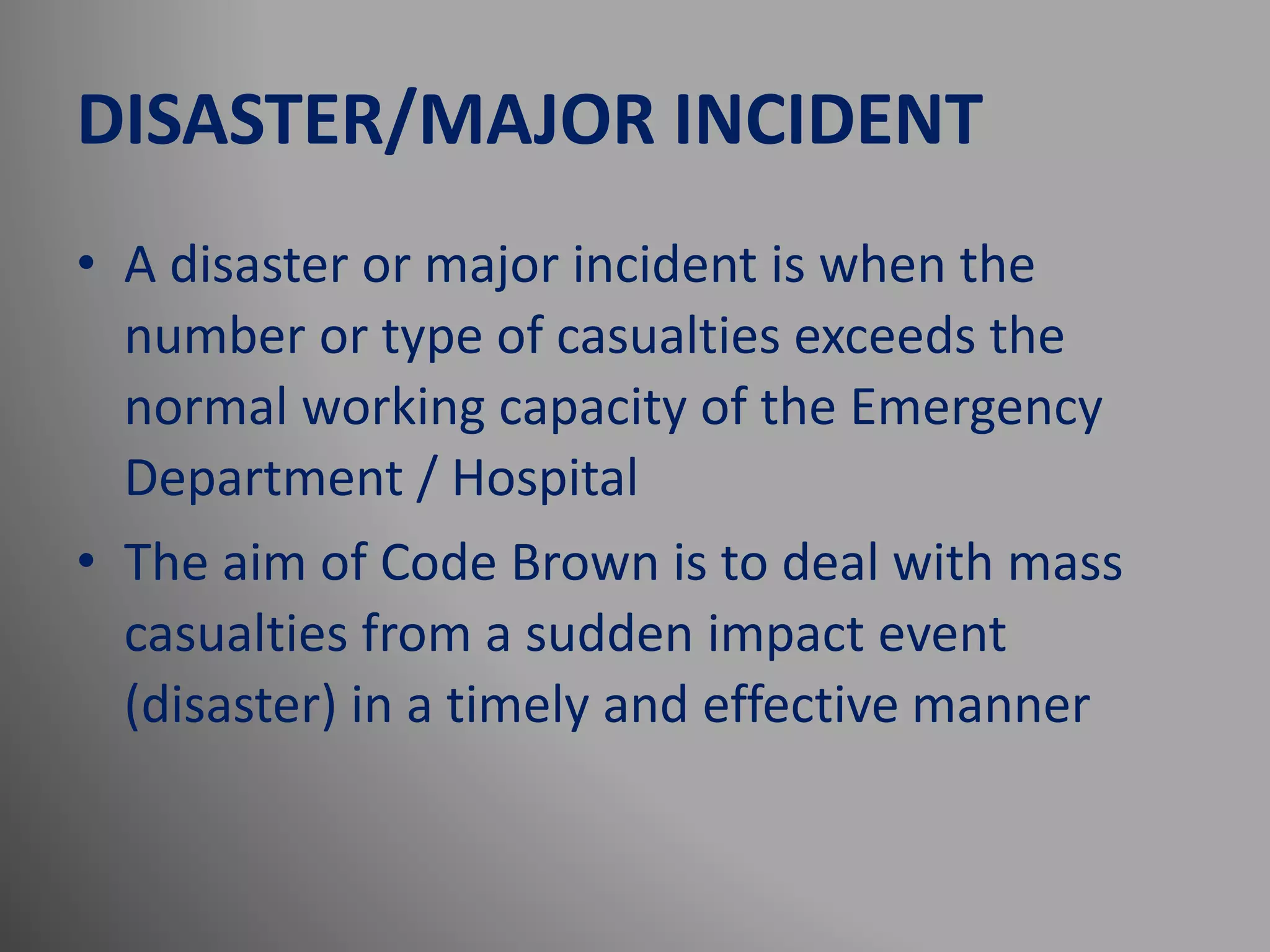
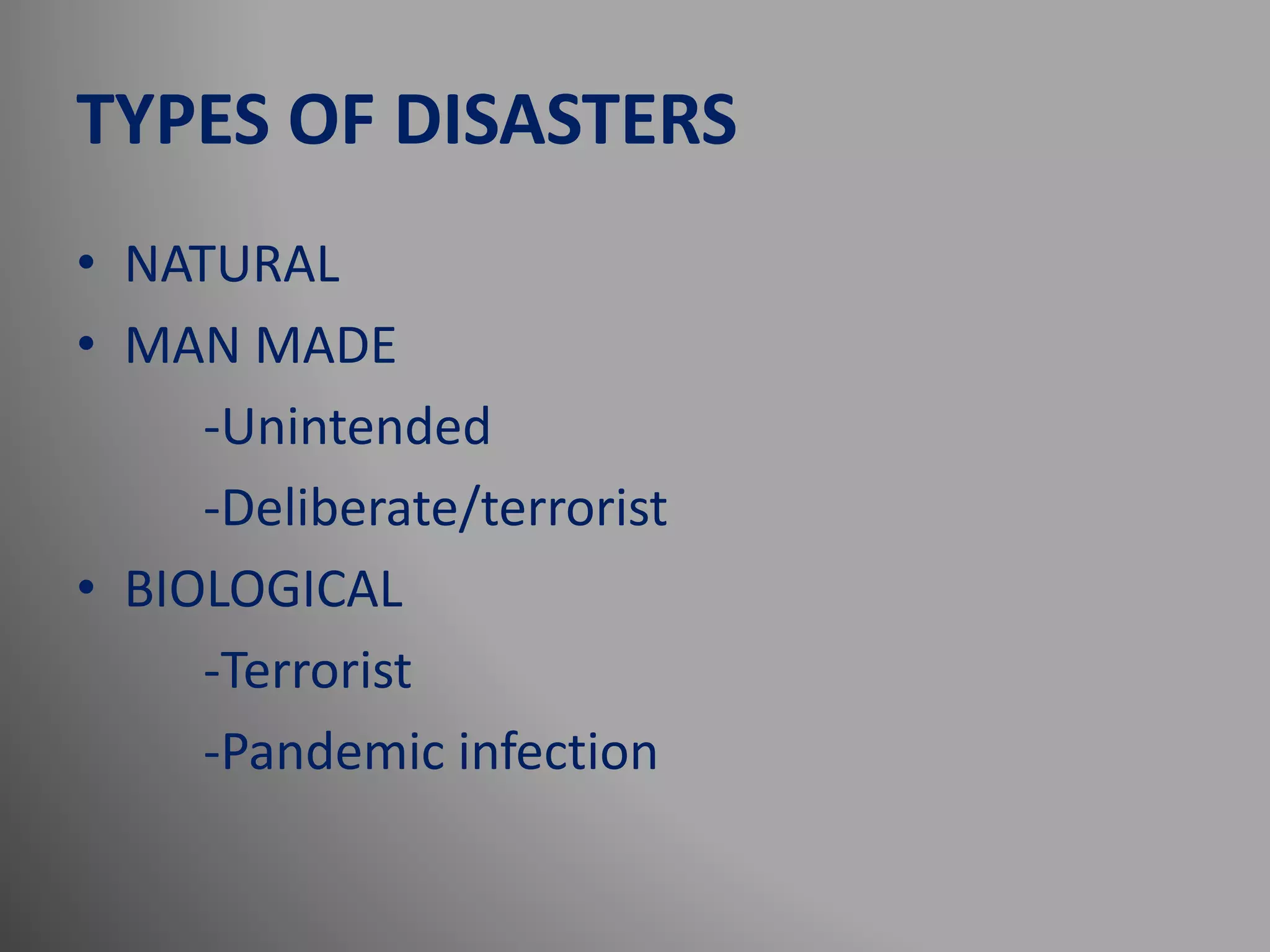
CODE BROWN
2018
EMERGENCY DEPARTMENT
OUTLINE
• What is a Disaster?
• The Emergency Department’s response
WHAT IS A DISASTER?
DISASTER/MAJOR INCIDENT
• A disaster or major incident is when the
number or type of casualties exceeds the
normal working capacity of the Emergency
Department / Hospital
• The aim of Code Brown is to deal with mass
casualties from a sudden impact event
(disaster) in a timely and effective manner
TYPES OF DISASTERS
• NATURAL
• MAN MADE
-Unintended
-Deliberate/terrorist
• BIOLOGICAL
-Terrorist
-Pandemic infection
AUSTRALIAN DISASTERS
YEAR KILLED INJURED AFFECTED HOMELESS
Black Saturday
bushfires
2009 173 414 60, 000 7, 562
Queensland/
NSW floods
2010-
2011
44 200, 000 38, 460
Lindt-Sydney
hostage crisis
2014 3 4 18
Melbourne car
attack
2017 6 36
INTERNATIONAL DISASTERS
YEAR KILLED INJURED AFFECTED HOMELESS
Twin tower
attacks-NYC
2001 2, 977 6, 000+
Kuta-Bali bombings 2002 202 196
Haiti earthquake 2010 316, 000 200, 000
Boston marathon
bombing
2013 5 280
MH17 Ukraine
plane crash
2014 298
Paris attacks 2015 130 80-99 368
Westminster
attack-London
2017 5 49
WHAT IS A CODE BROWN?
• A Code Brown refers to the hospitals response
to an external emergency (disaster or major
incident) that will result in the presentation of
casualties that exceeds the emergency
department or hospitals normal working
capacity.
• DIAL ‘55’ CODE BROWN
WALKING WOUNDED
STRETCHER CASES
EXTERNAL INCIDENT!
CASUALTY CLEARING POST
SELFPRESENTERS
CONTROLLEDPRESENTERS
OUTLINE OF RESPONSE
• The 4 phases of a Code Brown are:
-Notification
-Standby / Prepare to receive casualties
-Reception of casualties
-Stand down
EXTERNAL
INCIDENT
FIRST RESPONDERS
AMBULANCE CONTROL
DOH DUTY OFFICERED DUTY
CONSULTANT/REGISTRAR
HOSPITAL
RESPONSE
TEAM
What is the first thing that should be
done as the SCO?
READ THE DEPARTMENTAL
SUB PLAN!
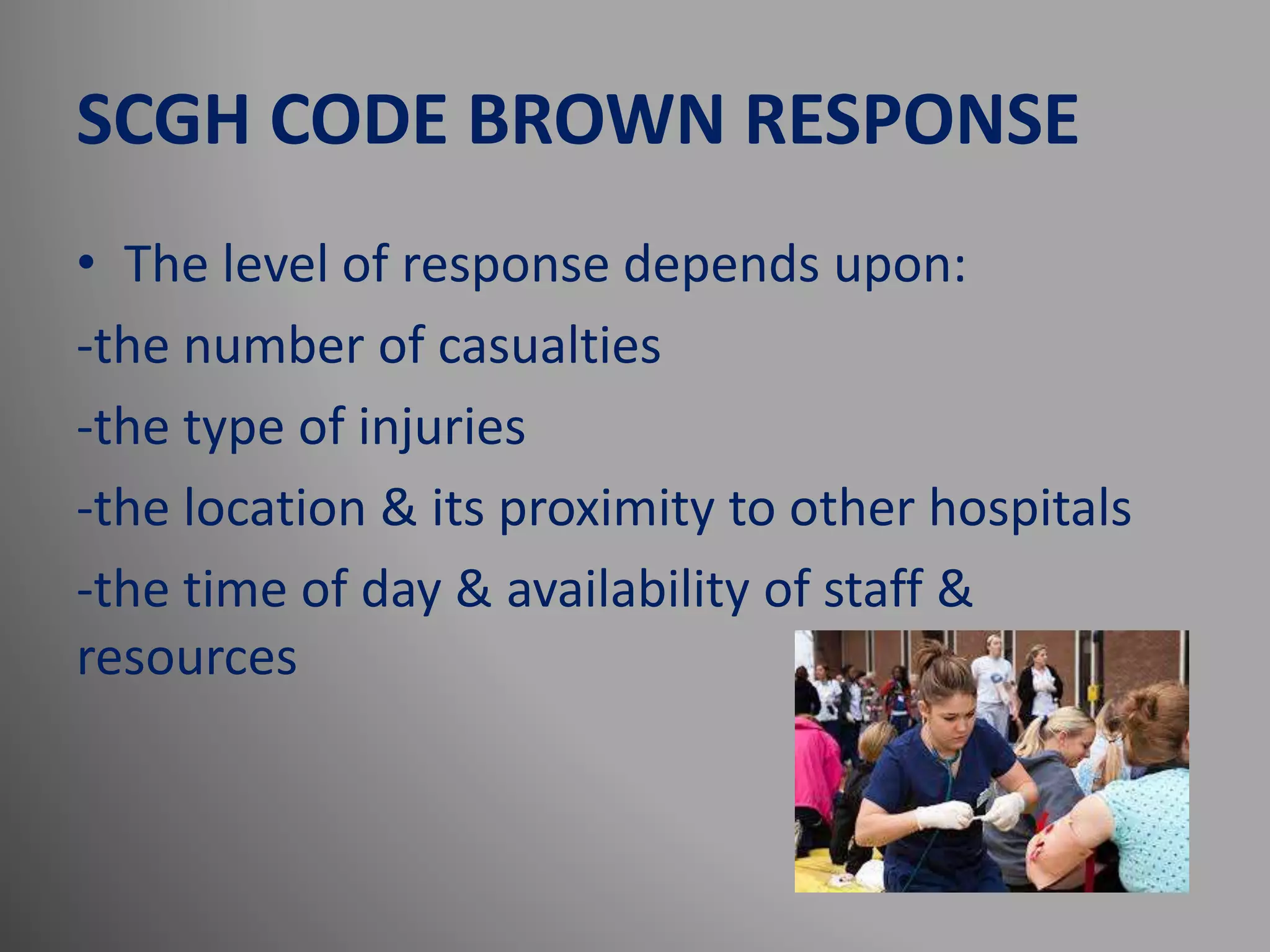
SCGH CODE BROWN RESPONSE
• The level of response depends upon:
-the number of casualties
-the type of injuries
-the location & its proximity to other hospitals
-the time of day & availability of staff &
resources
EMERGENCY CONTROL GROUP
• The Emergency Control Group (ECG) consists of
key personnel trained to deal with a major
incident concerning SCGH
• Comprised of:
-Medical Executive
-Nursing Executive
-Patient Support Services Management
-Facilities Management
-Expert Advisors as required
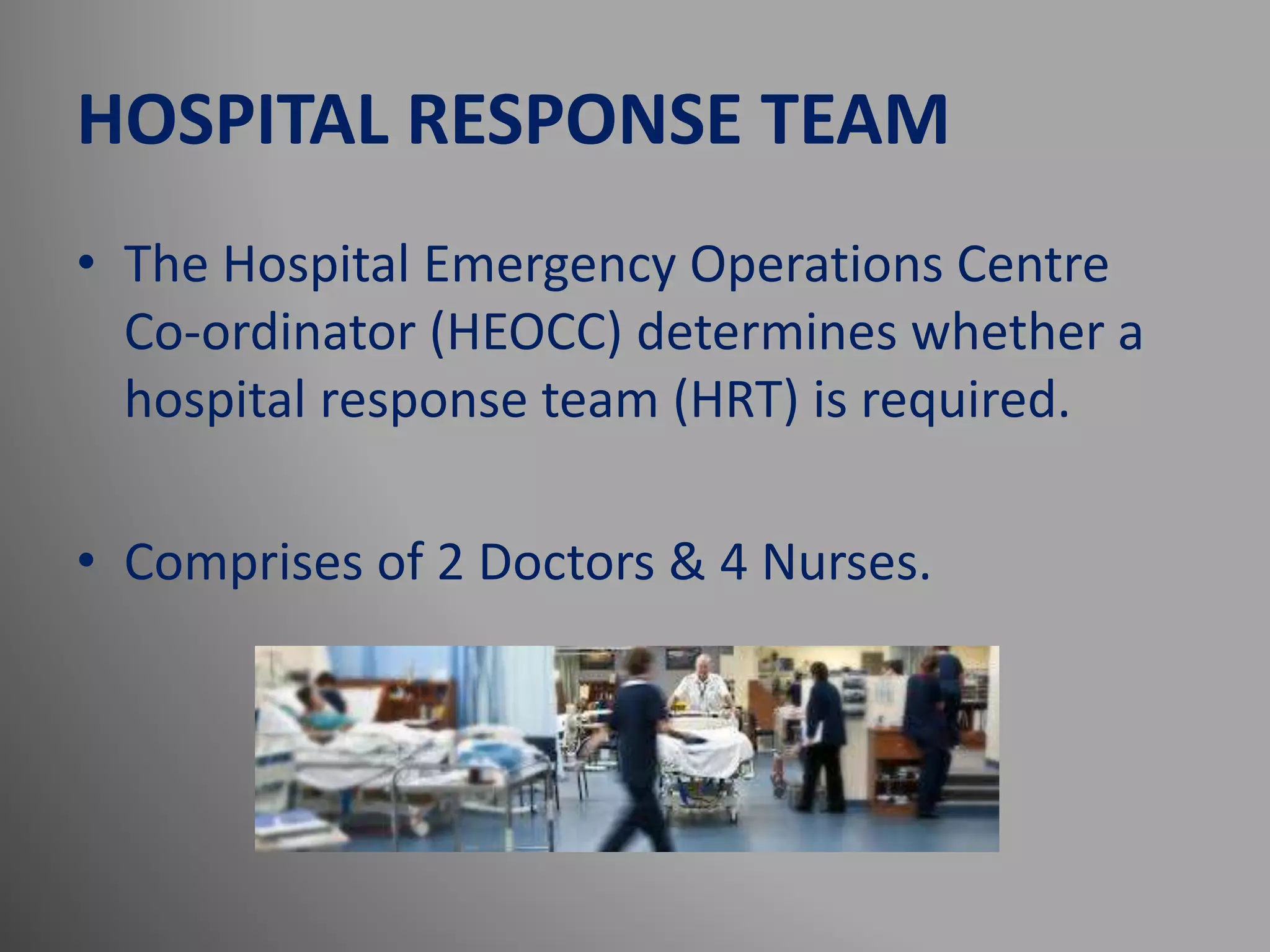
HOSPITAL RESPONSE TEAM
• The Hospital Emergency Operations Centre
Co-ordinator (HEOCC) determines whether a
hospital response team (HRT) is required.
• Comprises of 2 Doctors & 4 Nurses.
COMMAND & CONTROL
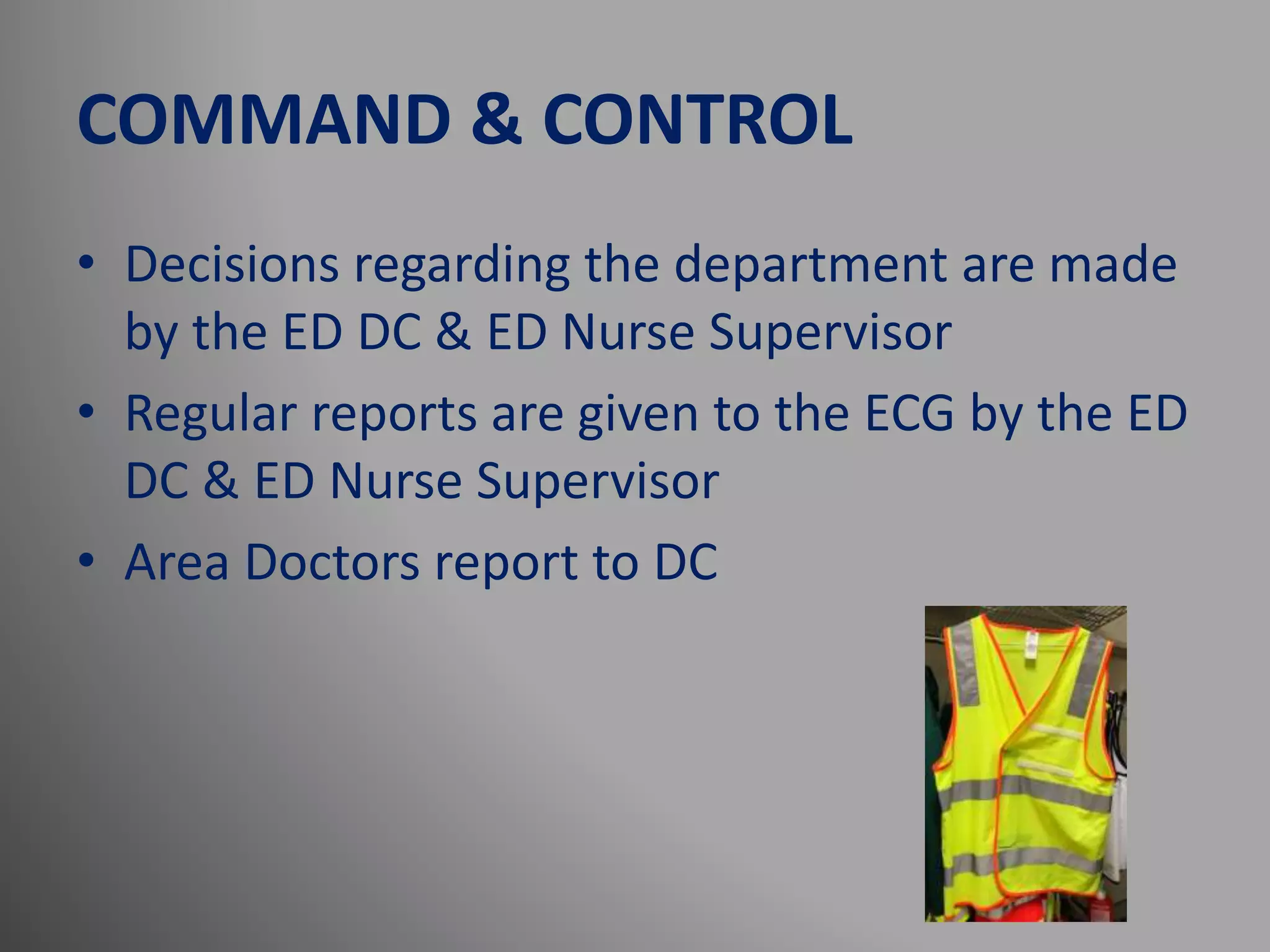
• Decisions regarding the department are made
by the ED DC & ED Nurse Supervisor
• Regular reports are given to the ECG by the ED
DC & ED Nurse Supervisor
• Area Doctors report to DC
Preparing to Receive Casualties
The ED DC or Reg will:
• Review patients in the WR
• Review patients in the main department
• All patients within the department will be
discharged, transferred to their ward or the
Acute Assessment Area when set up by the
ECG
STAFFING
• The ED DC & ED Nurse Supervisor will activate
the call back of duty staff as required.
• Contact numbers of off duty staff are
in the phone book
DEPARTMENT LAYOUT
• Dependent on numbers
• C27-R7: Area 1 RED 1 dr & 1 nurse: 1 patient
• C8-C14: Area 2 RED
• C15-C26 & Fast Track:
Area 3 Yellow 1 dr & 1 nurse: 2-3 patients
• Obs ward: Area 4 Yellow
• Outpatients Department (Eye clinic):
Area 5 Green 1 dr & 1 nurse: 4-5 patients
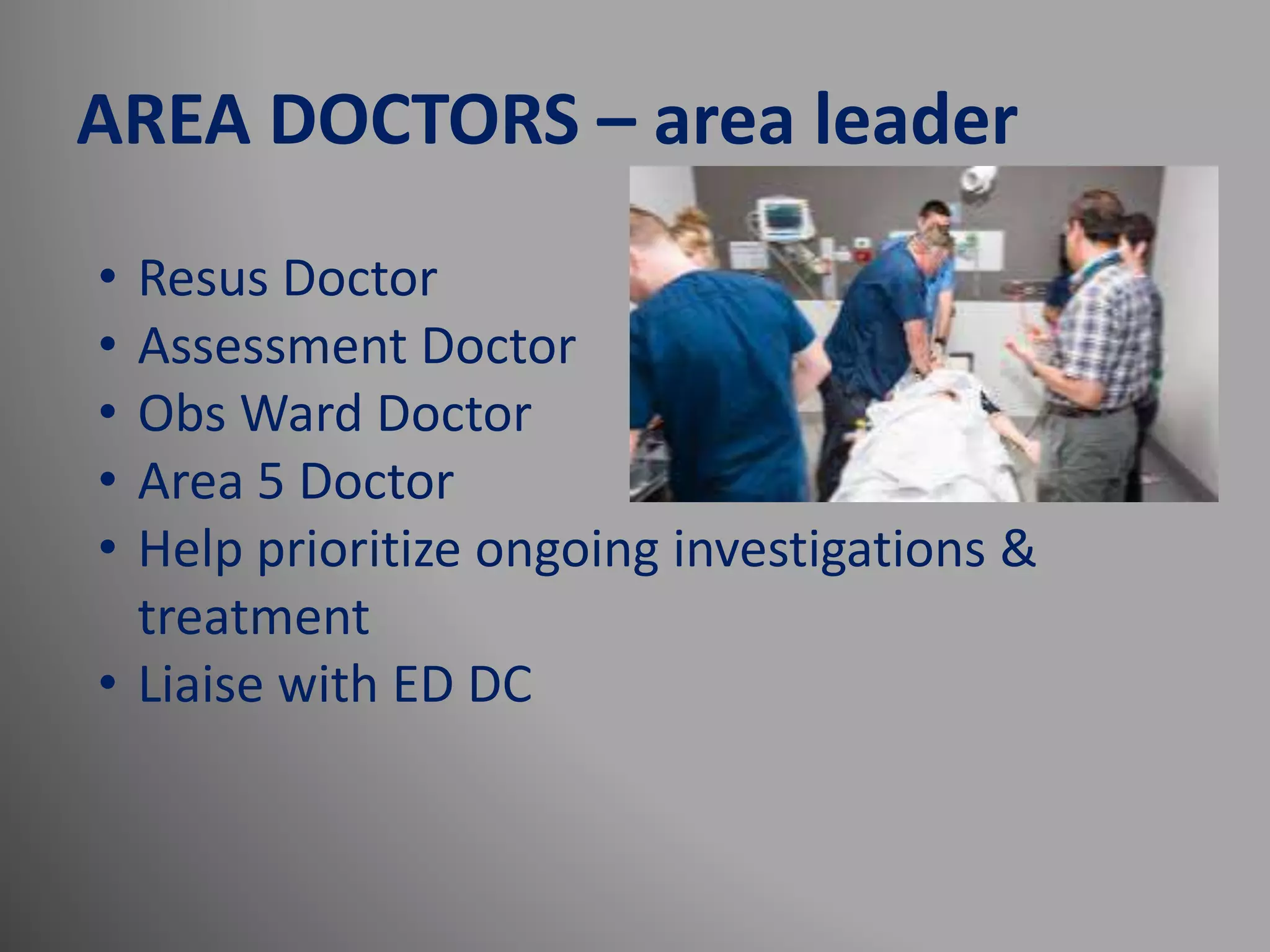
AREA DOCTORS – area leader
• Resus Doctor
• Assessment Doctor
• Obs Ward Doctor
• Area 5 Doctor
• Help prioritize ongoing investigations &
treatment
• Liaise with ED DC
TRIAGE
• One Doctor & Two Triage Nurses
• Patients triaged as Red, Yellow or Green
• Ensure disaster triage card is filled out
• Triage clerk enters details onto EDIS
• Two name bands
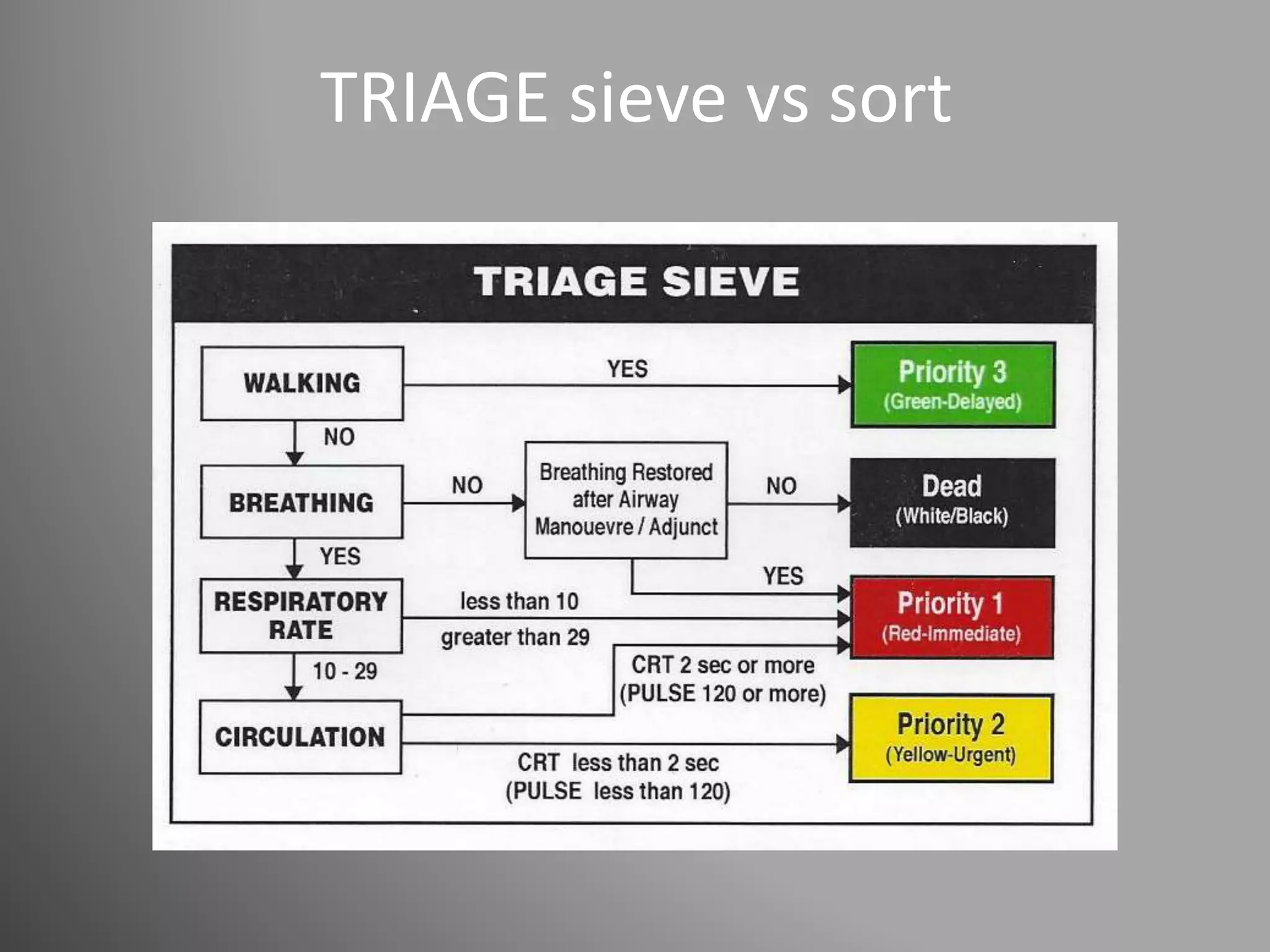
TRIAGE sieve vs sort
• 54 year old male:
– Chemical Burns to arms and legs, Shrapnel to face,
compound # to Rt forearm
– Ambulating.
– A: Nil Airway compromise.
– B: RR 20 Nil Respiratory Distress.
– C: CRT <2 sec. Perfused, nil bleeding
– D: Alert
• 64 year old female:
– Blunt injury to head. Lacerations to face.
– Collapses upon arrival to triage
– A: Clear
– B: RR 22
– C: CRT <2Sec.
– D: Groaning
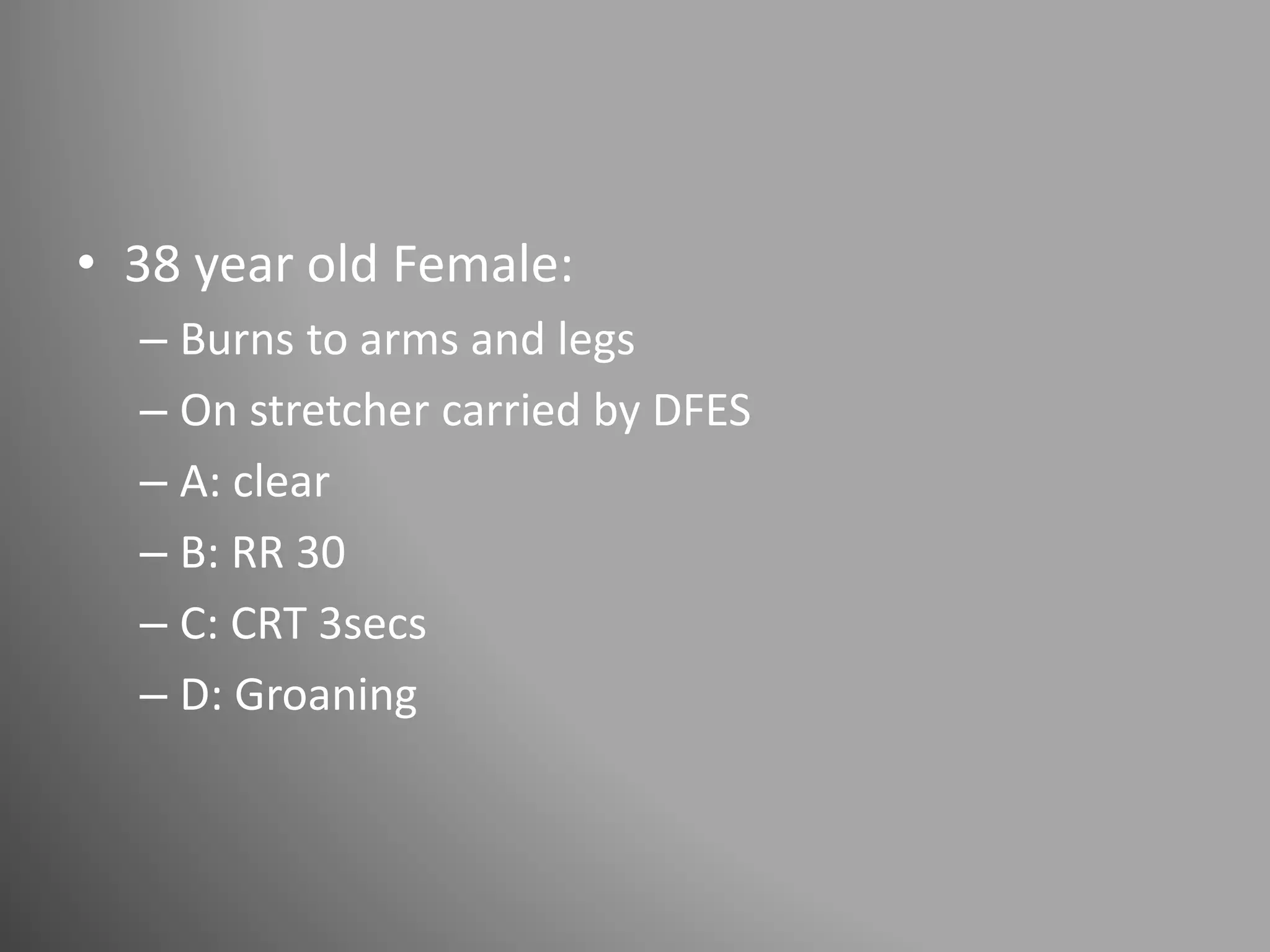
• 38 year old Female:
– Burns to arms and legs
– On stretcher carried by DFES
– A: clear
– B: RR 30
– C: CRT 3secs
– D: Groaning
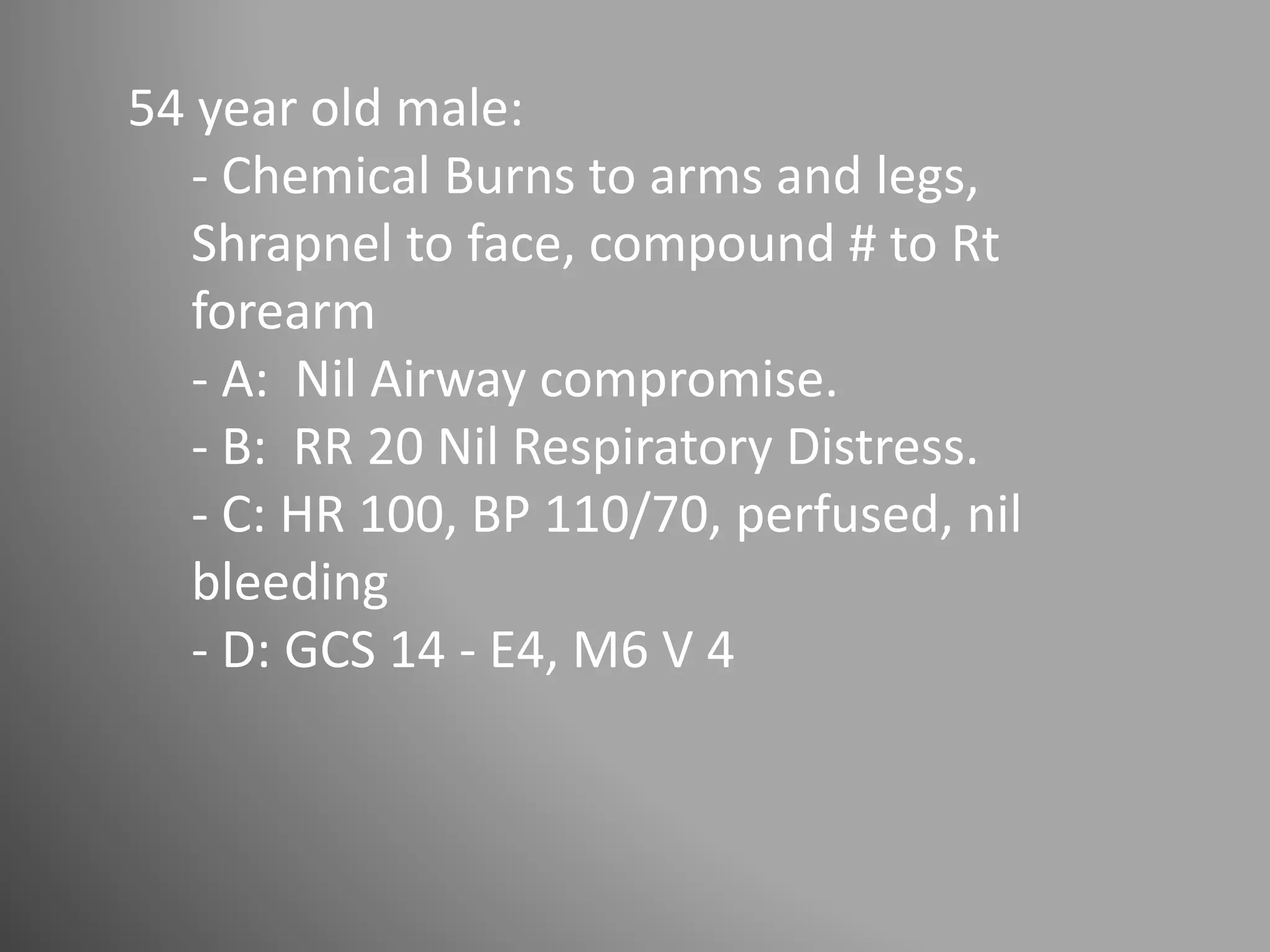
54 year old male:
- Chemical Burns to arms and legs,
Shrapnel to face, compound # to Rt
forearm
- A: Nil Airway compromise.
- B: RR 20 Nil Respiratory Distress.
- C: HR 100, BP 110/70, perfused, nil
bleeding
- D: GCS 14 - E4, M6 V 4
• 64 year old female:
– Blunt injury to head. Lacerations to face.
– Collapses upon arrival to triage
– A: Clear
– B: RR 22
– C: CRT <2Sec. HR 60, BP 90/60
– D: GCS 8 - E1, M5, V2
• 38 year old Female:
– Burns to arms and legs
– On stretcher carried by DFES
– A: clear
– B: RR 30
– C: CRT 3secs, BP 80/50, HR 125
– D: Groaning – GCS 10 - E3, M5, V2
RECEPTION OF CASUALTIES
PATIENT FLOW
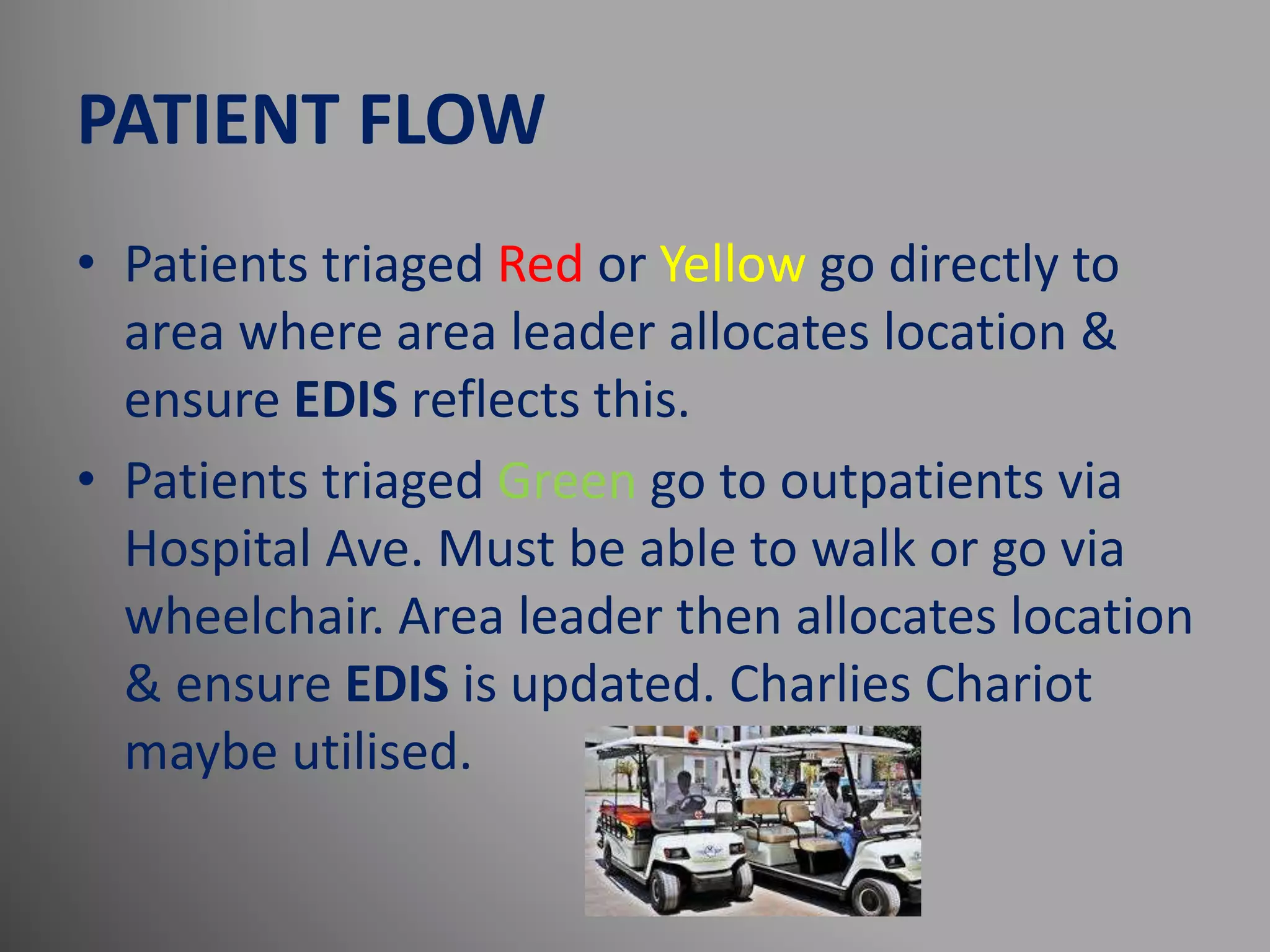
• Patients triaged Red or Yellow go directly to
area where area leader allocates location &
ensure EDIS reflects this.
• Patients triaged Green go to outpatients via
Hospital Ave. Must be able to walk or go via
wheelchair. Area leader then allocates location
& ensure EDIS is updated. Charlies Chariot
maybe utilised.
PATIENT FLOW CONT…
• Patients from Areas 1-4 should not return to
Emergency if leaving for an investigation or for
treatment.
• Activation of the Acute Admission Area &
discharge area as needed.
• Patients in Area 5 may return following
leaving.
WHAT PROBLEMS are we likely to
ENCOUNTER?
BOTTLENECK’S
• Theatre
• Radiology
• Bed Block (General Hospital Beds)
• High Dependency beds (ICU)
RELATIVES
• Social Work department takes care of relatives
• Visitors Centre may be activated
– located on first floor E Block
MEDIA & PATIENT ENQUIRES
• All media calls & patient enquires are to be
redirected to communications (switchboard)
on extension 91 who will then forward them
to the Public Relations/Media Liaison Officer
STAND DOWN
• No more disaster casualties expected
• ‘ALL CLEAR’ declared by ECG
• Return to normal procedures
• Staff informal defusing session if required
prior to leaving
• Ensure staff sign off
• Debriefing formally within 7 days
• Evaluation of response
Fremantle Ship Fire
• 11am call to DC – Code Brown Standy-by
• SJA requested HRT
• 3 doctors and 4 nurses deployed
• 1130am 2 x SJA arrived to transport HRTs
• HRT returned to ED at 1300
• 40 casualties reviewed and treated at the
scene
• 4 Crew members transferred to hospital – 1 to
RPH, 3 to FH
Other issues to think about
Chemical weapons
• Chemical weapon attacks may be disguised
with conventional attack
• Potential to cause more harm to care givers
• Know your toxidromes that suggest agents
requiring antidotes
• NEJM April 2018 Toxidrome Recognition
• Increased secretions, muscle effects, +/-
miosis
• Nerve agents – sarin, organophospate
• Initial antidote – atropine, pralidoxime, spot
decontamination at site, emergency care
• Bradypnoea/apnoea, collapse, seizures +/-
cyanosis
– Asphyxiant Agent – hydrogen cyanide, cyanogen
chloride
– Antidotes – hydroxycobalamin, sodium
thiosulfate, spot decontamination at the site and
urgent care
• Bradypnoea/apnoea, sedation, miosis
– Opioid agents – fentanyl, remifentanyl
– Antidote – naloxone, spot decontamination at the
site and urgent care
ANY QUESTIONS?

Code Brown - Disaster Medicine in the ED

  • 1.
  • 2.
    OUTLINE • What isa Disaster? • The Emergency Department’s response
  • 3.
    WHAT IS ADISASTER?
  • 4.
    DISASTER/MAJOR INCIDENT • Adisaster or major incident is when the number or type of casualties exceeds the normal working capacity of the Emergency Department / Hospital • The aim of Code Brown is to deal with mass casualties from a sudden impact event (disaster) in a timely and effective manner
  • 5.
    TYPES OF DISASTERS •NATURAL • MAN MADE -Unintended -Deliberate/terrorist • BIOLOGICAL -Terrorist -Pandemic infection
  • 6.
    AUSTRALIAN DISASTERS YEAR KILLEDINJURED AFFECTED HOMELESS Black Saturday bushfires 2009 173 414 60, 000 7, 562 Queensland/ NSW floods 2010- 2011 44 200, 000 38, 460 Lindt-Sydney hostage crisis 2014 3 4 18 Melbourne car attack 2017 6 36
  • 7.
    INTERNATIONAL DISASTERS YEAR KILLEDINJURED AFFECTED HOMELESS Twin tower attacks-NYC 2001 2, 977 6, 000+ Kuta-Bali bombings 2002 202 196 Haiti earthquake 2010 316, 000 200, 000 Boston marathon bombing 2013 5 280 MH17 Ukraine plane crash 2014 298 Paris attacks 2015 130 80-99 368 Westminster attack-London 2017 5 49
  • 8.
    WHAT IS ACODE BROWN? • A Code Brown refers to the hospitals response to an external emergency (disaster or major incident) that will result in the presentation of casualties that exceeds the emergency department or hospitals normal working capacity. • DIAL ‘55’ CODE BROWN
  • 9.
    WALKING WOUNDED STRETCHER CASES EXTERNALINCIDENT! CASUALTY CLEARING POST SELFPRESENTERS CONTROLLEDPRESENTERS
  • 10.
    OUTLINE OF RESPONSE •The 4 phases of a Code Brown are: -Notification -Standby / Prepare to receive casualties -Reception of casualties -Stand down
  • 11.
    EXTERNAL INCIDENT FIRST RESPONDERS AMBULANCE CONTROL DOHDUTY OFFICERED DUTY CONSULTANT/REGISTRAR HOSPITAL RESPONSE TEAM
  • 13.
    What is thefirst thing that should be done as the SCO? READ THE DEPARTMENTAL SUB PLAN!
  • 14.
    SCGH CODE BROWNRESPONSE • The level of response depends upon: -the number of casualties -the type of injuries -the location & its proximity to other hospitals -the time of day & availability of staff & resources
  • 15.
    EMERGENCY CONTROL GROUP •The Emergency Control Group (ECG) consists of key personnel trained to deal with a major incident concerning SCGH • Comprised of: -Medical Executive -Nursing Executive -Patient Support Services Management -Facilities Management -Expert Advisors as required
  • 16.
    HOSPITAL RESPONSE TEAM •The Hospital Emergency Operations Centre Co-ordinator (HEOCC) determines whether a hospital response team (HRT) is required. • Comprises of 2 Doctors & 4 Nurses.
  • 18.
    COMMAND & CONTROL •Decisions regarding the department are made by the ED DC & ED Nurse Supervisor • Regular reports are given to the ECG by the ED DC & ED Nurse Supervisor • Area Doctors report to DC
  • 19.
  • 20.
    The ED DCor Reg will: • Review patients in the WR • Review patients in the main department • All patients within the department will be discharged, transferred to their ward or the Acute Assessment Area when set up by the ECG
  • 21.
    STAFFING • The EDDC & ED Nurse Supervisor will activate the call back of duty staff as required. • Contact numbers of off duty staff are in the phone book
  • 22.
    DEPARTMENT LAYOUT • Dependenton numbers • C27-R7: Area 1 RED 1 dr & 1 nurse: 1 patient • C8-C14: Area 2 RED • C15-C26 & Fast Track: Area 3 Yellow 1 dr & 1 nurse: 2-3 patients • Obs ward: Area 4 Yellow • Outpatients Department (Eye clinic): Area 5 Green 1 dr & 1 nurse: 4-5 patients
  • 23.
    AREA DOCTORS –area leader • Resus Doctor • Assessment Doctor • Obs Ward Doctor • Area 5 Doctor • Help prioritize ongoing investigations & treatment • Liaise with ED DC
  • 24.
    TRIAGE • One Doctor& Two Triage Nurses • Patients triaged as Red, Yellow or Green • Ensure disaster triage card is filled out • Triage clerk enters details onto EDIS • Two name bands
  • 25.
  • 26.
    • 54 yearold male: – Chemical Burns to arms and legs, Shrapnel to face, compound # to Rt forearm – Ambulating. – A: Nil Airway compromise. – B: RR 20 Nil Respiratory Distress. – C: CRT <2 sec. Perfused, nil bleeding – D: Alert
  • 27.
    • 64 yearold female: – Blunt injury to head. Lacerations to face. – Collapses upon arrival to triage – A: Clear – B: RR 22 – C: CRT <2Sec. – D: Groaning
  • 28.
    • 38 yearold Female: – Burns to arms and legs – On stretcher carried by DFES – A: clear – B: RR 30 – C: CRT 3secs – D: Groaning
  • 30.
    54 year oldmale: - Chemical Burns to arms and legs, Shrapnel to face, compound # to Rt forearm - A: Nil Airway compromise. - B: RR 20 Nil Respiratory Distress. - C: HR 100, BP 110/70, perfused, nil bleeding - D: GCS 14 - E4, M6 V 4
  • 31.
    • 64 yearold female: – Blunt injury to head. Lacerations to face. – Collapses upon arrival to triage – A: Clear – B: RR 22 – C: CRT <2Sec. HR 60, BP 90/60 – D: GCS 8 - E1, M5, V2
  • 32.
    • 38 yearold Female: – Burns to arms and legs – On stretcher carried by DFES – A: clear – B: RR 30 – C: CRT 3secs, BP 80/50, HR 125 – D: Groaning – GCS 10 - E3, M5, V2
  • 33.
  • 34.
    PATIENT FLOW • Patientstriaged Red or Yellow go directly to area where area leader allocates location & ensure EDIS reflects this. • Patients triaged Green go to outpatients via Hospital Ave. Must be able to walk or go via wheelchair. Area leader then allocates location & ensure EDIS is updated. Charlies Chariot maybe utilised.
  • 35.
    PATIENT FLOW CONT… •Patients from Areas 1-4 should not return to Emergency if leaving for an investigation or for treatment. • Activation of the Acute Admission Area & discharge area as needed. • Patients in Area 5 may return following leaving.
  • 36.
    WHAT PROBLEMS arewe likely to ENCOUNTER? BOTTLENECK’S • Theatre • Radiology • Bed Block (General Hospital Beds) • High Dependency beds (ICU)
  • 37.
    RELATIVES • Social Workdepartment takes care of relatives • Visitors Centre may be activated – located on first floor E Block
  • 38.
    MEDIA & PATIENTENQUIRES • All media calls & patient enquires are to be redirected to communications (switchboard) on extension 91 who will then forward them to the Public Relations/Media Liaison Officer
  • 39.
    STAND DOWN • Nomore disaster casualties expected • ‘ALL CLEAR’ declared by ECG • Return to normal procedures • Staff informal defusing session if required prior to leaving • Ensure staff sign off • Debriefing formally within 7 days • Evaluation of response
  • 41.
    Fremantle Ship Fire •11am call to DC – Code Brown Standy-by • SJA requested HRT • 3 doctors and 4 nurses deployed • 1130am 2 x SJA arrived to transport HRTs
  • 43.
    • HRT returnedto ED at 1300 • 40 casualties reviewed and treated at the scene • 4 Crew members transferred to hospital – 1 to RPH, 3 to FH
  • 44.
    Other issues tothink about
  • 46.
    Chemical weapons • Chemicalweapon attacks may be disguised with conventional attack • Potential to cause more harm to care givers • Know your toxidromes that suggest agents requiring antidotes • NEJM April 2018 Toxidrome Recognition
  • 47.
    • Increased secretions,muscle effects, +/- miosis • Nerve agents – sarin, organophospate • Initial antidote – atropine, pralidoxime, spot decontamination at site, emergency care
  • 48.
    • Bradypnoea/apnoea, collapse,seizures +/- cyanosis – Asphyxiant Agent – hydrogen cyanide, cyanogen chloride – Antidotes – hydroxycobalamin, sodium thiosulfate, spot decontamination at the site and urgent care
  • 49.
    • Bradypnoea/apnoea, sedation,miosis – Opioid agents – fentanyl, remifentanyl – Antidote – naloxone, spot decontamination at the site and urgent care
  • 50.

Editor's Notes

  • #4 Queensland cyclone Tsunami Sept 11 Paris attacks Oz bushfires