Paediatric Rashes
Dan Pixley
2018
 How to describe a rash
 Recognise the visual diagnoses for paediatric rash
presentations
 Patterns, distribution, special features
 Broaden differentials for rash and identify the
commonly misdiagnosed presentations
 Treatments for rash
 Recognise the critical rash
Objectives
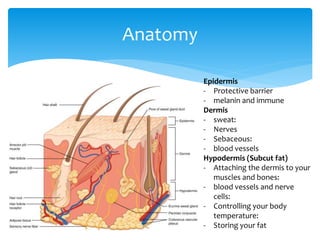
Anatomy
Epidermis
- Protective barrier
- melanin and immune
Dermis
- sweat:
- Nerves
- Sebaceous:
- blood vessels
Hypodermis (Subcut fat)
- Attaching the dermis to your
muscles and bones:
- blood vessels and nerve
cells:
- Controlling your body
temperature:
- Storing your fat
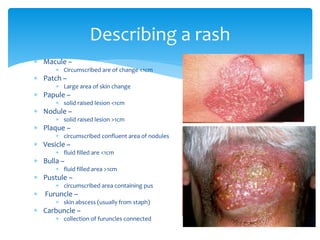
 Macule –
 Circumscribed are of change <1cm
 Patch –
 Large area of skin change
 Papule –
 solid raised lesion <1cm
 Nodule –
 solid raised lesion >1cm
 Plaque –
 circumscribed confluent area of nodules
 Vesicle –
 fluid filled are <1cm
 Bulla –
 fluid filled area >1cm
 Pustule –
 circumscribed area containing pus
 Furuncle –
 skin abscess (usually from staph)
 Carbuncle –
 collection of furuncles connected
Describing a rash
 Viral
 Bacterial
 Fungi
 Drug Reactions
 Allergic
 Autoimmune
 mites
Aetiologies
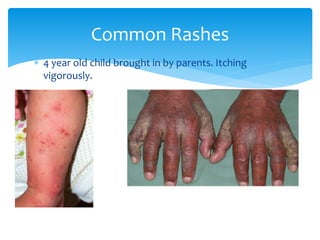
 4 year old child brought in by parents. Itching
vigorously.
Common Rashes
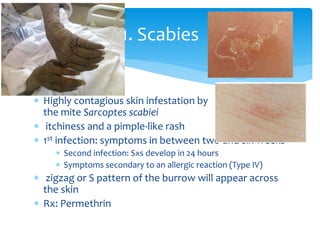
 Highly contagious skin infestation by
the mite Sarcoptes scabiei
 itchiness and a pimple-like rash
 1st infection: symptoms in between two and six weeks
 Second infection: Sxs develop in 24 hours
 Symptoms secondary to an allergic reaction (Type IV)
 zigzag or S pattern of the burrow will appear across
the skin
 Rx: Permethrin
1. Scabies
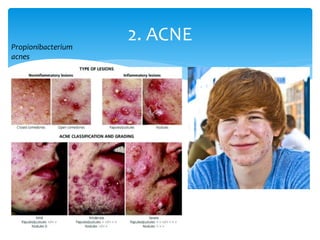
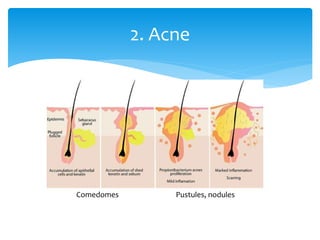
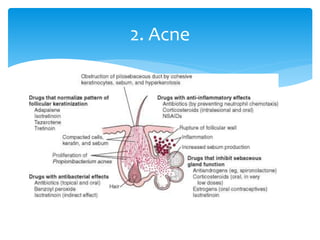
2. ACNEPropionibacterium
acnes
2. Acne
Comedomes Pustules, nodules
2. Acne
Common Rashes
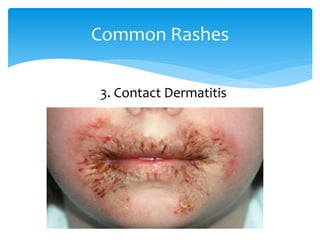
3. Contact Dermatitis
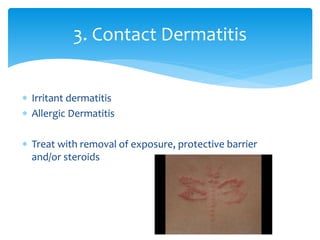
 Irritant dermatitis
 Allergic Dermatitis
 Treat with removal of exposure, protective barrier
and/or steroids
3. Contact Dermatitis
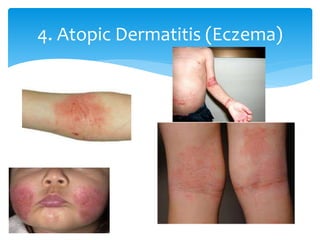
4. Atopic Dermatitis (Eczema)
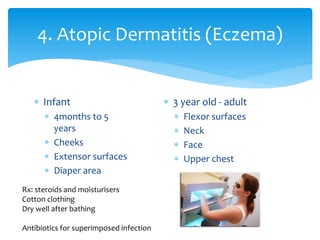
 Infant
 4months to 5
years
 Cheeks
 Extensor surfaces
 Diaper area
4. Atopic Dermatitis (Eczema)
 3 year old - adult
 Flexor surfaces
 Neck
 Face
 Upper chest
Rx: steroids and moisturisers
Cotton clothing
Dry well after bathing
Antibiotics for superimposed infection
Common Rashes
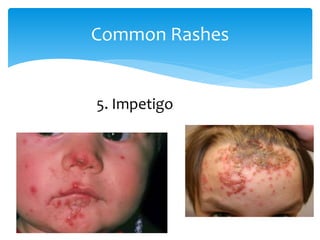
5. Impetigo
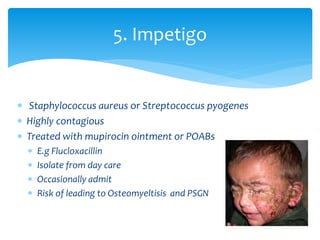
 Staphylococcus aureus or Streptococcus pyogenes
 Highly contagious
 Treated with mupirocin ointment or POABs
 E.g Flucloxacillin
 Isolate from day care
 Occasionally admit
 Risk of leading to Osteomyeltisis and PSGN
5. Impetigo
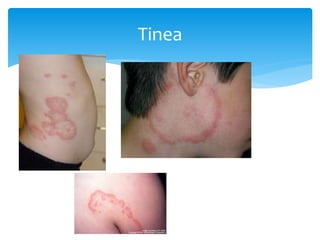
Tinea
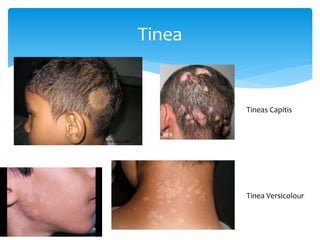
Tinea
Tineas Capitis
Tinea Versicolour
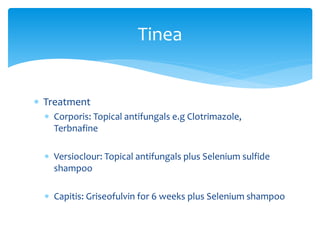
 Treatment
 Corporis: Topical antifungals e.g Clotrimazole,
Terbnafine
 Versioclour: Topical antifungals plus Selenium sulfide
shampoo
 Capitis: Griseofulvin for 6 weeks plus Selenium shampoo
Tinea
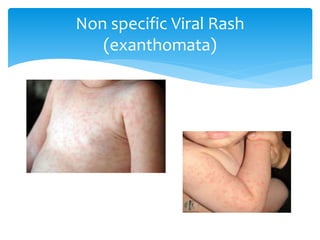
Non specific Viral Rash
(exanthomata)
 The majority of Exanthems are nonspecific and
difficult to categorise
 Associated with non specific sxs like headache,
lethargy, mayalgia and GI complaints
 Most resolve in less than a week
 Cause
 Thought to be from enteroviruses and
adenovirus/rhinovirus/parainfluenza
Non specific Viral Rash
(exanthomata)
 First Disease
 Measles
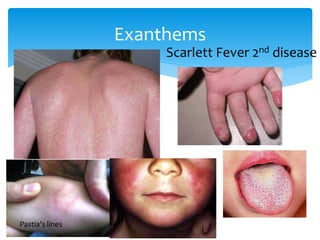
 Second Disease
 Scarlet Fever
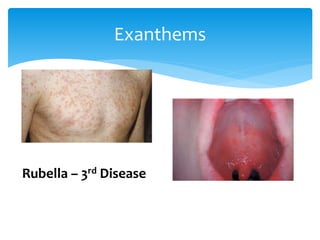
 Third Disease
 Rubella
 Fourth Disease
 Dukes -Controversial (possibly a misdiagnosis)
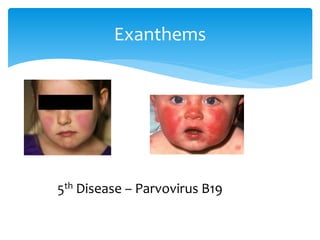
 Fifth Disease
 Erythema Infectiosum (Parvovirus B19)
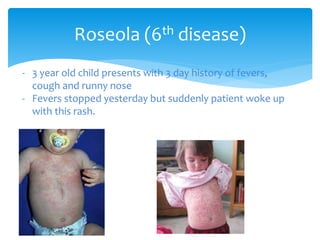
 Sixth Disease
 Roseola (HHV6)
Specific Exanthems
Exanthems
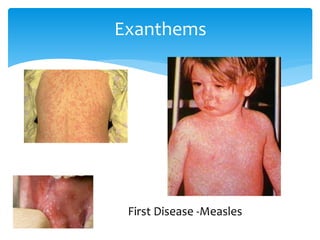
First Disease -Measles
 Incubation: 7-14 d
 Prodrome: 4 -5 d before rash
fever, malaise, rhinorrohea, cough,
Koplik spots 1-3 d before rash
 Rash: day 4-7 of illness
starts behind ears, forehead, around mouth
dusky red, florid maculopapular rash spreads
over trunk and limbs. Lasts 5 d.
 Infectivity: prodrome to 4 d after the rash
 Transmission: respiratory droplet or direct contact
 Complications: ears & OM,
lungs & pneumonia
conjunctivitis
CNS encephalitis at d 10, SSPE after several years
Measles
Exanthems
Rubella – 3rd Disease
 Also called German Measels
 often mild with half of people not realizing that they are
infected
 A rash may start around two weeks after exposure and last
for three days
 starts on the face and spreads to the rest of the body
 Infection during early pregnancy (below 20 weeks) may
result in a child born with congenital rubella
syndrome (CRS) or miscarriage.
 Once recovered, people are immune to future infections.
 Vaccine preventable
Rubella
Exanthems
Scarlett Fever 2nd disease
Pastia’s lines
 Can occur as a result of a group
A streptococcus (group A strep) infection
 It most commonly affects children between five and
15 years of age
 Complications:
 Suppurative: peritonsillar or retropharyngeal
abscesses, cellulitis, mastoiditis or sinusitis
 Non-suppurative: Rheumatic fever, RHD, PSGN,
Reactive Arthritis
Scarlett fever
Exanthems
5th Disease – Parvovirus B19
Roseola (6th disease)
- 3 year old child presents with 3 day history of fevers,
cough and runny nose
- Fevers stopped yesterday but suddenly patient woke up
with this rash.
Emergent Rashes
Pyotr Nikolsky (1858–1940)
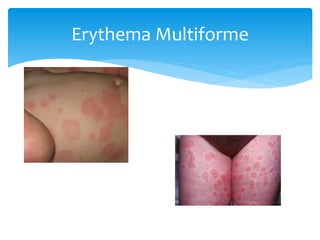
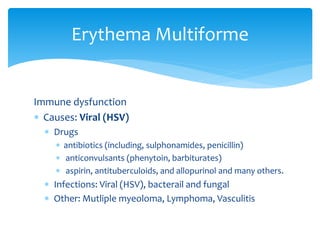
Erythema Multiforme
Immune dysfunction
 Causes: Viral (HSV)
 Drugs
 antibiotics (including, sulphonamides, penicillin)
 anticonvulsants (phenytoin, barbiturates)
 aspirin, antituberculoids, and allopurinol and many others.
 Infections: Viral (HSV), bacterail and fungal
 Other: Mutliple myeoloma, Lymphoma, Vasculitis
Erythema Multiforme
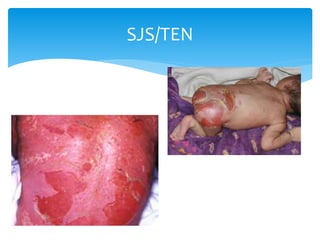
SJS/TEN
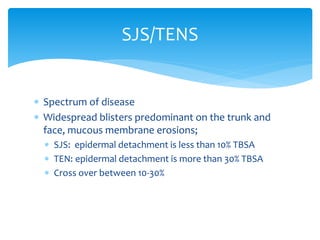
 Spectrum of disease
 Widespread blisters predominant on the trunk and
face, mucous membrane erosions;
 SJS: epidermal detachment is less than 10% TBSA
 TEN: epidermal detachment is more than 30% TBSA
 Cross over between 10-30%
SJS/TENS
 Often start with fever, sore throat, cough, and burning
eyes for 1 to 3 days
 Type IV hypersensitivity reaction – secondary to immune
system being triggered by drugs/infections
 Ulcers and other lesions begin to appear in the mucous
membranes
 - almost always in the mouth and lips, but also in the genital
and anal regions.
 Problems eating and drinking due to pain of ulcers
 Conjunctivitis occurs in about 30%
 Rash of round small lesions arise on the face, trunk, arms
and legs, but usually not the scalp
SJS/TENS
 Mortality rate:
 5% for SJS
 30-40% for TENS
 Treatment
 discontinuation of the causative factor – most important
 Move to a burns unit
 Supportive cares and IVH
 IV anti-biotics
 Immunomodulatory: steroids,
cyclophosphamide, plasmapheresis, acetylcysteine, infliximab
SJS/TENS
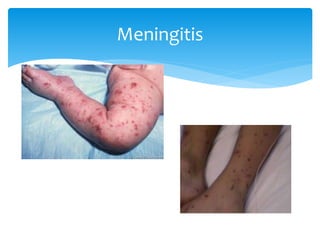
Meningitis
 Characterizing Viral Exanthems – Medscape
 Nguyen T, Freedman J. Dermatologic emergencies: diagnosing and managing life-
threatening rashes. Emerg Med Pract. 2002;4(9):1-28.
 Emergent Diagnoisis of the unknown rash. Jounral Emergency Medicine 2010. Heather
Murphy-Lavoie, MD, FAAEM, andTracy Leigh LeGros, MD, PhD, FACEP, FAAEM
 Morens DM, Katz AR. The "fourth disease" of childhood: reevaluation of a nonexistent
disease. Am J Epidemiol. 1991 Sep 15;134(6):628-40.
 Powell KR. Filatow-Dukes' disease. Epidermolytic toxin-producing staphylococci as the
etiologic agent of the fourth childhood exanthem. Am J Dis Child. 1979 Jan;133(1):88-
91.
 3Weisse ME. The fourth disease, 1900-2000. Lancet. 2001 Jan 27;357(9252):299-301.
 Maverakis, Emanual; Wang, Elizabeth A.; Shinkai, Kanade; Mahasirimongkol,
Surakameth; Margolis, David J.; Avigan, Mark; Chung, Wen-Hung; Goldman, Jennifer;
Grenade, Lois La. "Stevens-Johnson Syndrome and Toxic Epidermal Necrolysis
Standard Reporting and Evaluation Guidelines" JAMA
Dermatology. doi:10.1001/jamadermatol.2017.0160.
References

Paediatric rashes

  • 1.
  • 2.
     How todescribe a rash  Recognise the visual diagnoses for paediatric rash presentations  Patterns, distribution, special features  Broaden differentials for rash and identify the commonly misdiagnosed presentations  Treatments for rash  Recognise the critical rash Objectives
  • 3.
    Anatomy Epidermis - Protective barrier -melanin and immune Dermis - sweat: - Nerves - Sebaceous: - blood vessels Hypodermis (Subcut fat) - Attaching the dermis to your muscles and bones: - blood vessels and nerve cells: - Controlling your body temperature: - Storing your fat
  • 4.
     Macule – Circumscribed are of change <1cm  Patch –  Large area of skin change  Papule –  solid raised lesion <1cm  Nodule –  solid raised lesion >1cm  Plaque –  circumscribed confluent area of nodules  Vesicle –  fluid filled are <1cm  Bulla –  fluid filled area >1cm  Pustule –  circumscribed area containing pus  Furuncle –  skin abscess (usually from staph)  Carbuncle –  collection of furuncles connected Describing a rash
  • 5.
     Viral  Bacterial Fungi  Drug Reactions  Allergic  Autoimmune  mites Aetiologies
  • 6.
     4 yearold child brought in by parents. Itching vigorously. Common Rashes
  • 7.
     Highly contagiousskin infestation by the mite Sarcoptes scabiei  itchiness and a pimple-like rash  1st infection: symptoms in between two and six weeks  Second infection: Sxs develop in 24 hours  Symptoms secondary to an allergic reaction (Type IV)  zigzag or S pattern of the burrow will appear across the skin  Rx: Permethrin 1. Scabies
  • 8.
  • 9.
  • 10.
  • 11.
  • 12.
     Irritant dermatitis Allergic Dermatitis  Treat with removal of exposure, protective barrier and/or steroids 3. Contact Dermatitis
  • 13.
  • 14.
     Infant  4monthsto 5 years  Cheeks  Extensor surfaces  Diaper area 4. Atopic Dermatitis (Eczema)  3 year old - adult  Flexor surfaces  Neck  Face  Upper chest Rx: steroids and moisturisers Cotton clothing Dry well after bathing Antibiotics for superimposed infection
  • 15.
  • 16.
     Staphylococcus aureusor Streptococcus pyogenes  Highly contagious  Treated with mupirocin ointment or POABs  E.g Flucloxacillin  Isolate from day care  Occasionally admit  Risk of leading to Osteomyeltisis and PSGN 5. Impetigo
  • 17.
  • 18.
  • 19.
     Treatment  Corporis:Topical antifungals e.g Clotrimazole, Terbnafine  Versioclour: Topical antifungals plus Selenium sulfide shampoo  Capitis: Griseofulvin for 6 weeks plus Selenium shampoo Tinea
  • 20.
    Non specific ViralRash (exanthomata)
  • 21.
     The majorityof Exanthems are nonspecific and difficult to categorise  Associated with non specific sxs like headache, lethargy, mayalgia and GI complaints  Most resolve in less than a week  Cause  Thought to be from enteroviruses and adenovirus/rhinovirus/parainfluenza Non specific Viral Rash (exanthomata)
  • 22.
     First Disease Measles  Second Disease  Scarlet Fever  Third Disease  Rubella  Fourth Disease  Dukes -Controversial (possibly a misdiagnosis)  Fifth Disease  Erythema Infectiosum (Parvovirus B19)  Sixth Disease  Roseola (HHV6) Specific Exanthems
  • 23.
  • 24.
     Incubation: 7-14d  Prodrome: 4 -5 d before rash fever, malaise, rhinorrohea, cough, Koplik spots 1-3 d before rash  Rash: day 4-7 of illness starts behind ears, forehead, around mouth dusky red, florid maculopapular rash spreads over trunk and limbs. Lasts 5 d.  Infectivity: prodrome to 4 d after the rash  Transmission: respiratory droplet or direct contact  Complications: ears & OM, lungs & pneumonia conjunctivitis CNS encephalitis at d 10, SSPE after several years Measles
  • 25.
  • 26.
     Also calledGerman Measels  often mild with half of people not realizing that they are infected  A rash may start around two weeks after exposure and last for three days  starts on the face and spreads to the rest of the body  Infection during early pregnancy (below 20 weeks) may result in a child born with congenital rubella syndrome (CRS) or miscarriage.  Once recovered, people are immune to future infections.  Vaccine preventable Rubella
  • 27.
    Exanthems Scarlett Fever 2nddisease Pastia’s lines
  • 28.
     Can occuras a result of a group A streptococcus (group A strep) infection  It most commonly affects children between five and 15 years of age  Complications:  Suppurative: peritonsillar or retropharyngeal abscesses, cellulitis, mastoiditis or sinusitis  Non-suppurative: Rheumatic fever, RHD, PSGN, Reactive Arthritis Scarlett fever
  • 29.
  • 30.
    Roseola (6th disease) -3 year old child presents with 3 day history of fevers, cough and runny nose - Fevers stopped yesterday but suddenly patient woke up with this rash.
  • 31.
  • 32.
  • 33.
    Immune dysfunction  Causes:Viral (HSV)  Drugs  antibiotics (including, sulphonamides, penicillin)  anticonvulsants (phenytoin, barbiturates)  aspirin, antituberculoids, and allopurinol and many others.  Infections: Viral (HSV), bacterail and fungal  Other: Mutliple myeoloma, Lymphoma, Vasculitis Erythema Multiforme
  • 34.
  • 35.
     Spectrum ofdisease  Widespread blisters predominant on the trunk and face, mucous membrane erosions;  SJS: epidermal detachment is less than 10% TBSA  TEN: epidermal detachment is more than 30% TBSA  Cross over between 10-30% SJS/TENS
  • 36.
     Often startwith fever, sore throat, cough, and burning eyes for 1 to 3 days  Type IV hypersensitivity reaction – secondary to immune system being triggered by drugs/infections  Ulcers and other lesions begin to appear in the mucous membranes  - almost always in the mouth and lips, but also in the genital and anal regions.  Problems eating and drinking due to pain of ulcers  Conjunctivitis occurs in about 30%  Rash of round small lesions arise on the face, trunk, arms and legs, but usually not the scalp SJS/TENS
  • 37.
     Mortality rate: 5% for SJS  30-40% for TENS  Treatment  discontinuation of the causative factor – most important  Move to a burns unit  Supportive cares and IVH  IV anti-biotics  Immunomodulatory: steroids, cyclophosphamide, plasmapheresis, acetylcysteine, infliximab SJS/TENS
  • 38.
  • 39.
     Characterizing ViralExanthems – Medscape  Nguyen T, Freedman J. Dermatologic emergencies: diagnosing and managing life- threatening rashes. Emerg Med Pract. 2002;4(9):1-28.  Emergent Diagnoisis of the unknown rash. Jounral Emergency Medicine 2010. Heather Murphy-Lavoie, MD, FAAEM, andTracy Leigh LeGros, MD, PhD, FACEP, FAAEM  Morens DM, Katz AR. The "fourth disease" of childhood: reevaluation of a nonexistent disease. Am J Epidemiol. 1991 Sep 15;134(6):628-40.  Powell KR. Filatow-Dukes' disease. Epidermolytic toxin-producing staphylococci as the etiologic agent of the fourth childhood exanthem. Am J Dis Child. 1979 Jan;133(1):88- 91.  3Weisse ME. The fourth disease, 1900-2000. Lancet. 2001 Jan 27;357(9252):299-301.  Maverakis, Emanual; Wang, Elizabeth A.; Shinkai, Kanade; Mahasirimongkol, Surakameth; Margolis, David J.; Avigan, Mark; Chung, Wen-Hung; Goldman, Jennifer; Grenade, Lois La. "Stevens-Johnson Syndrome and Toxic Epidermal Necrolysis Standard Reporting and Evaluation Guidelines" JAMA Dermatology. doi:10.1001/jamadermatol.2017.0160. References

Editor's Notes

  • #4 https://www.rch.org.au/clinicalguide/guideline_index/Burns/
  • #5 Vesicles – chicken pox, herpes, autoimmune e.g bullous pemphigus
  • #8 DX by skin scrapping Permethrin is not an anti-biotic. It is an insecticide Scabies is most often spread during a relatively long period of direct skin contact with an infected person (at least 10 minutes) such as that which may occur during sex or living together. The elderly, disabled, and people with an impaired immune system, such as HIV, cancer, or those on immunosuppressive medications, are susceptible to crusted scabies (also called Norwegian scabies). – can also get this when you just get a severe infestation of scabies (above 2 million) applied from the neck down, usually before bedtime, and left on for about eight to 14 hours, then washed off in the morning.[11] Care should be taken to coat the entire skin surface, not just symptomatic areas; any patch of skin left untreated can provide a "safe haven" for one or more mites to survive. One application is normally sufficient, as permethrin kills eggs and hatchlings, as well as adult mites, though many physicians recommend a second application three to seven days later as a precaution. Crusted scabies may require multiple applications, or supplemental treatment with oral ivermectin
  • #10 Propionibacterium acnes overgrowth. Is normally a skin commensal - Genetics is thought to be the primary cause of acne in 80% of cases - higher than normal amount of oily sebum production (influenced by testosterone),
  • #11 Macrolides e.g Erythromycin/Minocyclin have anti-inflmmatory properties too why it is useful. That is why erythromycin used in some lung diseases e.g Bronchiectasis Isotrenitoin - roacutane
  • #13 The main difference between the rash caused by allergic contact dermatitis and the one caused by irritant contact dermatitis is that the latter tends to be confined to the area where the trigger touched the skin, whereas in allergic contact dermatitis the rash is more likely to be more widespread on the skin. Another characteristic of the allergic contact dermatitis rash is that it usually appears after a day or two after exposure to the allergen, unlike irritant contact dermatitis that appears immediately after the contact with the trigger.
  • #15 The cause is unknown but believed to involve genetics, immune system dysfunction, environmental exposures hose who live in cities and dry climates are more commonly affected. Exposure to certain chemicals or frequent hand washing makes symptoms worse. While emotional stress may make the symptoms worse commonly make it worse include wool clothing, soaps, perfumes, chlorine, dust, and cigarette smoke UV radiation targets inflammatory cells on the skin, inducing positive immunosuppressive effects by altering cytokine production, inducing apoptosis of infiltrating T-cells, and by inhibiting the antigen-presenting function of Langerhans cells. UV radiation can protect the skin by inducing thickening of the stratum corneum which could limit eczematous reactions and prevent entry of external antigens.Finally, skin colonization by Staphylococcus aureus and Pityrosporum orbiculare may be prevented or reduced by the antibacterial effect of UV radiation
  • #20 Mechanism of action. Clotrimazole works to kill individual Candida or fungal cells by altering the permeability of the fungal cell wall. It binds to phospholipids in the cell membrane and inhibits the biosynthesis of ergosterol and other sterols required for cell membrane production. Malassezia furfuris responsible for a small number of cases.These yeasts are normally found on the human skin and become troublesome only under certain circumstances, such as a warm and humid environment, although the exact conditions that cause initiation of the disease process are poorly understood.- production of azelaic acid, which has a slight bleaching effect Tine capitis – the fungus invades the hair follicle
  • #23 An exanthem is any eruptive skin rash that may be associated with fever or other systemic symptoms. Causes include infectious pathogens, medication reactions and, occasionally, a combination of both. Over 100 years ago, a group of characteristic childhood eruptions were described and numbered from one to six:[1,2] measles, scarlet fever, rubella, erythema infectiosum and roseola infantum. The origin of the fourth classic childhood eruption, formerly referred to as Dukes' disease, is controversial. It may represent misdiagnosed cases of rubella or scarlet fever, rather than a distinct illness.
  • #24 Koplik spots appear next to the premolar 2 days before the exanthem Morbifiliform rash starts after 3 days on face and behind ears then spreads to trunk
  • #26 Maculopapular rash Forscheimer's spots on uvula Hallmark = generalized tender lymphadenopathy which involves all nodes, but which is most striking in the suboccipital, postauricular, and anterior and posterior cervical nodes
  • #28 small red bumps that begin on the neck and groin Rash peels cheeks appears red and flushed dark, hyperpigmented areas on the skin, especially in skin creases. These areas are called Pastia's lines
  • #29 Non-suppurative: (The antibodies which the person’s immune system developed to attack the group A streptococci are in these cases also able to attack the person's own tissues.) Type 2 hypersestivity) Jones criteria for Rheumatic fever: migrating arthritis, carditis, syndenhams chorea, erythema marginatum and subcut nodules
  • #30 Slapped cheek Parvovirus infection in pregnant women is associated with hydrops foetalis due to severe foetal anaemia
  • #31 term exanthem subitum describes the sudden "surprise" appearance of the rash after the fall of the fever Rash fades in hours -> 2 days Rare complications. Usually just febrile convulsions - Caused by Human Herpes Virus 6 (HHV-6)
  • #34 EM minor is regarded as being triggered by HSV in almost all cases. A herpetic aetiology also accounts for 55% of cases of EM major. Among the other infections, Mycoplasma infection appears to be a common cause. Herpes simplex virus suppression and even prophylaxis (with acyclovir) has been shown to prevent recurrent erythema multiforme eruption
  • #37 The drug or metabolite covalently binds with a host protein to form a non-self, drug-related epitope. An antigen presenting cell takes up these alter proteins; digests them into small peptides; places the peptides in a groove on the human leukocyte antigen component of their major histocompatibility complex and presents the MHC-associated peptides to T-cell receptors on CD8+ T cells or CD4+ T cells.
  • #38 Little evidence that immunomodulatory help