




“It’s all about
the clinical
documentation!”
Delivering a Healthy WA
Sharon Linton
Area Manager Clinical Coding
North Metropolitan Health Services
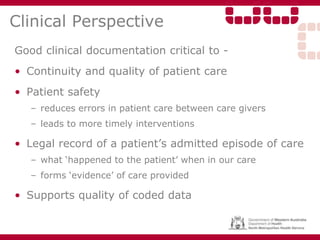
Clinical Perspective
Good clinical documentation critical to -
• Continuity and quality of patient care
• Patient safety
– reduces errors in patient care between care givers
– leads to more timely interventions
• Legal record of a patient’s admitted episode of care
– what ‘happened to the patient’ when in our care
– forms ‘evidence’ of care provided
• Supports quality of coded data
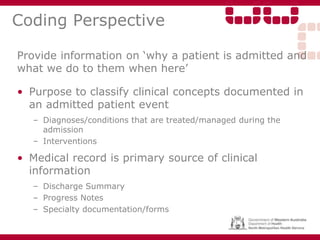
Coding Perspective
Provide information on ‘why a patient is admitted and
what we do to them when here’
• Purpose to classify clinical concepts documented in
an admitted patient event
– Diagnoses/conditions that are treated/managed during the
admission
– Interventions
• Medical record is primary source of clinical
information
– Discharge Summary
– Progress Notes
– Specialty documentation/forms
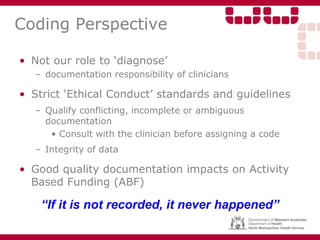
Coding Perspective
• Not our role to ‘diagnose’
– documentation responsibility of clinicians
• Strict ‘Ethical Conduct’ standards and guidelines
– Qualify conflicting, incomplete or ambiguous
documentation
• Consult with the clinician before assigning a code
– Integrity of data
• Good quality documentation impacts on Activity
Based Funding (ABF)
“If it is not recorded, it never happened”
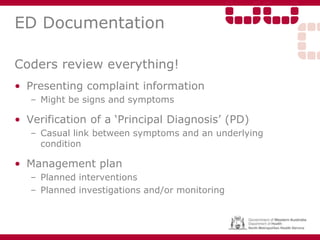
ED Documentation
Coders review everything!
• Presenting complaint information
– Might be signs and symptoms
• Verification of a ‘Principal Diagnosis’ (PD)
– Casual link between symptoms and an underlying
condition
• Management plan
– Planned interventions
– Planned investigations and/or monitoring
ED Documentation
• Evidence of ongoing clinical care (medical and
nursing) of condition/s
– Medical entries
• Significant/abnormal radiology and/or laboratory
results linked to condition
• Interventions
– Observation charts
– Medication charts
• Identify further specificity of PD and related
conditions
– Acute and/or chronic
– Angina – type of angina? Unstable
– ETOH / Drug Intoxication – with
abuse/dependence/withdrawal
Activity Based Funding
(ABF)
Basics
ABF Basics
• Way of funding hospitals for the number and
‘mix’ of patients they treat
• If a hospital treats more patients, it receives
more funding
• Also takes into account the fact that some
patients are more complicated to treat than
others (i.e. elderly, multi comorbidities)
Diagnosis Related
Groups (DRGs)
Basics
DRG Basics
“A classification system that categorises episodes of
patient care into clinically meaningful groups based
on the patient’s attributes that best explains the cost
of care”
• DRGs
– differing levels of resource consumption
– split on the basis of case complexity (presence of multiple
conditions or development of complications)
– each DRG has a value measured as Weighted Activity
Units (WAUs)
DRG Basics
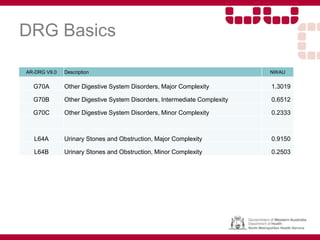
AR-DRG V9.0 Description NWAU
G70A Other Digestive System Disorders, Major Complexity 1.3019
G70B Other Digestive System Disorders, Intermediate Complexity 0.6512
G70C Other Digestive System Disorders, Minor Complexity 0.2333
L64A Urinary Stones and Obstruction, Major Complexity 0.9150
L64B Urinary Stones and Obstruction, Minor Complexity 0.2503
ARDT Policy
Compliance
ARDT Policy
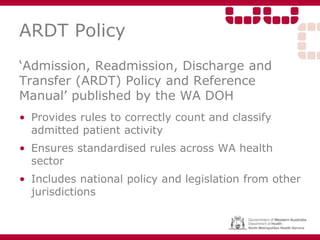
‘Admission, Readmission, Discharge and
Transfer (ARDT) Policy and Reference
Manual’ published by the WA DOH
• Provides rules to correctly count and classify
admitted patient activity
• Ensures standardised rules across WA health
sector
• Includes national policy and legislation from other
jurisdictions
ED Admission Criteria
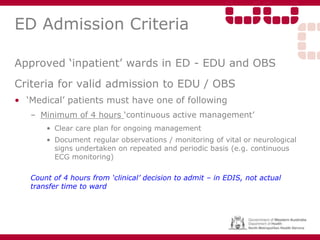
Approved ‘inpatient’ wards in ED - EDU and OBS
Criteria for valid admission to EDU / OBS
• ‘Medical’ patients must have one of following
– Minimum of 4 hours ‘continuous active management’
• Clear care plan for ongoing management
• Document regular observations / monitoring of vital or neurological
signs undertaken on repeated and periodic basis (e.g. continuous
ECG monitoring)
Count of 4 hours from ‘clinical’ decision to admit – in EDIS, not actual
transfer time to ward
ED Admission Criteria
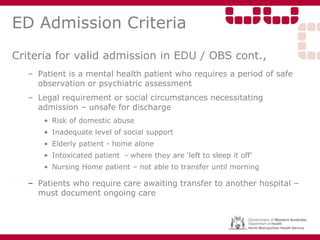
Criteria for valid admission in EDU / OBS cont.,
– Patient is a mental health patient who requires a period of safe
observation or psychiatric assessment
– Legal requirement or social circumstances necessitating
admission – unsafe for discharge
• Risk of domestic abuse
• Inadequate level of social support
• Elderly patient - home alone
• Intoxicated patient - where they are ‘left to sleep it off’
• Nursing Home patient – not able to transfer until morning
– Patients who require care awaiting transfer to another hospital –
must document ongoing care
ED Admission Criteria
• Patients following Type B Procedure
– Commonwealth list (Private Health Insurance Act)
• Non-admitted – Type C
• Admitted – Type B, includes where GA or intravenous/inhalation
sedation is required
– Can be less than 4 hours ‘continuous active management’
– Understand Type B procedures generally performed in ED but
transfer to EDU/OBS
• Require post-procedural observations following IV/Inhalation
sedation
• IV infusion commenced in ED and continuing in EDU/OBS
Documentation Quality
Impact on ABF and
DRGs
DRG Assignment
• Purely based on the clinical documentation
that informs the clinical coding process
• Three determinates of a DRG –
– Principal Diagnosis
– Additional Diagnoses (issues contributing to
admission)
– Surgical Interventions
ED Admissions
Principal Diagnosis (PD) is most important
factor in EDU/OBS inpatient events
Definition:
“The condition, which after study, is the reason for
the patient being admitted to hospital”
• NOT the presenting condition or complaint
• An incorrect PD will get wrong DRG and the
wrong WAUs!
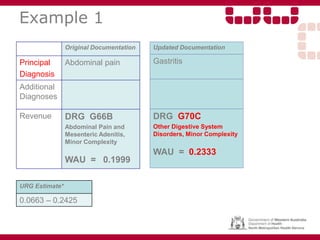
Example 1
Original Documentation
Principal
Diagnosis
Abdominal pain
Additional
Diagnoses
Revenue DRG G66B
Abdominal Pain and
Mesenteric Adenitis,
Minor Complexity
WAU = 0.1999
Updated Documentation
Gastritis
DRG G70C
Other Digestive System
Disorders, Minor Complexity
WAU = 0.2333
URG Estimate*
0.0663 – 0.2425
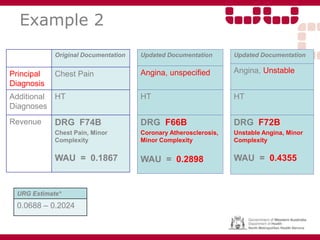
Example 2
Original Documentation
Principal
Diagnosis
Chest Pain
Additional
Diagnoses
HT
Revenue DRG F74B
Chest Pain, Minor
Complexity
WAU = 0.1867
Updated Documentation
Angina, unspecified
HT
DRG F66B
Coronary Atherosclerosis,
Minor Complexity
WAU = 0.2898
URG Estimate*
0.0688 – 0.2024
Updated Documentation
Angina, Unstable
HT
DRG F72B
Unstable Angina, Minor
Complexity
WAU = 0.4355
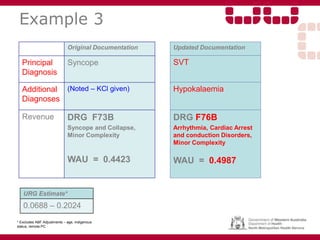
Example 3
Original Documentation
Principal
Diagnosis
Syncope
Additional
Diagnoses
(Noted – KCl given)
Revenue DRG F73B
Syncope and Collapse,
Minor Complexity
WAU = 0.4423
Updated Documentation
SVT
Hypokalaemia
DRG F76B
Arrhythmia, Cardiac Arrest
and conduction Disorders,
Minor Complexity
WAU = 0.4987
URG Estimate*
0.0688 – 0.2024
* Excludes ABF Adjustments – age, indigenous
status, remote PC
Write it right!
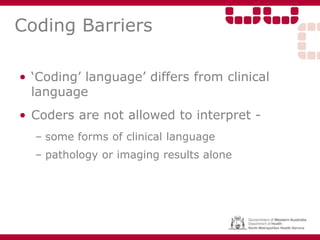
Coding Barriers
• ‘Coding’ language’ differs from clinical
language
• Coders are not allowed to interpret -
– some forms of clinical language
– pathology or imaging results alone
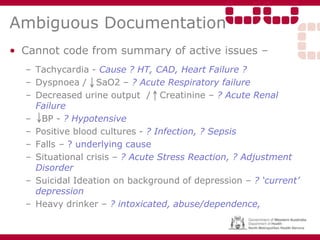
Ambiguous Documentation
• Cannot code from summary of active issues –
– Tachycardia - Cause ? HT, CAD, Heart Failure ?
– Dyspnoea / SaO2 – ? Acute Respiratory failure
– Decreased urine output / Creatinine – ? Acute Renal
Failure
– BP - ? Hypotensive
– Positive blood cultures - ? Infection, ? Sepsis
– Falls – ? underlying cause
– Situational crisis – ? Acute Stress Reaction, ? Adjustment
Disorder
– Suicidal Ideation on background of depression – ? ‘current’
depression
– Heavy drinker – ? intoxicated, abuse/dependence,
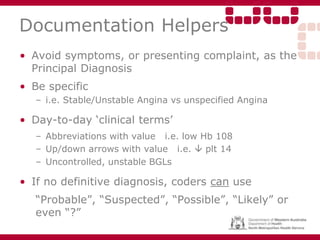
Documentation Helpers
• Avoid symptoms, or presenting complaint, as the
Principal Diagnosis
• Be specific
– i.e. Stable/Unstable Angina vs unspecified Angina
• Day-to-day ‘clinical terms’
– Abbreviations with value i.e. low Hb 108
– Up/down arrows with value i.e.  plt 14
– Uncontrolled, unstable BGLs
• If no definitive diagnosis, coders can use
“Probable”, “Suspected”, “Possible”, “Likely” or
even “?”
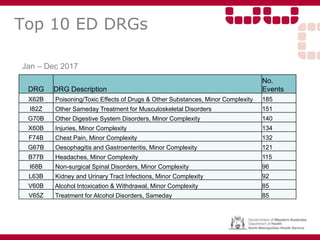
Top 10 ED DRGs
DRG DRG Description
No.
Events
X62B Poisoning/Toxic Effects of Drugs & Other Substances, Minor Complexity 185
I82Z Other Sameday Treatment for Musculoskeletal Disorders 151
G70B Other Digestive System Disorders, Minor Complexity 140
X60B Injuries, Minor Complexity 134
F74B Chest Pain, Minor Complexity 132
G67B Oesophagitis and Gastroenteritis, Minor Complexity 121
B77B Headaches, Minor Complexity 115
I68B Non-surgical Spinal Disorders, Minor Complexity 96
L63B Kidney and Urinary Tract Infections, Minor Complexity 92
V60B Alcohol Intoxication & Withdrawal, Minor Complexity 85
V65Z Treatment for Alcohol Disorders, Sameday 85
Jan – Dec 2017

It's all about the documentation

  • 1.
    “It’s all about theclinical documentation!” Delivering a Healthy WA Sharon Linton Area Manager Clinical Coding North Metropolitan Health Services
  • 2.
    Clinical Perspective Good clinicaldocumentation critical to - • Continuity and quality of patient care • Patient safety – reduces errors in patient care between care givers – leads to more timely interventions • Legal record of a patient’s admitted episode of care – what ‘happened to the patient’ when in our care – forms ‘evidence’ of care provided • Supports quality of coded data
  • 3.
    Coding Perspective Provide informationon ‘why a patient is admitted and what we do to them when here’ • Purpose to classify clinical concepts documented in an admitted patient event – Diagnoses/conditions that are treated/managed during the admission – Interventions • Medical record is primary source of clinical information – Discharge Summary – Progress Notes – Specialty documentation/forms
  • 4.
    Coding Perspective • Notour role to ‘diagnose’ – documentation responsibility of clinicians • Strict ‘Ethical Conduct’ standards and guidelines – Qualify conflicting, incomplete or ambiguous documentation • Consult with the clinician before assigning a code – Integrity of data • Good quality documentation impacts on Activity Based Funding (ABF) “If it is not recorded, it never happened”
  • 5.
    ED Documentation Coders revieweverything! • Presenting complaint information – Might be signs and symptoms • Verification of a ‘Principal Diagnosis’ (PD) – Casual link between symptoms and an underlying condition • Management plan – Planned interventions – Planned investigations and/or monitoring
  • 6.
    ED Documentation • Evidenceof ongoing clinical care (medical and nursing) of condition/s – Medical entries • Significant/abnormal radiology and/or laboratory results linked to condition • Interventions – Observation charts – Medication charts • Identify further specificity of PD and related conditions – Acute and/or chronic – Angina – type of angina? Unstable – ETOH / Drug Intoxication – with abuse/dependence/withdrawal
  • 7.
  • 8.
    ABF Basics • Wayof funding hospitals for the number and ‘mix’ of patients they treat • If a hospital treats more patients, it receives more funding • Also takes into account the fact that some patients are more complicated to treat than others (i.e. elderly, multi comorbidities)
  • 9.
  • 10.
    DRG Basics “A classificationsystem that categorises episodes of patient care into clinically meaningful groups based on the patient’s attributes that best explains the cost of care” • DRGs – differing levels of resource consumption – split on the basis of case complexity (presence of multiple conditions or development of complications) – each DRG has a value measured as Weighted Activity Units (WAUs)
  • 11.
    DRG Basics AR-DRG V9.0Description NWAU G70A Other Digestive System Disorders, Major Complexity 1.3019 G70B Other Digestive System Disorders, Intermediate Complexity 0.6512 G70C Other Digestive System Disorders, Minor Complexity 0.2333 L64A Urinary Stones and Obstruction, Major Complexity 0.9150 L64B Urinary Stones and Obstruction, Minor Complexity 0.2503
  • 12.
  • 13.
    ARDT Policy ‘Admission, Readmission,Discharge and Transfer (ARDT) Policy and Reference Manual’ published by the WA DOH • Provides rules to correctly count and classify admitted patient activity • Ensures standardised rules across WA health sector • Includes national policy and legislation from other jurisdictions
  • 14.
    ED Admission Criteria Approved‘inpatient’ wards in ED - EDU and OBS Criteria for valid admission to EDU / OBS • ‘Medical’ patients must have one of following – Minimum of 4 hours ‘continuous active management’ • Clear care plan for ongoing management • Document regular observations / monitoring of vital or neurological signs undertaken on repeated and periodic basis (e.g. continuous ECG monitoring) Count of 4 hours from ‘clinical’ decision to admit – in EDIS, not actual transfer time to ward
  • 15.
    ED Admission Criteria Criteriafor valid admission in EDU / OBS cont., – Patient is a mental health patient who requires a period of safe observation or psychiatric assessment – Legal requirement or social circumstances necessitating admission – unsafe for discharge • Risk of domestic abuse • Inadequate level of social support • Elderly patient - home alone • Intoxicated patient - where they are ‘left to sleep it off’ • Nursing Home patient – not able to transfer until morning – Patients who require care awaiting transfer to another hospital – must document ongoing care
  • 16.
    ED Admission Criteria •Patients following Type B Procedure – Commonwealth list (Private Health Insurance Act) • Non-admitted – Type C • Admitted – Type B, includes where GA or intravenous/inhalation sedation is required – Can be less than 4 hours ‘continuous active management’ – Understand Type B procedures generally performed in ED but transfer to EDU/OBS • Require post-procedural observations following IV/Inhalation sedation • IV infusion commenced in ED and continuing in EDU/OBS
  • 17.
  • 18.
    DRG Assignment • Purelybased on the clinical documentation that informs the clinical coding process • Three determinates of a DRG – – Principal Diagnosis – Additional Diagnoses (issues contributing to admission) – Surgical Interventions
  • 19.
    ED Admissions Principal Diagnosis(PD) is most important factor in EDU/OBS inpatient events Definition: “The condition, which after study, is the reason for the patient being admitted to hospital” • NOT the presenting condition or complaint • An incorrect PD will get wrong DRG and the wrong WAUs!
  • 20.
    Example 1 Original Documentation Principal Diagnosis Abdominalpain Additional Diagnoses Revenue DRG G66B Abdominal Pain and Mesenteric Adenitis, Minor Complexity WAU = 0.1999 Updated Documentation Gastritis DRG G70C Other Digestive System Disorders, Minor Complexity WAU = 0.2333 URG Estimate* 0.0663 – 0.2425
  • 21.
    Example 2 Original Documentation Principal Diagnosis ChestPain Additional Diagnoses HT Revenue DRG F74B Chest Pain, Minor Complexity WAU = 0.1867 Updated Documentation Angina, unspecified HT DRG F66B Coronary Atherosclerosis, Minor Complexity WAU = 0.2898 URG Estimate* 0.0688 – 0.2024 Updated Documentation Angina, Unstable HT DRG F72B Unstable Angina, Minor Complexity WAU = 0.4355
  • 22.
    Example 3 Original Documentation Principal Diagnosis Syncope Additional Diagnoses (Noted– KCl given) Revenue DRG F73B Syncope and Collapse, Minor Complexity WAU = 0.4423 Updated Documentation SVT Hypokalaemia DRG F76B Arrhythmia, Cardiac Arrest and conduction Disorders, Minor Complexity WAU = 0.4987 URG Estimate* 0.0688 – 0.2024 * Excludes ABF Adjustments – age, indigenous status, remote PC
  • 23.
  • 24.
    Coding Barriers • ‘Coding’language’ differs from clinical language • Coders are not allowed to interpret - – some forms of clinical language – pathology or imaging results alone
  • 25.
    Ambiguous Documentation • Cannotcode from summary of active issues – – Tachycardia - Cause ? HT, CAD, Heart Failure ? – Dyspnoea / SaO2 – ? Acute Respiratory failure – Decreased urine output / Creatinine – ? Acute Renal Failure – BP - ? Hypotensive – Positive blood cultures - ? Infection, ? Sepsis – Falls – ? underlying cause – Situational crisis – ? Acute Stress Reaction, ? Adjustment Disorder – Suicidal Ideation on background of depression – ? ‘current’ depression – Heavy drinker – ? intoxicated, abuse/dependence,
  • 26.
    Documentation Helpers • Avoidsymptoms, or presenting complaint, as the Principal Diagnosis • Be specific – i.e. Stable/Unstable Angina vs unspecified Angina • Day-to-day ‘clinical terms’ – Abbreviations with value i.e. low Hb 108 – Up/down arrows with value i.e.  plt 14 – Uncontrolled, unstable BGLs • If no definitive diagnosis, coders can use “Probable”, “Suspected”, “Possible”, “Likely” or even “?”
  • 27.
    Top 10 EDDRGs DRG DRG Description No. Events X62B Poisoning/Toxic Effects of Drugs & Other Substances, Minor Complexity 185 I82Z Other Sameday Treatment for Musculoskeletal Disorders 151 G70B Other Digestive System Disorders, Minor Complexity 140 X60B Injuries, Minor Complexity 134 F74B Chest Pain, Minor Complexity 132 G67B Oesophagitis and Gastroenteritis, Minor Complexity 121 B77B Headaches, Minor Complexity 115 I68B Non-surgical Spinal Disorders, Minor Complexity 96 L63B Kidney and Urinary Tract Infections, Minor Complexity 92 V60B Alcohol Intoxication & Withdrawal, Minor Complexity 85 V65Z Treatment for Alcohol Disorders, Sameday 85 Jan – Dec 2017

Editor's Notes

  • #9 Model based on health services activity Impacts on how services are delivered Measures everything we do with, to and for patients Measures health care outcomes