







QUIZ
• Answers
1. C
2. B
3. A
4. D
5. D
6. B
7. C
8. B
9. A
10. D, but no cases of this being an issue.
11. C
12. B
CASES
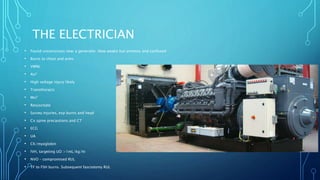
THE ELECTRICIAN
• Found unconscious near a generator. Now awake but amnesic and confused
• Burns to chest and arms
• VWNL
• Ax?
• High voltage injury likely
• Transthoracic
• Mx?
• Resuscitate
• Survey injuries, esp burns and head
• Cx spine precautions and CT
• ECG
• UA
• CK/myoglobin
• IVH, targeting UO >1mL/kg/hr
• NVO – compromised RUL
• TF to FSH burns. Subsequent fasciotomy RUL
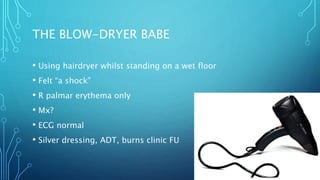
THE BLOW-DRYER BABE
• Using hairdryer whilst standing on a wet floor
• Felt “a shock”
• R palmar erythema only
• Mx?
• ECG normal
• Silver dressing, ADT, burns clinic FU
THE HAPPY CAMPERS
• 3 campers
• Tent struck by lightning
• Cardiac arrest w 10min CPR
• Bleeding ears and unable to hear
• Pale, mottled, numb LLs
• CPR continued and ROSC achieved despite fixed dilated pupils. In ICU, pupils returned to
normal – pt did not have severe hypoxic brain injury
• Ruptured TM
• Keraunoparalysis
HOUSE, MD
• Sticks knife into a power socket to see if there is an afterlife
• Suffers cardiac arrest, after which he is apparently fine
• Is this realistic?
• Consider the path of a current – where was the “grounding”?
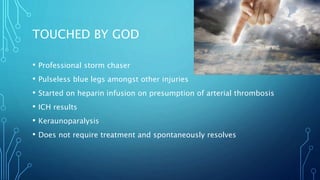
TOUCHED BY GOD
• Professional storm chaser
• Pulseless blue legs amongst other injuries
• Started on heparin infusion on presumption of arterial thrombosis
• ICH results
• Keraunoparalysis
• Does not require treatment and spontaneously resolves
HUNGRY HILLARY
• Tried to get toast from toaster w knife 3mo ago. Seen in ED and
essentially unhurt apart from minor R hand burn.
• Now c/o entire R forearm diffuse pain, swelling, and coolness
• CRPS
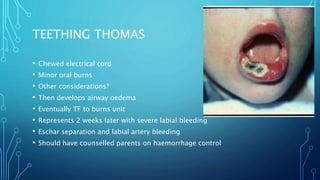
TEETHING THOMAS
• Chewed electrical cord
• Minor oral burns
• Other considerations?
• Then develops airway oedema
• Eventually TF to burns unit
• Represents 2 weeks later with severe labial bleeding
• Eschar separation and labial artery bleeding
• Should have counselled parents on haemorrhage control
ELECTRICAL INJURY
EPIDEMIOLOGY
• ~25 deaths/year in Australia
• Majority young men in industrial setting
FACTORS INFLUENCING DEGREE OF INJURY
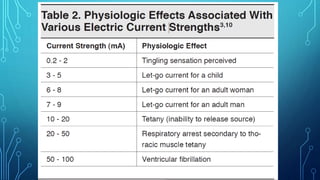
• Current, a flow of charge, measured in Amperes
• Voltage, the electrical potential difference driving the flow, the energy per unit of charge
• Resistance, the impedance to flow of charge
• Ohm’s law: I = V/R
• Current α voltage
• Voltage is used to classify injuries because it is the only variable that can be reliably measured.
• Current α 1/resistance
• Low resistance tissues: nerve, muscle, vessels, membranes.
• High resistance tissues: bone, fat, tendon
• Water on skin reduces resistance 40x!
• Power = VI = I2R = V2/R
• Heat = Pt = I2Rt = V2t/R
• Type of current
• DC causes muscle spasm and throwing
• AC can cause repeated spasm and grasping, depending on the frequency, leading to higher exposure time and possible dislocation
• Path of current through pt. Usually to the ground.
• Example: Household = 230V AC
MECHANISMS OF INJURY
• Current itself
• Thermal burns
• Mechanical trauma e.g. from throwing or convulsing
SOURCES
• >1000V
• Minimum of 24hr cardiac monitoring due to dysrhythmia risk
• BP monitoring due to autonomic dysfunction risk
• Serial neurovascular obs
• Admit cardiology or obs unless otherwise indicated by injuries
• <1000V
• And asymptomatic and examining normally – DC after ECG
• And mild Sx with normal ECG/UA – DC after few hours’ observation
• And ECG changes, LOC, injury – admit
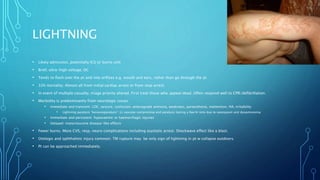
LIGHTNING
• Likely admission, potentially ICU or burns unit
• Brief, ultra-high voltage, DC
• Tends to flash over the pt and into orifices e.g. mouth and ears, rather than go through the pt
• 32% mortality. Almost all from initial cardiac arrest or from resp arrest.
• In event of multiple casualty, triage priority altered. First treat those who appear dead. Often respond well to CPR/defibrillation.
• Morbidity is predominantly from neurologic issues.
• Immediate and transient: LOC, seizure, confusion, anterograde amnesia, weakness, paraesthesia, inattention, HA, irritability
• Lightning paralysis “keraunoparalysis”: LL vascular compromise and paralysis lasting a few hr only due to vasospasm and dysautonomia
• Immediate and persistent: hypoxaemic or haemorrhagic injuries
• Delayed: motorneurone disease-like effects
• Fewer burns. More CVS, resp, neuro complications including asystolic arrest. Shockwave effect like a blast.
• Otologic and ophthalmic injury common. TM rupture may be only sign of lightning in pt w collapse outdoors.
• Pt can be approached immediately.
TASER
• High voltage, low current electricity through the target
• <15sec and clinically well = NOT dangerous and pts do not
require observation
• All of the few deaths previously associated with taser have
involved dysrhythmia-inducing drugs also
CHEWED ELECTRICAL CORD
• Oral arc burns
• Plastics/max-facs for debridement/recon/oral splinting
• Risk of severe labial artery bleeding after delayed eschar separation – pts
need education pre-discharge
• Thinner skin in children = likely more severe injury
• Risk of airway obstruction
SYNDROMES
CARDIAC
• Dysrhythmia is the most common
• VF at low exposures, asystole at high exposures including lightning
• 4-17% of electrocutions
• Esp hand-to-hand electrocution
• Rarely delayed. Most cases of delayed dysrhythmia also had dysrhythmia initially. Get early ECG.
• Energy levels for cardioversion are unchanged
• Often respond well to defibrillation and resuscitation
• Myocardial injury uncommon
• Mx
• Prolonged resus as pts are young and outcomes are good even if in asystole and signs of brain death may be unreliable in this
group
• Cardiac monitor if dysrhythmia, LOC, or >1000V
• Troponin levels not well studied
RESPIRATORY
• Respiratory failure from respiratory muscle tetany or
respiratory centre injury or cardiac arrest
• Mx: secure the airway
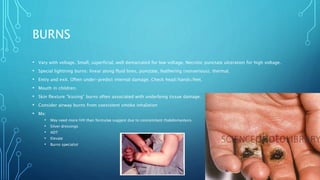
BURNS
• Vary with voltage. Small, superficial, well demarcated for low voltage. Necrotic punctate ulceration for high voltage.
• Special lightning burns: linear along fluid lines, punctate, feathering (nonserious), thermal.
• Entry and exit. Often under-predict internal damage. Check head/hands/feet.
• Mouth in children.
• Skin flexture “kissing” burns often associated with underlying tissue damage.
• Consider airway burns from coexistent smoke inhalation
• Mx:
• May need more IVH than formulae suggest due to concomitant rhabdomyolysis
• Silver dressings
• ADT
• Elevate
• Burns specialist
NEUROLOGIC
• 50% incidence in high-voltage injury, likely because nerve tissue has lowest
resistance.
• Central: LOC, memory disturbance, weakness, spinal cord injury – ALS/TM-
like, seizure, confusion, coma, aphasia
• Autonomic dysfunction: dilated pupils, hypotension, hypertension, arrest,
syncope, vasoconstriction, thermodysregulation, tachycardia,
• Peripheral: motor and sensory, CRPS – may be delayed
• Need CT to differentiate between electric and traumatic effects
• Persistent: inattention, poor memory, impaired learning
MUSCULAR
• Commonly rhabdomyolysis, coagulation necrosis, compartment
syndrome from oedema
• Check for myalgia
• NV exam
• Mx: IVH aggressively, check electrolytes <4hourly esp watching
K+, UO >1mL/kg/hr, fasciotomy for compartment syndrome or
ongoing myonecrosis
VASCULAR
• Usually tunica media injury leading to aneurysm or rupture.
Intimal injury leads to thrombosis.
• Commonly in small arteries to muscle. Results in myonecrosis.
ORTHOPAEDIC
• Highest resistance. Generates high heat when current passes.
• Osteonecrosis, periosteal burns, matrix breakdown
• Trauma from throwing, convulsions, shockwaves. Posterior
shoulder dislocation common.
• Mx: as trauma patient
OCULAR AND OTOLOGIC
• Ophthalmologic
• Corneal commonest. Erosion, keratitis, scarring
• Cataract – may be delayed and pts w high voltage injury ought to be
warned, hyphaema, vitreous haemorrhage, optic neuropathy
• Hearing impairment
• Conductive from TM rupture, esp in lightning strike due to shockwave
• Sensorineural from cochlea electrocution
GASTROINTESTINAL
• Rare
• Curling’s ulcers in pt w >30% BSA burns. Mx: PPI.
• Ileus
• Vascular insufficiency
PREGNANCY
• Burns = uteroplacento blood flow changes and dysfunction can
occur, abruption, abortion, oligohydramnios, growth
retardation,
• CTG/FHR/USS
• Obstetric consultation
• Most have good outcome if low voltage and not transuterine
shock
CLINICAL APPROACH
HISTORY
• Source and voltage and type of current. Specificity is key as capacitors and
transformers in household appliances can alter the voltage substantially
compared to housing mains voltage.
• Other risk factors in pts w low-voltage exposure
• Duration of contact
• Water involvement
• Spasmic injury
• Transthoracic
• PMHx: cardiac
• Tetanus immunity
EXAMINATION
• Entry and exit burns
• High voltage pts
• Ophthalmic including fundoscopy for haemorrhage and optic neuropathy
• Otoscopy for TM rupture
• Neurovascular of extremities
INVESTIGATIONS
• Only ECG needed if asymptomatic and low voltage injury
• ECG
• FBC, UEC,
• Coag, G+H if trauma
• CK. Need serial if elevated as this predicts mortality, LOS, risk of amputation.
• Trop – unclear utility and should DW cardiology
• Imaging as for trauma pt
• UA for Hb/myoglobin. If positive, send urine for microscopy ?RBC vs myoglobin.
MANAGEMENT
• Resuscitation
• Triage arrested casualties first
• Prolonged CPR indicated – young pts w good outcomes
• Secure airway against burns and in event of resp arrest
• Neurologic death difficult to determine
• Treat as trauma
• Cx spine needs to be cleared
• Image if any neuro issue to distinguish electric and trauma effects
• Eyes and ears are particularly vulnerable
• Burns management including DTPa
• Cardiac monitor if LOC, ECG change, and transthoracic or >1000V exposure
• NV monitoring
• IVH for rhabomyolysis and burns
• Titrate to UO rather than using a formula
KEY POINTS
• Avoid being electrocuted on scene
• Do not withdraw resuscitation too early
• Signs of death are unreliable in this patient group
• Treat as trauma
• High voltage DC and lightning injury pts are often thrown violently
• High voltage AC pts may have violent muscle spasm
• Internal injury may be severe despite only minor burns in pts with high voltage exposure
• ECG for all patients
• Cardiac monitor pts w LOC, ECG change, and transthoracic or >1000V exposure
• Frequently need aggressive IVH due to burns and rhabdomyolysis
• UO target 1-1.5mL/kg/hr rather than burns formulae
• Monitor neurovascular status of involved extremities regularly due to high risk of compartment
syndrome, vasospasm, and neurologic effects.
• Counsel pts about delayed effects
• CRPS, inattention, STML, weakness, paraesthesia, depression, cataract
REFERENCES
• Environmental and weapon-related electrical injuries - UpToDate
• Electrical Injuries: A Review For The Emergency Clinician - Emergency
medicine practice 2009
• Lightning and Electrical Injuries . Christopher B. Colwell. Emergency
medicine. 2nd ed. 2013.
• Chapter 218: Electrical and Lightning Injuries. Caitlin Bailey.
Tintinalli’s Emergency Medicine: A Comprehensive Study Guide, 8e.
• https://lifeinthefastlane.com/ccc/electrical-injury/
MISCELLANY
• Man electrocuted arm to arm
• Intact NV obs initially. Later develops compartment syndrome.
• LITFL info
• Tintinalli info starting from prehosp care section

Electrical injury

  • 1.
    QUIZ • Answers 1. C 2.B 3. A 4. D 5. D 6. B 7. C 8. B 9. A 10. D, but no cases of this being an issue. 11. C 12. B
  • 2.
  • 3.
    THE ELECTRICIAN • Foundunconscious near a generator. Now awake but amnesic and confused • Burns to chest and arms • VWNL • Ax? • High voltage injury likely • Transthoracic • Mx? • Resuscitate • Survey injuries, esp burns and head • Cx spine precautions and CT • ECG • UA • CK/myoglobin • IVH, targeting UO >1mL/kg/hr • NVO – compromised RUL • TF to FSH burns. Subsequent fasciotomy RUL
  • 4.
    THE BLOW-DRYER BABE •Using hairdryer whilst standing on a wet floor • Felt “a shock” • R palmar erythema only • Mx? • ECG normal • Silver dressing, ADT, burns clinic FU
  • 5.
    THE HAPPY CAMPERS •3 campers • Tent struck by lightning • Cardiac arrest w 10min CPR • Bleeding ears and unable to hear • Pale, mottled, numb LLs • CPR continued and ROSC achieved despite fixed dilated pupils. In ICU, pupils returned to normal – pt did not have severe hypoxic brain injury • Ruptured TM • Keraunoparalysis
  • 6.
    HOUSE, MD • Sticksknife into a power socket to see if there is an afterlife • Suffers cardiac arrest, after which he is apparently fine • Is this realistic? • Consider the path of a current – where was the “grounding”?
  • 7.
    TOUCHED BY GOD •Professional storm chaser • Pulseless blue legs amongst other injuries • Started on heparin infusion on presumption of arterial thrombosis • ICH results • Keraunoparalysis • Does not require treatment and spontaneously resolves
  • 8.
    HUNGRY HILLARY • Triedto get toast from toaster w knife 3mo ago. Seen in ED and essentially unhurt apart from minor R hand burn. • Now c/o entire R forearm diffuse pain, swelling, and coolness • CRPS
  • 9.
    TEETHING THOMAS • Chewedelectrical cord • Minor oral burns • Other considerations? • Then develops airway oedema • Eventually TF to burns unit • Represents 2 weeks later with severe labial bleeding • Eschar separation and labial artery bleeding • Should have counselled parents on haemorrhage control
  • 10.
  • 11.
    EPIDEMIOLOGY • ~25 deaths/yearin Australia • Majority young men in industrial setting
  • 12.
    FACTORS INFLUENCING DEGREEOF INJURY • Current, a flow of charge, measured in Amperes • Voltage, the electrical potential difference driving the flow, the energy per unit of charge • Resistance, the impedance to flow of charge • Ohm’s law: I = V/R • Current α voltage • Voltage is used to classify injuries because it is the only variable that can be reliably measured. • Current α 1/resistance • Low resistance tissues: nerve, muscle, vessels, membranes. • High resistance tissues: bone, fat, tendon • Water on skin reduces resistance 40x! • Power = VI = I2R = V2/R • Heat = Pt = I2Rt = V2t/R • Type of current • DC causes muscle spasm and throwing • AC can cause repeated spasm and grasping, depending on the frequency, leading to higher exposure time and possible dislocation • Path of current through pt. Usually to the ground. • Example: Household = 230V AC
  • 14.
    MECHANISMS OF INJURY •Current itself • Thermal burns • Mechanical trauma e.g. from throwing or convulsing
  • 15.
    SOURCES • >1000V • Minimumof 24hr cardiac monitoring due to dysrhythmia risk • BP monitoring due to autonomic dysfunction risk • Serial neurovascular obs • Admit cardiology or obs unless otherwise indicated by injuries • <1000V • And asymptomatic and examining normally – DC after ECG • And mild Sx with normal ECG/UA – DC after few hours’ observation • And ECG changes, LOC, injury – admit
  • 16.
    LIGHTNING • Likely admission,potentially ICU or burns unit • Brief, ultra-high voltage, DC • Tends to flash over the pt and into orifices e.g. mouth and ears, rather than go through the pt • 32% mortality. Almost all from initial cardiac arrest or from resp arrest. • In event of multiple casualty, triage priority altered. First treat those who appear dead. Often respond well to CPR/defibrillation. • Morbidity is predominantly from neurologic issues. • Immediate and transient: LOC, seizure, confusion, anterograde amnesia, weakness, paraesthesia, inattention, HA, irritability • Lightning paralysis “keraunoparalysis”: LL vascular compromise and paralysis lasting a few hr only due to vasospasm and dysautonomia • Immediate and persistent: hypoxaemic or haemorrhagic injuries • Delayed: motorneurone disease-like effects • Fewer burns. More CVS, resp, neuro complications including asystolic arrest. Shockwave effect like a blast. • Otologic and ophthalmic injury common. TM rupture may be only sign of lightning in pt w collapse outdoors. • Pt can be approached immediately.
  • 17.
    TASER • High voltage,low current electricity through the target • <15sec and clinically well = NOT dangerous and pts do not require observation • All of the few deaths previously associated with taser have involved dysrhythmia-inducing drugs also
  • 18.
    CHEWED ELECTRICAL CORD •Oral arc burns • Plastics/max-facs for debridement/recon/oral splinting • Risk of severe labial artery bleeding after delayed eschar separation – pts need education pre-discharge • Thinner skin in children = likely more severe injury • Risk of airway obstruction
  • 19.
  • 20.
    CARDIAC • Dysrhythmia isthe most common • VF at low exposures, asystole at high exposures including lightning • 4-17% of electrocutions • Esp hand-to-hand electrocution • Rarely delayed. Most cases of delayed dysrhythmia also had dysrhythmia initially. Get early ECG. • Energy levels for cardioversion are unchanged • Often respond well to defibrillation and resuscitation • Myocardial injury uncommon • Mx • Prolonged resus as pts are young and outcomes are good even if in asystole and signs of brain death may be unreliable in this group • Cardiac monitor if dysrhythmia, LOC, or >1000V • Troponin levels not well studied
  • 21.
    RESPIRATORY • Respiratory failurefrom respiratory muscle tetany or respiratory centre injury or cardiac arrest • Mx: secure the airway
  • 22.
    BURNS • Vary withvoltage. Small, superficial, well demarcated for low voltage. Necrotic punctate ulceration for high voltage. • Special lightning burns: linear along fluid lines, punctate, feathering (nonserious), thermal. • Entry and exit. Often under-predict internal damage. Check head/hands/feet. • Mouth in children. • Skin flexture “kissing” burns often associated with underlying tissue damage. • Consider airway burns from coexistent smoke inhalation • Mx: • May need more IVH than formulae suggest due to concomitant rhabdomyolysis • Silver dressings • ADT • Elevate • Burns specialist
  • 23.
    NEUROLOGIC • 50% incidencein high-voltage injury, likely because nerve tissue has lowest resistance. • Central: LOC, memory disturbance, weakness, spinal cord injury – ALS/TM- like, seizure, confusion, coma, aphasia • Autonomic dysfunction: dilated pupils, hypotension, hypertension, arrest, syncope, vasoconstriction, thermodysregulation, tachycardia, • Peripheral: motor and sensory, CRPS – may be delayed • Need CT to differentiate between electric and traumatic effects • Persistent: inattention, poor memory, impaired learning
  • 24.
    MUSCULAR • Commonly rhabdomyolysis,coagulation necrosis, compartment syndrome from oedema • Check for myalgia • NV exam • Mx: IVH aggressively, check electrolytes <4hourly esp watching K+, UO >1mL/kg/hr, fasciotomy for compartment syndrome or ongoing myonecrosis
  • 25.
    VASCULAR • Usually tunicamedia injury leading to aneurysm or rupture. Intimal injury leads to thrombosis. • Commonly in small arteries to muscle. Results in myonecrosis.
  • 26.
    ORTHOPAEDIC • Highest resistance.Generates high heat when current passes. • Osteonecrosis, periosteal burns, matrix breakdown • Trauma from throwing, convulsions, shockwaves. Posterior shoulder dislocation common. • Mx: as trauma patient
  • 27.
    OCULAR AND OTOLOGIC •Ophthalmologic • Corneal commonest. Erosion, keratitis, scarring • Cataract – may be delayed and pts w high voltage injury ought to be warned, hyphaema, vitreous haemorrhage, optic neuropathy • Hearing impairment • Conductive from TM rupture, esp in lightning strike due to shockwave • Sensorineural from cochlea electrocution
  • 28.
    GASTROINTESTINAL • Rare • Curling’sulcers in pt w >30% BSA burns. Mx: PPI. • Ileus • Vascular insufficiency
  • 29.
    PREGNANCY • Burns =uteroplacento blood flow changes and dysfunction can occur, abruption, abortion, oligohydramnios, growth retardation, • CTG/FHR/USS • Obstetric consultation • Most have good outcome if low voltage and not transuterine shock
  • 30.
  • 31.
    HISTORY • Source andvoltage and type of current. Specificity is key as capacitors and transformers in household appliances can alter the voltage substantially compared to housing mains voltage. • Other risk factors in pts w low-voltage exposure • Duration of contact • Water involvement • Spasmic injury • Transthoracic • PMHx: cardiac • Tetanus immunity
  • 32.
    EXAMINATION • Entry andexit burns • High voltage pts • Ophthalmic including fundoscopy for haemorrhage and optic neuropathy • Otoscopy for TM rupture • Neurovascular of extremities
  • 33.
    INVESTIGATIONS • Only ECGneeded if asymptomatic and low voltage injury • ECG • FBC, UEC, • Coag, G+H if trauma • CK. Need serial if elevated as this predicts mortality, LOS, risk of amputation. • Trop – unclear utility and should DW cardiology • Imaging as for trauma pt • UA for Hb/myoglobin. If positive, send urine for microscopy ?RBC vs myoglobin.
  • 34.
    MANAGEMENT • Resuscitation • Triagearrested casualties first • Prolonged CPR indicated – young pts w good outcomes • Secure airway against burns and in event of resp arrest • Neurologic death difficult to determine • Treat as trauma • Cx spine needs to be cleared • Image if any neuro issue to distinguish electric and trauma effects • Eyes and ears are particularly vulnerable • Burns management including DTPa • Cardiac monitor if LOC, ECG change, and transthoracic or >1000V exposure • NV monitoring • IVH for rhabomyolysis and burns • Titrate to UO rather than using a formula
  • 35.
    KEY POINTS • Avoidbeing electrocuted on scene • Do not withdraw resuscitation too early • Signs of death are unreliable in this patient group • Treat as trauma • High voltage DC and lightning injury pts are often thrown violently • High voltage AC pts may have violent muscle spasm • Internal injury may be severe despite only minor burns in pts with high voltage exposure • ECG for all patients • Cardiac monitor pts w LOC, ECG change, and transthoracic or >1000V exposure • Frequently need aggressive IVH due to burns and rhabdomyolysis • UO target 1-1.5mL/kg/hr rather than burns formulae • Monitor neurovascular status of involved extremities regularly due to high risk of compartment syndrome, vasospasm, and neurologic effects. • Counsel pts about delayed effects • CRPS, inattention, STML, weakness, paraesthesia, depression, cataract
  • 36.
    REFERENCES • Environmental andweapon-related electrical injuries - UpToDate • Electrical Injuries: A Review For The Emergency Clinician - Emergency medicine practice 2009 • Lightning and Electrical Injuries . Christopher B. Colwell. Emergency medicine. 2nd ed. 2013. • Chapter 218: Electrical and Lightning Injuries. Caitlin Bailey. Tintinalli’s Emergency Medicine: A Comprehensive Study Guide, 8e. • https://lifeinthefastlane.com/ccc/electrical-injury/
  • 37.
    MISCELLANY • Man electrocutedarm to arm • Intact NV obs initially. Later develops compartment syndrome. • LITFL info • Tintinalli info starting from prehosp care section