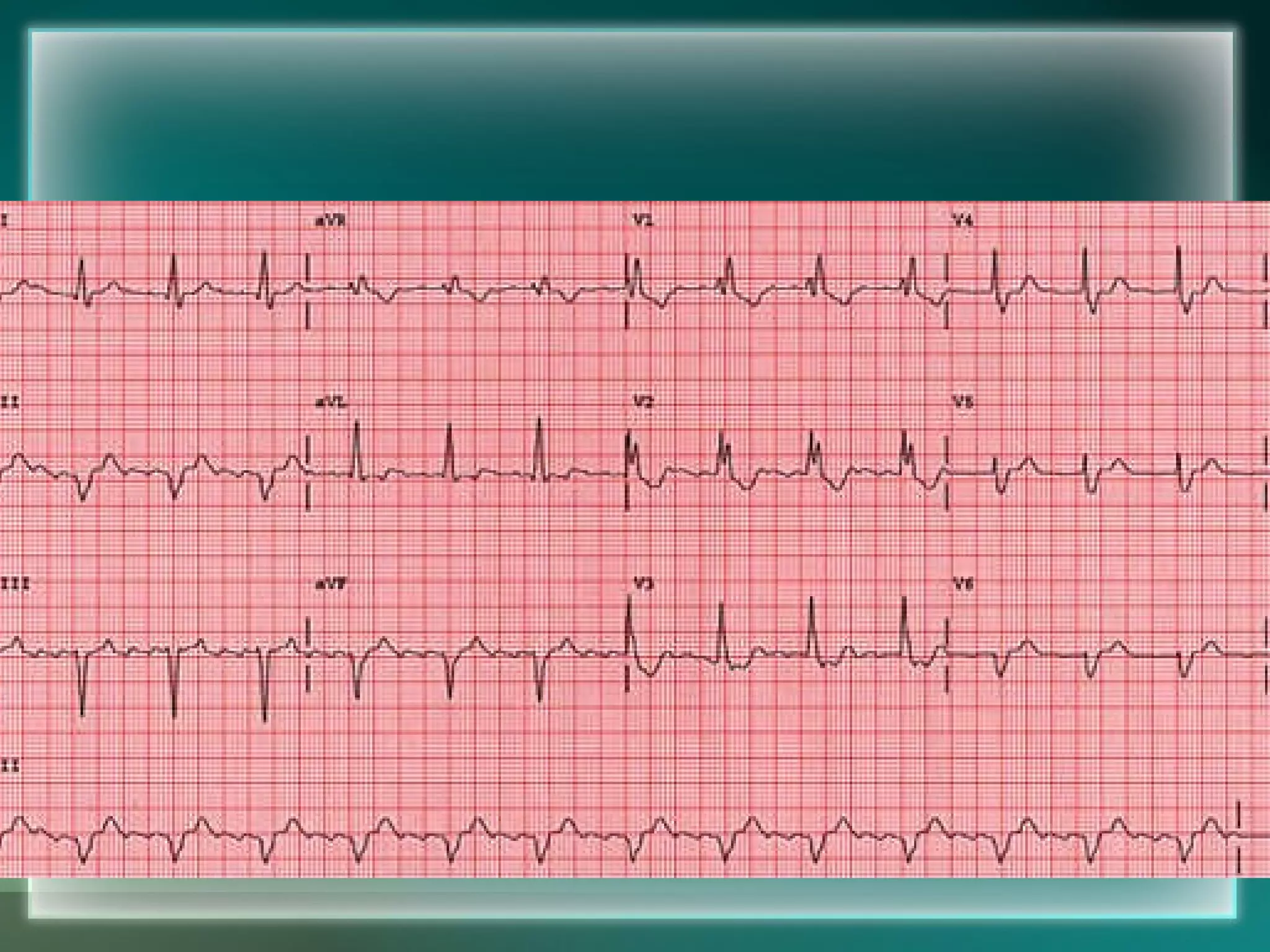
Basics of ECG http://emergencymedic.blogspot.com Dr Subroto Mandal, MD, DM, DC Associate Professor, Cardiology
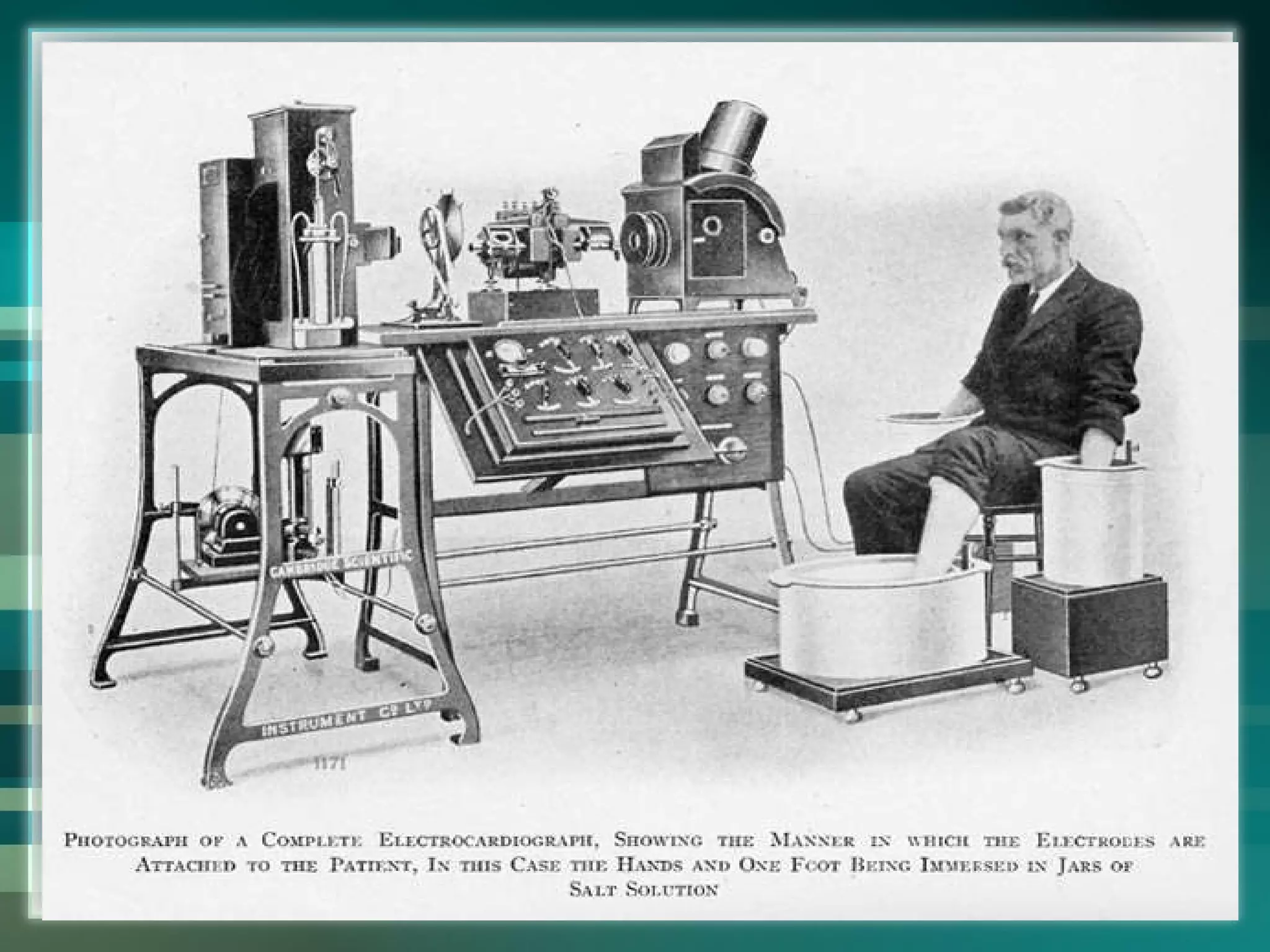
HISTORY 1842- Italian scientist Carlo Matteucci realizes that electricity is associated with the heart beat 1876- Irish scientist Marey  analyzes the electric pattern of frog’s heart   1895 - William Einthoven , credited for the invention of EKG 1906 - using the string electrometer EKG,  William Einthoven diagnoses some heart problems
CONTD… 1924 - the noble prize for physiology or medicine is given to William Einthoven for his work on EKG 1938 -AHA and Cardiac society of great Britan defined and position of chest leads 1942- Goldberger increased Wilson’s Unipolar lead voltage by 50% and made Augmented leads 2005- successful reduction in time of onset of chest pain and PTCA by wireless transmission of ECG on his PDA.
 
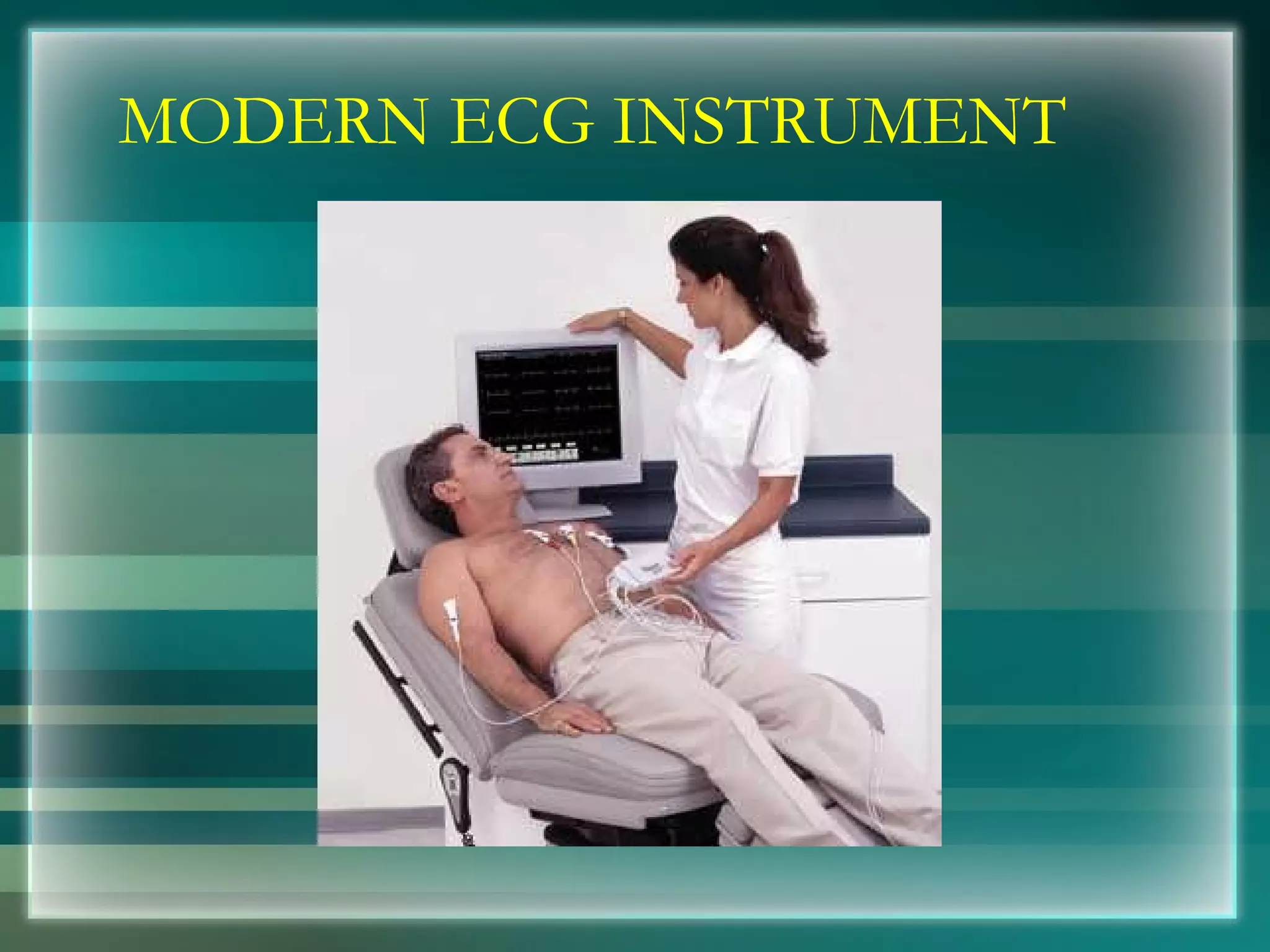
MODERN ECG INSTRUMENT
What is an EKG? The electrocardiogram (EKG) is a representation  of the electrical events of the cardiac cycle. Each event has a distinctive waveform  the study of waveform can lead to greater insight into a patient’s cardiac pathophysiology.
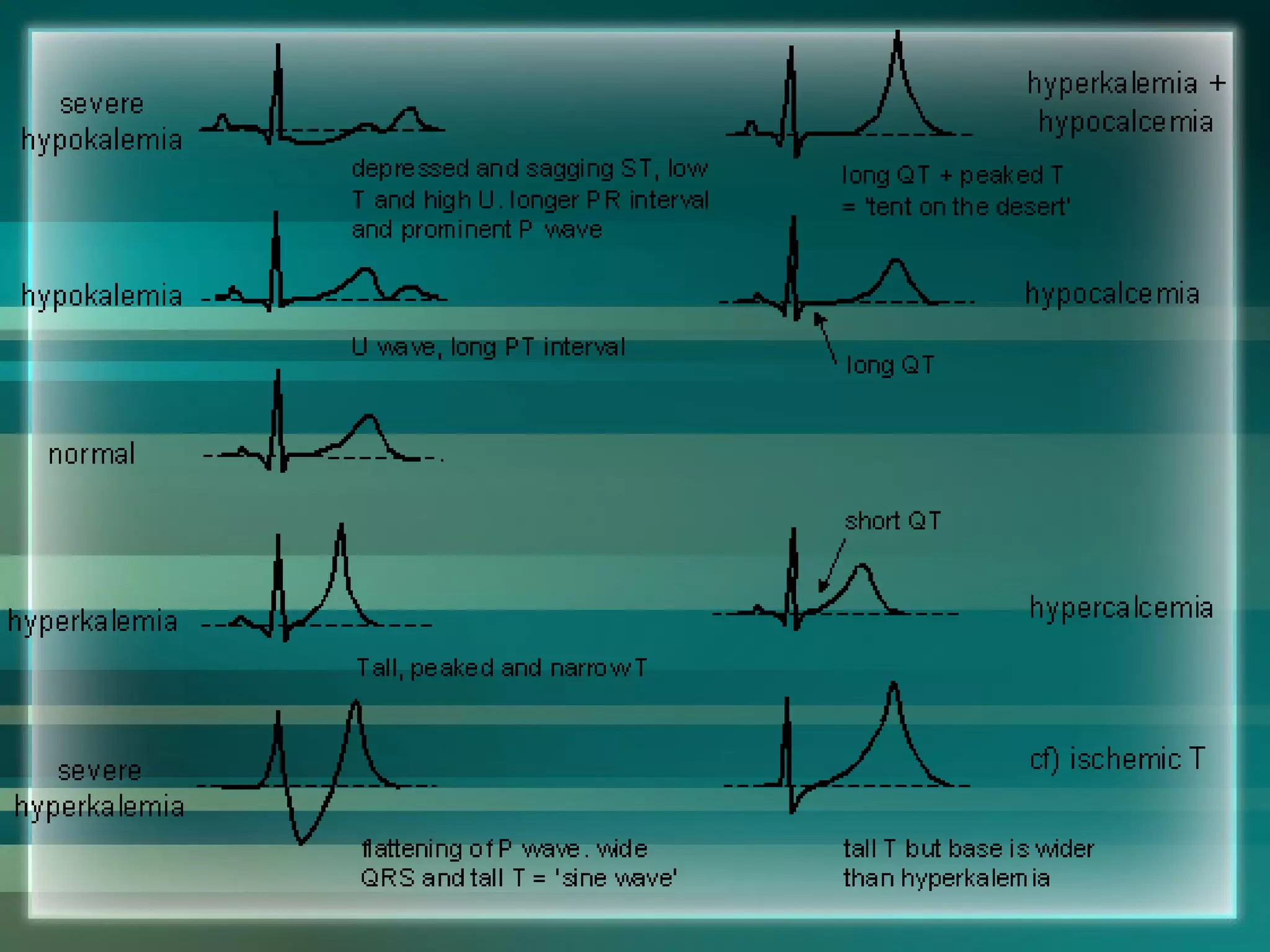
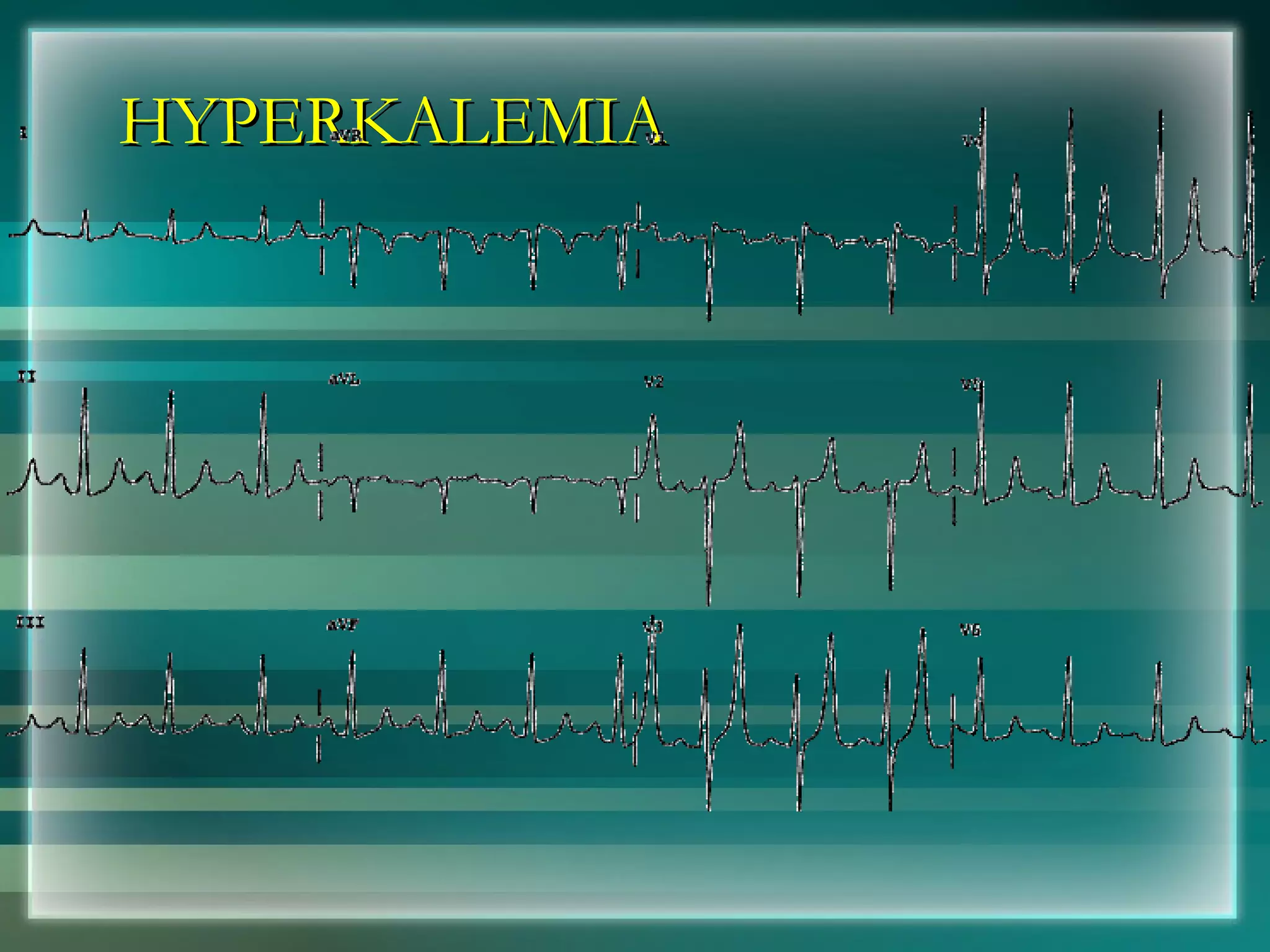
With EKGs we can identify Arrhythmias Myocardial ischemia and infarction Pericarditis Chamber hypertrophy Electrolyte disturbances (i.e. hyperkalemia, hypokalemia) Drug toxicity (i.e. digoxin and drugs which prolong the QT interval)
Depolarization Contraction of any muscle is associated with electrical changes called depolarization These changes can be detected by electrodes attached to the surface of the body
Pacemakers of the Heart SA Node  - Dominant pacemaker with an intrinsic rate of 60 - 100 beats/minute. AV Node  - Back-up pacemaker with an intrinsic rate of 40 - 60 beats/minute. Ventricular cells  - Back-up pacemaker with an intrinsic rate of 20 - 45 bpm.
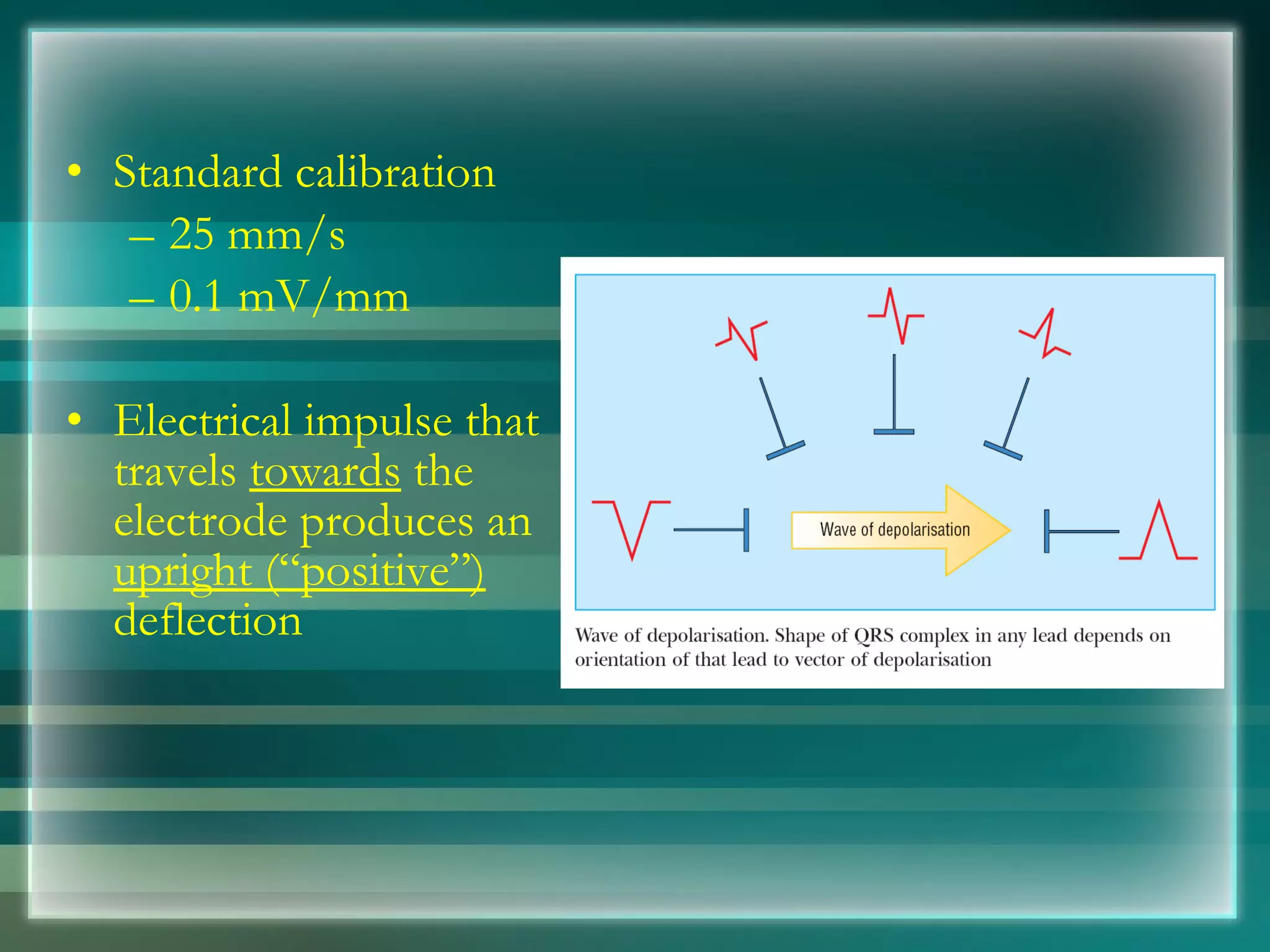
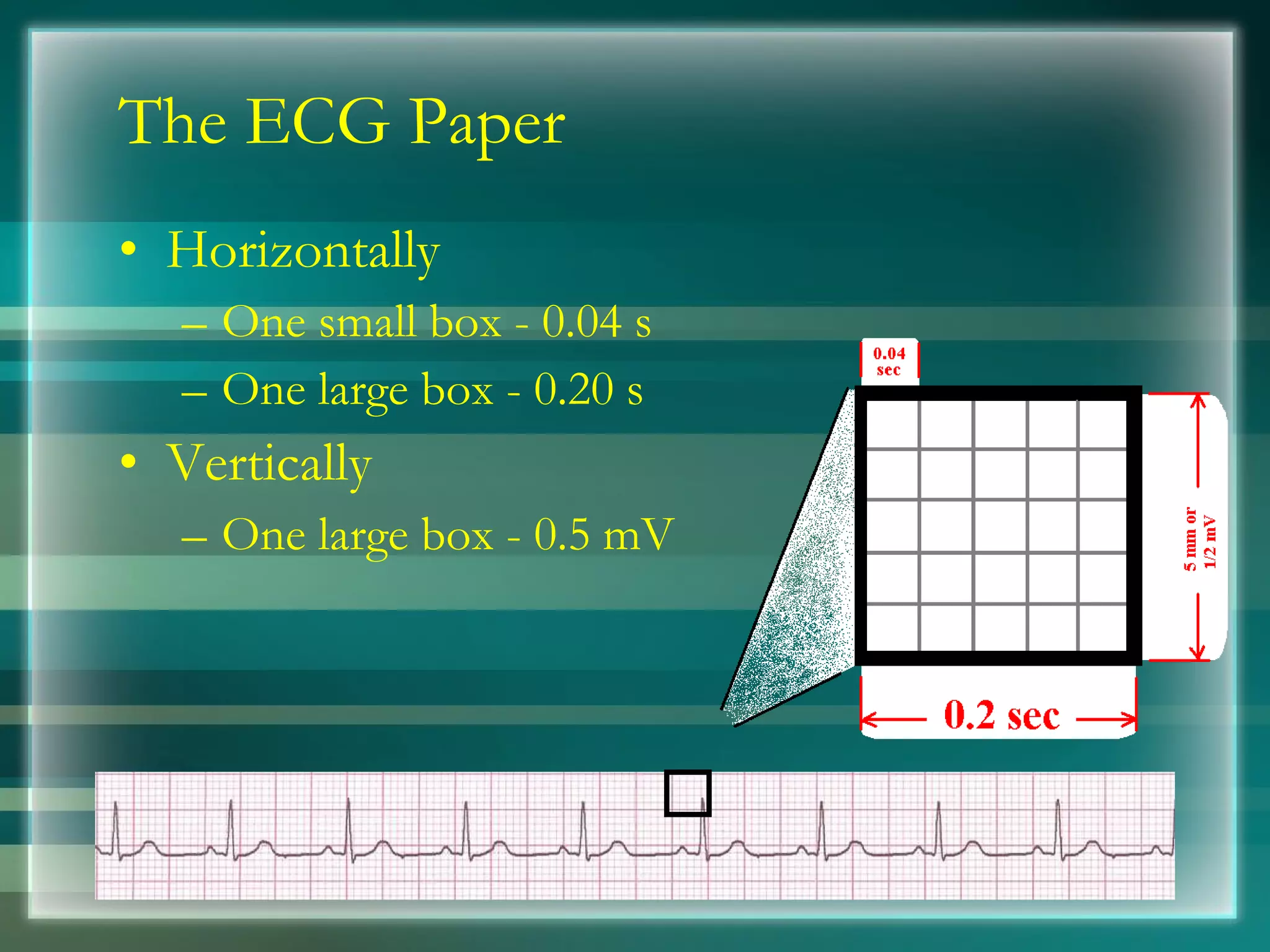
Standard calibration 25 mm/s 0.1 mV/mm Electrical impulse that travels  towards  the electrode produces an  upright (“positive”)  deflection
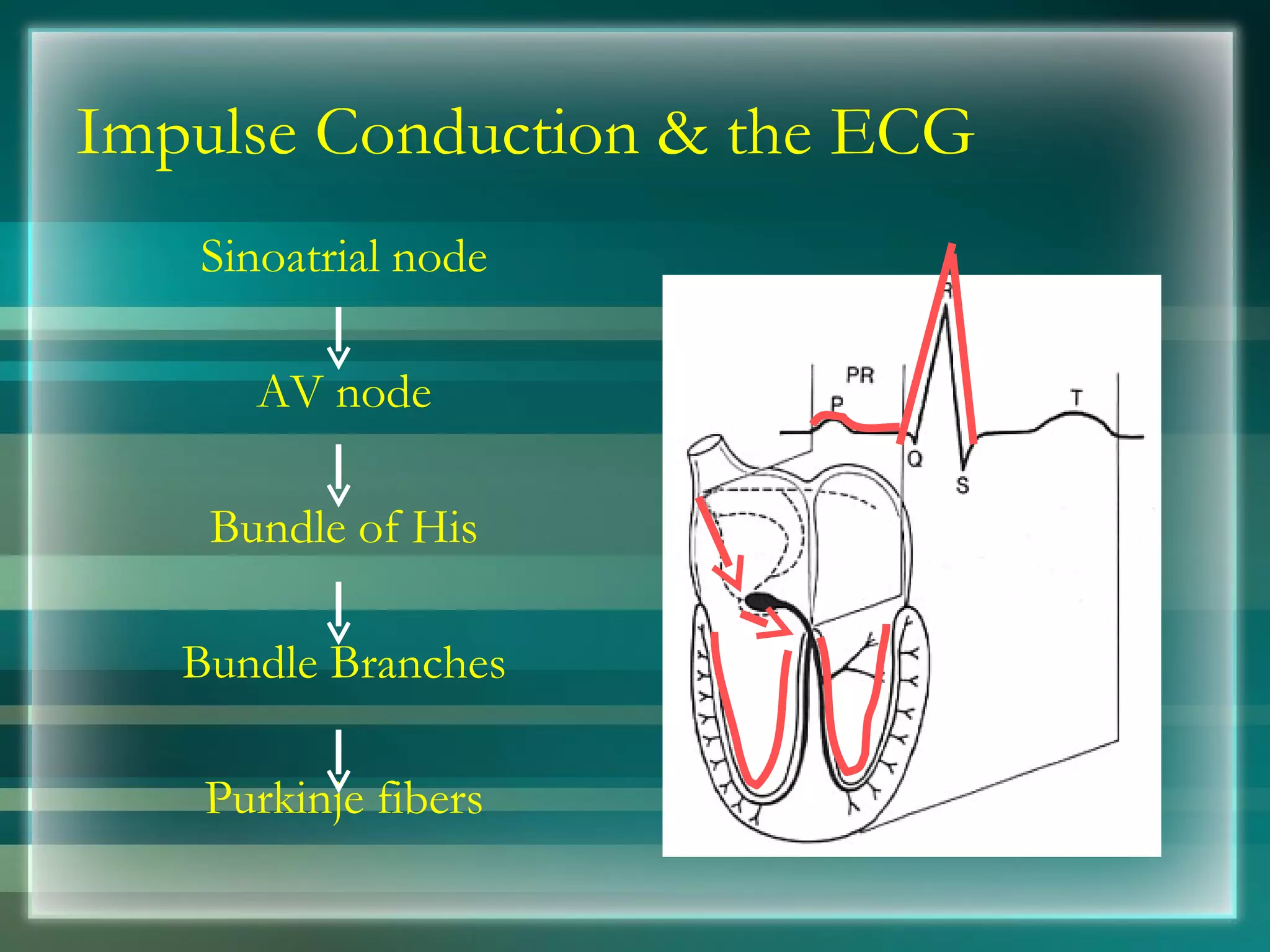
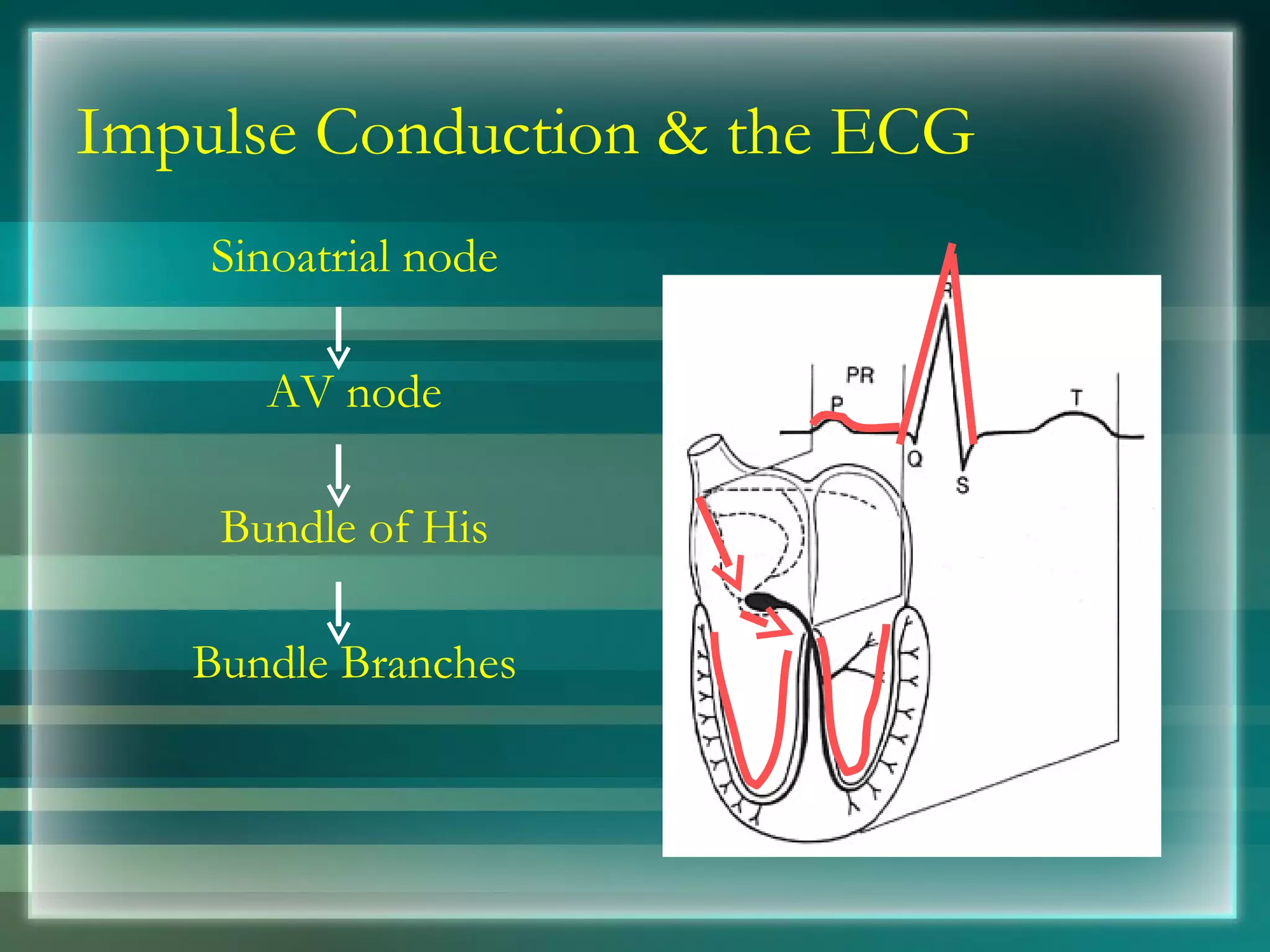
Impulse Conduction & the ECG Sinoatrial node AV node Bundle of His Bundle Branches Purkinje fibers
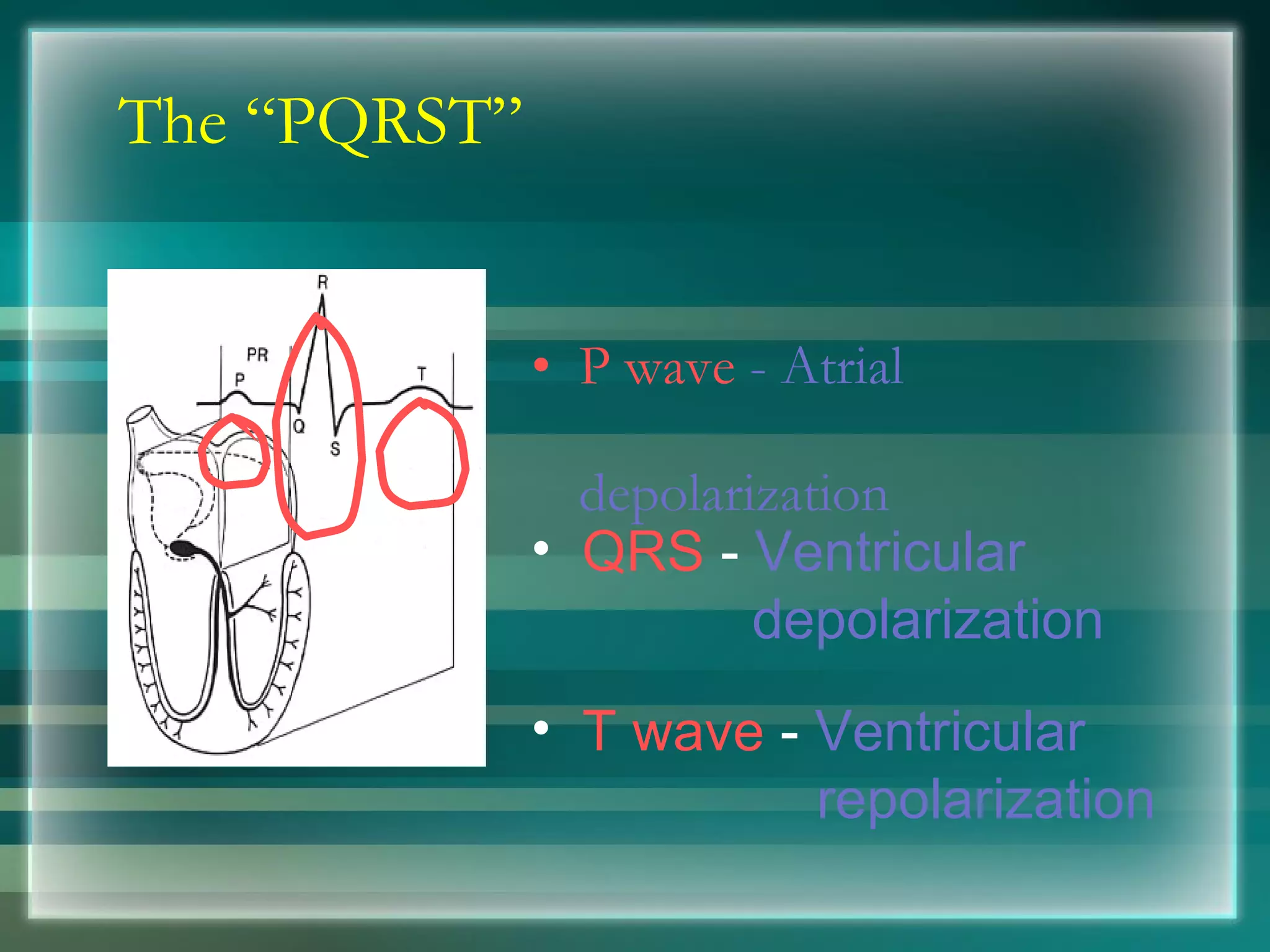
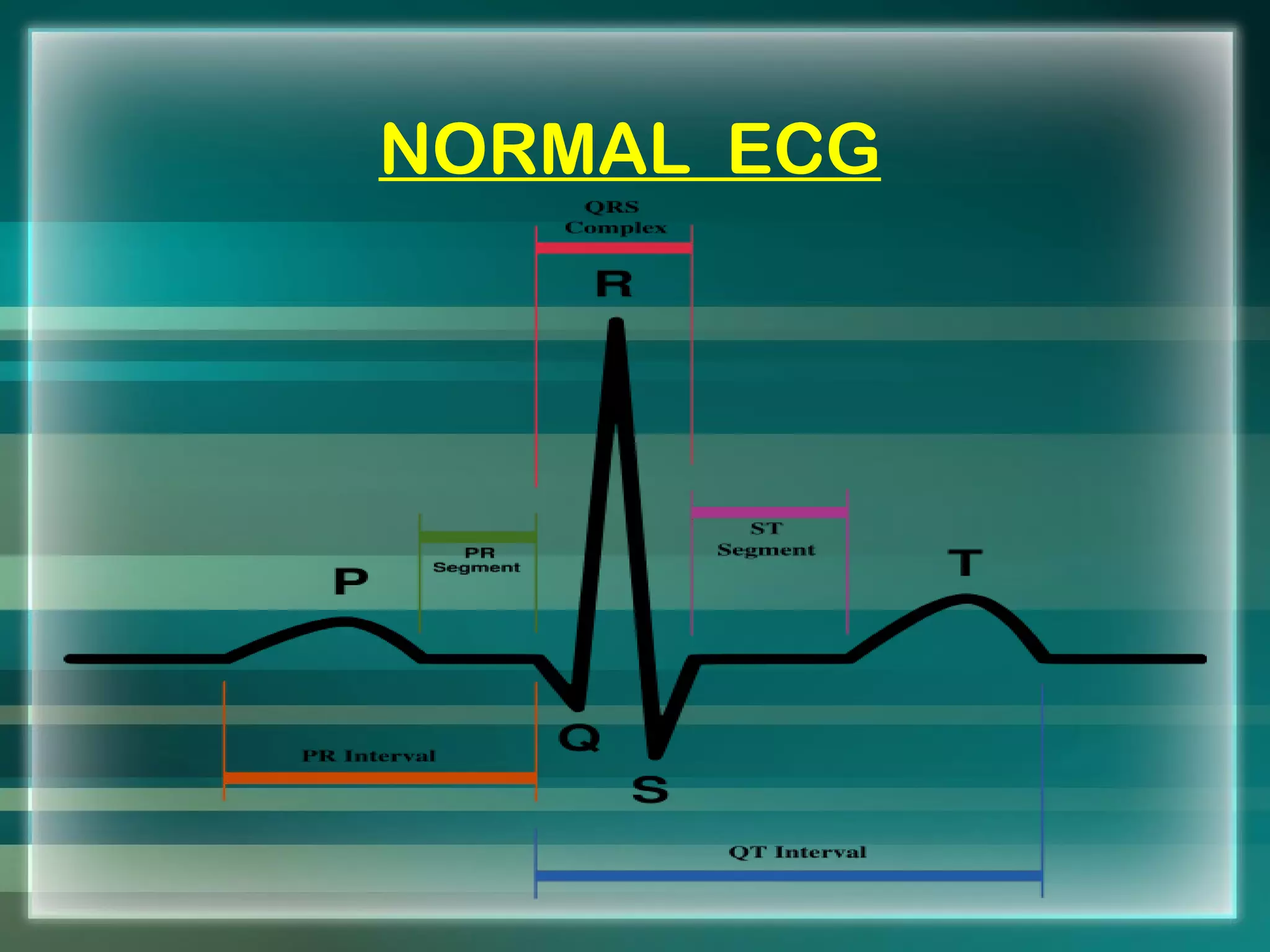
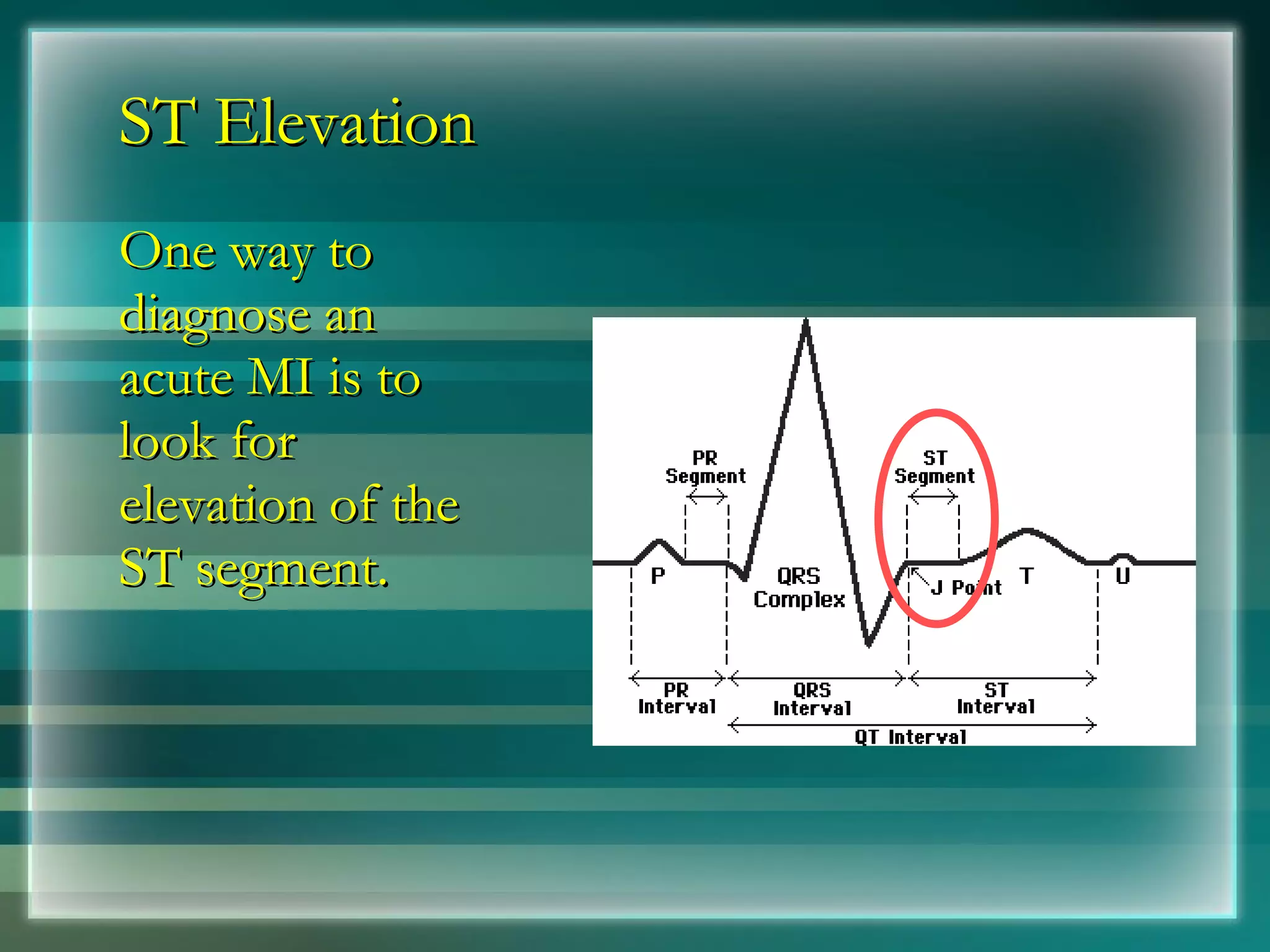
The “PQRST” P wave  - Atrial      depolarization T wave  -  Ventricular      repolarization QRS  -  Ventricular    depolarization
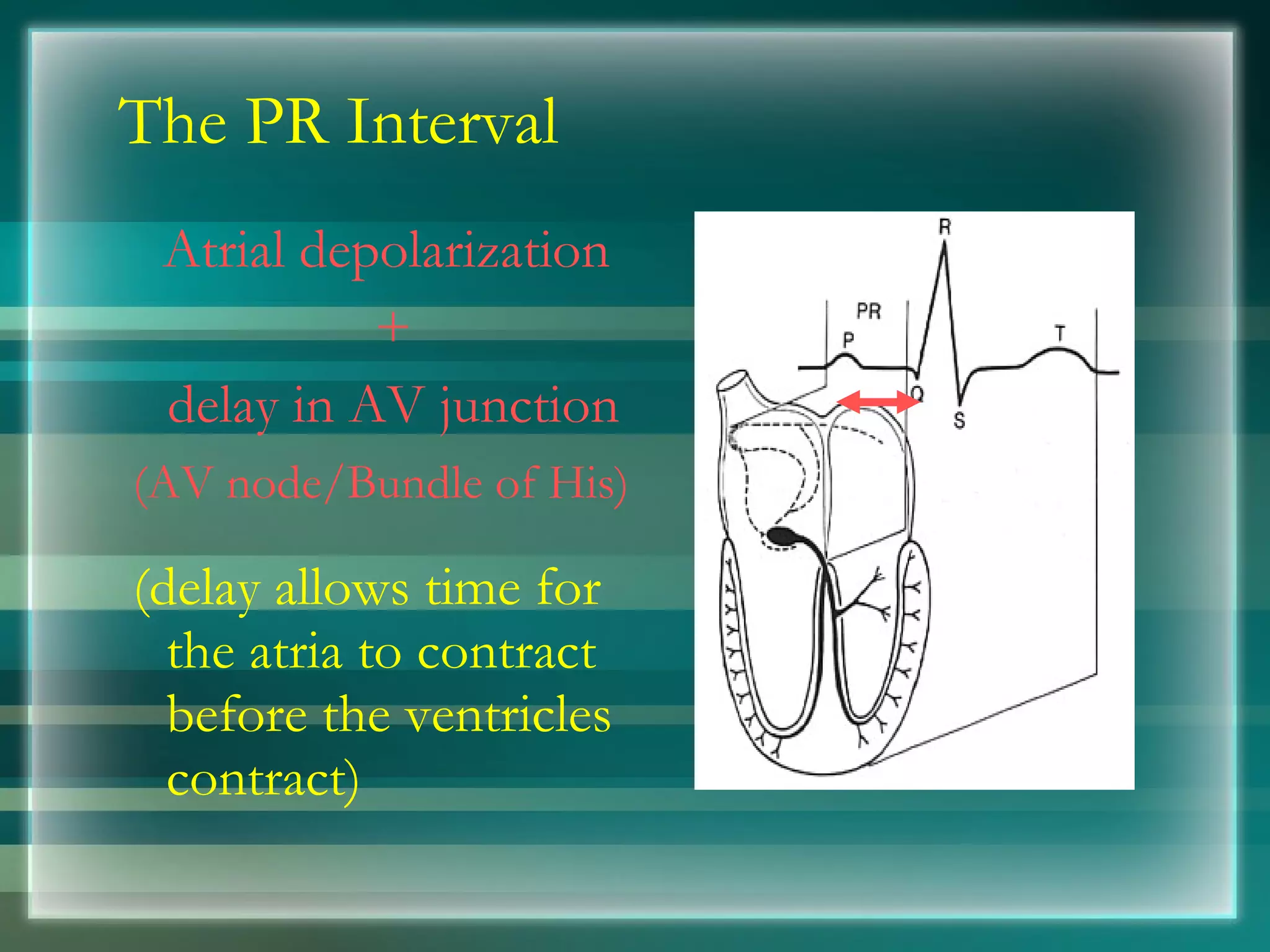
The PR Interval Atrial depolarization  + delay in AV junction (AV node/Bundle of His) (delay allows time for the atria to contract before the ventricles contract)
NORMAL  ECG
The ECG Paper Horizontally One small box - 0.04 s One large box - 0.20 s  Vertically One large box - 0.5 mV
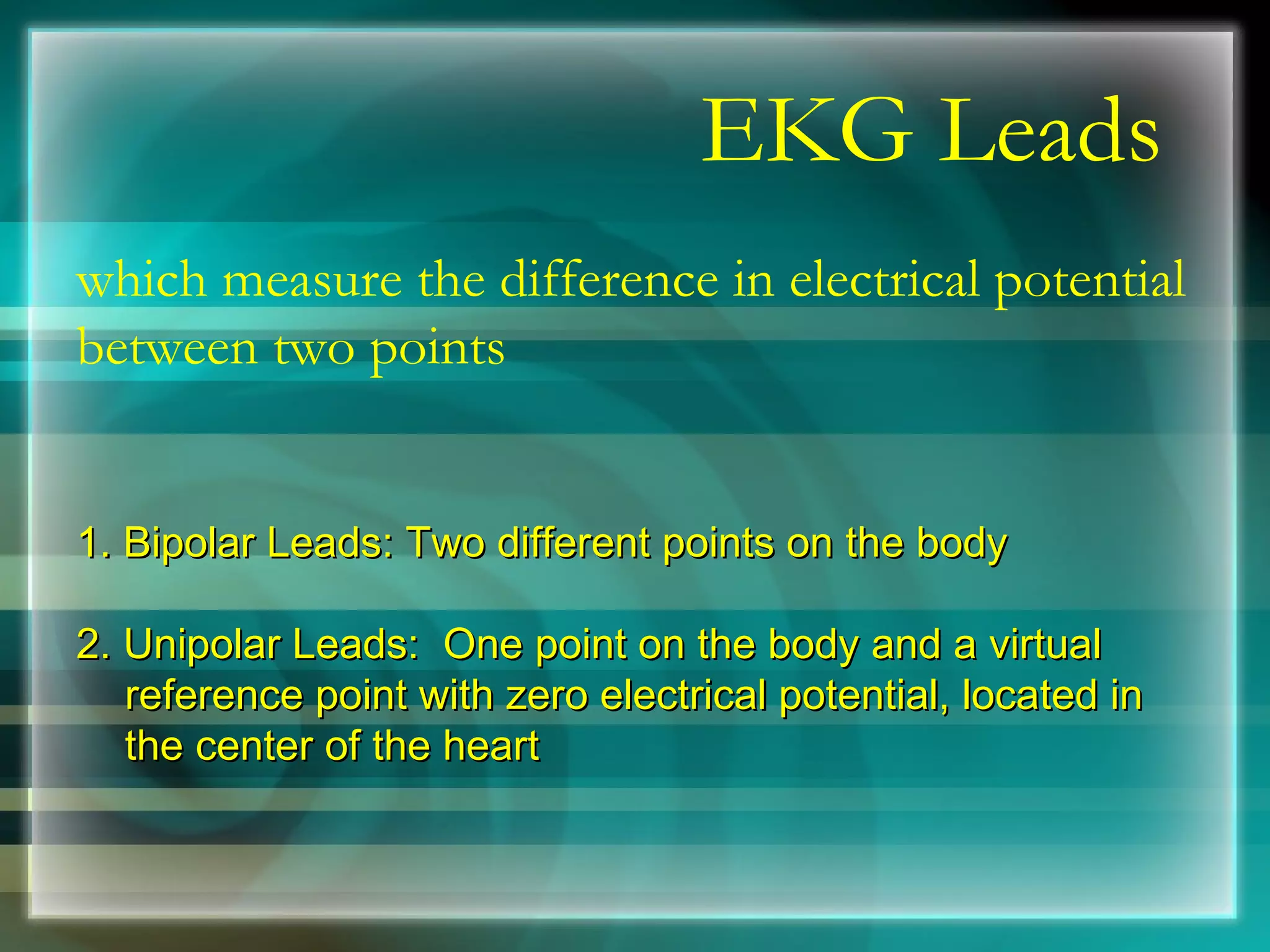
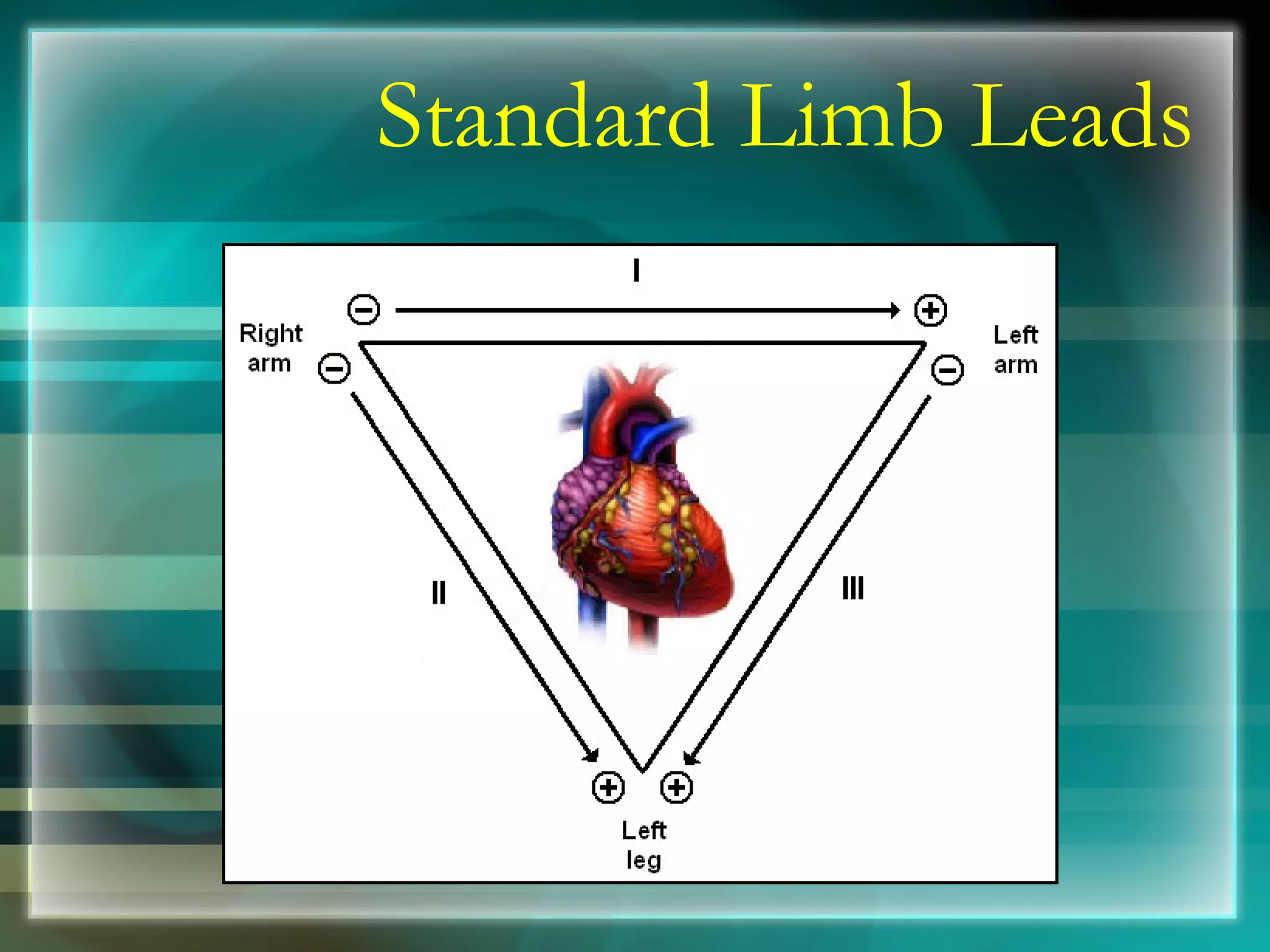
EKG Leads which measure the difference in electrical potential between two points 1. Bipolar Leads: Two different points on the body  2. Unipolar Leads:  One point on the body and a virtual reference point with zero electrical potential, located in the center of the heart
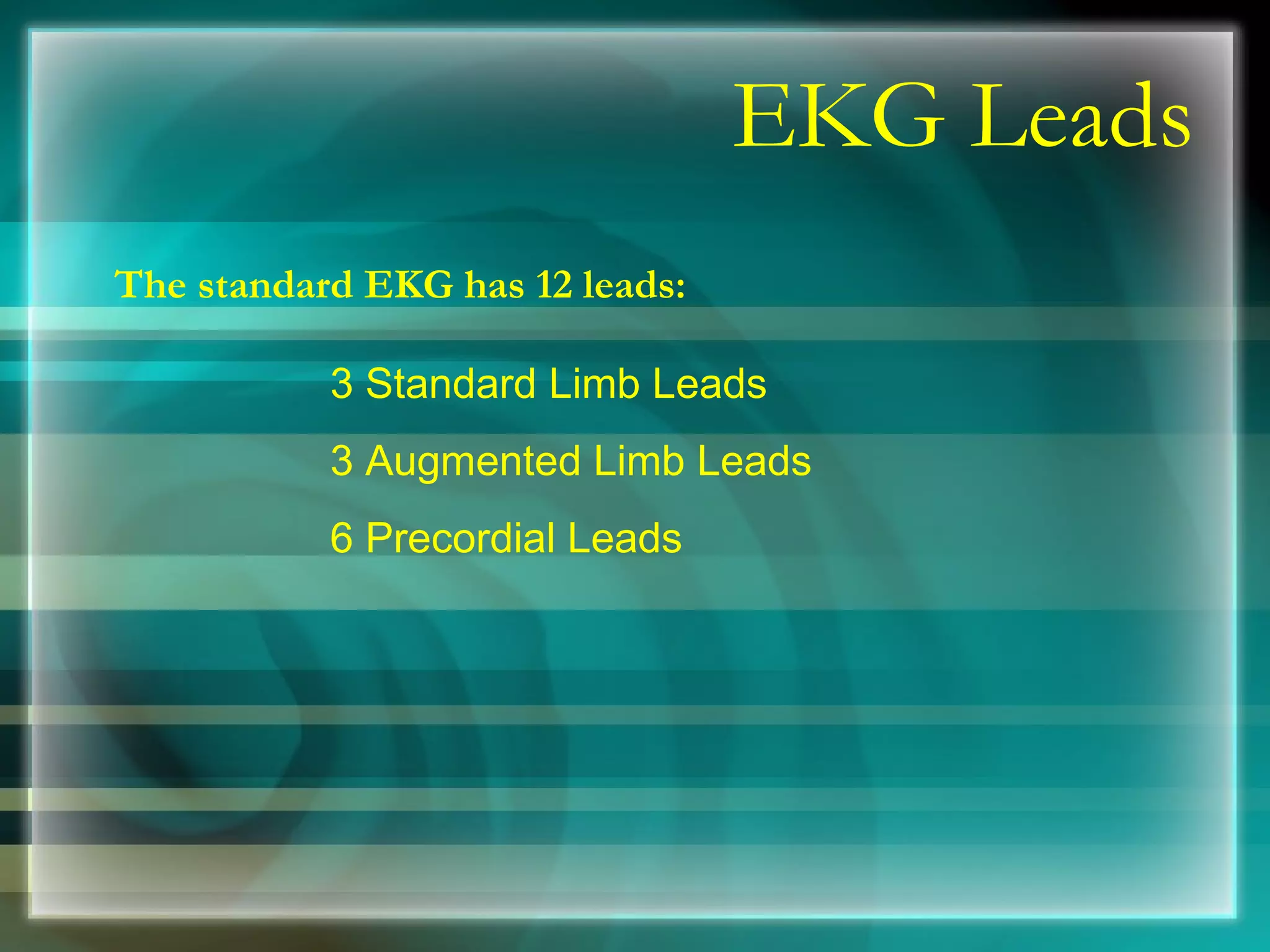
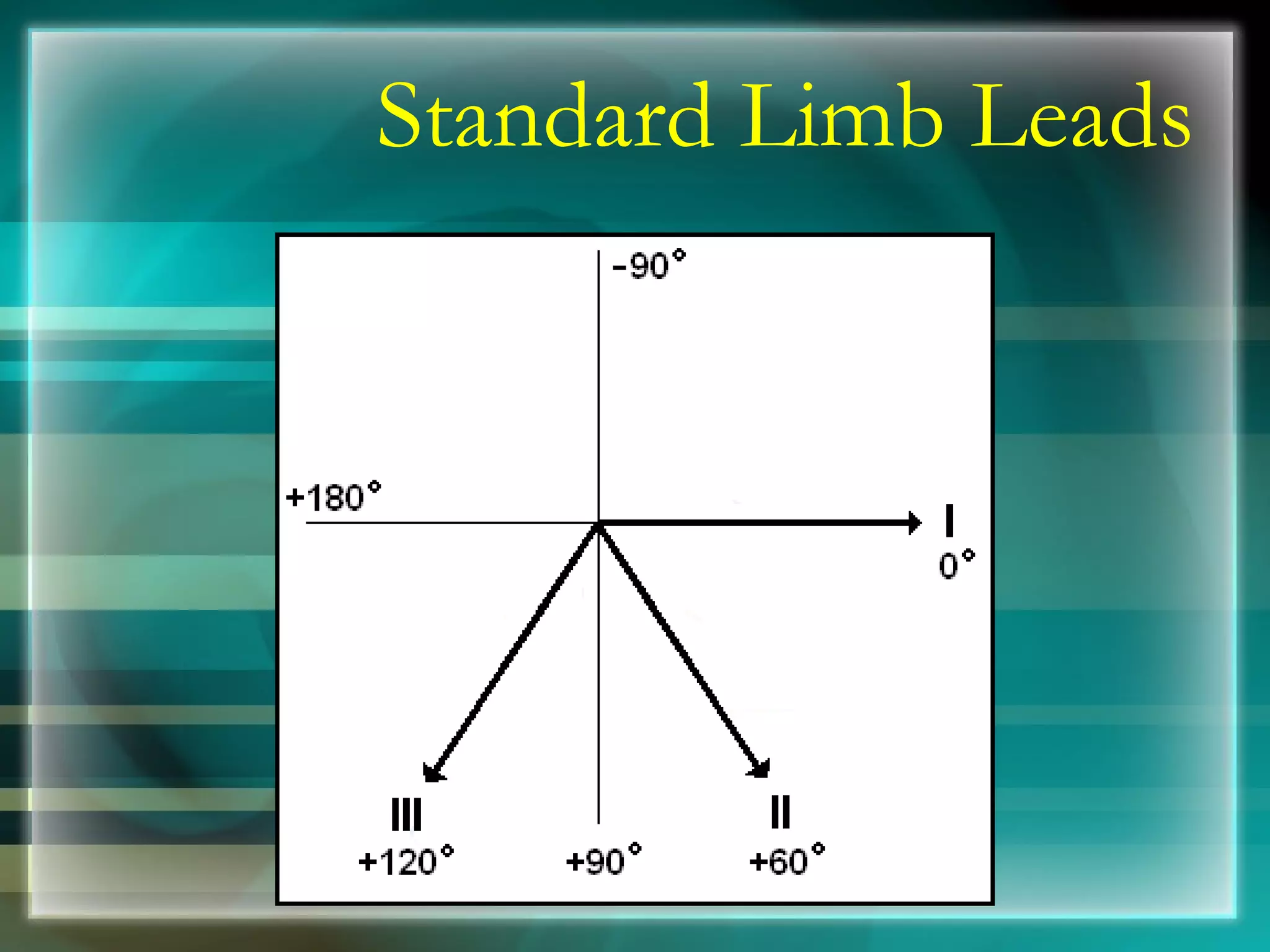
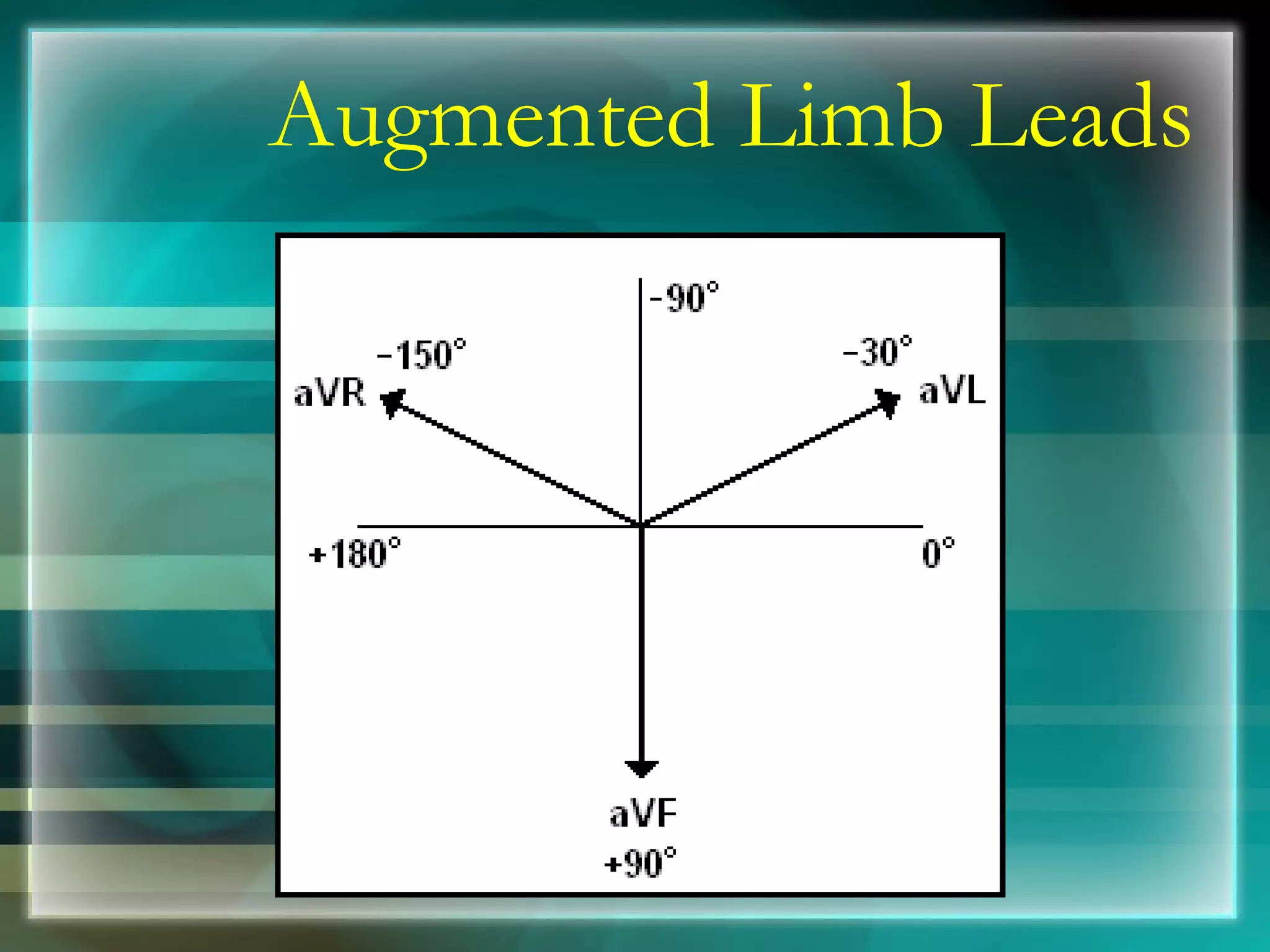
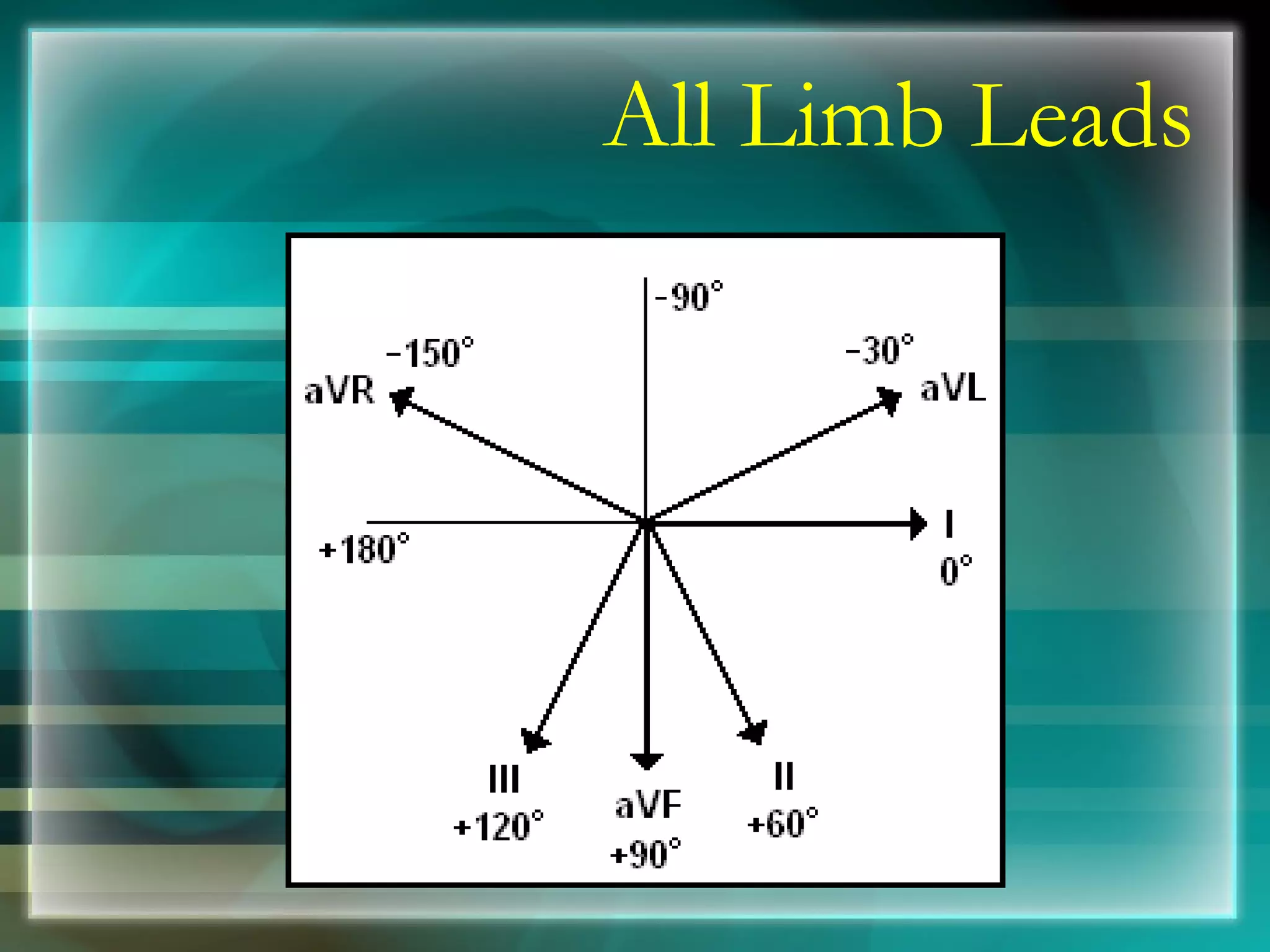
EKG Leads The standard EKG has 12 leads: 3 Standard Limb Leads 3 Augmented Limb Leads 6 Precordial Leads
Standard Limb Leads
Standard Limb Leads
Augmented Limb Leads
All Limb Leads
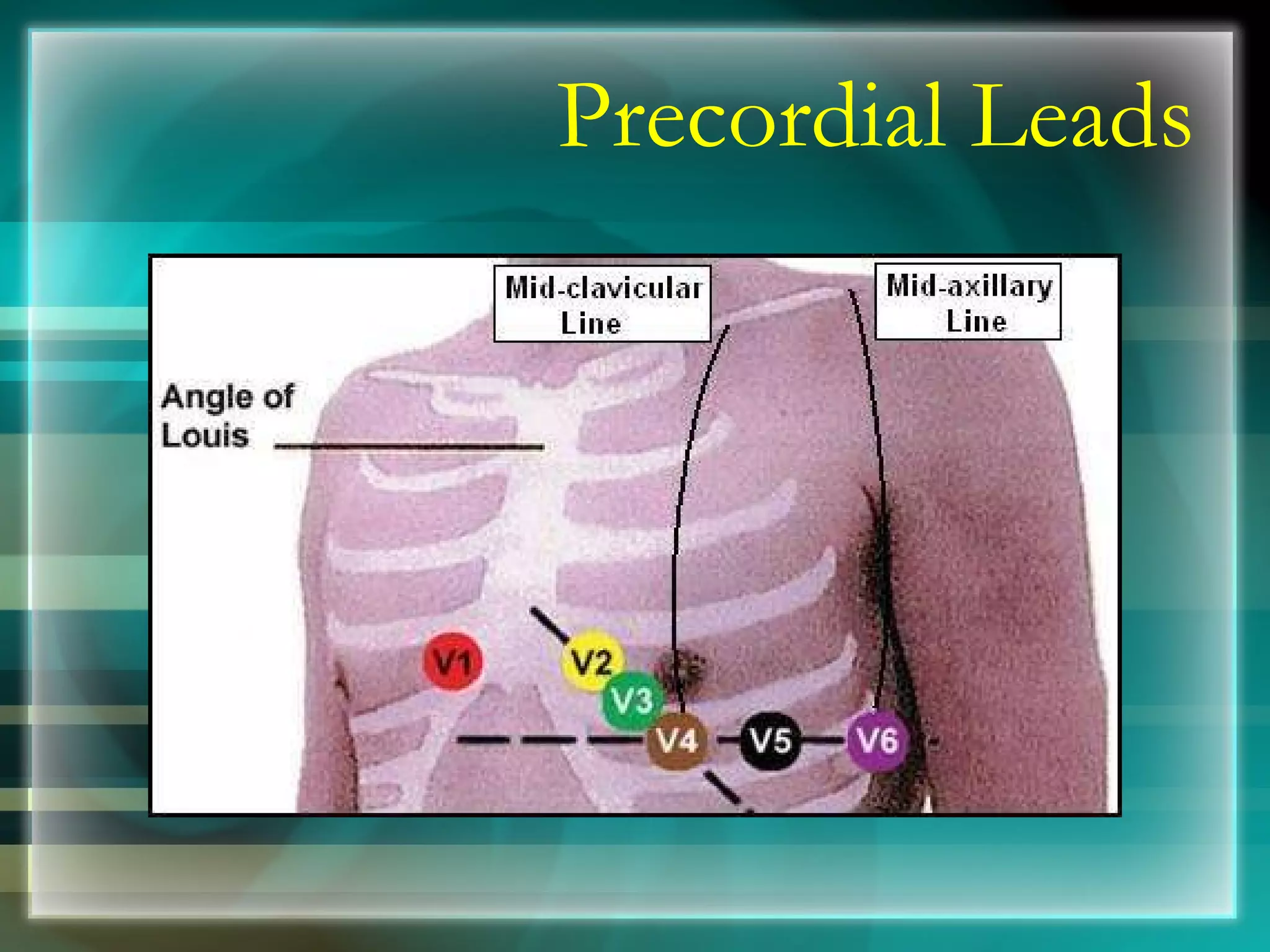
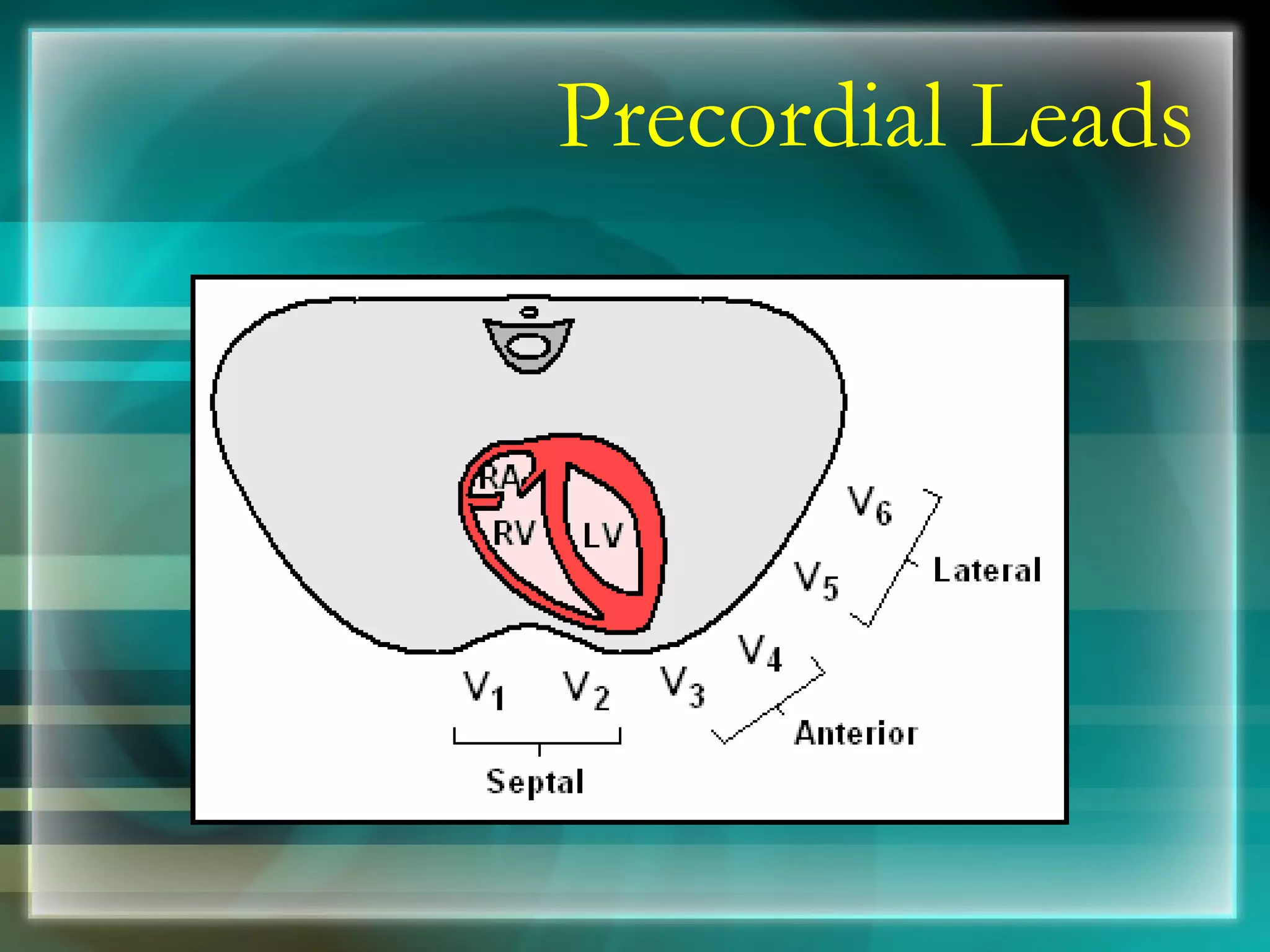
Precordial Leads
Precordial Leads
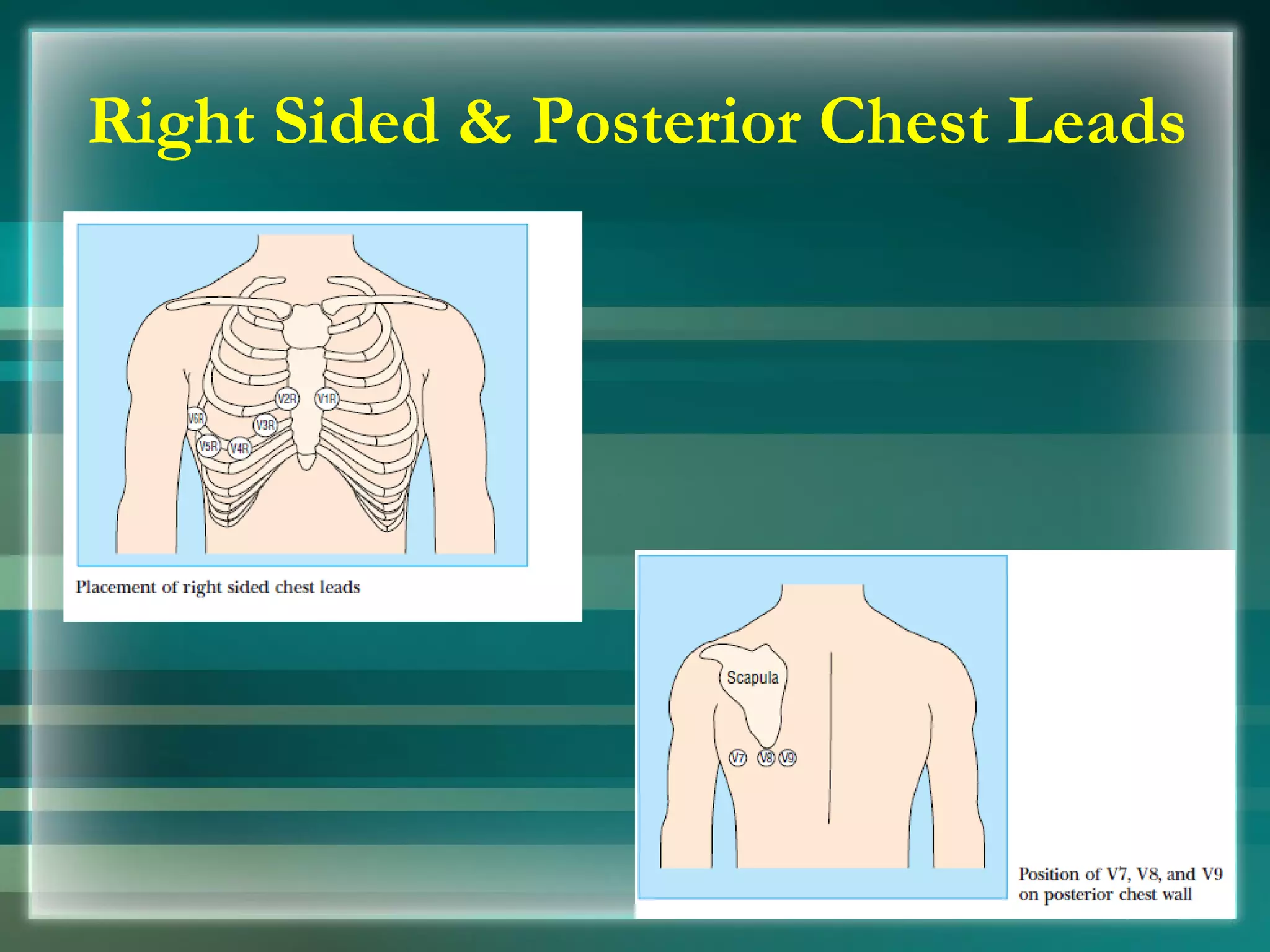
Right Sided & Posterior Chest Leads
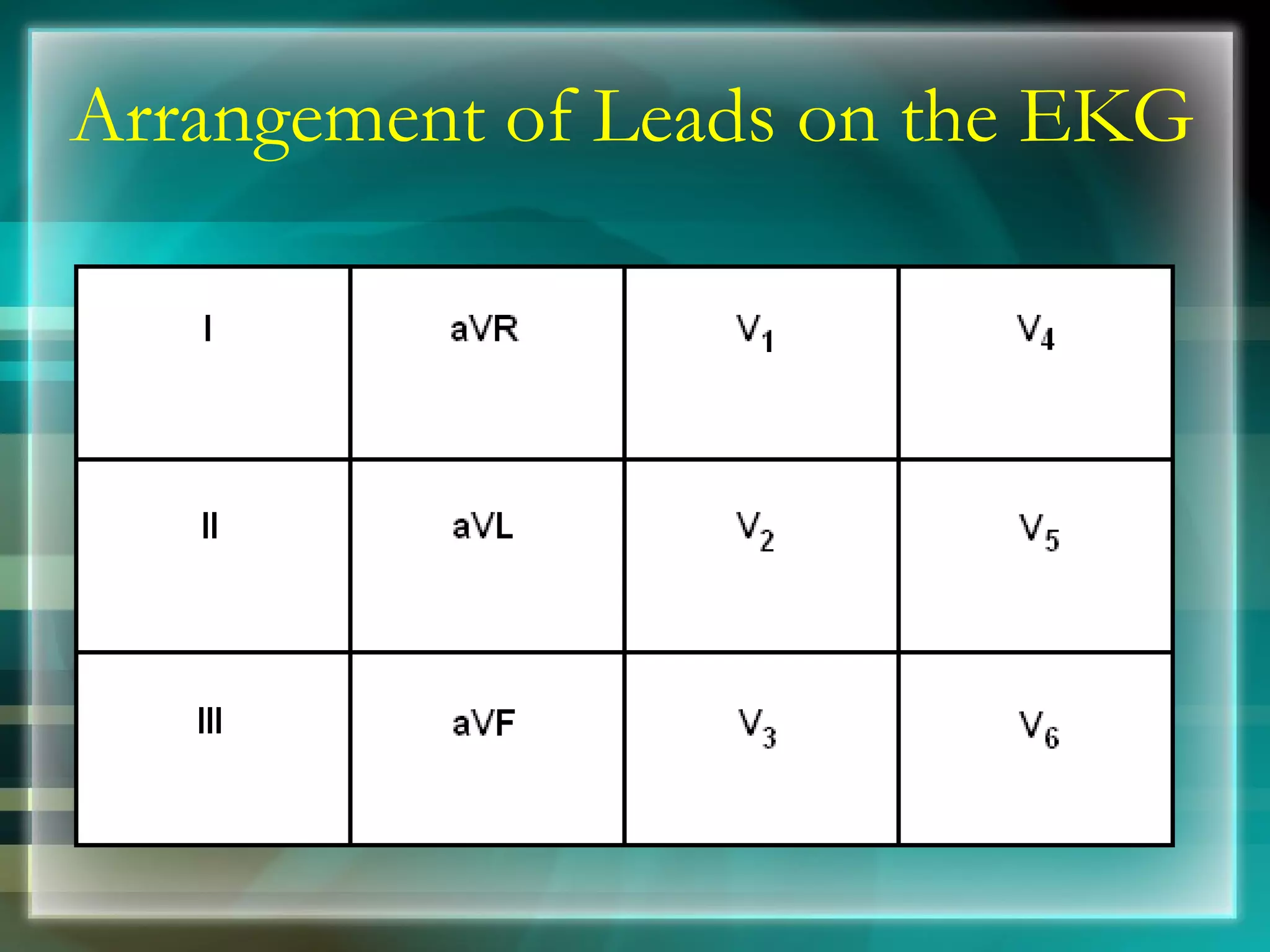
Arrangement of Leads on the EKG
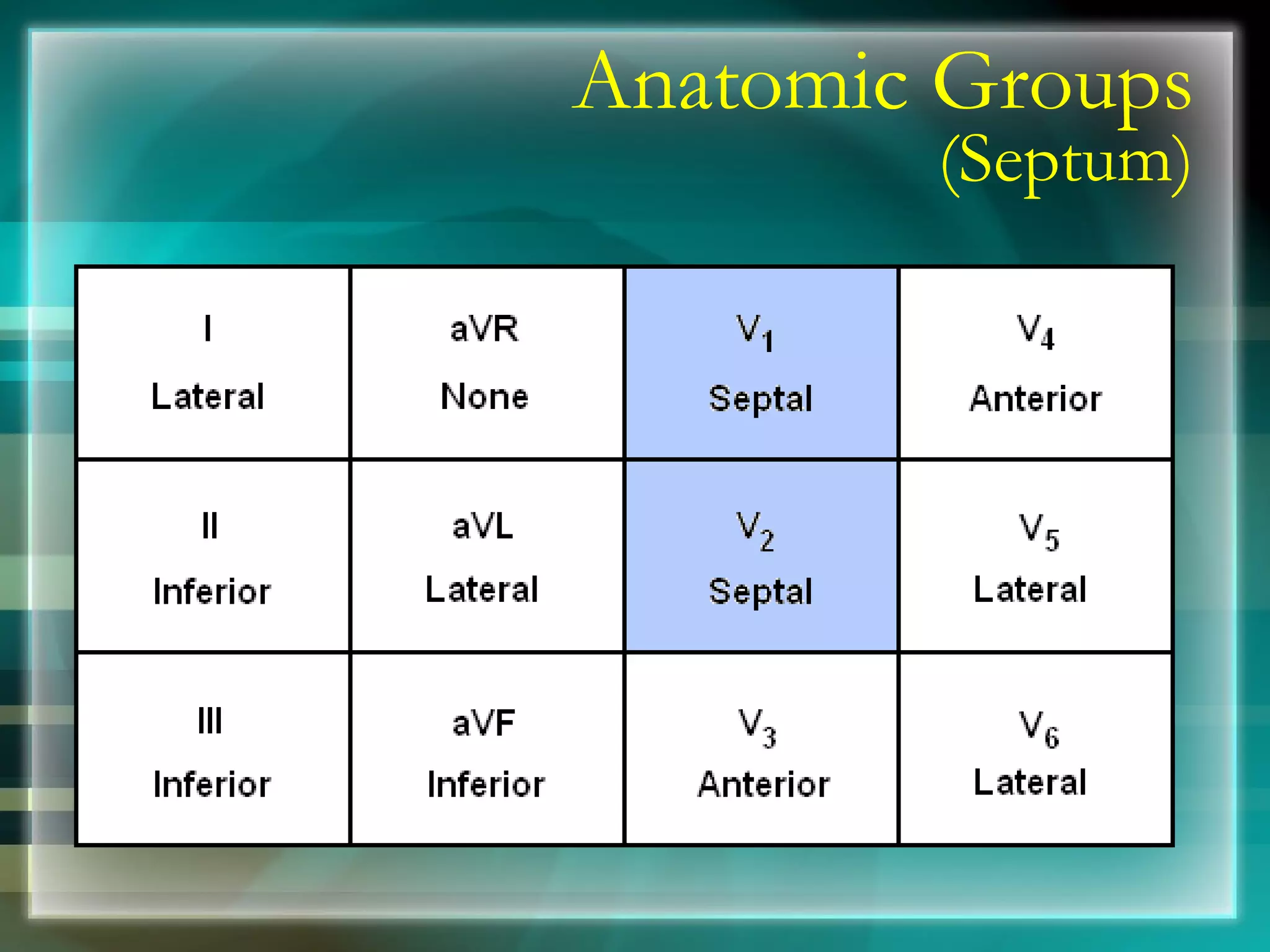
Anatomic Groups (Septum)
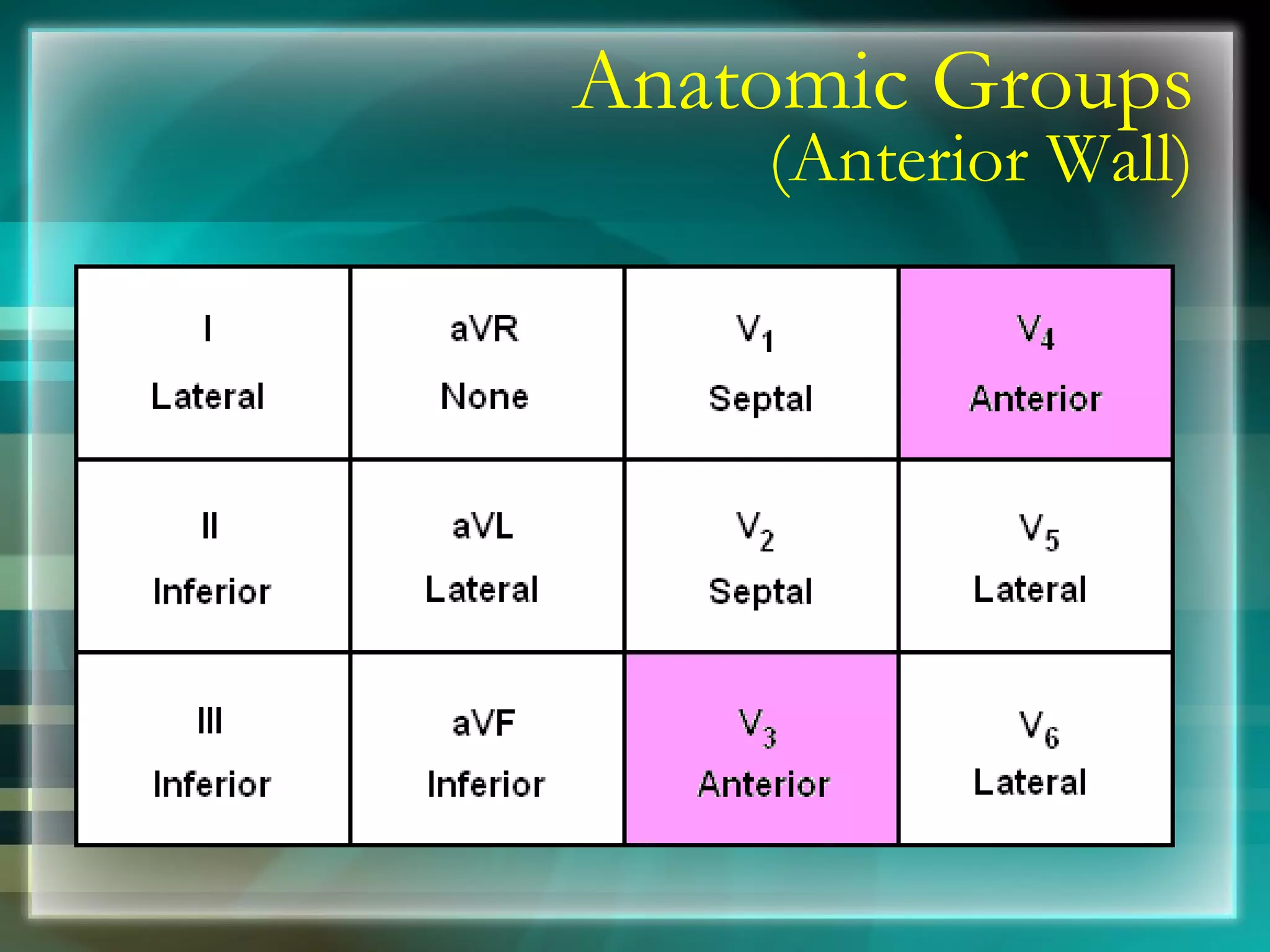
Anatomic Groups (Anterior Wall)
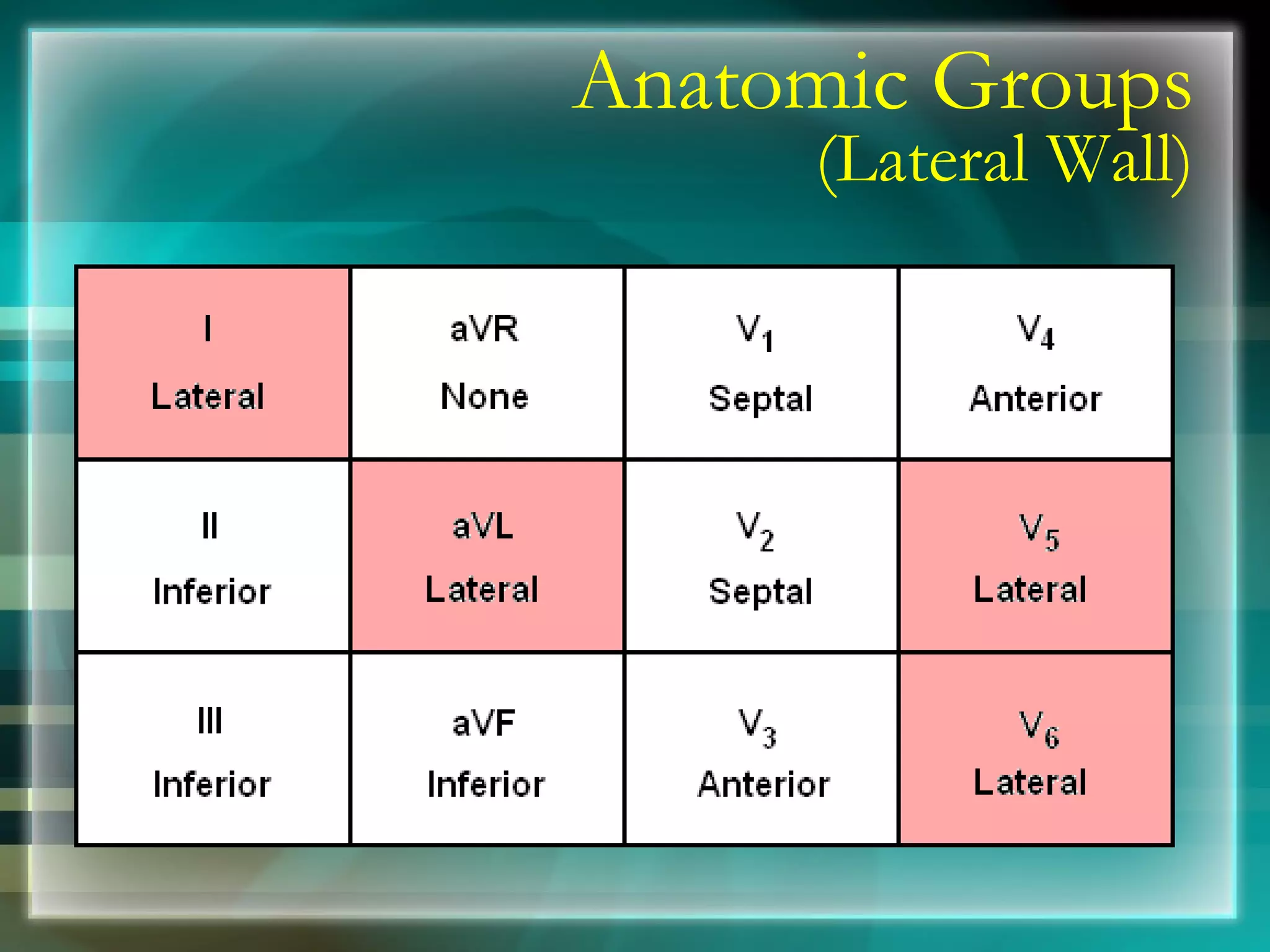
Anatomic Groups (Lateral Wall)
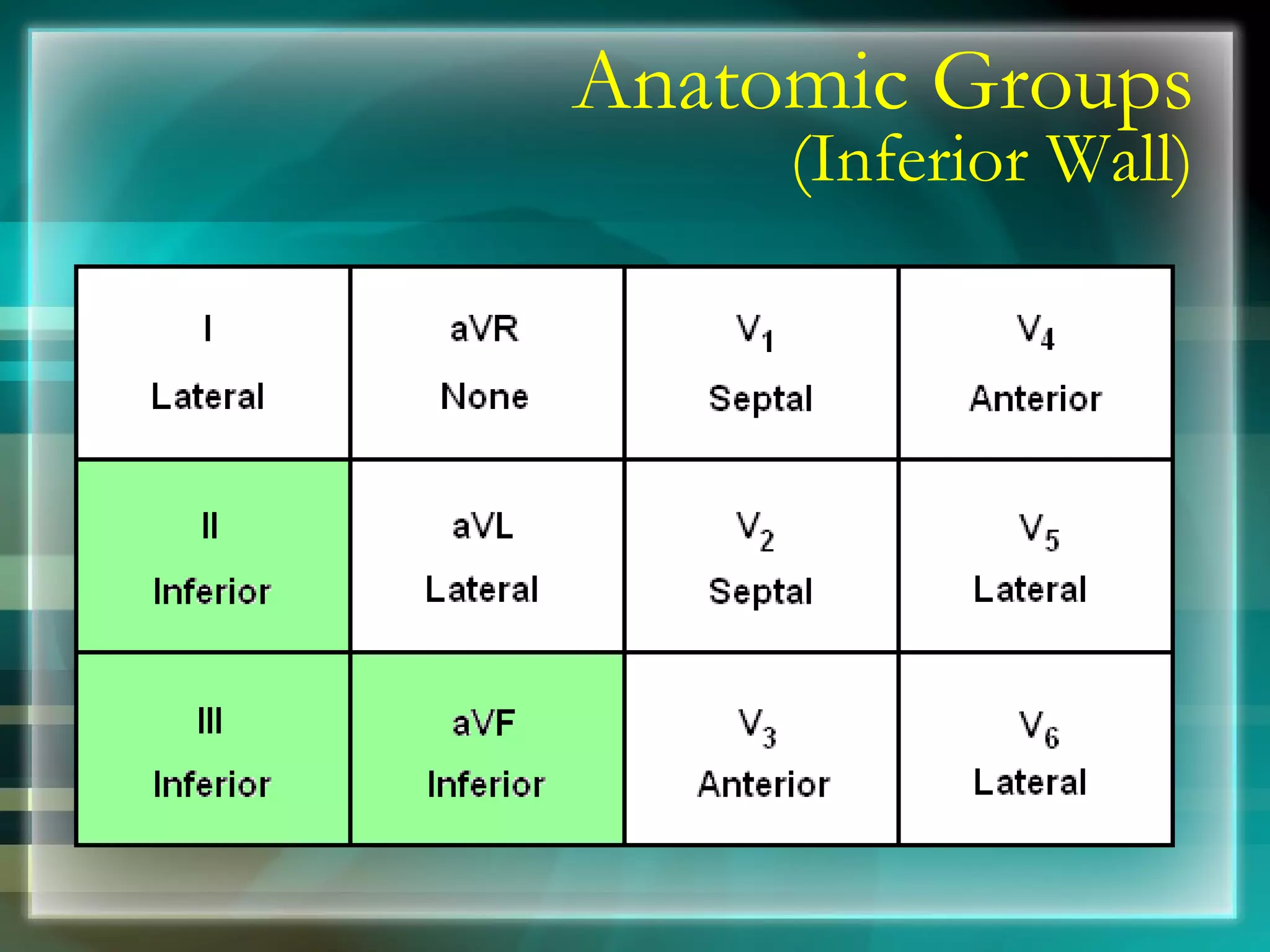
Anatomic Groups (Inferior Wall)
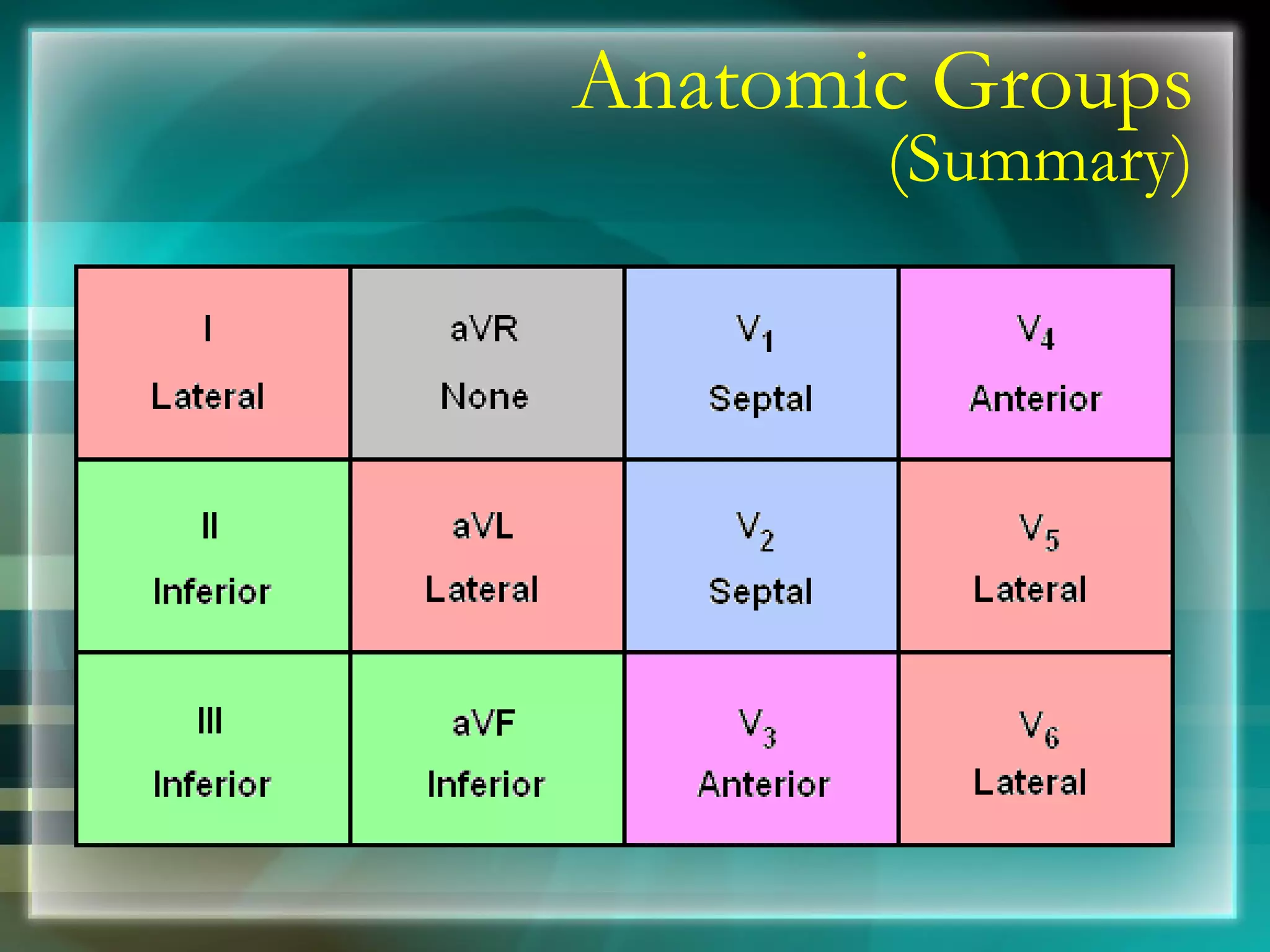
Anatomic Groups (Summary)
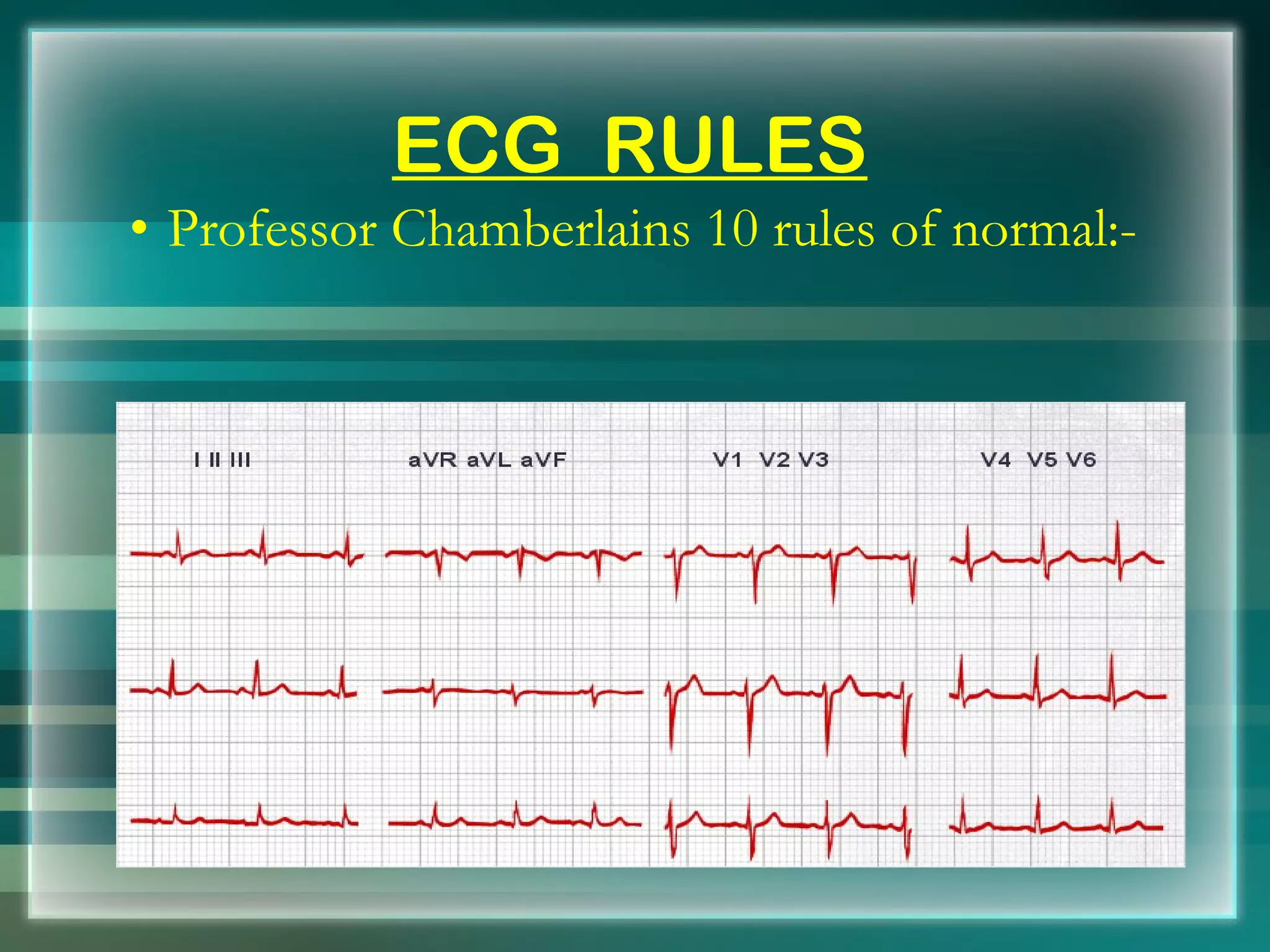
  ECG  RULES Professor Chamberlains 10 rules of normal:-
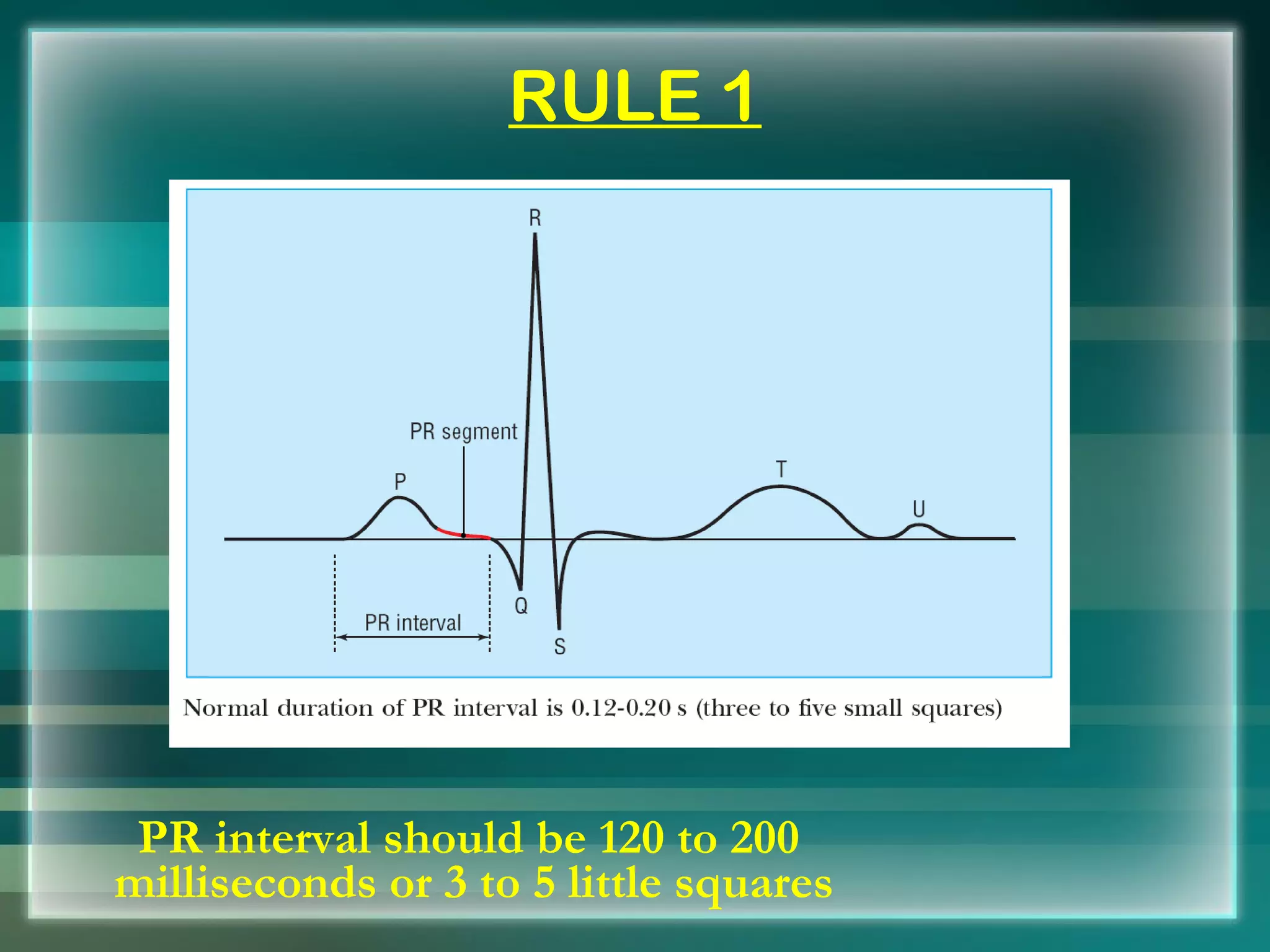
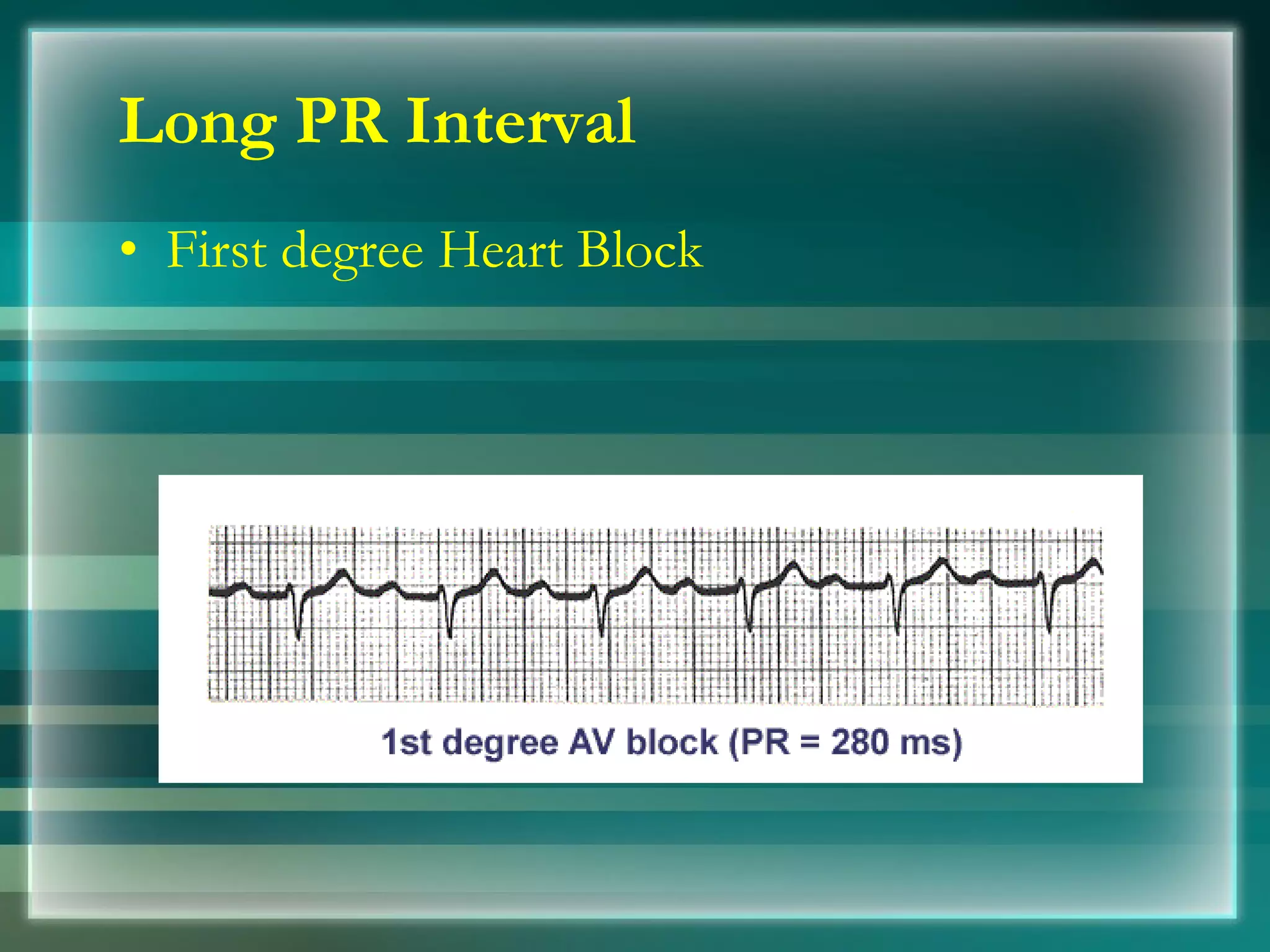
RULE 1 PR interval should be 120 to 200 milliseconds or 3 to 5 little squares
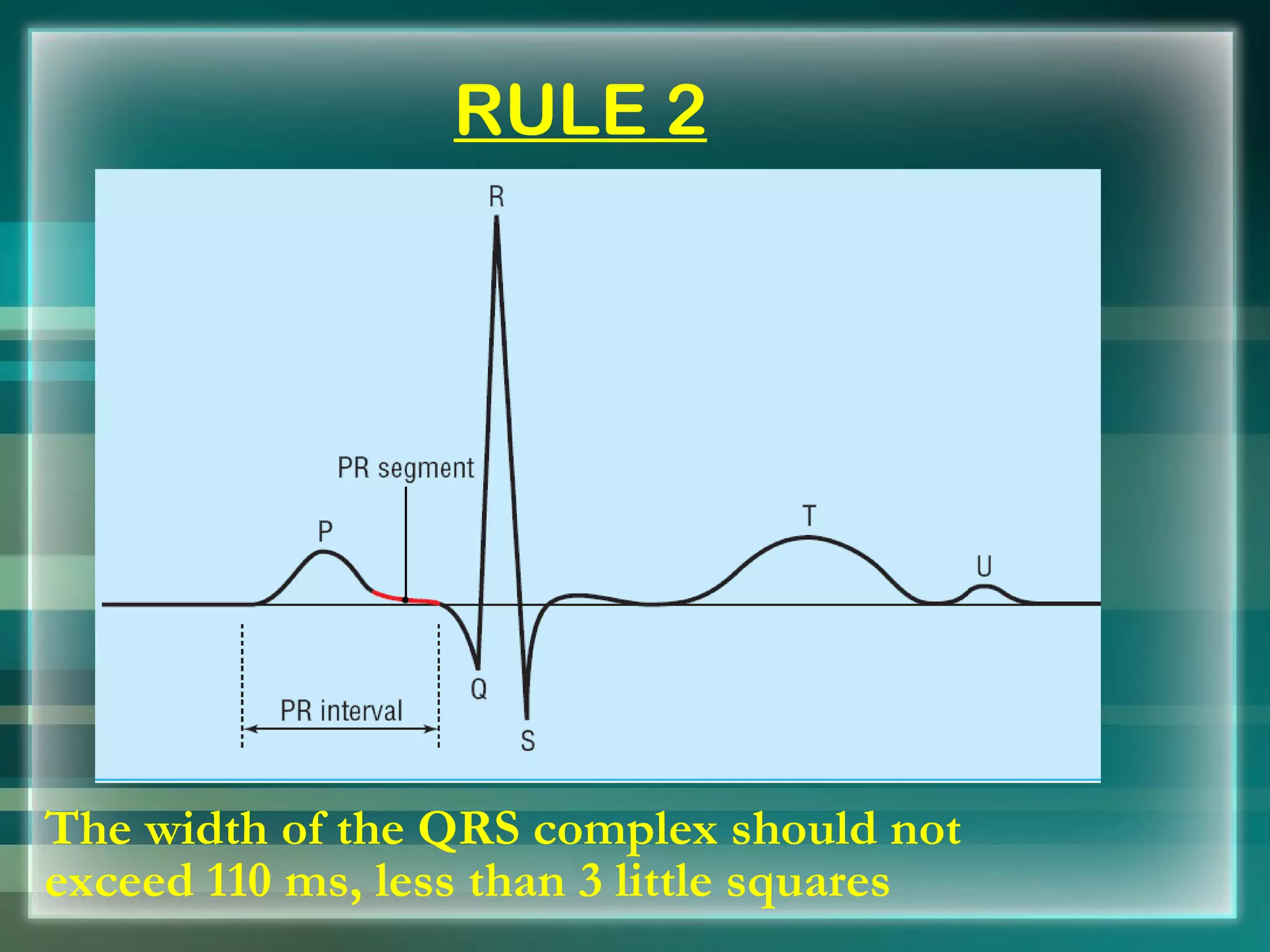
  RULE 2 The width of the QRS complex should not exceed 110 ms, less than 3 little squares
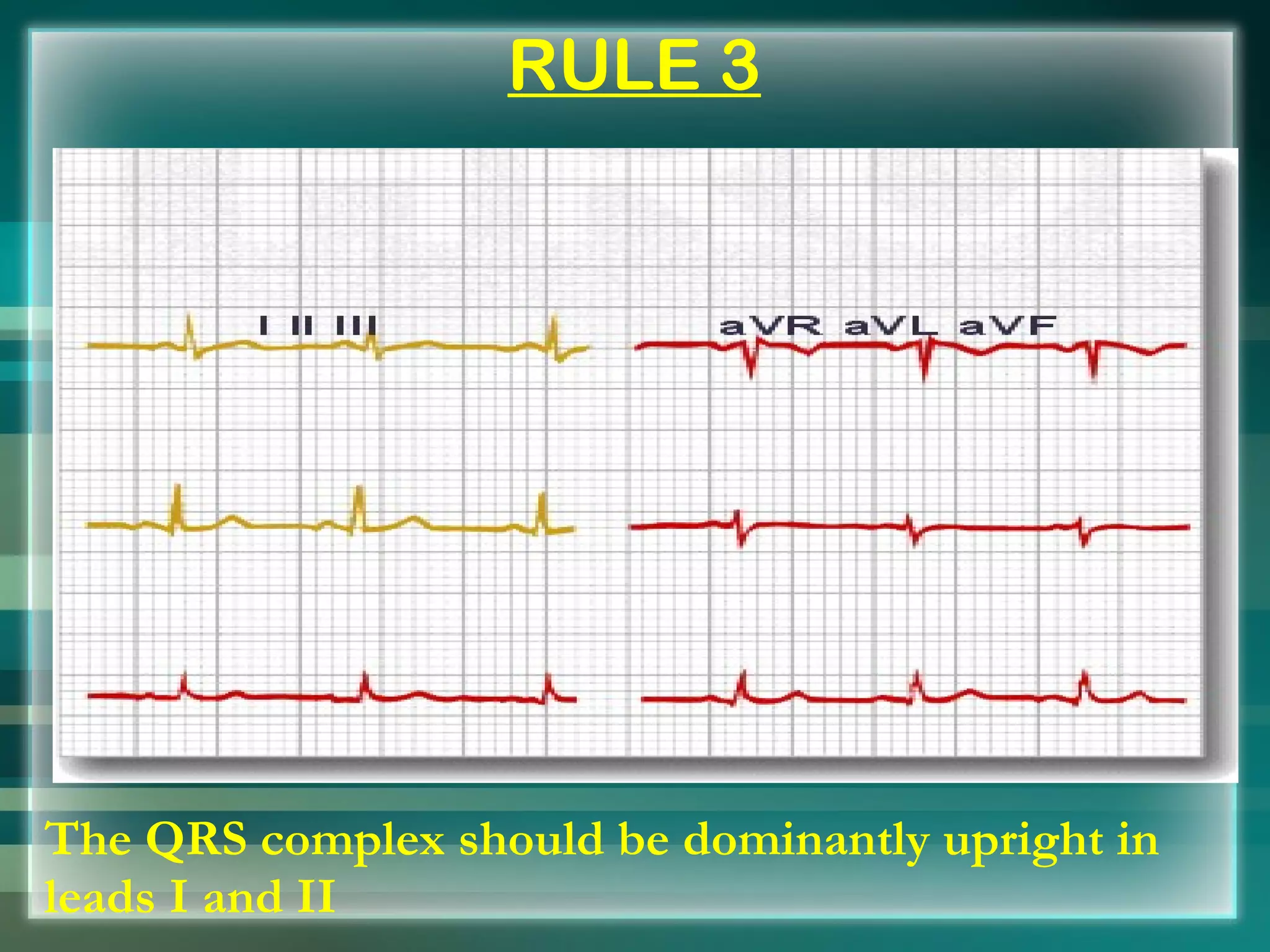
RULE 3 The QRS complex should be dominantly upright in leads I and II
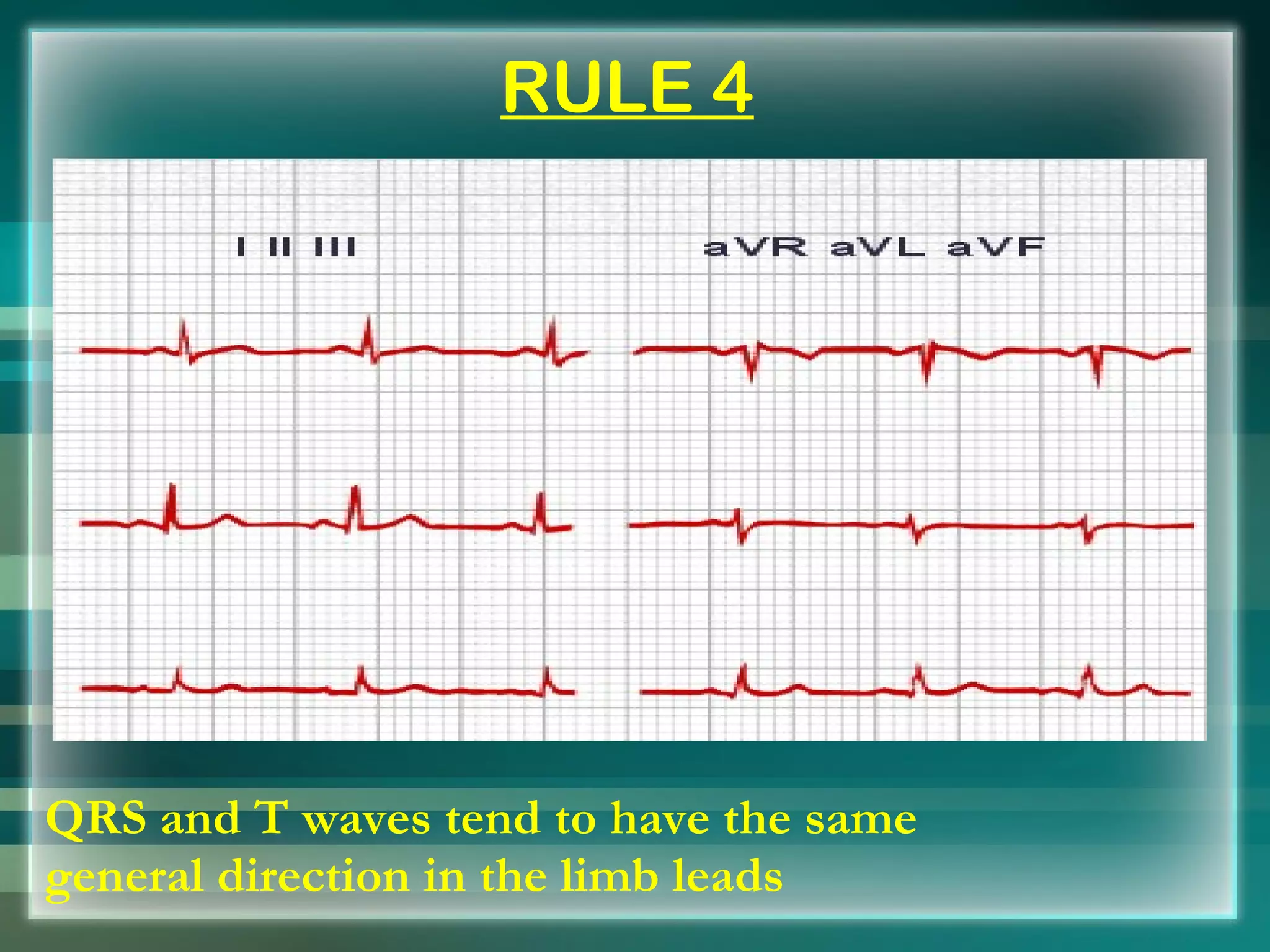
RULE 4 QRS and T waves tend to have the same general direction in the limb leads
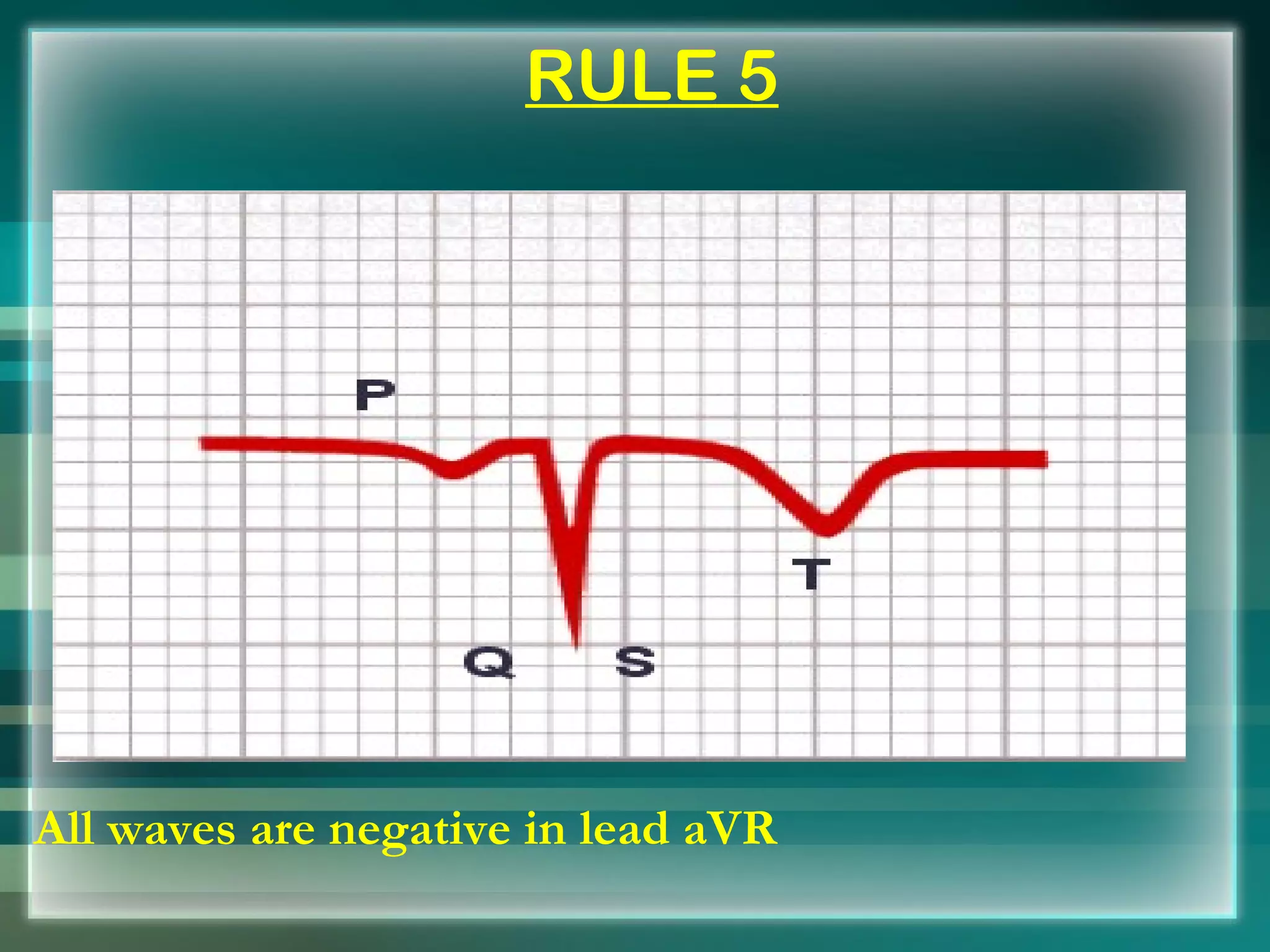
RULE 5 All waves are negative in lead aVR
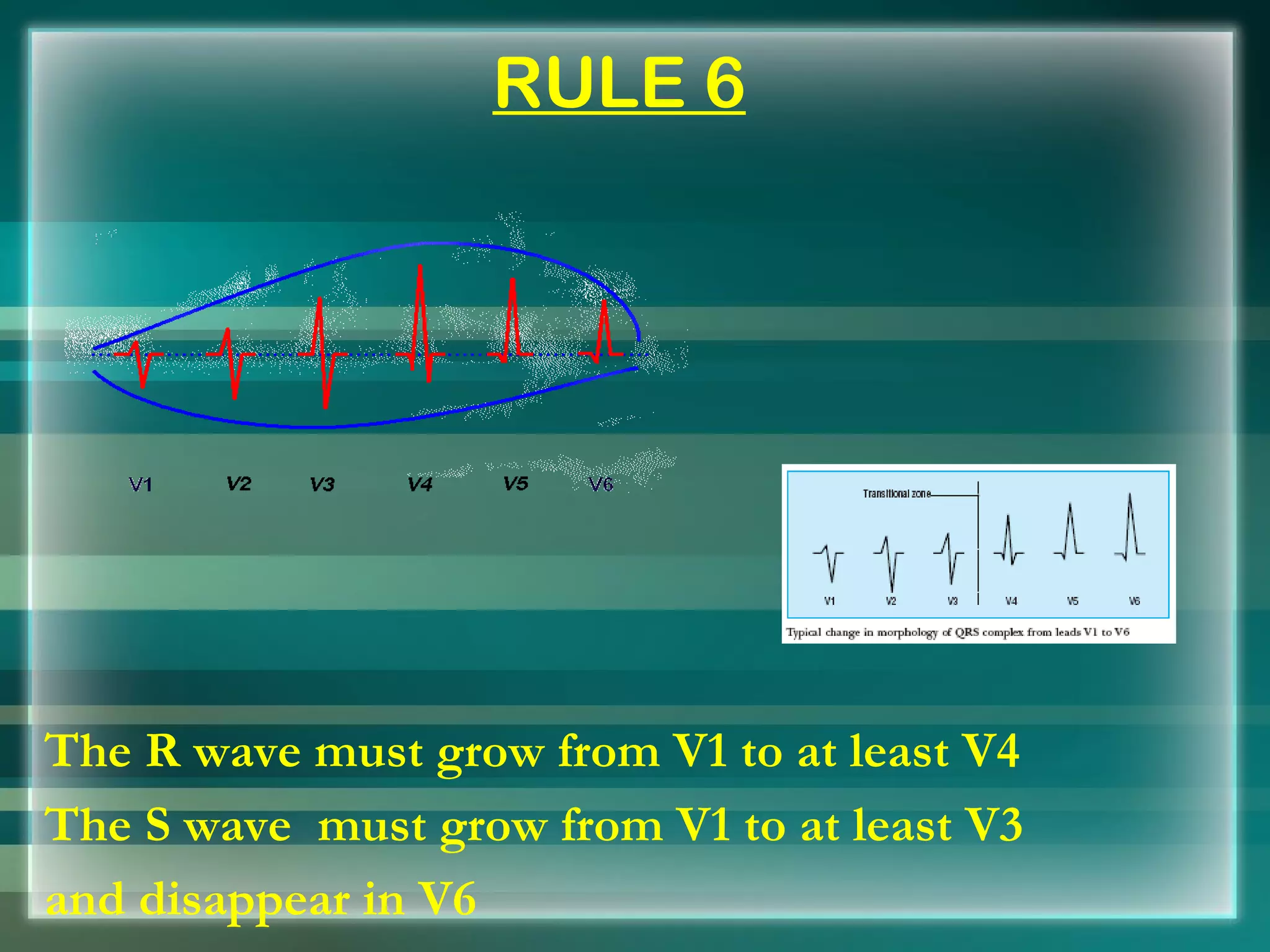
RULE 6 The R wave must grow from V1 to at least V4 The S wave  must grow from V1 to at least V3  and disappear in V6
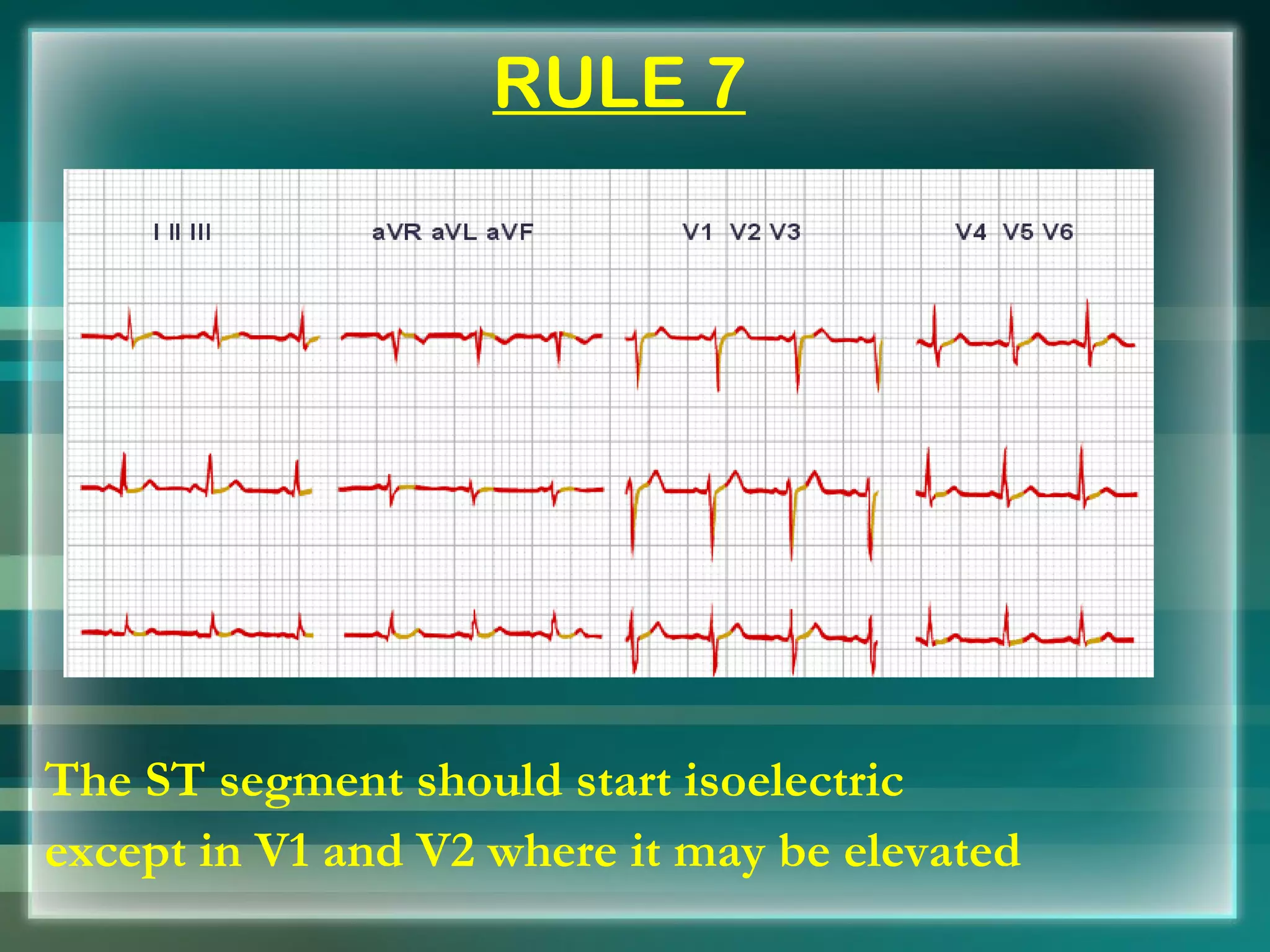
RULE 7 The ST segment should start isoelectric  except in V1 and V2 where it may be elevated
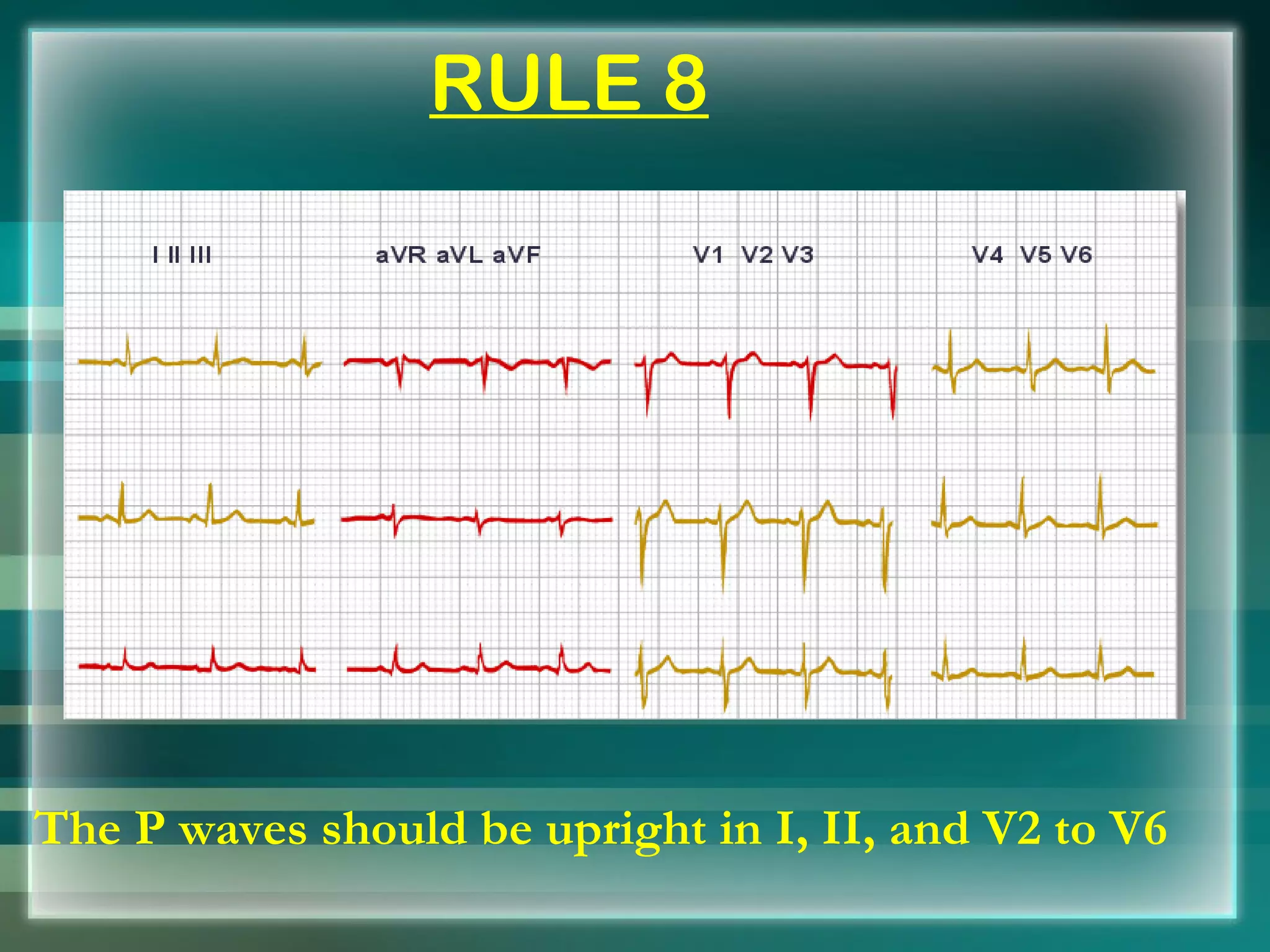
RULE 8 The P waves should be upright in I, II, and V2 to V6
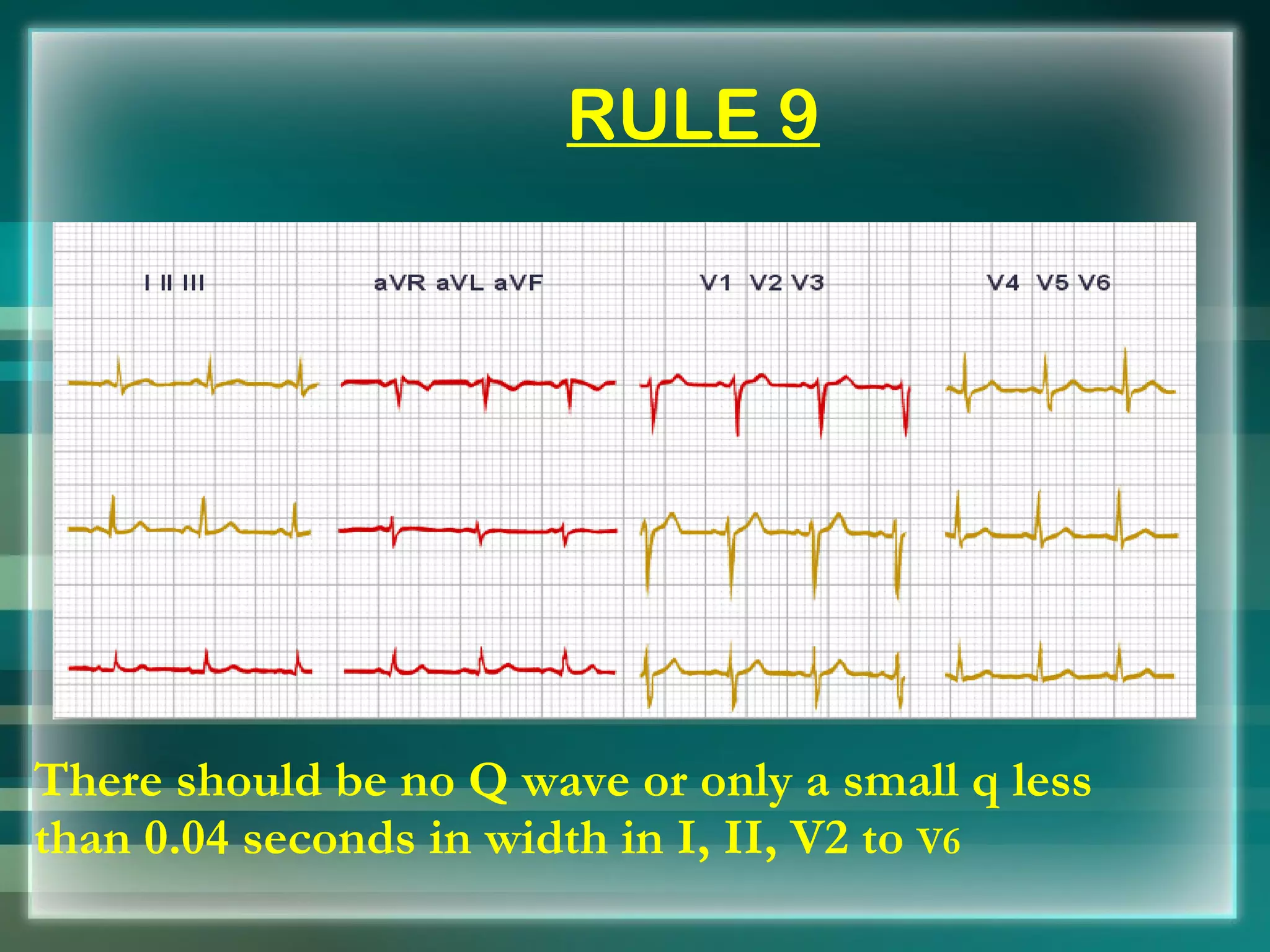
RULE 9 There should be no Q wave or only a small q less than 0.04 seconds in width in I, II, V2 to  V6
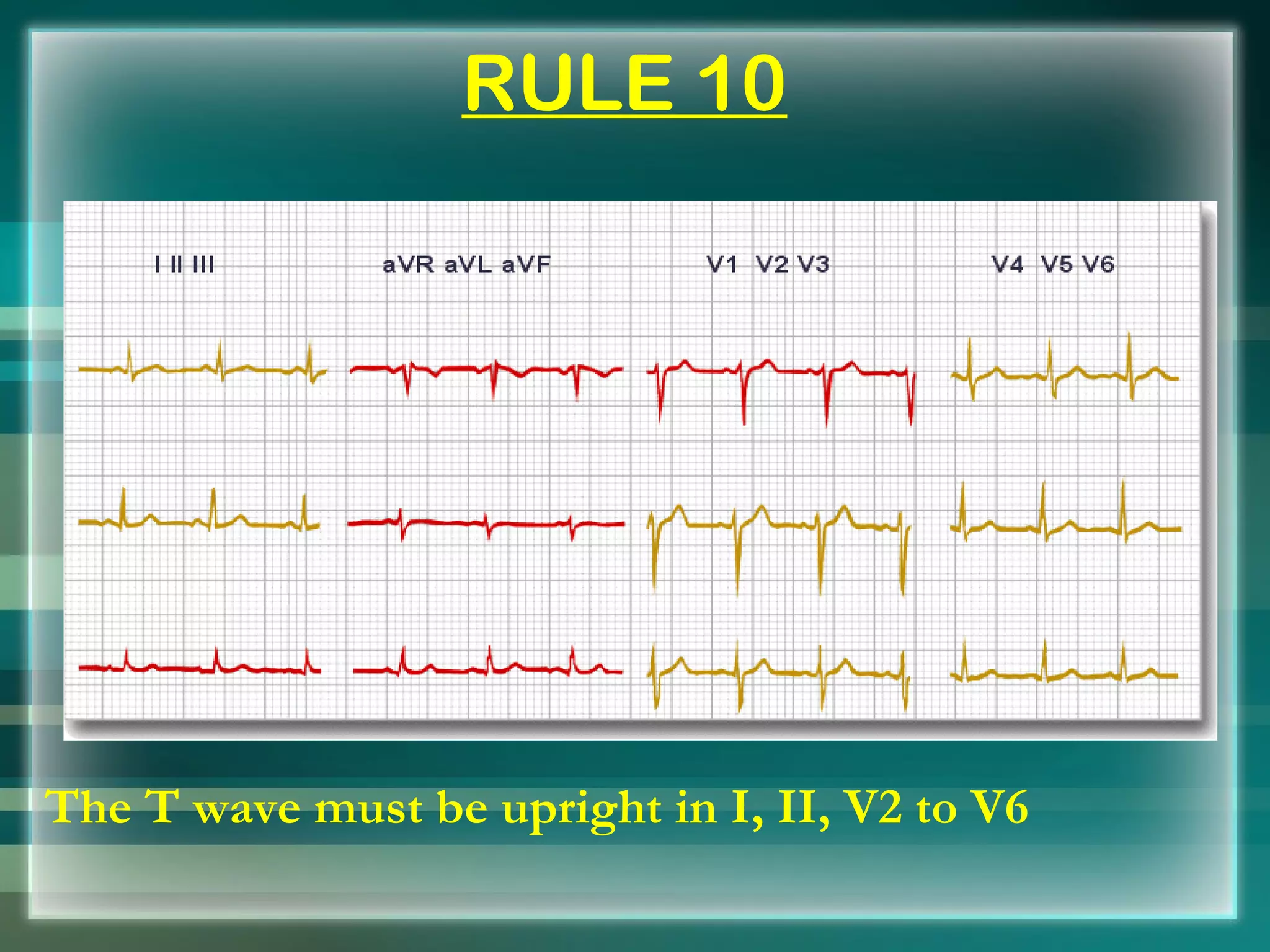
RULE 10 The T wave must be upright in I, II, V2 to V6
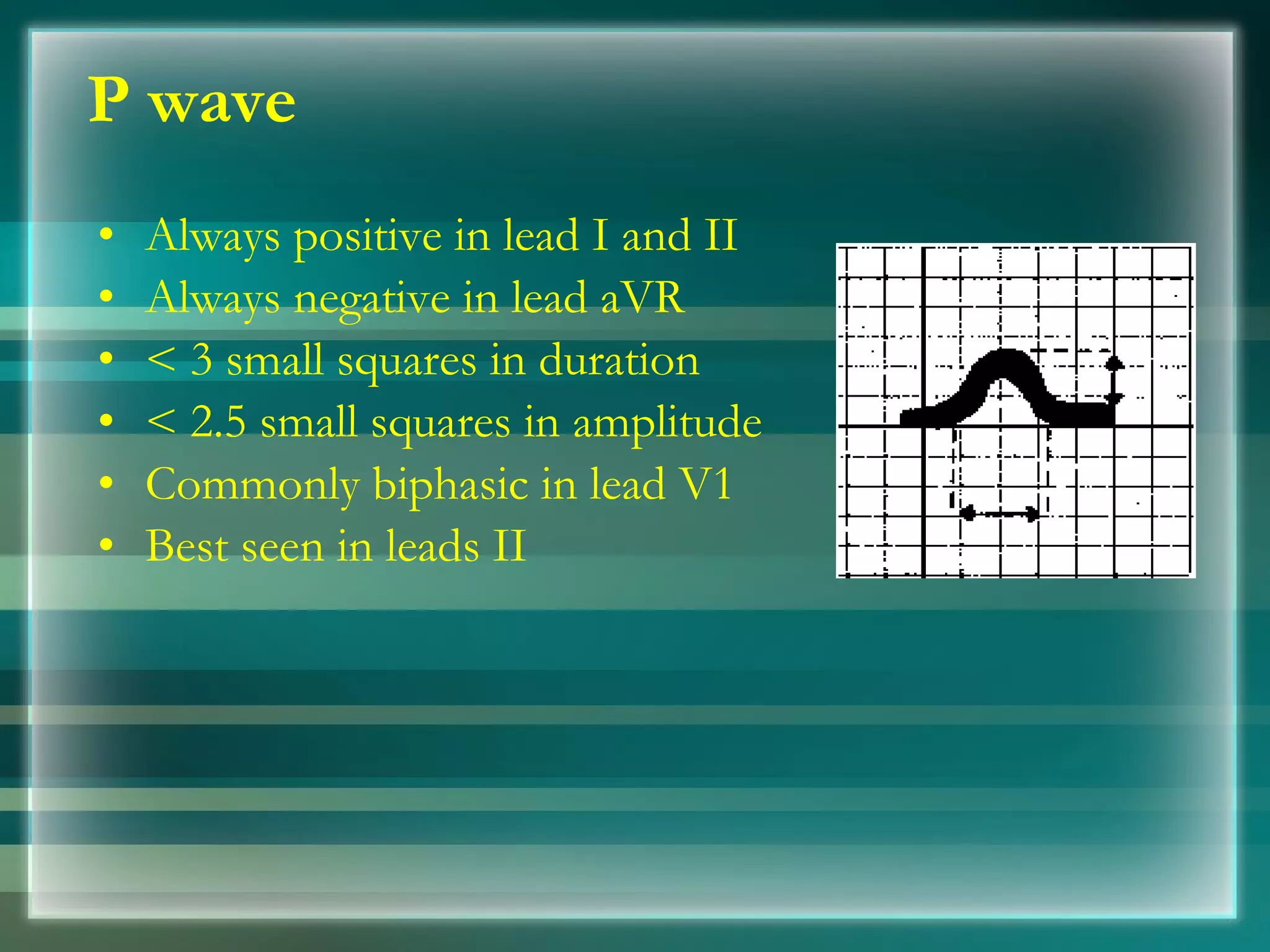
P wave Always positive in lead I and II  Always negative in lead aVR  < 3 small squares in duration < 2.5 small squares in amplitude Commonly biphasic in lead V1  Best seen in leads II
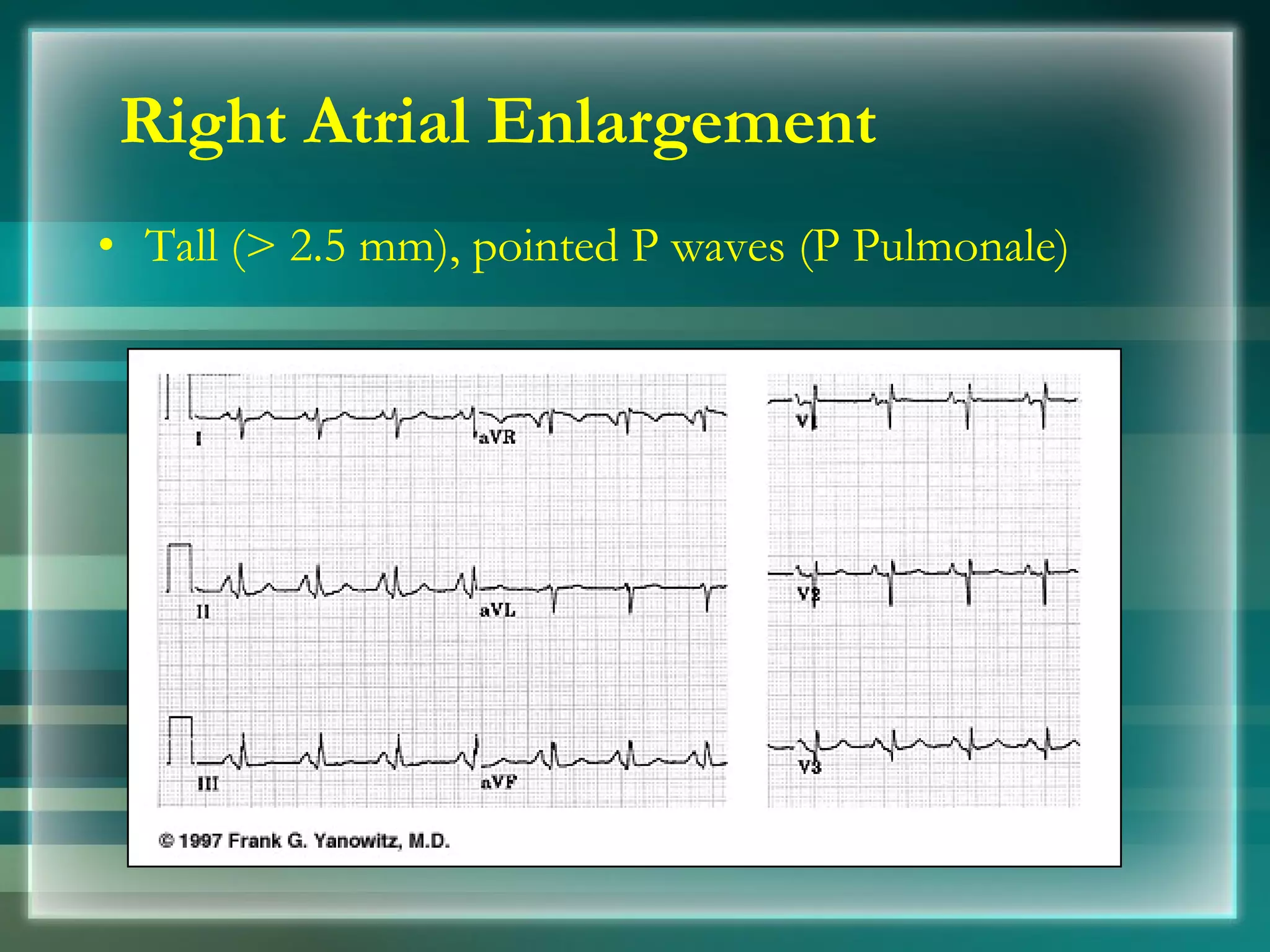
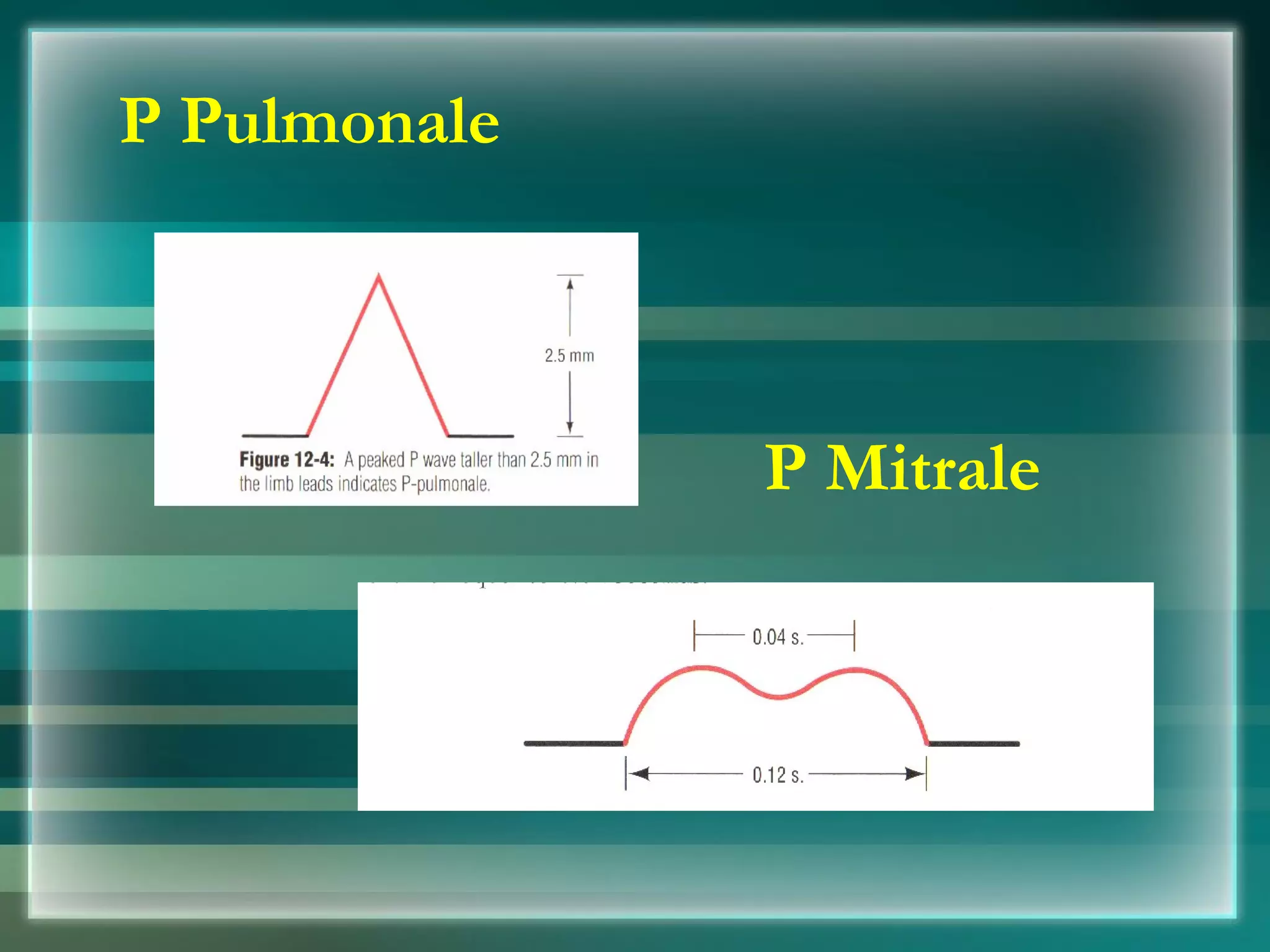
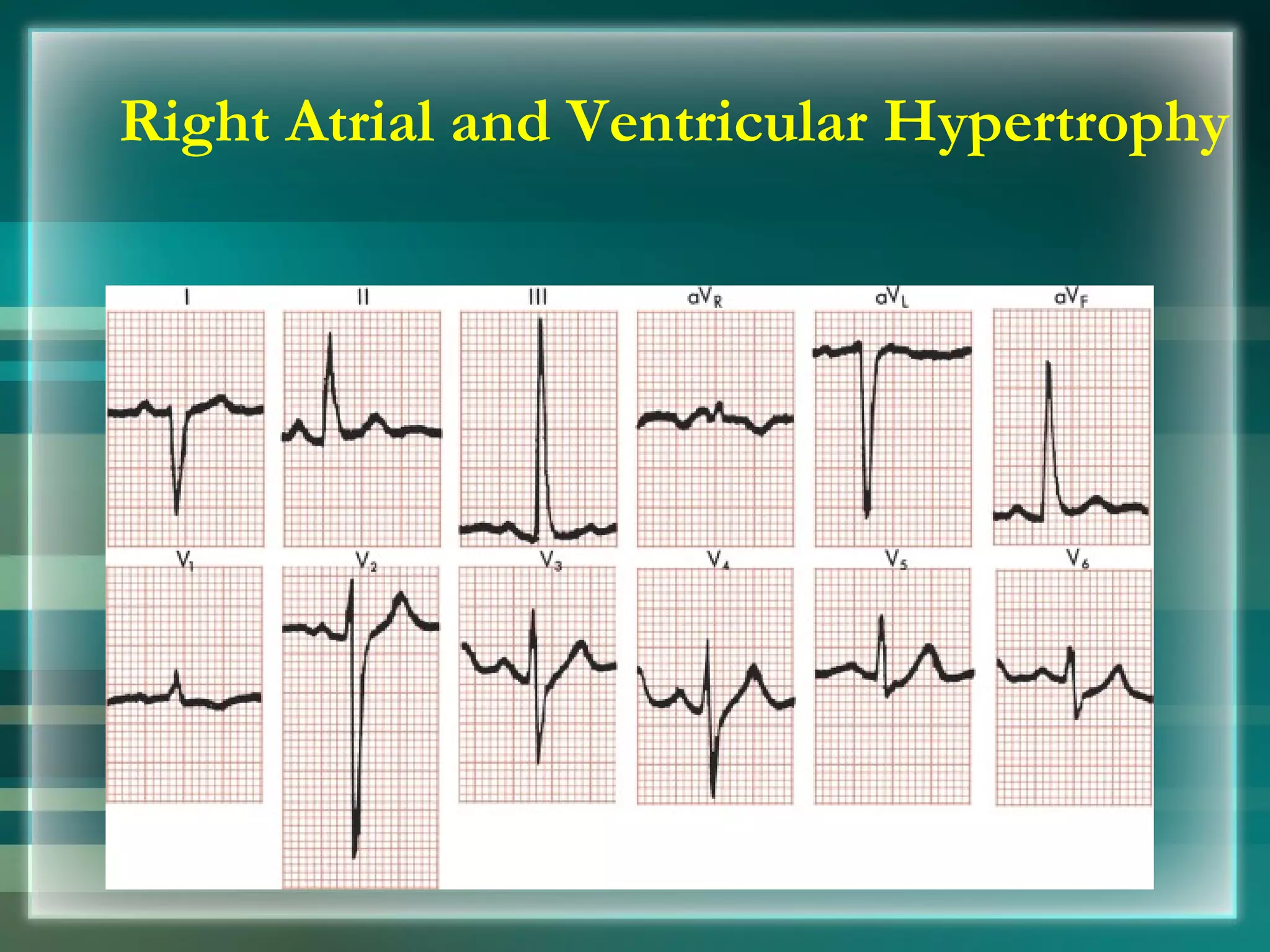
Right Atrial Enlargement Tall (> 2.5 mm), pointed P waves (P Pulmonale)
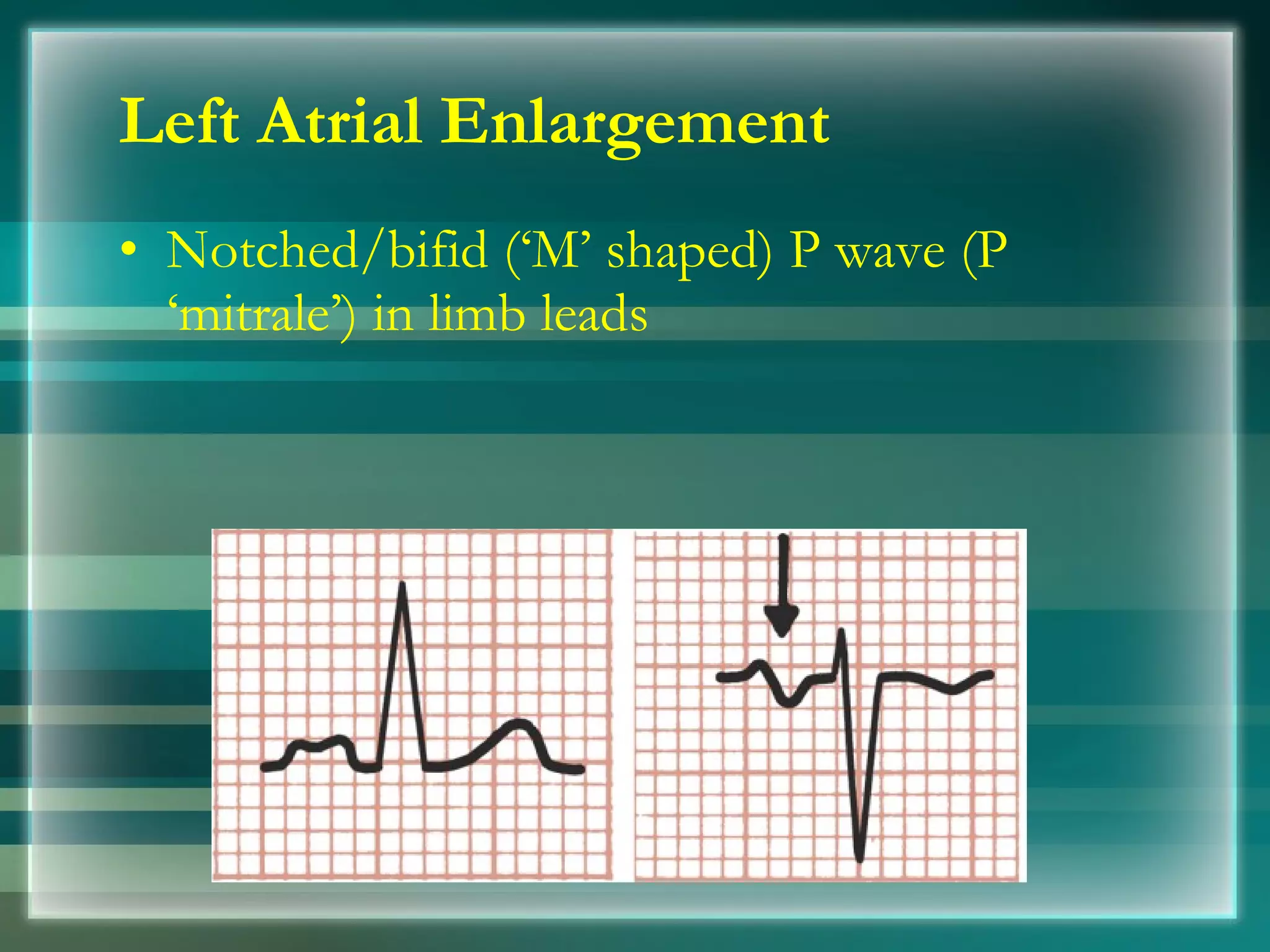
Notched/bifid (‘M’ shaped) P wave (P ‘mitrale’) in limb leads Left Atrial Enlargement
P Pulmonale P Mitrale
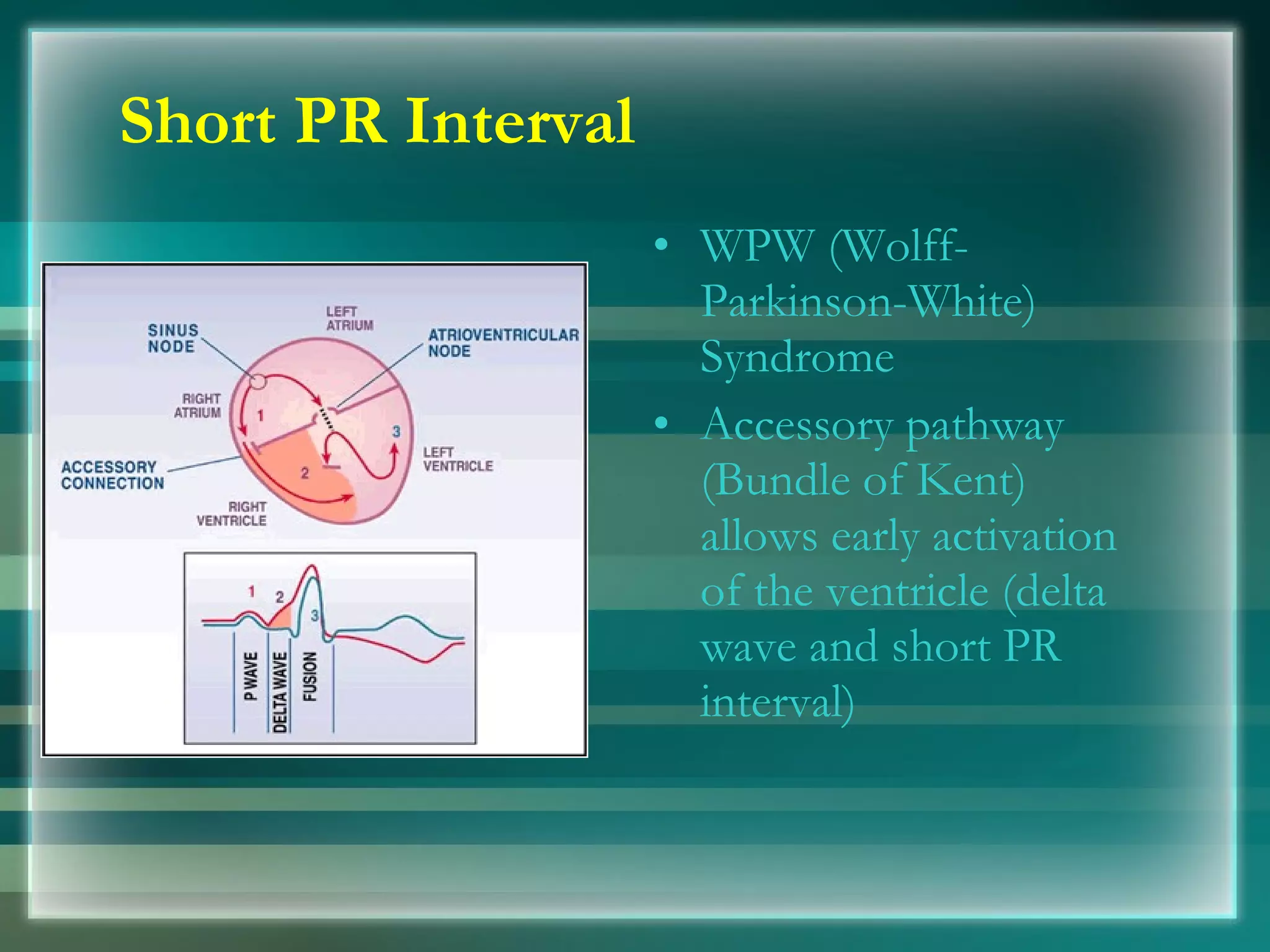
Short PR Interval WPW (Wolff-Parkinson-White) Syndrome Accessory pathway (Bundle of Kent) allows early activation of the ventricle (delta wave and short PR interval)
Long PR Interval First degree Heart Block
QRS Complexes Non­pathological Q waves may present in I, III, aVL, V5, and V6 R wave in lead V6 is smaller than V5 Depth of the S wave, should not exceed 30 mm Pathological Q wave > 2mm deep and > 1mm wide or > 25% amplitude of the subsequent R wave
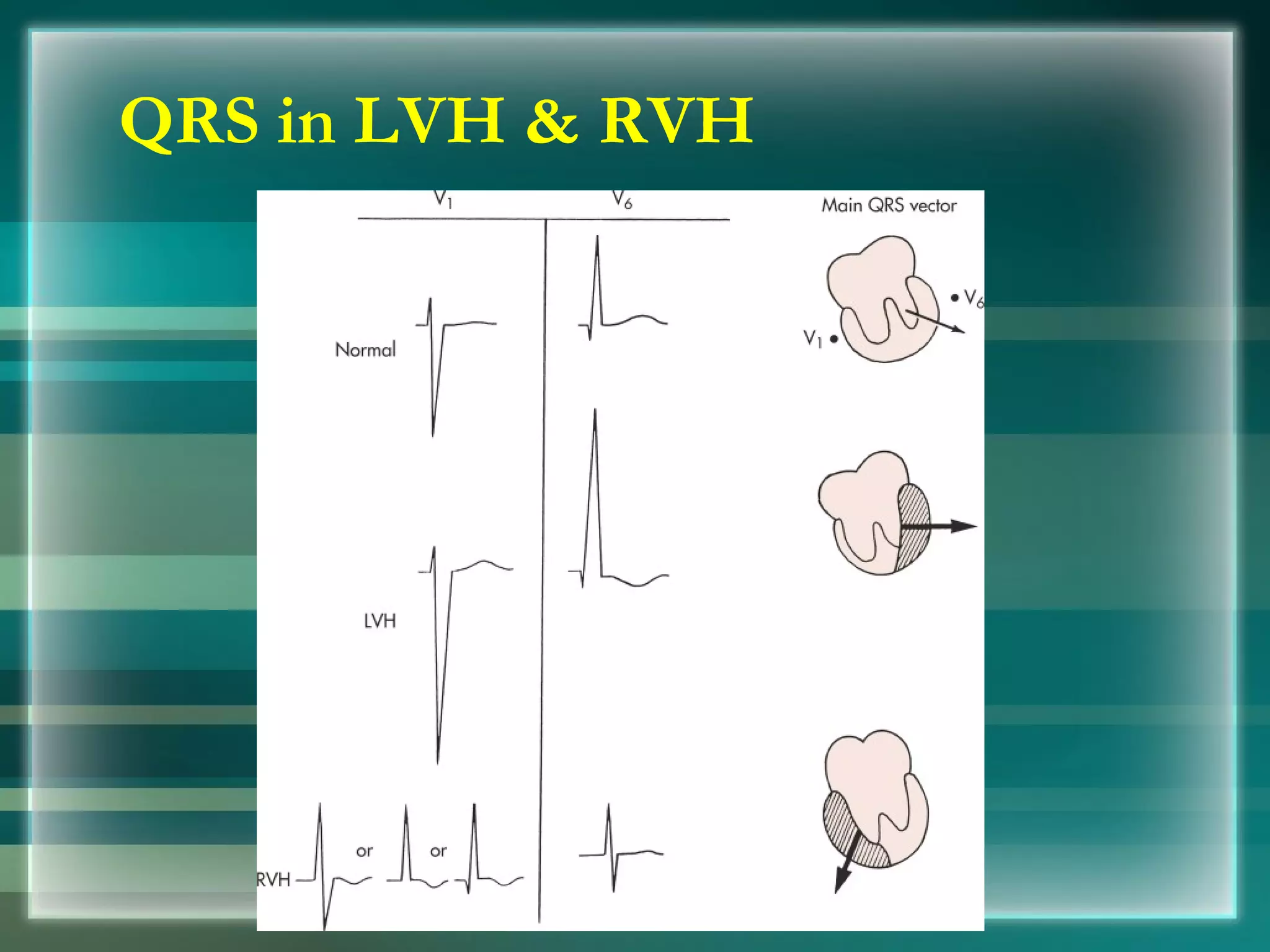
QRS in LVH & RVH
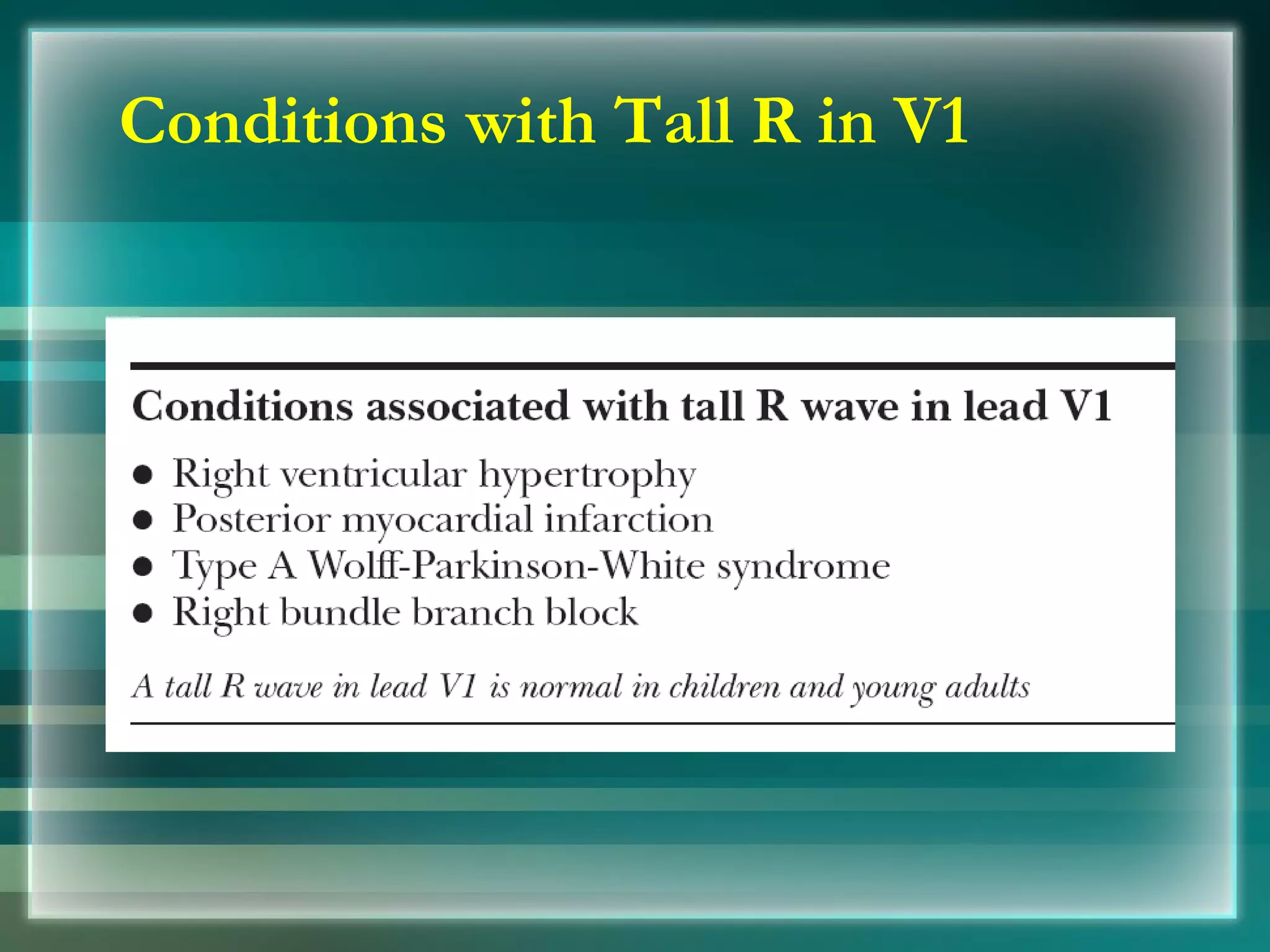
Conditions with Tall R in V1
Right Atrial and Ventricular Hypertrophy
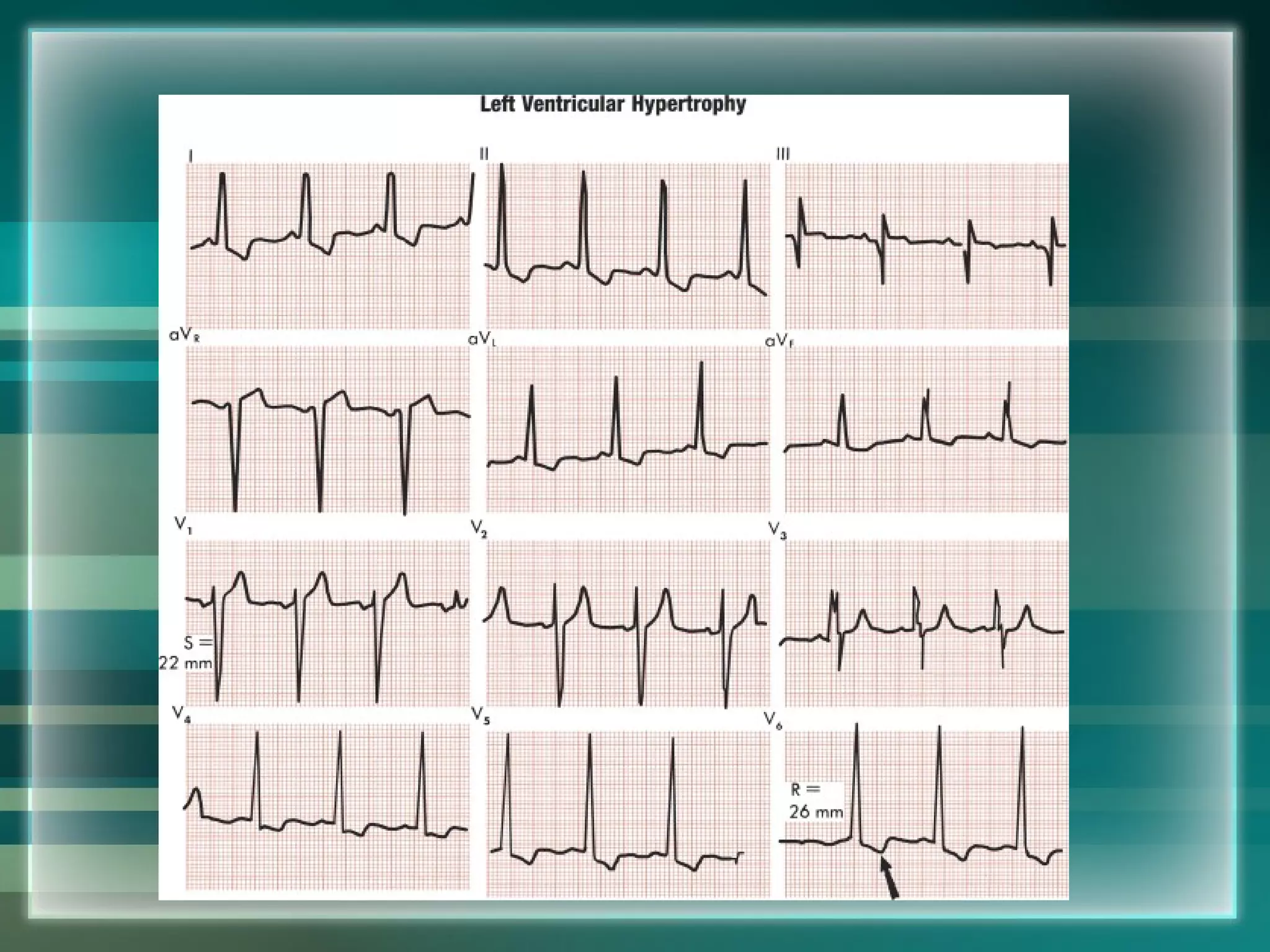
Left Ventricular Hypertrophy Sokolow & Lyon Criteria   S in V1+ R in V5 or V6 > 35 mm  An R wave of 11 to 13 mm (1.1 to 1.3 mV) or more in lead aVL  is another sign of LVH
 
ST Segment ST Segment is flat (isoelectric) Elevation or depression of ST segment  by 1 mm or more “ J” (Junction) point is the point between QRS and ST segment
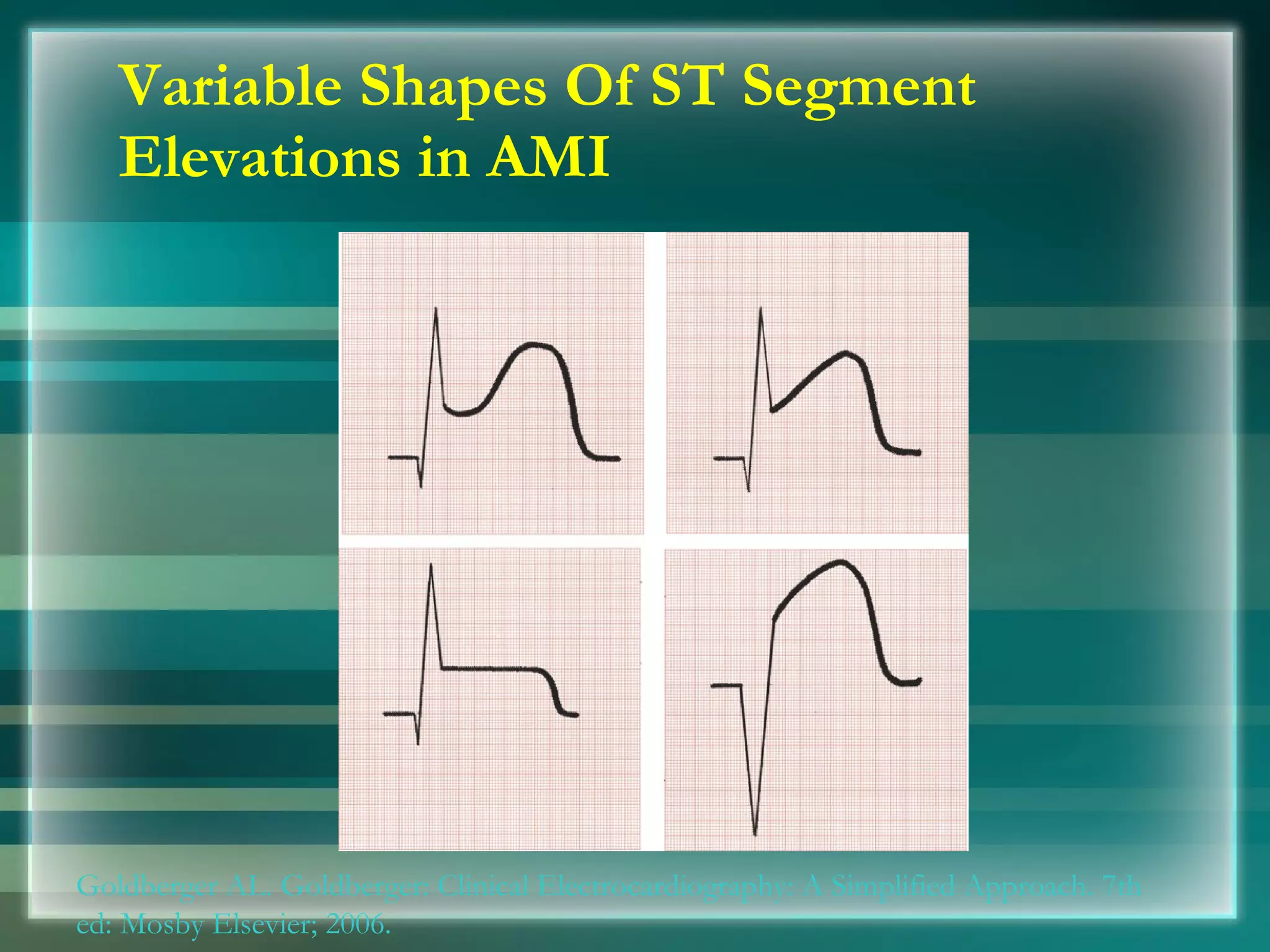
Variable Shapes Of ST Segment Elevations in AMI Goldberger AL. Goldberger: Clinical Electrocardiography: A Simplified Approach. 7th ed: Mosby Elsevier; 2006.
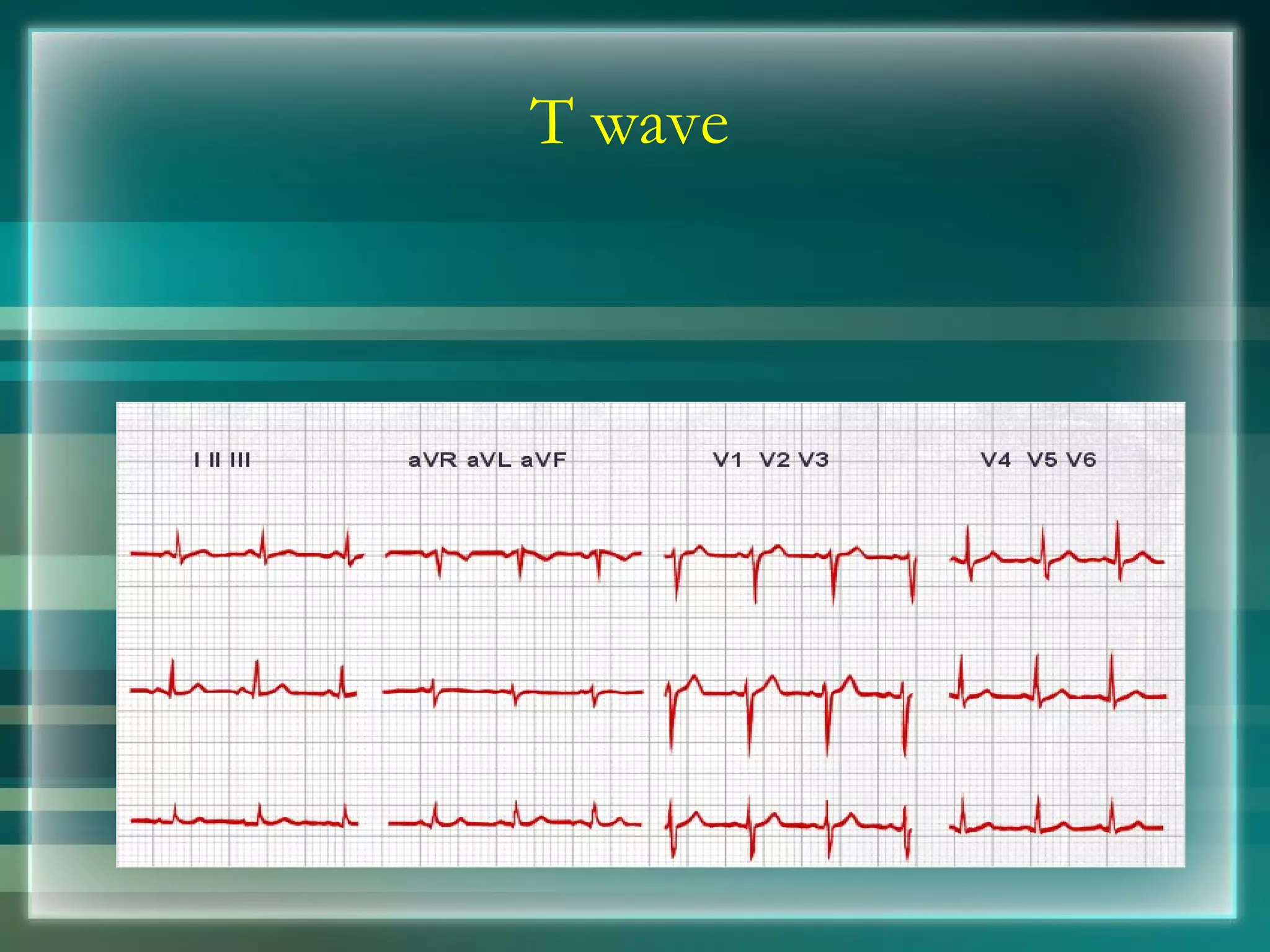
T wave Normal T wave is  asymmetrical,  first half having a gradual slope than the second Should be  at least 1/8 but less than 2/3  of the amplitude of the R T wave amplitude rarely exceeds 10 mm Abnormal T waves are symmetrical, tall, peaked, biphasic or inverted. T wave follows the direction of the QRS deflection.
T wave
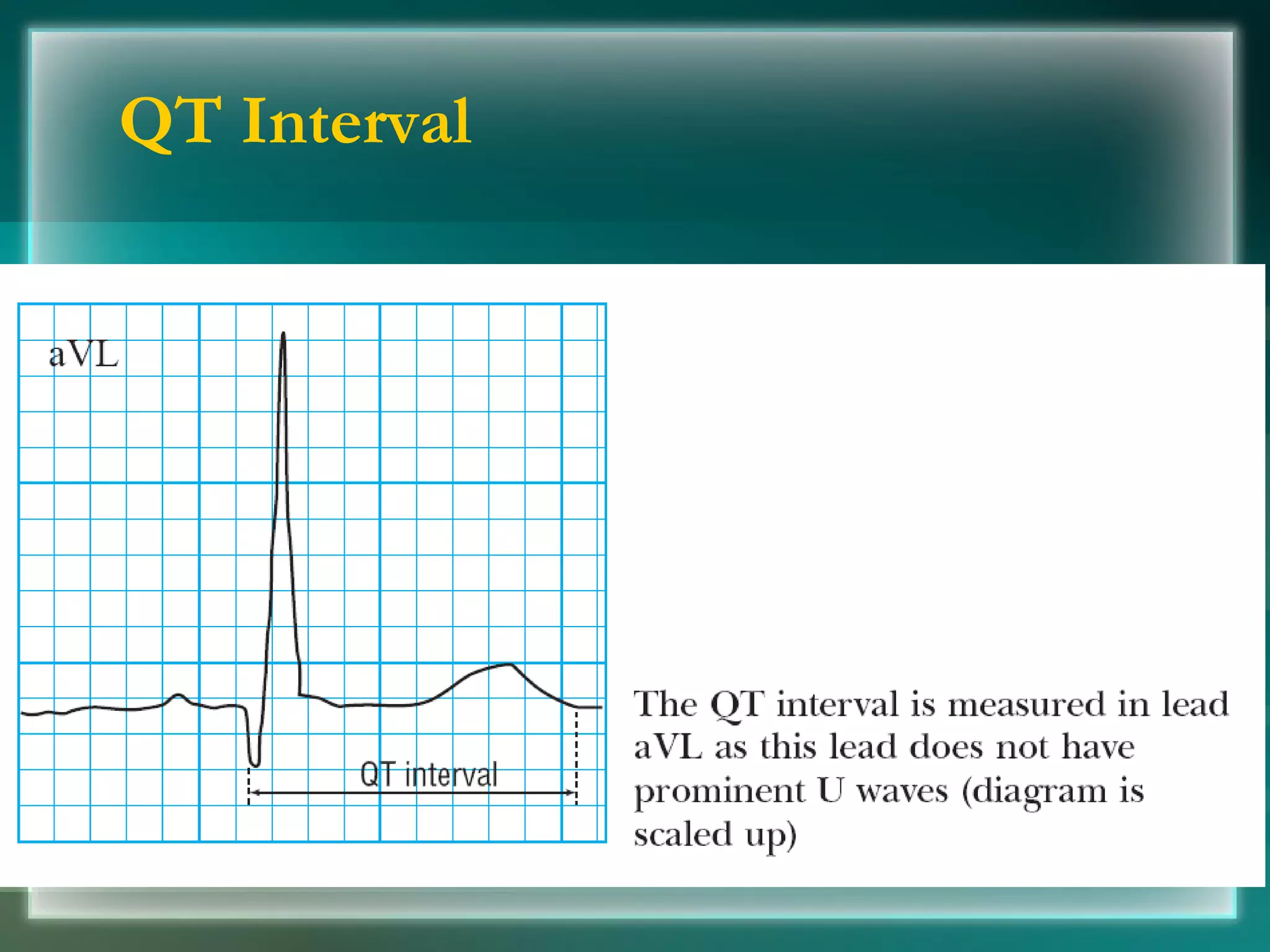
QT interval Total duration of Depolarization and Repolarization QT interval decreases when heart rate increases For HR = 70 bpm, QT<0.40 sec.  4.  QT interval should be 0.35­ 0.45 s, 5.  Should not be more than half of the interval between adjacent R waves (R­R interval).
QT Interval
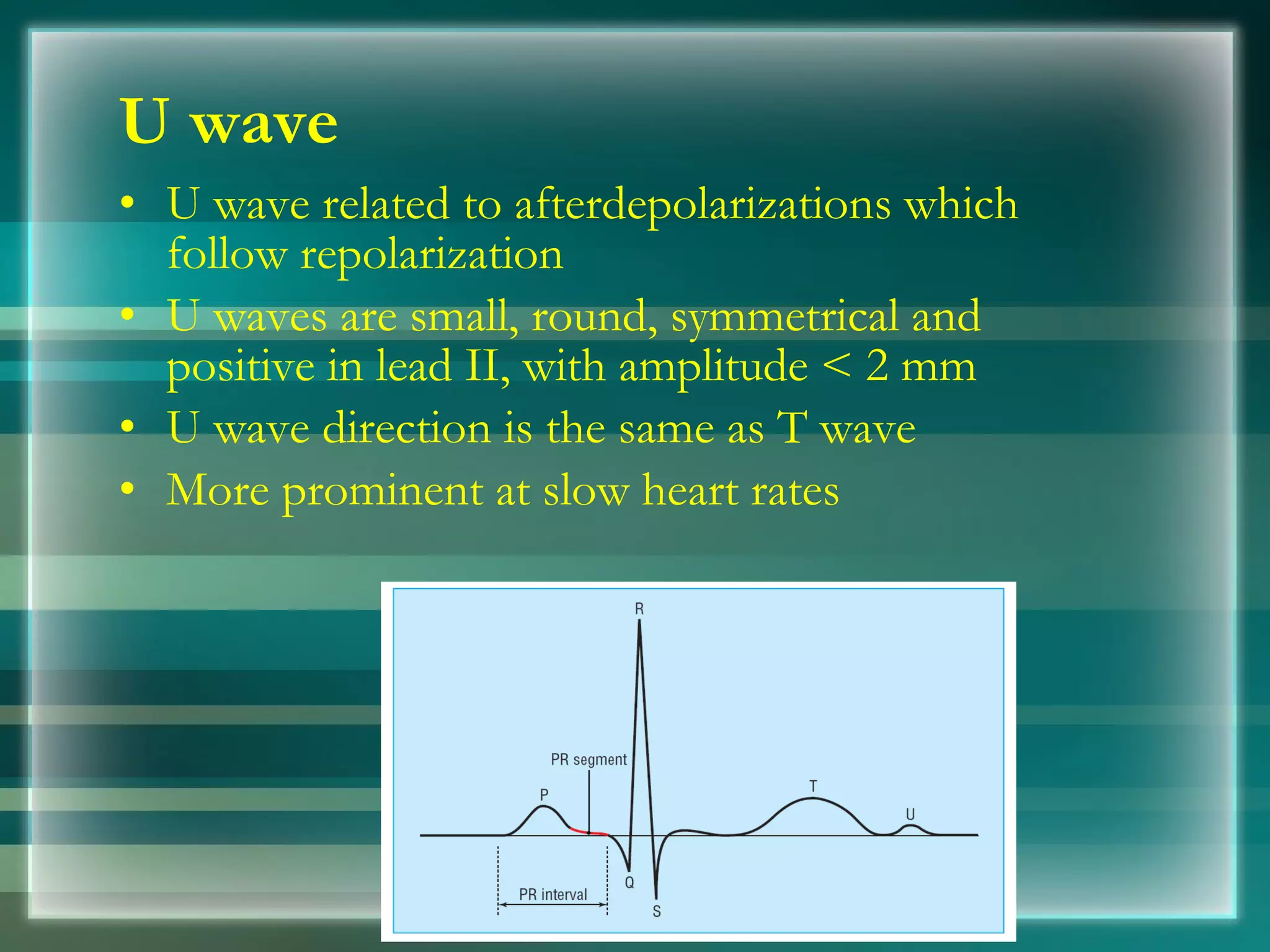
U wave U wave related to afterdepolarizations which follow repolarization U waves are small, round, symmetrical and positive in lead II, with amplitude < 2 mm  U wave direction is the same as T wave  More prominent at slow heart rates
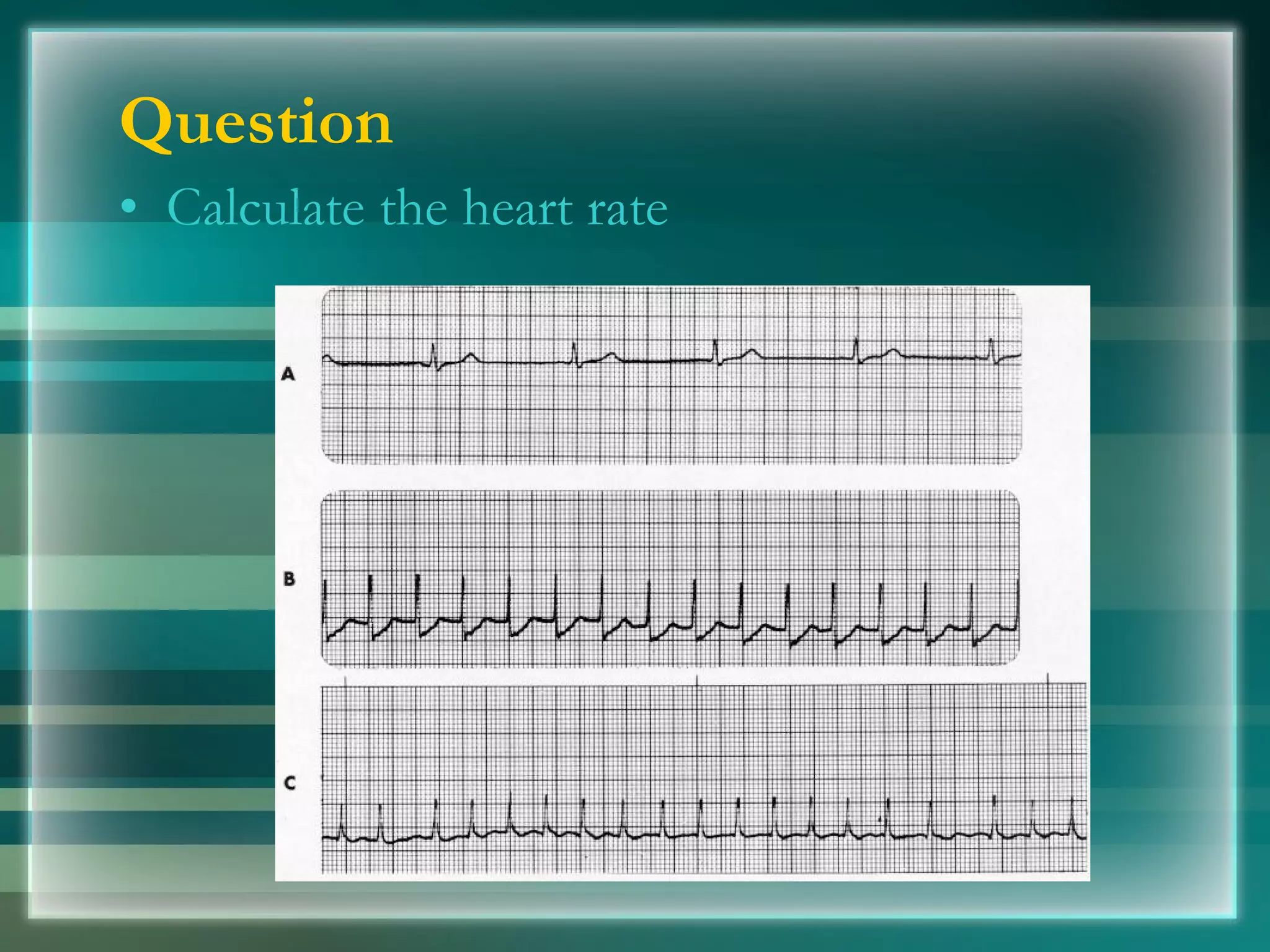
Determining the Heart Rate Rule of 300/1500 10 Second Rule
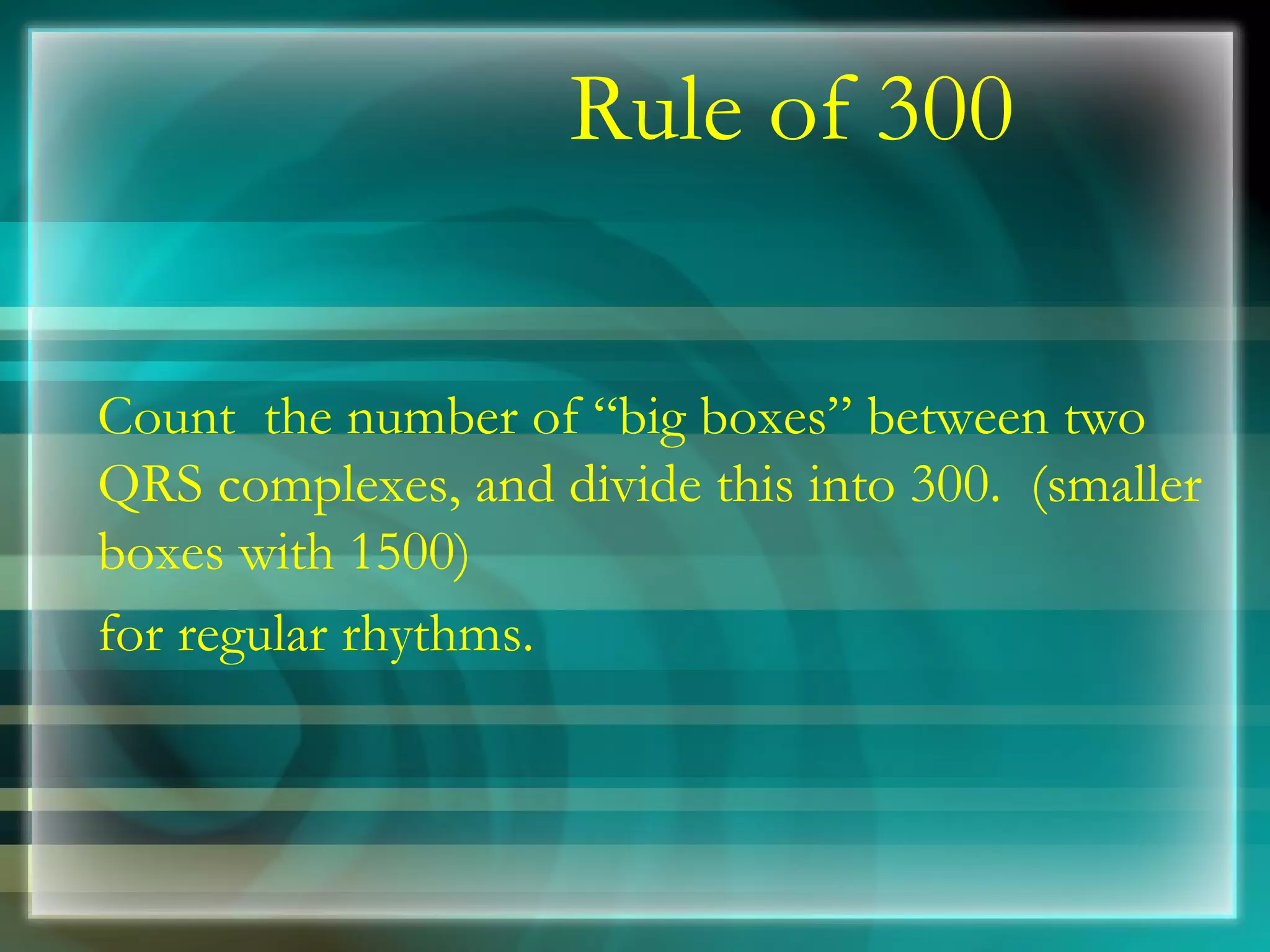
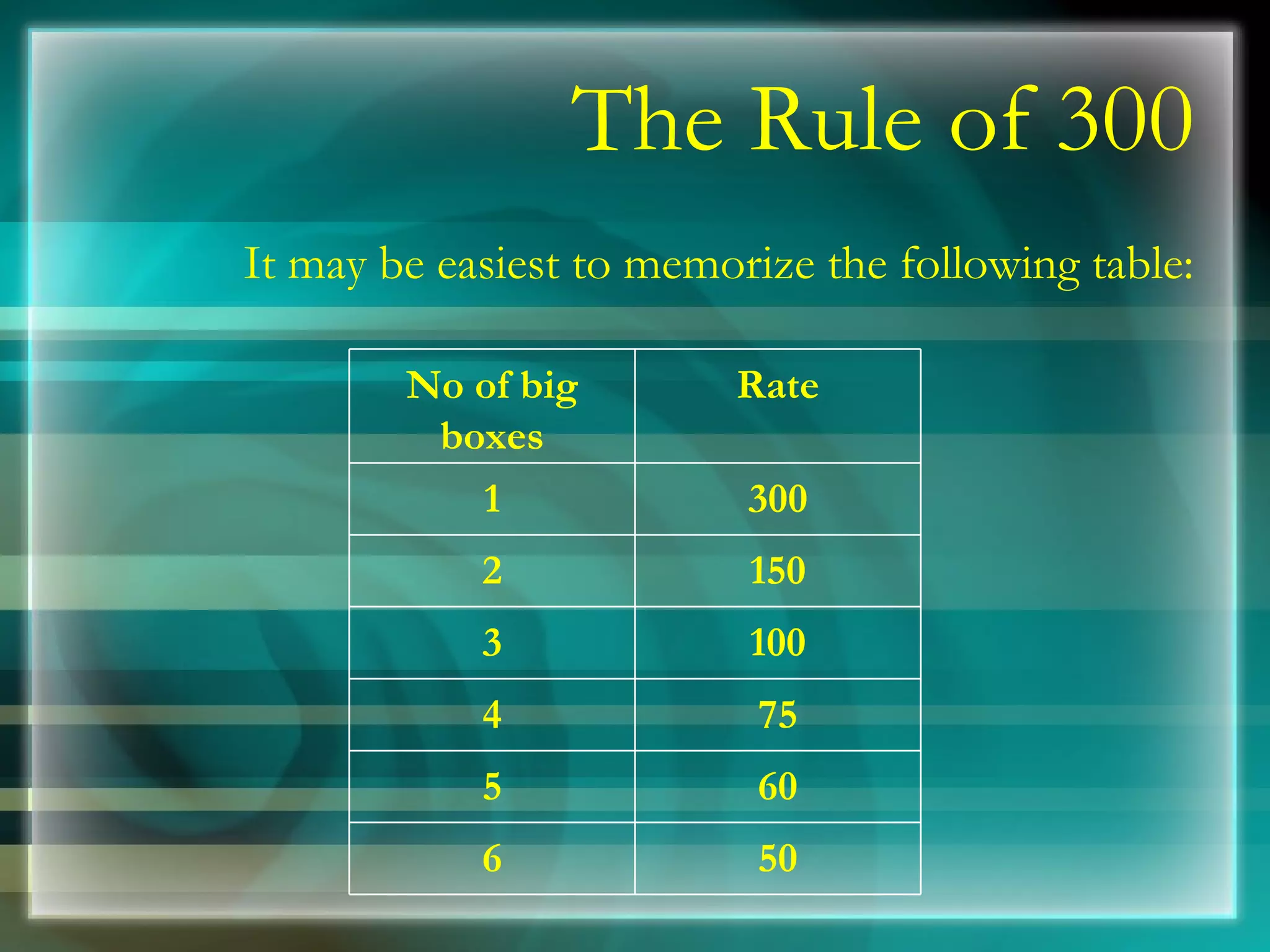
Rule of 300 Count  the number of “big boxes” between two QRS complexes, and divide this into 300.  (smaller boxes with 1500)  for regular rhythms.
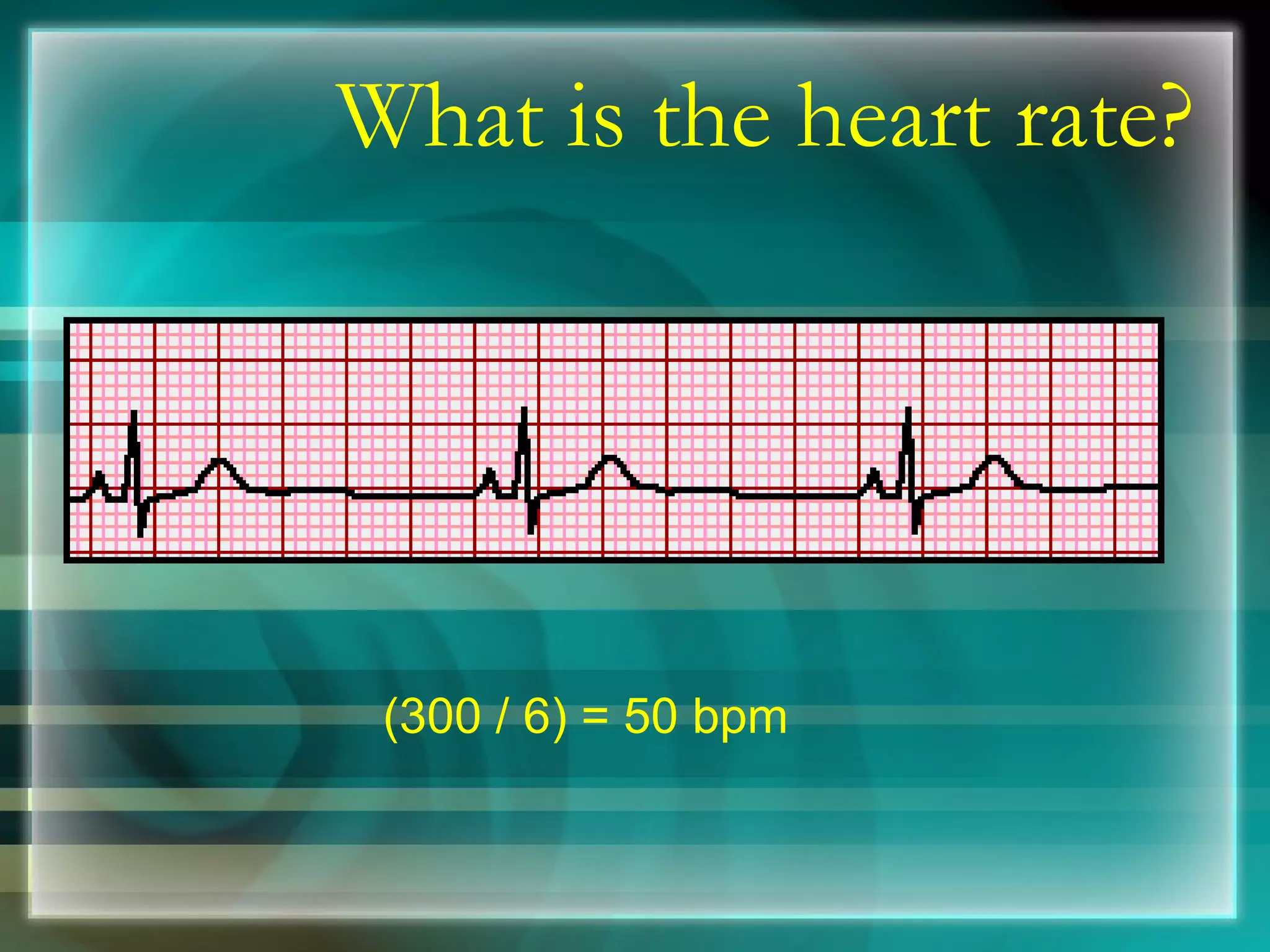
What is the heart rate? (300 / 6) = 50 bpm
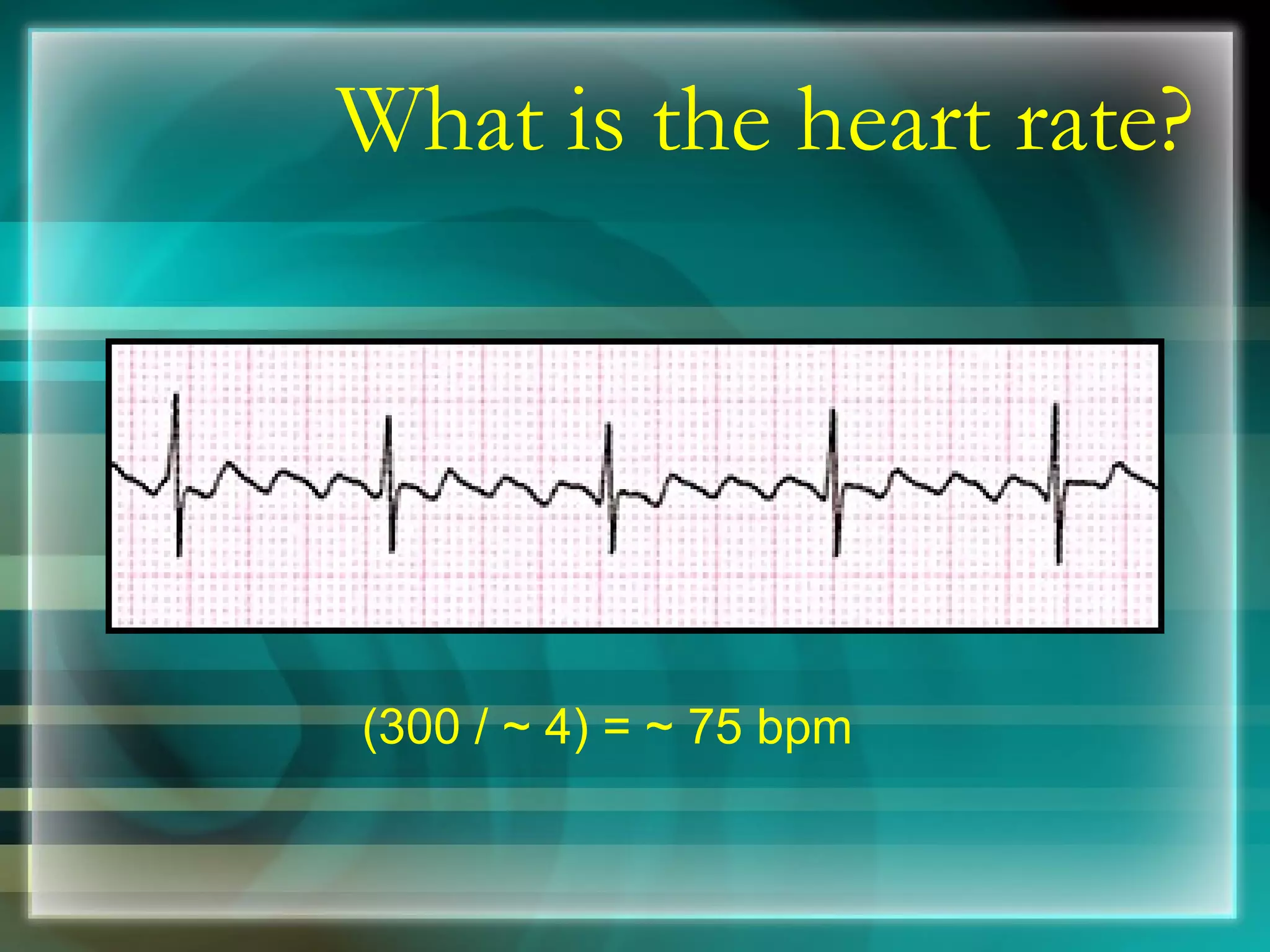
What is the heart rate? (300 / ~ 4) = ~ 75 bpm
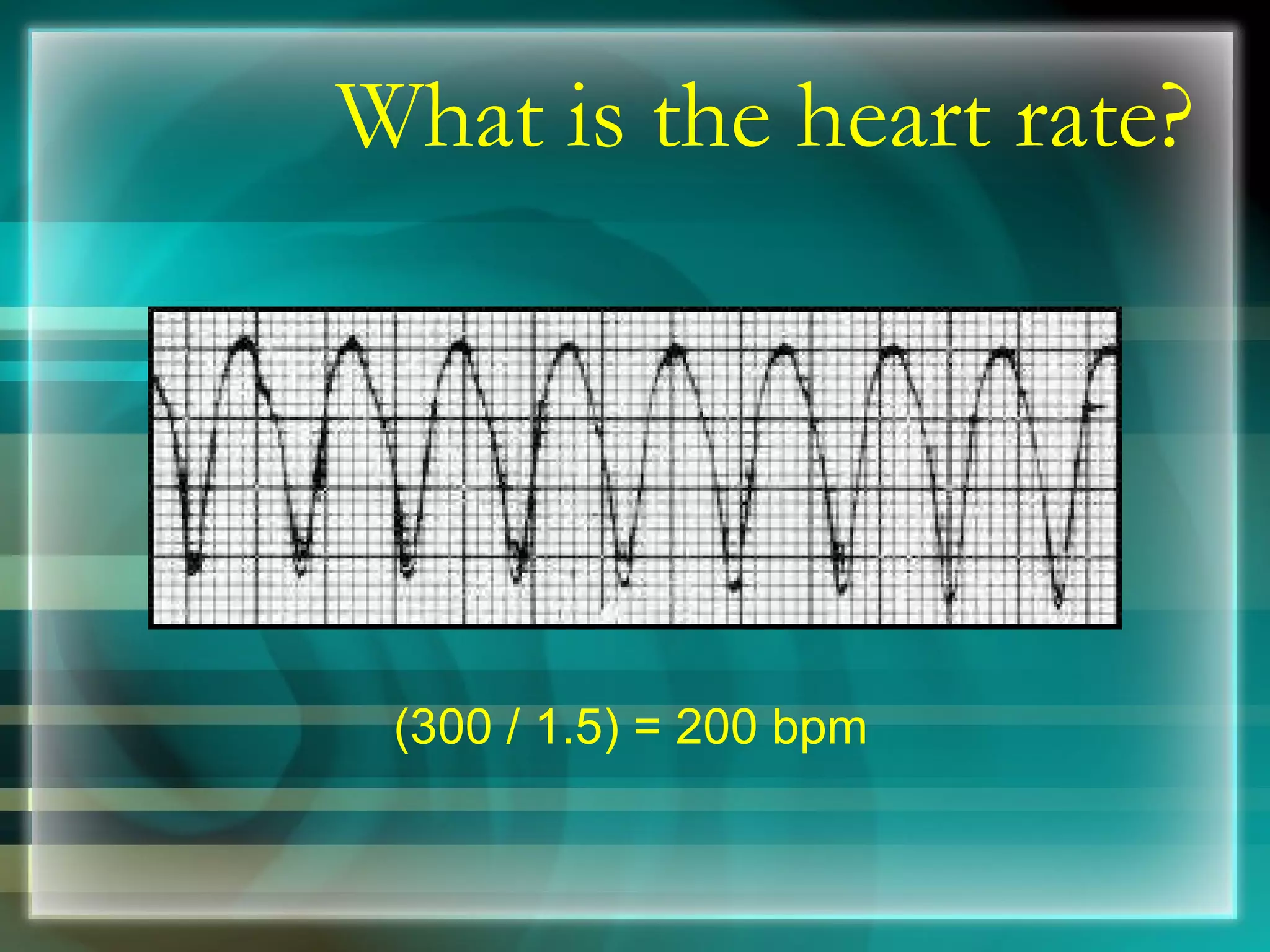
What is the heart rate? (300 / 1.5) = 200 bpm
The Rule of 300 It may be easiest to memorize the following table: 50 6 60 5 75 4 100 3 150 2 300 1 Rate No of big boxes
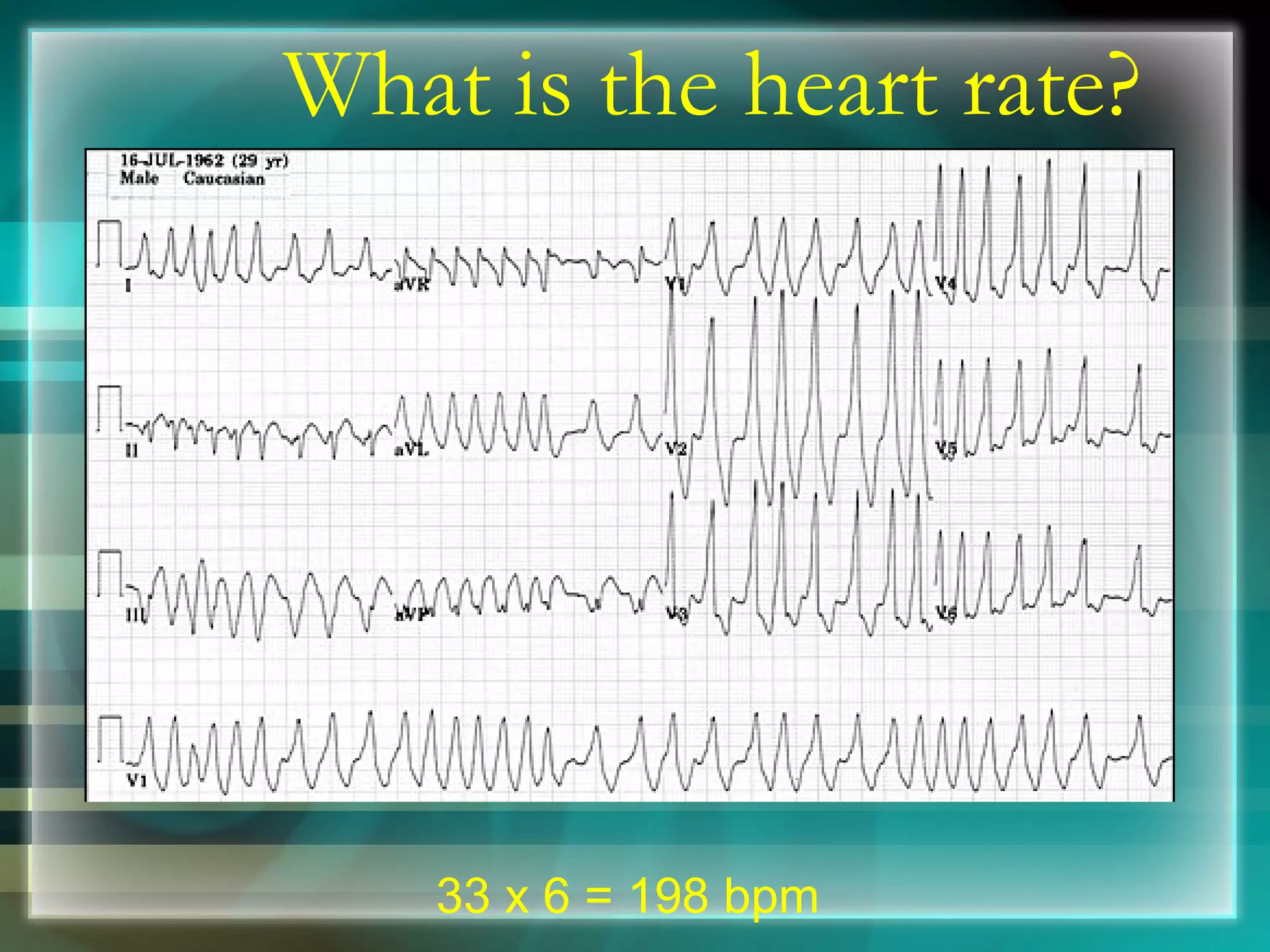
10 Second Rule EKGs record 10 seconds of rhythm per page, Count the number of beats present on the EKG Multiply by 6  For irregular rhythms.
What is the heart rate? 33 x 6 = 198 bpm
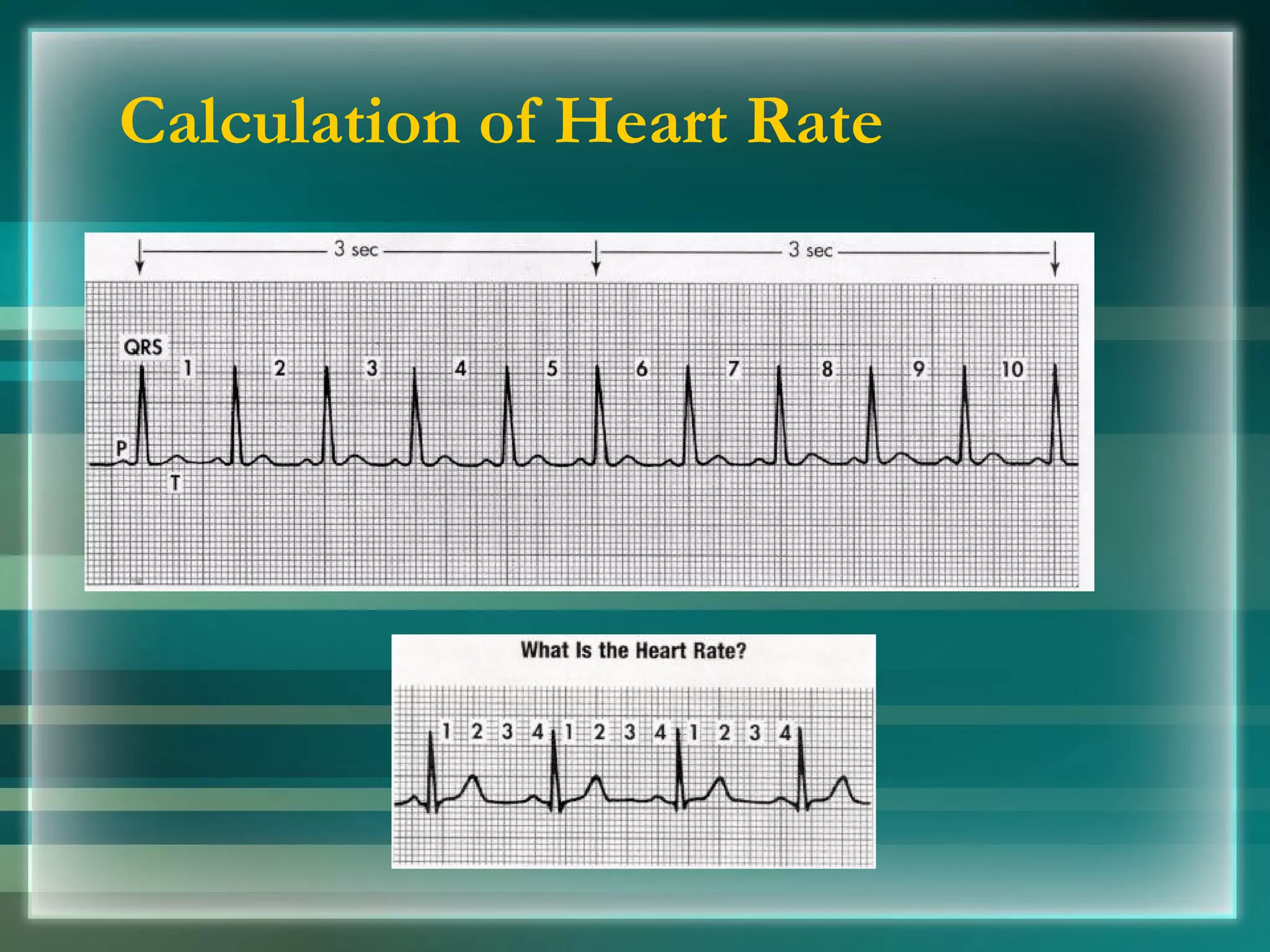
Calculation of Heart Rate
Question Calculate the heart rate
The QRS Axis The QRS axis represents overall direction of the heart’s electrical activity. Abnormalities hint at: Ventricular enlargement Conduction blocks (i.e. hemiblocks)
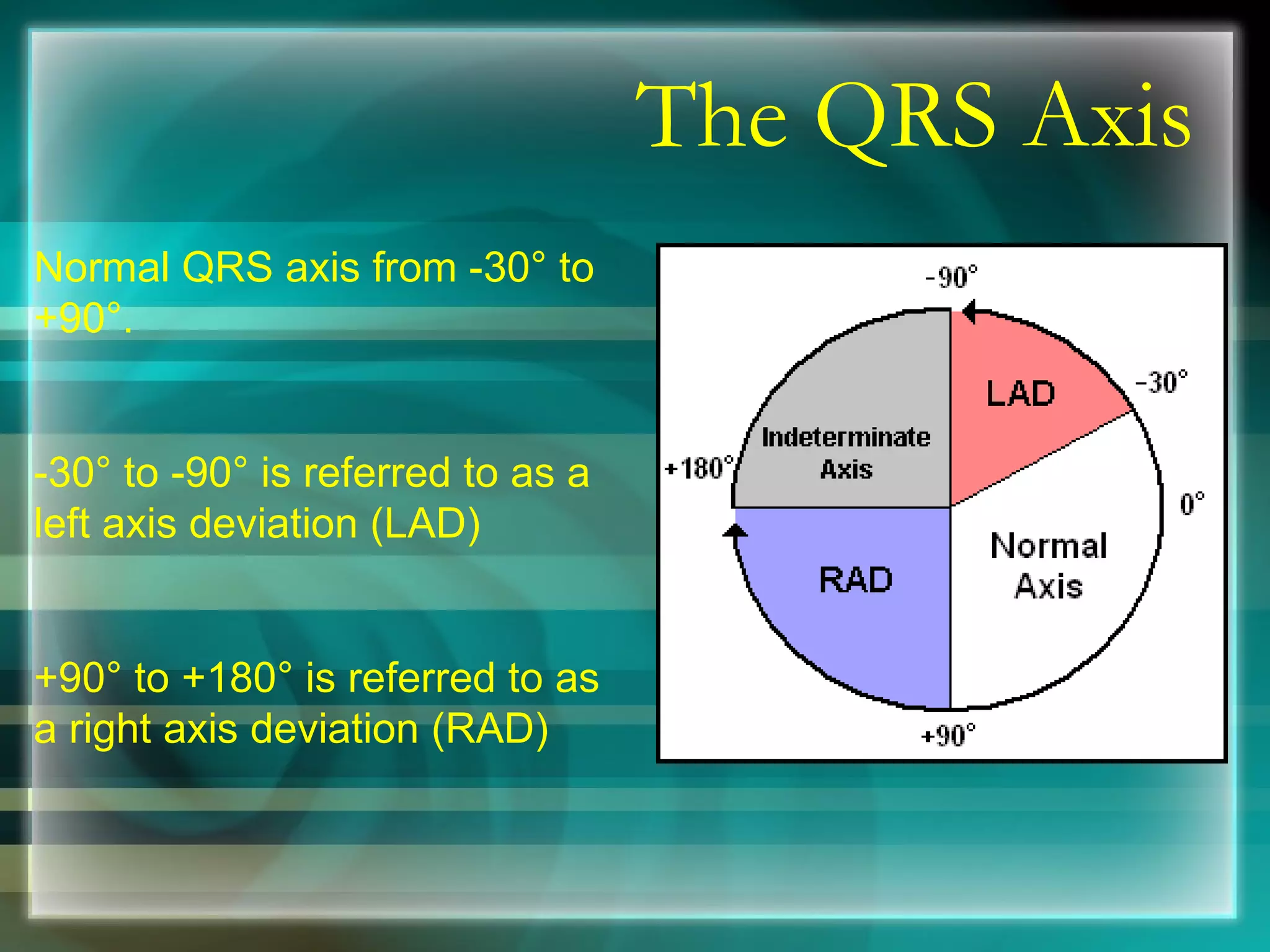
The QRS Axis Normal QRS axis from -30 °  to +90 ° . -30 °  to -90 °  is referred to as a left axis deviation (LAD) +90 °  to +180 °  is referred to as a right axis deviation (RAD)
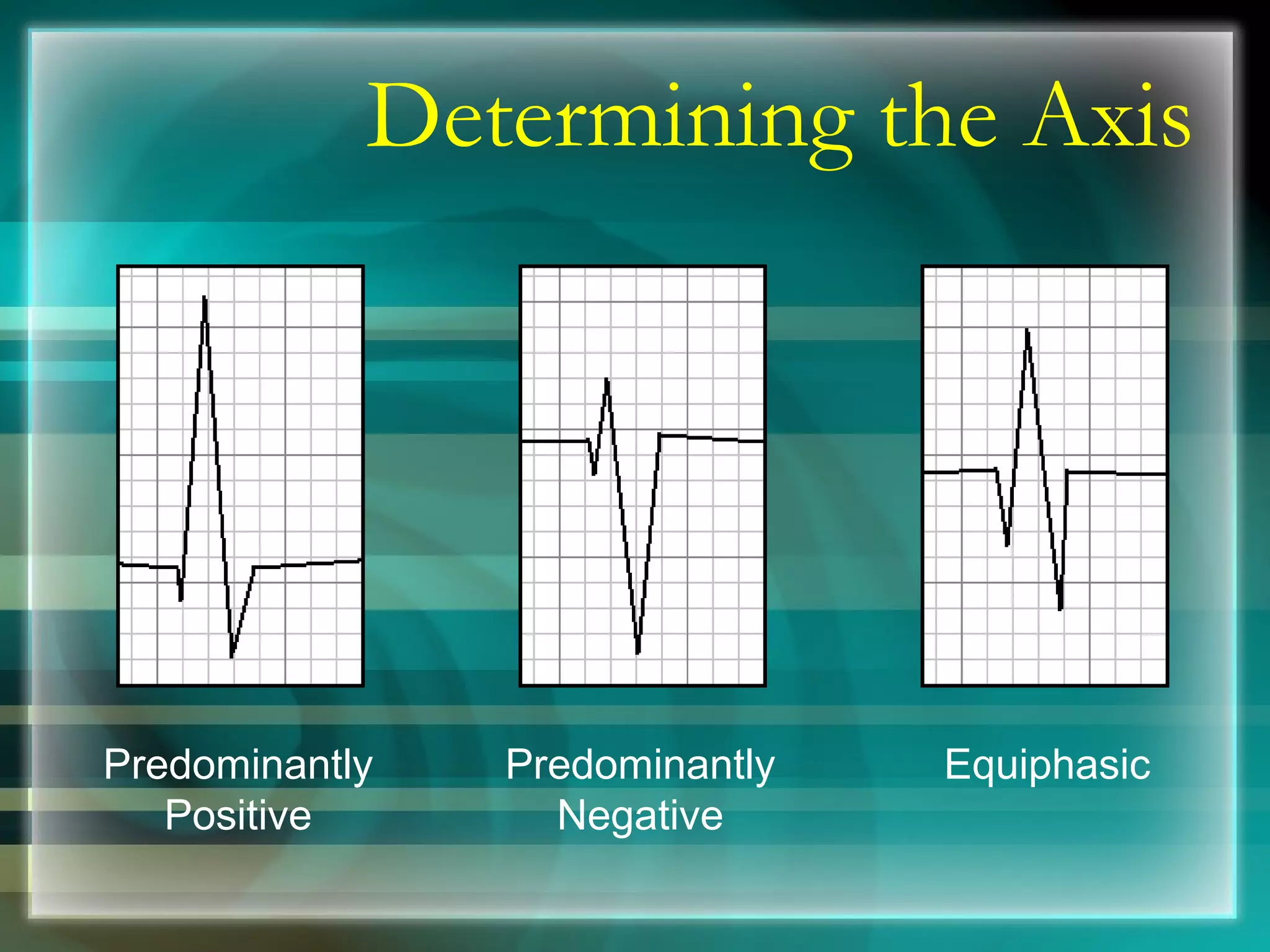
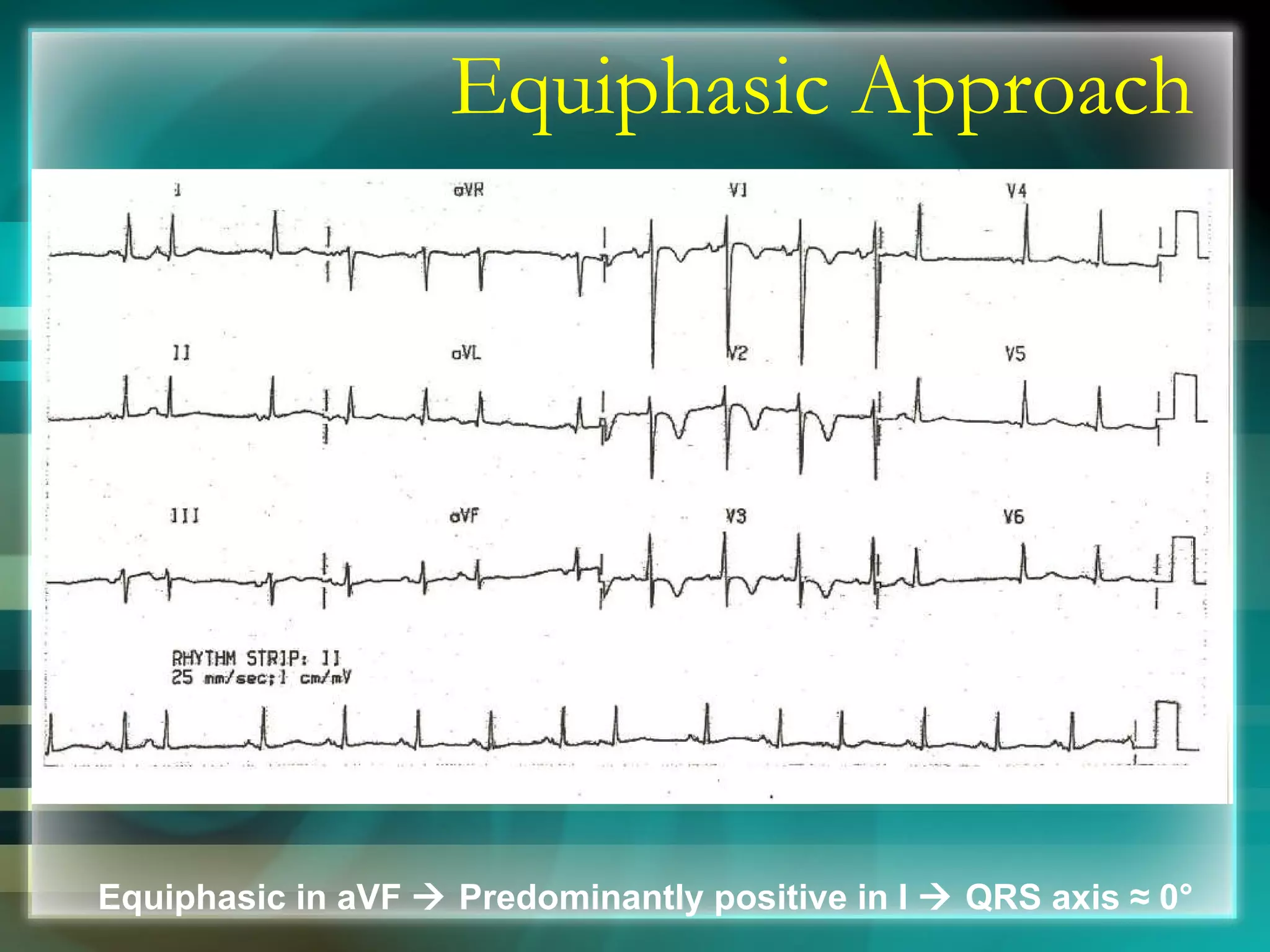
Determining the Axis The Quadrant Approach The Equiphasic Approach
Determining the Axis Predominantly Positive Predominantly Negative Equiphasic
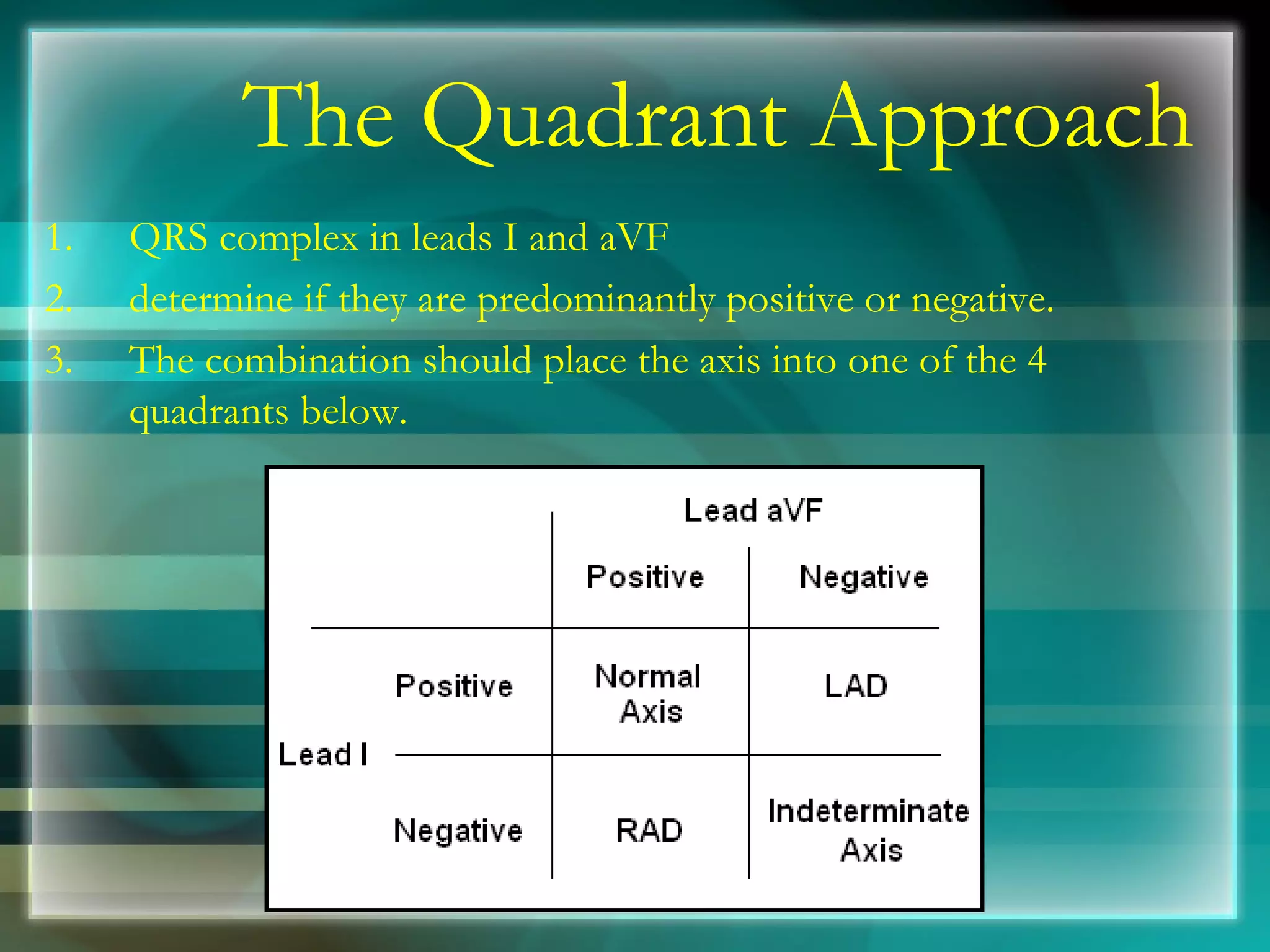
The Quadrant Approach QRS complex in leads I and aVF  determine if they are predominantly positive or negative.  The combination should place the axis into one of the 4 quadrants below.
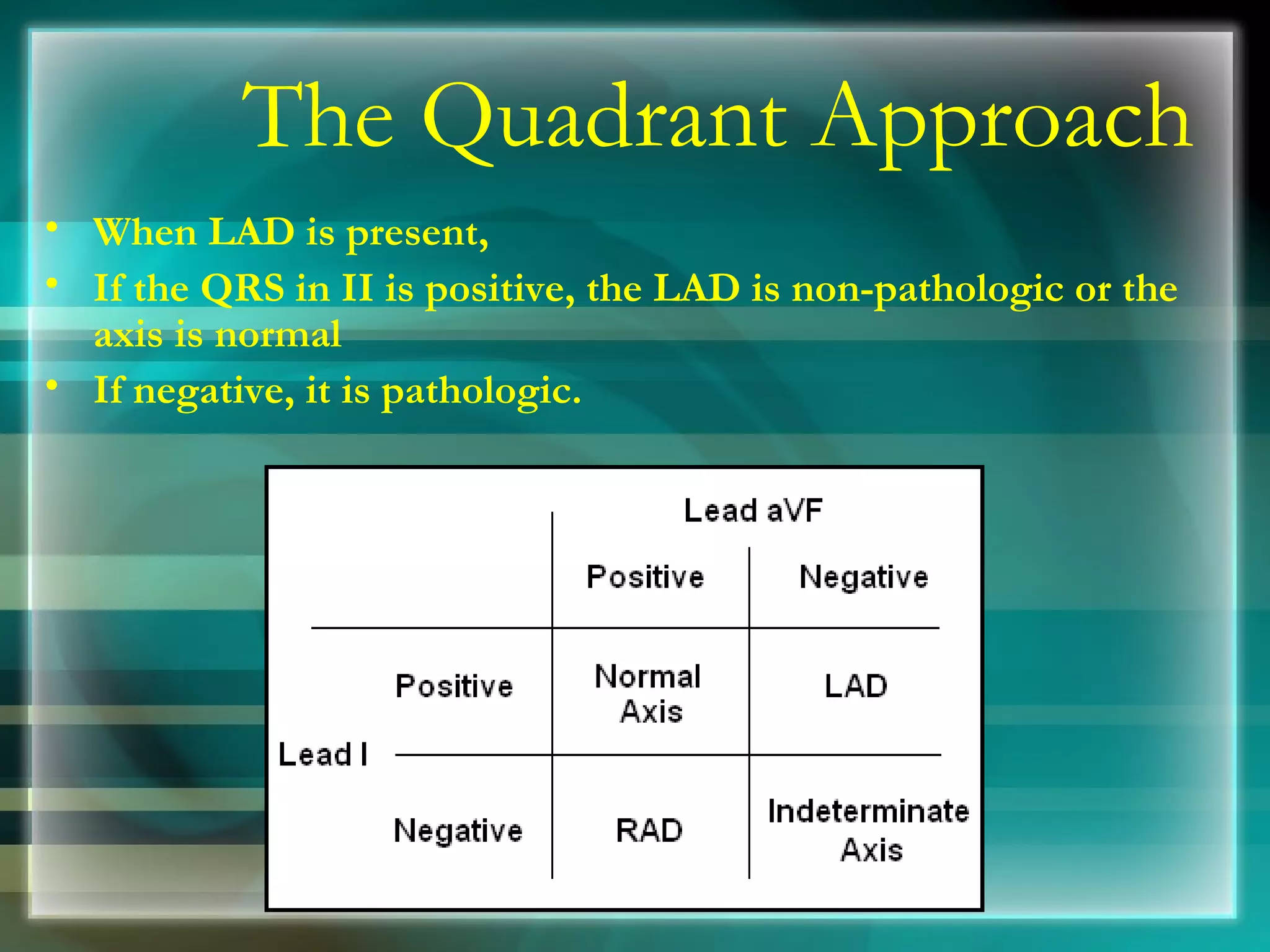
The Quadrant Approach When LAD is present,  If the QRS in II is positive, the LAD is non-pathologic or the axis is normal  If negative, it is pathologic.
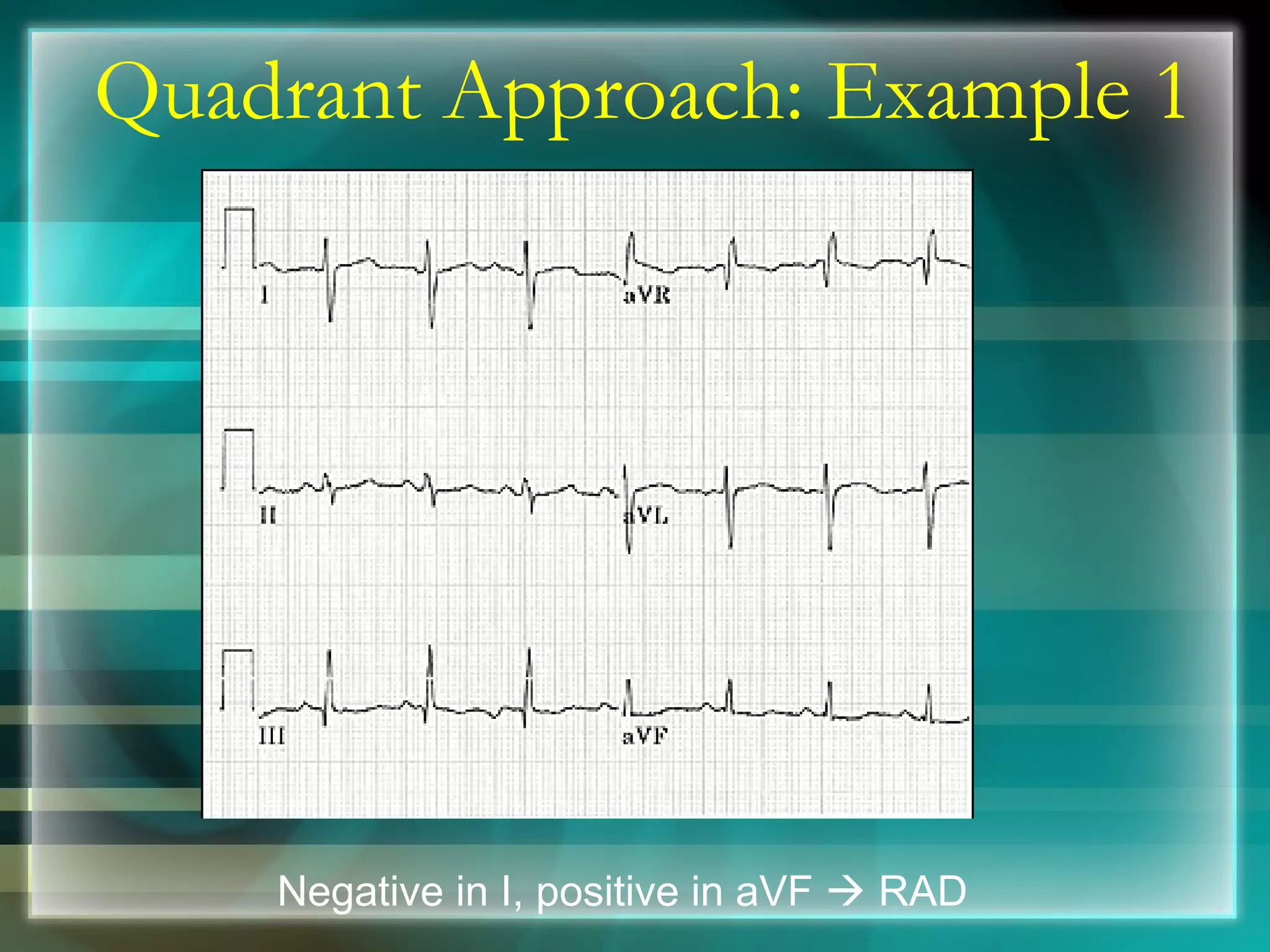
Quadrant Approach: Example 1 Negative in I, positive in aVF    RAD
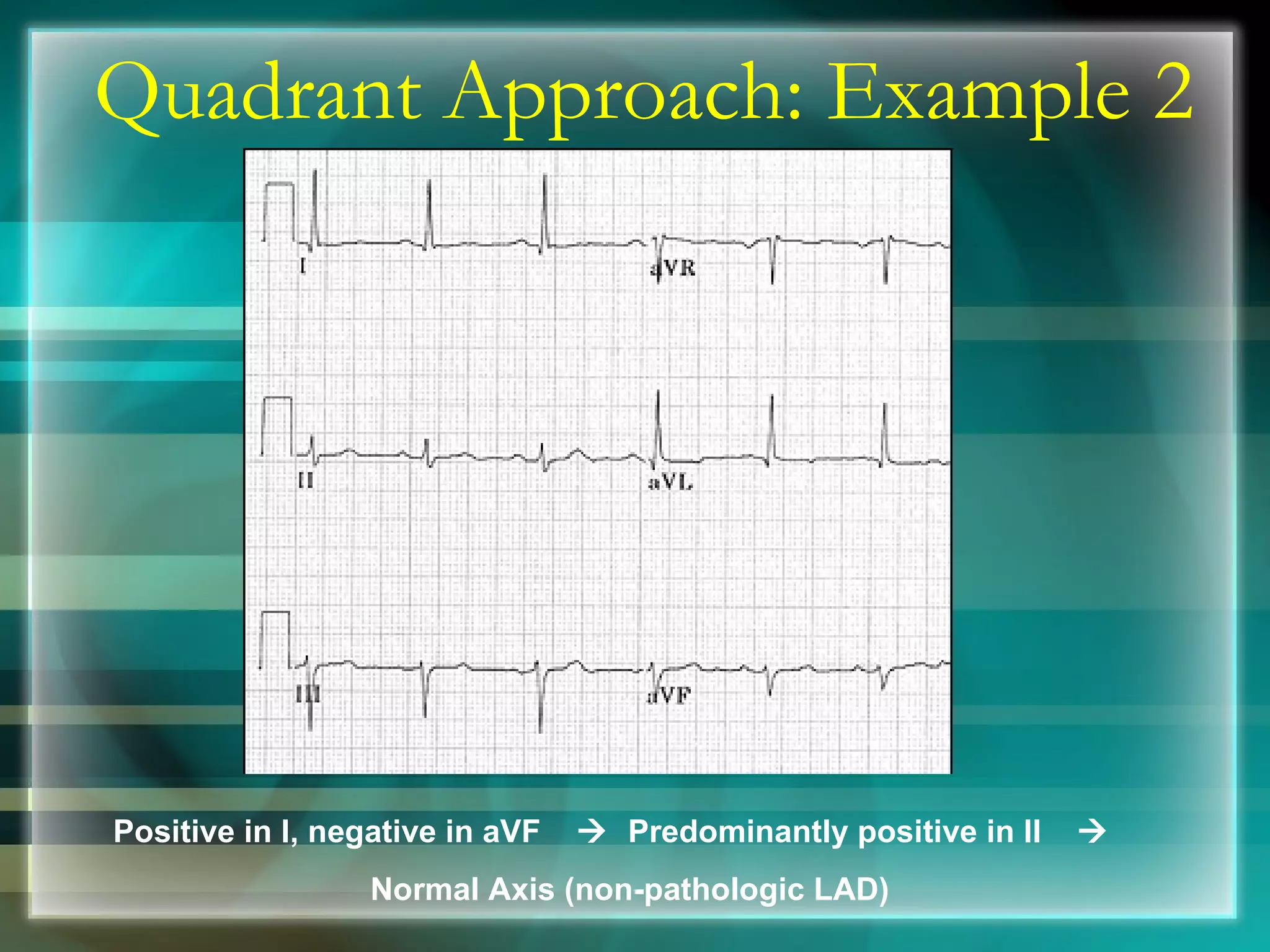
Quadrant Approach: Example 2 Positive in I, negative in aVF     Predominantly positive in II     Normal Axis (non-pathologic LAD)
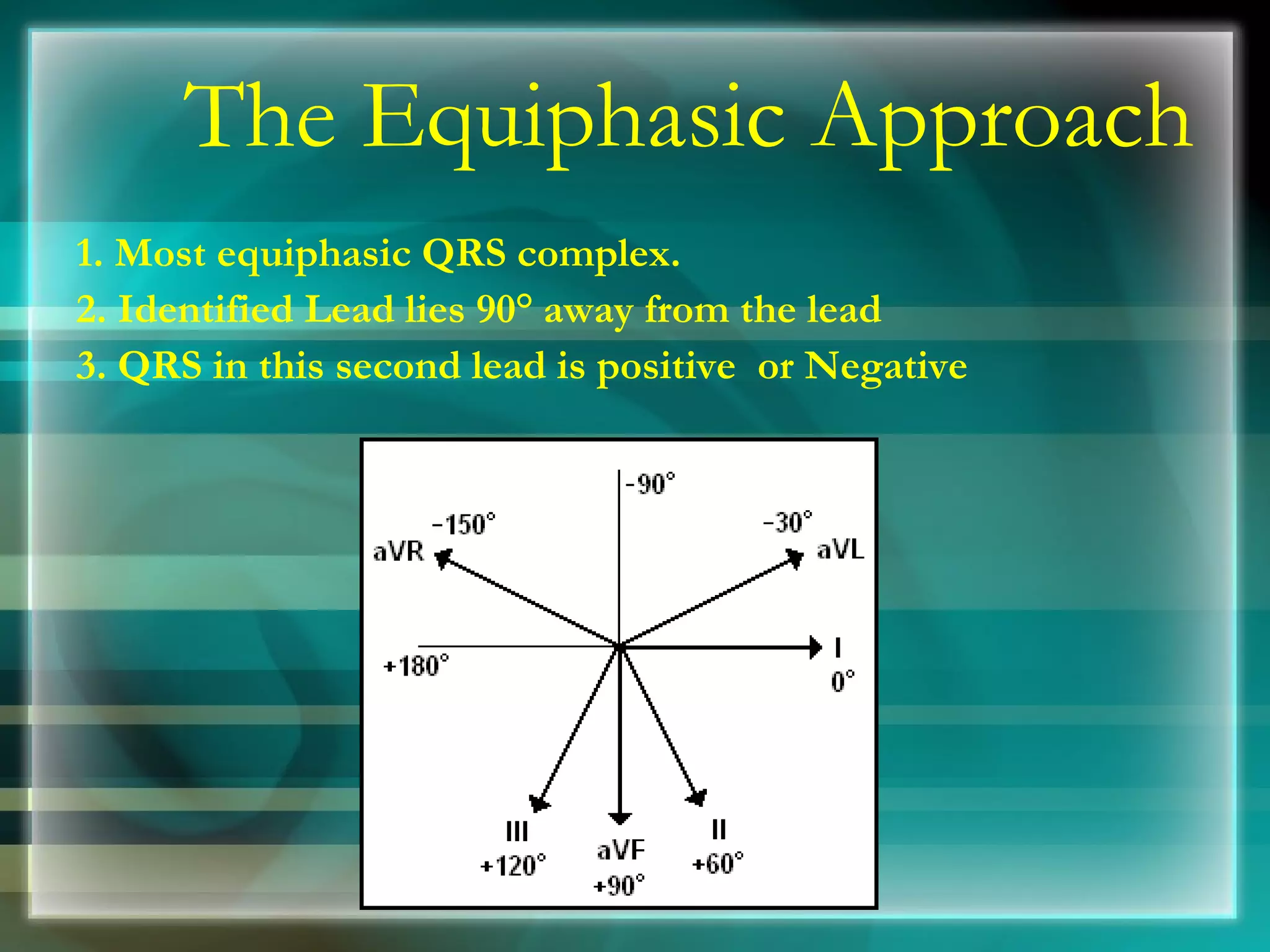
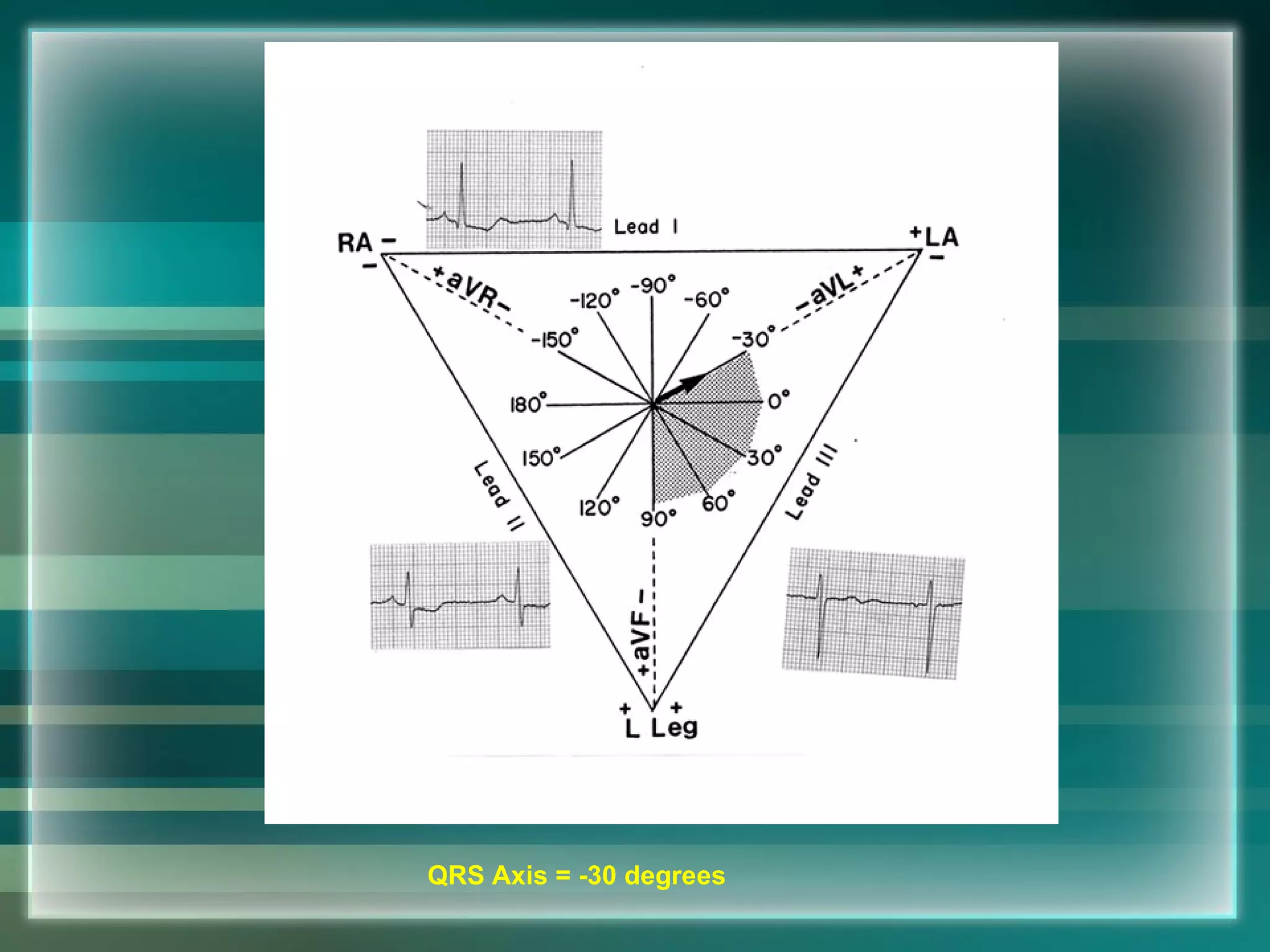
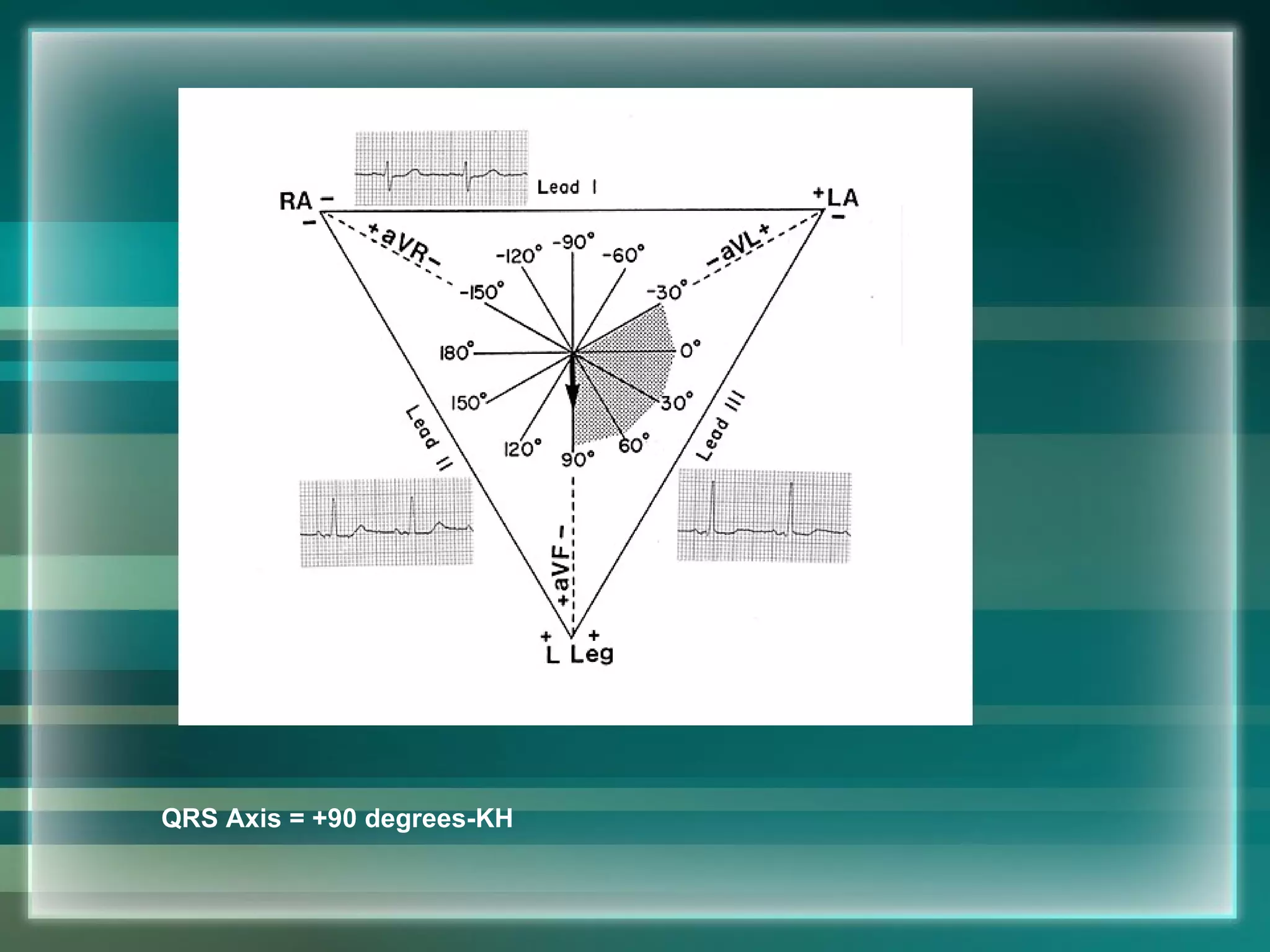
The Equiphasic Approach 1. Most equiphasic QRS complex.  2. Identified Lead lies 90° away from the lead  3. QRS in this second lead is positive  or Negative
QRS Axis = -30 degrees
                                                                     QRS Axis = +90 degrees-KH
 
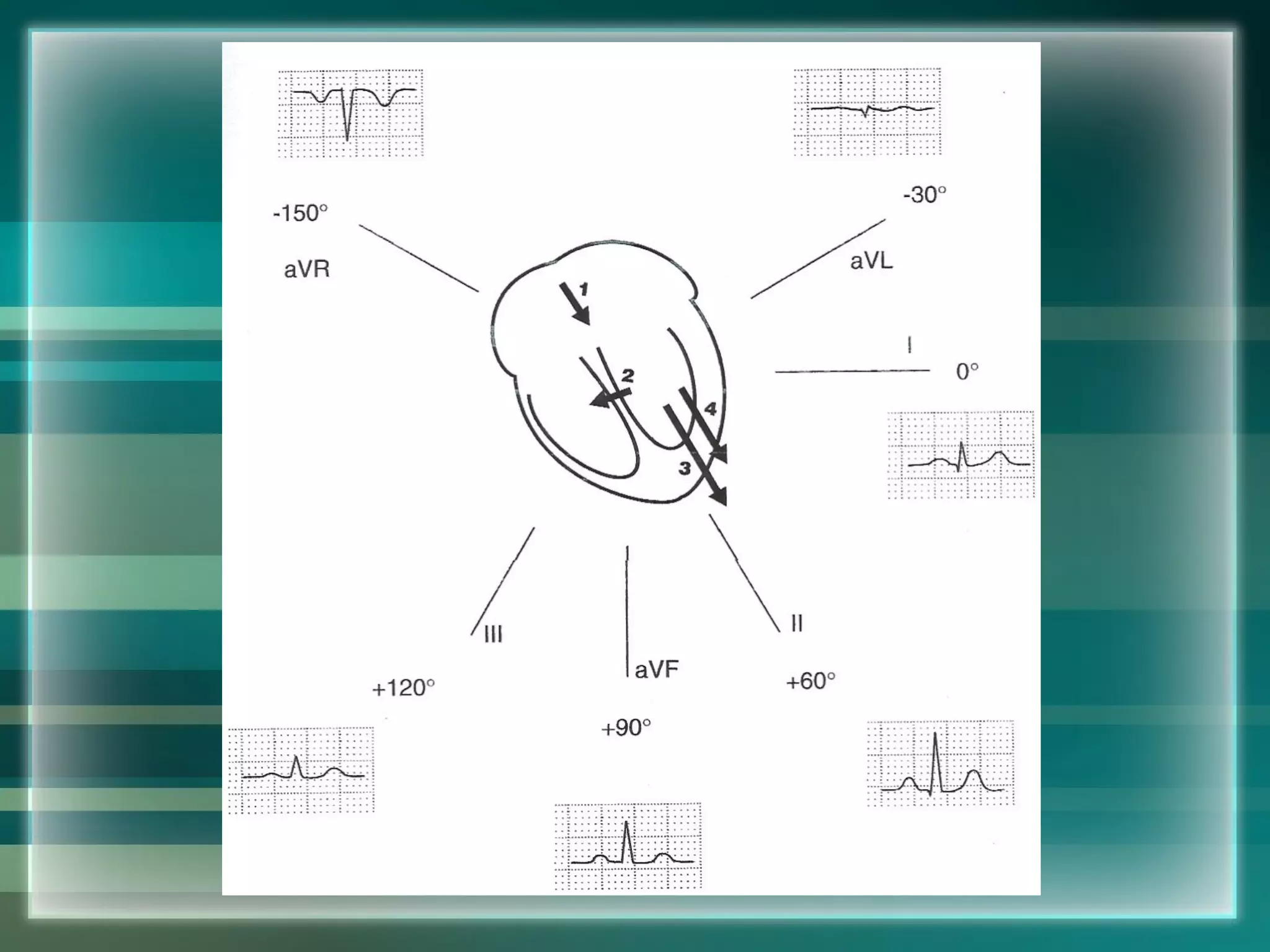
Equiphasic Approach Equiphasic in aVF    Predominantly positive in I    QRS axis  ≈ 0°
Thank You
BRADYARRYTHMIA Dr Subroto Mandal, MD, DM, DC Associate Professor, Cardiology
Classification Sinus Bradycardia Junctional Rhythm Sino Atrial Block Atrioventricular block
Impulse Conduction & the ECG Sinoatrial node AV node Bundle of His Bundle Branches
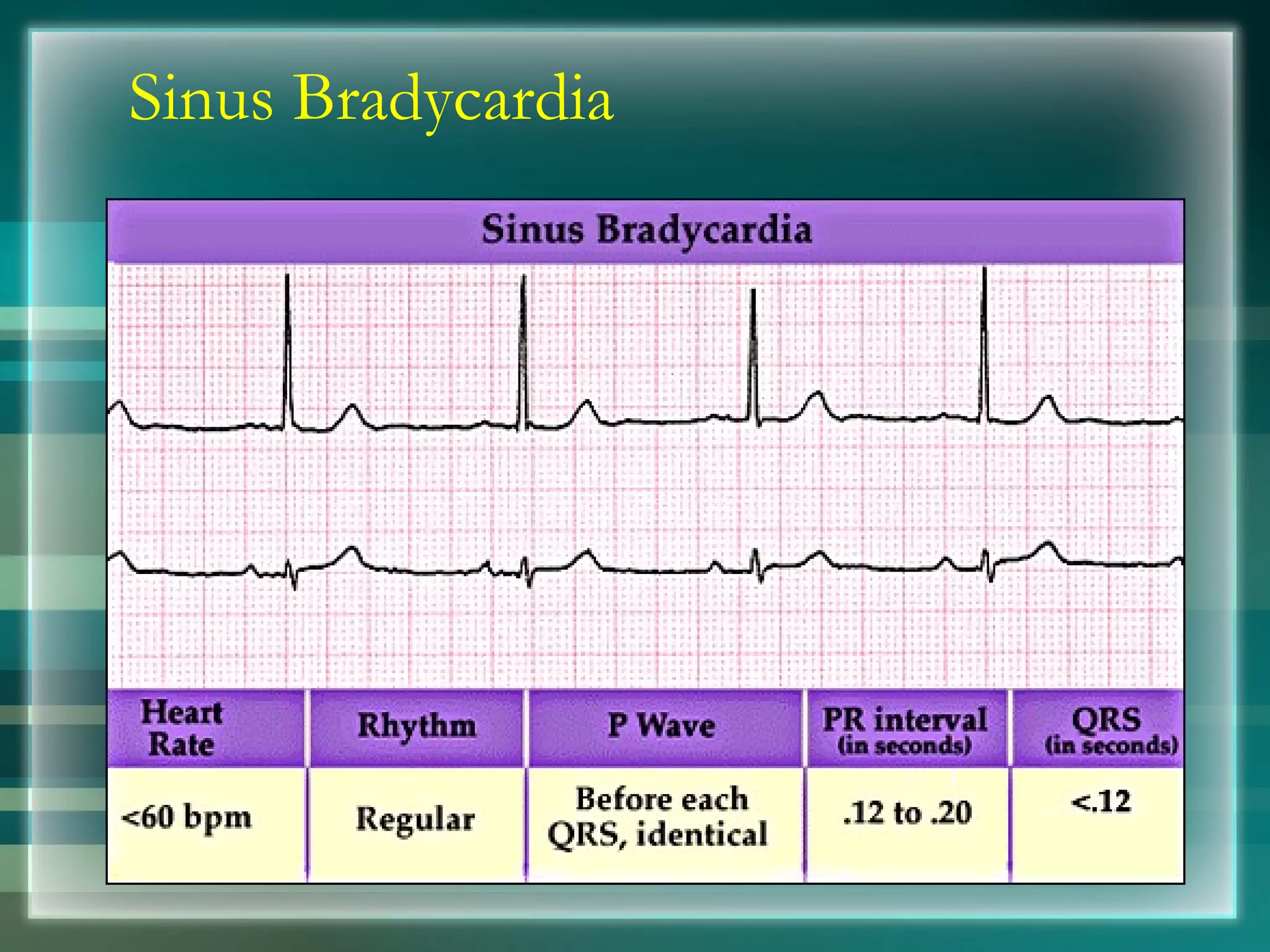
Sinus Bradycardia
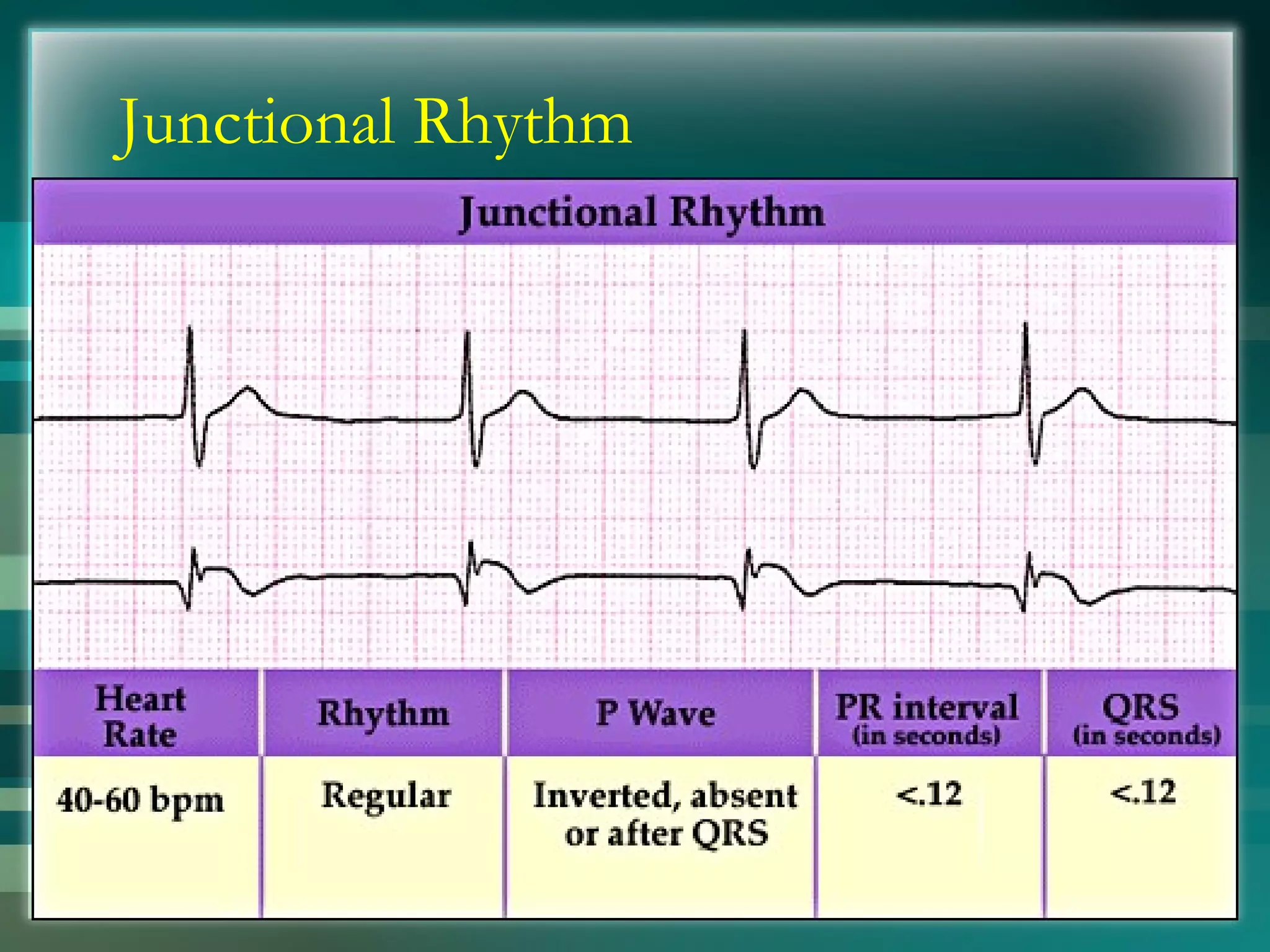
Junctional Rhythm
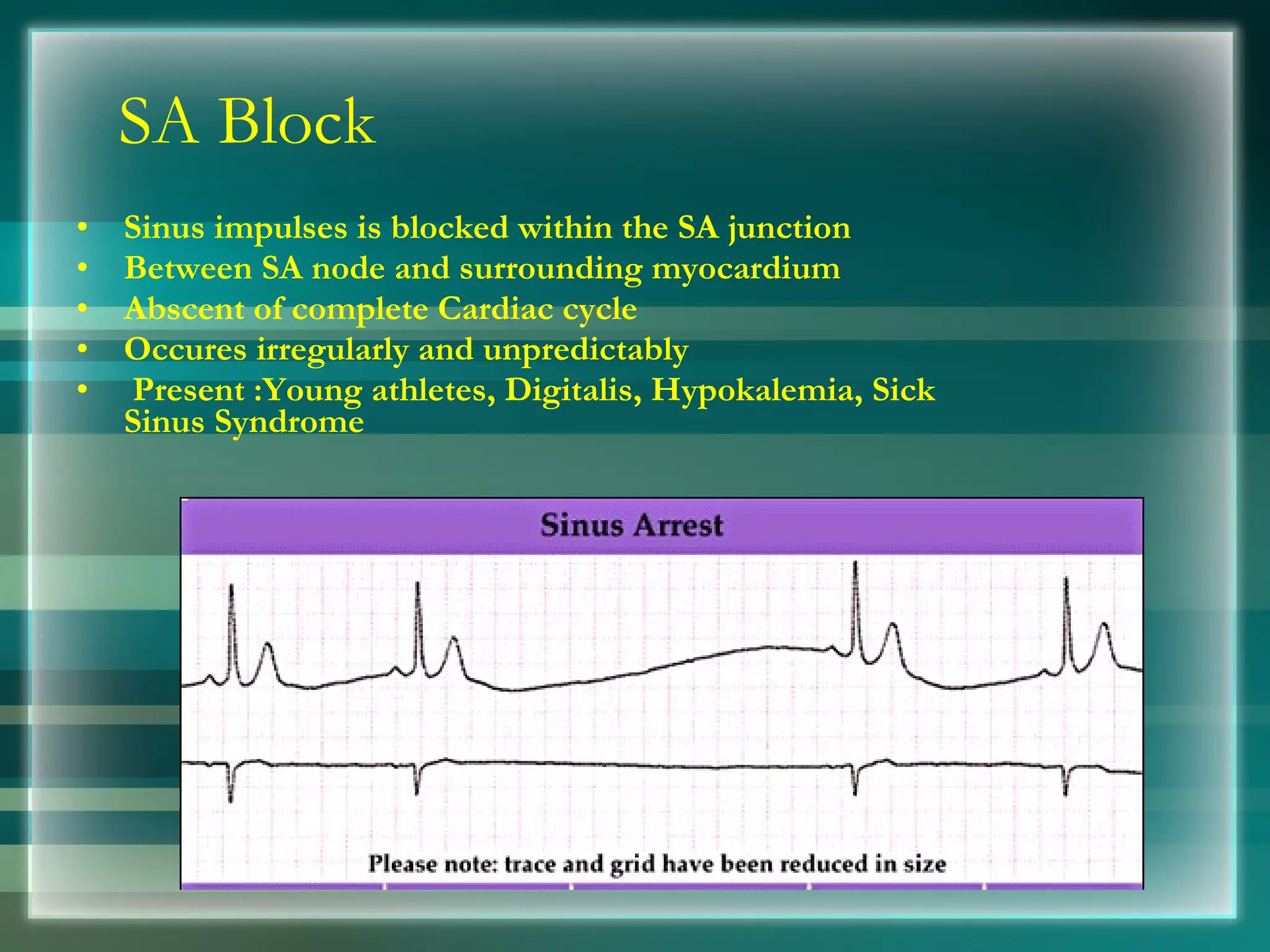
SA Block Sinus impulses is blocked within the SA junction Between SA node and surrounding myocardium Abscent of complete Cardiac cycle Occures irregularly and unpredictably Present :Young athletes, Digitalis, Hypokalemia, Sick Sinus Syndrome
AV Block First Degree AV Block Second Degree AV Block Third Degree AV Block
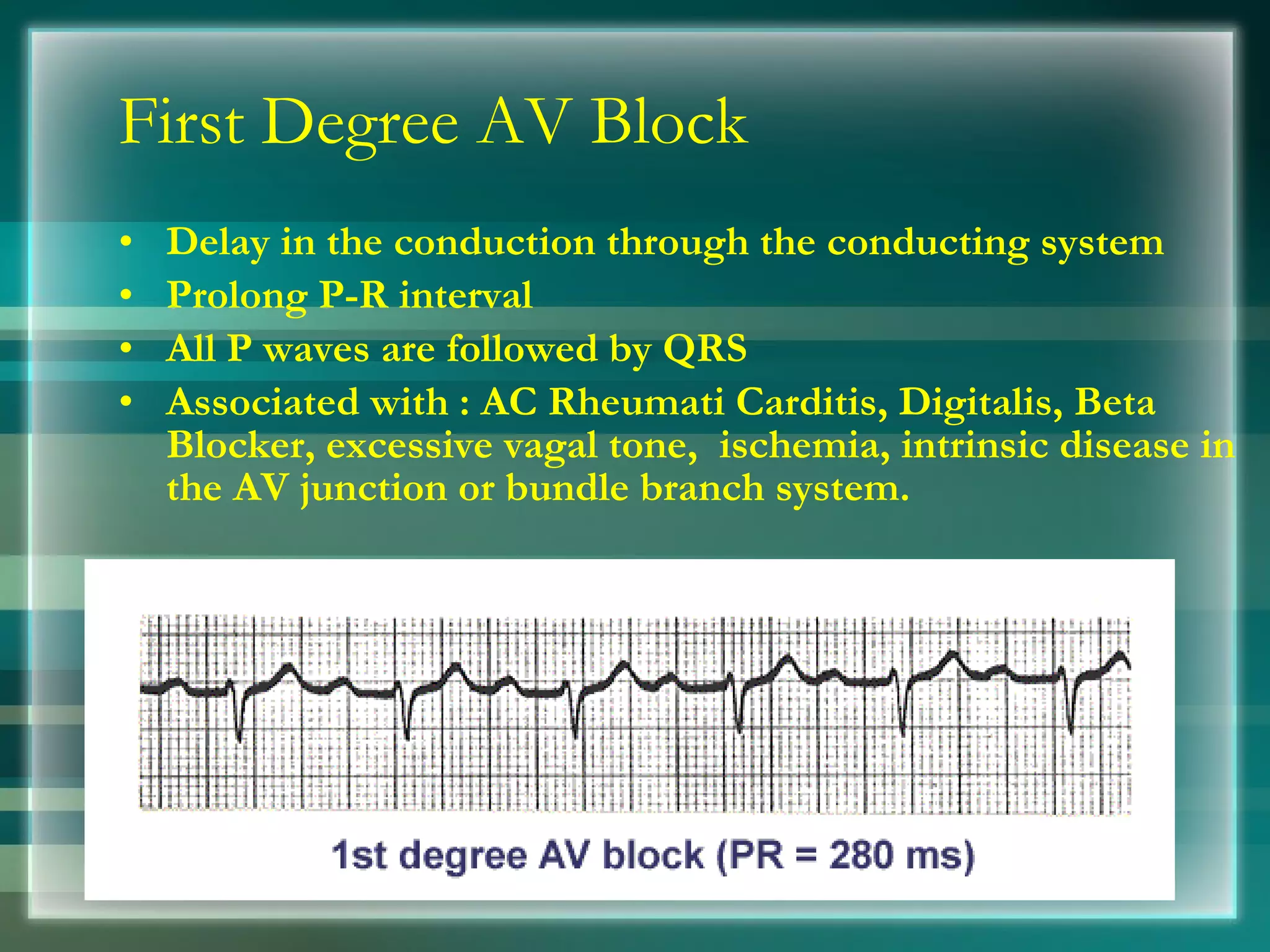
First Degree AV Block Delay in the conduction through the conducting system Prolong P-R interval All P waves are followed by QRS Associated with : AC Rheumati Carditis, Digitalis, Beta Blocker, excessive vagal tone,  ischemia, intrinsic disease in the AV junction or bundle branch system.
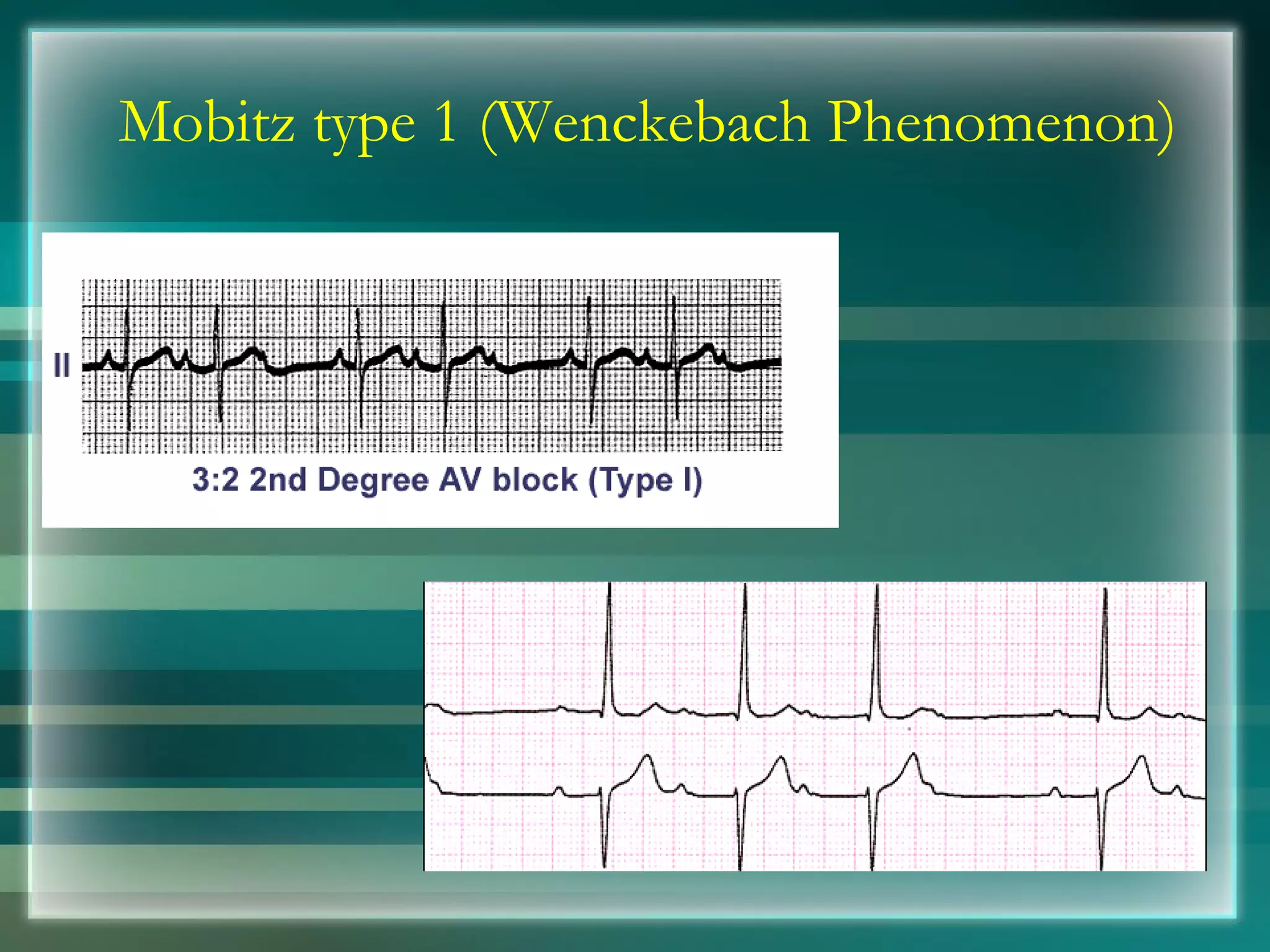
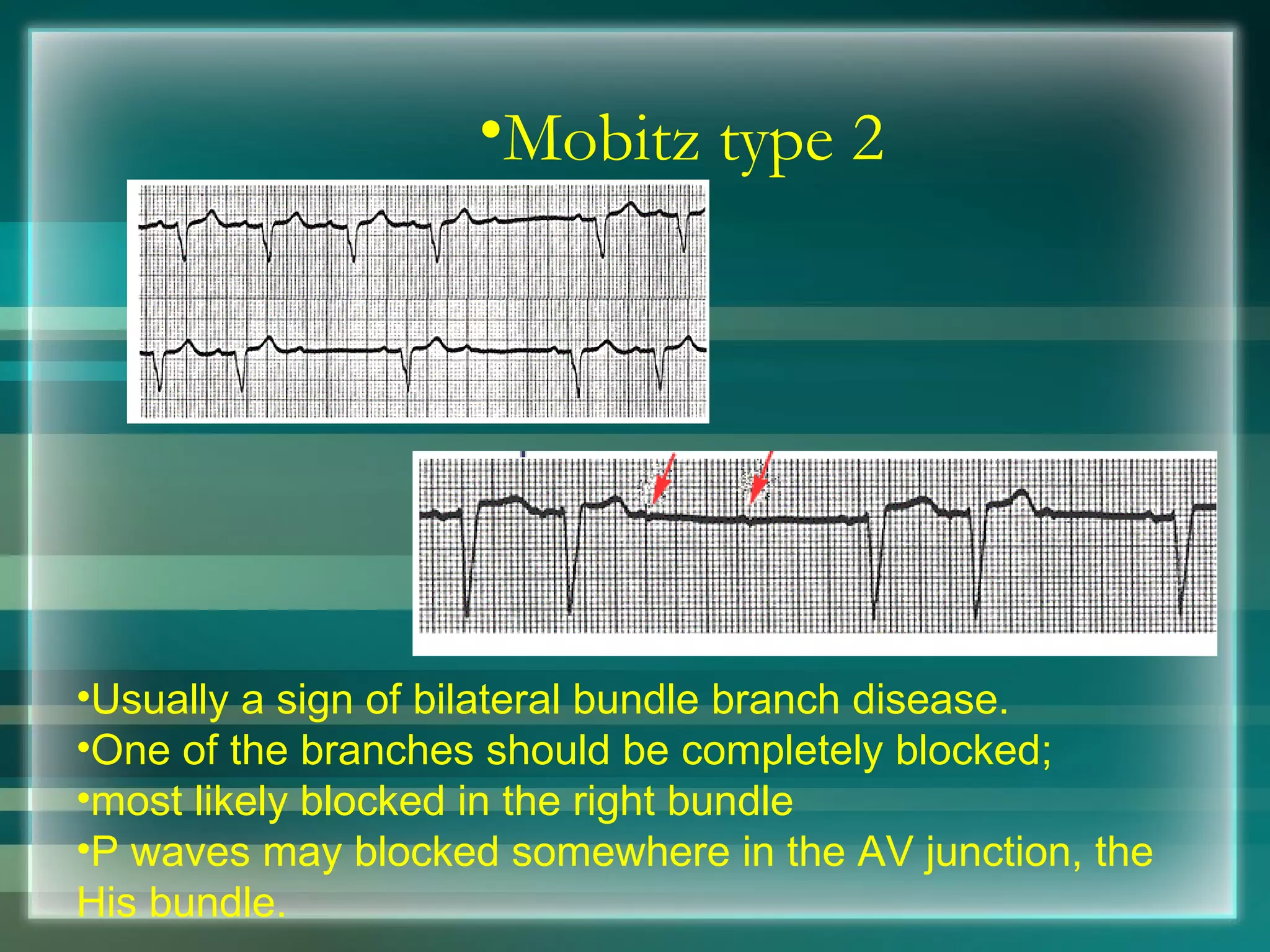
Second Degree AV Block Intermittent failure of AV conduction  Impulse blocked by AV node Types: Mobitz type 1 (Wenckebach Phenomenon) Mobitz type 2
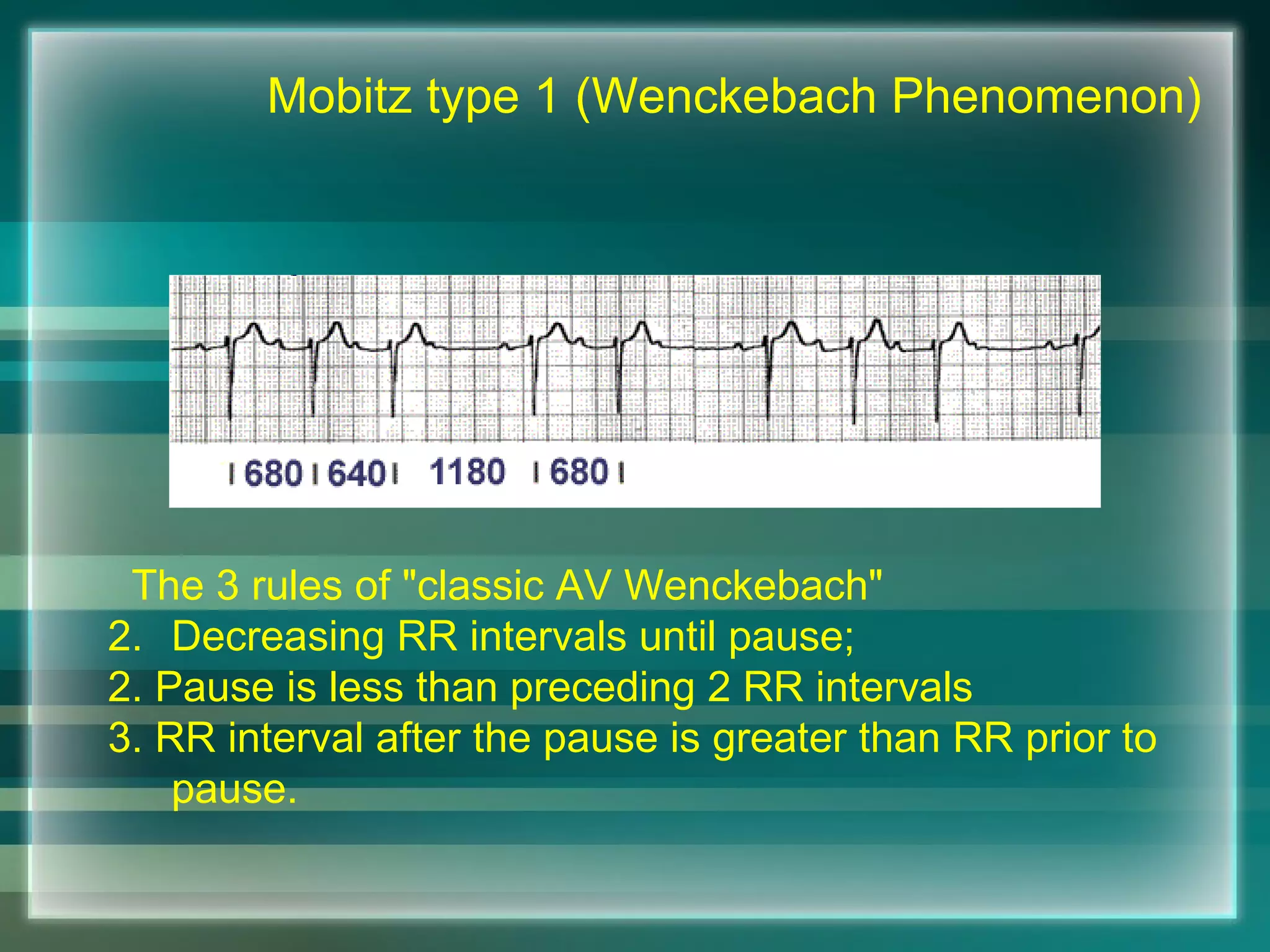
  The 3 rules of &quot;classic AV Wenckebach&quot;  Decreasing RR intervals until pause;  2. Pause is less than preceding 2 RR intervals 3. RR interval after the pause is greater than RR prior to pause. Mobitz type 1 (Wenckebach Phenomenon)
Mobitz type 1 (Wenckebach Phenomenon)
Mobitz type 2 Usually a sign of bilateral bundle branch disease. One of the branches should be completely blocked; most likely blocked in the right bundle  P waves may blocked somewhere in the AV junction, the His bundle.
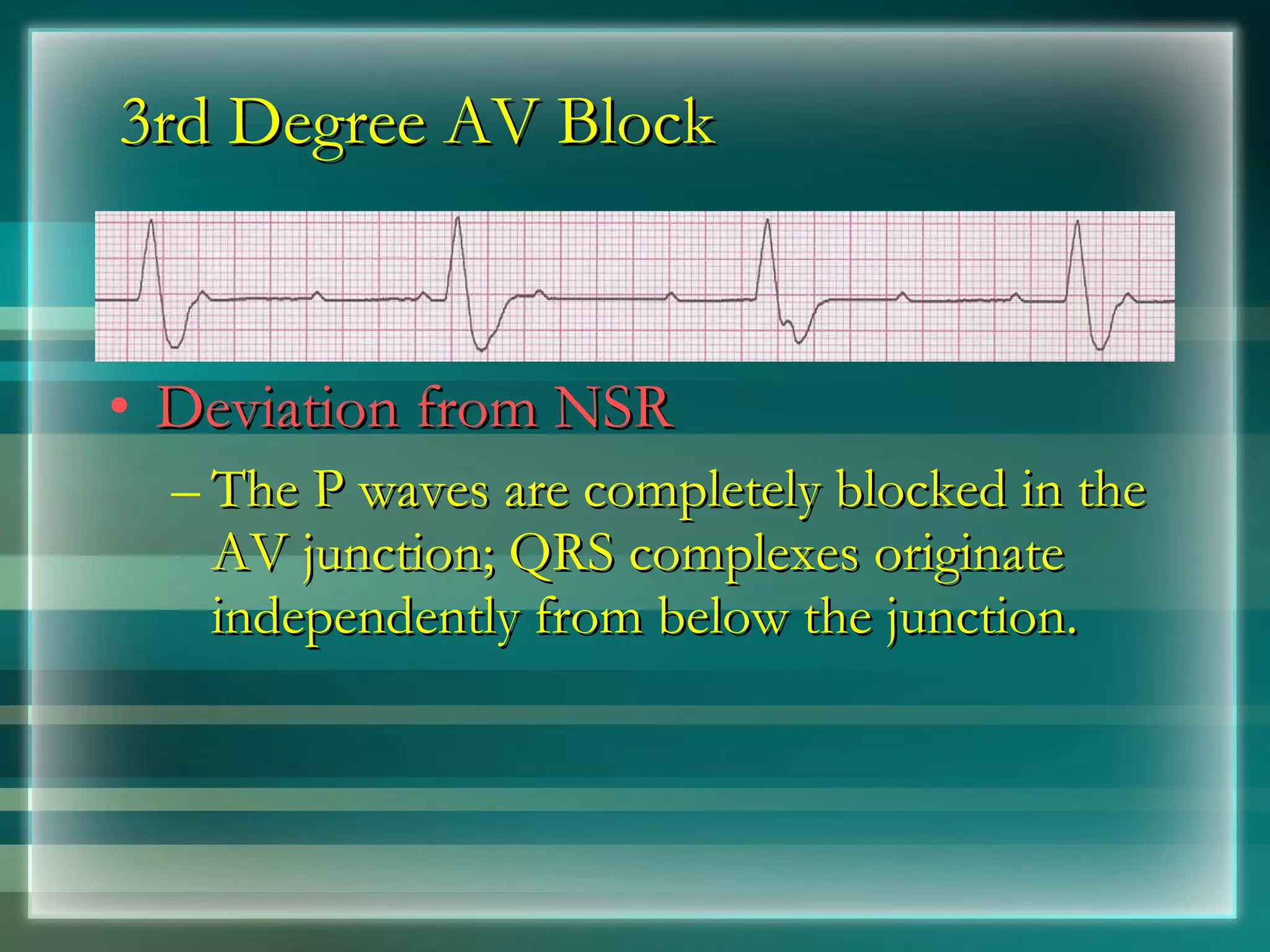
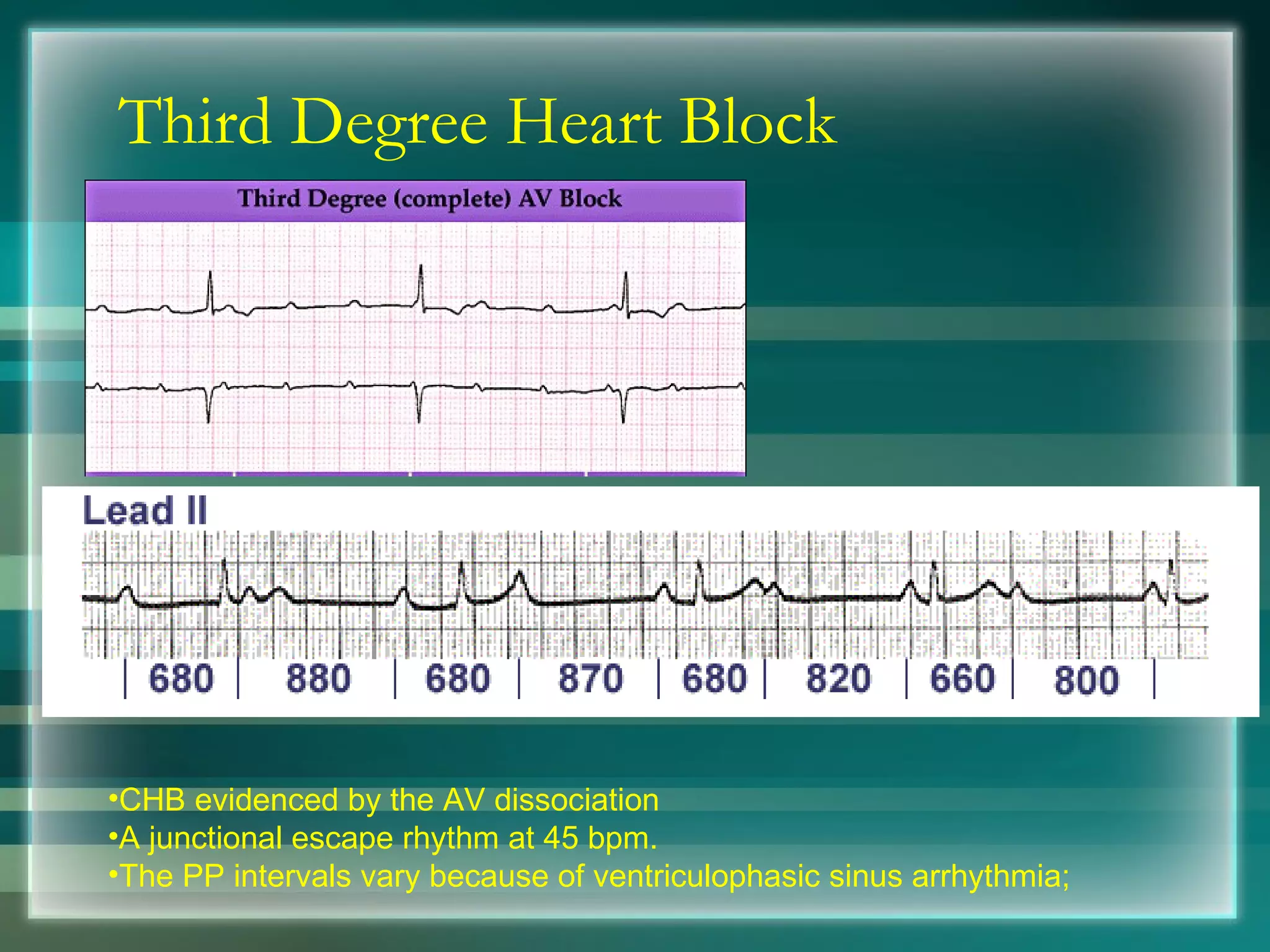
Third Degree Heart Block CHB evidenced by the AV dissociation A junctional escape rhythm at 45 bpm.  The PP intervals vary because of ventriculophasic sinus arrhythmia;
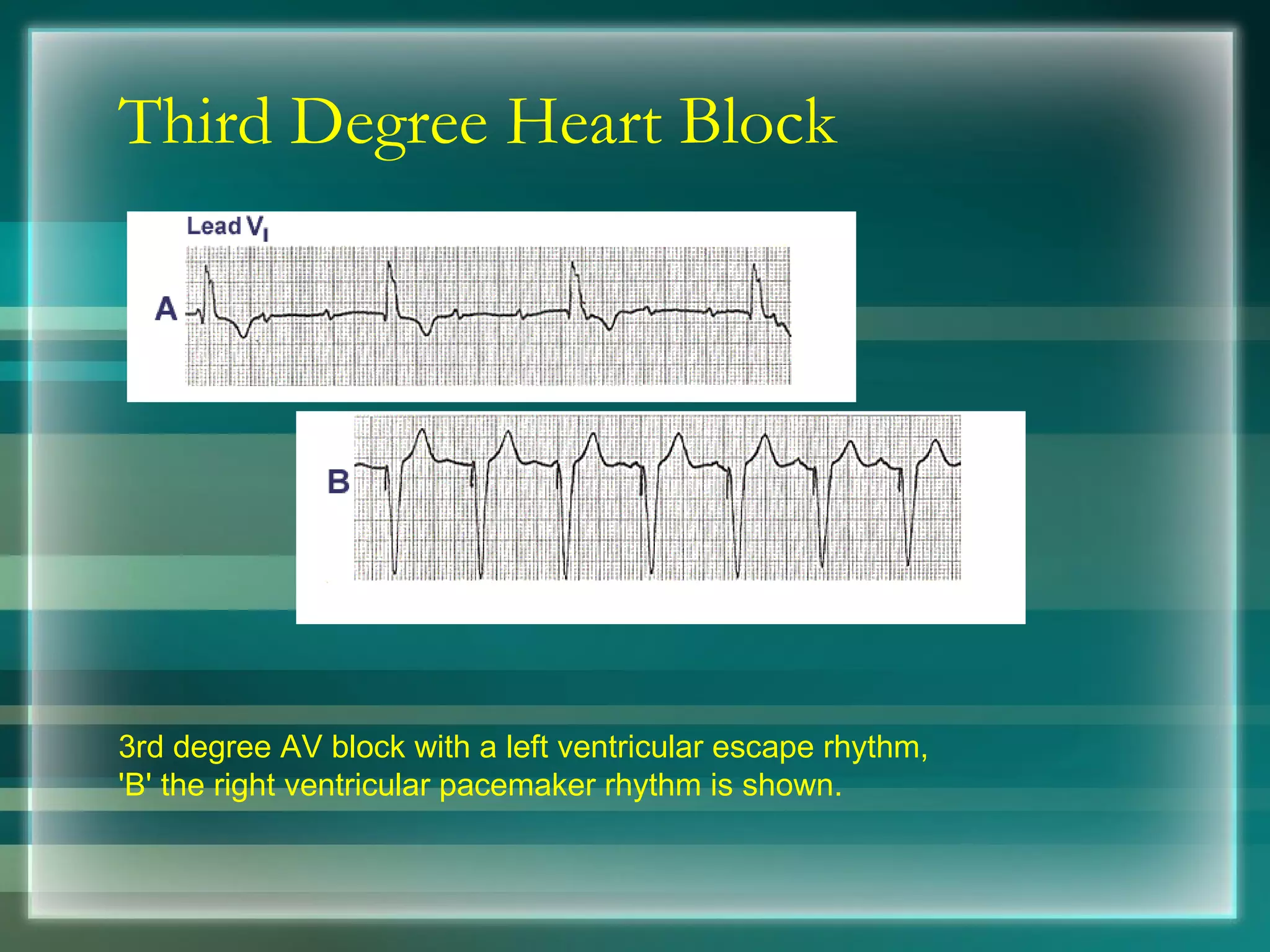
Third Degree Heart Block 3rd degree AV block with a left ventricular escape rhythm,  'B' the right ventricular pacemaker rhythm is shown.
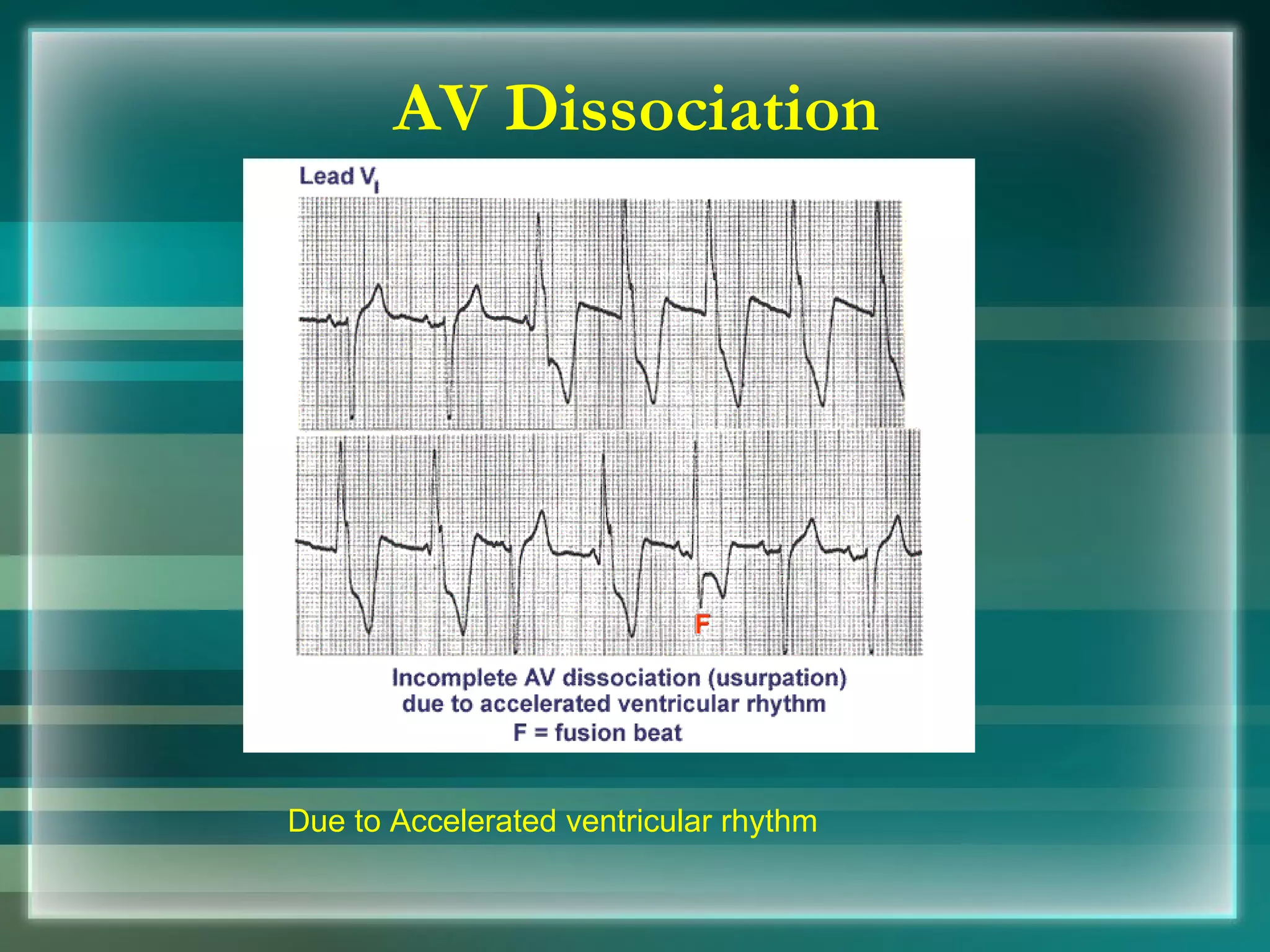
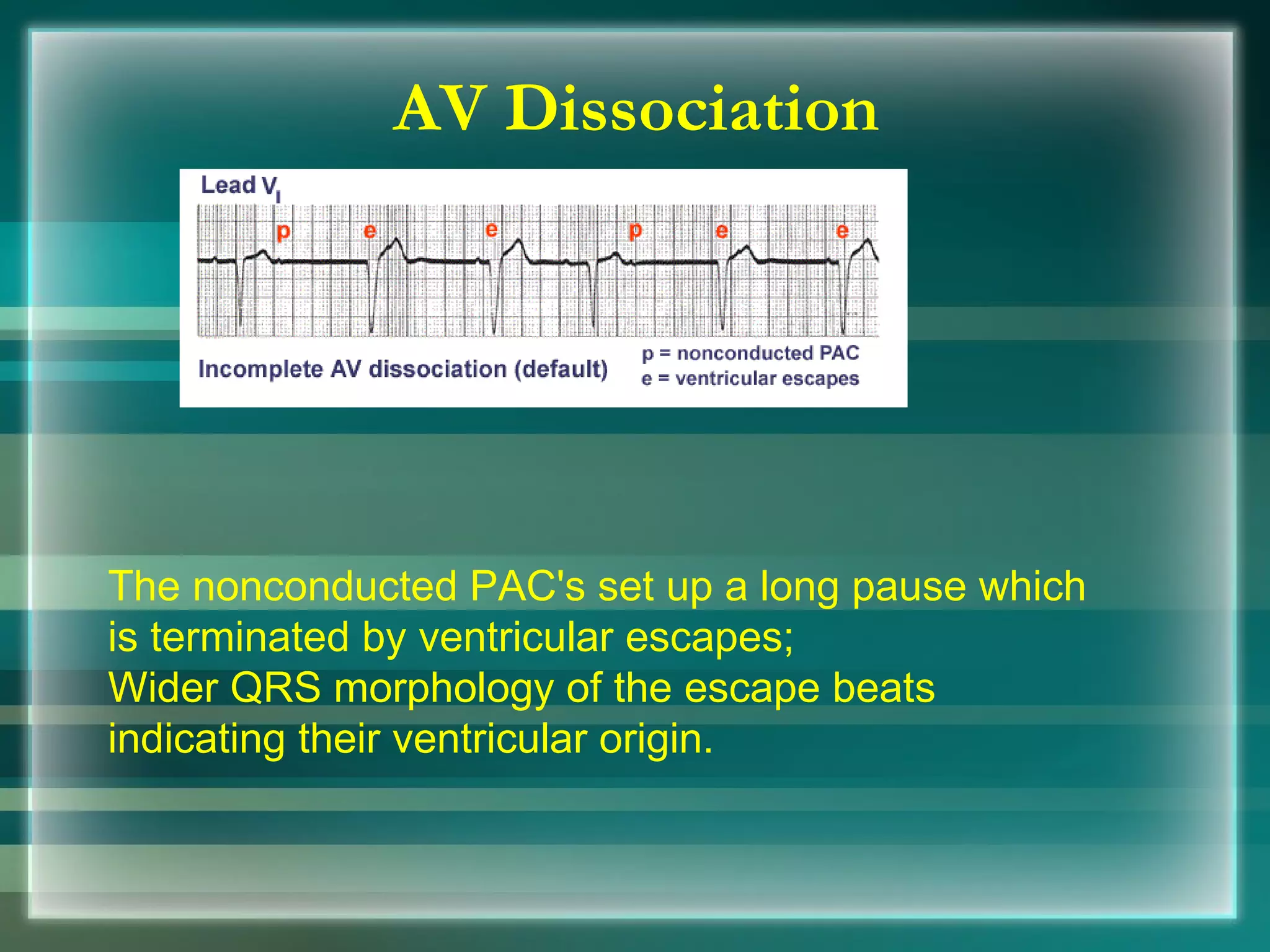
The nonconducted PAC's set up a long pause which is terminated by ventricular escapes;  Wider QRS morphology of the escape beats indicating their ventricular origin.  AV Dissociation
AV Dissociation Due to Accelerated ventricular rhythm
Thank You
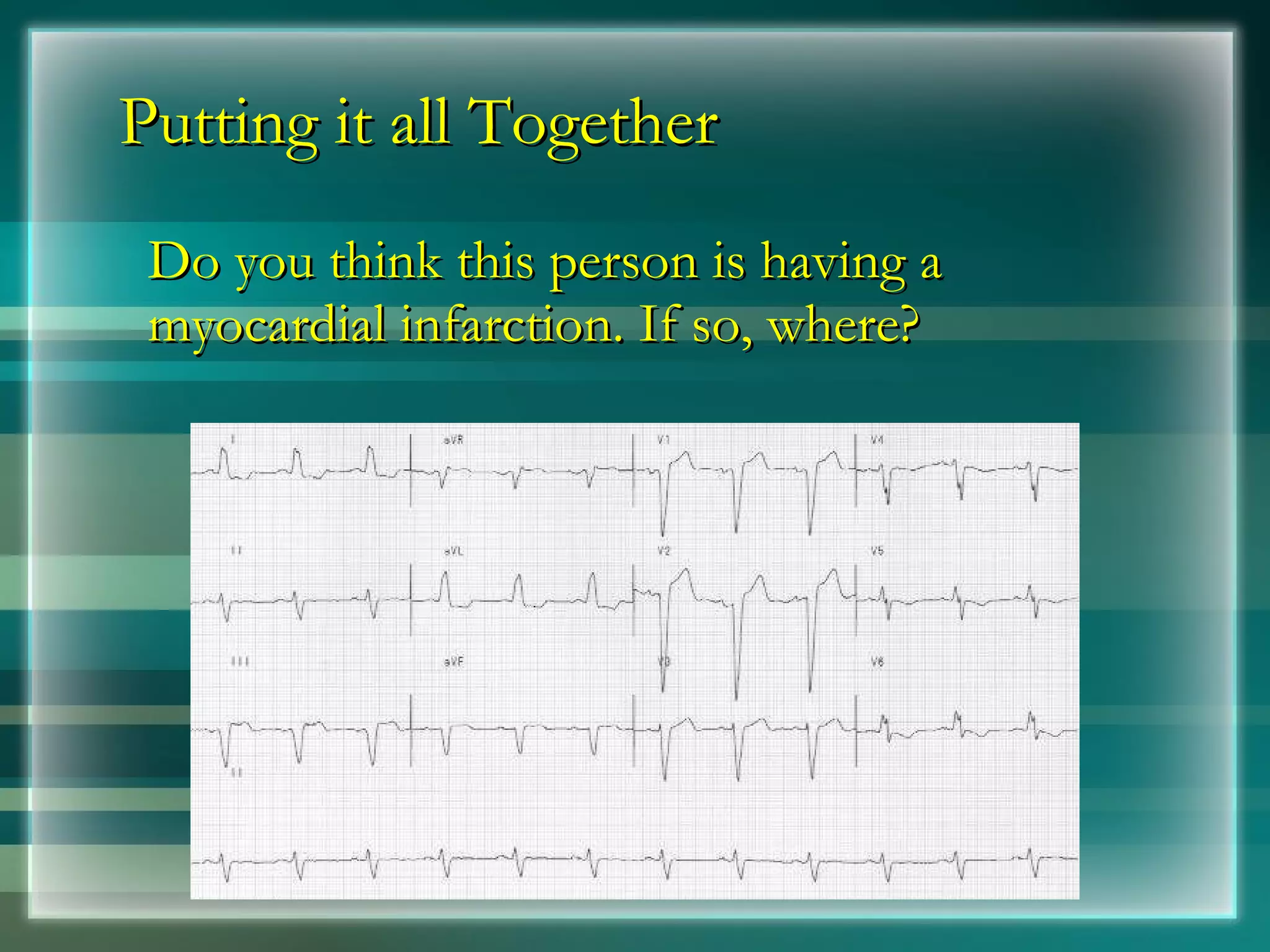
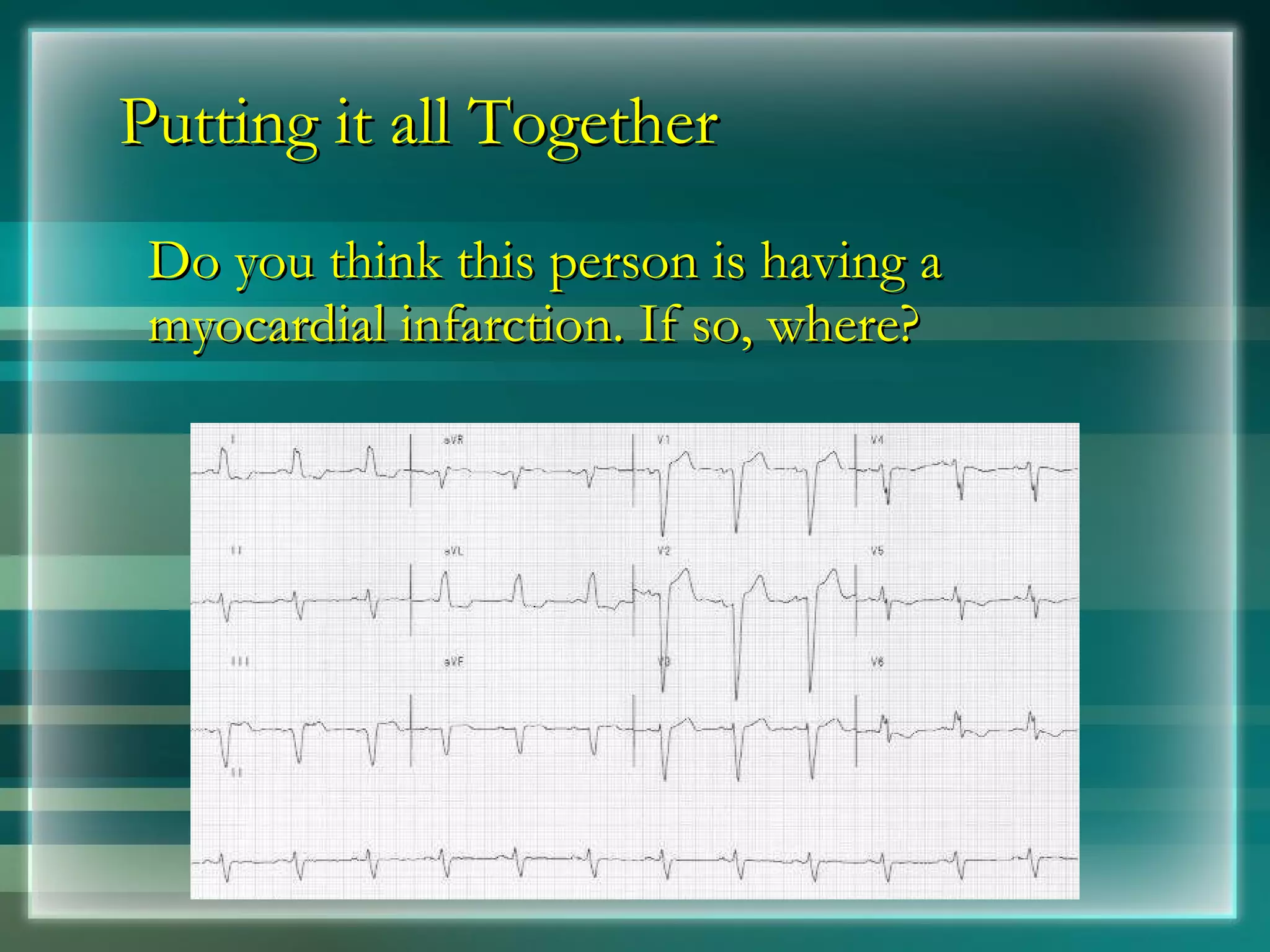
Putting it all Together Do you think this person is having a myocardial infarction. If so, where?
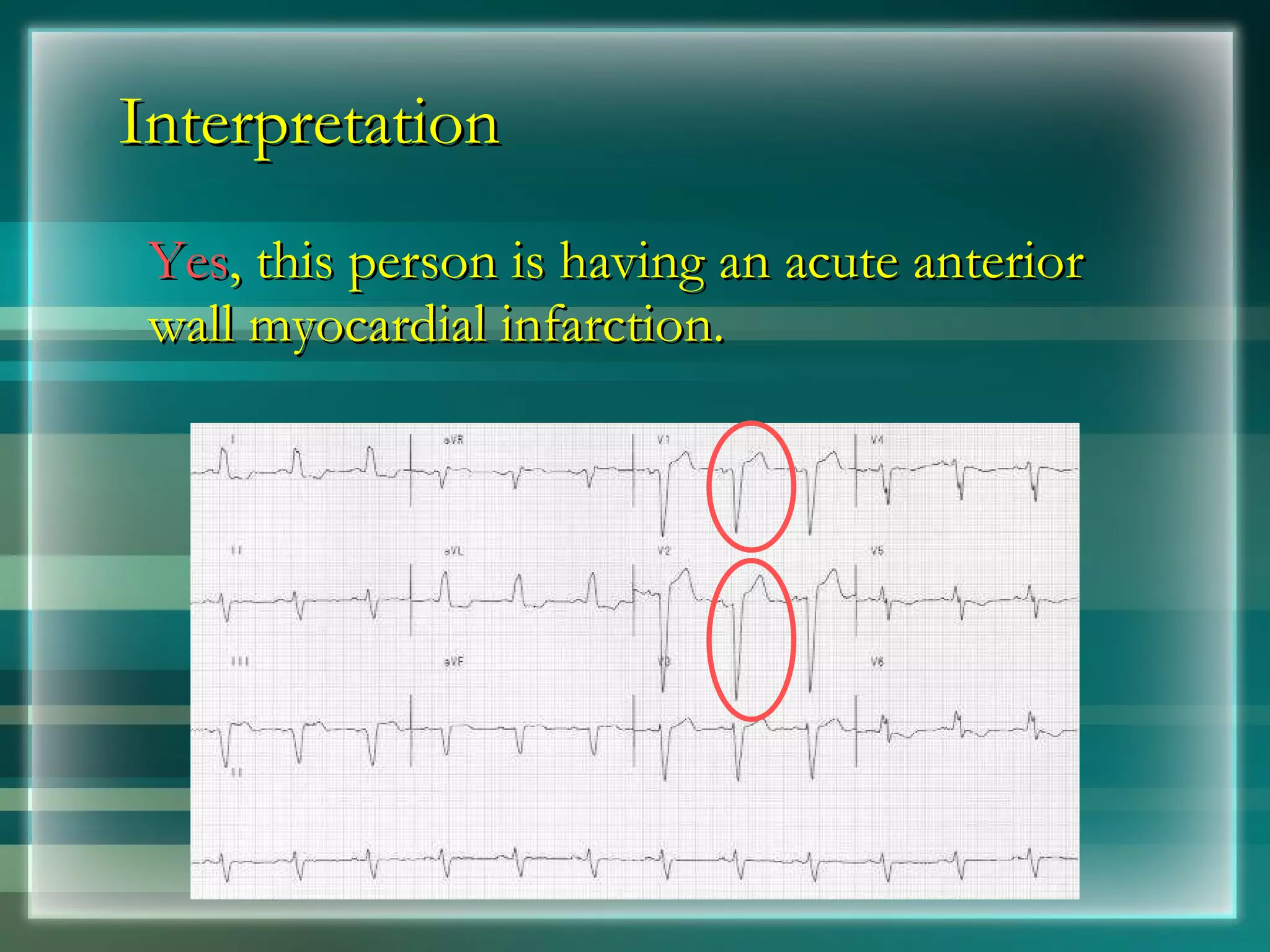
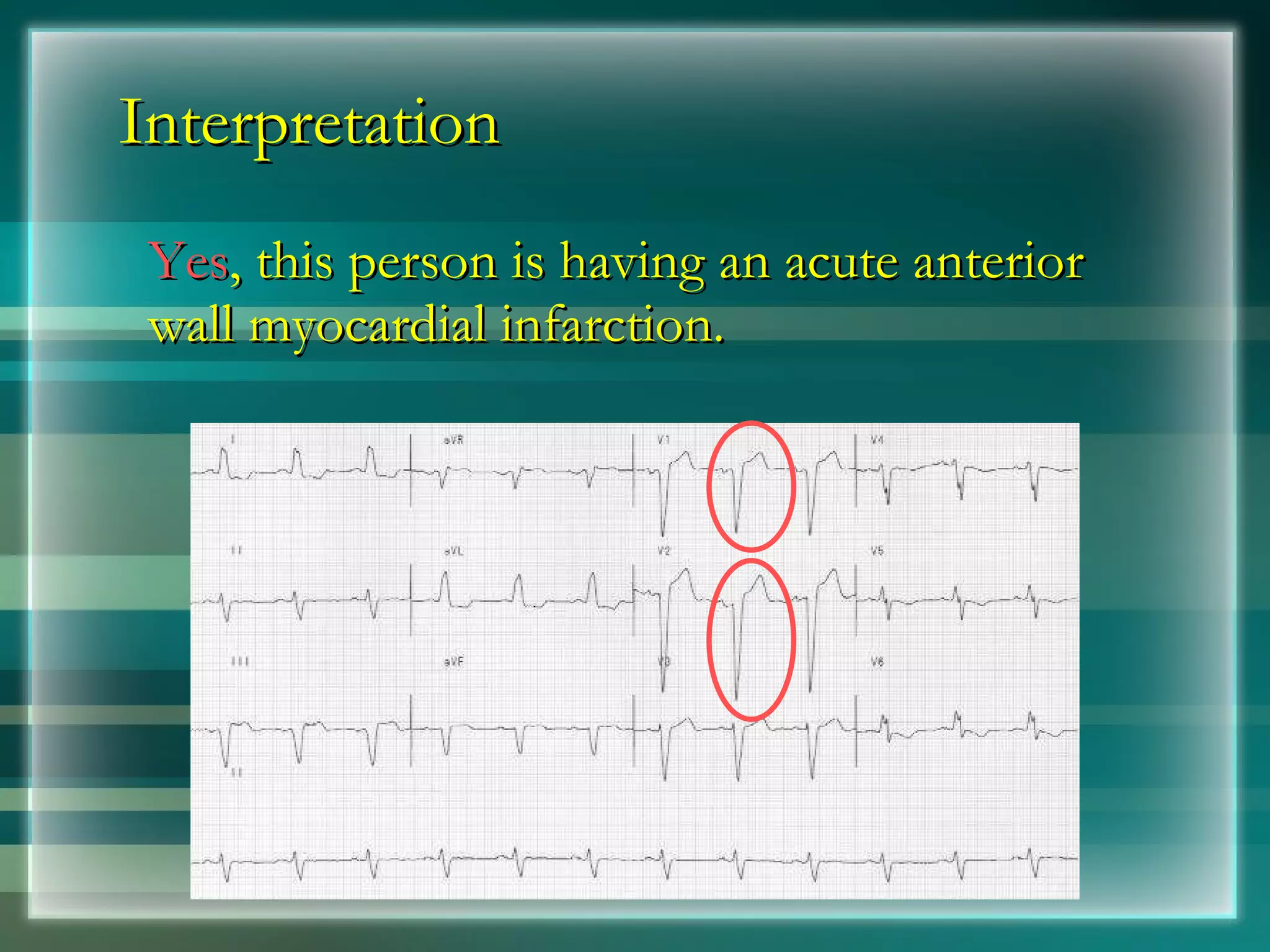
Interpretation Yes , this person is having an acute anterior wall myocardial infarction.
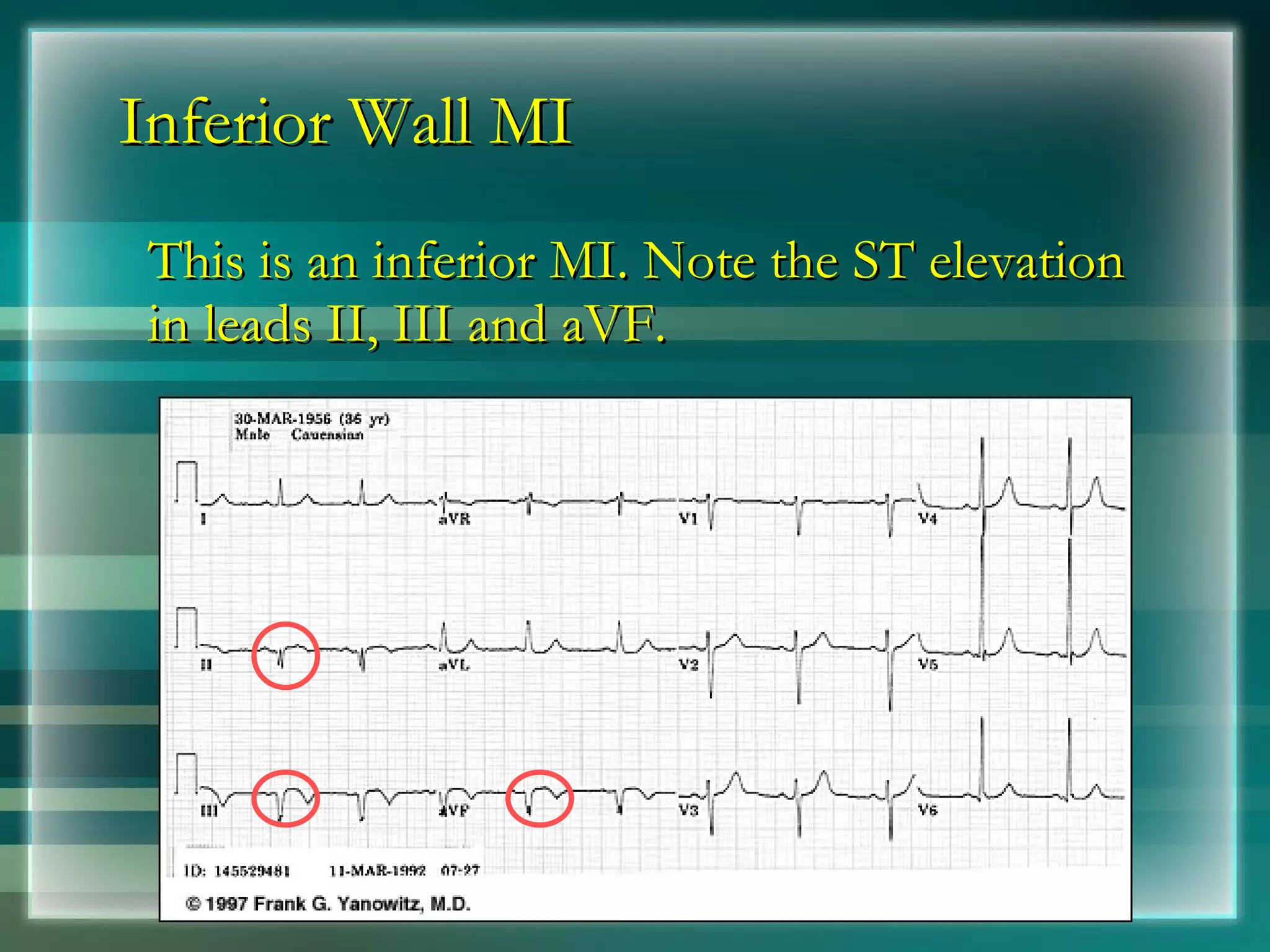
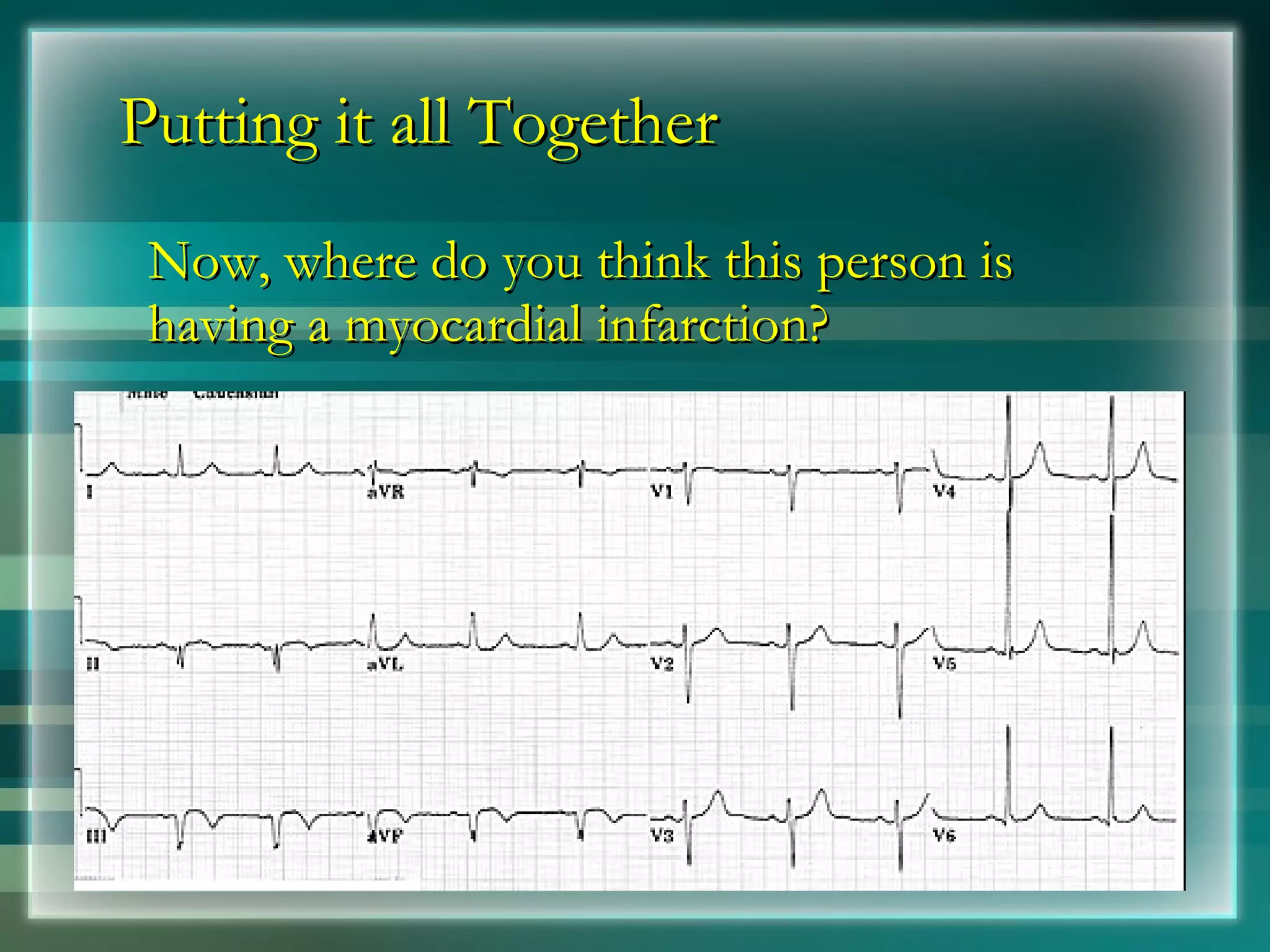
Putting it all Together Now, where do you think this person is having a myocardial infarction?
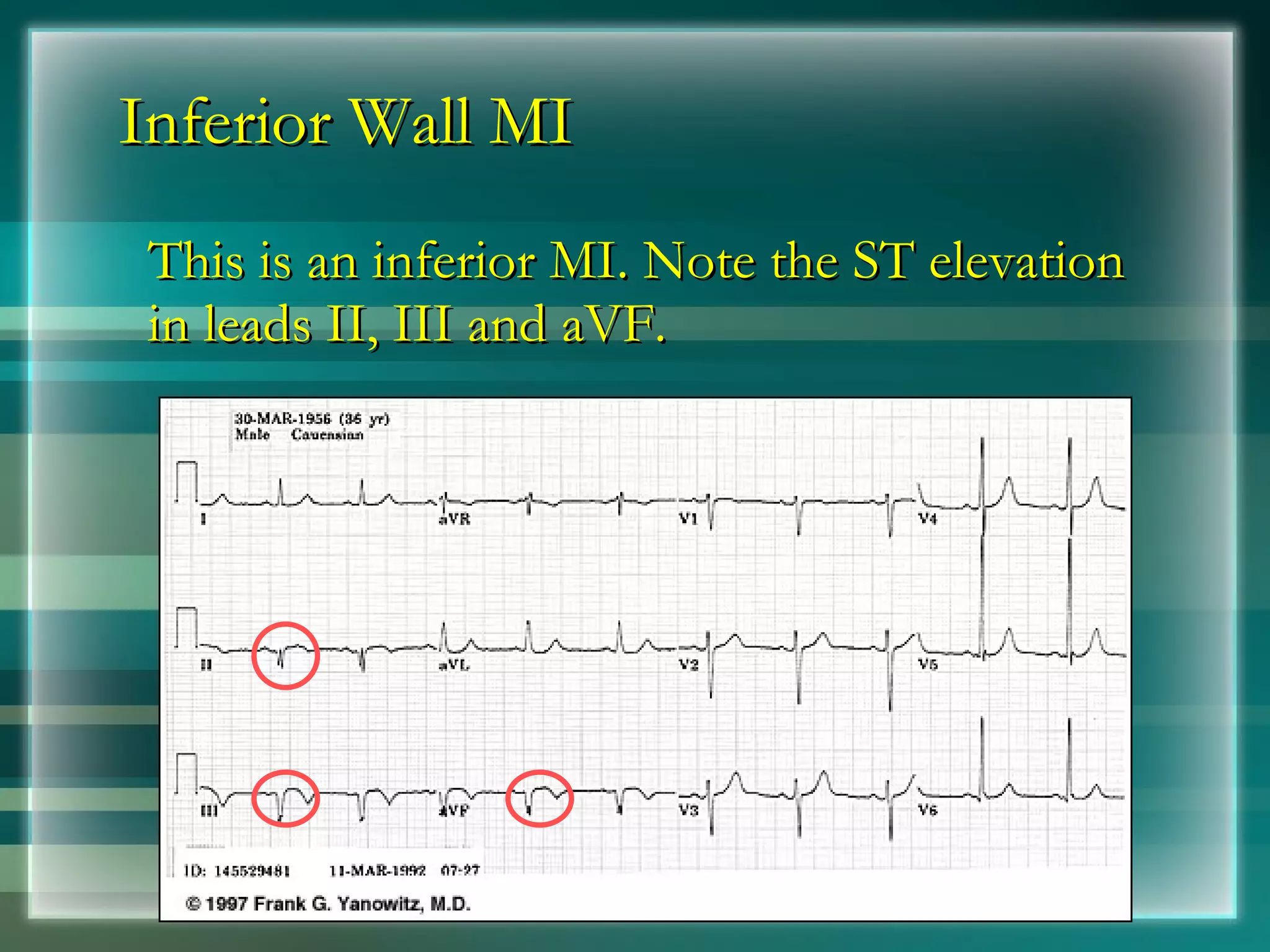
Inferior Wall MI This is an inferior MI. Note the ST elevation in leads II, III and aVF.
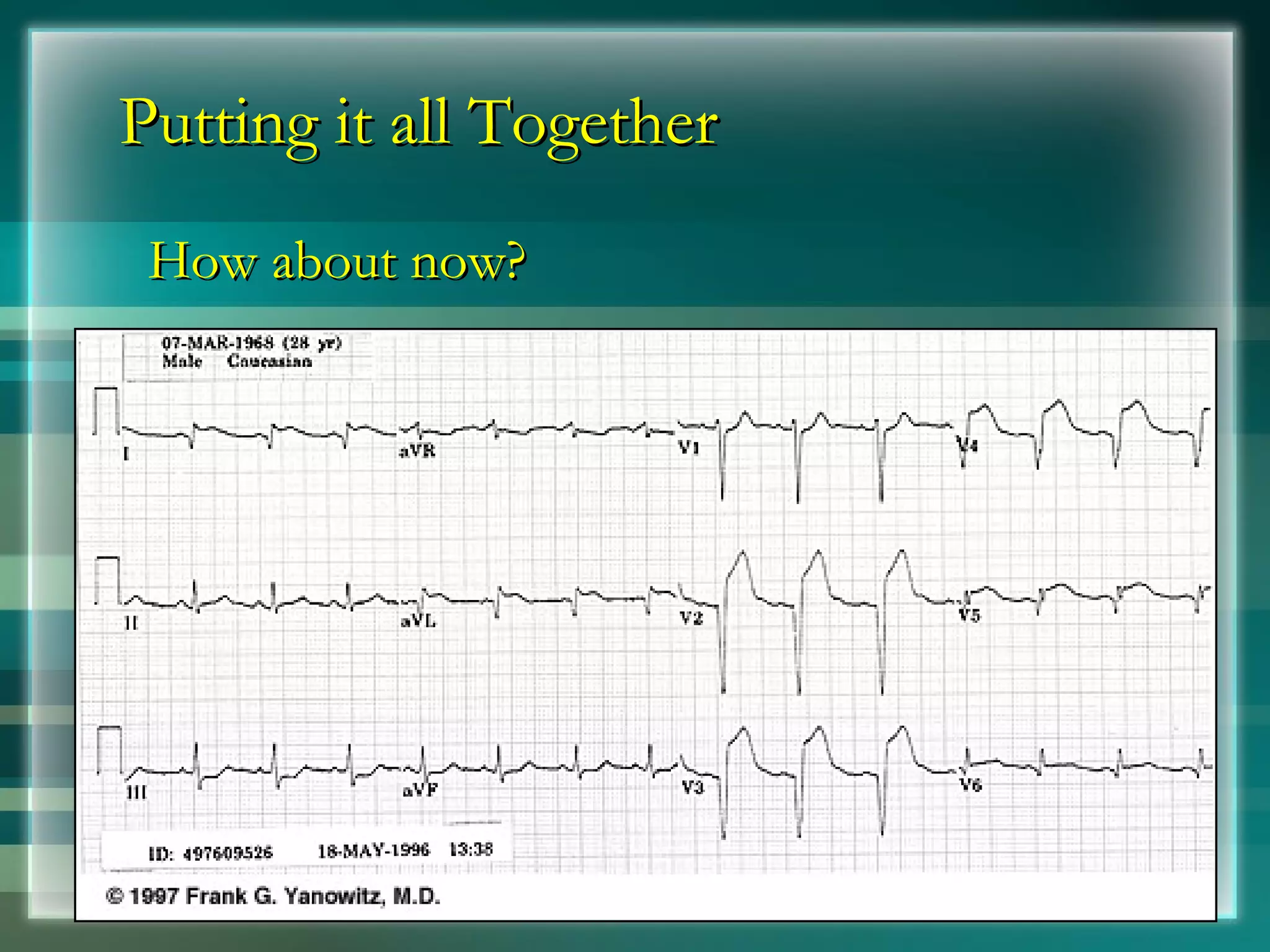
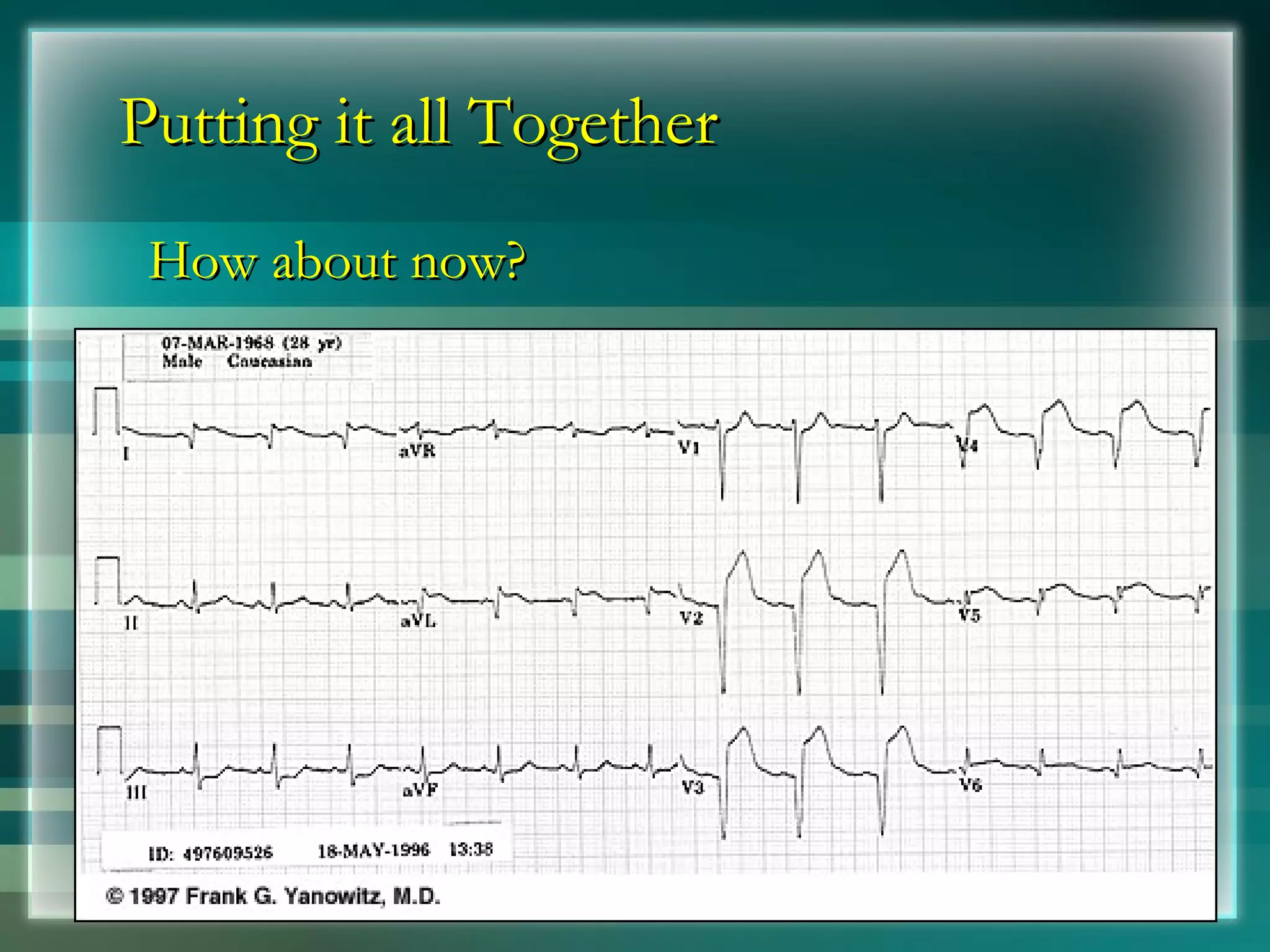
Putting it all Together How about now?
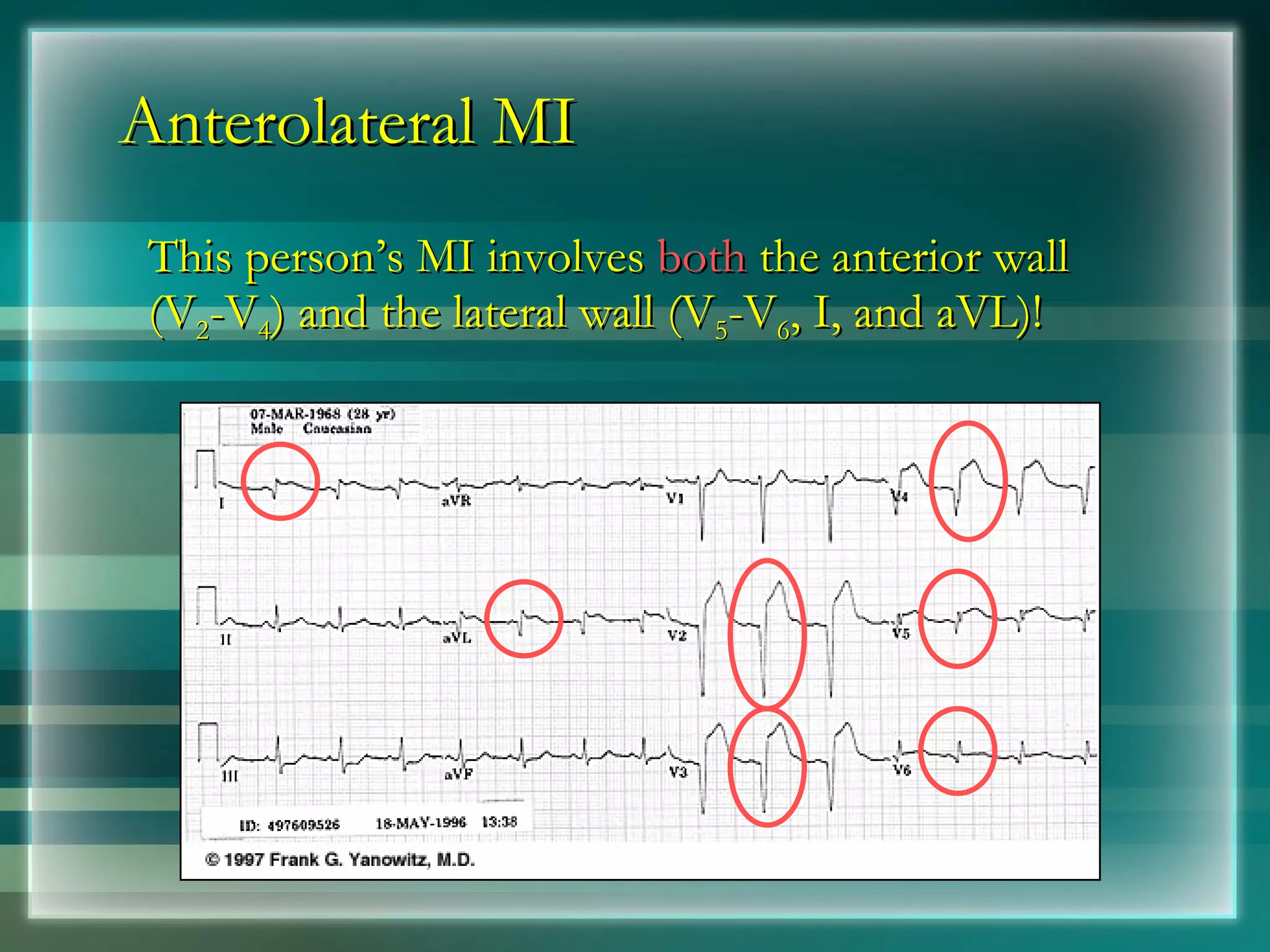
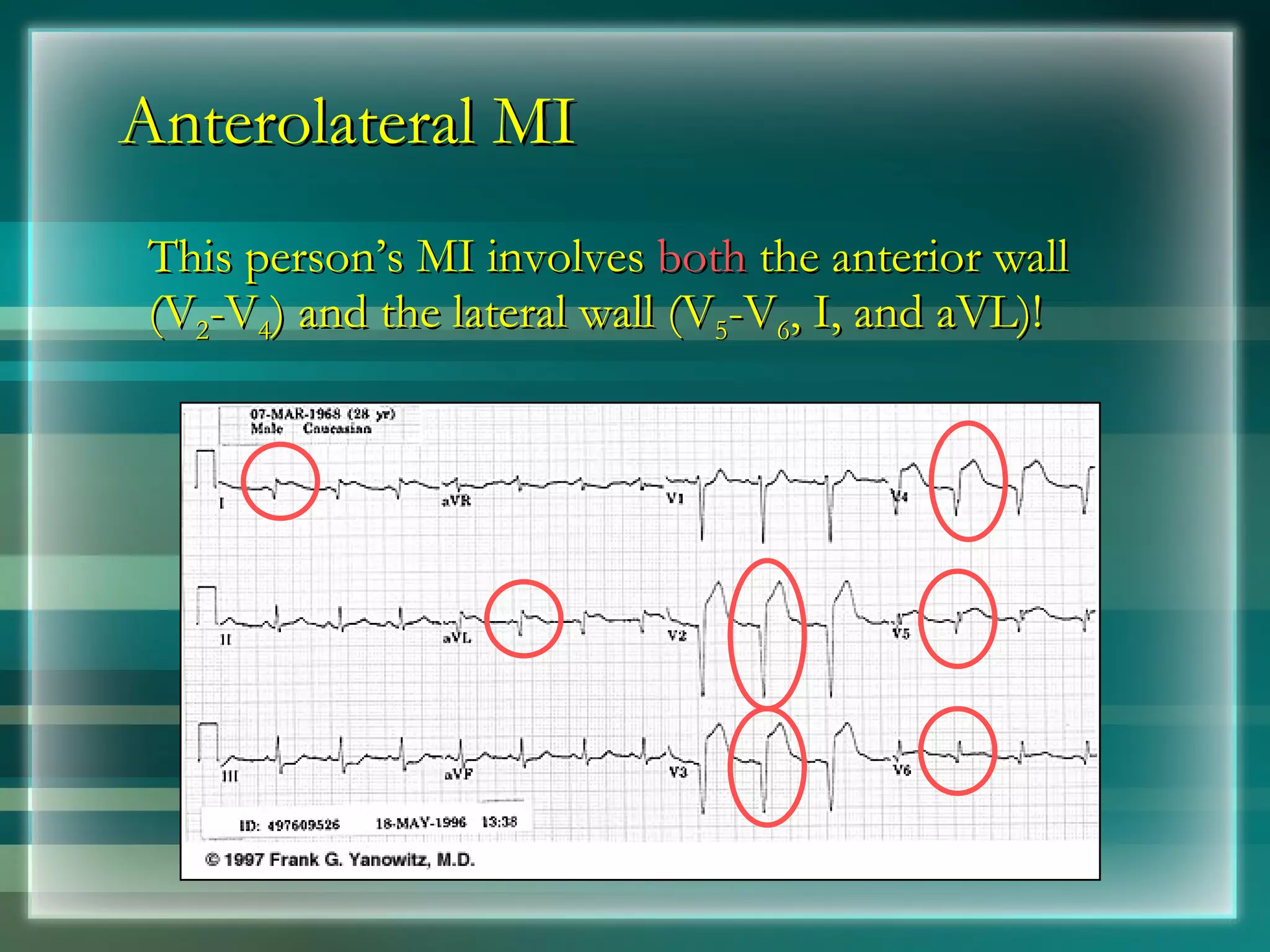
Anterolateral MI This person’s MI involves  both  the anterior wall (V 2 -V 4 ) and the lateral wall (V 5 -V 6 , I, and aVL)!
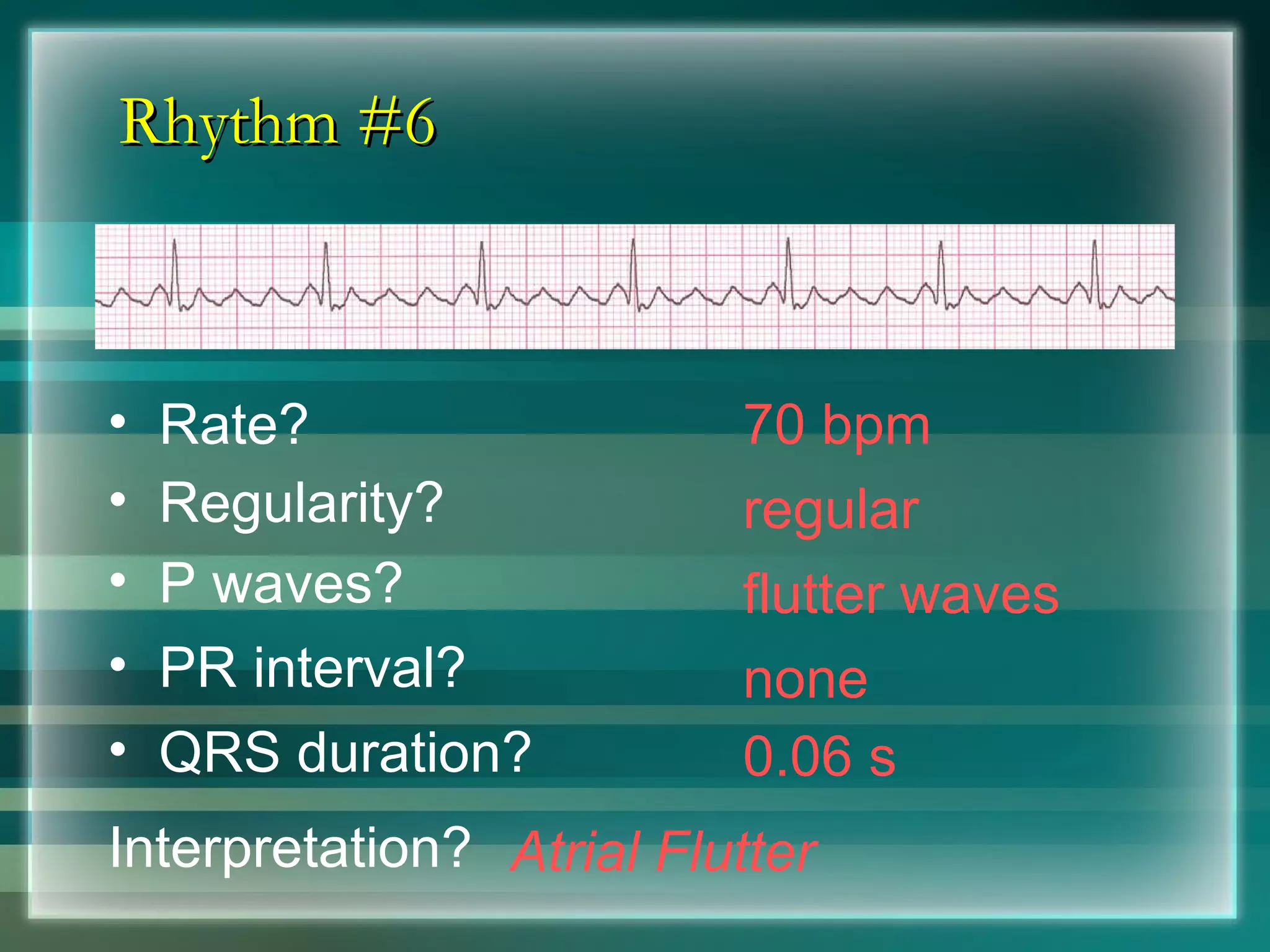
Rhythm #6 70 bpm Rate? Regularity? regular flutter waves 0.06 s P waves? PR interval? none QRS duration? Interpretation? Atrial Flutter
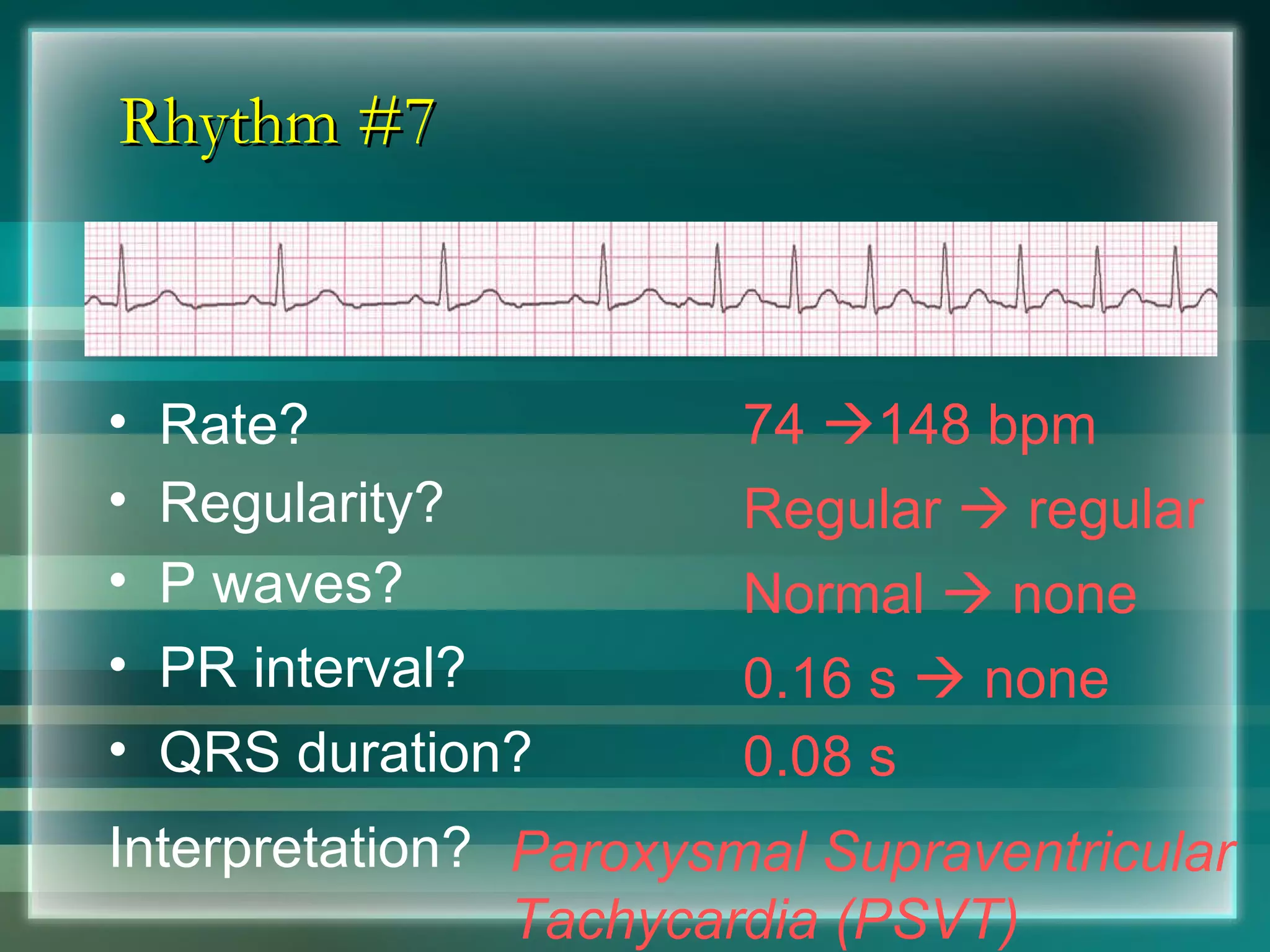
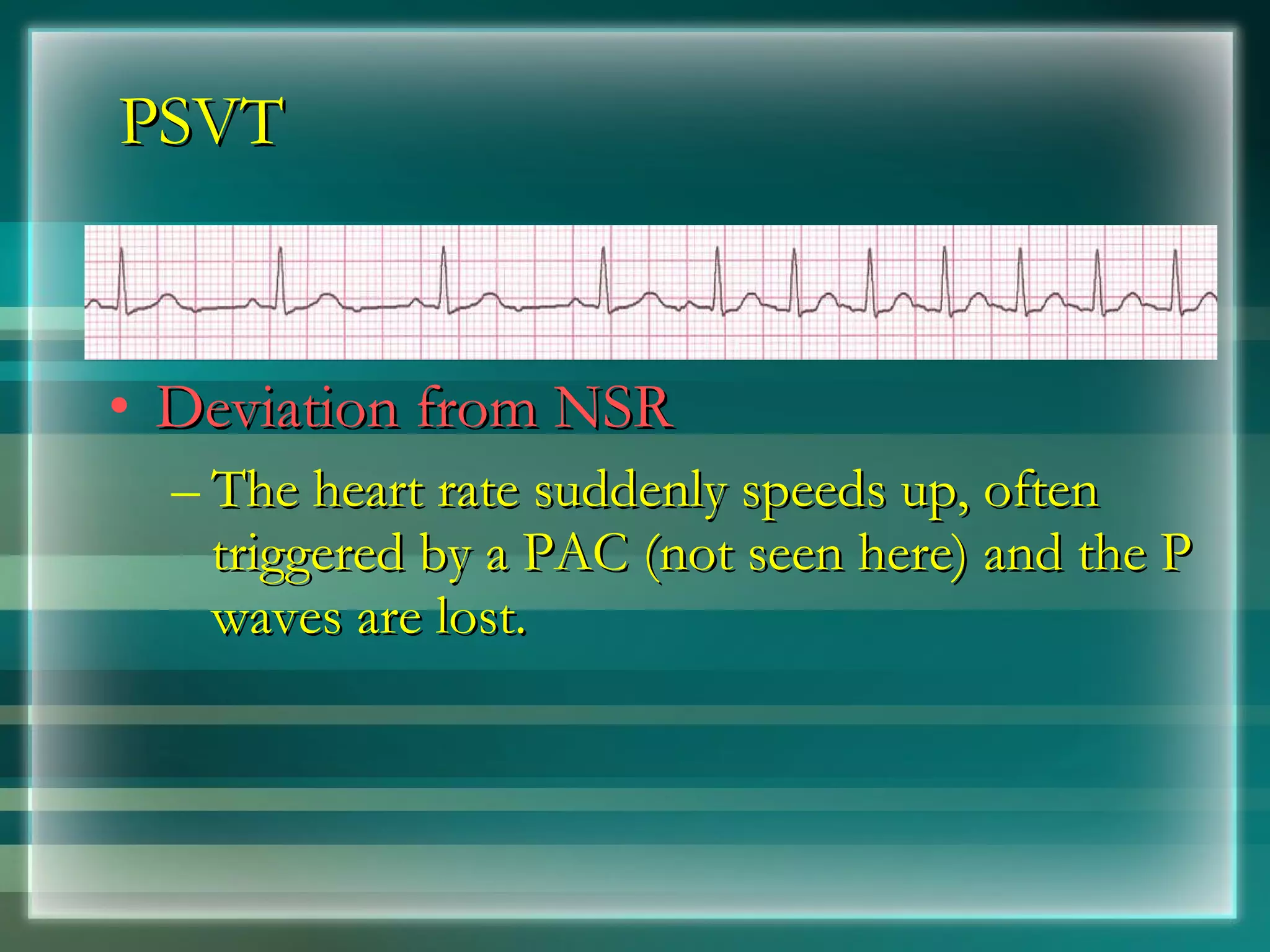
Rhythm #7 74   148 bpm Rate? Regularity? Regular    regular Normal    none 0.08 s P waves? PR interval? 0.16 s    none QRS duration? Interpretation? Paroxysmal Supraventricular Tachycardia (PSVT)
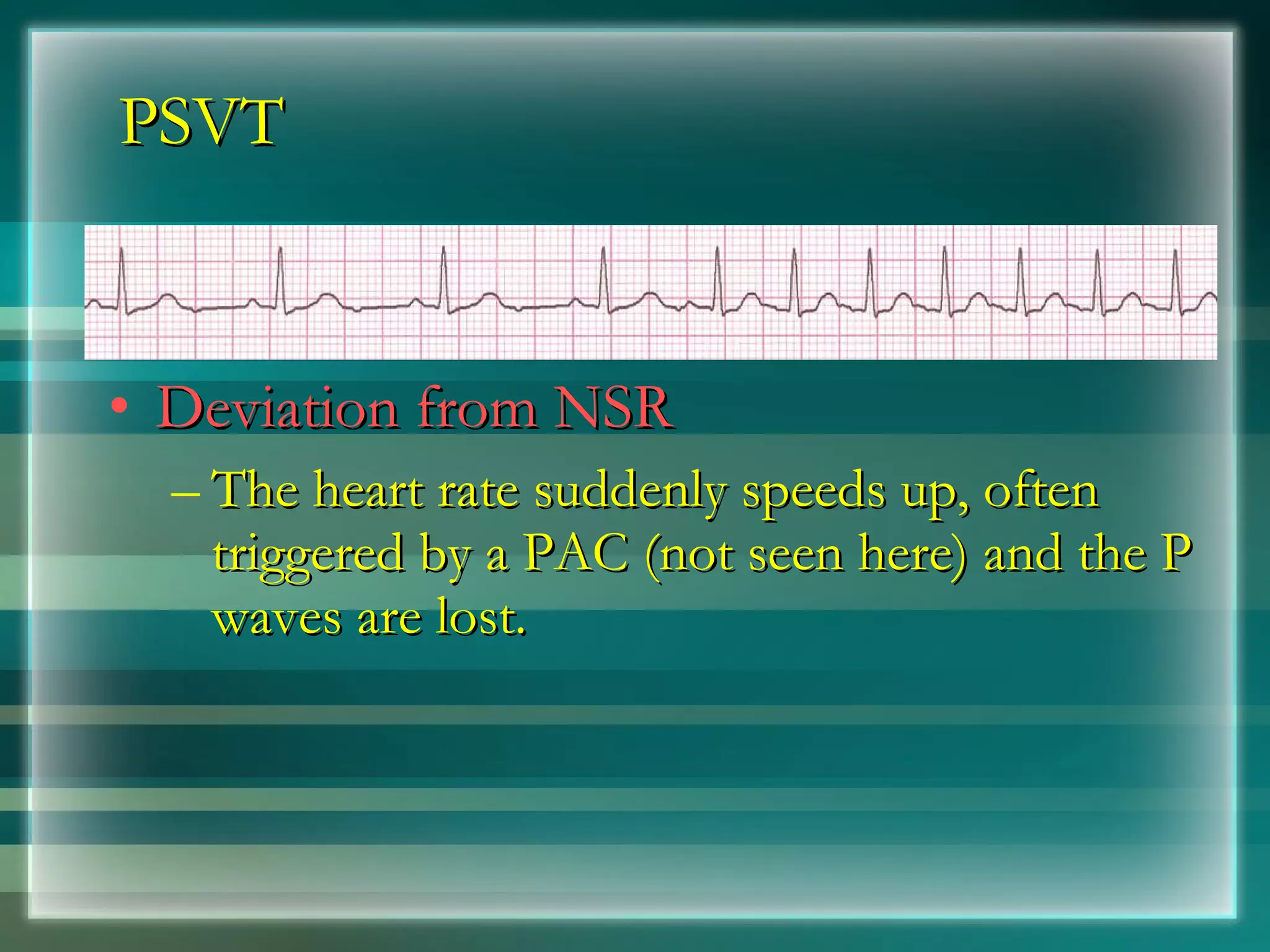
PSVT Deviation from NSR The heart rate suddenly speeds up, often triggered by a PAC (not seen here) and the P waves are lost.
Ventricular Arrhythmias Ventricular Tachycardia Ventricular Fibrillation
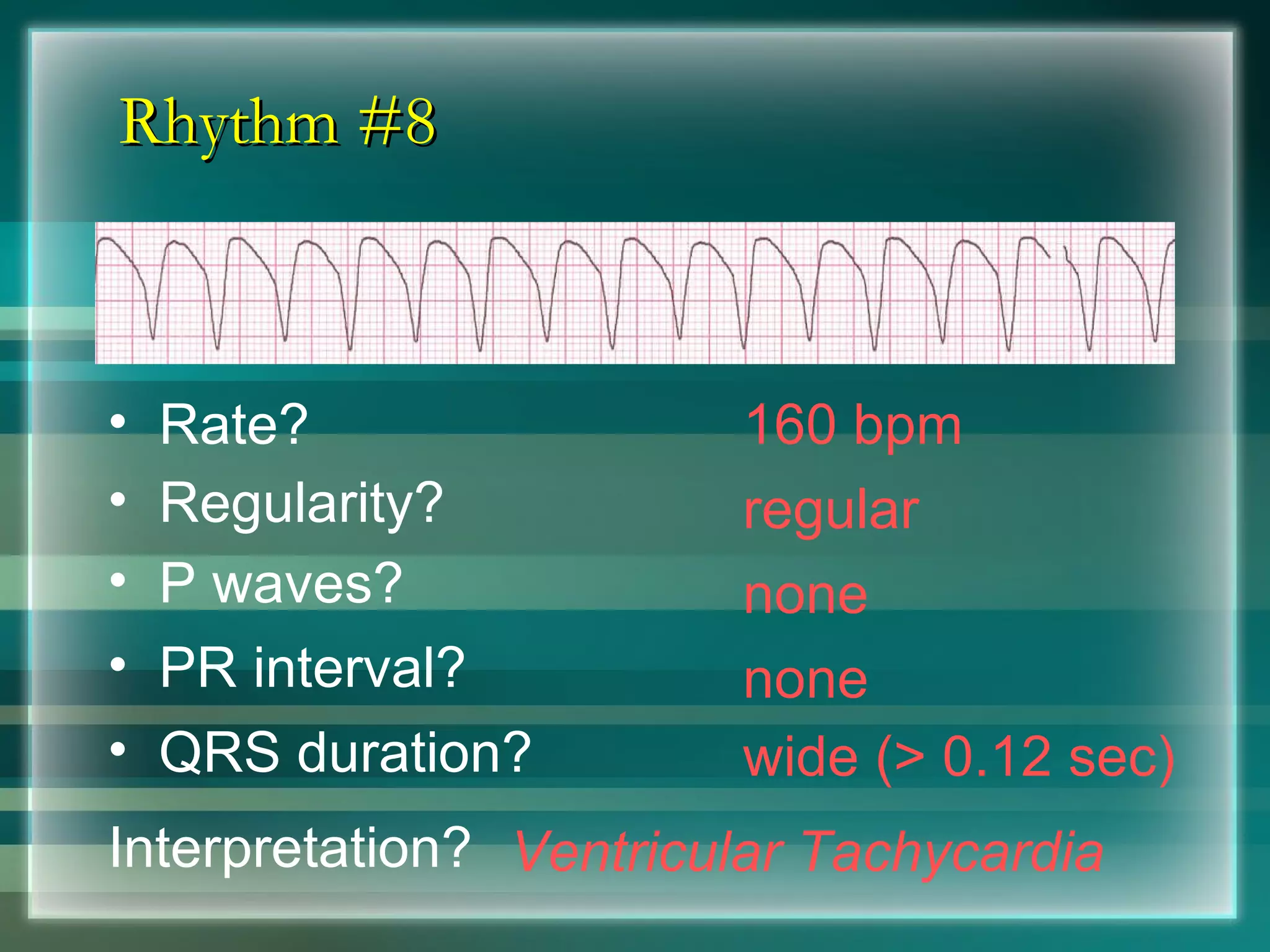
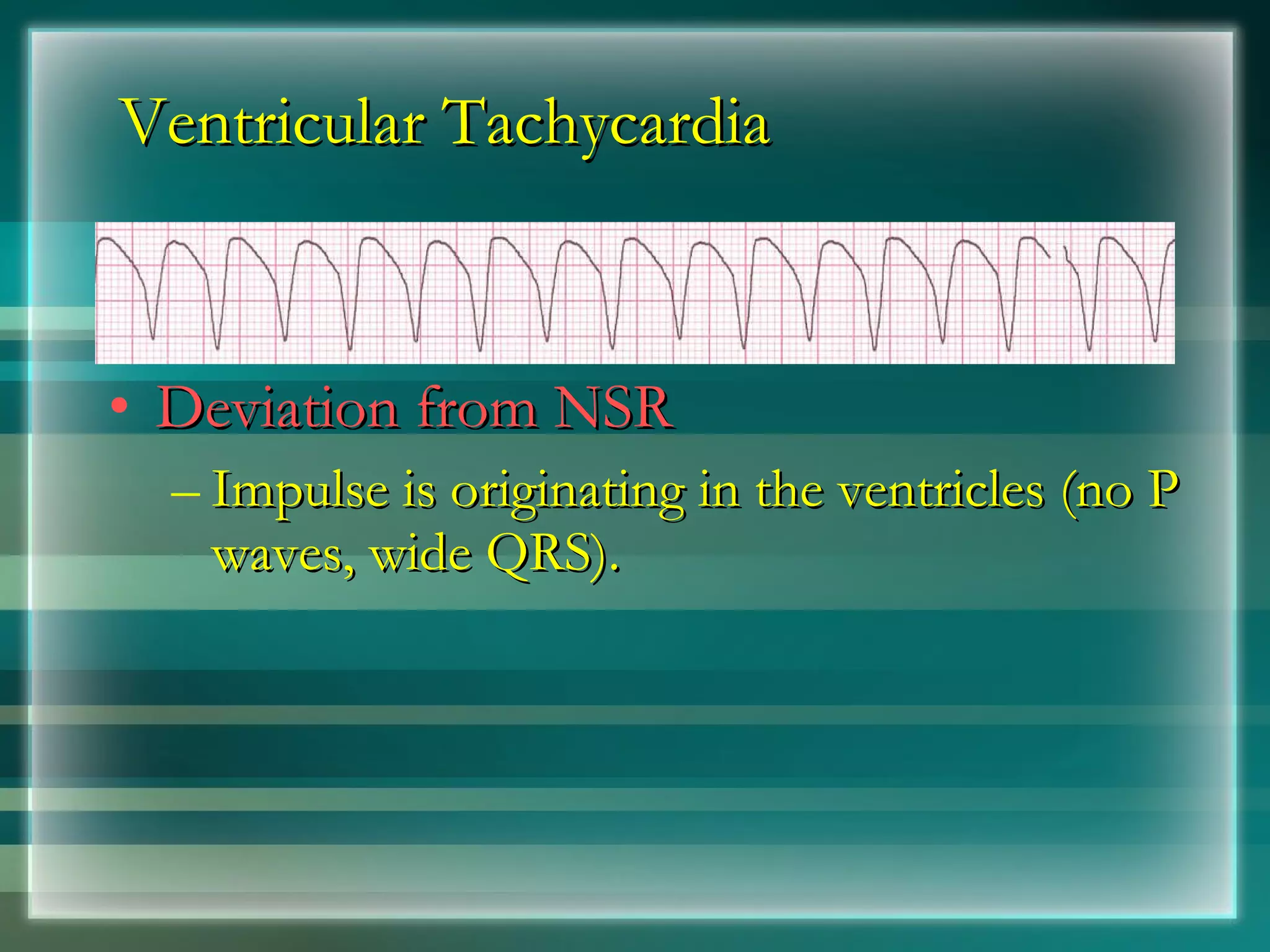
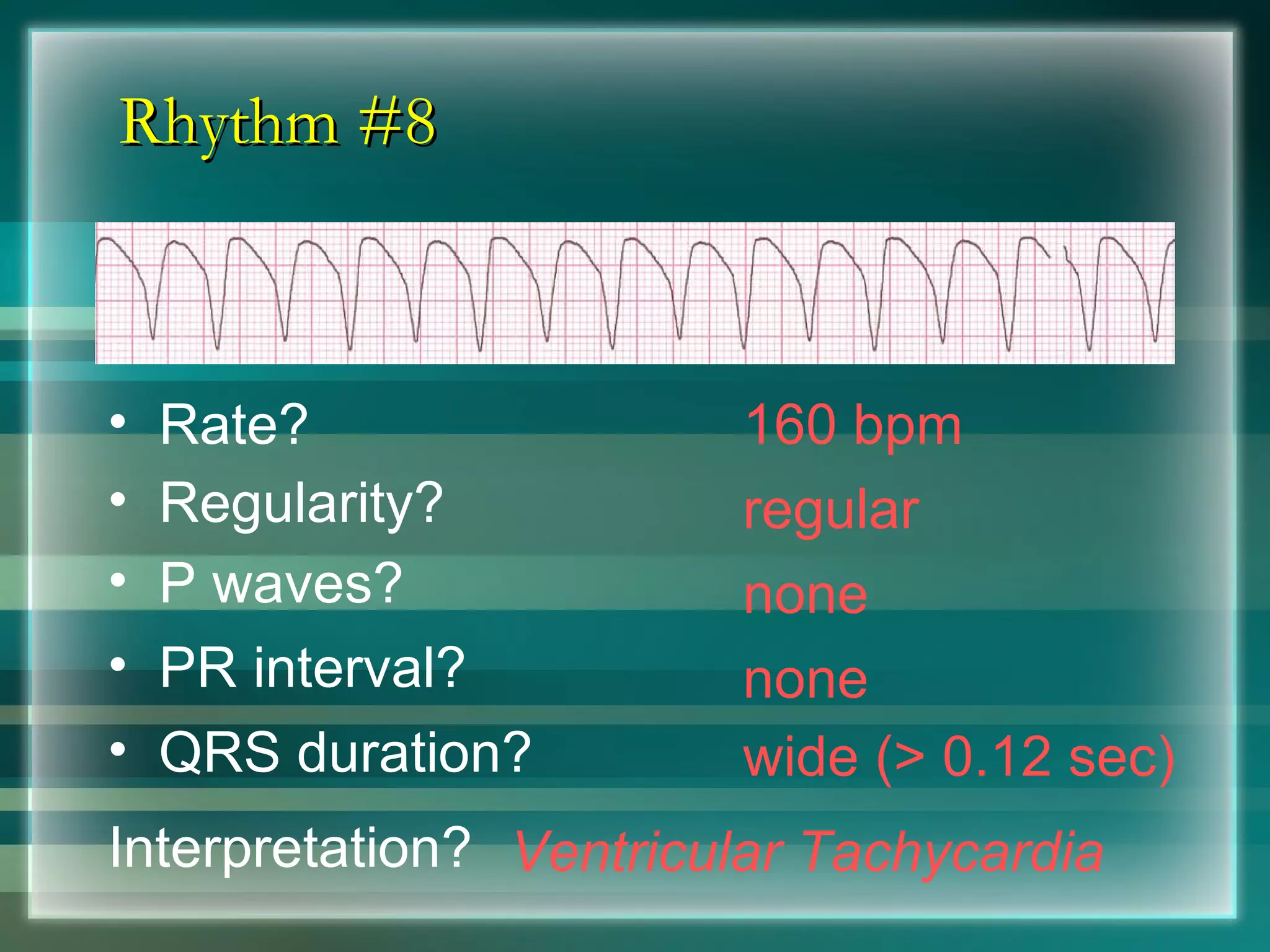
Rhythm #8 160 bpm Rate? Regularity? regular none wide (> 0.12 sec) P waves? PR interval? none QRS duration? Interpretation? Ventricular Tachycardia
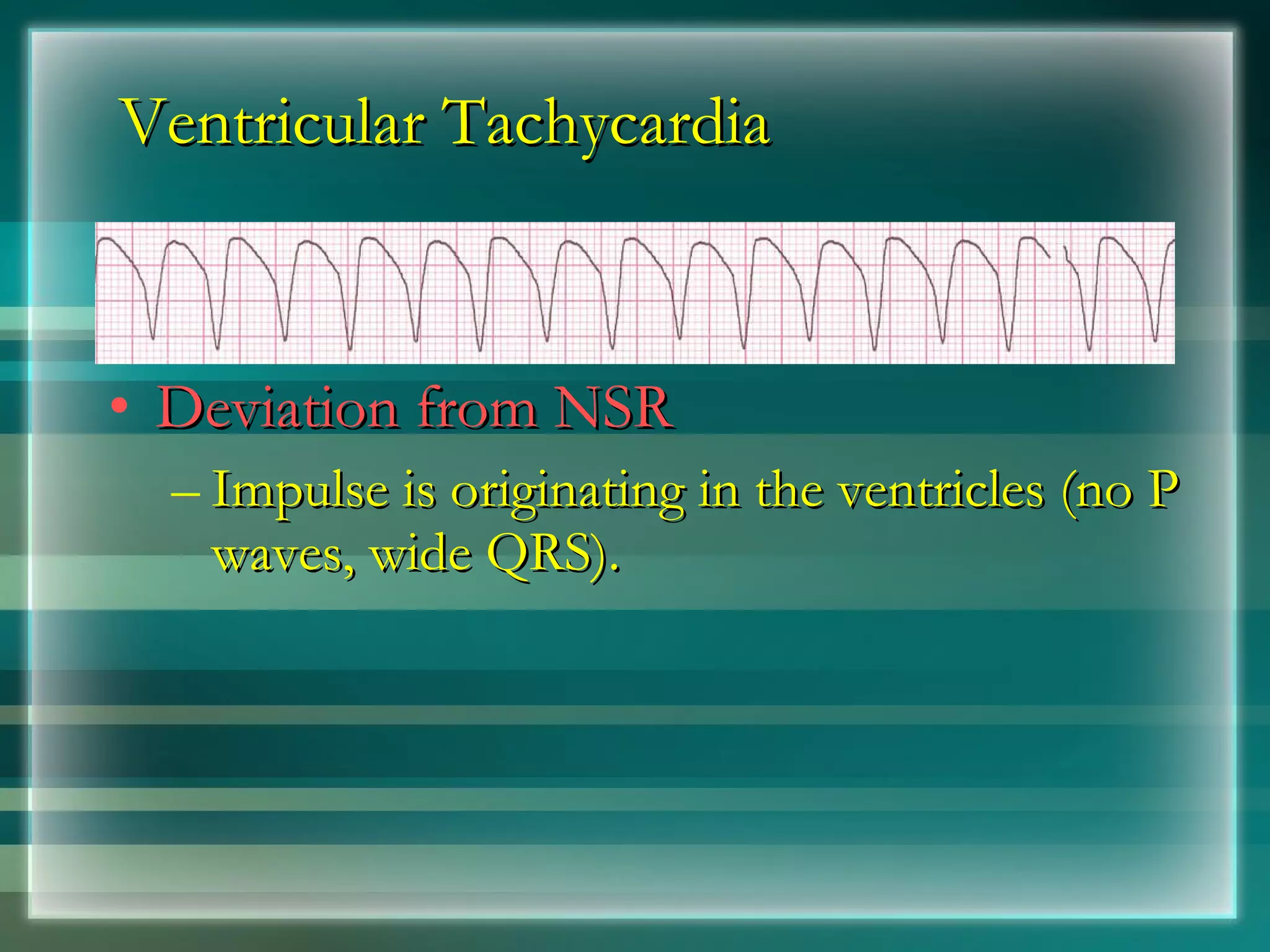
Ventricular Tachycardia Deviation from NSR Impulse is originating in the ventricles (no P waves, wide QRS).
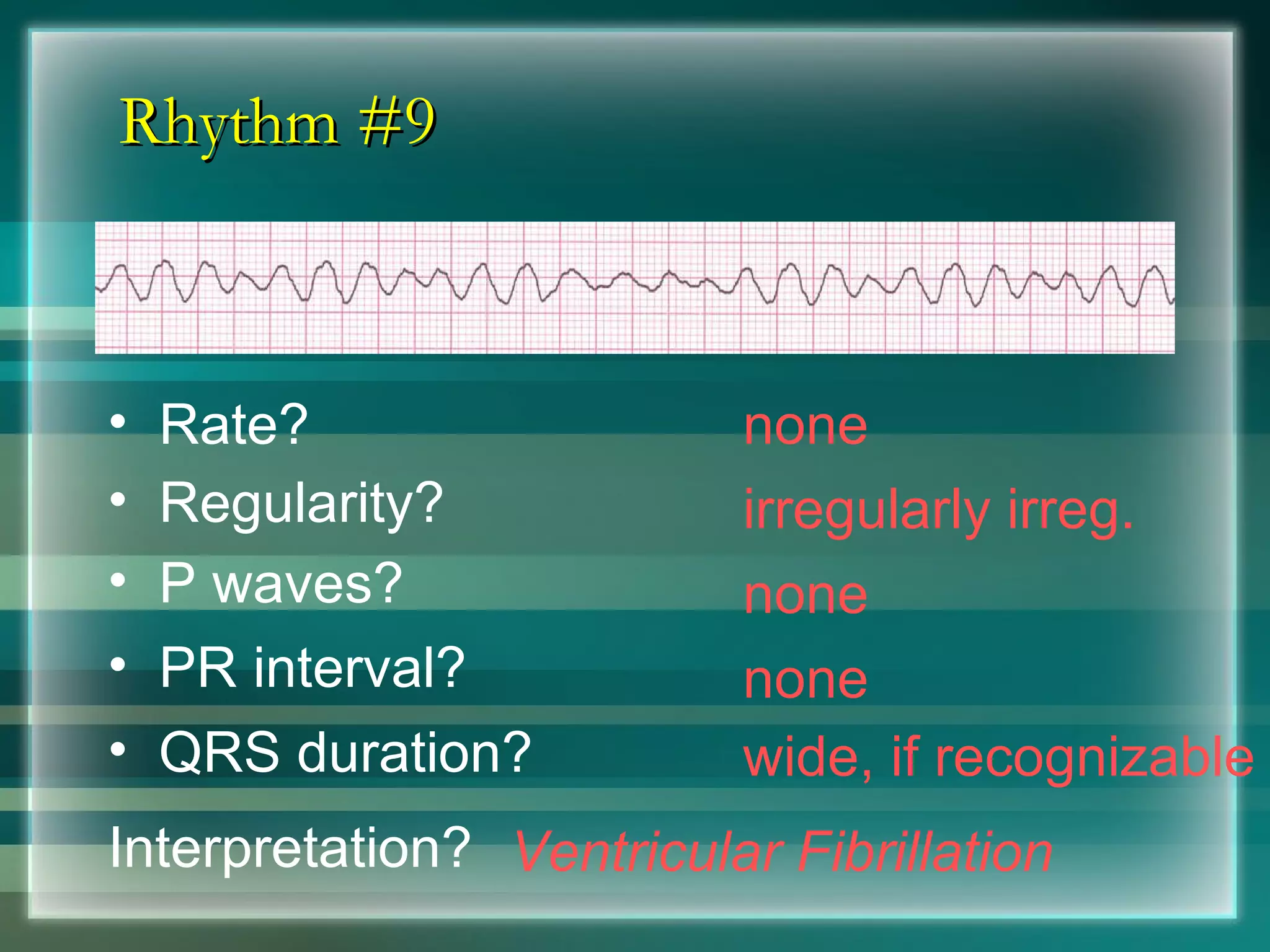
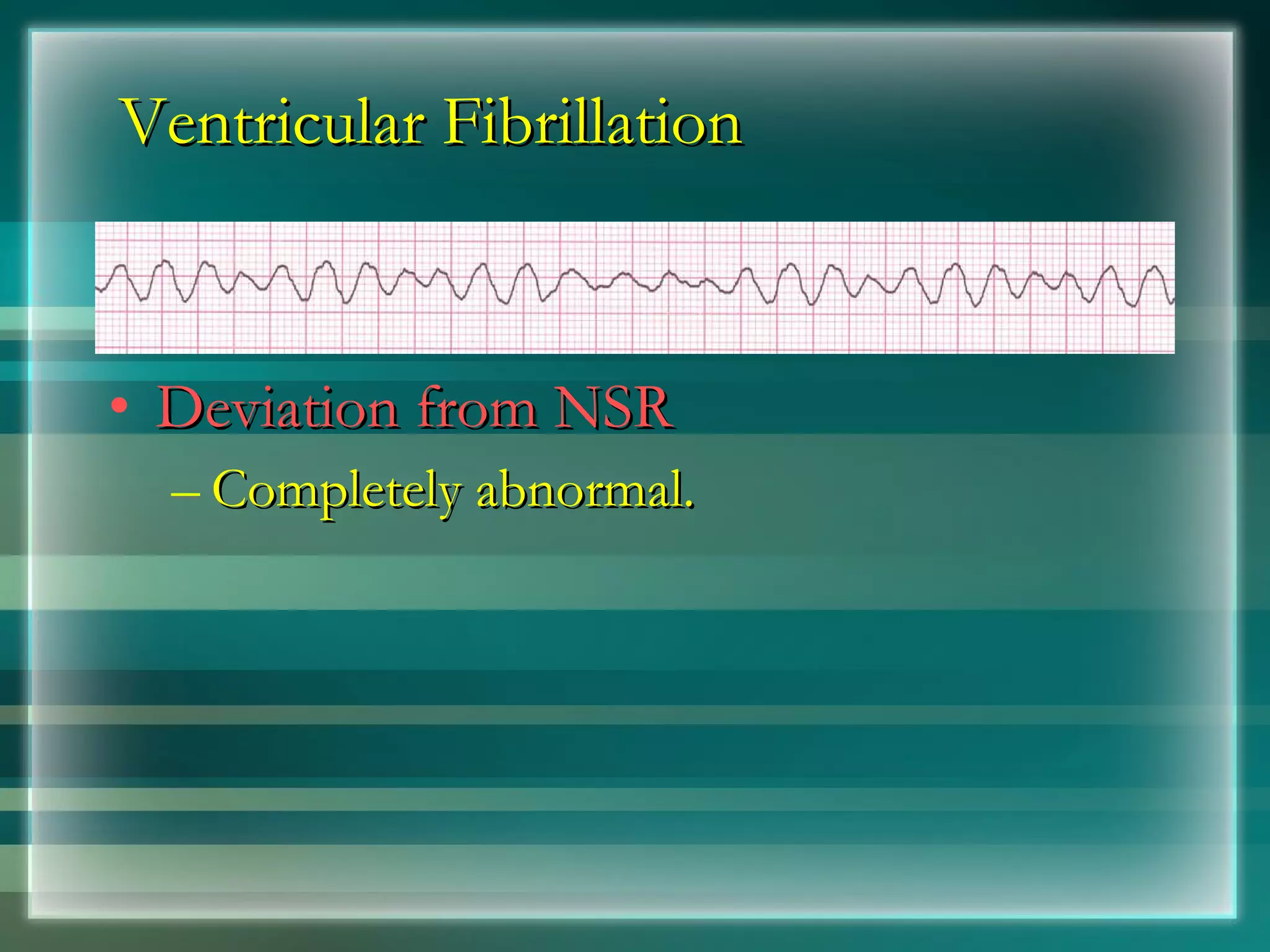
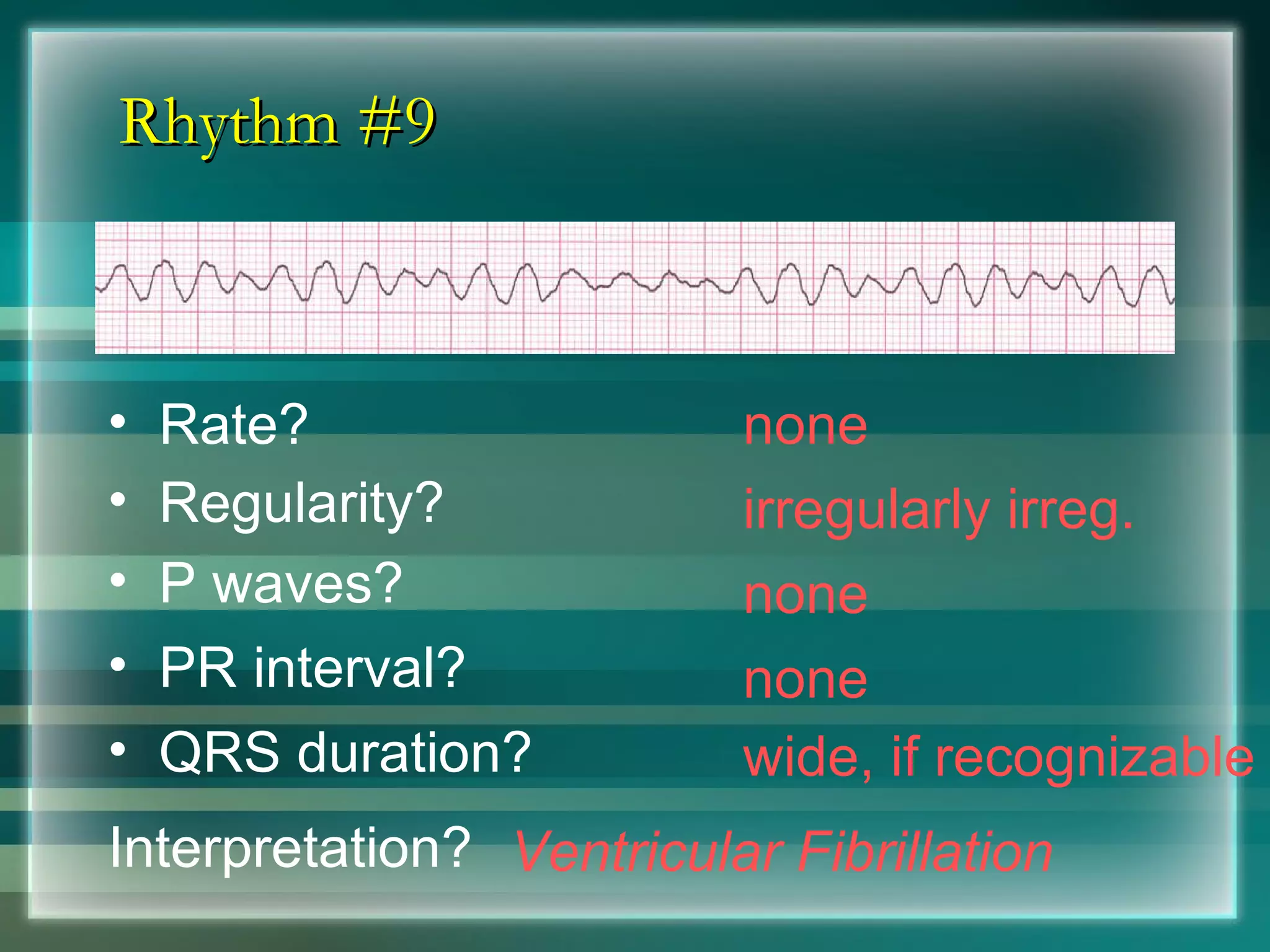
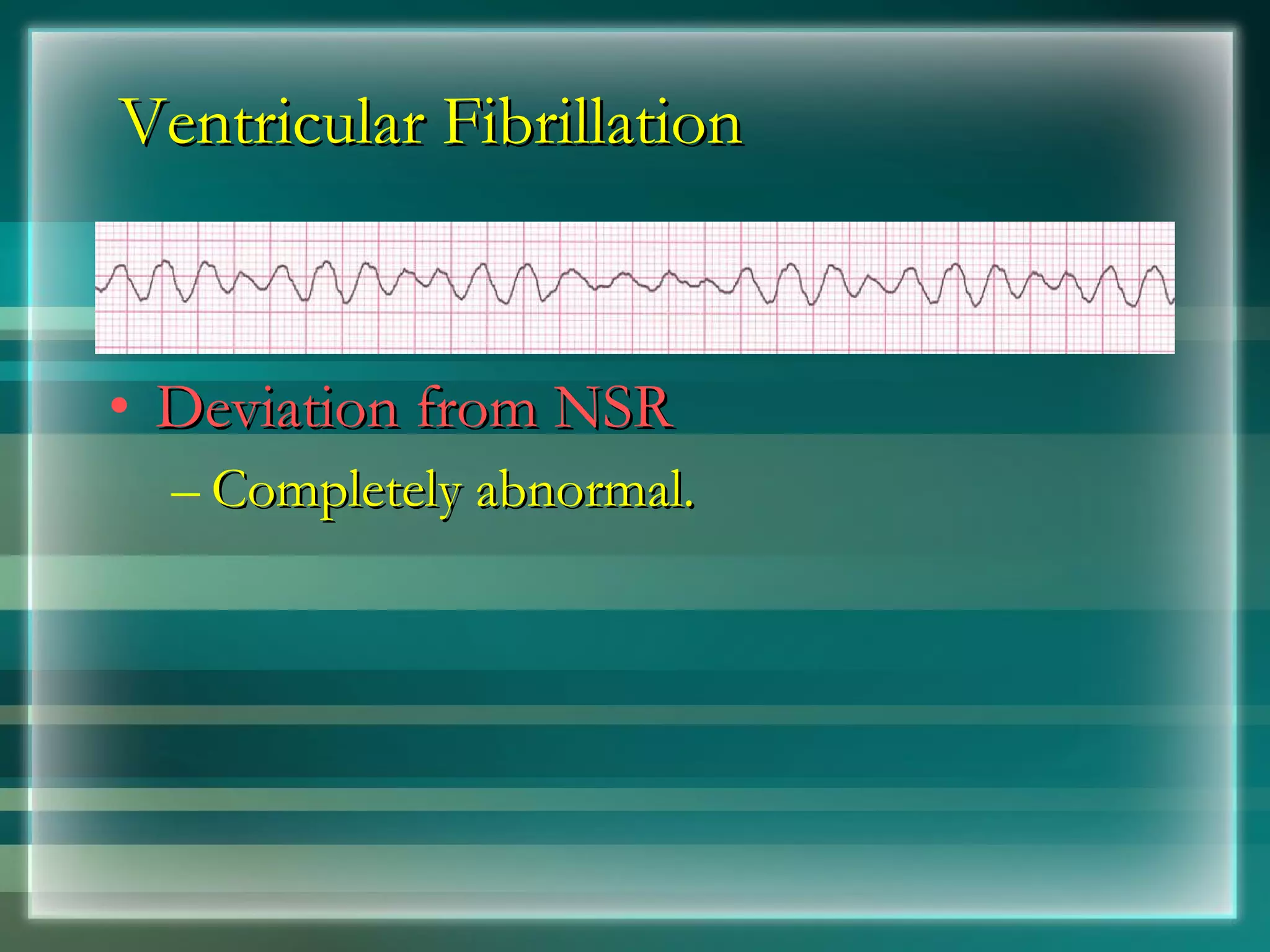
Rhythm #9 none Rate? Regularity? irregularly irreg. none wide, if recognizable  P waves? PR interval? none QRS duration? Interpretation? Ventricular Fibrillation
Ventricular Fibrillation Deviation from NSR Completely abnormal.
Arrhythmia Formation Arrhythmias can arise from problems in the: Sinus node Atrial cells AV junction Ventricular cells
SA Node Problems The SA Node can: fire too slow fire too fast Sinus Bradycardia Sinus Tachycardia Sinus Tachycardia may be an appropriate response to stress.
Atrial Cell Problems Atrial cells can: fire occasionally from a focus  fire continuously due to a looping re-entrant circuit  Premature Atrial Contractions (PACs) Atrial Flutter
AV Junctional Problems The AV junction can: fire continuously due to a looping re-entrant circuit  block impulses coming from the SA Node Paroxysmal  Supraventricular Tachycardia AV Junctional Blocks
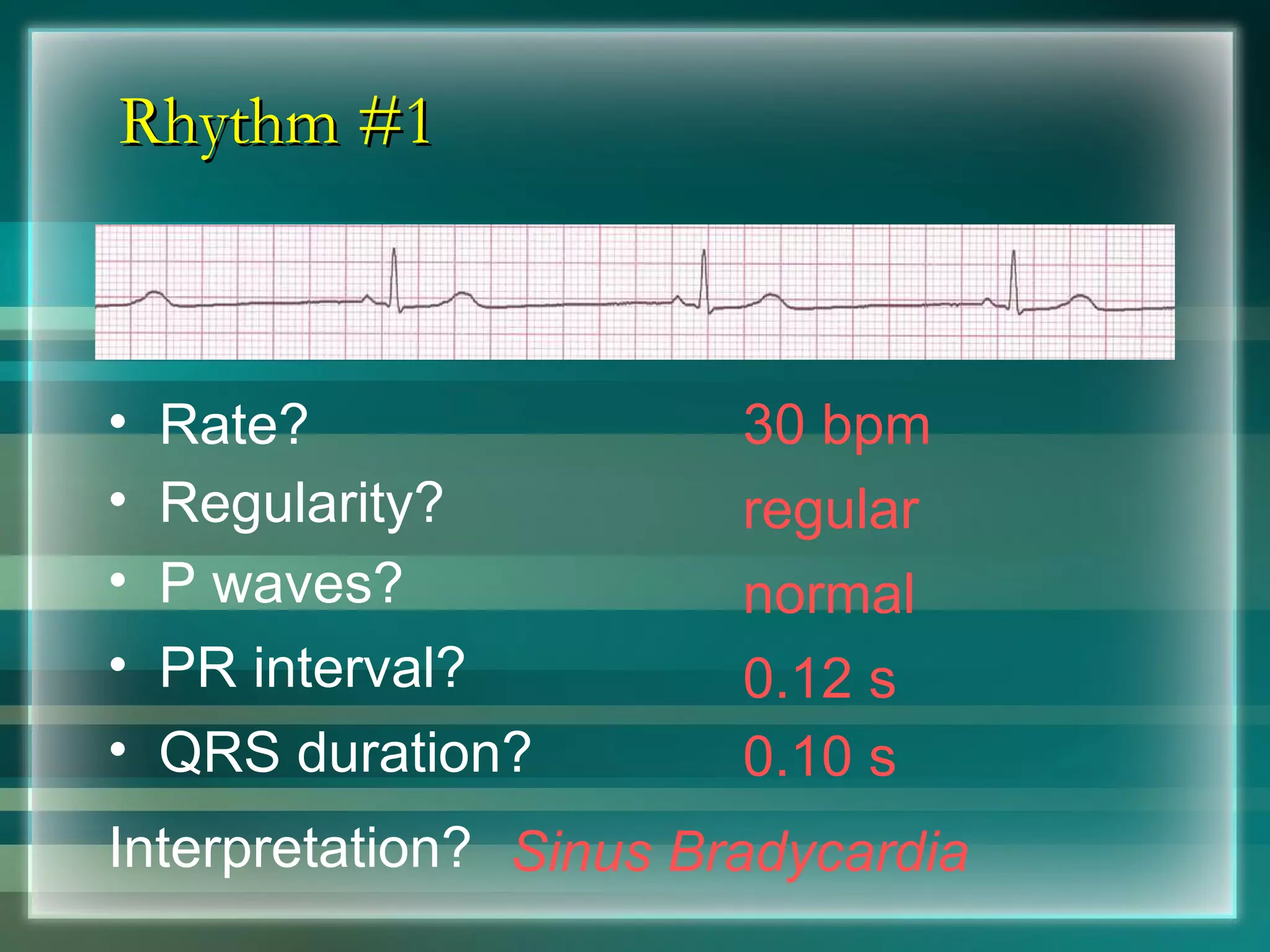
Rhythm #1 30 bpm Rate? Regularity? regular normal 0.10 s P waves? PR interval? 0.12 s QRS duration? Interpretation? Sinus Bradycardia
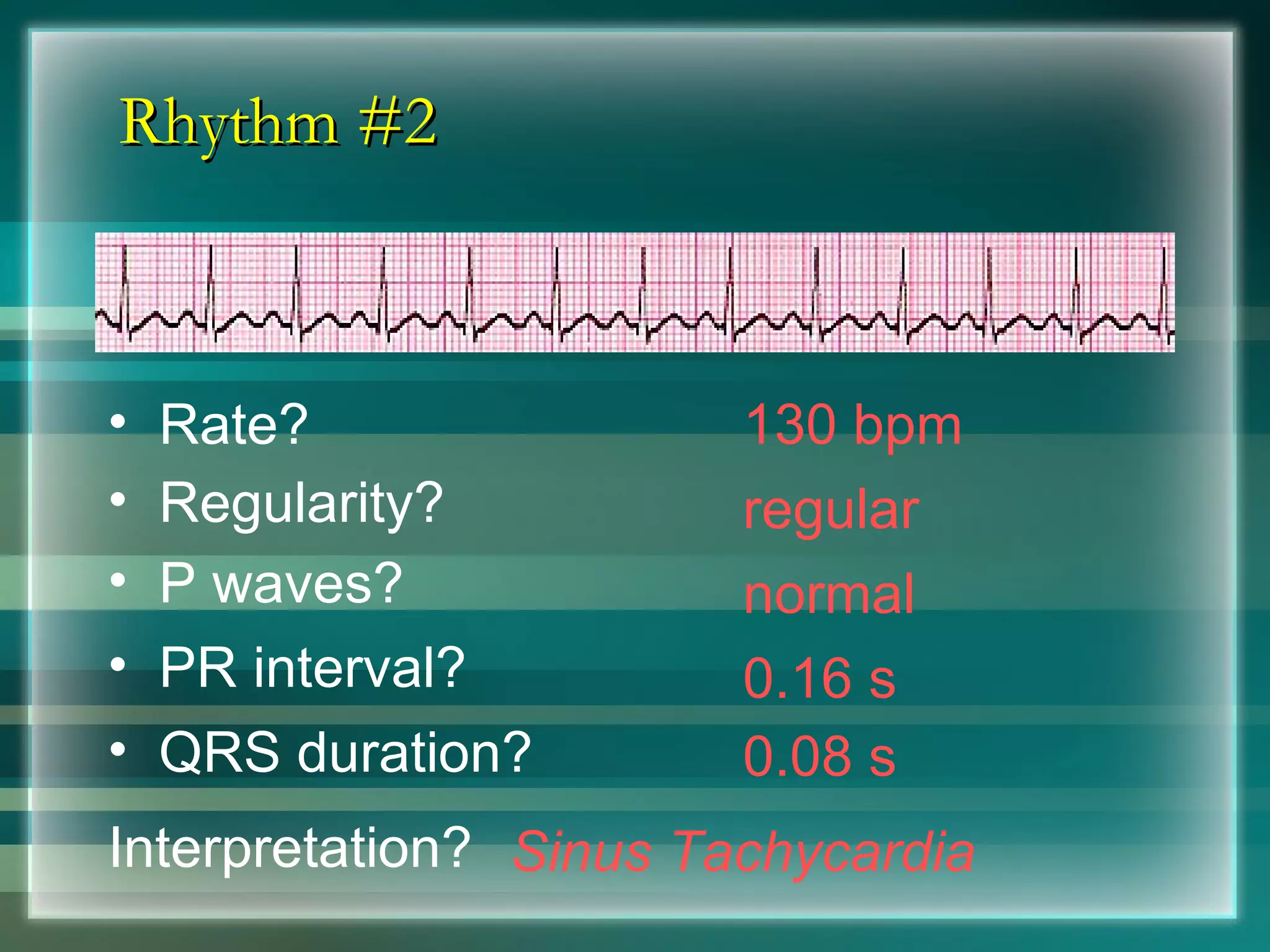
Rhythm #2 130 bpm Rate? Regularity? regular normal 0.08 s P waves? PR interval? 0.16 s QRS duration? Interpretation? Sinus Tachycardia
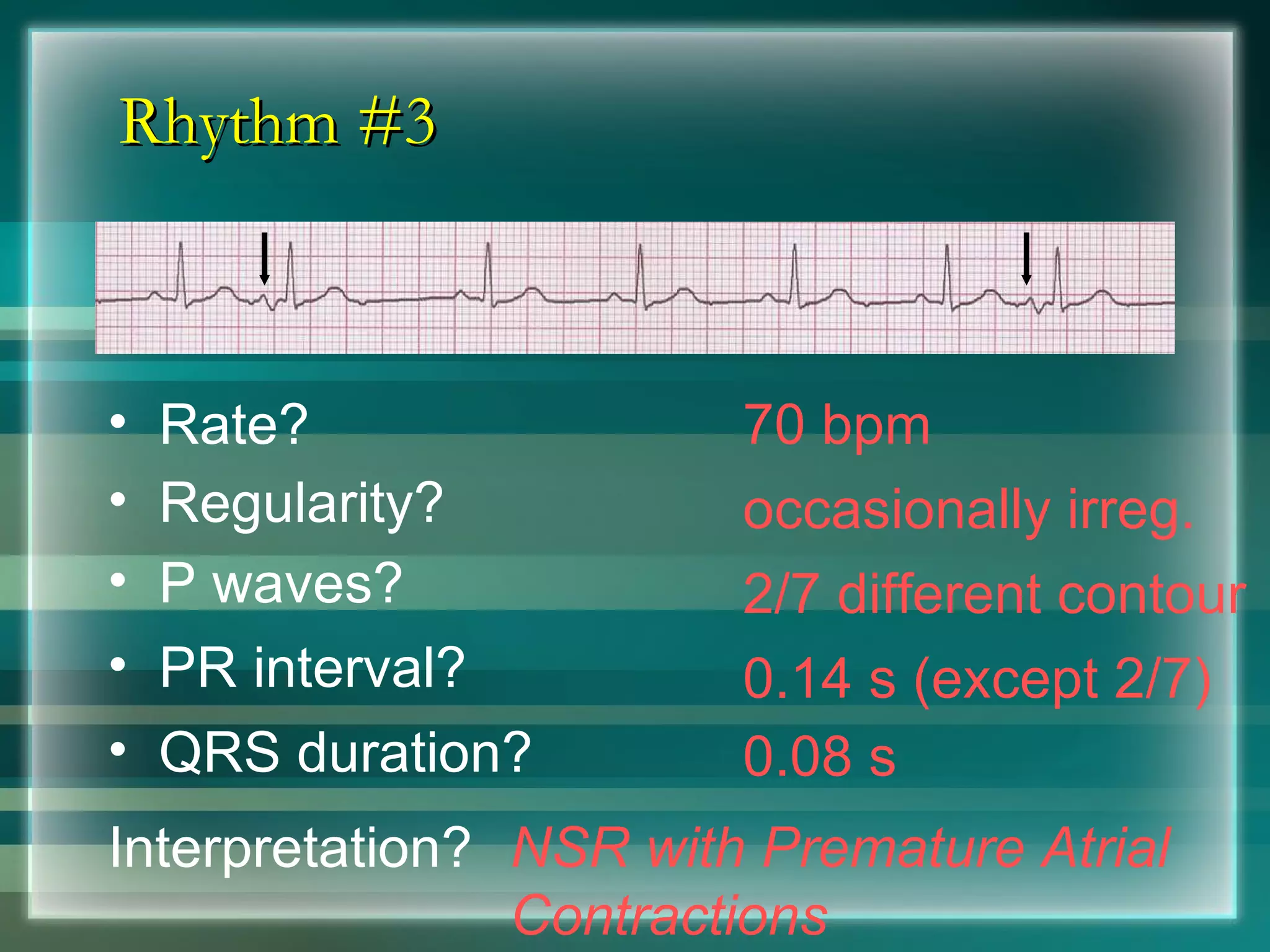
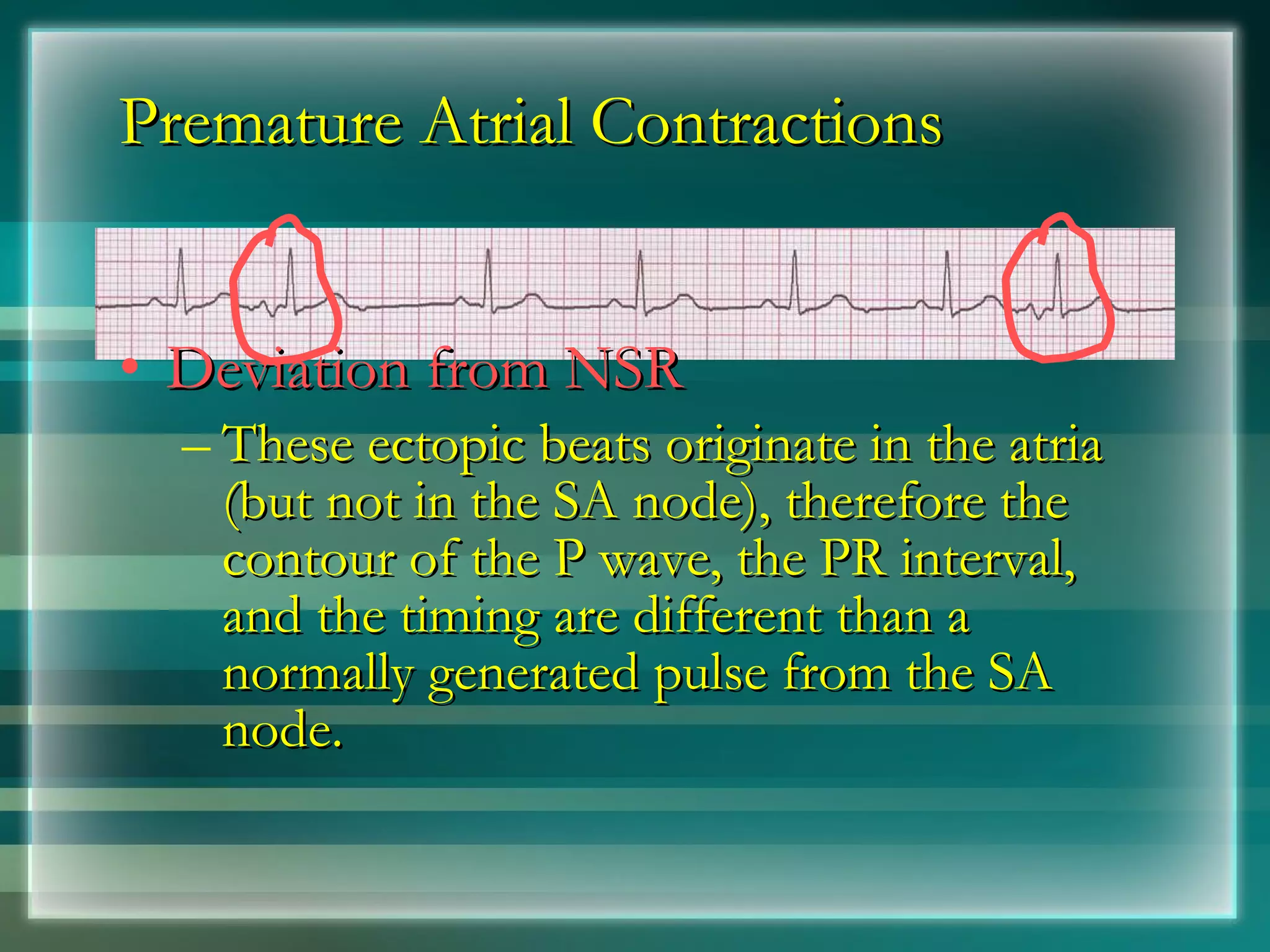
Rhythm #3 70 bpm Rate? Regularity? occasionally irreg. 2/7 different contour 0.08 s P waves? PR interval? 0.14 s (except 2/7) QRS duration? Interpretation? NSR with Premature Atrial Contractions
Premature Atrial Contractions Deviation from NSR These ectopic beats originate in the atria (but not in the SA node), therefore the contour of the P wave, the PR interval, and the timing are different than a normally generated pulse from the SA node.
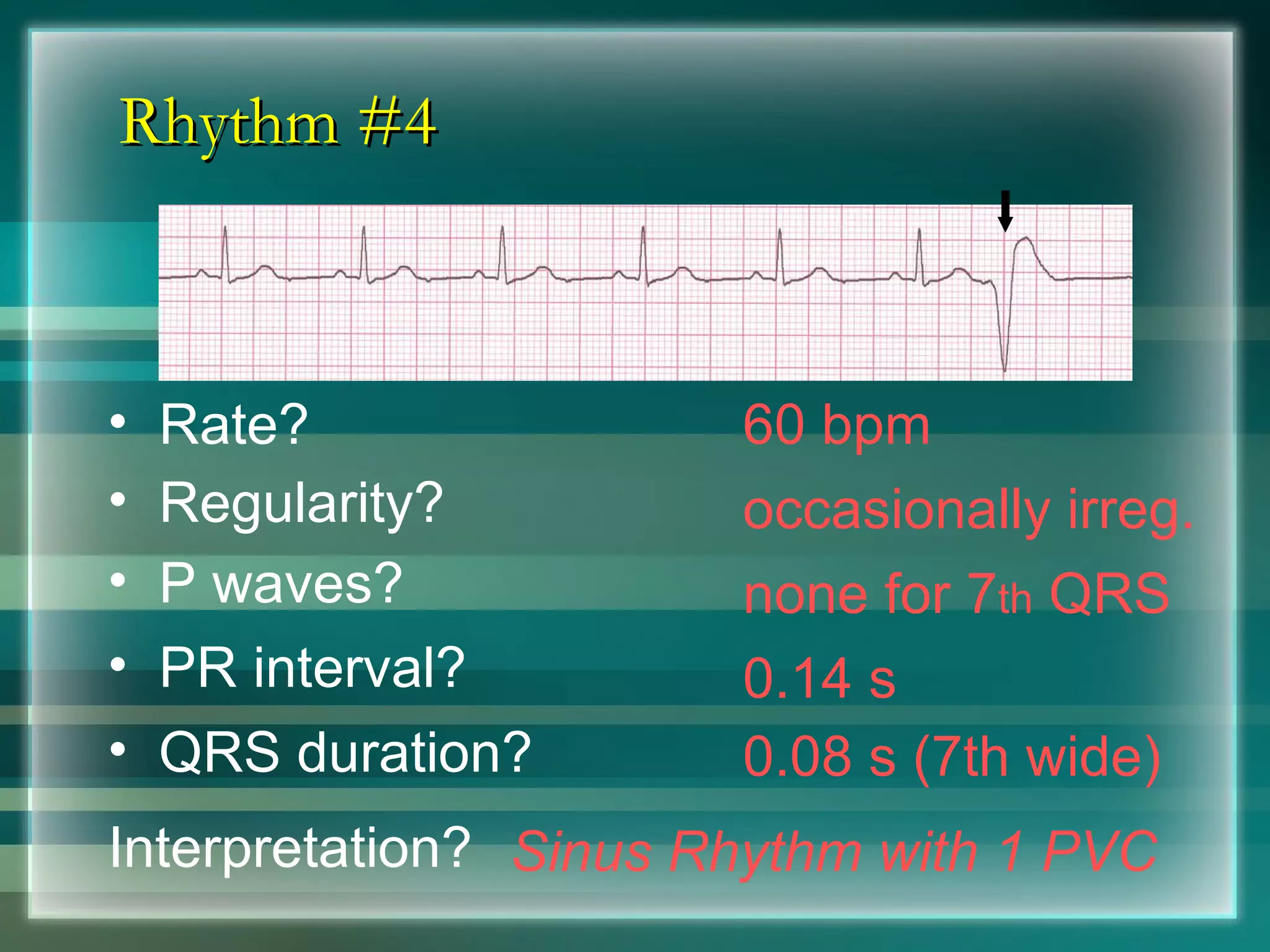
Rhythm #4 60 bpm Rate? Regularity? occasionally irreg. none for 7 th  QRS 0.08 s (7th wide) P waves? PR interval? 0.14 s QRS duration? Interpretation? Sinus Rhythm with 1 PVC
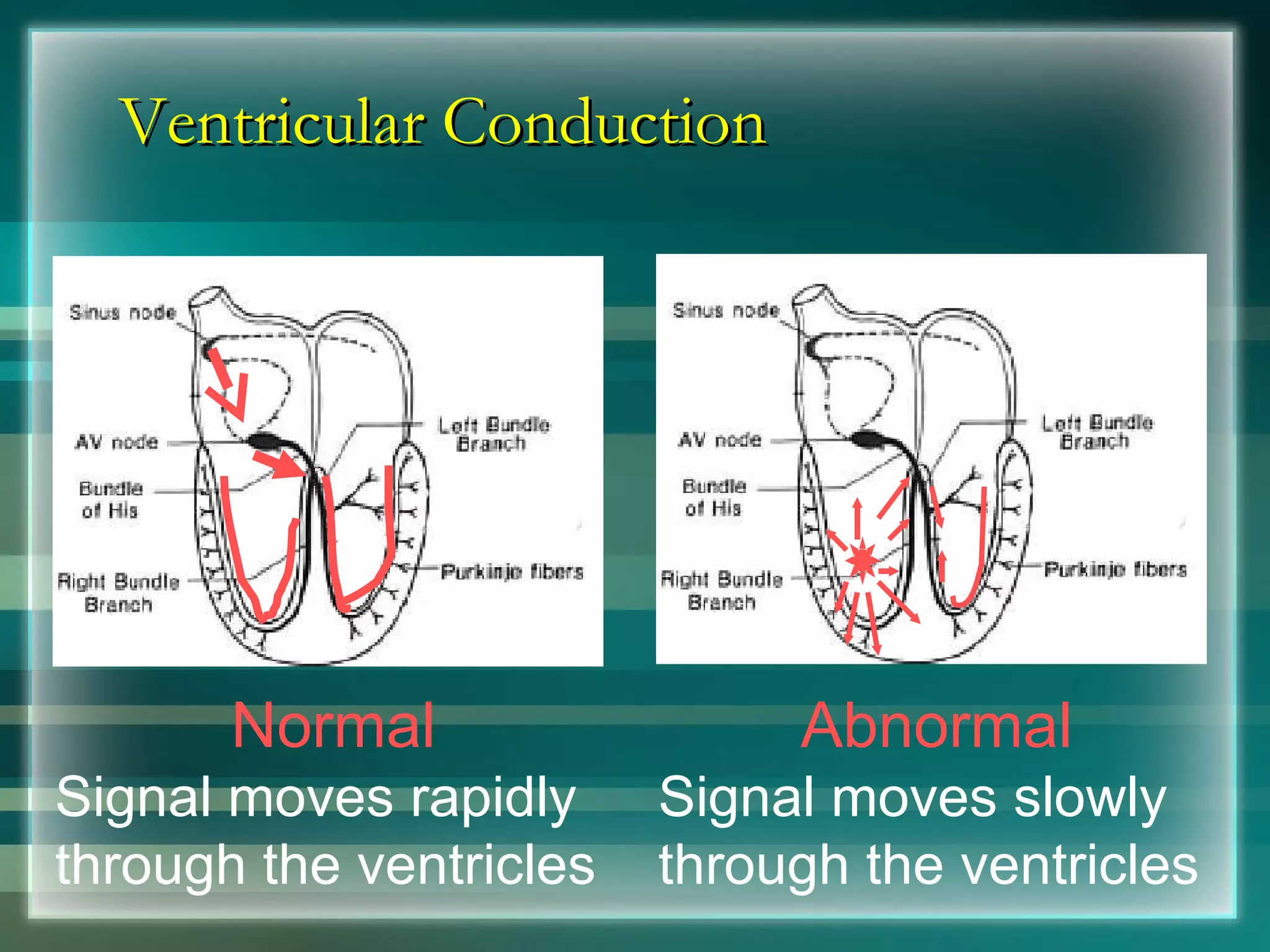
Ventricular Conduction Normal Signal moves rapidly through the ventricles Abnormal Signal moves slowly through the ventricles
AV Nodal Blocks 1st Degree AV Block 2nd Degree AV Block, Type I 2nd Degree AV Block, Type II 3rd Degree AV Block
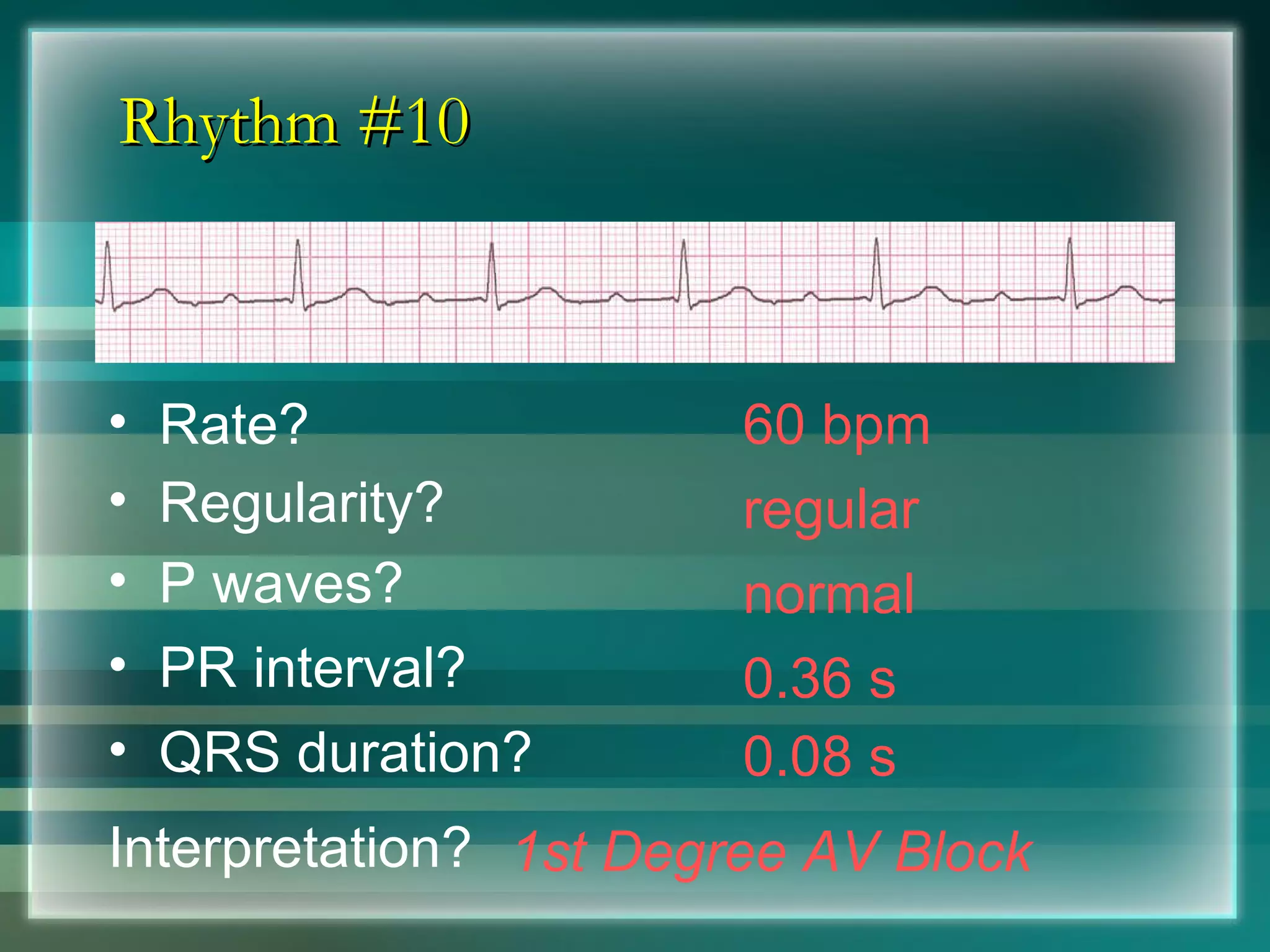
Rhythm #10 60 bpm Rate? Regularity? regular normal 0.08 s P waves? PR interval? 0.36 s QRS duration? Interpretation? 1st Degree AV Block
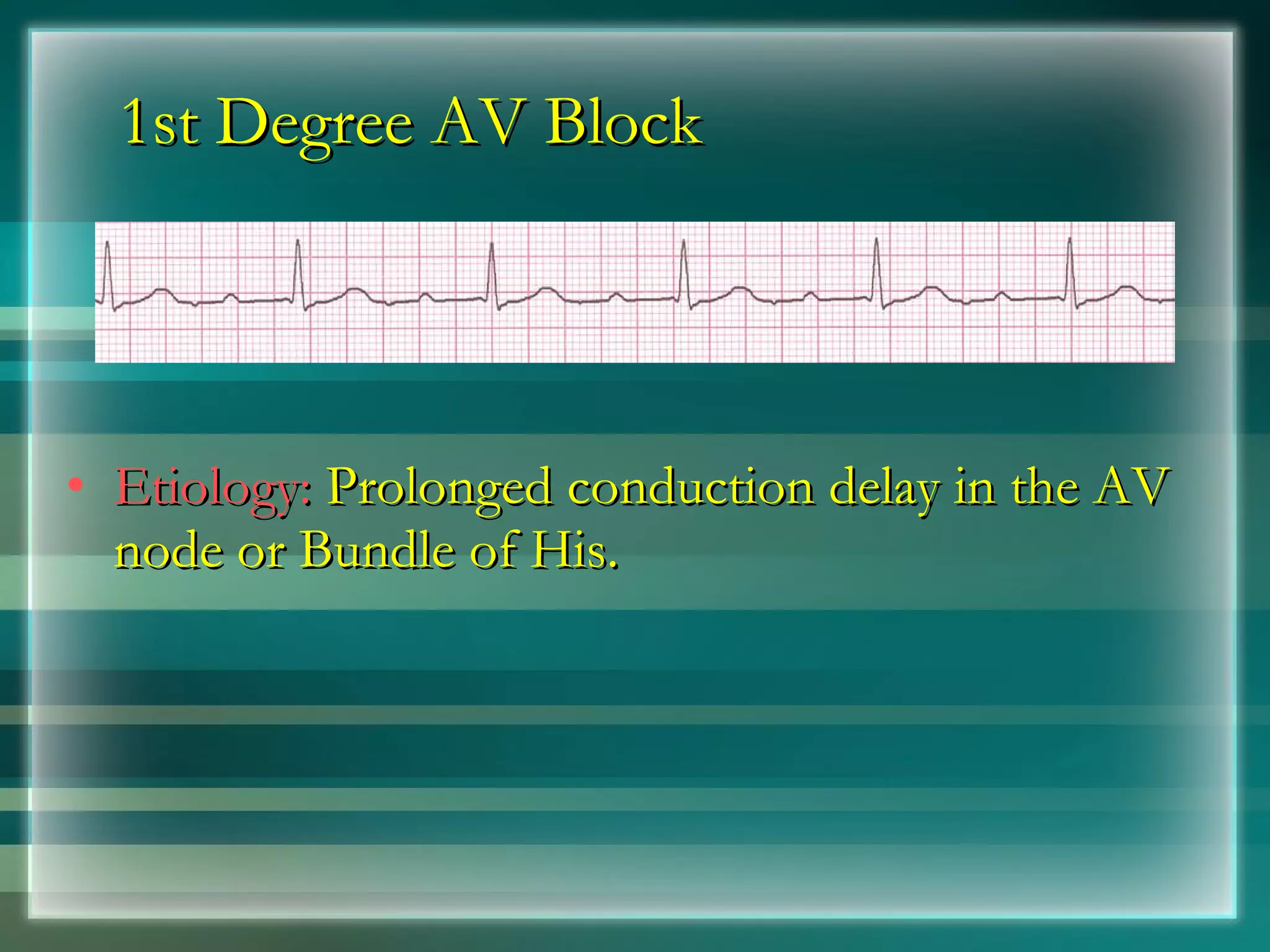
1st Degree AV Block Etiology:  Prolonged conduction delay in the AV node or Bundle of His.
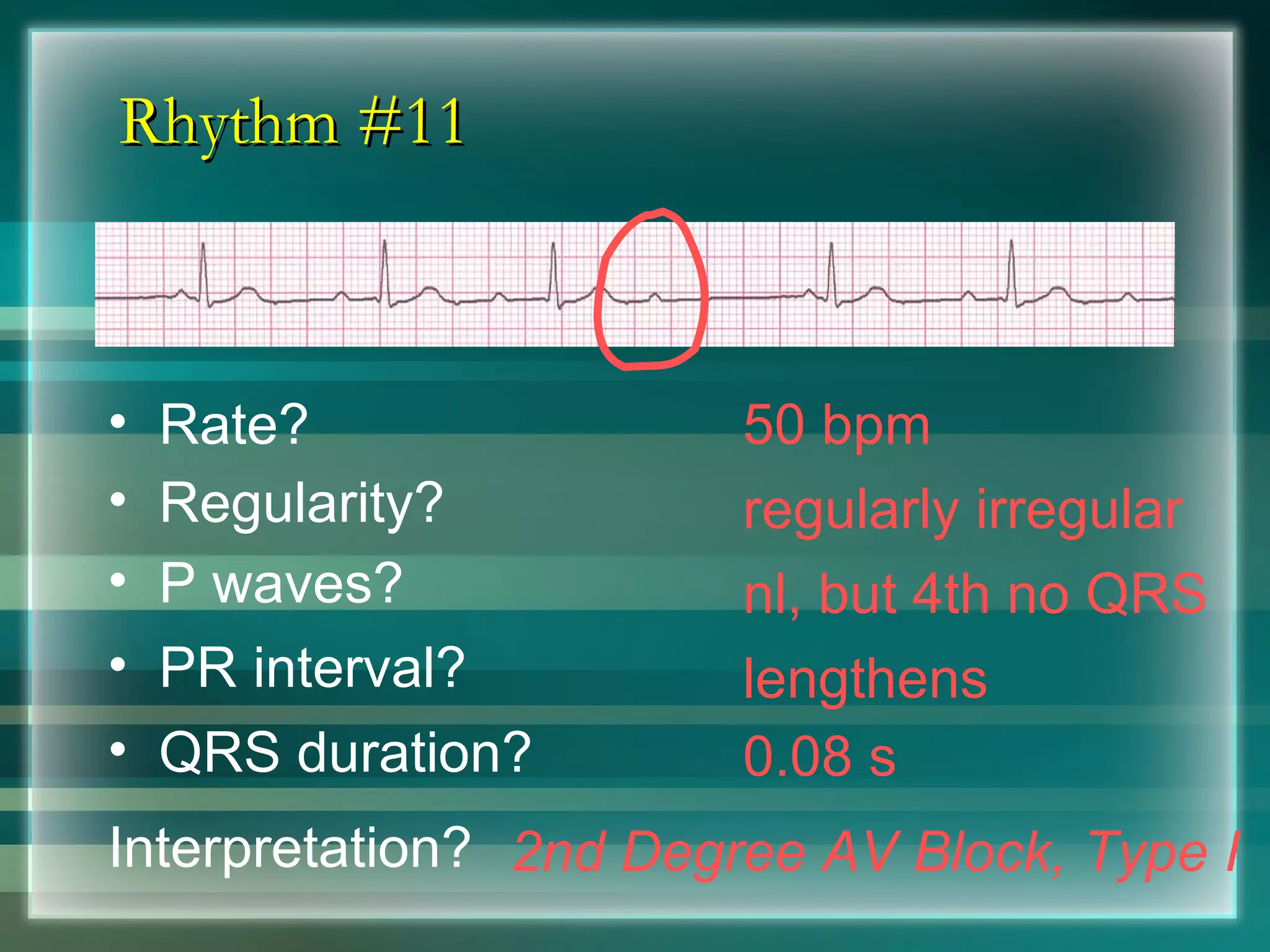
Rhythm #11 50 bpm Rate? Regularity? regularly irregular nl, but 4th no QRS 0.08 s P waves? PR interval? lengthens QRS duration? Interpretation? 2nd Degree AV Block, Type I
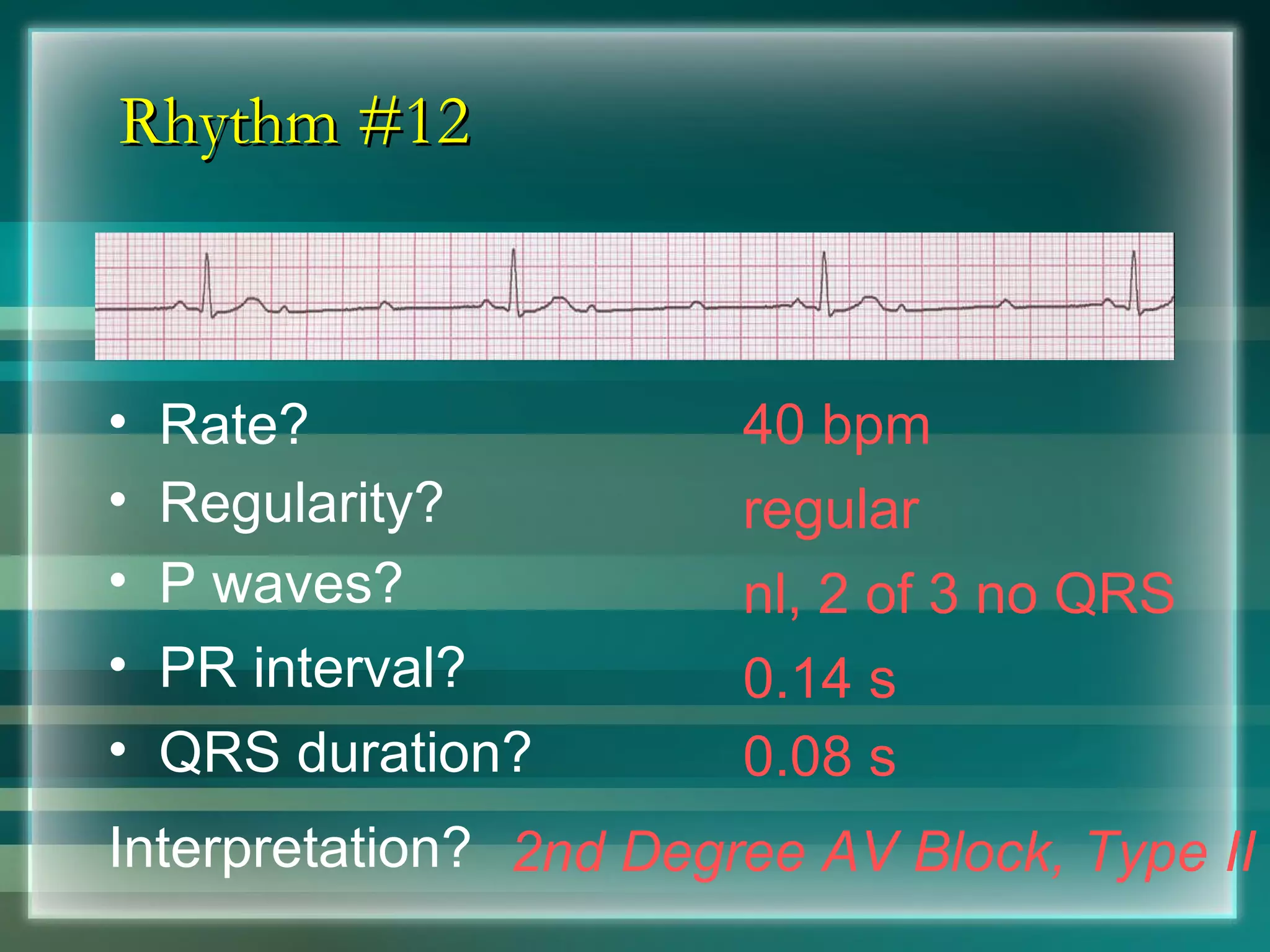
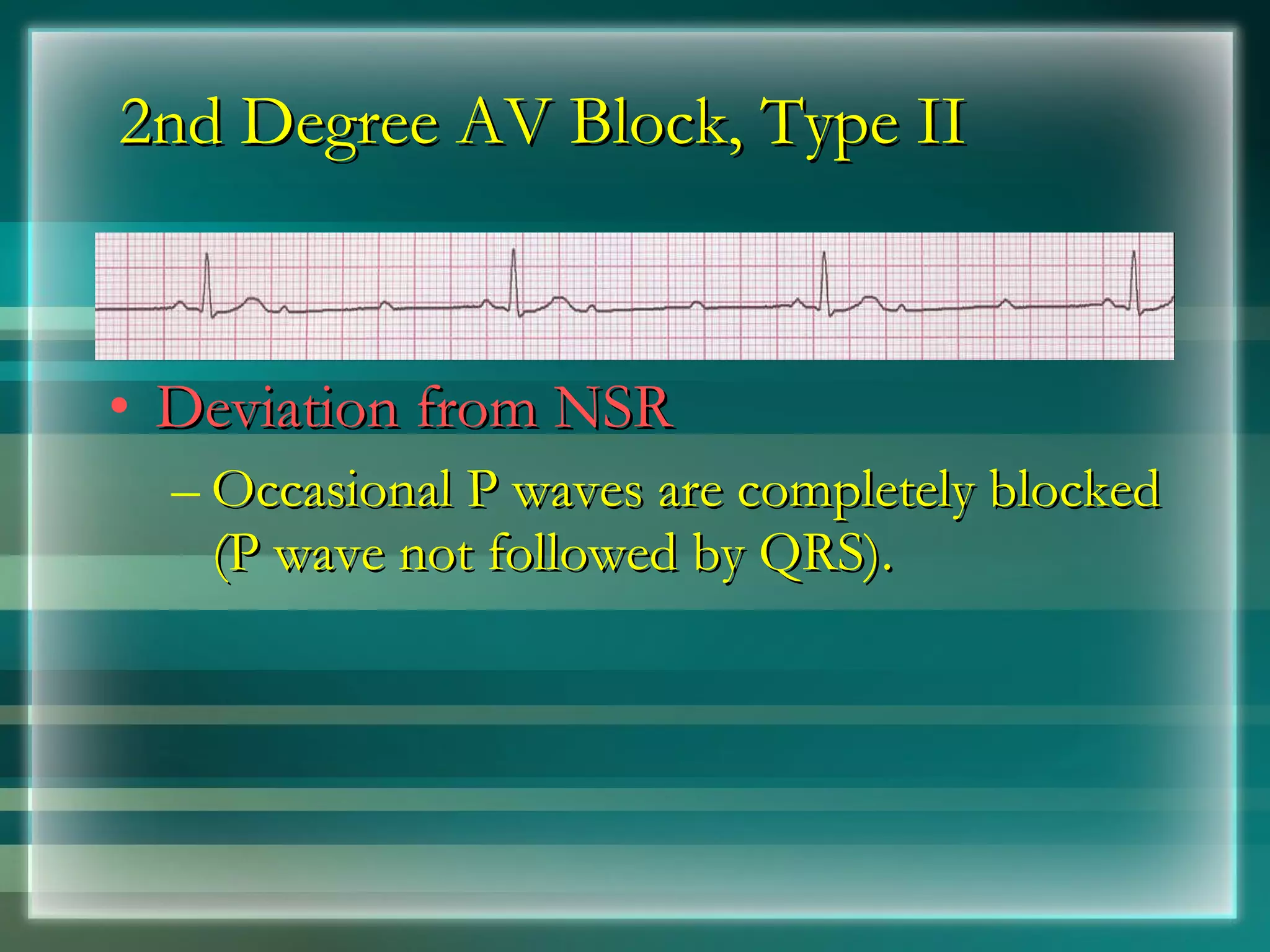
Rhythm #12 40 bpm Rate? Regularity? regular nl, 2 of 3 no QRS 0.08 s P waves? PR interval? 0.14 s QRS duration? Interpretation? 2nd Degree AV Block, Type II
2nd Degree AV Block, Type II Deviation from NSR Occasional P waves are completely blocked (P wave not followed by QRS).
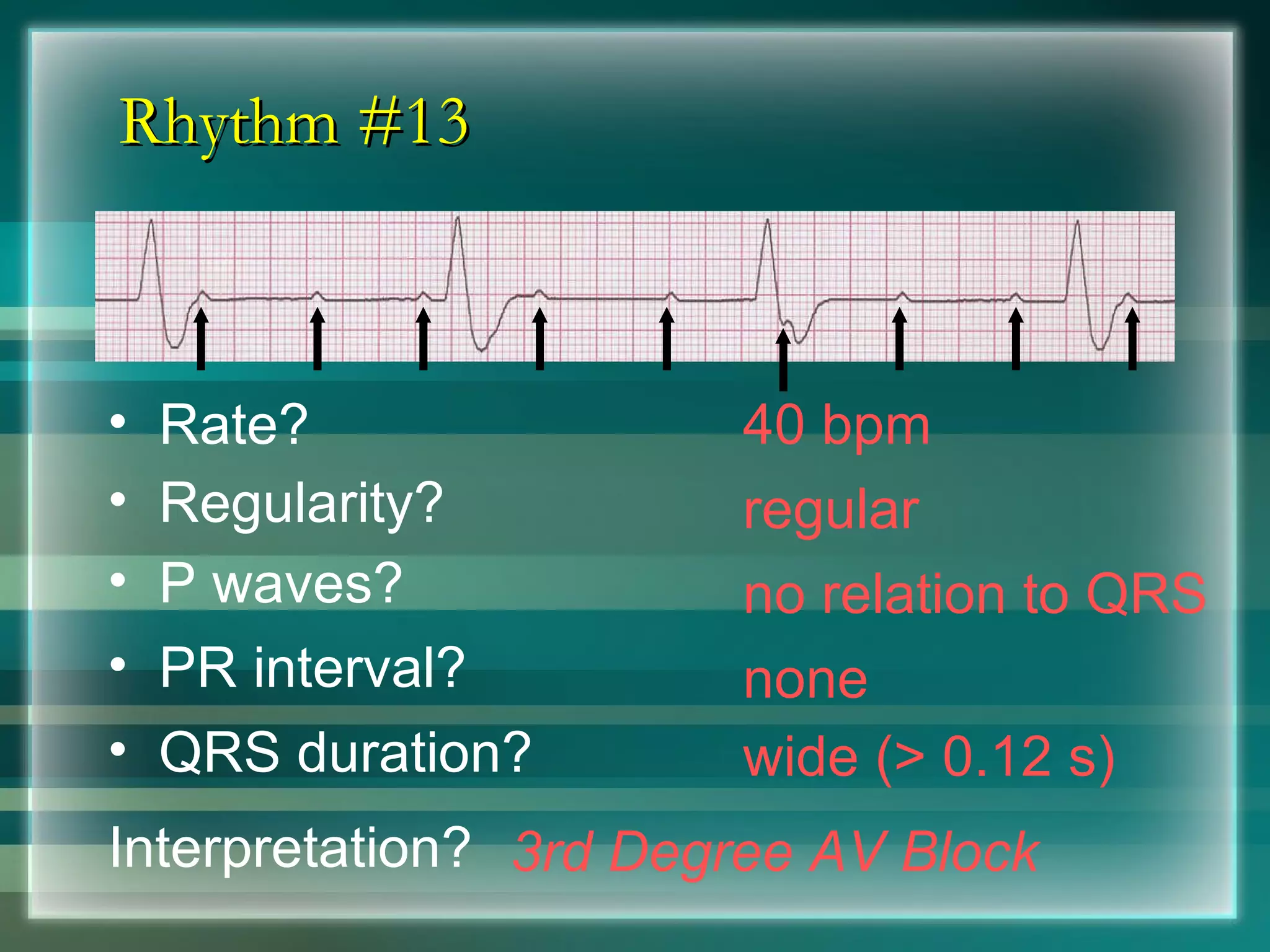
Rhythm #13 40 bpm Rate? Regularity? regular no relation to QRS wide (> 0.12 s) P waves? PR interval? none QRS duration? Interpretation? 3rd Degree AV Block
3rd Degree AV Block Deviation from NSR The P waves are completely blocked in the AV junction; QRS complexes originate independently from below the junction.
Supraventricular Arrhythmias Atrial Fibrillation Atrial Flutter Paroxysmal Supraventricular Tachycardia
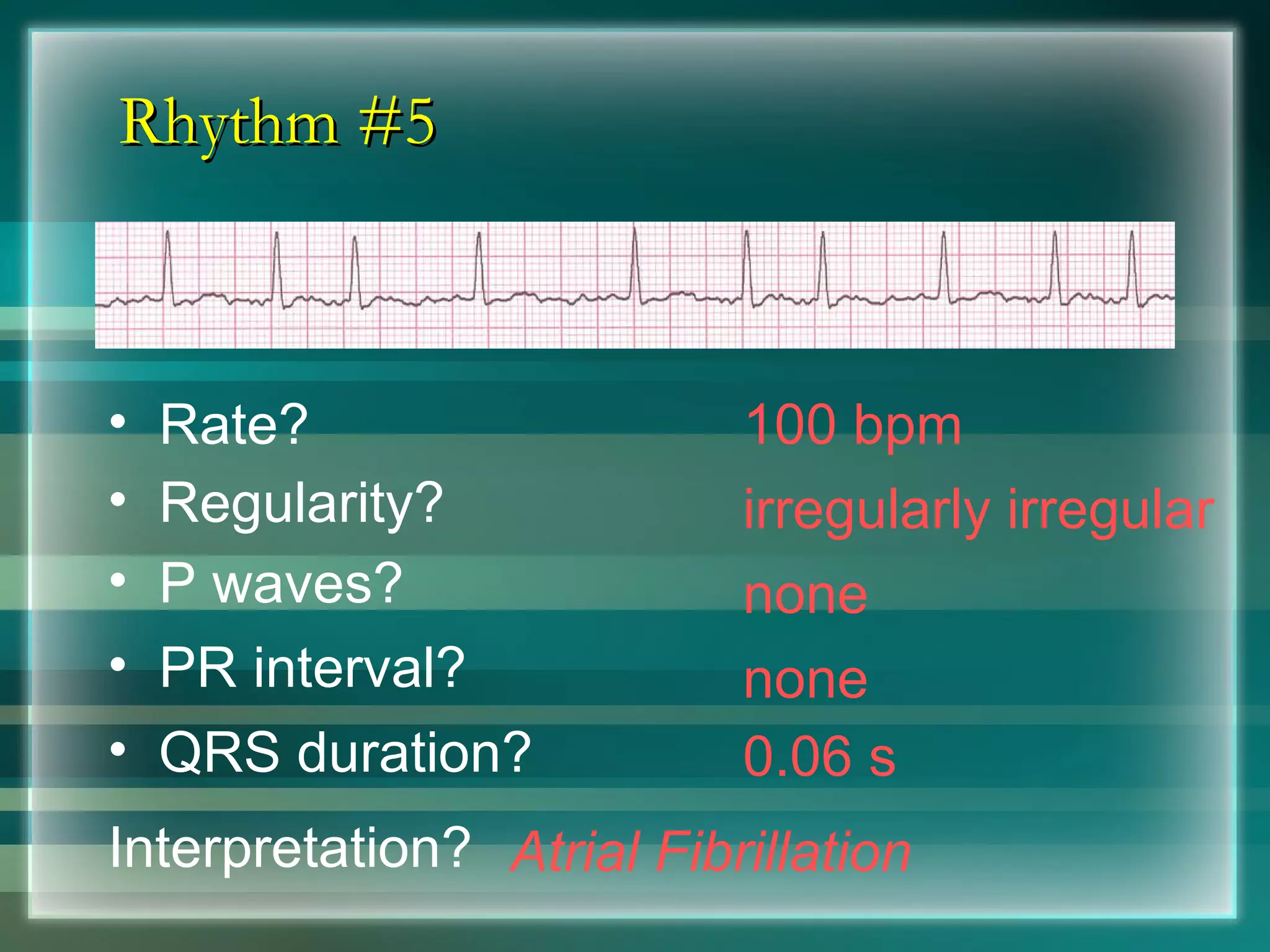
Rhythm #5 100 bpm Rate? Regularity? irregularly irregular none 0.06 s P waves? PR interval? none QRS duration? Interpretation? Atrial Fibrillation
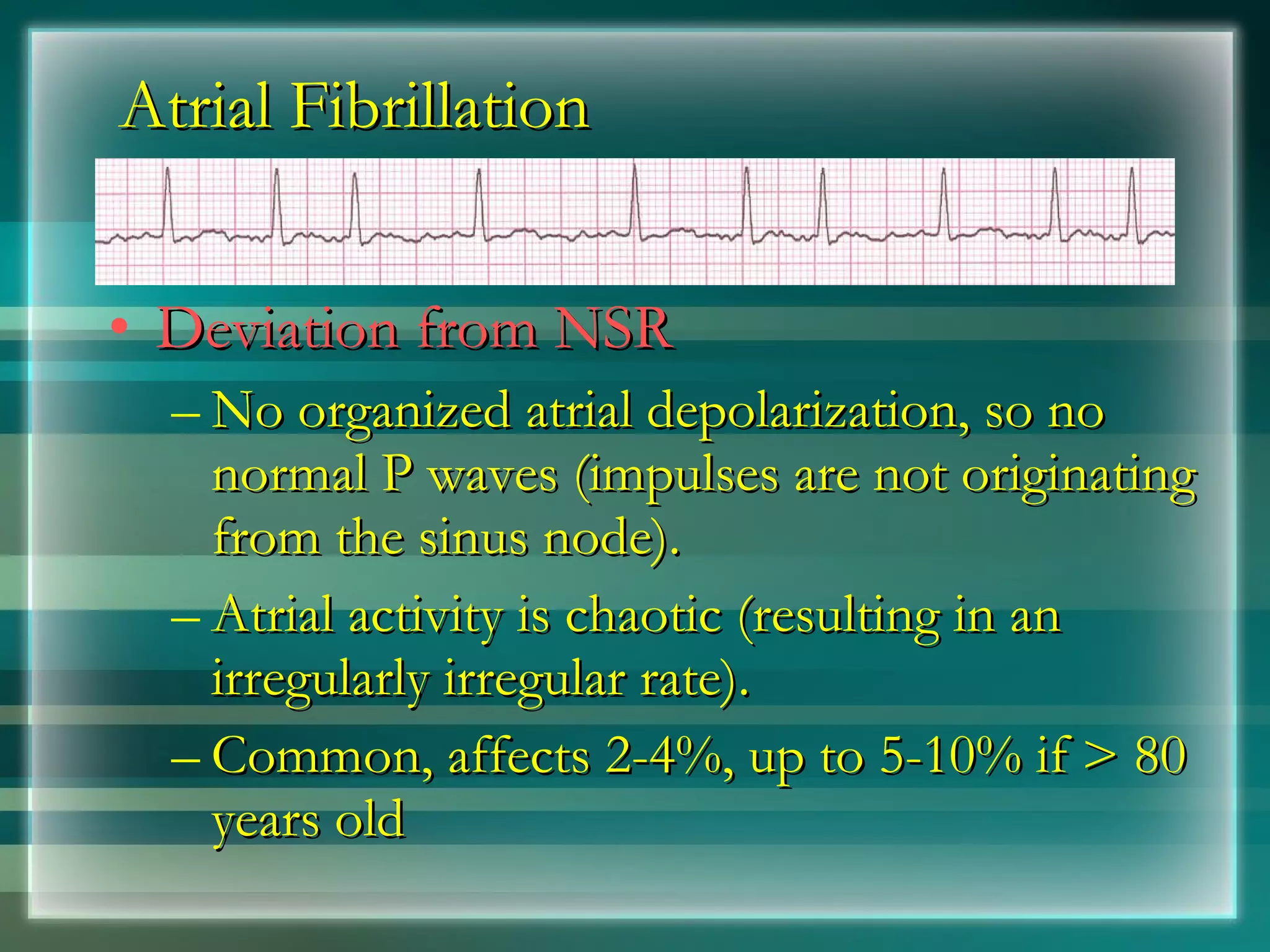
Atrial Fibrillation Deviation from NSR No organized atrial depolarization, so no normal P waves (impulses are not originating from the sinus node). Atrial activity is chaotic (resulting in an irregularly irregular rate). Common, affects 2-4%, up to 5-10% if > 80 years old
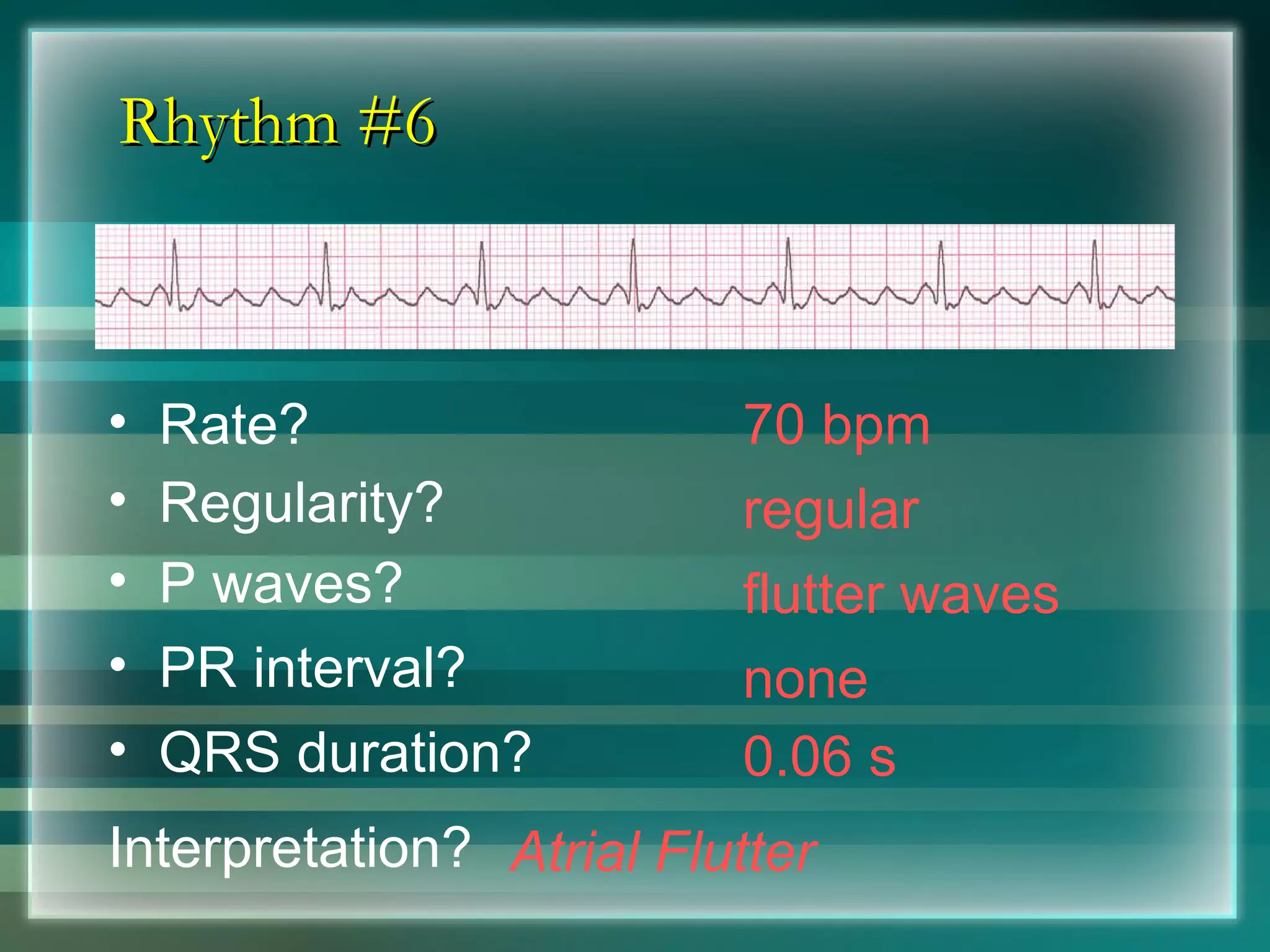
Rhythm #6 70 bpm Rate? Regularity? regular flutter waves 0.06 s P waves? PR interval? none QRS duration? Interpretation? Atrial Flutter
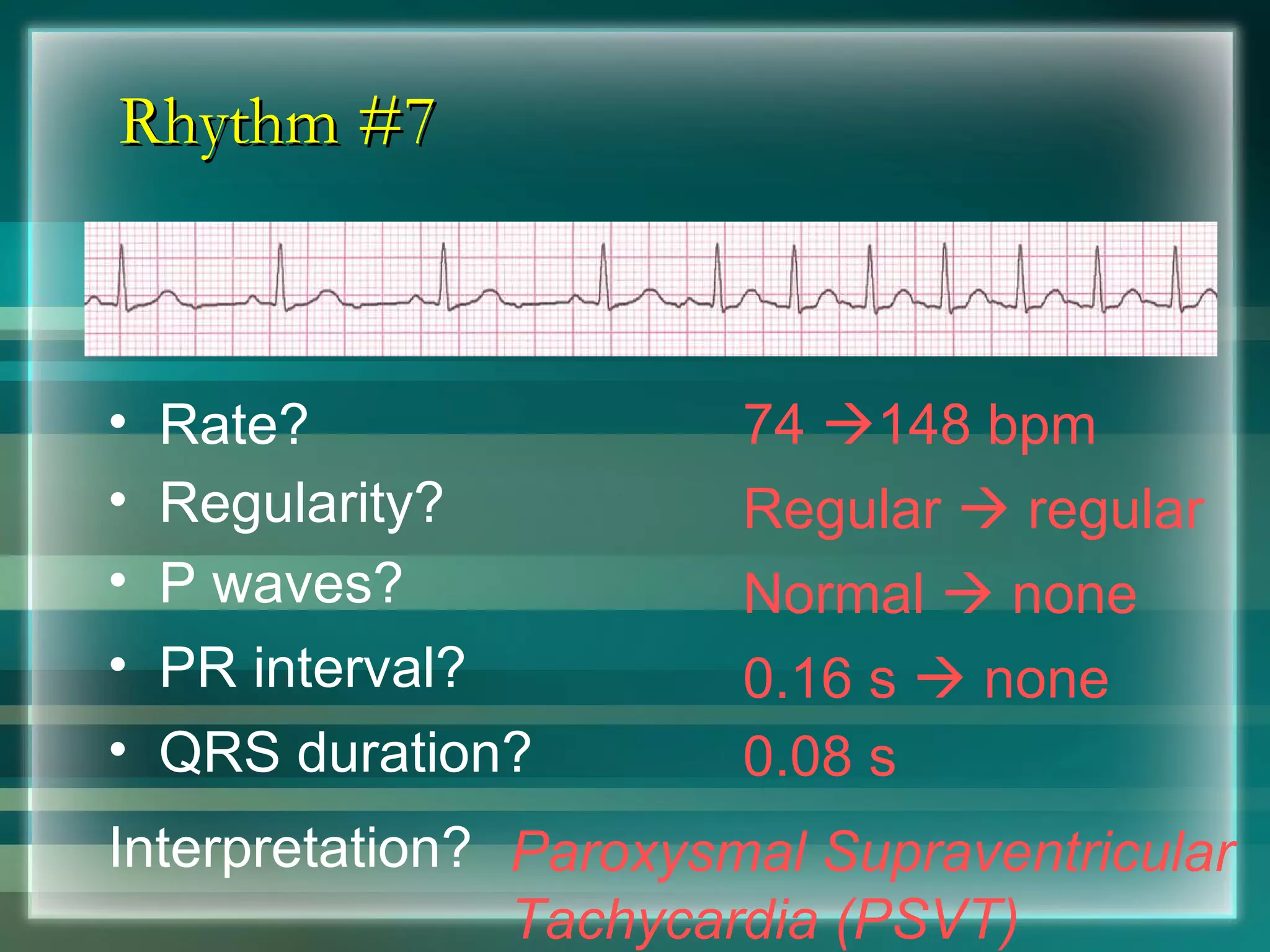
Rhythm #7 74   148 bpm Rate? Regularity? Regular    regular Normal    none 0.08 s P waves? PR interval? 0.16 s    none QRS duration? Interpretation? Paroxysmal Supraventricular Tachycardia (PSVT)
PSVT Deviation from NSR The heart rate suddenly speeds up, often triggered by a PAC (not seen here) and the P waves are lost.
Ventricular Arrhythmias Ventricular Tachycardia Ventricular Fibrillation
Rhythm #8 160 bpm Rate? Regularity? regular none wide (> 0.12 sec) P waves? PR interval? none QRS duration? Interpretation? Ventricular Tachycardia
Ventricular Tachycardia Deviation from NSR Impulse is originating in the ventricles (no P waves, wide QRS).
Rhythm #9 none Rate? Regularity? irregularly irreg. none wide, if recognizable  P waves? PR interval? none QRS duration? Interpretation? Ventricular Fibrillation
Ventricular Fibrillation Deviation from NSR Completely abnormal.
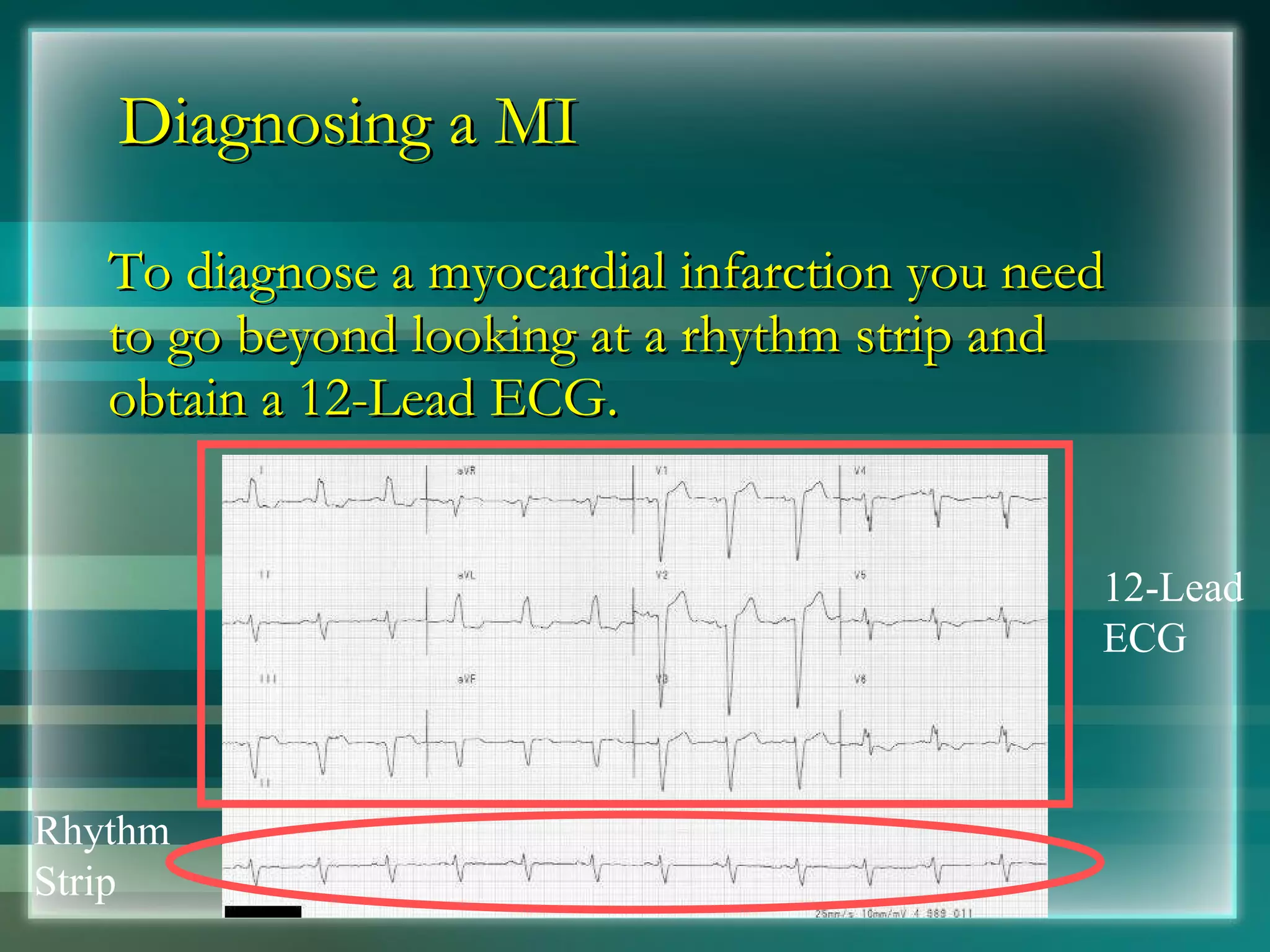
Diagnosing a MI To diagnose a myocardial infarction you need to go beyond looking at a rhythm strip and obtain a 12-Lead ECG. Rhythm Strip 12-Lead ECG
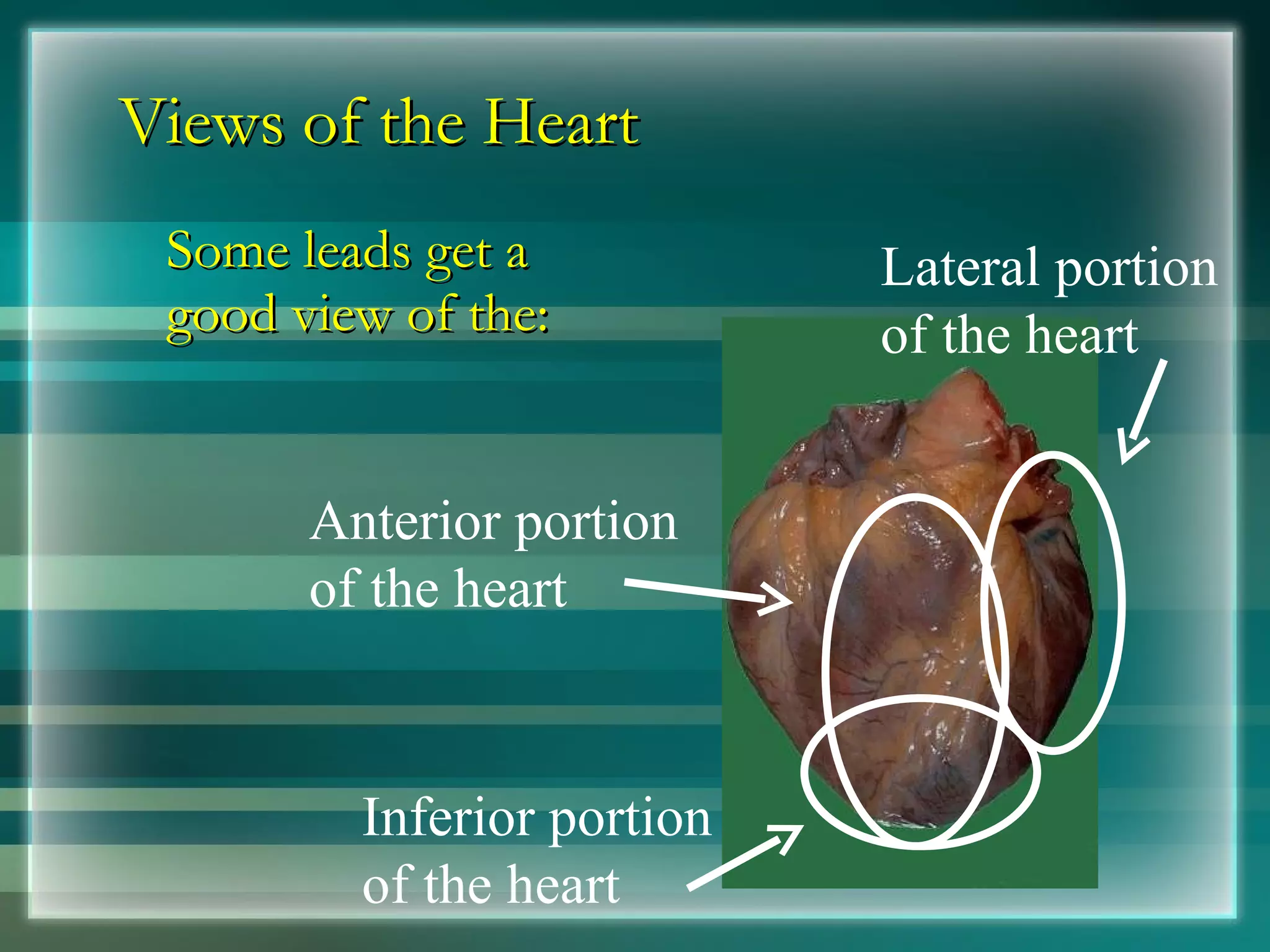
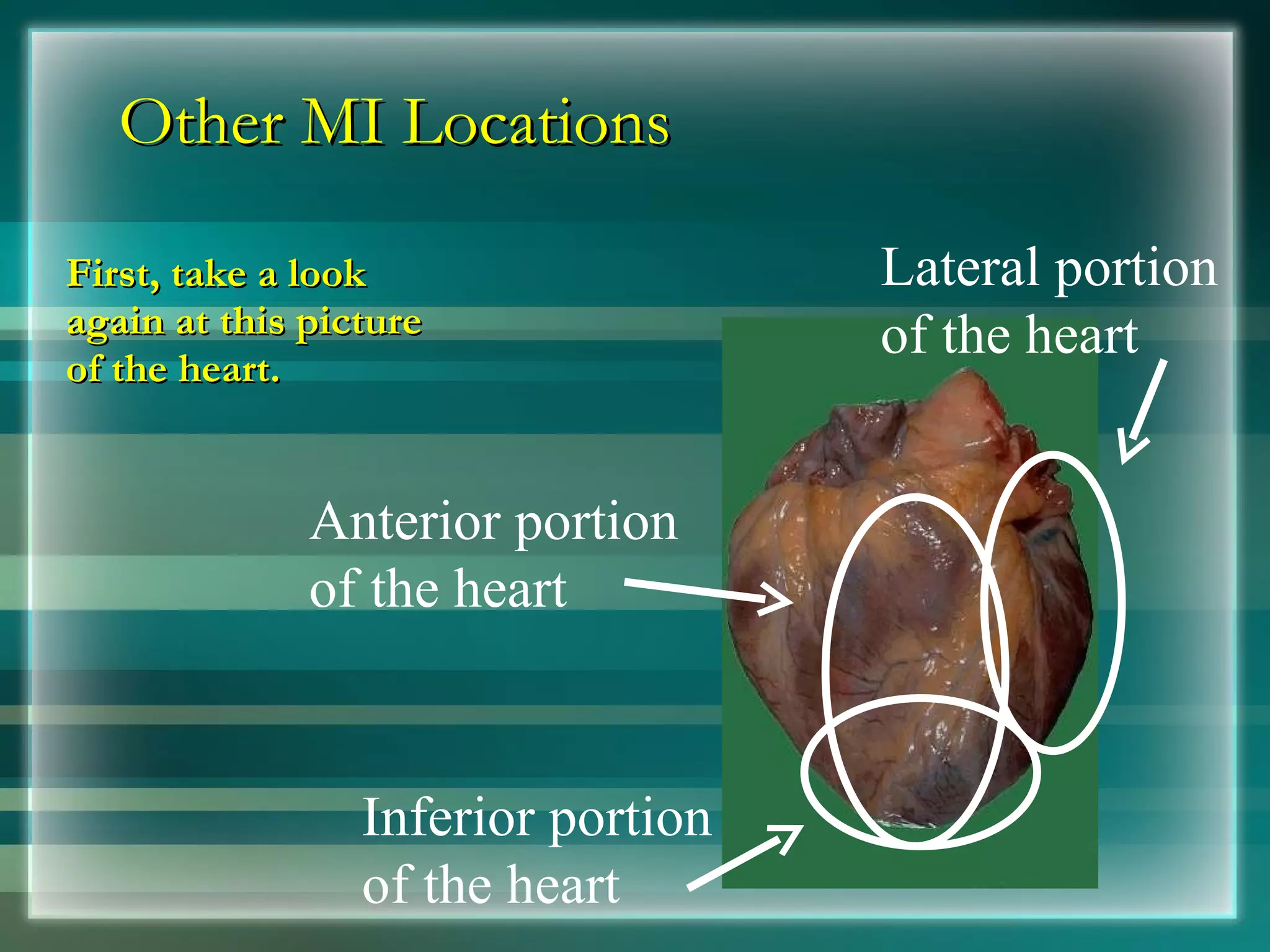
Views of the Heart Some leads get a good view of the: Anterior portion of the heart Lateral portion of the heart Inferior portion of the heart
ST Elevation One way to diagnose an acute MI is to look for elevation of the ST segment.
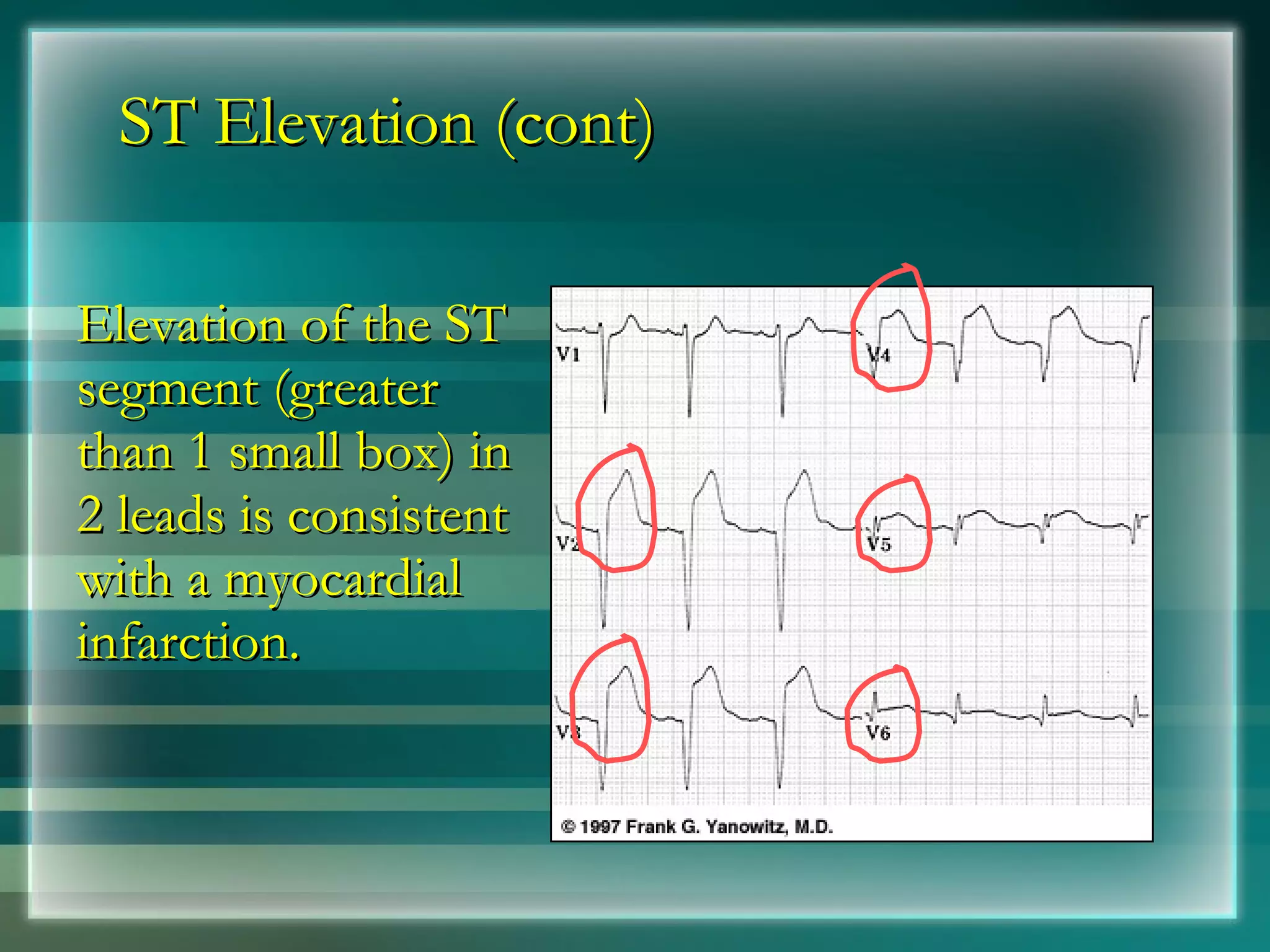
ST Elevation (cont) Elevation of the ST segment (greater than 1 small box) in 2 leads is consistent with a myocardial infarction.
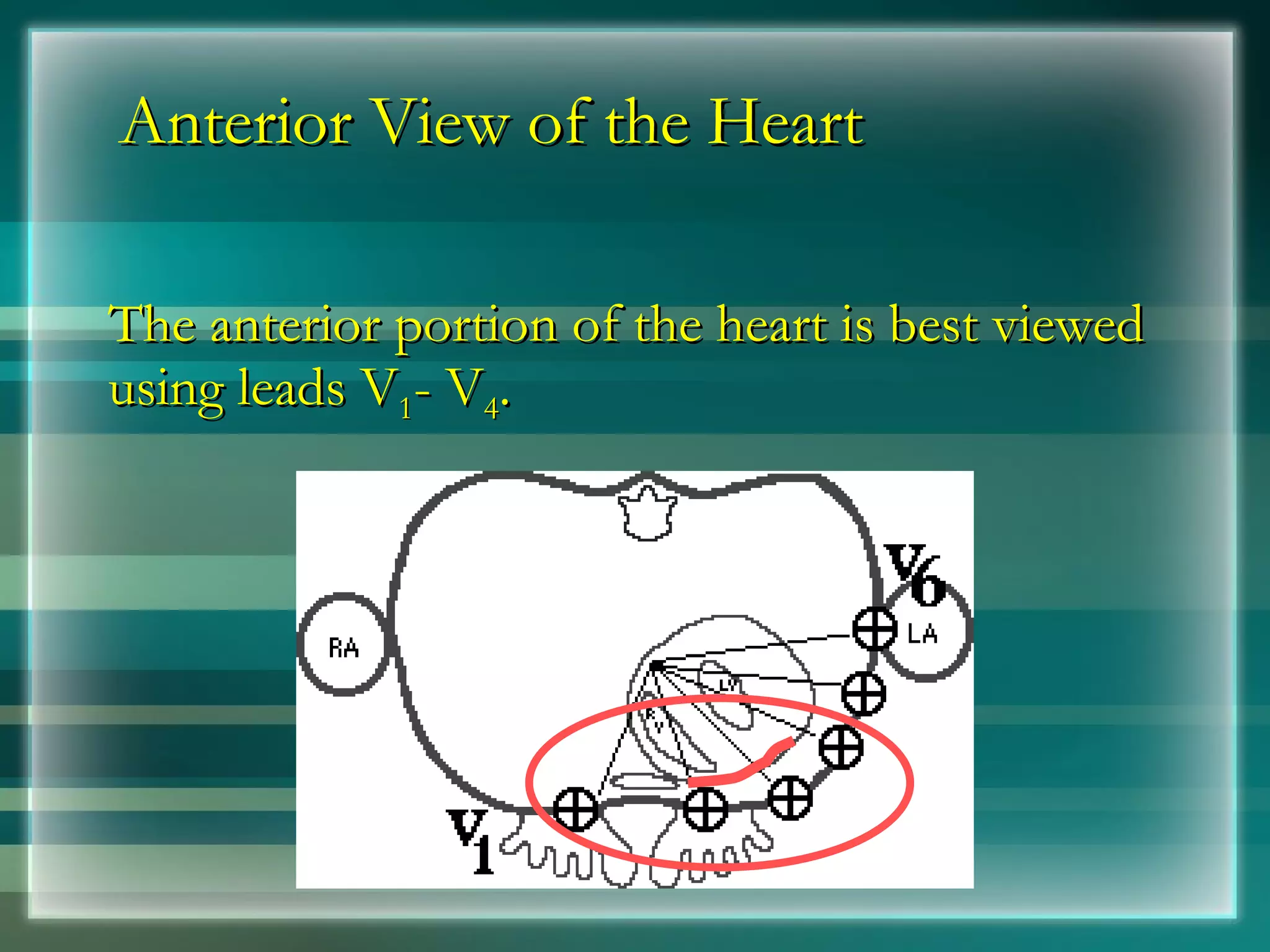
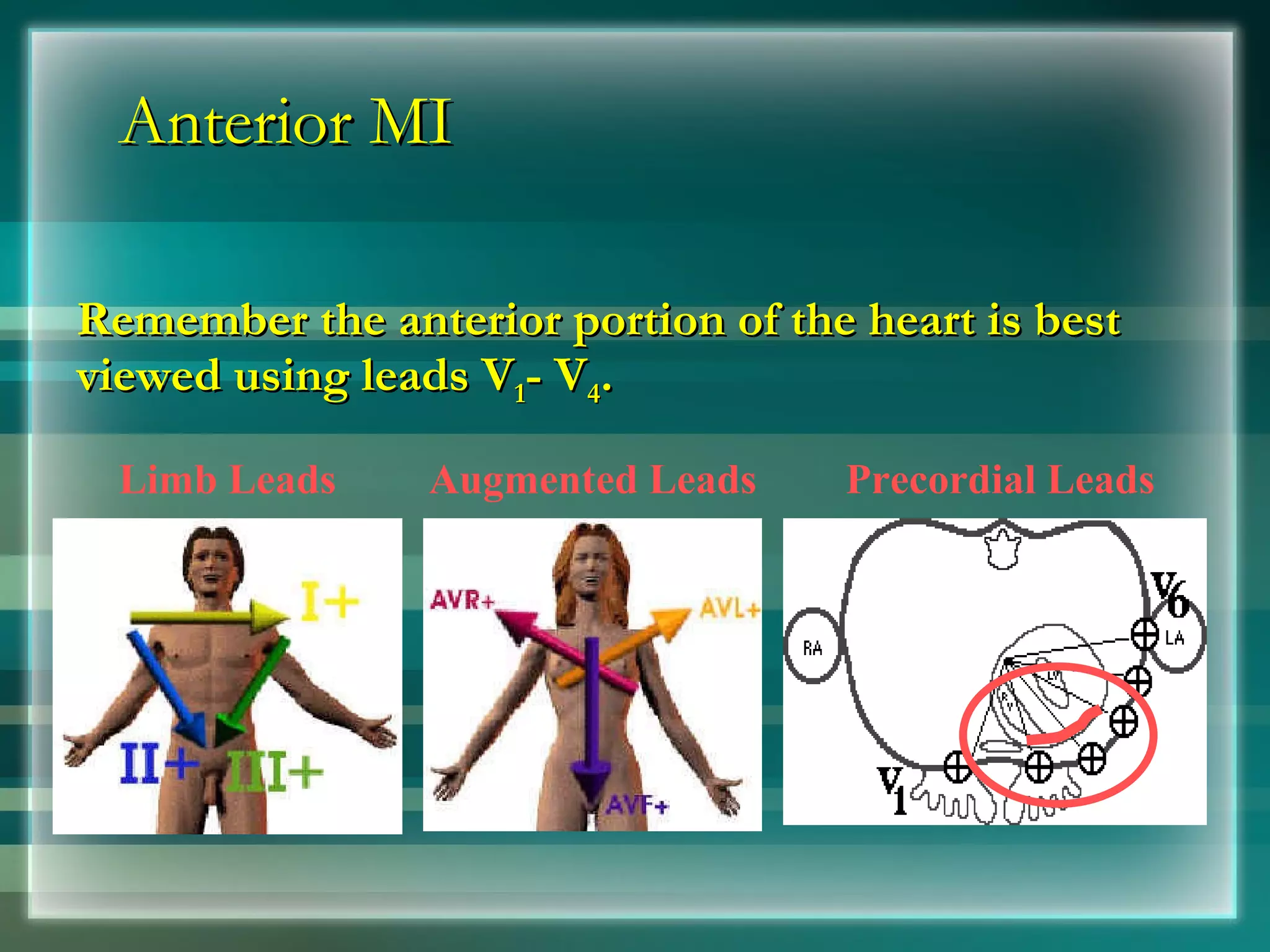
Anterior View of the Heart The anterior portion of the heart is best viewed using leads V 1 - V 4 .
Anterior Myocardial Infarction If you see changes in leads V 1  - V 4  that are consistent with a myocardial infarction, you can conclude that it is an anterior wall myocardial infarction.
Putting it all Together Do you think this person is having a myocardial infarction. If so, where?
Interpretation Yes , this person is having an acute anterior wall myocardial infarction.
Other MI Locations Now that you know where to look for an anterior wall myocardial infarction let’s look at how you would determine if the MI involves the lateral wall or the inferior wall of the heart.
Other MI Locations First, take a look again at this picture of the heart. Anterior portion of the heart Lateral portion of the heart Inferior portion of the heart
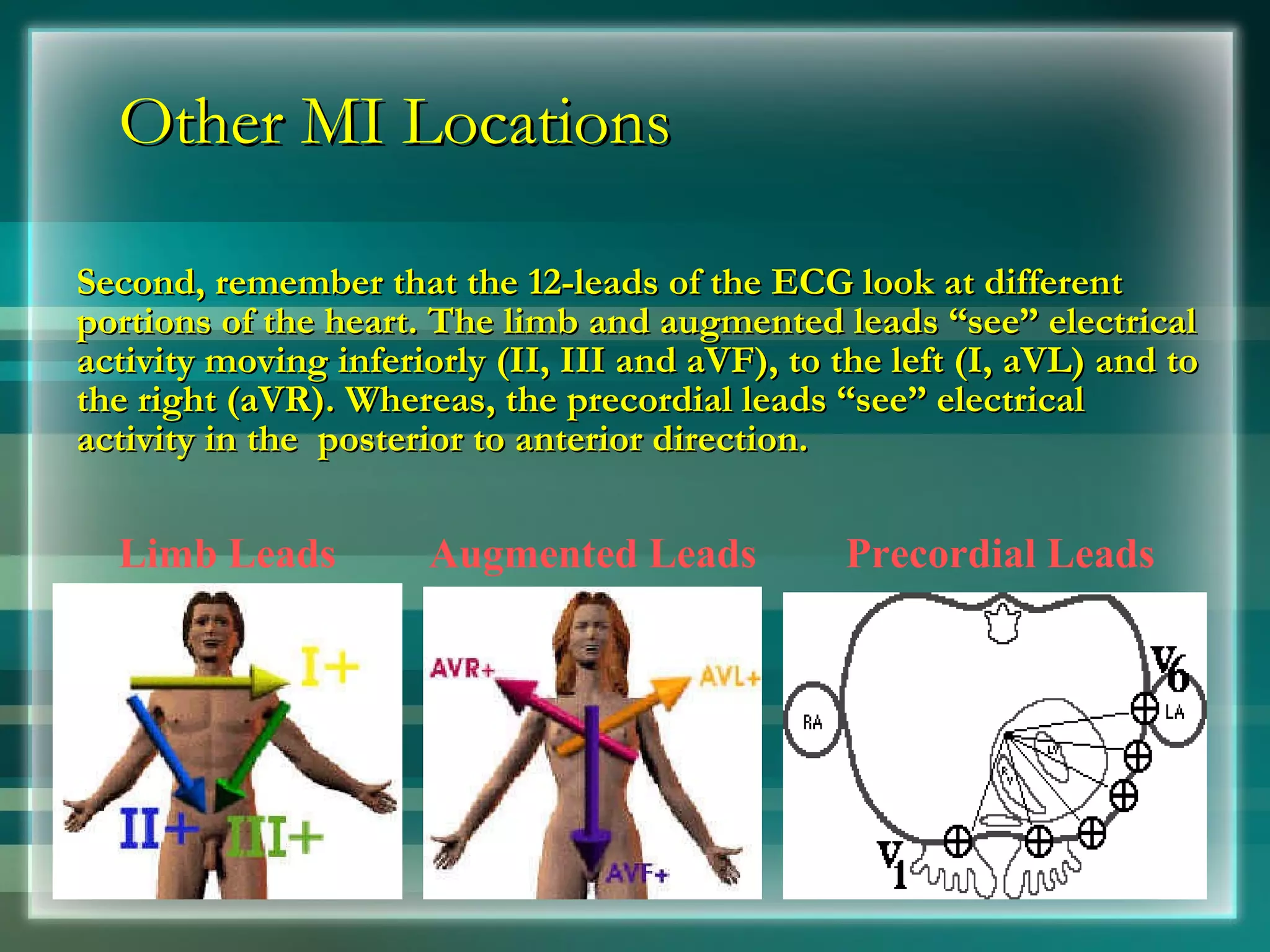
Other MI Locations Second, remember that the 12-leads of the ECG look at different portions of the heart. The limb and augmented leads “see” electrical activity moving inferiorly (II, III and aVF), to the left (I, aVL) and to the right (aVR). Whereas, the precordial leads “see” electrical activity in the  posterior to anterior direction. Limb Leads Augmented Leads Precordial Leads
Other MI Locations Now, using these 3 diagrams let’s figure where to look for a lateral wall and inferior wall MI. Limb Leads Augmented Leads Precordial Leads
Anterior MI Remember the anterior portion of the heart is best viewed using leads V 1 - V 4 . Limb Leads Augmented Leads Precordial Leads
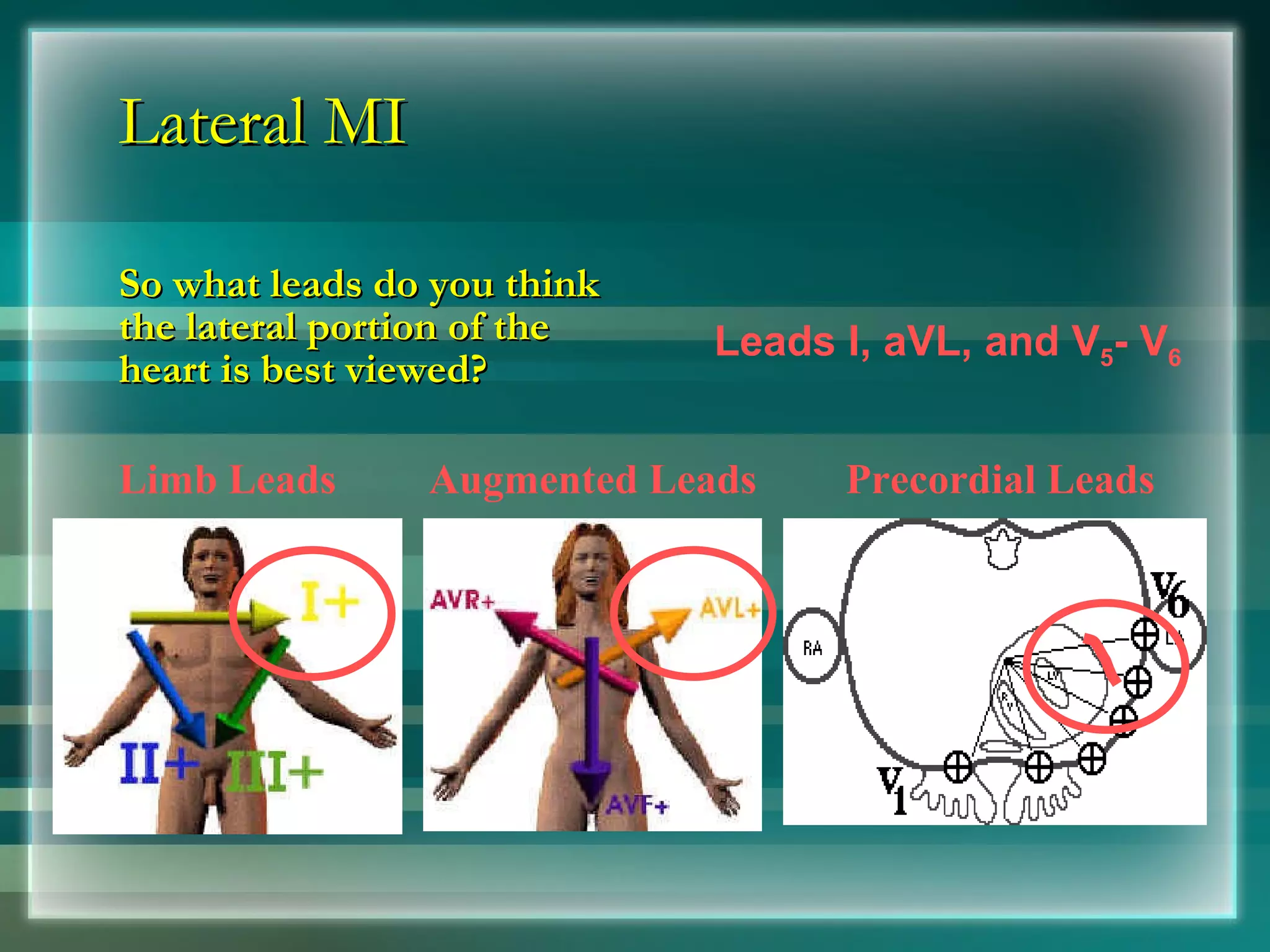
Lateral MI So what leads do you think the lateral portion of the heart is best viewed?  Limb Leads Augmented Leads Precordial Leads Leads I, aVL, and V 5 - V 6
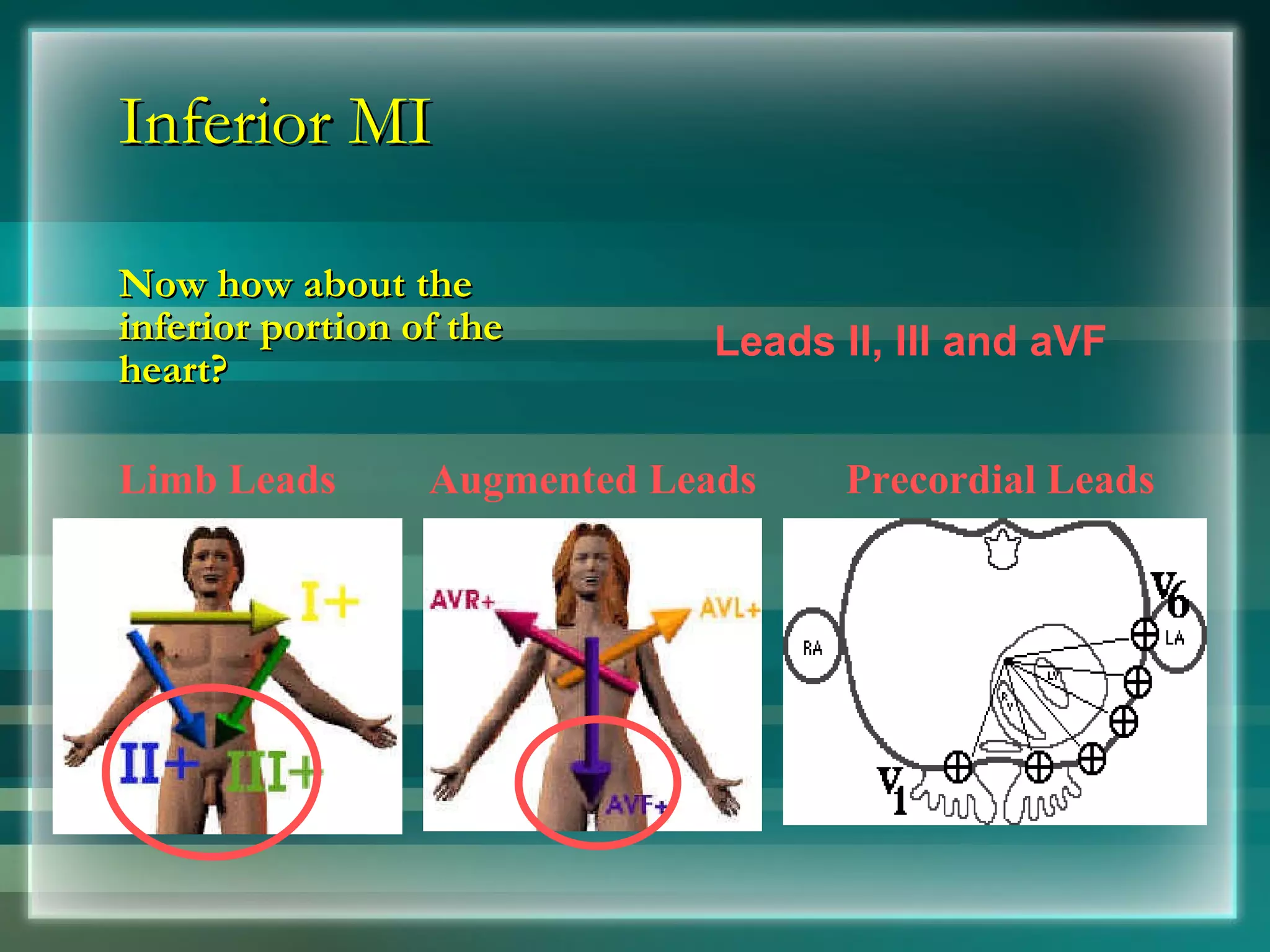
Inferior MI Now how about the inferior portion of the heart?  Limb Leads Augmented Leads Precordial Leads Leads II, III and aVF
Putting it all Together Now, where do you think this person is having a myocardial infarction?
Inferior Wall MI This is an inferior MI. Note the ST elevation in leads II, III and aVF.
Putting it all Together How about now?
Anterolateral MI This person’s MI involves  both  the anterior wall (V 2 -V 4 ) and the lateral wall (V 5 -V 6 , I, and aVL)!
RIGHT ATRIAL ENLARGEMENT
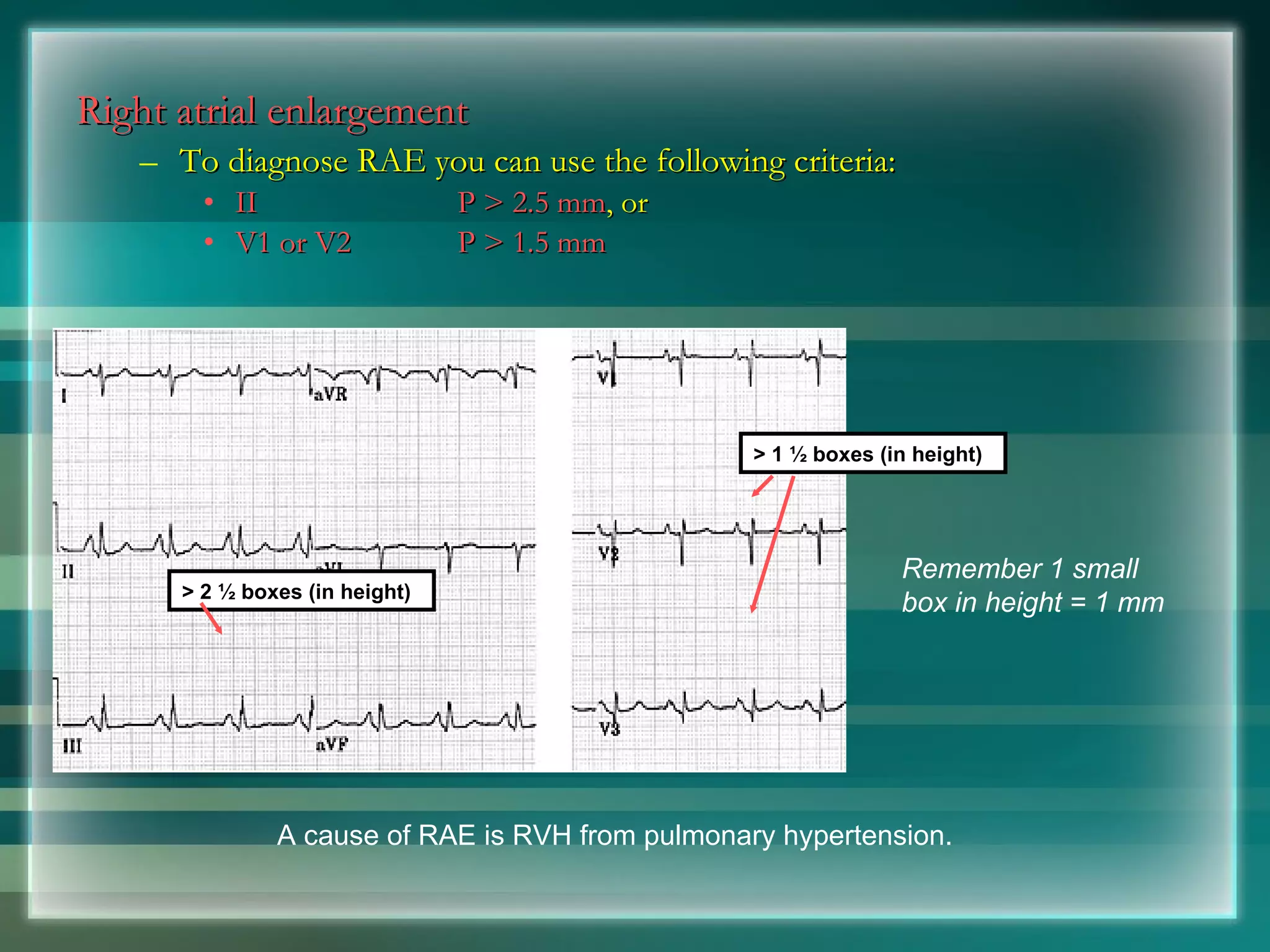
Right atrial enlargement   Take a look at this ECG. What do you notice about the P waves? The P waves are tall, especially in leads II, III and avF. Ouch! They would hurt to sit on!!
Right atrial enlargement   To diagnose RAE you can use the following criteria: II P > 2.5 mm , or V1 or V2 P > 1.5 mm Remember 1 small box in height = 1 mm A cause of RAE is RVH from pulmonary hypertension. > 2 ½ boxes (in height) > 1 ½ boxes (in height)
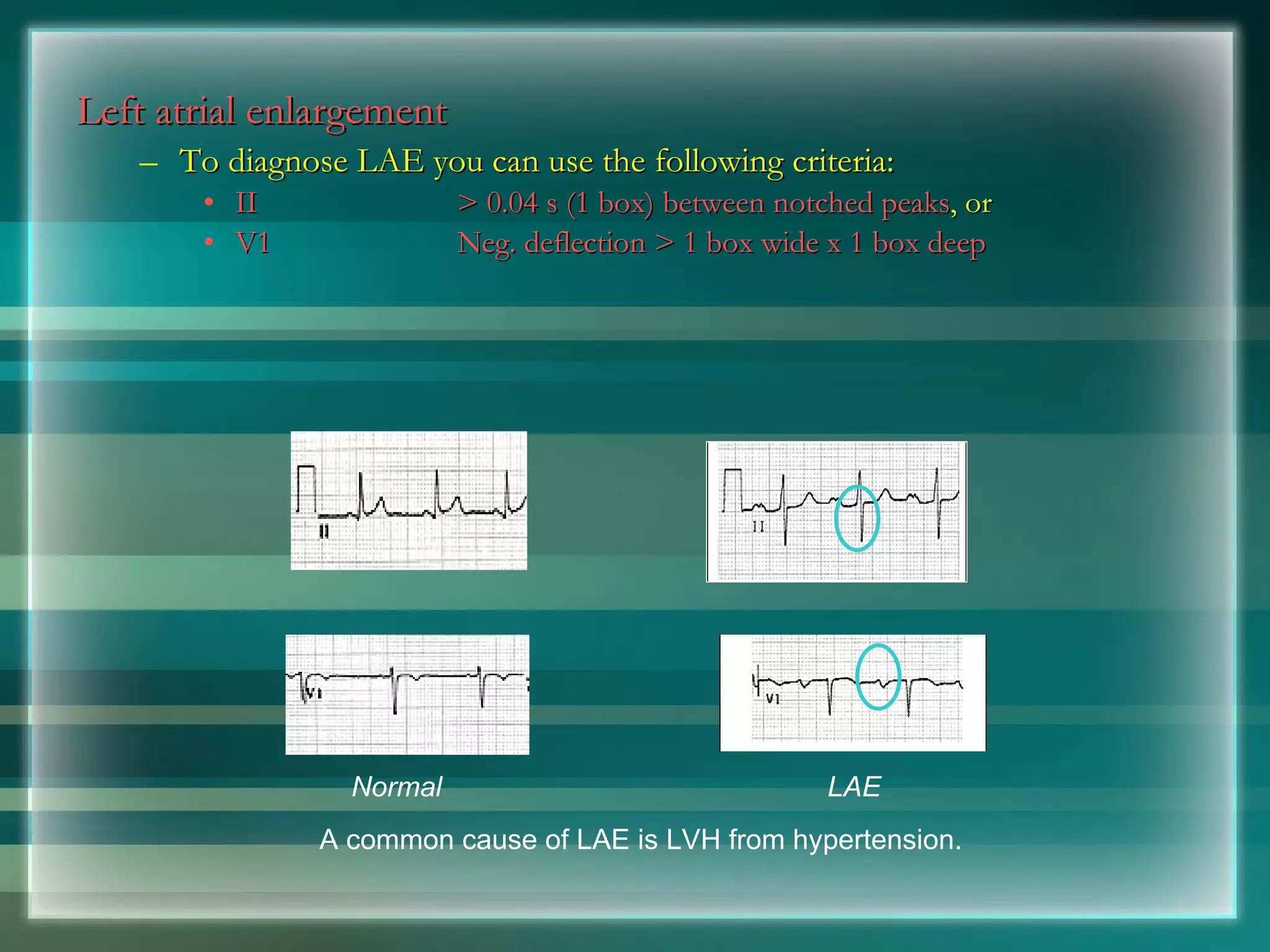
Left atrial enlargement   Take a look at this ECG. What do you notice about the P waves? The P waves in lead II are notched and in lead V1 they have a deep and wide negative component. Notched  Negative deflection
Left atrial enlargement   To diagnose LAE you can use the following criteria: II > 0.04 s (1 box) between notched peaks , or V1 Neg. deflection > 1 box wide x 1 box deep Normal LAE A common cause of LAE is LVH from hypertension.
Left Ventricular Hypertrophy
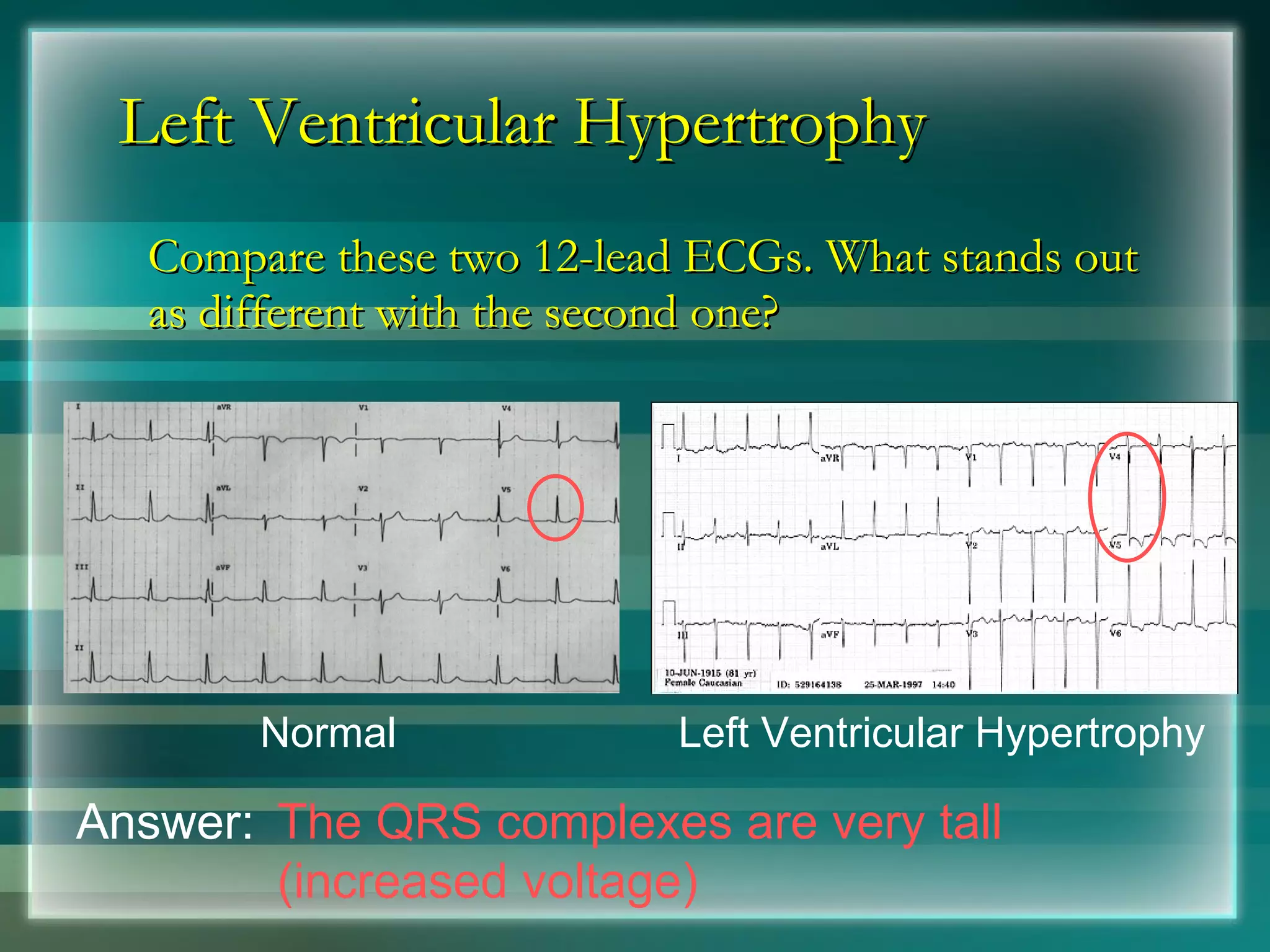
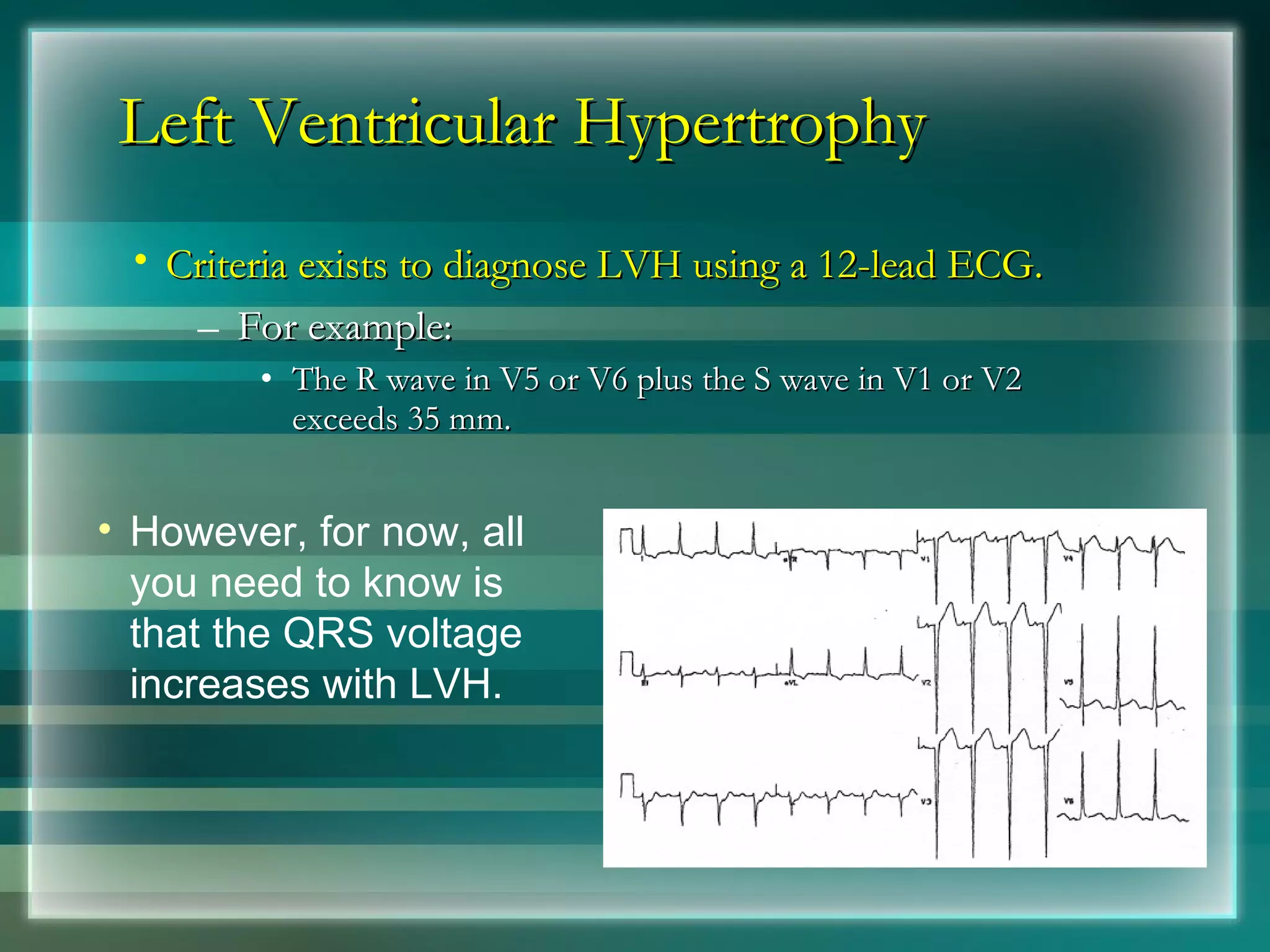
Left Ventricular Hypertrophy Compare these two 12-lead ECGs. What stands out as different with the second one? Normal Left Ventricular Hypertrophy Answer: The QRS complexes are very tall (increased voltage)
Left Ventricular Hypertrophy Criteria exists to diagnose LVH using a 12-lead ECG.   For example: The R wave in V5 or V6 plus the S wave in V1 or V2 exceeds 35 mm. However, for now, all you need to know is that the QRS voltage increases with LVH.
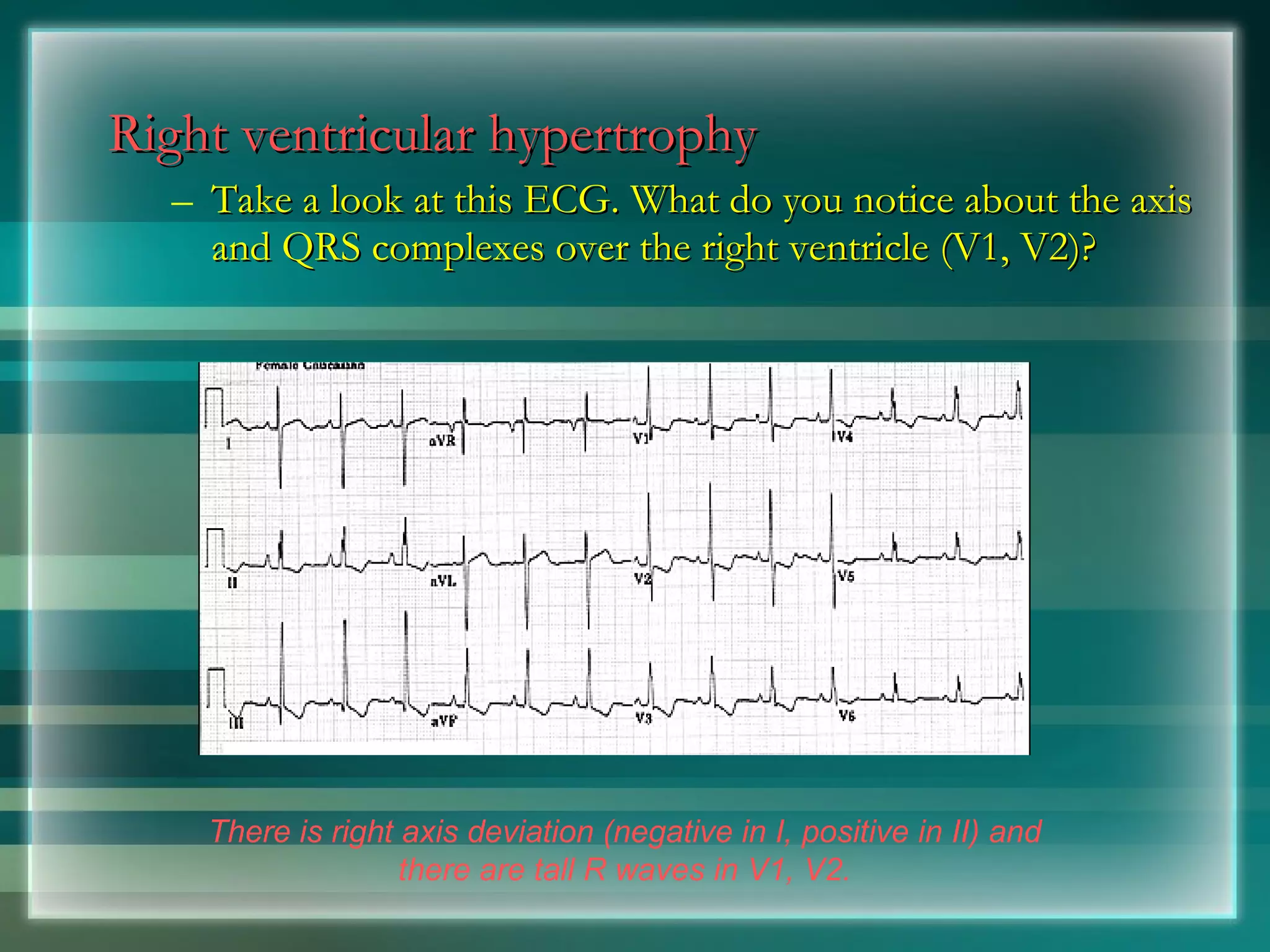
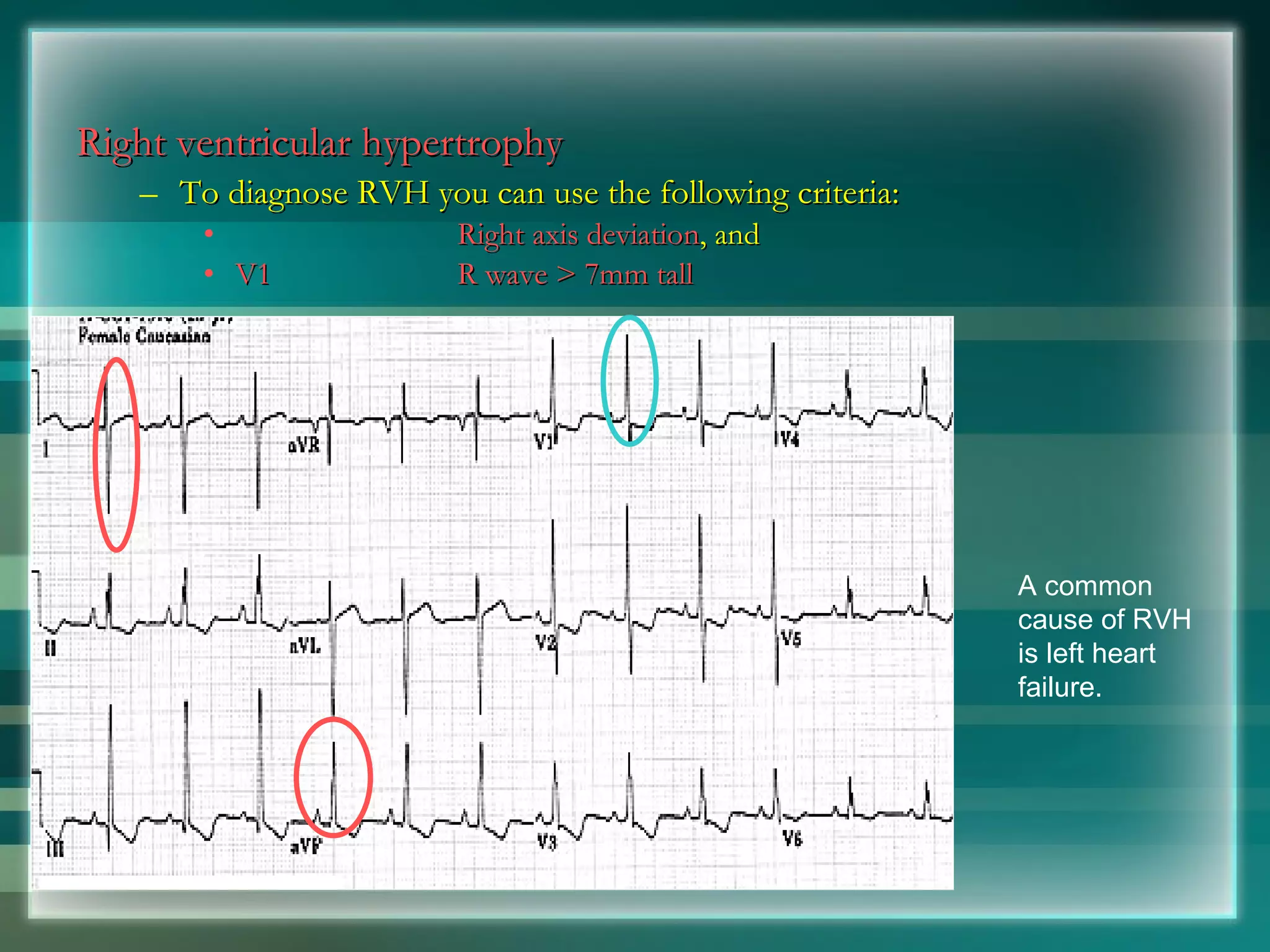
Right ventricular hypertrophy Take a look at this ECG. What do you notice about the axis and QRS complexes over the right ventricle (V1, V2)? There is right axis deviation (negative in I, positive in II) and there are tall R waves in V1, V2.
Right ventricular hypertrophy   To diagnose RVH you can use the following criteria: Right axis deviation , and V1 R wave > 7mm tall A common cause of RVH is left heart failure.
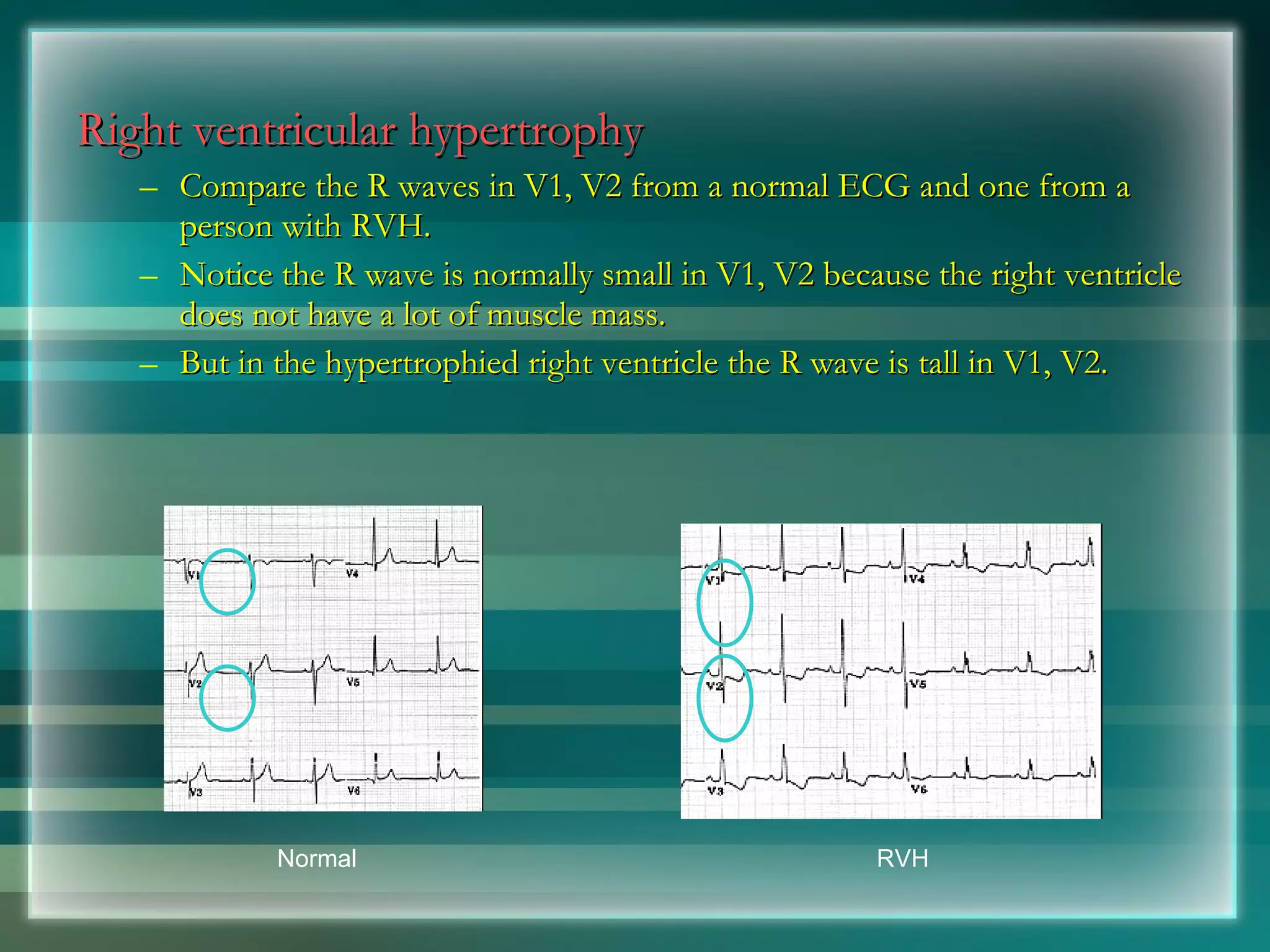
Right ventricular hypertrophy Compare the R waves in V1, V2 from a normal ECG and one from a person with RVH. Notice the R wave is normally small in V1, V2 because the right ventricle does not have a lot of muscle mass. But in the hypertrophied right ventricle the R wave is tall in V1, V2. Normal RVH
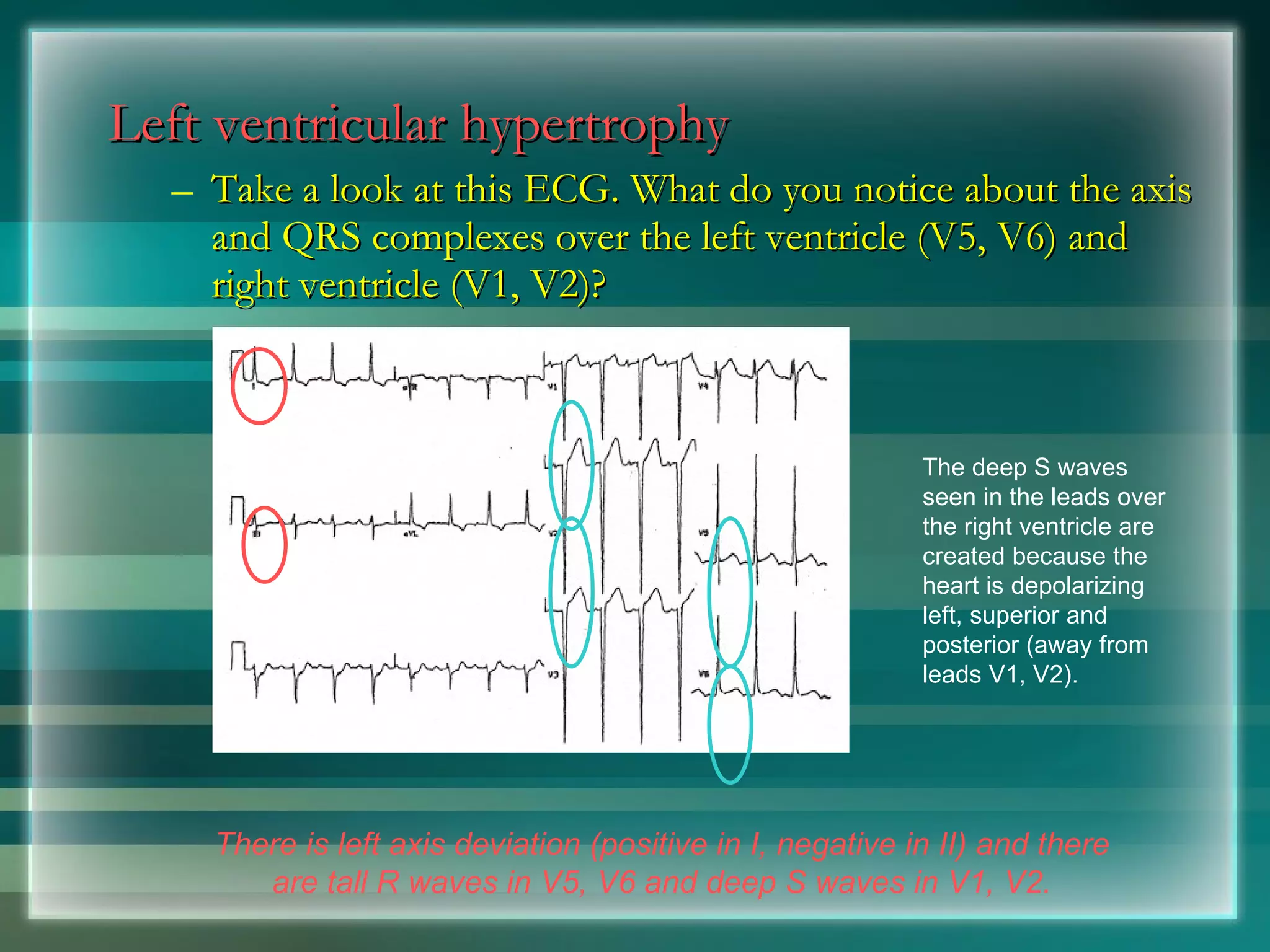
Left ventricular hypertrophy Take a look at this ECG. What do you notice about the axis and QRS complexes over the left ventricle (V5, V6) and right ventricle (V1, V2)? There is left axis deviation (positive in I, negative in II) and there are tall R waves in V5, V6 and deep S waves in V1, V2. The deep S waves seen in the leads over the right ventricle are created because the heart is depolarizing left, superior and posterior (away from leads V1, V2).
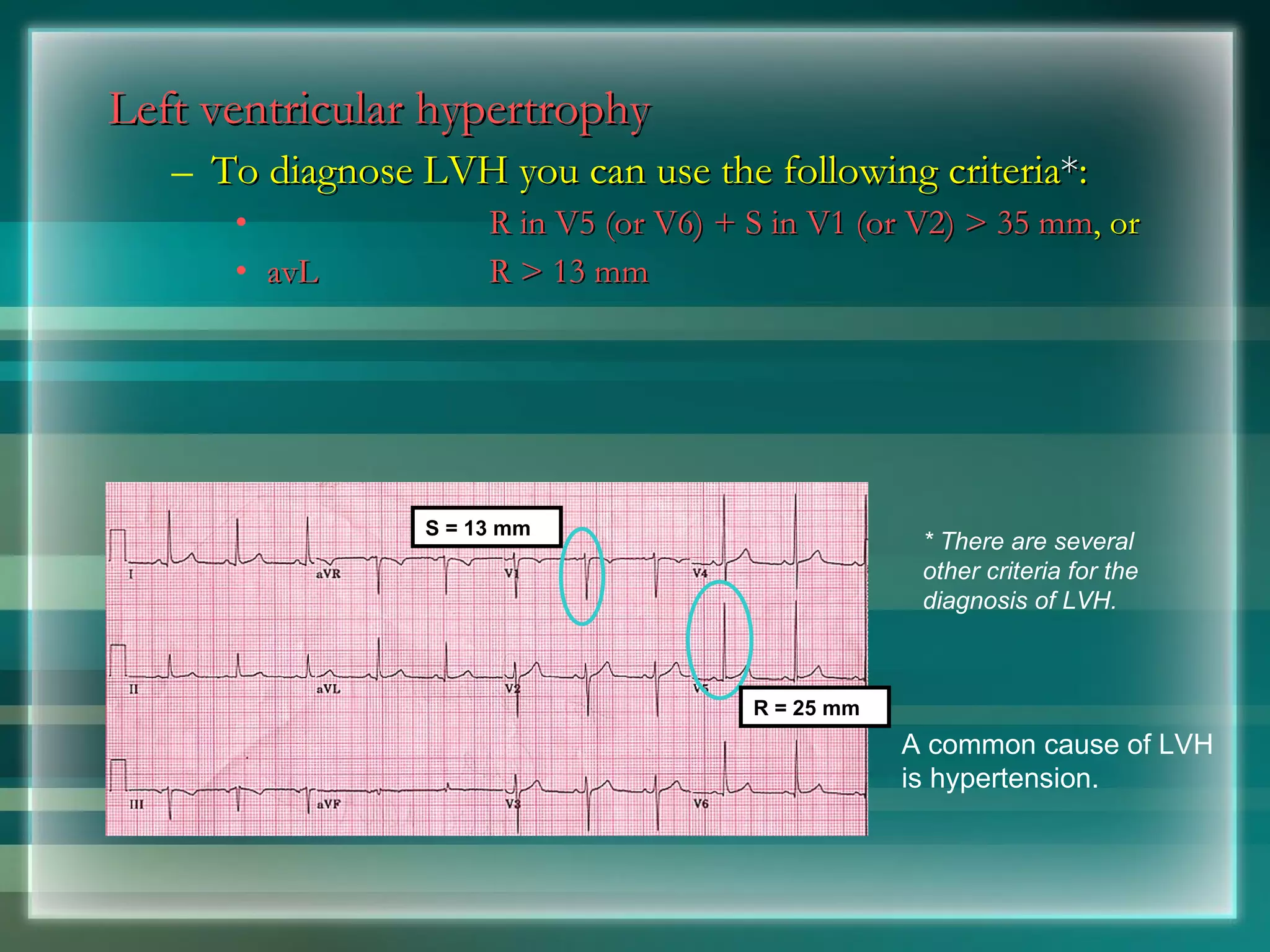
Left ventricular hypertrophy To diagnose LVH you can use the following criteria * : R in V5 (or V6) + S in V1 (or V2) > 35 mm , or avL R > 13 mm A common cause of LVH is hypertension. * There are several other criteria for the diagnosis of LVH. S = 13 mm R = 25 mm
Bundle Branch Blocks
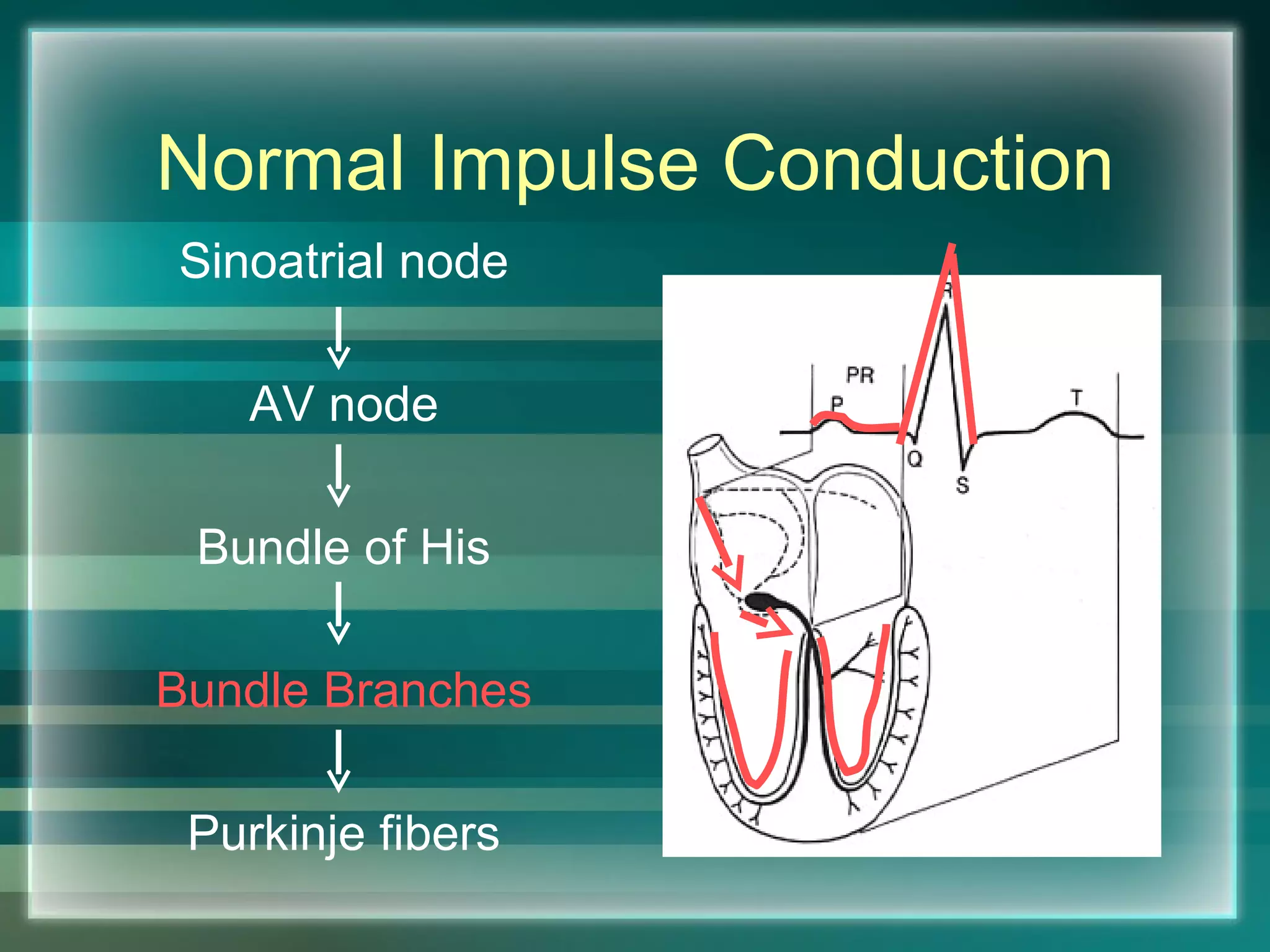
Normal Impulse Conduction Sinoatrial node AV node Bundle of His Bundle Branches Purkinje fibers
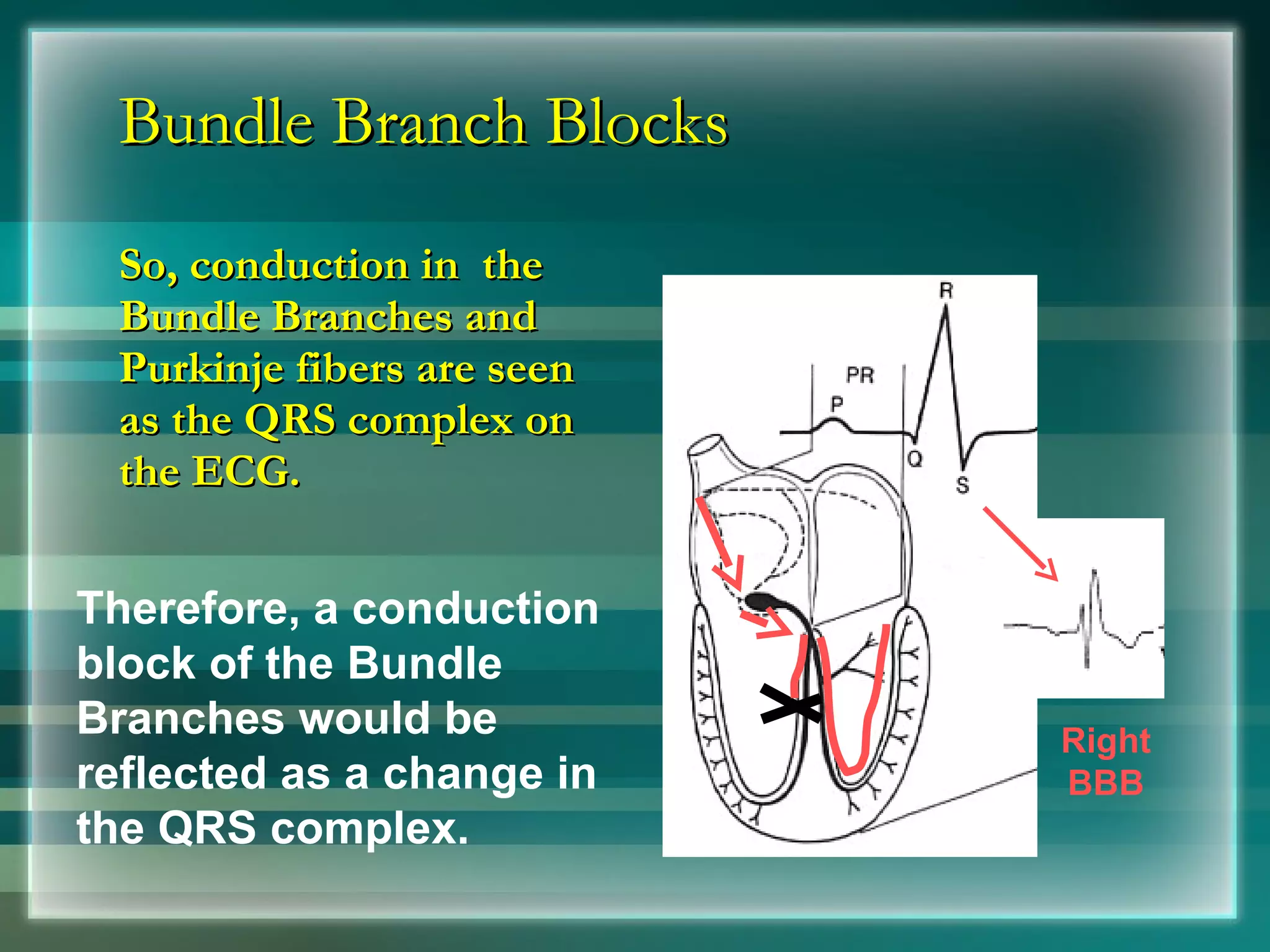
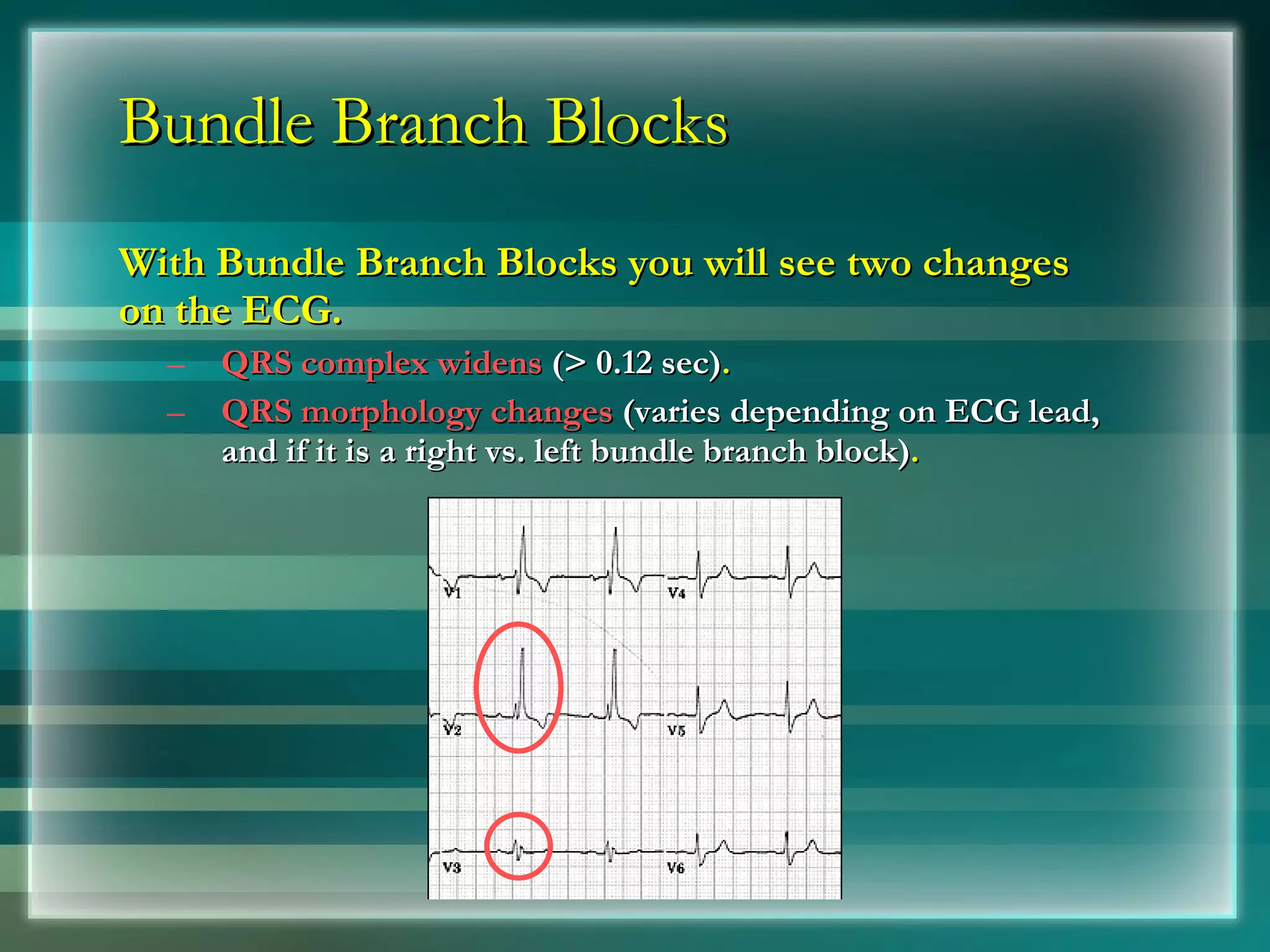
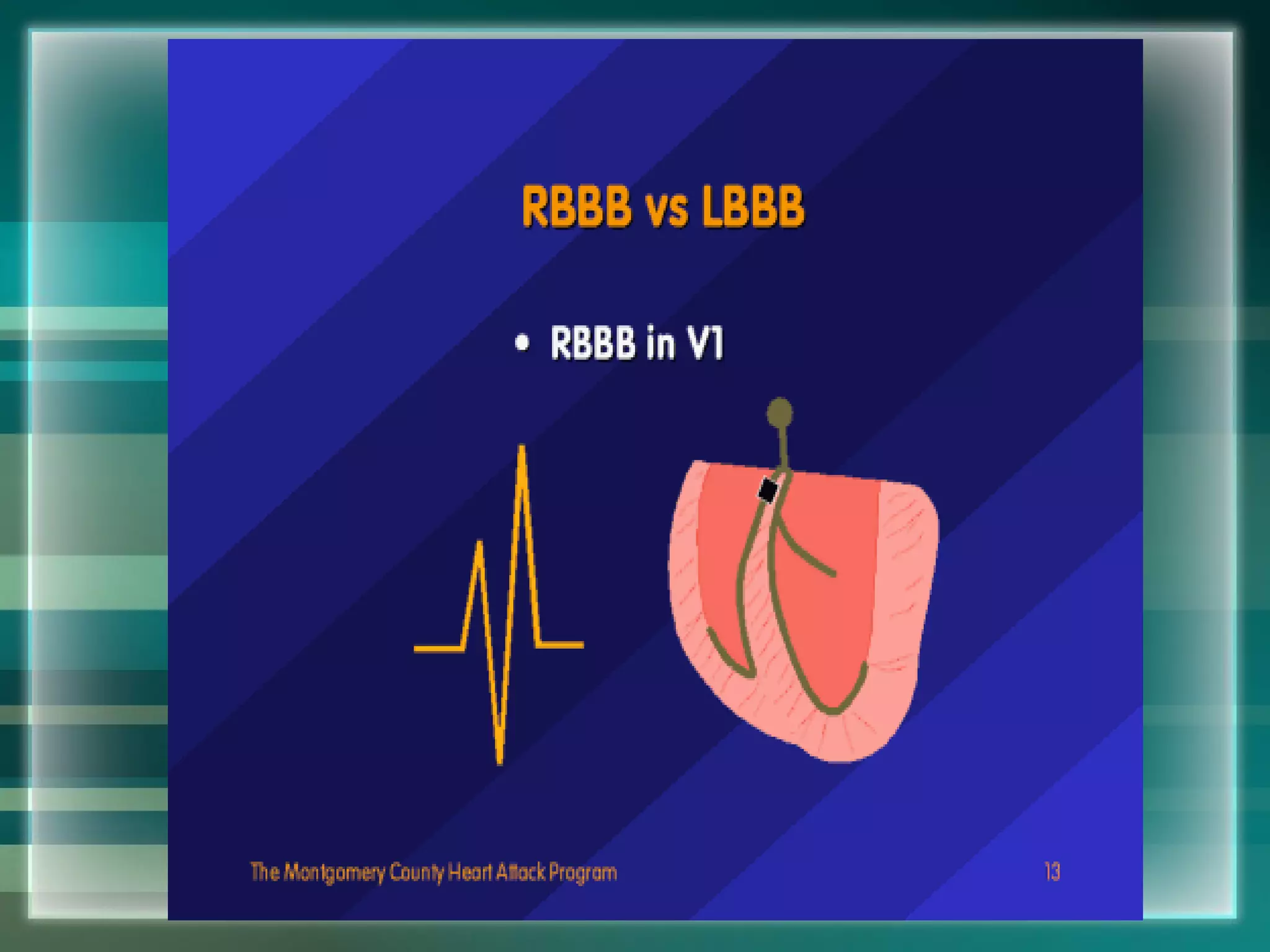
Bundle Branch Blocks So, conduction in  the Bundle Branches and Purkinje fibers are seen as the QRS complex on the ECG. Therefore, a conduction block of the Bundle Branches would be reflected as a change in the QRS complex. Right BBB
Bundle Branch Blocks With Bundle Branch Blocks you will see two changes on the ECG. QRS complex widens  (> 0.12 sec) .  QRS morphology changes  (varies depending on ECG lead, and if it is a right vs. left bundle branch block) .
 
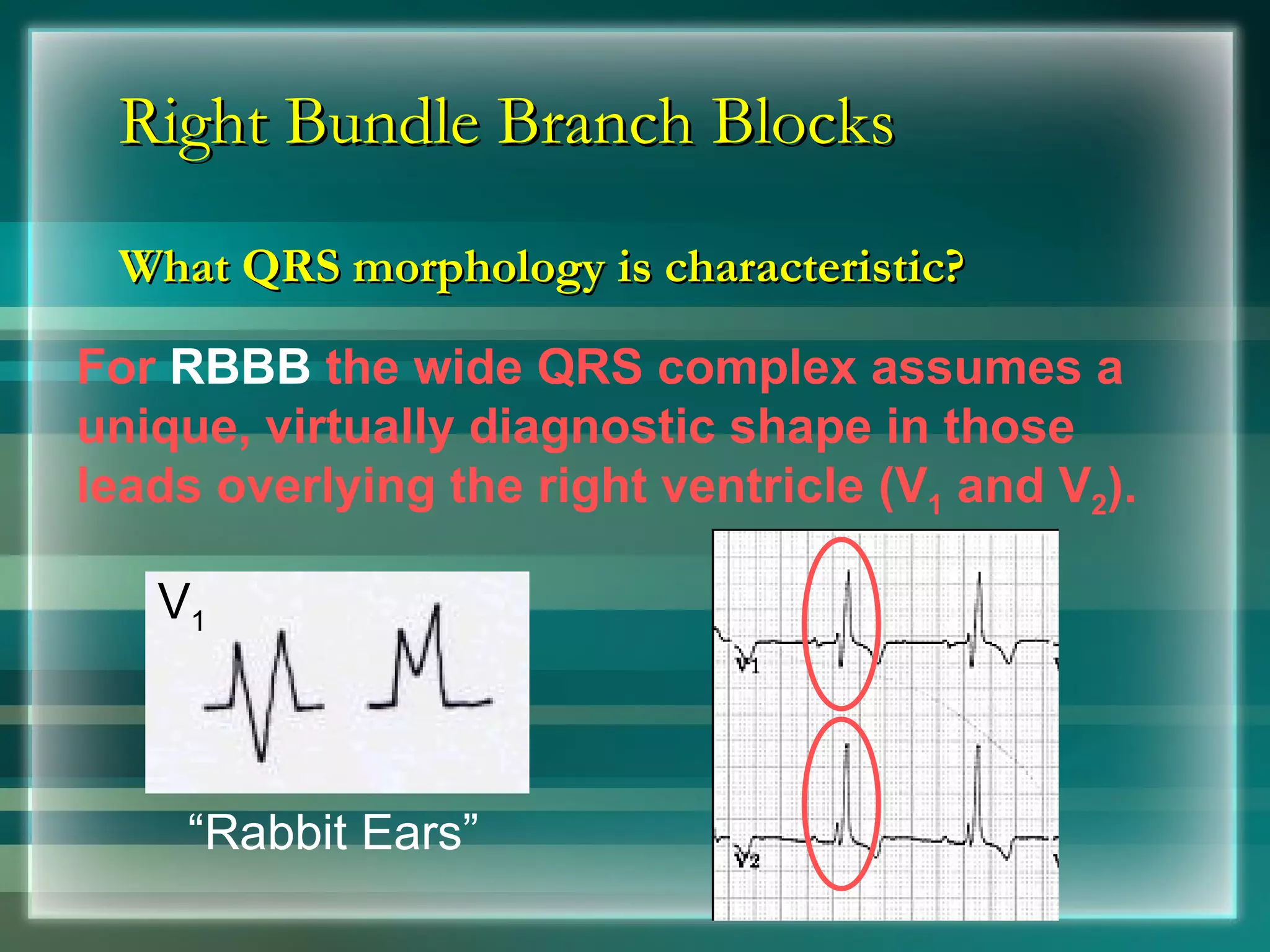
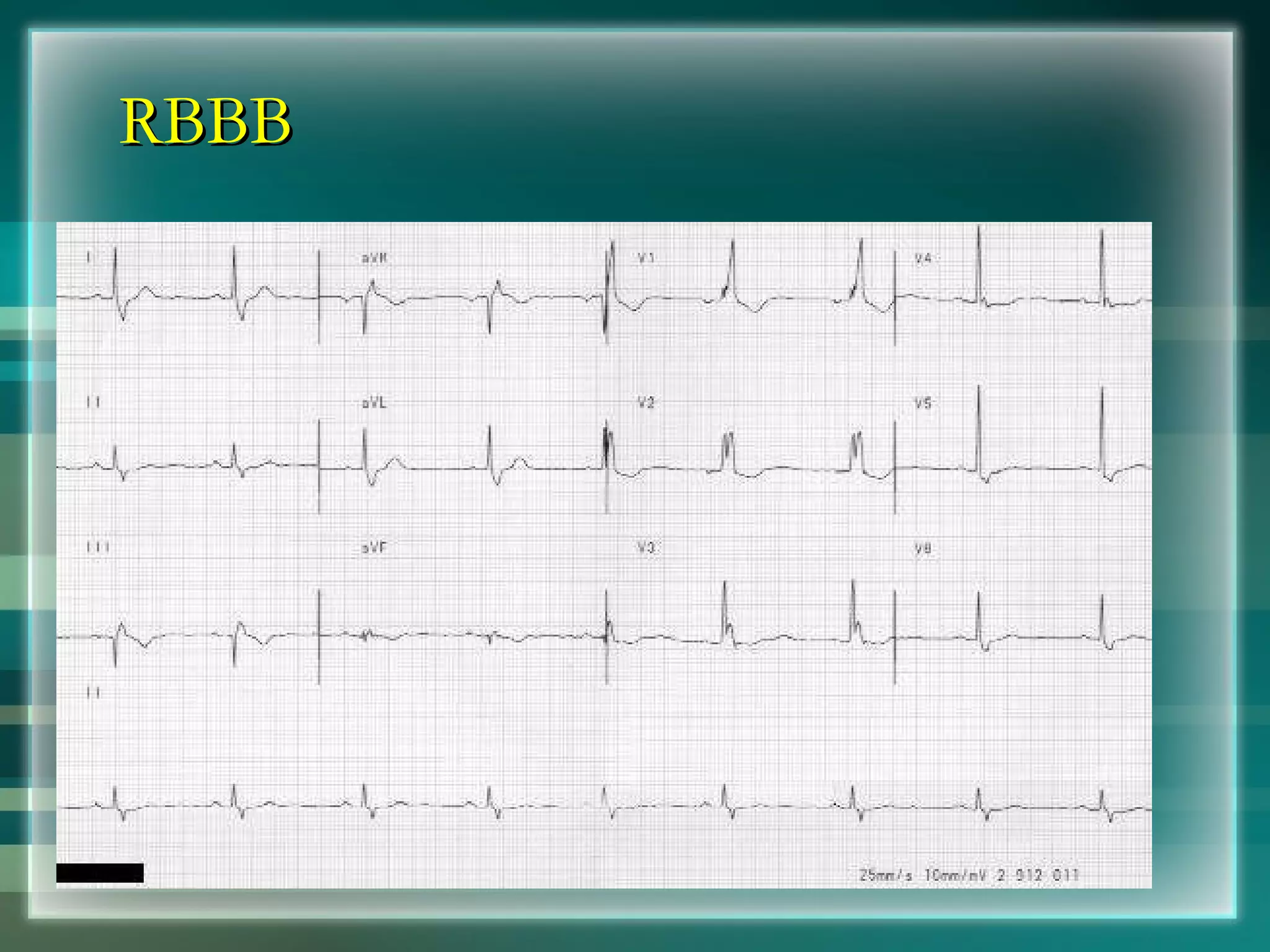
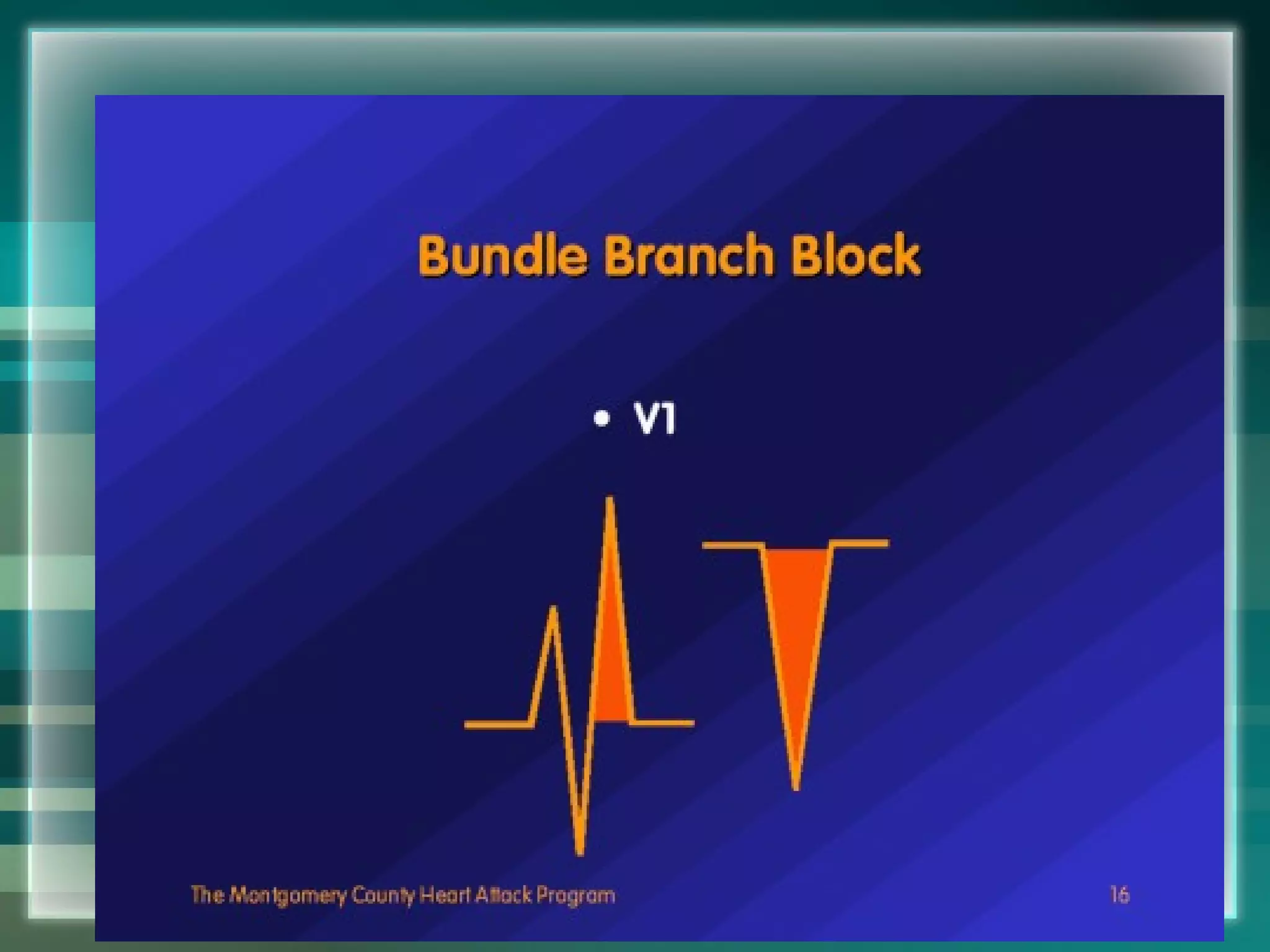
Right Bundle Branch Blocks What QRS morphology is characteristic? V 1 For  RBBB  the wide QRS complex assumes a unique, virtually diagnostic shape in those leads overlying the right ventricle (V 1  and V 2 ).  “ Rabbit Ears”
RBBB
 
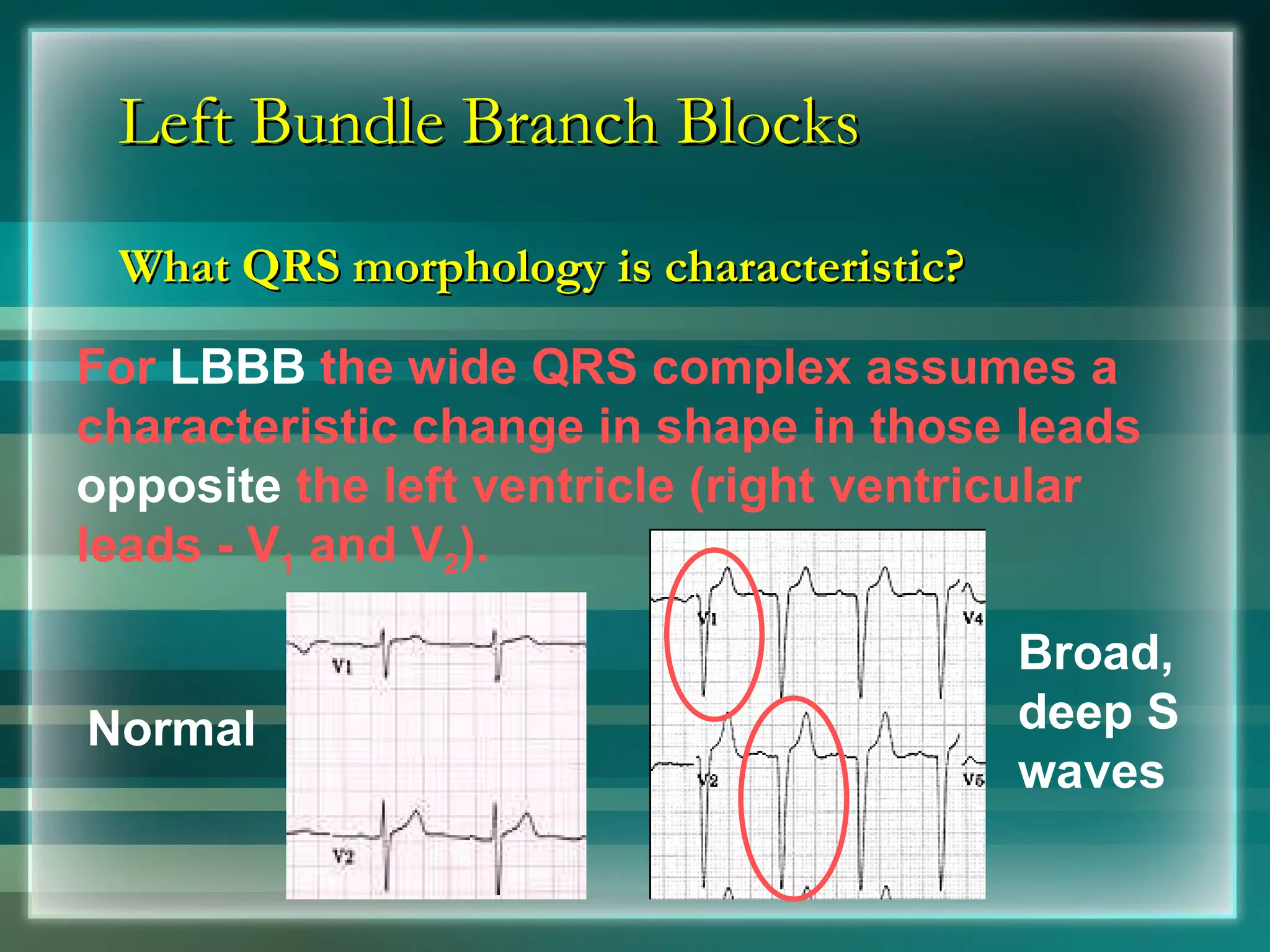
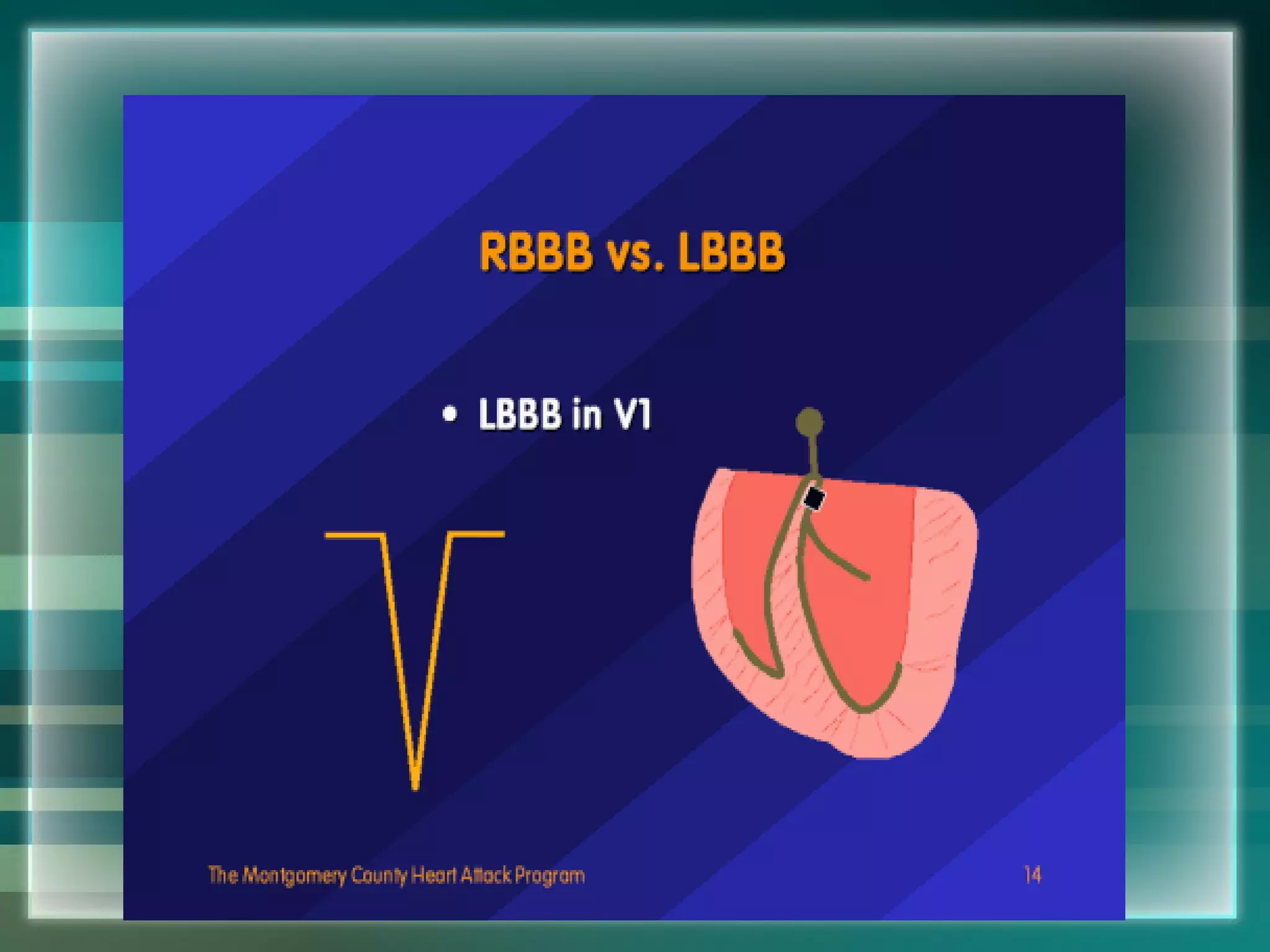
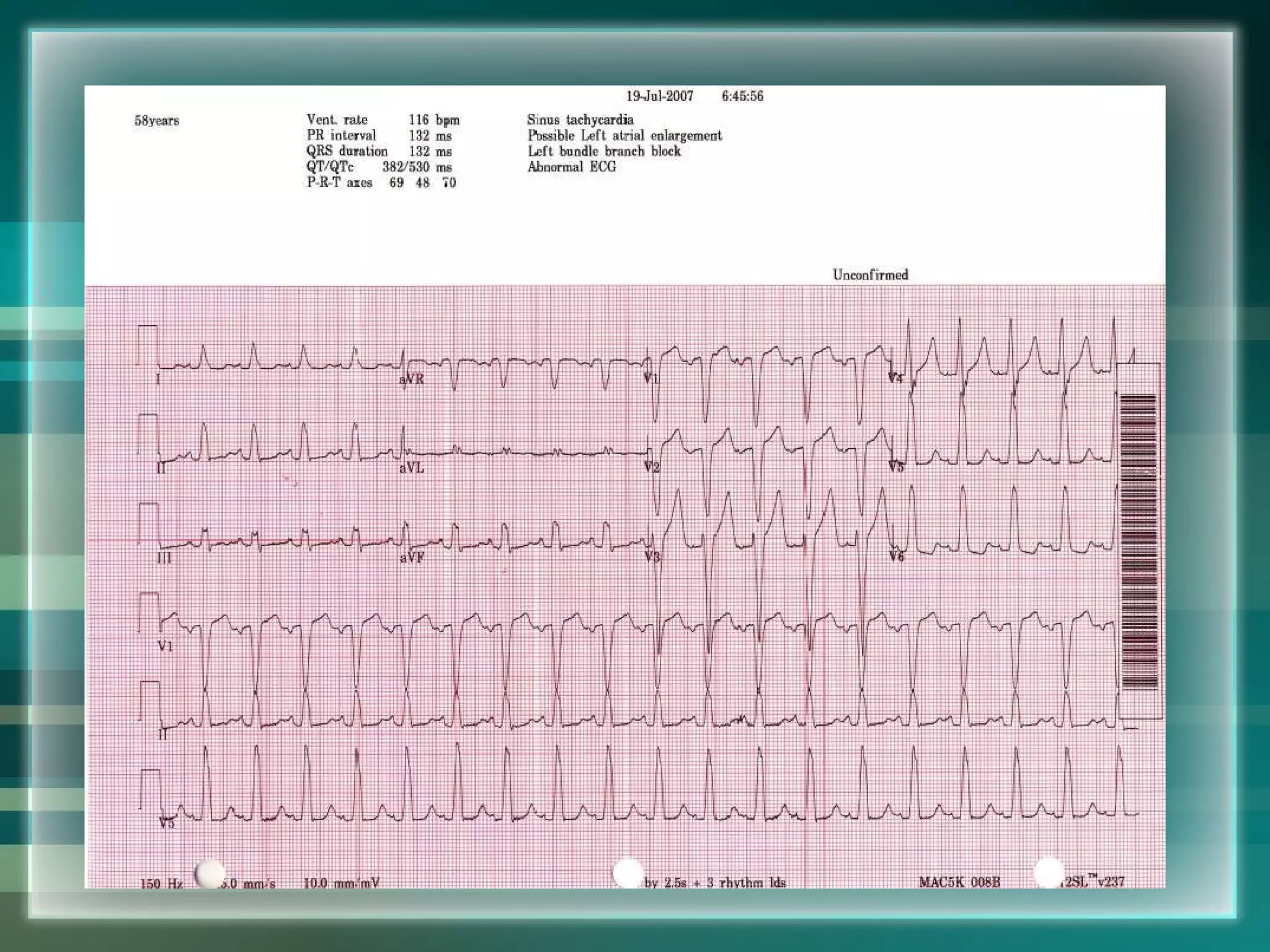
Left Bundle Branch Blocks What QRS morphology is characteristic? Normal For  LBBB  the wide QRS complex assumes a characteristic change in shape in those leads  opposite  the left ventricle (right ventricular leads - V 1  and V 2 ).  Broad, deep S waves


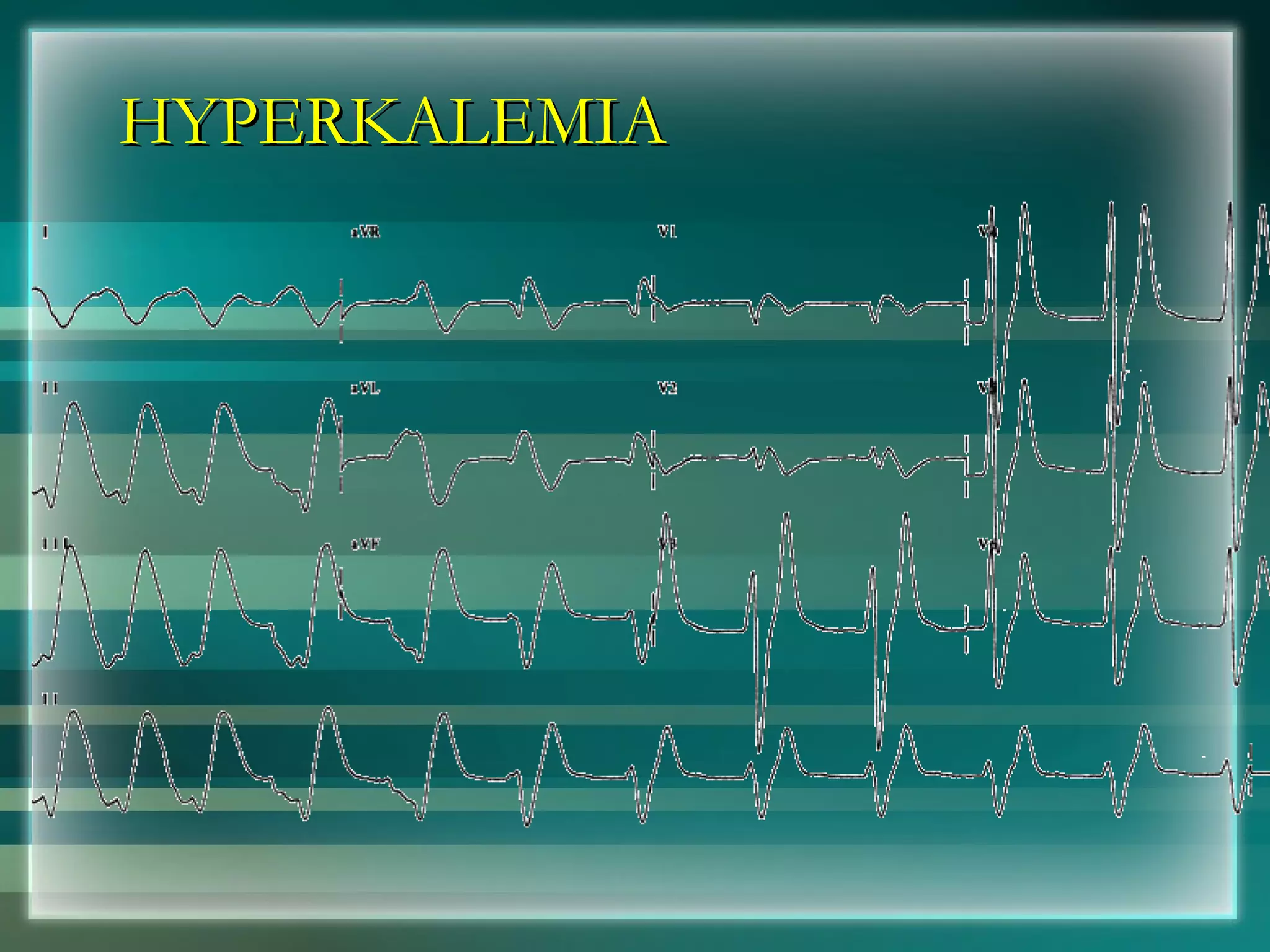
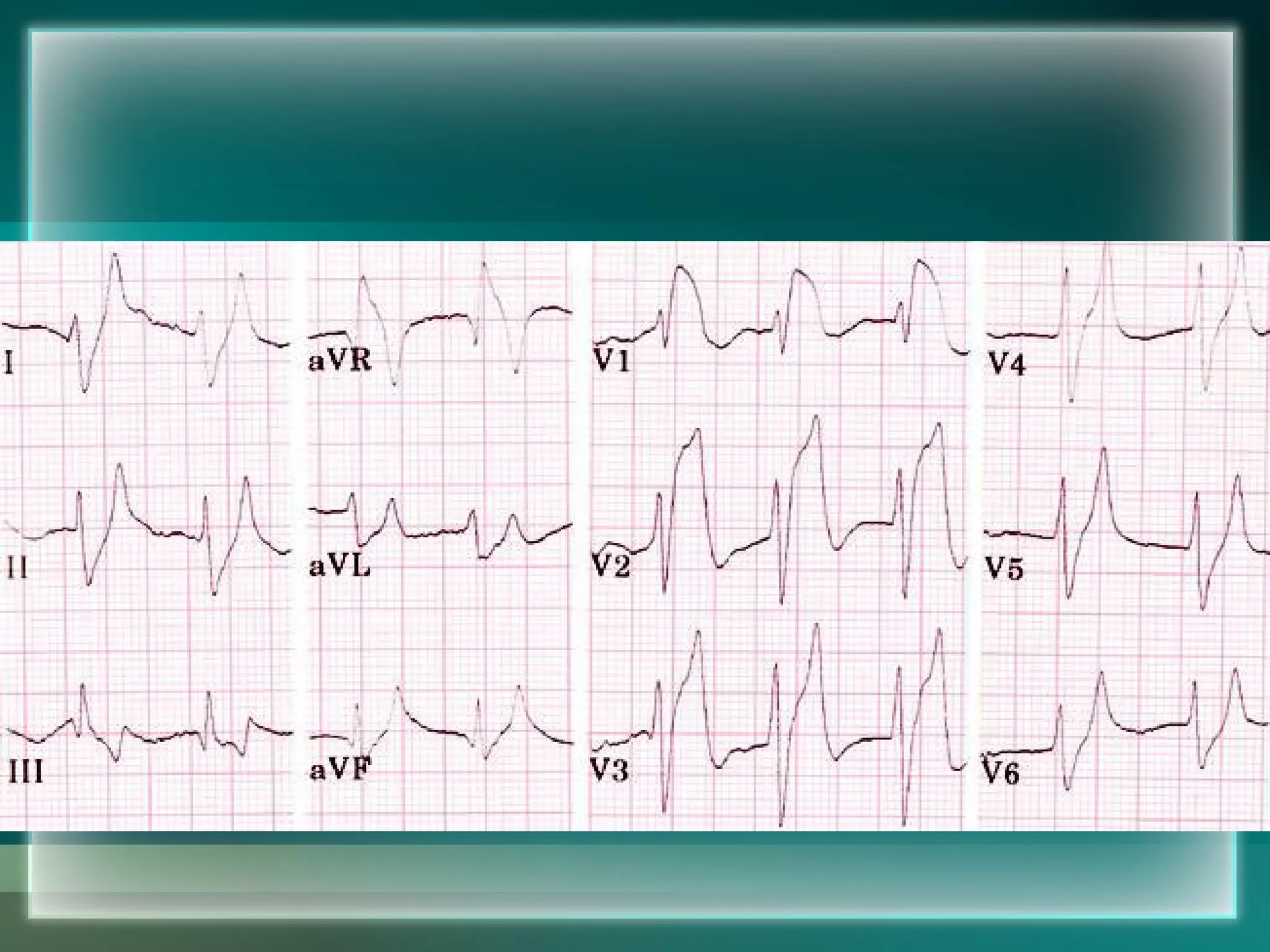
HYPERKALEMIA
HYPERKALEMIA
 
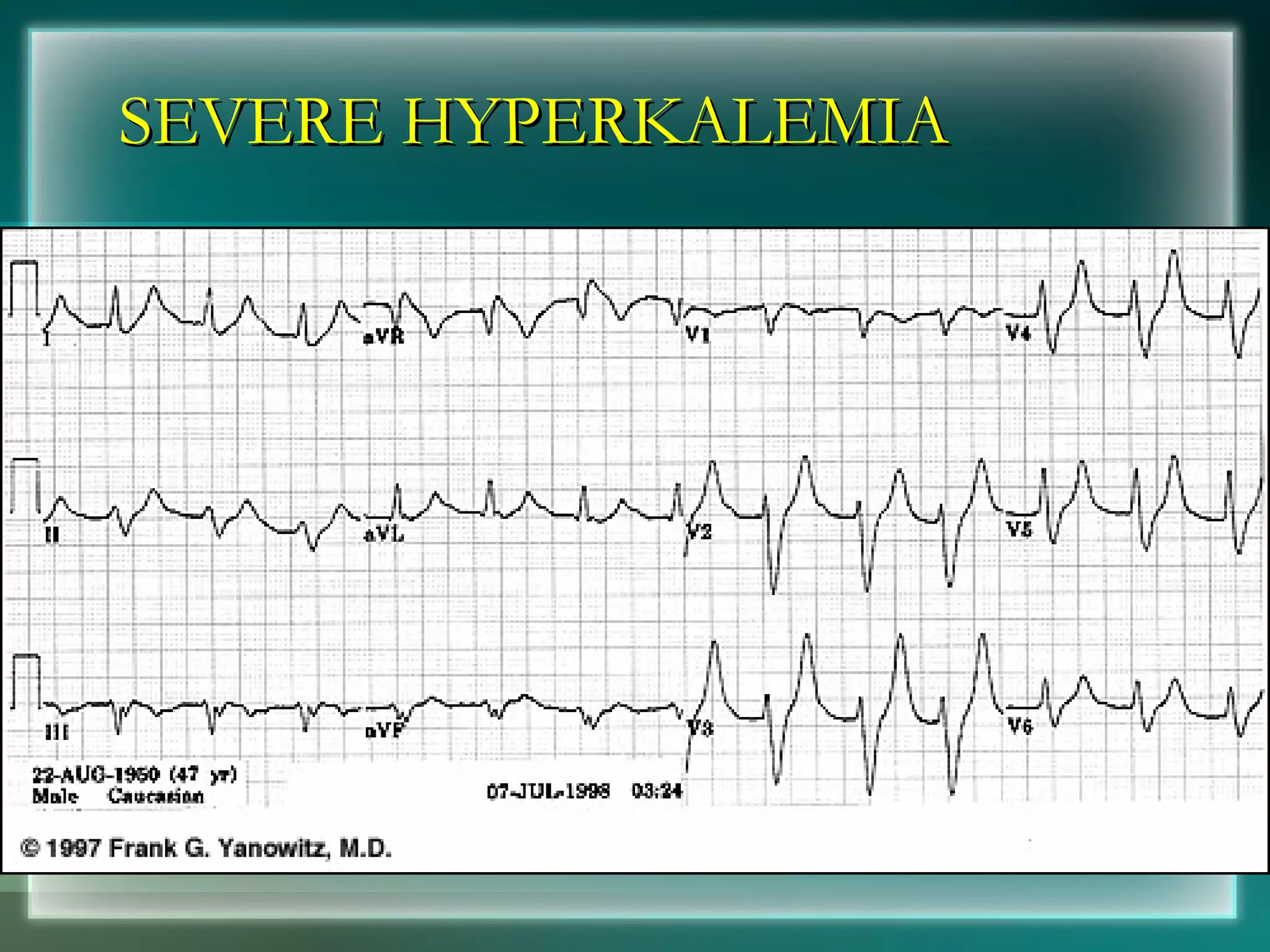
SEVERE HYPERKALEMIA
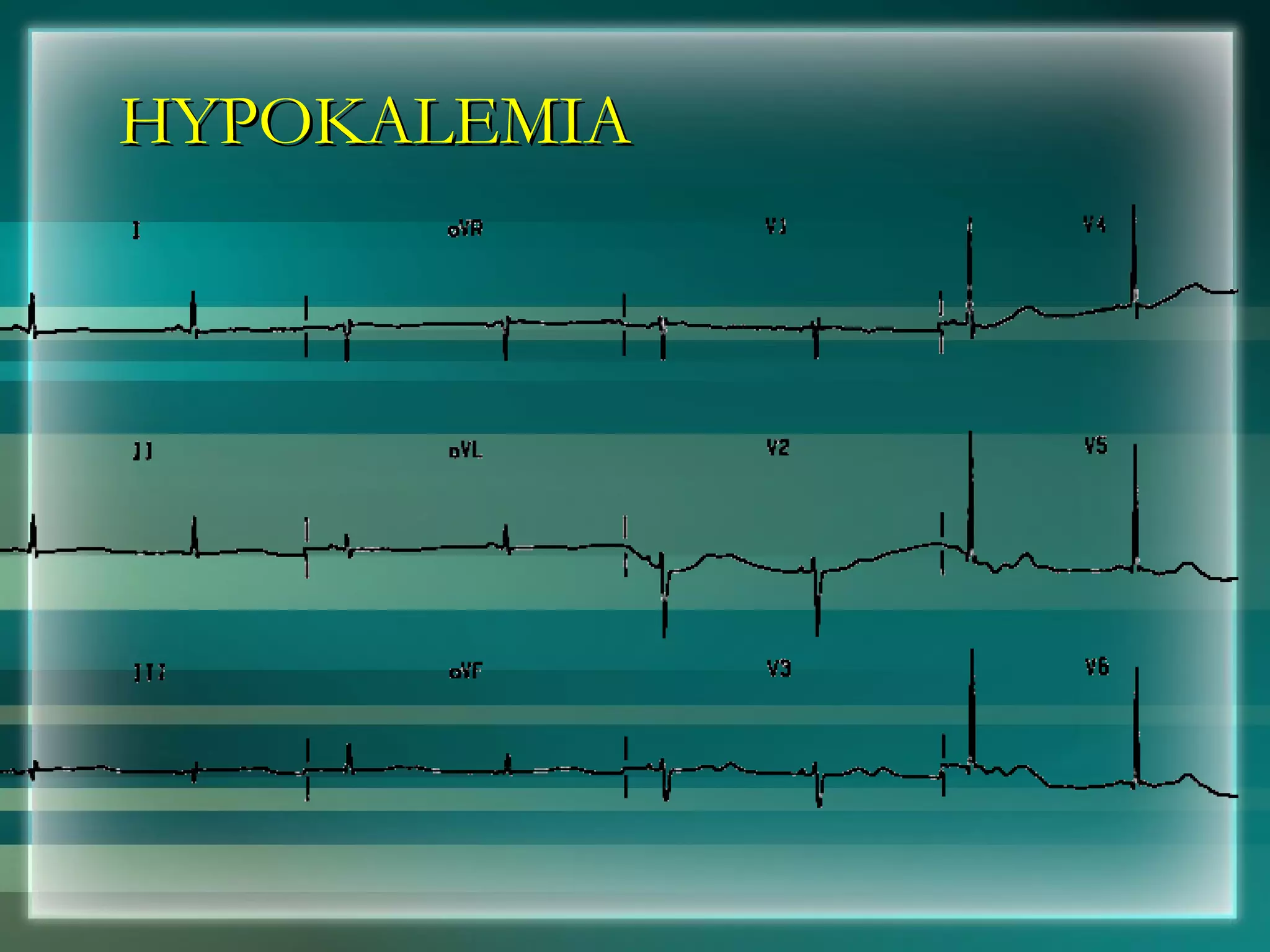
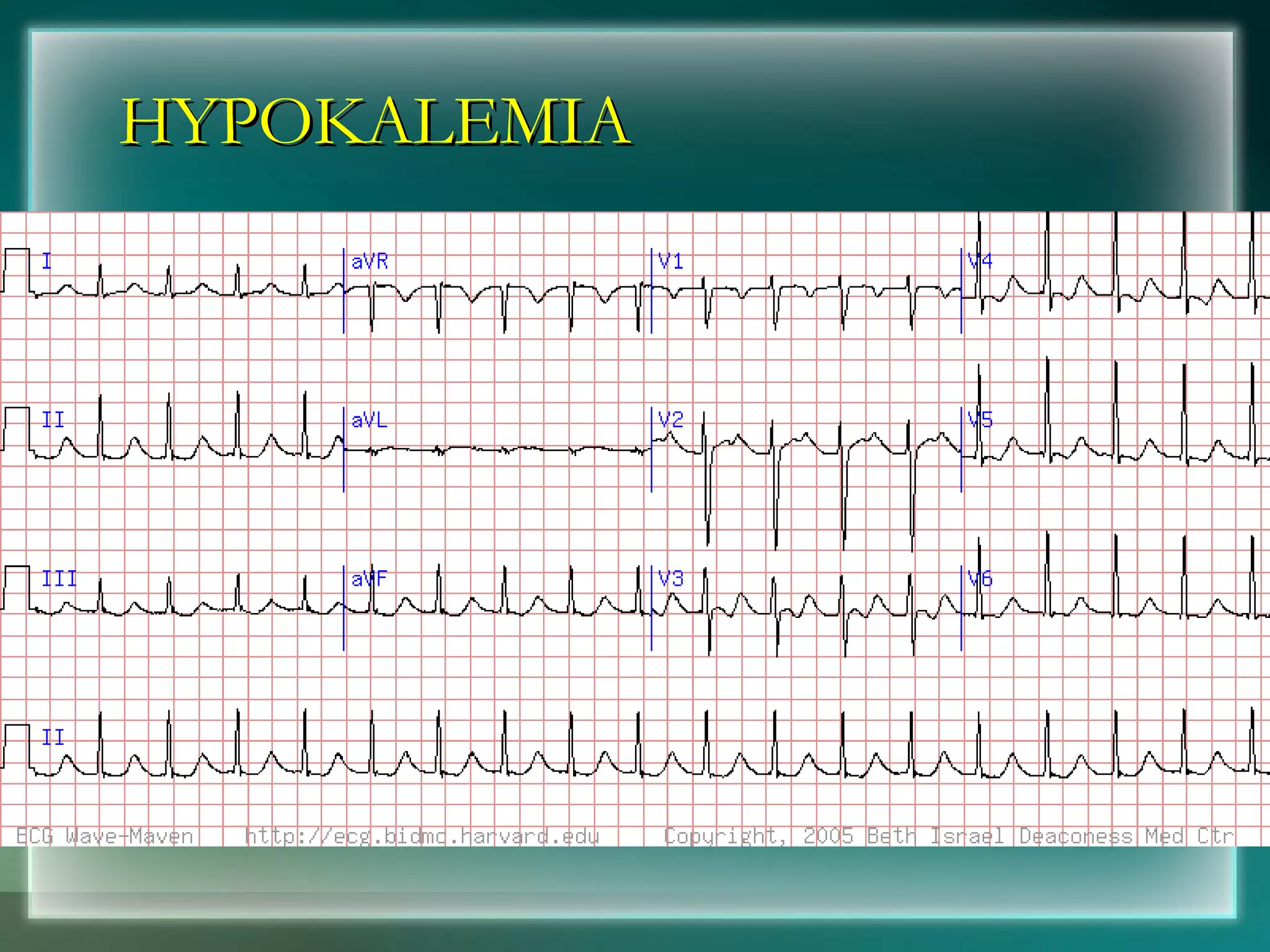
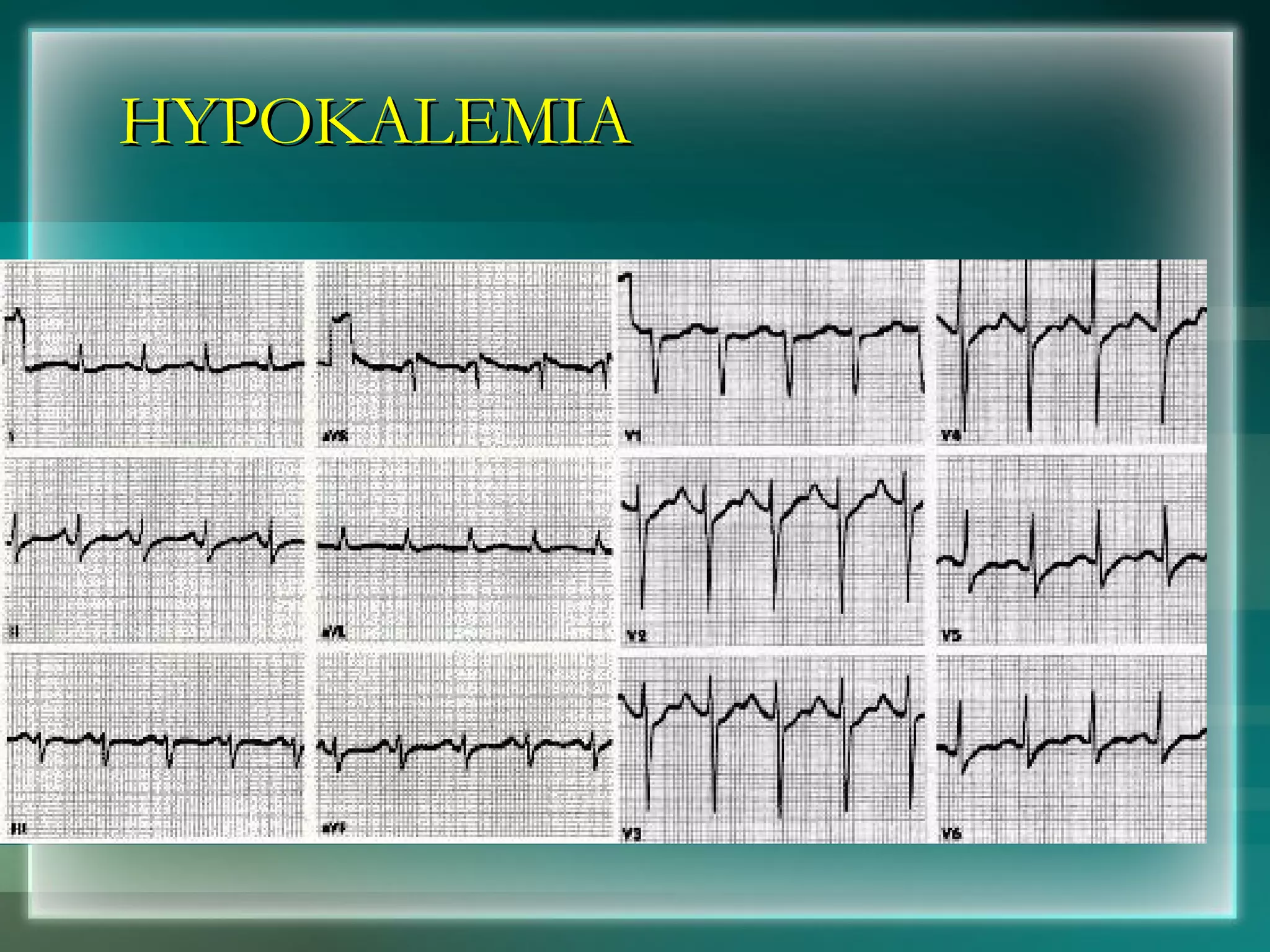
HYPOKALEMIA
HYPOKALEMIA
HYPOKALEMIA
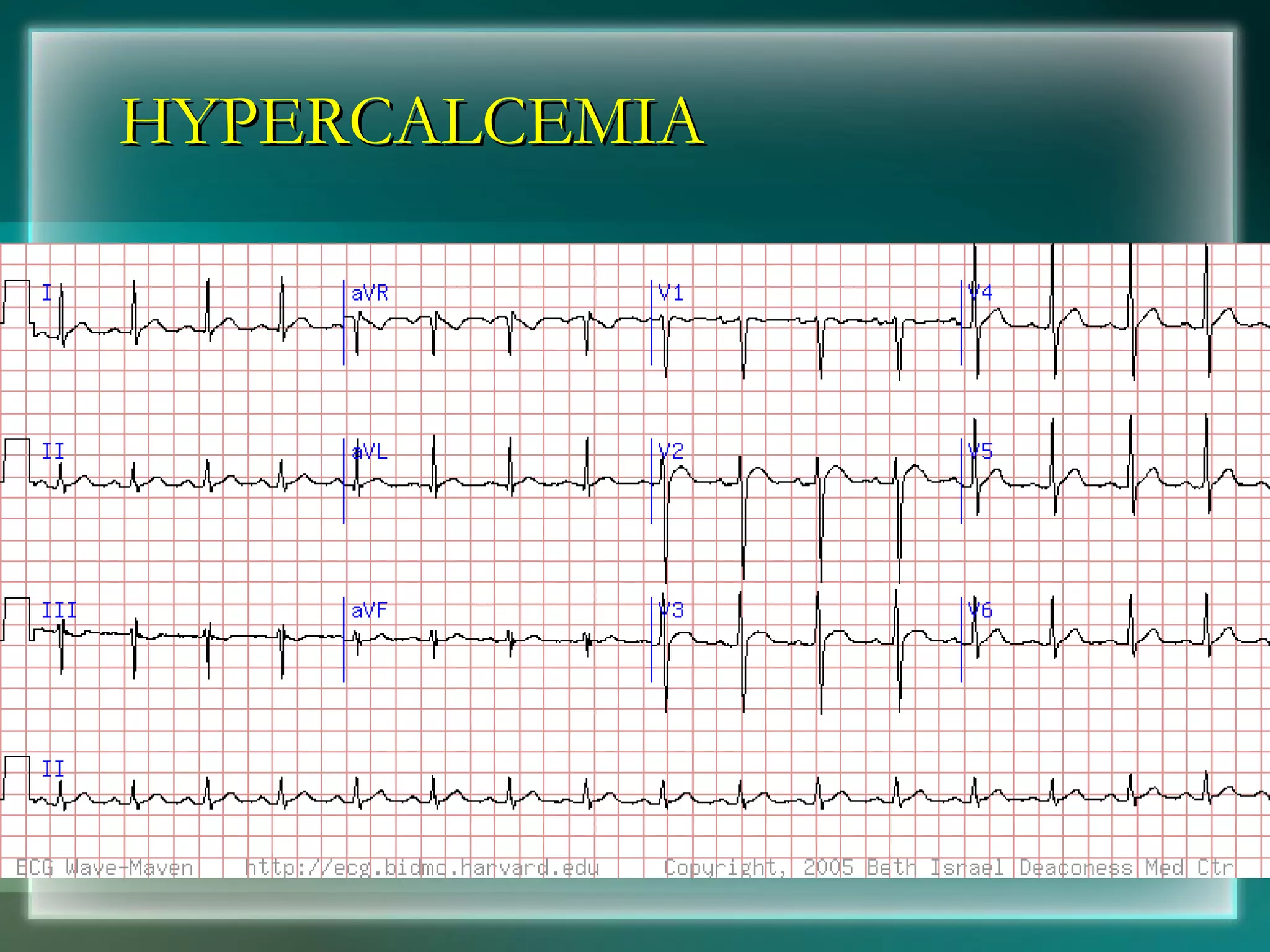
HYPERCALCEMIA
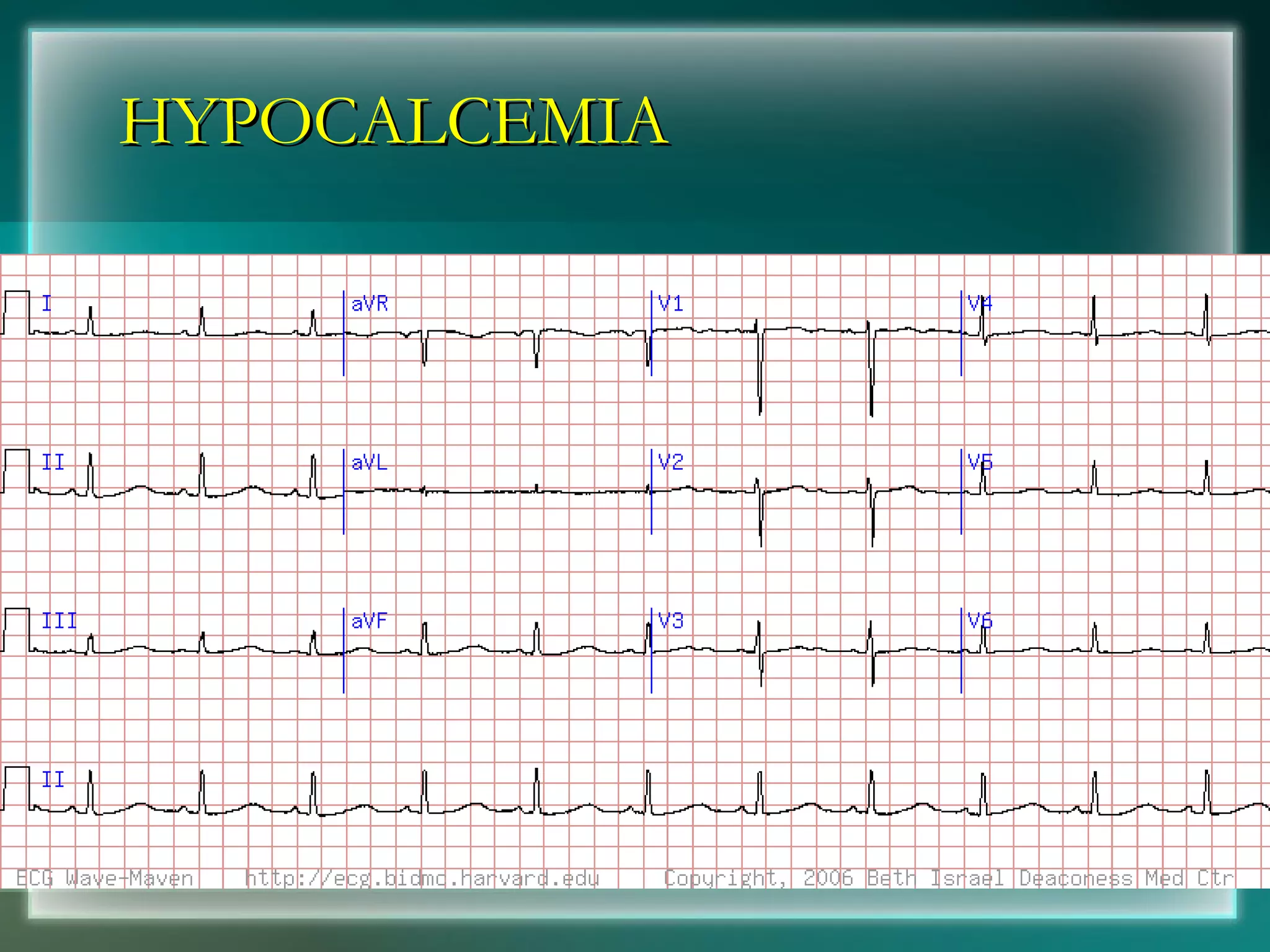
HYPOCALCEMIA
 
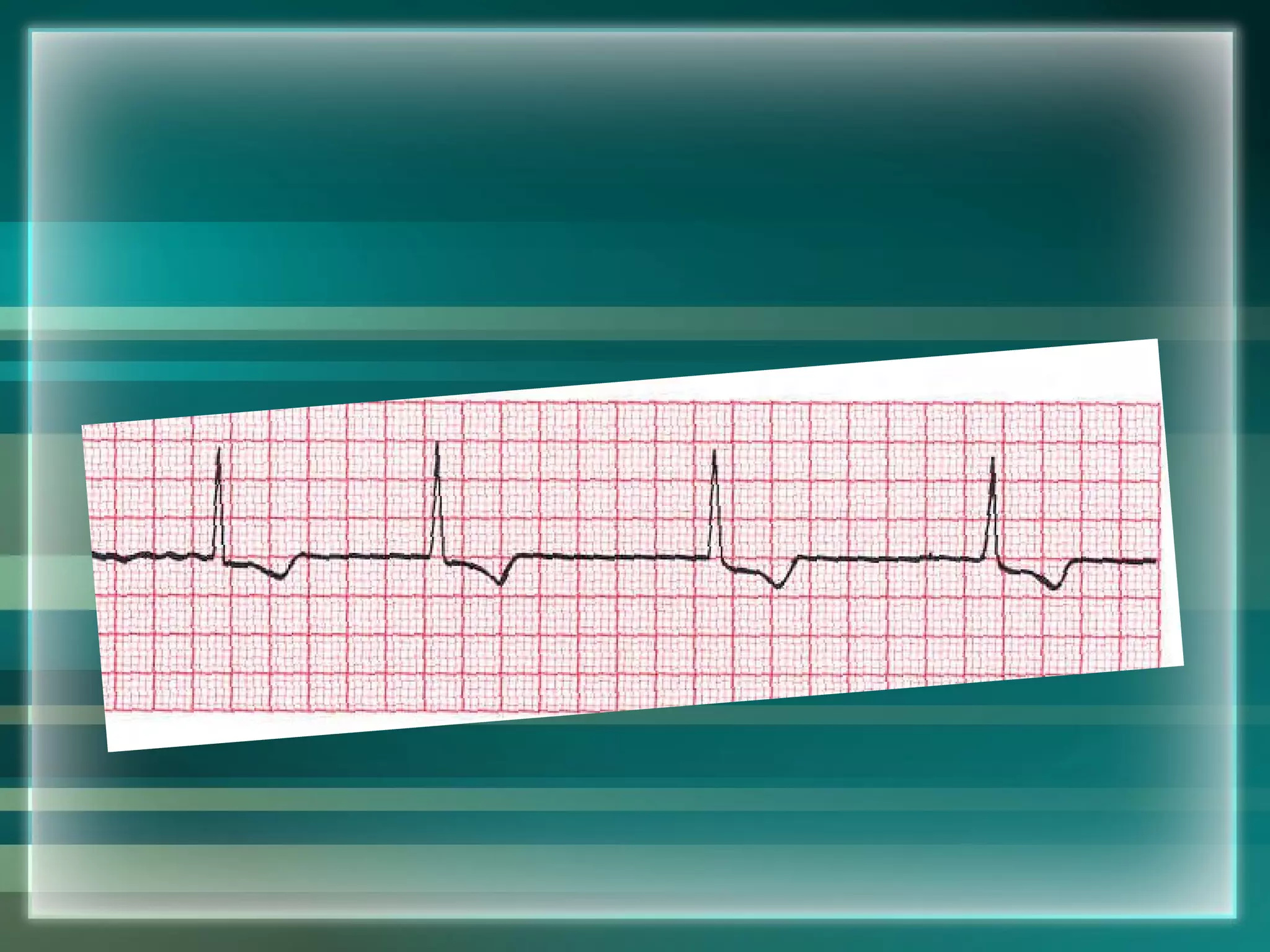
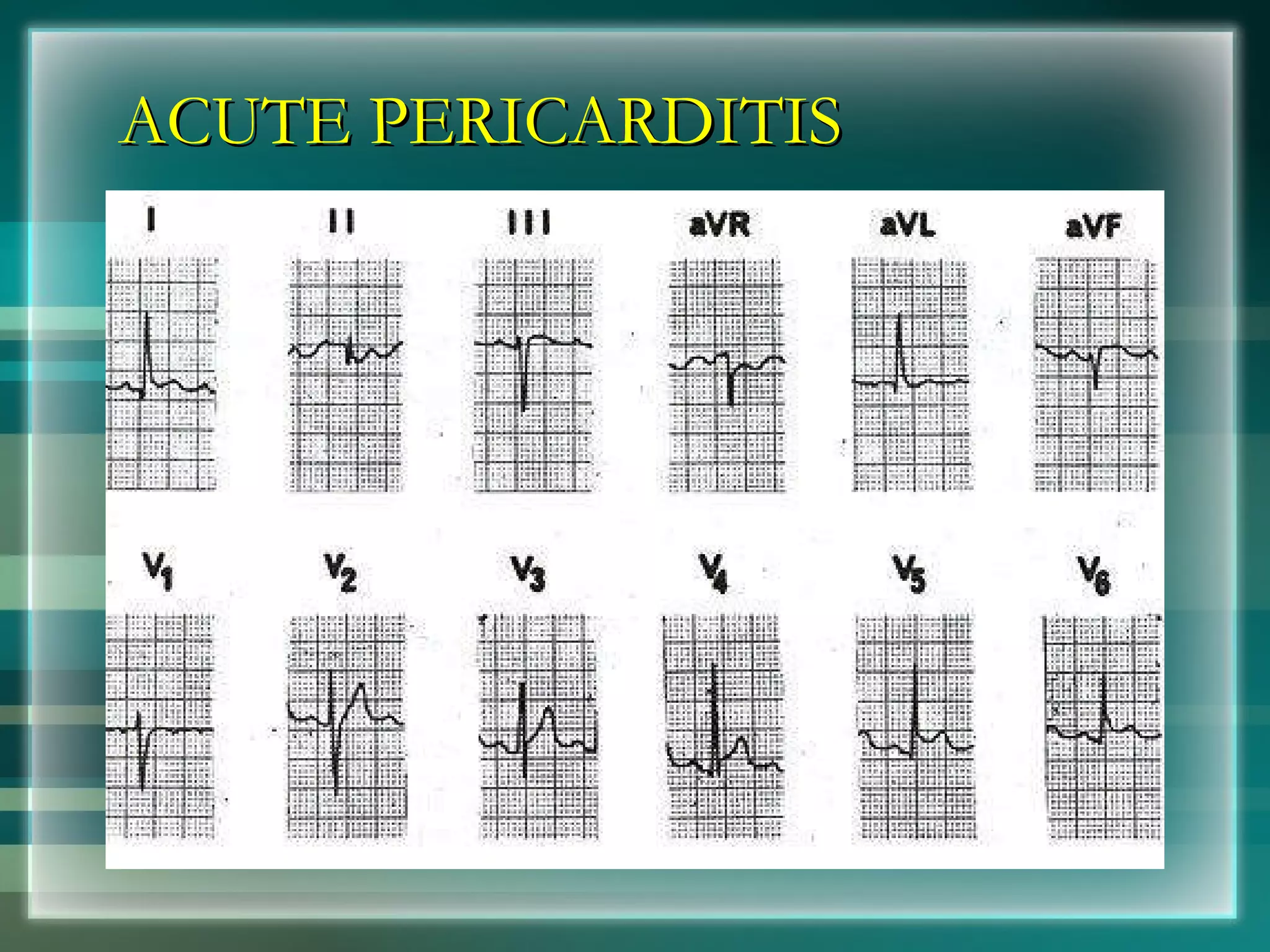
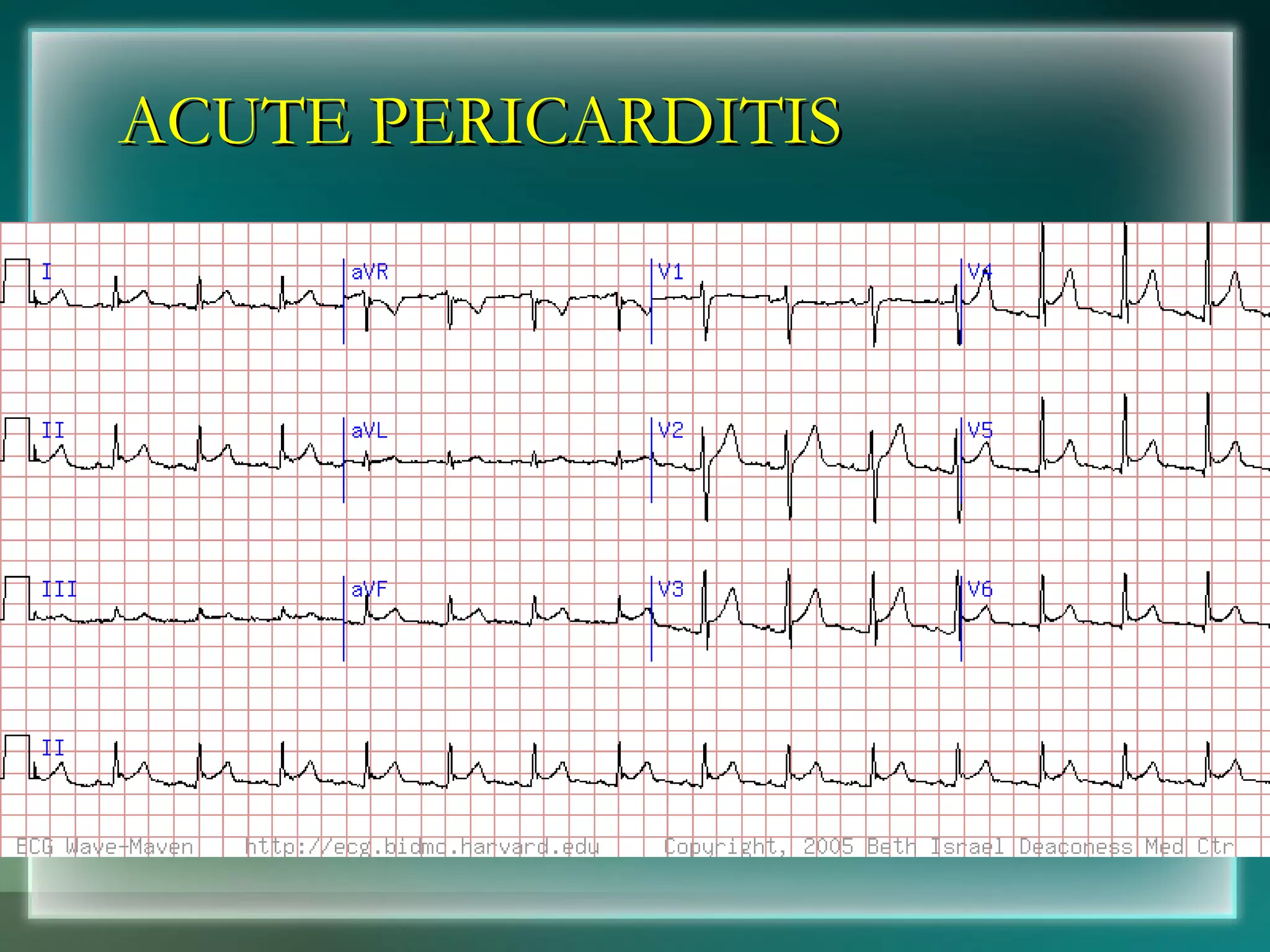
ACUTE PERICARDITIS
ACUTE PERICARDITIS
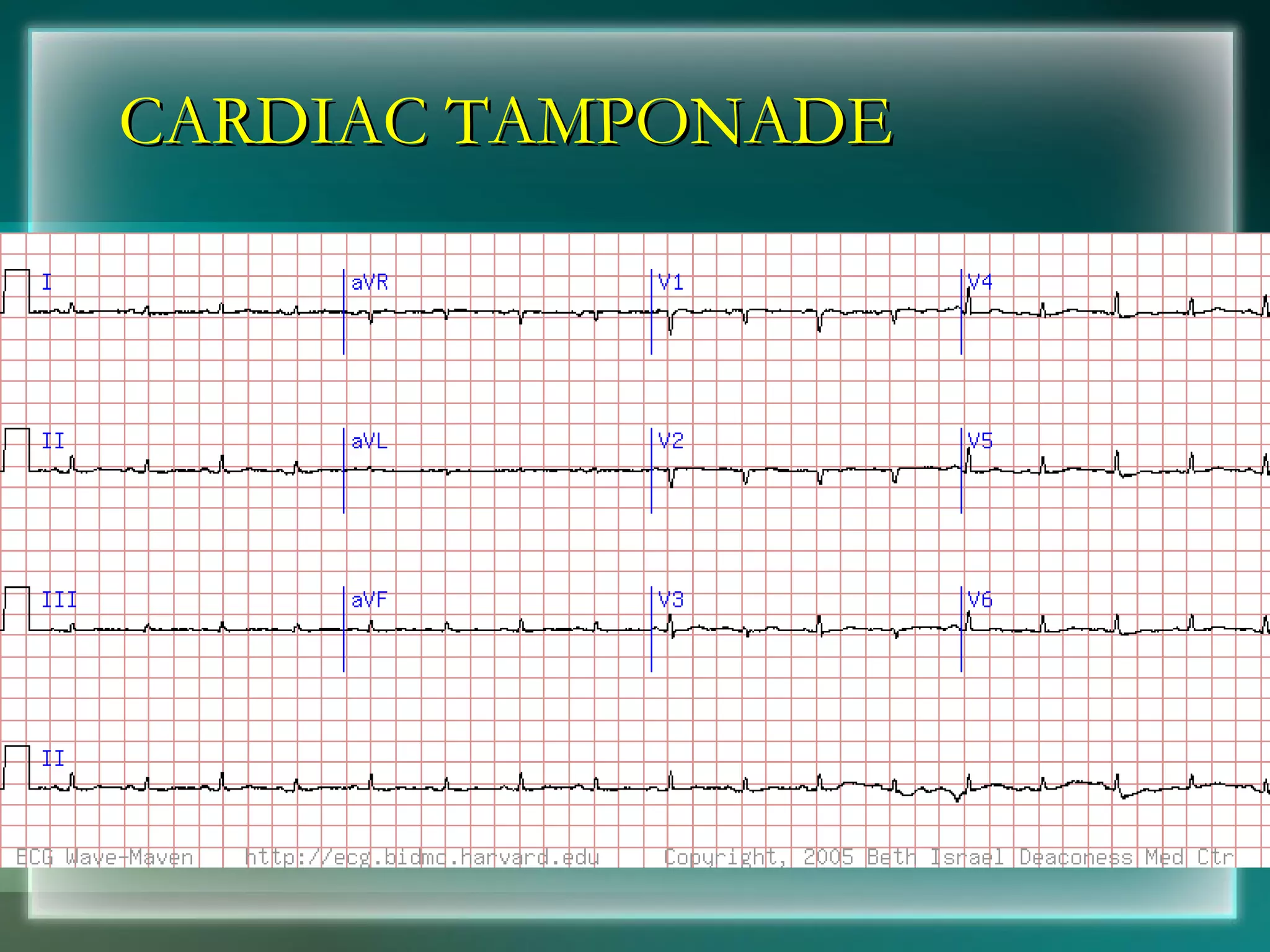
CARDIAC TAMPONADE
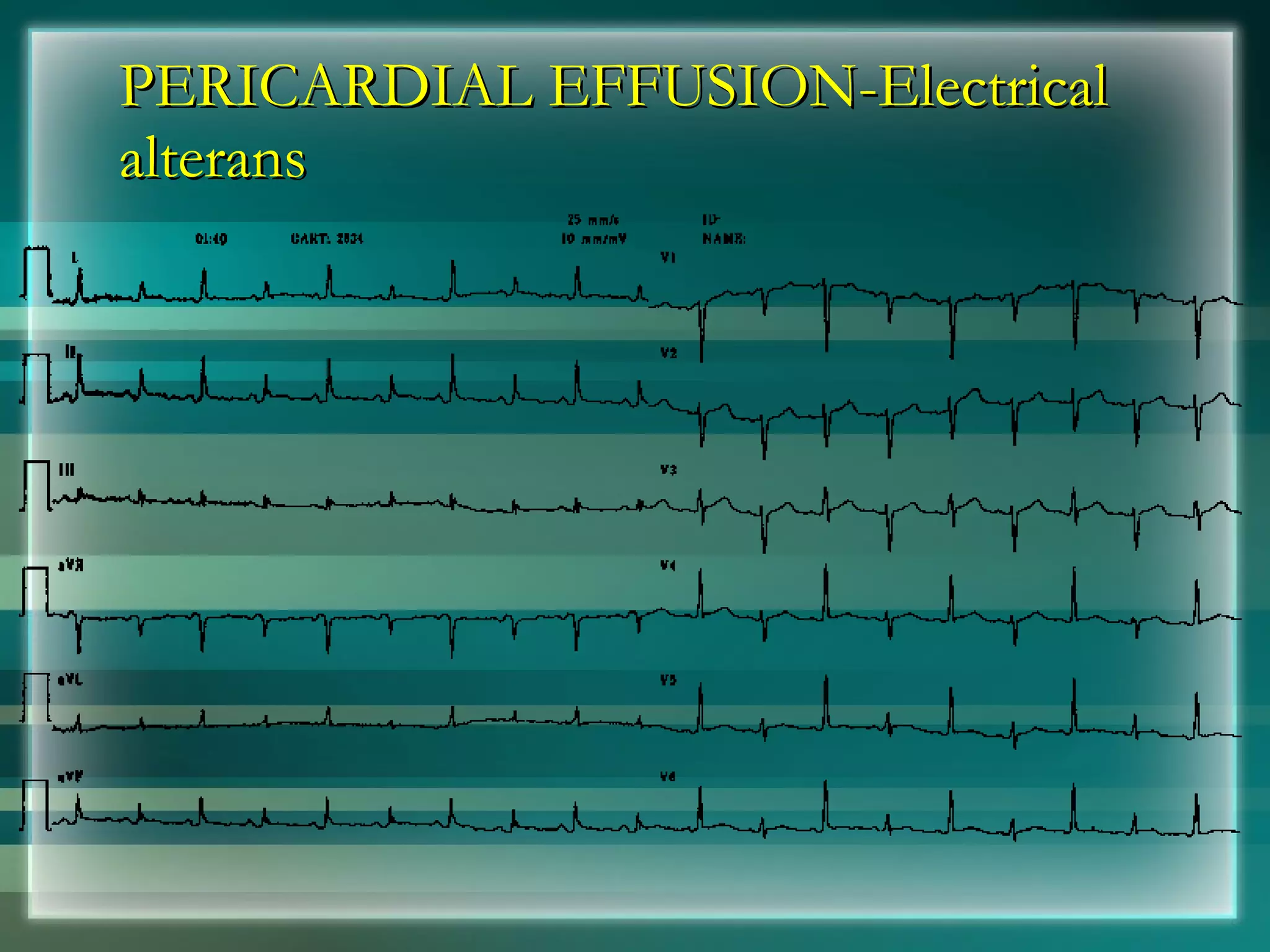
PERICARDIAL EFFUSION-Electrical alterans
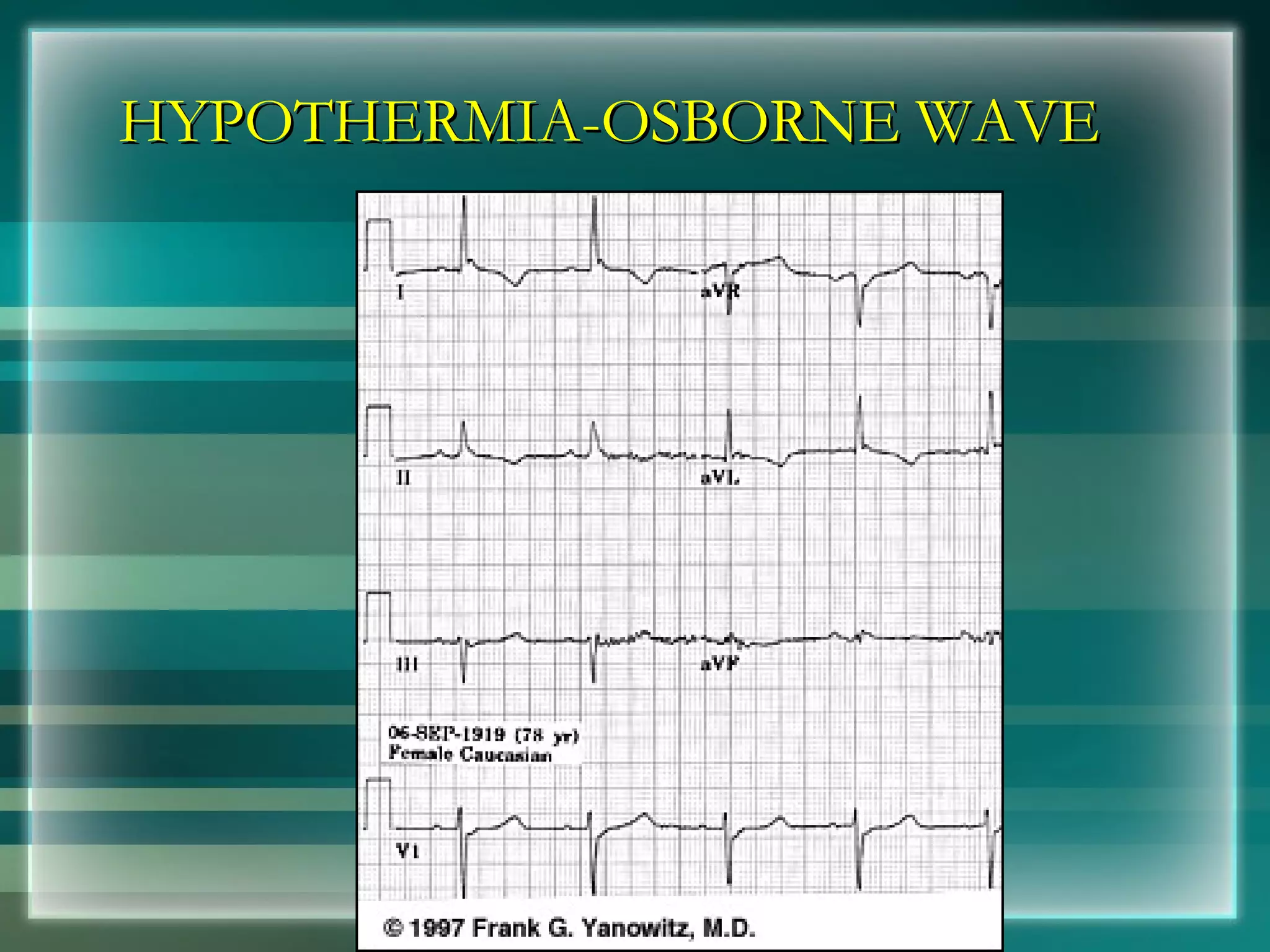
HYPOTHERMIA-OSBORNE WAVE
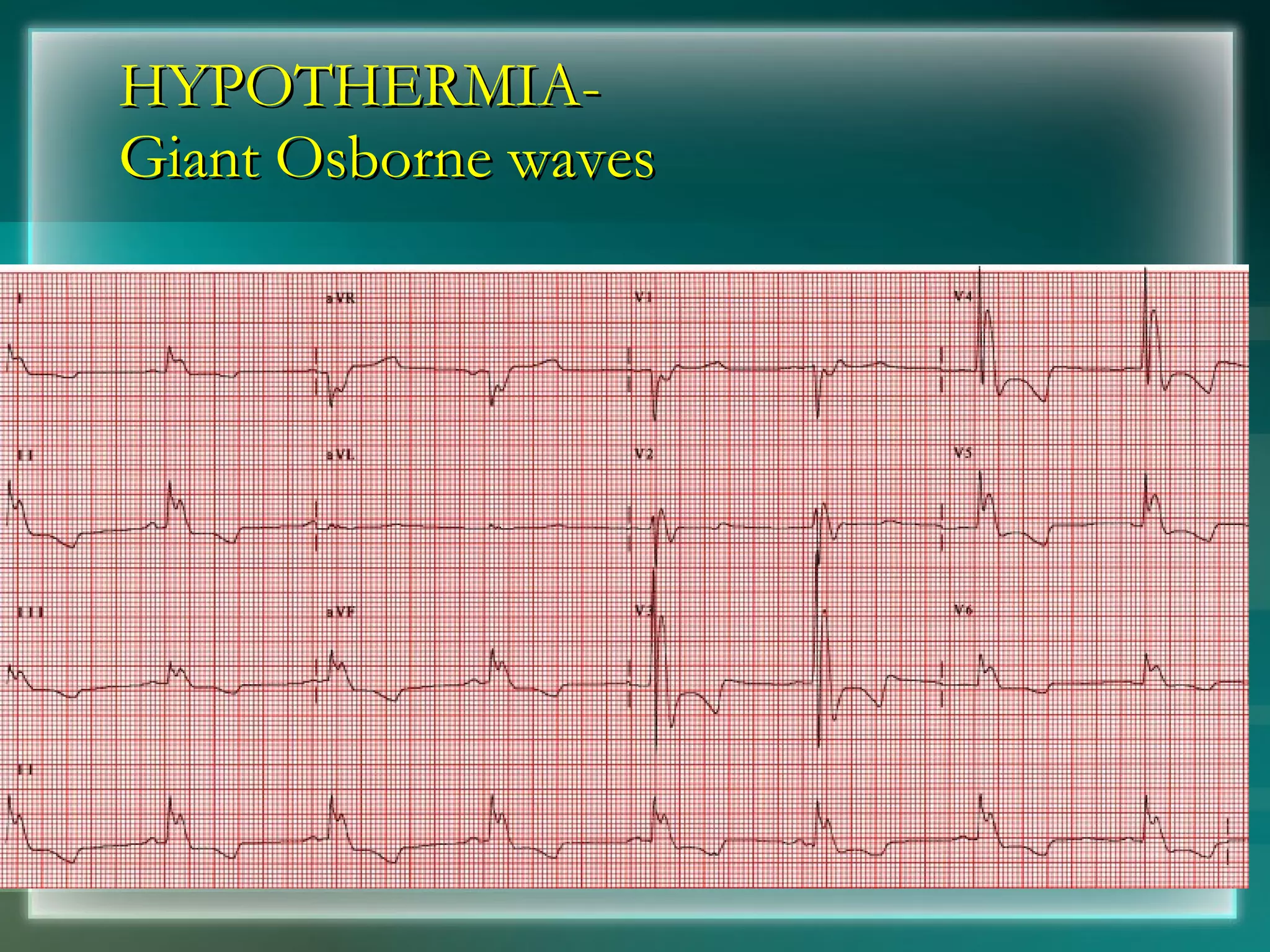
HYPOTHERMIA-  Giant Osborne waves

ECG Basics

  • 1.
    Basics of ECGhttp://emergencymedic.blogspot.com Dr Subroto Mandal, MD, DM, DC Associate Professor, Cardiology
  • 2.
    HISTORY 1842- Italianscientist Carlo Matteucci realizes that electricity is associated with the heart beat 1876- Irish scientist Marey analyzes the electric pattern of frog’s heart 1895 - William Einthoven , credited for the invention of EKG 1906 - using the string electrometer EKG, William Einthoven diagnoses some heart problems
  • 3.
    CONTD… 1924 -the noble prize for physiology or medicine is given to William Einthoven for his work on EKG 1938 -AHA and Cardiac society of great Britan defined and position of chest leads 1942- Goldberger increased Wilson’s Unipolar lead voltage by 50% and made Augmented leads 2005- successful reduction in time of onset of chest pain and PTCA by wireless transmission of ECG on his PDA.
  • 4.
  • 5.
  • 6.
    What is anEKG? The electrocardiogram (EKG) is a representation of the electrical events of the cardiac cycle. Each event has a distinctive waveform the study of waveform can lead to greater insight into a patient’s cardiac pathophysiology.
  • 7.
    With EKGs wecan identify Arrhythmias Myocardial ischemia and infarction Pericarditis Chamber hypertrophy Electrolyte disturbances (i.e. hyperkalemia, hypokalemia) Drug toxicity (i.e. digoxin and drugs which prolong the QT interval)
  • 8.
    Depolarization Contraction ofany muscle is associated with electrical changes called depolarization These changes can be detected by electrodes attached to the surface of the body
  • 9.
    Pacemakers of theHeart SA Node - Dominant pacemaker with an intrinsic rate of 60 - 100 beats/minute. AV Node - Back-up pacemaker with an intrinsic rate of 40 - 60 beats/minute. Ventricular cells - Back-up pacemaker with an intrinsic rate of 20 - 45 bpm.
  • 10.
    Standard calibration 25mm/s 0.1 mV/mm Electrical impulse that travels towards the electrode produces an upright (“positive”) deflection
  • 11.
    Impulse Conduction &the ECG Sinoatrial node AV node Bundle of His Bundle Branches Purkinje fibers
  • 12.
    The “PQRST” Pwave - Atrial depolarization T wave - Ventricular repolarization QRS - Ventricular depolarization
  • 13.
    The PR IntervalAtrial depolarization + delay in AV junction (AV node/Bundle of His) (delay allows time for the atria to contract before the ventricles contract)
  • 14.
  • 15.
    The ECG PaperHorizontally One small box - 0.04 s One large box - 0.20 s Vertically One large box - 0.5 mV
  • 16.
    EKG Leads whichmeasure the difference in electrical potential between two points 1. Bipolar Leads: Two different points on the body 2. Unipolar Leads: One point on the body and a virtual reference point with zero electrical potential, located in the center of the heart
  • 17.
    EKG Leads Thestandard EKG has 12 leads: 3 Standard Limb Leads 3 Augmented Limb Leads 6 Precordial Leads
  • 18.
  • 19.
  • 20.
  • 21.
  • 22.
  • 23.
  • 24.
    Right Sided &Posterior Chest Leads
  • 25.
  • 26.
  • 27.
  • 28.
  • 29.
  • 30.
  • 31.
    ECG RULES Professor Chamberlains 10 rules of normal:-
  • 32.
    RULE 1 PRinterval should be 120 to 200 milliseconds or 3 to 5 little squares
  • 33.
    RULE2 The width of the QRS complex should not exceed 110 ms, less than 3 little squares
  • 34.
    RULE 3 TheQRS complex should be dominantly upright in leads I and II
  • 35.
    RULE 4 QRSand T waves tend to have the same general direction in the limb leads
  • 36.
    RULE 5 Allwaves are negative in lead aVR
  • 37.
    RULE 6 TheR wave must grow from V1 to at least V4 The S wave must grow from V1 to at least V3 and disappear in V6
  • 38.
    RULE 7 TheST segment should start isoelectric except in V1 and V2 where it may be elevated
  • 39.
    RULE 8 TheP waves should be upright in I, II, and V2 to V6
  • 40.
    RULE 9 Thereshould be no Q wave or only a small q less than 0.04 seconds in width in I, II, V2 to V6
  • 41.
    RULE 10 TheT wave must be upright in I, II, V2 to V6
  • 42.
    P wave Alwayspositive in lead I and II Always negative in lead aVR < 3 small squares in duration < 2.5 small squares in amplitude Commonly biphasic in lead V1 Best seen in leads II
  • 43.
    Right Atrial EnlargementTall (> 2.5 mm), pointed P waves (P Pulmonale)
  • 44.
    Notched/bifid (‘M’ shaped)P wave (P ‘mitrale’) in limb leads Left Atrial Enlargement
  • 45.
  • 46.
    Short PR IntervalWPW (Wolff-Parkinson-White) Syndrome Accessory pathway (Bundle of Kent) allows early activation of the ventricle (delta wave and short PR interval)
  • 47.
    Long PR IntervalFirst degree Heart Block
  • 48.
    QRS Complexes Non­pathologicalQ waves may present in I, III, aVL, V5, and V6 R wave in lead V6 is smaller than V5 Depth of the S wave, should not exceed 30 mm Pathological Q wave > 2mm deep and > 1mm wide or > 25% amplitude of the subsequent R wave
  • 49.
  • 50.
  • 51.
    Right Atrial andVentricular Hypertrophy
  • 52.
    Left Ventricular HypertrophySokolow & Lyon Criteria S in V1+ R in V5 or V6 > 35 mm An R wave of 11 to 13 mm (1.1 to 1.3 mV) or more in lead aVL is another sign of LVH
  • 53.
  • 54.
    ST Segment STSegment is flat (isoelectric) Elevation or depression of ST segment by 1 mm or more “ J” (Junction) point is the point between QRS and ST segment
  • 55.
    Variable Shapes OfST Segment Elevations in AMI Goldberger AL. Goldberger: Clinical Electrocardiography: A Simplified Approach. 7th ed: Mosby Elsevier; 2006.
  • 56.
    T wave NormalT wave is asymmetrical, first half having a gradual slope than the second Should be at least 1/8 but less than 2/3 of the amplitude of the R T wave amplitude rarely exceeds 10 mm Abnormal T waves are symmetrical, tall, peaked, biphasic or inverted. T wave follows the direction of the QRS deflection.
  • 57.
  • 58.
    QT interval Totalduration of Depolarization and Repolarization QT interval decreases when heart rate increases For HR = 70 bpm, QT<0.40 sec. 4. QT interval should be 0.35­ 0.45 s, 5. Should not be more than half of the interval between adjacent R waves (R­R interval).
  • 59.
  • 60.
    U wave Uwave related to afterdepolarizations which follow repolarization U waves are small, round, symmetrical and positive in lead II, with amplitude < 2 mm U wave direction is the same as T wave More prominent at slow heart rates
  • 61.
    Determining the HeartRate Rule of 300/1500 10 Second Rule
  • 62.
    Rule of 300Count the number of “big boxes” between two QRS complexes, and divide this into 300. (smaller boxes with 1500) for regular rhythms.
  • 63.
    What is theheart rate? (300 / 6) = 50 bpm
  • 64.
    What is theheart rate? (300 / ~ 4) = ~ 75 bpm
  • 65.
    What is theheart rate? (300 / 1.5) = 200 bpm
  • 66.
    The Rule of300 It may be easiest to memorize the following table: 50 6 60 5 75 4 100 3 150 2 300 1 Rate No of big boxes
  • 67.
    10 Second RuleEKGs record 10 seconds of rhythm per page, Count the number of beats present on the EKG Multiply by 6 For irregular rhythms.
  • 68.
    What is theheart rate? 33 x 6 = 198 bpm
  • 69.
  • 70.
  • 71.
    The QRS AxisThe QRS axis represents overall direction of the heart’s electrical activity. Abnormalities hint at: Ventricular enlargement Conduction blocks (i.e. hemiblocks)
  • 72.
    The QRS AxisNormal QRS axis from -30 ° to +90 ° . -30 ° to -90 ° is referred to as a left axis deviation (LAD) +90 ° to +180 ° is referred to as a right axis deviation (RAD)
  • 73.
    Determining the AxisThe Quadrant Approach The Equiphasic Approach
  • 74.
    Determining the AxisPredominantly Positive Predominantly Negative Equiphasic
  • 75.
    The Quadrant ApproachQRS complex in leads I and aVF determine if they are predominantly positive or negative. The combination should place the axis into one of the 4 quadrants below.
  • 76.
    The Quadrant ApproachWhen LAD is present, If the QRS in II is positive, the LAD is non-pathologic or the axis is normal If negative, it is pathologic.
  • 77.
    Quadrant Approach: Example1 Negative in I, positive in aVF  RAD
  • 78.
    Quadrant Approach: Example2 Positive in I, negative in aVF  Predominantly positive in II  Normal Axis (non-pathologic LAD)
  • 79.
    The Equiphasic Approach1. Most equiphasic QRS complex. 2. Identified Lead lies 90° away from the lead 3. QRS in this second lead is positive or Negative
  • 80.
    QRS Axis =-30 degrees
  • 81.
  • 82.
  • 83.
    Equiphasic Approach Equiphasicin aVF  Predominantly positive in I  QRS axis ≈ 0°
  • 84.
  • 85.
    BRADYARRYTHMIA Dr SubrotoMandal, MD, DM, DC Associate Professor, Cardiology
  • 86.
    Classification Sinus BradycardiaJunctional Rhythm Sino Atrial Block Atrioventricular block
  • 87.
    Impulse Conduction &the ECG Sinoatrial node AV node Bundle of His Bundle Branches
  • 88.
  • 89.
  • 90.
    SA Block Sinusimpulses is blocked within the SA junction Between SA node and surrounding myocardium Abscent of complete Cardiac cycle Occures irregularly and unpredictably Present :Young athletes, Digitalis, Hypokalemia, Sick Sinus Syndrome
  • 91.
    AV Block FirstDegree AV Block Second Degree AV Block Third Degree AV Block
  • 92.
    First Degree AVBlock Delay in the conduction through the conducting system Prolong P-R interval All P waves are followed by QRS Associated with : AC Rheumati Carditis, Digitalis, Beta Blocker, excessive vagal tone, ischemia, intrinsic disease in the AV junction or bundle branch system.
  • 93.
    Second Degree AVBlock Intermittent failure of AV conduction Impulse blocked by AV node Types: Mobitz type 1 (Wenckebach Phenomenon) Mobitz type 2
  • 94.
      The 3rules of &quot;classic AV Wenckebach&quot; Decreasing RR intervals until pause; 2. Pause is less than preceding 2 RR intervals 3. RR interval after the pause is greater than RR prior to pause. Mobitz type 1 (Wenckebach Phenomenon)
  • 95.
    Mobitz type 1(Wenckebach Phenomenon)
  • 96.
    Mobitz type 2Usually a sign of bilateral bundle branch disease. One of the branches should be completely blocked; most likely blocked in the right bundle P waves may blocked somewhere in the AV junction, the His bundle.
  • 97.
    Third Degree HeartBlock CHB evidenced by the AV dissociation A junctional escape rhythm at 45 bpm. The PP intervals vary because of ventriculophasic sinus arrhythmia;
  • 98.
    Third Degree HeartBlock 3rd degree AV block with a left ventricular escape rhythm, 'B' the right ventricular pacemaker rhythm is shown.
  • 99.
    The nonconducted PAC'sset up a long pause which is terminated by ventricular escapes; Wider QRS morphology of the escape beats indicating their ventricular origin. AV Dissociation
  • 100.
    AV Dissociation Dueto Accelerated ventricular rhythm
  • 101.
  • 102.
    Putting it allTogether Do you think this person is having a myocardial infarction. If so, where?
  • 103.
    Interpretation Yes ,this person is having an acute anterior wall myocardial infarction.
  • 104.
    Putting it allTogether Now, where do you think this person is having a myocardial infarction?
  • 105.
    Inferior Wall MIThis is an inferior MI. Note the ST elevation in leads II, III and aVF.
  • 106.
    Putting it allTogether How about now?
  • 107.
    Anterolateral MI Thisperson’s MI involves both the anterior wall (V 2 -V 4 ) and the lateral wall (V 5 -V 6 , I, and aVL)!
  • 108.
    Rhythm #6 70bpm Rate? Regularity? regular flutter waves 0.06 s P waves? PR interval? none QRS duration? Interpretation? Atrial Flutter
  • 109.
    Rhythm #7 74  148 bpm Rate? Regularity? Regular  regular Normal  none 0.08 s P waves? PR interval? 0.16 s  none QRS duration? Interpretation? Paroxysmal Supraventricular Tachycardia (PSVT)
  • 110.
    PSVT Deviation fromNSR The heart rate suddenly speeds up, often triggered by a PAC (not seen here) and the P waves are lost.
  • 111.
    Ventricular Arrhythmias VentricularTachycardia Ventricular Fibrillation
  • 112.
    Rhythm #8 160bpm Rate? Regularity? regular none wide (> 0.12 sec) P waves? PR interval? none QRS duration? Interpretation? Ventricular Tachycardia
  • 113.
    Ventricular Tachycardia Deviationfrom NSR Impulse is originating in the ventricles (no P waves, wide QRS).
  • 114.
    Rhythm #9 noneRate? Regularity? irregularly irreg. none wide, if recognizable P waves? PR interval? none QRS duration? Interpretation? Ventricular Fibrillation
  • 115.
    Ventricular Fibrillation Deviationfrom NSR Completely abnormal.
  • 116.
    Arrhythmia Formation Arrhythmiascan arise from problems in the: Sinus node Atrial cells AV junction Ventricular cells
  • 117.
    SA Node ProblemsThe SA Node can: fire too slow fire too fast Sinus Bradycardia Sinus Tachycardia Sinus Tachycardia may be an appropriate response to stress.
  • 118.
    Atrial Cell ProblemsAtrial cells can: fire occasionally from a focus fire continuously due to a looping re-entrant circuit Premature Atrial Contractions (PACs) Atrial Flutter
  • 119.
    AV Junctional ProblemsThe AV junction can: fire continuously due to a looping re-entrant circuit block impulses coming from the SA Node Paroxysmal Supraventricular Tachycardia AV Junctional Blocks
  • 120.
    Rhythm #1 30bpm Rate? Regularity? regular normal 0.10 s P waves? PR interval? 0.12 s QRS duration? Interpretation? Sinus Bradycardia
  • 121.
    Rhythm #2 130bpm Rate? Regularity? regular normal 0.08 s P waves? PR interval? 0.16 s QRS duration? Interpretation? Sinus Tachycardia
  • 122.
    Rhythm #3 70bpm Rate? Regularity? occasionally irreg. 2/7 different contour 0.08 s P waves? PR interval? 0.14 s (except 2/7) QRS duration? Interpretation? NSR with Premature Atrial Contractions
  • 123.
    Premature Atrial ContractionsDeviation from NSR These ectopic beats originate in the atria (but not in the SA node), therefore the contour of the P wave, the PR interval, and the timing are different than a normally generated pulse from the SA node.
  • 124.
    Rhythm #4 60bpm Rate? Regularity? occasionally irreg. none for 7 th QRS 0.08 s (7th wide) P waves? PR interval? 0.14 s QRS duration? Interpretation? Sinus Rhythm with 1 PVC
  • 125.
    Ventricular Conduction NormalSignal moves rapidly through the ventricles Abnormal Signal moves slowly through the ventricles
  • 126.
    AV Nodal Blocks1st Degree AV Block 2nd Degree AV Block, Type I 2nd Degree AV Block, Type II 3rd Degree AV Block
  • 127.
    Rhythm #10 60bpm Rate? Regularity? regular normal 0.08 s P waves? PR interval? 0.36 s QRS duration? Interpretation? 1st Degree AV Block
  • 128.
    1st Degree AVBlock Etiology: Prolonged conduction delay in the AV node or Bundle of His.
  • 129.
    Rhythm #11 50bpm Rate? Regularity? regularly irregular nl, but 4th no QRS 0.08 s P waves? PR interval? lengthens QRS duration? Interpretation? 2nd Degree AV Block, Type I
  • 130.
    Rhythm #12 40bpm Rate? Regularity? regular nl, 2 of 3 no QRS 0.08 s P waves? PR interval? 0.14 s QRS duration? Interpretation? 2nd Degree AV Block, Type II
  • 131.
    2nd Degree AVBlock, Type II Deviation from NSR Occasional P waves are completely blocked (P wave not followed by QRS).
  • 132.
    Rhythm #13 40bpm Rate? Regularity? regular no relation to QRS wide (> 0.12 s) P waves? PR interval? none QRS duration? Interpretation? 3rd Degree AV Block
  • 133.
    3rd Degree AVBlock Deviation from NSR The P waves are completely blocked in the AV junction; QRS complexes originate independently from below the junction.
  • 134.
    Supraventricular Arrhythmias AtrialFibrillation Atrial Flutter Paroxysmal Supraventricular Tachycardia
  • 135.
    Rhythm #5 100bpm Rate? Regularity? irregularly irregular none 0.06 s P waves? PR interval? none QRS duration? Interpretation? Atrial Fibrillation
  • 136.
    Atrial Fibrillation Deviationfrom NSR No organized atrial depolarization, so no normal P waves (impulses are not originating from the sinus node). Atrial activity is chaotic (resulting in an irregularly irregular rate). Common, affects 2-4%, up to 5-10% if > 80 years old
  • 137.
    Rhythm #6 70bpm Rate? Regularity? regular flutter waves 0.06 s P waves? PR interval? none QRS duration? Interpretation? Atrial Flutter
  • 138.
    Rhythm #7 74  148 bpm Rate? Regularity? Regular  regular Normal  none 0.08 s P waves? PR interval? 0.16 s  none QRS duration? Interpretation? Paroxysmal Supraventricular Tachycardia (PSVT)
  • 139.
    PSVT Deviation fromNSR The heart rate suddenly speeds up, often triggered by a PAC (not seen here) and the P waves are lost.
  • 140.
    Ventricular Arrhythmias VentricularTachycardia Ventricular Fibrillation
  • 141.
    Rhythm #8 160bpm Rate? Regularity? regular none wide (> 0.12 sec) P waves? PR interval? none QRS duration? Interpretation? Ventricular Tachycardia
  • 142.
    Ventricular Tachycardia Deviationfrom NSR Impulse is originating in the ventricles (no P waves, wide QRS).
  • 143.
    Rhythm #9 noneRate? Regularity? irregularly irreg. none wide, if recognizable P waves? PR interval? none QRS duration? Interpretation? Ventricular Fibrillation
  • 144.
    Ventricular Fibrillation Deviationfrom NSR Completely abnormal.
  • 145.
    Diagnosing a MITo diagnose a myocardial infarction you need to go beyond looking at a rhythm strip and obtain a 12-Lead ECG. Rhythm Strip 12-Lead ECG
  • 146.
    Views of theHeart Some leads get a good view of the: Anterior portion of the heart Lateral portion of the heart Inferior portion of the heart
  • 147.
    ST Elevation Oneway to diagnose an acute MI is to look for elevation of the ST segment.
  • 148.
    ST Elevation (cont)Elevation of the ST segment (greater than 1 small box) in 2 leads is consistent with a myocardial infarction.
  • 149.
    Anterior View ofthe Heart The anterior portion of the heart is best viewed using leads V 1 - V 4 .
  • 150.
    Anterior Myocardial InfarctionIf you see changes in leads V 1 - V 4 that are consistent with a myocardial infarction, you can conclude that it is an anterior wall myocardial infarction.
  • 151.
    Putting it allTogether Do you think this person is having a myocardial infarction. If so, where?
  • 152.
    Interpretation Yes ,this person is having an acute anterior wall myocardial infarction.
  • 153.
    Other MI LocationsNow that you know where to look for an anterior wall myocardial infarction let’s look at how you would determine if the MI involves the lateral wall or the inferior wall of the heart.
  • 154.
    Other MI LocationsFirst, take a look again at this picture of the heart. Anterior portion of the heart Lateral portion of the heart Inferior portion of the heart
  • 155.
    Other MI LocationsSecond, remember that the 12-leads of the ECG look at different portions of the heart. The limb and augmented leads “see” electrical activity moving inferiorly (II, III and aVF), to the left (I, aVL) and to the right (aVR). Whereas, the precordial leads “see” electrical activity in the posterior to anterior direction. Limb Leads Augmented Leads Precordial Leads
  • 156.
    Other MI LocationsNow, using these 3 diagrams let’s figure where to look for a lateral wall and inferior wall MI. Limb Leads Augmented Leads Precordial Leads
  • 157.
    Anterior MI Rememberthe anterior portion of the heart is best viewed using leads V 1 - V 4 . Limb Leads Augmented Leads Precordial Leads
  • 158.
    Lateral MI Sowhat leads do you think the lateral portion of the heart is best viewed? Limb Leads Augmented Leads Precordial Leads Leads I, aVL, and V 5 - V 6
  • 159.
    Inferior MI Nowhow about the inferior portion of the heart? Limb Leads Augmented Leads Precordial Leads Leads II, III and aVF
  • 160.
    Putting it allTogether Now, where do you think this person is having a myocardial infarction?
  • 161.
    Inferior Wall MIThis is an inferior MI. Note the ST elevation in leads II, III and aVF.
  • 162.
    Putting it allTogether How about now?
  • 163.
    Anterolateral MI Thisperson’s MI involves both the anterior wall (V 2 -V 4 ) and the lateral wall (V 5 -V 6 , I, and aVL)!
  • 164.
  • 165.
    Right atrial enlargement Take a look at this ECG. What do you notice about the P waves? The P waves are tall, especially in leads II, III and avF. Ouch! They would hurt to sit on!!
  • 166.
    Right atrial enlargement To diagnose RAE you can use the following criteria: II P > 2.5 mm , or V1 or V2 P > 1.5 mm Remember 1 small box in height = 1 mm A cause of RAE is RVH from pulmonary hypertension. > 2 ½ boxes (in height) > 1 ½ boxes (in height)
  • 167.
    Left atrial enlargement Take a look at this ECG. What do you notice about the P waves? The P waves in lead II are notched and in lead V1 they have a deep and wide negative component. Notched Negative deflection
  • 168.
    Left atrial enlargement To diagnose LAE you can use the following criteria: II > 0.04 s (1 box) between notched peaks , or V1 Neg. deflection > 1 box wide x 1 box deep Normal LAE A common cause of LAE is LVH from hypertension.
  • 169.
  • 170.
    Left Ventricular HypertrophyCompare these two 12-lead ECGs. What stands out as different with the second one? Normal Left Ventricular Hypertrophy Answer: The QRS complexes are very tall (increased voltage)
  • 171.
    Left Ventricular HypertrophyCriteria exists to diagnose LVH using a 12-lead ECG. For example: The R wave in V5 or V6 plus the S wave in V1 or V2 exceeds 35 mm. However, for now, all you need to know is that the QRS voltage increases with LVH.
  • 172.
    Right ventricular hypertrophyTake a look at this ECG. What do you notice about the axis and QRS complexes over the right ventricle (V1, V2)? There is right axis deviation (negative in I, positive in II) and there are tall R waves in V1, V2.
  • 173.
    Right ventricular hypertrophy To diagnose RVH you can use the following criteria: Right axis deviation , and V1 R wave > 7mm tall A common cause of RVH is left heart failure.
  • 174.
    Right ventricular hypertrophyCompare the R waves in V1, V2 from a normal ECG and one from a person with RVH. Notice the R wave is normally small in V1, V2 because the right ventricle does not have a lot of muscle mass. But in the hypertrophied right ventricle the R wave is tall in V1, V2. Normal RVH
  • 175.
    Left ventricular hypertrophyTake a look at this ECG. What do you notice about the axis and QRS complexes over the left ventricle (V5, V6) and right ventricle (V1, V2)? There is left axis deviation (positive in I, negative in II) and there are tall R waves in V5, V6 and deep S waves in V1, V2. The deep S waves seen in the leads over the right ventricle are created because the heart is depolarizing left, superior and posterior (away from leads V1, V2).
  • 176.
    Left ventricular hypertrophyTo diagnose LVH you can use the following criteria * : R in V5 (or V6) + S in V1 (or V2) > 35 mm , or avL R > 13 mm A common cause of LVH is hypertension. * There are several other criteria for the diagnosis of LVH. S = 13 mm R = 25 mm
  • 177.
  • 178.
    Normal Impulse ConductionSinoatrial node AV node Bundle of His Bundle Branches Purkinje fibers
  • 179.
    Bundle Branch BlocksSo, conduction in the Bundle Branches and Purkinje fibers are seen as the QRS complex on the ECG. Therefore, a conduction block of the Bundle Branches would be reflected as a change in the QRS complex. Right BBB
  • 180.
    Bundle Branch BlocksWith Bundle Branch Blocks you will see two changes on the ECG. QRS complex widens (> 0.12 sec) . QRS morphology changes (varies depending on ECG lead, and if it is a right vs. left bundle branch block) .
  • 181.
  • 182.
    Right Bundle BranchBlocks What QRS morphology is characteristic? V 1 For RBBB the wide QRS complex assumes a unique, virtually diagnostic shape in those leads overlying the right ventricle (V 1 and V 2 ). “ Rabbit Ears”
  • 183.
  • 184.
  • 185.
    Left Bundle BranchBlocks What QRS morphology is characteristic? Normal For LBBB the wide QRS complex assumes a characteristic change in shape in those leads opposite the left ventricle (right ventricular leads - V 1 and V 2 ). Broad, deep S waves
  • 186.
  • 187.
  • 188.
  • 189.
  • 190.
  • 191.
  • 192.
  • 193.
  • 194.
  • 195.
  • 196.
  • 197.
  • 198.
  • 199.
  • 200.
  • 201.
  • 202.
  • 203.
  • 204.
  • 205.
  • 206.
    HYPOTHERMIA- GiantOsborne waves

Editor's Notes

  • #43 Atrial depolarisation Electrically both atria act almost as one. They have relatively little muscle and generate a single, small P wave. P wave amplitude rarely exceeds two and a half small squares (0.25 mV). The duration of the P wave should not exceed three small squares (0.12 s). The wave of depolarisation is directed inferiorly and towards the left, and thus the P wave tends to be upright in leads I and II and inverted in lead aVR. Sinus P waves are usually most prominently seen in leads II and V1. A negative P wave in lead I may be due to incorrect recording of the electrocardiogram (that is, with transposition of the left and right arm electrodes), dextrocardia, or abnormal atrial rhythms. Normal P waves may have a slight notch, particularly in the precordial (chest) leads. Bifid P waves result from slight asynchrony between right and left atrial depolarisation. A pronounced notch with a peak­to­peak interval of &gt; 1 mm (0.04 s) is usually pathological, and is seen in association with a left atrial abnormality—for example, in mitral stenosis.
  • #49 The R wave in lead V6 is smaller than the R wave in V5, since the V6 electrode is further from the left ventricle. The depth of the S wave, generally, should not exceed 30 mm in a normal individual (although &gt; 30 mm are occasionally recorded in normal young male adults) In another website it is also shown that small q wave seen in leads III and aVF Normal q-waves reflect normal septal activation (beginning on the LV septum); they are narrow (&lt;0.04s duration) and small (&lt;25% the amplitude of the R wave). They are often seen in leads I and aVL when the QRS axis is to the left of +60o, and in leads II, III, aVF when the QRS axis is to the right of +60o. Septal q waves should not be confused with the pathologic Q waves of myocardial infarction (http://medstat.med.utah.edu/kw/ecg/ecg_outline/Lesson3/index.html)
  • #53 Sokolow + Lyon (Am Heart J, 1949;37:161) S V1+ R V5 or V6 &gt; 35 mm Cornell criteria (Circulation, 1987;3: 565-72) SV3 + R avl &gt; 28 mm in men SV3 + R avl &gt; 20 mm in women Framingham criteria (Circulation,1990; 81:815-820) R avl &gt; 11mm, R V4-6 &gt; 25mm S V1-3 &gt; 25 mm S V1 or V2 + R V5 or V6 &gt; 35 mm R I + S III &gt; 25 mm Romhilt + Estes (Am Heart J, 1986:75:752-58) Point score system
  • #55 ST segment depression is always an abnormal finding, although often nonspecific (http://medstat.med.utah.edu/kw/ecg/ecg_outline/Lesson3/index.html)
  • #57 As a general rule, T wave amplitude corresponds with the amplitude of the preceding R wave, though the tallest T waves are seen in leads V3 and V4. Tall T waves may be seen in acute myocardial ischaemia and are a feature of hyperkalaemia.
  • #59 Poor Man&apos;s Guide to upper limits of QT: For HR = 70 bpm, QT&lt;0.40 sec; for every 10 bpm increase above 70 subtract 0.02 sec, and for every 10 bpm decrease below 70 add 0.02 sec. For example: QT &lt; 0.38 @ 80 bpm QT &lt; 0.42 @ 60 bpm