ECG Interpretation for Primary Care Physician Aamir A. Cheema M.D.
Welcome   P akistan  S ociety of  F amily  P hysicians
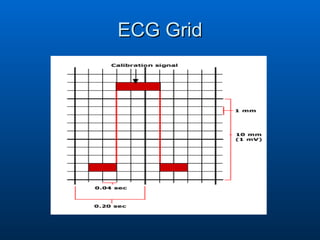
ECG Grid
6 Steps Rate Rhythm Axis Intervals Hypertrophy Infarction/Ischemia
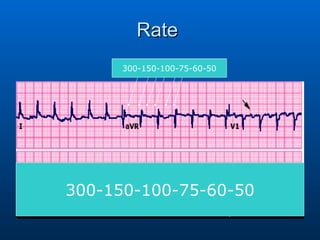
Rate  300-150-100-75-60-50 300-150-100-75-60-50
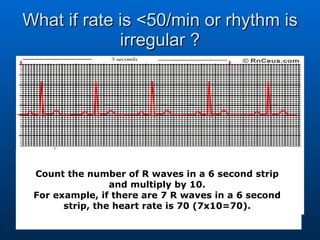
What if rate is <50/min or rhythm is irregular ? Count the number of R waves in a 6 second strip  and multiply by 10.  For example, if there are 7 R waves in a 6 second  strip, the heart rate is 70 (7x10=70).
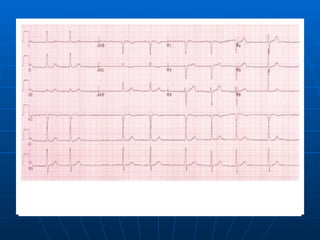
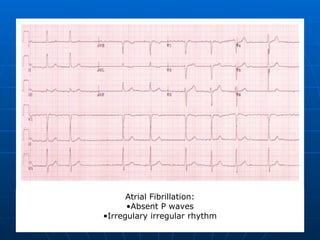
Rhythm 1.  Locate the P wave If absent and rhythm is irregular, think of atrial fibrillation. If present- check rate: If <60, bradycardia. If >100, tachycardia. In general, if narrow-complex tachycardia is present and heart rate is  100-150, think of sinus tachycardia 150-250, think of SVT (supraventricular tachycardia) 250-350, think of atrial flutter >350, think of atrial fibrillation
Rhythm 2. Establish the relationship between P wave and QRS complex If 1:1, it is normal If more P waves than QRS complexes, think of AV block If more QRS complexes than P waves, think of accelerated junctional or ventricular rhythm
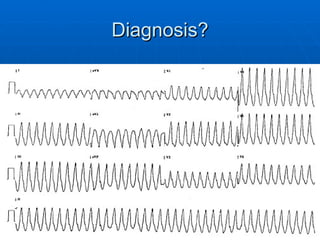
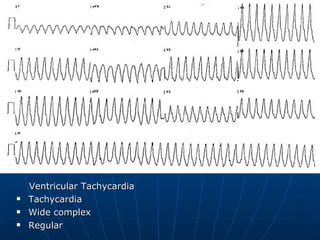
Rhythm 3. Analyze the QRS morphology If normal duration (<120 msec), think of supraventricular origin e.g. normal sinus rhythm or supraventricular tachycardia If wide (>120 msec), think of ventricular origin e.g. ventricular tachycardia
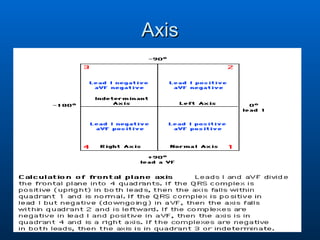
Axis
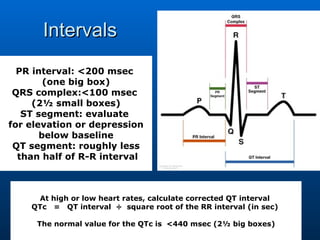
Intervals PR interval: <200 msec  (one big box) QRS complex:<100 msec  (2½ small boxes) ST segment: evaluate  for elevation or depression below baseline QT segment: roughly less than half of R-R interval At high or low heart rates, calculate corrected QT interval  QTc   =   QT interval  ÷  square root of the RR interval (in sec)  The normal value for the QTc is  <440 msec (2½ big boxes)
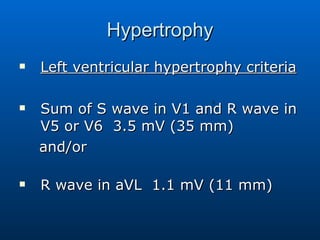
Hypertrophy Left ventricular hypertrophy criteria Sum of S wave in V1 and R wave in V5 or V6  3.5 mV (35 mm)       and/or  R wave in aVL  1.1 mV (11 mm)
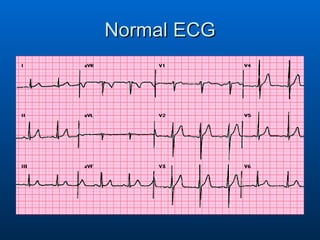
Normal ECG
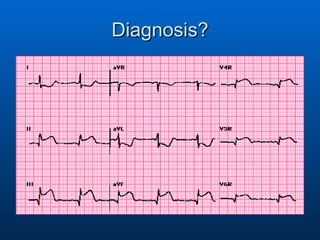
Infarction Clinically significant ST segment elevation is considered to be present if it is greater than 1 mm (0.1 mV) in at least two contiguous precordial leads or in at least two adjacent limb leads.
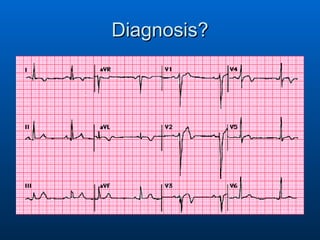
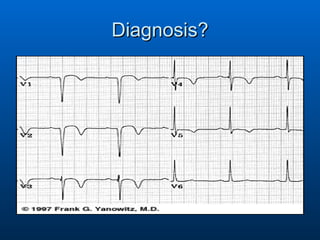
Diagnosis?
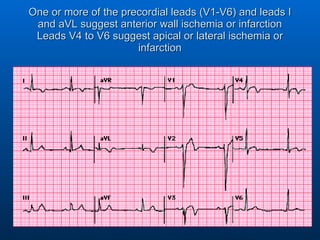
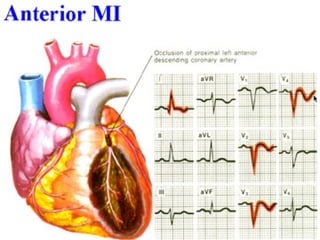
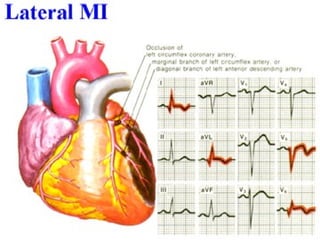
One or more of the precordial leads (V1-V6) and leads I and aVL suggest anterior wall ischemia or infarction Leads V4 to V6 suggest apical or lateral ischemia or infarction
Diagnosis?
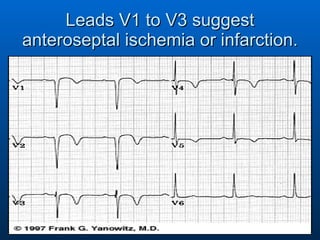
Leads V1 to V3 suggest anteroseptal ischemia or infarction.
 
 
Diagnosis?
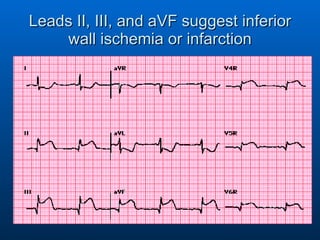
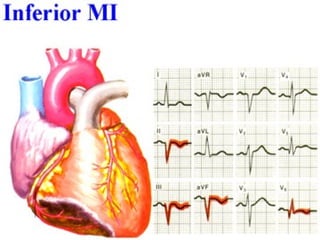
Leads II, III, and aVF suggest inferior wall ischemia or infarction
 
Diagnosis?
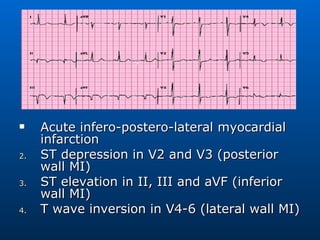
Acute infero-postero-lateral myocardial infarction ST depression in V2 and V3 (posterior wall MI) ST elevation in II, III and aVF (inferior wall MI) T wave inversion in V4-6 (lateral wall MI)
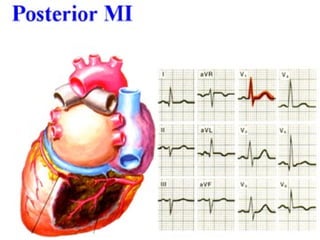
Posterior wall MI The ST elevations of acute posterior MI are usually associated with reciprocal ST depressions in leads V1 to V3.  Posterior inferior wall MI can be differentiated from anterior wall ischemia by the presence of ST segment elevations in the inferior (II, III, aVF). Relatively tall R waves may also appear in leads V1-V3, corresponding to the appearance of pathologic Q waves (loss of depolarization forces) in the posterior leads.
 
Diagnosis?
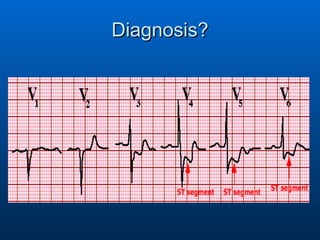
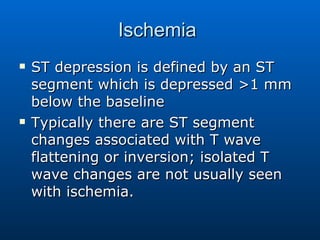
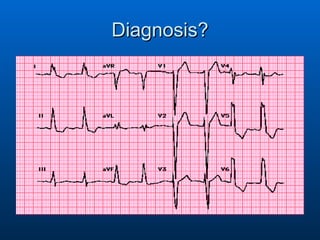
Ischemia  ST depression is defined by an ST segment which is depressed >1 mm below the baseline  Typically there are ST segment changes associated with T wave flattening or inversion; isolated T wave changes are not usually seen with ischemia.
Diagnosis?
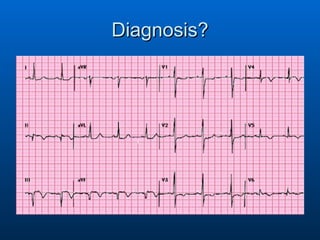
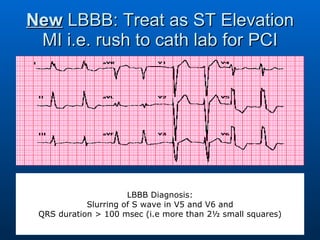
New  LBBB: Treat as ST Elevation MI i.e. rush to cath lab for PCI LBBB Diagnosis: Slurring of S wave in V5 and V6 and QRS duration > 100 msec (i.e more than 2½ small squares)
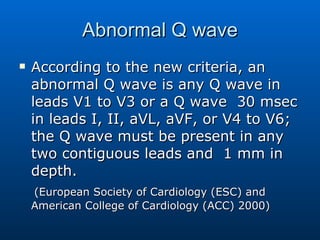
Abnormal Q wave According to the new criteria, an abnormal Q wave is any Q wave in leads V1 to V3 or a Q wave  30 msec in leads I, II, aVL, aVF, or V4 to V6; the Q wave must be present in any two contiguous leads and  1 mm in depth.  (European Society of Cardiology (ESC) and American College of Cardiology (ACC) 2000)
Diagnosis?
Ventricular Tachycardia Tachycardia Wide complex Regular
 
Atrial Fibrillation: Absent P waves Irregulary irregular rhythm


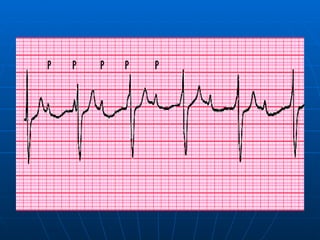
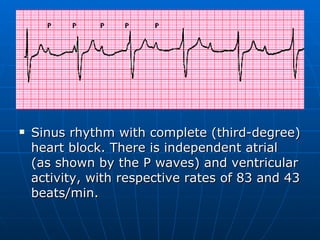
Sinus rhythm with complete (third-degree) heart block. There is independent atrial (as shown by the P waves) and ventricular activity, with respective rates of 83 and 43 beats/min.
 
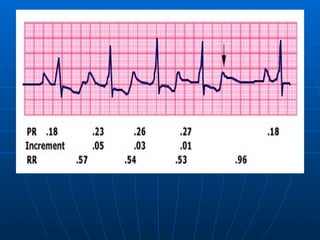
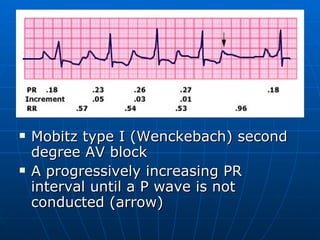
Mobitz type I (Wenckebach) second degree AV block  A progressively increasing PR interval until a P wave is not conducted (arrow)
?

Ecg interpretation

  • 1.
    ECG Interpretation forPrimary Care Physician Aamir A. Cheema M.D.
  • 2.
    Welcome P akistan S ociety of F amily P hysicians
  • 3.
  • 4.
    6 Steps RateRhythm Axis Intervals Hypertrophy Infarction/Ischemia
  • 5.
    Rate 300-150-100-75-60-50300-150-100-75-60-50
  • 6.
    What if rateis <50/min or rhythm is irregular ? Count the number of R waves in a 6 second strip and multiply by 10. For example, if there are 7 R waves in a 6 second strip, the heart rate is 70 (7x10=70).
  • 7.
    Rhythm 1. Locate the P wave If absent and rhythm is irregular, think of atrial fibrillation. If present- check rate: If <60, bradycardia. If >100, tachycardia. In general, if narrow-complex tachycardia is present and heart rate is 100-150, think of sinus tachycardia 150-250, think of SVT (supraventricular tachycardia) 250-350, think of atrial flutter >350, think of atrial fibrillation
  • 8.
    Rhythm 2. Establishthe relationship between P wave and QRS complex If 1:1, it is normal If more P waves than QRS complexes, think of AV block If more QRS complexes than P waves, think of accelerated junctional or ventricular rhythm
  • 9.
    Rhythm 3. Analyzethe QRS morphology If normal duration (<120 msec), think of supraventricular origin e.g. normal sinus rhythm or supraventricular tachycardia If wide (>120 msec), think of ventricular origin e.g. ventricular tachycardia
  • 10.
  • 11.
    Intervals PR interval:<200 msec (one big box) QRS complex:<100 msec (2½ small boxes) ST segment: evaluate for elevation or depression below baseline QT segment: roughly less than half of R-R interval At high or low heart rates, calculate corrected QT interval QTc   =   QT interval  ÷  square root of the RR interval (in sec) The normal value for the QTc is <440 msec (2½ big boxes)
  • 12.
    Hypertrophy Left ventricularhypertrophy criteria Sum of S wave in V1 and R wave in V5 or V6 3.5 mV (35 mm)      and/or R wave in aVL 1.1 mV (11 mm)
  • 13.
  • 14.
    Infarction Clinically significantST segment elevation is considered to be present if it is greater than 1 mm (0.1 mV) in at least two contiguous precordial leads or in at least two adjacent limb leads.
  • 15.
  • 16.
    One or moreof the precordial leads (V1-V6) and leads I and aVL suggest anterior wall ischemia or infarction Leads V4 to V6 suggest apical or lateral ischemia or infarction
  • 17.
  • 18.
    Leads V1 toV3 suggest anteroseptal ischemia or infarction.
  • 19.
  • 20.
  • 21.
  • 22.
    Leads II, III,and aVF suggest inferior wall ischemia or infarction
  • 23.
  • 24.
  • 25.
    Acute infero-postero-lateral myocardialinfarction ST depression in V2 and V3 (posterior wall MI) ST elevation in II, III and aVF (inferior wall MI) T wave inversion in V4-6 (lateral wall MI)
  • 26.
    Posterior wall MIThe ST elevations of acute posterior MI are usually associated with reciprocal ST depressions in leads V1 to V3. Posterior inferior wall MI can be differentiated from anterior wall ischemia by the presence of ST segment elevations in the inferior (II, III, aVF). Relatively tall R waves may also appear in leads V1-V3, corresponding to the appearance of pathologic Q waves (loss of depolarization forces) in the posterior leads.
  • 27.
  • 28.
  • 29.
    Ischemia STdepression is defined by an ST segment which is depressed >1 mm below the baseline Typically there are ST segment changes associated with T wave flattening or inversion; isolated T wave changes are not usually seen with ischemia.
  • 30.
  • 31.
    New LBBB:Treat as ST Elevation MI i.e. rush to cath lab for PCI LBBB Diagnosis: Slurring of S wave in V5 and V6 and QRS duration > 100 msec (i.e more than 2½ small squares)
  • 32.
    Abnormal Q waveAccording to the new criteria, an abnormal Q wave is any Q wave in leads V1 to V3 or a Q wave 30 msec in leads I, II, aVL, aVF, or V4 to V6; the Q wave must be present in any two contiguous leads and 1 mm in depth. (European Society of Cardiology (ESC) and American College of Cardiology (ACC) 2000)
  • 33.
  • 34.
  • 35.
  • 36.
    Atrial Fibrillation: AbsentP waves Irregulary irregular rhythm
  • 37.
  • 38.
  • 39.
  • 40.
    Sinus rhythm withcomplete (third-degree) heart block. There is independent atrial (as shown by the P waves) and ventricular activity, with respective rates of 83 and 43 beats/min.
  • 41.
  • 42.
    Mobitz type I(Wenckebach) second degree AV block A progressively increasing PR interval until a P wave is not conducted (arrow)
  • 43.