
HAEMOSTATIC
RESUSCITATION
Joshua Ho
SCGH ED CME
Aug 23, 2018
THE FORMAT
Context / definitions / theory
Resuscitation process / trials / monitoring our therapy / MTP / the
practical things
I WILL be asking questions, please don’t fall asleep
If you give ANY answer, you get chocolate
If you give the correct answer, you won’t get more chocolate, you just
look smarter
DISCLAIMER: MY EXPERIENCE
THE ED EXPERIENCE
HAEMOSTATIC RESUSCITATION
Rapid correction of haemostasis-impairing factors such as:
Hypothermia
Hypocalcaemia
Acidosis
Resuscitation with a balanced combination of blood products, which
in combination, resembles whole blood, so as to avoid the dilutional
coagulopathy observed in the “traditional methods”
The goal is to ensure adequate tissue perfusion without worsening
coagulopathy
Component of ”Damage Control Resuscitation”
Also permissive hypotension
Also damage control surgery
THE THEORY SIDE OF
THINGS
Not only because “exams”,
but sometimes it’s nice
when things at least have
the appearance of making
sense.
WHAT’S IN THE BLOOD?
Cells
Red cells
White cells
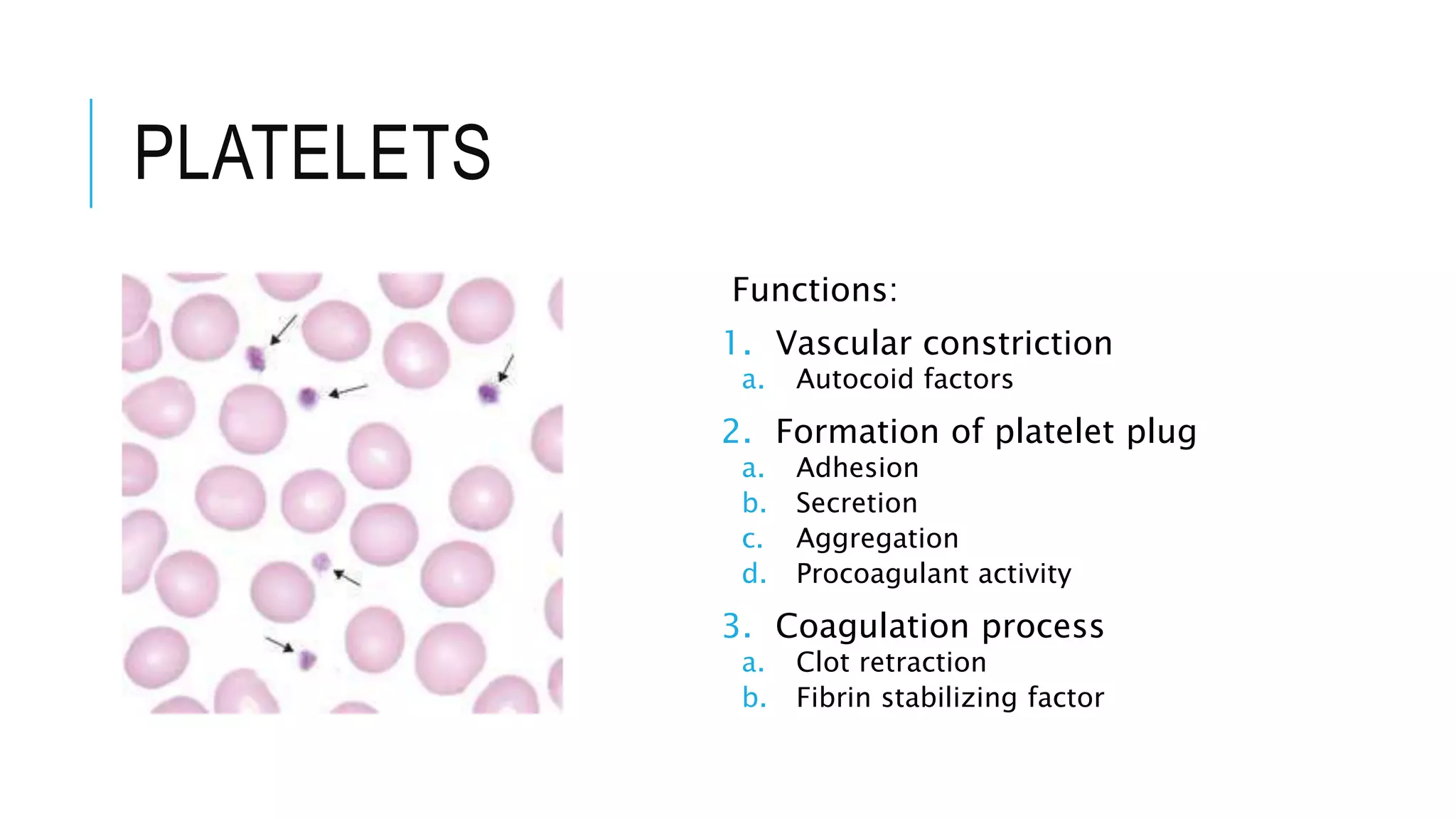
Platelets
Plasma proteins
Alpha globulins
Beta globulins
Gamma globulins
Coagulation factors
Water and electrolytes
RED CELLS
Functions:
1. Oxygen carrier (Hb)
2. CO2 carrier (carbamino
compounds)
3. Intracellular buffer
PLATELETS
Functions:
1. Vascular constriction
a. Autocoid factors
2. Formation of platelet plug
a. Adhesion
b. Secretion
c. Aggregation
d. Procoagulant activity
3. Coagulation process
a. Clot retraction
b. Fibrin stabilizing factor
COAGULATION FACTORS
Classical theory vs. cell based
theory
Serine proteases
Common pathway
Calcium important co-factor
FIBRINOLYSIS
PLASMA PROTEINS
Albumin 55%
Globulins 38%
Alpha 1: antitrypsin, TBG, transcortin
Alpha 2: haptoglobin, caeruloplasmin
Beta: beta 1 transferrin, beta
lipoprotein
Gamma: immunoglobulin
Fibrinogen fractions 7%
Complement
Coagulation factors
Functions:
1. Colloid oncotic pressure
2. Enzymatic functions
3. Coagulation
4. Transport and carriage
5. Buffering action
6. Acquired and innate immunity
7. Amino acid pool
ELECTROLYTES AND MORE
Water 93%
Electrolytes
Glucose
Lipids complexed with proteins
Plasma proteins
HOW DO WE REPLACE
THESE PRODUCTS?
Does anyone really know?
QUESTIONS TO ASK OURSELVES.
What products should we use?
How much do we need?
How quickly do we need to replace it?
What ratio of products is best?
How do we know we’re correcting anything?
What are the down sides?
PACKED RED CELLS
Each 250ml bag has a HCT of 0.6
ACPD additives
Stored at 4 degree celcius
28 day storage
Biochemical changes
2,3 – DPG
FRESH FROZEN PLASMA
Plasma from a single donation
Rapidly frozen to -30 degrees
celsius after separation from red
cells
200 – 300mls containing all
plasma proteins (>0.7IU/ml of
factor VIII)
Needs thawing before
transfusing
10 – 20mls/kg will raise
coagulation factor levels 12 –
15%
PLATELETS
Either derived from multiple
donors or apheresis from a
single donor
200 – 300mls of plasma
containing around 240 x 109 per
unit of platelets
Stored at 22 degrees for 5 days
Expected increment > 20 x
109/L
CRYOPRECIPITATE
Thawing FFP at 4 degrees then
frozen
Comes from a pool of 4 – 5
donors
Thawed to 37 degrees right
before use
100 – 250mls of fibrinogen at
>140mg/unit, factor VIII
>70IU/unit and vWF in high
concentrations
Each unit is 20 – 40mls
10 units of cryoprecipitate
expected to raise fibrinogen
FIBRINOGEN CONCENTRATE
Freeze dried lyophilized
preparations of fibrinogen
(number of brands)
900 – 1400mg per vial
Quickly reconstituted
No crossmatch required
4g (eg 4 vials) usually increases
fibrinogen levels 1g/L
NOVO SEVEN
Indicated for the use in the
context of surgery for patients
with:
Haemophilia A or B with inhibitors
Congenital Factor VII (FVII) deficiency
Glanzmann’s thrombasthenia who have
decreased or absent response to
platelet transfusions
Adults with acquired haemophilia
Off label use in all other cases
Incidence of thrombosis:
0.2% in patients with congenital
haemophilia
4% in people with acquired
haemophilia
COLLOIDS
Colloid solution as 4% or 20%
Prepared from pooled human
plasma
40g/L or 200g/L
Is expensive in other countries
but “free” in Australia
SAFE trial and head injuries
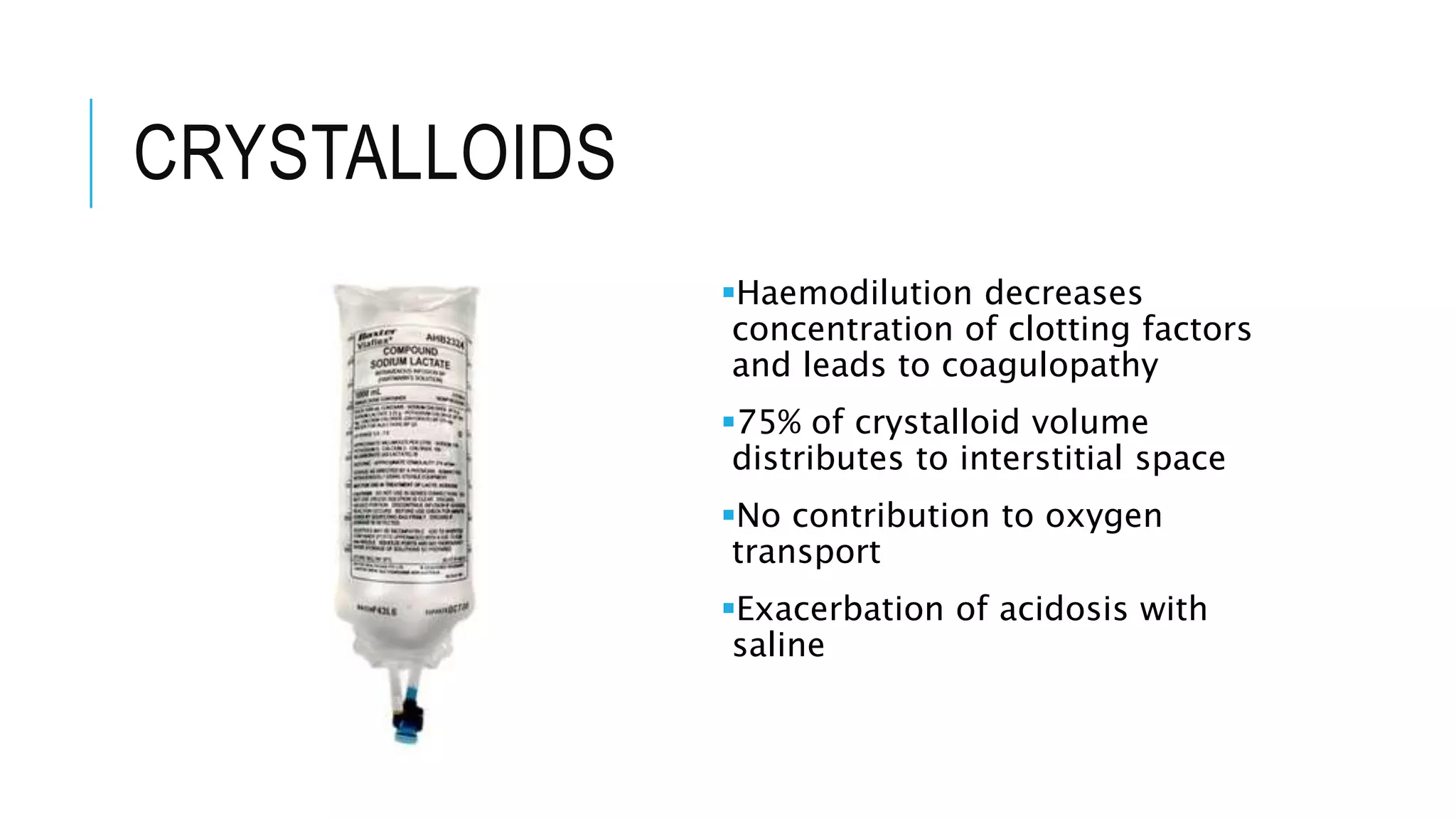
CRYSTALLOIDS
Haemodilution decreases
concentration of clotting factors
and leads to coagulopathy
75% of crystalloid volume
distributes to interstitial space
No contribution to oxygen
transport
Exacerbation of acidosis with
saline
TRANEXAMIC ACID
Aminocaproic acid analogue
Competitively inhibits
plasminogen activation
Intravascular thrombosis
Use in trauma
Use in obstetrics
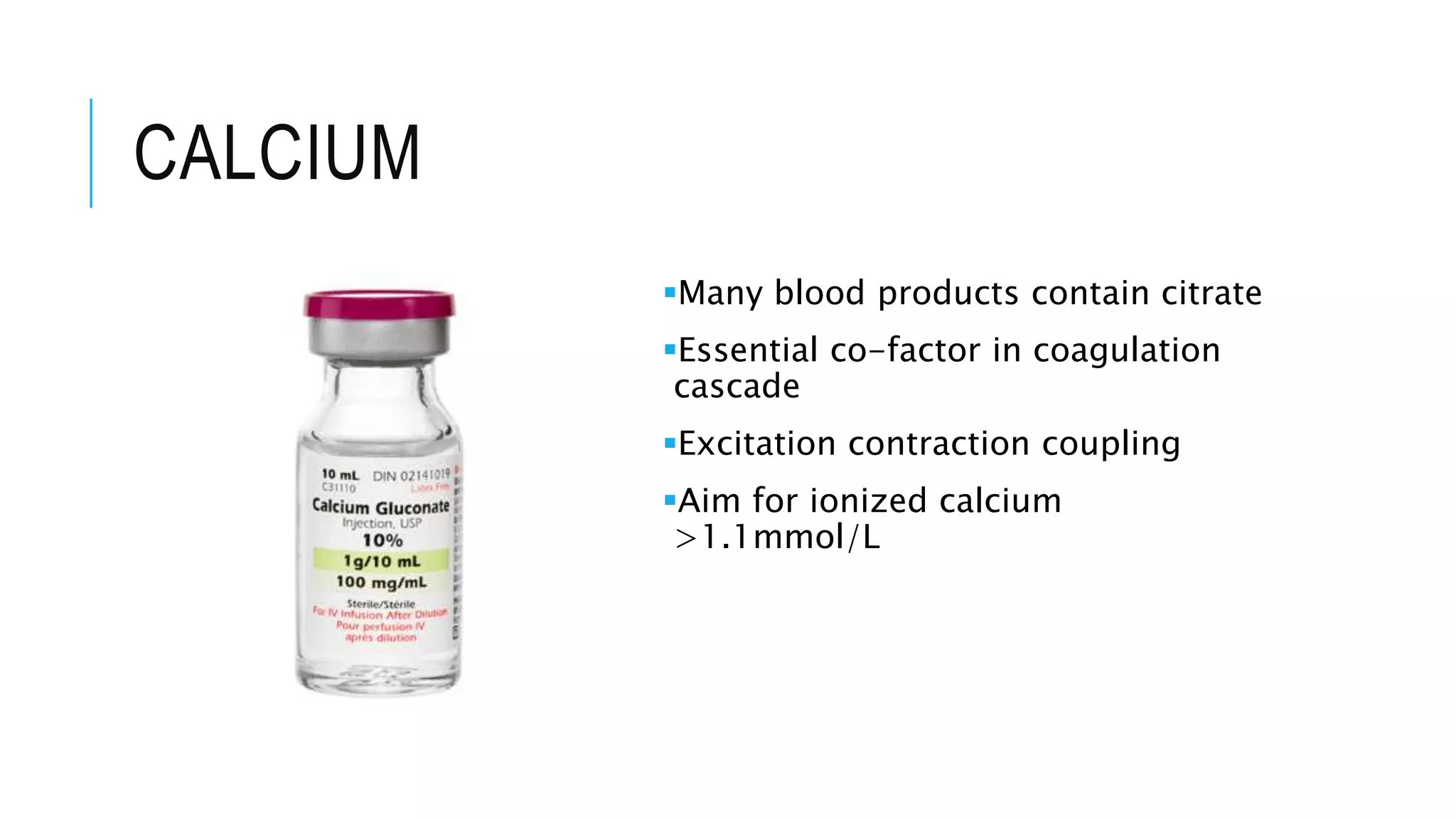
CALCIUM
Many blood products contain citrate
Essential co-factor in coagulation
cascade
Excitation contraction coupling
Aim for ionized calcium
>1.1mmol/L
REVERSAL AGENTS
Dabigatran
Rivaroxaban / Apixaban
Warfarin
Heparins
Aspirin / Ticagrelor / Clopidogrel
A FEW STUDIES
PROMMTT
PROPPR
CRASH-2
PROMMTT STUDY (2013)
Multi-centered prospective cohort study with 905 patients
Early death of patients receiving more red cells than platelets /
plasma within the first 6 hours (mortality increased 3 – 4x)
Those receiving 1:1 transfusion of plasma/platelets to red cells
tended to survive
Survival benefit was concentrated on first 6 hours
Of those who survived beyond 24 hours, no mortality difference at 30
days
PROPPR TRIAL (2015)
Multi-centered RCT
680 patients randomized to 1:1:1 or 1:1:2 (plasma: platelets: red
cells)
4% improvement in absolute mortality with 1:1:1, but underpowered
Statistically significant mortality improvement from exsanguination
within the first 24 hours with the 1:1:1 group (9.2% vs 14.6%)
CRASH 2 TRIAL (2010)
Multi-centered international RCT with 20,211 patients in total
1g of TXA given in first 3 hours of trauma followed by 1g over the
following 8 hours
All cause mortality improvement was significant but small (14.5% vs
16%)
Larger improvement in patients who received it within 1 hour of
trauma
Increase in mortality for those who received it AFTER 3 hours
TXA group had lower rate of thrombosis and myocardial infarction
MONITORING OUR
THERAPY
Traditional Coagulation
Studies
ROTEM / TEG
INR / PROTHROMBIN TIME
Measures integrity of extrinsic and final common pathways of
coagulation cascade
Factors II, V, VII, X and Fibrinogen
Calcium and thromboplastin added
Time for fibrin clot formation measured
9.5 to 13.5 seconds usually
INR is lab dependent and is PT converted to a ratio
ACTIVATED PARTIAL
THROMBOPLASTIN TIME
A more sensitive version of thromboplastin time with narrower
reference range
Evaluates the intrinsic and common pathways
Factors II, V, VIII, IX, X, XI, XII and Fibrinogen
Calcium and phospholipid emulsion added to sample time to clot
formation observed
Reference range 30 – 40 seconds
FIBRINOGEN LEVELS
Hypofibrinogenaemia
Hyperfibrinolysis
Level <1.5 needs replacement
Dosing for replacement on the MTP
PLATELET COUNT
Some suggestion of keeping platelet count >10 x 109/L for bleeding
prophylaxis
As part of MTP regardless of platelet count
>50 x 109/L for procedural cover or in DIC
>100 x 109/L in intracranial haemorrhage
Does not reflect platelet inactivation!
HAEMOGLOBIN
Late marker in the acutely bleeding patient
Not apt to wait for a Hb nor use Hb alone as a transfusion trigger
Generally keep >7g/dL in patients without IHD
If bleeding, keep >10g/dL
Higher targets may be necessary if continuous haemodynamic
compromise until definitive surgical haemostasis achieved
DIRECT ORAL ANTICOAGULANTS
Levels are available for all 3 DOACs
Perhaps more relevance now that Idarucizumab exists
Prothrombinex is an option
Call the haematologists
TEG / ROTEM
Thromboelastography and rotational thromboelastometry
Global tests of haemostasis performed on whole blood as a POC
Assesses kinetics of clot formation, strength and dissolution
Used to manage bleeding and assess response to interventions made
Cup rotates vs pin rotates
MASSIVE TRANSFUSION
PROTOCOLS
Available in both trauma
bays.
THE PRACTICAL SIDE OF
THINGS
Because that’s what really
matters in the end.
IN MY SCENARIO
IN THE ED SCENARIO
WHAT NEEDS TO HAPPEN?
Airway, breathing and circulation; primary survey
Large central venous access for massive transfusions
Arterial access for repeated ABGs and ROTEMs
FAST scan and trauma survey
Designated communicator with the laboratory
Designated runner to obtain blood products
Lots of checking of blood products
Managing traffic with presence of inpatient teams
THE CONSIDERATIONS
Pre-allocated trauma team roles
Badges with team member’s name and said role
Limited physical space around the patient available
Communication barrier with high decibels and unfamiliar faces
Decision on when the patient is ”stable enough” to get to CT / OT /
NIISWA / ICU
PEOPLE TO NOT FORGET
When things start to look
like they’re getting under
control.
THE FAMILY MEMBERS
THE REST OF THE DEPARTMENT
NON-ED STAFF
REFERENCES
https://www.blood.gov.au/system/files/documents/companion-25-pbm-guidelines.pdf
https://www.novosevenrt.com/safety-profile.html
https://derangedphysiology.com/main/required-reading/trauma-burns-and-
drowning/Chapter%203.0.3/haemostatic-resuscitation-and-massive-transfusion
https://wjes.biomedcentral.com/track/pdf/10.1186/1749-7922-7-S1-S3
https://archsurg.jamanetwork.com/article.aspx?articleID=1379768
https://secure.jbs.elsevierhealth.com/action/getSharedSiteSession?rc=1&redirect=https%
3A%2F%2Fwww.thelancet.com%2Fjournals%2Flancet%2Farticle%2FPIIS0140-
6736%252810%252960835-5%2Ffulltext
http://jama.jamanetwork.com/article.aspx?articleid=2107789
http://scghed.com/2015/04/scgh-massive-transfusion-protocol/
http://scghed.com/2016/03/roles-in-the-resuscitation-room/
http://rebelem.com/ten-trauma-resuscitation-commandments/

Haemostatic resuscitation

Editor's Notes

  • #10 Mention white cells and talk about leukodeplelted blood at the end of this slide.
  • #17 Adenine: prolongs shelf life to 35 days (energy substrate) Citrate: decrease calcium to anticoagulate blood Phosphate: buffers the pH Glucose/dextrose: for Ebden-Myerhoff glycolysis pathway   Biochemical changes: Decreased ATP Increased potassium: impaired Na/K/ATPase Increased lactate Decreased sodium Decreased calcium: essentially zero due to citrate Decreased glucose Decreased pH (6.8 at 28 days) Increased free haemoglobin due to RBC lysis in storage
  • #22 Factor VIIa Recombinant protein Tissue factor + factor VIIa + platelets leads to platelet aggregation and production of platelet-fibrin matrix, thus affording haemostatis (therapeutic end goal) Needs to be dosed twice, 20 minutes apart and is very expensive, also needs platelets to function Consider when patient has already had: 10 units of red cells / 8 units of FFP / 2 units of platelets / 2 units of cryoprecipitate Warfarin / heparin reversed TXA has been considered or given Warmed > 35, pH . 7.2, platelets > 100, ad Fib greater than 1 Adverse effects: DVT / PE and other thromboembolic disease including coronary
  • #27 Andexanet alpha coming soon – direct Xa inhibitors Warfarin – prothrombinex / FFP / Vit K Aspirin / ticagrelor – give platelets, ?role of desmopressin Protamine for heparins
  • #29 Survivor bias American study with 33% penetrating trauma rate – not your everyday SCGH trauma call
  • #30 The one RCT (PROPPR) was underpowered, unblinded, and of the groups the majority never even achieved their transfusion ratio targets.
  • #31 Reduction of fibrinolysis was the proposed goal, but no attempt to measure fibrinolysis was made. Tranexamic acid has an anti-inflammatory effect, which may account for some of the mortality difference (Volpi et al, 2015). In the CRASH-2 trial, doctors could choose to randomize or not randomize based on treatment certainty. Also, of the dead patients, only approximately 5% had bleeding as a cause of death. Approximately half of the patients in the trial did not even require a transfusion. in short, there are serious methodology concerns. Much of the trial intervention occurred in the pre-hospital environment, which makes it difficult to generalise the findings.
  • #39 Very good for detecting hyperfibrinolysis which no other test can detect Systematic review in 2011 only 9 RCTs, 8 in cardiac surgery, 1 in liver tnrasplants, none in trauma Between TEG and ROTEM, different transfusions can occur depending on which algorithm is used MCF reproducible with correlation to Plt counts and APTT -> transfusion requirements and mortality
  • #47 If the patient arrests, they almost certainly need to be intubated and have bilateral chest drains to decompress any potential pneumothoraces