ECG: Systematic
Analysis
Dr Nola McPherson CME SCGH 2014
ECG Interpretation Overview
1. ECG type &recording
2. Rate, Rhythm, Axis
3. P wave
4. PR interval + segment
5. Q Waves, R waves
6. QRS complex
7. ST segment
8. T wave
9. U wave
10. QT interval
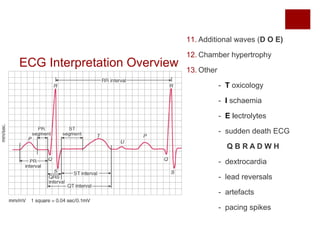
ECG Interpretation Overview
11. Additional waves (D O E)
12. Chamber hypertrophy
13. Other
- T oxicology
- I schaemia
- E lectrolytes
- sudden death ECG
Q B R A D W H
- dextrocardia
- lead reversals
- artefacts
- pacing spikes
Putting it all together…
Diagnosis
Differential diagnoses
Life threats
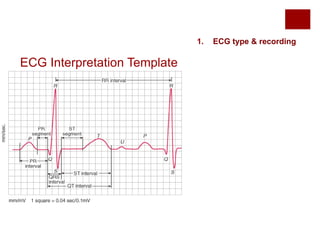
ECG Interpretation Template
1. ECG type & recording
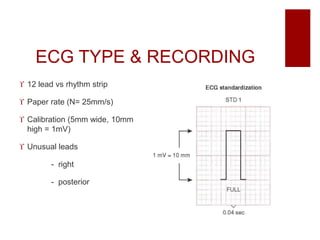
ECG TYPE & RECORDING
 12 lead vs rhythm strip
 Paper rate (N= 25mm/s)
 Calibration (5mm wide, 10mm
high = 1mV)
 Unusual leads
- right
- posterior
ECG Interpretation Template
1. ECG type &recording
2. Rate, Rhythm, Axis
Rate, Rhythm, Axis
RATE
Normal 60-100/min (tachy/bradycardia)
Method: 300/RR(large squares)
OR 1500/RR(small squares)
OR number of QRS x 6 (if 25mm/s)
RHYTHM
Pattern: regular or irregular (reg irreg or irreg irreg)
7 STEP APPROACH
Rate, Rhythm, Axis
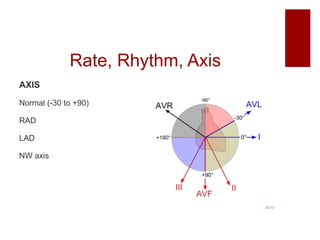
AXIS
Normal (-30 to +90)
RAD
LAD
NW axis
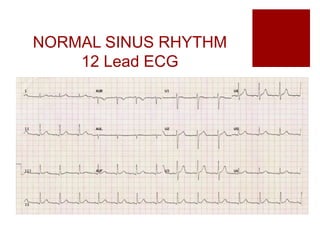
NORMAL SINUS RHYTHM
12 Lead ECG
ECG Interpretation Template
1. ECG type &recording
2. Rate, Rhythm, Axis
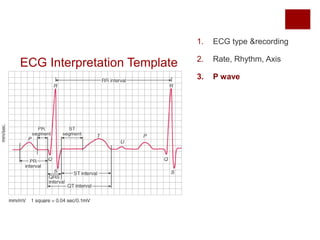
3. P wave
P Wave
 ?present or absent
 Amplitude & duration (LAE/RAE/BAE)
<2.5mm amp limb leads, <1.5mm amp chest leads
<3mm duration
 Contour
monophasic lead II, biphasic lead V1
inverted aVR, upright I, II, V2-6
Left Atrial Enlargement
Right Atrial Enlargement
ECG Interpretation Template
1. ECG type &recording
2. Rate, Rhythm, Axis
3. P wave
4. PR interval +
segment
PR Interval
 Duration (N= 120-200ms)
Short (<120ms)
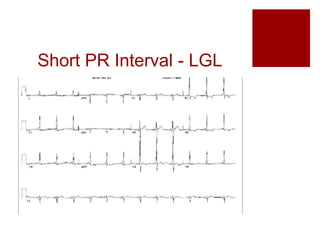
1. Preexcitation Syndrome
eg WPW, Lown - Ganong- Levine (LGL)
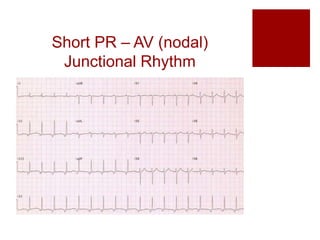
2. AV (nodal) junctional Rhythm
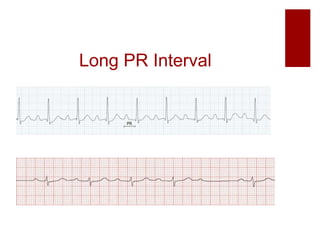
Long (>200ms)
1. 1 HB (alone or with other blocks)
Varying (blocks)
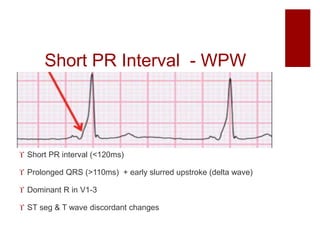
Short PR Interval - WPW
 Short PR interval (<120ms)
 Prolonged QRS (>110ms) + early slurred upstroke (delta wave)
 Dominant R in V1-3
 ST seg & T wave discordant changes
Short PR Interval - LGL
Short PR – AV (nodal)
Junctional Rhythm
Long PR Interval
PR Segment
 Elevation or Depression
1. pericarditis
2. atrial ischaemia
- Liu’s Criteria
ECG Interpretation Template
1. ECG type &recording
2. Rate, Rhythm, Axis
3. P wave
4. PR interval + segment
5. Q Waves, R waves
Q waves
 NORMAL
<1mm wide, <2mm deep
 PATHOLOGICAL
Criteria:
- >40ms (>1mm wide)
- > 2mm deep
- >25% depth of QRS complex
- seen in lead V1- V3
DDX:
1. Myocardial infarction
2. Cardiomyopathies
Hypertrophic
Infiltrative disease
Pathological Q Waves
R waves
 NORMAL
Transition point V3-V4
 ABNORMAL
Dominant R wave in aVR
Dominant R wave in V1
Poor R wave progression (Ht ≤ 3 mm in V3)
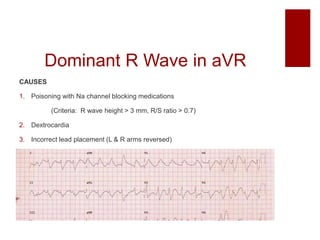
Dominant R Wave in aVR
CAUSES
1. Poisoning with Na channel blocking medications
(Criteria: R wave height > 3 mm, R/S ratio > 0.7)
2. Dextrocardia
3. Incorrect lead placement (L & R arms reversed)
Dominant R Wave in V1
CAUSES
1. RVH (PE, L to R shunt)
2. RBBB
3. POSTERIOR MI (+ STE in leads V7,8,9)
4. WPW TYPE A
5. Hypertrophic Cardiomyopathy
6. Dextrocardia
7. Normal in children and young adults
Poor R Wave Progression
CAUSES
1. Prior anteroseptal infarction
2. LVH
3. Dilated cardiomyopathy
4. Transpositioin of leads V1 & V3
5. May be normal
ECG Interpretation Template
1. ECG type &recording
2. Rate, Rhythm, Axis
3. P wave
4. PR interval + segment
5. Q Waves, R waves
6. QRS complex
QRS Complex
 Duration
N = 70-100ms
narrow (Supraventricular)
wide (ventricular or SVT
with aberrant
conduction)
 Amplitude
High voltage eg LVH
Low voltage
Alternans eg
pericardial effusion
 Morphology
Notched
RBBB
LBBB
 Spot Diagnoses
Brugada Syndrome
WPW Syndrome (delta
waves)
Tricyclic poisoning (wide
QRS + dom R in aVR
ECG Interpretation Template
1. ECG type &recording
2. Rate, Rhythm, Axis
3. P wave
4. PR interval + segment
5. Q Waves, R waves
6. QRS complex
7. ST segment
ST Segment
 Displacement
Elevation
Depression
 ST Depression Morphology
Horizontal
Up sloping
Down sloping
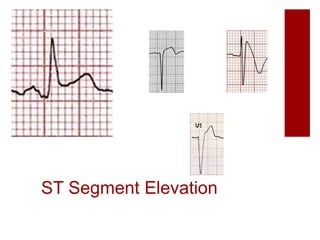
ST Segment Elevation
ST Segment Depression
ECG Interpretation Template
1. ECG type &recording
2. Rate, Rhythm, Axis
3. P wave
4. PR interval + segment
5. Q Waves, R waves
6. QRS complex
7. ST segment
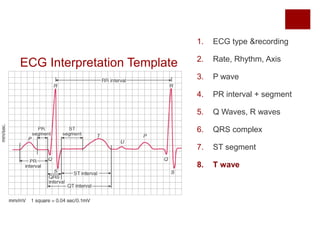
8. T wave
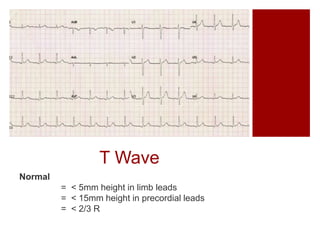
T Wave
Normal
= < 5mm height in limb leads
= < 15mm height in precordial leads
= < 2/3 R
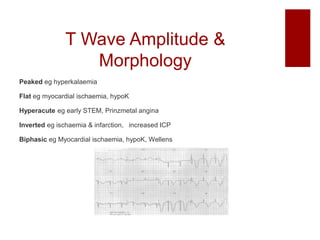
T Wave Amplitude &
Morphology
Peaked eg hyperkalaemia
Flat eg myocardial ischaemia, hypoK
Hyperacute eg early STEM, Prinzmetal angina
Inverted eg ischaemia & infarction, increased ICP
Biphasic eg Myocardial ischaemia, hypoK, Wellens
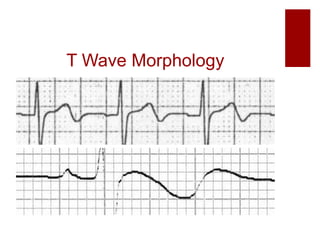
T Wave Morphology
ECG Interpretation Template
1. ECG type &recording
2. Rate, Rhythm, Axis
3. P wave
4. PR interval + segment
5. Q Waves, R waves
6. QRS complex
7. ST segment
8. T wave
9. U wave
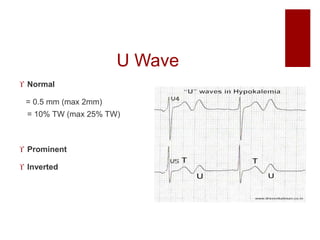
U Wave
 Normal
= 0.5 mm (max 2mm)
= 10% TW (max 25% TW)
 Prominent
 Inverted
U Wave
 Prominent
> 1-2mm or > 25% ht TW
CAUSES
Bradycardia
HypoK
HypoCa, HypoMg
Hypothermia
Increased ICP
LVH
Hypertrophic cardiomypy
Digoxin
 Inverted
abnormal if in leads with upright
T waves
CAUSES
Heart disease
**HIGHLY SPECIFIC FOR HEART
DISEASE**
**Predicts >75% stenosis of
LAD/LMCA and suggests LV
dysfn**
ECG Interpretation Template
1. ECG type &recording
2. Rate, Rhythm, Axis
3. P wave
4. PR interval + segment
5. Q Waves, R waves
6. QRS complex
7. ST segment
8. T wave
9. U wave
10. QT interval
QT Interval
 Normal QTc
= 390-440ms M/460 ms
F
< ½ preceding RR
inversely prop to HR
Measure in lead II or V5-6
Large U waves (>1 mm) fused
to T included in measurement
Small, separate U waves
excluded in measurement
 Long (>440/460 ms)
 Short (<350ms)
QT Interval
ECG Interpretation Template
11. Additional waves (D O E)
Additional Waves (D O E)
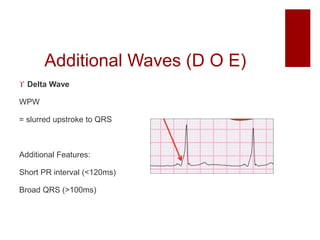
 Delta Wave
WPW
= slurred upstroke to QRS
Additional Features:
Short PR interval (<120ms)
Broad QRS (>100ms)
Additional Waves (D O E)
 Osborn Wave (J waves)
= positive deflection at J point
Most prominent in precordial leads
Causes
Hypothermia
Hyper Ca
Medications
Raised ICP
Normal varient
Additional Waves (D O E)
 Epsilon Wave
Arrythmogenic RV dysplasia (in
30% patients)
= pos deflection buried in end of
QRS
Additional Features
TWI V1-3
Prolonged S Wave upstroke V1-3
ECG Interpretation Template
11. Additional waves (D O E)
12. Chamber hypertrophy
13. Other
- T oxicology
- I schaemia
- E lectrolytes
- sudden death ECG
- dextrocardia
- lead reversals
- artefacts
- pacing spikes
Lethal Causes Syncope
Q BRAD W H
1. QT syndrome (Long/short)
2. Brugada Syndrome
3. RV infarction
4. Arrythmogenic RV Dysplasia
5. Dilated Cardiomyopathy
6. WPW
7. Hypertrophic Cardiomyopathy
Questions & Comments
References
 What-When-How In Depth Tutorials and Information:
http://what-when-how.com/paramedic-care/diagnostic-
ecgthe-12-lead-clinical-essentials-paramedic-care-
part-5/
 ECG Basics-Parts of the ECG:
http://www.emergsource.com/?page_id=90
 Academic Life in Emergency Medicine:
http://www.aliem.com/posterior-myocardial-infarction-
how-accurate-is-the-flipped-ecg-trick/
References
 ECG PEDIA.ORG:
http://en.ecgpedia.org/wiki/QRS_axis
 Life in the Fast Lane ECG Library

ECG interpretation

  • 1.
    ECG: Systematic Analysis Dr NolaMcPherson CME SCGH 2014
  • 2.
    ECG Interpretation Overview 1.ECG type &recording 2. Rate, Rhythm, Axis 3. P wave 4. PR interval + segment 5. Q Waves, R waves 6. QRS complex 7. ST segment 8. T wave 9. U wave 10. QT interval
  • 3.
    ECG Interpretation Overview 11.Additional waves (D O E) 12. Chamber hypertrophy 13. Other - T oxicology - I schaemia - E lectrolytes - sudden death ECG Q B R A D W H - dextrocardia - lead reversals - artefacts - pacing spikes
  • 4.
    Putting it alltogether… Diagnosis Differential diagnoses Life threats
  • 5.
    ECG Interpretation Template 1.ECG type & recording
  • 6.
    ECG TYPE &RECORDING  12 lead vs rhythm strip  Paper rate (N= 25mm/s)  Calibration (5mm wide, 10mm high = 1mV)  Unusual leads - right - posterior
  • 11.
    ECG Interpretation Template 1.ECG type &recording 2. Rate, Rhythm, Axis
  • 12.
    Rate, Rhythm, Axis RATE Normal60-100/min (tachy/bradycardia) Method: 300/RR(large squares) OR 1500/RR(small squares) OR number of QRS x 6 (if 25mm/s) RHYTHM Pattern: regular or irregular (reg irreg or irreg irreg) 7 STEP APPROACH
  • 13.
    Rate, Rhythm, Axis AXIS Normal(-30 to +90) RAD LAD NW axis
  • 14.
  • 15.
    ECG Interpretation Template 1.ECG type &recording 2. Rate, Rhythm, Axis 3. P wave
  • 16.
    P Wave  ?presentor absent  Amplitude & duration (LAE/RAE/BAE) <2.5mm amp limb leads, <1.5mm amp chest leads <3mm duration  Contour monophasic lead II, biphasic lead V1 inverted aVR, upright I, II, V2-6
  • 17.
  • 18.
  • 19.
  • 20.
  • 21.
    ECG Interpretation Template 1.ECG type &recording 2. Rate, Rhythm, Axis 3. P wave 4. PR interval + segment
  • 22.
    PR Interval  Duration(N= 120-200ms) Short (<120ms) 1. Preexcitation Syndrome eg WPW, Lown - Ganong- Levine (LGL) 2. AV (nodal) junctional Rhythm Long (>200ms) 1. 1 HB (alone or with other blocks) Varying (blocks)
  • 23.
    Short PR Interval- WPW  Short PR interval (<120ms)  Prolonged QRS (>110ms) + early slurred upstroke (delta wave)  Dominant R in V1-3  ST seg & T wave discordant changes
  • 24.
  • 25.
    Short PR –AV (nodal) Junctional Rhythm
  • 26.
  • 27.
    PR Segment  Elevationor Depression 1. pericarditis 2. atrial ischaemia - Liu’s Criteria
  • 28.
    ECG Interpretation Template 1.ECG type &recording 2. Rate, Rhythm, Axis 3. P wave 4. PR interval + segment 5. Q Waves, R waves
  • 29.
    Q waves  NORMAL <1mmwide, <2mm deep  PATHOLOGICAL Criteria: - >40ms (>1mm wide) - > 2mm deep - >25% depth of QRS complex - seen in lead V1- V3 DDX: 1. Myocardial infarction 2. Cardiomyopathies Hypertrophic Infiltrative disease
  • 30.
  • 31.
    R waves  NORMAL Transitionpoint V3-V4  ABNORMAL Dominant R wave in aVR Dominant R wave in V1 Poor R wave progression (Ht ≤ 3 mm in V3)
  • 32.
    Dominant R Wavein aVR CAUSES 1. Poisoning with Na channel blocking medications (Criteria: R wave height > 3 mm, R/S ratio > 0.7) 2. Dextrocardia 3. Incorrect lead placement (L & R arms reversed)
  • 33.
    Dominant R Wavein V1 CAUSES 1. RVH (PE, L to R shunt) 2. RBBB 3. POSTERIOR MI (+ STE in leads V7,8,9) 4. WPW TYPE A 5. Hypertrophic Cardiomyopathy 6. Dextrocardia 7. Normal in children and young adults
  • 35.
    Poor R WaveProgression CAUSES 1. Prior anteroseptal infarction 2. LVH 3. Dilated cardiomyopathy 4. Transpositioin of leads V1 & V3 5. May be normal
  • 37.
    ECG Interpretation Template 1.ECG type &recording 2. Rate, Rhythm, Axis 3. P wave 4. PR interval + segment 5. Q Waves, R waves 6. QRS complex
  • 38.
    QRS Complex  Duration N= 70-100ms narrow (Supraventricular) wide (ventricular or SVT with aberrant conduction)  Amplitude High voltage eg LVH Low voltage Alternans eg pericardial effusion  Morphology Notched RBBB LBBB  Spot Diagnoses Brugada Syndrome WPW Syndrome (delta waves) Tricyclic poisoning (wide QRS + dom R in aVR
  • 40.
    ECG Interpretation Template 1.ECG type &recording 2. Rate, Rhythm, Axis 3. P wave 4. PR interval + segment 5. Q Waves, R waves 6. QRS complex 7. ST segment
  • 41.
    ST Segment  Displacement Elevation Depression ST Depression Morphology Horizontal Up sloping Down sloping
  • 42.
  • 43.
  • 44.
    ECG Interpretation Template 1.ECG type &recording 2. Rate, Rhythm, Axis 3. P wave 4. PR interval + segment 5. Q Waves, R waves 6. QRS complex 7. ST segment 8. T wave
  • 45.
    T Wave Normal = <5mm height in limb leads = < 15mm height in precordial leads = < 2/3 R
  • 46.
    T Wave Amplitude& Morphology Peaked eg hyperkalaemia Flat eg myocardial ischaemia, hypoK Hyperacute eg early STEM, Prinzmetal angina Inverted eg ischaemia & infarction, increased ICP Biphasic eg Myocardial ischaemia, hypoK, Wellens
  • 47.
  • 48.
    ECG Interpretation Template 1.ECG type &recording 2. Rate, Rhythm, Axis 3. P wave 4. PR interval + segment 5. Q Waves, R waves 6. QRS complex 7. ST segment 8. T wave 9. U wave
  • 49.
    U Wave  Normal =0.5 mm (max 2mm) = 10% TW (max 25% TW)  Prominent  Inverted
  • 50.
    U Wave  Prominent >1-2mm or > 25% ht TW CAUSES Bradycardia HypoK HypoCa, HypoMg Hypothermia Increased ICP LVH Hypertrophic cardiomypy Digoxin  Inverted abnormal if in leads with upright T waves CAUSES Heart disease **HIGHLY SPECIFIC FOR HEART DISEASE** **Predicts >75% stenosis of LAD/LMCA and suggests LV dysfn**
  • 51.
    ECG Interpretation Template 1.ECG type &recording 2. Rate, Rhythm, Axis 3. P wave 4. PR interval + segment 5. Q Waves, R waves 6. QRS complex 7. ST segment 8. T wave 9. U wave 10. QT interval
  • 52.
    QT Interval  NormalQTc = 390-440ms M/460 ms F < ½ preceding RR inversely prop to HR Measure in lead II or V5-6 Large U waves (>1 mm) fused to T included in measurement Small, separate U waves excluded in measurement  Long (>440/460 ms)  Short (<350ms)
  • 53.
  • 54.
    ECG Interpretation Template 11.Additional waves (D O E)
  • 55.
    Additional Waves (DO E)  Delta Wave WPW = slurred upstroke to QRS Additional Features: Short PR interval (<120ms) Broad QRS (>100ms)
  • 56.
    Additional Waves (DO E)  Osborn Wave (J waves) = positive deflection at J point Most prominent in precordial leads Causes Hypothermia Hyper Ca Medications Raised ICP Normal varient
  • 57.
    Additional Waves (DO E)  Epsilon Wave Arrythmogenic RV dysplasia (in 30% patients) = pos deflection buried in end of QRS Additional Features TWI V1-3 Prolonged S Wave upstroke V1-3
  • 59.
    ECG Interpretation Template 11.Additional waves (D O E) 12. Chamber hypertrophy 13. Other - T oxicology - I schaemia - E lectrolytes - sudden death ECG - dextrocardia - lead reversals - artefacts - pacing spikes
  • 60.
    Lethal Causes Syncope QBRAD W H 1. QT syndrome (Long/short) 2. Brugada Syndrome 3. RV infarction 4. Arrythmogenic RV Dysplasia 5. Dilated Cardiomyopathy 6. WPW 7. Hypertrophic Cardiomyopathy
  • 61.
  • 62.
    References  What-When-How InDepth Tutorials and Information: http://what-when-how.com/paramedic-care/diagnostic- ecgthe-12-lead-clinical-essentials-paramedic-care- part-5/  ECG Basics-Parts of the ECG: http://www.emergsource.com/?page_id=90  Academic Life in Emergency Medicine: http://www.aliem.com/posterior-myocardial-infarction- how-accurate-is-the-flipped-ecg-trick/
  • 63.