ECG INTERPRETATION
Dr. C. Kannan

Post graduate
Pediatrics
MGMCRI
DISCUSSION
• Anatomy of conduction system of heart
• ECG leads and attachment
• Anatomy of ECG
• Basic concepts
• Cardiac Axis/Angle
• Conduction abnormalities
• Rhythm abnormalities
• Abnormalities P, QRS and T waves
• Exercises
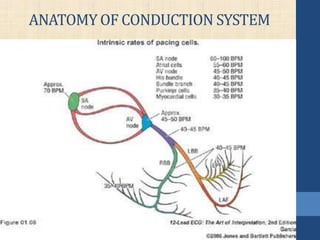
ANATOMY OF CONDUCTION SYSTEM
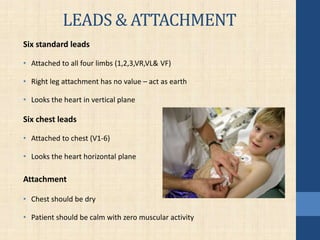
LEADS & ATTACHMENT
Six standard leads
• Attached to all four limbs (1,2,3,VR,VL& VF)
• Right leg attachment has no value – act as earth
• Looks the heart in vertical plane
Six chest leads
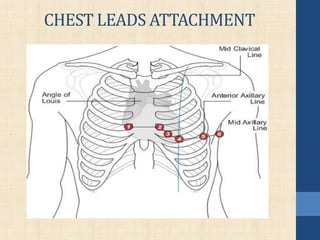
• Attached to chest (V1-6)
• Looks the heart horizontal plane
Attachment
• Chest should be dry
• Patient should be calm with zero muscular activity
CHEST LEADS ATTACHMENT
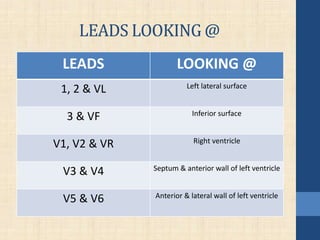
LEADS LOOKING @
LEADS LOOKING @
1, 2 & VL Left lateral surface
3 & VF Inferior surface
V1, V2 & VR Right ventricle
V3 & V4 Septum & anterior wall of left ventricle
V5 & V6 Anterior & lateral wall of left ventricle
ANATOMY OF ECG
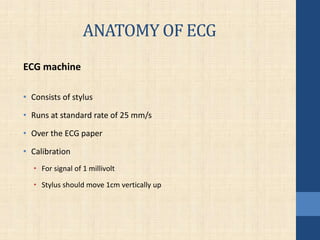
ECG machine
• Consists of stylus
• Runs at standard rate of 25 mm/s
• Over the ECG paper
• Calibration
• For signal of 1 millivolt
• Stylus should move 1cm vertically up
ANATOMY OF ECG
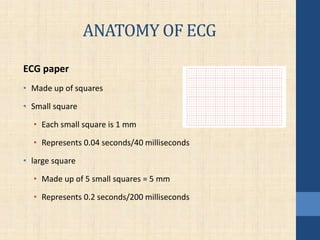
ECG paper
• Made up of squares
• Small square
• Each small square is 1 mm
• Represents 0.04 seconds/40 milliseconds
• large square
• Made up of 5 small squares = 5 mm
• Represents 0.2 seconds/200 milliseconds
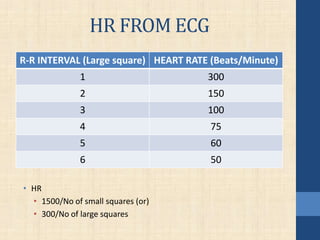
HR FROM ECG
• HR
• 1500/No of small squares (or)
• 300/No of large squares
R-R INTERVAL (Large square) HEART RATE (Beats/Minute)
1 300
2 150
3 100
4 75
5 60
6 50
ANATOMY OF ECG
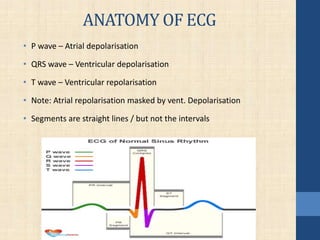
• P wave – Atrial depolarisation
• QRS wave – Ventricular depolarisation
• T wave – Ventricular repolarisation
• Note: Atrial repolarisation masked by vent. Depolarisation
• Segments are straight lines / but not the intervals
ANATOMY OF ECG
PR interval
• From beginning of P wave to the beginning of QRS wave
• Time taken for the excitation to spread
• From the SA node
• Upto ventricular muscle
• Should be called as PQ interval
• Commonly used as PR interval
• Duration: 3-5 small squares/120-220 ms
ANATOMY OF ECG
QRS complex
• Duration is 120 ms/3 small squares
• Low voltage QRS (<5 mm in limb leads/<10 mm in chest leads)
• High voltage QRS (>20 mm in LL/>30 mm in CL)
• Time taken for the excitation to
• Spread through the ventricles
• Represents
• Only vent. depolarisation
• No vent. Contraction
• Contraction is proceeding during ST segment
ANATOMY OF ECG
QT interval
• Represents both ventricular de/repolarisation
• Should be less than 450 ms
• Prolonged in electrolyte abnormalities/some drugs
T wave
• Repolarisation/relaxation of ventricles
BASIC CONCEPT
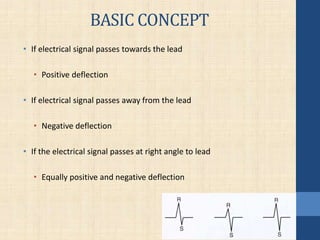
• If electrical signal passes towards the lead
• Positive deflection
• If electrical signal passes away from the lead
• Negative deflection
• If the electrical signal passes at right angle to lead
• Equally positive and negative deflection
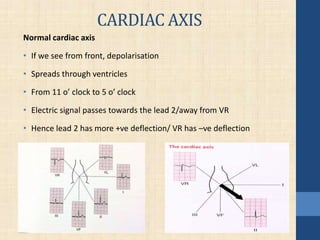
CARDIAC AXIS
Normal cardiac axis
• If we see from front, depolarisation
• Spreads through ventricles
• From 11 o’ clock to 5 o’ clock
• Electric signal passes towards the lead 2/away from VR
• Hence lead 2 has more +ve deflection/ VR has –ve deflection
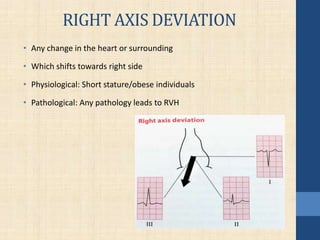
RIGHT AXIS DEVIATION
• Any change in the heart or surrounding
• Which shifts towards right side
• Physiological: Short stature/obese individuals
• Pathological: Any pathology leads to RVH
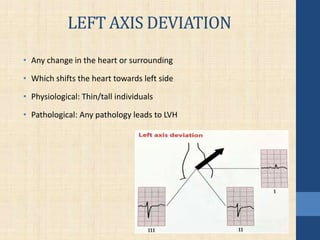
LEFT AXIS DEVIATION
• Any change in the heart or surrounding
• Which shifts the heart towards left side
• Physiological: Thin/tall individuals
• Pathological: Any pathology leads to LVH
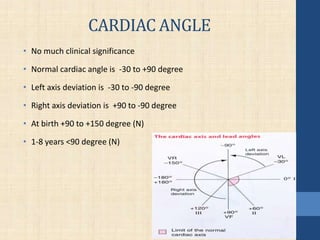
CARDIAC ANGLE
• No much clinical significance
• Normal cardiac angle is -30 to +90 degree
• Left axis deviation is -30 to -90 degree
• Right axis deviation is +90 to -90 degree
• At birth +90 to +150 degree (N)
• 1-8 years <90 degree (N)
HOW TO REPORT AN ECG ?
• Rhythm
• Rate
• Conduction intervals (PR/QT interval)
• Cardiac axis
• Description of the QRS complexes
• Description of ST segment and T wave
CONDUCTION ABNORMALITIES
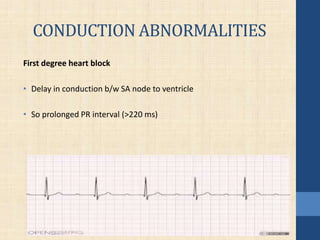
First degree heart block
• Delay in conduction b/w SA node to ventricle
• So prolonged PR interval (>220 ms)
SECOND DEGREE BLOCK
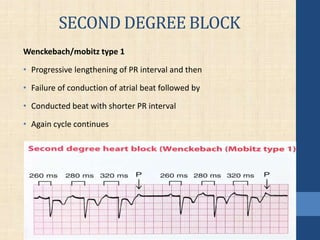
Wenckebach/mobitz type 1
• Progressive lengthening of PR interval and then
• Failure of conduction of atrial beat followed by
• Conducted beat with shorter PR interval
• Again cycle continues
SECOND DEGREE BLOCK
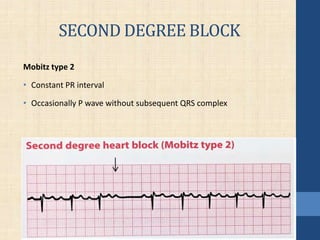
Mobitz type 2
• Constant PR interval
• Occasionally P wave without subsequent QRS complex
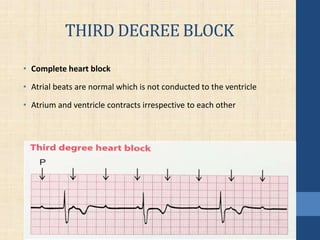
THIRD DEGREE BLOCK
• Complete heart block
• Atrial beats are normal which is not conducted to the ventricle
• Atrium and ventricle contracts irrespective to each other
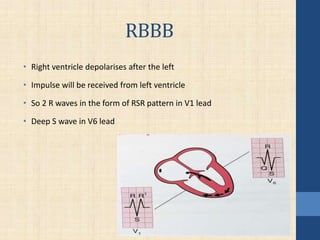
RBBB
• Right ventricle depolarises after the left
• Impulse will be received from left ventricle
• So 2 R waves in the form of RSR pattern in V1 lead
• Deep S wave in V6 lead
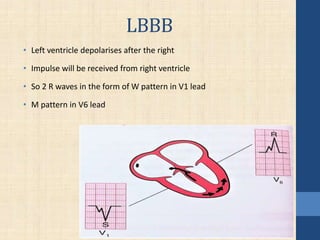
LBBB
• Left ventricle depolarises after the right
• Impulse will be received from right ventricle
• So 2 R waves in the form of W pattern in V1 lead
• M pattern in V6 lead
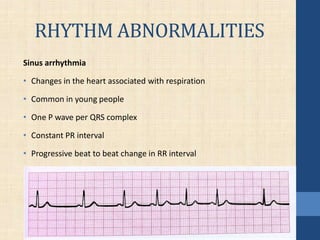
RHYTHM ABNORMALITIES
Sinus arrhythmia
• Changes in the heart associated with respiration
• Common in young people
• One P wave per QRS complex
• Constant PR interval
• Progressive beat to beat change in RR interval
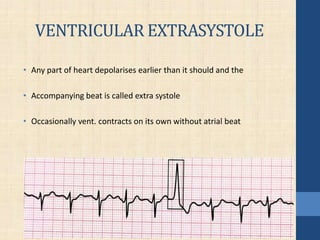
VENTRICULAR EXTRASYSTOLE
• Any part of heart depolarises earlier than it should and the
• Accompanying beat is called extra systole
• Occasionally vent. contracts on its own without atrial beat
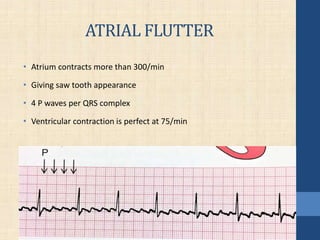
ATRIAL FLUTTER
• Atrium contracts more than 300/min
• Giving saw tooth appearance
• 4 P waves per QRS complex
• Ventricular contraction is perfect at 75/min
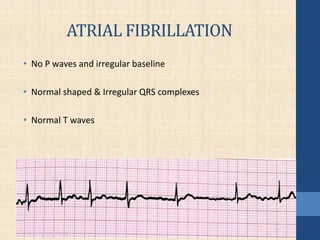
ATRIAL FIBRILLATION
• No P waves and irregular baseline
• Normal shaped & Irregular QRS complexes
• Normal T waves
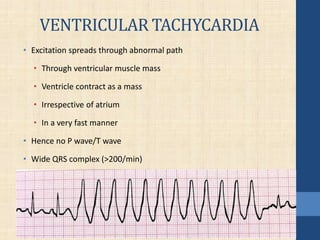
VENTRICULAR TACHYCARDIA
• Excitation spreads through abnormal path
• Through ventricular muscle mass
• Ventricle contract as a mass
• Irrespective of atrium
• In a very fast manner
• Hence no P wave/T wave
• Wide QRS complex (>200/min)
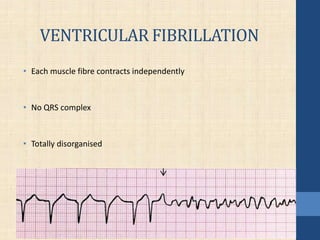
VENTRICULAR FIBRILLATION
• Each muscle fibre contracts independently
• No QRS complex
• Totally disorganised
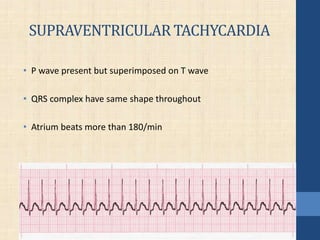
SUPRAVENTRICULAR TACHYCARDIA
• P wave present but superimposed on T wave
• QRS complex have same shape throughout
• Atrium beats more than 180/min
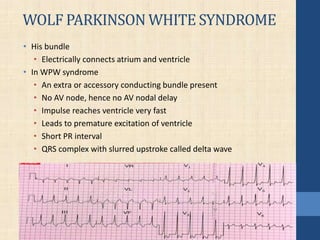
WOLF PARKINSON WHITE SYNDROME
• His bundle
• Electrically connects atrium and ventricle
• In WPW syndrome
• An extra or accessory conducting bundle present
• No AV node, hence no AV nodal delay
• Impulse reaches ventricle very fast
• Leads to premature excitation of ventricle
• Short PR interval
• QRS complex with slurred upstroke called delta wave
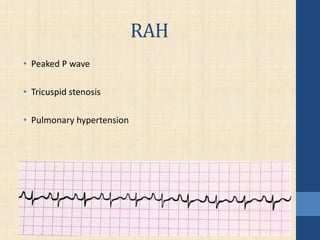
RAH
• Peaked P wave
• Tricuspid stenosis
• Pulmonary hypertension
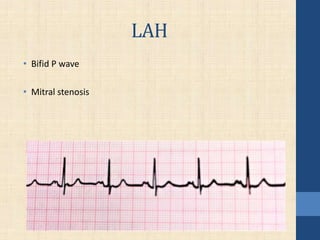
LAH
• Bifid P wave
• Mitral stenosis
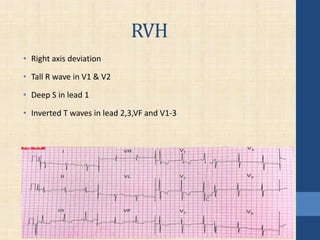
RVH
• Right axis deviation
• Tall R wave in V1 & V2
• Deep S in lead 1
• Inverted T waves in lead 2,3,VF and V1-3
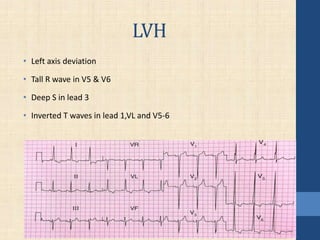
LVH
• Left axis deviation
• Tall R wave in V5 & V6
• Deep S in lead 3
• Inverted T waves in lead 1,VL and V5-6
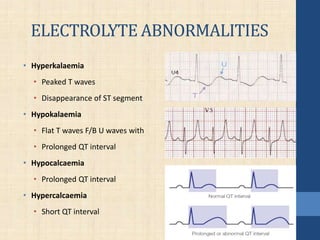
ELECTROLYTE ABNORMALITIES
• Hyperkalaemia
• Peaked T waves
• Disappearance of ST segment
• Hypokalaemia
• Flat T waves F/B U waves with
• Prolonged QT interval
• Hypocalcaemia
• Prolonged QT interval
• Hypercalcaemia
• Short QT interval
REFERENCES
• ECG made easy written by John R. Hampton
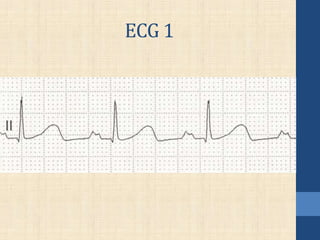
ECG 1
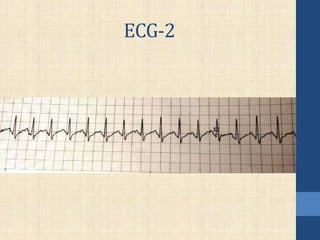
ECG-2
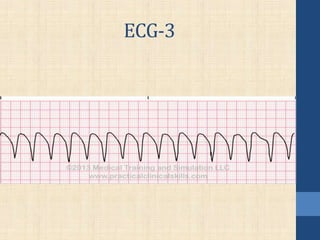
ECG-3
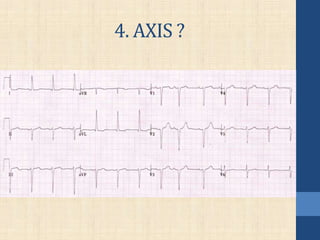
4. AXIS ?
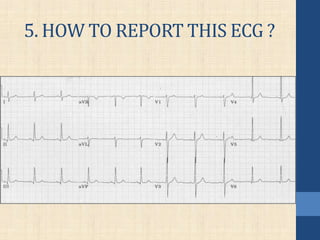
5. HOW TO REPORT THIS ECG ?
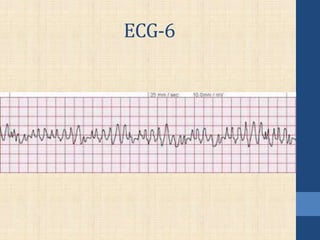
ECG-6
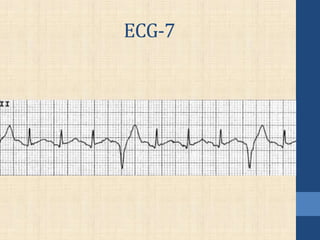
ECG-7
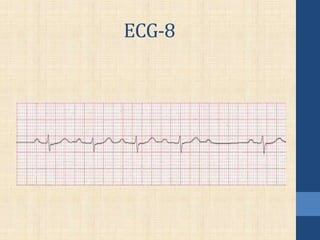
ECG-8
THANK YOU

ECG

  • 1.
    ECG INTERPRETATION Dr. C.Kannan Post graduate Pediatrics MGMCRI
  • 2.
    DISCUSSION • Anatomy ofconduction system of heart • ECG leads and attachment • Anatomy of ECG • Basic concepts • Cardiac Axis/Angle • Conduction abnormalities • Rhythm abnormalities • Abnormalities P, QRS and T waves • Exercises
  • 3.
  • 4.
    LEADS & ATTACHMENT Sixstandard leads • Attached to all four limbs (1,2,3,VR,VL& VF) • Right leg attachment has no value – act as earth • Looks the heart in vertical plane Six chest leads • Attached to chest (V1-6) • Looks the heart horizontal plane Attachment • Chest should be dry • Patient should be calm with zero muscular activity
  • 5.
  • 6.
    LEADS LOOKING @ LEADSLOOKING @ 1, 2 & VL Left lateral surface 3 & VF Inferior surface V1, V2 & VR Right ventricle V3 & V4 Septum & anterior wall of left ventricle V5 & V6 Anterior & lateral wall of left ventricle
  • 7.
    ANATOMY OF ECG ECGmachine • Consists of stylus • Runs at standard rate of 25 mm/s • Over the ECG paper • Calibration • For signal of 1 millivolt • Stylus should move 1cm vertically up
  • 8.
    ANATOMY OF ECG ECGpaper • Made up of squares • Small square • Each small square is 1 mm • Represents 0.04 seconds/40 milliseconds • large square • Made up of 5 small squares = 5 mm • Represents 0.2 seconds/200 milliseconds
  • 9.
    HR FROM ECG •HR • 1500/No of small squares (or) • 300/No of large squares R-R INTERVAL (Large square) HEART RATE (Beats/Minute) 1 300 2 150 3 100 4 75 5 60 6 50
  • 10.
    ANATOMY OF ECG •P wave – Atrial depolarisation • QRS wave – Ventricular depolarisation • T wave – Ventricular repolarisation • Note: Atrial repolarisation masked by vent. Depolarisation • Segments are straight lines / but not the intervals
  • 11.
    ANATOMY OF ECG PRinterval • From beginning of P wave to the beginning of QRS wave • Time taken for the excitation to spread • From the SA node • Upto ventricular muscle • Should be called as PQ interval • Commonly used as PR interval • Duration: 3-5 small squares/120-220 ms
  • 12.
    ANATOMY OF ECG QRScomplex • Duration is 120 ms/3 small squares • Low voltage QRS (<5 mm in limb leads/<10 mm in chest leads) • High voltage QRS (>20 mm in LL/>30 mm in CL) • Time taken for the excitation to • Spread through the ventricles • Represents • Only vent. depolarisation • No vent. Contraction • Contraction is proceeding during ST segment
  • 13.
    ANATOMY OF ECG QTinterval • Represents both ventricular de/repolarisation • Should be less than 450 ms • Prolonged in electrolyte abnormalities/some drugs T wave • Repolarisation/relaxation of ventricles
  • 14.
    BASIC CONCEPT • Ifelectrical signal passes towards the lead • Positive deflection • If electrical signal passes away from the lead • Negative deflection • If the electrical signal passes at right angle to lead • Equally positive and negative deflection
  • 15.
    CARDIAC AXIS Normal cardiacaxis • If we see from front, depolarisation • Spreads through ventricles • From 11 o’ clock to 5 o’ clock • Electric signal passes towards the lead 2/away from VR • Hence lead 2 has more +ve deflection/ VR has –ve deflection
  • 16.
    RIGHT AXIS DEVIATION •Any change in the heart or surrounding • Which shifts towards right side • Physiological: Short stature/obese individuals • Pathological: Any pathology leads to RVH
  • 17.
    LEFT AXIS DEVIATION •Any change in the heart or surrounding • Which shifts the heart towards left side • Physiological: Thin/tall individuals • Pathological: Any pathology leads to LVH
  • 18.
    CARDIAC ANGLE • Nomuch clinical significance • Normal cardiac angle is -30 to +90 degree • Left axis deviation is -30 to -90 degree • Right axis deviation is +90 to -90 degree • At birth +90 to +150 degree (N) • 1-8 years <90 degree (N)
  • 19.
    HOW TO REPORTAN ECG ? • Rhythm • Rate • Conduction intervals (PR/QT interval) • Cardiac axis • Description of the QRS complexes • Description of ST segment and T wave
  • 20.
    CONDUCTION ABNORMALITIES First degreeheart block • Delay in conduction b/w SA node to ventricle • So prolonged PR interval (>220 ms)
  • 21.
    SECOND DEGREE BLOCK Wenckebach/mobitztype 1 • Progressive lengthening of PR interval and then • Failure of conduction of atrial beat followed by • Conducted beat with shorter PR interval • Again cycle continues
  • 22.
    SECOND DEGREE BLOCK Mobitztype 2 • Constant PR interval • Occasionally P wave without subsequent QRS complex
  • 23.
    THIRD DEGREE BLOCK •Complete heart block • Atrial beats are normal which is not conducted to the ventricle • Atrium and ventricle contracts irrespective to each other
  • 24.
    RBBB • Right ventricledepolarises after the left • Impulse will be received from left ventricle • So 2 R waves in the form of RSR pattern in V1 lead • Deep S wave in V6 lead
  • 25.
    LBBB • Left ventricledepolarises after the right • Impulse will be received from right ventricle • So 2 R waves in the form of W pattern in V1 lead • M pattern in V6 lead
  • 26.
    RHYTHM ABNORMALITIES Sinus arrhythmia •Changes in the heart associated with respiration • Common in young people • One P wave per QRS complex • Constant PR interval • Progressive beat to beat change in RR interval
  • 27.
    VENTRICULAR EXTRASYSTOLE • Anypart of heart depolarises earlier than it should and the • Accompanying beat is called extra systole • Occasionally vent. contracts on its own without atrial beat
  • 28.
    ATRIAL FLUTTER • Atriumcontracts more than 300/min • Giving saw tooth appearance • 4 P waves per QRS complex • Ventricular contraction is perfect at 75/min
  • 29.
    ATRIAL FIBRILLATION • NoP waves and irregular baseline • Normal shaped & Irregular QRS complexes • Normal T waves
  • 30.
    VENTRICULAR TACHYCARDIA • Excitationspreads through abnormal path • Through ventricular muscle mass • Ventricle contract as a mass • Irrespective of atrium • In a very fast manner • Hence no P wave/T wave • Wide QRS complex (>200/min)
  • 31.
    VENTRICULAR FIBRILLATION • Eachmuscle fibre contracts independently • No QRS complex • Totally disorganised
  • 32.
    SUPRAVENTRICULAR TACHYCARDIA • Pwave present but superimposed on T wave • QRS complex have same shape throughout • Atrium beats more than 180/min
  • 33.
    WOLF PARKINSON WHITESYNDROME • His bundle • Electrically connects atrium and ventricle • In WPW syndrome • An extra or accessory conducting bundle present • No AV node, hence no AV nodal delay • Impulse reaches ventricle very fast • Leads to premature excitation of ventricle • Short PR interval • QRS complex with slurred upstroke called delta wave
  • 34.
    RAH • Peaked Pwave • Tricuspid stenosis • Pulmonary hypertension
  • 35.
    LAH • Bifid Pwave • Mitral stenosis
  • 36.
    RVH • Right axisdeviation • Tall R wave in V1 & V2 • Deep S in lead 1 • Inverted T waves in lead 2,3,VF and V1-3
  • 37.
    LVH • Left axisdeviation • Tall R wave in V5 & V6 • Deep S in lead 3 • Inverted T waves in lead 1,VL and V5-6
  • 38.
    ELECTROLYTE ABNORMALITIES • Hyperkalaemia •Peaked T waves • Disappearance of ST segment • Hypokalaemia • Flat T waves F/B U waves with • Prolonged QT interval • Hypocalcaemia • Prolonged QT interval • Hypercalcaemia • Short QT interval
  • 39.
    REFERENCES • ECG madeeasy written by John R. Hampton
  • 40.
  • 41.
  • 42.
  • 43.
  • 44.
    5. HOW TOREPORT THIS ECG ?
  • 45.
  • 46.
  • 47.
  • 48.