Digital Logic
Digital Systems * Digital systems operate on discrete elements of information # Numbers (e.g., pocket calculator) # Letters (e.g., word processor) # Pictures (e.g., digital cameras) * For a digital systems to operate on a continuous data, it needs to quantize (digitize) that data first # Covert data into digital representation * Digital systems # Cell phone  # MP3  music player …. etc # digital camera Ramzi Sh. Alqrainy
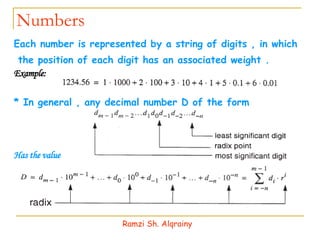
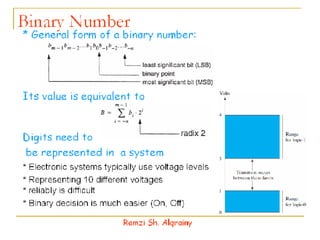
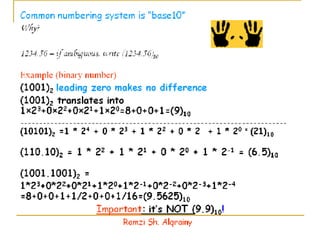
Numbers Each number is represented by a string of digits , in which the position of each digit has an associated weight . Example: * In general , any decimal number D of the form Has the value   Ramzi Sh. Alqrainy
 
 
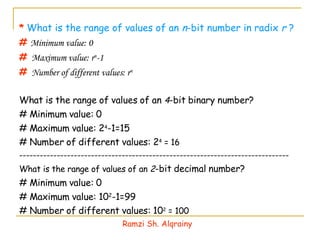
*   What is the range of values of an  n -bit number in radix  r  ? #   Minimum value: 0 #  Maximum value:  r n -1 #  Number of different values:  r n What is the range of values of an  4 -bit binary number? # Minimum value: 0 # Maximum value: 2 4 -1=15 # Number of different values: 2 4  = 16 ------------------------------------------------------------------------------- What is the range of values of an  2 -bit decimal number? # Minimum value: 0 # Maximum value: 10 2 -1=99 # Number of different values: 10 2  = 100 Ramzi Sh. Alqrainy
 
 
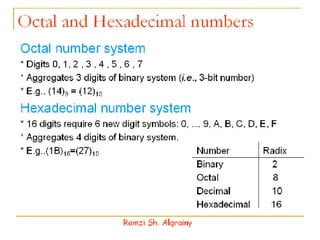
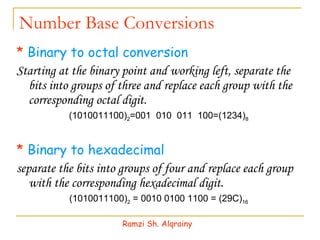
Number Base Conversions *  Binary to octal conversion Starting at the binary point and working left, separate the bits into groups of three and replace each group with the corresponding octal digit. (1010011100) 2 =001  010  011  100=(1234) 8 *  Binary to hexadecimal separate the bits into groups of four and replace each group with the corresponding hexadecimal digit. (1010011100) 2  = 0010 0100 1100 = (29C) 16 Ramzi Sh. Alqrainy
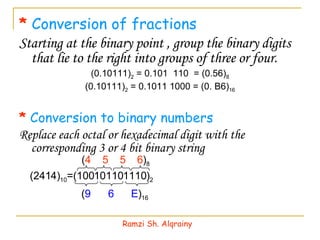
*   Conversion of fractions Starting at the binary point , group the binary digits that lie to the right into groups of three or four. (0.10111) 2  = 0.101  110  = (0.56) 8 (0.10111) 2  = 0.1011 1000 = (0. B6) 16 *  Conversion to binary numbers Replace each octal or hexadecimal digit with the corresponding 3 or 4 bit binary string (2414) 10 =(100101101110) 2 Ramzi Sh. Alqrainy ( 4  5  5  6 ) 8 ( 9  6  E ) 16


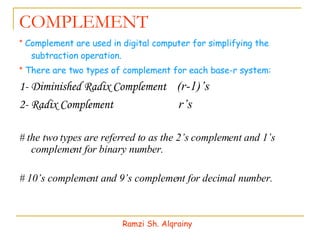
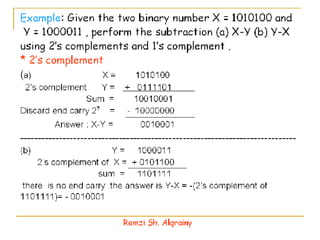
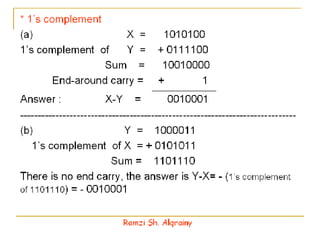
COMPLEMENT *   Complement are used in digital computer for simplifying the subtraction operation. *  There are two types of complement for each base-r system: 1- Diminished Radix Complement  (r-1)’s 2- Radix Complement  r’s # the two types are referred to as the 2’s complement and 1’s complement for binary number. # 10’s complement and 9’s complement for decimal number. Ramzi Sh. Alqrainy
 
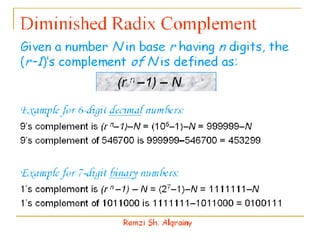
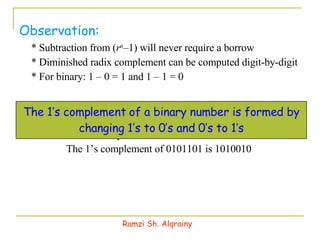
Observation: * Subtraction from ( r n –1) will never require a borrow * Diminished radix complement can be computed digit-by-digit * For binary: 1 – 0 = 1 and 1 – 1 = 0  Ex  .  The 1’s complement of 1011000 is 0100111 The 1’s complement of 0101101 is 1010010 Ramzi Sh. Alqrainy The 1’s complement of a binary number is formed by changing 1’s to 0’s and 0’s to 1’s


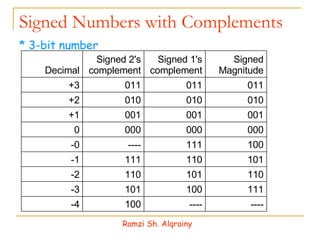
Signed Numbers with Complements * 3-bit number Ramzi Sh. Alqrainy ---- ---- 100 -4 111 100 101 -3 110 101 110 -2 101 110 111 -1 100 111 ---- -0 000 000 000 0 001 001 001 +1 010 010 010 +2 011 011 011 +3 Signed Magnitude Signed 1's complement Signed 2's complement Decimal
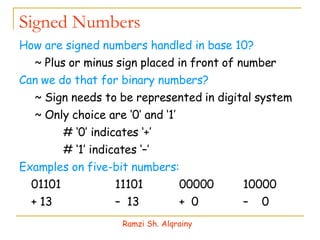
Signed Numbers How are signed numbers handled in base 10? ~ Plus or minus sign placed in front of number Can we do that for binary numbers? ~ Sign needs to be represented in digital system  ~ Only choice are ‘0’ and ‘1’ # ‘0’ indicates ‘+’ # ‘1’ indicates ‘–’ Examples on five-bit numbers: 01101 11101 00000  10000  + 13   –  13  +  0 –  0 Ramzi Sh. Alqrainy
 
 
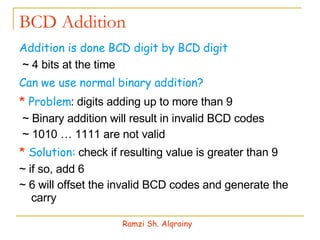
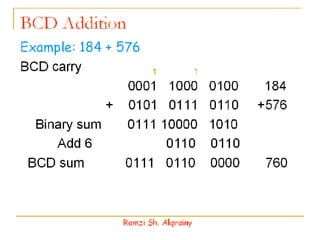
BCD Addition Addition is done BCD digit by BCD digit ~ 4 bits at the time Can we use normal binary addition? *  Problem : digits adding up to more than 9 ~ Binary addition will result in invalid BCD codes ~ 1010 … 1111 are not valid  *  Solution:  check if resulting value is greater than 9 ~ if so, add 6 ~ 6 will offset the invalid BCD codes and generate the carry Ramzi Sh. Alqrainy
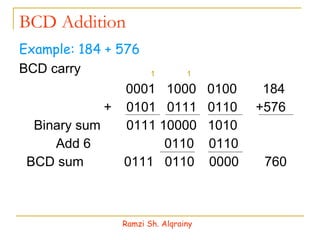
BCD Addition Example: 184 + 576 BCD carry  1  1  0001  1000  0100  184  +  0101  0111  0110  +576  Binary sum  0111 10000  1010 Add 6  0110  0110 BCD sum  0111  0110  0000  760 Ramzi Sh. Alqrainy
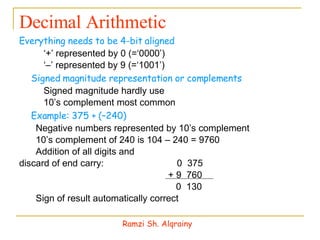
Decimal Arithmetic Everything needs to be 4-bit aligned 􀁹 ‘ +’ represented by 0 (=‘0000’) 􀁹 ‘–’  represented by 9 (=‘1001’) 􀂃  Signed magnitude representation or complements 􀁹  Signed magnitude hardly use 􀁹  10’s complement most common 􀂃  Example: 375 + (–240) 􀁹  Negative numbers represented by 10’s complement  􀁹  10’s complement of 240 is 104 – 240 = 9760 􀁹  Addition of all digits and discard of end carry:  0  375 + 9  760  0  130  􀁹  Sign of result automatically correct Ramzi Sh. Alqrainy
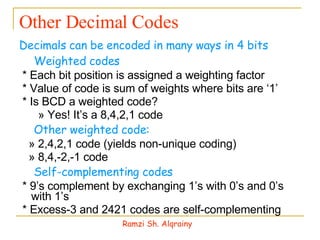
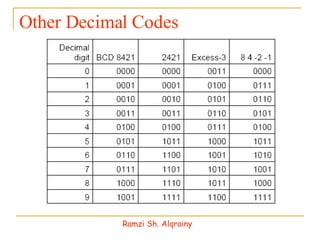
Other Decimal Codes Decimals can be encoded in many ways in 4 bits 􀂃  Weighted codes * Each bit position is assigned a weighting factor * Value of code is sum of weights where bits are ‘1’ * Is BCD a weighted code? » Yes! It’s a 8,4,2,1 code 􀁹  Other weighted code: » 2,4,2,1 code (yields non-unique coding) » 8,4,-2,-1 code 􀂃  Self-complementing codes * 9’s complement by exchanging 1’s with 0’s and 0’s with 1’s * Excess-3 and 2421 codes are self-complementing Ramzi Sh. Alqrainy
Other Decimal Codes Ramzi Sh. Alqrainy
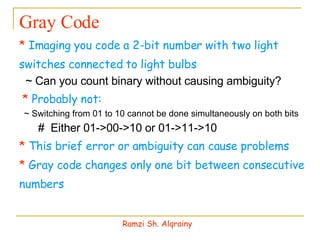
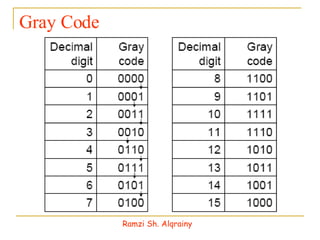
Gray Code *  Imaging you code a 2-bit number with two light switches connected to light bulbs ~ Can you count binary without causing ambiguity? *  Probably not: ~ Switching from 01 to 10 cannot be done simultaneously on both bits #  Either 01->00->10 or 01->11->10 *  This brief error or ambiguity can cause problems *  Gray code changes only one bit between consecutive numbers Ramzi Sh. Alqrainy
Gray Code Ramzi Sh. Alqrainy
 
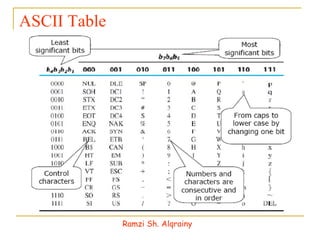
ASCII Table Ramzi Sh. Alqrainy
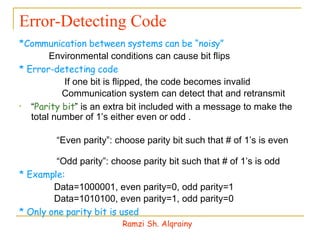
Error-Detecting Code *Communication between systems can be “noisy” 􀁹  Environmental conditions can cause bit flips * Error-detecting code 􀁹  If one bit is flipped, the code becomes invalid 􀁹  Communication system can detect that and retransmit  “ Parity bit ” is an extra bit included with a message to make the total number of 1’s either even or odd . 􀁹 “ Even parity”: choose parity bit such that # of 1’s is even  􀁹 “ Odd parity”: choose parity bit such that # of 1’s is odd * Example: 􀁹  Data=1000001, even parity=0, odd parity=1 􀁹  Data=1010100, even parity=1, odd parity=0 * Only one parity bit is used Ramzi Sh. Alqrainy
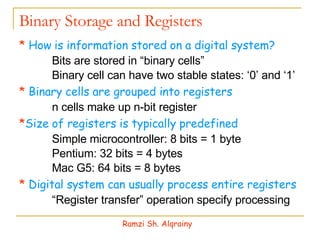
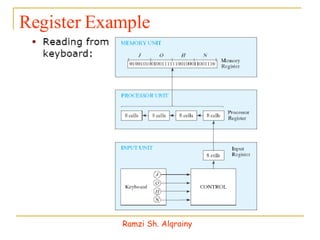
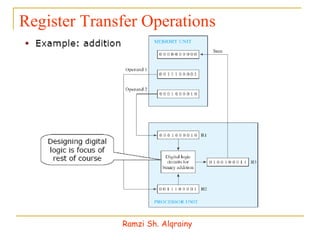
Binary Storage and Registers *   How is information stored on a digital system? 􀁹  Bits are stored in “binary cells”  􀁹  Binary cell can have two stable states: ‘0’ and ‘1’ *  Binary cells are grouped into registers 􀁹  n cells make up n-bit register * Size of registers is typically predefined 􀁹  Simple microcontroller: 8 bits = 1 byte  􀁹  Pentium: 32 bits = 4 bytes 􀁹  Mac G5: 64 bits = 8 bytes *   Digital system can usually process entire registers 􀁹 “ Register transfer” operation specify processing Ramzi Sh. Alqrainy
Register Example Ramzi Sh. Alqrainy
Register Transfer Operations Ramzi Sh. Alqrainy

Digital Logic Rcs

  • 1.
  • 2.
    Digital Systems *Digital systems operate on discrete elements of information # Numbers (e.g., pocket calculator) # Letters (e.g., word processor) # Pictures (e.g., digital cameras) * For a digital systems to operate on a continuous data, it needs to quantize (digitize) that data first # Covert data into digital representation * Digital systems # Cell phone # MP3 music player …. etc # digital camera Ramzi Sh. Alqrainy
  • 3.
    Numbers Each numberis represented by a string of digits , in which the position of each digit has an associated weight . Example: * In general , any decimal number D of the form Has the value Ramzi Sh. Alqrainy
  • 4.
  • 5.
  • 6.
    * What is the range of values of an n -bit number in radix r ? # Minimum value: 0 # Maximum value: r n -1 # Number of different values: r n What is the range of values of an 4 -bit binary number? # Minimum value: 0 # Maximum value: 2 4 -1=15 # Number of different values: 2 4 = 16 ------------------------------------------------------------------------------- What is the range of values of an 2 -bit decimal number? # Minimum value: 0 # Maximum value: 10 2 -1=99 # Number of different values: 10 2 = 100 Ramzi Sh. Alqrainy
  • 7.
  • 8.
  • 9.
    Number Base Conversions* Binary to octal conversion Starting at the binary point and working left, separate the bits into groups of three and replace each group with the corresponding octal digit. (1010011100) 2 =001 010 011 100=(1234) 8 * Binary to hexadecimal separate the bits into groups of four and replace each group with the corresponding hexadecimal digit. (1010011100) 2 = 0010 0100 1100 = (29C) 16 Ramzi Sh. Alqrainy
  • 10.
    * Conversion of fractions Starting at the binary point , group the binary digits that lie to the right into groups of three or four. (0.10111) 2 = 0.101 110 = (0.56) 8 (0.10111) 2 = 0.1011 1000 = (0. B6) 16 * Conversion to binary numbers Replace each octal or hexadecimal digit with the corresponding 3 or 4 bit binary string (2414) 10 =(100101101110) 2 Ramzi Sh. Alqrainy ( 4 5 5 6 ) 8 ( 9 6 E ) 16
  • 11.
  • 12.
  • 13.
  • 14.
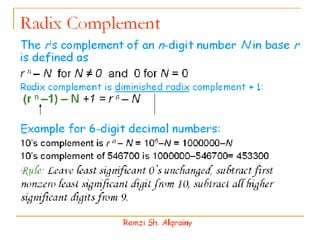
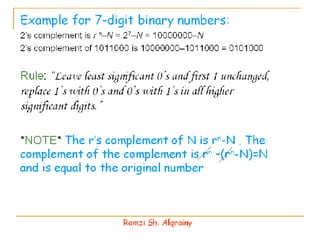
    COMPLEMENT * Complement are used in digital computer for simplifying the subtraction operation. * There are two types of complement for each base-r system: 1- Diminished Radix Complement (r-1)’s 2- Radix Complement r’s # the two types are referred to as the 2’s complement and 1’s complement for binary number. # 10’s complement and 9’s complement for decimal number. Ramzi Sh. Alqrainy
  • 15.
  • 16.
    Observation: * Subtractionfrom ( r n –1) will never require a borrow * Diminished radix complement can be computed digit-by-digit * For binary: 1 – 0 = 1 and 1 – 1 = 0 Ex . The 1’s complement of 1011000 is 0100111 The 1’s complement of 0101101 is 1010010 Ramzi Sh. Alqrainy The 1’s complement of a binary number is formed by changing 1’s to 0’s and 0’s to 1’s
  • 17.
  • 18.
  • 19.
  • 20.
  • 21.
  • 22.
    Signed Numbers withComplements * 3-bit number Ramzi Sh. Alqrainy ---- ---- 100 -4 111 100 101 -3 110 101 110 -2 101 110 111 -1 100 111 ---- -0 000 000 000 0 001 001 001 +1 010 010 010 +2 011 011 011 +3 Signed Magnitude Signed 1's complement Signed 2's complement Decimal
  • 23.
    Signed Numbers Howare signed numbers handled in base 10? ~ Plus or minus sign placed in front of number Can we do that for binary numbers? ~ Sign needs to be represented in digital system ~ Only choice are ‘0’ and ‘1’ # ‘0’ indicates ‘+’ # ‘1’ indicates ‘–’ Examples on five-bit numbers: 01101 11101 00000 10000 + 13 – 13 + 0 – 0 Ramzi Sh. Alqrainy
  • 24.
  • 25.
  • 26.
    BCD Addition Additionis done BCD digit by BCD digit ~ 4 bits at the time Can we use normal binary addition? * Problem : digits adding up to more than 9 ~ Binary addition will result in invalid BCD codes ~ 1010 … 1111 are not valid * Solution: check if resulting value is greater than 9 ~ if so, add 6 ~ 6 will offset the invalid BCD codes and generate the carry Ramzi Sh. Alqrainy
  • 27.
    BCD Addition Example:184 + 576 BCD carry 1 1 0001 1000 0100 184 + 0101 0111 0110 +576 Binary sum 0111 10000 1010 Add 6 0110 0110 BCD sum 0111 0110 0000 760 Ramzi Sh. Alqrainy
  • 28.
    Decimal Arithmetic Everythingneeds to be 4-bit aligned 􀁹 ‘ +’ represented by 0 (=‘0000’) 􀁹 ‘–’ represented by 9 (=‘1001’) 􀂃 Signed magnitude representation or complements 􀁹 Signed magnitude hardly use 􀁹 10’s complement most common 􀂃 Example: 375 + (–240) 􀁹 Negative numbers represented by 10’s complement 􀁹 10’s complement of 240 is 104 – 240 = 9760 􀁹 Addition of all digits and discard of end carry: 0 375 + 9 760 0 130 􀁹 Sign of result automatically correct Ramzi Sh. Alqrainy
  • 29.
    Other Decimal CodesDecimals can be encoded in many ways in 4 bits 􀂃 Weighted codes * Each bit position is assigned a weighting factor * Value of code is sum of weights where bits are ‘1’ * Is BCD a weighted code? » Yes! It’s a 8,4,2,1 code 􀁹 Other weighted code: » 2,4,2,1 code (yields non-unique coding) » 8,4,-2,-1 code 􀂃 Self-complementing codes * 9’s complement by exchanging 1’s with 0’s and 0’s with 1’s * Excess-3 and 2421 codes are self-complementing Ramzi Sh. Alqrainy
  • 30.
    Other Decimal CodesRamzi Sh. Alqrainy
  • 31.
    Gray Code * Imaging you code a 2-bit number with two light switches connected to light bulbs ~ Can you count binary without causing ambiguity? * Probably not: ~ Switching from 01 to 10 cannot be done simultaneously on both bits # Either 01->00->10 or 01->11->10 * This brief error or ambiguity can cause problems * Gray code changes only one bit between consecutive numbers Ramzi Sh. Alqrainy
  • 32.
    Gray Code RamziSh. Alqrainy
  • 33.
  • 34.
    ASCII Table RamziSh. Alqrainy
  • 35.
    Error-Detecting Code *Communicationbetween systems can be “noisy” 􀁹 Environmental conditions can cause bit flips * Error-detecting code 􀁹 If one bit is flipped, the code becomes invalid 􀁹 Communication system can detect that and retransmit “ Parity bit ” is an extra bit included with a message to make the total number of 1’s either even or odd . 􀁹 “ Even parity”: choose parity bit such that # of 1’s is even 􀁹 “ Odd parity”: choose parity bit such that # of 1’s is odd * Example: 􀁹 Data=1000001, even parity=0, odd parity=1 􀁹 Data=1010100, even parity=1, odd parity=0 * Only one parity bit is used Ramzi Sh. Alqrainy
  • 36.
    Binary Storage andRegisters * How is information stored on a digital system? 􀁹 Bits are stored in “binary cells” 􀁹 Binary cell can have two stable states: ‘0’ and ‘1’ * Binary cells are grouped into registers 􀁹 n cells make up n-bit register * Size of registers is typically predefined 􀁹 Simple microcontroller: 8 bits = 1 byte 􀁹 Pentium: 32 bits = 4 bytes 􀁹 Mac G5: 64 bits = 8 bytes * Digital system can usually process entire registers 􀁹 “ Register transfer” operation specify processing Ramzi Sh. Alqrainy
  • 37.
  • 38.
    Register Transfer OperationsRamzi Sh. Alqrainy