1
EE8351 Digital Logic Circuits
Department of EEE
Part - A
Unit - 1
1.Define binary logic?
Binary logic consists of binary variables and logical operations. The variables are designated by the
alphabets such as A, B, C, x, y, z, etc., with each variable having only two distinct values: 1 and 0.
There
are three basic logic operations: AND, OR, and NOT.
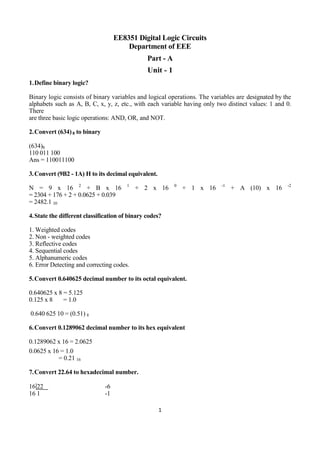
2.Convert (634)8 to binary
(634)8
110 011 100
Ans = 110011100
3.Convert (9B2 - 1A) H to its decimal equivalent.
N = 9 x 16 2
+ B x 16 1
+ 2 x 16 0
+ 1 x 16 -1
+ A (10) x 16 -2
= 2304 + 176 + 2 + 0.0625 + 0.039
= 2482.1 10
4.State the different classification of binary codes?
1. Weighted codes
2. Non - weighted codes
3. Reflective codes
4. Sequential codes
5. Alphanumeric codes
6. Error Detecting and correcting codes.
5.Convert 0.640625 decimal number to its octal equivalent.
0.640625 x 8 = 5.125
0.125 x 8 = 1.0
0.640 625 10 = (0.51) 8
6.Convert 0.1289062 decimal number to its hex equivalent
0.1289062 x 16 = 2.0625
0.0625 x 16 = 1.0
= 0.21 16
7.Convert 22.64 to hexadecimal number.
16 22 -6
16 1 -1
2
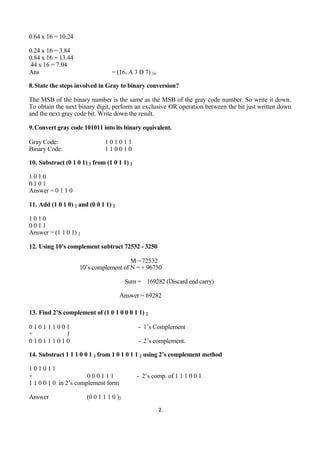
0.64 x 16 = 10.24
0.24 x 16 = 3.84
0.84 x 16 = 13.44
.44 x 16 = 7.04
Ans = (16. A 3 D 7) 16
8.State the steps involved in Gray to binary conversion?
The MSB of the binary number is the same as the MSB of the gray code number. So write it down.
To obtain the next binary digit, perform an exclusive OR operation between the bit just written down
and the next gray code bit. Write down the result.
9.Convert gray code 101011 into its binary equivalent.
Gray Code: 1 0 1 0 1 1
Binary Code: 1 1 0 0 1 0
10. Substract (0 1 0 1) 2 from (1 0 1 1) 2
1 0 1 0
0 1 0 1
Answer = 0 1 1 0
11. Add (1 0 1 0) 2 and (0 0 1 1) 2
1 0 1 0
0 0 1 1
Answer = (1 1 0 1) 2
12. Using 10’s complement subtract 72532 - 3250
M =72532
10’s complement of N = + 96750
Sum = 169282 (Discard end carry)
Answer = 69282
13. Find 2’S complement of (1 0 1 0 0 0 1 1) 2
0 1 0 1 1 1 0 0 1 - 1’s Complement
+ 0 0 0 0 0 0 0 1
0 1 0 1 1 1 0 1 0 - 2’s complement.
14. Substract 1 1 1 0 0 1 2 from 1 0 1 0 1 1 2 using 2’s complement method
1 0 1 0 1 1
+ 0 0 0 1 1 1 - 2’s comp. of 1 1 1 0 0 1
1 1 0 0 1 0 in 2’s complement form
Answer (0 0 1 1 1 0 )2
3
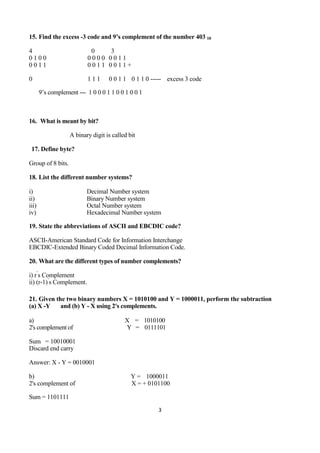
15. Find the excess -3 code and 9’s complement of the number 403 10
4 0 3
0 1 0 0 0 0 0 0 0 0 1 1
0 0 1 1 0 0 1 1 0 0 1 1 +
0 1 1 1 0 0 1 1 0 1 1 0 ----- excess 3 code
9’s complement --- 1 0 0 0 1 1 0 0 1 0 0 1
16. What is meant by bit?
A binary digit is called bit
17. Define byte?
Group of 8 bits.
18. List the different number systems?
i) Decimal Number system
ii) Binary Number system
iii) Octal Number system
iv) Hexadecimal Number system
19. State the abbreviations of ASCII and EBCDIC code?
ASCII-American Standard Code for Information Interchange
EBCDIC-Extended Binary Coded Decimal Information Code.
20. What are the different types of number complements?
i) r’
s Complement
ii) (r-1)’
s Complement.
21. Given the two binary numbers X = 1010100 and Y = 1000011, perform the subtraction
(a) X -Y and (b) Y - X using 2's complements.
a) X = 1010100
2's complement of Y = 0111101
Sum = 10010001
Discard end carry
Answer: X - Y = 0010001
b) Y = 1000011
2's complement of X = + 0101100
Sum = 1101111
4
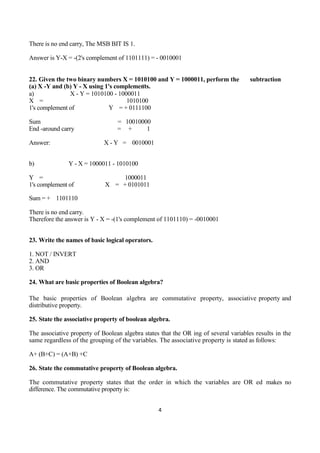
There is no end carry, The MSB BIT IS 1.
Answer is Y-X = -(2's complement of 1101111) = - 0010001
22. Given the two binary numbers X = 1010100 and Y = 1000011, perform the subtraction
(a) X -Y and (b) Y - X using 1's complements.
a) X - Y = 1010100 - 1000011
X = 1010100
1's complement of Y = + 0111100
Sum = 10010000
End -around carry = + 1
Answer: X - Y = 0010001
b) Y - X = 1000011 - 1010100
Y = 1000011
1's complement of X = + 0101011
Sum = + 1101110
There is no end carry.
Therefore the answer is Y - X = -(1's complement of 1101110) = -0010001
23. Write the names of basic logical operators.
1. NOT / INVERT
2. AND
3. OR
24. What are basic properties of Boolean algebra?
The basic properties of Boolean algebra are commutative property, associative property and
distributive property.
25. State the associative property of boolean algebra.
The associative property of Boolean algebra states that the OR ing of several variables results in the
same regardless of the grouping of the variables. The associative property is stated as follows:
A+ (B+C) = (A+B) +C
26. State the commutative property of Boolean algebra.
The commutative property states that the order in which the variables are OR ed makes no
difference. The commutative property is:
5
A+B=B+A
27. State the distributive property of Boolean algebra.
The distributive property states that AND ing several variables and OR ing the result with a single
variable is equivalent to OR ing the single variable with each of the the several variables and then AND
ing the sums. The distributive property is:
A+BC= (A+B) (A+C)
28. State the absorption law of Boolean algebra.
The absorption law of Boolean algebra is given by X+XY=X, X(X+Y) =X. 29) Simplify the following
using De Morgan's theorem [((AB)'C)'' D]'
[((AB)'C)'' D]' = ((AB)'C)'' + D' [(AB)' = A' + B']
= (AB)' C + D'
= (A' + B' )C + D'
29. State De Morgan's theorem.
De Morgan suggested two theorems that form important part of Boolean algebra. They are,
1) The complement of a product is equal to the sum of the complements.
(AB)' = A' + B'
2) The complement of a sum term is equal to the product of the complements.
(A + B)' = A'B'
30. Reduce A.A'C
A.A'C = 0.C [A.A' = 0]
= 0
31. Reduce A(A + B)
A(A + B) = AA + AB
= A(1 + B) [1 + B = 1]
= A.
32. Reduce A'B'C' + A'BC' + A'BC
A'B'C' + A'BC' + A'BC = A'C'(B' + B) + A'B'C
= A'C' + A'BC [A + A' = 1]
= A'(C' + BC)
= A'(C' + B) [A + A'B = A + B]
33. Reduce AB + (AC)' + AB'C(AB + C)
AB + (AC)' + AB'C(AB + C) = AB + (AC)' + AAB'BC + AB'CC
= AB + (AC)' + AB'CC [A.A' = 0]
= AB + (AC)' + AB'C [A.A = 1]
6
= AB + A' + C' =AB'C [(AB)' = A' + B']
= A' + B + C' + AB'C [A + AB' = A + B]
= A' + B'C + B + C' [A + A'B = A + B]
=A'+B+C'+B'C
=A'+B+C'+B'
=A' + C' + 1
= 1 [A + 1 =1]
34. Simplify the following expression Y = (A + B)(A + C' )(B' + C' )
Y = (A + B)(A + C' )(B' + C' )
= (AA' + AC +A'B +BC )(B' + C') [A.A' = 0]
= (AC + A'B + BC)(B' + C' )
= AB'C + ACC' + A'BB' + A'BC' + BB'C + BCC' = AB'C + A'BC'
35. Show that (X + Y' + XY)( X + Y')(X'Y) = 0
(X + Y' + XY)( X + Y')(X'Y) = (X + Y' + X)(X + Y' )(X' + Y) [A + A'B = A + B]
= (X + Y' )(X + Y' )(X'Y) [A + A = 1]
= (X + Y' )(X'Y) [A.A = 1]
= X.X' + Y'.X'.Y
= 0 [A.A' = 0]
36. Prove that ABC + ABC' + AB'C + A'BC = AB + AC + BC
ABC + ABC' + AB'C + A'BC=AB(C + C') + AB'C + A'BC
=AB + AB'C + A'BC
=A(B + B'C) + A'BC
=A(B + C) + A'BC
=AB + AC + A'BC
=B(A+C)+AC
=AB + BC + AC
=AB + AC +BC ...Proved
37. Convert the given expression in canonical SOP form Y = AC + AB + BC
Y = AC + AB + BC
=AC(B + B' ) + AB(C + C' ) + (A + A')BC
=ABC + ABC' + AB'C + AB'C' + ABC + ABC' + ABC
=ABC + ABC' +AB'C + AB'C' [A + A =1]
38. Define duality property.
Duality property states that every algebraic expression deducible from the postulates of Boolean
algebra remains valid if the operators and identity elements are interchanged. If the dual of an
algebraic expression is desired, we simply interchange OR and AND operators and replace 1's by 0's
and 0's by 1's.
39. Find the complement of the functions F1 = x'yz' + x'y'z and F2 = x(y'z' + yz). By
applying De-Morgan's theorem.
F1' = (x'yz' + x'y'z)' = (x'yz')'(x'y'z)' = (x + y' + z)(x + y +z')
7
F2' = [x(y'z' + yz)]' = x' + (y'z' + yz)'
= x' + (y'z')'(yz)'
= x' + (y + z)(y' + z')
40. Simplify the following expression
Y = (A + B) (A = C) (B + C)
= (A A + A C + A B + B C) (B + C) = (A C + A B + B C) (B + C)
= A B C + A C C + A B B + A B C + B B C + B C C = A B C
41. What are the methods adopted to reduce Boolean function?
i) Karnaug map
ii) Tabular method or Quine Mc-Cluskey method
iii) Variable entered map technique.
42. State the limitations of karnaugh map.
i) Generally it is limited to six variable map (i.e) more then six variable involving expression
are not reduced.
ii) The map method is restricted in its capability since they are useful for simplifying only
Boolean expression represented in standard form.
What is a karnaugh map?
A karnaugh map or k map is a pictorial form of truth table, in which the map diagram is made up of
squares, with each squares representing one minterm of the function.
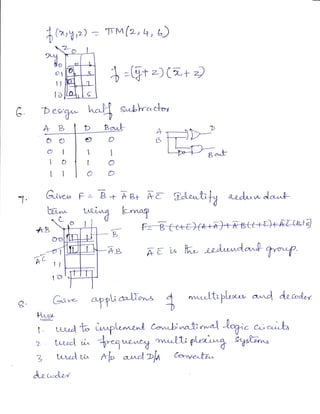
43. Find the minterms of the logical expression Y = A'B'C' + A'B'C + A'BC + ABC'
Y = A'B'C' + A'B'C + A'BC + ABC'
=m0 + m1 +m3 +m6
=∑m(0, 1, 3, 6)
44. Write the maxterms corresponding to the logical expression
Y = (A + B + C' )(A + B' + C')(A' + B' + C)
= (A + B + C' )(A + B' + C')(A' + B' + C) =M1.M3.M6
=π M(1,3,6)
45. What are called don’t care conditions?
In some logic circuits certain input conditions never occur, therefore the corresponding
output never appears. In such cases the output level is not defined, it can be either high or low. These
output levels are indicated by ‘X’ or‘d’ in the truth tables and are called don’t care conditions or
incompletely specified functions.
46. What is a prime implicant?
A prime implicant is a product term obtained by combining the maximum possible number of
adjacent squares in the map.
8
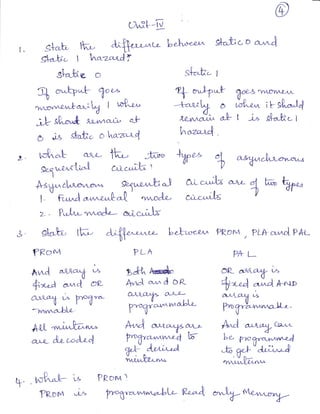
47. What is an essential implicant?
If a min term is covered by only one prime implicant, the prime implicant is said to be essential
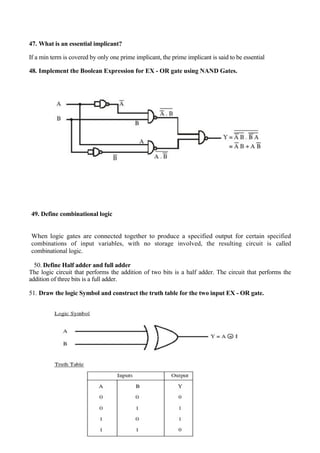
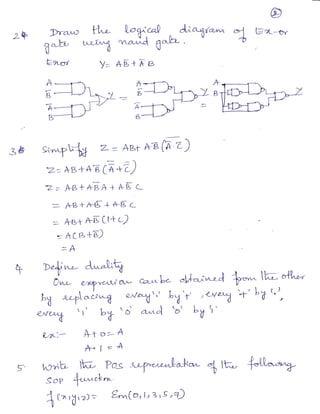
48. Implement the Boolean Expression for EX - OR gate using NAND Gates.
49. Define combinational logic
When logic gates are connected together to produce a specified output for certain specified
combinations of input variables, with no storage involved, the resulting circuit is called
combinational logic.
50. Define Half adder and full adder
The logic circuit that performs the addition of two bits is a half adder. The circuit that performs the
addition of three bits is a full adder.
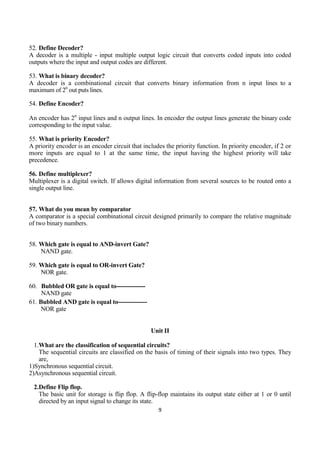
51. Draw the logic Symbol and construct the truth table for the two input EX - OR gate.
9
52. Define Decoder?
A decoder is a multiple - input multiple output logic circuit that converts coded inputs into coded
outputs where the input and output codes are different.
53. What is binary decoder?
A decoder is a combinational circuit that converts binary information from n input lines to a
maximum of 2n
out puts lines.
54. Define Encoder?
An encoder has 2n
input lines and n output lines. In encoder the output lines generate the binary code
corresponding to the input value.
55. What is priority Encoder?
A priority encoder is an encoder circuit that includes the priority function. In priority encoder, if 2 or
more inputs are equal to 1 at the same time, the input having the highest priority will take
precedence.
56. Define multiplexer?
Multiplexer is a digital switch. If allows digital information from several sources to be routed onto a
single output line.
57. What do you mean by comparator
A comparator is a special combinational circuit designed primarily to compare the relative magnitude
of two binary numbers.
58. Which gate is equal to AND-invert Gate?
NAND gate.
59. Which gate is equal to OR-invert Gate?
NOR gate.
60. Bubbled OR gate is equal to--------------
NAND gate
61. Bubbled AND gate is equal to--------------
NOR gate
Unit II
1.What are the classification of sequential circuits?
The sequential circuits are classified on the basis of timing of their signals into two types. They
are,
1)Synchronous sequential circuit.
2)Asynchronous sequential circuit.
2.Define Flip flop.
The basic unit for storage is flip flop. A flip-flop maintains its output state either at 1 or 0 until
directed by an input signal to change its state.
10
3.What are the different types of flip-flop?
There are various types of flip flops. Some of them are mentioned below they are,
RS flip-flop
SR flip-flop
D flip-flop
JK flip-flop
T flip-flop
4.What is the operation of RS flip-flop?
When R input is low and S input is high the Q output of flip-flop is set.
When R input is high and S input is low the Q output of flip-flop is reset.
When both the inputs R and S are low the output does not change
When both the inputs R and S are high the output is unpredictable.
5.What is the operation of SR flip-flop?
When R input is low and S input is high the Q output of flip-flop is set.
When R input is high and S input is low the Q output of flip-flop is reset.
When both the inputs R and S are low the output does not change.
When both the inputs R and S are high the output is unpredictable.
6.What is the operation of D flip-flop?
In D flip-flop during the occurrence of clock pulse if D=1, the output Q is set and if D=0, the
output is reset.
7.What is the operation of JK flip-flop?
When K input is low and J input is high the Q output of flip-flop is set.
When K input is high and J input is low the Q output of flip-flop is reset.
When both the inputs K and J are low the output does not change
When both the inputs K and J are high it is possible to set or reset the flip-flop (ie) the output
toggle on the next positive clock edge.
8.What is the operation of T flip-flop?
T flip-flop is also known as Toggle flip-flop.
When T=0 there is no change in the output.
When T=1 the output switch to the complement state (ie) the output toggles.
9.Define race around condition.
In JK flip-flop output is fed back to the input. Therefore change in the output results change in the
input. Due to this in the positive half of the clock pulse if both J and K are high then output toggles
continuously. This condition is called ‘race around condition’.
10. What is edge-triggered flip-flop?
The problem of race around condition can solved by edge triggering flip flop. The
term edge triggering means that the flip-flop changes state either at the positive edge or
negative edge of the clock pulse and it is sensitive to its inputs only at this transition of the
clock.
11. What is a master-slave flip-flop?
A master-slave flip-flop consists of two flip-flops where one circuit serves as a master and the other
as a slave.
11
12. Define rise time.
The time required to change the voltage level from 10% to 90% is known as rise time(tr).
13. Define fall time.
The time required to change the voltage level from 90% to 10% is known as fall time(tf).
14. Define skew and clock skew.
The phase shift between the rectangular clock waveforms is referred to as skew and the time
delay between the two clock pulses is called clock skew.
15. Define setup time.
The setup time is the minimum time required to maintain a constant voltage levels at the excitation
inputs of the flip-flop device prior to the triggering edge of the clock pulse in order for the levels to
be reliably clocked into the flip flop. It is denoted as tsetup.
16. Define hold time.
The hold time is the minimum time for which the voltage levels at the excitation inputs must
remain constant after the triggering edge of the clock pulse in order for the levels to be reliably
clocked into the flip flop. It is denoted as thold .
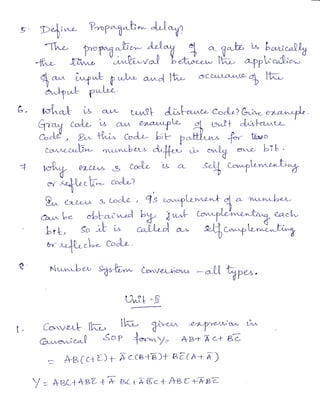
17. Define propagation delay.
A propagation delay is the time required to change the output after the application of the input.
18. Define registers.
A register is a group of flip-flops flip-flop can store one bit information. So an n-bit register has
a group of n flip-flops and is capable of storing any binary information/number containing
n-bits.
19. Explain the flip-flop excitation tables for RS FF.
In RS flip-flop there are four possible transitions from the present state to the next state. They are,
00 transition: This can happen either when R=S=0 or when R=1 and S=0.
01 transition: This can happen only when S=1 and R=0.
10 transition: This can happen only when S=0 and R=1.
11 transition: This can happen either when S=1 and R=0 or S=0 and R=0.
20. Explain the flip-flop excitation tables for JK flip-flop
In JK flip-flop also there are four possible transitions from present state to next state. They are,
00 transition: This can happen when J=0 and K=1 or K=0.
01 transition: This can happen either when J=1 and K=0 or when J=K=1.
10 transition: This can happen either when J=0 and K=1 or when J=K=1.
11 transition: This can happen when K=0 and J=0 or J=1.
21.Explain the flip-flop excitation tables for D flip-flop
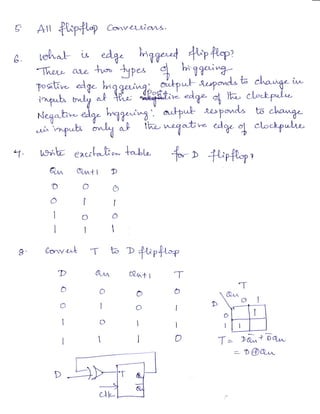
In D flip-flop the next state is always equal to the D input and it is independent of the present
state. Therefore D must be 0 if Qn+1 has to 0,and if Qn+1 has to be 1 regardless the value of Qn.
22.Explain the flip-flop excitation tables for T flip-flop
When input T=1 the state of the flip-flop is complemented; when T=0,the state of the
flip-flop remains unchanged. Therefore, for 00 and 11 transitions T must be 0 and for
12
01 and 10 transitions must be 1.
23.Define sequential circuit?
In sequential circuits the output variables dependent not only on the present input variables but they
also depend up on the past history of these input variables.
24.Give the comparison between combinational circuits and sequential circuits.
Combinational circuits Sequential circuits
Memory unit is not required Memory unity is required
Parallel adder is a combinational circuit Serial adder is a sequential circuit
25.What do you mean by present state?
The information stored in the memory elements at any given time define.s the present state of the
sequential circuit.
26.What do you mean by next state?
The present state and the external inputs determine the outputs and the next state of the sequential
circuit.
27.State the types of sequential circuits?
i.Synchronous sequential circuits
ii.Asynchronous sequential circuits
28.Define synchronous sequential circuit
In synchronous sequential circuits, signals can affect the memory elements only at discrete instant
of time.
29.Define Asynchronous sequential circuit?
In asynchronous sequential circuits change in input signals can affect memory element at
any instant of time.
30.Give the comparison between synchronous & Asynchronous sequential circuits?
Synchronous sequential circuits Asynchronous sequential circuits.
(a) Memory elements are clocked flip-flops Memory elements are either unlocked flip -
flops or time delay elements.
(b) Easier to design More difficult to design
31.Define flip-flop
Flip - flop is a sequential device that normally samples its inputs and changes its outputs only at
times determined by clocking signal.
32.Draw the logic diagram for SR latch using two NOR gates.
13
The following wave forms are applied to the inputs of SR latch. Determine the Q waveform
Assume initially Q = 1
Here the latch input has to be pulsed momentarily to cause a change in the latch
output state, and the output will remain in that new state even after the input pulse is over.
33.What is race around condition?
In the JK latch, the output is feedback to the input, and therefore changes in the output
results change in the input. Due to this in the positive half of the clock pulse if J and K are
both high then output toggles continuously. This condition is known as race around
condition.
34.State the types of counter?
Synchronous counter
Asynchronous Counter
35.Give the comparison between synchronous & Asynchronous counters.
Asynchronous counters
(i) In this type of counter flip-
flops are connected in such a
way that output of 1st
flip-flop
drives the clock for the next
flip-flop.
(ii) All the flip-flops are Not
clocked simultaneously
Synchronous counters
In this type there is no connection
between output of first flip-flop
and clock input of the next flip -
flop
Allthe flip-flopsare clocked
Simultaneously
14
36.The t pd for each flip-flop is 50 ns. Determine the maximum operating frequency for
MOD - 32 ripple counter
f max (ripple) = 5 x 50 ns = 4 MHZ
Unit III
1. What are secondary variables?
-present state variables in asynchronous sequential circuits
2. What are excitation variables?
next state variables in asynchronous sequential circuits
3. What is fundamental mode sequential circuit?
-input variables changes if the circuit is stable -inputs are levels, not pulses
-only one input can change at a given time
4. What are pulse mode circuit?
-inputs are pulses
-width of pulses are long for circuit to respond to the input
-pulse width must not be so long that it is still present after the new state is reached
5. What are the significance of state assignment?
In synchronous circuits-state assignments are made with the objective of circuit reduction
Asynchronous circuits-its objective is to avoid critical races
6. When do race condition occur?
-two or more binary state variables change their value in response to the change in i/p variable
7. What is non critical race?
Final stable state does not depend on the order in which the state variable changes -race
condition is not harmful
8. What is critical race?
Final stable state depends on the order in which the state variable changes -race condition is
harmful
9. When does a cycle occur?
Asynchronous circuit makes a transition through a series of unstable state
10.What are the different techniques used in state assignment?
-shared row state assignment
-one hot state assignment
11.What are the steps for the design of asynchronous sequential circuit?
-construction of primitive flow table reduction of flow table
-state assignment is made
-realization of primitive flow table
12.What is hazard?
Unwanted switching transients
15
13.What is static 1 hazard?
Output goes momentarily 0 when it should remain at 1
14.What is static 0 hazard?
Output goes momentarily 1 when it should remain at 0
15.What is dynamic hazard?
Output changes 3 or more times when it changes from 1 to 0 or 0 to 1
16.What is the cause for essential hazards?
Unequal delays along 2 or more path from same input
17.What is flow table?
State table of an synchronous sequential network
18.What is SM chart?
-Describes the behavior of a state machine
-used in hardware design of digital systems
19.What are the advantages of SM chart?
Easy to understand the operation
Easy to convert to several equivalent forms
20.What is primitive flow chart?
-One stable state per row
21.Define compatibility
States Si and Sj said to be compatible states, if and only if for every input sequence that
affects the two states, the same output sequence, occurs whenever both outputs are
specified and regardless of whether Si on Sj is the initial state.
22.Define merger graph.
The merger graph is defined as follows. It contains the same number of vertices as the state
table contains states. A line drawn between the two state vertices indicates each
compatible state pair. It two states are incompatible no connecting line is drawn.
23.Define incompatibility
The states are said to be incompatible if no line is drawn in between them. If implied states
are incompatible, they are crossed & the corresponding line is ignored.
24.Explain the procedure for state minimization.
i.Partition the states into subsets such that all states in the same subsets are 1 -
equivalent.
ii.Partition the states into subsets such that all states in the same subsets are 2 -
equivalent.
iii. Partition the states into subsets such that all states in the same subsets are 3 -
equivalent.
25.Define state table.
For the design of sequential counters we have to relate present states and next states. The
table, which represents the relationship between present states and next states, is called state
table.
16
26.Define total state
The combination of level signals that appear at the inputs and the outputs of the delays
define what is called the total state of the circuit.
27.What are the steps for the design of asynchronous sequential circuit?
Construction of a primitive flow table from the problem statement.
Primitive flow table is reduced by eliminating redundant states using the state
reduction
28.State assignment is made
The primitive flow table is realized using appropriate logic elements.
29.Define primitive flow table :
It is defined as a flow table which has exactly one stable state for each row in the table. The
design process begins with the construction of primitive flow table.
30.What are the types of asynchronous circuits?
Fundamental mode circuits
Pulse mode circuits
31.Give the comparison between state Assignment Synchronous circuit and state assignment
asynchronous circuit.
In synchronous circuit, the state assignments are made with the objective of circuit
reduction. In asynchronous circuits, the objective of state assignment is to avoid critical races.
32.What are races?
When 2 or more binary state variables change their value in response to a change in
an input variable, race condition occurs in an asynchronous sequential circuit. In case of
unequal delays, a race condition may cause the state variables to change in an unpredictable
manner.
33.Define non critical race.
If the final stable state that the circuit reaches does not depend on the order in which
the state variable changes, the race condition is not harmful and it is called a non critical race.
34.Define critical race?
If the final stable state depends on the order in which the state variable changes, the race
condition is harmful and it is called a critical race.
35.What is a cycle?
A cycle occurs when an asynchronous circuit makes a transition through a series of unstable
states. If a cycle does not contain a stable state, the circuit will go from one unstable to stable
to another, until the inputs are changed.
36.List the different techniques used for state assignment.
Shared row state assignment
One hot state assignment.
37.Write a short note on fundamental mode asynchronous circuit.
Fundamental mode circuit assumes that. The input variables change only when the circuit
is stable. Only one input variable can change at a given time and inputs are levels and not
pulses.
17
38.Write a short note on pulse mode circuit.
Pulse mode circuit assumes that the input variables are pulses instead of level. The width of the
pulses is long enough for the circuit to respond to the input and the pulse width must not be so
long that it is still present after the new state is reached.
39.Define secondary variables
The delay elements provide a short term memory for the sequential circuit. The present
state and next state variables in asynchronous sequential circuits are called secondary
variables.
40.Define flow table in asynchronous sequential circuit.
In asynchronous sequential circuit state table is known as flow table because of the
behaviour of the asynchronous sequential circuit. The stage changes occur in independent of
a clock, based on the logic propagation delay, and cause the states to .flow. from one to
another.
41.What is fundamental mode.
A transition from one stable state to another occurs only in response to a change in the
input state. After a change in one input has occurred, no other change in any input occurs
until the circuit enters a stable state. Such a mode of operation is referred to as a fundamental
mode.
42.Write short note on shared row state assignment.
Races can be avoided by making a proper binary assignment to the state variables.
Here, the state variables are assigned with binary numbers in such a way that only one state
variable can change at any one state variable can change at any one time when a state
transition occurs. To accomplish this, it is necessary that states between which transitions
occur be given adjacent assignments. Two binary are said to be adjacent if they differ in only
one variable.
43.Write short note on one hot state assignment.
The one hot state assignment is another method for finding a race free state
assignment. In this method, only one variable is active or hot for each row in the original
flow table, ie, it requires one state variable for each row of the flow table. Additional row are
introduced to provide single variable changes between internal state transitions.
Unit - IV
1. What is a Logic gate?
Logic gates are the basic elements that make up a digital system. The electronic gate is a circuit that
is able to operate on a number of binary inputs in order to perform a
particular logical function.
2. Give the classification of logic families
Bipolar Unipolar, Saturated Non Saturated PMOS, NMOS, CMOS , RTL Schottky TTL, ECL, DTL,
I2
C and TTL
3. What are the basic digital logic gates?
The three basic logic gates are
a. AND gate
b.OR gate
18
c. NOT gate
4. Which gates are called as the universal gates? What are its advantages?
The NAND and NOR gates are called as the universal gates. These gates are used to
perform any type of logic application.
5. Classify the logic family by operation?
The Bipolar logic family is classified into
saturated logic
Unsaturated logic.
The RTL, DTL, TTL, I2
L, HTL logic comes under the saturated logic family.
The Schottky TTL, and ECL logic comes under the unsaturated logic family.
6. Mention the classification of saturated bipolar logic families.
The bipolar logic family is classified as follows:
RTL- Resistor Transistor Logic
DTL- Diode Transistor logic
I2L- Integrated Injection Logic
TTL- Transistor Transistor Logic
ECL- Emitter Coupled Logic
7. Mention the important characteristics of digital IC’s?
a. Fan out
b.Power dissipation
c. Propagation Delay
d.Noise Margin
e. Fan In
f. Operating temperature
g.Power supply requirements
8. Define Fan-out?
Fan out specifies the number of standard loads that the output of the gate can drive with
out impairment of its normal operation.
9. Define power dissipation?
Power dissipation is measure of power consumed by the gate when fully driven by all its
inputs.
10.What is propagation delay?
Propagation delay is the average transition delay time for the signal to propagate from input
to output when the signals change in value. It is expressed in ns.
11.Define noise margin?
It is the maximum noise voltage added to an input signal of a digital circuit that does not
cause an undesirable change in the circuit output. It is expressed in volts.
12.Define fan in?
Fan in is the number of inputs connected to the gate without any degradation in the
voltage level.
13.What is Operating temperature?
All the gates or semiconductor devices are temperature sensitive in nature. The temperature
19
in which the performance of the IC is effective is called as operating temperature.
Operating temperature of the IC vary from 00
C to 700
c.
14.What is High Threshold Logic?
Some digital circuits operate in environments, which produce very high noise signals.
For operation in such surroundings there is available a type of DTL gate which possesses a
high threshold to noise immunity. This type of gate is called HTL logic or High
Threshold
Logic.
15.What are the types of TTL logic?
Open collector output
Totem-Pole Output
Tri-state output.
16. Why totem pole outputs cannot be connected together.
Totem pole outputs cannot be connected together because such a connection might
produce excessive current and may result in damage to the devices.
17.State advantages and disadvantages of TTL
Advantages:
a. Easily compatible with other ICs Low output impedance
Disadvanges:
b.Wired output capability is possible only with tristate and open collector types Special circuits
in Circuit layout and system design are required.
18.When does the noise margin allow digital circuits to function properly.
When noise voltages are within the limits of VNA(High State Noise Margin) and VNK for a
particular logic family.
19. What happens to output when a tristate circuit is selected for high impedance.
Output is disconnected from rest of the circuits by internal circuitry.
20.List basic types of programmable logic devices.
. Read only memory
. Programmable logic Array
. Programmable Array Logic
21.Define ROM
Read only memory is a device that includes both the decoder and the OR gates within a single IC
package.
22.Define address and word:
In a ROM, each bit combination of the input variable is called on address. Each bit combination that
comes out of the output lines is called a word.
23.State the types of ROM
. Masked ROM.
. Programmable Read only Memory
. Erasable Programmable Read only memory.
. Electrically Erasable Programmable Read only Memory.
24.What is programmable logic array? How it differs from ROM?
20
In some cases the number of don’t care conditions is excessive, it is more economical to use a second
type of LSI component called a PLA. A PLA is similar to a ROM in concept; however it does not
provide full decoding of the variables and does not generates all the minterms as in the ROM.
25.Explain ROM
A read only memory(ROM) is a device that includes both the decoder and the OR gates within
a single IC package. It consists of n input lines and m output lines. Each bit combination of the
input variables is called an address. Each bit combination that comes out of the output lines is
called a word. The number of distinct addresses possible with n input variables is 2n
.
26.What are the types of ROM?
1.PROM
2.EPROM
3 EEPROM
27.Explain PROM.
PROM (Programmable Read Only Memory)
It allows user to store data or program. PROMs use the fuses with material like nichrome and
polycrystalline. The user can blow these fuses by passing around 20 to 50 mA of current for the
period 5 to 20µs.The blowing of fuses is called programming of ROM. The PROMs are one time
programmable. Once programmed, the information is stored permanent.
28.Explain EPROM.
EPROM(Erasable Programmable Read Only Memory)
EPROM use MOS circuitry. They store 1’s and 0’s as a packet of charge in a buried layer of the IC
chip. We can erase the stored data in the EPROMs by exposing the chip to ultraviolet light via its
quartz window for 15 to 20 minutes. It is not possible to erase selective information. The chip
can be reprogrammed.
29.Explain EEPROM.
EEPROM(Electrically Erasable Programmable Read Only Memory)
EEPROM also use MOS circuitry. Data is stored as charge or no charge on an insulated layer or an
insulated floating gate in the device. EEPROM allows selective erasing at the register level rather
than erasing all the information since the information can be changed by using electrical signals.
30.What is RAM?
Random Access Memory. Read and write operations can be carried out.
31.Define ROM
A read only memory is a device that includes both the decoder and the OR gates within a single IC
package.
32.Define address and word:
In a ROM, each bit combination of the input variable is called on address. Each bit combination that
comes out of the output lines is called a word.
33.What are the types of ROM.
1. Masked ROM.
2. Programmable Read only Memory
3. Erasable Programmable Read only memory.
4. Electrically Erasable Programmable Read only Memory.
34.What is programmable logic array? How it differs from ROM?
21
In some cases the number of don’t care conditions is excessive, it is more economical to use a second
type of LSI component called a PLA. A PLA is similar to a ROM in concept; however it does not
provide full decoding of the variables and does not generates all the minterms as in the ROM.
35.What is mask - programmable?
With a mask programmable PLA, the user must submit a PLA program table to the manufacturer.
36.What is field programmable logic array?
The second type of PLA is called a field programmable logic array. The user by means of certain
recommended procedures can program the EPLA.
List the major differences between PLA and PAL
PLA
Both AND and OR arrays are programmable and Complex Costlier than PAL
PAL
AND arrays are programmable OR arrays are fixed Cheaper and Simpler
37.Define PLD.
Programmable Logic Devices consist of a large array of AND gates and OR gates that can be
programmed to achieve specific logic functions.
38.Give the classification of PLDs.
PLDs are classified as PROM(Programmable Read Only Memory), Programmable Logic
Array(PLA), Programmable Array Logic (PAL), and Generic Array Logic(GAL)
39.Define PROM.
PROM is Programmable Read Only Memory. It consists of a set of fixed AND gates connected to a
decoder and a programmable OR array.
40.Define PLA
PLA is Programmable Logic Array(PLA). The PLA is a PLD that consists of a programmable
AND array and a programmable OR array.
41.Define PAL
PAL is Programmable Array Logic. PAL consists of a programmable AND array and a fixed OR array
with output logic.
42.Why was PAL developed ?
It is a PLD that was developed to overcome certain disadvantages of PLA, such as longer delays due
to additional fusible links that result from using two programmable arrays and more circuit complexity.
43.Define bit, byte and word.
The smallest unit of binary data is bit. Data are handled in a 8 bit unit called byte. A complete unit of
information is called a word which consists of one or more bytes.
44.How many words can a 16x8 memory can store ?
A 16x8 memory can store 16,384 words of eight bits each
45.Define address of a memory.
The location of a unit of data in a memory is called address.
46.Define Capacity of a memory.
It is the total number of data units that can be stored.
22
47.What is Read and Write operation ?
The Write operation stores data into a specified address into the memory and the Read operation takes
data out of a specified address in the memory.
48.Why RAMs are called as Volatile ?
RAMs are called as Volatile memories because RAMs lose stored data when the power is turned
OFF.
49.Define ROM.
ROM is a type of memory in which data are stored permanently or semi permanently. Data can be
read from a ROM, but there is no write operation
50.Define RAM.
RAM is Random Access Memory. It is a random access read/write memory. The data can be read or
written into from any selected address in any sequence.
51.List the two categories of RAMs.
The two categories of RAMs are static RAM(SRAM) and dynamic RAM (DRAM).
52.List the basic types of DRAMs
Fast Page Mode DRAM,Extended Data Out DRAM(EDO DRAM),Burst EDO DRAM and
Synchronous DRAM.
53.Define a bus
A bus is a set of conductive paths that serve to interconnect two or more functional components of a
system or several diverse systems.
54.Define Cache memory
It is a relatively small, high-speed memory that can store the most recently used instructions or
data from larger but slower main memory.
55.List basic types of programmable logic devices.
1. Read only memory
2. Programmable logic Array
3. Programmable Array Logic
56.Define ROM
A read only memory is a device that includes both the decoder and the OR gates within a single
IC package.
57.What is programmable logic array? How it differs from ROM?
In some cases the number of don’t care conditions is excessive, it is more economical to use a second
type of LSI component called a PLA. A PLA is similar to a ROM in concept; however it does not
provide full decoding of the variables and does not generates all the minterms as in the ROM.
58.What is mask - programmable?
With a mask programmable PLA, the user must submit a PLA PLA program table to the manufacturer.
59.Give the comparison between PROM and PLA.
PROM PLA
1. And array is fixed and OR Both AND and OR arrays are
23
array is programmable. Programmable.
2. Cheaper and simple to use. Costliest and complex than
PROMS.
Unit V
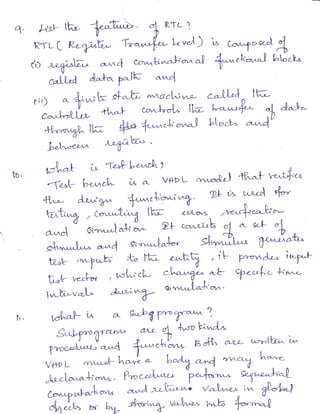
1. Define HDL
Hardware Description Language which is used for system level design. HDL’s were used for
simulation of system boards, interconnect buses etc., It is a common approach is to design each IC
chip using HDL and then verify system functionality via simulation.
2. Compare traditional Vs HDL schematic based design
In HDL designs can be described at a every abstract and the functional verification of the design can
be done early in the design cycle. HDL’s are now the dominant method for large digital designs.
3. What are the two components of simulation?
A design block and stimulus block
4. State the levels in Verilog HDL.
Behavioral level
Data flow level
Gate level
Switch level
5. What are data types in VHDL?
The data types are nets, registers, vectors, numbers, simulation time, arrays, parameters ,memories
and strings.
6. What are lexical conventions used by VHDL?
Lexical conventions are tokens; they are comments, delimiters, numbers, strings, identifiers and
keywords
7. What is the use of conditional operator?
It behaves like a multiplexer in hardware or like the if-then-else statement in programming
languages
8. What are compiler directive?
Compiler directive is used to define text macros and include is used to include other Verilog files.
9. Define Module definition
Module definitions contain various components. Keywords module and end module are mandatory.
Others components are port list, port declarations, data flow statements, behavioral blocks, lower
level module instantiations and tasks or functions are optimal and can be added as needed.
10.List the uses of ports.
A port provides the module with a means to communicate with other modules or its environment. A
module can have a port list. Ports in the port list must be declared as input, output or inout.
11.State the different types of delays associated with gates.
The delays are rise, fall and turn-off.
Values of rise, fall and turn-off delays are computed by verilog based on the one, two or three delays
specified.
12.What are the various operators used in Verilog?
24
The operators are Arithmetic, Logical, Relations, Equality, Bitwise, Reduction , Shift,
Concatenation, Replication and Conditional operators
13.What is behavioral description?
In expresses a digital circuit in terms of the algorithms it implements. It does not include the
hardware implementation details. It is used to evaluate various – related
14.Define procedural assignments
Procedural assignments are used in behavioral modeling to assign values to register variables
15.Differentiate Tasks and Functions
A function can enable another function but not another task. A task can enable other tasks and
functions.
16.What are constant functions?
A constant function is a regular Verilog HDL function which can be used to reference complex
values and can be used instead of constants
17.Define Recursive functions
Recursive functions defined with the keyword automatic allow each function acall to operate in an
independent space.
18.State the behavioral or algorithmic level Verilog HDL
It is the highest level of abstraction which implements the desired algorithm without concern for the
hardware implementation details.
19.Define data flow level
It is designed by specifying the data flow that is how the data is processed in the design
20.Define gate level
It is designed in terms of logic gates and interconnections between these gates
21.Define Switch level
This is the lowest level abstraction which can be implemented in terms of switches, storage nodes
and the interconnection between them.
22.Define instantiation
This is the process of creating the objects from the module template
23.Define test – bench
It is called as stimulus block which can be used to thoroughly test the design block
24.What are numbers specifications?
Number specifications are sized and unsized
25.What are escaped identifiers?
It begins with backslash() character and end with white space. Ex: a + b
o
t.
o
9
E76zol -DfflU l-rff. C>riB
P^"L=A
U'"-,. [- e
Cunv Q"* _tt^{-
ft"T uA-z
lrtk*f brwar,l c"Au i',^1, a-
1 g r o I I I ao>q
l+Otttq tldtot*D
Yu I I t o D I 0o
A3 cn-l-,-io ltll looloo
l4: ,y:*tr'Jrr*-,u o)^+ic. q^b.
#; t lh-- 'rqa^)J"^
"vLL,^Le')
tl a#*'g"ffii,ffi*#T*-"0
sp.-fl.J -ir:,,dlz
3,v..-f ,^-^R, to f-^^ y"t," o.'.tP*tr' *^^J effu CA)--,-br
o.Jt*-fl
"I-dh.*^ p rV epe*^ ..t{""l;v
I ,+.^L *ft V6+ eil?*L *fi--""fut
p*Il"f .^""4
tf"ll ip^rt- *-*"? p*J-l ,],.-o'. rr-^^^r"t'{
lTe--)^Alqfu
Xare
s,q*ry ry.*a'u*r-'$* ffi eP**A t^
lF. Giu<. -t-* **^^^fW fu k-...S't"lA"I coA,^t
gqil, 2-,;2-t ; "x^^1'^
"
4- u^*"^5't^D2"l d'' '
s' D$r^"- ?*P^foh^* -t"l 1
4 ^* *r* u-x^' a-^"-) lfr-
e'+*l- t
Qr^A cil.t- u a^^ a+aLMfV
c"Jrl , 4ru tgil^ C,,A!-- b t- b
Cr"t';.-iltli,}o- *^r^^L"^o Cr#.",
VIU^L W-cu, 3 C*A- tr a''
(
*)*W.k-* a,J.,-t
l),
6. ,rt"*,L U qj^- u;n-?l- J-.-,,!-^^^c. c-oA-ni G.iv.-
L?ri L A*la^ to-
'TVr- p'o ?"ff^-W?-
AoJ.oo "1 a- q^k- Ls b" ;*l-17
i3.- -Wr,/, *' u
u^yru.'r^l LR*;-IHI ^frLt"ol;r-*
"jilil^L {-. 6po
o^.-e- tt U "-"lt
S.l-,1
n
C-^*yl""*r"tL*q
Nur--nn-Je-t, r,AA-Y*r" ,.-o,rv<.t*L3w^
- *1.)
)puu.
r.) ol fi)
"5b'i
[ . g*,'t1le.rL lk- I'-- ?"* Q4J'Y€-)'";*-
G.-ro*;cA So P {"'-"y= A:p + F c-+ e-c
= #ACct L) f FccB+E)f BErr'+ * )
,/ = #ec+ *sL-rF e,LIFtsc-+AB c+-RBz
c,CCI*:.,o,-t",tA a lt -
&
8^^ €-x-c-t-,t> g wAl' "
&.p-V<- tLV*'*;
Lr L, 9o ;L i'
s-
^.4{l-.."*-
C"J-. "
bd, ) u"+ o?
?o
I
a_ lwt^zq--be-L,
e
)b.z-l
3b
}"=uuo Y"'-
fl^-t?,
o*^,^1
Ex* y=
s,nnf U-1# z- = ABt lrE 6tS
z=+B + AE S'x +=.)
7-=.hB+A-BA+ #6 c-
=- ,{-a+ Ate Ct+ u)
= ACB+6)
n
-f
D"d. w--. ,^&q
C^-- n or*"u^- c^'^V 4+*J*-tJ
t.d *ra&""?**"' L?'.' )<NP^l
<N'e:.,,+ t l' by t j n^"A tot l'V tl '
((
Q-r'*"- St o >- A
N[=A
Lo*d A;ooor*^n
*^JC fl,-h-
+E+ F e
@
*-l Ezt--w
n
;
+.* 1[ b+".'
+' t tr
,.',,
t&iz h" Po-s
S or +.-"l "''
tuf-",^).*-{i*- $lk- +Jl^,-?
A
B
T.
g'
A
g
?
15*
4," tfltD': g*^Co, ttZts 't)
{ t" tiil = Ti-M (Y, 4, a)
2-
6
%o1
rI
I}
.l =t?* =) (r. t ,
'b e-*'Vo^- k"f4 e*i o.-t{-'
P - E + Fst P'c- E&r^b,h tlA,,* Jo*"L-T" (9Lr-,<.4^
l-
t1r,v^
C
+rB
I
-kc rl
to
/^
lztive
w
I ur-ra -f,
z . ti-i"d u^
Z t,.x"A ui"
A-zc*As./
Lr"".?
+,
k-
g
Te
g.
lfurr^-L^^Q-
"ftU
a,Jf",*
4
**^JttPLox-uo d*4 &a
;"^pt{"*r^} c^r-^L}^^} .^-d "lT. a; r-^L^
**^Jtt pLo*"o ^^a &p-d"rr
eo
l
IO
OO
Nb ^^rX
>fa c."'/e.-bL"
A
b
{. Gn"-r- IL,
La,AV cl
I
U"?U-g'---
,r^^&u;*b-
9p- fi -f-f tt p
eq--t-tt0
@
e<voflio.* ^-r^.)
c-1,^ooa&ur..lr.
)
$*^"-^"h^i L..- 7v'-b*^
of,[Ltr) -- S+E o'tt)
O
I
o
1
,o
l
O
I
e
O
O
o
t
t
I
I
o
0
I
-ri^JP-tr^***-b-
9"+*k dra^"#^ A**
tr ^4t"*
ofb-,I?*t
W?r..-L L fffi A^a^.A^cI t^^ Rs liupp*n
W Rs #^ft-t"f ,re** bA|"- 1'-f"-lr a-,,--e:.
l, or^}p"I ., i*N'
'
,rUoJ- L^ 4-Y- a)x;f&',
1.,^
gVM a:*;V,tar'*r^b 16 -'";tr**? b''^- l 'td^"o
{" "^;* d*"-
14'D e')
fu '?h *4 "L ; a-
J.^r^.-b ^,- A Y""^"--V
aeML" e+
r'^ g^)"*'wt"AJ
dxt'-[t,*L & & +'*'i;^^*-.t
r>, a)a,^] d'ild"" *J
L ?-'"'^Y
t'^fJ'
v^,+.x
Iffi;T,4{"+ ,8. o- 4
+U- oit//ut't''-'
'
3'
t"
A1 i #^f*try C-Pr"v e:'xtr o/L^'
e. t"|,,""f i3 ,+ Vt a 'r'^P *lpz
-Iv,!^* ax,.- -lv,""lp..-,L 4 Lt?W^*:. ,
joaf,,-, A3- VZW*ry;-"*T+{
-tus?,w**,* (
i*?*h*k^1 ffi^@Lrf;ff;ffi*
Nte?^h""-
"XT
l,o3y",5
"'
@"+"-L *4)T*"Ao tr **
*",*f& "^UU ^l iba-5*t"' dWl cl-'hf ,-Lil-
1. U:-k erut-r.fi,*, l+U $,- o 4brlt^y,
.T
&/-
-r
c
I
I
c
p
e
I
o
t
o
I
q/^
0
O
I
L
D
L)
O
I
I
8'
Q",rn-f t
O
I
eo^v-et T Y" D{tlrflr+,
c9-u.t t
a
O
1
I
E-,tn
O
I
D
 T =- lil*+ B-q^-
- fi@A-^r.-
ol
o
I
I
I
ut^;t-E
S+c.,Xr, |ft* J^&""-*t-
-do.-h., I Vc:?-a AT
SI=rt e. o
4 CI*h*tr T*
* gL"..r& ts-)^^ari'^ 4$
e 'Ls s{-ho o Vezs-L{
p.!f.r-L oxz-- jk- frr,r
ggq
"-?,,."tt--[ &ie^*-t5 1
I
A4-q*"d"^r*-^^ k{t,,.a-^^h J
I
v
R.*J *^"a-Lo-Q.
' ,*aAp--
qde4'wl,owr{-t -
(/
r"aLp^,r 'ts glt J"l
I j-b gLalc I
L r)^rr"rr^ sl.t.c o *^"d
t.
S+..h- I
9+- *.[p*-L
--La,$V o
4_
e-uvtr:,,-^ 6L
h"zrd
9-
3-
+H?u'
%
a,v{^a^AnYnwa
&L c;12 a-^/-- ol k* b
cr**;)E
^'x-'
1
r''^,D
wru
S+.,k, tfi.-- A;W*r^"t - b*r*rz^^ FRorur , PL;1*^{PAL
FRona
Awd 6tAa^-t ;
$x*a *-.1 ffi-
^{ft; Y',T*
-Yvlrr*o'-bV'
.*{.1- .v.^L^b^^r,
a^-l- &x-c*Md
L.+.^t- .s
?trOf"t -tz5
PLA
gdPt^ @
A.,,A o-^".d oR
*^r.fr a-x-s'
p-*g#r*wabb
.A.,,.n *^fi*
P"yorr^'vwQ-4 tF-
fr"|YWx*ffit*v*
PRont l
f^tr*wdrW R"-^A
P# [-
OR- as8-ar+ U
+*,-) -ld A-{D
*JLLg-Lt 
P^qt!--.,
'U
A^A ard*&-.LA
be- P^xe fiael^/trrta)
h c,j-"J*-lr*-J
*^-,Y"tart^"
-"I7.-, W^^r.y.-
.k^r^^e g "^'-''n*bT,.4
cvrrpt r.,Le,r- 4. -"[P "-[-
u ^14
@,.*+ bk"^^^ +-*^:'"'
?* w-o-" a- Art r,{'---t- tF
-$".*
i+u-' ro'6 Jz ^'^)
1*b"
-,,-r p*[- *f"'u.al
"-"^e
rnl-
I
;*A U5 "rYflL4t'L'4-Ye
Arr-coA- .-t-'t '"n'-^'z^"-
Y*T*vv'il-lt-
SR*
Y4?t'r I
k.,irJ
s- c-*^^-f a'a2 4*'-?^f'
Full"- "t^tA-
'Ci)-c-IL-^-^ T '
I t'"^F--lfc{i-'Ld dJ'/v
=11"- i.*ftr.L Ya,r- o*U-'t'
d"d ^ff- o"'t* d""^
t-t^z- c''xu^L
(
Lt gU'LbL'
"*t
o"4- i"^f* ca'-rx
d,a,^f ''Fo
t^*-
&^.h--b a'2-2- )e-/&4
eA .,"-t- d'""
}...^*c bl""A- e3" ^ 1 Pla
ntt^oA* cn-";-lt ^*d
P,ild-Q,
fL-r-J+' -{ th" pwl^"' *
^n
g r^*& +"- IF'-
;,{;t t- L-'P''^J 6-1'
a""*--;)* W- [f.'
--"; L*.r^J 6-lk-
t -^4"-E
[ "'
'*-[d
]-# o Qi]'L^2
V"Y't-' *Vr
u@,,.-4'"o*cy^p{ f.rn1u-H; wo-^'
b1&uk fa-"-'tr dJ&6 u'e-P- fA"'^
i")"-A oVvd>
6
rlr +fDci"i-C.L{tulhvt
+1p h",-"?
:-l * r"rt,^-U aq.-a-- llL
eLilV^r^-u*,
tir C^*-"A A'vo d*f- *yY"u^I
Ct) O^- t"r{' il"*k- *ff'r*/*}'
8 " r-?..J- a-arz- rdLcr-& )
h#,'2^ dr" cr(- ^^flx- 9+r)g, vax-'a)-llA
d^fl*Ar* ,u-r*l,roAn
I d-b@
@""-- *l
tr-."1,S{*-b- utolU.
VA*^-r- ,l^" A.t:lotts* t, Ct^a""
41tu{ drls / v^c-(- e-^Aj}*^ ,"ff^ ."
t^-*o1"^l dA^^tr , ik *^r't Car^A-z-
k ,V"^f -r-i" crJU tt'^"yr-A^c)-^LA
,)raCt: a,^t- q
n
l,-" r-
C{ib cAyau'. Ik-^+ ^"-l d-Ju "4*-lz A-f
"A^C{ib c;lya(z'^ 4 |k-^'tr-:r"af ila}V s-e=W, drf -
6r, lt^:f arr')-rrt t't( uuY" d,- 11,6, s|.,e vaila-Llk-
c-fvi1-LyLO-t
1
d""^"tr, . lt- cwa. Cs- C^rt,r-Ji h -^ L ttea^r+4^I , .rt- .-s
CrU a) cr.'-, h c-.) Ya' ct' '
Var,.,t ila-
Crn C. il,
ur^J.-.At -,
Vr*^^il€r^-b
A ora a^^^t
r^,,or^* Qr,rttC T a'c-o.i
%lk- 1-{--f
gf."bL.-"*=.}., A,,*
^*
AA e,^A.o en^ lhr- orA-ro eL^ uo],; 21* Ik- g+*-Pd
d@"**f , ltro- )e-cz-'t's rytg,Y b.o*^^.$..i- "
1,of"-* L4 a-
%'1"2
A Cyc,t- oc.):,'-e *'?^t-- a',"#^o)'^xpvturL
rvoka/> r.t- )"il'/wih^^ *9'*-*-^6'[^ o u g€'-t]
+
?r^Lvz '
uot..--l' o.t,a.- V"r^^an
l*qz-^A* cisLe LLLilrea^^-MA -gr"aF-).;?
1ru ^fF* ^+ lt=*- oAT,+-
ILe-c^u"-
I ItL pro ?nJ'.,,- )A^f
)o"
,rY!1
r. hdt*l- tt v1;D L 1
.V *e t-- ,r^r& 1n,.'34" 4,"A W?-^-E3 e-t c';]'
l;*../ v)o*-o- 'beo*pi*- )*"V7"* ik .s *4
-16 Mrufuu &tfU e*o^ila Ln k^l Po''nu-
Dtfl ; &; *il*
-
c# L' s''rM)Ae'A *"5'/++oL'
b?'"A ef."^'V", RJ^A"'"^i
"*+
' 'NtL""-"-b.
,f;^It^ a^^-J c-"..-F,,.n.-I* '1'*t+-'
Lol^^tr L^ o ?n"h-^tr
dL" v++ PL
i 7^cka,y-U ^c-l'l,ufr*'4 A-+"bf1el,
,*l-*r^,b' ,
'C.r,',-t'<-"t
"b , +*A'* a^d f'oo
Yrd
6"ul.'ur-t^ , f"D clAlr-),a-
A,-t-t"-^"-$'oA^ '
tol.aJ. at-a- tk-- n'-x-[ c^/-^ .n"l'c,
.l+p r-
Je"}'-, 1,w" d^
$.-l- {-t-'-
>r)"avi rrA
9+*^c+."'^-a.,1
o
,.
A
q
P. l'
,.
f)
keaib th- LJ.-vro-o) """"odJ I
D dtrfkg:
J5loyaan i <-e2-',
l^t.t- i.e--e--o-. sH *VT.- Tl t q,"LU
€^.trtT DFF u,s
Pa+C D, t)L, ru** I Li^ gpl-V.,"
)
cr,.'ilc,'* s+d-€,
<-r.A DF€
atc0;t= &5^. t.l.-^,orr,-r-*.1 cyf pFF u
Leq;^ )
P'rt, er*o L dV
L<a*;
'rl" gn;y.'t' +f,,^
'*.= o
d,,*$ edlc=r)pr_._nd
ruQc=D)
.*.a {,
L
"1-
v ,^l.,, +r-* *,.oAn-l a# c*LLe-g [.-*, fa e^"rc;]
*fr^"aL +-- ?r-,"" 1t{" }Y'e b lk -""}""}-
-Tl^,a-
^'i-PS
sl-,tz '*{-'}5 cvutL . "^-A h'
At,- ciV<- 'u* ap<-^'c-b""^^
% lk-,. c'ic,;L oL^*e*
A.d tu. t[,- Y*T-^-*-
Lc* [z v.i+D L cnA,(- +* 2X I rr,ur-r-x
'{ :-3c'* sg(
)^bx*"rl i e-oz ;
r^^-r- i e;. r4-l-L6'.
-r I 6q . *-t {;
e-.fi-tr1 l"-u_,t)L t
0
P""t- Lsrf , ,T, : & sl-d -tr b. )
Y: c'** sH-bf)
€*d rrrtur j
a "t.;
b..l^^. "^&,*y,,a,qx-
t-4
b"o.*
Yu.= (q^,,+ s) a''d %
+ S arxd2, )
I
e,VC )
sf*h. ril- -- v"^Ii"4i 4 , paoVaXt- A'4""-*"*
Sre.,", C*Ia-^^b A''-dc.-La-|-.''or"n 2
A oar*.q q/-, .^r & c*W*A"ev- 4. d+^& YA'A gc.r-ha
f- "^J & cxyr-,d.'"c7v- 4. aax-a't*Vry^
rr ^- " ,L,,^ I= C rnzr.r-D ."t^k , &!^"4-^,^. *^^--f
r--
'h-^b , c-ovuuP *nP-^k '+hqq4^J Cp,,q_1,@wv , , | ''l*-'
U A I-^ I"-^. A f rn,t-rf:o
*.
C-a,txp*A"^L b t
I n F l-.
q' A'gt-
Rrl f
ei) errX re, ^ ^-td ,,T''*h^oI'"'"
-l
""!-t"d
AJ-. p*-Ik "'^A
eti) ^'#*,--Lz
s*^b {"}^Aa"WA-e'
.l+"%l^ ll,G ry +"^""h,*'j
-t-
bA-**'^ "'tr'LU'
'
*,L-r L, -(*L*"^&t I
r.--.L v*nis.u^
<* bunJ- .& a- v+t+L
^o-AJ
+
+t^-.- A.!^f Xr^ +a.I'5r"ta'*?
2t t4 L^"d 4-'
@t*? .,;^"!* lh.,-' ;-*" ,@atT
a^^d ei.^,
^-)"$; D* '-^'*V I a'- %f +
*h*rrJ-, o'^xQ g'.""*J
^l-" Sl #)'* A.^^"h^
bk ry*jr fu lE "t? , i[- Pk'^ )e^ i^f*
T,* v.J-, , t^-{^^'c-l.- C,|'.-**, * ff<-ul'. .|.'r"^*-
r^.f-v ^^
A.-,;^? eiryuaJ,.-I o!^'
c-.J")."A lf'-
'-^ '4"* -1 .[J*-
bLo& --^AT
b0.

EE8351 DLC

  • 1.
    1 EE8351 Digital LogicCircuits Department of EEE Part - A Unit - 1 1.Define binary logic? Binary logic consists of binary variables and logical operations. The variables are designated by the alphabets such as A, B, C, x, y, z, etc., with each variable having only two distinct values: 1 and 0. There are three basic logic operations: AND, OR, and NOT. 2.Convert (634)8 to binary (634)8 110 011 100 Ans = 110011100 3.Convert (9B2 - 1A) H to its decimal equivalent. N = 9 x 16 2 + B x 16 1 + 2 x 16 0 + 1 x 16 -1 + A (10) x 16 -2 = 2304 + 176 + 2 + 0.0625 + 0.039 = 2482.1 10 4.State the different classification of binary codes? 1. Weighted codes 2. Non - weighted codes 3. Reflective codes 4. Sequential codes 5. Alphanumeric codes 6. Error Detecting and correcting codes. 5.Convert 0.640625 decimal number to its octal equivalent. 0.640625 x 8 = 5.125 0.125 x 8 = 1.0 0.640 625 10 = (0.51) 8 6.Convert 0.1289062 decimal number to its hex equivalent 0.1289062 x 16 = 2.0625 0.0625 x 16 = 1.0 = 0.21 16 7.Convert 22.64 to hexadecimal number. 16 22 -6 16 1 -1
  • 2.
    2 0.64 x 16= 10.24 0.24 x 16 = 3.84 0.84 x 16 = 13.44 .44 x 16 = 7.04 Ans = (16. A 3 D 7) 16 8.State the steps involved in Gray to binary conversion? The MSB of the binary number is the same as the MSB of the gray code number. So write it down. To obtain the next binary digit, perform an exclusive OR operation between the bit just written down and the next gray code bit. Write down the result. 9.Convert gray code 101011 into its binary equivalent. Gray Code: 1 0 1 0 1 1 Binary Code: 1 1 0 0 1 0 10. Substract (0 1 0 1) 2 from (1 0 1 1) 2 1 0 1 0 0 1 0 1 Answer = 0 1 1 0 11. Add (1 0 1 0) 2 and (0 0 1 1) 2 1 0 1 0 0 0 1 1 Answer = (1 1 0 1) 2 12. Using 10’s complement subtract 72532 - 3250 M =72532 10’s complement of N = + 96750 Sum = 169282 (Discard end carry) Answer = 69282 13. Find 2’S complement of (1 0 1 0 0 0 1 1) 2 0 1 0 1 1 1 0 0 1 - 1’s Complement + 0 0 0 0 0 0 0 1 0 1 0 1 1 1 0 1 0 - 2’s complement. 14. Substract 1 1 1 0 0 1 2 from 1 0 1 0 1 1 2 using 2’s complement method 1 0 1 0 1 1 + 0 0 0 1 1 1 - 2’s comp. of 1 1 1 0 0 1 1 1 0 0 1 0 in 2’s complement form Answer (0 0 1 1 1 0 )2
  • 3.
    3 15. Find theexcess -3 code and 9’s complement of the number 403 10 4 0 3 0 1 0 0 0 0 0 0 0 0 1 1 0 0 1 1 0 0 1 1 0 0 1 1 + 0 1 1 1 0 0 1 1 0 1 1 0 ----- excess 3 code 9’s complement --- 1 0 0 0 1 1 0 0 1 0 0 1 16. What is meant by bit? A binary digit is called bit 17. Define byte? Group of 8 bits. 18. List the different number systems? i) Decimal Number system ii) Binary Number system iii) Octal Number system iv) Hexadecimal Number system 19. State the abbreviations of ASCII and EBCDIC code? ASCII-American Standard Code for Information Interchange EBCDIC-Extended Binary Coded Decimal Information Code. 20. What are the different types of number complements? i) r’ s Complement ii) (r-1)’ s Complement. 21. Given the two binary numbers X = 1010100 and Y = 1000011, perform the subtraction (a) X -Y and (b) Y - X using 2's complements. a) X = 1010100 2's complement of Y = 0111101 Sum = 10010001 Discard end carry Answer: X - Y = 0010001 b) Y = 1000011 2's complement of X = + 0101100 Sum = 1101111
  • 4.
    4 There is noend carry, The MSB BIT IS 1. Answer is Y-X = -(2's complement of 1101111) = - 0010001 22. Given the two binary numbers X = 1010100 and Y = 1000011, perform the subtraction (a) X -Y and (b) Y - X using 1's complements. a) X - Y = 1010100 - 1000011 X = 1010100 1's complement of Y = + 0111100 Sum = 10010000 End -around carry = + 1 Answer: X - Y = 0010001 b) Y - X = 1000011 - 1010100 Y = 1000011 1's complement of X = + 0101011 Sum = + 1101110 There is no end carry. Therefore the answer is Y - X = -(1's complement of 1101110) = -0010001 23. Write the names of basic logical operators. 1. NOT / INVERT 2. AND 3. OR 24. What are basic properties of Boolean algebra? The basic properties of Boolean algebra are commutative property, associative property and distributive property. 25. State the associative property of boolean algebra. The associative property of Boolean algebra states that the OR ing of several variables results in the same regardless of the grouping of the variables. The associative property is stated as follows: A+ (B+C) = (A+B) +C 26. State the commutative property of Boolean algebra. The commutative property states that the order in which the variables are OR ed makes no difference. The commutative property is:
  • 5.
    5 A+B=B+A 27. State thedistributive property of Boolean algebra. The distributive property states that AND ing several variables and OR ing the result with a single variable is equivalent to OR ing the single variable with each of the the several variables and then AND ing the sums. The distributive property is: A+BC= (A+B) (A+C) 28. State the absorption law of Boolean algebra. The absorption law of Boolean algebra is given by X+XY=X, X(X+Y) =X. 29) Simplify the following using De Morgan's theorem [((AB)'C)'' D]' [((AB)'C)'' D]' = ((AB)'C)'' + D' [(AB)' = A' + B'] = (AB)' C + D' = (A' + B' )C + D' 29. State De Morgan's theorem. De Morgan suggested two theorems that form important part of Boolean algebra. They are, 1) The complement of a product is equal to the sum of the complements. (AB)' = A' + B' 2) The complement of a sum term is equal to the product of the complements. (A + B)' = A'B' 30. Reduce A.A'C A.A'C = 0.C [A.A' = 0] = 0 31. Reduce A(A + B) A(A + B) = AA + AB = A(1 + B) [1 + B = 1] = A. 32. Reduce A'B'C' + A'BC' + A'BC A'B'C' + A'BC' + A'BC = A'C'(B' + B) + A'B'C = A'C' + A'BC [A + A' = 1] = A'(C' + BC) = A'(C' + B) [A + A'B = A + B] 33. Reduce AB + (AC)' + AB'C(AB + C) AB + (AC)' + AB'C(AB + C) = AB + (AC)' + AAB'BC + AB'CC = AB + (AC)' + AB'CC [A.A' = 0] = AB + (AC)' + AB'C [A.A = 1]
  • 6.
    6 = AB +A' + C' =AB'C [(AB)' = A' + B'] = A' + B + C' + AB'C [A + AB' = A + B] = A' + B'C + B + C' [A + A'B = A + B] =A'+B+C'+B'C =A'+B+C'+B' =A' + C' + 1 = 1 [A + 1 =1] 34. Simplify the following expression Y = (A + B)(A + C' )(B' + C' ) Y = (A + B)(A + C' )(B' + C' ) = (AA' + AC +A'B +BC )(B' + C') [A.A' = 0] = (AC + A'B + BC)(B' + C' ) = AB'C + ACC' + A'BB' + A'BC' + BB'C + BCC' = AB'C + A'BC' 35. Show that (X + Y' + XY)( X + Y')(X'Y) = 0 (X + Y' + XY)( X + Y')(X'Y) = (X + Y' + X)(X + Y' )(X' + Y) [A + A'B = A + B] = (X + Y' )(X + Y' )(X'Y) [A + A = 1] = (X + Y' )(X'Y) [A.A = 1] = X.X' + Y'.X'.Y = 0 [A.A' = 0] 36. Prove that ABC + ABC' + AB'C + A'BC = AB + AC + BC ABC + ABC' + AB'C + A'BC=AB(C + C') + AB'C + A'BC =AB + AB'C + A'BC =A(B + B'C) + A'BC =A(B + C) + A'BC =AB + AC + A'BC =B(A+C)+AC =AB + BC + AC =AB + AC +BC ...Proved 37. Convert the given expression in canonical SOP form Y = AC + AB + BC Y = AC + AB + BC =AC(B + B' ) + AB(C + C' ) + (A + A')BC =ABC + ABC' + AB'C + AB'C' + ABC + ABC' + ABC =ABC + ABC' +AB'C + AB'C' [A + A =1] 38. Define duality property. Duality property states that every algebraic expression deducible from the postulates of Boolean algebra remains valid if the operators and identity elements are interchanged. If the dual of an algebraic expression is desired, we simply interchange OR and AND operators and replace 1's by 0's and 0's by 1's. 39. Find the complement of the functions F1 = x'yz' + x'y'z and F2 = x(y'z' + yz). By applying De-Morgan's theorem. F1' = (x'yz' + x'y'z)' = (x'yz')'(x'y'z)' = (x + y' + z)(x + y +z')
  • 7.
    7 F2' = [x(y'z'+ yz)]' = x' + (y'z' + yz)' = x' + (y'z')'(yz)' = x' + (y + z)(y' + z') 40. Simplify the following expression Y = (A + B) (A = C) (B + C) = (A A + A C + A B + B C) (B + C) = (A C + A B + B C) (B + C) = A B C + A C C + A B B + A B C + B B C + B C C = A B C 41. What are the methods adopted to reduce Boolean function? i) Karnaug map ii) Tabular method or Quine Mc-Cluskey method iii) Variable entered map technique. 42. State the limitations of karnaugh map. i) Generally it is limited to six variable map (i.e) more then six variable involving expression are not reduced. ii) The map method is restricted in its capability since they are useful for simplifying only Boolean expression represented in standard form. What is a karnaugh map? A karnaugh map or k map is a pictorial form of truth table, in which the map diagram is made up of squares, with each squares representing one minterm of the function. 43. Find the minterms of the logical expression Y = A'B'C' + A'B'C + A'BC + ABC' Y = A'B'C' + A'B'C + A'BC + ABC' =m0 + m1 +m3 +m6 =∑m(0, 1, 3, 6) 44. Write the maxterms corresponding to the logical expression Y = (A + B + C' )(A + B' + C')(A' + B' + C) = (A + B + C' )(A + B' + C')(A' + B' + C) =M1.M3.M6 =π M(1,3,6) 45. What are called don’t care conditions? In some logic circuits certain input conditions never occur, therefore the corresponding output never appears. In such cases the output level is not defined, it can be either high or low. These output levels are indicated by ‘X’ or‘d’ in the truth tables and are called don’t care conditions or incompletely specified functions. 46. What is a prime implicant? A prime implicant is a product term obtained by combining the maximum possible number of adjacent squares in the map.
  • 8.
    8 47. What isan essential implicant? If a min term is covered by only one prime implicant, the prime implicant is said to be essential 48. Implement the Boolean Expression for EX - OR gate using NAND Gates. 49. Define combinational logic When logic gates are connected together to produce a specified output for certain specified combinations of input variables, with no storage involved, the resulting circuit is called combinational logic. 50. Define Half adder and full adder The logic circuit that performs the addition of two bits is a half adder. The circuit that performs the addition of three bits is a full adder. 51. Draw the logic Symbol and construct the truth table for the two input EX - OR gate.
  • 9.
    9 52. Define Decoder? Adecoder is a multiple - input multiple output logic circuit that converts coded inputs into coded outputs where the input and output codes are different. 53. What is binary decoder? A decoder is a combinational circuit that converts binary information from n input lines to a maximum of 2n out puts lines. 54. Define Encoder? An encoder has 2n input lines and n output lines. In encoder the output lines generate the binary code corresponding to the input value. 55. What is priority Encoder? A priority encoder is an encoder circuit that includes the priority function. In priority encoder, if 2 or more inputs are equal to 1 at the same time, the input having the highest priority will take precedence. 56. Define multiplexer? Multiplexer is a digital switch. If allows digital information from several sources to be routed onto a single output line. 57. What do you mean by comparator A comparator is a special combinational circuit designed primarily to compare the relative magnitude of two binary numbers. 58. Which gate is equal to AND-invert Gate? NAND gate. 59. Which gate is equal to OR-invert Gate? NOR gate. 60. Bubbled OR gate is equal to-------------- NAND gate 61. Bubbled AND gate is equal to-------------- NOR gate Unit II 1.What are the classification of sequential circuits? The sequential circuits are classified on the basis of timing of their signals into two types. They are, 1)Synchronous sequential circuit. 2)Asynchronous sequential circuit. 2.Define Flip flop. The basic unit for storage is flip flop. A flip-flop maintains its output state either at 1 or 0 until directed by an input signal to change its state.
  • 10.
    10 3.What are thedifferent types of flip-flop? There are various types of flip flops. Some of them are mentioned below they are, RS flip-flop SR flip-flop D flip-flop JK flip-flop T flip-flop 4.What is the operation of RS flip-flop? When R input is low and S input is high the Q output of flip-flop is set. When R input is high and S input is low the Q output of flip-flop is reset. When both the inputs R and S are low the output does not change When both the inputs R and S are high the output is unpredictable. 5.What is the operation of SR flip-flop? When R input is low and S input is high the Q output of flip-flop is set. When R input is high and S input is low the Q output of flip-flop is reset. When both the inputs R and S are low the output does not change. When both the inputs R and S are high the output is unpredictable. 6.What is the operation of D flip-flop? In D flip-flop during the occurrence of clock pulse if D=1, the output Q is set and if D=0, the output is reset. 7.What is the operation of JK flip-flop? When K input is low and J input is high the Q output of flip-flop is set. When K input is high and J input is low the Q output of flip-flop is reset. When both the inputs K and J are low the output does not change When both the inputs K and J are high it is possible to set or reset the flip-flop (ie) the output toggle on the next positive clock edge. 8.What is the operation of T flip-flop? T flip-flop is also known as Toggle flip-flop. When T=0 there is no change in the output. When T=1 the output switch to the complement state (ie) the output toggles. 9.Define race around condition. In JK flip-flop output is fed back to the input. Therefore change in the output results change in the input. Due to this in the positive half of the clock pulse if both J and K are high then output toggles continuously. This condition is called ‘race around condition’. 10. What is edge-triggered flip-flop? The problem of race around condition can solved by edge triggering flip flop. The term edge triggering means that the flip-flop changes state either at the positive edge or negative edge of the clock pulse and it is sensitive to its inputs only at this transition of the clock. 11. What is a master-slave flip-flop? A master-slave flip-flop consists of two flip-flops where one circuit serves as a master and the other as a slave.
  • 11.
    11 12. Define risetime. The time required to change the voltage level from 10% to 90% is known as rise time(tr). 13. Define fall time. The time required to change the voltage level from 90% to 10% is known as fall time(tf). 14. Define skew and clock skew. The phase shift between the rectangular clock waveforms is referred to as skew and the time delay between the two clock pulses is called clock skew. 15. Define setup time. The setup time is the minimum time required to maintain a constant voltage levels at the excitation inputs of the flip-flop device prior to the triggering edge of the clock pulse in order for the levels to be reliably clocked into the flip flop. It is denoted as tsetup. 16. Define hold time. The hold time is the minimum time for which the voltage levels at the excitation inputs must remain constant after the triggering edge of the clock pulse in order for the levels to be reliably clocked into the flip flop. It is denoted as thold . 17. Define propagation delay. A propagation delay is the time required to change the output after the application of the input. 18. Define registers. A register is a group of flip-flops flip-flop can store one bit information. So an n-bit register has a group of n flip-flops and is capable of storing any binary information/number containing n-bits. 19. Explain the flip-flop excitation tables for RS FF. In RS flip-flop there are four possible transitions from the present state to the next state. They are, 00 transition: This can happen either when R=S=0 or when R=1 and S=0. 01 transition: This can happen only when S=1 and R=0. 10 transition: This can happen only when S=0 and R=1. 11 transition: This can happen either when S=1 and R=0 or S=0 and R=0. 20. Explain the flip-flop excitation tables for JK flip-flop In JK flip-flop also there are four possible transitions from present state to next state. They are, 00 transition: This can happen when J=0 and K=1 or K=0. 01 transition: This can happen either when J=1 and K=0 or when J=K=1. 10 transition: This can happen either when J=0 and K=1 or when J=K=1. 11 transition: This can happen when K=0 and J=0 or J=1. 21.Explain the flip-flop excitation tables for D flip-flop In D flip-flop the next state is always equal to the D input and it is independent of the present state. Therefore D must be 0 if Qn+1 has to 0,and if Qn+1 has to be 1 regardless the value of Qn. 22.Explain the flip-flop excitation tables for T flip-flop When input T=1 the state of the flip-flop is complemented; when T=0,the state of the flip-flop remains unchanged. Therefore, for 00 and 11 transitions T must be 0 and for
  • 12.
    12 01 and 10transitions must be 1. 23.Define sequential circuit? In sequential circuits the output variables dependent not only on the present input variables but they also depend up on the past history of these input variables. 24.Give the comparison between combinational circuits and sequential circuits. Combinational circuits Sequential circuits Memory unit is not required Memory unity is required Parallel adder is a combinational circuit Serial adder is a sequential circuit 25.What do you mean by present state? The information stored in the memory elements at any given time define.s the present state of the sequential circuit. 26.What do you mean by next state? The present state and the external inputs determine the outputs and the next state of the sequential circuit. 27.State the types of sequential circuits? i.Synchronous sequential circuits ii.Asynchronous sequential circuits 28.Define synchronous sequential circuit In synchronous sequential circuits, signals can affect the memory elements only at discrete instant of time. 29.Define Asynchronous sequential circuit? In asynchronous sequential circuits change in input signals can affect memory element at any instant of time. 30.Give the comparison between synchronous & Asynchronous sequential circuits? Synchronous sequential circuits Asynchronous sequential circuits. (a) Memory elements are clocked flip-flops Memory elements are either unlocked flip - flops or time delay elements. (b) Easier to design More difficult to design 31.Define flip-flop Flip - flop is a sequential device that normally samples its inputs and changes its outputs only at times determined by clocking signal. 32.Draw the logic diagram for SR latch using two NOR gates.
  • 13.
    13 The following waveforms are applied to the inputs of SR latch. Determine the Q waveform Assume initially Q = 1 Here the latch input has to be pulsed momentarily to cause a change in the latch output state, and the output will remain in that new state even after the input pulse is over. 33.What is race around condition? In the JK latch, the output is feedback to the input, and therefore changes in the output results change in the input. Due to this in the positive half of the clock pulse if J and K are both high then output toggles continuously. This condition is known as race around condition. 34.State the types of counter? Synchronous counter Asynchronous Counter 35.Give the comparison between synchronous & Asynchronous counters. Asynchronous counters (i) In this type of counter flip- flops are connected in such a way that output of 1st flip-flop drives the clock for the next flip-flop. (ii) All the flip-flops are Not clocked simultaneously Synchronous counters In this type there is no connection between output of first flip-flop and clock input of the next flip - flop Allthe flip-flopsare clocked Simultaneously
  • 14.
    14 36.The t pdfor each flip-flop is 50 ns. Determine the maximum operating frequency for MOD - 32 ripple counter f max (ripple) = 5 x 50 ns = 4 MHZ Unit III 1. What are secondary variables? -present state variables in asynchronous sequential circuits 2. What are excitation variables? next state variables in asynchronous sequential circuits 3. What is fundamental mode sequential circuit? -input variables changes if the circuit is stable -inputs are levels, not pulses -only one input can change at a given time 4. What are pulse mode circuit? -inputs are pulses -width of pulses are long for circuit to respond to the input -pulse width must not be so long that it is still present after the new state is reached 5. What are the significance of state assignment? In synchronous circuits-state assignments are made with the objective of circuit reduction Asynchronous circuits-its objective is to avoid critical races 6. When do race condition occur? -two or more binary state variables change their value in response to the change in i/p variable 7. What is non critical race? Final stable state does not depend on the order in which the state variable changes -race condition is not harmful 8. What is critical race? Final stable state depends on the order in which the state variable changes -race condition is harmful 9. When does a cycle occur? Asynchronous circuit makes a transition through a series of unstable state 10.What are the different techniques used in state assignment? -shared row state assignment -one hot state assignment 11.What are the steps for the design of asynchronous sequential circuit? -construction of primitive flow table reduction of flow table -state assignment is made -realization of primitive flow table 12.What is hazard? Unwanted switching transients
  • 15.
    15 13.What is static1 hazard? Output goes momentarily 0 when it should remain at 1 14.What is static 0 hazard? Output goes momentarily 1 when it should remain at 0 15.What is dynamic hazard? Output changes 3 or more times when it changes from 1 to 0 or 0 to 1 16.What is the cause for essential hazards? Unequal delays along 2 or more path from same input 17.What is flow table? State table of an synchronous sequential network 18.What is SM chart? -Describes the behavior of a state machine -used in hardware design of digital systems 19.What are the advantages of SM chart? Easy to understand the operation Easy to convert to several equivalent forms 20.What is primitive flow chart? -One stable state per row 21.Define compatibility States Si and Sj said to be compatible states, if and only if for every input sequence that affects the two states, the same output sequence, occurs whenever both outputs are specified and regardless of whether Si on Sj is the initial state. 22.Define merger graph. The merger graph is defined as follows. It contains the same number of vertices as the state table contains states. A line drawn between the two state vertices indicates each compatible state pair. It two states are incompatible no connecting line is drawn. 23.Define incompatibility The states are said to be incompatible if no line is drawn in between them. If implied states are incompatible, they are crossed & the corresponding line is ignored. 24.Explain the procedure for state minimization. i.Partition the states into subsets such that all states in the same subsets are 1 - equivalent. ii.Partition the states into subsets such that all states in the same subsets are 2 - equivalent. iii. Partition the states into subsets such that all states in the same subsets are 3 - equivalent. 25.Define state table. For the design of sequential counters we have to relate present states and next states. The table, which represents the relationship between present states and next states, is called state table.
  • 16.
    16 26.Define total state Thecombination of level signals that appear at the inputs and the outputs of the delays define what is called the total state of the circuit. 27.What are the steps for the design of asynchronous sequential circuit? Construction of a primitive flow table from the problem statement. Primitive flow table is reduced by eliminating redundant states using the state reduction 28.State assignment is made The primitive flow table is realized using appropriate logic elements. 29.Define primitive flow table : It is defined as a flow table which has exactly one stable state for each row in the table. The design process begins with the construction of primitive flow table. 30.What are the types of asynchronous circuits? Fundamental mode circuits Pulse mode circuits 31.Give the comparison between state Assignment Synchronous circuit and state assignment asynchronous circuit. In synchronous circuit, the state assignments are made with the objective of circuit reduction. In asynchronous circuits, the objective of state assignment is to avoid critical races. 32.What are races? When 2 or more binary state variables change their value in response to a change in an input variable, race condition occurs in an asynchronous sequential circuit. In case of unequal delays, a race condition may cause the state variables to change in an unpredictable manner. 33.Define non critical race. If the final stable state that the circuit reaches does not depend on the order in which the state variable changes, the race condition is not harmful and it is called a non critical race. 34.Define critical race? If the final stable state depends on the order in which the state variable changes, the race condition is harmful and it is called a critical race. 35.What is a cycle? A cycle occurs when an asynchronous circuit makes a transition through a series of unstable states. If a cycle does not contain a stable state, the circuit will go from one unstable to stable to another, until the inputs are changed. 36.List the different techniques used for state assignment. Shared row state assignment One hot state assignment. 37.Write a short note on fundamental mode asynchronous circuit. Fundamental mode circuit assumes that. The input variables change only when the circuit is stable. Only one input variable can change at a given time and inputs are levels and not pulses.
  • 17.
    17 38.Write a shortnote on pulse mode circuit. Pulse mode circuit assumes that the input variables are pulses instead of level. The width of the pulses is long enough for the circuit to respond to the input and the pulse width must not be so long that it is still present after the new state is reached. 39.Define secondary variables The delay elements provide a short term memory for the sequential circuit. The present state and next state variables in asynchronous sequential circuits are called secondary variables. 40.Define flow table in asynchronous sequential circuit. In asynchronous sequential circuit state table is known as flow table because of the behaviour of the asynchronous sequential circuit. The stage changes occur in independent of a clock, based on the logic propagation delay, and cause the states to .flow. from one to another. 41.What is fundamental mode. A transition from one stable state to another occurs only in response to a change in the input state. After a change in one input has occurred, no other change in any input occurs until the circuit enters a stable state. Such a mode of operation is referred to as a fundamental mode. 42.Write short note on shared row state assignment. Races can be avoided by making a proper binary assignment to the state variables. Here, the state variables are assigned with binary numbers in such a way that only one state variable can change at any one state variable can change at any one time when a state transition occurs. To accomplish this, it is necessary that states between which transitions occur be given adjacent assignments. Two binary are said to be adjacent if they differ in only one variable. 43.Write short note on one hot state assignment. The one hot state assignment is another method for finding a race free state assignment. In this method, only one variable is active or hot for each row in the original flow table, ie, it requires one state variable for each row of the flow table. Additional row are introduced to provide single variable changes between internal state transitions. Unit - IV 1. What is a Logic gate? Logic gates are the basic elements that make up a digital system. The electronic gate is a circuit that is able to operate on a number of binary inputs in order to perform a particular logical function. 2. Give the classification of logic families Bipolar Unipolar, Saturated Non Saturated PMOS, NMOS, CMOS , RTL Schottky TTL, ECL, DTL, I2 C and TTL 3. What are the basic digital logic gates? The three basic logic gates are a. AND gate b.OR gate
  • 18.
    18 c. NOT gate 4.Which gates are called as the universal gates? What are its advantages? The NAND and NOR gates are called as the universal gates. These gates are used to perform any type of logic application. 5. Classify the logic family by operation? The Bipolar logic family is classified into saturated logic Unsaturated logic. The RTL, DTL, TTL, I2 L, HTL logic comes under the saturated logic family. The Schottky TTL, and ECL logic comes under the unsaturated logic family. 6. Mention the classification of saturated bipolar logic families. The bipolar logic family is classified as follows: RTL- Resistor Transistor Logic DTL- Diode Transistor logic I2L- Integrated Injection Logic TTL- Transistor Transistor Logic ECL- Emitter Coupled Logic 7. Mention the important characteristics of digital IC’s? a. Fan out b.Power dissipation c. Propagation Delay d.Noise Margin e. Fan In f. Operating temperature g.Power supply requirements 8. Define Fan-out? Fan out specifies the number of standard loads that the output of the gate can drive with out impairment of its normal operation. 9. Define power dissipation? Power dissipation is measure of power consumed by the gate when fully driven by all its inputs. 10.What is propagation delay? Propagation delay is the average transition delay time for the signal to propagate from input to output when the signals change in value. It is expressed in ns. 11.Define noise margin? It is the maximum noise voltage added to an input signal of a digital circuit that does not cause an undesirable change in the circuit output. It is expressed in volts. 12.Define fan in? Fan in is the number of inputs connected to the gate without any degradation in the voltage level. 13.What is Operating temperature? All the gates or semiconductor devices are temperature sensitive in nature. The temperature
  • 19.
    19 in which theperformance of the IC is effective is called as operating temperature. Operating temperature of the IC vary from 00 C to 700 c. 14.What is High Threshold Logic? Some digital circuits operate in environments, which produce very high noise signals. For operation in such surroundings there is available a type of DTL gate which possesses a high threshold to noise immunity. This type of gate is called HTL logic or High Threshold Logic. 15.What are the types of TTL logic? Open collector output Totem-Pole Output Tri-state output. 16. Why totem pole outputs cannot be connected together. Totem pole outputs cannot be connected together because such a connection might produce excessive current and may result in damage to the devices. 17.State advantages and disadvantages of TTL Advantages: a. Easily compatible with other ICs Low output impedance Disadvanges: b.Wired output capability is possible only with tristate and open collector types Special circuits in Circuit layout and system design are required. 18.When does the noise margin allow digital circuits to function properly. When noise voltages are within the limits of VNA(High State Noise Margin) and VNK for a particular logic family. 19. What happens to output when a tristate circuit is selected for high impedance. Output is disconnected from rest of the circuits by internal circuitry. 20.List basic types of programmable logic devices. . Read only memory . Programmable logic Array . Programmable Array Logic 21.Define ROM Read only memory is a device that includes both the decoder and the OR gates within a single IC package. 22.Define address and word: In a ROM, each bit combination of the input variable is called on address. Each bit combination that comes out of the output lines is called a word. 23.State the types of ROM . Masked ROM. . Programmable Read only Memory . Erasable Programmable Read only memory. . Electrically Erasable Programmable Read only Memory. 24.What is programmable logic array? How it differs from ROM?
  • 20.
    20 In some casesthe number of don’t care conditions is excessive, it is more economical to use a second type of LSI component called a PLA. A PLA is similar to a ROM in concept; however it does not provide full decoding of the variables and does not generates all the minterms as in the ROM. 25.Explain ROM A read only memory(ROM) is a device that includes both the decoder and the OR gates within a single IC package. It consists of n input lines and m output lines. Each bit combination of the input variables is called an address. Each bit combination that comes out of the output lines is called a word. The number of distinct addresses possible with n input variables is 2n . 26.What are the types of ROM? 1.PROM 2.EPROM 3 EEPROM 27.Explain PROM. PROM (Programmable Read Only Memory) It allows user to store data or program. PROMs use the fuses with material like nichrome and polycrystalline. The user can blow these fuses by passing around 20 to 50 mA of current for the period 5 to 20µs.The blowing of fuses is called programming of ROM. The PROMs are one time programmable. Once programmed, the information is stored permanent. 28.Explain EPROM. EPROM(Erasable Programmable Read Only Memory) EPROM use MOS circuitry. They store 1’s and 0’s as a packet of charge in a buried layer of the IC chip. We can erase the stored data in the EPROMs by exposing the chip to ultraviolet light via its quartz window for 15 to 20 minutes. It is not possible to erase selective information. The chip can be reprogrammed. 29.Explain EEPROM. EEPROM(Electrically Erasable Programmable Read Only Memory) EEPROM also use MOS circuitry. Data is stored as charge or no charge on an insulated layer or an insulated floating gate in the device. EEPROM allows selective erasing at the register level rather than erasing all the information since the information can be changed by using electrical signals. 30.What is RAM? Random Access Memory. Read and write operations can be carried out. 31.Define ROM A read only memory is a device that includes both the decoder and the OR gates within a single IC package. 32.Define address and word: In a ROM, each bit combination of the input variable is called on address. Each bit combination that comes out of the output lines is called a word. 33.What are the types of ROM. 1. Masked ROM. 2. Programmable Read only Memory 3. Erasable Programmable Read only memory. 4. Electrically Erasable Programmable Read only Memory. 34.What is programmable logic array? How it differs from ROM?
  • 21.
    21 In some casesthe number of don’t care conditions is excessive, it is more economical to use a second type of LSI component called a PLA. A PLA is similar to a ROM in concept; however it does not provide full decoding of the variables and does not generates all the minterms as in the ROM. 35.What is mask - programmable? With a mask programmable PLA, the user must submit a PLA program table to the manufacturer. 36.What is field programmable logic array? The second type of PLA is called a field programmable logic array. The user by means of certain recommended procedures can program the EPLA. List the major differences between PLA and PAL PLA Both AND and OR arrays are programmable and Complex Costlier than PAL PAL AND arrays are programmable OR arrays are fixed Cheaper and Simpler 37.Define PLD. Programmable Logic Devices consist of a large array of AND gates and OR gates that can be programmed to achieve specific logic functions. 38.Give the classification of PLDs. PLDs are classified as PROM(Programmable Read Only Memory), Programmable Logic Array(PLA), Programmable Array Logic (PAL), and Generic Array Logic(GAL) 39.Define PROM. PROM is Programmable Read Only Memory. It consists of a set of fixed AND gates connected to a decoder and a programmable OR array. 40.Define PLA PLA is Programmable Logic Array(PLA). The PLA is a PLD that consists of a programmable AND array and a programmable OR array. 41.Define PAL PAL is Programmable Array Logic. PAL consists of a programmable AND array and a fixed OR array with output logic. 42.Why was PAL developed ? It is a PLD that was developed to overcome certain disadvantages of PLA, such as longer delays due to additional fusible links that result from using two programmable arrays and more circuit complexity. 43.Define bit, byte and word. The smallest unit of binary data is bit. Data are handled in a 8 bit unit called byte. A complete unit of information is called a word which consists of one or more bytes. 44.How many words can a 16x8 memory can store ? A 16x8 memory can store 16,384 words of eight bits each 45.Define address of a memory. The location of a unit of data in a memory is called address. 46.Define Capacity of a memory. It is the total number of data units that can be stored.
  • 22.
    22 47.What is Readand Write operation ? The Write operation stores data into a specified address into the memory and the Read operation takes data out of a specified address in the memory. 48.Why RAMs are called as Volatile ? RAMs are called as Volatile memories because RAMs lose stored data when the power is turned OFF. 49.Define ROM. ROM is a type of memory in which data are stored permanently or semi permanently. Data can be read from a ROM, but there is no write operation 50.Define RAM. RAM is Random Access Memory. It is a random access read/write memory. The data can be read or written into from any selected address in any sequence. 51.List the two categories of RAMs. The two categories of RAMs are static RAM(SRAM) and dynamic RAM (DRAM). 52.List the basic types of DRAMs Fast Page Mode DRAM,Extended Data Out DRAM(EDO DRAM),Burst EDO DRAM and Synchronous DRAM. 53.Define a bus A bus is a set of conductive paths that serve to interconnect two or more functional components of a system or several diverse systems. 54.Define Cache memory It is a relatively small, high-speed memory that can store the most recently used instructions or data from larger but slower main memory. 55.List basic types of programmable logic devices. 1. Read only memory 2. Programmable logic Array 3. Programmable Array Logic 56.Define ROM A read only memory is a device that includes both the decoder and the OR gates within a single IC package. 57.What is programmable logic array? How it differs from ROM? In some cases the number of don’t care conditions is excessive, it is more economical to use a second type of LSI component called a PLA. A PLA is similar to a ROM in concept; however it does not provide full decoding of the variables and does not generates all the minterms as in the ROM. 58.What is mask - programmable? With a mask programmable PLA, the user must submit a PLA PLA program table to the manufacturer. 59.Give the comparison between PROM and PLA. PROM PLA 1. And array is fixed and OR Both AND and OR arrays are
  • 23.
    23 array is programmable.Programmable. 2. Cheaper and simple to use. Costliest and complex than PROMS. Unit V 1. Define HDL Hardware Description Language which is used for system level design. HDL’s were used for simulation of system boards, interconnect buses etc., It is a common approach is to design each IC chip using HDL and then verify system functionality via simulation. 2. Compare traditional Vs HDL schematic based design In HDL designs can be described at a every abstract and the functional verification of the design can be done early in the design cycle. HDL’s are now the dominant method for large digital designs. 3. What are the two components of simulation? A design block and stimulus block 4. State the levels in Verilog HDL. Behavioral level Data flow level Gate level Switch level 5. What are data types in VHDL? The data types are nets, registers, vectors, numbers, simulation time, arrays, parameters ,memories and strings. 6. What are lexical conventions used by VHDL? Lexical conventions are tokens; they are comments, delimiters, numbers, strings, identifiers and keywords 7. What is the use of conditional operator? It behaves like a multiplexer in hardware or like the if-then-else statement in programming languages 8. What are compiler directive? Compiler directive is used to define text macros and include is used to include other Verilog files. 9. Define Module definition Module definitions contain various components. Keywords module and end module are mandatory. Others components are port list, port declarations, data flow statements, behavioral blocks, lower level module instantiations and tasks or functions are optimal and can be added as needed. 10.List the uses of ports. A port provides the module with a means to communicate with other modules or its environment. A module can have a port list. Ports in the port list must be declared as input, output or inout. 11.State the different types of delays associated with gates. The delays are rise, fall and turn-off. Values of rise, fall and turn-off delays are computed by verilog based on the one, two or three delays specified. 12.What are the various operators used in Verilog?
  • 24.
    24 The operators areArithmetic, Logical, Relations, Equality, Bitwise, Reduction , Shift, Concatenation, Replication and Conditional operators 13.What is behavioral description? In expresses a digital circuit in terms of the algorithms it implements. It does not include the hardware implementation details. It is used to evaluate various – related 14.Define procedural assignments Procedural assignments are used in behavioral modeling to assign values to register variables 15.Differentiate Tasks and Functions A function can enable another function but not another task. A task can enable other tasks and functions. 16.What are constant functions? A constant function is a regular Verilog HDL function which can be used to reference complex values and can be used instead of constants 17.Define Recursive functions Recursive functions defined with the keyword automatic allow each function acall to operate in an independent space. 18.State the behavioral or algorithmic level Verilog HDL It is the highest level of abstraction which implements the desired algorithm without concern for the hardware implementation details. 19.Define data flow level It is designed by specifying the data flow that is how the data is processed in the design 20.Define gate level It is designed in terms of logic gates and interconnections between these gates 21.Define Switch level This is the lowest level abstraction which can be implemented in terms of switches, storage nodes and the interconnection between them. 22.Define instantiation This is the process of creating the objects from the module template 23.Define test – bench It is called as stimulus block which can be used to thoroughly test the design block 24.What are numbers specifications? Number specifications are sized and unsized 25.What are escaped identifiers? It begins with backslash() character and end with white space. Ex: a + b
  • 25.
    o t. o 9 E76zol -DfflU l-rff.C>riB P^"L=A U'"-,. [- e Cunv Q"* _tt^{- ft"T uA-z lrtk*f brwar,l c"Au i',^1, a- 1 g r o I I I ao>q l+Otttq tldtot*D Yu I I t o D I 0o A3 cn-l-,-io ltll looloo l4: ,y:*tr'Jrr*-,u o)^+ic. q^b. #; t lh-- 'rqa^)J"^ "vLL,^Le') tl a#*'g"ffii,ffi*#T*-"0 sp.-fl.J -ir:,,dlz 3,v..-f ,^-^R, to f-^^ y"t," o.'.tP*tr' *^^J effu CA)--,-br o.Jt*-fl "I-dh.*^ p rV epe*^ ..t{""l;v I ,+.^L *ft V6+ eil?*L *fi--""fut p*Il"f .^""4 tf"ll ip^rt- *-*"? p*J-l ,],.-o'. rr-^^^r"t'{ lTe--)^Alqfu Xare s,q*ry ry.*a'u*r-'$* ffi eP**A t^ lF. Giu<. -t-* **^^^fW fu k-...S't"lA"I coA,^t gqil, 2-,;2-t ; "x^^1'^ " 4- u^*"^5't^D2"l d'' '
  • 26.
    s' D$r^"- ?*P^foh^*-t"l 1 4 ^* *r* u-x^' a-^"-) lfr- e'+*l- t Qr^A cil.t- u a^^ a+aLMfV c"Jrl , 4ru tgil^ C,,A!-- b t- b Cr"t';.-iltli,}o- *^r^^L"^o Cr#.", VIU^L W-cu, 3 C*A- tr a'' ( *)*W.k-* a,J.,-t l), 6. ,rt"*,L U qj^- u;n-?l- J-.-,,!-^^^c. c-oA-ni G.iv.- L?ri L A*la^ to- 'TVr- p'o ?"ff^-W?- AoJ.oo "1 a- q^k- Ls b" ;*l-17 i3.- -Wr,/, *' u u^yru.'r^l LR*;-IHI ^frLt"ol;r-* "jilil^L {-. 6po o^.-e- tt U "-"lt S.l-,1 n C-^*yl""*r"tL*q Nur--nn-Je-t, r,AA-Y*r" ,.-o,rv<.t*L3w^ - *1.) )puu. r.) ol fi) "5b'i [ . g*,'t1le.rL lk- I'-- ?"* Q4J'Y€-)'";*- G.-ro*;cA So P {"'-"y= A:p + F c-+ e-c = #ACct L) f FccB+E)f BErr'+ * ) ,/ = #ec+ *sL-rF e,LIFtsc-+AB c+-RBz c,CCI*:.,o,-t",tA a lt - & 8^^ €-x-c-t-,t> g wAl' " &.p-V<- tLV*'*; Lr L, 9o ;L i' s- ^.4{l-.."*- C"J-. " bd, ) u"+ o? ?o I a_ lwt^zq--be-L, e
  • 27.
    )b.z-l 3b }"=uuo Y"'- fl^-t?, o*^,^1 Ex* y= s,nnfU-1# z- = ABt lrE 6tS z=+B + AE S'x +=.) 7-=.hB+A-BA+ #6 c- =- ,{-a+ Ate Ct+ u) = ACB+6) n -f D"d. w--. ,^&q C^-- n or*"u^- c^'^V 4+*J*-tJ t.d *ra&""?**"' L?'.' )<NP^l <N'e:.,,+ t l' by t j n^"A tot l'V tl ' (( Q-r'*"- St o >- A N[=A Lo*d A;ooor*^n *^JC fl,-h- +E+ F e @ *-l Ezt--w n ; +.* 1[ b+".' +' t tr ,.',, t&iz h" Po-s S or +.-"l "'' tuf-",^).*-{i*- $lk- +Jl^,-? A B T. g' A g ? 15* 4," tfltD': g*^Co, ttZts 't)
  • 28.
    { t" tiil= Ti-M (Y, 4, a) 2- 6 %o1 rI I} .l =t?* =) (r. t , 'b e-*'Vo^- k"f4 e*i o.-t{-' P - E + Fst P'c- E&r^b,h tlA,,* Jo*"L-T" (9Lr-,<.4^ l- t1r,v^ C +rB I -kc rl to /^ lztive w I ur-ra -f, z . ti-i"d u^ Z t,.x"A ui" A-zc*As./ Lr"".? +, k- g Te g. lfurr^-L^^Q- "ftU a,Jf",* 4 **^JttPLox-uo d*4 &a ;"^pt{"*r^} c^r-^L}^^} .^-d "lT. a; r-^L^ **^Jtt pLo*"o ^^a &p-d"rr eo l IO OO Nb ^^rX >fa c."'/e.-bL" A b
  • 29.
    {. Gn"-r- IL, La,AVcl I U"?U-g'--- ,r^^&u;*b- 9p- fi -f-f tt p eq--t-tt0 @ e<voflio.* ^-r^.) c-1,^ooa&ur..lr. ) $*^"-^"h^i L..- 7v'-b*^ of,[Ltr) -- S+E o'tt) O I o 1 ,o l O I e O O o t t I I o 0 I -ri^JP-tr^***-b- 9"+*k dra^"#^ A** tr ^4t"* ofb-,I?*t W?r..-L L fffi A^a^.A^cI t^^ Rs liupp*n W Rs #^ft-t"f ,re** bA|"- 1'-f"-lr a-,,--e:. l, or^}p"I ., i*N' ' ,rUoJ- L^ 4-Y- a)x;f&', 1.,^ gVM a:*;V,tar'*r^b 16 -'";tr**? b''^- l 'td^"o {" "^;* d*"- 14'D e') fu '?h *4 "L ; a- J.^r^.-b ^,- A Y""^"--V aeML" e+ r'^ g^)"*'wt"AJ dxt'-[t,*L & & +'*'i;^^*-.t r>, a)a,^] d'ild"" *J L ?-'"'^Y t'^fJ' v^,+.x Iffi;T,4{"+ ,8. o- 4 +U- oit//ut't''-' ' 3' t"
  • 30.
    A1 i #^f*tryC-Pr"v e:'xtr o/L^' e. t"|,,""f i3 ,+ Vt a 'r'^P *lpz -Iv,!^* ax,.- -lv,""lp..-,L 4 Lt?W^*:. , joaf,,-, A3- VZW*ry;-"*T+{ -tus?,w**,* ( i*?*h*k^1 ffi^@Lrf;ff;ffi* Nte?^h""- "XT l,o3y",5 "' @"+"-L *4)T*"Ao tr ** *",*f& "^UU ^l iba-5*t"' dWl cl-'hf ,-Lil- 1. U:-k erut-r.fi,*, l+U $,- o 4brlt^y, .T &/- -r c I I c p e I o t o I q/^ 0 O I L D L) O I I 8' Q",rn-f t O I eo^v-et T Y" D{tlrflr+, c9-u.t t a O 1 I E-,tn O I D T =- lil*+ B-q^- - fi@A-^r.- ol o I I I
  • 31.
    ut^;t-E S+c.,Xr, |ft* J^&""-*t- -do.-h.,I Vc:?-a AT SI=rt e. o 4 CI*h*tr T* * gL"..r& ts-)^^ari'^ 4$ e 'Ls s{-ho o Vezs-L{ p.!f.r-L oxz-- jk- frr,r ggq "-?,,."tt--[ &ie^*-t5 1 I A4-q*"d"^r*-^^ k{t,,.a-^^h J I v R.*J *^"a-Lo-Q. ' ,*aAp-- qde4'wl,owr{-t - (/ r"aLp^,r 'ts glt J"l I j-b gLalc I L r)^rr"rr^ sl.t.c o *^"d t. S+..h- I 9+- *.[p*-L --La,$V o 4_ e-uvtr:,,-^ 6L h"zrd 9- 3- +H?u' % a,v{^a^AnYnwa &L c;12 a-^/-- ol k* b cr**;)E ^'x-' 1 r''^,D wru S+.,k, tfi.-- A;W*r^"t - b*r*rz^^ FRorur , PL;1*^{PAL FRona Awd 6tAa^-t ; $x*a *-.1 ffi- ^{ft; Y',T* -Yvlrr*o'-bV' .*{.1- .v.^L^b^^r, a^-l- &x-c*Md L.+.^t- .s ?trOf"t -tz5 PLA gdPt^ @ A.,,A o-^".d oR *^r.fr a-x-s' p-*g#r*wabb .A.,,.n *^fi* P"yorr^'vwQ-4 tF- fr"|YWx*ffit*v* PRont l f^tr*wdrW R"-^A P# [- OR- as8-ar+ U +*,-) -ld A-{D *JLLg-Lt P^qt!--., 'U A^A ard*&-.LA be- P^xe fiael^/trrta) h c,j-"J*-lr*-J *^-,Y"tart^" -"I7.-, W^^r.y.-
  • 32.
    .k^r^^e g "^'-''n*bT,.4 cvrrptr.,Le,r- 4. -"[P "-[- u ^14 @,.*+ bk"^^^ +-*^:'"' ?* w-o-" a- Art r,{'---t- tF -$".* i+u-' ro'6 Jz ^'^) 1*b" -,,-r p*[- *f"'u.al "-"^e rnl- I ;*A U5 "rYflL4t'L'4-Ye Arr-coA- .-t-'t '"n'-^'z^"- Y*T*vv'il-lt- SR* Y4?t'r I k.,irJ s- c-*^^-f a'a2 4*'-?^f' Full"- "t^tA- 'Ci)-c-IL-^-^ T ' I t'"^F--lfc{i-'Ld dJ'/v =11"- i.*ftr.L Ya,r- o*U-'t' d"d ^ff- o"'t* d""^ t-t^z- c''xu^L ( Lt gU'LbL' "*t o"4- i"^f* ca'-rx d,a,^f ''Fo t^*- &^.h--b a'2-2- )e-/&4 eA .,"-t- d'"" }...^*c bl""A- e3" ^ 1 Pla ntt^oA* cn-";-lt ^*d P,ild-Q, fL-r-J+' -{ th" pwl^"' * ^n g r^*& +"- IF'- ;,{;t t- L-'P''^J 6-1' a""*--;)* W- [f.' --"; L*.r^J 6-lk- t -^4"-E [ "' '*-[d ]-# o Qi]'L^2 V"Y't-' *Vr u@,,.-4'"o*cy^p{ f.rn1u-H; wo-^' b1&uk fa-"-'tr dJ&6 u'e-P- fA"'^ i")"-A oVvd> 6 rlr +fDci"i-C.L{tulhvt +1p h",-"?
  • 33.
    :-l * r"rt,^-Uaq.-a-- llL eLilV^r^-u*, tir C^*-"A A'vo d*f- *yY"u^I Ct) O^- t"r{' il"*k- *ff'r*/*}' 8 " r-?..J- a-arz- rdLcr-& ) h#,'2^ dr" cr(- ^^flx- 9+r)g, vax-'a)-llA d^fl*Ar* ,u-r*l,roAn I d-b@ @""-- *l tr-."1,S{*-b- utolU. VA*^-r- ,l^" A.t:lotts* t, Ct^a"" 41tu{ drls / v^c-(- e-^Aj}*^ ,"ff^ ." t^-*o1"^l dA^^tr , ik *^r't Car^A-z- k ,V"^f -r-i" crJU tt'^"yr-A^c)-^LA ,)raCt: a,^t- q n l,-" r- C{ib cAyau'. Ik-^+ ^"-l d-Ju "4*-lz A-f "A^C{ib c;lya(z'^ 4 |k-^'tr-:r"af ila}V s-e=W, drf - 6r, lt^:f arr')-rrt t't( uuY" d,- 11,6, s|.,e vaila-Llk- c-fvi1-LyLO-t 1 d""^"tr, . lt- cwa. Cs- C^rt,r-Ji h -^ L ttea^r+4^I , .rt- .-s CrU a) cr.'-, h c-.) Ya' ct' ' Var,.,t ila- Crn C. il, ur^J.-.At -, Vr*^^il€r^-b A ora a^^^t r^,,or^* Qr,rttC T a'c-o.i %lk- 1-{--f gf."bL.-"*=.}., A,,* ^* AA e,^A.o en^ lhr- orA-ro eL^ uo],; 21* Ik- g+*-Pd d@"**f , ltro- )e-cz-'t's rytg,Y b.o*^^.$..i- " 1,of"-* L4 a- %'1"2 A Cyc,t- oc.):,'-e *'?^t-- a',"#^o)'^xpvturL rvoka/> r.t- )"il'/wih^^ *9'*-*-^6'[^ o u g€'-t] + ?r^Lvz ' uot..--l' o.t,a.- V"r^^an l*qz-^A* cisLe LLLilrea^^-MA -gr"aF-).;? 1ru ^fF* ^+ lt=*- oAT,+- ILe-c^u"- I ItL pro ?nJ'.,,- )A^f )o"
  • 34.
    ,rY!1 r. hdt*l- ttv1;D L 1 .V *e t-- ,r^r& 1n,.'34" 4,"A W?-^-E3 e-t c';]' l;*../ v)o*-o- 'beo*pi*- )*"V7"* ik .s *4 -16 Mrufuu &tfU e*o^ila Ln k^l Po''nu- Dtfl ; &; *il* - c# L' s''rM)Ae'A *"5'/++oL' b?'"A ef."^'V", RJ^A"'"^i "*+ ' 'NtL""-"-b. ,f;^It^ a^^-J c-"..-F,,.n.-I* '1'*t+-' Lol^^tr L^ o ?n"h-^tr dL" v++ PL i 7^cka,y-U ^c-l'l,ufr*'4 A-+"bf1el, ,*l-*r^,b' , 'C.r,',-t'<-"t "b , +*A'* a^d f'oo Yrd 6"ul.'ur-t^ , f"D clAlr-),a- A,-t-t"-^"-$'oA^ ' tol.aJ. at-a- tk-- n'-x-[ c^/-^ .n"l'c, .l+p r- Je"}'-, 1,w" d^ $.-l- {-t-'- >r)"avi rrA 9+*^c+."'^-a.,1 o ,. A q P. l' ,. f) keaib th- LJ.-vro-o) """"odJ I D dtrfkg: J5loyaan i <-e2-', l^t.t- i.e--e--o-. sH *VT.- Tl t q,"LU €^.trtT DFF u,s Pa+C D, t)L, ru** I Li^ gpl-V.," ) cr,.'ilc,'* s+d-€, <-r.A DF€ atc0;t= &5^. t.l.-^,orr,-r-*.1 cyf pFF u Leq;^ ) P'rt, er*o L dV L<a*; 'rl" gn;y.'t' +f,,^ '*.= o d,,*$ edlc=r)pr_._nd ruQc=D) .*.a {,
  • 35.
    L "1- v ,^l.,, +r-**,.oAn-l a# c*LLe-g [.-*, fa e^"rc;] *fr^"aL +-- ?r-,"" 1t{" }Y'e b lk -""}""}- -Tl^,a- ^'i-PS sl-,tz '*{-'}5 cvutL . "^-A h' At,- ciV<- 'u* ap<-^'c-b""^^ % lk-,. c'ic,;L oL^*e* A.d tu. t[,- Y*T-^-*- Lc* [z v.i+D L cnA,(- +* 2X I rr,ur-r-x '{ :-3c'* sg( )^bx*"rl i e-oz ; r^^-r- i e;. r4-l-L6'. -r I 6q . *-t {; e-.fi-tr1 l"-u_,t)L t 0 P""t- Lsrf , ,T, : & sl-d -tr b. ) Y: c'** sH-bf) €*d rrrtur j a "t.; b..l^^. "^&,*y,,a,qx- t-4 b"o.* Yu.= (q^,,+ s) a''d % + S arxd2, ) I e,VC ) sf*h. ril- -- v"^Ii"4i 4 , paoVaXt- A'4""-*"* Sre.,", C*Ia-^^b A''-dc.-La-|-.''or"n 2 A oar*.q q/-, .^r & c*W*A"ev- 4. d+^& YA'A gc.r-ha f- "^J & cxyr-,d.'"c7v- 4. aax-a't*Vry^ rr ^- " ,L,,^ I= C rnzr.r-D ."t^k , &!^"4-^,^. *^^--f r-- 'h-^b , c-ovuuP *nP-^k '+hqq4^J Cp,,q_1,@wv , , | ''l*-' U A I-^ I"-^. A f rn,t-rf:o *. C-a,txp*A"^L b t I n F l-.
  • 36.
    q' A'gt- Rrl f ei)errX re, ^ ^-td ,,T''*h^oI'"'" -l ""!-t"d AJ-. p*-Ik "'^A eti) ^'#*,--Lz s*^b {"}^Aa"WA-e' .l+"%l^ ll,G ry +"^""h,*'j -t- bA-**'^ "'tr'LU' ' *,L-r L, -(*L*"^&t I r.--.L v*nis.u^ <* bunJ- .& a- v+t+L ^o-AJ + +t^-.- A.!^f Xr^ +a.I'5r"ta'*? 2t t4 L^"d 4-' @t*? .,;^"!* lh.,-' ;-*" ,@atT a^^d ei.^, ^-)"$; D* '-^'*V I a'- %f + *h*rrJ-, o'^xQ g'.""*J ^l-" Sl #)'* A.^^"h^ bk ry*jr fu lE "t? , i[- Pk'^ )e^ i^f* T,* v.J-, , t^-{^^'c-l.- C,|'.-**, * ff<-ul'. .|.'r"^*- r^.f-v ^^ A.-,;^? eiryuaJ,.-I o!^' c-.J")."A lf'- '-^ '4"* -1 .[J*- bLo& --^AT b0.