1
Unit-I
DIGITAL
FUNDAMENTALS
Number
System
A number system defines a set of values
used to represent quantity.
2
Different Number
Systems
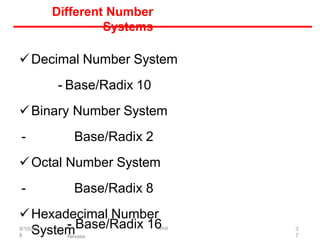
Decimal Number System
- Base/Radix 10
Binary Number System
- Base/Radix 2
Octal Number System
- Base/Radix 8
Hexadecimal Number
System
- Base/Radix 16
Amit
Nevase
9/10/201
8
3
7
Decimal Number
System
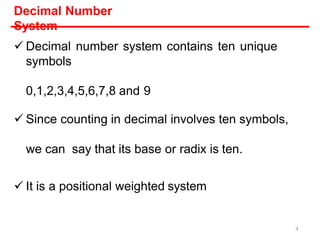
 Decimal number system contains ten unique
symbols
0,1,2,3,4,5,6,7,8 and 9
 Since counting in decimal involves ten symbols,
we can say that its base or radix is ten.
 It is a positional weighted system
4
Decimal Number System
In this system, any number (integer, fraction
or mixed) of any magnitude can be
represented by the use of these ten
symbols only
5
Each symbols in the number is called a
“Digit”
Decimal Number
System
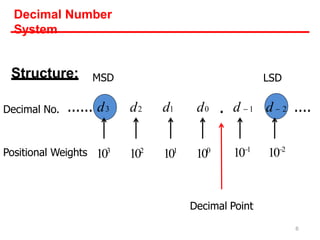
Structure:
Decimal No. ...... d3
Positional Weights
d2 d1 d0 . d  1 d  2
103
102
101
100
101
102
....
Decimal Point
MSD LSD
6
Decimal Number
System
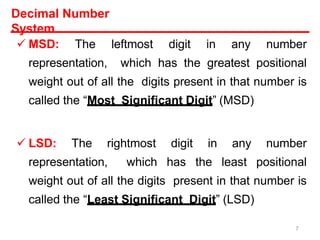
 MSD: The leftmost digit in any number
representation, which has the greatest positional
weight out of all the digits present in that number is
called the “Most Significant Digit” (MSD)
 LSD: The rightmost digit in any number
representation, which has the least positional
weight out of all the digits present in that number is
called the “Least Significant Digit” (LSD)
7
Decimal Number
System
Examples
1214
1897
9875.54
8
Binary Number System
Binary number system is a positional
weighted system
It contains two unique symbols 0 and 1
Since counting in binary
involves two symbols, we can
say that its base or radix is two.
9
Binary Number System
A binary digit is called a “Bit”
A binary number consistsof a sequenceof
bits, each of which is either a 0 or a 1.
The binary point separatesthe integer
and fraction parts
10
9/10/201
8
Amit
Nevase
4
7
Binary Number
System
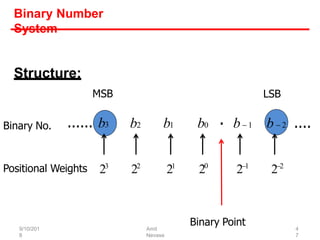
Structure:
Binary No.
Positional Weights
b2 b1 b0 . b 1 b  2
...... b3
23
22
21
20
21
22
....
Binary Point
MSB LSB
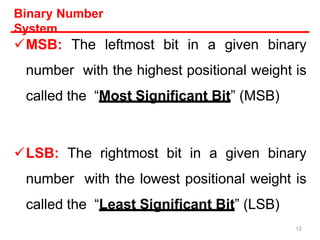
MSB: The leftmost bit in a given binary
number with the highest positional weight is
called the “Most Significant Bit” (MSB)
LSB: The rightmost bit in a given binary
number with the lowest positional weight is
called the “Least Significant Bit” (LSB)
Binary Number
System
12
Binary Number
System
13
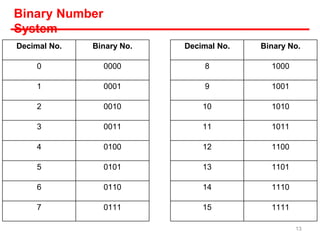
Decimal No. Binary No.
0 0000
1 0001
2 0010
3 0011
4 0100
5 0101
6 0110
7 0111
Decimal No. Binary No.
8 1000
9 1001
10 1010
11 1011
12 1100
13 1101
14 1110
15 1111
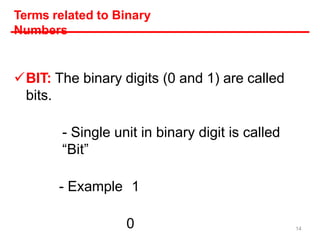
BIT: The binary digits (0 and 1) are called
bits.
- Single unit in binary digit is called
“Bit”
- Example 1
0
Terms related to Binary
Numbers
14
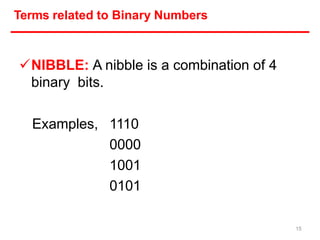
Examples, 1110
0000
1001
0101
Terms related to Binary Numbers
NIBBLE: A nibble is a combination of 4
binary bits.
15
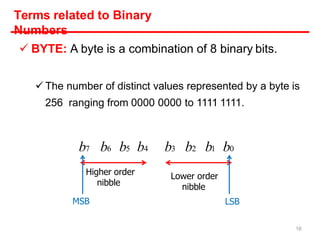
 BYTE: A byte is a combination of 8 binary bits.
 The number of distinct values represented by a byte is
256 ranging from 0000 0000 to 1111 1111.
Terms related to Binary
Numbers
b7 b6 b5
Higher order
nibble
MSB
b4 b3 b2 b1 b0
Lower order
nibble
LSB
16
Terms related to Binary Numbers
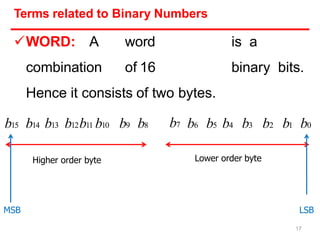
WORD: A word is a
combination of 16 binary bits.
Hence it consists of two bytes.
b2 b1 b0
b6 b5 b4 b3
Lower order byte
17
MSB LSB
b15 b14 b13 b12b11 b10
Higher order byte
b9 b8 b7
-It is a combination of 32 binary
bits.
Terms related to Binary Numbers
DOUBLE WORD: A double word is exactly
what its name implies, two words.
18
Octal Number
System
Octal number
system system
is a positional weighted
It containseight unique symbols0,1,2,3,4,5,6
and 7
Since counting in octal involves eight symbols,
we can say that its base or radix is eight.
19
The largestvalue of a digit in the octal
system will be 7.
That means the octal number higher than 7
will not be 8, instead of that it will be 10.
Octal Number
System
20
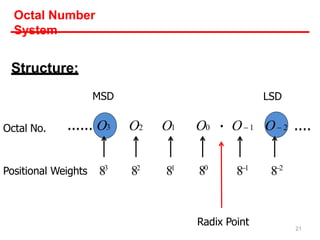
Octal Number
System
Structure:
Octal No.
Positional Weights
O2 O1 O0 . O 1 O 2
...... O3
80
83
82
81
81
82
....
Radix Point 21
MSD LSD
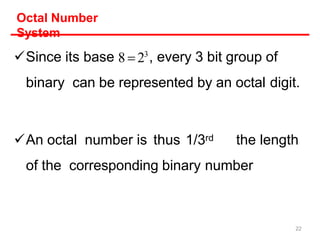
Since its base 8  23
, every 3 bit group of
binary can be represented by an octal digit.
An octal number is thus 1/3rd the length
of the corresponding binary number
Octal Number
System
22
Decimal No. Binary No. Octal No.
0 0000 0
1 0001 1
2 0010 2
3 0011 3
4 0100 4
5 0101 5
6 0110 6
7 0111 7
8 1000 10
9 1001 11
10 1010 12
11 1011 13
12 1100 14
9/10/2018 13 Am1i
t1N
0e
v
1as
e 15 60
Octal Number
System
Hexadecimal Number System
(HEX)
Binary numbers are long. These numbers are
fine for machines but are too lengthy to be
handled by human beings. So there is a need
to represent the binary numbers concisely.
One number system developed with this
objective is the hexadecimal number system
(or Hex)
weighte
d
It contains sixteen
unique
0,1,2,3,4,5,6,7,8,9,A,B,C,D,E and
F.
symbol
s
Since counting in hex involves sixteen
symbols, we can say that its base or radix is
sixteen.
Hexadecimal Number System (HEX)
Hex number system is a
positional system
Hexadecimal Number System
(HEX)
Structure:
Hex No.
Positional Weights
H2 H1
...... H3 . H 1 H 2
H0
160
163
162
161 161
162
....
Radix Point
MSD LSD
Hexadecimal Number System (HEX)
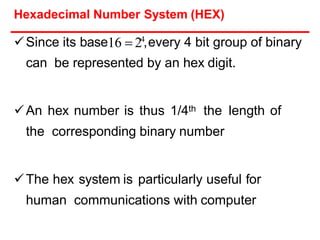
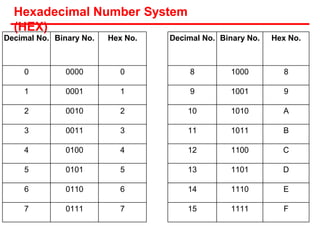
Since its base16  24
,every 4 bit group of binary
can be represented by an hex digit.
An hex number is thus 1/4th the length of
the corresponding binary number
The hex system is particularly useful for
human communications with computer
Hexadecimal Number System
(HEX)
Decimal No. Binary No. Hex No.
0 0000 0
1 0001 1
2 0010 2
3 0011 3
4 0100 4
5 0101 5
6 0110 6
7 0111 7
Decimal No. Binary No. Hex No.
8 1000 8
9 1001 9
10 1010 A
11 1011 B
12 1100 C
13 1101 D
14 1110 E
15 1111 F
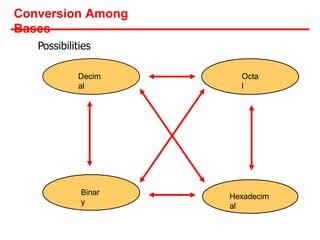
Conversion Among
Bases
Hexadecim
al
Decim
al
Octa
l
Binar
y
Possibilities
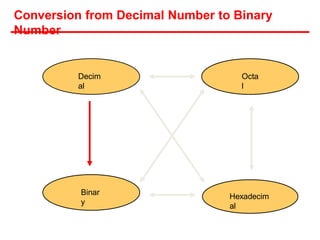
Conversion from Decimal Number to Binary
Number
Hexadecim
al
Decim
al
Octa
l
Binar
y
Conversion of Decimal number into Binary
number (Integer Number)
Procedure:
1. Divide the decimal no by the base 2, noting
the remainder.
2. Continue to divide the quotient by 2 until there
is nothing left, keeping the track of the
remainders from each step.
3. List the remainder values in reverse order to
find the number’s binary equivalent
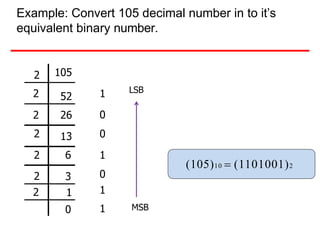
Example: Convert 105 decimal number in to it’s
equivalent binary number.
2 105
2 52
2 26
2 13
2 6
2 3
2 1
0
1
0
0
1
0
1
1
LSB
MSB
(105)10  (1101001)2
Procedure:
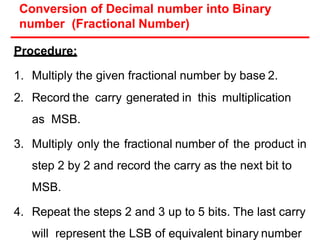
1. Multiply the given fractional number by base 2.
2. Record the carry generated in this multiplication
as MSB.
3. Multiply only the fractional number of the product in
step 2 by 2 and record the carry as the next bit to
MSB.
4. Repeat the steps 2 and 3 up to 5 bits. The last carry
will represent the LSB of equivalent binary number
Conversion of Decimal number into Binary
number (Fractional Number)
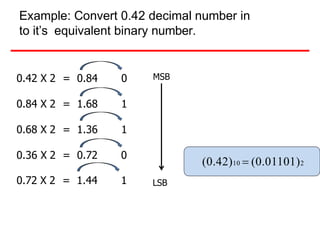
Example: Convert 0.42 decimal number in
to it’s equivalent binary number.
0.42 X 2 = 0.84 0
0.84 X 2 = 1.68 1
0.68 X 2 = 1.36 1
0.36 X 2 = 0.72 0
0.72 X 2 = 1.44 1
(0.42)10  (0.01101)2
LSB
MSB
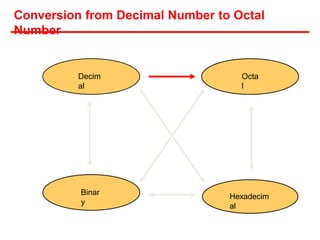
Conversion from Decimal Number to Octal
Number
Hexadecim
al
Decim
al
Octa
l
Binar
y
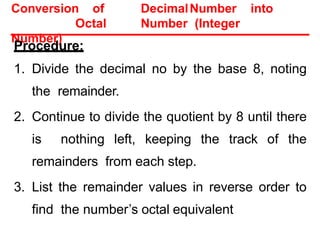
Conversion of DecimalNumber into
Octal Number (Integer
Number)
Procedure:
1. Divide the decimal no by the base 8, noting
the remainder.
2. Continue to divide the quotient by 8 until there
is nothing left, keeping the track of the
remainders from each step.
3. List the remainder values in reverse order to
find the number’s octal equivalent
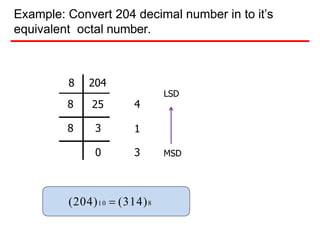
Example: Convert 204 decimal number in to it’s
equivalent octal number.
8 204
8 25
8 3
0
LSD
4
1
3 MSD
(204)10  (314)8
Procedure:
1. Multiply the given fractional number by base 8.
2. Record the carry generated in this multiplication
as MSD.
3. Multiply only the fractional number of the product in
step 2 by 8 and record the carry as the next bit to
MSD.
4. Repeat the steps 2 and 3 up to 5 bits. The last carry
will represent the LSD of equivalent octal number
Conversion of Decimal Number into
Octal Number (Fractional
Number)
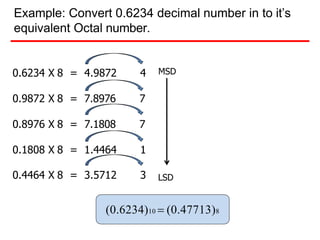
Example: Convert 0.6234 decimal number in to it’s
equivalent Octal number.
0.6234 X 8 = 4.9872 4
0.9872 X 8 = 7.8976 7
0.8976 X 8 = 7.1808 7
0.1808 X 8 = 1.4464 1
0.4464 X 8 = 3.5712 3 LSD
(0.6234)10  (0.47713)8
MSD
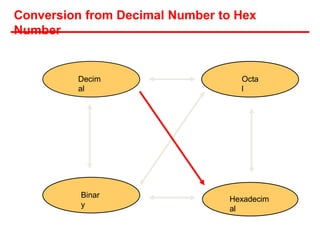
Conversion from Decimal Number to Hex
Number
Hexadecim
al
Decim
al
Octa
l
Binar
y
Conversionof
Decimal
Number (Integer
Number)
Numbe
r
int
o
Hexadecim
al
Procedure:
1. Divide the decimal no by the base 16, noting
the remainder.
2. Continue to divide the quotient by 16 until
there is nothing left, keeping the track of the
remainders from each step.
3. List the remainder values in reverse order to
find the number’s hex equivalent
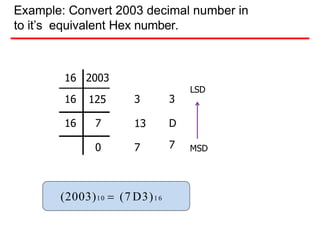
Example: Convert 2003 decimal number in
to it’s equivalent Hex number.
16 2003
16 125
16 7
0
3
7
13 D
LSD
MSD
(2003)10  (7 D3)16
3
7
Conversionof Decimal Number into
Hexadecimal Number (Fractional
Number)
Procedure:
1. Multiply the given fractional number by base 16.
2. Record the carry generated in this multiplication
as MSD.
3. Multiply only the fractional number of the product in
step 2 by 16 and record the carry as the next bit to
MSD.
4. Repeat the steps 2 and 3 up to 5 bits. The last carry
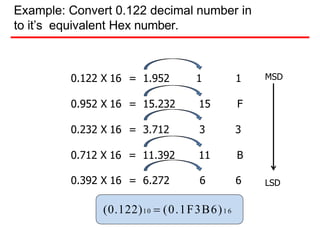
Example: Convert 0.122 decimal number in
to it’s equivalent Hex number.
0.122 X 16 = 1.952 1 1
0.952 X 16 = 15.232 15 F
0.232 X 16 = 3.712 3 3
0.712 X 16 = 11.392 11 B
0.392 X 16 = 6.272 6 6 LSD
(0.122)10  (0.1F3B6)1 6
MSD
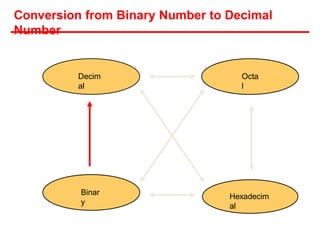
Conversion from Binary Number to Decimal
Number
Hexadecim
al
Decim
al
Octa
l
Binar
y
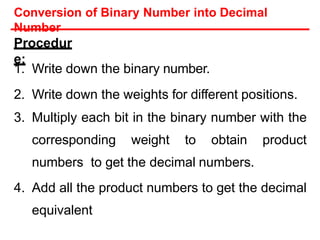
Procedur
e:
1. Write down the binary number.
2. Write down the weights for different positions.
3. Multiply each bit in the binary number with the
corresponding weight to obtain product
numbers to get the decimal numbers.
4. Add all the product numbers to get the decimal
equivalent
Conversion of Binary Number into Decimal
Number
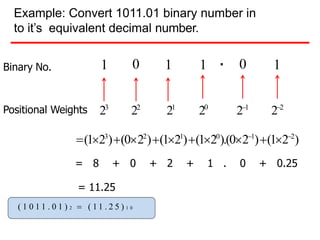
Example: Convert 1011.01 binary number in
to it’s equivalent decimal number.
Binary No.
Positional Weights
0 0
1 1 1 1
.
23
22
21
20
21
22
(123
)(022
)(121
)(120
).(021
)(122
)
= 8 + 0 + 2 + 1 . 0 + 0.25
= 11.25
( 1 0 1 1 . 0 1 ) 2  ( 1 1 . 2 5 ) 1 0
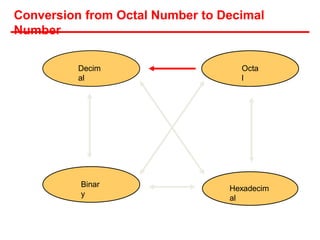
Conversion from Octal Number to Decimal
Number
Hexadecim
al
Decim
al
Octa
l
Binar
y
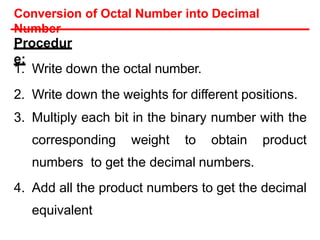
Procedur
e:
1. Write down the octal number.
2. Write down the weights for different positions.
3. Multiply each bit in the binary number with the
corresponding weight to obtain product
numbers to get the decimal numbers.
4. Add all the product numbers to get the decimal
equivalent
Conversion of Octal Number into Decimal
Number
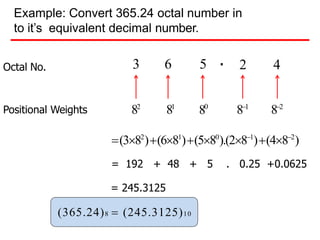
Example: Convert 365.24 octal number in
to it’s equivalent decimal number.
Octal No.
Positional Weights
3 6 5 2 4
.
82
81
80
81
82
(382
)(681
)(580
).(281
)(482
)
= 192 + 48 + 5 . 0.25 +0.0625
= 245.3125
(365.24)8  (245.3125)10
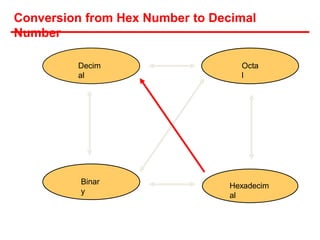
Conversion from Hex Number to Decimal
Number
Hexadecim
al
Decim
al
Octa
l
Binar
y
Procedur
e:
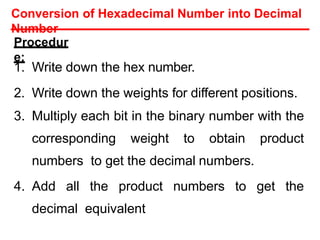
1. Write down the hex number.
2. Write down the weights for different positions.
3. Multiply each bit in the binary number with the
corresponding weight to obtain product
numbers to get the decimal numbers.
4. Add all the product numbers to get the
decimal equivalent
Conversion of Hexadecimal Number into Decimal
Number
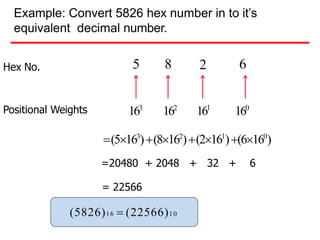
Example: Convert 5826 hex number in to it’s
equivalent decimal number.
Hex No.
Positional Weights
5 8 6
2
163
162
161
160
(5163
)(8162
)(2161
)(6160
)
=20480 + 2048 + 32 + 6
= 22566
(5826)16  (22566)10
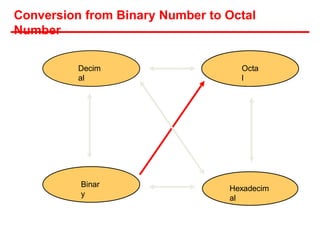
Conversion from Binary Number to Octal
Number
Hexadecim
al
Decim
al
Octa
l
Binar
y
Procedur
e:
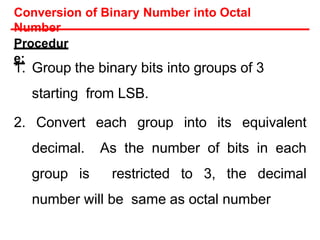
1. Group the binary bits into groups of 3
starting from LSB.
2. Convert each group into its equivalent
decimal. As the number of bits in each
group is restricted to 3, the decimal
number will be same as octal number
Conversion of Binary Number into Octal
Number
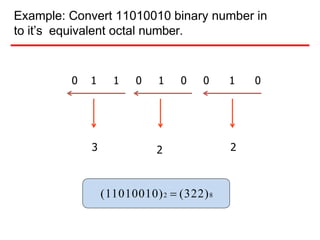
Example: Convert 11010010 binary number in
to it’s equivalent octal number.
0 1 1 0 1 0 0 1 0
3 2 2
(11010010)2  (322)8
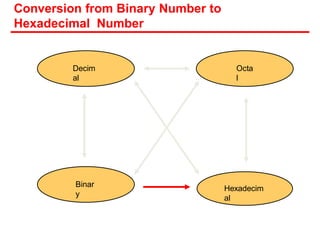
Conversion from Binary Number to
Hexadecimal Number
Hexadecim
al
Decim
al
Octa
l
Binar
y
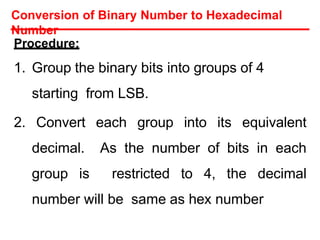
Procedure:
1. Group the binary bits into groups of 4
starting from LSB.
2. Convert each group into its equivalent
decimal. As the number of bits in each
group is restricted to 4, the decimal
number will be same as hex number
Conversion of Binary Number to Hexadecimal
Number
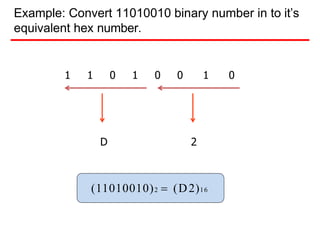
Example: Convert 11010010 binary number in to it’s
equivalent hex number.
1 1 0 1 0 0 1 0
D
(11010010)2  (D2)16
2
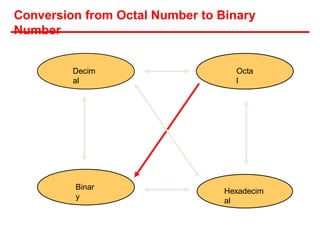
Conversion from Octal Number to Binary
Number
Hexadecim
al
Decim
al
Octa
l
Binar
y
Conversion of Octal Number into Binary Number
To get the binary equivalent of the given
octal number we have to convert each octal
digit into its equivalent 3 bit binary number
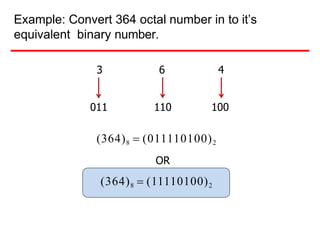
Example: Convert 364 octal number in to it’s
equivalent binary number.
3 6 4
011 110 100
(364)8  (011110100)2
OR
(364)8  (11110100)2
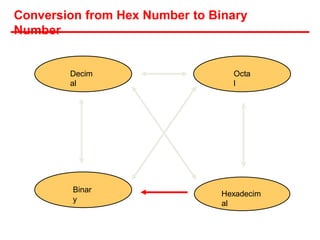
Conversion from Hex Number to Binary
Number
Hexadecim
al
Decim
al
Octa
l
Binar
y
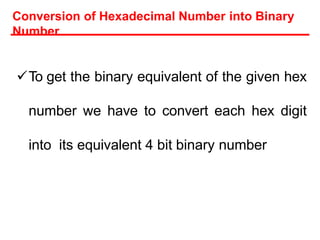
Conversion of Hexadecimal Number into Binary
Number
To get the binary equivalent of the given hex
number we have to convert each hex digit
into its equivalent 4 bit binary number
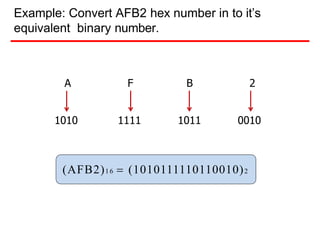
Example: Convert AFB2 hex number in to it’s
equivalent binary number.
A F B 2
1010 1111 1011 0010
(AFB2)16  (1010111110110010)2
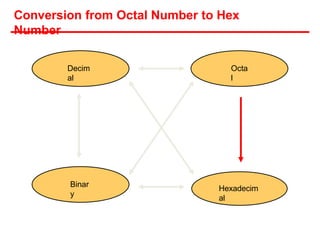
Conversion from Octal Number to Hex
Number
Hexadecim
al
Decim
al
Octa
l
Binar
y
Conversion of Octal Number into Hexadecimal
Number
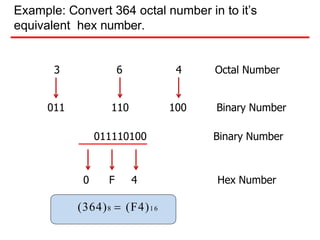
To get hex equivalent number of given octal
number, first we have to convert octal
number into its 3 bit binary equivalent and
then convert binary number into its hex
equivalent.
Example: Convert 364 octal number in to it’s
equivalent hex number.
(364)8  (F4)16
3 6 4 Octal Number
011 110 100 Binary Number
011110100 Binary Number
0 F 4 Hex Number
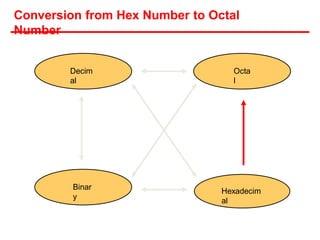
Conversion from Hex Number to Octal
Number
Hexadecim
al
Decim
al
Octa
l
Binar
y
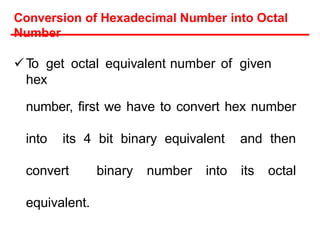
To get octal equivalent number of given
hex
number, first we have to convert hex number
into its 4 bit binary equivalent and then
convert binary number into its octal
equivalent.
Conversion of Hexadecimal Number into Octal
Number
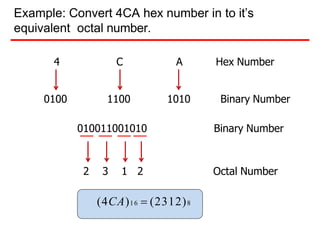
Example: Convert 4CA hex number in to it’s
equivalent octal number.
4 C A Hex Number
0100 1100 1010 Binary Number
2 3 1 2
(4CA)16  (2312)8
010011001010 Binary Number
Octal Number
Binary
Addition
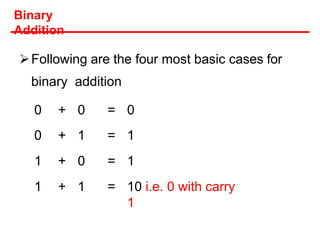
Following are the four most basic cases for
binary addition
0 + 0 = 0
0 + 1 = 1
1 + 0 = 1
1 + 1 = 10 i.e. 0 with carry
1
Binary
Addition
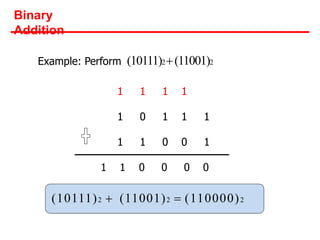
Example: Perform (10111)2(11001)2
1 1 1 1
1 0 1 1 1
1 1 0 0 1
1 1 0 0 0 0
(10111)2  (11001)2  (110000)2
Binary
Addition
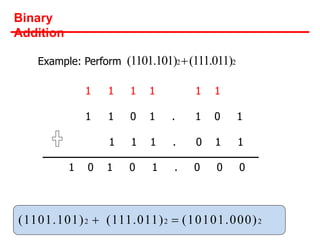
Example: Perform (1101.101)2(111.011)2
1 1 1 1 1 1
1 1 0 1 . 1 0 1
1 1 1 . 0 1 1
1 0 1 0 1 . 0 0 0
(1101.101)2  (111.011)2  (10101.000)2
Binary
Subtraction
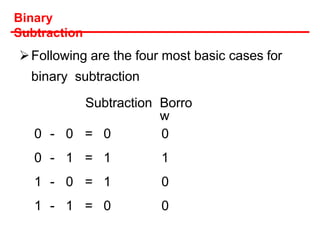
Following are the four most basic cases for
binary subtraction
Subtraction Borro
w
0 - 0 = 0 0
0 - 1 = 1 1
1 - 0 = 1 0
1 - 1 = 0 0
Binary
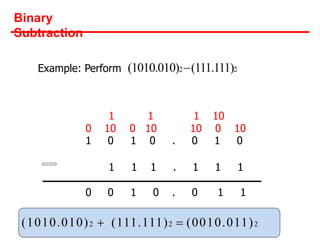
Subtraction
Example: Perform (1010.010)2(111.111)2
1 1 1 10
0 10 0 10 10 0 10
1 0 1 0 . 0 1 0
1 1 1 . 1 1 1
0 0 1 0 . 0 1 1
(1010.010)2  (111.111)2  (0010.011)2
Binary
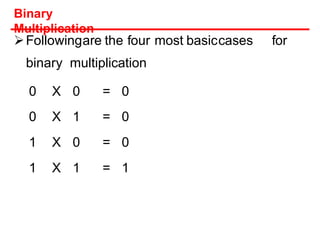
Multiplication
Followingare the four most basiccases for
binary multiplication
0 X 0 = 0
0 X 1 = 0
1 X 0 = 0
1 X 1 = 1
Binary
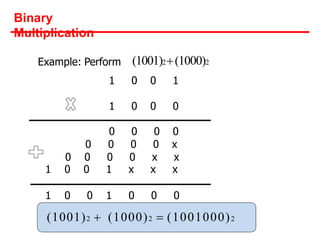
Multiplication
Example: Perform (1001)2(1000)2
(1001)2  (1000)2  (1001000)2
1 0 0 1
1 0 0 0
0 0 0 0
0 0 0 0 x
0 0 0 0 x x
1 0 0 1 x x x
1 0 0 1 0 0 0
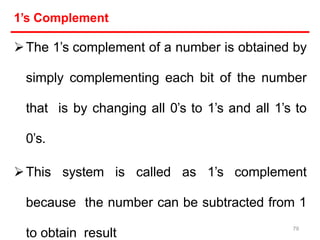
1’s Complement
The 1’s complement of a number is obtained by
simply complementing each bit of the number
that is by changing all 0’s to 1’s and all 1’s to
0’s.
This system is called as 1’s complement
because the number can be subtracted from 1
to obtain result
79
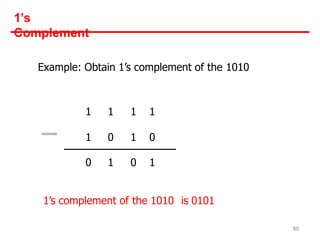
1’s
Complement
Example: Obtain 1’s complement of the 1010
1 1 1 1
1 0 1 0
0 1 0 1
1’s complement of the 1010 is 0101
80
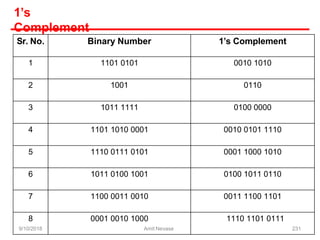
1’s
Complement
Sr. No. Binary Number 1’s Complement
1 1101 0101 0010 1010
2 1001 0110
3 1011 1111 0100 0000
4 1101 1010 0001 0010 0101 1110
5 1110 0111 0101 0001 1000 1010
6 1011 0100 1001 0100 1011 0110
7 1100 0011 0010 0011 1100 1101
8
9/10/2018
0001 0010 1000
Amit Nevase
1110 1101 0111
231
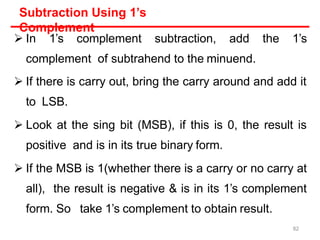
Subtraction Using 1’s
Complement
 In 1’s complement subtraction, add the 1’s
complement of subtrahend to the minuend.
 If there is carry out, bring the carry around and add it
to LSB.
 Look at the sing bit (MSB), if this is 0, the result is
positive and is in its true binary form.
 If the MSB is 1(whether there is a carry or no carry at
all), the result is negative & is in its 1’s complement
form. So take 1’s complement to obtain result.
82
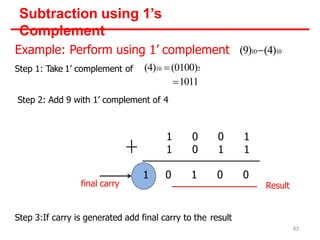
Subtraction using 1’s
Complement
Example: Perform using 1’ complement (9)10(4)10
Step 1: Take 1’ complement of (4)10 (0100)2
1011
Step 2: Add 9 with 1’ complement of 4
1 0 0 1
1 0 1 1
1 0 1 0 0
Step 3:If carry is generated add final carry to the result
final carry
83
Result
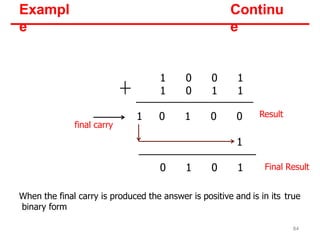
Exampl
e
Continu
e
1 0 0 1
1 0 1 1
1 0 1 0 0
1
0 1 0 1
When the final carry is produced the answer is positive and is in its true
binary form
final carry
Result
Final Result
84
2’s
Complement
The 2’s complement of a number is
obtained by adding 1 to the 1’s
complement of that number
85
2’s
Complement
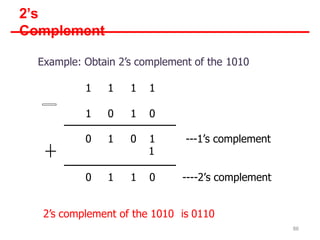
Example: Obtain 2’s complement of the 1010
1 1 1 1
1 0 1 0
0 1 0 1 ---1’s complement
1
0 1 1 0 ----2’s complement
2’s complement of the 1010 is 0110
86
2’s
Complement
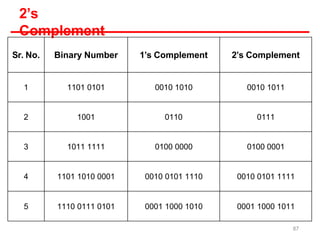
Sr. No. Binary Number 1’s Complement 2’s Complement
1 1101 0101 0010 1010 0010 1011
2 1001 0110 0111
3 1011 1111 0100 0000 0100 0001
4 1101 1010 0001 0010 0101 1110 0010 0101 1111
5 1110 0111 0101 0001 1000 1010 0001 1000 1011
87
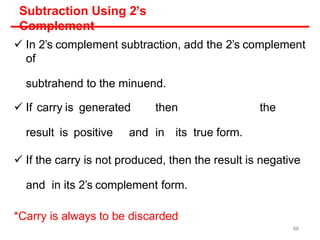
Subtraction Using 2’s
Complement
 In 2’s complement subtraction, add the 2’s complement
of
subtrahend to the minuend.
 If carry is generated then the
result is positive and in its true form.
 If the carry is not produced, then the result is negative
and in its 2’s complement form.
*Carry is always to be discarded
88
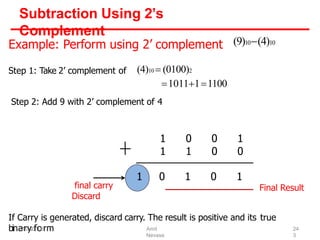
Subtraction Using 2’s
Complement
Amit
Nevase
24
3
Example: Perform using 2’ complement (9)10(4)10
Step 1: Take 2’ complement of (4)10  (0100)2
101111100
Step 2: Add 9 with 2’ complement of 4
1 0 0 1
1 1 0 0
If Carry is generated, discard carry. The result is positive and its true
bin9
a/
1
r0
y/
2
0
f1
o8rm
final carry
Discard
1 0 1 0 1
Final Result
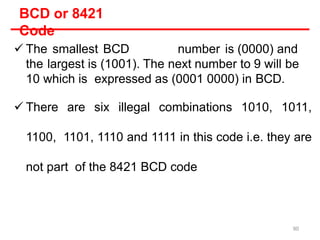
BCD or 8421
Code
 The smallest BCD number is (0000) and
the largest is (1001). The next number to 9 will be
10 which is expressed as (0001 0000) in BCD.
 There are six illegal combinations 1010, 1011,
1100, 1101, 1110 and 1111 in this code i.e. they are
not part of the 8421 BCD code
90
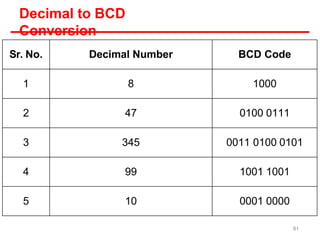
Decimal to BCD
Conversion
Sr. No. Decimal Number BCD Code
1 8 1000
2 47 0100 0111
3 345 0011 0100 0101
4 99 1001 1001
5 10 0001 0000
91
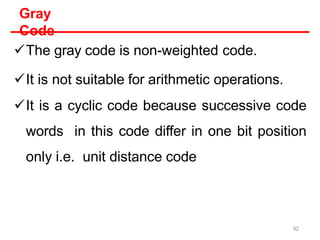
Gray
Code
The gray code is non-weighted code.
It is not suitable for arithmetic operations.
It is a cyclic code because successive code
words in this code differ in one bit position
only i.e. unit distance code
92
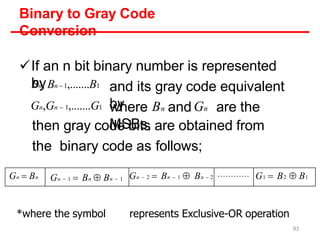
Binary to Gray Code
Conversion
If an n bit binary number is represented
by and its gray code equivalent
by
then gray code bits are obtained from
the binary code as follows;
where Bn andGn are the
MSBs,
Bn, Bn  1,.......B1
Gn,Gn  1,.......G1
93
Gn  Bn Gn  1  Bn  Bn  1 Gn  2  Bn  1  Bn  2 ………… G1  B2  B1
*where the symbol represents Exclusive-OR operation
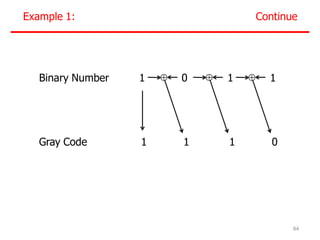
Binary Number 1 0 1 1
Gray Code 1 1 1 0
  
Example 1:
94
Continue
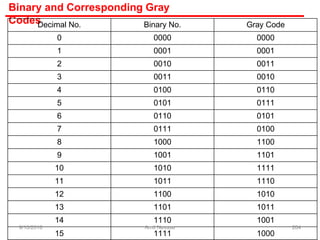
Binary and Corresponding Gray
Codes
Decimal No. Binary No. Gray Code
0 0000 0000
1 0001 0001
2 0010 0011
3 0011 0010
4 0100 0110
5 0101 0111
6 0110 0101
7 0111 0100
8 1000 1100
9 1001 1101
10 1010 1111
11 1011 1110
12 1100 1010
13 1101 1011
14 1110 1001
9/10/2018
15
Amit Nevase
1111
264
1000
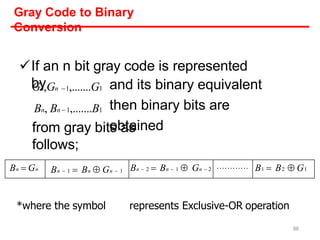
Gray Code to Binary
Conversion
If an n bit gray code is represented
by and its binary equivalent
then binary bits are
obtained
from gray bits as
follows;
Gn,Gn 1,.......G1
Bn, Bn  1,.......B1
96
Bn  Gn Bn  1  Bn  Gn  1 Bn  2  Bn  1  Gn  2 ………… B1  B2  G1
*where the symbol represents Exclusive-OR operation
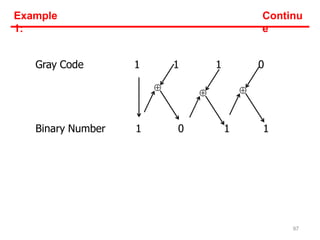
Gray Code 1 1 1 0
Binary Number 1 0 1 1

 
Example
1:
97
Continu
e
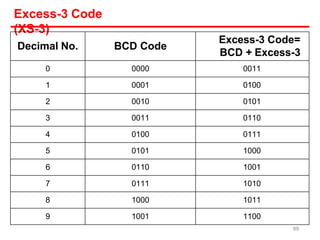
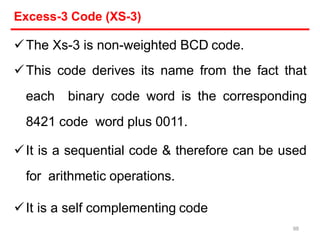
Excess-3 Code (XS-3)
The Xs-3 is non-weighted BCD code.
This code derives its name from the fact that
each binary code word is the corresponding
8421 code word plus 0011.
It is a sequential code & therefore can be used
for arithmetic operations.
It is a self complementing code
98
Excess-3 Code
(XS-3)
99
Decimal No. BCD Code
Excess-3 Code=
BCD + Excess-3
0 0000 0011
1 0001 0100
2 0010 0101
3 0011 0110
4 0100 0111
5 0101 1000
6 0110 1001
7 0111 1010
8 1000 1011
9 1001 1100
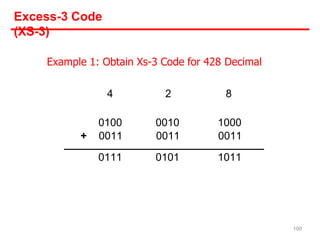
Excess-3 Code
(XS-3)
100
Example 1: Obtain Xs-3 Code for 428 Decimal
4 2 8
0100 0010 1000
+ 0011 0011 0011
0111 0101 1011
ASCII Codes
The American Standard Code for
Information Interchange is a character-
encoding scheme originally based on the
English alphabet.
ASCII codes represent text in computers,
communications equipment, and other devices
that use text.
Most modern character-encoding schemes are
based on ASCII, though they support many
additional characters. 101
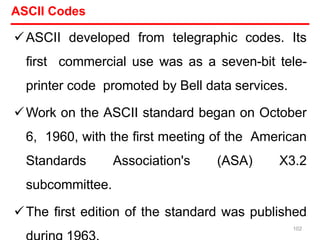
ASCII Codes
ASCII developed from telegraphic codes. Its
first commercial use was as a seven-bit tele-
printer code promoted by Bell data services.
Work on the ASCII standard began on October
6, 1960, with the first meeting of the American
Standards Association's (ASA) X3.2
subcommittee.
The first edition of the standard was published
102
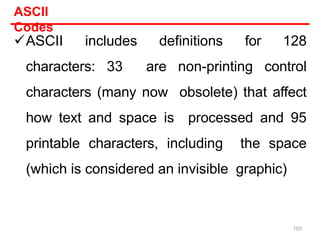
ASCII includes definitions for 128
characters: 33 are non-printing control
characters (many now obsolete) that affect
how text and space is processed and 95
printable characters, including the space
(which is considered an invisible graphic)
ASCII
Codes
103
ASCII
Codes
B7 0 0 0 0 1 1 1 1
B6 0 0 1 1 0 0 1 1
B5 0 1 0 1 0 1 0 1
B4 B3 B2 B1 0 1 2 3 4 5 6 7
0 0 0 0 0 NUL DLE SP 0 @ P ‘ p
0 0 0 1 1 SOH DC1 | 1 A Q a q
0 0 1 0 2 STX DC2 “ 2 B R b r
0 0 1 1 3 ETX DC3 # 3 C S c s
0 1 0 0 4 EOT DC4 $ 4 D T d t
0 1 0 1 5 ENQ NAK % 5 E U e u
0 1 1 0 6 ACK SYN & 6 F V f v
0 1 1 1 7 BEL ETB ‘ 7 G W g w
1 0 0 0 8 BS CAN ( 8 H X h x
1 0 0 1 9 HT EM ) 9 I Y i y
1 0 1 0 10 LF SUB “ : J Z j z
1 0 1 1 11 VT ESC + ; K [ k {
1 1 0 0 12 FF FC , < L  l !
1 1 0 1 13 CR GS = M ] m }
1 1 1 0 14 SO RS . > N ^ n ~
ASCII
Codes

dtei-180910104911-converted.pptx

  • 1.
  • 2.
    Number System A number systemdefines a set of values used to represent quantity. 2
  • 3.
    Different Number Systems Decimal NumberSystem - Base/Radix 10 Binary Number System - Base/Radix 2 Octal Number System - Base/Radix 8 Hexadecimal Number System - Base/Radix 16 Amit Nevase 9/10/201 8 3 7
  • 4.
    Decimal Number System  Decimalnumber system contains ten unique symbols 0,1,2,3,4,5,6,7,8 and 9  Since counting in decimal involves ten symbols, we can say that its base or radix is ten.  It is a positional weighted system 4
  • 5.
    Decimal Number System Inthis system, any number (integer, fraction or mixed) of any magnitude can be represented by the use of these ten symbols only 5 Each symbols in the number is called a “Digit”
  • 6.
    Decimal Number System Structure: Decimal No....... d3 Positional Weights d2 d1 d0 . d  1 d  2 103 102 101 100 101 102 .... Decimal Point MSD LSD 6
  • 7.
    Decimal Number System  MSD:The leftmost digit in any number representation, which has the greatest positional weight out of all the digits present in that number is called the “Most Significant Digit” (MSD)  LSD: The rightmost digit in any number representation, which has the least positional weight out of all the digits present in that number is called the “Least Significant Digit” (LSD) 7
  • 8.
  • 9.
    Binary Number System Binarynumber system is a positional weighted system It contains two unique symbols 0 and 1 Since counting in binary involves two symbols, we can say that its base or radix is two. 9
  • 10.
    Binary Number System Abinary digit is called a “Bit” A binary number consistsof a sequenceof bits, each of which is either a 0 or a 1. The binary point separatesthe integer and fraction parts 10
  • 11.
    9/10/201 8 Amit Nevase 4 7 Binary Number System Structure: Binary No. PositionalWeights b2 b1 b0 . b 1 b  2 ...... b3 23 22 21 20 21 22 .... Binary Point MSB LSB
  • 12.
    MSB: The leftmostbit in a given binary number with the highest positional weight is called the “Most Significant Bit” (MSB) LSB: The rightmost bit in a given binary number with the lowest positional weight is called the “Least Significant Bit” (LSB) Binary Number System 12
  • 13.
    Binary Number System 13 Decimal No.Binary No. 0 0000 1 0001 2 0010 3 0011 4 0100 5 0101 6 0110 7 0111 Decimal No. Binary No. 8 1000 9 1001 10 1010 11 1011 12 1100 13 1101 14 1110 15 1111
  • 14.
    BIT: The binarydigits (0 and 1) are called bits. - Single unit in binary digit is called “Bit” - Example 1 0 Terms related to Binary Numbers 14
  • 15.
    Examples, 1110 0000 1001 0101 Terms relatedto Binary Numbers NIBBLE: A nibble is a combination of 4 binary bits. 15
  • 16.
     BYTE: Abyte is a combination of 8 binary bits.  The number of distinct values represented by a byte is 256 ranging from 0000 0000 to 1111 1111. Terms related to Binary Numbers b7 b6 b5 Higher order nibble MSB b4 b3 b2 b1 b0 Lower order nibble LSB 16
  • 17.
    Terms related toBinary Numbers WORD: A word is a combination of 16 binary bits. Hence it consists of two bytes. b2 b1 b0 b6 b5 b4 b3 Lower order byte 17 MSB LSB b15 b14 b13 b12b11 b10 Higher order byte b9 b8 b7
  • 18.
    -It is acombination of 32 binary bits. Terms related to Binary Numbers DOUBLE WORD: A double word is exactly what its name implies, two words. 18
  • 19.
    Octal Number System Octal number systemsystem is a positional weighted It containseight unique symbols0,1,2,3,4,5,6 and 7 Since counting in octal involves eight symbols, we can say that its base or radix is eight. 19
  • 20.
    The largestvalue ofa digit in the octal system will be 7. That means the octal number higher than 7 will not be 8, instead of that it will be 10. Octal Number System 20
  • 21.
    Octal Number System Structure: Octal No. PositionalWeights O2 O1 O0 . O 1 O 2 ...... O3 80 83 82 81 81 82 .... Radix Point 21 MSD LSD
  • 22.
    Since its base8  23 , every 3 bit group of binary can be represented by an octal digit. An octal number is thus 1/3rd the length of the corresponding binary number Octal Number System 22
  • 23.
    Decimal No. BinaryNo. Octal No. 0 0000 0 1 0001 1 2 0010 2 3 0011 3 4 0100 4 5 0101 5 6 0110 6 7 0111 7 8 1000 10 9 1001 11 10 1010 12 11 1011 13 12 1100 14 9/10/2018 13 Am1i t1N 0e v 1as e 15 60 Octal Number System
  • 24.
    Hexadecimal Number System (HEX) Binarynumbers are long. These numbers are fine for machines but are too lengthy to be handled by human beings. So there is a need to represent the binary numbers concisely. One number system developed with this objective is the hexadecimal number system (or Hex)
  • 25.
    weighte d It contains sixteen unique 0,1,2,3,4,5,6,7,8,9,A,B,C,D,Eand F. symbol s Since counting in hex involves sixteen symbols, we can say that its base or radix is sixteen. Hexadecimal Number System (HEX) Hex number system is a positional system
  • 26.
    Hexadecimal Number System (HEX) Structure: HexNo. Positional Weights H2 H1 ...... H3 . H 1 H 2 H0 160 163 162 161 161 162 .... Radix Point MSD LSD
  • 27.
    Hexadecimal Number System(HEX) Since its base16  24 ,every 4 bit group of binary can be represented by an hex digit. An hex number is thus 1/4th the length of the corresponding binary number The hex system is particularly useful for human communications with computer
  • 28.
    Hexadecimal Number System (HEX) DecimalNo. Binary No. Hex No. 0 0000 0 1 0001 1 2 0010 2 3 0011 3 4 0100 4 5 0101 5 6 0110 6 7 0111 7 Decimal No. Binary No. Hex No. 8 1000 8 9 1001 9 10 1010 A 11 1011 B 12 1100 C 13 1101 D 14 1110 E 15 1111 F
  • 29.
  • 30.
    Conversion from DecimalNumber to Binary Number Hexadecim al Decim al Octa l Binar y
  • 31.
    Conversion of Decimalnumber into Binary number (Integer Number) Procedure: 1. Divide the decimal no by the base 2, noting the remainder. 2. Continue to divide the quotient by 2 until there is nothing left, keeping the track of the remainders from each step. 3. List the remainder values in reverse order to find the number’s binary equivalent
  • 32.
    Example: Convert 105decimal number in to it’s equivalent binary number. 2 105 2 52 2 26 2 13 2 6 2 3 2 1 0 1 0 0 1 0 1 1 LSB MSB (105)10  (1101001)2
  • 33.
    Procedure: 1. Multiply thegiven fractional number by base 2. 2. Record the carry generated in this multiplication as MSB. 3. Multiply only the fractional number of the product in step 2 by 2 and record the carry as the next bit to MSB. 4. Repeat the steps 2 and 3 up to 5 bits. The last carry will represent the LSB of equivalent binary number Conversion of Decimal number into Binary number (Fractional Number)
  • 34.
    Example: Convert 0.42decimal number in to it’s equivalent binary number. 0.42 X 2 = 0.84 0 0.84 X 2 = 1.68 1 0.68 X 2 = 1.36 1 0.36 X 2 = 0.72 0 0.72 X 2 = 1.44 1 (0.42)10  (0.01101)2 LSB MSB
  • 35.
    Conversion from DecimalNumber to Octal Number Hexadecim al Decim al Octa l Binar y
  • 36.
    Conversion of DecimalNumberinto Octal Number (Integer Number) Procedure: 1. Divide the decimal no by the base 8, noting the remainder. 2. Continue to divide the quotient by 8 until there is nothing left, keeping the track of the remainders from each step. 3. List the remainder values in reverse order to find the number’s octal equivalent
  • 37.
    Example: Convert 204decimal number in to it’s equivalent octal number. 8 204 8 25 8 3 0 LSD 4 1 3 MSD (204)10  (314)8
  • 38.
    Procedure: 1. Multiply thegiven fractional number by base 8. 2. Record the carry generated in this multiplication as MSD. 3. Multiply only the fractional number of the product in step 2 by 8 and record the carry as the next bit to MSD. 4. Repeat the steps 2 and 3 up to 5 bits. The last carry will represent the LSD of equivalent octal number Conversion of Decimal Number into Octal Number (Fractional Number)
  • 39.
    Example: Convert 0.6234decimal number in to it’s equivalent Octal number. 0.6234 X 8 = 4.9872 4 0.9872 X 8 = 7.8976 7 0.8976 X 8 = 7.1808 7 0.1808 X 8 = 1.4464 1 0.4464 X 8 = 3.5712 3 LSD (0.6234)10  (0.47713)8 MSD
  • 40.
    Conversion from DecimalNumber to Hex Number Hexadecim al Decim al Octa l Binar y
  • 41.
    Conversionof Decimal Number (Integer Number) Numbe r int o Hexadecim al Procedure: 1. Dividethe decimal no by the base 16, noting the remainder. 2. Continue to divide the quotient by 16 until there is nothing left, keeping the track of the remainders from each step. 3. List the remainder values in reverse order to find the number’s hex equivalent
  • 42.
    Example: Convert 2003decimal number in to it’s equivalent Hex number. 16 2003 16 125 16 7 0 3 7 13 D LSD MSD (2003)10  (7 D3)16 3 7
  • 43.
    Conversionof Decimal Numberinto Hexadecimal Number (Fractional Number) Procedure: 1. Multiply the given fractional number by base 16. 2. Record the carry generated in this multiplication as MSD. 3. Multiply only the fractional number of the product in step 2 by 16 and record the carry as the next bit to MSD. 4. Repeat the steps 2 and 3 up to 5 bits. The last carry
  • 44.
    Example: Convert 0.122decimal number in to it’s equivalent Hex number. 0.122 X 16 = 1.952 1 1 0.952 X 16 = 15.232 15 F 0.232 X 16 = 3.712 3 3 0.712 X 16 = 11.392 11 B 0.392 X 16 = 6.272 6 6 LSD (0.122)10  (0.1F3B6)1 6 MSD
  • 45.
    Conversion from BinaryNumber to Decimal Number Hexadecim al Decim al Octa l Binar y
  • 46.
    Procedur e: 1. Write downthe binary number. 2. Write down the weights for different positions. 3. Multiply each bit in the binary number with the corresponding weight to obtain product numbers to get the decimal numbers. 4. Add all the product numbers to get the decimal equivalent Conversion of Binary Number into Decimal Number
  • 47.
    Example: Convert 1011.01binary number in to it’s equivalent decimal number. Binary No. Positional Weights 0 0 1 1 1 1 . 23 22 21 20 21 22 (123 )(022 )(121 )(120 ).(021 )(122 ) = 8 + 0 + 2 + 1 . 0 + 0.25 = 11.25 ( 1 0 1 1 . 0 1 ) 2  ( 1 1 . 2 5 ) 1 0
  • 48.
    Conversion from OctalNumber to Decimal Number Hexadecim al Decim al Octa l Binar y
  • 49.
    Procedur e: 1. Write downthe octal number. 2. Write down the weights for different positions. 3. Multiply each bit in the binary number with the corresponding weight to obtain product numbers to get the decimal numbers. 4. Add all the product numbers to get the decimal equivalent Conversion of Octal Number into Decimal Number
  • 50.
    Example: Convert 365.24octal number in to it’s equivalent decimal number. Octal No. Positional Weights 3 6 5 2 4 . 82 81 80 81 82 (382 )(681 )(580 ).(281 )(482 ) = 192 + 48 + 5 . 0.25 +0.0625 = 245.3125 (365.24)8  (245.3125)10
  • 51.
    Conversion from HexNumber to Decimal Number Hexadecim al Decim al Octa l Binar y
  • 52.
    Procedur e: 1. Write downthe hex number. 2. Write down the weights for different positions. 3. Multiply each bit in the binary number with the corresponding weight to obtain product numbers to get the decimal numbers. 4. Add all the product numbers to get the decimal equivalent Conversion of Hexadecimal Number into Decimal Number
  • 53.
    Example: Convert 5826hex number in to it’s equivalent decimal number. Hex No. Positional Weights 5 8 6 2 163 162 161 160 (5163 )(8162 )(2161 )(6160 ) =20480 + 2048 + 32 + 6 = 22566 (5826)16  (22566)10
  • 54.
    Conversion from BinaryNumber to Octal Number Hexadecim al Decim al Octa l Binar y
  • 55.
    Procedur e: 1. Group thebinary bits into groups of 3 starting from LSB. 2. Convert each group into its equivalent decimal. As the number of bits in each group is restricted to 3, the decimal number will be same as octal number Conversion of Binary Number into Octal Number
  • 56.
    Example: Convert 11010010binary number in to it’s equivalent octal number. 0 1 1 0 1 0 0 1 0 3 2 2 (11010010)2  (322)8
  • 57.
    Conversion from BinaryNumber to Hexadecimal Number Hexadecim al Decim al Octa l Binar y
  • 58.
    Procedure: 1. Group thebinary bits into groups of 4 starting from LSB. 2. Convert each group into its equivalent decimal. As the number of bits in each group is restricted to 4, the decimal number will be same as hex number Conversion of Binary Number to Hexadecimal Number
  • 59.
    Example: Convert 11010010binary number in to it’s equivalent hex number. 1 1 0 1 0 0 1 0 D (11010010)2  (D2)16 2
  • 60.
    Conversion from OctalNumber to Binary Number Hexadecim al Decim al Octa l Binar y
  • 61.
    Conversion of OctalNumber into Binary Number To get the binary equivalent of the given octal number we have to convert each octal digit into its equivalent 3 bit binary number
  • 62.
    Example: Convert 364octal number in to it’s equivalent binary number. 3 6 4 011 110 100 (364)8  (011110100)2 OR (364)8  (11110100)2
  • 63.
    Conversion from HexNumber to Binary Number Hexadecim al Decim al Octa l Binar y
  • 64.
    Conversion of HexadecimalNumber into Binary Number To get the binary equivalent of the given hex number we have to convert each hex digit into its equivalent 4 bit binary number
  • 65.
    Example: Convert AFB2hex number in to it’s equivalent binary number. A F B 2 1010 1111 1011 0010 (AFB2)16  (1010111110110010)2
  • 66.
    Conversion from OctalNumber to Hex Number Hexadecim al Decim al Octa l Binar y
  • 67.
    Conversion of OctalNumber into Hexadecimal Number To get hex equivalent number of given octal number, first we have to convert octal number into its 3 bit binary equivalent and then convert binary number into its hex equivalent.
  • 68.
    Example: Convert 364octal number in to it’s equivalent hex number. (364)8  (F4)16 3 6 4 Octal Number 011 110 100 Binary Number 011110100 Binary Number 0 F 4 Hex Number
  • 69.
    Conversion from HexNumber to Octal Number Hexadecim al Decim al Octa l Binar y
  • 70.
    To get octalequivalent number of given hex number, first we have to convert hex number into its 4 bit binary equivalent and then convert binary number into its octal equivalent. Conversion of Hexadecimal Number into Octal Number
  • 71.
    Example: Convert 4CAhex number in to it’s equivalent octal number. 4 C A Hex Number 0100 1100 1010 Binary Number 2 3 1 2 (4CA)16  (2312)8 010011001010 Binary Number Octal Number
  • 72.
    Binary Addition Following are thefour most basic cases for binary addition 0 + 0 = 0 0 + 1 = 1 1 + 0 = 1 1 + 1 = 10 i.e. 0 with carry 1
  • 73.
    Binary Addition Example: Perform (10111)2(11001)2 11 1 1 1 0 1 1 1 1 1 0 0 1 1 1 0 0 0 0 (10111)2  (11001)2  (110000)2
  • 74.
    Binary Addition Example: Perform (1101.101)2(111.011)2 11 1 1 1 1 1 1 0 1 . 1 0 1 1 1 1 . 0 1 1 1 0 1 0 1 . 0 0 0 (1101.101)2  (111.011)2  (10101.000)2
  • 75.
    Binary Subtraction Following are thefour most basic cases for binary subtraction Subtraction Borro w 0 - 0 = 0 0 0 - 1 = 1 1 1 - 0 = 1 0 1 - 1 = 0 0
  • 76.
    Binary Subtraction Example: Perform (1010.010)2(111.111)2 11 1 10 0 10 0 10 10 0 10 1 0 1 0 . 0 1 0 1 1 1 . 1 1 1 0 0 1 0 . 0 1 1 (1010.010)2  (111.111)2  (0010.011)2
  • 77.
    Binary Multiplication Followingare the fourmost basiccases for binary multiplication 0 X 0 = 0 0 X 1 = 0 1 X 0 = 0 1 X 1 = 1
  • 78.
    Binary Multiplication Example: Perform (1001)2(1000)2 (1001)2 (1000)2  (1001000)2 1 0 0 1 1 0 0 0 0 0 0 0 0 0 0 0 x 0 0 0 0 x x 1 0 0 1 x x x 1 0 0 1 0 0 0
  • 79.
    1’s Complement The 1’scomplement of a number is obtained by simply complementing each bit of the number that is by changing all 0’s to 1’s and all 1’s to 0’s. This system is called as 1’s complement because the number can be subtracted from 1 to obtain result 79
  • 80.
    1’s Complement Example: Obtain 1’scomplement of the 1010 1 1 1 1 1 0 1 0 0 1 0 1 1’s complement of the 1010 is 0101 80
  • 81.
    1’s Complement Sr. No. BinaryNumber 1’s Complement 1 1101 0101 0010 1010 2 1001 0110 3 1011 1111 0100 0000 4 1101 1010 0001 0010 0101 1110 5 1110 0111 0101 0001 1000 1010 6 1011 0100 1001 0100 1011 0110 7 1100 0011 0010 0011 1100 1101 8 9/10/2018 0001 0010 1000 Amit Nevase 1110 1101 0111 231
  • 82.
    Subtraction Using 1’s Complement In 1’s complement subtraction, add the 1’s complement of subtrahend to the minuend.  If there is carry out, bring the carry around and add it to LSB.  Look at the sing bit (MSB), if this is 0, the result is positive and is in its true binary form.  If the MSB is 1(whether there is a carry or no carry at all), the result is negative & is in its 1’s complement form. So take 1’s complement to obtain result. 82
  • 83.
    Subtraction using 1’s Complement Example:Perform using 1’ complement (9)10(4)10 Step 1: Take 1’ complement of (4)10 (0100)2 1011 Step 2: Add 9 with 1’ complement of 4 1 0 0 1 1 0 1 1 1 0 1 0 0 Step 3:If carry is generated add final carry to the result final carry 83 Result
  • 84.
    Exampl e Continu e 1 0 01 1 0 1 1 1 0 1 0 0 1 0 1 0 1 When the final carry is produced the answer is positive and is in its true binary form final carry Result Final Result 84
  • 85.
    2’s Complement The 2’s complementof a number is obtained by adding 1 to the 1’s complement of that number 85
  • 86.
    2’s Complement Example: Obtain 2’scomplement of the 1010 1 1 1 1 1 0 1 0 0 1 0 1 ---1’s complement 1 0 1 1 0 ----2’s complement 2’s complement of the 1010 is 0110 86
  • 87.
    2’s Complement Sr. No. BinaryNumber 1’s Complement 2’s Complement 1 1101 0101 0010 1010 0010 1011 2 1001 0110 0111 3 1011 1111 0100 0000 0100 0001 4 1101 1010 0001 0010 0101 1110 0010 0101 1111 5 1110 0111 0101 0001 1000 1010 0001 1000 1011 87
  • 88.
    Subtraction Using 2’s Complement In 2’s complement subtraction, add the 2’s complement of subtrahend to the minuend.  If carry is generated then the result is positive and in its true form.  If the carry is not produced, then the result is negative and in its 2’s complement form. *Carry is always to be discarded 88
  • 89.
    Subtraction Using 2’s Complement Amit Nevase 24 3 Example:Perform using 2’ complement (9)10(4)10 Step 1: Take 2’ complement of (4)10  (0100)2 101111100 Step 2: Add 9 with 2’ complement of 4 1 0 0 1 1 1 0 0 If Carry is generated, discard carry. The result is positive and its true bin9 a/ 1 r0 y/ 2 0 f1 o8rm final carry Discard 1 0 1 0 1 Final Result
  • 90.
    BCD or 8421 Code The smallest BCD number is (0000) and the largest is (1001). The next number to 9 will be 10 which is expressed as (0001 0000) in BCD.  There are six illegal combinations 1010, 1011, 1100, 1101, 1110 and 1111 in this code i.e. they are not part of the 8421 BCD code 90
  • 91.
    Decimal to BCD Conversion Sr.No. Decimal Number BCD Code 1 8 1000 2 47 0100 0111 3 345 0011 0100 0101 4 99 1001 1001 5 10 0001 0000 91
  • 92.
    Gray Code The gray codeis non-weighted code. It is not suitable for arithmetic operations. It is a cyclic code because successive code words in this code differ in one bit position only i.e. unit distance code 92
  • 93.
    Binary to GrayCode Conversion If an n bit binary number is represented by and its gray code equivalent by then gray code bits are obtained from the binary code as follows; where Bn andGn are the MSBs, Bn, Bn  1,.......B1 Gn,Gn  1,.......G1 93 Gn  Bn Gn  1  Bn  Bn  1 Gn  2  Bn  1  Bn  2 ………… G1  B2  B1 *where the symbol represents Exclusive-OR operation
  • 94.
    Binary Number 10 1 1 Gray Code 1 1 1 0    Example 1: 94 Continue
  • 95.
    Binary and CorrespondingGray Codes Decimal No. Binary No. Gray Code 0 0000 0000 1 0001 0001 2 0010 0011 3 0011 0010 4 0100 0110 5 0101 0111 6 0110 0101 7 0111 0100 8 1000 1100 9 1001 1101 10 1010 1111 11 1011 1110 12 1100 1010 13 1101 1011 14 1110 1001 9/10/2018 15 Amit Nevase 1111 264 1000
  • 96.
    Gray Code toBinary Conversion If an n bit gray code is represented by and its binary equivalent then binary bits are obtained from gray bits as follows; Gn,Gn 1,.......G1 Bn, Bn  1,.......B1 96 Bn  Gn Bn  1  Bn  Gn  1 Bn  2  Bn  1  Gn  2 ………… B1  B2  G1 *where the symbol represents Exclusive-OR operation
  • 97.
    Gray Code 11 1 0 Binary Number 1 0 1 1    Example 1: 97 Continu e
  • 98.
    Excess-3 Code (XS-3) TheXs-3 is non-weighted BCD code. This code derives its name from the fact that each binary code word is the corresponding 8421 code word plus 0011. It is a sequential code & therefore can be used for arithmetic operations. It is a self complementing code 98
  • 99.
    Excess-3 Code (XS-3) 99 Decimal No.BCD Code Excess-3 Code= BCD + Excess-3 0 0000 0011 1 0001 0100 2 0010 0101 3 0011 0110 4 0100 0111 5 0101 1000 6 0110 1001 7 0111 1010 8 1000 1011 9 1001 1100
  • 100.
    Excess-3 Code (XS-3) 100 Example 1:Obtain Xs-3 Code for 428 Decimal 4 2 8 0100 0010 1000 + 0011 0011 0011 0111 0101 1011
  • 101.
    ASCII Codes The AmericanStandard Code for Information Interchange is a character- encoding scheme originally based on the English alphabet. ASCII codes represent text in computers, communications equipment, and other devices that use text. Most modern character-encoding schemes are based on ASCII, though they support many additional characters. 101
  • 102.
    ASCII Codes ASCII developedfrom telegraphic codes. Its first commercial use was as a seven-bit tele- printer code promoted by Bell data services. Work on the ASCII standard began on October 6, 1960, with the first meeting of the American Standards Association's (ASA) X3.2 subcommittee. The first edition of the standard was published 102
  • 103.
    ASCII includes definitionsfor 128 characters: 33 are non-printing control characters (many now obsolete) that affect how text and space is processed and 95 printable characters, including the space (which is considered an invisible graphic) ASCII Codes 103
  • 104.
    ASCII Codes B7 0 00 0 1 1 1 1 B6 0 0 1 1 0 0 1 1 B5 0 1 0 1 0 1 0 1 B4 B3 B2 B1 0 1 2 3 4 5 6 7 0 0 0 0 0 NUL DLE SP 0 @ P ‘ p 0 0 0 1 1 SOH DC1 | 1 A Q a q 0 0 1 0 2 STX DC2 “ 2 B R b r 0 0 1 1 3 ETX DC3 # 3 C S c s 0 1 0 0 4 EOT DC4 $ 4 D T d t 0 1 0 1 5 ENQ NAK % 5 E U e u 0 1 1 0 6 ACK SYN & 6 F V f v 0 1 1 1 7 BEL ETB ‘ 7 G W g w 1 0 0 0 8 BS CAN ( 8 H X h x 1 0 0 1 9 HT EM ) 9 I Y i y 1 0 1 0 10 LF SUB “ : J Z j z 1 0 1 1 11 VT ESC + ; K [ k { 1 1 0 0 12 FF FC , < L l ! 1 1 0 1 13 CR GS = M ] m } 1 1 1 0 14 SO RS . > N ^ n ~ ASCII Codes