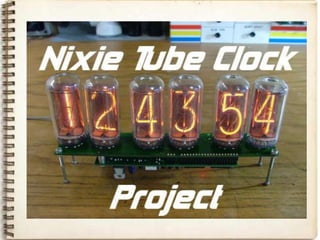
THE DECODER
PREPARED BY: JOHN LEXTER L. EMBERADOR
         BSIE-201 ELECTRONICS
  SUBMITTED TO: MS. JANICE G. DULCE
   DATE SUBMITTED: AUGUST 13,2012
BASIC CONCEPT
1. A DECODER circuit is used to recognize the
  various combinations of an input word and
  provide an output for each combination.
2.If an input word contains N “bits” then the
  decoder can have 2N outputs.
3.A combination of gates can be used to
  construct a decoder circuit.
4.A BCD to Decimal Decoder is used to provide
  decimal information from a binary coded
  input.
INTRODUCTORY INFORMATION
● A decoder can be thought of in the
  opposite sense as an encoder. In
  encoder, the decimal number was coded
  so that digital operation could be
  performed using binary numbers. The
  binary information which was processed
  in a coded form by digital circuits can be
  recognized or decoded by a decoder
  circuit.
• The resulting outputs will represent
  the original input code. A typical
  example of this is a BCD to Decimal
  Decoder.
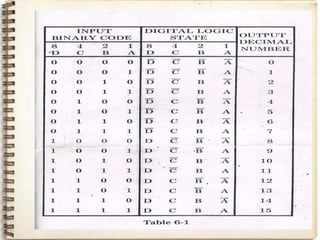
• Table 6-1 shows the decimal
  equivalents of a four “bit” binary
  word. In addition it shows the states
  of the four inputs ABCD to a decider
  required to represent decimal
  numbers 0 through 9.
• Notice that the table shows a four bit binary
  word can produce up to 16 distinct outputs. A
  general rule for decoders is that when the
  number of inputs is equal to a number N, the
  decoder will produce 2N outputs.
• For table 6-1, N equals 4 and there will be 24
  or 16 outputs. However, we need only to
  produce one digit of a decimal number or the
  decimal symbols 0 through 9.
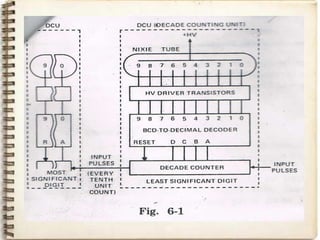
• Figure 6-1 shows a typical application for a
  BCD to Decimal decoder.
• The functions shown will provide a
  two digit numeric readout using
  Nixie ® tubes as display devices.
• The requirement is to provide a
  signal to energize the proper
  number, 0 through 9 of the Nixie
  Tube, when a certain number of
  input pulses are counted in Binary
  Coded Decimal form.
• That is, a four bit BCD word exist as inputs to
  the decoder and outputs 0 through 9 are
  required for Nixie tube drivers. The circuitry
  for a second digit is shown in block form, is
  identical to the first digit and accepts a pulse
  following each 0 through 9 sequence of the
  first digit.
• Simultaneously, a reset pulse within the
  counter will initiate the BCD code 0000 and
  the numeric 0 output. The system shown
  represents a two digit counter that will count
  up to 99 and then reset to 0.
IDENTIFYING BCD TO
     DECIMAL DECODER
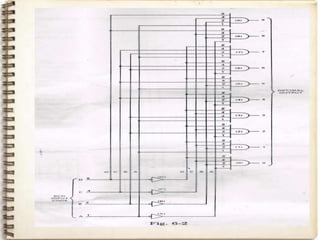
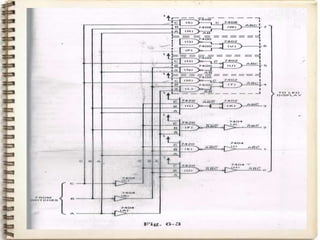
• A BCD to Decimal Decoder circuit
  is shown in Figure 6-2.
• As we can see from the figure 6-1 and
  table 6-1, the decoding process
  essentially requires the logic AND
  operation. The table and figure show the
  BCD inputs required to produce the
  decimal outputs 0 through 9.
• Recalling that all HI logic states are
  required to produce HI outputs, notice
  that the circuit shows inverters to
  provide HI inputs at the AND gates when
  BCD inputs A,B,C and D are L0 (A̅,B̅,C̅ and
  D̅).
• Also notice that all lines of the circuit are identified
  showing the input state and code place value for
  each input bit. For example, if the BCD code for the
  number 6 were to be decoded the input from table
  6-1 would be 0110 or D̅CBA̅. In figure 6-2 a L0 at the
  input to INVERTERS (D) and (A)(circles) will produce
  a HI at these outputs (no circles). The remaining 2
  input bits required to produce a HI output from AND
  gate (6), namely C and B are HI and will activate the
  gate without inversion. Looking at the input lines to
  gate (6) will verify that a HI will exist on all inputs for
  the code 0110 or D̅CBA̅ with place values (8̅421̅).
• All remaining gates of figure 6-
  2 can be analyzed in the same
  manner. A HI at the outputs
  would provide the signal
  required to activate a numeric
  readout.
ANALYZING TROUBLE SYMPTOMS OF
 DECODER CIRCUIT AND ITS SIGNAL
• Decoder circuit operation can be checked by
  noting the inputs and outputs. An analysis of
  the inputs and outputs usually indicates
  location of the circuit fault. Then, logic probe
  circuit tracing can be employed to isolate the
  exact location of the fault.
• For example, in the BCD decoder circuit of
  figure 6-3, a defective gate will affect only one
  decimal output, the gate might be open or
  shorted, in which case the output would
  remain permanently L0 or HI.
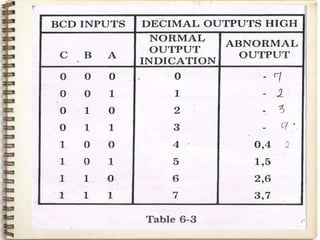
• On the other hand, if one of the
  INVERTERS were defective, the
  decimal outputs would be incorrect
  for several inputs. If the C̅ inverter
  were in a permanently HI state, for
  example, then as the BCD inputs
  proceeded through a count from 000
  to 111, we would get the outputs
  shown in table 6-3.
POST-TEST
I.IDENTIFICATION
1.A DECODER can be thought of in the
  opposite sense as an __________.
2.What is the general rule for decoder, if
  the number of the inputs is equal to a
  number N, the decoder will produce
  _________ outputs.
3.__________ is used to provide decimal
  information from a binary coded input.
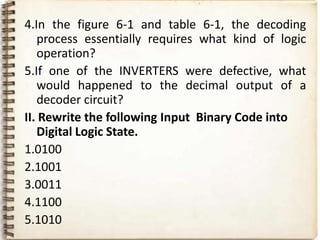
4.In the figure 6-1 and table 6-1, the decoding
   process essentially requires what kind of logic
   operation?
5.If one of the INVERTERS were defective, what
   would happened to the decimal output of a
   decoder circuit?
II. Rewrite the following Input Binary Code into
   Digital Logic State.
1.0100
2.1001
3.0011
4.1100
5.1010
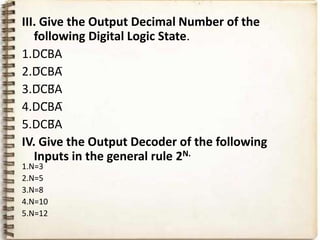
III. Give the Output Decimal Number of the
   following Digital Logic State.
1.DC̅BA
2.D̅CBA̅
3.D̅C̅B̅A
4.DC̅BA̅
5.DCB̅A
IV. Give the Output Decoder of the following
   Inputs in the general rule 2N.
1.N=3
2.N=5
3.N=8
4.N=10
5.N=12
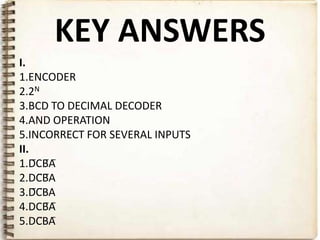
KEY ANSWERS
I.
1.ENCODER
2.2N
3.BCD TO DECIMAL DECODER
4.AND OPERATION
5.INCORRECT FOR SEVERAL INPUTS
II.
1.D̅CB̅A̅
2.DC̅B̅A
3.D̅C̅BA
4.DCB̅A̅
5.DC̅BA̅
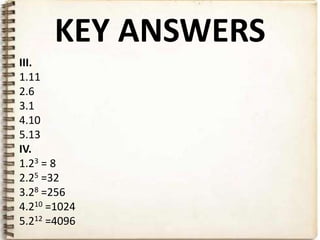
KEY ANSWERS
III.
1.11
2.6
3.1
4.10
5.13
IV.
1.23 = 8
2.25 =32
3.28 =256
4.210 =1024
5.212 =4096

The decoder

  • 1.
    THE DECODER PREPARED BY:JOHN LEXTER L. EMBERADOR BSIE-201 ELECTRONICS SUBMITTED TO: MS. JANICE G. DULCE DATE SUBMITTED: AUGUST 13,2012
  • 2.
    BASIC CONCEPT 1. ADECODER circuit is used to recognize the various combinations of an input word and provide an output for each combination. 2.If an input word contains N “bits” then the decoder can have 2N outputs. 3.A combination of gates can be used to construct a decoder circuit. 4.A BCD to Decimal Decoder is used to provide decimal information from a binary coded input.
  • 3.
    INTRODUCTORY INFORMATION ● Adecoder can be thought of in the opposite sense as an encoder. In encoder, the decimal number was coded so that digital operation could be performed using binary numbers. The binary information which was processed in a coded form by digital circuits can be recognized or decoded by a decoder circuit.
  • 4.
    • The resultingoutputs will represent the original input code. A typical example of this is a BCD to Decimal Decoder. • Table 6-1 shows the decimal equivalents of a four “bit” binary word. In addition it shows the states of the four inputs ABCD to a decider required to represent decimal numbers 0 through 9.
  • 6.
    • Notice thatthe table shows a four bit binary word can produce up to 16 distinct outputs. A general rule for decoders is that when the number of inputs is equal to a number N, the decoder will produce 2N outputs. • For table 6-1, N equals 4 and there will be 24 or 16 outputs. However, we need only to produce one digit of a decimal number or the decimal symbols 0 through 9. • Figure 6-1 shows a typical application for a BCD to Decimal decoder.
  • 8.
    • The functionsshown will provide a two digit numeric readout using Nixie ® tubes as display devices. • The requirement is to provide a signal to energize the proper number, 0 through 9 of the Nixie Tube, when a certain number of input pulses are counted in Binary Coded Decimal form.
  • 10.
    • That is,a four bit BCD word exist as inputs to the decoder and outputs 0 through 9 are required for Nixie tube drivers. The circuitry for a second digit is shown in block form, is identical to the first digit and accepts a pulse following each 0 through 9 sequence of the first digit. • Simultaneously, a reset pulse within the counter will initiate the BCD code 0000 and the numeric 0 output. The system shown represents a two digit counter that will count up to 99 and then reset to 0.
  • 11.
    IDENTIFYING BCD TO DECIMAL DECODER • A BCD to Decimal Decoder circuit is shown in Figure 6-2.
  • 13.
    • As wecan see from the figure 6-1 and table 6-1, the decoding process essentially requires the logic AND operation. The table and figure show the BCD inputs required to produce the decimal outputs 0 through 9. • Recalling that all HI logic states are required to produce HI outputs, notice that the circuit shows inverters to provide HI inputs at the AND gates when BCD inputs A,B,C and D are L0 (A̅,B̅,C̅ and D̅).
  • 14.
    • Also noticethat all lines of the circuit are identified showing the input state and code place value for each input bit. For example, if the BCD code for the number 6 were to be decoded the input from table 6-1 would be 0110 or D̅CBA̅. In figure 6-2 a L0 at the input to INVERTERS (D) and (A)(circles) will produce a HI at these outputs (no circles). The remaining 2 input bits required to produce a HI output from AND gate (6), namely C and B are HI and will activate the gate without inversion. Looking at the input lines to gate (6) will verify that a HI will exist on all inputs for the code 0110 or D̅CBA̅ with place values (8̅421̅).
  • 15.
    • All remaininggates of figure 6- 2 can be analyzed in the same manner. A HI at the outputs would provide the signal required to activate a numeric readout.
  • 16.
    ANALYZING TROUBLE SYMPTOMSOF DECODER CIRCUIT AND ITS SIGNAL • Decoder circuit operation can be checked by noting the inputs and outputs. An analysis of the inputs and outputs usually indicates location of the circuit fault. Then, logic probe circuit tracing can be employed to isolate the exact location of the fault. • For example, in the BCD decoder circuit of figure 6-3, a defective gate will affect only one decimal output, the gate might be open or shorted, in which case the output would remain permanently L0 or HI.
  • 18.
    • On theother hand, if one of the INVERTERS were defective, the decimal outputs would be incorrect for several inputs. If the C̅ inverter were in a permanently HI state, for example, then as the BCD inputs proceeded through a count from 000 to 111, we would get the outputs shown in table 6-3.
  • 20.
    POST-TEST I.IDENTIFICATION 1.A DECODER canbe thought of in the opposite sense as an __________. 2.What is the general rule for decoder, if the number of the inputs is equal to a number N, the decoder will produce _________ outputs. 3.__________ is used to provide decimal information from a binary coded input.
  • 21.
    4.In the figure6-1 and table 6-1, the decoding process essentially requires what kind of logic operation? 5.If one of the INVERTERS were defective, what would happened to the decimal output of a decoder circuit? II. Rewrite the following Input Binary Code into Digital Logic State. 1.0100 2.1001 3.0011 4.1100 5.1010
  • 22.
    III. Give theOutput Decimal Number of the following Digital Logic State. 1.DC̅BA 2.D̅CBA̅ 3.D̅C̅B̅A 4.DC̅BA̅ 5.DCB̅A IV. Give the Output Decoder of the following Inputs in the general rule 2N. 1.N=3 2.N=5 3.N=8 4.N=10 5.N=12
  • 23.
    KEY ANSWERS I. 1.ENCODER 2.2N 3.BCD TODECIMAL DECODER 4.AND OPERATION 5.INCORRECT FOR SEVERAL INPUTS II. 1.D̅CB̅A̅ 2.DC̅B̅A 3.D̅C̅BA 4.DCB̅A̅ 5.DC̅BA̅
  • 24.
    KEY ANSWERS III. 1.11 2.6 3.1 4.10 5.13 IV. 1.23 =8 2.25 =32 3.28 =256 4.210 =1024 5.212 =4096