CHAPTER 1
Basic Principles of
Digital Systems
ANALOG VS. DIGITAL
 Analog:
 A way of representing a physical quantity by a
proportional continuous voltage or current.
 Digital:
 A way of representing a physical quantity in discrete
voltage steps.
2
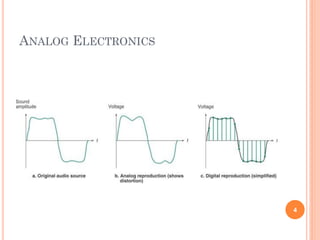
ANALOG ELECTRONICS
 Values are continuously variable between defined
values.
 Can have any value within a defined range.
3
ANALOG ELECTRONICS
4
DIGITAL ELECTRONICS
 Values can vary only by distinct, or discrete,
steps.
 Can only have two values.
5
DIGITAL LOGIC LEVELS
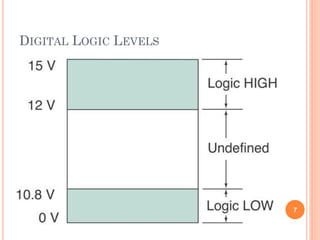
 Logic HIGH is the higher voltage and
represented by binary digit ‘1’.
 Logic LOW is the lower voltage and represented
by binary digit ‘0’.
6
DIGITAL LOGIC LEVELS
7
BINARY NUMBER SYSTEM
 Uses two digits, 0 and 1.
 Represents any number using the positional
notation.
8
POSITIONAL NOTATION
 The value of a digit depends on its placement
within a number.
 In base 10, the positional values are (starting to
the left of the decimal) –
1 (100), 10 (101), 100 (102), 1000 (103), etc.
 In base 2, the positional values are
1 (20), 2 (21), 4 (22), 8 (23), etc.
9
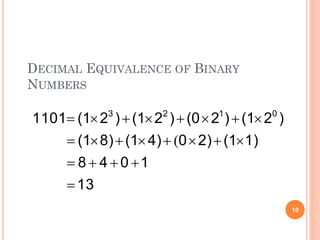
DECIMAL EQUIVALENCE OF BINARY
NUMBERS
10
13
1048
1)(12)04)(18)(1
)2(1)2(0)2(1)2(11101 0123




(
BIT
 Shorthand for binary digit, a logic 0 or 1.
 The most significant bit (MSB) is the leftmost bit
of a binary number.
 The least significant bit (LSB) is the rightmost
bit of a binary number.
11
BINARY INPUTS
 Digital circuits operate by accepting logic levels
(0,1) at their input(s).
 The corresponding output(s) logic level will
change (0,1).
12
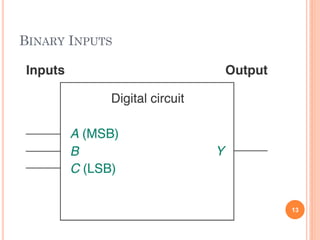
BINARY INPUTS
13
TRUTH TABLE
 A list of output logic levels corresponding to all
possible input combinations.
 The number of input combinations is 2n, where n
is the number of inputs.
14
INPUT COMBINATIONS
 A logic circuit with 3 inputs will have 23 or 8
possible input conditions.
 For this logic circuit there would also be 8
possible output conditions.
15
CONSTRUCTING A BINARY SEQUENCE
FOR A TRUTH TABLE – 1
 Two methods:
 Learn to count in binary
 Follow a simple repetitive pattern
 Memorize the binary numbers from 0000 to 1111
and their decimal equivalents (0 to 15).
 Use the weighted values of binary bits.
16
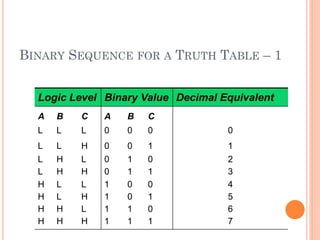
BINARY SEQUENCE FOR A TRUTH TABLE – 1
Logic Level Binary Value Decimal Equivalent
A B C A B C
L L L 0 0 0 0
L L H 0 0 1 1
L H L 0 1 0 2
L H H 0 1 1 3
H L L 1 0 0 4
H L H 1 0 1 5
H H L 1 1 0 6
H H H 1 1 1 7
17
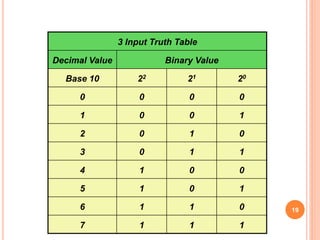
FOLLOW A SIMPLE REPETITIVE PATTERN
 The LSB of any binary number alternates
between 0 and 1 with every line.
 The next bit alternates every two lines.
 The next bit alternates every four lines, and so
on.
18
19
3 Input Truth Table
Decimal Value Binary Value
Base 10 22 21 20
0 0 0 0
1 0 0 1
2 0 1 0
3 0 1 1
4 1 0 0
5 1 0 1
6 1 1 0
7 1 1 1
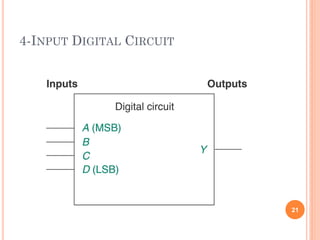
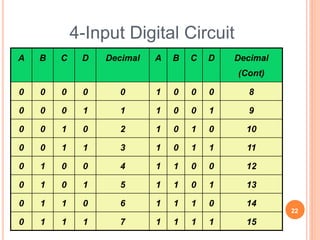
4-INPUT DIGITAL CIRCUIT
 24 = 16 possible input conditions.
20
4-INPUT DIGITAL CIRCUIT
21
A B C D Decimal A B C D Decimal
(Cont)
0 0 0 0 0 1 0 0 0 8
0 0 0 1 1 1 0 0 1 9
0 0 1 0 2 1 0 1 0 10
0 0 1 1 3 1 0 1 1 11
0 1 0 0 4 1 1 0 0 12
0 1 0 1 5 1 1 0 1 13
0 1 1 0 6 1 1 1 0 14
0 1 1 1 7 1 1 1 1 15
22
4-Input Digital Circuit
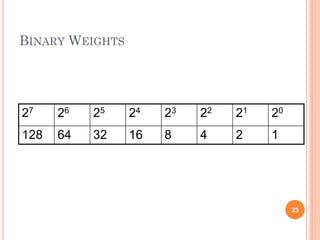
BINARY WEIGHTS
23
27 26 25 24 23 22 21 20
128 64 32 16 8 4 2 1
DECIMAL-TO-BINARY CONVERSION
 Two methods:
 Sum powers of 2
 Repeated division by 2
24
SUM POWERS OF 2
 Step 1:
 Determine the largest power of 2 less than or equal to
the number to be converted.
 Place a 1 in that positional location.
25
SUM POWERS OF 2
 Step 2:
 Subtract the number found in Step 1 from the
number to be converted.
 For the new number, determine if the next lowest
power of 2 is less than or equal to that number.
26
SUM POWERS OF 2
 Step 3:
 If the new power of two from Step 2 is larger, place a
0 in that positional location.
 If the new value is less than or equal, place a 1 in
that positional location.
27
SUM POWERS OF 2
 Step 4:
 Repeat Steps 2 and 3 until there is nothing left to
subtract.
 All remaining bits are set to 0.
28
REPEATED DIVISION BY 2
 Step 1:
 Take the number to be converted, and divide it by 2.
 The remainder (0 or 1) is the LSB of the binary value.
29
REPEATED DIVISION BY 2
 Step 2:
 Divide the quotient from Step 1 by 2.
 The remainder (0 or 1) is the next most significant
bit.
30
REPEATED DIVISION BY 2
 Step 3:
 Continue to execute Step 2 until the quotient is 0.
 The last remainder is the MSB.
31
FRACTIONAL BINARY NUMBERS
 Radix point:
 The generalized decimal point. The dividing line
between positive and negative powers for positional
multipliers.
 Binary point:
 The radix point for binary numbers.
32
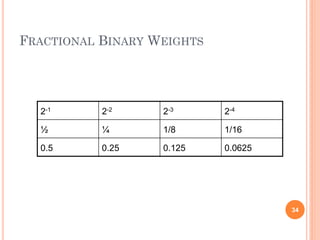
FRACTIONAL BINARY VALUES
 The value immediately to the right of the binary
point is 2–1 = 0.5.
 The next value to the right is 2–2 = 0.25.
 The next value to the right is 2–4 = 0.125, and so
on.
33
FRACTIONAL BINARY WEIGHTS
34
2-1 2-2 2-3 2-4
½ ¼ 1/8 1/16
0.5 0.25 0.125 0.0625
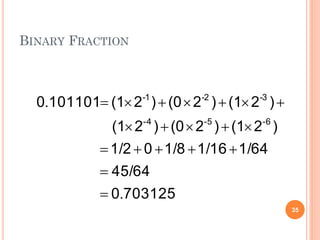
BINARY FRACTION
35
7031250
45/64
1/641/161/801/2
)2(1)2(0)2(1
)2(1)2(0)2(11011010
6-5-4-
-3-2-1
.
.





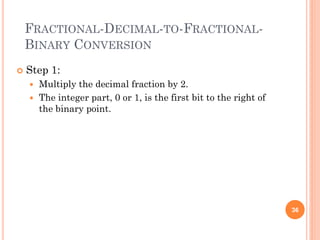
FRACTIONAL-DECIMAL-TO-FRACTIONAL-
BINARY CONVERSION
 Step 1:
 Multiply the decimal fraction by 2.
 The integer part, 0 or 1, is the first bit to the right of
the binary point.
36
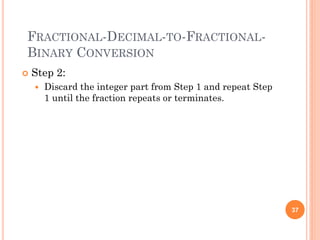
FRACTIONAL-DECIMAL-TO-FRACTIONAL-
BINARY CONVERSION
 Step 2:
 Discard the integer part from Step 1 and repeat Step
1 until the fraction repeats or terminates.
37
HEXADECIMAL NUMBERS
 Base 16 number system.
 Primarily used as a shorthand form of binary
numbers.
38
COUNTING IN HEXADECIMAL
 Values range from 0 to F with the letters A to F
used to represent the values 10 to 15
respectively.
 Positional multipliers are powers of 16:
160 = 1, 161 = 16, 162 = 256, etc.
39
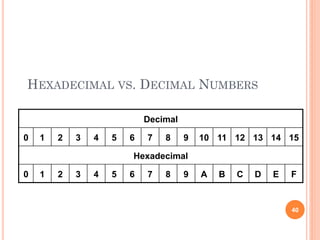
HEXADECIMAL VS. DECIMAL NUMBERS
40
Decimal
0 1 2 3 4 5 6 7 8 9 10 11 12 13 14 15
Hexadecimal
0 1 2 3 4 5 6 7 8 9 A B C D E F
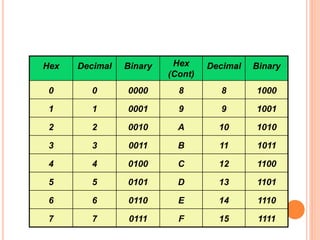
Hex Decimal Binary Hex
(Cont)
Decimal Binary
0 0 0000 8 8 1000
1 1 0001 9 9 1001
2 2 0010 A 10 1010
3 3 0011 B 11 1011
4 4 0100 C 12 1100
5 5 0101 D 13 1101
6 6 0110 E 14 1110
7 7 0111 F 15 1111
41
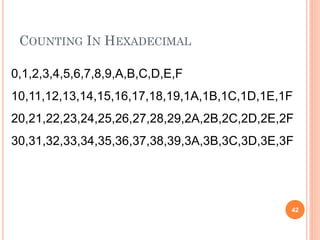
COUNTING IN HEXADECIMAL
42
0,1,2,3,4,5,6,7,8,9,A,B,C,D,E,F
10,11,12,13,14,15,16,17,18,19,1A,1B,1C,1D,1E,1F
20,21,22,23,24,25,26,27,28,29,2A,2B,2C,2D,2E,2F
30,31,32,33,34,35,36,37,38,39,3A,3B,3C,3D,3E,3F
DECIMAL-TO-HEXADECIMAL CONVERSION
 Two methods:
 Sum of weighted hexadecimal digits.
 Repeated division by 16.
43
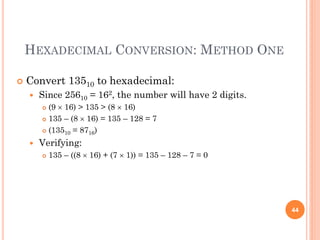
HEXADECIMAL CONVERSION: METHOD ONE
 Convert 13510 to hexadecimal:
 Since 25610 = 162, the number will have 2 digits.
 (9  16) > 135 > (8  16)
 135 – (8  16) = 135 – 128 = 7
 (13510 = 8716)
 Verifying:
 135 – ((8  16) + (7  1)) = 135 – 128 – 7 = 0
44
CONVERSION BETWEEN HEXADECIMAL AND
BINARY
 Each hexadecimal digit represents 4 binary bits.
45
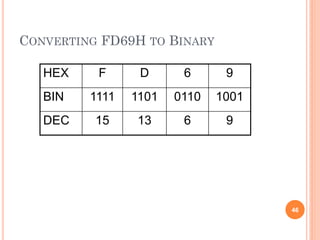
CONVERTING FD69H TO BINARY
46
HEX F D 6 9
BIN 1111 1101 0110 1001
DEC 15 13 6 9
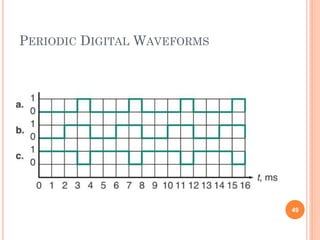
PERIODIC DIGITAL WAVEFORMS
 A periodic digital waveform is a time-varying
sequence of logic HIGHs and LOWs that repeat
over some period of time.
 Period (T) is the time required for the pattern to
repeat.
47
PERIODIC DIGITAL WAVEFORMS
 Frequency (f) is the number of times per second a
signal repeats and is the reciprocal of period.
 f = 1/T
48
PERIODIC DIGITAL WAVEFORMS
49
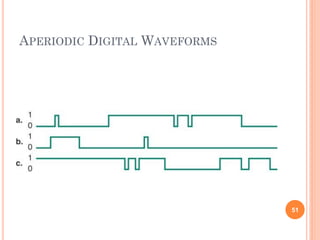
APERIODIC DIGITAL WAVEFORMS
 An aperiodic digital waveform is a time-varying
sequence of logic HIGHs and LOWs that does not
repeat.
50
APERIODIC DIGITAL WAVEFORMS
51
WAVEFORM DEFINITIONS
 Time HIGH (th) is the time a logic signal is in its
HIGH state.
 Time LOW (tl) is the time a logic signal is in its
LOW state.
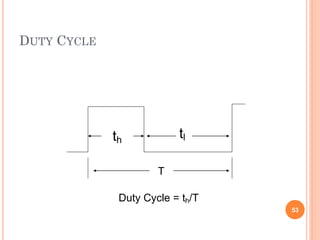
 Duty cycle is the ratio of the time a logic signal is
HIGH (th) to the period (T).
52
DUTY CYCLE
53
th
tl
T
Duty Cycle = th/T
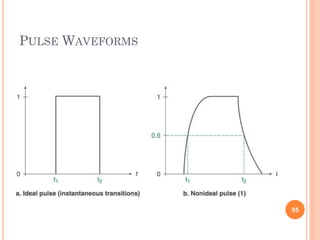
PULSE WAVEFORMS
 A pulse is a momentary variation of voltage from
one logic level to the opposite level and back
again.
 Amplitude is the voltage magnitude of a pulse.
 Edge is the part of a pulse representing the
transition from one logic level to the other.
54
PULSE WAVEFORMS
55
PULSE WAVEFORM CHARACTERISTICS
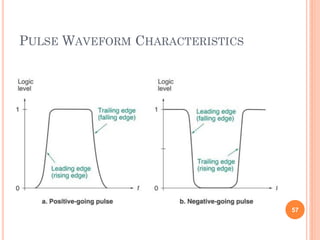
 Rising edge is the transition from LOW to HIGH.
 Falling edge is the transition from HIGH to
LOW.
 Leading edge is the earliest transition.
 Falling edge is the latest transition.
56
PULSE WAVEFORM CHARACTERISTICS
57
PULSE WAVEFORM TIMING
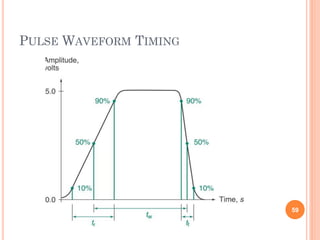
 Pulse width (tw) is the time from the 50% point of
the leading edge to the 50% point of the trailing
edge.
 Rise time is the time from 10% to 90% amplitude
of the rising edge.
 Fall time is the time from 90% to 10% amplitude
of the falling edge.
58
PULSE WAVEFORM TIMING
59

Chapter 01 Basic Principles of Digital Systems