1 
Combinational Logic 
Design 
Unit-3
List of Topics: 
 Single output and multiple output combinational logic circuit design 
 AND-OR, OR-AND, and NAND/NOR realizations 
 Exclusive-OR and Equivalence functions 
 Binary adders/subtractors 
 Encoder, Decoder 
 Multiplexer, Demultiplexer 
 MUX realization of switching functions 
 Parity bit generator 
 Code-converters 
 Contact Networks 
 Hazards and hazard free realizations. 
2
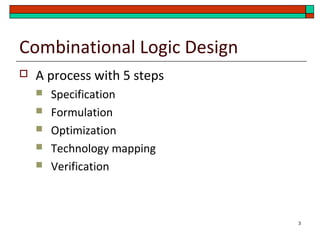
Combinational Logic Design 
 A process with 5 steps 
 Specification 
 Formulation 
 Optimization 
 Technology mapping 
 Verification 
3
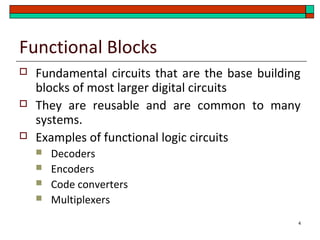
Functional Blocks 
 Fundamental circuits that are the base building 
blocks of most larger digital circuits 
 They are reusable and are common to many 
systems. 
 Examples of functional logic circuits 
 Decoders 
 Encoders 
 Code converters 
 Multiplexers 
4
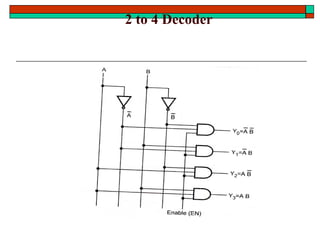
Where they are used 
 Multiplexers 
 Selectors for routing data to the processor, memory, 
I/O 
 Multiplexers route the data to the correct bus or 
port. 
 Decoders 
 are used for selecting things like a bank of memory 
and then the address within the bank. This is also 
the function needed to ‘decode’ the instruction to 
determine the operation to perform. 
 Encoders 
 are used in various components such as keyboards. 
5
Specifications step 
 Write a specification for the circuits 
 Specification includes 
 What are the inputs: how many, how many bits in a 
given output, how are they grouped, are they 
control, are they active high? 
 What are the outputs: how many and how many bits 
in each, active high, active low, tristate output? 
 The functional operation that takes place in the chip, 
i.e., for given inputs what will appear on the outputs. 
6
Formulation step 
 Convert the specifications into a variety forms 
for optimal implementation. 
 Possible forms 
 Truth Tables 
 Expressions 
 K-maps 
 Binary Decision Diagrams 
 IF THE SPECIFCATION IS ERRONOUS OR INCOMPLETE (open for various 
interpretation) then the circuit will perform as specified but will not 
perform as desired. 
7
Digital Circuits: 
 Combinational circuit consists of logic gates whose outputs 
at any time are determined directly from the present 
combination of inputs without regard to previous inputs. 
 Sequential Circuit employ memory elements in addition to 
logic gates. Their outputs are a function of the inputs and 
the state of the memory elements. 
8
Combinational Circuit: 
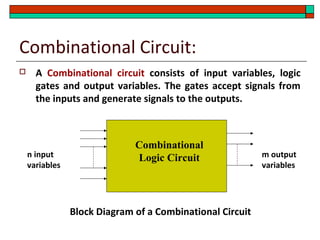
 A Combinational circuit consists of input variables, logic 
gates and output variables. The gates accept signals from 
the inputs and generate signals to the outputs. 
Combinational 
n input Logic Circuit 
variables 
m output 
variables 
Block Diagram of a Combinational Circuit
Design of Combinational Circuits: 
The design procedure involves the following steps: 
 The problem is stated. 
 The number of available input variables and required 
output variables is determined. 
 The input and output variables are assigned letter symbols. 
 The truth table that defines the required relationships 
between inputs and outputs is derived. 
 The simplified Boolean function for each output is 
obtained. 
 The logic diagram is drawn.
A Practical design method would have to consider 
constraints such as: 
 Minimum no. of gates. 
 Minimum no. of inputs to the gates. 
 Minimum propagation time of the signal through the 
circuit. 
 Minimum no. of interconnections and 
 Limitations of the driving capabilities of each gate.
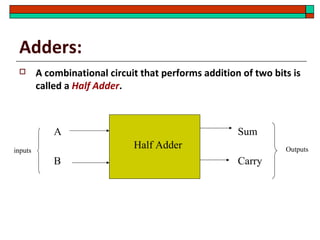
Adders: 
 A combinational circuit that performs addition of two bits is 
called a Half Adder. 
Half Adder 
A 
inputs Outputs 
B 
Sum 
Carry
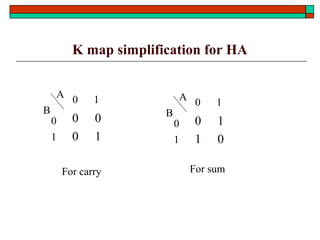
K map simplification for HA 
0 0 
0 1 
A 
B 
0 1 
0 
1 
0 1 
1 0 
A 
B 
0 1 
0 
1 
For carry For sum
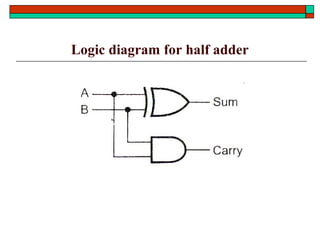
Logic diagram for half adder
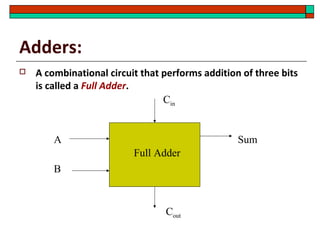
Adders: 
 A combinational circuit that performs addition of three bits 
is called a Full Adder. 
Full Adder 
A 
B 
Sum 
Cin 
Cout
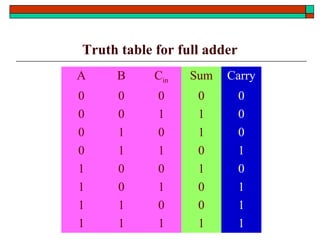
Truth table for full adder 
A B Cin Sum Carry 
0 0 0 0 0 
0 0 1 1 0 
0 1 0 1 0 
0 1 1 0 1 
1 0 0 1 0 
1 0 1 0 1 
1 1 0 0 1 
1 1 1 1 1
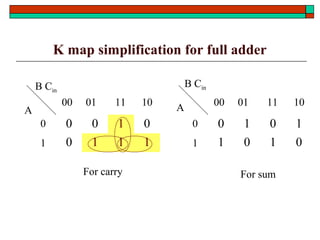
K map simplification for full adder 
0 0 1 0 
0 1 1 1 
B Cin 
00 01 11 10 
0 
1 
00 01 11 10 
0 1 0 1 
1 0 1 0 
0 
1 
A 
B Cin 
A 
For carry For sum
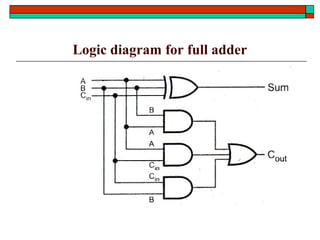
Logic diagram for full adder
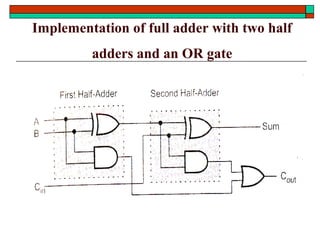
Implementation of full adder with two half 
adders and an OR gate
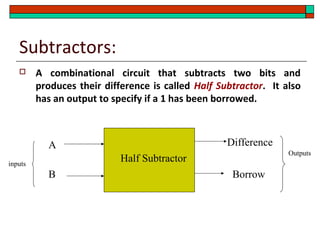
Subtractors: 
 A combinational circuit that subtracts two bits and 
produces their difference is called Half Subtractor. It also 
has an output to specify if a 1 has been borrowed. 
Half Subtractor 
A 
B 
Difference 
Borrow 
Outputs 
inputs
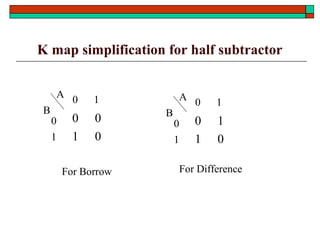
K map simplification for half subtractor 
0 0 
1 0 
A 
B 
0 1 
0 
1 
0 1 
1 0 
A 
B 
0 1 
0 
1 
For Borrow For Difference
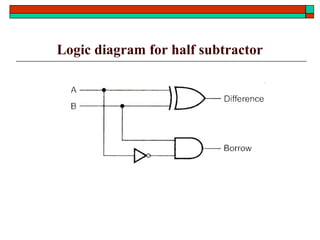
Logic diagram for half subtractor
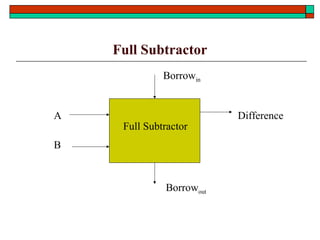
Full Subtractor 
Full Subtractor 
A 
B 
Difference 
Borrowin 
Borrowout
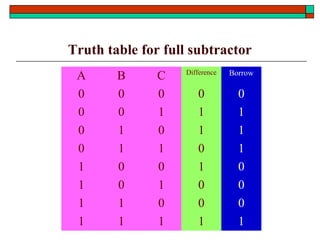
Truth table for full subtractor 
A B C Difference Borrow 
0 0 0 0 0 
0 0 1 1 1 
0 1 0 1 1 
0 1 1 0 1 
1 0 0 1 0 
1 0 1 0 0 
1 1 0 0 0 
1 1 1 1 1
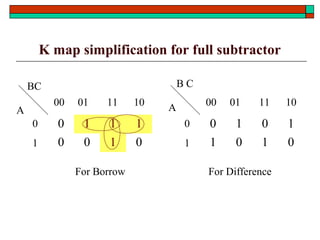
K map simplification for full subtractor 
0 1 1 1 
0 0 1 0 
BC 
00 01 11 10 
0 
1 
00 01 11 10 
0 1 0 1 
1 0 1 0 
0 
1 
A 
B C 
A 
For Borrow For Difference
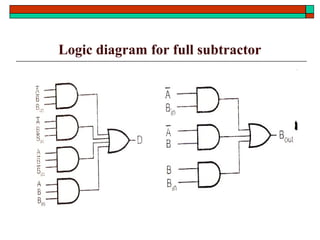
Logic diagram for full subtractor
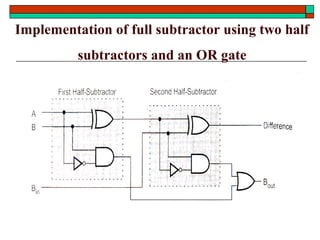
Implementation of full subtractor using two half 
subtractors and an OR gate
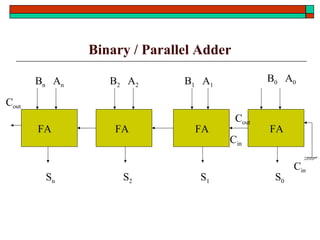
Binary / Parallel Adder 
B B0 A0 1 A1 B2 A2 Bn An 
Cout 
Cin 
Cin 
Cout 
FA FA FA FA 
Sn S2 S1 S0
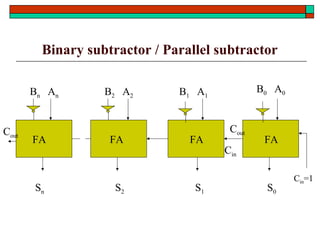
Binary subtractor / Parallel subtractor 
B B0 A0 1 A1 B2 A2 Bn An 
Cout 
Cin 
FA FA FA FA 
Cout 
Sn S2 S1 S0 
Cin=1
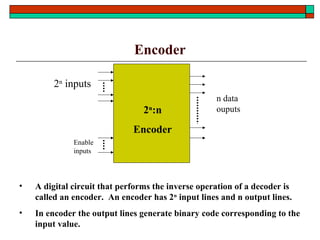
Encoder 
2n inputs 
• A digital circuit that performs the inverse operation of a decoder is 
called an encoder. An encoder has 2n input lines and n output lines. 
• In encoder the output lines generate binary code corresponding to the 
input value. 
n data 
ouputs 
Enable 
inputs 
2n:n 
Encoder
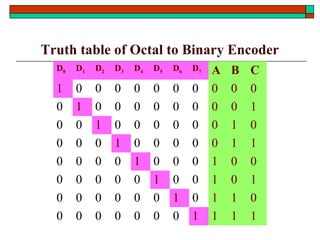
Truth table of Octal to Binary Encoder 
D0 D1 D2 D3 D4 D5 D6 D7 A B C 
1 0 0 0 0 0 0 0 0 0 0 
0 1 0 0 0 0 0 0 0 0 1 
0 0 1 0 0 0 0 0 0 1 0 
0 0 0 1 0 0 0 0 0 1 1 
0 0 0 0 1 0 0 0 1 0 0 
0 0 0 0 0 1 0 0 1 0 1 
0 0 0 0 0 0 1 0 1 1 0 
0 0 0 0 0 0 0 1 1 1 1
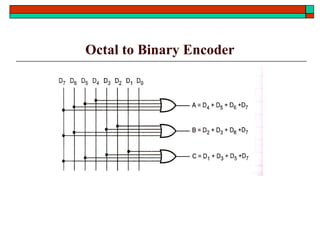
Octal to Binary Encoder
Decoders 
• A decoder is a multiple-input, multiple-output logic circuit 
which converts coded inputs into coded outputs, where the 
input and output codes are different. 
• The input code generally has fewer bits than the output code, 
• Each input code word produces a different output code word.
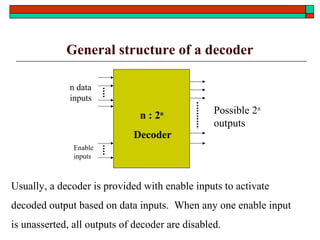
General structure of a decoder 
Possible 2n 
outputs 
n data 
inputs 
Enable 
inputs 
n : 2n 
Decoder 
Usually, a decoder is provided with enable inputs to activate 
decoded output based on data inputs. When any one enable input 
is unasserted, all outputs of decoder are disabled.
Binary decoder 
• A decoder which has an n-bit binary input code and a one 
activated output out of 2n output code is called binary 
decoder. 
• A binary decoder is used when it is necessary to 
activate exactly one of 2n output based on an n-bit input 
value.
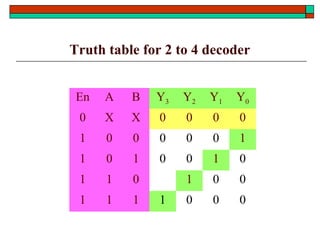
Truth table for 2 to 4 decoder 
En A B Y3 Y2 Y1 Y0 
0 X X 0 0 0 0 
1 0 0 0 0 0 1 
1 0 1 0 0 1 0 
1 1 0 0 1 0 0 
1 1 1 1 0 0 0
2 to 4 Decoder
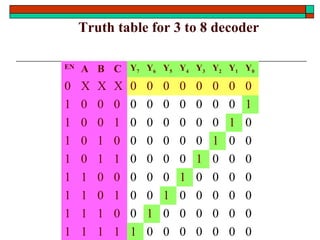
Truth table for 3 to 8 decoder 
EN A B C Y7 Y6 Y5 Y4 Y3 Y2 Y1 Y0 
0 X X X 0 0 0 0 0 0 0 0 
1 0 0 0 0 0 0 0 0 0 0 1 
1 0 0 1 0 0 0 0 0 0 1 0 
1 0 1 0 0 0 0 0 0 1 0 0 
1 0 1 1 0 0 0 0 1 0 0 0 
1 1 0 0 0 0 0 1 0 0 0 0 
1 1 0 1 0 0 1 0 0 0 0 0 
1 1 1 0 0 1 0 0 0 0 0 0 
1 1 1 1 1 0 0 0 0 0 0 0
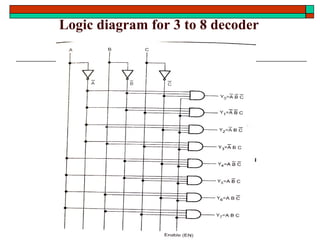
Logic diagram for 3 to 8 decoder
BCD to decimal decoder 
• BCD decoders have four inputs and 10 outputs. 
• The four bit BCD input is decoded to activate one of the ten 
outputs. 
• It accepts four active high BCD inputs and provides 10 
independent active low outputs
Multiplexer 
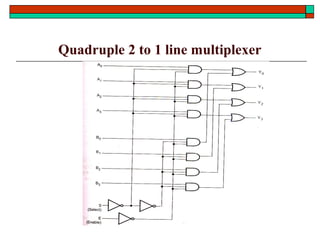
• Multiplexer is a digital switch. It allows digital information 
from several sources to be routed onto a single output line. 
• The selection of a particular input line is controlled by a set of 
selection lines. 
• Normally, there are 2n input lines and n selection lines whose 
bit combinations determine which input is selected.
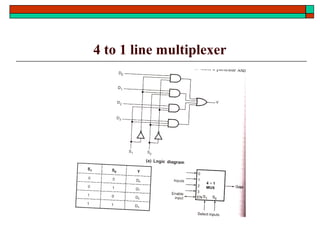
4 to 1 line multiplexer
Quadruple 2 to 1 line multiplexer
Expanding multiplexers 
Expansion of multiplexer
Implementation of combinational logic using Mux 
• A multiplexer consists of a set of AND gates whose outputs are connected to 
single OR gate. Because of this construction any boolean function in a SOP 
form can be easily realized using multiplexer. 
• Each AND gate in a multiplexer represents a min term. 
• In 8 to 1 mux, there are 3 select inputs and 23 minterms. 
• By connecting the function variables directly to the select inputs, a multiplexer 
can be made to select the AND gate that corresponds to the minterm of the 
function. 
• If a minterm exists in a function, we have to connect the AND gate data input to 
logic 1; otherwise we have to connect it to logic 0.
Demultiplexers 
• A demultiplexer is a circuit that receives information on a single 
line and transmits this information on one of 2n possible outputs. 
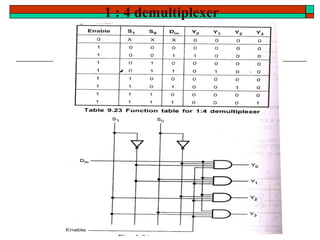
• The selection of specific output line is controlled by the values 
of n selection lines.
1 : 4 demultiplexer
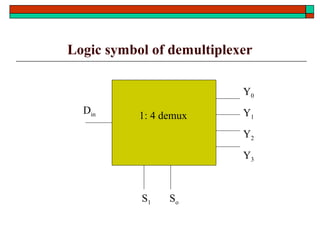
Logic symbol of demultiplexer 
D 1: 4 demux in 
Y0 
Y1 
Y2 
Y3 
S1 So
Cascading Demultiplexers 
Cascading demultiplexers is same as that of the 
cascading decoders.
Implementing boolean function using 
demultiplexer 
Demultiplexer gives min terms at the output so by 
logically Oring required minterms we can implement 
boolean functions.
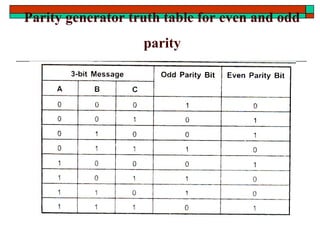
Parity generator truth table for even and odd 
parity
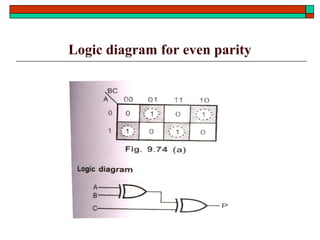
Logic diagram for even parity
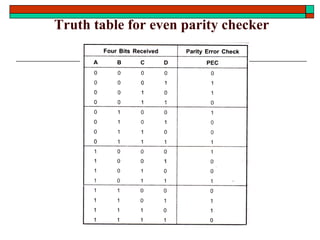
Truth table for even parity checker
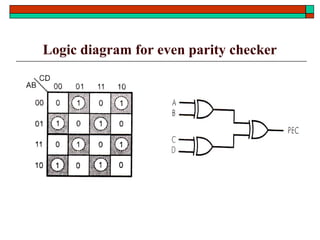
Logic diagram for even parity checker
Code converters 
1. Binary to BCD converter 
2. BCD to binary converter 
3. BCD to excess 3 
4. Excess 3 to BCD 
5. Binary to gray code 
6. Gray code to binary 
7. BCD to gray code
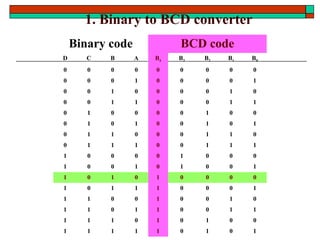
1. Binary to BCD converter 
Binary code BCD code 
D C B A B4 B3 B2 B1 B0 
0 0 0 0 0 0 0 0 0 
0 0 0 1 0 0 0 0 1 
0 0 1 0 0 0 0 1 0 
0 0 1 1 0 0 0 1 1 
0 1 0 0 0 0 1 0 0 
0 1 0 1 0 0 1 0 1 
0 1 1 0 0 0 1 1 0 
0 1 1 1 0 0 1 1 1 
1 0 0 0 0 1 0 0 0 
1 0 0 1 0 1 0 0 1 
1 0 1 0 1 0 0 0 0 
1 0 1 1 1 0 0 0 1 
1 1 0 0 1 0 0 1 0 
1 1 0 1 1 0 0 1 1 
1 1 1 0 1 0 1 0 0 
1 1 1 1 1 0 1 0 1
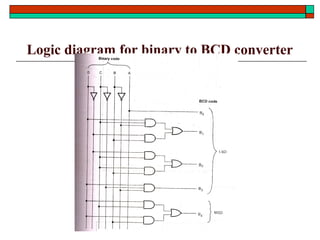
Logic diagram for binary to BCD converter
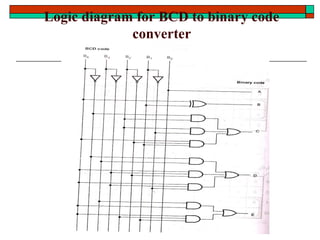
2. BCD to Binary converter 
BCD to binary table
Logic diagram for BCD to binary code 
converter
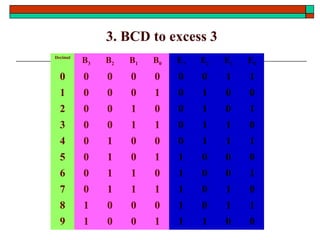
3. BCD to excess 3 
Decimal B3 B2 B1 B0 E3 E2 E1 E0 
0 0 0 0 0 0 0 1 1 
1 0 0 0 1 0 1 0 0 
2 0 0 1 0 0 1 0 1 
3 0 0 1 1 0 1 1 0 
4 0 1 0 0 0 1 1 1 
5 0 1 0 1 1 0 0 0 
6 0 1 1 0 1 0 0 1 
7 0 1 1 1 1 0 1 0 
8 1 0 0 0 1 0 1 1 
9 1 0 0 1 1 1 0 0
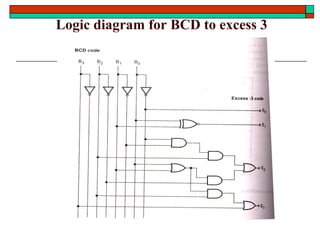
Logic diagram for BCD to excess 3
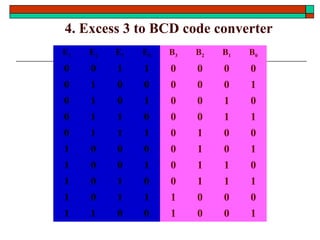
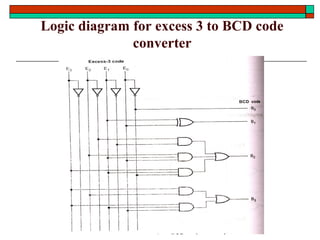
4. Excess 3 to BCD code converter 
E3 E2 E1 E0 B3 B2 B1 B0 
0 0 1 1 0 0 0 0 
0 1 0 0 0 0 0 1 
0 1 0 1 0 0 1 0 
0 1 1 0 0 0 1 1 
0 1 1 1 0 1 0 0 
1 0 0 0 0 1 0 1 
1 0 0 1 0 1 1 0 
1 0 1 0 0 1 1 1 
1 0 1 1 1 0 0 0 
1 1 0 0 1 0 0 1
Logic diagram for excess 3 to BCD code 
converter
5. Binary to Gray code converter 
Binary to gray code table
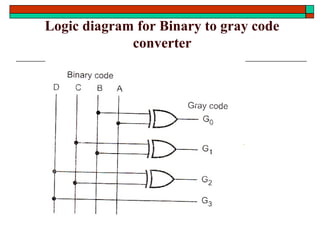
Logic diagram for Binary to gray code 
converter
6. Gray code to binary code converter 
Gray code to binary table
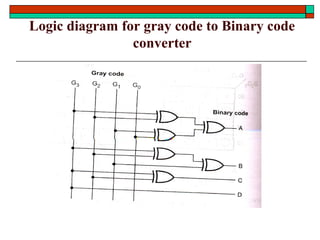
Logic diagram for gray code to Binary code 
converter
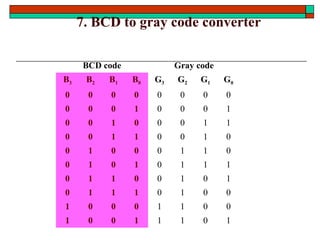
7. BCD to gray code converter 
BCD code Gray code 
B3 B2 B1 B0 G3 G2 G1 G0 
0 0 0 0 0 0 0 0 
0 0 0 1 0 0 0 1 
0 0 1 0 0 0 1 1 
0 0 1 1 0 0 1 0 
0 1 0 0 0 1 1 0 
0 1 0 1 0 1 1 1 
0 1 1 0 0 1 0 1 
0 1 1 1 0 1 0 0 
1 0 0 0 1 1 0 0 
1 0 0 1 1 1 0 1
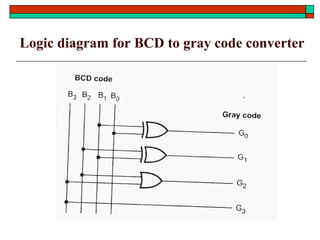
Logic diagram for BCD to gray code converter
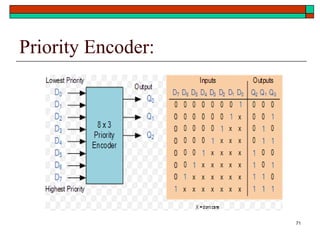
Priority encoder 
A Priority encoder is an encoder circuit that includes the priority 
function. In priority encoder, if two or more inputs are equal to 
1 at the same time, the input having the highest priority will take 
precedence.
Priority Encoder: 
71
End

STLD-Combinational logic design

  • 1.
    1 Combinational Logic Design Unit-3
  • 2.
    List of Topics:  Single output and multiple output combinational logic circuit design  AND-OR, OR-AND, and NAND/NOR realizations  Exclusive-OR and Equivalence functions  Binary adders/subtractors  Encoder, Decoder  Multiplexer, Demultiplexer  MUX realization of switching functions  Parity bit generator  Code-converters  Contact Networks  Hazards and hazard free realizations. 2
  • 3.
    Combinational Logic Design  A process with 5 steps  Specification  Formulation  Optimization  Technology mapping  Verification 3
  • 4.
    Functional Blocks Fundamental circuits that are the base building blocks of most larger digital circuits  They are reusable and are common to many systems.  Examples of functional logic circuits  Decoders  Encoders  Code converters  Multiplexers 4
  • 5.
    Where they areused  Multiplexers  Selectors for routing data to the processor, memory, I/O  Multiplexers route the data to the correct bus or port.  Decoders  are used for selecting things like a bank of memory and then the address within the bank. This is also the function needed to ‘decode’ the instruction to determine the operation to perform.  Encoders  are used in various components such as keyboards. 5
  • 6.
    Specifications step Write a specification for the circuits  Specification includes  What are the inputs: how many, how many bits in a given output, how are they grouped, are they control, are they active high?  What are the outputs: how many and how many bits in each, active high, active low, tristate output?  The functional operation that takes place in the chip, i.e., for given inputs what will appear on the outputs. 6
  • 7.
    Formulation step Convert the specifications into a variety forms for optimal implementation.  Possible forms  Truth Tables  Expressions  K-maps  Binary Decision Diagrams  IF THE SPECIFCATION IS ERRONOUS OR INCOMPLETE (open for various interpretation) then the circuit will perform as specified but will not perform as desired. 7
  • 8.
    Digital Circuits: Combinational circuit consists of logic gates whose outputs at any time are determined directly from the present combination of inputs without regard to previous inputs.  Sequential Circuit employ memory elements in addition to logic gates. Their outputs are a function of the inputs and the state of the memory elements. 8
  • 9.
    Combinational Circuit: A Combinational circuit consists of input variables, logic gates and output variables. The gates accept signals from the inputs and generate signals to the outputs. Combinational n input Logic Circuit variables m output variables Block Diagram of a Combinational Circuit
  • 10.
    Design of CombinationalCircuits: The design procedure involves the following steps:  The problem is stated.  The number of available input variables and required output variables is determined.  The input and output variables are assigned letter symbols.  The truth table that defines the required relationships between inputs and outputs is derived.  The simplified Boolean function for each output is obtained.  The logic diagram is drawn.
  • 11.
    A Practical designmethod would have to consider constraints such as:  Minimum no. of gates.  Minimum no. of inputs to the gates.  Minimum propagation time of the signal through the circuit.  Minimum no. of interconnections and  Limitations of the driving capabilities of each gate.
  • 12.
    Adders:  Acombinational circuit that performs addition of two bits is called a Half Adder. Half Adder A inputs Outputs B Sum Carry
  • 13.
    K map simplificationfor HA 0 0 0 1 A B 0 1 0 1 0 1 1 0 A B 0 1 0 1 For carry For sum
  • 14.
  • 15.
    Adders:  Acombinational circuit that performs addition of three bits is called a Full Adder. Full Adder A B Sum Cin Cout
  • 16.
    Truth table forfull adder A B Cin Sum Carry 0 0 0 0 0 0 0 1 1 0 0 1 0 1 0 0 1 1 0 1 1 0 0 1 0 1 0 1 0 1 1 1 0 0 1 1 1 1 1 1
  • 17.
    K map simplificationfor full adder 0 0 1 0 0 1 1 1 B Cin 00 01 11 10 0 1 00 01 11 10 0 1 0 1 1 0 1 0 0 1 A B Cin A For carry For sum
  • 18.
  • 19.
    Implementation of fulladder with two half adders and an OR gate
  • 20.
    Subtractors:  Acombinational circuit that subtracts two bits and produces their difference is called Half Subtractor. It also has an output to specify if a 1 has been borrowed. Half Subtractor A B Difference Borrow Outputs inputs
  • 21.
    K map simplificationfor half subtractor 0 0 1 0 A B 0 1 0 1 0 1 1 0 A B 0 1 0 1 For Borrow For Difference
  • 22.
    Logic diagram forhalf subtractor
  • 23.
    Full Subtractor FullSubtractor A B Difference Borrowin Borrowout
  • 24.
    Truth table forfull subtractor A B C Difference Borrow 0 0 0 0 0 0 0 1 1 1 0 1 0 1 1 0 1 1 0 1 1 0 0 1 0 1 0 1 0 0 1 1 0 0 0 1 1 1 1 1
  • 25.
    K map simplificationfor full subtractor 0 1 1 1 0 0 1 0 BC 00 01 11 10 0 1 00 01 11 10 0 1 0 1 1 0 1 0 0 1 A B C A For Borrow For Difference
  • 26.
    Logic diagram forfull subtractor
  • 27.
    Implementation of fullsubtractor using two half subtractors and an OR gate
  • 28.
    Binary / ParallelAdder B B0 A0 1 A1 B2 A2 Bn An Cout Cin Cin Cout FA FA FA FA Sn S2 S1 S0
  • 29.
    Binary subtractor /Parallel subtractor B B0 A0 1 A1 B2 A2 Bn An Cout Cin FA FA FA FA Cout Sn S2 S1 S0 Cin=1
  • 30.
    Encoder 2n inputs • A digital circuit that performs the inverse operation of a decoder is called an encoder. An encoder has 2n input lines and n output lines. • In encoder the output lines generate binary code corresponding to the input value. n data ouputs Enable inputs 2n:n Encoder
  • 31.
    Truth table ofOctal to Binary Encoder D0 D1 D2 D3 D4 D5 D6 D7 A B C 1 0 0 0 0 0 0 0 0 0 0 0 1 0 0 0 0 0 0 0 0 1 0 0 1 0 0 0 0 0 0 1 0 0 0 0 1 0 0 0 0 0 1 1 0 0 0 0 1 0 0 0 1 0 0 0 0 0 0 0 1 0 0 1 0 1 0 0 0 0 0 0 1 0 1 1 0 0 0 0 0 0 0 0 1 1 1 1
  • 32.
  • 33.
    Decoders • Adecoder is a multiple-input, multiple-output logic circuit which converts coded inputs into coded outputs, where the input and output codes are different. • The input code generally has fewer bits than the output code, • Each input code word produces a different output code word.
  • 34.
    General structure ofa decoder Possible 2n outputs n data inputs Enable inputs n : 2n Decoder Usually, a decoder is provided with enable inputs to activate decoded output based on data inputs. When any one enable input is unasserted, all outputs of decoder are disabled.
  • 35.
    Binary decoder •A decoder which has an n-bit binary input code and a one activated output out of 2n output code is called binary decoder. • A binary decoder is used when it is necessary to activate exactly one of 2n output based on an n-bit input value.
  • 36.
    Truth table for2 to 4 decoder En A B Y3 Y2 Y1 Y0 0 X X 0 0 0 0 1 0 0 0 0 0 1 1 0 1 0 0 1 0 1 1 0 0 1 0 0 1 1 1 1 0 0 0
  • 37.
    2 to 4Decoder
  • 38.
    Truth table for3 to 8 decoder EN A B C Y7 Y6 Y5 Y4 Y3 Y2 Y1 Y0 0 X X X 0 0 0 0 0 0 0 0 1 0 0 0 0 0 0 0 0 0 0 1 1 0 0 1 0 0 0 0 0 0 1 0 1 0 1 0 0 0 0 0 0 1 0 0 1 0 1 1 0 0 0 0 1 0 0 0 1 1 0 0 0 0 0 1 0 0 0 0 1 1 0 1 0 0 1 0 0 0 0 0 1 1 1 0 0 1 0 0 0 0 0 0 1 1 1 1 1 0 0 0 0 0 0 0
  • 39.
    Logic diagram for3 to 8 decoder
  • 40.
    BCD to decimaldecoder • BCD decoders have four inputs and 10 outputs. • The four bit BCD input is decoded to activate one of the ten outputs. • It accepts four active high BCD inputs and provides 10 independent active low outputs
  • 41.
    Multiplexer • Multiplexeris a digital switch. It allows digital information from several sources to be routed onto a single output line. • The selection of a particular input line is controlled by a set of selection lines. • Normally, there are 2n input lines and n selection lines whose bit combinations determine which input is selected.
  • 42.
    4 to 1line multiplexer
  • 43.
    Quadruple 2 to1 line multiplexer
  • 44.
  • 45.
    Implementation of combinationallogic using Mux • A multiplexer consists of a set of AND gates whose outputs are connected to single OR gate. Because of this construction any boolean function in a SOP form can be easily realized using multiplexer. • Each AND gate in a multiplexer represents a min term. • In 8 to 1 mux, there are 3 select inputs and 23 minterms. • By connecting the function variables directly to the select inputs, a multiplexer can be made to select the AND gate that corresponds to the minterm of the function. • If a minterm exists in a function, we have to connect the AND gate data input to logic 1; otherwise we have to connect it to logic 0.
  • 46.
    Demultiplexers • Ademultiplexer is a circuit that receives information on a single line and transmits this information on one of 2n possible outputs. • The selection of specific output line is controlled by the values of n selection lines.
  • 47.
    1 : 4demultiplexer
  • 48.
    Logic symbol ofdemultiplexer D 1: 4 demux in Y0 Y1 Y2 Y3 S1 So
  • 49.
    Cascading Demultiplexers Cascadingdemultiplexers is same as that of the cascading decoders.
  • 50.
    Implementing boolean functionusing demultiplexer Demultiplexer gives min terms at the output so by logically Oring required minterms we can implement boolean functions.
  • 51.
    Parity generator truthtable for even and odd parity
  • 52.
    Logic diagram foreven parity
  • 53.
    Truth table foreven parity checker
  • 54.
    Logic diagram foreven parity checker
  • 55.
    Code converters 1.Binary to BCD converter 2. BCD to binary converter 3. BCD to excess 3 4. Excess 3 to BCD 5. Binary to gray code 6. Gray code to binary 7. BCD to gray code
  • 56.
    1. Binary toBCD converter Binary code BCD code D C B A B4 B3 B2 B1 B0 0 0 0 0 0 0 0 0 0 0 0 0 1 0 0 0 0 1 0 0 1 0 0 0 0 1 0 0 0 1 1 0 0 0 1 1 0 1 0 0 0 0 1 0 0 0 1 0 1 0 0 1 0 1 0 1 1 0 0 0 1 1 0 0 1 1 1 0 0 1 1 1 1 0 0 0 0 1 0 0 0 1 0 0 1 0 1 0 0 1 1 0 1 0 1 0 0 0 0 1 0 1 1 1 0 0 0 1 1 1 0 0 1 0 0 1 0 1 1 0 1 1 0 0 1 1 1 1 1 0 1 0 1 0 0 1 1 1 1 1 0 1 0 1
  • 57.
    Logic diagram forbinary to BCD converter
  • 58.
    2. BCD toBinary converter BCD to binary table
  • 59.
    Logic diagram forBCD to binary code converter
  • 60.
    3. BCD toexcess 3 Decimal B3 B2 B1 B0 E3 E2 E1 E0 0 0 0 0 0 0 0 1 1 1 0 0 0 1 0 1 0 0 2 0 0 1 0 0 1 0 1 3 0 0 1 1 0 1 1 0 4 0 1 0 0 0 1 1 1 5 0 1 0 1 1 0 0 0 6 0 1 1 0 1 0 0 1 7 0 1 1 1 1 0 1 0 8 1 0 0 0 1 0 1 1 9 1 0 0 1 1 1 0 0
  • 61.
    Logic diagram forBCD to excess 3
  • 62.
    4. Excess 3to BCD code converter E3 E2 E1 E0 B3 B2 B1 B0 0 0 1 1 0 0 0 0 0 1 0 0 0 0 0 1 0 1 0 1 0 0 1 0 0 1 1 0 0 0 1 1 0 1 1 1 0 1 0 0 1 0 0 0 0 1 0 1 1 0 0 1 0 1 1 0 1 0 1 0 0 1 1 1 1 0 1 1 1 0 0 0 1 1 0 0 1 0 0 1
  • 63.
    Logic diagram forexcess 3 to BCD code converter
  • 64.
    5. Binary toGray code converter Binary to gray code table
  • 65.
    Logic diagram forBinary to gray code converter
  • 66.
    6. Gray codeto binary code converter Gray code to binary table
  • 67.
    Logic diagram forgray code to Binary code converter
  • 68.
    7. BCD togray code converter BCD code Gray code B3 B2 B1 B0 G3 G2 G1 G0 0 0 0 0 0 0 0 0 0 0 0 1 0 0 0 1 0 0 1 0 0 0 1 1 0 0 1 1 0 0 1 0 0 1 0 0 0 1 1 0 0 1 0 1 0 1 1 1 0 1 1 0 0 1 0 1 0 1 1 1 0 1 0 0 1 0 0 0 1 1 0 0 1 0 0 1 1 1 0 1
  • 69.
    Logic diagram forBCD to gray code converter
  • 70.
    Priority encoder APriority encoder is an encoder circuit that includes the priority function. In priority encoder, if two or more inputs are equal to 1 at the same time, the input having the highest priority will take precedence.
  • 71.
  • 72.