A nutshell on Convolutional Codes (representations) 
PREPARED BY, 
ALKA DILEEP(14304002) 
SWARA G.I.K(14304026) 
M-TECH ECE 
PONDICHERRY UNIVERSITY
OUTLINE 
▪ An introduction to convolutional codes 
 An introduction to convolutional encoder 
▪ Convolutional codes representations and explanation with 
examples 
Generator representation 
State diagram 
Tree diagram 
Trellis diagram 
 Advantages of Convolutional codes 
2
FORWARD ERROR CORRECTION CODE 
There are four important forward error correction codes that find 
applications in digital transmission. They are : 
3 
Block Parity 
Hamming Code 
Interleaved Code 
Convolutional Code
CONVOLUTIONAL CODES : AN INTRODUCTION 
 Convolutional codes are introduced in 1955 by Elias. 
 Convolution coding is a popular error-correcting coding method 
used in digital communications. A message is convoluted, and then 
transmitted into a noisy channel. 
 This convolution operation encodes some redundant information 
into the transmitted signal, thereby improving the data capacity of 
the channel. 
 The Viterbi algorithm is a popular method used to decode 
convolutionally coded messages. 
 The block codes can be applied only for the block of data whereas 
convolution coding can be applied to a continuous data stream as 
well as to blocks of data. 
4
CONVOLUTIONAL ENCODER 
▪ Convolutional encoder is a finite state machine (FSM), processing 
information bits in a serial manner. 
▪ Convolutional encoding of data is accomplished using a shift register and 
associated combinatorial logic that performs modulo-two addition. 
▪ A shift register is merely a chain of flip-flops wherein the output of the 
nth flip-flop is tied to the input of the (n+1)th flip flop. 
▪ Every time the active edge of the clock occurs, the input to the flip-flop is 
clocked through to the output, and thus the data are shifted over one stage. 
▪ In convolutional code the block of n code bits generated by the encoder in 
a particular time instant depends not only on the block of k message bits 
within that time instant but also on the block of data bits within a previous 
span of N-1 time instants (N>1). 
5
 A convolutional code with constraint length N consists of an N-stage 
shift register (SR) and ν modulo-2 adders. 
Fig (a): A convolutional Encoder 
 Fig (a) shows a coder for the case N=3 and ν=2. The message bits are 
applied at the input of the shift register (SR). The coded digit stream is 
obtained at the commutator output. The commutator samples the ν modulo-2 
adders in a sequence, once during each input-bit interval. 
6
Example: Assume that the input digits are 1010. Find the coded 
sequence output for Fig(a). 
Initially, the Shift Registers s1=s2=s3=0. 
When the first message bit 1 enters the SR, s1= 1, s2 = s3=0. 
Then ν1=1, ν2=1 and the coder output is 11. 
When the second message bit 0 enters the SR, s1=0, s2=1, s3=0. 
Then ν1=1 and ν2=0 and the coder output is 10. 
When the third message bit 1 enters the SR, s1=1, s2=0 and s3=1 
Then ν1=0 and ν2=0 and the coder output is 00. 
When the fourth message bit 0 enters the SR, s1=0, s2=1 and s3=0 
Then ν1=1 and ν2=0 and the coder output is 10. 
The coded Output Sequence is : 11100010 
7
PARAMETERS OF A CONVOLUTIONAL ENCODER 
Convolutional codes are commonly specified by three parameters: (n,k,m) 
n = number of output bits 
k = number of input bits 
m = number of memory registers 
Code Rate: The quantity k/n is called as code rate. It is a measure of the 
efficiency of the code. 
Constraint Length: The quantity L(or K) is called the constraint length of the 
code. It represents the number of bits in the encoder memory that affect the 
generation of the n output bits. It is defined by 
Constraint Length, L = k (m-1) 
8
ENCODER REPRESENTATIONS 
The encoder can be represented in several different but equivalent ways. They are 
1. Generator Representation 
2. Tree Diagram Representation 
3. State Diagram Representation 
4. Trellis Diagram Representation 
(A) Generator Representation 
Generator representation shows the hardware connection of the shift register 
taps to the modulo-2 adders. A generator vector represents the position of the taps 
for an output. A “1” represents a connection and a “0” represents no connection. 
For example, the two generator vectors for the encoder in Fig(a) are g1 = 
[111] and g2 = [101], where the subscripts 1 and 2 denote the corresponding output 
terminals. 
9
(B) State Diagram Representation 
 In the state diagram, the state information of the encoder is shown in the 
circles. Each new input information bit causes a transition from one state to 
another. 
Contents of the rightmost (K-1) shift register stages define the states of the 
encoder. So, the encoder in Fig(b) has four states. The transition of an 
encoder from one state to another, as caused by input bits, is depicted in the 
state diagram. 
The path information between the states, denoted as x/c, represents input 
information bit x and output encoded bits c. 
 It is customary to begin convolutional encoding from the all zero state. 
10
Example: Consider the half rate encoder in the following figure: 
The present state values are the possible 2 bit combinations for both 0 
and 1 input. The output AB is obtained from the expressions in the Fig 
(b). Then, the next state values are calculated by right shifting the input 
and present state values together by 1 bit position. 
11 
Fig (b) Half Rate 
Encoder
Truth Table for the encoder in Fig(b) 
12 
INPUT PRESENT STATE OUTPUT NEXT STATE 
0 00 00 00 
0 01 11 00 
0 10 01 01 
0 11 10 01 
1 00 11 10 
1 01 00 10 
1 10 10 11 
1 11 01 11
From the truth table the state diagram is constructed as 
follows: 
13 
Fig (c) State Diagram
Interpretations from state diagram 
Let 00 State a ; 01 State b; 10 State c; 11 State d; 
(1) State a goes to State a when the input is 0 and the output is 00 
(2) State a goes to State b when the input is 1 and the output is 11 
(3) State b goes to State c when the input is 0 and the output is 10 
(4) State b goes to State d when the input is 1 and the output is 01 
(5) State c goes to State a when the input is 0 and the output is 11 
(6) State c goes to State b when the input is 1 and the output is 00 
(7) State d goes to State c when the input is 0 and the output is 01 
(8) State d goes to State d when the input is 1 and the output is 10 
14
(C) Tree Diagram Representations 
The tree diagram representation shows all possible information and 
encoded sequences for the convolutional encoder. 
 In the tree diagram, a solid line represents input information bit 0 and a 
dashed line represents input information bit 1. 
The corresponding output encoded bits are shown on the branches of 
the tree. 
 An input information sequence defines a specific path through the tree 
diagram from left to right. 
15
16 
Fig (d) Tree Diagram
(D) Trellis diagram Representation 
The trellis diagram is basically a redrawing of the state diagram. It 
shows all possible state transitions at each time step. 
The trellis diagram is drawn by lining up all the possible states (2L) in 
the vertical axis. Then we connect each state to the next state by the 
allowable codeword’s for that state. 
There are only two choices possible at each state. These are determined 
by the arrival of either a 0 or a 1 bit. 
The arrows show the input bit and the output bits are shown in 
parentheses. 
 The arrows going upwards represent a 0 bit and going downwards 
represent a 1 bit. 
17
Steps to construct trellis diagram 
 It starts from scratch (all 0’s in the SR, i.e., state a) and makes 
transitions corresponding to each input data digit. 
These transitions are denoted by a solid line for the next data digit 0 
and by a dashed line for the next data digit 1. 
 Thus when the first input digit is 0, the encoder output is 00 (solid 
line) 
When the input digit is 1, the encoder output is 11 (dashed line). 
 We continue this way for the second input digit and so on as depicted 
in Fig (e) that follows. 
18
Trellis diagram for the state diagram mentioned before 
19 
Fig(e) Trellis diagram
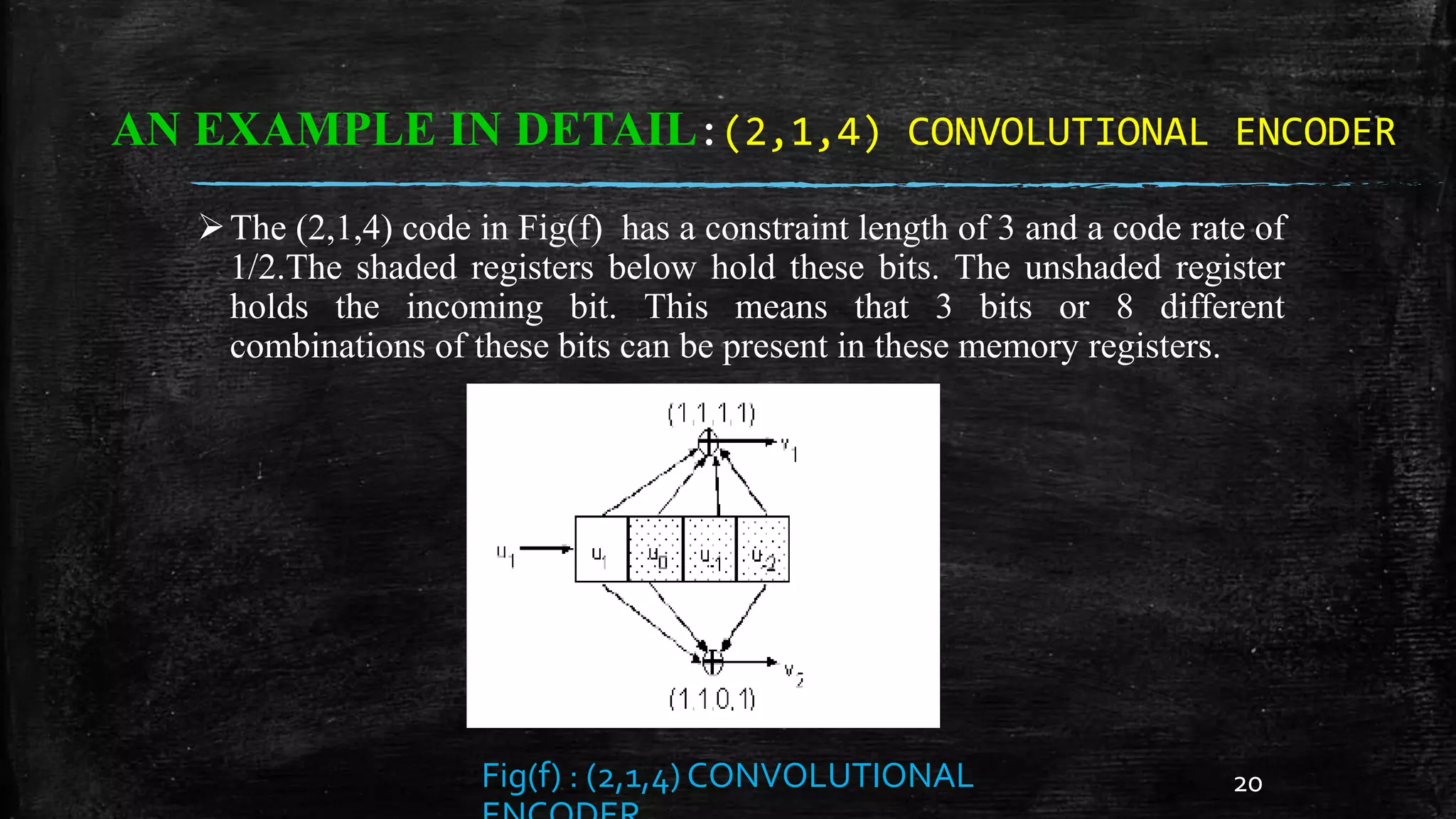
AN EXAMPLE IN DETAIL:(2,1,4) CONVOLUTIONAL ENCODER 
The (2,1,4) code in Fig(f) has a constraint length of 3 and a code rate of 
1/2.The shaded registers below hold these bits. The unshaded register 
holds the incoming bit. This means that 3 bits or 8 different 
combinations of these bits can be present in these memory registers. 
Fig(f) : (2,1,4) CONVOLUTIONAL 20 
ENCODER
Let us give an input sequence (1011) to the encoder in Fig(f). 
Then the coded output sequence will be obtained as follows: 
21
Truth Table of (2,1,4) encoder for the sequence (1011) 
INPUT BIT PRESENT ENCODER 
STATE 
OUTPUT BIT NEXT ENCODER 
STATE 
1 000 11 100 
0 100 11 010 
1 010 01 101 
1 101 11 110 
22
23 
(A) State Diagram Representation for the above truth 
table 
Steps involved to construct state diagram: 
 Conventionally we start from state 000. 
 The arrival of a 1 bit outputs 11 and state transition occurs to 100. 
 The arrival of next 0 bit outputs 11 and state transition occurs to 010. 
 The arrival of next 1 bit outputs 01 and state transition occurs to 101. 
 The arrival of last 1 bit outputs 11 and state transition occurs to 110. 
So now we have the coded output sequence as 11 11 01 11.
State diagram for (1011) 
24 
Fig (g): State diagram of (2,1,4) encoder for 
sequence 1011
25 
(B) Tree Diagram Representation 
Steps involved in constructing tree diagram for input sequence 1011: 
The first branch indicates the arrival of a 0 or a 1 bit. The starting state is 
assumed to be 000.If 0 is received we go upwards and if 1 is received we go 
downwards. The first two bits shows the output bits and the number inside 
the parenthesis is the output state. 
At branch 1 we go down. The output is 11 and we are in state 111. 
Now we get a 0 bit and we go upward. The output bits are 11 and the state is 
now 011. 
The next incoming bit is 1,we go downwards and get an output of 01 and now 
the output state is 101. 
The next incoming bit is 1 so we again go downwards and get the output bit 
as 11.
Fig(h): Tree diagram of (2,1,4) encoder for 26 
sequence 1011
27 
(C)Trellis Diagram Representation 
Steps involved in constructing the Trellis diagram: 
We start from 000. 
 In the trellis diagram the incoming bits are shown on top. 
 For input 1 bit, the output is 11 and it goes down to state 100. 
 For the next o bit , the output is 11 and it goes upward to the state 010. 
 For the next 1 bit, the output is 01 and it goes downward to the state 
101. 
 For the last 1 bit, the output is 11 and it goes downward to the state 
110.
28 
Fig(i): Trellis diagram of (2,1,4) encoder for 
sequence 1011
29 
ADVANTAGES OF CONVOLUTIONAL CODES 
Convolution coding is a popular error-correcting coding method used 
in digital communications. 
The convolution operation encodes some redundant information into 
the transmitted signal, thereby improving the data capacity of the 
channel. 
Convolution Encoding with Viterbi decoding is a powerful FEC 
technique that is particularly suited to a channel in which the 
transmitted signal is corrupted mainly by AWGN. 
It is simple and has good performance with low implementation cost.
30

A Nutshell On Convolutional Codes (Representations)

  • 1.
    A nutshell onConvolutional Codes (representations) PREPARED BY, ALKA DILEEP(14304002) SWARA G.I.K(14304026) M-TECH ECE PONDICHERRY UNIVERSITY
  • 2.
    OUTLINE ▪ Anintroduction to convolutional codes  An introduction to convolutional encoder ▪ Convolutional codes representations and explanation with examples Generator representation State diagram Tree diagram Trellis diagram  Advantages of Convolutional codes 2
  • 3.
    FORWARD ERROR CORRECTIONCODE There are four important forward error correction codes that find applications in digital transmission. They are : 3 Block Parity Hamming Code Interleaved Code Convolutional Code
  • 4.
    CONVOLUTIONAL CODES :AN INTRODUCTION  Convolutional codes are introduced in 1955 by Elias.  Convolution coding is a popular error-correcting coding method used in digital communications. A message is convoluted, and then transmitted into a noisy channel.  This convolution operation encodes some redundant information into the transmitted signal, thereby improving the data capacity of the channel.  The Viterbi algorithm is a popular method used to decode convolutionally coded messages.  The block codes can be applied only for the block of data whereas convolution coding can be applied to a continuous data stream as well as to blocks of data. 4
  • 5.
    CONVOLUTIONAL ENCODER ▪Convolutional encoder is a finite state machine (FSM), processing information bits in a serial manner. ▪ Convolutional encoding of data is accomplished using a shift register and associated combinatorial logic that performs modulo-two addition. ▪ A shift register is merely a chain of flip-flops wherein the output of the nth flip-flop is tied to the input of the (n+1)th flip flop. ▪ Every time the active edge of the clock occurs, the input to the flip-flop is clocked through to the output, and thus the data are shifted over one stage. ▪ In convolutional code the block of n code bits generated by the encoder in a particular time instant depends not only on the block of k message bits within that time instant but also on the block of data bits within a previous span of N-1 time instants (N>1). 5
  • 6.
     A convolutionalcode with constraint length N consists of an N-stage shift register (SR) and ν modulo-2 adders. Fig (a): A convolutional Encoder  Fig (a) shows a coder for the case N=3 and ν=2. The message bits are applied at the input of the shift register (SR). The coded digit stream is obtained at the commutator output. The commutator samples the ν modulo-2 adders in a sequence, once during each input-bit interval. 6
  • 7.
    Example: Assume thatthe input digits are 1010. Find the coded sequence output for Fig(a). Initially, the Shift Registers s1=s2=s3=0. When the first message bit 1 enters the SR, s1= 1, s2 = s3=0. Then ν1=1, ν2=1 and the coder output is 11. When the second message bit 0 enters the SR, s1=0, s2=1, s3=0. Then ν1=1 and ν2=0 and the coder output is 10. When the third message bit 1 enters the SR, s1=1, s2=0 and s3=1 Then ν1=0 and ν2=0 and the coder output is 00. When the fourth message bit 0 enters the SR, s1=0, s2=1 and s3=0 Then ν1=1 and ν2=0 and the coder output is 10. The coded Output Sequence is : 11100010 7
  • 8.
    PARAMETERS OF ACONVOLUTIONAL ENCODER Convolutional codes are commonly specified by three parameters: (n,k,m) n = number of output bits k = number of input bits m = number of memory registers Code Rate: The quantity k/n is called as code rate. It is a measure of the efficiency of the code. Constraint Length: The quantity L(or K) is called the constraint length of the code. It represents the number of bits in the encoder memory that affect the generation of the n output bits. It is defined by Constraint Length, L = k (m-1) 8
  • 9.
    ENCODER REPRESENTATIONS Theencoder can be represented in several different but equivalent ways. They are 1. Generator Representation 2. Tree Diagram Representation 3. State Diagram Representation 4. Trellis Diagram Representation (A) Generator Representation Generator representation shows the hardware connection of the shift register taps to the modulo-2 adders. A generator vector represents the position of the taps for an output. A “1” represents a connection and a “0” represents no connection. For example, the two generator vectors for the encoder in Fig(a) are g1 = [111] and g2 = [101], where the subscripts 1 and 2 denote the corresponding output terminals. 9
  • 10.
    (B) State DiagramRepresentation  In the state diagram, the state information of the encoder is shown in the circles. Each new input information bit causes a transition from one state to another. Contents of the rightmost (K-1) shift register stages define the states of the encoder. So, the encoder in Fig(b) has four states. The transition of an encoder from one state to another, as caused by input bits, is depicted in the state diagram. The path information between the states, denoted as x/c, represents input information bit x and output encoded bits c.  It is customary to begin convolutional encoding from the all zero state. 10
  • 11.
    Example: Consider thehalf rate encoder in the following figure: The present state values are the possible 2 bit combinations for both 0 and 1 input. The output AB is obtained from the expressions in the Fig (b). Then, the next state values are calculated by right shifting the input and present state values together by 1 bit position. 11 Fig (b) Half Rate Encoder
  • 12.
    Truth Table forthe encoder in Fig(b) 12 INPUT PRESENT STATE OUTPUT NEXT STATE 0 00 00 00 0 01 11 00 0 10 01 01 0 11 10 01 1 00 11 10 1 01 00 10 1 10 10 11 1 11 01 11
  • 13.
    From the truthtable the state diagram is constructed as follows: 13 Fig (c) State Diagram
  • 14.
    Interpretations from statediagram Let 00 State a ; 01 State b; 10 State c; 11 State d; (1) State a goes to State a when the input is 0 and the output is 00 (2) State a goes to State b when the input is 1 and the output is 11 (3) State b goes to State c when the input is 0 and the output is 10 (4) State b goes to State d when the input is 1 and the output is 01 (5) State c goes to State a when the input is 0 and the output is 11 (6) State c goes to State b when the input is 1 and the output is 00 (7) State d goes to State c when the input is 0 and the output is 01 (8) State d goes to State d when the input is 1 and the output is 10 14
  • 15.
    (C) Tree DiagramRepresentations The tree diagram representation shows all possible information and encoded sequences for the convolutional encoder.  In the tree diagram, a solid line represents input information bit 0 and a dashed line represents input information bit 1. The corresponding output encoded bits are shown on the branches of the tree.  An input information sequence defines a specific path through the tree diagram from left to right. 15
  • 16.
    16 Fig (d)Tree Diagram
  • 17.
    (D) Trellis diagramRepresentation The trellis diagram is basically a redrawing of the state diagram. It shows all possible state transitions at each time step. The trellis diagram is drawn by lining up all the possible states (2L) in the vertical axis. Then we connect each state to the next state by the allowable codeword’s for that state. There are only two choices possible at each state. These are determined by the arrival of either a 0 or a 1 bit. The arrows show the input bit and the output bits are shown in parentheses.  The arrows going upwards represent a 0 bit and going downwards represent a 1 bit. 17
  • 18.
    Steps to constructtrellis diagram  It starts from scratch (all 0’s in the SR, i.e., state a) and makes transitions corresponding to each input data digit. These transitions are denoted by a solid line for the next data digit 0 and by a dashed line for the next data digit 1.  Thus when the first input digit is 0, the encoder output is 00 (solid line) When the input digit is 1, the encoder output is 11 (dashed line).  We continue this way for the second input digit and so on as depicted in Fig (e) that follows. 18
  • 19.
    Trellis diagram forthe state diagram mentioned before 19 Fig(e) Trellis diagram
  • 20.
    AN EXAMPLE INDETAIL:(2,1,4) CONVOLUTIONAL ENCODER The (2,1,4) code in Fig(f) has a constraint length of 3 and a code rate of 1/2.The shaded registers below hold these bits. The unshaded register holds the incoming bit. This means that 3 bits or 8 different combinations of these bits can be present in these memory registers. Fig(f) : (2,1,4) CONVOLUTIONAL 20 ENCODER
  • 21.
    Let us givean input sequence (1011) to the encoder in Fig(f). Then the coded output sequence will be obtained as follows: 21
  • 22.
    Truth Table of(2,1,4) encoder for the sequence (1011) INPUT BIT PRESENT ENCODER STATE OUTPUT BIT NEXT ENCODER STATE 1 000 11 100 0 100 11 010 1 010 01 101 1 101 11 110 22
  • 23.
    23 (A) StateDiagram Representation for the above truth table Steps involved to construct state diagram:  Conventionally we start from state 000.  The arrival of a 1 bit outputs 11 and state transition occurs to 100.  The arrival of next 0 bit outputs 11 and state transition occurs to 010.  The arrival of next 1 bit outputs 01 and state transition occurs to 101.  The arrival of last 1 bit outputs 11 and state transition occurs to 110. So now we have the coded output sequence as 11 11 01 11.
  • 24.
    State diagram for(1011) 24 Fig (g): State diagram of (2,1,4) encoder for sequence 1011
  • 25.
    25 (B) TreeDiagram Representation Steps involved in constructing tree diagram for input sequence 1011: The first branch indicates the arrival of a 0 or a 1 bit. The starting state is assumed to be 000.If 0 is received we go upwards and if 1 is received we go downwards. The first two bits shows the output bits and the number inside the parenthesis is the output state. At branch 1 we go down. The output is 11 and we are in state 111. Now we get a 0 bit and we go upward. The output bits are 11 and the state is now 011. The next incoming bit is 1,we go downwards and get an output of 01 and now the output state is 101. The next incoming bit is 1 so we again go downwards and get the output bit as 11.
  • 26.
    Fig(h): Tree diagramof (2,1,4) encoder for 26 sequence 1011
  • 27.
    27 (C)Trellis DiagramRepresentation Steps involved in constructing the Trellis diagram: We start from 000.  In the trellis diagram the incoming bits are shown on top.  For input 1 bit, the output is 11 and it goes down to state 100.  For the next o bit , the output is 11 and it goes upward to the state 010.  For the next 1 bit, the output is 01 and it goes downward to the state 101.  For the last 1 bit, the output is 11 and it goes downward to the state 110.
  • 28.
    28 Fig(i): Trellisdiagram of (2,1,4) encoder for sequence 1011
  • 29.
    29 ADVANTAGES OFCONVOLUTIONAL CODES Convolution coding is a popular error-correcting coding method used in digital communications. The convolution operation encodes some redundant information into the transmitted signal, thereby improving the data capacity of the channel. Convolution Encoding with Viterbi decoding is a powerful FEC technique that is particularly suited to a channel in which the transmitted signal is corrupted mainly by AWGN. It is simple and has good performance with low implementation cost.
  • 30.