CHAPTER 6 : REGISTER
By:
Siti Sabariah Hj. Salihin
Electrical Engineering Department

EE 202 : DIGITAL ELECTRONICS

1
CHAPTER 202 ::DIGITAL ELECTRONICS
6 REGISTER
EE
Course Learning Outcomes, CLO
Upon completion of the course, students should be able to:
� CLO 3 : Draw logics diagrams, truth tables and timing diagrams for

all common flip flops and use these to implement sequential logic
circuits correctly.

EE 202 : DIGITAL ELECTRONICS
CHAPTER 6 : REGISTER
EE 202 : DIGITAL ELECTRONICS

Upon completion of this Chapter, students should be able to
to:
6.1 Understand the concepts and applications of registers and shift
Registers.
6.1.1 Classify the Shift Register according to the methods of data
input/output: SISO, PIPO, SIPO, PISO.
6.1.2 State the applications of Shift registers listed in 6.1.1
6.1.3 Interpret the Operation and circuit of Shift Register listed in 6.1.1
6.1.4 Interpret the Operation and application of an integrated circuits
Shift Register listed in 6.1.1
6.1.5 Explain the application of Shift Register as arithmetic circuits:
6.1.6 Explain the operations and application of Ring Counters and
Johnson Counter
Introduction – Shift Register
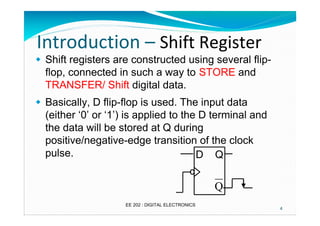
� Shift registers are constructed using several flipflop, connected in such a way to STORE and
TRANSFER/ Shift digital data.
� Basically, D flip-flop is used. The input data
(either ‘0’ or ‘1’) is applied to the D terminal and
the data will be stored at Q during
positive/negative-edge transition of the clock
pulse.
D Q

Q
EE 202 : DIGITAL ELECTRONICS

4
Shift Register
� One D FF is used to store 1-bit of data. Thus, the
number of flip-flops used is the same with the
number of bit stored.
� Shift register mean that the data in each FF can be
transferred/move to other FF upon edge triggering
of the clock signal.
� Four types of data movement in shift register are:� Parallel in / parallel out (PIPO)
� Serial in / serial out (SISO)
� Parallel in / serial out (PISO)
� Serial in / parallel out (SIPO)
EE 202 : DIGITAL ELECTRONICS

5
� Serial Data VS Parallel Data movement

Serial

Parallel

•Movement of N-bit data
require N number of CLK
pulses. Thus, the operation is
slow.
•Only one FF is required to be
connected at the output
terminal, thus only one wire is
required.

•Require only one CLK pulse
to transfer all N-bit of data.
Thus, operation is faster than
serial.
•Required N number of
connection to the output
terminal, which is proportional
to the number of bit. Thus, too
many connection is required.

EE 202 : DIGITAL ELECTRONICS

6
� Flip-flop configuration for PIPO register.
D3

D2

D Q3

D1

D Q2

CP

D0

D Q1

CP

D Q0

CP

CP

CLK
Q3

Q2

EE 202 : DIGITAL ELECTRONICS

Q1

Q0

7
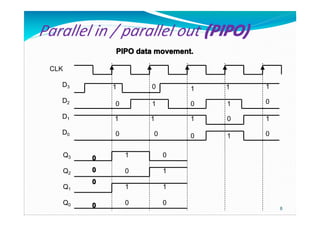
Parallel in / parallel out (PIPO)
PIPO data movement.
CLK
D3

0

1

1

1

1

D2

0

1

0

1

0

D1

1

1

1

0

1

D0

0

0

1

0

0

Q3

0

1

0

Q2

0

0

1

1

1

0

0

Q1
Q0

0

0

8
� Flip-flop connection for SISO.

1st CLK

DIN
CLK

D Q0

2nd CLK

D Q1

3rd CLK

4th CLK

D Q2

D Q3

CP

CP

CP

CP

FF0

FF1

FF2

FF3

EE 202 : DIGITAL ELECTRONICS

9
Serial in / serial out (SISO)
SISO data movement. Binary data 10111 is transferred!
1st

2nd

3rd

4th

5th

CLK
DATA-IN

1

0

1

1

1

Q0
Q1

Q2

Q3

10
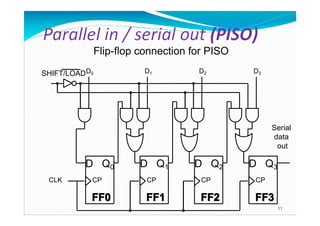
Flip-flop connection for PISO
SHIFT/LOADD0

D1

D2

D3

Serial
data
out

D Q0
CLK

D Q1

D Q2

D Q3

CP

CP

CP

CP

FF0

FF1

FF2

FF3
11
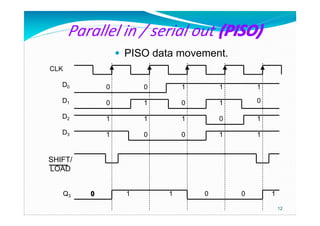
Parallel in / serial out (PISO)
� PISO data movement.
CLK
D0

0

0

1

1

1

D1

0

1

0

1

0

D2

1

1

1

0

1

D3

1

0

0

1

1

SHIFT/
LOAD
Q3

0

1

1

0

0

1
12
Integrated circuits Shift Register

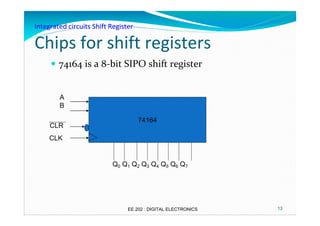
Chips for shift registers
� 74164 is a 8-bit SIPO shift register

A
B
CLR

74164

CLK

Q0 Q 1 Q 2 Q3 Q 4 Q5 Q6 Q 7

EE 202 : DIGITAL ELECTRONICS

13
Integrated circuits Shift Register

Chips for shift registers
� 74165 is a 8-bit PISO register
D0 D1 D2 D3 D4 D5 D6 D7

SH/LD
SER
CLK INH

Q7
74165

Q7

CLK

EE 202 : DIGITAL ELECTRONICS

14
Integrated circuits Shift Register

Chips for shift registers
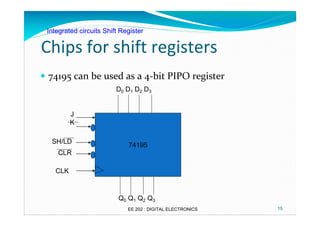
� 74195 can be used as a 4-bit PIPO register
D0 D1 D2 D3

J
K
SH/LD

74195

CLR
CLK

Q0 Q 1 Q 2 Q 3
EE 202 : DIGITAL ELECTRONICS

15
Shift Register as arithmetic circuits:
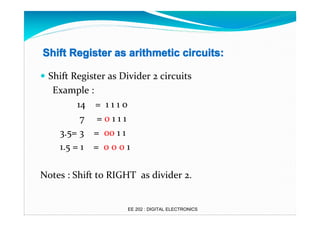
� Shift Register as Divider 2 circuits

Example :
14 = 1 1 1 0
7 =0111
3.5= 3 = 00 1 1
1.5 = 1 = 0 0 0 1
Notes : Shift to RIGHT as divider 2.

EE 202 : DIGITAL ELECTRONICS
Shift Register as arithmetic circuits:
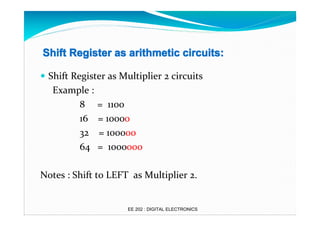
� Shift Register as Multiplier 2 circuits

Example :
8
16
32
64

= 1100
= 10000
= 100000
= 1000000

Notes : Shift to LEFT as Multiplier 2.

EE 202 : DIGITAL ELECTRONICS
Shift Register Counters
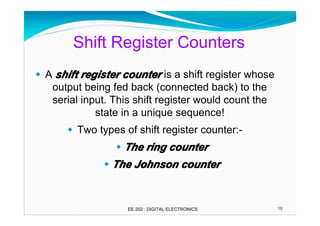
� A shift register counter is a shift register whose
output being fed back (connected back) to the
serial input. This shift register would count the
state in a unique sequence!
� Two types of shift register counter:� The ring counter
� The Johnson counter

EE 202 : DIGITAL ELECTRONICS

18
Ring Counter (continue)
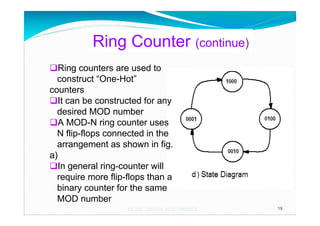
�Ring counters are used to
construct “One-Hot”
counters
�It can be constructed for any
desired MOD number
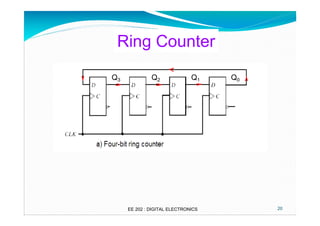
�A MOD-N ring counter uses
N flip-flops connected in the
arrangement as shown in fig.
a)
�In general ring-counter will
require more flip-flops than a
binary counter for the same
MOD number
EE 202 : DIGITAL ELECTRONICS

19
Ring Counter
Q3

Q2

Q1

EE 202 : DIGITAL ELECTRONICS

Q0

20
Ring Counter (continue)

EE 202 : DIGITAL ELECTRONICS

21
Ring Counter (continue)
0

0

0

1

1

0

0

0

0

1

0

0

0

0

1

0

EE 202 : DIGITAL ELECTRONICS

22
Ring Counter (continue)
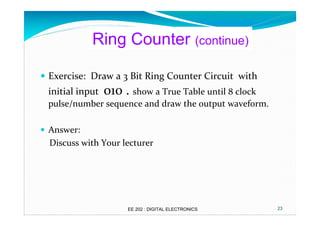
� Exercise: Draw a 3 Bit Ring Counter Circuit with

initial input

010 . show a True Table until 8 clock

pulse/number sequence and draw the output waveform.
� Answer:

Discuss with Your lecturer

EE 202 : DIGITAL ELECTRONICS

23
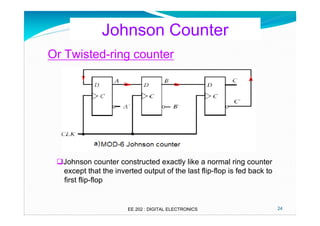
Johnson Counter
Or Twisted-ring counter

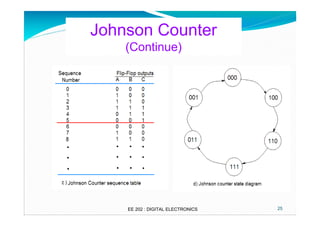
�Johnson counter constructed exactly like a normal ring counter
except that the inverted output of the last flip-flop is fed back to
first flip-flop

EE 202 : DIGITAL ELECTRONICS

24
Johnson Counter
(Continue)

EE 202 : DIGITAL ELECTRONICS

25
Johnson Counter
(Continue)

0

1

1

1

0

0

1

1

C 0

0

0

1

A

B

EE 202 : DIGITAL ELECTRONICS

26
REFERENCES:
1. "Digital Systems Principles And Application"
Sixth Editon, Ronald J. Tocci.
2. "Digital Systems Fundamentals"
P.W Chandana Prasad, Lau Siong Hoe,
Dr. Ashutosh Kumar Singh, Muhammad Suryanata.

Download Tutorials Chapter 6: Register
@ CIDOS
http://www.cidos.edu.my
http://www.sabariahsalihin.com
EE 202 : DIGITAL ELECTRONICS

28

Chapter 6 register

  • 1.
    CHAPTER 6 :REGISTER By: Siti Sabariah Hj. Salihin Electrical Engineering Department EE 202 : DIGITAL ELECTRONICS 1
  • 2.
    CHAPTER 202 ::DIGITALELECTRONICS 6 REGISTER EE Course Learning Outcomes, CLO Upon completion of the course, students should be able to: � CLO 3 : Draw logics diagrams, truth tables and timing diagrams for all common flip flops and use these to implement sequential logic circuits correctly. EE 202 : DIGITAL ELECTRONICS
  • 3.
    CHAPTER 6 :REGISTER EE 202 : DIGITAL ELECTRONICS Upon completion of this Chapter, students should be able to to: 6.1 Understand the concepts and applications of registers and shift Registers. 6.1.1 Classify the Shift Register according to the methods of data input/output: SISO, PIPO, SIPO, PISO. 6.1.2 State the applications of Shift registers listed in 6.1.1 6.1.3 Interpret the Operation and circuit of Shift Register listed in 6.1.1 6.1.4 Interpret the Operation and application of an integrated circuits Shift Register listed in 6.1.1 6.1.5 Explain the application of Shift Register as arithmetic circuits: 6.1.6 Explain the operations and application of Ring Counters and Johnson Counter
  • 4.
    Introduction – ShiftRegister � Shift registers are constructed using several flipflop, connected in such a way to STORE and TRANSFER/ Shift digital data. � Basically, D flip-flop is used. The input data (either ‘0’ or ‘1’) is applied to the D terminal and the data will be stored at Q during positive/negative-edge transition of the clock pulse. D Q Q EE 202 : DIGITAL ELECTRONICS 4
  • 5.
    Shift Register � OneD FF is used to store 1-bit of data. Thus, the number of flip-flops used is the same with the number of bit stored. � Shift register mean that the data in each FF can be transferred/move to other FF upon edge triggering of the clock signal. � Four types of data movement in shift register are:� Parallel in / parallel out (PIPO) � Serial in / serial out (SISO) � Parallel in / serial out (PISO) � Serial in / parallel out (SIPO) EE 202 : DIGITAL ELECTRONICS 5
  • 6.
    � Serial DataVS Parallel Data movement Serial Parallel •Movement of N-bit data require N number of CLK pulses. Thus, the operation is slow. •Only one FF is required to be connected at the output terminal, thus only one wire is required. •Require only one CLK pulse to transfer all N-bit of data. Thus, operation is faster than serial. •Required N number of connection to the output terminal, which is proportional to the number of bit. Thus, too many connection is required. EE 202 : DIGITAL ELECTRONICS 6
  • 7.
    � Flip-flop configurationfor PIPO register. D3 D2 D Q3 D1 D Q2 CP D0 D Q1 CP D Q0 CP CP CLK Q3 Q2 EE 202 : DIGITAL ELECTRONICS Q1 Q0 7
  • 8.
    Parallel in /parallel out (PIPO) PIPO data movement. CLK D3 0 1 1 1 1 D2 0 1 0 1 0 D1 1 1 1 0 1 D0 0 0 1 0 0 Q3 0 1 0 Q2 0 0 1 1 1 0 0 Q1 Q0 0 0 8
  • 9.
    � Flip-flop connectionfor SISO. 1st CLK DIN CLK D Q0 2nd CLK D Q1 3rd CLK 4th CLK D Q2 D Q3 CP CP CP CP FF0 FF1 FF2 FF3 EE 202 : DIGITAL ELECTRONICS 9
  • 10.
    Serial in /serial out (SISO) SISO data movement. Binary data 10111 is transferred! 1st 2nd 3rd 4th 5th CLK DATA-IN 1 0 1 1 1 Q0 Q1 Q2 Q3 10
  • 11.
    Flip-flop connection forPISO SHIFT/LOADD0 D1 D2 D3 Serial data out D Q0 CLK D Q1 D Q2 D Q3 CP CP CP CP FF0 FF1 FF2 FF3 11
  • 12.
    Parallel in /serial out (PISO) � PISO data movement. CLK D0 0 0 1 1 1 D1 0 1 0 1 0 D2 1 1 1 0 1 D3 1 0 0 1 1 SHIFT/ LOAD Q3 0 1 1 0 0 1 12
  • 13.
    Integrated circuits ShiftRegister Chips for shift registers � 74164 is a 8-bit SIPO shift register A B CLR 74164 CLK Q0 Q 1 Q 2 Q3 Q 4 Q5 Q6 Q 7 EE 202 : DIGITAL ELECTRONICS 13
  • 14.
    Integrated circuits ShiftRegister Chips for shift registers � 74165 is a 8-bit PISO register D0 D1 D2 D3 D4 D5 D6 D7 SH/LD SER CLK INH Q7 74165 Q7 CLK EE 202 : DIGITAL ELECTRONICS 14
  • 15.
    Integrated circuits ShiftRegister Chips for shift registers � 74195 can be used as a 4-bit PIPO register D0 D1 D2 D3 J K SH/LD 74195 CLR CLK Q0 Q 1 Q 2 Q 3 EE 202 : DIGITAL ELECTRONICS 15
  • 16.
    Shift Register asarithmetic circuits: � Shift Register as Divider 2 circuits Example : 14 = 1 1 1 0 7 =0111 3.5= 3 = 00 1 1 1.5 = 1 = 0 0 0 1 Notes : Shift to RIGHT as divider 2. EE 202 : DIGITAL ELECTRONICS
  • 17.
    Shift Register asarithmetic circuits: � Shift Register as Multiplier 2 circuits Example : 8 16 32 64 = 1100 = 10000 = 100000 = 1000000 Notes : Shift to LEFT as Multiplier 2. EE 202 : DIGITAL ELECTRONICS
  • 18.
    Shift Register Counters �A shift register counter is a shift register whose output being fed back (connected back) to the serial input. This shift register would count the state in a unique sequence! � Two types of shift register counter:� The ring counter � The Johnson counter EE 202 : DIGITAL ELECTRONICS 18
  • 19.
    Ring Counter (continue) �Ringcounters are used to construct “One-Hot” counters �It can be constructed for any desired MOD number �A MOD-N ring counter uses N flip-flops connected in the arrangement as shown in fig. a) �In general ring-counter will require more flip-flops than a binary counter for the same MOD number EE 202 : DIGITAL ELECTRONICS 19
  • 20.
    Ring Counter Q3 Q2 Q1 EE 202: DIGITAL ELECTRONICS Q0 20
  • 21.
    Ring Counter (continue) EE202 : DIGITAL ELECTRONICS 21
  • 22.
  • 23.
    Ring Counter (continue) �Exercise: Draw a 3 Bit Ring Counter Circuit with initial input 010 . show a True Table until 8 clock pulse/number sequence and draw the output waveform. � Answer: Discuss with Your lecturer EE 202 : DIGITAL ELECTRONICS 23
  • 24.
    Johnson Counter Or Twisted-ringcounter �Johnson counter constructed exactly like a normal ring counter except that the inverted output of the last flip-flop is fed back to first flip-flop EE 202 : DIGITAL ELECTRONICS 24
  • 25.
    Johnson Counter (Continue) EE 202: DIGITAL ELECTRONICS 25
  • 26.
  • 27.
    REFERENCES: 1. "Digital SystemsPrinciples And Application" Sixth Editon, Ronald J. Tocci. 2. "Digital Systems Fundamentals" P.W Chandana Prasad, Lau Siong Hoe, Dr. Ashutosh Kumar Singh, Muhammad Suryanata. Download Tutorials Chapter 6: Register @ CIDOS http://www.cidos.edu.my http://www.sabariahsalihin.com
  • 28.
    EE 202 :DIGITAL ELECTRONICS 28