Chapter 1 
Digital Systems and Binary Numbers
Key Concepts : 
● Why digital Over Analog Systems ? 
● Number - Base Conversions 
● Complements of Numbers 
● Signed Binary Number Systems 
● OverFlow Concept 
● Binary and Decimal Codes 
● BCD Addition 
● Gray Code 
● Parity Check
Why Digital Over Analog ? 
1. Reduced Cost 
2. More Reliable 
3. Programmable (so has major application) 
4. Selective ( Akin to a Research Scientist vs 
a Payroll Schedule) 
5. Implemented via Electronic Components
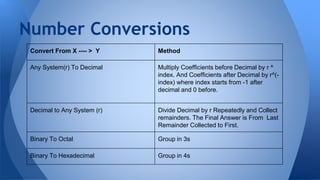
Number Conversions 
Convert From X ---- > Y Method 
Any System(r) To Decimal Multiply Coefficients before Decimal by r ^ 
index. And Coefficients after Decimal by r^(- 
index) where index starts from -1 after 
decimal and 0 before. 
Decimal to Any System (r) Divide Decimal by r Repeatedly and Collect 
remainders. The Final Answer is From Last 
Remainder Collected to First. 
Binary To Octal Group in 3s 
Binary To Hexadecimal Group in 4s
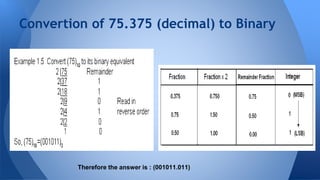
Convertion of 75.375 (decimal) to Binary 
Therefore the answer is : (001011.011)
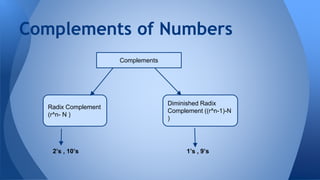
Complements of Numbers 
Complements 
Radix Complement 
(r^n- N ) 
Diminished Radix 
Complement ((r^n-1)-N 
) 
2’s , 10’s 1’s , 9’s
* 
Signed Binary Numbers 
We need to represent these symbols using bits 
– Convention: 
• 0 positive 
1 negative 
• The leftmost bit position is used as a sign bit 
– In signed representation, bits to the right of sign bit is 
the number 
– In unsigned representation, the leftmost bit is a part of 
the number (the most significant bit (MSB))
* 
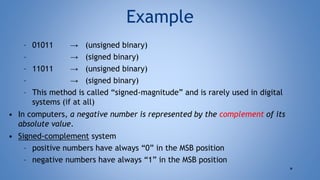
Example 
– 01011 → (unsigned binary) 
– → (signed binary) 
– 11011 → (unsigned binary) 
– → (signed binary) 
– This method is called “signed-magnitude” and is rarely used in digital 
systems (if at all) 
• In computers, a negative number is represented by the complement of its 
absolute value. 
• Signed-complement system 
– positive numbers have always “0” in the MSB position 
– negative numbers have always “1” in the MSB position
* 
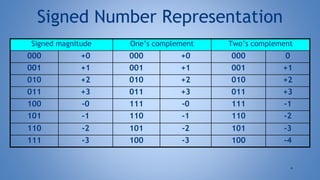
Signed Number Representation 
Signed magnitude One’s complement Two’s complement 
000 +0 000 +0 000 0 
001 +1 001 +1 001 +1 
010 +2 010 +2 010 +2 
011 +3 011 +3 011 +3 
100 -0 111 -0 111 -1 
101 -1 110 -1 110 -2 
110 -2 101 -2 101 -3 
111 -3 100 -3 100 -4
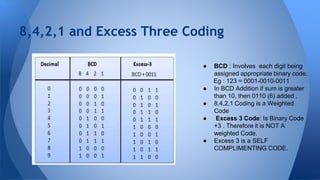
8,4,2,1 and Excess Three Coding 
● BCD : Involves each digit being 
assigned appropriate binary code. 
Eg : 123 = 0001-0010-0011 
● In BCD Addition if sum is greater 
than 10, then 0110 (6) added . 
● 8,4,2,1 Coding is a Weighted 
Code 
● Excess 3 Code: Is Binary Code 
+3 . Therefore it is NOT A 
weighted Code. 
● Excess 3 is a SELF 
COMPLIMENTING CODE.
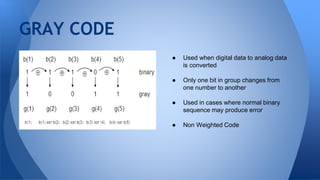
GRAY CODE 
● Used when digital data to analog data 
is converted 
● Only one bit in group changes from 
one number to another 
● Used in cases where normal binary 
sequence may produce error 
● Non Weighted Code
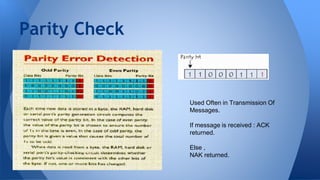
Parity Check 
Used Often in Transmission Of 
Messages. 
If message is received : ACK 
returned. 
Else , 
NAK returned.
By : 
Debarati Das 
1PI13CS052 
PES University

Binary Codes and Number System

  • 1.
    Chapter 1 DigitalSystems and Binary Numbers
  • 2.
    Key Concepts : ● Why digital Over Analog Systems ? ● Number - Base Conversions ● Complements of Numbers ● Signed Binary Number Systems ● OverFlow Concept ● Binary and Decimal Codes ● BCD Addition ● Gray Code ● Parity Check
  • 3.
    Why Digital OverAnalog ? 1. Reduced Cost 2. More Reliable 3. Programmable (so has major application) 4. Selective ( Akin to a Research Scientist vs a Payroll Schedule) 5. Implemented via Electronic Components
  • 4.
    Number Conversions ConvertFrom X ---- > Y Method Any System(r) To Decimal Multiply Coefficients before Decimal by r ^ index. And Coefficients after Decimal by r^(- index) where index starts from -1 after decimal and 0 before. Decimal to Any System (r) Divide Decimal by r Repeatedly and Collect remainders. The Final Answer is From Last Remainder Collected to First. Binary To Octal Group in 3s Binary To Hexadecimal Group in 4s
  • 5.
    Convertion of 75.375(decimal) to Binary Therefore the answer is : (001011.011)
  • 6.
    Complements of Numbers Complements Radix Complement (r^n- N ) Diminished Radix Complement ((r^n-1)-N ) 2’s , 10’s 1’s , 9’s
  • 7.
    * Signed BinaryNumbers We need to represent these symbols using bits – Convention: • 0 positive 1 negative • The leftmost bit position is used as a sign bit – In signed representation, bits to the right of sign bit is the number – In unsigned representation, the leftmost bit is a part of the number (the most significant bit (MSB))
  • 8.
    * Example –01011 → (unsigned binary) – → (signed binary) – 11011 → (unsigned binary) – → (signed binary) – This method is called “signed-magnitude” and is rarely used in digital systems (if at all) • In computers, a negative number is represented by the complement of its absolute value. • Signed-complement system – positive numbers have always “0” in the MSB position – negative numbers have always “1” in the MSB position
  • 9.
    * Signed NumberRepresentation Signed magnitude One’s complement Two’s complement 000 +0 000 +0 000 0 001 +1 001 +1 001 +1 010 +2 010 +2 010 +2 011 +3 011 +3 011 +3 100 -0 111 -0 111 -1 101 -1 110 -1 110 -2 110 -2 101 -2 101 -3 111 -3 100 -3 100 -4
  • 10.
    8,4,2,1 and ExcessThree Coding ● BCD : Involves each digit being assigned appropriate binary code. Eg : 123 = 0001-0010-0011 ● In BCD Addition if sum is greater than 10, then 0110 (6) added . ● 8,4,2,1 Coding is a Weighted Code ● Excess 3 Code: Is Binary Code +3 . Therefore it is NOT A weighted Code. ● Excess 3 is a SELF COMPLIMENTING CODE.
  • 11.
    GRAY CODE ●Used when digital data to analog data is converted ● Only one bit in group changes from one number to another ● Used in cases where normal binary sequence may produce error ● Non Weighted Code
  • 12.
    Parity Check UsedOften in Transmission Of Messages. If message is received : ACK returned. Else , NAK returned.
  • 13.
    By : DebaratiDas 1PI13CS052 PES University