DecimalNumber System
Binary Number System
Octal Number System
Hexadecimal Number System
ASCII,ISCII,UNICODE
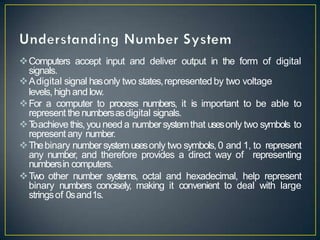
Computers accept input and deliver output in the form of digital
signals.
Adigital signal hasonly two states,represented by two voltage
levels, high and low.
For a computer to process numbers, it is important to be able to
represent thenumbersasdigital signals.
T
oachieve this,you need a numbersystemthat usesonly two symbols to
represent any number.
Thebinary number systemusesonly two symbols,0 and 1, to represent
any number, and therefore provides a direct way of representing
numbersin computers.
Two other number systems, octal and hexadecimal, help represent
binary numbers concisely, making it convenient to deal with large
stringsof 0sand1s.
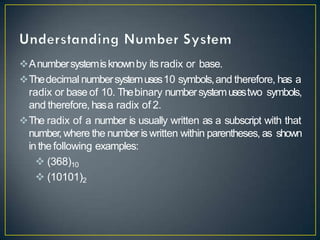
Anumbersystemisknownby itsradix or base.
Thedecimal numbersystemuses10 symbols,and therefore, has a
radix or base of 10. Thebinary numbersystemusestwo symbols,
and therefore, hasa radix of 2.
The radix of a number is usually written as a subscript with that
number, where the numberis written within parentheses, as shown
in thefollowing examples:
 (368)10
 (10101)2
• Thedecimal numbersystemuses10 symbols,and therefore has
a radix or base of 10.
• Symbolsare [ 0 to 9 ]
• Everydigit in Decimal numbersystemisidentified from its
position i.e. from right to left as(for e.g. 345) :-
• It means: 3 x 10² + 4 x 101 + 5 x 100 = 345
• 3 x 100 + 4 x 10 + 5 x 1 = 345
• Left mostdigit will be MSD(mostsignificant digit and right most
digit will be LSD(least significant digit)
Number 3 4 5
POSITIONALVALUE 102 101 100
• Thebinary numbersystemuses2 symbols, and therefore hasa radix
or base of 2.
• Symbols are [ 0 and 1 ], also knownasbits or binary digit
• Everybit in Binary numbersystemisidentified from its position i.e.
from right to left as(for e.g. 110) :-
will be LSB(least significant bit)
• It means : 1 x 22 + 1 x 21 + 0x 20 will give its decimal equivalent
• 1 x 4 + 1 x 2 + 0 x1 = 6, So (110)2 = (6)10
• Left mostdigit will be MSB(mostsignificantbit and right mostdigit
Binary Number 1 1 0
POSITIONAL VALUE 22 21 20
• Theoctal numbersystemuses8 symbols,and therefore hasa
radix or base of 8.
• Symbols are [ 0 to 7 ]
• Everybit in Octal numbersystemisidentified from itsposition
i.e. from right to left as(for e.g. 140) :-
• It means: 1 x 82 + 4 x 81 + 0 x 80 will give its decimal
equivalent
• 1 x 64 + 4 x 8 + 0 x 1 = 96, So (140)8 = (96)10
Binary Number 1 4 0
POSITIONAL VALUE 82 81 80
• TheHex numbersystemuses16 symbols,and therefore hasa
radix or base of 16.
• Symbols are [ 0 to 9 andA to F ]
• 10 isrepresented asAand soon
• Everybit in Hex numbersystemisidentified from its position i.e.
from right to left as(for e.g.A2B) :-
• It means :Ax162 + 2x161 + Bx160 will give itsdecimal equivalent
• 10x256 + 2x16 + 11x1 = 2603, So (A2B)16 = (2603)10
Binary Number A 2 B
POSITIONAL VALUE 162 161 160
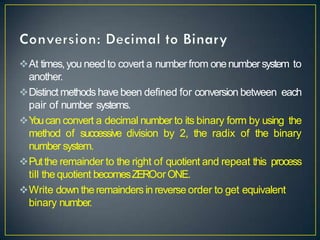
At times,you need to covert a numberfrom onenumbersystem to
another.
Distinct methods have been defined for conversion between each
pair of number systems.
Y
oucan convert a decimal number to its binary form by using the
method of successive division by 2, the radix of the binary
number system.
Putthe remainder to the right of quotient and repeat this process
till the quotient becomesZEROorONE.
Write down theremainders in reverse order to get equivalent
binary number.
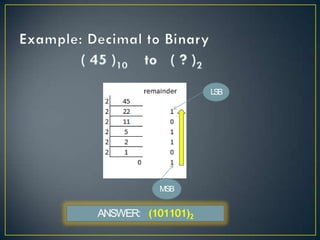
LSB
MSB
ANSWER: (101101)2
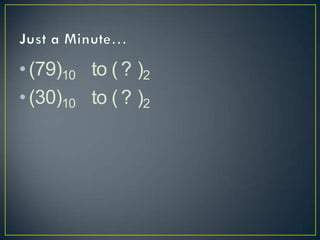
•(79)10
•(30)10
to ( ? )2
to ( ? )2
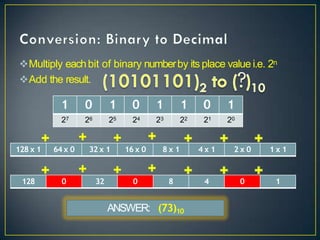
Multiply eachbit of binary numberby its place value i.e. 2n
Add the result.
1 0 1 0 1 1 0 1
27 26 25 24 23 22 21 20
128 x 1 64 x 0 32 x 1 16 x 0 8 x 1 4 x 1 2 x 0 1 x 1
128 0 32 0 8 4 0 1
ANSWER: (73)10
2
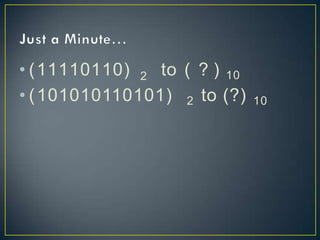
• (11110110) to ( ? ) 10
• (101010110101) 2 to (?) 10
Y
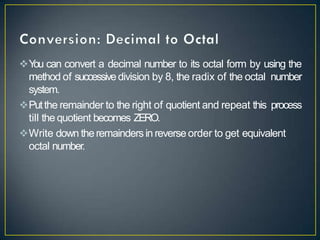
ou can convert a decimal number to its octal form by using the
method of successivedivision by 8, the radix of the octal number
system.
Putthe remainder to the right of quotient and repeat this process
till the quotient becomes ZERO.
Write down theremaindersin reverse order to get equivalent
octal number.
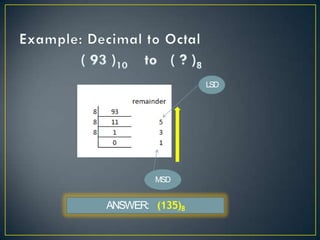
LSD
MSD
ANSWER: (135)8
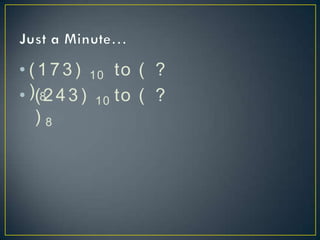
• (173) 10 to ( ?
) 8
• (243) 10 to ( ?
) 8
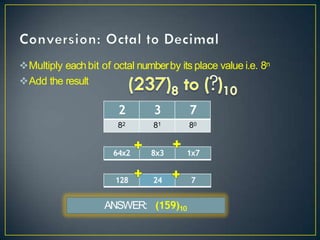
Multiply eachbit of octal numberby its place value i.e. 8n
Add the result
2 3 7
82 81 80
64x2 8x3 1x7
128 24 7
ANSWER: (159)10
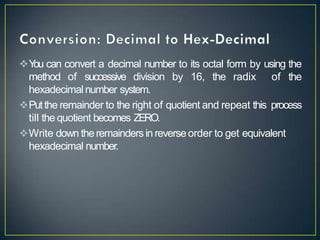
Y
ou can convert a decimal number to its octal form by using the
method of successive division by 16, the radix of the
hexadecimalnumber system.
Putthe remainder to the right of quotient and repeat this process
till the quotient becomes ZERO.
Write down theremaindersin reverse order to get equivalent
hexadecimal number.
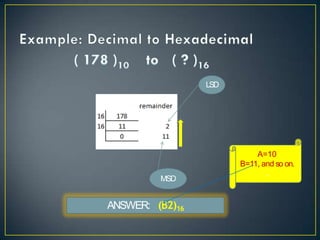
LSD
MSD
ANSWER: (B2)16
A=10
B=11, and so on.
..
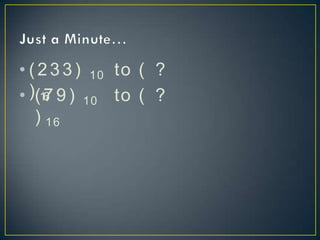
• (233) 10 to ( ?
) 1
6
• ( 7 9 ) 10 to ( ?
) 16
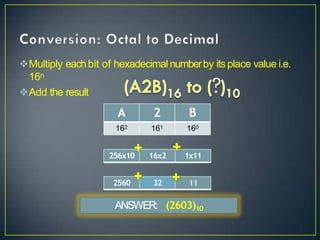
Multiply eachbit of hexadecimal numberby itsplace value i.e.
16n
Add the result
A 2 B
162 161 160
256x10 16x2 1x11
2560 32 11
ANSWER: (2603)10
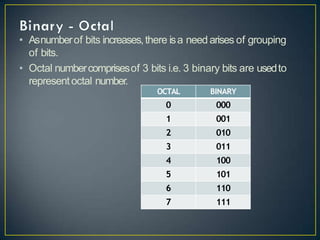
• Asnumberof bits increases,there isa need arises of grouping
of bits.
• Octal numbercomprisesof 3 bits i.e. 3 binary bits are usedto
representoctal number.
OCTAL BINARY
0 000
1 001
2 010
3 011
4 100
5 101
6 110
7 111
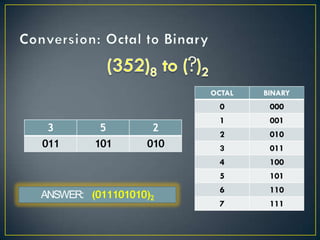
3 5 2
011 101 010
ANSWER: (011101010)2
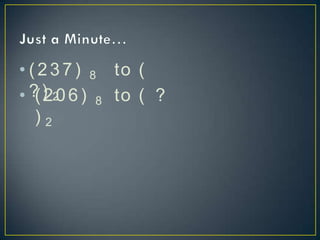
• (237) 8 to (
? ) 2
• (206) 8 to ( ?
) 2
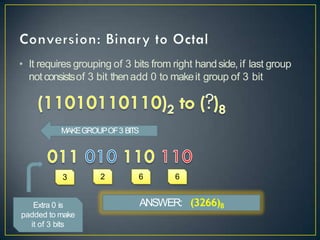
• It requires grouping of 3 bits from right handside, if last group
not consistsof 3 bit thenadd 0 to makeit group of 3 bit
MAKEGROUPOF3 BITS
Extra 0 is
padded to make
2 6 6
3
ANSWER: (3266)8
it of 3 bits
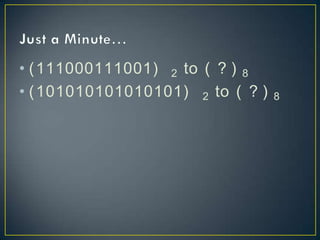
• (111000111001) 2 to ( ? ) 8
• (101010101010101) 2 to ( ? ) 8
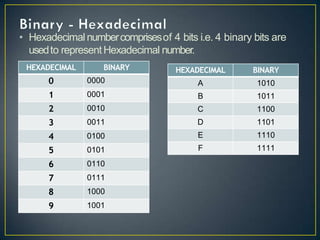
• Hexadecimalnumbercomprisesof 4 bits i.e. 4 binary bits are
usedto representHexadecimal number.
HEXADECIMAL BINARY
0 0000
1 0001
2 0010
3 0011
4 0100
5 0101
6 0110
7 0111
8 1000
9 1001
HEXADECIMAL BINARY
A 1010
B 1011
C 1100
D 1101
E 1110
F 1111
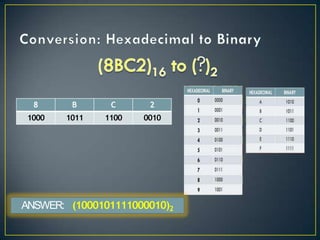
8 B C 2
1000 1011 1100 0010
ANSWER: (1000101111000010)2
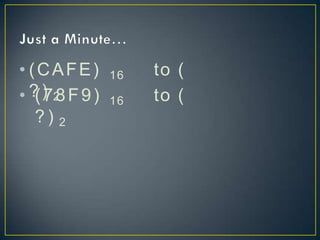
• (CAFE) 16 to (
? ) 2
• (78F9) 16 to (
? ) 2
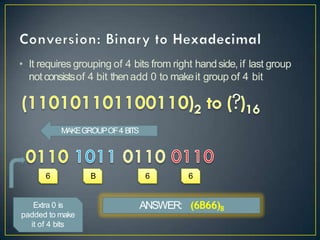
• It requires grouping of 4 bits from right handside, if last group
not consistsof 4 bit thenadd 0 to makeit group of 4 bit
MAKEGROUPOF4 BITS
Extra 0 is
padded to make
6
6
B
6
ANSWER: (6B66)8
it of 4 bits
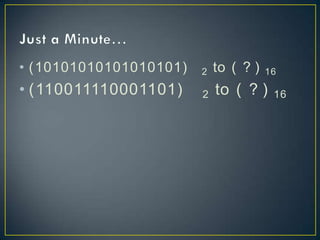
• (10101010101010101)
• (110011110001101)
2 to ( ? ) 16
2 to ( ? ) 16
• T
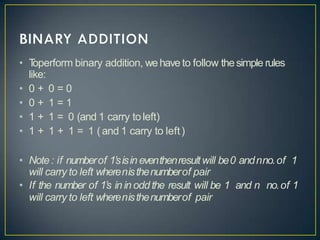
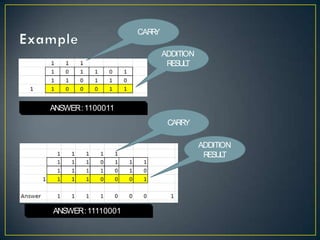
operform binary addition, we have to follow thesimple rules
like:
• 0 + 0 = 0
• 0 + 1 = 1
• 1 + 1 = 0 (and 1 carry toleft)
• 1 + 1 + 1 = 1 (and 1 carry to left)
• Note : if numberof 1’sisin eventhenresultwill be0 andnno.of 1
will carry to left wherenisthenumberof pair
• If the number of 1’s in in odd the result will be 1 and n no.of 1
will carry to left wherenisthenumberof pair
ADDITION
RESUL
T
CAR
R
Y
CARRY
ADDITION
RESUL
T
ANSWER:1100011
ANSWER:11110001
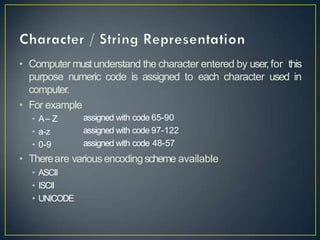
• Computer mustunderstand the character entered by user,for this
purpose numeric code is assigned to each character used in
computer.
• For example
• A– Z
• a-z
• 0-9
assigned with code 65-90
assigned with code 97-122
assigned with code 48-57
• Thereare various encodingscheme available
• ASCII
• ISCII
• UNICODE
• Stands for American Standard code for
information interchange.
• It is most widely used alphanumeric code for
microcomputers and minicomputers.
• It is 7-Bitccaonde, so it representmaximumof 27 = 128code
i.e. 128 possible characters.
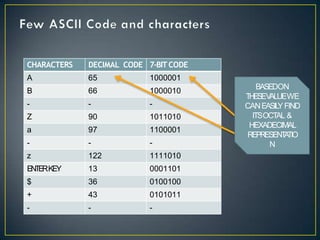
CHARACTERS DECIMAL CODE 7-BIT CODE
A 65 1000001
B 66 1000010
- - -
Z 90 1011010
a 97 1100001
- - -
z 122 1111010
ENTERKEY 13 0001101
$ 36 0100100
+ 43 0101011
- - -
BASEDON
THESEV
ALUEWE
CANEASIL
YFIND
ITSOCTAL &
HEXADECIMAL
REPRESENT
A
TIO
N
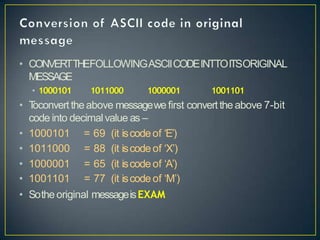
• CONVERTTHEFOLLOWINGASCIICODEINTTOITSORIGINAL
MESSAGE
• 1000101 1011000 1000001 1001101
• T
oconvert the above messagewe first convert the above 7-bit
code into decimalvalue as –
• 1000101 = 69 (it iscodeof ‘E’)
• 1011000 = 88 (it iscode of ‘X’)
• 1000001 = 65 (it iscode of ‘A’)
• 1001101 = 77 (it iscode of ‘M’)
• Sothe original messageisEXAM
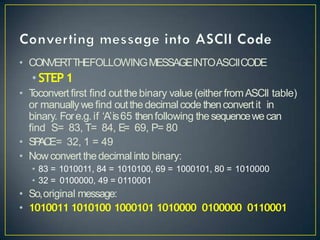
• CONVERTTHEFOLLOWINGMESSAGEINTOASCIICODE
• STEP1
• T
oconvert first find outthe binary value (either fromASCII table)
or manuallywe find outthedecimalcode thenconvert it in
binary. Fore.g. if ‘A’is65 thenfollowing thesequencewe can
find S= 83, T= 84, E= 69, P= 80
• SP
ACE= 32, 1 = 49
• Nowconvert thedecimal into binary:
• 83 = 1010011, 84 = 1010100, 69 = 1000101, 80 = 1010000
• 32 = 0100000, 49 = 0110001
• So,original message:
• 1010011 1010100 1000101 1010000 0100000 0110001
• Stands for Indian Standard Code for Information Interchange
• ISCII we adopted in 1991, by Bureauby IndianStandards to
have commonstandard for Indian scripts.
• It is8-bit encodingschemeand canrepresent28 =256chars.
• It retain first 128 for ASCII code
• ASCIIisable to representIndian language characters like :
Tamil,Telugu,Kannada, Oriya, Bengali,Assamese,Gujarati,etc.
• Aswe knowASCIIand ISCIIrepresentcharacters belonging to
different language by assigned unique code to each characters.
• Need arises to have encodingschemewhich canrepresentall
the knownlanguage aroundthe world. Theresult isUNICODE.
• It isthestandard usedworldwide now.
• Itsvariants are UTF-8,UTF-16,UTF-32
• Unicode13.0 represent 143000 characters
• Supported by mostOS,makingit platform, vendor,application
independent
• Allows data to be transported betweendifferent system without
distortion.
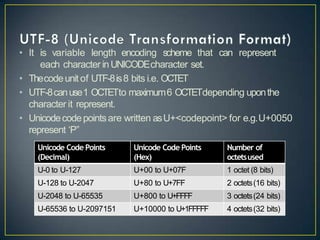
• It is variable length encoding scheme that can represent
each character in UNICODEcharacter set.
• Thecodeunit of UTF-8is8 bits i.e. OCTET
• UTF-8canuse1 OCTETto maximum6 OCTETdepending uponthe
character it represent.
• Unicodecodepointsare written asU+<codepoint> for e.g.U+0050
represent ‘P”
Unicode Code Points
(Decimal)
Unicode Code Points
(Hex)
Number of
octetsused
U-0 to U-127 U+00 to U+07F 1 octet (8 bits)
U-128 to U-2047 U+80 to U+7FF 2 octets(16 bits)
U-2048 to U-65535 U+800 to U+FFFF 3 octets(24 bits)
U-65536 to U-2097151 U+10000 to U+1FFFFF 4 octets(32 bits)
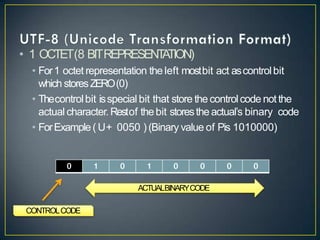
• 1 OCTET(8 BITREPRESENT
A
TION)
• For1 octet representation theleft mostbit act ascontrolbit
which storesZERO(0)
• Thecontrolbit isspecial bit that store the controlcode not the
actual character.Restof thebit storesthe actual’s binary code
• ForExample( U+ 0050 ) (Binary value of Pis 1010000)
0 1 0 1 0 0 0 0
CONTROLCODE
ACTUALBINARYCODE
1 1 0 0 0 0 1 0
1 0 1 0 0 1 1 1 OCTET2
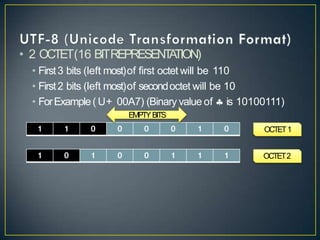
• 2 OCTET(16 BITREPRESENT
A
TION)
• First3 bits (left most)of first octet will be 110
• First2 bits (left most)of secondoctet will be 10
• ForExample( U+ 00A7) (Binary value of  is 10100111)
EMPTYBITS
OCTET1
1 1 1 0 0 0 1 0
1 0 0 0 0 0 0 0
1 0 1 1 1 0 1 1
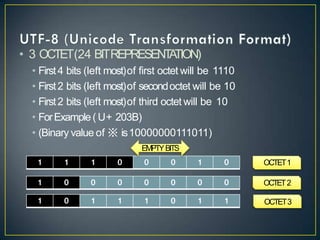
• 3 OCTET(24 BITREPRESENT
A
TION)
• First4 bits (left most)of first octet will be 1110
• First2 bits (left most)of secondoctet will be 10
• First2 bits (left most)of third octet will be 10
• ForExample( U+ 203B)
• (Binary value of ※ is10000000111011)
EMPTYBITS
OCTET1
OCTET2
OCTET3
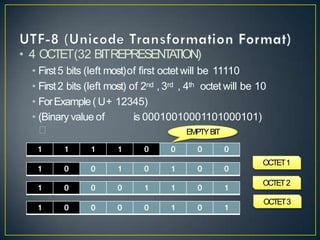
• 4 OCTET(32 BITREPRESENT
A
TION)
• First5 bits (left most)of first octet will be 11110
• First2 bits (left most) of 2nd , 3rd , 4th octet will be 10
• ForExample( U+ 12345)
• (Binary value of
𒍅
1 1 1 1 0 0 0 0
1 0 0 1 0 1 0 0
1 0 0 0 1 1 0 1
OCTET1
OCTET2
OCTET3
1 0 0 0 0 1 0 1
is 00010010001101000101)
EMPTYBIT
• It isfixed length encodingschemethat usesexactly 4 bytes to
representall Unicode characters.
• It storesevery character using4bytes
• Example: Consider the Symbol* [U+002A binary-00101010]
0 0 0 0 0 0 0 0
0 0 0 0 0 0 0 0
0 0 0 0 0 0 0 0
0 0 1 0 1 0 1 0

004 NUMBER SYSTEM (1).pdf

  • 1.
    DecimalNumber System Binary NumberSystem Octal Number System Hexadecimal Number System ASCII,ISCII,UNICODE
  • 2.
    Computers accept inputand deliver output in the form of digital signals. Adigital signal hasonly two states,represented by two voltage levels, high and low. For a computer to process numbers, it is important to be able to represent thenumbersasdigital signals. T oachieve this,you need a numbersystemthat usesonly two symbols to represent any number. Thebinary number systemusesonly two symbols,0 and 1, to represent any number, and therefore provides a direct way of representing numbersin computers. Two other number systems, octal and hexadecimal, help represent binary numbers concisely, making it convenient to deal with large stringsof 0sand1s.
  • 3.
    Anumbersystemisknownby itsradix orbase. Thedecimal numbersystemuses10 symbols,and therefore, has a radix or base of 10. Thebinary numbersystemusestwo symbols, and therefore, hasa radix of 2. The radix of a number is usually written as a subscript with that number, where the numberis written within parentheses, as shown in thefollowing examples:  (368)10  (10101)2
  • 4.
    • Thedecimal numbersystemuses10symbols,and therefore has a radix or base of 10. • Symbolsare [ 0 to 9 ] • Everydigit in Decimal numbersystemisidentified from its position i.e. from right to left as(for e.g. 345) :- • It means: 3 x 10² + 4 x 101 + 5 x 100 = 345 • 3 x 100 + 4 x 10 + 5 x 1 = 345 • Left mostdigit will be MSD(mostsignificant digit and right most digit will be LSD(least significant digit) Number 3 4 5 POSITIONALVALUE 102 101 100
  • 5.
    • Thebinary numbersystemuses2symbols, and therefore hasa radix or base of 2. • Symbols are [ 0 and 1 ], also knownasbits or binary digit • Everybit in Binary numbersystemisidentified from its position i.e. from right to left as(for e.g. 110) :- will be LSB(least significant bit) • It means : 1 x 22 + 1 x 21 + 0x 20 will give its decimal equivalent • 1 x 4 + 1 x 2 + 0 x1 = 6, So (110)2 = (6)10 • Left mostdigit will be MSB(mostsignificantbit and right mostdigit Binary Number 1 1 0 POSITIONAL VALUE 22 21 20
  • 6.
    • Theoctal numbersystemuses8symbols,and therefore hasa radix or base of 8. • Symbols are [ 0 to 7 ] • Everybit in Octal numbersystemisidentified from itsposition i.e. from right to left as(for e.g. 140) :- • It means: 1 x 82 + 4 x 81 + 0 x 80 will give its decimal equivalent • 1 x 64 + 4 x 8 + 0 x 1 = 96, So (140)8 = (96)10 Binary Number 1 4 0 POSITIONAL VALUE 82 81 80
  • 7.
    • TheHex numbersystemuses16symbols,and therefore hasa radix or base of 16. • Symbols are [ 0 to 9 andA to F ] • 10 isrepresented asAand soon • Everybit in Hex numbersystemisidentified from its position i.e. from right to left as(for e.g.A2B) :- • It means :Ax162 + 2x161 + Bx160 will give itsdecimal equivalent • 10x256 + 2x16 + 11x1 = 2603, So (A2B)16 = (2603)10 Binary Number A 2 B POSITIONAL VALUE 162 161 160
  • 8.
    At times,you needto covert a numberfrom onenumbersystem to another. Distinct methods have been defined for conversion between each pair of number systems. Y oucan convert a decimal number to its binary form by using the method of successive division by 2, the radix of the binary number system. Putthe remainder to the right of quotient and repeat this process till the quotient becomesZEROorONE. Write down theremainders in reverse order to get equivalent binary number.
  • 9.
  • 10.
  • 11.
    Multiply eachbit ofbinary numberby its place value i.e. 2n Add the result. 1 0 1 0 1 1 0 1 27 26 25 24 23 22 21 20 128 x 1 64 x 0 32 x 1 16 x 0 8 x 1 4 x 1 2 x 0 1 x 1 128 0 32 0 8 4 0 1 ANSWER: (73)10
  • 12.
    2 • (11110110) to( ? ) 10 • (101010110101) 2 to (?) 10
  • 13.
    Y ou can converta decimal number to its octal form by using the method of successivedivision by 8, the radix of the octal number system. Putthe remainder to the right of quotient and repeat this process till the quotient becomes ZERO. Write down theremaindersin reverse order to get equivalent octal number.
  • 14.
  • 15.
    • (173) 10to ( ? ) 8 • (243) 10 to ( ? ) 8
  • 16.
    Multiply eachbit ofoctal numberby its place value i.e. 8n Add the result 2 3 7 82 81 80 64x2 8x3 1x7 128 24 7 ANSWER: (159)10
  • 17.
    Y ou can converta decimal number to its octal form by using the method of successive division by 16, the radix of the hexadecimalnumber system. Putthe remainder to the right of quotient and repeat this process till the quotient becomes ZERO. Write down theremaindersin reverse order to get equivalent hexadecimal number.
  • 18.
  • 19.
    • (233) 10to ( ? ) 1 6 • ( 7 9 ) 10 to ( ? ) 16
  • 20.
    Multiply eachbit ofhexadecimal numberby itsplace value i.e. 16n Add the result A 2 B 162 161 160 256x10 16x2 1x11 2560 32 11 ANSWER: (2603)10
  • 21.
    • Asnumberof bitsincreases,there isa need arises of grouping of bits. • Octal numbercomprisesof 3 bits i.e. 3 binary bits are usedto representoctal number. OCTAL BINARY 0 000 1 001 2 010 3 011 4 100 5 101 6 110 7 111
  • 22.
    3 5 2 011101 010 ANSWER: (011101010)2
  • 23.
    • (237) 8to ( ? ) 2 • (206) 8 to ( ? ) 2
  • 24.
    • It requiresgrouping of 3 bits from right handside, if last group not consistsof 3 bit thenadd 0 to makeit group of 3 bit MAKEGROUPOF3 BITS Extra 0 is padded to make 2 6 6 3 ANSWER: (3266)8 it of 3 bits
  • 25.
    • (111000111001) 2to ( ? ) 8 • (101010101010101) 2 to ( ? ) 8
  • 26.
    • Hexadecimalnumbercomprisesof 4bits i.e. 4 binary bits are usedto representHexadecimal number. HEXADECIMAL BINARY 0 0000 1 0001 2 0010 3 0011 4 0100 5 0101 6 0110 7 0111 8 1000 9 1001 HEXADECIMAL BINARY A 1010 B 1011 C 1100 D 1101 E 1110 F 1111
  • 27.
    8 B C2 1000 1011 1100 0010 ANSWER: (1000101111000010)2
  • 28.
    • (CAFE) 16to ( ? ) 2 • (78F9) 16 to ( ? ) 2
  • 29.
    • It requiresgrouping of 4 bits from right handside, if last group not consistsof 4 bit thenadd 0 to makeit group of 4 bit MAKEGROUPOF4 BITS Extra 0 is padded to make 6 6 B 6 ANSWER: (6B66)8 it of 4 bits
  • 30.
  • 31.
    • T operform binaryaddition, we have to follow thesimple rules like: • 0 + 0 = 0 • 0 + 1 = 1 • 1 + 1 = 0 (and 1 carry toleft) • 1 + 1 + 1 = 1 (and 1 carry to left) • Note : if numberof 1’sisin eventhenresultwill be0 andnno.of 1 will carry to left wherenisthenumberof pair • If the number of 1’s in in odd the result will be 1 and n no.of 1 will carry to left wherenisthenumberof pair
  • 32.
  • 33.
    • Computer mustunderstandthe character entered by user,for this purpose numeric code is assigned to each character used in computer. • For example • A– Z • a-z • 0-9 assigned with code 65-90 assigned with code 97-122 assigned with code 48-57 • Thereare various encodingscheme available • ASCII • ISCII • UNICODE
  • 34.
    • Stands forAmerican Standard code for information interchange. • It is most widely used alphanumeric code for microcomputers and minicomputers. • It is 7-Bitccaonde, so it representmaximumof 27 = 128code i.e. 128 possible characters.
  • 35.
    CHARACTERS DECIMAL CODE7-BIT CODE A 65 1000001 B 66 1000010 - - - Z 90 1011010 a 97 1100001 - - - z 122 1111010 ENTERKEY 13 0001101 $ 36 0100100 + 43 0101011 - - - BASEDON THESEV ALUEWE CANEASIL YFIND ITSOCTAL & HEXADECIMAL REPRESENT A TIO N
  • 36.
    • CONVERTTHEFOLLOWINGASCIICODEINTTOITSORIGINAL MESSAGE • 10001011011000 1000001 1001101 • T oconvert the above messagewe first convert the above 7-bit code into decimalvalue as – • 1000101 = 69 (it iscodeof ‘E’) • 1011000 = 88 (it iscode of ‘X’) • 1000001 = 65 (it iscode of ‘A’) • 1001101 = 77 (it iscode of ‘M’) • Sothe original messageisEXAM
  • 37.
    • CONVERTTHEFOLLOWINGMESSAGEINTOASCIICODE • STEP1 •T oconvert first find outthe binary value (either fromASCII table) or manuallywe find outthedecimalcode thenconvert it in binary. Fore.g. if ‘A’is65 thenfollowing thesequencewe can find S= 83, T= 84, E= 69, P= 80 • SP ACE= 32, 1 = 49 • Nowconvert thedecimal into binary: • 83 = 1010011, 84 = 1010100, 69 = 1000101, 80 = 1010000 • 32 = 0100000, 49 = 0110001 • So,original message: • 1010011 1010100 1000101 1010000 0100000 0110001
  • 38.
    • Stands forIndian Standard Code for Information Interchange • ISCII we adopted in 1991, by Bureauby IndianStandards to have commonstandard for Indian scripts. • It is8-bit encodingschemeand canrepresent28 =256chars. • It retain first 128 for ASCII code • ASCIIisable to representIndian language characters like : Tamil,Telugu,Kannada, Oriya, Bengali,Assamese,Gujarati,etc.
  • 39.
    • Aswe knowASCIIandISCIIrepresentcharacters belonging to different language by assigned unique code to each characters. • Need arises to have encodingschemewhich canrepresentall the knownlanguage aroundthe world. Theresult isUNICODE. • It isthestandard usedworldwide now. • Itsvariants are UTF-8,UTF-16,UTF-32 • Unicode13.0 represent 143000 characters • Supported by mostOS,makingit platform, vendor,application independent • Allows data to be transported betweendifferent system without distortion.
  • 40.
    • It isvariable length encoding scheme that can represent each character in UNICODEcharacter set. • Thecodeunit of UTF-8is8 bits i.e. OCTET • UTF-8canuse1 OCTETto maximum6 OCTETdepending uponthe character it represent. • Unicodecodepointsare written asU+<codepoint> for e.g.U+0050 represent ‘P” Unicode Code Points (Decimal) Unicode Code Points (Hex) Number of octetsused U-0 to U-127 U+00 to U+07F 1 octet (8 bits) U-128 to U-2047 U+80 to U+7FF 2 octets(16 bits) U-2048 to U-65535 U+800 to U+FFFF 3 octets(24 bits) U-65536 to U-2097151 U+10000 to U+1FFFFF 4 octets(32 bits)
  • 41.
    • 1 OCTET(8BITREPRESENT A TION) • For1 octet representation theleft mostbit act ascontrolbit which storesZERO(0) • Thecontrolbit isspecial bit that store the controlcode not the actual character.Restof thebit storesthe actual’s binary code • ForExample( U+ 0050 ) (Binary value of Pis 1010000) 0 1 0 1 0 0 0 0 CONTROLCODE ACTUALBINARYCODE
  • 42.
    1 1 00 0 0 1 0 1 0 1 0 0 1 1 1 OCTET2 • 2 OCTET(16 BITREPRESENT A TION) • First3 bits (left most)of first octet will be 110 • First2 bits (left most)of secondoctet will be 10 • ForExample( U+ 00A7) (Binary value of  is 10100111) EMPTYBITS OCTET1
  • 43.
    1 1 10 0 0 1 0 1 0 0 0 0 0 0 0 1 0 1 1 1 0 1 1 • 3 OCTET(24 BITREPRESENT A TION) • First4 bits (left most)of first octet will be 1110 • First2 bits (left most)of secondoctet will be 10 • First2 bits (left most)of third octet will be 10 • ForExample( U+ 203B) • (Binary value of ※ is10000000111011) EMPTYBITS OCTET1 OCTET2 OCTET3
  • 44.
    • 4 OCTET(32BITREPRESENT A TION) • First5 bits (left most)of first octet will be 11110 • First2 bits (left most) of 2nd , 3rd , 4th octet will be 10 • ForExample( U+ 12345) • (Binary value of 𒍅 1 1 1 1 0 0 0 0 1 0 0 1 0 1 0 0 1 0 0 0 1 1 0 1 OCTET1 OCTET2 OCTET3 1 0 0 0 0 1 0 1 is 00010010001101000101) EMPTYBIT
  • 45.
    • It isfixedlength encodingschemethat usesexactly 4 bytes to representall Unicode characters. • It storesevery character using4bytes • Example: Consider the Symbol* [U+002A binary-00101010] 0 0 0 0 0 0 0 0 0 0 0 0 0 0 0 0 0 0 0 0 0 0 0 0 0 0 1 0 1 0 1 0