CLASSIFICATION
OF
DATA
What is classification of data?
Data classification is the
process of organizing
data into categories for
its most effective and
efficient use.
A well- planned data
classification system makes
essential data easy to find
and retrieve.
3 - 4
Types of Data
Recognizing and understanding the
different data types is an important
component of proper data use and
interpretation.
Reviewed 15 April 2005 /MODULE 2
3 - 5
Data are often discussed in terms of
variables, where a variable is:
Any characteristic that varies from
one member of a population to
another.
A simple example is height in
centimeters, which varies from
person to person.
Data and Variables
TYPES OF DATA
QUALITATIVE DATA
QUANTITATIVE OR INTERVAL
DATA(measurements)
CHRONOLOGICAL BASE
TEMPORAL BASE
1. QUALITATIVE DATA
A. NOMINAL, ATTRIBUTE OR CATEGORICAL DATA:
Examples:
1. Gender
2. Religion
3.Countries
4. Civil Status
1.QUALITATIVE DATA
B. Ordinal or Ranked Data: one value is greater
or less than another, but the magnitude of the
difference is unknown.
EXAMPLES:
1. Student Performance(outstanding, very
satisfactory, satisfactory, unsatisfactory)
2. Income (10, 000.00- 15, 000.00, 20, 000.00- 50, 000.00)
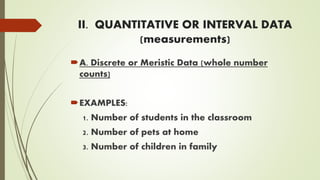
II. QUANTITATIVE OR INTERVAL DATA
(measurements)
A. Discrete or Meristic Data (whole number
counts)
EXAMPLES:
1. Number of students in the classroom
2. Number of pets at home
3. Number of children in family
 B. Continuous Measurements (rational numbers, limited by
the accuracy of your measurements)
 EXAMPLES:
1. Height
2. Weight
3. Grades
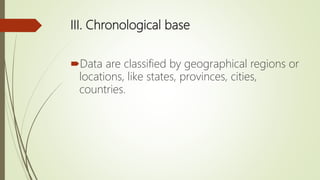
III. Chronological base
Data are classified by geographical regions or
locations, like states, provinces, cities,
countries.
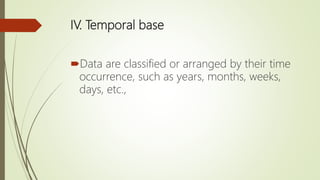
IV. Temporal base
Data are classified or arranged by their time
occurrence, such as years, months, weeks,
days, etc.,
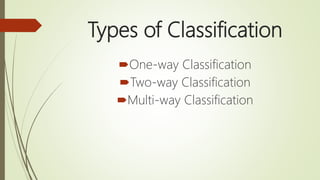
Types of Classification
One-way Classification
Two-way Classification
Multi-way Classification
I. One-way Classification
Data keeping are viewed by single characteristics
Example:
population of the world are classified by religion
II. Two-way Classification
We consider two characteristics at a time
Example:
population of the world are classified according to
religion and sex
III. Multi-way Classification
We consider more than two characteristics at a
time
Example:
population of the world are classified according to
religion, sex and literacy

Classification of data

  • 1.
  • 2.
    What is classificationof data? Data classification is the process of organizing data into categories for its most effective and efficient use.
  • 3.
    A well- planneddata classification system makes essential data easy to find and retrieve.
  • 4.
    3 - 4 Typesof Data Recognizing and understanding the different data types is an important component of proper data use and interpretation. Reviewed 15 April 2005 /MODULE 2
  • 5.
    3 - 5 Dataare often discussed in terms of variables, where a variable is: Any characteristic that varies from one member of a population to another. A simple example is height in centimeters, which varies from person to person. Data and Variables
  • 6.
    TYPES OF DATA QUALITATIVEDATA QUANTITATIVE OR INTERVAL DATA(measurements) CHRONOLOGICAL BASE TEMPORAL BASE
  • 7.
    1. QUALITATIVE DATA A.NOMINAL, ATTRIBUTE OR CATEGORICAL DATA: Examples: 1. Gender 2. Religion 3.Countries 4. Civil Status
  • 8.
    1.QUALITATIVE DATA B. Ordinalor Ranked Data: one value is greater or less than another, but the magnitude of the difference is unknown. EXAMPLES: 1. Student Performance(outstanding, very satisfactory, satisfactory, unsatisfactory) 2. Income (10, 000.00- 15, 000.00, 20, 000.00- 50, 000.00)
  • 9.
    II. QUANTITATIVE ORINTERVAL DATA (measurements) A. Discrete or Meristic Data (whole number counts) EXAMPLES: 1. Number of students in the classroom 2. Number of pets at home 3. Number of children in family
  • 10.
     B. ContinuousMeasurements (rational numbers, limited by the accuracy of your measurements)  EXAMPLES: 1. Height 2. Weight 3. Grades
  • 11.
    III. Chronological base Dataare classified by geographical regions or locations, like states, provinces, cities, countries.
  • 12.
    IV. Temporal base Dataare classified or arranged by their time occurrence, such as years, months, weeks, days, etc.,
  • 13.
    Types of Classification One-wayClassification Two-way Classification Multi-way Classification
  • 14.
    I. One-way Classification Datakeeping are viewed by single characteristics Example: population of the world are classified by religion
  • 15.
    II. Two-way Classification Weconsider two characteristics at a time Example: population of the world are classified according to religion and sex
  • 16.
    III. Multi-way Classification Weconsider more than two characteristics at a time Example: population of the world are classified according to religion, sex and literacy