 What is Coefficient of Variation?
 What are the Formulas of COV in
Excel
 How to find COV by Hand
 Calculating Quartile (Ungrouped
Data)
 Calculating Quartile
(Group Data)
 Calculating COV by Box and
Whisker Plot
 References
*
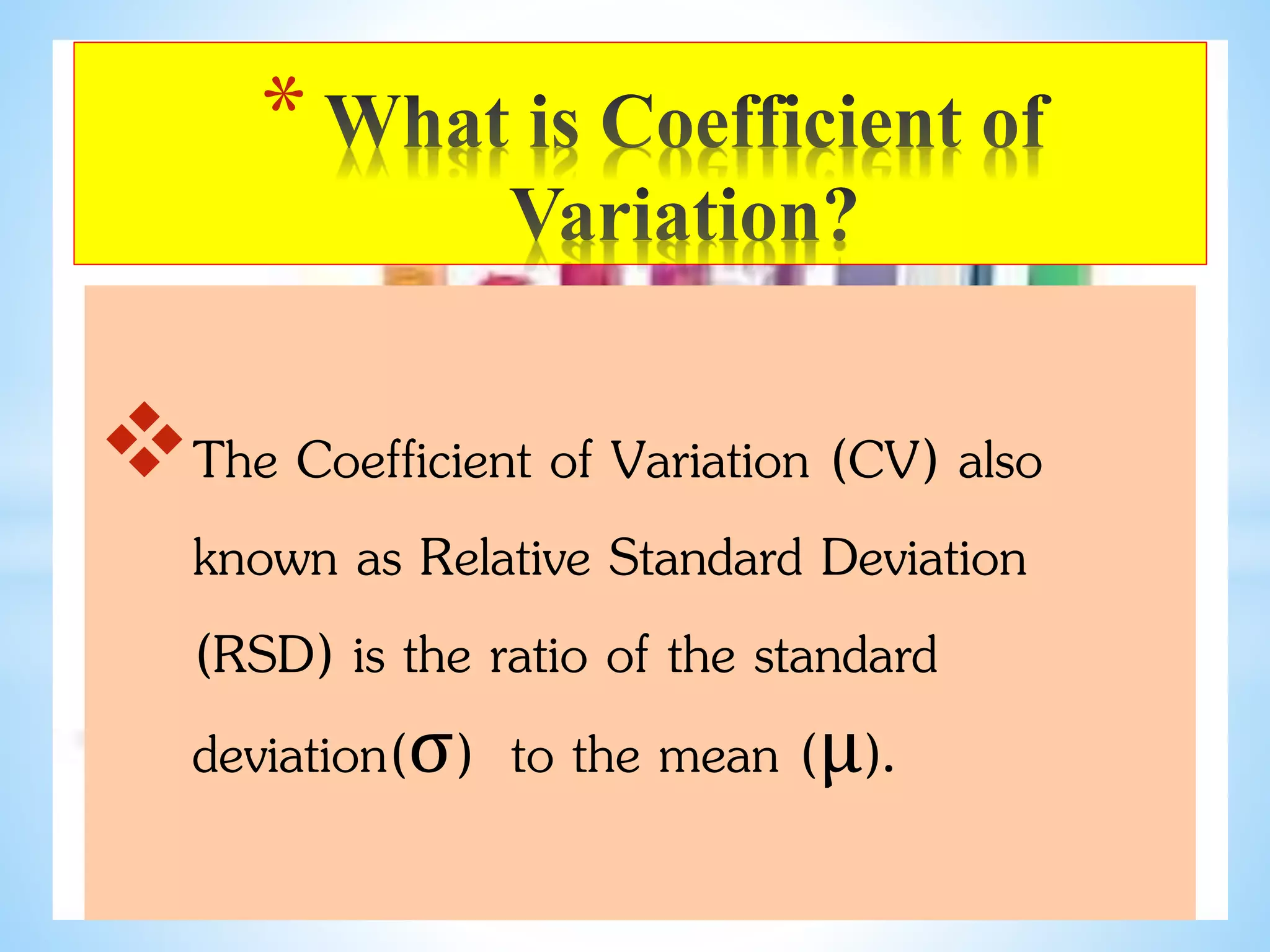
The Coefficient of Variation (CV) also
known as Relative Standard Deviation
(RSD) is the ratio of the standard
deviation(σ) to the mean (μ).
*
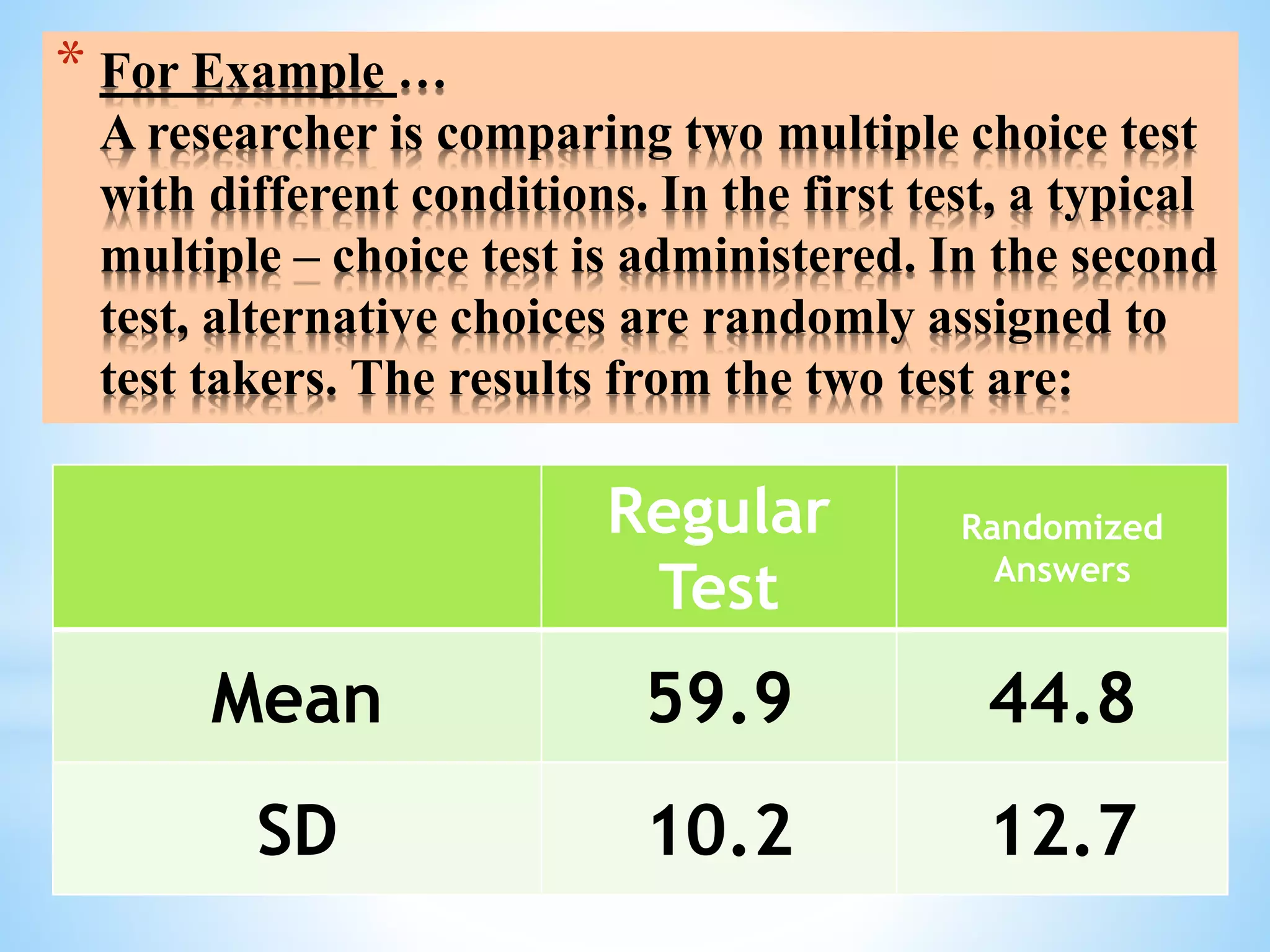
Regular
Test
Randomized
Answers
Mean 59.9 44.8
SD 10.2 12.7
* For Example …
A researcher is comparing two multiple choice test
with different conditions. In the first test, a typical
multiple – choice test is administered. In the second
test, alternative choices are randomly assigned to
test takers. The results from the two test are:
*
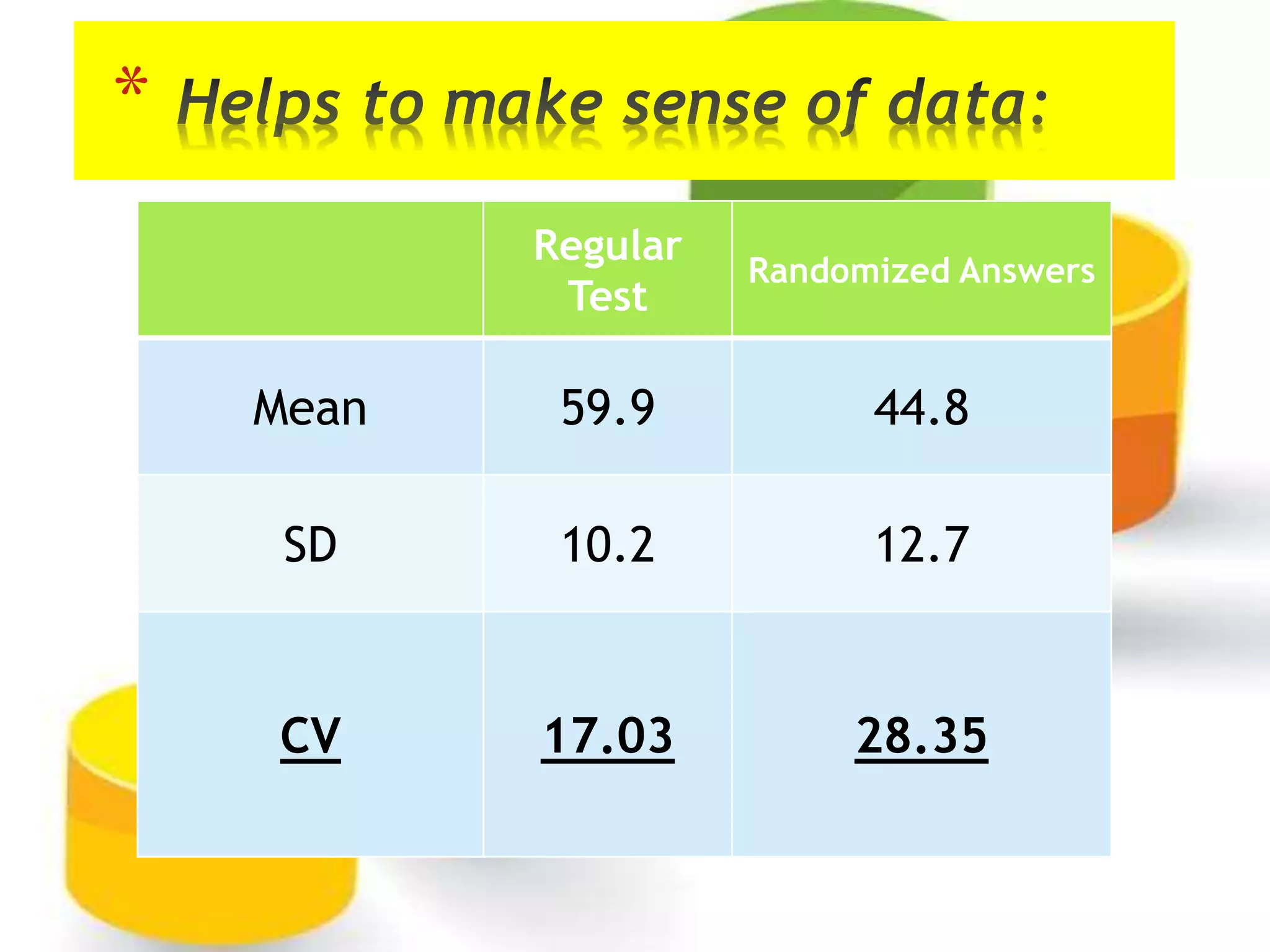
Regular
Test
Randomized Answers
Mean 59.9 44.8
SD 10.2 12.7
CV 17.03 28.35
*
Excel.xlsx
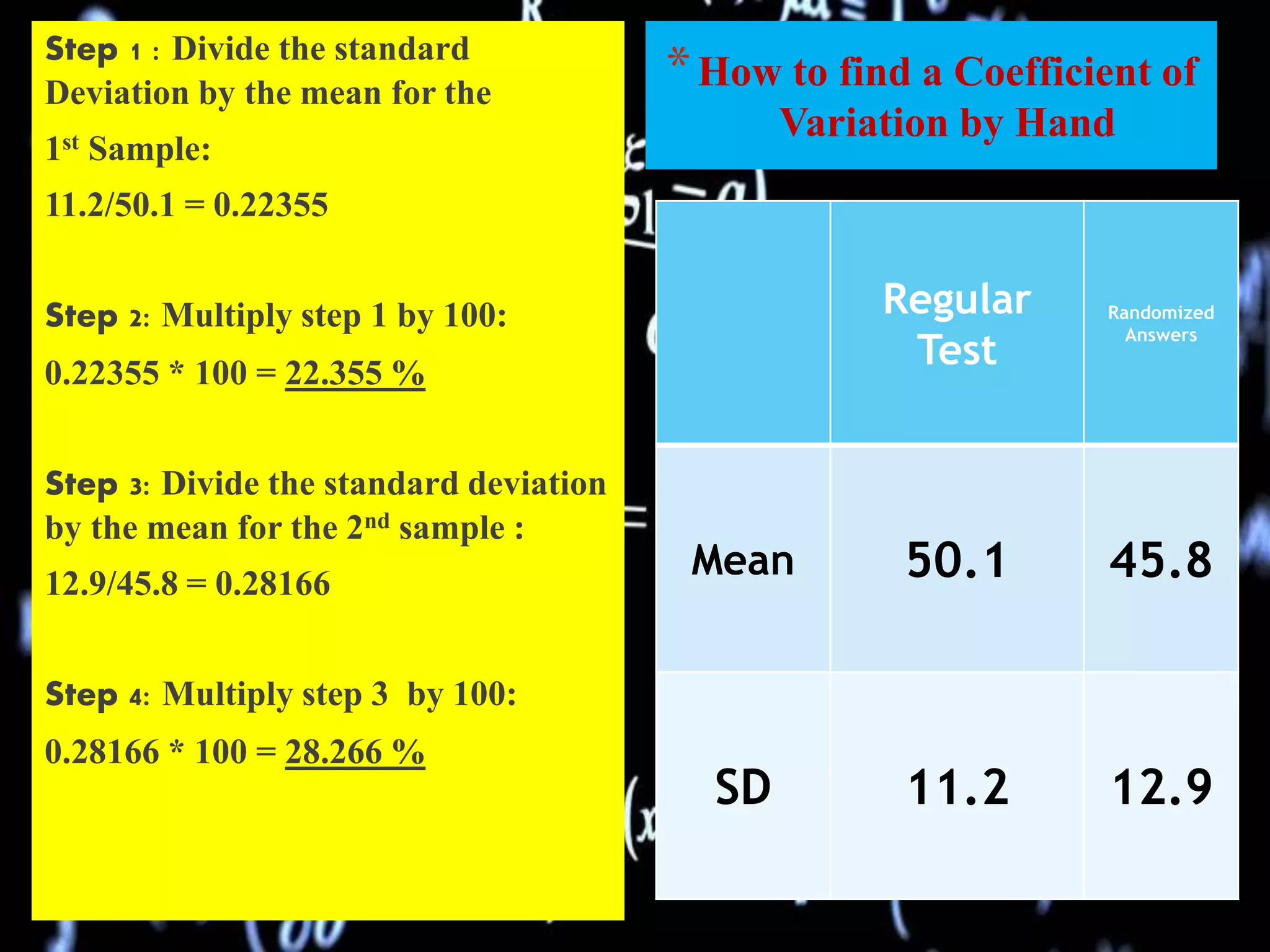
*How to find a Coefficient of
Variation by Hand
Regular
Test
Randomized
Answers
Mean 50.1 45.8
SD 11.2 12.9
Step 1 : Divide the standard
Deviation by the mean for the
1st Sample:
11.2/50.1 = 0.22355
Step 2: Multiply step 1 by 100:
0.22355 * 100 = 22.355 %
Step 3: Divide the standard deviation
by the mean for the 2nd sample :
12.9/45.8 = 0.28166
Step 4: Multiply step 3 by 100:
0.28166 * 100 = 28.266 %
*
*
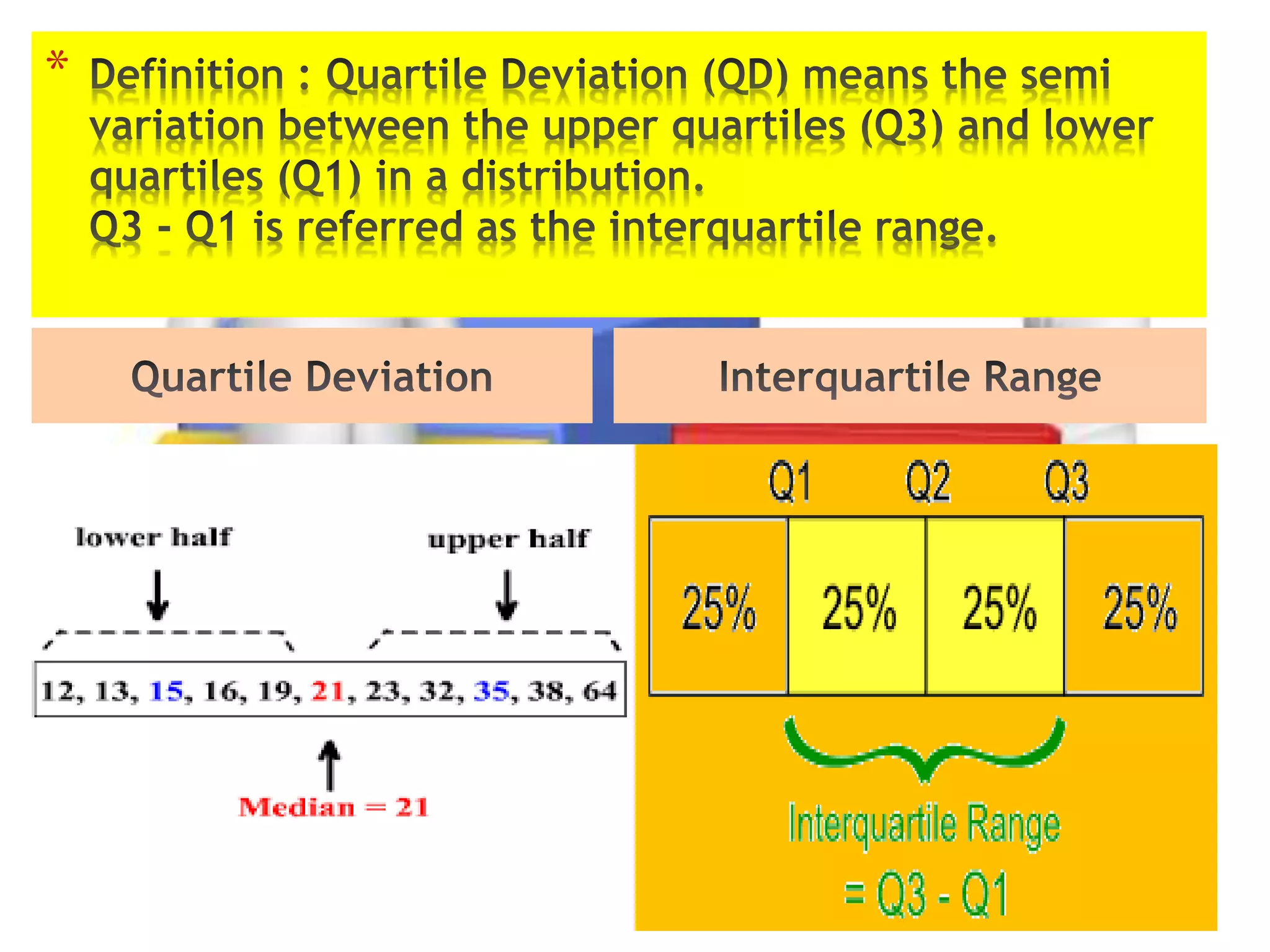
*Quartiles Raw
or
Ungrouped Data
25, 18, 30, 8, 15, 5,10, 35, 40, 45
5, 8, 10, 15, 18, 25, 30, 35, 40, 45
𝑄
1= (
𝑁+1
4
)
th Item
= (
10+1
4
) th Item
= (2. 75) th Item
= 2nd Item + (
3
4
) (3rd – 2nd )
8 +
3
4
(10 − 8 )
8 +
3
4
x 2
= 8+ 1.5
= 9.5
* 𝑄3 =3 (
𝑁+1
4
)
th Item
*=3 x (2.75) th item
*(8.25) th item
*8th item + (
1
4
) [ 9th – 8th ]
*= 35 +
1
4
[ 40 – 35 ]
*=35 + 1.25
*=36.25
*Quartile
Deviation
(Grouped Data)
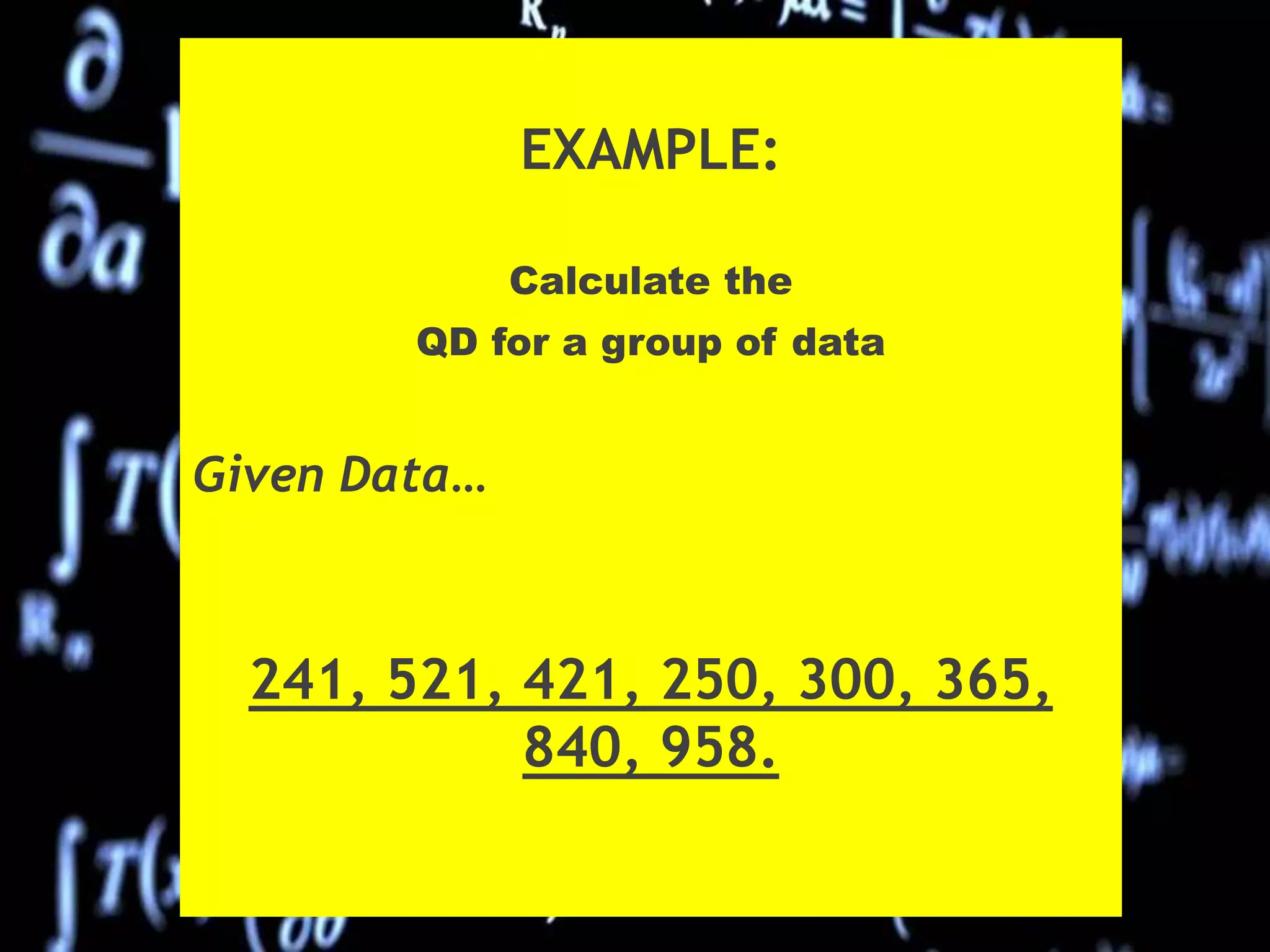
EXAMPLE:
Calculate the
QD for a group of data
Given Data…
241, 521, 421, 250, 300, 365,
840, 958.
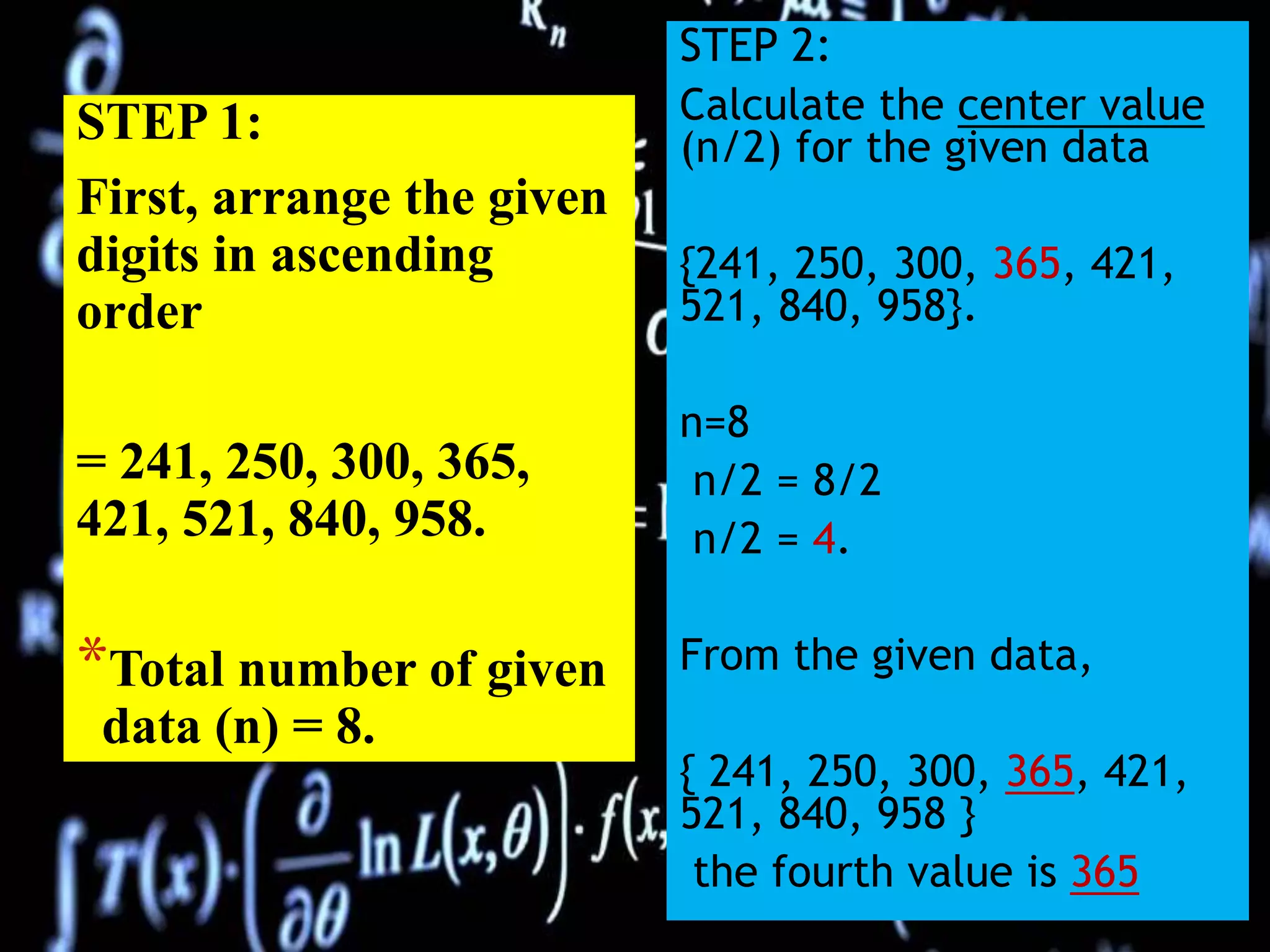
STEP 1:
First, arrange the given
digits in ascending
order
= 241, 250, 300, 365,
421, 521, 840, 958.
*Total number of given
data (n) = 8.
STEP 2:
Calculate the center value
(n/2) for the given data
{241, 250, 300, 365, 421,
521, 840, 958}.
n=8
n/2 = 8/2
n/2 = 4.
From the given data,
{ 241, 250, 300, 365, 421,
521, 840, 958 }
the fourth value is 365
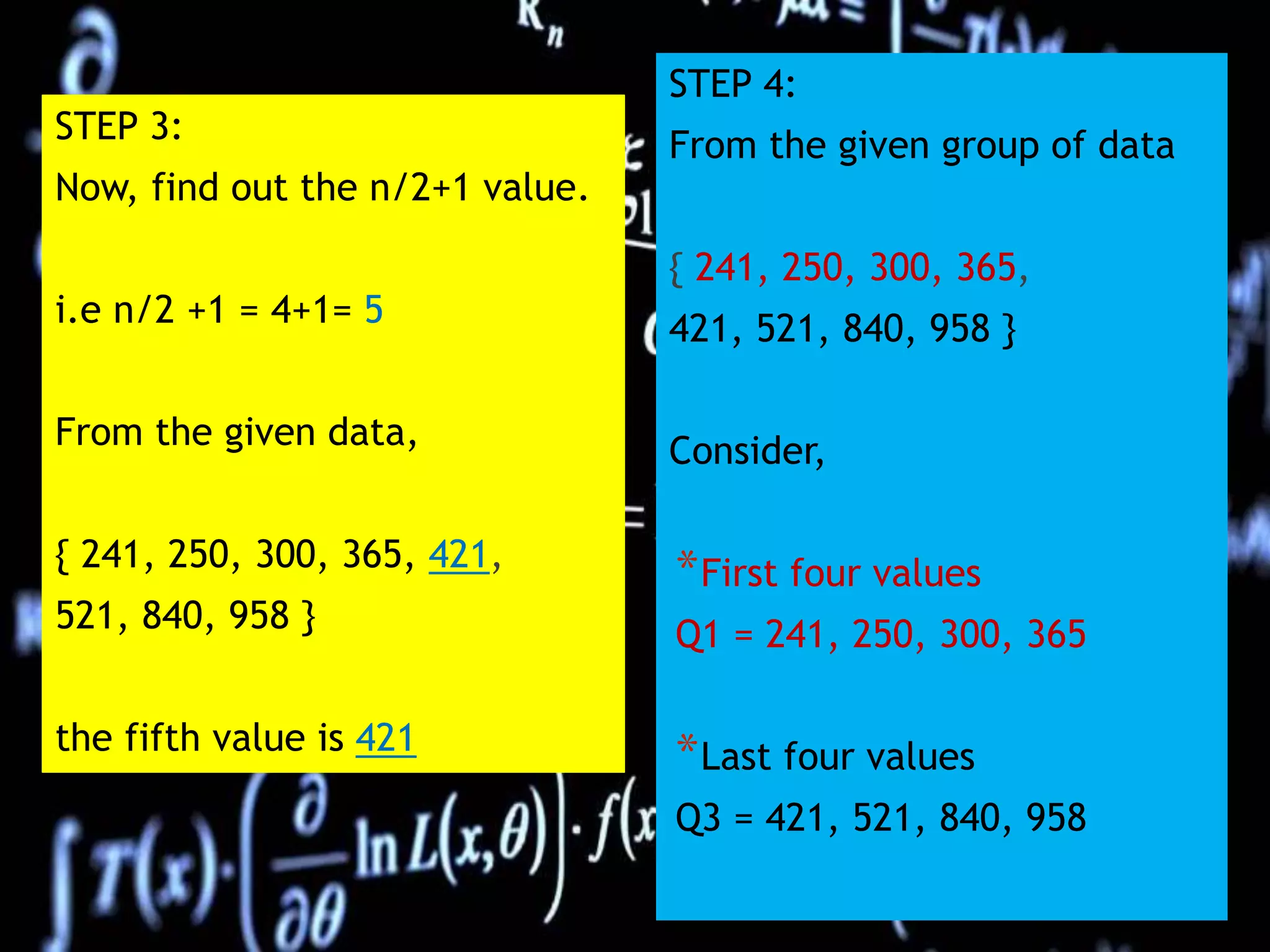
STEP 3:
Now, find out the n/2+1 value.
i.e n/2 +1 = 4+1= 5
From the given data,
{ 241, 250, 300, 365, 421,
521, 840, 958 }
the fifth value is 421
STEP 4:
From the given group of data
{ 241, 250, 300, 365,
421, 521, 840, 958 }
Consider,
*First four values
Q1 = 241, 250, 300, 365
*Last four values
Q3 = 421, 521, 840, 958
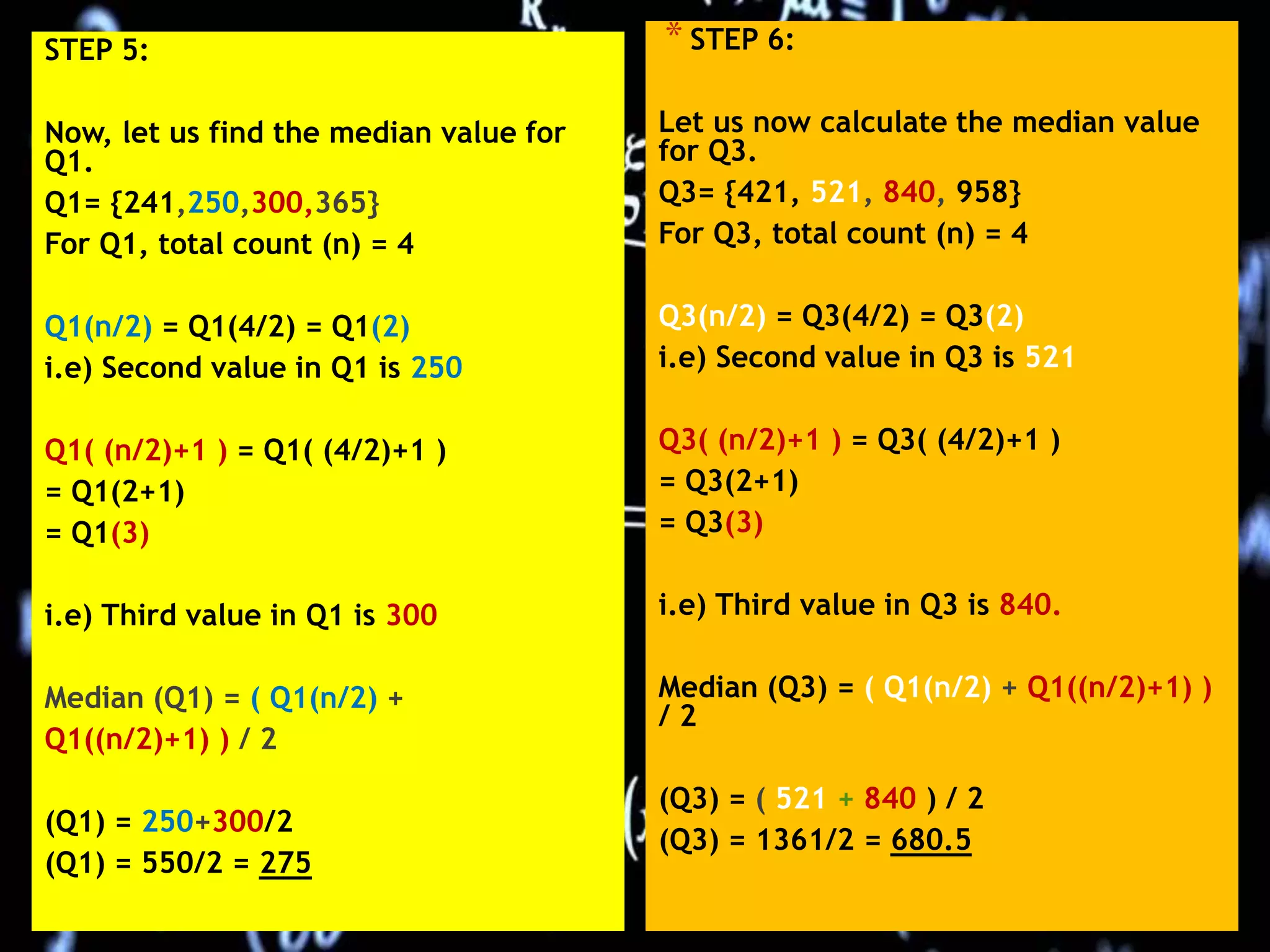
STEP 5:
Now, let us find the median value for
Q1.
Q1= {241,250,300,365}
For Q1, total count (n) = 4
Q1(n/2) = Q1(4/2) = Q1(2)
i.e) Second value in Q1 is 250
Q1( (n/2)+1 ) = Q1( (4/2)+1 )
= Q1(2+1)
= Q1(3)
i.e) Third value in Q1 is 300
Median (Q1) = ( Q1(n/2) +
Q1((n/2)+1) ) / 2
(Q1) = 250+300/2
(Q1) = 550/2 = 275
* STEP 6:
Let us now calculate the median value
for Q3.
Q3= {421, 521, 840, 958}
For Q3, total count (n) = 4
Q3(n/2) = Q3(4/2) = Q3(2)
i.e) Second value in Q3 is 521
Q3( (n/2)+1 ) = Q3( (4/2)+1 )
= Q3(2+1)
= Q3(3)
i.e) Third value in Q3 is 840.
Median (Q3) = ( Q1(n/2) + Q1((n/2)+1) )
/ 2
(Q3) = ( 521 + 840 ) / 2
(Q3) = 1361/2 = 680.5
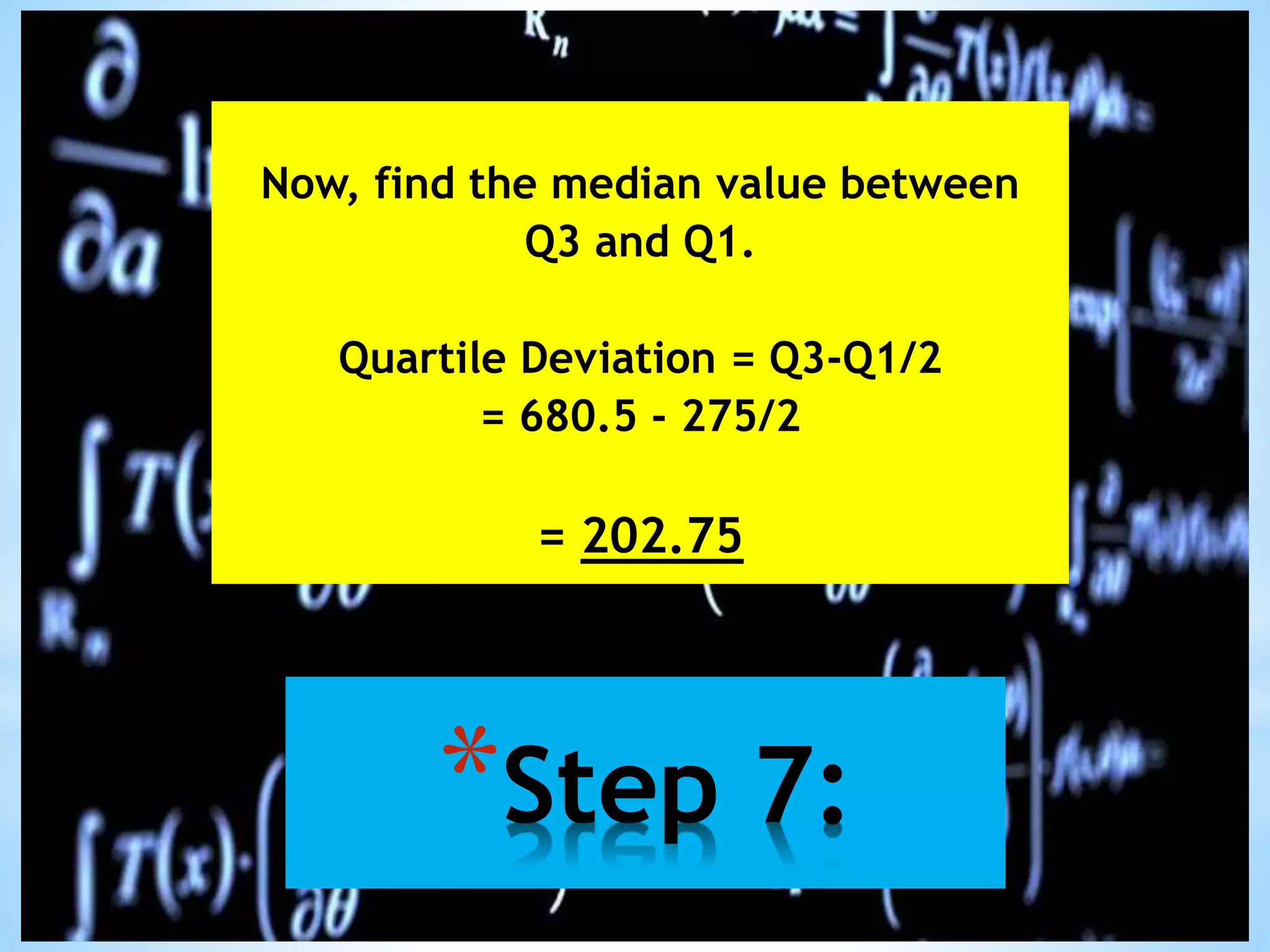
*Step 7:
Now, find the median value between
Q3 and Q1.
Quartile Deviation = Q3-Q1/2
= 680.5 - 275/2
= 202.75
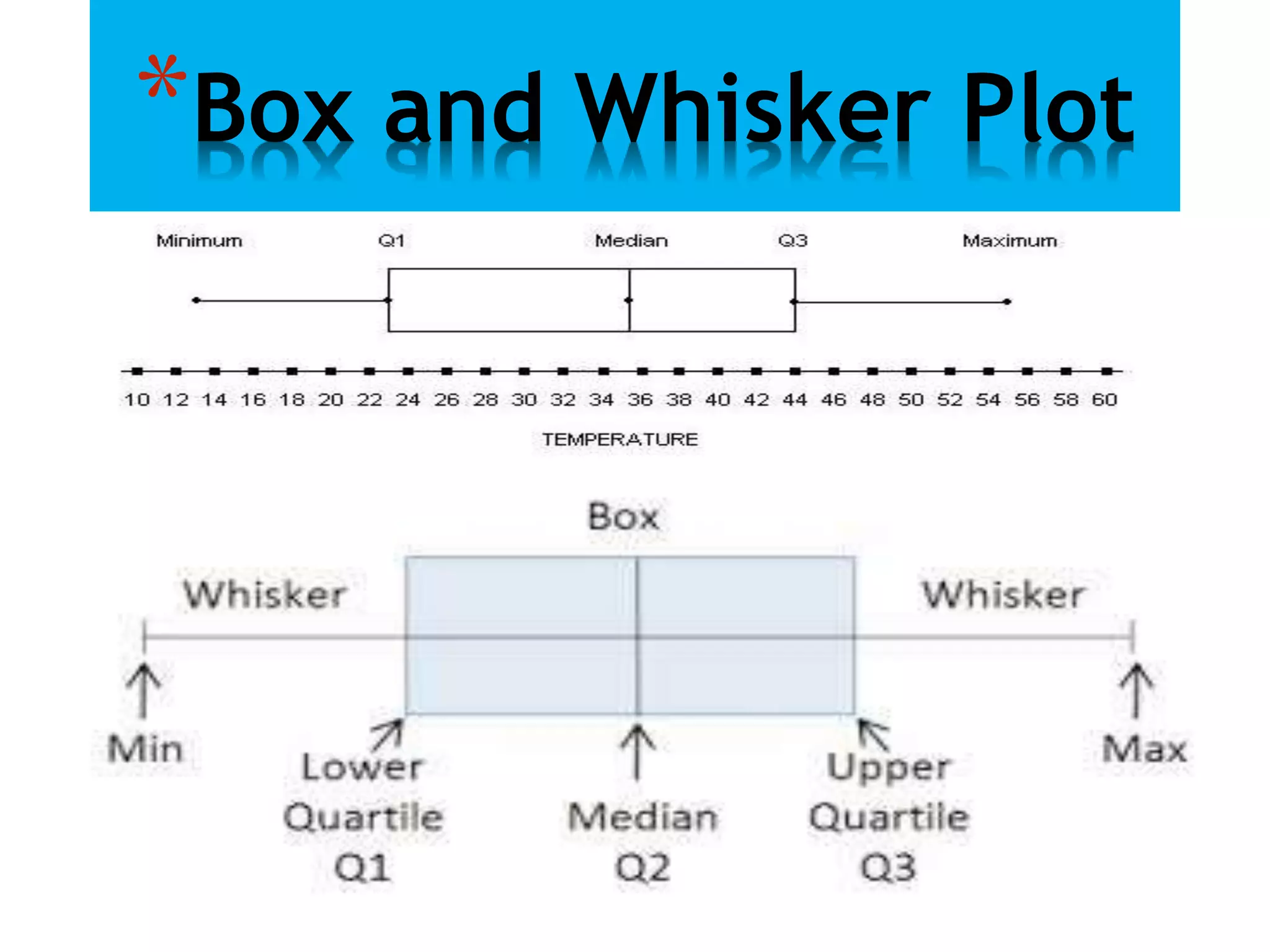
*Box and Whisker Plot
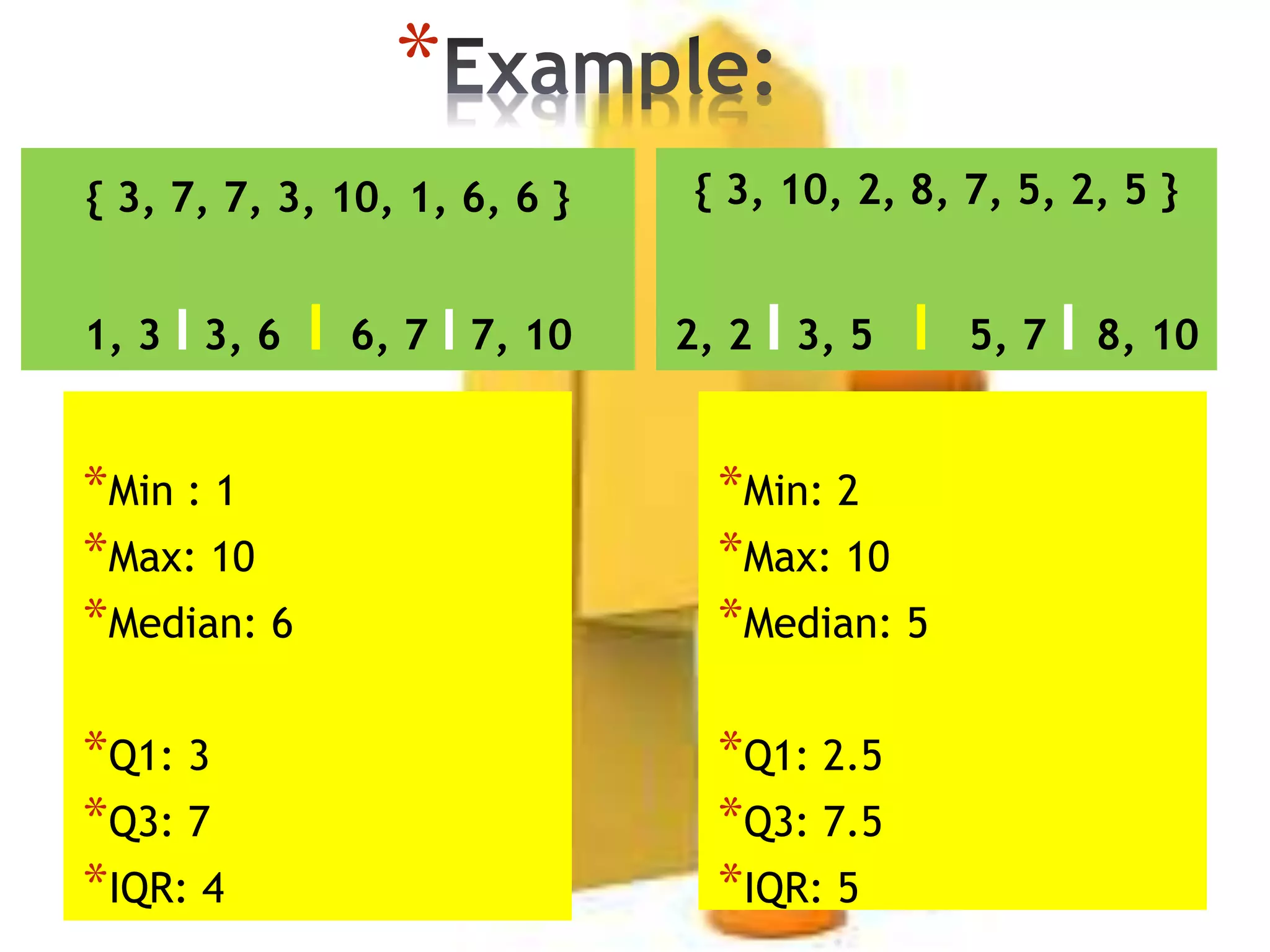
{ 3, 7, 7, 3, 10, 1, 6, 6 }
1, 3 I 3, 6 I 6, 7 I 7, 10
*Min : 1
*Max: 10
*Median: 6
*Q1: 3
*Q3: 7
*IQR: 4
{ 3, 10, 2, 8, 7, 5, 2, 5 }
2, 2 I 3, 5 I 5, 7 I 8, 10
*Min: 2
*Max: 10
*Median: 5
*Q1: 2.5
*Q3: 7.5
*IQR: 5
*
*
*http://www.lexic.us/definition-of/quartile
*https://www.google.com.ph/search?q=QUARTILE+DEVIATION++FORMULA&bi
w=1093&bih=471&source=lnms&tbm=isch&sa=X&ved=0ahUKEwjqhanq7IHSA
hVEn5QKHW39BFcQ_AUIBigB#tbm=isch&q=box+and+whisky+plots
*http://www.purplemath.com/modules/boxwhisk.htm
*https://www.youtube.com/watch?v=FQqUmWPpI_M
*https://www.youtube.com/watch?v=ybHABoAlIQE
*“All the statistics in the
world can't measure the
warmth of a smile.”
― Chris Hart
ROSELYN 

coefficient variation

  • 2.
     What isCoefficient of Variation?  What are the Formulas of COV in Excel  How to find COV by Hand  Calculating Quartile (Ungrouped Data)  Calculating Quartile (Group Data)  Calculating COV by Box and Whisker Plot  References *
  • 4.
    The Coefficient ofVariation (CV) also known as Relative Standard Deviation (RSD) is the ratio of the standard deviation(σ) to the mean (μ). *
  • 6.
    Regular Test Randomized Answers Mean 59.9 44.8 SD10.2 12.7 * For Example … A researcher is comparing two multiple choice test with different conditions. In the first test, a typical multiple – choice test is administered. In the second test, alternative choices are randomly assigned to test takers. The results from the two test are:
  • 7.
    * Regular Test Randomized Answers Mean 59.944.8 SD 10.2 12.7 CV 17.03 28.35
  • 8.
  • 9.
    *How to finda Coefficient of Variation by Hand Regular Test Randomized Answers Mean 50.1 45.8 SD 11.2 12.9 Step 1 : Divide the standard Deviation by the mean for the 1st Sample: 11.2/50.1 = 0.22355 Step 2: Multiply step 1 by 100: 0.22355 * 100 = 22.355 % Step 3: Divide the standard deviation by the mean for the 2nd sample : 12.9/45.8 = 0.28166 Step 4: Multiply step 3 by 100: 0.28166 * 100 = 28.266 %
  • 10.
  • 11.
  • 13.
  • 14.
    25, 18, 30,8, 15, 5,10, 35, 40, 45 5, 8, 10, 15, 18, 25, 30, 35, 40, 45 𝑄 1= ( 𝑁+1 4 ) th Item = ( 10+1 4 ) th Item = (2. 75) th Item = 2nd Item + ( 3 4 ) (3rd – 2nd ) 8 + 3 4 (10 − 8 ) 8 + 3 4 x 2 = 8+ 1.5 = 9.5 * 𝑄3 =3 ( 𝑁+1 4 ) th Item *=3 x (2.75) th item *(8.25) th item *8th item + ( 1 4 ) [ 9th – 8th ] *= 35 + 1 4 [ 40 – 35 ] *=35 + 1.25 *=36.25
  • 15.
  • 16.
    EXAMPLE: Calculate the QD fora group of data Given Data… 241, 521, 421, 250, 300, 365, 840, 958.
  • 17.
    STEP 1: First, arrangethe given digits in ascending order = 241, 250, 300, 365, 421, 521, 840, 958. *Total number of given data (n) = 8. STEP 2: Calculate the center value (n/2) for the given data {241, 250, 300, 365, 421, 521, 840, 958}. n=8 n/2 = 8/2 n/2 = 4. From the given data, { 241, 250, 300, 365, 421, 521, 840, 958 } the fourth value is 365
  • 18.
    STEP 3: Now, findout the n/2+1 value. i.e n/2 +1 = 4+1= 5 From the given data, { 241, 250, 300, 365, 421, 521, 840, 958 } the fifth value is 421 STEP 4: From the given group of data { 241, 250, 300, 365, 421, 521, 840, 958 } Consider, *First four values Q1 = 241, 250, 300, 365 *Last four values Q3 = 421, 521, 840, 958
  • 19.
    STEP 5: Now, letus find the median value for Q1. Q1= {241,250,300,365} For Q1, total count (n) = 4 Q1(n/2) = Q1(4/2) = Q1(2) i.e) Second value in Q1 is 250 Q1( (n/2)+1 ) = Q1( (4/2)+1 ) = Q1(2+1) = Q1(3) i.e) Third value in Q1 is 300 Median (Q1) = ( Q1(n/2) + Q1((n/2)+1) ) / 2 (Q1) = 250+300/2 (Q1) = 550/2 = 275 * STEP 6: Let us now calculate the median value for Q3. Q3= {421, 521, 840, 958} For Q3, total count (n) = 4 Q3(n/2) = Q3(4/2) = Q3(2) i.e) Second value in Q3 is 521 Q3( (n/2)+1 ) = Q3( (4/2)+1 ) = Q3(2+1) = Q3(3) i.e) Third value in Q3 is 840. Median (Q3) = ( Q1(n/2) + Q1((n/2)+1) ) / 2 (Q3) = ( 521 + 840 ) / 2 (Q3) = 1361/2 = 680.5
  • 20.
    *Step 7: Now, findthe median value between Q3 and Q1. Quartile Deviation = Q3-Q1/2 = 680.5 - 275/2 = 202.75
  • 21.
  • 22.
    { 3, 7,7, 3, 10, 1, 6, 6 } 1, 3 I 3, 6 I 6, 7 I 7, 10 *Min : 1 *Max: 10 *Median: 6 *Q1: 3 *Q3: 7 *IQR: 4 { 3, 10, 2, 8, 7, 5, 2, 5 } 2, 2 I 3, 5 I 5, 7 I 8, 10 *Min: 2 *Max: 10 *Median: 5 *Q1: 2.5 *Q3: 7.5 *IQR: 5 *
  • 23.
  • 24.
    *“All the statisticsin the world can't measure the warmth of a smile.” ― Chris Hart
  • 25.