PROGRAMME B.COM
SUBJECT
QUANTITATIVE TECHNIQUE – I
SEMESTER III
UNIVERSITY VIJAYANAGAR SRI
KRISHNADEVARAYA UNIVERSITY,
BALLARI
SESSION 06
• MODERATOR
DR.RAMAKRISHNA
ASSOCIATE PROFESSOR OF COMMERCE
GFGC, KUROGODU, BALLARI DIST.
SUBJECT EXPERT. 1
DR.VYJANATH
ASSISTANT PROFESSOR OF COMMERCE
GFGC, TEKKALAKOTE, BALLARI DIST.
SUBJECT EXPERT. 2
AKKI MARUTHI
ASSISTANT PROFESSOR OF COMMERCE
SKNG,GFGC,GANGAVATHI KOPPAL DIST.
RECAP
• Limitations and Applications of statistics in various
fields
• Primary and Secondary Data( Collection of Data)
Learning Objectives
• The aim of the chapter is to make students to
present data in textual and Tabular format including
the technique of creating frequency distribution
and working out bi-variate distribution table
Learning Outcomes
• After the Chapter, The Students Shall be able to
Describe and Understand the Rules & Types of
Classification, Frequency Distribution, Class Interval
& its Types, Basic Principles Tabulation and The
Sorting of Data.
Session -6
• Meaning & Definition, Objectives of Classification
and Rules of Classification
MEANING AND DEFINITION OF CLASSIFICATION
Classification is the process of arranging the primary data in a
definite pattern and presenting in a systematic form.
Horace Secrist defined classification as the process of arranging
the data into sequences and groups according to their common
characteristics or separating them into different but related
parts.
It is also defined as the process of dividing the data into
different groups or classes which are as homogeneous as
possible within the groups or classes, but heterogeneous
between themselves.
OBJECTIVES OF CLASSIFICATION
• It explains the features of the data.
• It facilitates comparison with similar data.
• It strikes a note of homogeneity in the heterogeneous
elements of the collected information.
• It explains the similarities which may exist in the
diversity of data points.
• It is required to condense the mass data in such a
manner that the similarities and dissimilarities are
understood.
• It reduces the complexity of nature of data and
renders the data to comprehend easily.
• It enables proper utilization of data for further
statistical treatment.
TYPES OF CLASSIFICATION
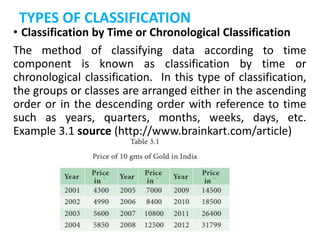
• Classification by Time or Chronological Classification
The method of classifying data according to time
component is known as classification by time or
chronological classification. In this type of classification,
the groups or classes are arranged either in the ascending
order or in the descending order with reference to time
such as years, quarters, months, weeks, days, etc.
Example 3.1 source (http://www.brainkart.com/article)
Cont.,
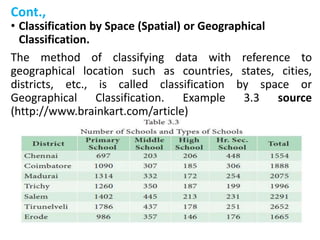
• Classification by Space (Spatial) or Geographical
Classification.
The method of classifying data with reference to
geographical location such as countries, states, cities,
districts, etc., is called classification by space or
Geographical Classification. Example 3.3 source
(http://www.brainkart.com/article)
Cont.,
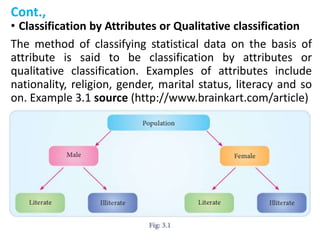
• Classification by Attributes or Qualitative classification
The method of classifying statistical data on the basis of
attribute is said to be classification by attributes or
qualitative classification. Examples of attributes include
nationality, religion, gender, marital status, literacy and so
on. Example 3.1 source (http://www.brainkart.com/article)
Cont.,
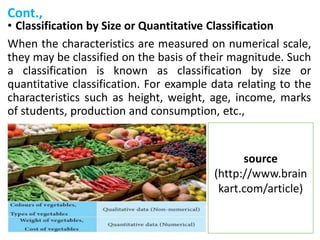
• Classification by Size or Quantitative Classification
When the characteristics are measured on numerical scale,
they may be classified on the basis of their magnitude. Such
a classification is known as classification by size or
quantitative classification. For example data relating to the
characteristics such as height, weight, age, income, marks
of students, production and consumption, etc.,
source
(http://www.brain
kart.com/article)
RULES FOR CLASSIFICATION OF DATA
• The classes must be exhaustive, i.e., it should be
possible to include each of the data points in one or the
other group or class.
• The classes must be mutually exclusive, i.e., there
should not be any overlapping.
• Generally, the number of classes may be fixed between
4 and 15.
• The magnitude or width of all the classes should be
equal in the entire classification.
• The system of open end classes may be avoided.
SUMMARY
As we already discussed and learnt today on
Classifications as below
• Meaning and definition of classification
• Objectives of classification
• Types of classification
• Rules for classification of data
MCQs
1. Find objective of Classification
a) It facilitates comparison with similar data.
b) The classes must be mutually exclusive
c) Generally, the number of classes may be fixed
between 4 and 15.
d) The magnitude or width of all the classes should
be equal in the entire classification.
2. The method of classifying data according to time
component is known as
a) Chronological Classification
b) Geographical Classification
c) Qualitative Classification
d) Quantitative Classification
MCQs
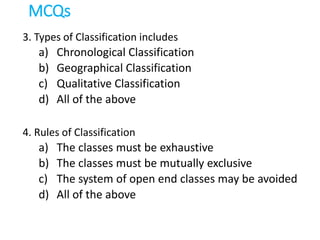
3. Types of Classification includes
a) Chronological Classification
b) Geographical Classification
c) Qualitative Classification
d) All of the above
4. Rules of Classification
a) The classes must be exhaustive
b) The classes must be mutually exclusive
c) The system of open end classes may be avoided
d) All of the above
MCQs
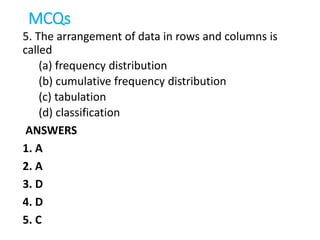
5. The arrangement of data in rows and columns is
called
(a) frequency distribution
(b) cumulative frequency distribution
(c) tabulation
(d) classification
ANSWERS
1. A
2. A
3. D
4. D
5. C
REFERENCES
• STATISTICAL METHODS BY S.P GUPTA SULTAN CHAND
PUBLICATIONS
• FUNDAMENTALS OF STATISTICS BY S.C.GUPTA SULTAN CHAND
PUBLICATIONS
• BUSINESS STATISTICS BY PILLAI AND BHAGAWATHI SULTAN
CHAND PUBLICATIONS
THANK YOU

Classification of Data

  • 1.
    PROGRAMME B.COM SUBJECT QUANTITATIVE TECHNIQUE– I SEMESTER III UNIVERSITY VIJAYANAGAR SRI KRISHNADEVARAYA UNIVERSITY, BALLARI SESSION 06
  • 2.
    • MODERATOR DR.RAMAKRISHNA ASSOCIATE PROFESSOROF COMMERCE GFGC, KUROGODU, BALLARI DIST. SUBJECT EXPERT. 1 DR.VYJANATH ASSISTANT PROFESSOR OF COMMERCE GFGC, TEKKALAKOTE, BALLARI DIST. SUBJECT EXPERT. 2 AKKI MARUTHI ASSISTANT PROFESSOR OF COMMERCE SKNG,GFGC,GANGAVATHI KOPPAL DIST.
  • 3.
    RECAP • Limitations andApplications of statistics in various fields • Primary and Secondary Data( Collection of Data)
  • 4.
    Learning Objectives • Theaim of the chapter is to make students to present data in textual and Tabular format including the technique of creating frequency distribution and working out bi-variate distribution table
  • 5.
    Learning Outcomes • Afterthe Chapter, The Students Shall be able to Describe and Understand the Rules & Types of Classification, Frequency Distribution, Class Interval & its Types, Basic Principles Tabulation and The Sorting of Data.
  • 6.
    Session -6 • Meaning& Definition, Objectives of Classification and Rules of Classification
  • 7.
    MEANING AND DEFINITIONOF CLASSIFICATION Classification is the process of arranging the primary data in a definite pattern and presenting in a systematic form. Horace Secrist defined classification as the process of arranging the data into sequences and groups according to their common characteristics or separating them into different but related parts. It is also defined as the process of dividing the data into different groups or classes which are as homogeneous as possible within the groups or classes, but heterogeneous between themselves.
  • 8.
    OBJECTIVES OF CLASSIFICATION •It explains the features of the data. • It facilitates comparison with similar data. • It strikes a note of homogeneity in the heterogeneous elements of the collected information. • It explains the similarities which may exist in the diversity of data points. • It is required to condense the mass data in such a manner that the similarities and dissimilarities are understood. • It reduces the complexity of nature of data and renders the data to comprehend easily. • It enables proper utilization of data for further statistical treatment.
  • 9.
    TYPES OF CLASSIFICATION •Classification by Time or Chronological Classification The method of classifying data according to time component is known as classification by time or chronological classification. In this type of classification, the groups or classes are arranged either in the ascending order or in the descending order with reference to time such as years, quarters, months, weeks, days, etc. Example 3.1 source (http://www.brainkart.com/article)
  • 10.
    Cont., • Classification bySpace (Spatial) or Geographical Classification. The method of classifying data with reference to geographical location such as countries, states, cities, districts, etc., is called classification by space or Geographical Classification. Example 3.3 source (http://www.brainkart.com/article)
  • 11.
    Cont., • Classification byAttributes or Qualitative classification The method of classifying statistical data on the basis of attribute is said to be classification by attributes or qualitative classification. Examples of attributes include nationality, religion, gender, marital status, literacy and so on. Example 3.1 source (http://www.brainkart.com/article)
  • 12.
    Cont., • Classification bySize or Quantitative Classification When the characteristics are measured on numerical scale, they may be classified on the basis of their magnitude. Such a classification is known as classification by size or quantitative classification. For example data relating to the characteristics such as height, weight, age, income, marks of students, production and consumption, etc., source (http://www.brain kart.com/article)
  • 13.
    RULES FOR CLASSIFICATIONOF DATA • The classes must be exhaustive, i.e., it should be possible to include each of the data points in one or the other group or class. • The classes must be mutually exclusive, i.e., there should not be any overlapping. • Generally, the number of classes may be fixed between 4 and 15. • The magnitude or width of all the classes should be equal in the entire classification. • The system of open end classes may be avoided.
  • 14.
    SUMMARY As we alreadydiscussed and learnt today on Classifications as below • Meaning and definition of classification • Objectives of classification • Types of classification • Rules for classification of data
  • 15.
    MCQs 1. Find objectiveof Classification a) It facilitates comparison with similar data. b) The classes must be mutually exclusive c) Generally, the number of classes may be fixed between 4 and 15. d) The magnitude or width of all the classes should be equal in the entire classification. 2. The method of classifying data according to time component is known as a) Chronological Classification b) Geographical Classification c) Qualitative Classification d) Quantitative Classification
  • 16.
    MCQs 3. Types ofClassification includes a) Chronological Classification b) Geographical Classification c) Qualitative Classification d) All of the above 4. Rules of Classification a) The classes must be exhaustive b) The classes must be mutually exclusive c) The system of open end classes may be avoided d) All of the above
  • 17.
    MCQs 5. The arrangementof data in rows and columns is called (a) frequency distribution (b) cumulative frequency distribution (c) tabulation (d) classification ANSWERS 1. A 2. A 3. D 4. D 5. C
  • 18.
    REFERENCES • STATISTICAL METHODSBY S.P GUPTA SULTAN CHAND PUBLICATIONS • FUNDAMENTALS OF STATISTICS BY S.C.GUPTA SULTAN CHAND PUBLICATIONS • BUSINESS STATISTICS BY PILLAI AND BHAGAWATHI SULTAN CHAND PUBLICATIONS
  • 19.