STAT ANALYTICA
Preseted By: Statanalytica Team
KEY CONCEPTS COVERED
Introduction of Classification of data
Objectives of Data Classification
Why do you need classification of data?
Steps for Effective data classification
Types of Classification
Conclusion
Classification of data is an essential aspect of
statistics. It is the way to organize the data
in an efficient way. That is quite useful to
perform the statistics operation on the data
without any hassle. Most of the students
may not be aware of the classification of
data. But as statistics experts, we have to
help the students to clear all their doubts.
Here in this presentation we will share with
you the best guide on the classification of
data. Let’s begin with the introduction:-
Data classification is defined as the way to organize the data by relevant
categories. Therefore it makes the data quite easy to use for the data
analyst. The data classification is used for legal discovery, risk
management, and compliance. There can be different guidelines for
data classifications vary from organization to organization.
Apart from that, the data can also be protected more efficiently.
Besides, when you do the proper data classification, then you can
quickly locate and retrieve the data. Tagging data is also available in it
to make it easily searchable and trackable. It also reduces the risk of
duplication of data. Therefore the data storage also decreases, and it
can be cheap to backup the data. Besides, whenever you want to
perform any operation on the data, then the process will also be done
at a rapid pace. In some cases, it is is quite tricky and technical.
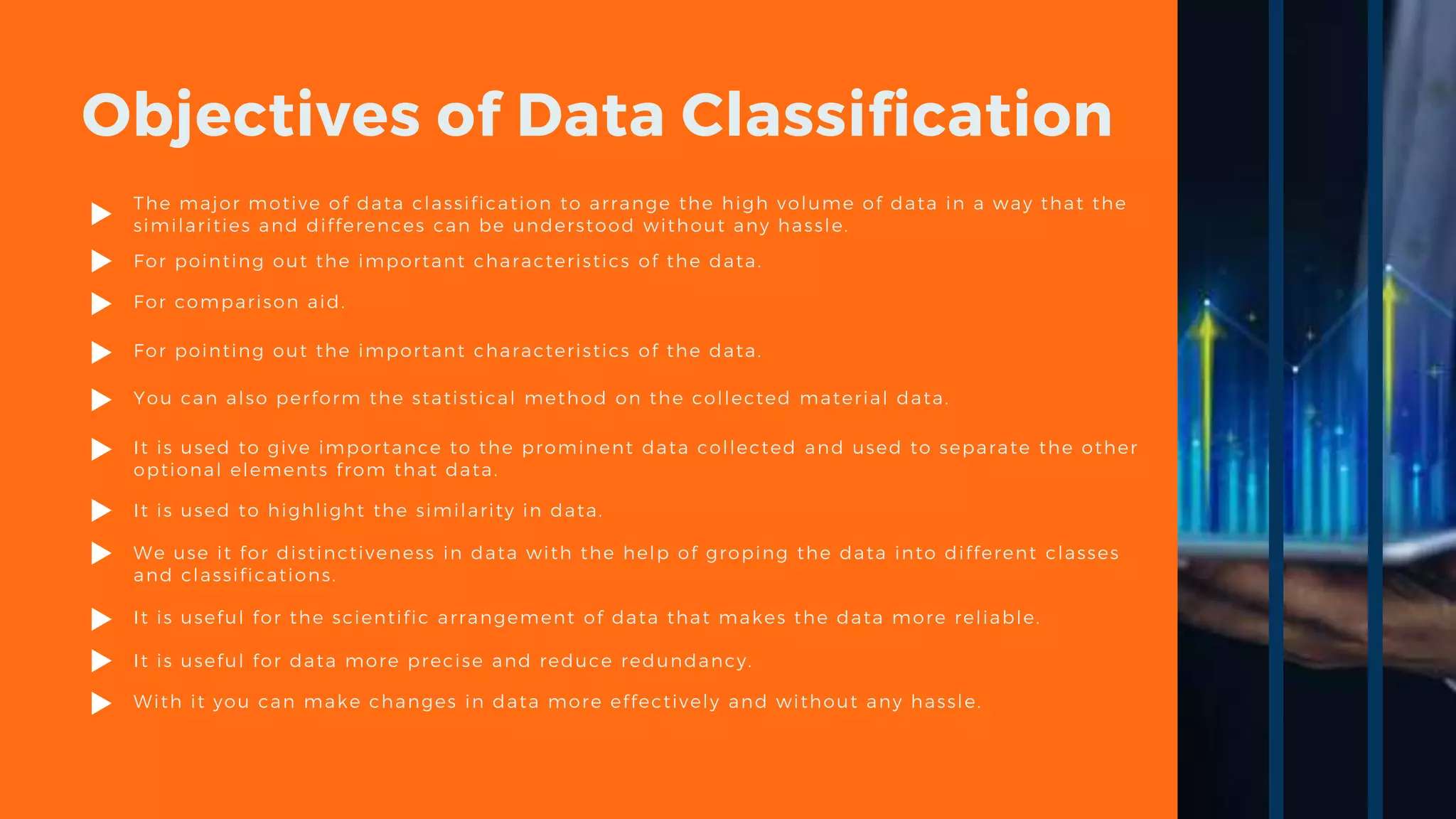
Objectives of Data Classification
The major motive of data classification to arrange the high volume of data in a way that the
similarities and differences can be understood without any hassle.
For pointing out the important characteristics of the data.
For comparison aid.
For pointing out the important characteristics of the data.
You can also perform the statistical method on the collected material data.
It is used to give importance to the prominent data collected and used to separate the other
optional elements from that data.
It is used to highlight the similarity in data.
We use it for distinctiveness in data with the help of groping the data into different classes
and classifications.
It is useful for the scientific arrangement of data that makes the data more reliable.
It is useful for data more precise and reduce redundancy.
With it you can make changes in data more effectively and without any hassle.
SCAN
It is the initial step and involves the process where we analyze the entire database. In this process, we analyze every single database to get
the raw data.
IDENTIFY
In this step, we identify the types of data that we need to insert in different categories. E.g, we can put the age and gender data into the
demographic category.
SEPARATE
CREATING A DATA CLASSIFICATION POLICY
PRIORITIZE AND ORGANIZE DATA
In this step, we separate the data which is no longer required to perform. For example, in the demographic category, we also put the
weight measurement data, which is no longer useful for our data operations.
This is the step to generate the data classification policy. Every organization has its own data classification policy. So be careful while
creating the data classification policy because it will affect the business in the long run.
Last but not the least step. It is time to implement the data classification policy on your data. You have to prioritize the sensitive
information to sort first rather than the insensitive one.
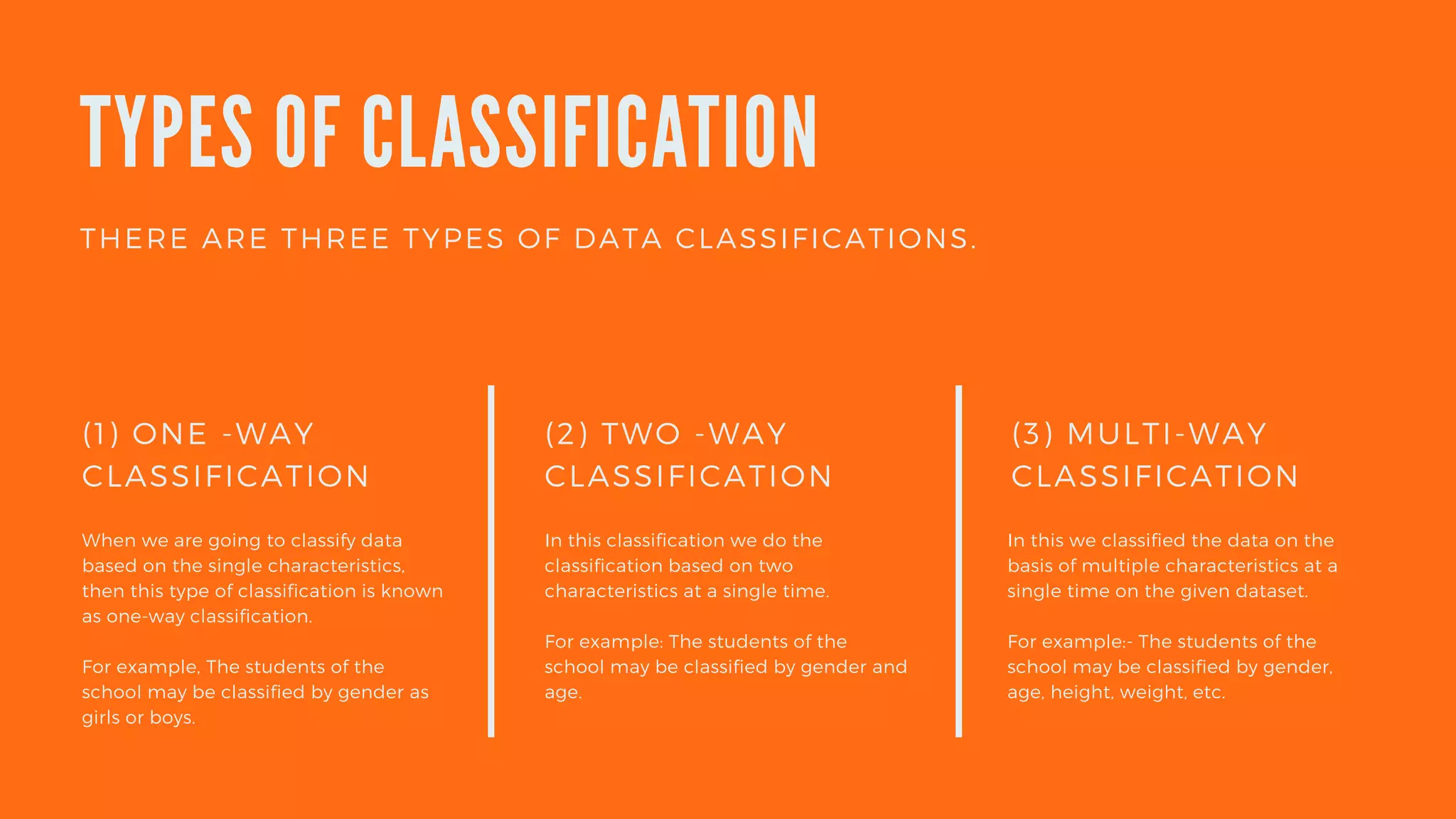
THERE ARE THREE TYPES OF DATA CLASSIFICATIONS.
When we are going to classify data
based on the single characteristics,
then this type of classification is known
as one-way classification.
For example, The students of the
school may be classified by gender as
girls or boys.
(1) ONE -WAY
CLASSIFICATION
In this classification we do the
classification based on two
characteristics at a single time.
For example: The students of the
school may be classified by gender and
age.
(2) TWO -WAY
CLASSIFICATION
In this we classified the data on the
basis of multiple characteristics at a
single time on the given dataset.
For example:- The students of the
school may be classified by gender,
age, height, weight, etc.
(3) MULTI-WAY
CLASSIFICATION
Data classification is exciting from the
ancient era. But it is improving time over
time. As we know that nowadays,
technology is everywhere. And all these
technologies are used to store the data.
Therefore these technologies require it for
easy access, maintaining regular
compliance. Apart from that, the data
analysts are using it regularly. They used it
to search and retrieve the data. The best
part of data classification is data security.
CONFIDENTIALITY
With data classification, you can develop a system
where you can allow the users to access only the
limited data. It can only happen with the proper
classification of the data. In this way, the most sensitive
information with a limited number of users.
THE INTEGRITY OF DATA
It allows you to get the integrity of data. In other words,
the data is integrated with the other organized data,
and the users require permission to access the data. It
happened in a well-organized manner.
AVAILABILITY OF DATA
In this, the data can be available to a large number of
audience with proper security and ease of access.
There is no need to search for particular data to
perform any statistics methods.
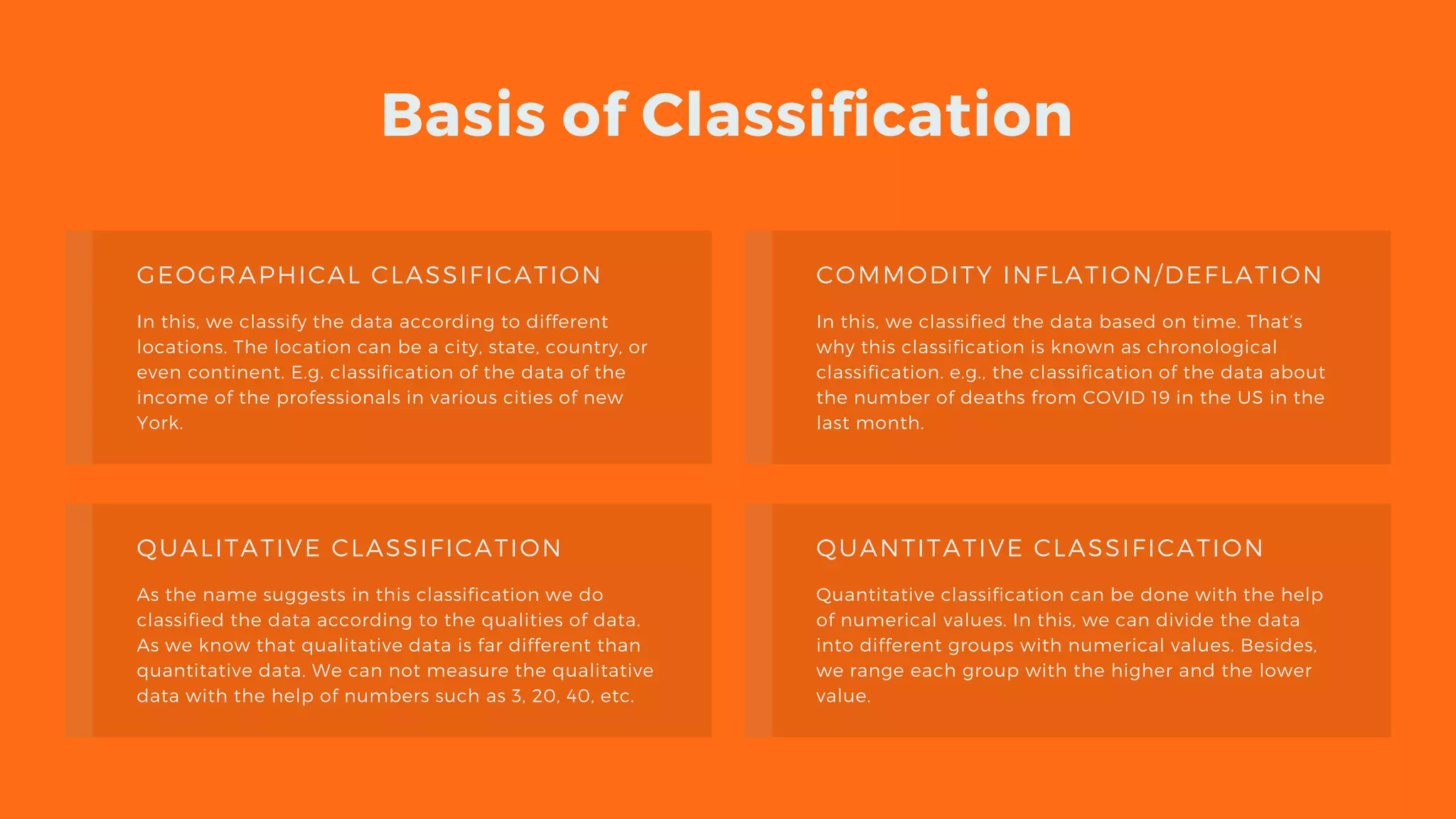
Basis of Classification
GEOGRAPHICAL CLASSIFICATION
In this, we classify the data according to different
locations. The location can be a city, state, country, or
even continent. E.g. classification of the data of the
income of the professionals in various cities of new
York.
QUALITATIVE CLASSIFICATION
As the name suggests in this classification we do
classified the data according to the qualities of data.
As we know that qualitative data is far different than
quantitative data. We can not measure the qualitative
data with the help of numbers such as 3, 20, 40, etc.
COMMODITY INFLATION/DEFLATION
In this, we classified the data based on time. That’s
why this classification is known as chronological
classification. e.g., the classification of the data about
the number of deaths from COVID 19 in the US in the
last month.
QUANTITATIVE CLASSIFICATION
Quantitative classification can be done with the help
of numerical values. In this, we can divide the data
into different groups with numerical values. Besides,
we range each group with the higher and the lower
value.
Now it may be clear in your mind
what is the classification of data, how
it works, and the importance of it.
Next time whenever you are going to
do it. Then you may be quite
confident to use it. If it is still
overwhelming for you to understand
the classification of data. Then you
can take the help from your statistics
homework helper.
WE ARE EVERYWHERE
FACEBOOK
@statanalytica
TWITTER
@statanalytica
TWITTER
@statanalytica
GET IN TOUCH WITH US
statanalytica.com
Info@statanalytica.com
STATANALYTICA
LIKE AND SHARE

Classification of Data in Statistics

  • 1.
    STAT ANALYTICA Preseted By:Statanalytica Team
  • 2.
    KEY CONCEPTS COVERED Introductionof Classification of data Objectives of Data Classification Why do you need classification of data? Steps for Effective data classification Types of Classification Conclusion
  • 3.
    Classification of datais an essential aspect of statistics. It is the way to organize the data in an efficient way. That is quite useful to perform the statistics operation on the data without any hassle. Most of the students may not be aware of the classification of data. But as statistics experts, we have to help the students to clear all their doubts. Here in this presentation we will share with you the best guide on the classification of data. Let’s begin with the introduction:-
  • 4.
    Data classification isdefined as the way to organize the data by relevant categories. Therefore it makes the data quite easy to use for the data analyst. The data classification is used for legal discovery, risk management, and compliance. There can be different guidelines for data classifications vary from organization to organization. Apart from that, the data can also be protected more efficiently. Besides, when you do the proper data classification, then you can quickly locate and retrieve the data. Tagging data is also available in it to make it easily searchable and trackable. It also reduces the risk of duplication of data. Therefore the data storage also decreases, and it can be cheap to backup the data. Besides, whenever you want to perform any operation on the data, then the process will also be done at a rapid pace. In some cases, it is is quite tricky and technical.
  • 5.
    Objectives of DataClassification The major motive of data classification to arrange the high volume of data in a way that the similarities and differences can be understood without any hassle. For pointing out the important characteristics of the data. For comparison aid. For pointing out the important characteristics of the data. You can also perform the statistical method on the collected material data. It is used to give importance to the prominent data collected and used to separate the other optional elements from that data. It is used to highlight the similarity in data. We use it for distinctiveness in data with the help of groping the data into different classes and classifications. It is useful for the scientific arrangement of data that makes the data more reliable. It is useful for data more precise and reduce redundancy. With it you can make changes in data more effectively and without any hassle.
  • 6.
    SCAN It is theinitial step and involves the process where we analyze the entire database. In this process, we analyze every single database to get the raw data. IDENTIFY In this step, we identify the types of data that we need to insert in different categories. E.g, we can put the age and gender data into the demographic category. SEPARATE CREATING A DATA CLASSIFICATION POLICY PRIORITIZE AND ORGANIZE DATA In this step, we separate the data which is no longer required to perform. For example, in the demographic category, we also put the weight measurement data, which is no longer useful for our data operations. This is the step to generate the data classification policy. Every organization has its own data classification policy. So be careful while creating the data classification policy because it will affect the business in the long run. Last but not the least step. It is time to implement the data classification policy on your data. You have to prioritize the sensitive information to sort first rather than the insensitive one.
  • 7.
    THERE ARE THREETYPES OF DATA CLASSIFICATIONS. When we are going to classify data based on the single characteristics, then this type of classification is known as one-way classification. For example, The students of the school may be classified by gender as girls or boys. (1) ONE -WAY CLASSIFICATION In this classification we do the classification based on two characteristics at a single time. For example: The students of the school may be classified by gender and age. (2) TWO -WAY CLASSIFICATION In this we classified the data on the basis of multiple characteristics at a single time on the given dataset. For example:- The students of the school may be classified by gender, age, height, weight, etc. (3) MULTI-WAY CLASSIFICATION
  • 8.
    Data classification isexciting from the ancient era. But it is improving time over time. As we know that nowadays, technology is everywhere. And all these technologies are used to store the data. Therefore these technologies require it for easy access, maintaining regular compliance. Apart from that, the data analysts are using it regularly. They used it to search and retrieve the data. The best part of data classification is data security. CONFIDENTIALITY With data classification, you can develop a system where you can allow the users to access only the limited data. It can only happen with the proper classification of the data. In this way, the most sensitive information with a limited number of users. THE INTEGRITY OF DATA It allows you to get the integrity of data. In other words, the data is integrated with the other organized data, and the users require permission to access the data. It happened in a well-organized manner. AVAILABILITY OF DATA In this, the data can be available to a large number of audience with proper security and ease of access. There is no need to search for particular data to perform any statistics methods.
  • 9.
    Basis of Classification GEOGRAPHICALCLASSIFICATION In this, we classify the data according to different locations. The location can be a city, state, country, or even continent. E.g. classification of the data of the income of the professionals in various cities of new York. QUALITATIVE CLASSIFICATION As the name suggests in this classification we do classified the data according to the qualities of data. As we know that qualitative data is far different than quantitative data. We can not measure the qualitative data with the help of numbers such as 3, 20, 40, etc. COMMODITY INFLATION/DEFLATION In this, we classified the data based on time. That’s why this classification is known as chronological classification. e.g., the classification of the data about the number of deaths from COVID 19 in the US in the last month. QUANTITATIVE CLASSIFICATION Quantitative classification can be done with the help of numerical values. In this, we can divide the data into different groups with numerical values. Besides, we range each group with the higher and the lower value.
  • 10.
    Now it maybe clear in your mind what is the classification of data, how it works, and the importance of it. Next time whenever you are going to do it. Then you may be quite confident to use it. If it is still overwhelming for you to understand the classification of data. Then you can take the help from your statistics homework helper.
  • 11.
  • 12.
    GET IN TOUCHWITH US statanalytica.com Info@statanalytica.com
  • 13.