DATA COLLECTION,
TABULATION, PROCESSING
AND ANALYSIS OF DATA
BY
J.ROBINSON RAJA
M-6006
NEED FOR DATA COLLECTION
 Scientific research
 Verify the hypothesis
 Substantiate various arguments in research findings
 Solution to problem
 Helps in drawing generalization
OTHER METHODS OF DATA COLLECTION
 Warranty cards
 Distributor / store audits
 Pantry audits
 Consumer panel
 Mechanical devices
 Eye camera, Pupilometric camera
 Pscychogalvanometer, Motion picture camera, audiometers
PROCESSING AND ANALYSIS
NEED FOR PROCESSING AND
ANALYSING
 Essential for scientific study
 To make the raw data meaningful,
 To test null hypothesis,
 To obtain the significant results,
 To draw some inferences or make generalization, and
 To estimate parameters
EDITING
 Detect errors and omissions and correct them
 Assure that data are accurate, consistent, complete, homogenous
 Field editing-what the latter has written in abbreviated and/or in illegible form at
the time of recording the respondents’ responses.
 Difficult for others to decipher.
 As soon as possible after the interview.
 Must not correct errors of omission
CENTRAL EDITING
 All forms -Completed and returned to the office.
 May correct the obvious errors (entry in the wrong place).
 On missing replies, sometimes determine the proper answer by reviewing the
other information in the schedule.
 At times, the respondent can be contacted for clarification.
 The editor must strike out the answer if the same is inappropriate and he has no
basis for determining the correct answer or the response. In such a case an
editing entry of ‘no answer’ is called for.
 All the wrong replies, which are quite obvious, must be dropped from the final
results, especially in the context of mail surveys.
CODING
 Assigning numerals or other symbols to answers so that responses can be put
into a limited number of categories or classes.
 Such classes should be appropriate to the research problem under consideration.
 Exhaustive , mutually exclusive
 Uni-dimensionality
 Critical information required for analysis.
 Coding decisions -designing stage of the questionnaire.
 Easy tabulation
CLASSIFICATION
 Arranging data in groups or classes – common characteristics
 Types of classification:
 Attributes- simple and manifold
 Class intervals- inclusive, exclusive
 11-20, 21-30
 10-20, 20-30
 How many classes ?
Sex
TABULATION
 Orderly arrangement of data in columns and rows.
 conserves space.
 comparison.
 summation of items
 detection of errors and omissions.
 statistical computations
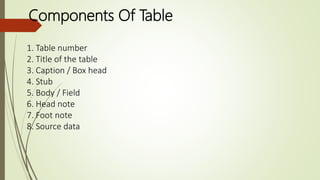
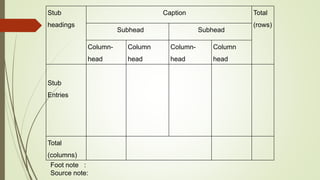
Components Of Table
1. Table number
2. Title of the table
3. Caption / Box head
4. Stub
5. Body / Field
6. Head note
7. Foot note
8. Source data
Stub
headings
Caption Total
(rows)
Subhead Subhead
Column-
head
Column
head
Column-
head
Column
head
Stub
Entries
Total
(columns)
Foot note :
Source note:
TYPES OF TABLES
 Simple and complex
 General and special purpose
PRINCIPLES OF TABULATION
 Clear, concise and adequate title.
 Distinct number to facilitate reference
 Column headings and row headings of table should be clear and brief.
 Units of measurement under each heading or subheading must always be
indicated.
 Explanatory footnotes –beneath the table
 Source-just below the table.
 Abbreviation, ditto should be avoided
PROBLEMS IN PROCESSING
 DK response
 Respondent may not know the answer or researcher fail in obtaining the
appropriate information.
 DK response in separate category
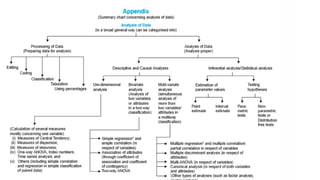
ANALYSIS OF DATA
 Analysis means categorising, ordering, manipulating, and summarising of data to
obtain answer to research questions.
 Descriptive analysis
 Correlation analysis
 Causal analysis / regression analysis
FREQUENCY DISTRIBUTION
 Manner in which different frequencies are distributed over different classes.
 Represented in graphical form.
 1) Histogram
 2) Bar graph
 3) Pie diagram
 4) Frequency polygon
 5) Cumulative frequency curve / ogive curve
HISTOGRAM
 Two dimension
 Continous data
 Similar to bar chart without gaps
Distribution of studied group according to their height
0
5
10
15
20
25
30
100- 110- 120- 130- 140- 150-
height in cm
numberofindividuals
BAR DIAGRAM
 Simple
 Discrete frequency distribution
PIE GRAPH
 Data in form of circle
 Total is divided into parts
 Not best for showing trends
FREQUENCY POLYGON
 Ungrouped frequency distribution
CUMULATIVE FREQUENCY CURVE
 Class interval is very small
 Obtained by adding successive frequency
MEASURES OF CENTRAL TENDENCY
(MCT)
 AM
 GM
 HM
 MEDIAN
 MODE
MEASURES OF DISPERSION
 RANGE
 QUARTILE DEVIATION
 MD
 SD
 CV
SKEWNESS AND KURTOSIS
 Skewness- asymmetry
 Positively skewed distribution
 Kurtosis- peakedness
 Leptokurtic
PARAMETRIC OR STANDARD TEST
 Sample is large
 Population have normal distribution
 Observations – independent
 Variables- interval or ratio scale
 Eg. t- test, z test, F test
NON- PARAMETRIC TEST
 Distribution free test
 Normal distribution- doubtful
 Small sample size
 Data – ranks or different between pairs
 Eg. Chi square test, The Mann- whitney U test, kendall W, rho
IMPORTANT ANALYSES
t -Test:
 Comparing the means of two independent groups
 Sample size < 30
 Paired t-test:
ANOVA:
 Statistical approach for determining the means of two or more populations are
equal.
One way ANOVA
ANCOVA
CORRELATION
 Intensity of association between 2 variable
 Ranges from + 1 to -1
BISERIAL CORRELATION:
 One variable is continous and other is dichotomous.
POINT BISERIAL CORRELATION:
 One of the 2 variables is a genuine dichotomy ( can’t measured on interval scale)
REGRESSION
 Determination of statistical relationship between two or more variables
DIFFERENT ANALYSIS
PATH ANALYSIS:
 Clear picture of the direct and indirect effects of the independent variables on the
dependent variable.
DISCRIMINANT FUNCTION ANALYSIS:
 Necessary to find out how populations actually discriminate or differ
CANONICAL ANALYSIS:
 Explaining several dependent variables by a set of independent variables.
FACTOR ANALYSIS:
 Resolve large set of measured variables by few categories.
CONTINUED
META ANALYSIS:
 Set of techniques for summarising the findings of many studies
CLUSTER ANALYSIS:
 Classify objects into small number of mutually exclusive and exhaustive groups.
 Better understanding of buyer behaviour
MULTIDIMENSIONAL SCALING:
 Data reduction technique
 Uncover the hidden structure of a set of data.
NON-PARAMETRIC TESTS
CHI-SQUARE TEST:
 Testing the agreement between a given hypothesis and observed data
 Test goodness of fit
MCNEMAR TEST
 Significance of change
 Research involve before and after situation and data is nominal
 Effectiveness of a particular treatment.
MANN WHITNEY U TEST
 Test whether two independent groups have been drawn from same population.
 Powerful test, alternative to parametric t test when researcher wants to avoid t
test assumptions
KRUSKAL WALLIS – ONE WAY ANOVA
 H test.
 Applied to more than 2 samples of observation
 Nonparametric substitute for simple ANOVA
FRIEDMAN TWO WAY ANOVA
 Testing the null hypothesis of difference between treatments by ranking the data
KENDALL COEFFICIENT OF CONCORDANCE:W
 Measures extent of association among several sets of ranking of events, objects
 Studies of cluster of variables
OTHER MEASURES
INDEX NUMBERS:
 Changes in various economic and social phenomena
 Approximate indicators
TIME SERIES ANALYSIS:
REFERENCES
 Research methods in social sciences and extension education by G.L.Ray & Sagar
Mondal
 Research methodology – methods and techniques (2nd revised edition) by C.R.
Kothari.
 Essentials of research design and methodology by Geoffrey Marczyk, David
DeMatteo, and David Festinger.
 Research methodology by Ranjit kumar
 Fundamentals of research methodology and statistics by Yogesh kumar singh.
QUIZ
1)Warranty cards is an example for
a) Primary data b) Secondary data c) both d) none
2) Commonly used program for statistical analysis in social sciences is
a) SAS b) SPSS c) GENSTAT d) STATA
3) Which of the following is not an example for standard test ?
a)T test b) chi square test c) Z test d) F test
4) Which test is suitable for small sample size
a) Parametric b) Non parametric c) Standard d) None
5) Vertical bar diagram without gap between the bars is
a) Ogive b) frequency polygon c) Histogram d) Bar diagram
QUIZ
6) Mode is obtained from
a) Ogive b) Histogram c) frequency curve d) Lorenz curve
7) Average which is applicable to all sorts of data
a) AM b) GM c) HM d) Median
8) Quickest measure of centrality is
a) AM b) GM c) Mode d) Median
9) Which is used for measuring intelligence
a) Median b) Mode c) AM d) GM
10) Which test is used for the significance of changes ?
a) Chi square b) Mann Whitney U c) Mc Nemar d) t test
THANK YOU

Data collection,tabulation,processing and analysis

  • 1.
    DATA COLLECTION, TABULATION, PROCESSING ANDANALYSIS OF DATA BY J.ROBINSON RAJA M-6006
  • 2.
    NEED FOR DATACOLLECTION  Scientific research  Verify the hypothesis  Substantiate various arguments in research findings  Solution to problem  Helps in drawing generalization
  • 3.
    OTHER METHODS OFDATA COLLECTION  Warranty cards  Distributor / store audits  Pantry audits  Consumer panel  Mechanical devices  Eye camera, Pupilometric camera  Pscychogalvanometer, Motion picture camera, audiometers
  • 4.
  • 5.
    NEED FOR PROCESSINGAND ANALYSING  Essential for scientific study  To make the raw data meaningful,  To test null hypothesis,  To obtain the significant results,  To draw some inferences or make generalization, and  To estimate parameters
  • 6.
    EDITING  Detect errorsand omissions and correct them  Assure that data are accurate, consistent, complete, homogenous  Field editing-what the latter has written in abbreviated and/or in illegible form at the time of recording the respondents’ responses.  Difficult for others to decipher.  As soon as possible after the interview.  Must not correct errors of omission
  • 7.
    CENTRAL EDITING  Allforms -Completed and returned to the office.  May correct the obvious errors (entry in the wrong place).  On missing replies, sometimes determine the proper answer by reviewing the other information in the schedule.  At times, the respondent can be contacted for clarification.  The editor must strike out the answer if the same is inappropriate and he has no basis for determining the correct answer or the response. In such a case an editing entry of ‘no answer’ is called for.  All the wrong replies, which are quite obvious, must be dropped from the final results, especially in the context of mail surveys.
  • 8.
    CODING  Assigning numeralsor other symbols to answers so that responses can be put into a limited number of categories or classes.  Such classes should be appropriate to the research problem under consideration.  Exhaustive , mutually exclusive  Uni-dimensionality  Critical information required for analysis.  Coding decisions -designing stage of the questionnaire.  Easy tabulation
  • 9.
    CLASSIFICATION  Arranging datain groups or classes – common characteristics  Types of classification:  Attributes- simple and manifold  Class intervals- inclusive, exclusive  11-20, 21-30  10-20, 20-30  How many classes ? Sex
  • 10.
    TABULATION  Orderly arrangementof data in columns and rows.  conserves space.  comparison.  summation of items  detection of errors and omissions.  statistical computations
  • 11.
    Components Of Table 1.Table number 2. Title of the table 3. Caption / Box head 4. Stub 5. Body / Field 6. Head note 7. Foot note 8. Source data
  • 12.
  • 13.
    TYPES OF TABLES Simple and complex  General and special purpose
  • 14.
    PRINCIPLES OF TABULATION Clear, concise and adequate title.  Distinct number to facilitate reference  Column headings and row headings of table should be clear and brief.  Units of measurement under each heading or subheading must always be indicated.  Explanatory footnotes –beneath the table  Source-just below the table.  Abbreviation, ditto should be avoided
  • 15.
    PROBLEMS IN PROCESSING DK response  Respondent may not know the answer or researcher fail in obtaining the appropriate information.  DK response in separate category
  • 16.
    ANALYSIS OF DATA Analysis means categorising, ordering, manipulating, and summarising of data to obtain answer to research questions.  Descriptive analysis  Correlation analysis  Causal analysis / regression analysis
  • 18.
    FREQUENCY DISTRIBUTION  Mannerin which different frequencies are distributed over different classes.  Represented in graphical form.  1) Histogram  2) Bar graph  3) Pie diagram  4) Frequency polygon  5) Cumulative frequency curve / ogive curve
  • 19.
    HISTOGRAM  Two dimension Continous data  Similar to bar chart without gaps Distribution of studied group according to their height 0 5 10 15 20 25 30 100- 110- 120- 130- 140- 150- height in cm numberofindividuals
  • 20.
    BAR DIAGRAM  Simple Discrete frequency distribution
  • 21.
    PIE GRAPH  Datain form of circle  Total is divided into parts  Not best for showing trends
  • 22.
    FREQUENCY POLYGON  Ungroupedfrequency distribution
  • 23.
    CUMULATIVE FREQUENCY CURVE Class interval is very small  Obtained by adding successive frequency
  • 24.
    MEASURES OF CENTRALTENDENCY (MCT)  AM  GM  HM  MEDIAN  MODE
  • 25.
    MEASURES OF DISPERSION RANGE  QUARTILE DEVIATION  MD  SD  CV
  • 26.
    SKEWNESS AND KURTOSIS Skewness- asymmetry  Positively skewed distribution  Kurtosis- peakedness  Leptokurtic
  • 27.
    PARAMETRIC OR STANDARDTEST  Sample is large  Population have normal distribution  Observations – independent  Variables- interval or ratio scale  Eg. t- test, z test, F test
  • 28.
    NON- PARAMETRIC TEST Distribution free test  Normal distribution- doubtful  Small sample size  Data – ranks or different between pairs  Eg. Chi square test, The Mann- whitney U test, kendall W, rho
  • 29.
    IMPORTANT ANALYSES t -Test: Comparing the means of two independent groups  Sample size < 30  Paired t-test: ANOVA:  Statistical approach for determining the means of two or more populations are equal. One way ANOVA ANCOVA
  • 30.
    CORRELATION  Intensity ofassociation between 2 variable  Ranges from + 1 to -1 BISERIAL CORRELATION:  One variable is continous and other is dichotomous. POINT BISERIAL CORRELATION:  One of the 2 variables is a genuine dichotomy ( can’t measured on interval scale)
  • 31.
    REGRESSION  Determination ofstatistical relationship between two or more variables
  • 32.
    DIFFERENT ANALYSIS PATH ANALYSIS: Clear picture of the direct and indirect effects of the independent variables on the dependent variable. DISCRIMINANT FUNCTION ANALYSIS:  Necessary to find out how populations actually discriminate or differ CANONICAL ANALYSIS:  Explaining several dependent variables by a set of independent variables. FACTOR ANALYSIS:  Resolve large set of measured variables by few categories.
  • 33.
    CONTINUED META ANALYSIS:  Setof techniques for summarising the findings of many studies CLUSTER ANALYSIS:  Classify objects into small number of mutually exclusive and exhaustive groups.  Better understanding of buyer behaviour MULTIDIMENSIONAL SCALING:  Data reduction technique  Uncover the hidden structure of a set of data.
  • 34.
    NON-PARAMETRIC TESTS CHI-SQUARE TEST: Testing the agreement between a given hypothesis and observed data  Test goodness of fit
  • 35.
    MCNEMAR TEST  Significanceof change  Research involve before and after situation and data is nominal  Effectiveness of a particular treatment.
  • 36.
    MANN WHITNEY UTEST  Test whether two independent groups have been drawn from same population.  Powerful test, alternative to parametric t test when researcher wants to avoid t test assumptions
  • 37.
    KRUSKAL WALLIS –ONE WAY ANOVA  H test.  Applied to more than 2 samples of observation  Nonparametric substitute for simple ANOVA
  • 38.
    FRIEDMAN TWO WAYANOVA  Testing the null hypothesis of difference between treatments by ranking the data KENDALL COEFFICIENT OF CONCORDANCE:W  Measures extent of association among several sets of ranking of events, objects  Studies of cluster of variables
  • 39.
    OTHER MEASURES INDEX NUMBERS: Changes in various economic and social phenomena  Approximate indicators TIME SERIES ANALYSIS:
  • 40.
    REFERENCES  Research methodsin social sciences and extension education by G.L.Ray & Sagar Mondal  Research methodology – methods and techniques (2nd revised edition) by C.R. Kothari.  Essentials of research design and methodology by Geoffrey Marczyk, David DeMatteo, and David Festinger.  Research methodology by Ranjit kumar  Fundamentals of research methodology and statistics by Yogesh kumar singh.
  • 41.
    QUIZ 1)Warranty cards isan example for a) Primary data b) Secondary data c) both d) none 2) Commonly used program for statistical analysis in social sciences is a) SAS b) SPSS c) GENSTAT d) STATA 3) Which of the following is not an example for standard test ? a)T test b) chi square test c) Z test d) F test 4) Which test is suitable for small sample size a) Parametric b) Non parametric c) Standard d) None 5) Vertical bar diagram without gap between the bars is a) Ogive b) frequency polygon c) Histogram d) Bar diagram
  • 42.
    QUIZ 6) Mode isobtained from a) Ogive b) Histogram c) frequency curve d) Lorenz curve 7) Average which is applicable to all sorts of data a) AM b) GM c) HM d) Median 8) Quickest measure of centrality is a) AM b) GM c) Mode d) Median 9) Which is used for measuring intelligence a) Median b) Mode c) AM d) GM 10) Which test is used for the significance of changes ? a) Chi square b) Mann Whitney U c) Mc Nemar d) t test
  • 43.