STATISTICS & DATA
REPRESENTATION
What is Statistics
• Statistics is a science that involves the use of numerical
data.
• It can be defined as “science of collecting, organizing,
presenting, analyzing, and interpreting numerical data to
help in process of making decisions
• The profession that involve statistics is called a “statistician”.
• Statistics use in marketing, accounting, quality control,
and others.
Why study Statistics?
1. Data are everywhere
2. Statistical techniques are used to make many decisions
that affect our lives
3. No matter what your career, you will make
professional decisions that involve data. An
understanding of statistical methods will help you
make these decisions efectively
Applications of statistical concepts
in the business world
• Finance – correlation and regression, index numbers,
time series analysis
• Marketing – hypothesis testing, chi-square tests,
nonparametric statistics
• Personel – hypothesis testing, chi-square tests,
nonparametric tests
• Operating management – hypothesis testing,
estimation, analysis of variance, time series analysis
Types of Statistics
• There are 2 types of
statistics;
1. descriptive statistics
2. inferential statistics.
Descriptive Statistics
• Describe the sample data (basic features)
• Provide simple summaries about data and the
measures together with graphical analysis.
• Definition: organizing, presenting, and analyzing
numerical data.
• Used to present quantitative description in
manageable form.
Inferential
Statistics
• Involves using a sample to draw conclusions
about a population.
• Estimation
e.g., Estimate the population mean weight using the
sample mean weight
• Hypothesis testing
e.g., Test the claim that the population mean weight is
70 kg
• Inference is the process of drawing conclusions or
making decisions about a population based on sample
results
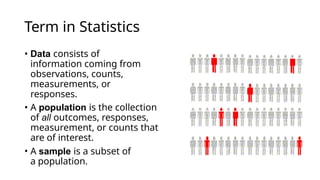
Term in Statistics
• Data consists of
information coming from
observations, counts,
measurements, or
responses.
• A population is the collection
of all outcomes, responses,
measurement, or counts that
are of interest.
• A sample is a subset of
a population.
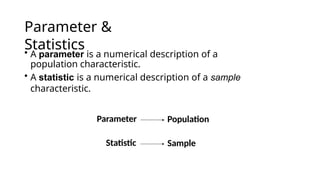
Parameter &
Statistics
• A parameter is a numerical description of a
population characteristic.
• A statistic is a numerical description of a sample
characteristic.
Parameter Population
Statistic Sample
Data
• Statistical data are usually obtained by counting or
measuring items. Most data can be put into the following
categories:
• Qualitative - data are measurements that each fail into
one of several categories. (hair color, ethnic groups and
other attributes of the population)
• quantitative - data are observations that are measured
on a numerical scale (distance traveled to college,
number of children in a family, etc.)
Qualitative Data
• Qualitative data are generally described by words or letters.
They are not as widely used as quantitative data because many
numerical techniques do not apply to the qualitative data.
• For example, it does not make sense to find an average hair
color or blood type.
• Qualitative data can be separated into two subgroups:
1) dichotomic (if it takes the form of a word with two options
(gender
- male or female)
2) polynomic (if it takes the form of a word with more than
two options (education - primary school, secondary
school and university).
Quantitative Data
Quantitative data are always numbers and are the
result of counting or measuring attributes of a population.
Quantitative data can be separated into
two subgroups:
• discrete (if it is the result of counting (the number of
students of a given ethnic group in a class, the number of
books on a shelf,
...)
• continuous (if it is the result of measuring (distance
traveled, weight of luggage, …)
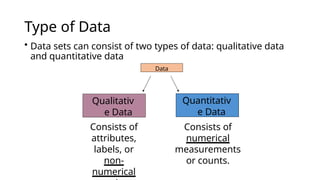
Type of Data
• Data sets can consist of two types of data: qualitative data
and quantitative data
Data
Qualitativ
e Data
Quantitativ
e Data
Consists of
attributes,
labels, or
non-
numerical
Consists of
numerical
measurements
or counts.
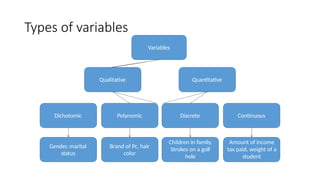
Types of variables
Variables
Quantitative
Qualitative
Dichotomic Polynomic Discrete Continuous
Gender, marital
status
Brand of Pc, hair
color
Children in family,
Strokes on a golf
hole
Amount of income
tax paid, weight of a
student
Level of Measurement
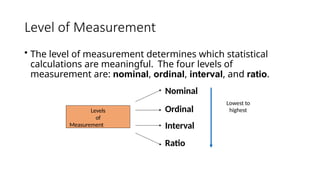
• The level of measurement determines which statistical
calculations are meaningful. The four levels of
measurement are: nominal, ordinal, interval, and ratio.
Nominal
Levels
of
Measurement
Ordinal
Interval
Ratio
Lowest to
highest
Nominal
Level
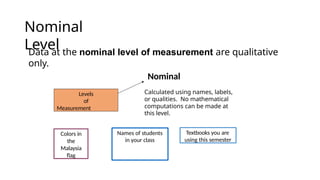
Data at the nominal level of measurement are qualitative
only.
Levels
of
Measurement
Nominal
Calculated using names, labels,
or qualities. No mathematical
computations can be made at
this level.
Colors in
the
Malaysia
flag
Names of students
in your class
Textbooks you are
using this semester
OrdinalLevel
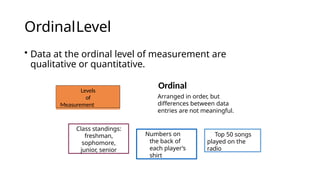
• Data at the ordinal level of measurement are
qualitative or quantitative.
Levels
of
Measurement
Class standings:
freshman,
sophomore,
junior, senior
Numbers on
the back of
each player’s
shirt
Ordinal
Arranged in order, but
differences between data
entries are not meaningful.
Top 50 songs
played on the
radio
Interval
Level
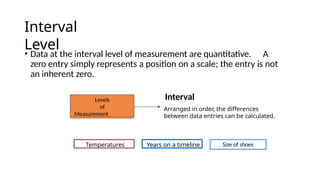
• Data at the interval level of measurement are quantitative. A
zero entry simply represents a position on a scale; the entry is not
an inherent zero.
Levels
of
Measurement
Temperatures Years on a timeline
Interval
Arranged in order, the differences
between data entries can be calculated.
Size of shoes
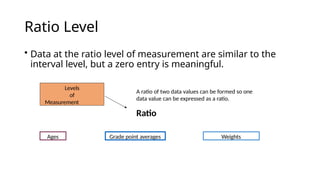
Ratio Level
• Data at the ratio level of measurement are similar to the
interval level, but a zero entry is meaningful.
Levels
of
Measurement
A ratio of two data values can be formed so one
data value can be expressed as a ratio.
Ratio
Ages Grade point averages Weights
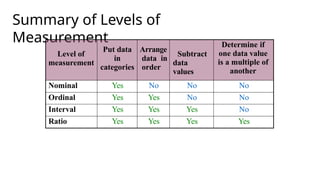
Summary of Levels of
Measurement
Level of
measurement
Put data
in
categories
Arrange
data in
order
Subtract
data
values
Determine if
one data value
is a multiple of
another
Nominal Yes No No No
Ordinal Yes Yes No No
Interval Yes Yes Yes No
Ratio Yes Yes Yes Yes
Source of Data
•There are two source of
data
1. Primary data
2. Secondary data
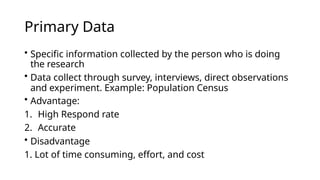
Primary Data
• Specific information collected by the person who is doing
the research
• Data collect through survey, interviews, direct observations
and experiment. Example: Population Census
• Advantage:
1. High Respond rate
2. Accurate
• Disadvantage
1. Lot of time consuming, effort, and cost
Secondary Data
• Data that has been collected form other parties. Eg.
Journals, yearly report etc.
• Easily available
• Advantage
1.Convenient and less time effort, and cost
• Disadvantage
2. Produce error
3. May not meet specific needs
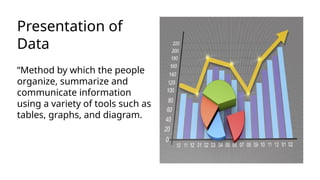
Presentation of
Data
“Method by which the people
organize, summarize and
communicate information
using a variety of tools such as
tables, graphs, and diagram.
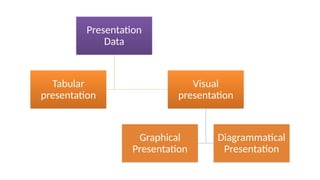
Presentation
Data
Tabular
presentation
Visual
presentation
Graphical
Presentation
Diagrammatical
Presentation
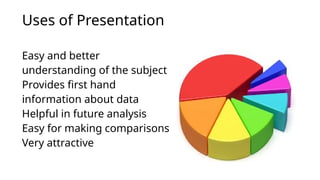
Uses of Presentation
Easy and better
understanding of the subject
Provides first hand
information about data
Helpful in future analysis
Easy for making comparisons
Very attractive
Tabulation
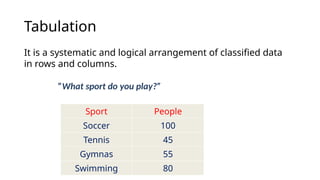
It is a systematic and logical arrangement of classified data
in rows and columns.
”What sport do you play?”
Sport People
Soccer 100
Tennis 45
Gymnas 55
Swimming 80
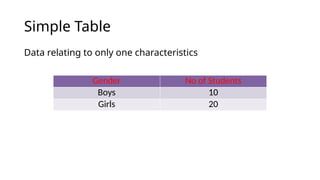
Simple Table
Data relating to only one characteristics
Gender No of Students
Boys 10
Girls 20
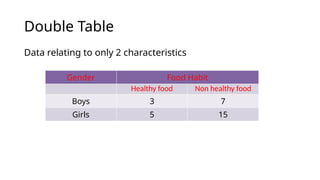
Double Table
Data relating to only 2 characteristics
Gender Food Habit
Healthy food Non healthy food
Boys 3 7
Girls 5 15
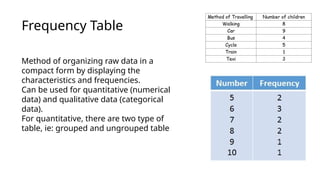
Frequency Table
Method of organizing raw data in a
compact form by displaying the
characteristics and frequencies.
Can be used for quantitative (numerical
data) and qualitative data (categorical
data).
For quantitative, there are two type of
table, ie: grouped and ungrouped table
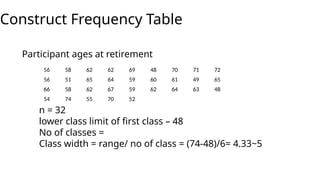
Construct Frequency Table
Participant ages at retirement
n = 32
lower class limit of first class – 48
No of classes =
Class width = range/ no of class = (74-48)/6= 4.33~5
56 58 62 62 69 48 70 71 72
56 51 65 64 59 60 61 49 65
66 58 62 67 59 62 64 63 48
54 74 55 70 52
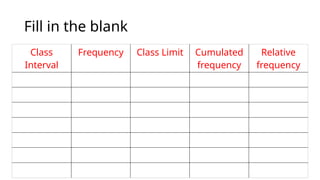
Fill in the blank
Class
Interval
Frequency Class Limit Cumulated
frequency
Relative
frequency
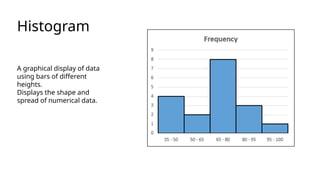
Histogram
A graphical display of data
using bars of different
heights.
Displays the shape and
spread of numerical data.
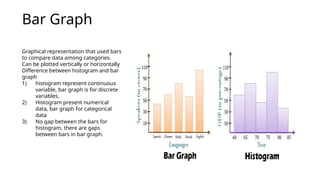
Bar Graph
Graphical representation that used bars
to compare data among categories.
Can be plotted vertically or horizontally
Difference between histogram and bar
graph
1) histogram represent continuous
variable, bar graph is for discrete
variables.
2) Histogram present numerical
data, bar graph for categorical
data
3) No gap between the bars for
histogram, there are gaps
between bars in bar graph.
Frequency
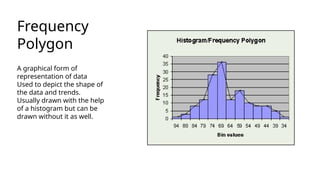
Polygon
A graphical form of
representation of data
Used to depict the shape of
the data and trends.
Usually drawn with the help
of a histogram but can be
drawn without it as well.
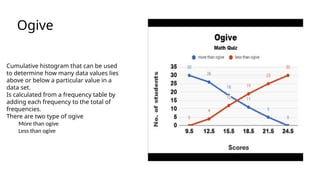
Ogive
Cumulative histogram that can be used
to determine how many data values lies
above or below a particular value in a
data set.
Is calculated from a frequency table by
adding each frequency to the total of
frequencies.
There are two type of ogive
More than ogive
Less than ogive
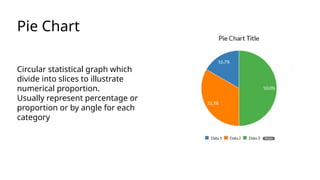
Pie Chart
Circular statistical graph which
divide into slices to illustrate
numerical proportion.
Usually represent percentage or
proportion or by angle for each
category
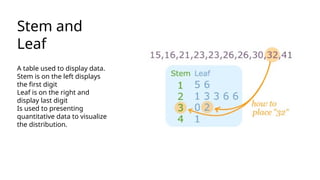
Stem and
Leaf
A table used to display data.
Stem is on the left displays
the first digit
Leaf is on the right and
display last digit
Is used to presenting
quantitative data to visualize
the distribution.
THANK YOU

Chapter 2 business mathematics for .pptx

  • 1.
  • 2.
    What is Statistics •Statistics is a science that involves the use of numerical data. • It can be defined as “science of collecting, organizing, presenting, analyzing, and interpreting numerical data to help in process of making decisions • The profession that involve statistics is called a “statistician”. • Statistics use in marketing, accounting, quality control, and others.
  • 3.
    Why study Statistics? 1.Data are everywhere 2. Statistical techniques are used to make many decisions that affect our lives 3. No matter what your career, you will make professional decisions that involve data. An understanding of statistical methods will help you make these decisions efectively
  • 4.
    Applications of statisticalconcepts in the business world • Finance – correlation and regression, index numbers, time series analysis • Marketing – hypothesis testing, chi-square tests, nonparametric statistics • Personel – hypothesis testing, chi-square tests, nonparametric tests • Operating management – hypothesis testing, estimation, analysis of variance, time series analysis
  • 5.
    Types of Statistics •There are 2 types of statistics; 1. descriptive statistics 2. inferential statistics.
  • 6.
    Descriptive Statistics • Describethe sample data (basic features) • Provide simple summaries about data and the measures together with graphical analysis. • Definition: organizing, presenting, and analyzing numerical data. • Used to present quantitative description in manageable form.
  • 7.
    Inferential Statistics • Involves usinga sample to draw conclusions about a population. • Estimation e.g., Estimate the population mean weight using the sample mean weight • Hypothesis testing e.g., Test the claim that the population mean weight is 70 kg • Inference is the process of drawing conclusions or making decisions about a population based on sample results
  • 8.
    Term in Statistics •Data consists of information coming from observations, counts, measurements, or responses. • A population is the collection of all outcomes, responses, measurement, or counts that are of interest. • A sample is a subset of a population.
  • 9.
    Parameter & Statistics • Aparameter is a numerical description of a population characteristic. • A statistic is a numerical description of a sample characteristic. Parameter Population Statistic Sample
  • 10.
    Data • Statistical dataare usually obtained by counting or measuring items. Most data can be put into the following categories: • Qualitative - data are measurements that each fail into one of several categories. (hair color, ethnic groups and other attributes of the population) • quantitative - data are observations that are measured on a numerical scale (distance traveled to college, number of children in a family, etc.)
  • 11.
    Qualitative Data • Qualitativedata are generally described by words or letters. They are not as widely used as quantitative data because many numerical techniques do not apply to the qualitative data. • For example, it does not make sense to find an average hair color or blood type. • Qualitative data can be separated into two subgroups: 1) dichotomic (if it takes the form of a word with two options (gender - male or female) 2) polynomic (if it takes the form of a word with more than two options (education - primary school, secondary school and university).
  • 12.
    Quantitative Data Quantitative dataare always numbers and are the result of counting or measuring attributes of a population. Quantitative data can be separated into two subgroups: • discrete (if it is the result of counting (the number of students of a given ethnic group in a class, the number of books on a shelf, ...) • continuous (if it is the result of measuring (distance traveled, weight of luggage, …)
  • 13.
    Type of Data •Data sets can consist of two types of data: qualitative data and quantitative data Data Qualitativ e Data Quantitativ e Data Consists of attributes, labels, or non- numerical Consists of numerical measurements or counts.
  • 14.
    Types of variables Variables Quantitative Qualitative DichotomicPolynomic Discrete Continuous Gender, marital status Brand of Pc, hair color Children in family, Strokes on a golf hole Amount of income tax paid, weight of a student
  • 15.
    Level of Measurement •The level of measurement determines which statistical calculations are meaningful. The four levels of measurement are: nominal, ordinal, interval, and ratio. Nominal Levels of Measurement Ordinal Interval Ratio Lowest to highest
  • 16.
    Nominal Level Data at thenominal level of measurement are qualitative only. Levels of Measurement Nominal Calculated using names, labels, or qualities. No mathematical computations can be made at this level. Colors in the Malaysia flag Names of students in your class Textbooks you are using this semester
  • 17.
    OrdinalLevel • Data atthe ordinal level of measurement are qualitative or quantitative. Levels of Measurement Class standings: freshman, sophomore, junior, senior Numbers on the back of each player’s shirt Ordinal Arranged in order, but differences between data entries are not meaningful. Top 50 songs played on the radio
  • 18.
    Interval Level • Data atthe interval level of measurement are quantitative. A zero entry simply represents a position on a scale; the entry is not an inherent zero. Levels of Measurement Temperatures Years on a timeline Interval Arranged in order, the differences between data entries can be calculated. Size of shoes
  • 19.
    Ratio Level • Dataat the ratio level of measurement are similar to the interval level, but a zero entry is meaningful. Levels of Measurement A ratio of two data values can be formed so one data value can be expressed as a ratio. Ratio Ages Grade point averages Weights
  • 20.
    Summary of Levelsof Measurement Level of measurement Put data in categories Arrange data in order Subtract data values Determine if one data value is a multiple of another Nominal Yes No No No Ordinal Yes Yes No No Interval Yes Yes Yes No Ratio Yes Yes Yes Yes
  • 21.
    Source of Data •Thereare two source of data 1. Primary data 2. Secondary data
  • 22.
    Primary Data • Specificinformation collected by the person who is doing the research • Data collect through survey, interviews, direct observations and experiment. Example: Population Census • Advantage: 1. High Respond rate 2. Accurate • Disadvantage 1. Lot of time consuming, effort, and cost
  • 23.
    Secondary Data • Datathat has been collected form other parties. Eg. Journals, yearly report etc. • Easily available • Advantage 1.Convenient and less time effort, and cost • Disadvantage 2. Produce error 3. May not meet specific needs
  • 24.
    Presentation of Data “Method bywhich the people organize, summarize and communicate information using a variety of tools such as tables, graphs, and diagram.
  • 25.
  • 26.
    Uses of Presentation Easyand better understanding of the subject Provides first hand information about data Helpful in future analysis Easy for making comparisons Very attractive
  • 27.
    Tabulation It is asystematic and logical arrangement of classified data in rows and columns. ”What sport do you play?” Sport People Soccer 100 Tennis 45 Gymnas 55 Swimming 80
  • 28.
    Simple Table Data relatingto only one characteristics Gender No of Students Boys 10 Girls 20
  • 29.
    Double Table Data relatingto only 2 characteristics Gender Food Habit Healthy food Non healthy food Boys 3 7 Girls 5 15
  • 30.
    Frequency Table Method oforganizing raw data in a compact form by displaying the characteristics and frequencies. Can be used for quantitative (numerical data) and qualitative data (categorical data). For quantitative, there are two type of table, ie: grouped and ungrouped table
  • 31.
    Construct Frequency Table Participantages at retirement n = 32 lower class limit of first class – 48 No of classes = Class width = range/ no of class = (74-48)/6= 4.33~5 56 58 62 62 69 48 70 71 72 56 51 65 64 59 60 61 49 65 66 58 62 67 59 62 64 63 48 54 74 55 70 52
  • 32.
    Fill in theblank Class Interval Frequency Class Limit Cumulated frequency Relative frequency
  • 33.
    Histogram A graphical displayof data using bars of different heights. Displays the shape and spread of numerical data.
  • 34.
    Bar Graph Graphical representationthat used bars to compare data among categories. Can be plotted vertically or horizontally Difference between histogram and bar graph 1) histogram represent continuous variable, bar graph is for discrete variables. 2) Histogram present numerical data, bar graph for categorical data 3) No gap between the bars for histogram, there are gaps between bars in bar graph.
  • 35.
    Frequency Polygon A graphical formof representation of data Used to depict the shape of the data and trends. Usually drawn with the help of a histogram but can be drawn without it as well.
  • 36.
    Ogive Cumulative histogram thatcan be used to determine how many data values lies above or below a particular value in a data set. Is calculated from a frequency table by adding each frequency to the total of frequencies. There are two type of ogive More than ogive Less than ogive
  • 37.
    Pie Chart Circular statisticalgraph which divide into slices to illustrate numerical proportion. Usually represent percentage or proportion or by angle for each category
  • 38.
    Stem and Leaf A tableused to display data. Stem is on the left displays the first digit Leaf is on the right and display last digit Is used to presenting quantitative data to visualize the distribution.
  • 39.