Classification of data
Submitted by : Aditya Kiran
1834104
B.Sc(H) Botany,3rd year
CLASSIFICATION OF DATA
• It is the process of arranging data
into homogeneous (similar) groups
according to their common
characteristics.
OBJECTIVES OF CLASSIFICATION
• Simplification and briefness
• Utility
• Distinctiveness
• Comparability
• Scientific arrangement
• Attractive and effective
CHARACTERISTICS
• Comprehensive
• Clarity
• Homogeneity
• Suitability
• Stability
• Elastic
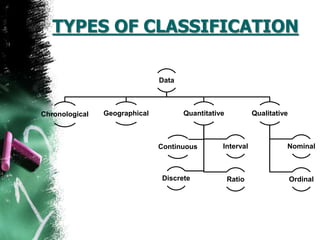
TYPES OF CLASSIFICATION
Data
Chronological Geographical Quantitative
Interval
Ratio
Continuous
Discrete
Qualitative
Nominal
Ordinal
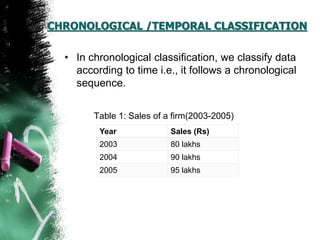
CHRONOLOGICAL /TEMPORAL CLASSIFICATION
• In chronological classification, we classify data
according to time i.e., it follows a chronological
sequence.
Table 1: Sales of a firm(2003-2005)
Year Sales (Rs)
2003 80 lakhs
2004 90 lakhs
2005 95 lakhs
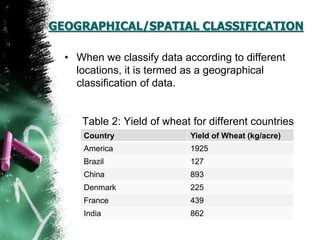
GEOGRAPHICAL/SPATIAL CLASSIFICATION
• When we classify data according to different
locations, it is termed as a geographical
classification of data.
Table 2: Yield of wheat for different countries
Country Yield of Wheat (kg/acre)
America 1925
Brazil 127
China 893
Denmark 225
France 439
India 862
QUALITATIVE CLASSIFICATION
• When data is classified on the basis of
attributes, it is known as qualitative
classification.
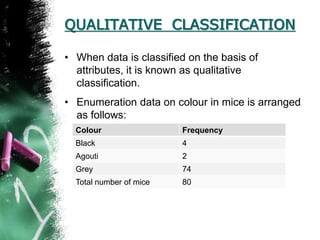
• Enumeration data on colour in mice is arranged
as follows:
Colour Frequency
Black 4
Agouti 2
Grey 74
Total number of mice 80
SIMPLE CLASSIFICATION
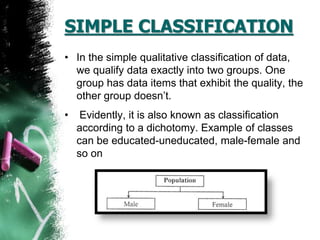
• In the simple qualitative classification of data,
we qualify data exactly into two groups. One
group has data items that exhibit the quality, the
other group doesn’t.
• Evidently, it is also known as classification
according to a dichotomy. Example of classes
can be educated-uneducated, male-female and
so on
MANIFOLD CLASSIFICTION
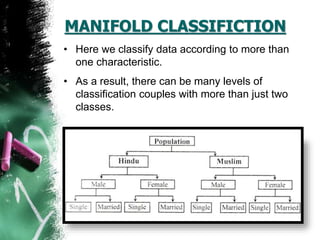
• Here we classify data according to more than
one characteristic.
• As a result, there can be many levels of
classification couples with more than just two
classes.
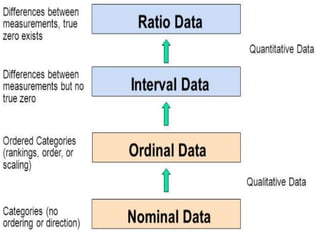
NOMINAL DATA
• Lowest measurement scale
• As the name implies it consists of “naming”
observations or classifying them into mutually
exclusive categories.
• Numbers are arbitrarily assigned to characteristics
for data classification.
• Mode can be calculated in this type of data.
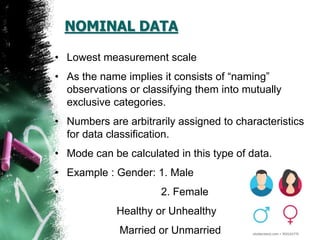
• Example : Gender: 1. Male
• 2. Female
Healthy or Unhealthy
Married or Unmarried
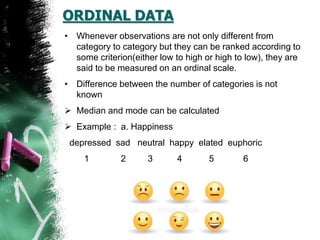
ORDINAL DATA
• Whenever observations are not only different from
category to category but they can be ranked according to
some criterion(either low to high or high to low), they are
said to be measured on an ordinal scale.
• Difference between the number of categories is not
known
 Median and mode can be calculated
 Example : a. Happiness
depressed sad neutral happy elated euphoric
1 2 3 4 5 6
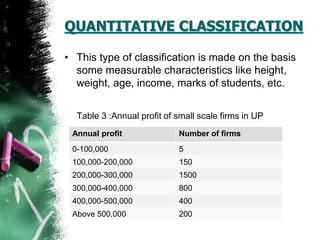
QUANTITATIVE CLASSIFICATION
• This type of classification is made on the basis
some measurable characteristics like height,
weight, age, income, marks of students, etc.
Table 3 :Annual profit of small scale firms in UP
Annual profit Number of firms
0-100,000 5
100,000-200,000 150
200,000-300,000 1500
300,000-400,000 800
400,000-500,000 400
Above 500,000 200
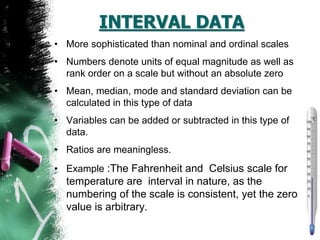
INTERVAL DATA
• More sophisticated than nominal and ordinal scales
• Numbers denote units of equal magnitude as well as
rank order on a scale but without an absolute zero
• Mean, median, mode and standard deviation can be
calculated in this type of data
• Variables can be added or subtracted in this type of
data.
• Ratios are meaningless.
• Example :The Fahrenheit and Celsius scale for
temperature are interval in nature, as the
numbering of the scale is consistent, yet the zero
value is arbitrary.
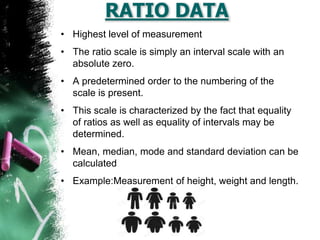
RATIO DATA
• Highest level of measurement
• The ratio scale is simply an interval scale with an
absolute zero.
• A predetermined order to the numbering of the
scale is present.
• This scale is characterized by the fact that equality
of ratios as well as equality of intervals may be
determined.
• Mean, median, mode and standard deviation can be
calculated
• Example:Measurement of height, weight and length.
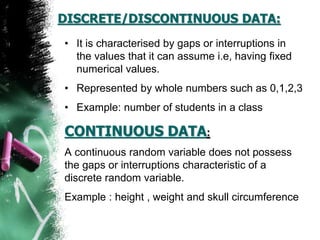
DISCRETE/DISCONTINUOUS DATA:
• It is characterised by gaps or interruptions in
the values that it can assume i.e, having fixed
numerical values.
• Represented by whole numbers such as 0,1,2,3
• Example: number of students in a class
CONTINUOUS DATA:
A continuous random variable does not possess
the gaps or interruptions characteristic of a
discrete random variable.
Example : height , weight and skull circumference
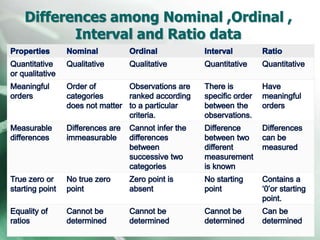
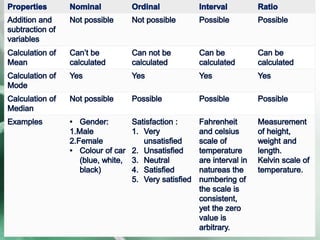
Differences among Nominal ,Ordinal ,
Interval and Ratio data
https://youtu.be/yp8zReT3AfY
https://www.youtube.com/watch?v=xgjMmpv7r4M&t=295s
REFERENCES :
• Biostatistics (by Daniel)
• Introduction of biostatistics by Sokal and Rohlf
• www.sciencedirect.com (introduction to
biostatistics part 2 basic concepts)
• https://byjus.com/commerce/meaning-and-
objectives-of-classification-of-data/
• https://www.toppr.com/guides/economics/organi
sation-of-data/raw-data-classification-of-data-
and-variables/
Classification of data ppt.pptx

Classification of data ppt.pptx

  • 1.
    Classification of data Submittedby : Aditya Kiran 1834104 B.Sc(H) Botany,3rd year
  • 2.
    CLASSIFICATION OF DATA •It is the process of arranging data into homogeneous (similar) groups according to their common characteristics.
  • 3.
    OBJECTIVES OF CLASSIFICATION •Simplification and briefness • Utility • Distinctiveness • Comparability • Scientific arrangement • Attractive and effective
  • 4.
    CHARACTERISTICS • Comprehensive • Clarity •Homogeneity • Suitability • Stability • Elastic
  • 5.
    TYPES OF CLASSIFICATION Data ChronologicalGeographical Quantitative Interval Ratio Continuous Discrete Qualitative Nominal Ordinal
  • 6.
    CHRONOLOGICAL /TEMPORAL CLASSIFICATION •In chronological classification, we classify data according to time i.e., it follows a chronological sequence. Table 1: Sales of a firm(2003-2005) Year Sales (Rs) 2003 80 lakhs 2004 90 lakhs 2005 95 lakhs
  • 7.
    GEOGRAPHICAL/SPATIAL CLASSIFICATION • Whenwe classify data according to different locations, it is termed as a geographical classification of data. Table 2: Yield of wheat for different countries Country Yield of Wheat (kg/acre) America 1925 Brazil 127 China 893 Denmark 225 France 439 India 862
  • 8.
    QUALITATIVE CLASSIFICATION • Whendata is classified on the basis of attributes, it is known as qualitative classification. • Enumeration data on colour in mice is arranged as follows: Colour Frequency Black 4 Agouti 2 Grey 74 Total number of mice 80
  • 9.
    SIMPLE CLASSIFICATION • Inthe simple qualitative classification of data, we qualify data exactly into two groups. One group has data items that exhibit the quality, the other group doesn’t. • Evidently, it is also known as classification according to a dichotomy. Example of classes can be educated-uneducated, male-female and so on
  • 10.
    MANIFOLD CLASSIFICTION • Herewe classify data according to more than one characteristic. • As a result, there can be many levels of classification couples with more than just two classes.
  • 11.
    NOMINAL DATA • Lowestmeasurement scale • As the name implies it consists of “naming” observations or classifying them into mutually exclusive categories. • Numbers are arbitrarily assigned to characteristics for data classification. • Mode can be calculated in this type of data. • Example : Gender: 1. Male • 2. Female Healthy or Unhealthy Married or Unmarried
  • 12.
    ORDINAL DATA • Wheneverobservations are not only different from category to category but they can be ranked according to some criterion(either low to high or high to low), they are said to be measured on an ordinal scale. • Difference between the number of categories is not known  Median and mode can be calculated  Example : a. Happiness depressed sad neutral happy elated euphoric 1 2 3 4 5 6
  • 13.
    QUANTITATIVE CLASSIFICATION • Thistype of classification is made on the basis some measurable characteristics like height, weight, age, income, marks of students, etc. Table 3 :Annual profit of small scale firms in UP Annual profit Number of firms 0-100,000 5 100,000-200,000 150 200,000-300,000 1500 300,000-400,000 800 400,000-500,000 400 Above 500,000 200
  • 14.
    INTERVAL DATA • Moresophisticated than nominal and ordinal scales • Numbers denote units of equal magnitude as well as rank order on a scale but without an absolute zero • Mean, median, mode and standard deviation can be calculated in this type of data • Variables can be added or subtracted in this type of data. • Ratios are meaningless. • Example :The Fahrenheit and Celsius scale for temperature are interval in nature, as the numbering of the scale is consistent, yet the zero value is arbitrary.
  • 15.
    RATIO DATA • Highestlevel of measurement • The ratio scale is simply an interval scale with an absolute zero. • A predetermined order to the numbering of the scale is present. • This scale is characterized by the fact that equality of ratios as well as equality of intervals may be determined. • Mean, median, mode and standard deviation can be calculated • Example:Measurement of height, weight and length.
  • 16.
    DISCRETE/DISCONTINUOUS DATA: • Itis characterised by gaps or interruptions in the values that it can assume i.e, having fixed numerical values. • Represented by whole numbers such as 0,1,2,3 • Example: number of students in a class CONTINUOUS DATA: A continuous random variable does not possess the gaps or interruptions characteristic of a discrete random variable. Example : height , weight and skull circumference
  • 17.
    Differences among Nominal,Ordinal , Interval and Ratio data
  • 20.
  • 21.
    REFERENCES : • Biostatistics(by Daniel) • Introduction of biostatistics by Sokal and Rohlf • www.sciencedirect.com (introduction to biostatistics part 2 basic concepts) • https://byjus.com/commerce/meaning-and- objectives-of-classification-of-data/ • https://www.toppr.com/guides/economics/organi sation-of-data/raw-data-classification-of-data- and-variables/