BY
Dr KHALED SALEH ALGARIRI
IMS – MSU
May 2016
CSF LACTATE
In neonates (10-40mg/dl) .
In adult or older children (10-22 mg/dl)
 Measurement of lactate concentrations in cerebrospinal fluid
(CSF) may be useful as part of the investigation of inborn errors of
metabolism in which lactic acidosis occurs.
 This includes disorders of gluconeogenesis, pyruvate
dehydrogenase complex, the Krebs cycle and the
mitochondrial electron transport chain.
 Levels greater than 35 mg/dl are frequently seen with bacterial
meningitis (due to increased glycolysis by bacteria & inflammatory
cells), whereas in viral meningitis, lactate levels remain lower than 25
mg/dl.
CSF LACTATE cont
 CSF lactate levels remain elevated during initial treatment but fall rapidly
when treatment is successful, thus offering a sensitive method for
evaluating the effectiveness of antibiotic therapy.
 Measurement of lactate in CSF has also been advocated for
investigating children with unexplained neurological disease
CSF GLUTAMINE
Normal range 8-18 mg/dL
 Glutamine is produced in the CNS by the brain cells from ammonia and
alpha-ketoglutarate. This process serves to remove the toxic metabolic waste
product ammonia from the CNS.
 Glutamine synthesis helps to protect the CNS from the toxic effects of
increased ammonia.
 Ammonia production is increase dramatically in patients with liver
failure.
 Accordingly, CSF glutamine production is increased in cases of hepatic
encephalopathy
CSF ENZYMES
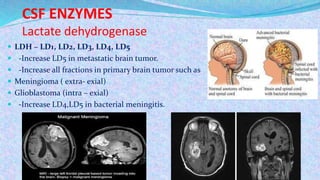
Lactate dehydrogenase
 LDH – LD1, LD2, LD3, LD4, LD5
 -Increase LD5 in metastatic brain tumor.
 -Increase all fractions in primary brain tumor such as
 Meningioma ( extra- exial)
 Glioblastoma (intra – exial)
 -Increase LD4,LD5 in bacterial meningitis.
CSF ENZYMES
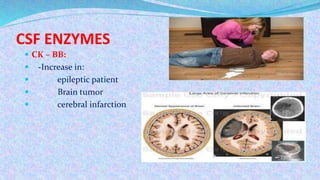
 CK – BB:
 -Increase in:
 epileptic patient
 Brain tumor
 cerebral infarction
CSF ENZYMES
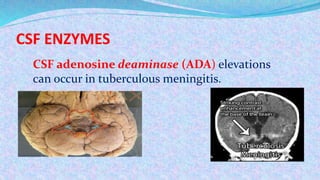
CSF adenosine deaminase (ADA) elevations
can occur in tuberculous meningitis.
Other Chemical Components of CSF
 CSF [Calcium], [Potassium] & [Phosphates] are lower than their
levels in the blood
 CSF [Chloride] & [Magnesium] are higher than their levels in the
blood
 Abnormal CSF [Chloride]
 marked  in acute bacterial meningitis
 slight  in viral meningitis & brain tumors
What is the function of CSF?
 To supply nutrients to the nervous system
 To remove metabolic wastes
 The presence of a number of biologically active principles
(releasing factors, hormones, neurotransmitters,
metabolites) within the CSF suggests that it may function as
a transport system.
 To produce a mechanical barrier to cushion the brain and
spinal cord against trauma
How many times perday is CSF completely replaced?
 What is the estimated total volume of CSF?
 140 mL
3 to 4 times per day
What is the difference between CSF and blood in
terms of protein concentration?
CSF has reduced protein concentration
 Compare Blood and CSF Glucose, Calcium and
Potassium levels. CSF has lower glucose, calcium and
potassium concentrations than in the plasma
What indicates a hemorhage in the brain?
What does protein content of >150 mg/dl
indicate?
That bilirubing (bound to albumin) has been brought from
the plasma to the CSF.
Grossly bloody or yellow (xanthochromia) color
What does a protein content of greater than 500 mg/dl
indicate?
 What occurs to the CSF concentration of glucose during an
acute bacterial infction?
Decreases
Usually a manifestation of a block in the spinal subarachnoid
space by a tumore, meningeal cancer or other compressing lesion
In multiple sclerosis and other inflammatory disease
what happens to gamma-globulin content in the CSF?
It is increased in the CSF
What is a hydrodynamic disorder of the CSF leading to
an excess of intracranial CSF?
Hydrocephalus
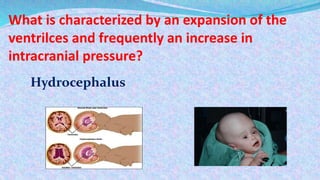
What is characterized by an expansion of the
ventrilces and frequently an increase in
intracranial pressure?
Hydrocephalus
 What are the three reasons behind hydroencephalus?
 What is one possible cause behind oversecretion of
CSF?
Papilloma or tumors of the choroid plexus
Over secretion of CSF
Impaired reabsorption of CSF
Obstruction of CSF circulation
How many tubes of CSF should be collected
for CSF examination?
 Tube 1 – used for chemical and serologic test: centrifuge and use
supernatant for chemistry analysis (glucose, protein, chloride)
 Tube 2 – used for microbiology lab
 Tube 3 – used for hematology (cell count) Cell counts done as soon
as possible after the fluid is collected as cellular degradation occurs
rapidly. If postponed, refrigerate for up to one hour.
Mukalla City-

Chemical components of CSF analysis

  • 1.
    BY Dr KHALED SALEHALGARIRI IMS – MSU May 2016
  • 2.
    CSF LACTATE In neonates(10-40mg/dl) . In adult or older children (10-22 mg/dl)  Measurement of lactate concentrations in cerebrospinal fluid (CSF) may be useful as part of the investigation of inborn errors of metabolism in which lactic acidosis occurs.  This includes disorders of gluconeogenesis, pyruvate dehydrogenase complex, the Krebs cycle and the mitochondrial electron transport chain.  Levels greater than 35 mg/dl are frequently seen with bacterial meningitis (due to increased glycolysis by bacteria & inflammatory cells), whereas in viral meningitis, lactate levels remain lower than 25 mg/dl.
  • 3.
    CSF LACTATE cont CSF lactate levels remain elevated during initial treatment but fall rapidly when treatment is successful, thus offering a sensitive method for evaluating the effectiveness of antibiotic therapy.  Measurement of lactate in CSF has also been advocated for investigating children with unexplained neurological disease
  • 4.
    CSF GLUTAMINE Normal range8-18 mg/dL  Glutamine is produced in the CNS by the brain cells from ammonia and alpha-ketoglutarate. This process serves to remove the toxic metabolic waste product ammonia from the CNS.  Glutamine synthesis helps to protect the CNS from the toxic effects of increased ammonia.  Ammonia production is increase dramatically in patients with liver failure.  Accordingly, CSF glutamine production is increased in cases of hepatic encephalopathy
  • 5.
    CSF ENZYMES Lactate dehydrogenase LDH – LD1, LD2, LD3, LD4, LD5  -Increase LD5 in metastatic brain tumor.  -Increase all fractions in primary brain tumor such as  Meningioma ( extra- exial)  Glioblastoma (intra – exial)  -Increase LD4,LD5 in bacterial meningitis.
  • 6.
    CSF ENZYMES  CK– BB:  -Increase in:  epileptic patient  Brain tumor  cerebral infarction
  • 7.
    CSF ENZYMES CSF adenosinedeaminase (ADA) elevations can occur in tuberculous meningitis.
  • 8.
    Other Chemical Componentsof CSF  CSF [Calcium], [Potassium] & [Phosphates] are lower than their levels in the blood  CSF [Chloride] & [Magnesium] are higher than their levels in the blood  Abnormal CSF [Chloride]  marked  in acute bacterial meningitis  slight  in viral meningitis & brain tumors
  • 9.
    What is thefunction of CSF?  To supply nutrients to the nervous system  To remove metabolic wastes  The presence of a number of biologically active principles (releasing factors, hormones, neurotransmitters, metabolites) within the CSF suggests that it may function as a transport system.  To produce a mechanical barrier to cushion the brain and spinal cord against trauma
  • 10.
    How many timesperday is CSF completely replaced?  What is the estimated total volume of CSF?  140 mL 3 to 4 times per day
  • 11.
    What is thedifference between CSF and blood in terms of protein concentration? CSF has reduced protein concentration  Compare Blood and CSF Glucose, Calcium and Potassium levels. CSF has lower glucose, calcium and potassium concentrations than in the plasma
  • 12.
    What indicates ahemorhage in the brain? What does protein content of >150 mg/dl indicate? That bilirubing (bound to albumin) has been brought from the plasma to the CSF. Grossly bloody or yellow (xanthochromia) color
  • 13.
    What does aprotein content of greater than 500 mg/dl indicate?  What occurs to the CSF concentration of glucose during an acute bacterial infction? Decreases Usually a manifestation of a block in the spinal subarachnoid space by a tumore, meningeal cancer or other compressing lesion
  • 14.
    In multiple sclerosisand other inflammatory disease what happens to gamma-globulin content in the CSF? It is increased in the CSF What is a hydrodynamic disorder of the CSF leading to an excess of intracranial CSF? Hydrocephalus
  • 15.
    What is characterizedby an expansion of the ventrilces and frequently an increase in intracranial pressure? Hydrocephalus
  • 16.
     What arethe three reasons behind hydroencephalus?  What is one possible cause behind oversecretion of CSF? Papilloma or tumors of the choroid plexus Over secretion of CSF Impaired reabsorption of CSF Obstruction of CSF circulation
  • 17.
    How many tubesof CSF should be collected for CSF examination?  Tube 1 – used for chemical and serologic test: centrifuge and use supernatant for chemistry analysis (glucose, protein, chloride)  Tube 2 – used for microbiology lab  Tube 3 – used for hematology (cell count) Cell counts done as soon as possible after the fluid is collected as cellular degradation occurs rapidly. If postponed, refrigerate for up to one hour.
  • 18.