CSF Examination
Muhammad Asif Zeb
lecturer Hematology
IPMS-KMU
Contents
Introduction
Function
Sample Collection
CSF Lab Examination
Chemical Analysis
Serological Examination
Other Techniques
References
GENERAL
INFORMATION:
Both the brain and spinal cord are covered by three
protective membranes referred to as the meninges.
The outermost layer is called the dura mater and is
composed of tough connective tissue.
The middle layer is the arachnoid named for it
spider web like appearance.
The delicate innermost layer which is in direct contact
with the brain and spinal cord is called the pia
mater. An inflammation of the meninges is referred
to as meningitis.
Between the arachnoid layer and the pia mater is a
space called the subarachnoid space.
It contains a clear, colorless fluid referred to as
Cerebrospinal Fluid (CSF).
CSF is produced in the ventricles of the brain by a
collection of rich vascular protrusions called the
choroid plexus.
Excess CSF is continuously reabsorbed by
arachnoid villi and returned to the venous system
thus maintaining a consistent amount of fluid
FUNCTIONS OF CSF
THE TWO CHIEF FUNCTIONS OF CSF (SPINAL)
FLUID ARE:
1. To protect and cushion the brain and the spinal
cord against possible injury.
2. To deliver nutrients from the blood to the Central
Nervous System and removes
wastes
Normal CSF
Thin, colourless, clear fluid
CSF is the 3rd
major fluid of the body
Adult volume 90-150 mL
Neonate volume 10-60 mL
0-5 WBC’s /mm3
(neonates 0-30/ mm3
)
(Lymphocytes & monocytes)
Occasional ependymal or choroid plexus cells
Protein 15-45mg/dl
Glucose 50-80mg/dl
Chloride 113-130 mEq/L
Sterile
Lumber puncture or collection
of CSf
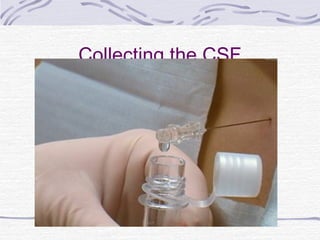
The procedure used to obtain
cerebrospinal fluid is referred to as
Lumbar Puncture or a Spinal Tap.
Purpose
The purpose of CSF analysis is to diagnose
medical Disorders that affect the CNS.
Viral and Bacterial Infections.
Tumors of Nervous System.
Syphilis, a Sexually transmitted disease.
Bleeding around the brain and spinal cord.
Multiple sclerosis,a disease that affects the myelin
coating of the nerve fibers.
Guilain-Barre syndrome,an inflammation of the
nerves.
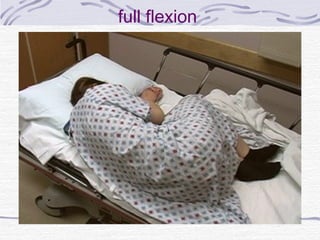
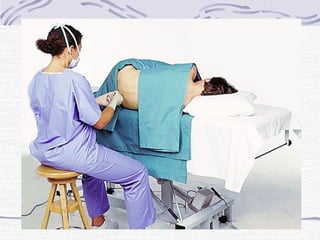
Collection Technique
full flexion
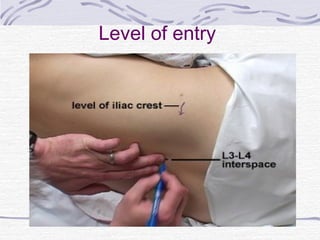
Level of entry
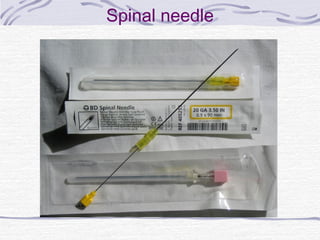
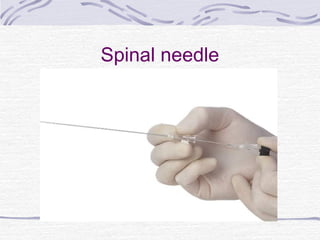
Spinal needle
Spinal needle
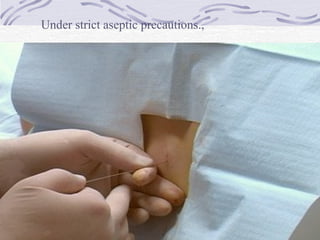
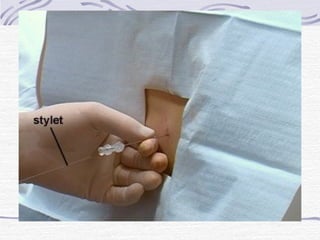
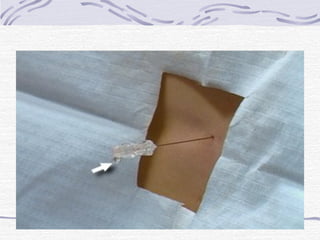
Under strict aseptic precautions.,
Collecting the CSF
19
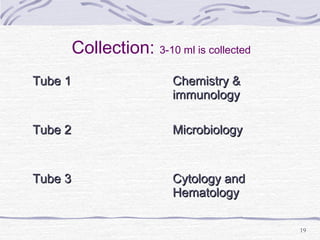
Collection: 3-10 ml is collected
Tube 1Tube 1 Chemistry &Chemistry &
immunologyimmunology
Tube 2Tube 2 MicrobiologyMicrobiology
Tube 3Tube 3 Cytology andCytology and
HematologyHematology
Analysis
Physical examination
Chemical examination
Microscopic examination
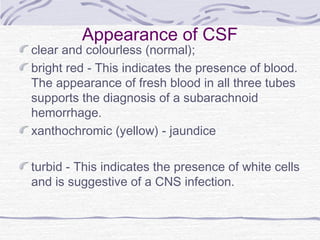
Appearance of CSF
clear and colourless (normal);
bright red - This indicates the presence of blood.
The appearance of fresh blood in all three tubes
supports the diagnosis of a subarachnoid
hemorrhage.
xanthochromic (yellow) - jaundice
turbid - This indicates the presence of white cells
and is suggestive of a CNS infection.
Presence of clot
No clot
If present indicate high protein content
Condition
With patient traumatic tap
Complete spinal blockage
Tuberculosis meningitis
Bacterial infection
Amount of CSF
How much collected
Microscopic examination
Cell counts
Noramal less than 5/ul
 TLC count
 RBC count
 Smear preparation
for Differential count to see the morphology of
WBC,s
Usually few lymphocytes are present
How to count TLC and
RBC???
Clinical significance of Increase
TLC
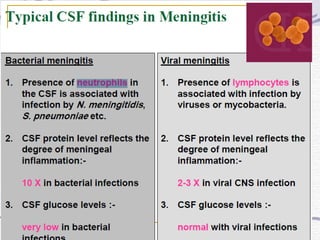
Neutrophili leukocytosis =
Neisseria meningitis, Hemophilus influenza
and E. coli
Lymphocytic/monocytic leukocytosis=
T.b, Viral infection, fungus or with syphilis
Malignancy=
Leukemia,
Leukocyte-differential
Most patients with
bacterial infections=neutrophils
while
fungal, tubercular and viral infection =
lymphocytes.
Leukocyte-differential (Contd..)
other conditions.
Leukemia
Plasma cell leukemia
Presence of tumor in brain.
Metastasis to CSF
Gram stain and culture
A Gram’s stain should be perform on all CSF
.
Cultures are also set up in order to retrieve and identify
organisms present in the CSF.
If the physician suspects a viral, mycobacterial, or rickettsia
organism,
it is important that special culture techniques be followed for
isolation of these organisms.
Chemical analysis
CSF PROTEIN DETERMINATION
CSF Glucose DETERMINATION
Protein
Normal CSF protein concentration is 15 - 45
mg/dl. It is derived from the plasma.
Increased levels are associated with:
- infection
- altered capillary permeability
- decreased absorption
- local biosynthesis of gamma globulin
Sulfosalicylic acid test
Take 3 ml of 3% sulfosalicylic acid in a
tube
add 1 ml of supernatant clear CSF in it.
Cloudiness indicate the presence of
protein
Principle (Biuret Method): Any
compound
(proteins) containing three or more peptide
bonds reacts with alkaline copper tartrate
reagent to form a blue to purple coloured
substance.
The intensity of colour produced is proportional
to the number of peptide bonds reacting and,
therefore, to the amount of proteins.
Biuret Method
Procedure:
To 2 ml CSF add 2 ml 10%trichloracetic acid, mix well and allow to
stand for 5 min.
Centrifuge at high speed and discard the supernatant.
Mark this tube containing precipitate as test.
Take another test tube and mark it blank.
To both tubes add 1 ml 15% NaOH. Shake the “test” tube to
dissolve them precipitate. Add 0.5 ml 5% Copper sulphate and 4 ml
distilled water.
Mix thoroughly and centrifuge at high speed.
Transfer the supernatant to corresponding clean tubes marked.
Read absorbance of the “test” against “blank” in a colorimeter at 550
nm.
CSF GLUCOSE DETERMINATION
• Normal CSF glucose is: 60 to 70 % of the patient's
serum glucose concentration.
It is generally decreased in bacterial meningitis, as well
as in meningitis associated with a fungus, tuberculosis
or syphilis.
Chemical analysis
(Contd..)
Decreased protein levels are less commonly
encountered.
Common reasons are removal of large amounts of
CSF and leakage of CSF caused by trauma.
Glucose concentrations can be determined using the
same methodologies as used for blood.
The most common finding is a low glucose
concentration associated with most types of CNS
infections.
If patient is hyperglycemic, then the CSF glucose
concentrations will like wise be elevated and an
infection may be masked.
If the patient is hypoglycemic the physician may be
misled by a low CSF glucose.
Chemical analysis (Contd..)
Lactate determination is considered to be of
some use by physicians in differentiating
bacterial, tuberculous and fungal meningitis
from viral meningitis.
The lactate concentration in viral meningitis is
generally normal or low in comparison to that
in bacterial, tuberculous, or fungal meningitis.
Serologic examination
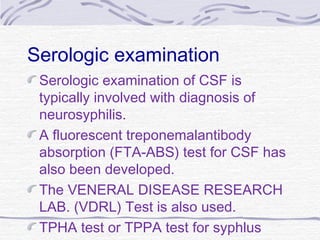
Serologic examination of CSF is
typically involved with diagnosis of
neurosyphilis.
A fluorescent treponemalantibody
absorption (FTA-ABS) test for CSF has
also been developed.
The VENERAL DISEASE RESEARCH
LAB. (VDRL) Test is also used.
TPHA test or TPPA test for syphlus
Other techniques
It is important to recognize other techniques that have
been used and may still be used for CSF.
Immunoelectrophorsis (CIE), latex agglutination tests
for bacterial antigens, enzyme linked immunosorbent
assay (ELISA) and limulus of gram-negative bacterial).
The nucleic acid probes using PCR are the newest of
the techniques being investigated for indentification of
specific infectious agents.
Thank You

Csf by asif

  • 1.
    CSF Examination Muhammad AsifZeb lecturer Hematology IPMS-KMU
  • 2.
    Contents Introduction Function Sample Collection CSF LabExamination Chemical Analysis Serological Examination Other Techniques References
  • 3.
    GENERAL INFORMATION: Both the brainand spinal cord are covered by three protective membranes referred to as the meninges. The outermost layer is called the dura mater and is composed of tough connective tissue. The middle layer is the arachnoid named for it spider web like appearance. The delicate innermost layer which is in direct contact with the brain and spinal cord is called the pia mater. An inflammation of the meninges is referred to as meningitis.
  • 4.
    Between the arachnoidlayer and the pia mater is a space called the subarachnoid space. It contains a clear, colorless fluid referred to as Cerebrospinal Fluid (CSF). CSF is produced in the ventricles of the brain by a collection of rich vascular protrusions called the choroid plexus. Excess CSF is continuously reabsorbed by arachnoid villi and returned to the venous system thus maintaining a consistent amount of fluid
  • 5.
    FUNCTIONS OF CSF THETWO CHIEF FUNCTIONS OF CSF (SPINAL) FLUID ARE: 1. To protect and cushion the brain and the spinal cord against possible injury. 2. To deliver nutrients from the blood to the Central Nervous System and removes wastes
  • 6.
    Normal CSF Thin, colourless,clear fluid CSF is the 3rd major fluid of the body Adult volume 90-150 mL Neonate volume 10-60 mL 0-5 WBC’s /mm3 (neonates 0-30/ mm3 ) (Lymphocytes & monocytes) Occasional ependymal or choroid plexus cells Protein 15-45mg/dl Glucose 50-80mg/dl Chloride 113-130 mEq/L Sterile
  • 7.
    Lumber puncture orcollection of CSf The procedure used to obtain cerebrospinal fluid is referred to as Lumbar Puncture or a Spinal Tap.
  • 8.
    Purpose The purpose ofCSF analysis is to diagnose medical Disorders that affect the CNS. Viral and Bacterial Infections. Tumors of Nervous System. Syphilis, a Sexually transmitted disease. Bleeding around the brain and spinal cord. Multiple sclerosis,a disease that affects the myelin coating of the nerve fibers. Guilain-Barre syndrome,an inflammation of the nerves.
  • 9.
  • 10.
  • 12.
  • 13.
  • 14.
  • 15.
    Under strict asepticprecautions.,
  • 18.
  • 19.
    19 Collection: 3-10 mlis collected Tube 1Tube 1 Chemistry &Chemistry & immunologyimmunology Tube 2Tube 2 MicrobiologyMicrobiology Tube 3Tube 3 Cytology andCytology and HematologyHematology
  • 20.
  • 21.
    Appearance of CSF clearand colourless (normal); bright red - This indicates the presence of blood. The appearance of fresh blood in all three tubes supports the diagnosis of a subarachnoid hemorrhage. xanthochromic (yellow) - jaundice turbid - This indicates the presence of white cells and is suggestive of a CNS infection.
  • 22.
    Presence of clot Noclot If present indicate high protein content Condition With patient traumatic tap Complete spinal blockage Tuberculosis meningitis Bacterial infection
  • 23.
    Amount of CSF Howmuch collected
  • 24.
    Microscopic examination Cell counts Noramalless than 5/ul  TLC count  RBC count  Smear preparation for Differential count to see the morphology of WBC,s Usually few lymphocytes are present
  • 25.
    How to countTLC and RBC???
  • 26.
    Clinical significance ofIncrease TLC Neutrophili leukocytosis = Neisseria meningitis, Hemophilus influenza and E. coli Lymphocytic/monocytic leukocytosis= T.b, Viral infection, fungus or with syphilis Malignancy= Leukemia,
  • 27.
    Leukocyte-differential Most patients with bacterialinfections=neutrophils while fungal, tubercular and viral infection = lymphocytes.
  • 28.
    Leukocyte-differential (Contd..) other conditions. Leukemia Plasmacell leukemia Presence of tumor in brain. Metastasis to CSF
  • 29.
    Gram stain andculture A Gram’s stain should be perform on all CSF . Cultures are also set up in order to retrieve and identify organisms present in the CSF. If the physician suspects a viral, mycobacterial, or rickettsia organism, it is important that special culture techniques be followed for isolation of these organisms.
  • 30.
    Chemical analysis CSF PROTEINDETERMINATION CSF Glucose DETERMINATION
  • 31.
    Protein Normal CSF proteinconcentration is 15 - 45 mg/dl. It is derived from the plasma. Increased levels are associated with: - infection - altered capillary permeability - decreased absorption - local biosynthesis of gamma globulin
  • 32.
    Sulfosalicylic acid test Take3 ml of 3% sulfosalicylic acid in a tube add 1 ml of supernatant clear CSF in it. Cloudiness indicate the presence of protein
  • 33.
    Principle (Biuret Method):Any compound (proteins) containing three or more peptide bonds reacts with alkaline copper tartrate reagent to form a blue to purple coloured substance. The intensity of colour produced is proportional to the number of peptide bonds reacting and, therefore, to the amount of proteins.
  • 34.
    Biuret Method Procedure: To 2ml CSF add 2 ml 10%trichloracetic acid, mix well and allow to stand for 5 min. Centrifuge at high speed and discard the supernatant. Mark this tube containing precipitate as test. Take another test tube and mark it blank. To both tubes add 1 ml 15% NaOH. Shake the “test” tube to dissolve them precipitate. Add 0.5 ml 5% Copper sulphate and 4 ml distilled water. Mix thoroughly and centrifuge at high speed. Transfer the supernatant to corresponding clean tubes marked. Read absorbance of the “test” against “blank” in a colorimeter at 550 nm.
  • 35.
    CSF GLUCOSE DETERMINATION •Normal CSF glucose is: 60 to 70 % of the patient's serum glucose concentration. It is generally decreased in bacterial meningitis, as well as in meningitis associated with a fungus, tuberculosis or syphilis.
  • 36.
    Chemical analysis (Contd..) Decreased proteinlevels are less commonly encountered. Common reasons are removal of large amounts of CSF and leakage of CSF caused by trauma. Glucose concentrations can be determined using the same methodologies as used for blood. The most common finding is a low glucose concentration associated with most types of CNS infections. If patient is hyperglycemic, then the CSF glucose concentrations will like wise be elevated and an infection may be masked. If the patient is hypoglycemic the physician may be misled by a low CSF glucose.
  • 37.
    Chemical analysis (Contd..) Lactatedetermination is considered to be of some use by physicians in differentiating bacterial, tuberculous and fungal meningitis from viral meningitis. The lactate concentration in viral meningitis is generally normal or low in comparison to that in bacterial, tuberculous, or fungal meningitis.
  • 39.
    Serologic examination Serologic examinationof CSF is typically involved with diagnosis of neurosyphilis. A fluorescent treponemalantibody absorption (FTA-ABS) test for CSF has also been developed. The VENERAL DISEASE RESEARCH LAB. (VDRL) Test is also used. TPHA test or TPPA test for syphlus
  • 40.
    Other techniques It isimportant to recognize other techniques that have been used and may still be used for CSF. Immunoelectrophorsis (CIE), latex agglutination tests for bacterial antigens, enzyme linked immunosorbent assay (ELISA) and limulus of gram-negative bacterial). The nucleic acid probes using PCR are the newest of the techniques being investigated for indentification of specific infectious agents.
  • 41.