CSF ANALYSIS
CSF Formation
Cerebrospinal fluid (CSF) is the liquid that surrounds the brain & spinal cord.
The brain & spinal cord are surrounded by the meninges that consist of three layers:
dura matter, arachnoid & pia matter
CSF flow between the arachnoid & pia matter
in an area referred to as the subarachnoid space
The cerebrospinal fluid is formed mainly in the choroid plexuses of
the lateral, third, and fourth ventricles; some originates from the ependymal cells lining the
ventricles and from the brain substance
• Mechanism of formation:
– Selective ultrafiltration of plasma
– Active secretion by epithelial membranes
Normal blood brain barrier (BBB) is important for the normal chemistry results
of CSF
Functions of CSF
1- Physical support & protection of the CNS from trauma.
2- Supplying nutrients to the CNS & removal of metabolic wastes
from CNS
3- Intra-cerebral transport
neuroendocrine role i.e. distribution of hypothalamic hormones
within the brain.
Clinical Indications for CSF Analysis
CSF is performed in cases of suspected:
1- CNS infections (infectious meningitis & encephalitis)
2- CNS malignancy (as malignant infiltrates as in leukemia ..etc)
3- CNS hemorrhages (as subarachnoid hemorrhage)
4- CNS demylineating diseases (as multiple sclerosis)
Routine Laboratory CSF Analysis
Collection
Lumbar puncture
At interspace of vertebrate L3-4 or lower
With complete aseptic techniques
Sampling:
Collected CSF sample is immediately divided into three tubes:
Tube 1: Chemical Investigation (kept in freezer till performed)
Tube 2: Microbiology Investigation (kept in room temperature)
Tube 3: Microscopic Investigation (Cellular Counting – Differential – Cytology)
CSF Sample Collection
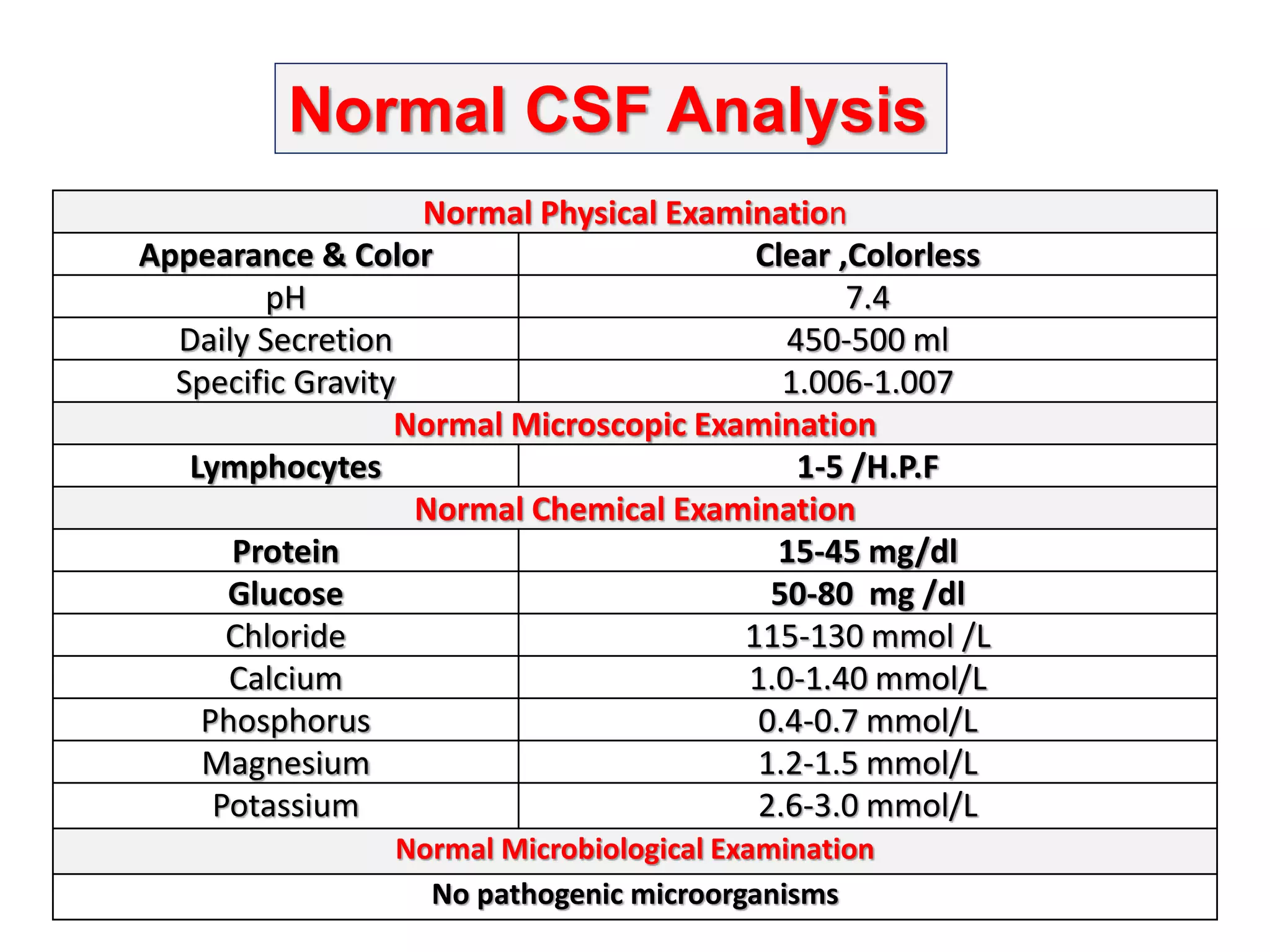
Normal Physical Examination
Appearance & Color Clear ,Colorless
pH 7.4
Daily Secretion 450-500 ml
Specific Gravity 1.006-1.007
Normal Microscopic Examination
Lymphocytes 1-5 /H.P.F
Normal Chemical Examination
Protein 15-45 mg/dl
Glucose 50-80 mg /dl
Chloride 115-130 mmol /L
Calcium 1.0-1.40 mmol/L
Phosphorus 0.4-0.7 mmol/L
Magnesium 1.2-1.5 mmol/L
Potassium 2.6-3.0 mmol/L
Normal Microbiological Examination
No pathogenic microorganisms
Normal CSF Analysis
Physical examination of CSF
Normal CSF: Clear & colorless
Viscosity: equal to water (increased with increased proteins)
Color and/or turbidity of CSF: observed only in pathological circumstances.
Turbid CSF
Bacteria
WBCs cells or pus cells: suggestive of a CNS infection (menigitis or encephalitis)
Blood : suggestive of hemorrhage: subarachnoid or artifactual traumatic tap: DIFFERNTIATE?
Red & brown color :
Blood
Yellow colour
1- Jaundice (bilirubin in CSF)
2- Xanthochromia (hemoglobin breakdown pigments in CSF)
Xanthochromic CSF suggests that a subarachnoid hemorrhage has recently occurred
(at least within two hours prior to tapping).
The yellow color is due to bilirubin generated in the CNS by the breakdown of hemoglobin
released from RBC's. (so jaundice should be excluded).
Microscopic examination of CSF
WBCs
Normal Total WBCs count: 1-5 lymphocytes /HPF
Normal differential WBCs Count: (in centrifuged cells)
- 62% lymphocytes
- 36% monocytes
- 2% neutrophils
Increased neutrophils: bacterial meningitis
Increased lymphocytes: aseptic and viral meningitis
RBCs
Normally CSF is blood free
RBCs in CSF: subarachnoid hemorrhage & malignancy
Artifact: traumatic tap (should be excluded)
(Traumatic tap bright red color RBCS in decreasing number as the fluid is sampled)
Chemical examination of CSF
In addition to the major ions, CSF contains oxygen, sugars
(e.g. glucose, fructose), lactate, proteins (e.g. albumin,
globulins), amino acids, urea, ammonia, glutamine, creatinine,
lipids, hormones (e.g. insulin) and vitamins.
CSF Glucose
- Normal CSF glucose: 50-80 mg/dl
- The actual CSF glucose concentration may be:
1- Falsely low in the presence of hypoglycemia
Or 2- Incorrectly interpreted as normal when the patient is hyperglycemic
-Accordingly, CSF glucose should always be compared with a simultaneous
plasma glucose that is drawn prior to lumbar puncture.
Normal CSF glucose/ plasma glucose ratio is approximately 0.6-0.7
(N.B. Ratio is decreased if plasma glucose is more than 500 mg/dl
due to saturation of the glucose carrier system to CSF
Elevated CSF / plasma glucose ratio (more than 0.7)
has no CSF diagnostic significance (occurs with hyperglycemia)
Decreased CSF / plasma glucose ratio (hypoglycorrhachia):
1- CNS septic (pyogenic) infections
Due to increased glycolysis by leukocytes and bacteria (with increase CSF lactate)
2- Brain tumors
due to increased metabolism of glucose by CNS
3- TB meningitis & sarcoidosis
Due to inhibition of glucose entry into the subarachnoid space
N.B. in viral CNS infections, CSF glucose is usually normal
CSF Glucose cont.
CSF Protein cont.
Lumbar CSF protein: 15 - 45 mg/dl (mostly albumin)
The majority of CSF protein is derived from the plasma by ultrafiltration
Certain proteins arise within the intrathecal compartment:
1- Immunoglobulins produced by CNS lymphocytes
2- Transthyretin (produced by choroid plexus)
3- Various structural proteins found in brain tissue
CSF Protein
Decreased CSF protein:
1- Leak of CSF from a tear in the dura due to severe trauma
2- Otorrohea: leak of CSF from ear
3- Rhinorrohea: leak of CSF from nose
Increased CSF protein:
1- Lysis of contaminant blood from traumatic tap
2- Increased permeability of epithelial membrane (blood-brain barrier)
in cases of:
- CNS bacterial or fungal infections
- Cerebral hemorrhages
2- Increased production by CNS tissue as in cases of:
- Multiple sclerosis (MS)
- Subacute sclerosing panencephalitis (SSPE)
3- Obstruction as in cases of :
- Tumors or abscess
CSF Protein cont.
Analysis of protein fractions: (Albumin & IgG)
• 1- Albumin of CSF
is obtained from blood by means of blood-brain barrier (as it is
produced solely by the liver)
In cases of increased permeability of BBB, albumin is increased in
CSF
• 2- IgG of CSF can be obtained:
from blood (By BBB) : increase in cases of increase permeab. of BBB
& by local synthesis from plasma cells within CSF (increased in cases of MS)
So, it is essential to determine the source of IgG
SEE NEXT SLIDE PLEAE !!!
CSF Protein cont.
• FIRST: CHECK INTEGRITY OF BLOOD BRAIN BARRIER (BBB)
BY CSF / serum albumin index calculation
CSF serum albumin index = CSF albumin (mg/dl) / serum albumin (g/dl)
Index less than 9 indicates intact BBB (no increased permeability of BBB)
• SECOND: CSF IgG INDEX IS CALCULATED
CSF IgG / Serum IgG
CSF IgG index = ---------------------------------------
CSF albumin / serum albumin
Normal : less than 0.7
Increased in cases of demylineating diseases of CNS as : Multiple sclerosis (MS)
CSF Protein cont.
CSF Immunoglobulin
• CSF IgG can arise:
– from plasma cells within CSF
– & from the blood through BBB
• ↑CSF [IgG] without concomitant ↑ in CSF [Alb] suggests local
production of IgG:
– multiple sclerosis (MS)
– subacute sclerosing panencephalitis (SPEE)
CSF IgG/Serum IgG
CSF serum /Albumin index
CSF IgG index:
Normally: < 0.7
=
CSF Electrophoresis: Oligoclonal Banding
CSF lactate
CSF lactate is increased in cases of bacterial meningitis (due to increased
glycolysis by bacteria & inflammatory cells)
The level of CSF glutamine reflects level of ammonia in that is normally
removed in the CNS by formation of glutamine (amino acid glutamate +
ammonia).
Glutamine synthesis helps to protect the CNS from the toxic effects of
increased ammonia.
Ammonia production is increase dramatically in patients with liver failure.
Accordingly, CSF glutamine production is increased in cases of hepatic
encephalopathy
CSF glutamine
Enzymes in the CSF
CSF lactate dehydrogenase (LDH) may be elevated in bacterial
meningitis.
CSF adenosine deaminase (ADA) elevations can occur in tuberculous
meningitis.
Other Chemical Components of CSF
• CSF [Calcium], [Potassium] & [Phosphates] are lower
than their levels in the blood
• CSF [Chloride] & [Magnesium] are higher than their
levels in the blood
– Abnormal CSF [Chloride]
• marked  in acute bacterial meningitis
• slight  in viral meningitis & brain tumors
Interpretations of Results of CSF Chemical Analysis
Bacterial
Meningitis
Viral Meningitis Tuberculous
Meningitis
Brain Tumor
Protein Increased Normal Increased Increased
Glucose Decreased
Normal
or
slightly affected
Decreased Decreased

Csf analysis

  • 1.
  • 4.
    CSF Formation Cerebrospinal fluid(CSF) is the liquid that surrounds the brain & spinal cord. The brain & spinal cord are surrounded by the meninges that consist of three layers: dura matter, arachnoid & pia matter CSF flow between the arachnoid & pia matter in an area referred to as the subarachnoid space The cerebrospinal fluid is formed mainly in the choroid plexuses of the lateral, third, and fourth ventricles; some originates from the ependymal cells lining the ventricles and from the brain substance • Mechanism of formation: – Selective ultrafiltration of plasma – Active secretion by epithelial membranes Normal blood brain barrier (BBB) is important for the normal chemistry results of CSF
  • 5.
    Functions of CSF 1-Physical support & protection of the CNS from trauma. 2- Supplying nutrients to the CNS & removal of metabolic wastes from CNS 3- Intra-cerebral transport neuroendocrine role i.e. distribution of hypothalamic hormones within the brain.
  • 6.
    Clinical Indications forCSF Analysis CSF is performed in cases of suspected: 1- CNS infections (infectious meningitis & encephalitis) 2- CNS malignancy (as malignant infiltrates as in leukemia ..etc) 3- CNS hemorrhages (as subarachnoid hemorrhage) 4- CNS demylineating diseases (as multiple sclerosis)
  • 7.
    Routine Laboratory CSFAnalysis Collection Lumbar puncture At interspace of vertebrate L3-4 or lower With complete aseptic techniques Sampling: Collected CSF sample is immediately divided into three tubes: Tube 1: Chemical Investigation (kept in freezer till performed) Tube 2: Microbiology Investigation (kept in room temperature) Tube 3: Microscopic Investigation (Cellular Counting – Differential – Cytology)
  • 8.
  • 9.
    Normal Physical Examination Appearance& Color Clear ,Colorless pH 7.4 Daily Secretion 450-500 ml Specific Gravity 1.006-1.007 Normal Microscopic Examination Lymphocytes 1-5 /H.P.F Normal Chemical Examination Protein 15-45 mg/dl Glucose 50-80 mg /dl Chloride 115-130 mmol /L Calcium 1.0-1.40 mmol/L Phosphorus 0.4-0.7 mmol/L Magnesium 1.2-1.5 mmol/L Potassium 2.6-3.0 mmol/L Normal Microbiological Examination No pathogenic microorganisms Normal CSF Analysis
  • 10.
    Physical examination ofCSF Normal CSF: Clear & colorless Viscosity: equal to water (increased with increased proteins) Color and/or turbidity of CSF: observed only in pathological circumstances. Turbid CSF Bacteria WBCs cells or pus cells: suggestive of a CNS infection (menigitis or encephalitis) Blood : suggestive of hemorrhage: subarachnoid or artifactual traumatic tap: DIFFERNTIATE? Red & brown color : Blood Yellow colour 1- Jaundice (bilirubin in CSF) 2- Xanthochromia (hemoglobin breakdown pigments in CSF) Xanthochromic CSF suggests that a subarachnoid hemorrhage has recently occurred (at least within two hours prior to tapping). The yellow color is due to bilirubin generated in the CNS by the breakdown of hemoglobin released from RBC's. (so jaundice should be excluded).
  • 11.
    Microscopic examination ofCSF WBCs Normal Total WBCs count: 1-5 lymphocytes /HPF Normal differential WBCs Count: (in centrifuged cells) - 62% lymphocytes - 36% monocytes - 2% neutrophils Increased neutrophils: bacterial meningitis Increased lymphocytes: aseptic and viral meningitis RBCs Normally CSF is blood free RBCs in CSF: subarachnoid hemorrhage & malignancy Artifact: traumatic tap (should be excluded) (Traumatic tap bright red color RBCS in decreasing number as the fluid is sampled)
  • 12.
    Chemical examination ofCSF In addition to the major ions, CSF contains oxygen, sugars (e.g. glucose, fructose), lactate, proteins (e.g. albumin, globulins), amino acids, urea, ammonia, glutamine, creatinine, lipids, hormones (e.g. insulin) and vitamins.
  • 13.
    CSF Glucose - NormalCSF glucose: 50-80 mg/dl - The actual CSF glucose concentration may be: 1- Falsely low in the presence of hypoglycemia Or 2- Incorrectly interpreted as normal when the patient is hyperglycemic -Accordingly, CSF glucose should always be compared with a simultaneous plasma glucose that is drawn prior to lumbar puncture. Normal CSF glucose/ plasma glucose ratio is approximately 0.6-0.7 (N.B. Ratio is decreased if plasma glucose is more than 500 mg/dl due to saturation of the glucose carrier system to CSF
  • 14.
    Elevated CSF /plasma glucose ratio (more than 0.7) has no CSF diagnostic significance (occurs with hyperglycemia) Decreased CSF / plasma glucose ratio (hypoglycorrhachia): 1- CNS septic (pyogenic) infections Due to increased glycolysis by leukocytes and bacteria (with increase CSF lactate) 2- Brain tumors due to increased metabolism of glucose by CNS 3- TB meningitis & sarcoidosis Due to inhibition of glucose entry into the subarachnoid space N.B. in viral CNS infections, CSF glucose is usually normal CSF Glucose cont.
  • 15.
    CSF Protein cont. LumbarCSF protein: 15 - 45 mg/dl (mostly albumin) The majority of CSF protein is derived from the plasma by ultrafiltration Certain proteins arise within the intrathecal compartment: 1- Immunoglobulins produced by CNS lymphocytes 2- Transthyretin (produced by choroid plexus) 3- Various structural proteins found in brain tissue
  • 16.
    CSF Protein Decreased CSFprotein: 1- Leak of CSF from a tear in the dura due to severe trauma 2- Otorrohea: leak of CSF from ear 3- Rhinorrohea: leak of CSF from nose
  • 17.
    Increased CSF protein: 1-Lysis of contaminant blood from traumatic tap 2- Increased permeability of epithelial membrane (blood-brain barrier) in cases of: - CNS bacterial or fungal infections - Cerebral hemorrhages 2- Increased production by CNS tissue as in cases of: - Multiple sclerosis (MS) - Subacute sclerosing panencephalitis (SSPE) 3- Obstruction as in cases of : - Tumors or abscess CSF Protein cont.
  • 18.
    Analysis of proteinfractions: (Albumin & IgG) • 1- Albumin of CSF is obtained from blood by means of blood-brain barrier (as it is produced solely by the liver) In cases of increased permeability of BBB, albumin is increased in CSF • 2- IgG of CSF can be obtained: from blood (By BBB) : increase in cases of increase permeab. of BBB & by local synthesis from plasma cells within CSF (increased in cases of MS) So, it is essential to determine the source of IgG SEE NEXT SLIDE PLEAE !!! CSF Protein cont.
  • 19.
    • FIRST: CHECKINTEGRITY OF BLOOD BRAIN BARRIER (BBB) BY CSF / serum albumin index calculation CSF serum albumin index = CSF albumin (mg/dl) / serum albumin (g/dl) Index less than 9 indicates intact BBB (no increased permeability of BBB) • SECOND: CSF IgG INDEX IS CALCULATED CSF IgG / Serum IgG CSF IgG index = --------------------------------------- CSF albumin / serum albumin Normal : less than 0.7 Increased in cases of demylineating diseases of CNS as : Multiple sclerosis (MS) CSF Protein cont.
  • 20.
    CSF Immunoglobulin • CSFIgG can arise: – from plasma cells within CSF – & from the blood through BBB • ↑CSF [IgG] without concomitant ↑ in CSF [Alb] suggests local production of IgG: – multiple sclerosis (MS) – subacute sclerosing panencephalitis (SPEE) CSF IgG/Serum IgG CSF serum /Albumin index CSF IgG index: Normally: < 0.7 =
  • 21.
  • 22.
    CSF lactate CSF lactateis increased in cases of bacterial meningitis (due to increased glycolysis by bacteria & inflammatory cells)
  • 23.
    The level ofCSF glutamine reflects level of ammonia in that is normally removed in the CNS by formation of glutamine (amino acid glutamate + ammonia). Glutamine synthesis helps to protect the CNS from the toxic effects of increased ammonia. Ammonia production is increase dramatically in patients with liver failure. Accordingly, CSF glutamine production is increased in cases of hepatic encephalopathy CSF glutamine
  • 24.
    Enzymes in theCSF CSF lactate dehydrogenase (LDH) may be elevated in bacterial meningitis. CSF adenosine deaminase (ADA) elevations can occur in tuberculous meningitis.
  • 25.
    Other Chemical Componentsof CSF • CSF [Calcium], [Potassium] & [Phosphates] are lower than their levels in the blood • CSF [Chloride] & [Magnesium] are higher than their levels in the blood – Abnormal CSF [Chloride] • marked  in acute bacterial meningitis • slight  in viral meningitis & brain tumors
  • 26.
    Interpretations of Resultsof CSF Chemical Analysis Bacterial Meningitis Viral Meningitis Tuberculous Meningitis Brain Tumor Protein Increased Normal Increased Increased Glucose Decreased Normal or slightly affected Decreased Decreased