
By
Dr KHALED ALGARIRI
CAMS- QASSIM UNIVERSITY
September 2020
What is the chemical bond?
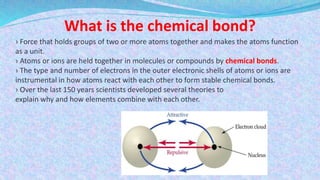
› Force that holds groups of two or more atoms together and makes the atoms function
as a unit.
› Atoms or ions are held together in molecules or compounds by chemical bonds.
› The type and number of electrons in the outer electronic shells of atoms or ions are
instrumental in how atoms react with each other to form stable chemical bonds.
› Over the last 150 years scientists developed several theories to
explain why and how elements combine with each other.
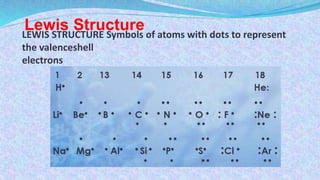
Lewis Structure
named after Gilbert N. Lewis, who introduced it in his 1916
› also known as Lewis dot diagrams, electron dot diagrams, "Lewis Dot
formula" Lewis dot structures, and electron dot structures)
› are diagrams that show the bonding between atoms of a molecule and the
lone pairs of electrons that may exist in the molecule
Lewis Structure
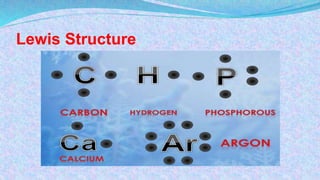
LEWIS STRUCTURE Symbols of atoms with dots to represent
the valenceshell
electrons
Lewis Structure
 Drawing of the electrons of the outer energy level.
 “Valence Electrons”
 (Dots around the element)
Valence electrons=4
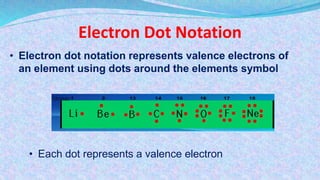
Electron Dot Notation
• Electron dot notation represents valence electrons of
an element using dots around the elements symbol
• Each dot represents a valence electron
Electronegativity
Electronegativity is defined as the ability of an atom to attract
electron density to itself when joined to another atom in a chemical
bond.
The most electronegative elements have the greatest attraction for
electrons.
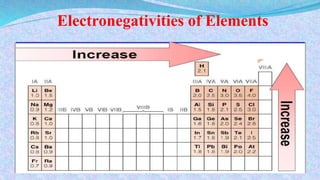
Electronegativities of Elements
Octet Rule
When ionic bonds are formed, metals lose
valence electrons so that the electron
configuration becomes like a noble gas, leaving
it with eight outer electrons.
Non-metals gain electrons to become like the
next higher noble gas, usually having 8 valence
electrons.
Octet Rule
Recognize the importance of the octet
rule.
• Atoms tend to gain lose or share
electrons so that
there are eight electrons
in the outer shell.
Ionic Bonds
 Ionic Bonds- result from the electrical attraction between large of
cations(+) and anions(-)
 An Ionic bond is when an electron leaves one atom and exothermically
enters into orbit around another. These to oppositely charged ions now
attract each other.
 Generally involves a metal and a nonmetal
 Electronegativity of Ionic Bonds: ionic bonds form when the
electronegativity difference between the atoms is 1.8 or more
Ex: Na + Cl  NaCl
Na = 0.9 Difference = 2.1 = ionic bond
Cl = 3.0
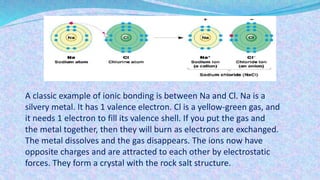
A classic example of ionic bonding is between Na and Cl. Na is a
silvery metal. It has 1 valence electron. Cl is a yellow-green gas, and
it needs 1 electron to fill its valence shell. If you put the gas and
the metal together, then they will burn as electrons are exchanged.
The metal dissolves and the gas disappears. The ions now have
opposite charges and are attracted to each other by electrostatic
forces. They form a crystal with the rock salt structure.
Properties of ionic bonds
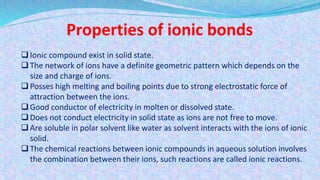
Ionic compound exist in solid state.
The network of ions have a definite geometric pattern which depends on the
size and charge of ions.
Posses high melting and boiling points due to strong electrostatic force of
attraction between the ions.
Good conductor of electricity in molten or dissolved state.
Does not conduct electricity in solid state as ions are not free to move.
Are soluble in polar solvent like water as solvent interacts with the ions of ionic
solid.
The chemical reactions between ionic compounds in aqueous solution involves
the combination between their ions, such reactions are called ionic reactions.
Covalent Bonds
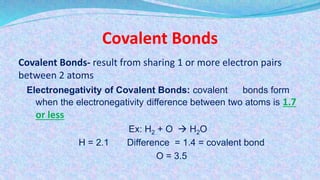
Covalent Bonds- result from sharing 1 or more electron pairs
between 2 atoms
Electronegativity of Covalent Bonds: covalent bonds form
when the electronegativity difference between two atoms is 1.7
or less
Ex: H2 + O  H2O
H = 2.1 Difference = 1.4 = covalent bond
O = 3.5
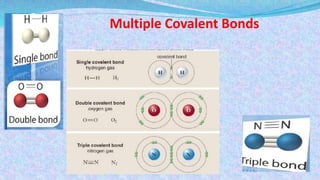
Multiple Covalent Bonds
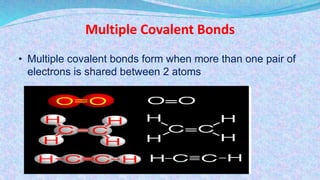
• Multiple covalent bonds form when more than one pair of
electrons is shared between 2 atoms
Multiple Covalent Bonds
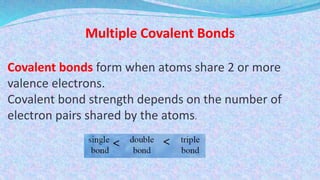
Covalent bonds form when atoms share 2 or more
valence electrons.
Covalent bond strength depends on the number of
electron pairs shared by the atoms.
Multiple Covalent Bonds
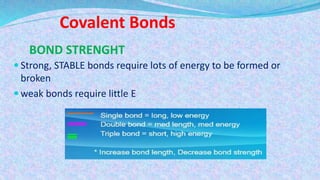
BOND STRENGHT
 Strong, STABLE bonds require lots of energy to be formed or
broken
 weak bonds require little E
Covalent Bonds
Covalent Bonds
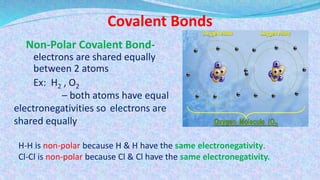
Non-Polar Covalent Bond-
electrons are shared equally
between 2 atoms
Ex: H2 , O2
– both atoms have equal
electronegativities so electrons are
shared equally
H-H is non-polar because H & H have the same electronegativity.
Cl-Cl is non-polar because Cl & Cl have the same electronegativity.
Covalent Bonds
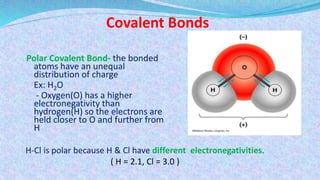
Polar Covalent Bond- the bonded
atoms have an unequal
distribution of charge
Ex: H2O
- Oxygen(O) has a higher
electronegativity than
hydrogen(H) so the electrons are
held closer to O and further from
H
H-Cl is polar because H & Cl have different electronegativities.
( H = 2.1, Cl = 3.0 )
Properties of covalent bonds
 Compounds formed exist as discrete molecules
 Weak intermolecular force due to small molecular size
 Mainly exist in liquid or gaseous state
 Sugar, urea, starch etc. exist in solid state
 Low melting and Boiling points due to weak attractive forces
 Poor conductor of electricity in fused or dissolved state
 Less soluble in water
Compare and contrast ionic and
covalent bonds
Ionic Bonds
• Exchange of electrons
• metal/non-metal
• high mp/bp
• brittle
• melt, solution
conduct electricity.
Covalent
• Sharing electrons
• non-metal/non-metal
• Molecular (low mp/bp)
• Macromolecular (high
mp/bp)
• Non conductors
Hydrogen Bonds
A hydrogen bond is the attractive force between the
hydrogen attached to an electronegative atom of one
molecule and an electronegative atom of a different
molecule.
Usually the electronegative atom is oxygen, nitrogen,
or fluorine, which has a partial negative charge.
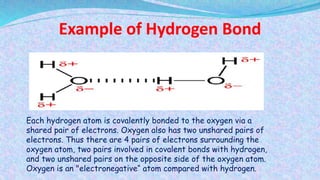
Example of Hydrogen Bond
Each hydrogen atom is covalently bonded to the oxygen via a
shared pair of electrons. Oxygen also has two unshared pairs of
electrons. Thus there are 4 pairs of electrons surrounding the
oxygen atom, two pairs involved in covalent bonds with hydrogen,
and two unshared pairs on the opposite side of the oxygen atom.
Oxygen is an "electronegative“ atom compared with hydrogen.
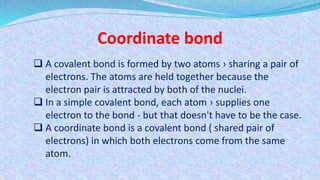
Coordinate bond
 A covalent bond is formed by two atoms › sharing a pair of
electrons. The atoms are held together because the
electron pair is attracted by both of the nuclei.
 In a simple covalent bond, each atom › supplies one
electron to the bond - but that doesn't have to be the case.
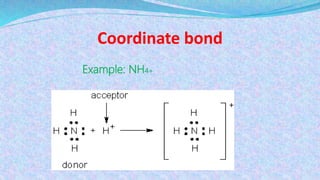
 A coordinate bond is a covalent bond ( shared pair of
electrons) in which both electrons come from the same
atom.
Coordinate bond
Example: NH4+
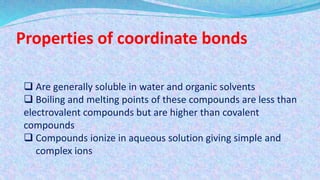
Properties of coordinate bonds
 Are generally soluble in water and organic solvents
 Boiling and melting points of these compounds are less than
electrovalent compounds but are higher than covalent
compounds
 Compounds ionize in aqueous solution giving simple and
complex ions
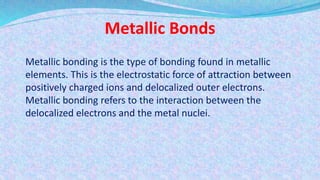
Metallic Bonds
Metallic bonding is the type of bonding found in metallic
elements. This is the electrostatic force of attraction between
positively charged ions and delocalized outer electrons.
Metallic bonding refers to the interaction between the
delocalized electrons and the metal nuclei.
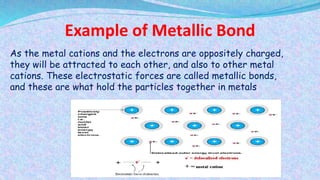
Example of Metallic Bond
As the metal cations and the electrons are oppositely charged,
they will be attracted to each other, and also to other metal
cations. These electrostatic forces are called metallic bonds,
and these are what hold the particles together in metals
Importance of Metallic and Nonmetallic Trace
Elements for Human Health
 Living organisms need minute amounts of certain elements—called trace
elements—to function properly.
 These trace elements now number 15, and more may be discovered. Ten of the 15
known trace elements are metals, and 5 are non-metals.
 The trace elements are present in milligram quantities in the human body. If you
could collect them all together, you would not have enough material to fill a
teaspoon.
Metallic Trace Elements
Need in Humans Established
Iron: forms part of hemoglobin (the oxygen-carrying protein of red blood
cells) and myoglobin (the oxygenholding protein in muscle cells)
Zinc: occurs in more than 70 enzymes that perform specific tasks in the
eyes, liver, kidneys, muscles, skin, bones,and male reproductive organs
Copper: necessary for the absorption and use of iron in the formation of
hemoglobin; also a factor in the formation of the protective covering of
nerves.
Manganese: facilitator, with enzymes, of many different metabolic
processes
Metallic Trace Elements
Molybdenum: facilitator, with enzymes, of numerous cell processes
Cobalt: part of vitamin B12; necessary for nerve cell function and
blood formation
Chromium: associated with insulin and required for the release of
energy from glucose
Need in Animals Established but Not Yet in Humans
Nickel: deficiencies harm the liver and other organs
Tin: necessary for growth
Vanadium: necessary for growth, bone development, and
normal reproduction
Nonmetallic Trace Elements
Need in Humans Established
Iodine: occurs in three thyroid gland hormones that regulate metabolic rate
Selenium: part of an enzyme that acts as an antioxidant for polyunsaturated fatty acids
Fluorine: involved in the formation of bones and teeth; helps make teeth resistant to
decay
Need in Animals Established but Not Yet in Humans
Silicon: involved in bone calcification
Boron: involved in bone development and minimization of demineralization in
osteoporosis
Chemical bonds 2020

Chemical bonds 2020

  • 1.
    By Dr KHALED ALGARIRI CAMS-QASSIM UNIVERSITY September 2020
  • 2.
    What is thechemical bond? › Force that holds groups of two or more atoms together and makes the atoms function as a unit. › Atoms or ions are held together in molecules or compounds by chemical bonds. › The type and number of electrons in the outer electronic shells of atoms or ions are instrumental in how atoms react with each other to form stable chemical bonds. › Over the last 150 years scientists developed several theories to explain why and how elements combine with each other.
  • 3.
    Lewis Structure named afterGilbert N. Lewis, who introduced it in his 1916 › also known as Lewis dot diagrams, electron dot diagrams, "Lewis Dot formula" Lewis dot structures, and electron dot structures) › are diagrams that show the bonding between atoms of a molecule and the lone pairs of electrons that may exist in the molecule
  • 4.
  • 5.
    LEWIS STRUCTURE Symbolsof atoms with dots to represent the valenceshell electrons Lewis Structure
  • 6.
     Drawing ofthe electrons of the outer energy level.  “Valence Electrons”  (Dots around the element) Valence electrons=4
  • 7.
    Electron Dot Notation •Electron dot notation represents valence electrons of an element using dots around the elements symbol • Each dot represents a valence electron
  • 8.
    Electronegativity Electronegativity is definedas the ability of an atom to attract electron density to itself when joined to another atom in a chemical bond. The most electronegative elements have the greatest attraction for electrons.
  • 9.
  • 10.
    Octet Rule When ionicbonds are formed, metals lose valence electrons so that the electron configuration becomes like a noble gas, leaving it with eight outer electrons. Non-metals gain electrons to become like the next higher noble gas, usually having 8 valence electrons.
  • 11.
    Octet Rule Recognize theimportance of the octet rule. • Atoms tend to gain lose or share electrons so that there are eight electrons in the outer shell.
  • 12.
    Ionic Bonds  IonicBonds- result from the electrical attraction between large of cations(+) and anions(-)  An Ionic bond is when an electron leaves one atom and exothermically enters into orbit around another. These to oppositely charged ions now attract each other.  Generally involves a metal and a nonmetal  Electronegativity of Ionic Bonds: ionic bonds form when the electronegativity difference between the atoms is 1.8 or more Ex: Na + Cl  NaCl Na = 0.9 Difference = 2.1 = ionic bond Cl = 3.0
  • 13.
    A classic exampleof ionic bonding is between Na and Cl. Na is a silvery metal. It has 1 valence electron. Cl is a yellow-green gas, and it needs 1 electron to fill its valence shell. If you put the gas and the metal together, then they will burn as electrons are exchanged. The metal dissolves and the gas disappears. The ions now have opposite charges and are attracted to each other by electrostatic forces. They form a crystal with the rock salt structure.
  • 14.
    Properties of ionicbonds Ionic compound exist in solid state. The network of ions have a definite geometric pattern which depends on the size and charge of ions. Posses high melting and boiling points due to strong electrostatic force of attraction between the ions. Good conductor of electricity in molten or dissolved state. Does not conduct electricity in solid state as ions are not free to move. Are soluble in polar solvent like water as solvent interacts with the ions of ionic solid. The chemical reactions between ionic compounds in aqueous solution involves the combination between their ions, such reactions are called ionic reactions.
  • 15.
    Covalent Bonds Covalent Bonds-result from sharing 1 or more electron pairs between 2 atoms Electronegativity of Covalent Bonds: covalent bonds form when the electronegativity difference between two atoms is 1.7 or less Ex: H2 + O  H2O H = 2.1 Difference = 1.4 = covalent bond O = 3.5
  • 16.
    Multiple Covalent Bonds •Multiple covalent bonds form when more than one pair of electrons is shared between 2 atoms
  • 17.
    Multiple Covalent Bonds Covalentbonds form when atoms share 2 or more valence electrons. Covalent bond strength depends on the number of electron pairs shared by the atoms.
  • 18.
  • 19.
    BOND STRENGHT  Strong,STABLE bonds require lots of energy to be formed or broken  weak bonds require little E Covalent Bonds
  • 20.
    Covalent Bonds Non-Polar CovalentBond- electrons are shared equally between 2 atoms Ex: H2 , O2 – both atoms have equal electronegativities so electrons are shared equally H-H is non-polar because H & H have the same electronegativity. Cl-Cl is non-polar because Cl & Cl have the same electronegativity.
  • 21.
    Covalent Bonds Polar CovalentBond- the bonded atoms have an unequal distribution of charge Ex: H2O - Oxygen(O) has a higher electronegativity than hydrogen(H) so the electrons are held closer to O and further from H H-Cl is polar because H & Cl have different electronegativities. ( H = 2.1, Cl = 3.0 )
  • 22.
    Properties of covalentbonds  Compounds formed exist as discrete molecules  Weak intermolecular force due to small molecular size  Mainly exist in liquid or gaseous state  Sugar, urea, starch etc. exist in solid state  Low melting and Boiling points due to weak attractive forces  Poor conductor of electricity in fused or dissolved state  Less soluble in water
  • 23.
    Compare and contrastionic and covalent bonds Ionic Bonds • Exchange of electrons • metal/non-metal • high mp/bp • brittle • melt, solution conduct electricity. Covalent • Sharing electrons • non-metal/non-metal • Molecular (low mp/bp) • Macromolecular (high mp/bp) • Non conductors
  • 24.
    Hydrogen Bonds A hydrogenbond is the attractive force between the hydrogen attached to an electronegative atom of one molecule and an electronegative atom of a different molecule. Usually the electronegative atom is oxygen, nitrogen, or fluorine, which has a partial negative charge.
  • 25.
    Example of HydrogenBond Each hydrogen atom is covalently bonded to the oxygen via a shared pair of electrons. Oxygen also has two unshared pairs of electrons. Thus there are 4 pairs of electrons surrounding the oxygen atom, two pairs involved in covalent bonds with hydrogen, and two unshared pairs on the opposite side of the oxygen atom. Oxygen is an "electronegative“ atom compared with hydrogen.
  • 26.
    Coordinate bond  Acovalent bond is formed by two atoms › sharing a pair of electrons. The atoms are held together because the electron pair is attracted by both of the nuclei.  In a simple covalent bond, each atom › supplies one electron to the bond - but that doesn't have to be the case.  A coordinate bond is a covalent bond ( shared pair of electrons) in which both electrons come from the same atom.
  • 27.
  • 28.
    Properties of coordinatebonds  Are generally soluble in water and organic solvents  Boiling and melting points of these compounds are less than electrovalent compounds but are higher than covalent compounds  Compounds ionize in aqueous solution giving simple and complex ions
  • 29.
    Metallic Bonds Metallic bondingis the type of bonding found in metallic elements. This is the electrostatic force of attraction between positively charged ions and delocalized outer electrons. Metallic bonding refers to the interaction between the delocalized electrons and the metal nuclei.
  • 30.
    Example of MetallicBond As the metal cations and the electrons are oppositely charged, they will be attracted to each other, and also to other metal cations. These electrostatic forces are called metallic bonds, and these are what hold the particles together in metals
  • 31.
    Importance of Metallicand Nonmetallic Trace Elements for Human Health  Living organisms need minute amounts of certain elements—called trace elements—to function properly.  These trace elements now number 15, and more may be discovered. Ten of the 15 known trace elements are metals, and 5 are non-metals.  The trace elements are present in milligram quantities in the human body. If you could collect them all together, you would not have enough material to fill a teaspoon.
  • 32.
    Metallic Trace Elements Needin Humans Established Iron: forms part of hemoglobin (the oxygen-carrying protein of red blood cells) and myoglobin (the oxygenholding protein in muscle cells) Zinc: occurs in more than 70 enzymes that perform specific tasks in the eyes, liver, kidneys, muscles, skin, bones,and male reproductive organs Copper: necessary for the absorption and use of iron in the formation of hemoglobin; also a factor in the formation of the protective covering of nerves. Manganese: facilitator, with enzymes, of many different metabolic processes
  • 33.
    Metallic Trace Elements Molybdenum:facilitator, with enzymes, of numerous cell processes Cobalt: part of vitamin B12; necessary for nerve cell function and blood formation Chromium: associated with insulin and required for the release of energy from glucose Need in Animals Established but Not Yet in Humans Nickel: deficiencies harm the liver and other organs Tin: necessary for growth Vanadium: necessary for growth, bone development, and normal reproduction
  • 34.
    Nonmetallic Trace Elements Needin Humans Established Iodine: occurs in three thyroid gland hormones that regulate metabolic rate Selenium: part of an enzyme that acts as an antioxidant for polyunsaturated fatty acids Fluorine: involved in the formation of bones and teeth; helps make teeth resistant to decay Need in Animals Established but Not Yet in Humans Silicon: involved in bone calcification Boron: involved in bone development and minimization of demineralization in osteoporosis