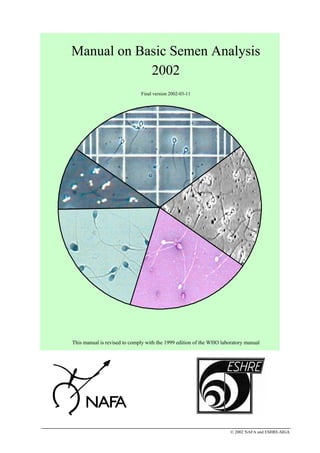
Manual on Basic Semen Analysis
            2002
                              Final version 2002-03-11


This manual is revised to comply with the 1999 edition of the WHO laboratory manual


                                                                       2002 NAFA and ESHRE-SIGA
© NAFA and ESHRE-SIGA 2002
Table of contents
Foreword
Semen analysis - overview...................................................................................... 1
                        Background and principles ........................................................................ 1
                        Safety in the andrology laboratory ............................................................ 1
                        The semen sample ..................................................................................... 1
                        Calibration ................................................................................................. 2
                        Procedure................................................................................................... 2
                        Equipment and materials ........................................................................... 6
Sperm concentration .............................................................................................. 7
                        Principles ................................................................................................... 7
                        Assessment of appropriate dilution ........................................................... 7
                        Procedure................................................................................................... 8
                        Calculations ............................................................................................... 9
                        Results ..................................................................................................... 10
                        Quality Control........................................................................................ 10
                        Reagents .................................................................................................. 10
                        Equipment and materials ......................................................................... 10
                        The confidence of sperm counts.............................................................. 11
Sperm motility....................................................................................................... 14
                        Principles ................................................................................................. 14
                        Procedure................................................................................................. 14
                        Sperm motility on video monitor............................................................. 14
                        Assessment of sperm motility.................................................................. 15
                        Calculations ............................................................................................. 15
                        Results ..................................................................................................... 15
                        Quality control......................................................................................... 16
                        Equipment ............................................................................................... 16
                        Video recording....................................................................................... 16
Sperm vitality ........................................................................................................ 18
                        Principles ................................................................................................. 18
                        Procedure................................................................................................. 18
                        Calculations and Results.......................................................................... 18
                        Reagents .................................................................................................. 18
                        Equipment and materials ......................................................................... 18
Sperm morphology ............................................................................................... 19
                        Principles ................................................................................................. 19
                        Background for assessment of sperm morphology.................................. 20
                        Preparation of smears .............................................................................. 21
                        Assessment of sperm morphology........................................................... 23
                        Immature germinal cells and mature spermatozoa .................................. 24
                        Quality control......................................................................................... 24
                        Calculations and Results.......................................................................... 24
                        Reagents .................................................................................................. 24
                        Equipment and materials ......................................................................... 25
Antisperm antibodies............................................................................................ 26
                        Principles ................................................................................................. 26
                        SpermMAR™ Tests ................................................................................ 27
                        Immunobead™ Test ................................................................................ 28
                        Reagents: ................................................................................................. 29
                        Quality control for SpermMAR™ and Immunobead™ Tests................. 29
                        Equipment and materials ......................................................................... 29
Quality Control and Quality Assurance............................................................. 30
                        Quality Control........................................................................................ 30
                        Quality Assurance ................................................................................... 31
Appendix I ............................................................................................................. 32
Appendix II............................................................................................................ 33


                                                                                                                            2002 NAFA and ESHRE-SIGA
Foreword
The Nordic Association for Andrology (NAFA)                and the NAFA andrology laboratory quality group
decided in Turku in August 1995 to form the NAFA           on semen analysis. Ulrik Kvist co-ordinated the
andrology laboratory quality group on semen                work and Lars Björndahl acted as secretary.
analysis. The mission of this group was to develop a
                                                           This NAFA-ESHRE manual is an application of the
detailed, technical manual with methods based on
                                                           guidelines of the WHO (WHO Laboratory Manual
the WHO recommendations (1992). The aim was
                                                           for the Examination of Human Semen and Semen-
that the manual should constitute a basis for external
                                                           Cervical Mucus Interaction, 4th edition, Cambridge
quality control and for scientific collaboration in this
                                                           University Press, Cambridge, ISBN 0-521-64599-9)
field.
                                                           to facilitate the establishment of common,
Members in the NAFA group were: Ulrik Kvist (co-           standardized methods and materials in andrology
ordinator), Aleksander Giwercman, Trine B Haugen,          laboratories in the European countries, this being a
Jyrki Suominen, and Lars Björndahl (secretary).            prerequisite for external quality control and
Other contributors were: Birute Zilaitiene, Margus         scientific collaboration. No single method is
Punab, Øystein Magnus, Åse Strutz, Trine                   completely ideal, and the group has discussed
Henrichsen, Turid Vollen, Ingmarie Sundgren, Inger         different possibilities to reach consensus on
Söderlund, Maiken Simonsen, Lene Andersen,                 methods, which are possible to use in a clinical
Majbrit Kvist, and Antero Horte.                           andrology laboratory and still are acceptable from a
                                                           methodological point of view (elimination of
This manual was first published in 1997. A second
                                                           sources of errors).
edition was published in 1998 and a third, re-edited
to comply with the 1999 edition of the WHO                 The methods in the manual also comply with the
recommendations, in 2000.                                  curriculum of the standardised training course in
                                                           Basic Semen Analysis developed and implemented
At the annual business meeting of ESHRE Special
                                                           by the ESHRE-SIGA. Such courses have for
Interest Group on Andrology (SIGA) in Bologna,
                                                           instance been given as the joint ESHRE-NAFA
July 2000, it was decided that efforts should be
                                                           courses in Stockholm (1995, 1996 and 2001), Århus
made to make a joint NAFA-ESHRE Manual on
                                                           (1997), Göteborg (1998), Oslo (1998), and Helsinki
Basic Semen Analysis. A working group with
                                                           (2001).
representatives of the ESHRE SIGA was formed,
consisting of Usha Punjabi, David Mortimer,
Christopher Barratt, and Lars Björndahl for ESHRE,
Addresses
NAFA – Nordic Association for Andrology, President Marita Räsänen
http://www.ki.se/org/nafa
ESHRE – European Society of Human Reproduction and Embryology
SIGA – Special Interest Group on Andrology; co-ordinator Herman Tournaye
http://www.eshre.com


 2002 NAFA and ESHRE-SIGA
Manual on Basic Semen Analysis (2002), Semen analysis – overview                                   chapter 1, page 1


Semen analysis - overview
Background and principles
From the results of semen analysis we can                          different probabilities of achieving pregnancy
never predict whether a specific man can be-                       within a certain time period.
come a biological father or not. There are no
                                                                   The aim of the basic semen analysis is to
specific properties one can measure in the
                                                                   evaluate descriptive parameters of ejaculates
whole population of spermatozoa that spe-
                                                                   obtained by masturbation. The qualities that
cifically reflect the fertilizing capacity of the
                                                                   are assessed are visual appearance, smell,
very small population spermatozoa, which is
                                                                   liquefaction, viscosity, volume, sperm concen-
able to reach the site of fertilization. However,
                                                                   tration and total number of spermatozoa, sperm
analysis of semen can give us information
                                                                   motility, and sperm vitality. Furthermore,
about problems in the genital organs of the
                                                                   differential count with respect to sperm mor-
male; semen analysis can thus be used to focus
                                                                   phology, assessment of sperm agglutina-
the continued infertility investigation. How-
                                                                   tion/aggregation, and assessment of presence
ever, the results of semen analysis have been
                                                                   of debris and other cell types in semen are also
used to categorize men into groups with
                                                                   performed.


Safety in the andrology laboratory
All staff should be aware that semen samples                       guidelines as pointed out in Appendix II of the
might contain harmful viruses and should                           WHO 1999 Manual should be strictly
therefore be handled with due care. Safety                         observed.


The semen sample
Analysis of an ejaculate, obtained with
masturbation, begins at the laboratory 30                          Instructions to the patients
minutes after ejaculation. Special rooms should                    An appropriate request form should accom-
be provided for sample collection. Before                          pany the sample containing relevant clinical
sample collection, the WHO manual recom-                           details. Before producing semen sample the
mends a maximum interval of abstinence be-                         patient should get verbal as well as written
tween 2 and 7 days, but recommends that the                        information about the purpose of the
interval should be “as constant as possible”.                      investigation and other important facts to avoid
Therefore, standardization of ”abstinence                          problems with the analyses. A short expla-
time” to 3-4 days is strongly advised1. Some                       nation of the male reproductive organs for
men have difficulties producing a semen                            laymen could be included in the written
sample at the laboratory. In these cases the                       material. The patient should be informed about
man may collect a first sample at home and de-                     the relevance of the abstinence time and the
liver it to the laboratory within one hour. In                     importance of collecting the complete
some cases it may be necessary for the man to                      ejaculate. If the sample cannot be produced in
use a special, non-spermicidal condom to                           the laboratory it should be transported
collect a sample at intercourse.                                   protected from cooling (close to body) and
                                                                   delivered to the laboratory preferably within 30
                                                                   minutes, but at least within one hour after
                                                                   ejaculation


1 The time of sexual abstinence, given in days, is very
imprecise. It is therefore advantageous if the time of
abstinence is given in hours. When results are to be used
in studies relating to abstinence time it is mandatory to
register it in hours.

 2002 NAFA laboratory quality group
page 2; chapter 1                                              Manual on Basic Semen Analysis (2002), Semen analysis - overview


Calibration
Calibration shall always be done after changes                    these measurements and their results should be
have been done to the equipment or any time                       kept in a special binder.
errors are suspected.                                             Balances for weighing semen and reagents
Automatic pipettes used for measurements                          should be calibrated at least every year by a
(sperm concentration, biochemistry) should be                     technologist or engineer certified by the
calibrated at least twice a year. Protocols for                   balance manufacturer. Results are stored in a
                                                                  special binder.

Procedure
Overview of procedure
In the table below, the steps in basic semen analysis are given in an appropriate order to allow
efficiency and quality in the laboratory work. Details for the individual steps are given in the text
below. For microbiological culture, a sterile sample container and sterile disposable pipettes must be
used. Some steps are not mandatory, either because of agreed limitations (*), or because steps are
optional (#) according to the WHO manual (i.e. each laboratory can chose whether to perform them or
not).


Time after
ejaculation         Task
0 - 5 minutes       Register, weigh1 and label sample container; label corresponding laboratory
                    documents2
                    Put sample on an orbital mixer in the incubator (+37°C)
20-25               Assess liquefaction, visual appearance and smell
minutes
30 minutes          Assess semen viscosity3.
                    Examine wet preparation for:
                    sperm motility and sperm aggregation/agglutination; other cells and debris
                    Perform antibody test
                    * Make smears for eosin-nigrosin stain if <40% motile spermatozoa and assess sperm
                    vitality
                    Make dilutions for determination of sperm concentration
                    Save 100 µL semen for assessment of inflammatory cells
                    Make smears to stain for morphological assessment
                    # Save and centrifuge semen for later biochemical analyses
Later               Count spermatozoa in the improved Neubauer chamber
                    * If >1 million round cells/mL in semen: assess inflammatory cells
                    # Perform biochemical analyses of secretory contribution from prostate (e.g. zinc),
                    seminal vesicles (e.g. fructose) and epididymis (e.g.α-glucosidase)
                    Stain smear for morphology assessment
                    Assess morphology (differential counting)


1 Semen volume can also be determined by a graded pipette with 0.1 mL accuracy; weighing is then not necessary
2 Labels should in general comprise two unique identifiers, e.g. name and a unique number
3 The pipette used for determination of semen volume could be used to assess semen viscosity when semen is allowed to
drop from the pipette

 2002 NAFA and ESHRE-SIGA
Manual on Basic Semen Analysis (2002), Semen analysis - overview                                             chapter 1, page 3


Details of procedure
                                                                   liquefaction is complete. If not (gel particles
Register, weigh and label sample container                         or mucous streaks), put the specimen back into
Initially, the sample should be registered.                        the incubator for some minutes (the
Sample container must be uniquely labelled1                        examination must, however, begin within 60
concomitantly with the requisition, sample                         minutes after ejaculation - see Treatment of
record form, and optional questionnaire. If the                    some viscous samples below). Deviations from
sample is produced at the laboratory, the                          normal findings are noted on the sample record
container should be weighed and marked                             form. If the smell of the sample differs
before sample collection. When samples are                         strongly from the majority of samples, this is
not collected at the laboratory, the weight of                     also written on the sample record form.
empty containers should be marked on the
container before distribution to remitting                         The viscosity of the sample is assessed by
physicians/clinics or directly to patients. When                   estimation of how fast the sample runs out of a
the sample is collected, the time for ejaculation                  pipette. Fill a pipette4 (e.g. a 5-mL pipette)
should be clearly marked on the container, as                      with semen and let the semen flow back into
well as written in the protocol. The net weight                    the container. If the droplets form ”threads”
of the sample (total weight of sample and                          that are more than 2 cm long, note ”increased
container minus container weight) should be                        viscosity” on the sample record form.
noted in the protocol as semen volume (unit                        Treatment of viscous samples
mL; 1 decimal).
                                                                   For samples with moderate to very high
Put sample on an orbital mixer in the                              viscosity a comment of the finding in the
                                                                   sample record form as free text is sufficient.
incubator (+37°C)
                                                                   High viscosity interferes with determination of
The sample should without delay be placed on                       sperm motility, concentration and antibody
a moving tray in an orbital mixer2 (+37°C).                        coating of spermatozoa. For samples where
The time of placement in the incubator should                      high viscosity hinders examination, addition of
be written on the sample record form. The                          a known volume of saline, phosphate buffer
sample should be left in the incubator until                       solution (PBS) or culture medium and careful
25-30 minutes after ejaculation, so that                           mixing with a wide bore pipette should give a
examination can begin at 30 minutes after                          homogenous dilution for examination. The
ejaculation. Take the container out of the                         original volume must be calculated and used to
incubator and check that the sample is well                        express the original sperm concentration in
mixed by ”swirling” the sample around the                          undiluted semen. If spermatozoa are to be used
bottom of the container for some 20 seconds. If                    for assisted fertilization, one must avoid
the sample was been produced outside the                           contamination of the sample and the medium
laboratory, it must be warmed up in the                            used for sperm preparation for assisted
incubator for 5-10 minutes before examination.                     fertilization should be used for dilution. N.B.
                                                                   When semen samples are diluted the motility
Assessment of liquefaction, visual                                 characteristics of the spermatozoa will be
appearance and semen viscosity                                     affected.
Inspect the visual appearance of the sample
with respect to colour (without remark or                          Wet preparation
reddish-brown)3; opalescent or clear, presence                     Examination of a wet preparation
of gel particles or mucous streaks. Check that
                                                                   Put 6 µL of well-mixed semen on a clean mic-
                                                                   roscope slide and put a cover glass on top
1 Labelling should, in general, comprise two unique
                                                                   (18 x 18 mm, #1½)5. This gives the preparation
identifiers, e.g. name and a number that is unique for the         a depth of about 20 µm. Examination of this
sample
2 It is important to check that the sample containers used
                                                                   wet preparation should begin as soon as the
allow a complete mixing of the samples with the orbital
                                                                   ”flow” in the preparation has ceased. If drifting
mixer used.                                                        does not cease within 60 seconds, the prepara-
3 A yellowish colour of the ejaculate usually depends on
an increased content of flavo proteins of seminal                  4 If volume is not measured by weight, the pipette used
vesicular origin, indicating long time of sexual
abstinence, or from B-vitamins. Also icterus may give a            for assessing the volume could be used
yellow colour. A reddish or brown discolouring mostly              5 If a 22 x 22 coverslip is used, the semen volume on the
depends on presence of erythrocytes (haemoglobin).                 microscope slide should be 10 µL.

                                                                                              2002 NAFA and ESHRE-SIGA
page 4; chapter 1                                  Manual on Basic Semen Analysis (2002), Semen analysis - overview


tion must be discarded and a new one pre-             in semen from normal men, while presence of
pared. Phase contrast optics are needed. If           large aggregates - often containing hundreds of
there is on average less than 1 spermatozoon          spermatozoa, is abnormal. When the presence
per field of vision (40X objective with wide          of sperm aggregates or agglutinates becomes
fields eyepieces), the sample should be treated       clearly increased this should be noted as a free
as suspected azoospermia. For details and mo-         comment in the report.
tility determination on video monitor, see
                                                      Other cells and debris
Chapter 3 in this manual
                                                      Other cells and debris that can be found in
Azoospermia or severe oligozoospermia
                                                      semen are assessed in several fields and
If there are no or only very few spermatozoa in       unusual findings are expressed as free
the wet preparation you should note *                 comments in the report with a few different,
(asterisk) in the sample record form and as a         standardized expressions:
free comment write how many motile and
                                                      •    No debris is a very unusual situation,
immotile spermatozoa that were observed in
                                                           some debris is typical, but moderate
the wet preparation. If no motile spermatozoa
                                                           contamination with debris is not nec-
or only a few spermatozoa were found in the
                                                           essarily abnormal. Larger amounts of
wet preparation the sample should be
                                                           debris are, however, abnormal. Be careful
centrifuged6, and the pellet examined under the
                                                           to differentiate between particulate debris
microscope (40 X objective, phase contrast
                                                           and motile bacteria!
optics). If motile or immotile spermatozoa can
be identified when the whole area of a                •    Red blood cells (erythrocytes) should not
coverslip (at least 400 fields in a 22 x 22 mm             be found in semen, although a few can be
coverslip) is scanned, the number of                       present without indicating pathology.
spermatozoa and whether they were motile or
immotile should be noted on the sample report         •    Epithelial cells (squamous, cubic and
form.                                                      transitional) are usual in semen in low
                                                           numbers. Increased presence is not related
Assessment of sperm motility                               to any specific functional impairment or
The first aspect of sperm function to assess in            presence of infection.
the wet preparation is sperm motility. This           •    "Round cells" are often seen in semen
assessment should begin immediately to avoid               and it is important that leukocytes are
temperature drop or dehydration of the                     differentiated from immature gametes or
preparation. For detailed methods, see                     large cell bodies (usually without nucleus)
Chapter 3 in this manual.                                  with cytoplasm exfoliated from the semini-
Sperm aggregation and sperm agglutination                  ferous epithelium of the testis. Also cells
                                                           of prostatic origin appear round in the
Sperm aggregation or agglutination is deter-               ejaculate. If there are more than 1 million
mined in 10 randomly chosen fields, away                   round cells/mL, counted in the Neubauer
from the coverslip edges. The average percen-              chamber (at the same time as sperm
tage (estimated to nearest 5%) of spermatozoa              concentration is determined), a special
trapped in clumps is estimated. Agglutination              method for detection of leukocytes should
means spermatozoa adhering without other                   be used to determine the presence of ”in-
cells and debris. Multivalent antisperm                    flammatory cells”.
antibodies cause sperm agglutination. If the
clumps are very large, it can be difficult to         •    Bacteria and protozoa are usually not
determine whether the binding patterns are                 present in semen, but if signs of micro-
specific (e.g. head-to-head or tail-to-tail). If           organisms are found, this must be noted in
cells, debris, and immotile spermatozoa are                the report.
included, the clumping is most probably
caused by aggregation. The agglutinates are           Smears for eosin-nigrosin stain
caused by sperm antibodies and often contain a        According to the WHO manual, if the pro-
certain proportion motile spermatozoa, while          portion of motile spermatozoa is less than
aggregates usually contain only dead sper-            50%, the proportion vital (living) spermatozoa
matozoa.     Small    aggregates    of     dead       should be determined. The reason for assessing
spermatozoa and other material are often found        the proportion living spermatozoa is to
                                                      differentiate between dead spermatozoa and
                                                      live, immotile spermatozoa. Clinically, this
6 At least at 1000 g for 15 minutes                   difference is only of interest when there are no

 2002 NAFA and ESHRE-SIGA
Manual on Basic Semen Analysis (2002), Semen analysis - overview                                           chapter 1, page 5


or very few motile spermatozoa. Therefore, a                       Make smears to stain for morphological
decision limit at less than 40% motile                             assessment
spermatozoa will not lead to any missed                            Two smears are made on clean microscope
diagnosis, but will decrease work load by                          slides from each semen sample for
reducing the number of vitality assessments of                     morphological evaluation. An aliquot (8-10-15
samples with living spermatozoa. For a
                                                                   µL - volume adjusted to the sperm
detailed method for assessment of sperm
                                                                   concentration to reduce overcrowding of the
vitality see Chapter 4 in this manual.
                                                                   spermatozoa) of well-mixed semen is placed
                                                                   on the slide and the droplet is spread with the
Antibody test
                                                                   edge of a cover slip7. The smears are left to air
The secretory part of IgA-type antibodies bind                     dry and then fixed immediately and stored for
to cervical mucus. Presence of spermatozoa                         later staining for assessment of sperm
bound IgA therefore results in a reduced ability                   morphology (see Chapter 5 in this manual).
to penetrate cervical mucus.                                       Smears from samples with suspected
Antibodies on sperm                                                azoospermia should be fixed in separate vials
                                                                   with fresh solutions to avoid the risk of
IgG and IgA on spermatozoa can be assessed                         contamination with spermatozoa from other
directly in semen with e.g. SpermMAR™ for                          smears.
IgG and IgA, and after washing with the
Immunobead™ test.                                                  Save and centrifuge semen for later
Antibodies in seminal plasma                                       biochemical analyses
In semen samples lacking spermatozoa the                           The remaining semen volume is centrifuged
presence of antisperm antibodies can be                            (3000 g, 15 min) and the supernatant (seminal
assessed indirectly by exposing donor                              plasma) put into a labelled test tube for later
spermatozoa, without antibodies, to seminal                        biochemical analyses. The test tube is sealed
plasma from a man with suspected presence of                       and put in sample number order in a separate
antibodies. The donor spermatozoa are then                         rack in the freezer (-20°C). Methods for
processed as in a direct sperm antibody assay.                     biochemical analyses are not included in this
                                                                   manual.
All methods are dependent on motile
spermatozoa. At least 200 motile spermatozoa                       Counting in an improved Neubauer
should be assessed.                                                haemocytometer
Results from SpermMAR™ and Immuno-                                 See Chapter 2 in this manual.
bead™ are not fully concordant. A positive
finding of IgA (i.e. more than 50% of motile                       Staining of smear for morphology
spermatozoa with beads attached) should be                         assessment
verified with a sperm-mucus interaction test.
                                                                   See Chapter 5 in this manual
Dilution for determination of sperm
concentration
It is essential for the accuracy of the sperm
concentration assessment that the semen
sample is gently, but thoroughly mixed before
an exact volume is withdrawn with a positive
displacement pipette. See Chapter 2 in this
manual for a detailed method for assessment of
sperm concentration.

Save 100 µL for assessment of
inflammatory cells
To evaluate if a high concentration of round
cells (>1 million round cells/mL) in semen is
due to inflammatory cells, a specific method                       7 An alternative method, using two opposed microscope
(cytological or immunocytochemical) for                            slides smearing the semen droplet in between them and
detection of leukocytes should be used.                            then pulling the slides apart, could also be used.
                                                                   Irrespective of which method is used the smears must be
                                                                   even and thin to allow good staining and easy
                                                                   examination.

                                                                                             2002 NAFA and ESHRE-SIGA
page 6; chapter 1                                                Manual on Basic Semen Analysis (2002), Semen analysis - overview


Equipment and materials
The equipment and materials listed here are for semen collection and examination of the wet
preparation in general. In the following chapters, equipment and materials for the specific methods
described are listed separately.
Sample collection container (e.g. Sarstedt: 100 mL; # 75.563; Lid: #76.564)
Special condom for semen collection (Milex products Inc., Chicago, Illinois 60631, USA; Male Factor Pack®,
Hygiene®, FertiPro N.V., Belgium)
Phase contrast microscope (40X phase objectives)
Microscope slides (standard size); Coverslips (18 x 18 mm, # 1½ [thickness]; 22 x 22 mm; # 1½)
Pipettes for making
       wet preparation: air displacement (positive displacement not needed): 6 µL
       morphology smears: air displacement (positive displacement not needed): 8-15 µL
       vitality smears: air displacement (positive displacement not needed): 15-50 µL
Pipette tips: plastic, for air displacement pipettes, volume 5-50 µL
Centrifuge (1000-3000 g)1
Laboratory balance, top loading 150 or 300 g capacity; resolution 0,01 g)
Test tubes for determination of inflammatory cells, e.g. styrene tubes 55 mm long, 11 mm OD
Test tubes with lid for freezing (biochemistry), e.g. styrene tubes 55 mm long, 11 mm OD
Incubator or heated chamber (+37°C)
Plastic gloves for laboratory use


1 The relative centrifugal force [RCF] (g) is calculated from the formula g=1118 • 10-8 • R •·N2 where R = distance in cm
from centre of rotor to the point where the RCF is required (ie. in the bottom of the tube); N = revolutions per minute

 2002 NAFA and ESHRE-SIGA
Manual on Basic Semen Analysis (2002), Sperm concentration                                         chapter 2, page 7


Sperm concentration
Principles
To count diluted and immobilized spermatozoa                 exact volume. Ordinary pipettes, which
is easy using the microscope. The problem is                 displace a volume of air, are calibrated to take
to ensure that these spermatozoa are repre-                  an exact volume of water. Since the viscosity
sentative and that the aliquot examined is                   of semen is higher than water and varies from
adequate and representative. This means that                 one sample to another air displacement pipettes
the spermatozoa should not be allowed to                     will take different volumes samples from
disappear by sedimentation, aggregation or by                different semen specimens.
adhesion to the walls of the sample container,
                                                             In addition, to achieve a correct volume in the
pipette tips or test tubes, and that there are no
                                                             counting chamber, the coverslip must be
dilution errors. Thorough mixing is essential
                                                             mounted properly (tight), and the chambers
both before the semen is sampled for dilution,
                                                             must be correctly filled.
and before an aliquot is taken from the sperm
dilution to fill the counting chamber.                       The sperm concentration (106/mL semen) is
                                                             calculated by dividing the number of spermato-
Furthermore, the dilution must be exact.
                                                             zoa counted in the counting chambers, with a
Positive displacement pipettes are mandatory
                                                             factor depending on the dilution and the num-
to minimize the error when sampling a fixed
                                                             ber of squares counted. The total sperm num-
volume from the well-mixed semen for
                                                             ber (106/ejaculate) is the product of ejaculate
dilution. The reason for using a positive
                                                             volume and sperm concentration.
displacement pipette is that this pipette takes
an


Assessment of appropriate dilution
 The wet preparation is used to estimate the
concentration and select the most appropriate                 Table 1: Dilution of the ejaculate
dilution. With the recommended method for                       Spermatozoa
                                                                                               Semen        Diluent
making the wet preparation (6 µL semen,                       per field of vision   Dilution
                                                                                                 µL           µL
cover slip 18 x 18 mm, “thickness” # 1½), the                   40X objective
depth of the sample volume, surveyed in one                                          1+1
field of vision, is about 20 µm. Provided the                     Swim up                       100           100
                                                                                     (1:2)
diameter of the field of vision is 500 µm1, the                                      1+4
given numbers of spermatozoa per field of                            < 15                       100           400
                                                                                     (1:5)
vision can be used to chose the appropriate
                                                                                     1+9
dilution of the sample as given in Table 1 (4                       15-40                       50            450
                                                                                    (1:10)
spermatozoa per field approximately corre-
spond to the concentration of 1 million                                             1 + 19
                                                                   40-200                       50            950
sperm/mL). In older microscopes, the field                                          (1:20)
diameter may be substantially smaller and then                                      1+ 49
                                                                    > 200                       50            2450
fewer spermatozoa are seen per field of vision                                      (1:50)
(e.g. if the diameter is 250 µm, 1 spermato-
zoon per field of vision corresponds to 1                    should be multiplied by four before going to
million sperm/mL, and the ”spermatozoa per                   Table 1).
field of vision” observed in the microscope
                                                             Thus, standard dilutions are 1 + 19 and 1 + 9;
                                                             for swim up preparations with < 10 mil-
                                                             lions/mL a dilution 1+ 1 could be used. When
1 The correct area of the microscopic field can be           azoospermia is suspected, a pellet (after cen-
assessed with a stage micrometer, i.e. a microscope slide    trifugation) is examined with regard to the
with a graded scale, usually with indications of 0.1 mm      presence of motile and immotile spermatozoa
and 0.01 mm. Measure the diameter of the field and
                                                             in the pellet (see ”Azoospermia...” on page 4).
calculate the field area with the formula Area = π · r2
where r = diameter / 2.


                                                                                     2002 NAFA and ESHRE-SIGA
page 8; chapter 2                                                    Manual on Basic Semen Analysis (2002), Sperm concentration


Dilutions can be kept for a maximum of four                        that can occur upon prolonged storage are
weeks in tested vials at +4°C, but should pref-                    sperm clumping and sperm adhesion to the test
erably be assessed the same day. The problems                      tube walls.

Procedure
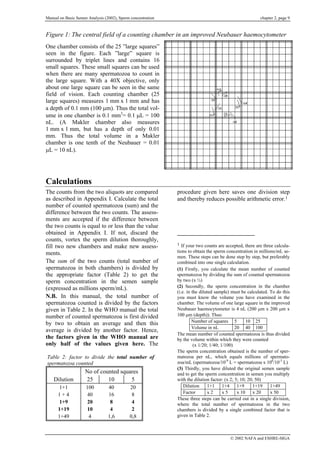
(1)     For every semen sample one dilution is prepared according to Table 1. The exact
        volume of liquefied semen is withdrawn from the well-mixed semen sample with a
        positive displacement pipette and added to the diluent in a test tube with a tight lid.
(2)     Mount the coverslip1 on the counting chamber (improved Neubauer haemocytometer).
        Interference patterns (>10 Newton’s rings/fringes or iridescence lines) should be seen
        between the glass surfaces of both areas where the cover glass attaches to the Neubauer
        slide. If too few lines are visible, then the distance between the cover glass and the
        Neubauer slide is increased, and thereby the volume of the chamber is too large and the
        result of the assessment will be incorrect.
(3)     The tubes containing the diluted sample should be mixed for at least 10 seconds (on a
        vortex mixer) immediately before filling the counting chamber. After mixing, an aliquot
        of about 6-10 µL2 is taken with a pipette to one side of an improved Neubauer
        haemocytometer. Then a second aliquot is taken to the other side. Each chamber should
        be completely filled. If a chamber is overfilled, it must be discarded and a new chamber
        filled. Removal of superfluous volume from the chamber must not be done, since this
        can change the sperm concentration in the chamber. The counts from these two aliquots
        are then compared.
(4)     Let the chamber rest for 10-15 minutes in a humid box to allow the spermatozoa to
        sediment to the grid of the counting chamber.
(5)     Count the spermatozoa with a 20-40 X-objective3 (phase contrast) according to the
        following criteria: One ”large square” in an improved Neubauer chamber is limited on
        all sides by triple lines (see also Figure 1: the visual appearance of the central grid of an
        improved Neubauer haemocytometer). To define each large square, you should always
        use the uppermost lines and the leftmost lines as limits.
        a)     Determine the number of squares that should be counted. First count the number
               of spermatozoa in the upper, left corner square.
                   < 10 sperm            count all the grid (25 squares in each chamber)
                   10-40 sperm           count 10 squares in each chamber
                   > 40 sperm            count 5 squares in each chamber (e.g. 4 corners and
               centre).
               The purpose is that typically 200 spermatozoa should be counted in each chamber
               and that this number is sufficient for a comparison between the two counts.
        b)     If a free sperm head can be recognized with certainty, it is recommended that it
               should be included in the sperm count assessment. “Pin heads” should be counted
               separately and commented in the report form. Immature germ cells should not be
               counted (these will be assessed in differential morphology count), but round cells
               and inflammatory cells should be counted separately in the counting chamber.
        c)     ”Borderline cases": only spermatozoa whose head is located on the upper or left
               limiting lines (marked “OK” in Fig. 1) should be counted as ”belonging” to that
               square. Thus, do not count spermatozoa located on the lower or right limiting
               lines (marked “out” in Fig. 1).


1 This must be the special, thick coverslip for haemocytometers to achieve correct depth in the chamber.
2 the exact volume depends on what volume is needed to fill the area under the coverslip properly.
3 Note that a 40x objective with long working distance is necessary when using a Neubauer chamber.


 2002 NAFA and ESHRE-SIGA
Manual on Basic Semen Analysis (2002), Sperm concentration                                              chapter 2, page 9


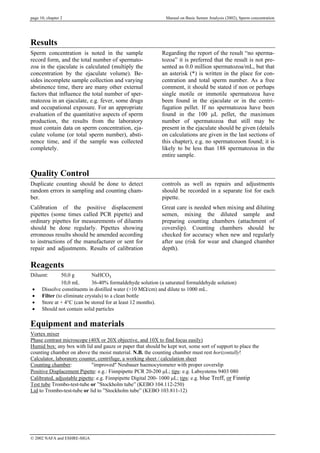
Figure 1: The central field of a counting chamber in an improved Neubauer haemocytometer
One chamber consists of the 25 ”large squares”
seen in the figure. Each ”large” square is
surrounded by triplet lines and contains 16
small squares. These small squares can be used
when there are many spermatozoa to count in
the large square. With a 40X objective, only
about one large square can be seen in the same
field of vision. Each counting chamber (25
large squares) measures 1 mm x 1 mm and has
a depth of 0.1 mm (100 µm). Thus the total vol-
ume in one chamber is 0.1 mm3= 0.1 µL = 100
nL. (A Makler chamber also measures
1 mm x 1 mm, but has a depth of only 0.01
mm. Thus the total volume in a Makler
chamber is one tenth of the Neubauer = 0.01
µL = 10 nL).


Calculations
The counts from the two aliquots are compared                procedure given here saves one division step
as described in Appendix I. Calculate the total              and thereby reduces possible arithmetic error.1
number of counted spermatozoa (sum) and the
difference between the two counts. The assess-
ments are accepted if the difference between
the two counts is equal to or less than the value
obtained in Appendix I. If not, discard the
counts, vortex the sperm dilution thoroughly,
                                                             1 If your two counts are accepted, there are three calcula-
fill two new chambers and make new assess-
ments.                                                       tions to obtain the sperm concentration in millions/mL se-
                                                             men. These steps can be done step by step, but preferably
The sum of the two counts (total number of                   combined into one single calculation.
spermatozoa in both chambers) is divided by                  (1) Firstly, you calculate the mean number of counted
the appropriate factor (Table 2) to get the                  spermatozoa by dividing the sum of counted spermatozoa
sperm concentration in the semen sample                      by two (x ½)
(expressed as millions sperm/mL).                            (2) Secondly, the sperm concentration in the chamber
                                                             (i.e. in the diluted sample) must be calculated. To do this
N.B. In this manual, the total number of                     you must know the volume you have examined in the
spermatozoa counted is divided by the factors                chamber. The volume of one large square in the improved
given in Table 2. In the WHO manual the total                Neubauer haemocytometer is 4 nL (200 µm x 200 µm x
number of counted spermatozoa is first divided               100 µm (depth)). Thus:
                                                                      Number of squares 5          10 25
by two to obtain an average and then this
                                                                      Volume in nL           20 40 100
average is divided by another factor. Hence,
                                                             The mean number of counted spermatozoa is thus divided
the factors given in the WHO manual are                      by the volume within which they were counted
only half of the values given here. The                                (x 1/20; 1/40; 1/100)
                                                             The sperm concentration obtained is the number of sper-
Table 2: factor to divide the total number of                matozoa per nL, which equals millions of spermato-
spermatozoa counted                                          zoa/mL (spermatozoa/10-9 L = spermatozoa x 106/10-3 L)
                                                             (3) Thirdly, you have diluted the original semen sample
                     No of counted squares                   and to get the sperm concentration in semen you multiply
    Dilution         25       10       5                     with the dilution factor: (x 2; 5; 10; 20; 50)
       1+1           100         40         20                   Dilution      1+1 1+4        1+9     1+19    1+49
                                                                 Factor       x2       x5     x 10    x 20    x 50
      1+4            40          16          8
                                                             These three steps can be carried out in a single division,
      1+9            20           8          4               where the total number of spermatozoa in the two
      1+19           10           4          2               chambers is divided by a single combined factor that is
      1+49            4          1,6        0,8              given in Table 2.


                                                                                         2002 NAFA and ESHRE-SIGA
page 10; chapter 2                                            Manual on Basic Semen Analysis (2002), Sperm concentration


Results
Sperm concentration is noted in the sample                  Regarding the report of the result “no sperma-
record form, and the total number of spermato-              tozoa” it is preferred that the result is not pre-
zoa in the ejaculate is calculated (multiply the            sented as 0.0 million spermatozoa/mL, but that
concentration by the ejaculate volume). Be-                 an asterisk (*) is written in the place for con-
sides incomplete sample collection and varying              centration and total sperm number. As a free
abstinence time, there are many other external              comment, it should be stated if non or perhaps
factors that influence the total number of sper-            single motile or immotile spermatozoa have
matozoa in an ejaculate, e.g. fever, some drugs             been found in the ejaculate or in the centri-
and occupational exposure. For an appropriate               fugation pellet. If no spermatozoa have been
evaluation of the quantitative aspects of sperm             found in the 100 µL pellet, the maximum
production, the results from the laboratory                 number of spermatozoa that still may be
must contain data on sperm concentration, eja-              present in the ejaculate should be given (details
culate volume (or total sperm number), absti-               on calculations are given in the last sections of
nence time, and if the sample was collected                 this chapter), e.g. no spermatozoon found; it is
completely.                                                 likely to be less than 188 spermatozoa in the
                                                            entire sample.


Quality Control
Duplicate counting should be done to detect                 controls as well as repairs and adjustments
random errors in sampling and counting cham-                should be recorded in a separate list for each
ber.                                                        pipette.
Calibration of the positive displacement                    Great care is needed when mixing and diluting
pipettes (some times called PCR pipette) and                semen, mixing the diluted sample and
ordinary pipettes for measurements of diluents              preparing counting chambers (attachment of
should be done regularly. Pipettes showing                  coverslip). Counting chambers should be
erroneous results should be amended according               checked for accuracy when new and regularly
to instructions of the manufacturer or sent for             after use (risk for wear and changed chamber
repair and adjustments. Results of calibration              depth).

Reagents
Diluent:        50,0 g        NaHCO3
                10,0 mL       36-40% formaldehyde solution (a saturated formaldehyde solution)
 •    Dissolve constituents in distilled water (>10 MΩ/cm) and dilute to 1000 mL.
 •    Filter (to eliminate crystals) to a clean bottle
 •    Store at + 4°C (can be stored for at least 12 months).
 •    Should not contain solid particles

Equipment and materials
Vortex mixer
Phase contrast microscope (40X or 20X objective, and 10X to find focus easily)
Humid box: any box with lid and gauze or paper that should be kept wet, some sort of support to place the
counting chamber on above the moist material. N.B. the counting chamber must rest horizontally!
Calculator, laboratory counter, centrifuge, a working sheet / calculation sheet
Counting chamber:            "improved" Neubauer haemocytometer with proper coverslip
Positive Displacement Pipette: e.g.: Finnpipette PCR 20-200 µL; tips: e.g. Labsystems 9403 080
Calibrated, adjustable pipette: e.g. Finnpipette Digital 200- 1000 µL; tips: e.g. blue Treff, or Finntip
Test tube Trombo-test-tube or ”Stockholm tube” (KEBO 104.112-250)
Lid to Trombo-test-tube or lid to ”Stockholm tube” (KEBO 103.811-12)


 2002 NAFA and ESHRE-SIGA
Manual on Basic Semen Analysis (2002), Sperm concentration                                          chapter 2, page 11


The confidence of sperm counts
What does it mean when no
spermatozoon is found?
                                                             Table 3: The risk to find no spermatozoon at various
If, theoretically, an entire semen sample is                 sperm concentrations assessed in 100 nL- and 10 nL-
examined and no spermatozoon is found, then                  chambers and in a wet preparation (approximately 40
the result is 0 spermatozoa. However, in a wet               nL). The risk to find no spermatozoa is less than 5% at
preparation or in a counting chamber only a                  sperm concentrations ≥ 300 000/mL for the 10 nL-
small part of the whole sample is examined.                  chambers, ≥ 75 000/mL for the wet preparation and
Therefore, the finding “no spermatozoa”                      ≥ 30 000 for the 100 nL-chambers.
means that the sample with a certain proba-                   True sperm 1 Makler Wet prepa- Neubauer
bility contains less than a certain concentration                conc.    No dilution ration     (2 chambers)
of spermatozoa. The precision of an assess-                   (sp-zoa/mL) (10 nL of (10 fields ≈ 1+1 dilution
ment depends on the true sperm concentration                                sample    40 nL)       (100 nL of
and how large a proportion of the original                                 analyzed)                 sample
                                                                                                    analyzed)
sample that was examined under the micro-                                      Risk to find no spermatozoon
scope. The larger proportion, the higher the
                                                                  1 000        0.99        0.96        0.90
precision will be. An example: if a semen
                                                                 10 000        0.90        0.67        0.37
sample is diluted 1+1 and assessed in an im-
proved Neubauer haemocytometer (two cham-                        30 000        0.74        0.30       < 0.05
bers) you have examined 100 nL of the origi-                     70 000        0.50        0.06
nal sample. If the same sample is examined                       75 000        0.47       < 0.05
undiluted in a Makler chamber you have exa-                     100 000        0.37
mined 10 nL. In the wet preparation you may                     200 000        0.14
examine some 10 fields, which corresponds to                    300 000       < 0.05
a volume of 40 nL. Table 3 shows the risk to
find no spermatozoon at various true sperm
concentrations. The risk to find no sperm is                  Table 4: There is always a risk to find no sperma-
                                                              tozoon even when a sample does contain
less than 5% only at sperm concentrations ≥                   spermatozoa. In this table the critical sperm
300 000/mL for 10 nL-chambers, ≥ 75 000/mL                    numbers are given for when the risk to find no
for wet preparations (40 nL), and ≥ 30 000/mL                 spermatozoon goes under the limit of 5%, in
for 100 nL-chambers.                                          relation to the number of fields examined. Thus,
                                                              the risk to find no spermatozoon is less than 5%
These numbers also mean that when no sper-                    when the sample contains 188 spermatozoa and
matozoa have been found there is a risk of 5%                 400 fields have been examined. If the sample
to ignore a sperm concentration of 290 000/mL                 contains fewer spermatozoa, e.g. 100, the risk to
and 50% to ignore 70 000/mL when examined                     find none is greater than 5% (20%). Field
in the smaller, 10 nL-chambers. This empha-                   diameter 500 µm, preparation depth 20 µm.
sizes the need to investigate a centrifuged
                                                                                         No of fields assessed:
sperm pellet when no spermatozoa have been
found in the wet preparation.                                                              4        40     400
                                                                 Critical number of
                                                                                        18 750    1 875    188
Confidence in assessment of a                                      spermatozoa

10 µL droplet from a centrifuged
sperm pellet                                                   and down 10 times means that some 400 such
                                                               fields are screened. When 400 fields have been
Under the 40X objective one microscopic field                  scanned a total volume of about 1600 nL (4 x
corresponds to 4 nL1. Each time the coverslip                  400) have been assessed, i.e. about 1/62 of the
is scanned during screening in the microscope                  total pellet volume of 100 µL (100 000 nL). If
some 40 fields will be “passed”. Scanning up                   there are more than 188 spermatozoa in the
                                                               centrifuge pellet, the risk to find no
1 If the aperture has a diameter of 500 µm you view an
                                                               spermatozoon is less than 5%. However, with
                                                               lower concentration the probability to find no
area of 196 427 µm2 and with a 10 µL droplet under a
22x22 coverslip the depth is 20.7 µm giving a viewed           spermatozoon is higher than 5%. Therefore,
volume of 4 058 442 µm3 ≈ 4 nL                                 with no spermatozoon found, after examining a


                                                                                        2002 NAFA and ESHRE-SIGA
page 12; chapter 2                                  Manual on Basic Semen Analysis (2002), Sperm concentration


total volume of 1600nL, you can answer that        all spermatozoa in both sides of an improved
the 100 µL-pellet, and thus the sample,            Neubauer haemocytometer gives accurate
contains less than 188 spermatozoa (Table 4).      results from 4 mill/mL and above. In contrast,
                                                   counting all spermatozoa in a 10 nL-chamber
Counting spermatozoa selected for                  gives accurate results within ± 10%, only when
                                                   the sperm concentration is 40 mill/mL and
assisted fertilization                             above. To obtain a result within ± 10% for
Spermatozoa selected by gradient centrifuga-       samples in the concentration range of 4
tion or swim-up are to be assessed after 1+1       mill/mL you need to assess 10 of the 10 nL-
dilution (to immobilise the spermatozoa) in the    chambers.
improved Neubauer haemocytometer. Both
chambers are counted.                              Table 5 gives the 95% confidence interval for
                                                   the sperm concentrations obtained after count-
Spermatozoa selected by swim up or gradient        ing all spermatozoa in one Neubauer haemo-
centrifugation are used for ART and for            cytometer and one 10 nL-chamber. When the
various experimental studies. Whenever the         variation exceeds ±10%, awareness of the
results are to be related to, or evaluated as, a   uncertainty should be given as the range in the
function of sperm number (e.g. in publica-         report form. For instance, 2 mill/mL obtained
tions), Good Laboratory Praxis (GLP) calls for     from an assessment in an improved Neubauer
a certainty of ± 10%, in the sperm concen-         chamber is reported as 2 mill/mL (1.7-2.3) or
tration assessment. A concentration of 4.0         ±14%. If GLP, i.e. a uncertainty < ±10%, is
mill/mL should then mean 4.0 mill/mL ± 10%,        desired assessment of two Neubauer chambers
i.e. 3.6 to 4.4 mill/mL with 95% confidence.       is necessary. If the same result is obtained after
This certainty is easy to reach - it is simply a   assessment in one 10 nL-chamber, the result
question of counting at least 400 spermatozoa.     should be expressed as 2 mill/mL (1.1-2.9) or
One improved Neubauer haemocytometer               ±44%. To achieve the result 2 mill/mL ±10%
(both chambers) takes 2 x 100 nL of a sperm        with the 10 nL-chamber, 20 assessments are
suspension diluted 1+1 (to immobilize the          needed. If your IVF protocol aims at adding
spermatozoa). The Makler chamber takes 10          e.g. 50 000 spermatozoa to every oocyte and
nL of undiluted sample. Thus, in the Neubauer      an assessment in one 10 nL-chamber gives the
haemocytometer there are ten times more            result 1 mill/mL (0.4-1.6), ±62%, you have
spermatozoa to count than in the 10 nL-            actually 20 000-80 000 spermatozoa in a 50 µL
chamber. This is of special importance for the     droplet. Only in 24% of the outcomes you add
low sperm concentrations obtained after sperm      50 000 ±10%, i.e. 45 000-55 000 spermatozoa.
selection. With the recommended routine            In most cases (76%), you add either more than
assessment of sperm concentration, counting        55 000 or less than 45 000 spermatozoa.


 2002 NAFA and ESHRE-SIGA
Manual on Basic Semen Analysis (2002), Sperm concentration                                       chapter 2, page 13


Table 5: Expression of results for sperm concentration with 95% confidence interval due to number of assessed
spermatozoa in a 10 nL-chamber (e.g. a Makler chamber) and in an improved Neubauer haemocytometer (two
chambers)
                One 10 nL-chamber                            One Neubauer haemocytometer
               Undiluted sperm suspension                         Two chambers,
                                                   sample diluted 1+1 to immobilize spermatozoa
     Number of Sperm          95% of all      Number of Sperm 95% of all assessments lie in the
      counted    conc. assessments lie in the  counted      conc.           interval (Mill/mL)
    spermatozoa           interval (Mill/mL) spermatozoa
                Mill/mL Low High ± %                      Mill/mL Low High                 ±%
         1        0.1   0.0     0.3      148      10         0.1     0.0    0.2             62
         2        0.2   0.0     0.5      119      20         0.2     0.1    0.3             44
         3        0.3   0.0     0.6      107      30         0.3     0.2    0.4             36
         4        0.4   0.0     0.8       98      40         0.4     0.3    0.5             31
         5        0.5   0.1     0.9       88      50         0.5     0.4    0.6             28
         6        0.6   0.1     1.1       80      60         0.6     0.4    0.8             25
         7        0.7   0.2     1.2       74      70         0.7     0.5    0.9             23
         8        0.8   0.2     1.4       69      80         0.8     0.6    1.0             22
         9        0.9   0.3     1.5       65      90         0.9     0.7    1.1             21
        10        1.0   0.4     1.6      62      100         1.0     0.8    1.2             20
        11        1.1   0.4     1.8      59      110         1.1     0.9    1.3             19
        12        1.2   0.5     1.9      57      120         1.2     1.0    1.4             18
        13        1.3   0.6     2.0      54      130         1.3     1.1    1.5             17
        14        1.4   0.7     2.1      52      140         1.4     1.2    1.6             17
        15        1.5   0.7     2.3      51      150         1.5     1.3    1.7             16
        16        1.6   0.8     2.4      49      160         1.6     1.4    1.8             16
        17        1.7   0.9     2.5      48      170         1.7     1.4    2.0             15
        18        1.8   1.0     2.6      46      180         1.8     1.5    2.1             15
        19        1.9   1.0     2.8      45      190         1.9     1.6    2.2             14
        20        2.0   1.1     2.9      44      200         2.0     1.7    2.3             14
        25        2.5   1.5     3.5      39      250         2.5     2.2    2.8             12
        30        3.0   1.9     4.1      36      300         3.0     2.7    3.3             11
        35        3.5   2.3     4.7      33      350         3.5     3.1    3.9             11
        40        4.0   2.8     5.2      31      400         4.0     3.6    4.4             10
        45        4.5   3.2     5.8      29     > 400                                      < 10
        50        5.0   3.6     6.4      28
        55        5.5   4.0     7.0      26
        60        6.0   4.5     7.5      25
        65        6.5   4.9     8.1      24
        70        7.0   5.4     8.6      23
        75        7.5   5.8     9.2      23
        80        8.0   6.2     9.8      22
        85        8.5   6.7 10.3          21
        90        9.0   7.1 10.9          21
        95        9.5   7.6 11.4          20
        100      10.0    8.0 12.0         20
        150      15.0   12.6 17.4         16
        200      20.0   17.2 22.8         14
        250      25.0   21.9 28.1         12
        300      30.0   26.6 33.4         11
        350      35.0   31.3 38.7         11
        400      40.0   36.1 43.9        10
       >400                              <10


                                                                               2002 NAFA laboratory quality group
page 14; chapter 3                                       Manual on Basic Semen Analysis (2002), Sperm motility


Sperm motility
Principles
Ideally, all assessments are made on a video        a temperature decrease or dehydration of the
monitor (see below) in order to minimize dif-       preparation.
ferences in assessing videotaped samples for
                                                    Sperm motility is determined by counting all
QC purposes, and daily routine assessments of
                                                    motile and immotile spermatozoa in several
“live” samples. If video equipment is not
                                                    randomly chosen fields (but not fields close to
available assessments are made by eye via the
                                                    coverslip edges) using a 40X objective. If more
oculars and using a 40X phase contrast
                                                    than 25% of spermatozoa are involved in
objective.
                                                    clumping motility assessment is only done on
Assessment of sperm motility should begin           free spermatozoa, and a comment is given on
immediately to avoid artefacts caused by either     this in the report form. Spermatozoa with pin-
                                                    heads, “free tails”, should not be counted.

Procedure
                                                    field is very high, a smaller part of the field
Wet preparation                                     should be used; a graticule or reticle in the
Put 6 µL well mixed undiluted semen (+37°C)         ocular is of great help.
on a clean microscope slide (+37°C) and put         When all progressive spermatozoa have been
on a coverslip (18 x 18 mm, “thickness” #1½).       counted, non-progressive spermatozoa (WHO
This gives a preparation depth of about 20 µm.      class c) and immotile spermatozoa (WHO class
Examination of this "wet preparation" should        d) are counted in the same field.
begin as soon as the “flow” has ceased. If the
flow has not stopped within 60 seconds a new        The four categories are expressed as
aliquot should be prepared and examined.            percentages (rapid, slow and non-progressive,
                                                    and immotile.
If coverslips of the size 22 x 22 are used, the
volume must be 10 µL to give a depth of about       Duplicated counting is important to detect and
20µm.                                               minimise random errors due to variations due
                                                    to variation when withdrawing aliquots from
Counting                                            the semen sample, and when making and as-
                                                    sessing the wet preparations. Assessment of
At least 200 spermatozoa are classified in          sperm motility should therefore be repeated on
duplicate, i.e. at least 400 spermatozoa in total   a second aliquot prepared in the same way.
(for criteria and a detailed method for as-         The averages for two counts are calculated and
sessment of sperm motility: see below,              given as results. If the difference between the
Assessment of sperm motility). At least five        two motility counts is too large, you have de-
fields should be assessed in each count.            tected a random error and two new as-
Within each field, all rapidly progressive          sessments should be done (see below for
spermatozoa (WHO class a) and slowly                details on method and comparisons of du-
progressive spermatozoa (WHO class b) are           plicate counts).
counted first - and care should be taken to
count only, and all, cells which are present in
the field at the same time. N.B. If the number
of progressively motile spermatozoa in the

Sperm motility on video monitor
On the monitor screen, either a black mask          in the specimen can be attached to facilitate
with a circular opening or an acetate transpar-     estimation of velocity.
ency with a circular field drawn upon it should
                                                    Use the 10X-phase contrast objective and
be mounted. In the circular field so defined, a
                                                    corresponding condenser phase ring. Check in
grid with squares corresponding to 25 x 25 µm
                                                    the oculars that the sample is focused correctly.


 2002 NAFA and ESHRE-SIGA
Manual on Basic Semen Analysis (2002), Sperm motility                                                   chapter 3, page 15


Adjust the focus while examining the picture                         on the screen.


Assessment of sperm motility
Sperm motility is assessed by categorisation into four groups of motility at 37°C:
        WHO category                  ”code”            corresponding velocity
        rapid progressive                a              ≥25 µm/s (≥ 1 monitor square, or a 5 sperm head lengths)
        slow progressive                b               5-24 µm/s
        non progressive                  c              <5 µm/s (< 1 sperm head length)
        immotile                        d               -
(1)     Chose randomly a field of vision (if                                 same field.
        the sperm concentration is very high,                        (2)     Count at least five different fields. At
        only count those spermatozoa in a                                    least 200 spermatozoa should be
        smaller field, e.g. in the most central                              counted in each preparation.
        four squares). First, count all rapid                        (3)     Repeat the assessment of the motility
        and slow progressive spermatozoa.                                    of at least 200 spermatozoa in a new,
        Thereafter, count non-progressive                                    separate preparation from the same
        and immotile spermatozoa in the                                      semen sample.

Calculations
For each of the two preparations, the total                                the difference in proportion between the
number of spermatozoa in each motility group                               two assessments in this group.
is divided with the total of number of
                                                                     • The assessments are accepted if the diffe-
spermatozoa assessed to obtain percentages for
                                                                       rence between the two motility percentages
the four groups (a-d).
                                                                       is equal or below the value obtained in
To check that the difference between the two                           Appendix II. If not, discard the assessments
counts is within an acceptable range, the                              and make two new wet preparations and re-
following calculations are done:                                       count.
• Calculate the percentage of spermatozoa in                         When two accepted counts have been
  each motility group (a-d).                                         achieved, the average proportions (a-d) are
                                                                     rounded to integers (no decimals). 0.5% is
• Calculate the average in each group for the
                                                                     rounded to the nearest even number. Finally,
  two assessments.
                                                                     the sum of percentages (a-d) should add up to
• Then, select the group of motile sperma-                           100%. If necessary the group with the highest
  tozoa with the highest average proportion                          proportion is adjusted (decreased or increased)
  (i.e. one of group a, b, c, or d) and calculate                    to obtain a sum of 100%.

Results
Percentages for the four categories of sperm                         gressive spermatozoa (a+b) are written on the
motility, percentage motile spermatozoa                              sample report form.
(a+b+c), and (optionally) percentage pro-


                                                                                             2002 NAFA and ESHRE-SIGA
page 16; chapter 3                                         Manual on Basic Semen Analysis (2002), Sperm motility


Quality control
Duplicate counting is used to decrease the risk      Some aspects of Internal Quality Control can
of random errors.                                    be covered by repeated examination of video-
                                                     tapes with known values by all technologists in
In semen samples recorded on videotapes the
                                                     each laboratory.
velocity of individual spermatozoa can be
measured ”frame by frame” to classify                One technologist at each laboratory, assessing
spermatozoa into the different groups (a-d)          videotapes sent out to participating labora-
more objectively.                                    tories, is the basis for External Quality Control.


Equipment
• Phase contrast microscope (10X objective)          • A total magnification on the monitor: 100
  with +37°C microscope stage. Triocular               µm = 75-88 mm (further magnification is
  tube (oculars and photo tube with additional         usually needed ”above” the 10X magnifi-
  10X magnification).                                  cation in the objective; typically about
                                                       another 10X in the photo tube). Check the
• Black & white (or colour) video camera,
                                                       overall on-screen magnification with a
  e.g. Panasonic: (1/2 inch; WV-BL200);
                                                       micrometer scale.
  connect to text generator.
                                                     • Micrometer scale mounted on a microscope
• Monitor 13 cm (black & white; e.g. Pana-
                                                       slide (for calibration).
  sonic WV5340 or WV5370 [Size normal]).
  A black mask with a circular opening (∅            • Microscope slides; cover glass 18 x 18 mm,
  about 13 cm)                                         #1½
  CONNECTIONS:
                                                     • Videotapes (30-60 min recording time; high
  In: connect from video recorder;
                                                       quality).
  switch: 75 Ω.
                                                     • 4-channel cell counter.


Video recording
Extra equipment needed for video recording:
• Text generator connected to video recorder (e.g. Hama Video Script 550)
  Input: Video camera.
  Output: connect to video recorder (SCART multi pin socket: In).
• Video Cassette Recorder (VHS) with possibility to move frame by frame (1/25 s) - ”ordinary home
  video” and two SCART multi pin sockets (In and Out).
  Input from text generator.
  Output to monitor.
• Videotapes (30-60 min recording time; high quality).
                                                     3.   Reset the counter so that used time is
Procedure                                                 zero. Check that the video recorder shows
1.    Turn on camera, monitor, video recorder,            ”used time” on the panel.
      and text generator. The text generator
                                                     4.   First record the image of a micrometer
      starts to show a demonstration - turn it off
                                                          scale, to allow ”calibration”. Record for
      by pressing three times on MODE.
                                                          about 10 s, then set recorder for ”pause”.
2.    Put the videotape to be used into the video
                                                     5.   Set the beam splitter so that the light does
      recorder. Wind the tape first forward and
                                                          not go to the camera, i.e. make the picture
      then back to start again before first re-
                                                          black. Get the ”start text” from the sign
      cording.
                                                          generator (e.g. ”Andrology laboratory,
                                                          XXXXX Hospital, Quality control”).
                                                          When the text is visible on the monitor,


 2002 NAFA and ESHRE-SIGA
Manual on Basic Semen Analysis (2002), Sperm motility                                    chapter 3, page 17


      start recording for about 10 s. Record a              that field. Repeat step 10-12 until more
      further 5 s without text but with black               than 200 spermatozoa that can be assessed
      background.                                           have been recorded.
6.    Now put an aliquot of the sample on the           11. Change the field of view in the
      microscope slide (pre-heated to 37°C) and             microscope, then set the beam splitter so
      focus the microscope. Set the beam                    that the light goes to the camera.
      splitter so that the light goes to the camera
                                                        12. Record 5 s with black background after
      and adjust the focus. Deselect the camera
                                                            each field of view has been recorded.
      at the beam splitter.
                                                        13. After one sample has been completed,
7.    Note the start time and number for the
                                                            make a longer period of ”black recording”
      sample to be recorded. Get the ”sample
                                                            (10 s).
      text” from the text generator (e.g.
      ”Sample 1”).                                      14. Repeat from step 7 until the tape is com-
                                                            pleted (about 10-12 samples should be
8.    With the sample text turned on, start re-
                                                            possible with samples having reasonable
      cording for 5 s.
                                                            sperm concentrations in a 60 minute
9.    Turn off the sample text and reset the                videotape).
      beam splitter so that the light goes to the
                                                        15. Record a message ”End of tape” directly
      camera.
                                                            after last field of the last sample.
10. Check focus. Record for 10-15 s. Estimate
    how many spermatozoa can be counted in


 2002 NAFA and ESHRE-SIGA
chapter 4, page 18                                                      Manual for Laboratory Andrology (2002), Sperm vitality


Sperm vitality
Principles
A cell with an intact cell membrane does not                     up the red stain. Nigrosin is used as a
take up the stain Eosin Y, while a dead cell                     background stain to provide contrast for the
(i.e. one with damaged cell membrane) takes                      unstained (white) live cells.

Procedure
(1) Mix one drop (50 µL) of undiluted, well-mixed liquefied semen with one drop (50 µL) of
    eosin-nigrosin staining solution (e.g. in a porcelain spotting plate) and incubate for 30
    seconds.
(2) Then place a drop of the solution (12-15 µL per microscope slide) on a clean microscope
    slide, and make a smear1.
(3) Let the smear air dry and examine directly or mount permanently the same day, and
    examine after the mountant has dried (e.g. overnight). Mounted smears are stored at room
    temperature.
(4) At least 200 spermatozoa should be assessed2 at 1000X (or 1250X) magnification under
    oil immersion with a high-resolution 100 X objective (not phase contrast) with correct
    adjustment of the bright field optics (Köhler illumination). Spermatozoa that are white
    (unstained) are classified as "live" and those that show any pink or red colouration are
    classified as "dead".
(5) WHO does not specify duplicate counting for vitality assessment, but if this is done, com-
    parison should be done as for motility or morphology (comparison of proportions;
    Appendix II).
Calculations and Results
The result is the proportion of vital (“live”)                   The proportion of live spermatozoa is usually
spermatozoa, expressed as an integer                             somewhat higher than the proportion of motile
percentage (i.e. without decimals).                              spermatozoa in the sample.

Reagents
Reagents:
0.67 g eosin Y (C.I. 45380, Europe M 15935), 10 g Nigrosin (C.I. 50420, Europe M 15924) and 0.9 g
sodium chloride in 100 mL distilled water
• Dissolve 0.67 g eosin Y and 0.9 g sodium chloride in 100 ml distilled water under gentle heating and add 10
    g nigrosin
• Bring the solution to boil and allow to cool to room temperature
• Filter the solution through filter paper (eg. Munktell Class II)
• Store in a sealed glass bottle
• The staining solution should be at room temperature when used
Mounting:
• Use Merck Entellan-medium or other equivalent medium for quick and permanent mounting.

Equipment and materials
Microscope with 100X objective (oil immersion)
Microscope slides (standard size) and cover slips (e.g. 24 x 60 mm)


1 The drop is smeared by sliding a cover slip in front of the drop. If two smears are made simultaneously by spreading
between two microscope slides without feathering, one drop of 20-30µL is used. Don’t make the smears too thick, since the
background stain could be too dark and cover the sperm.
2 Since this method dilutes the original semen sample 2 times, patience is needed to find 200 sperm in samples with low
sperm concentration.
 2002 NAFA and ESHRE-SIGA
Manual on Basic Semen Analysis (2002), Sperm morphology                                       chapter 5, page 19


Sperm morphology
Principles
The morphology seen with the microscope is                Consequently, the pH during staining affects the
not the true morphology of a living                       final results. Spontaneous oxidation of
spermatozoon, but an image we create. This                haematoxylin to haematein takes weeks.
image comprises a number of factors: spermio-             Therefore haematoxylin is oxidized artificially
genesis, sperm transport, maturation and                  by adding an oxidizing agent; usually sodium
ageing, time in seminal plasma, smearing                  iodate or mercuric oxide and most of the
technique, fixation, staining, mounting, and the          commercially available haematoxylins are
optics and illumination used (i.e. the quality of         artificially oxidized and contain a mixture of
the microscope). The criteria for classification          haematoxylin and haematein. Over-oxidation
are only the final step by which we describe              can occur and then the coloured haematein is
the image created during preparation. With                transformed to colourless oxyhaematein. This
standardized and quality controlled methods,              explains the spontaneous fading of colour in
we can minimize technique dependent sources               haematoxylin-stained smears during long-term
of errors and focus our efforts on classifi-              (years) storage.
cations of variations in sperm morphology.
                                                          Haematoxylin and haematein are charged
It is of great importance that the preparations           positively but only weakly, and it is therefore
(smearing and staining) are of high quality               necessary to use "mordants" which behave as
when assessing sperm morphology. Even                     binding reagents, linking haematoxylin stain to
small, technique-dependent artefacts influence            the cells. The type of mordant also has an effect
the appearance of the spermatozoa.                        on the colour of the stained cells. Mordants are
                                                          metallic compounds bound both to haematoxylin
Although human spermatozoa show large
                                                          stain and to negatively charged tissue
variations in morphology, observations on
                                                          components, usually the phosphoric acid
spermatozoa obtained from post-coital cervical
                                                          residues of the DNA, but also to carboxyl
mucus have helped to define the morphology
                                                          groups. Aluminium ammonium sulphate is the
of an ideal spermatozoon. Presumably, the
                                                          most commonly used mordant and it is a
fertilizing spermatozoon is selected among
                                                          component of both Harris' and Mayer's haema-
these ideal spermatozoa.
                                                          toxylins.
Papanicolaou stain (haematoxylin, orange G6,
                                                          Smears stained with Harris' haematoxylin (the
and EA50) gives a clear difference between
                                                          usual haematoxylin in the Papanicolaou method)
basophilic and acidophilic cell constituents and
                                                          are stable for months to years if stored in the
thereby enables a detailed examination of
                                                          dark. However, the colour intensity of haema-
chromatin pattern, which is useful in the
                                                          toxylin will fade during a prolonged storage as
evaluation of sperm morphology and
                                                          explained above.
assessment of presence of immature
spermatozoa. Cytoplasmic staining can vary                Cytoplasmic staining: this is done with OG6
between red and green dependent on ionic                  (orange G6), which is an acidic solution
strength, pH, and composition of the cell                 allowing binding of OG6 to negatively charged
department and the stain (OG6 and EA50).                  cytoplasmic proteins.
Nuclear staining: there are several hae-                  Cytoplasmic and nucleolar staining: EA 50 is
matoxylin stains depending on how the                     a polychromatic dye mixture: Light green (SF
haematoxylin is oxidized and which type of                yellowish), Eosin (Eosin Y) and Bismarck
mordant (the reagent that facilitates binding of          brown Y. Light green and Eosin are acidic dyes:
the dye to cell structures) is used.                      Light green binds to side-chains of basic
Haematoxylin itself is in fact colourless. It is          proteins. Eosin is a xantheine dye; negatively
the oxidized form, haematein that gives the               charged in aqueous solutions; stains cytoplasmic
staining. The colour of haematein depends on              components, nucleoli (which do not occur in
pH. Under acid conditions it is red, whilst               spermatozoa) and cilia. Its absorption maximum
under alkaline conditions it is blue.                     is 515-520 nm.


                                                                                   2002 NAFA and ESHRE-SIGA
page 20; chapter 5                                               Manual on Basic Semen Analysis (2002), Sperm morphology


Background for assessment of sperm morphology
Each spermatozoon without morphological
”defects” is defined as ideal. All deviations                Counting of defect forms
from the ideal morphology are classified as                  This assessment relates only to the main regions
defects. The presence of defects in each region              of the spermatozoon (i.e. head, neck/mid-piece,
of the spermatozoon is expressed as “defects                 tail). Differentiation between different abnor-
per 100 spermatozoa” for that region. A                      malities within the head, or between different
spermatozoon with a head defect, a neck/mid-                 tail defects is not performed. If a specific abnor-
piece defect and a tail defect is registered as              mality is predominant, this should be commen-
having defects in all three sperm regions (i.e.              ted upon in the report form. The following four
three defects), but is still only one defective              main categories are assessed:
cell. Therefore, the total number of defects will
be higher than the number of defective cells.                Head defects
Only intact spermatozoa, i.e. those with both                Includes large, small, tapered (i.e. length-to-
head and tail, are counted. Free sperm heads                 width ration >2), pear-shaped (pyriform), round,
are counted separately. If there are many free               amorphous, vacuolated (>20% of head area is
tails or ”pin heads” (>20 % in relation to                   unstained vacuoles), small acrosomal area
spermatozoa) this should be noted separately.                (<40% of head area), double heads or combi-
Immature germ cells should be counted                        nations of these defects. "Pin head" or "micro
separately and not as spermatozoa.                           head" spermatozoa are not counted.

What is an ideal spermatozoon?                               Defective neck and mid-piece
An ideal, mature spermatozoon, as adopted by                 Includes bent tail (midpiece and tail form an
the WHO 1999, has an oval shaped head with a                 angle > 90° to the long axis of the sperm head =
                                                             grown from the wrong centriole?), asymmetrical
regular contour (4.0-5.0 µm long and 2.5-3.5
                                                             tail insertion, thick or irregular mid piece, thin
µm wide) with a pale anterior part (acrosome;
                                                             mid-piece (absence or displacement of mito-
40-70% of the head area) and a darker poste-
                                                             chondrial sheath) or combinations of these ab-
rior region. The length-to-width ratio of the
                                                             normalities.
head should be 1.50 to 1.75. The sperm tail
should be attached in a symmetrically situated
                                                             Tail defects
fossa in the base of the head. The base of the
head should be broad and not arrow-like. Only                Includes short, double (multiple), hairpin, bro-
one tail should be attached (about 45 µm long),              ken, bent (angle >90°), irregular width, or coiled
not coiled, nicked or bent over itself. Im-                  tail - or combinations of these abnormalities.
mediately behind the head the first part of the              Free tails are not counted. A high frequency of
tail, the mid piece, should be somewhat thicker              coiled tails can indicate that the spermatozoa
(maximum width = 1 µm) and about 7-8 µm                      have been subjected to hypo-osmotic stress. Tail
long. A ”normal” cytoplasmic droplet has a                   coiling is also related to sperm ageing. A fre-
smooth outline (not irregular), appears at the               quency of coiled tails above 20 % should be
base of the head and its size is less than 1/3 the           commented on in the report form.
of a normal sperm head.
                                                             Cytoplasmic droplet
All borderline cases should be classified as                 Cytoplasmic residues can persist protruding
defective. The criteria are supposed to conform              from the base of the head at the neck-midpiece
to the “strict criteria” for morphological nor-              region. Droplets with a smooth outline and a size
mality published by Menkveld et al (Human                    not exceeding 1/3 of the sperm head are
Reproduction, 5: 586-592, 1990).1                            classified as normal. Consequently, if the size
                                                             exceeds 1/3 of the head or if the contour of a
                                                             droplet is irregular (stained red or green) it is an
1 On page 19 in the WHO manual (1999) the size of a
                                                             abnormal cytoplasmic residue and, classified as
normal cytoplasmic droplet should be smaller than ½ the
area of a normal head area. On page 21, the given limit is
                                                             cytoplasmic droplet. Some immature spermato-
one-third. The recommendation of this manual is the limit    zoa can have a cytoplasmic droplet at other
of one-third of the normal head size.                        positions along the tail.
In the WHO manual the figure legends (Fig. 2.9-2.10) are
not congruent with the text on page 19-21 in the WHO
manual. This manual recommends that the criteria given
in the present text should be applied.
 2002 NAFA and ESHRE-SIGA
Manual on Basic Semen Analysis (2002), Sperm morphology                                                   chapter 5, page 21


Specific defects                                               equivalent cases have been described in men; the
                                                               best known is probably the so-called "round
Among domestic animals, different ”sterili-
                                                               head defect" or "globozoospermia". This defect
zing” defects have been described, where prac-
                                                               is seen in some men and affects all the spermato-
tically all the spermatozoa produced by an
                                                               zoa in their ejaculates.
individual animal have a specific structural
defect that impairs sperm function. A few

Preparation of smears
Slides for morphology smears should be
completely free from grease to ensure that the                  Fixation of smears
smears stick to the glass. If smears fall off the               Fixation: 15 minutes in 95% ethanol. Smears
slides during fixation and staining, of the slides              could be kept for days in this ethanol until
being used should be pre-cleaned with 95% (or                   staining.2
absolute) ethanol to allow the smears to be
                                                                One (of the two) smears from each sample is
attached firmly to the slides.
                                                                kept as reserve; the other is stained and
If a smear is made from a sperm suspension                      assessed.
prepared by washing and swim-up technique, it
is difficult to make an even and firmly attached
smear on the slide if the solution does not
contain proteins. In these cases, use slides,
which have been pre-coated with albumin or
poly-L-lysine, or add albumin to the sperm
solution (final concentration 1% w/v).

To make a smear
To make a smear, a ca 6 µL aliquot of semen is
placed on the slide. The aliquot is then pulled
out into a smear with a second slide or a
coverslip. This must be done with minimal
force otherwise the sperm tails might be
broken. Two smears are made from each
sample. If the sperm concentration is judged to
be below 20 million/mL then 10-20 µL of
semen are used. Especially with viscous                         fresh made smear has evaporated. Furthermore, this
samples, alternative methods could be used.                     ”incomplete” air-drying usually allows a better
Either the sample is diluted with a 170 mM                      attachment of the smear on to the slide.
NaCl solution and smears are done as above,                     2 Ethanol (undiluted spirit; 94-96% ethanol) is a
or one drop of semen is put on a slide, and                     satisfactory fixing fluid for semen smears. These smears
another slide is put on top of the first. Then the              can be stained after 15 minutes of fixation. Semen smears
                                                                can be stored in ethanol for several days or even weeks
slides are slided apart.                                        (optimally 70% for long storage). Ethanol fixation causes
Let the smears air-dry1. As soon as the                         a dehydration of cells. Therefore, the cells in a fixed and
                                                                dried smear must be rehydrated before staining.
moisture of the smear has evaporated, the                       The previously used ethanol-ether fixative does not give
smear should be fixed.                                          any benefit for the analysis of sperm morphology, and
                                                                ether is relatively expensive, much more inflammable and
                                                                a health hazard. Acetic acid, which is one component of
                                                                the fixative recommended by WHO, causes an increase in
1 A wet fixation is used for most of smears in cytological      water content of the cells and might improve the nuclear
diagnostic cytology, i.e. the still wet smear is immersed       staining, but gives a lighter cytoplasmic staining.
in, or sprayed with, the fixative. In this way the shrinkage    Where spray fixatives are used for fixation of smears,
of the cells can be avoided. This method can also be used       the fixative is usually sprayed on a wet smear. The spray
with good results for semen smears (but note that, as a         usually contains 50% ethanol or iso-propanol, and also
complication, the cells can float off from the slide).          polyethylene glycol ("Carbovax"), which forms a
Semen smears can be completely air dried before                 protective coat on the smeared cells which preserves the
fixation, but if smears are left dry for long periods           smear e.g. during transportation from a too vigorous
morphological changes might appear in spermatozoa (e.g.         drying. If polyethylene-glycol is used, it must be washed
a gap between the tail and head, or loosening of the            off before the slide is immersed in the haematoxylin stain:
acrosome can be caused by shrinkage due to too intensive        the first container with 50% ethanol (i.e. before
drying). Therefore, semen smears should be transferred          haematoxylin) must be replaced after every set of slides
into the fixative immediately after the moisture from the       to make sure that the polyethylene-glycol is excluded.
                                                                                            2002 NAFA and ESHRE-SIGA
page 22; chapter 5                                                       Manual on Basic Semen Analysis (2002), Sperm morphology


Staining of smears
Fill staining dishes or jars with the different solutions (see the sequence below). Use a fume hood for
safety.
Place the microscope slides into each solution according to the following schedule (one "dip" corre-
sponds to immersion of about 1 second):
 Stain or reagent        Exposure               Explanations and comments
 ethanol 50%             10 dips or 10          • Smears transferred directly from a 95% ethanol fixation solution
                         seconds                  (without drying) must be transferred through at least one container with
                                                  50% ethanol.
                                                • Air-dried smears. Rehydration of air-dried smears need longer time,
                                                  2-3 minutes in 50% ethanol if ”dry” time has been long (days or weeks).
 Distilled water    10 dips
 Harris’ haematoxy- 3 minutes (ex-              Fixed and dried smears can be transferred directly to the haematoxylin,
 lin                actly)                      container, but the incubation time usually must be increased.
                                                Haematoxylin is a nuclear stain. Observe that haematoxylin is “consumed”.
                                                If nuclear staining is weak, exposure time can be increased, or, preferably, a
                                                fresh stain solution used.
 Running tap water 5 minutes                    Removal of unbound haematoxylin
 Acid ethanol      2 dips1                      After staining, the haematoxylin is bound over the entire cell. Acid treat-
 (0.25% HCl in 70%                              ment removes unspecific staining since colour bound to cytoplasmic com-
 ethanol)                                       ponents is replaced with hydrogen ions (H+). However, too long acid treat-
                                                ment also decreases the amount of colour in the nucleus. After acid treat-
                                                ment the slides should be put under tap water immediately to increase pH
                                                and thus to prevent disappearance of all the haematoxylin. (The intensity of
                                                the staining can be checked here, before continuing the staining procedure.
                                                If the nuclei appear too dark this step (acid ethanol) can be repeated). Too
                                                weak stain indicates that exposure to haematoxylin was insufficient.
 Running tap water       5 minutes              The colour of haematoxylin is dependent on the pH. After acid treatment
 (or alkaline water)                            haematoxylin is reddish. Washing the slides in tap water for several minutes
                                                increases pH and haematoxylin bound to the nucleus will return the bluish
                                                colour.2
 Distilled water         1 dip                  Preparation for cytoplasmic staining
 Ethanol 50%             10 dips                To stain cytoplasmic components (see below), dehydration of the cells using
 Ethanol 70%             10 dips                a series of increasing strength ethanol solutions, is necessary because the
 Ethanol 80%             10 dips                staining solutions (Orange G6 and EA-50) are only soluble in alcohol.
 Ethanol 95%             10 dips
 Orange G6               2 minutes              Cytoplasmic staining
 Ethanol 95%             10 dips                These steps are to remove surplus Orange G6. If exposed to ethanol for too
 Ethanol 95%             10 dips                long cytoplasmic orange G6 will be released.
 EA-50                   5 minutes              Cytoplasmic and nucleolar staining: A small amount of acid, e.g. acetic
                                                acid, in the stain mixture, increases the presence of positively charged com-
                                                ponents of the tissue which then binds more eosin. Excessive stain is washed
                                                away by ethanol (EA 50 is dissolved in 95% ethanol-methanol).
If the colours fade on the slides change reagents (and certainly at least after 25-30 staining series)!3


1 Suitable time for acid treatment can be tested, but usually 2 dips are enough to remove unspecific stain (this can be checked
directly in the microscope).
2 Sometimes the tap water is too acidic (pH 4-5), which means that this change of colour (bluing) does not occur. In these
cases the smears are immersed either in Scott's solution (contains sodium bicarbonate 3,5 g, magnesium sulphate 20 g, tap
water 1000 ml and 1 small crystal of Thymol to avoid microbial growth). Another method to alkalinize the water is to dip the
slide once in a solution made by adding 2-3 droplets of liquid ammonium (NH4OH) in 200 mL tap water. This quickly
develops the blue colour and also shortens the procedure.
3 The stain intensity decreases gradually when sets of slides are stained. This means that, for example, after 8-10 sets of
slides one could increase the staining time and/or add a portion of fresh stain solution to the dish or jar. In all three staining
 2002 NAFA and ESHRE-SIGA
Manual on Basic Semen Analysis (2002), Sperm morphology                                                       chapter 5, page 23


    Mounting of stained smears
    Mounting allows the storage of smears for long periods of time with maintenance of acceptable
    quality. Smears to be mounted should be mounted directly using a permanent mountant. Let the
    mounted smear dry at least over-night before examining it. Mounted smears can be stored for at least
    several months at room temperature. Smears that are not for mounting can be assessed as soon as they
    are air-dried. The use of alcohol-soluble mounting media is recommended instead of xylene, which
    constitutes a health hazard.
Step          Exposure        Explanations and comments
Ethanol 95%   5 dips          Dehydration steps to prepare for mounting with inorganic solvent
Ethanol 95%   5 dips
Ethanol       2 minutes
98-99,5%
(”absolute
ethanol”)
Mounting4     •   Mountex     When the mounting medium is soluble in ethanol (Mountex, Eukitt), the medium can be put
2-3 small     •   Eukitt      directly on smears, which are still moist by ethanol.
Droplets      •   DePex       If the mounting media is insoluble in ethanol, (DePex, Pertex Permount) let the smear air
              •   Pertex      dry thoroughly (ethanol evaporates) and then add the medium and mount. If smears are not
                              completely dried, ethanol has to be removed, by dipping the smears first in an ethanol-xy-
                              lene solution (v/v) and then in two changes of 100% xylene. Bioclear® can also be used in-
                              stead of xylene for removal of ethanol. Ethanol must be thoroughly removed. Check the
                              slide against light to be sure that there is no liquid phase due to presence of ethanol. If etha-
                              nol drops are left on the slide to be mounted with a medium insoluble in ethanol, it results
                              in Eosin rich background areas. However, when smears are air dried there is neither need
                              for xylene nor Bioclear®.
Cover slip                    • A cover slip of 24 x 60 mm size is most convenient, and it can be placed directly on the
24 x 60 mm                        smear after 2 or 3 small drops of mounting medium have been added.
                              • Place the cover slip so, that the first contact with the mounting medium begins from one
                                  end of the cover slip. In this way air-bubbles can be avoided. Pressing gently on the top
                                  of the cover slip and wiping off the extra mounting medium can also remove bubbles.
                                  Allow the mounted smear to dry before examining under the microscope, usually over
                                  night. If there is an urgent need for sperm morphology results, microscopy can be
                                  undertaken after 30 minutes of drying. However, any pressure or sliding of the coverslip
                                  should be avoided


    Assessment of sperm morphology
    At least 200 spermatozoa should be assessed.                      provide sufficient resolution for assessment of
    Each smear is assessed using a microscope                         sperm morphology due to the presence of the
    with a total magnification 1000-X using a high                    phase ring on the back face of the lens. Only
    qualitative 100X non-phase contrast objective                     consider intact spermatozoa, i.e. a sperm head
    under oil immersion and correctly adjusted                        with a tail. This includes situations where the
    bright field (Köhler illumination). The                           amount of cytoplasm and a short tail length
    objective should be a plane-corrected                             indicate that the spermatozoon is immature (i.e.
    objective. Phase contrast objectives do not                       is still at the elongating spermatid stage).


    solutions (haematoxylin, Orange G6 and EA50, sedimented material appears and the solutions should be filtered to avoid
    these sediments being deposited on the slides.
    4 The last step of the staining procedure is to mount the smear, i.e. the slide is covered by a cover slip, which is "glued" in
    place by a mounting medium.
                                                                                                     2002 NAFA and ESHRE-SIGA
page 24; chapter 5                                                   Manual on Basic Semen Analysis (2002), Sperm morphology


Immature germinal cells and mature spermatozoa
The presence of immature forms should also                      In this way, immature forms can be expressed
be noted. An immature germ cell is a “round                     per 100 spermatozoa and their concentration in
cell”. Spermatids in the ejaculate can have                     the original semen sample can be calculated
between one and four distinct blue-reddish,                     from the sperm concentration. The formula for
round nuclei located peripherally in the cell.                  this calculation is:
Spermatocytes have only one centrally located
nucleus.

                               Concentration of immature germ cells =
         number of immature cells counted per 100 spermatozoa (%) / 100 * sperm concentration

Quality control
The WHO manual recommends that duplicate                        (2) Calculate the difference between the two
counts of 200 spermatozoa (i.e. 2 x 200 sperm)                       assessments in this group.
be performed if the diagnosis and treatment of                  (3) If the difference is smaller than the value
the patient depends crucially on this analysis.                      obtained from Appendix II, the assessments
ESHRE/NAFA recommend that duplicate                                  can be accepted. If the difference is larger
counts of 200 spermatozoa should also be                             than the value, two new assessments should
performed when the derived data are to be used                       be made.
in scientific publications. In routine practice,
                                                                If the smear is technically difficult to read, the
only 200 spermatozoa are assessed, and not in
                                                                smear kept in reserve should be stained with
duplicate (i.e. 1 x 200 spermatozoa). When
                                                                fresh solutions and assessed.
duplicate counts are performed, calculations
are performed as follows:                                       If the smear has disappeared during the staining
                                                                process, one reason could be that the smear was
(1) First calculate the average % normal and
                                                                too thick, another could be that the slides was
     % abnormal and select the larger of these
                                                                not clean enough. Small, black-blue crystals on
     two groups for duplicate comparison.
                                                                the stained smear indicate that the haematoxylin
                                                                solution had not been filtered before use.

Calculations and Results
Transfer the following data to the report form:
1. % ideal spermatozoa (corresponding to WHO ”% normal”)
2. % head defects, % neck/mid piece defects, % tail defects, % cytoplasmic droplets
3. Teratozoospermia Index (TZI92: average number of defects per defective spermatozoon; calculated by
   dividing the sum of the % defects (head defects, neck/midpiece defects, tail defects, and cytoplasmic droplet,
   i.e. all four groups of defects) by the % abnormal.1

Reagents
N.B. Distilled water means water, which has been deionized or double-distilled (the lack of ions
should give a resistance of >10 MΩ/cm).
Fixation:            Ethanol, 95% (see below).
Staining:            Ethanol: different strengths of ethanol in water solution are used: 50%, 70%, 80%, 95%, 99,5%
                     v/v. These solutions are prepared by volumetric dilution of 99,5% ethanol with distilled water
                     and kept in tightly stoppered glass bottles at room temperature. Do not store them in refrigerator
                     due to explosion hazard!
                     Acid ethanol:                     150 mL 70% ethanol (v/v)
                                                       1.0 mL concentrated HCl (36 %)
                                                       50 mL distilled water


1 The 1999 WHO manual classifies the calculation of a Teratozoospermia Index (TZI) as “optional”. The recommendation of
ESHRE/NAFA is that the Teratozoospermia Index should be calculated including all groups of defects, as defined by WHO
1992. However, to avoid confusion with the former index, which included also cytoplasmic droplets, ESHRE/NAFA
suggests that the TZI should be given with the index 92 – TZI92 – to clearly refer to the earlier WHO recommendation.
 2002 NAFA and ESHRE-SIGA
Manual on Basic Semen Analysis (2002), Sperm morphology                                              chapter 5, page 25


                 Stains: Harris Haematoxylin, EA50 and OG6 can be bought ready to use and stored at room
                 temperature protected from light. Haematoxylin should be filtered (e.g. Reeve 802 filter paper)
                 immediately before each use.
                 A maximum of 25-30 staining series can be performed with each batch of working stain solu-
                 tions. If the intensity of colours becomes too weak or decreases rapidly on the slides (especially
                 the blue colour), reagents should be exchanged for fresh prepared solutions. After 10 staining
                 filtration should be used to remove debris (detached fragments of smears) and sedimented stain
                 particles.
Mounting:        Mountex, Eukitt, DePex, Permount, Pertex (See Table ”Mounting of stained smears”).

Equipment and materials
Microscope: 100X oil immersion, an objective corrected for irregularities in the surface of the lens, not phase
               contrast.
Microscope slides (standard size), cover slips (24x60 mm)
Conventional cytological equipment for the fixation and staining of smears


                                                                                         2002 NAFA and ESHRE-SIGA
page 26; chapter 6                                   Manual on Basic Semen Analysis (2002), Antisperm Antibodies


Antisperm antibodies
Principles
The spermatozoon evokes an immune-                   phenomenon” of spermatozoa in cervical
response when exposed to the systemic                mucus. Antibodies binding to the sperm head
immune defense system. Therefore, trauma,            can interfere with zona binding and the
e.g. vasectomy, in the male genital apparatus        acrosome reaction, and thereby interfere with
or inflammatory reactions in the male or             fertilization. Pregnancy has been achieved after
female genital tracts can evoke the production       in vitro fertilization in cases with up to 80% of
of sperm directed antibodies. Depending on the       sperm heads being covered with antibodies. In
nature and the localization of the sperm             other cases, intra-cytoplasmic sperm injection
antigen and on the concentration of antibodies,      has been used to overcome a tentative,
different effects can be seen:                       immunological infertility, where up to 100% of
                                                     spermatozoa have antibodies bound to their
(1) Agglutination. The effect can be seen as
                                                     surface. Almost all cases with locally produced
    agglutinates of moving spermatozoa in
                                                     antisperm IgA-antibodies also secrete IgG-
    the semen sample.
                                                     antibodies. Screening for sperm antibodies on
(2) Cytotoxic effect. With serum (i.e. with          spermatozoa has therefore often employed a
    active complement) spermatozoa will be           test for antisperm IgG-antibodies. However,
    killed. The presence of antibodies               there are now tests available, by which surface
    exerting a cytotoxic effect might be             bound IgA-antibodies can be assessed directly
    suspected if motility and vitality decline       in the semen sample.
    rapidly in a semen sample. This is a rare
    phenomenon and probably needs high               Tests for anti-sperm antibodies on sperm
    concentrations of antibodies.                    surface
(3) Other effects as hampering passage               IgG and IgA on spermatozoa can be assessed
    through cervical mucus, and zona binding         directly in semen with SpermMAR™ reagents
    and passage.                                     for IgG and IgA. After washing, IgA and IgG
                                                     can be identified on spermatozoa by the Immu-
Antibodies detected on the sperm surface are
                                                     nobead™ test.
not always directed towards antigens
originating from the spermatozoon, but may be        IgM–type antibodies are very rare, and
directed towards loosely attached molecules          considered of only limited importance in
originating from the accessory sex glands.           infertility. Their presence can reduce the
                                                     availability of spermatozoa by heavy sperm
Antisperm antibodies                                 agglutination.
A description of methods for detecting sperm
                                                     Tests for free antibodies, directed against
surface antibodies of IgG and IgA type is given
below. Antibodies of IgG type can appear in          the sperm surface
the genital ducts by transudation from blood.        For detection of free antibodies directed
Immunological cells “homed” into the mucosal         against spermatozoa in samples lacking
linings of the genital tracts (e.g. the epididymis   spermatozoa and in serum or cervical mucus,
or the cervix) can produce antibodies of the         donor spermatozoa without antibodies are used
IgA type.                                            to bind any free antibodies in the examined
                                                     fluids. Then, the antibodies bound to these
Antibodies of the IgA-type have a special            donor spermatozoa are detected as described
structure (secretor-part) that can bind to           above for the direct tests.
cervical mucins. If IgA is present on the sperm
surface this means that the spermatozoa, via         Cervical mucus can be solubilized enzyma-
the IgA-antibody, can become attached to the         tically (bromelain) or by sonication.
cervical mucus. This can be seen as a “shaking


 2002 NAFA and ESHRE-SIGA
Manual on Basic Semen Analysis (2002), Sperm Antibodies                                              chapter 6, page 27


SpermMAR™ Tests
                                                                coated latex particles and one droplet
Principles                                                      of antiserum to human IgG.
Direct SpermMAR™ IgG Test                                   (2) Mix first, using a yellow pipette tip, the
                                                                two droplets containing semen and
The test uses latex particles coated with
                                                                IgG-coated particles. Then mix in the
human IgG. Normally when spermatozoa
                                                                third droplet of antiserum. Put the
are mixed with these latex particles
                                                                coverslip on top. Assess after 3 and 10
nothing happens. However, in the presence
                                                                minutes, under a 40X phase contrast
of anti-human immunoglobulin, there are
                                                                objective, examining at least 200
two possibilities. If the spermatozoa do not
                                                                motile spermatozoa (with beating tails)
have antibodies on their surface they will
                                                                and classifying whether they carry
be seen swimming without attached
                                                                particles.
particles, whereas the particles (which do
have antibodies on their surface) will be                   Direct SpermMAR™ IgA Test
clumped together due to the antiserum. In                   (1) Put as separate equal-sized drops on a
contrast, if the spermatozoa have anti-                         microscope slide: one droplet2 of fresh
bodies on their surface, the anti-human                         unwashed semen and one droplet of the
immunoglobulin will bind together the IgG                       anti-IgA-coated latex particles.
localized on the particles and the                          (2) Mix using a yellow pipette tip and put
spermatozoa.        Motile     spermatozoa,                     the coverslip on top. Assess after 3 and
swimming with attached particles, will                          10 minutes under 40X phase contrast
then be seen.                                                   objective and examine at least 200
                                                                motile spermatozoa (with beating
Direct SpermMAR™ IgA Test                                       tails): classify whether they carry
The SpermMAR™ IgA Test contains latex                           particles.
particles that carry antibodies directed
                                                            Indirect SpermMAR- tests
towards human IgA, i.e. anti-human IgA.
Thus, after mixing spermatozoa and these                    (1) The indirect SpermMAR test is used to
anti-IgA coated particles, the particles will                   detect antisperm antibodies in fluids
bind to spermatozoa if the spermatozoa                          without spermatozoa (serum should be
have IgA on their surface.                                      heat inactivated: 56°C, 45 minutes in
                                                                plastic tube)
Indirect SpermMAR™ Tests                                    (2) Prepare motile donor spermatozoa by
Antibodies bound to donor spermatozoa,                          swim-up or density gradient centrifuga-
incubated in the fluid to be analyzed, are                      tion. Adjust the final motile sperm con-
detected as described above for the direct                      centration to 20 million/mL.
tests.                                                      (3) Dilute the sample to be tested serially,
                                                                e.g. to 1/16 for the IgG-test and ¼ for
Procedures                                                      the IgA-test. Dilute with swim-up
                                                                medium, e.g. Earle’s medium (pH 7.4)
Direct SpermMAR™ IgG Test                                       without albumin or serum.
(1) Put as separate equal-sized drops on a                  (4) Mix 100 µL of the sperm suspension
    microscope slide: one droplet1 of fresh                     with 100 µL of the diluted test speci-
    unwashed semen, one droplet of IgG-                         men and incubate for 60 min at 37°C.
                                                            (5) Add 2 mL of medium, mix well, and
                                                                centrifuge for 10 min at 400 g.
1 With a droplet volume of 3,5 µL (semen, particles and
antiserum) use a cover slip of 22 x 22 mm # 1,5
thickness. If 10 µL droplets are used as recommended by
the manufacturer, a larger coverslip should be used (e.g.
24 x 40 mm # 1,5 thickness) otherwise the depth of the
preparation will be too large and force the observer to
continuously change focus.                                  2 See footnote #1 (above).

                                                                                          2002 NAFA and ESHRE-SIGA
page 28; chapter 6                              Manual on Basic Semen Analysis (2002), Antisperm Antibodies


(6) Remove the supernatant and resuspend        attached particles. If 50% or more of
    the sperm pellet with 50 µL medium.         spermatozoa have latex particles attached, an
(7) Proceed as described above for the          immunological problem is probable.
    respective direct SpermMAR™-tests,          Reagents
    steps 1 and 2, but use one droplet of the
                                                Reagents for SpermMAR™ IgG and IgA Tests
    prepared sperm suspension instead of        are available from FertiPro N.V., Beernem,
    fresh semen.                                Belgium. Kits contain all the materials needed.
Calculations and Results                        For a large-scale andrology laboratory, bottles
                                                containing 0.7 mL of latex particle solutions
Count at least 200 motile spermatozoa (with     with IgG or anti-IgA and 0.7 mL antiserum
beating tails). The result is given as the      solutions (anti human IgG) can be ordered
percentage of motile spermatozoa carrying       separately.

Immunobead™ Test
Principle
                                                 Table 6: Semen volume needed for analysis
Antibodies bound to the human sperm
surface can be visualized by other anti-         Sperm Conc.           Motility           Amount of
                                                   (106/mL)          grades a+b,         semen to be
bodies, which have been raised against                                  (%)               used (µL)
human IgG, IgA or IgM immunoglobulin                  >50                                     200
molecules. Immunobeads are plastic                   20-50                >40                400
particles with attached antihuman Ig                 20-50                <40                800
antibodies. Thus, anti-IgG, anti-IgA or               <20                 >40                1000
anti-IgM Immunobeads detect spermatzoa                <20                 <40                2000
with anti-sperm antibodies of the IgG-,               <10                                   >2000
IgA- and IgM-isotypes, respectively. For
screening, Immunobeads designed for total           pellets in 10 mL of fresh Buffer I and
B-cell labelling (“GAM” beads) can be               centrifuge again as above. Discard
used since these beads are coated with              supernatants and resuspend sperm
antibodies directed against all three im-           pellets in 200 µL of Buffer II.
munoglobulin isotypes.                          (5) Tubes with beads: Discard the super-
                                                    natants and resuspend the beads in 200
Indirect test                                       µL of Buffer II.
Antibodies bound to donor spermatozoa,          (6) Put 5 µL droplets of each Immunobead
incubated in the fluid to be analyzed, are          type on clean microscope slides. Add 5
detected as described above for the direct          µL of washed sperm suspension to
tests.                                              each droplet of beads and mix well
                                                    using a yellow pipette tip. Place a
Procedures                                          22 x 22 mm # 1.5 coverslip on each of
Direct Immunobead-Test™                             the mixtures.
                                                (7) Leave the slides 10 min at room
(1) For each Immunobead type, add 0.2               temperature in a moist chamber and
    mL of stock bead suspension to 10 mL            then assess under a 20X phase contrast
    of Buffer I in separate conical-based           objective.
    centrifuge tubes.
(2) Determine the amount of semen to be         Indirect Immunobead-Test™
    used according to Table 6, and transfer     (1) Wash normal donor spermatozoa twice
    the volume of semen needed to a tube            in Buffer I as described above, steps 2
    and add up to 10 mL with Buffer I.              through 4, or prepare them initially by
(3) Centrifuge all tubes at 500 g for 6 min         swim-up procedure or density gradient
    at room temperature.                            centrifugation procedure and wash
(4) Tubes with spermatozoa: Discard the             thereafter. Adjust the washed sperm
    supernatants. Resuspend the sperm               suspensions to a final motile sperm

 2002 NAFA and ESHRE-SIGA
Manual on Basic Semen Analysis (2002), Sperm Antibodies                                           chapter 6, page 29


    concentration of 50 million/mL in                        Calculations and Results
    Buffer II.                                               Assess only motile spermatozoa and score the
(2) Dilute 10 µL of the fluid to be tested                   percentage that has two or more attached
    with 40 µL of Buffer II and mix with                     Immunobeads (ignore binding to the tip of the
    50 µL of the washed donor sperm                          tail). Count at least 200 motile spermatozoa in
    suspension. Incubate at 37°C for 60                      duplicate for every preparation. Record the
    min.                                                     percentage of spermatozoa carrying attached
(3) Wash the spermatozoa twice as de-                        beads, the immunoglobulin class (IgG or IgA)
                                                             and the site of binding (head, mid-piece, tail)
    scribed above (steps 2 through 4) and
    perform the test as described in step 6
    above.

Reagents:
•     Immunobeads: anti-IgG, -IgA and IgM beads
      (Irvine Scientific, Santa Ana, California               Table 7: Tyrode’s and Dulbecco’s solutions
      92705, USA; Laboserv GmbH, Am Boden 25-                   Constituents       Tyrode’s       Dulbecco’s
      26, 35460 Staufenberg, Germany; Labsystems                                 solution (g/L)   PBS (g/L)
      AB, Sweden).                                                 CaCl2               0.2            0.1
•     For screening, beads for total B-cell labelling               KCl                0.2            0.2
      can be used.                                                 NaCl                8.0             8.0
•     Reconstitute the Immunobeads according to                  NaH2PO4              0.05              --
      manufacturers instructions. Beads can be kept            MgCl2 ‘ 6H20            0.2            0.1
      for several months at +4°C in the original                 NaHCO3                1.0              --
      buffer which contains preservative (azide).
                                                              Na2HPO4•7H20              --            2.16
•     Stock buffer: Tyrode’s solution or Dulbecco’s
                                                                  KH2PO4                --             0.2
      phosphate-buffered saline (PBS) can be used.
                                                                  Glucose              1.0              --
      (Table 7),
•     Buffer I (0,3% BSA): Buffer for bead washing
      (10 mL) and sperm washing (2 x 10 mL for                •   Buffer II (5% BSA): Buffer for resuspension
      each semen sample). Add 0.6 g BSA (bovine                   of beads and sperm pellets, 200uL for each
      serum albumin, Cohn fraction V) to 200 mL                   specimen. Add 250 mg BSA to 5 mL stock
      Stock Buffer. 200 mL Buffer I is enough to                  buffer. 2 mL Buffer II is needed for 6 samples,
      wash and run 6 unknown samples, one                         2 controls and 2 sets of beads.
      positive and one negative control and two sets          •   Filter all solutions through 0.22 µm or 0.45
      of IgA and IgG beads)                                       µm filters and warm to 25 to 35°C before use.

Quality control for SpermMAR™ and Immunobead™ Tests
All methods are dependent on motile
spermatozoa. At least 200 motile spermatozoa
                                                             Limitations
should be assessed for each test.                            Results are based on the analysis of motile
                                                             spermatozoa. Consequently, in samples with
A positive control and a negative control                    poor motility, false negative results may be
should be included in each run. A positive                   obtained.
control means serum from a donor with high
titres of anti-sperm antibodies as detected by               Results from SpermMAR™ and Immuno-
the indirect SpermMAR™ or Immunobead™                        bead™ tests are not fully concordant. A positi-
tests. This serum is prepared and assayed in                 ve finding of more than 50% of motile
each run.                                                    spermatozoa with attached beads is regarded to
                                                             be of clinical significance.

Equipment and materials
     •    Microscope with 40X phase contrast objective
     •    Microscope slides (standard size) and coverslips (22 x 22 mm # 1.5 thickness)


                                                                                      2002 NAFA and ESHRE-SIGA
page 30; chapter 7                           Manual on Basic Semen Analysis (2002), Quality Control and Quality Assurance


Quality Control and Quality Assurance
The importance of a distinct policy for Quality Assurance (QA) has become more evident during the
last decade. This chapter will focus on some aspects of Quality Assurance and important procedures of
the underlying technical Quality Control (QC).
QC is only one part of QA. It is beyond the aims of this manual to cover all details of QA, and we will
focus only on some basic aspects of QC in relation to the WHO manual.
The fourth edition of the WHO Laboratory Manual for the Examination of Human Semen and Sperm-
Cervical Mucus Interaction (1999) has a new, comprehensive chapter dealing mainly with technical
Quality Control issues.


Quality Control
Two main parts of QC can be distinguished:                  of assessments is large, when less than 200-
Internal QC (IQC) and external QC (EQC). All                400 spermatozoa have been assessed.
laboratories must have IQC to be able to pro-
                                                            Another, equally important, aspect of IQC at
vide reliable results. EQC is necessary to allow
                                                            analysis-level, is the knowledge of the
comparisons of results from different laborato-
                                                            technologist – awareness of sources of errors,
ries. However, EQC is only valid and useful if
                                                            weaknesses of the methods and equipment
the laboratory also runs an effective IQC
                                                            used, and also understanding of the biological
programme. If basic, internal control does not
                                                            and clinical context of the analysis.
work properly, the results of the EQC will be
random. Thus, participation in an EQC
                                                            Basic IQC programme
program cannot replace the IQC component
in an individual laboratory.                                A basic programme for running IQC should
                                                            include replicate assessments of the main
Internal Quality Control IQC                                semen variables by different technologists.
                                                            This could be organized in different ways,
IQC has many different levels:                              depending on the structure of the particular
•    Control at individual analysis-level                   laboratory. It is important to comply with the
                                                            following points:
•    A basic IQC program
                                                            •    Sperm concentration, motility, morphology
•    Monthly averages of results                                 and vitality must be included.
•    Control of equipment (calibration of pi-               •    All technologists participating in analysis
     pettes, regular maintenance of instruments                  work must be included.
     and other equipment such as counting
     chambers)                                              •    All IQC assessments must be done with
                                                                 the same – or equivalent – methods and
Control at individual analysis-level                             equipment as used for routine analyses.
                                                                 For motility assessments this will require
One basic aspect of IQC is duplicate as-
                                                                 that (1) IQC samples are recorded, and that
sessments with verification that the duplicates
                                                                 (2) assessments of the routine samples are
do not differ too much. A large difference
                                                                 done with the same equipment as used to
increases the risk that a random error has
                                                                 view the IQC recordings (i.e. on a video
occurred somewhere in the process. With the
                                                                 monitor, but note that this does not require
recommended method for comparison, the
                                                                 that the routine samples be videotaped).
most important factor is the number of cells
assessed. In Graph 2 (Appendix II), the 95%
                                                            Monthly averages of results
Confidence Interval for proportions is shown
in relation to number of assessed spermatozoa.              This measurement is widely used in other
It is obvious that the interval – and the un-               clinical laboratory disciplines, but needs
certainty of results – is large when less than              further evaluation in Clinical Laboratory
200-400 spermatozoa have been assessed. In                  Andrology due to expected seasonal variations
Graph 1 (Appendix I), a relative (%) 95%                    in sperm production (cf. Vierula et. al.: High
Confidence Interval is shown for sperm                      and unchanged sperm counts of Finnish men.
concentration. It is obvious that the uncertainty           Int. J. Androl. 1996, 19: 11-17). With properly
                                                            applied IQC the monthly averages should not
                                                            show other changes than those due to seasonal
 2002 NAFA and ESHRE-SIGA
Manual on Basic Semen Analysis (2002), Quality Control and Quality Assurance                                 chapter 7, page 31


or other true changes in the population                                laboratory with low precision is more likely to
examined.                                                              produce variable results to an EQC
                                                                       programme.
Control of equipment and instruments                                   Also the material used in an EQC program
The documentation of methods must also                                 should be assessed with methods and
include specifications for calibration and                             equipment equivalent to those used for routine
maintenance. There should also be a record for                         analysis to be valid for the clinical analyses.
each instrument to document calibration results                        This calls for a much more stringent
and all repairs and modifications that have                            international standardization of both basic
occurred.                                                              methods and QC programmes than are
                                                                       available today. Therefore, the aims of ESHRE
External Quality Control EQC                                           (courses on Basic Semen Analysis, and devel-
The extent of the EQC is limited mainly by                             opment and initiation of EQC programs) and
practical reasons – expense (time and cost) for                        NAFA (with the joint courses on Basic Semen
the production of high quality material and                            Analysis and the Nordic Network for EQC)
their transportation to the various laboratories.                      and, of course, this manual are of the utmost
It must be based on good IQC because with a                            importance for the qualitative development of
few assessments, the EQC can focus on ac-                              semen analysis.
curacy (i.e. how correct the result is). A                             With the full operation of an EQC, including
laboratory with high precision (low variation)                         remedial action for laboratories that submit
controlled by good IQC will also provide                               poor EQC results, a true External Quality
stable results to an EQC programme, while a                            Assurance programme (EQAP) will develop.

Quality Assurance
The modern concept of QA encompasses all                                       routines for contacts with patients and
efforts to ensure a high quality of the service or                             referring physicians)
product provided. This includes many different
                                                                       •       Documented routines for handling of
aspects:
                                                                               errors in all procedures: actions to correct
•    The overall organization with clearly                                     the occurred error, and actions to prevent
     identifiable responsibilities for all indi-                               recurrence of the error.
     vidual staff members.
                                                                       •       Internal and external Quality Control to
•    Requirements for competence of all staff                                  decrease errors in the results due to method
     members.                                                                  variations and low accuracy, and allow
                                                                               comparisons with other laboratories
•    Continuous education of all staff members.
•    Documentation of procedures for all
     services provided (including technical
     methods for analyses and equipment,


                                                                                                  2002 NAFA and ESHRE-SIGA
page 32; Appendix I             Manual on Basic Semen Analysis (2002): Comparisons of sperm counts


Appendix I
                             This appendix is a table to help finding out if two
  SUM VALUE SUM VALUE        duplicate assessments of sperm concentration are close
969-1000 61 376-395 38       enough to be accepted.
938-968  60 357-375 37       Search the total number of spermatozoa counted in
907-937  59 338-356 36       the left column (SUM). If the difference between the
                             two assessments is less or equal to the value in the
876-906  58 319-337 35       right column (VALUE), the assessments can be
846-875  57 301-318 34       accepted
817-845  56 284-300 33       If the difference between the duplicates is above the
788-816  55 267-283 32       VALUE, the assessment must be discarded and two
760-787  54 251-266 31       new chambers prepared and assessed. The shadowed
                             part of the table is where too few spermatozoa have
732-759  53 235-250 30       been counted, meaning that the confidence interval in
704-731  52 219-234 29       the final result (millions/mL) becomes larger than the
678-703  51 206-218 28       ± 10% interval (cf Table 5, Chapter 2).
651-677  50 190-205 27       This table is calculated from the formula given in the
                             WHO manual, page 37, and complies with Figure 2.4,
625-650  49 176-189 26
                             on page 117 of the WHO Laboratory Manual for the
600-624  48 163-175 25       Examination of Human Semen and Sperm-Cervical
576-599  47 150-162 24       Mucus Interaction (1999).
551-575  46 138-149 23
528-550  45 126-137 22
                             Confidence in the result due to number
                             of counted spermatozoa
504-527  44 115-125 21
                             How certain a result of sperm con-               Counted    ±%
482-503  43 105-114 20       centration is, depends to a large
                                                                                 1       196
460-481  42 94-104  19       extent on the number of
                                                                                 5       88
438-459  41 85-93   18       spermatozoa actually counted. The
                             table to the right gives the con-                  10       62
417-437  40 76-84   17                                                          20       44
                             fidence intervals for results ob-
396-416  39 67-75   16       tained by assessing different                      30       36
            59-66   15       numbers of spermatozoa.                            40       31
                                                                                50       28
            52-58   14
                                                                                60       25
            44-51   13       If you have counted 10 spermatozoa to
                                                                                70       23
            38-43   12       get the result 1 million/mL in a
                             Makler chamber, the confidence of                  80       22
            32-37   11       your result is between 0.4 and 1.6                 90       21
            27-31   10       million/mL (1 million ± 62%                        100       20
                             according to the table). Thus, your                150       16
            22-26    9       result may vary up to 4 times. If you
                                                                                200       14
            17-21    8       instead have counted 100 spermatozoa
                             in an improved Neubauer haemo-                     250       12
            13-16    7       cytometer, the confidence of your                  300       11
            10-12    6       result is between 0.8 and 1.2                      400       10
            7-9      5       million/mL (1 million ± 20%). To                   500       9
                             reach the confidence ± 10% (0.9-1.1
            5-6      4                                                          600       8
                             million) you would need to assess 4
                             improved Neubauer haemocytometers                  700       7
            3-4      3
                             or 40 Makler chambers.                            1000       6
            2        2                                                         1300       5
            1        1                                                         1900       4
            0        0                                                         3200       3


 2002 NAFA and ESHRE-SIGA
Manual on Basic Semen Analysis (2002): Comparison of Proportions                               Appendix II; page 33


Appendix II
                                      This appendix is a help to finding out when duplicate assessments of
Average %         Limit               percentages (e.g. % motile spermatozoa, % normal spermatozoa, or
                difference            (optional) % live spermatozoa) can be accepted.
      0               1               Since the recommendation is that 200 spermatozoa should be counted in
      1               2               duplicate (2 x 200) values are only given for this sample size. This
                                      means that the table below is not valid for duplicate counts of 100
    02-03             3
                                      spermatozoa (i.e. 2 x 100).
    04-06             4
                                      Calculate the average (rounded off to an integer) for the two percen-
    07-09             5               tages and the difference between them. Look up the row corresponding
    10-13             6               to the average percentage (left column). The difference between the two
                                      assessments must be less than or equal to the limit difference given in
    14-19             7               the right column. If the difference is greater than the limit, the
    20-27             8               assessments must be discarded and two new be done.
    28-44             9
                                      This table is calculated from a formula1 based on the binomial distri-
    45-55            10               bution needed to determine asymmetrical confidence intervals for pro-
    56-72             9               portions (which have absolute minimum and maximum, here 0% and
                                      100%). The formula given in the WHO Laboratory Manual for the
    73-80             8               Examination of Human Semen and Sperm-Cervical Mucus Interaction
    81-86             7               (1999), page 40, is not adequate, especially not for proportions close to
                                      the endpoints.
    87-90             6
    91-93             5               On next page, a table is given to show the confidence in your result with
                      4
                                      respect to the number of spermatozoa you have assessed to obtain the
    94-96
                                      result.
    97-98             3
      99              2
     100              1


1 Cf. Motulsky H: Intuitive Biostatistics, Oxford University Press, 1996.

                                                                                      2002 NAFA and ESHRE-SIGA
page 34; Appendix II                                      Manual on Basic Semen Analysis (2002): Comparison of Proportions


The confidence in your results due to number of assessed spermatozoa
                                                               When you assess a proportion (as % Motile or %
                       Total number of spermatozoa             Normal spermatozoa) the total number of
                                assessed                       spermatozoa examined will influence how
   Average               400        100         200            certain the proportion you obtain is. The higher
  percentage           (2x200)                                 number of spermatozoa that have been
    found                    confidence interval               examined, the more certain the result will be.
        0               0-1         0-4          0-2           This can be described as the ”95% Confidence
        1               0-3         0-5          0-4           Interval” of the obtained proportion2. The
        2               1-4         0-7          1-5           following table will give an idea of how certain
        3               2-5         1-9          1-6           different proportions are in relation to the total
        4               2-6         1-10         2-8           number of spermatozoa examined.
        5               3-8         2-11         2-9           The recommendation is that at least 400
        6               4-9         2-13         3-10          spermatozoa are assessed (2x200 when
        7               5-10        3-14         4-11          assessment in duplicate). In the table data is
        8               6-11        4-15         5-13          given also for 100 and 200 assessed spermatozoa
        9               6-12        4-16         5-14          for comparisons and for cases where less than
       10               7-13        5-18         6-15          400 spermatozoa are available for assessments.
       11               8-14        6-19         7-16
       12               9-16        6-20         8-17          Example
       13              10-17        7-21         9-18          We obtain the result 6% normal spermatozoa
       14              11-18        8-22        10-20          after examining the recommended 2 x 200
       15              12-19        9-24        10-21          spermatozoa. The true proportion is most likely
       20              16-24       13-29        15-26          in the range 4-9%. If we had examined only 100
       25              21-30       17-35        19-32          spermatozoa the range would be 2-13%. Thus,
       30              26-35       21-40        24-37          the certainty of the result is higher if we count
       35              30-40       26-45        28-42          400 spermatozoa instead of 100.
       40              35-45       30-50        33-47          Correspondingly, the result 50% progressively
       45              40-50       35-55        38-52          motile spermatozoa has a confidence range of
       50              45-55       40-60        43-57          45-55% if 400 spermatozoa have been assessed,
       55              50-60       45-65        48-62          and 40-60% if only 100 have been assessed.
       60              55-65       50-70        53-67
       65              60-70       55-74        58-72
       70              65-74       60-79        63-76
       75              70-79       65-83        68-81
       80              76-84       71-87        74-85
       85              81-88       76-91        79-90
       90              87-93       82-95        85-94
       91              88-94       84-96        86-95
       92              89-94       85-96        87-95
       93              90-95       86-97        89-96
       94              91-96       87-98        90-97
       95              92-97       89-98        91-98
       96              94-98       90-99        92-98
       97              95-98       91-99        94-99
       98              96-99       93-100       95-99
       99              97-100      95-100      96-100
       100             99-100      96-100      98-100


2 The 95% Confidence Interval of a proportion means that there is 95% probability that the true value of the proportion is
within the interval. This interval cannot reach below 0% or above 100%.
 2002 NAFA and ESHRE-SIGA

Manual on Basic Semen Analysis

  • 1.
    Manual on BasicSemen Analysis 2002 Final version 2002-03-11 This manual is revised to comply with the 1999 edition of the WHO laboratory manual  2002 NAFA and ESHRE-SIGA
  • 2.
    © NAFA andESHRE-SIGA 2002
  • 3.
    Table of contents Foreword Semenanalysis - overview...................................................................................... 1 Background and principles ........................................................................ 1 Safety in the andrology laboratory ............................................................ 1 The semen sample ..................................................................................... 1 Calibration ................................................................................................. 2 Procedure................................................................................................... 2 Equipment and materials ........................................................................... 6 Sperm concentration .............................................................................................. 7 Principles ................................................................................................... 7 Assessment of appropriate dilution ........................................................... 7 Procedure................................................................................................... 8 Calculations ............................................................................................... 9 Results ..................................................................................................... 10 Quality Control........................................................................................ 10 Reagents .................................................................................................. 10 Equipment and materials ......................................................................... 10 The confidence of sperm counts.............................................................. 11 Sperm motility....................................................................................................... 14 Principles ................................................................................................. 14 Procedure................................................................................................. 14 Sperm motility on video monitor............................................................. 14 Assessment of sperm motility.................................................................. 15 Calculations ............................................................................................. 15 Results ..................................................................................................... 15 Quality control......................................................................................... 16 Equipment ............................................................................................... 16 Video recording....................................................................................... 16 Sperm vitality ........................................................................................................ 18 Principles ................................................................................................. 18 Procedure................................................................................................. 18 Calculations and Results.......................................................................... 18 Reagents .................................................................................................. 18 Equipment and materials ......................................................................... 18 Sperm morphology ............................................................................................... 19 Principles ................................................................................................. 19 Background for assessment of sperm morphology.................................. 20 Preparation of smears .............................................................................. 21 Assessment of sperm morphology........................................................... 23 Immature germinal cells and mature spermatozoa .................................. 24 Quality control......................................................................................... 24 Calculations and Results.......................................................................... 24 Reagents .................................................................................................. 24 Equipment and materials ......................................................................... 25 Antisperm antibodies............................................................................................ 26 Principles ................................................................................................. 26 SpermMAR™ Tests ................................................................................ 27 Immunobead™ Test ................................................................................ 28 Reagents: ................................................................................................. 29 Quality control for SpermMAR™ and Immunobead™ Tests................. 29 Equipment and materials ......................................................................... 29 Quality Control and Quality Assurance............................................................. 30 Quality Control........................................................................................ 30 Quality Assurance ................................................................................... 31 Appendix I ............................................................................................................. 32 Appendix II............................................................................................................ 33  2002 NAFA and ESHRE-SIGA
  • 4.
    Foreword The Nordic Associationfor Andrology (NAFA) and the NAFA andrology laboratory quality group decided in Turku in August 1995 to form the NAFA on semen analysis. Ulrik Kvist co-ordinated the andrology laboratory quality group on semen work and Lars Björndahl acted as secretary. analysis. The mission of this group was to develop a This NAFA-ESHRE manual is an application of the detailed, technical manual with methods based on guidelines of the WHO (WHO Laboratory Manual the WHO recommendations (1992). The aim was for the Examination of Human Semen and Semen- that the manual should constitute a basis for external Cervical Mucus Interaction, 4th edition, Cambridge quality control and for scientific collaboration in this University Press, Cambridge, ISBN 0-521-64599-9) field. to facilitate the establishment of common, Members in the NAFA group were: Ulrik Kvist (co- standardized methods and materials in andrology ordinator), Aleksander Giwercman, Trine B Haugen, laboratories in the European countries, this being a Jyrki Suominen, and Lars Björndahl (secretary). prerequisite for external quality control and Other contributors were: Birute Zilaitiene, Margus scientific collaboration. No single method is Punab, Øystein Magnus, Åse Strutz, Trine completely ideal, and the group has discussed Henrichsen, Turid Vollen, Ingmarie Sundgren, Inger different possibilities to reach consensus on Söderlund, Maiken Simonsen, Lene Andersen, methods, which are possible to use in a clinical Majbrit Kvist, and Antero Horte. andrology laboratory and still are acceptable from a methodological point of view (elimination of This manual was first published in 1997. A second sources of errors). edition was published in 1998 and a third, re-edited to comply with the 1999 edition of the WHO The methods in the manual also comply with the recommendations, in 2000. curriculum of the standardised training course in Basic Semen Analysis developed and implemented At the annual business meeting of ESHRE Special by the ESHRE-SIGA. Such courses have for Interest Group on Andrology (SIGA) in Bologna, instance been given as the joint ESHRE-NAFA July 2000, it was decided that efforts should be courses in Stockholm (1995, 1996 and 2001), Århus made to make a joint NAFA-ESHRE Manual on (1997), Göteborg (1998), Oslo (1998), and Helsinki Basic Semen Analysis. A working group with (2001). representatives of the ESHRE SIGA was formed, consisting of Usha Punjabi, David Mortimer, Christopher Barratt, and Lars Björndahl for ESHRE, Addresses NAFA – Nordic Association for Andrology, President Marita Räsänen http://www.ki.se/org/nafa ESHRE – European Society of Human Reproduction and Embryology SIGA – Special Interest Group on Andrology; co-ordinator Herman Tournaye http://www.eshre.com  2002 NAFA and ESHRE-SIGA
  • 5.
    Manual on BasicSemen Analysis (2002), Semen analysis – overview chapter 1, page 1 Semen analysis - overview Background and principles From the results of semen analysis we can different probabilities of achieving pregnancy never predict whether a specific man can be- within a certain time period. come a biological father or not. There are no The aim of the basic semen analysis is to specific properties one can measure in the evaluate descriptive parameters of ejaculates whole population of spermatozoa that spe- obtained by masturbation. The qualities that cifically reflect the fertilizing capacity of the are assessed are visual appearance, smell, very small population spermatozoa, which is liquefaction, viscosity, volume, sperm concen- able to reach the site of fertilization. However, tration and total number of spermatozoa, sperm analysis of semen can give us information motility, and sperm vitality. Furthermore, about problems in the genital organs of the differential count with respect to sperm mor- male; semen analysis can thus be used to focus phology, assessment of sperm agglutina- the continued infertility investigation. How- tion/aggregation, and assessment of presence ever, the results of semen analysis have been of debris and other cell types in semen are also used to categorize men into groups with performed. Safety in the andrology laboratory All staff should be aware that semen samples guidelines as pointed out in Appendix II of the might contain harmful viruses and should WHO 1999 Manual should be strictly therefore be handled with due care. Safety observed. The semen sample Analysis of an ejaculate, obtained with masturbation, begins at the laboratory 30 Instructions to the patients minutes after ejaculation. Special rooms should An appropriate request form should accom- be provided for sample collection. Before pany the sample containing relevant clinical sample collection, the WHO manual recom- details. Before producing semen sample the mends a maximum interval of abstinence be- patient should get verbal as well as written tween 2 and 7 days, but recommends that the information about the purpose of the interval should be “as constant as possible”. investigation and other important facts to avoid Therefore, standardization of ”abstinence problems with the analyses. A short expla- time” to 3-4 days is strongly advised1. Some nation of the male reproductive organs for men have difficulties producing a semen laymen could be included in the written sample at the laboratory. In these cases the material. The patient should be informed about man may collect a first sample at home and de- the relevance of the abstinence time and the liver it to the laboratory within one hour. In importance of collecting the complete some cases it may be necessary for the man to ejaculate. If the sample cannot be produced in use a special, non-spermicidal condom to the laboratory it should be transported collect a sample at intercourse. protected from cooling (close to body) and delivered to the laboratory preferably within 30 minutes, but at least within one hour after ejaculation 1 The time of sexual abstinence, given in days, is very imprecise. It is therefore advantageous if the time of abstinence is given in hours. When results are to be used in studies relating to abstinence time it is mandatory to register it in hours.  2002 NAFA laboratory quality group
  • 6.
    page 2; chapter1 Manual on Basic Semen Analysis (2002), Semen analysis - overview Calibration Calibration shall always be done after changes these measurements and their results should be have been done to the equipment or any time kept in a special binder. errors are suspected. Balances for weighing semen and reagents Automatic pipettes used for measurements should be calibrated at least every year by a (sperm concentration, biochemistry) should be technologist or engineer certified by the calibrated at least twice a year. Protocols for balance manufacturer. Results are stored in a special binder. Procedure Overview of procedure In the table below, the steps in basic semen analysis are given in an appropriate order to allow efficiency and quality in the laboratory work. Details for the individual steps are given in the text below. For microbiological culture, a sterile sample container and sterile disposable pipettes must be used. Some steps are not mandatory, either because of agreed limitations (*), or because steps are optional (#) according to the WHO manual (i.e. each laboratory can chose whether to perform them or not). Time after ejaculation Task 0 - 5 minutes Register, weigh1 and label sample container; label corresponding laboratory documents2 Put sample on an orbital mixer in the incubator (+37°C) 20-25 Assess liquefaction, visual appearance and smell minutes 30 minutes Assess semen viscosity3. Examine wet preparation for: sperm motility and sperm aggregation/agglutination; other cells and debris Perform antibody test * Make smears for eosin-nigrosin stain if <40% motile spermatozoa and assess sperm vitality Make dilutions for determination of sperm concentration Save 100 µL semen for assessment of inflammatory cells Make smears to stain for morphological assessment # Save and centrifuge semen for later biochemical analyses Later Count spermatozoa in the improved Neubauer chamber * If >1 million round cells/mL in semen: assess inflammatory cells # Perform biochemical analyses of secretory contribution from prostate (e.g. zinc), seminal vesicles (e.g. fructose) and epididymis (e.g.α-glucosidase) Stain smear for morphology assessment Assess morphology (differential counting) 1 Semen volume can also be determined by a graded pipette with 0.1 mL accuracy; weighing is then not necessary 2 Labels should in general comprise two unique identifiers, e.g. name and a unique number 3 The pipette used for determination of semen volume could be used to assess semen viscosity when semen is allowed to drop from the pipette  2002 NAFA and ESHRE-SIGA
  • 7.
    Manual on BasicSemen Analysis (2002), Semen analysis - overview chapter 1, page 3 Details of procedure liquefaction is complete. If not (gel particles Register, weigh and label sample container or mucous streaks), put the specimen back into Initially, the sample should be registered. the incubator for some minutes (the Sample container must be uniquely labelled1 examination must, however, begin within 60 concomitantly with the requisition, sample minutes after ejaculation - see Treatment of record form, and optional questionnaire. If the some viscous samples below). Deviations from sample is produced at the laboratory, the normal findings are noted on the sample record container should be weighed and marked form. If the smell of the sample differs before sample collection. When samples are strongly from the majority of samples, this is not collected at the laboratory, the weight of also written on the sample record form. empty containers should be marked on the container before distribution to remitting The viscosity of the sample is assessed by physicians/clinics or directly to patients. When estimation of how fast the sample runs out of a the sample is collected, the time for ejaculation pipette. Fill a pipette4 (e.g. a 5-mL pipette) should be clearly marked on the container, as with semen and let the semen flow back into well as written in the protocol. The net weight the container. If the droplets form ”threads” of the sample (total weight of sample and that are more than 2 cm long, note ”increased container minus container weight) should be viscosity” on the sample record form. noted in the protocol as semen volume (unit Treatment of viscous samples mL; 1 decimal). For samples with moderate to very high Put sample on an orbital mixer in the viscosity a comment of the finding in the sample record form as free text is sufficient. incubator (+37°C) High viscosity interferes with determination of The sample should without delay be placed on sperm motility, concentration and antibody a moving tray in an orbital mixer2 (+37°C). coating of spermatozoa. For samples where The time of placement in the incubator should high viscosity hinders examination, addition of be written on the sample record form. The a known volume of saline, phosphate buffer sample should be left in the incubator until solution (PBS) or culture medium and careful 25-30 minutes after ejaculation, so that mixing with a wide bore pipette should give a examination can begin at 30 minutes after homogenous dilution for examination. The ejaculation. Take the container out of the original volume must be calculated and used to incubator and check that the sample is well express the original sperm concentration in mixed by ”swirling” the sample around the undiluted semen. If spermatozoa are to be used bottom of the container for some 20 seconds. If for assisted fertilization, one must avoid the sample was been produced outside the contamination of the sample and the medium laboratory, it must be warmed up in the used for sperm preparation for assisted incubator for 5-10 minutes before examination. fertilization should be used for dilution. N.B. When semen samples are diluted the motility Assessment of liquefaction, visual characteristics of the spermatozoa will be appearance and semen viscosity affected. Inspect the visual appearance of the sample with respect to colour (without remark or Wet preparation reddish-brown)3; opalescent or clear, presence Examination of a wet preparation of gel particles or mucous streaks. Check that Put 6 µL of well-mixed semen on a clean mic- roscope slide and put a cover glass on top 1 Labelling should, in general, comprise two unique (18 x 18 mm, #1½)5. This gives the preparation identifiers, e.g. name and a number that is unique for the a depth of about 20 µm. Examination of this sample 2 It is important to check that the sample containers used wet preparation should begin as soon as the allow a complete mixing of the samples with the orbital ”flow” in the preparation has ceased. If drifting mixer used. does not cease within 60 seconds, the prepara- 3 A yellowish colour of the ejaculate usually depends on an increased content of flavo proteins of seminal 4 If volume is not measured by weight, the pipette used vesicular origin, indicating long time of sexual abstinence, or from B-vitamins. Also icterus may give a for assessing the volume could be used yellow colour. A reddish or brown discolouring mostly 5 If a 22 x 22 coverslip is used, the semen volume on the depends on presence of erythrocytes (haemoglobin). microscope slide should be 10 µL.  2002 NAFA and ESHRE-SIGA
  • 8.
    page 4; chapter1 Manual on Basic Semen Analysis (2002), Semen analysis - overview tion must be discarded and a new one pre- in semen from normal men, while presence of pared. Phase contrast optics are needed. If large aggregates - often containing hundreds of there is on average less than 1 spermatozoon spermatozoa, is abnormal. When the presence per field of vision (40X objective with wide of sperm aggregates or agglutinates becomes fields eyepieces), the sample should be treated clearly increased this should be noted as a free as suspected azoospermia. For details and mo- comment in the report. tility determination on video monitor, see Other cells and debris Chapter 3 in this manual Other cells and debris that can be found in Azoospermia or severe oligozoospermia semen are assessed in several fields and If there are no or only very few spermatozoa in unusual findings are expressed as free the wet preparation you should note * comments in the report with a few different, (asterisk) in the sample record form and as a standardized expressions: free comment write how many motile and • No debris is a very unusual situation, immotile spermatozoa that were observed in some debris is typical, but moderate the wet preparation. If no motile spermatozoa contamination with debris is not nec- or only a few spermatozoa were found in the essarily abnormal. Larger amounts of wet preparation the sample should be debris are, however, abnormal. Be careful centrifuged6, and the pellet examined under the to differentiate between particulate debris microscope (40 X objective, phase contrast and motile bacteria! optics). If motile or immotile spermatozoa can be identified when the whole area of a • Red blood cells (erythrocytes) should not coverslip (at least 400 fields in a 22 x 22 mm be found in semen, although a few can be coverslip) is scanned, the number of present without indicating pathology. spermatozoa and whether they were motile or immotile should be noted on the sample report • Epithelial cells (squamous, cubic and form. transitional) are usual in semen in low numbers. Increased presence is not related Assessment of sperm motility to any specific functional impairment or The first aspect of sperm function to assess in presence of infection. the wet preparation is sperm motility. This • "Round cells" are often seen in semen assessment should begin immediately to avoid and it is important that leukocytes are temperature drop or dehydration of the differentiated from immature gametes or preparation. For detailed methods, see large cell bodies (usually without nucleus) Chapter 3 in this manual. with cytoplasm exfoliated from the semini- Sperm aggregation and sperm agglutination ferous epithelium of the testis. Also cells of prostatic origin appear round in the Sperm aggregation or agglutination is deter- ejaculate. If there are more than 1 million mined in 10 randomly chosen fields, away round cells/mL, counted in the Neubauer from the coverslip edges. The average percen- chamber (at the same time as sperm tage (estimated to nearest 5%) of spermatozoa concentration is determined), a special trapped in clumps is estimated. Agglutination method for detection of leukocytes should means spermatozoa adhering without other be used to determine the presence of ”in- cells and debris. Multivalent antisperm flammatory cells”. antibodies cause sperm agglutination. If the clumps are very large, it can be difficult to • Bacteria and protozoa are usually not determine whether the binding patterns are present in semen, but if signs of micro- specific (e.g. head-to-head or tail-to-tail). If organisms are found, this must be noted in cells, debris, and immotile spermatozoa are the report. included, the clumping is most probably caused by aggregation. The agglutinates are Smears for eosin-nigrosin stain caused by sperm antibodies and often contain a According to the WHO manual, if the pro- certain proportion motile spermatozoa, while portion of motile spermatozoa is less than aggregates usually contain only dead sper- 50%, the proportion vital (living) spermatozoa matozoa. Small aggregates of dead should be determined. The reason for assessing spermatozoa and other material are often found the proportion living spermatozoa is to differentiate between dead spermatozoa and live, immotile spermatozoa. Clinically, this 6 At least at 1000 g for 15 minutes difference is only of interest when there are no  2002 NAFA and ESHRE-SIGA
  • 9.
    Manual on BasicSemen Analysis (2002), Semen analysis - overview chapter 1, page 5 or very few motile spermatozoa. Therefore, a Make smears to stain for morphological decision limit at less than 40% motile assessment spermatozoa will not lead to any missed Two smears are made on clean microscope diagnosis, but will decrease work load by slides from each semen sample for reducing the number of vitality assessments of morphological evaluation. An aliquot (8-10-15 samples with living spermatozoa. For a µL - volume adjusted to the sperm detailed method for assessment of sperm concentration to reduce overcrowding of the vitality see Chapter 4 in this manual. spermatozoa) of well-mixed semen is placed on the slide and the droplet is spread with the Antibody test edge of a cover slip7. The smears are left to air The secretory part of IgA-type antibodies bind dry and then fixed immediately and stored for to cervical mucus. Presence of spermatozoa later staining for assessment of sperm bound IgA therefore results in a reduced ability morphology (see Chapter 5 in this manual). to penetrate cervical mucus. Smears from samples with suspected Antibodies on sperm azoospermia should be fixed in separate vials with fresh solutions to avoid the risk of IgG and IgA on spermatozoa can be assessed contamination with spermatozoa from other directly in semen with e.g. SpermMAR™ for smears. IgG and IgA, and after washing with the Immunobead™ test. Save and centrifuge semen for later Antibodies in seminal plasma biochemical analyses In semen samples lacking spermatozoa the The remaining semen volume is centrifuged presence of antisperm antibodies can be (3000 g, 15 min) and the supernatant (seminal assessed indirectly by exposing donor plasma) put into a labelled test tube for later spermatozoa, without antibodies, to seminal biochemical analyses. The test tube is sealed plasma from a man with suspected presence of and put in sample number order in a separate antibodies. The donor spermatozoa are then rack in the freezer (-20°C). Methods for processed as in a direct sperm antibody assay. biochemical analyses are not included in this manual. All methods are dependent on motile spermatozoa. At least 200 motile spermatozoa Counting in an improved Neubauer should be assessed. haemocytometer Results from SpermMAR™ and Immuno- See Chapter 2 in this manual. bead™ are not fully concordant. A positive finding of IgA (i.e. more than 50% of motile Staining of smear for morphology spermatozoa with beads attached) should be assessment verified with a sperm-mucus interaction test. See Chapter 5 in this manual Dilution for determination of sperm concentration It is essential for the accuracy of the sperm concentration assessment that the semen sample is gently, but thoroughly mixed before an exact volume is withdrawn with a positive displacement pipette. See Chapter 2 in this manual for a detailed method for assessment of sperm concentration. Save 100 µL for assessment of inflammatory cells To evaluate if a high concentration of round cells (>1 million round cells/mL) in semen is due to inflammatory cells, a specific method 7 An alternative method, using two opposed microscope (cytological or immunocytochemical) for slides smearing the semen droplet in between them and detection of leukocytes should be used. then pulling the slides apart, could also be used. Irrespective of which method is used the smears must be even and thin to allow good staining and easy examination.  2002 NAFA and ESHRE-SIGA
  • 10.
    page 6; chapter1 Manual on Basic Semen Analysis (2002), Semen analysis - overview Equipment and materials The equipment and materials listed here are for semen collection and examination of the wet preparation in general. In the following chapters, equipment and materials for the specific methods described are listed separately. Sample collection container (e.g. Sarstedt: 100 mL; # 75.563; Lid: #76.564) Special condom for semen collection (Milex products Inc., Chicago, Illinois 60631, USA; Male Factor Pack®, Hygiene®, FertiPro N.V., Belgium) Phase contrast microscope (40X phase objectives) Microscope slides (standard size); Coverslips (18 x 18 mm, # 1½ [thickness]; 22 x 22 mm; # 1½) Pipettes for making wet preparation: air displacement (positive displacement not needed): 6 µL morphology smears: air displacement (positive displacement not needed): 8-15 µL vitality smears: air displacement (positive displacement not needed): 15-50 µL Pipette tips: plastic, for air displacement pipettes, volume 5-50 µL Centrifuge (1000-3000 g)1 Laboratory balance, top loading 150 or 300 g capacity; resolution 0,01 g) Test tubes for determination of inflammatory cells, e.g. styrene tubes 55 mm long, 11 mm OD Test tubes with lid for freezing (biochemistry), e.g. styrene tubes 55 mm long, 11 mm OD Incubator or heated chamber (+37°C) Plastic gloves for laboratory use 1 The relative centrifugal force [RCF] (g) is calculated from the formula g=1118 • 10-8 • R •·N2 where R = distance in cm from centre of rotor to the point where the RCF is required (ie. in the bottom of the tube); N = revolutions per minute  2002 NAFA and ESHRE-SIGA
  • 11.
    Manual on BasicSemen Analysis (2002), Sperm concentration chapter 2, page 7 Sperm concentration Principles To count diluted and immobilized spermatozoa exact volume. Ordinary pipettes, which is easy using the microscope. The problem is displace a volume of air, are calibrated to take to ensure that these spermatozoa are repre- an exact volume of water. Since the viscosity sentative and that the aliquot examined is of semen is higher than water and varies from adequate and representative. This means that one sample to another air displacement pipettes the spermatozoa should not be allowed to will take different volumes samples from disappear by sedimentation, aggregation or by different semen specimens. adhesion to the walls of the sample container, In addition, to achieve a correct volume in the pipette tips or test tubes, and that there are no counting chamber, the coverslip must be dilution errors. Thorough mixing is essential mounted properly (tight), and the chambers both before the semen is sampled for dilution, must be correctly filled. and before an aliquot is taken from the sperm dilution to fill the counting chamber. The sperm concentration (106/mL semen) is calculated by dividing the number of spermato- Furthermore, the dilution must be exact. zoa counted in the counting chambers, with a Positive displacement pipettes are mandatory factor depending on the dilution and the num- to minimize the error when sampling a fixed ber of squares counted. The total sperm num- volume from the well-mixed semen for ber (106/ejaculate) is the product of ejaculate dilution. The reason for using a positive volume and sperm concentration. displacement pipette is that this pipette takes an Assessment of appropriate dilution The wet preparation is used to estimate the concentration and select the most appropriate Table 1: Dilution of the ejaculate dilution. With the recommended method for Spermatozoa Semen Diluent making the wet preparation (6 µL semen, per field of vision Dilution µL µL cover slip 18 x 18 mm, “thickness” # 1½), the 40X objective depth of the sample volume, surveyed in one 1+1 field of vision, is about 20 µm. Provided the Swim up 100 100 (1:2) diameter of the field of vision is 500 µm1, the 1+4 given numbers of spermatozoa per field of < 15 100 400 (1:5) vision can be used to chose the appropriate 1+9 dilution of the sample as given in Table 1 (4 15-40 50 450 (1:10) spermatozoa per field approximately corre- spond to the concentration of 1 million 1 + 19 40-200 50 950 sperm/mL). In older microscopes, the field (1:20) diameter may be substantially smaller and then 1+ 49 > 200 50 2450 fewer spermatozoa are seen per field of vision (1:50) (e.g. if the diameter is 250 µm, 1 spermato- zoon per field of vision corresponds to 1 should be multiplied by four before going to million sperm/mL, and the ”spermatozoa per Table 1). field of vision” observed in the microscope Thus, standard dilutions are 1 + 19 and 1 + 9; for swim up preparations with < 10 mil- lions/mL a dilution 1+ 1 could be used. When 1 The correct area of the microscopic field can be azoospermia is suspected, a pellet (after cen- assessed with a stage micrometer, i.e. a microscope slide trifugation) is examined with regard to the with a graded scale, usually with indications of 0.1 mm presence of motile and immotile spermatozoa and 0.01 mm. Measure the diameter of the field and in the pellet (see ”Azoospermia...” on page 4). calculate the field area with the formula Area = π · r2 where r = diameter / 2.  2002 NAFA and ESHRE-SIGA
  • 12.
    page 8; chapter2 Manual on Basic Semen Analysis (2002), Sperm concentration Dilutions can be kept for a maximum of four that can occur upon prolonged storage are weeks in tested vials at +4°C, but should pref- sperm clumping and sperm adhesion to the test erably be assessed the same day. The problems tube walls. Procedure (1) For every semen sample one dilution is prepared according to Table 1. The exact volume of liquefied semen is withdrawn from the well-mixed semen sample with a positive displacement pipette and added to the diluent in a test tube with a tight lid. (2) Mount the coverslip1 on the counting chamber (improved Neubauer haemocytometer). Interference patterns (>10 Newton’s rings/fringes or iridescence lines) should be seen between the glass surfaces of both areas where the cover glass attaches to the Neubauer slide. If too few lines are visible, then the distance between the cover glass and the Neubauer slide is increased, and thereby the volume of the chamber is too large and the result of the assessment will be incorrect. (3) The tubes containing the diluted sample should be mixed for at least 10 seconds (on a vortex mixer) immediately before filling the counting chamber. After mixing, an aliquot of about 6-10 µL2 is taken with a pipette to one side of an improved Neubauer haemocytometer. Then a second aliquot is taken to the other side. Each chamber should be completely filled. If a chamber is overfilled, it must be discarded and a new chamber filled. Removal of superfluous volume from the chamber must not be done, since this can change the sperm concentration in the chamber. The counts from these two aliquots are then compared. (4) Let the chamber rest for 10-15 minutes in a humid box to allow the spermatozoa to sediment to the grid of the counting chamber. (5) Count the spermatozoa with a 20-40 X-objective3 (phase contrast) according to the following criteria: One ”large square” in an improved Neubauer chamber is limited on all sides by triple lines (see also Figure 1: the visual appearance of the central grid of an improved Neubauer haemocytometer). To define each large square, you should always use the uppermost lines and the leftmost lines as limits. a) Determine the number of squares that should be counted. First count the number of spermatozoa in the upper, left corner square. < 10 sperm count all the grid (25 squares in each chamber) 10-40 sperm count 10 squares in each chamber > 40 sperm count 5 squares in each chamber (e.g. 4 corners and centre). The purpose is that typically 200 spermatozoa should be counted in each chamber and that this number is sufficient for a comparison between the two counts. b) If a free sperm head can be recognized with certainty, it is recommended that it should be included in the sperm count assessment. “Pin heads” should be counted separately and commented in the report form. Immature germ cells should not be counted (these will be assessed in differential morphology count), but round cells and inflammatory cells should be counted separately in the counting chamber. c) ”Borderline cases": only spermatozoa whose head is located on the upper or left limiting lines (marked “OK” in Fig. 1) should be counted as ”belonging” to that square. Thus, do not count spermatozoa located on the lower or right limiting lines (marked “out” in Fig. 1). 1 This must be the special, thick coverslip for haemocytometers to achieve correct depth in the chamber. 2 the exact volume depends on what volume is needed to fill the area under the coverslip properly. 3 Note that a 40x objective with long working distance is necessary when using a Neubauer chamber.  2002 NAFA and ESHRE-SIGA
  • 13.
    Manual on BasicSemen Analysis (2002), Sperm concentration chapter 2, page 9 Figure 1: The central field of a counting chamber in an improved Neubauer haemocytometer One chamber consists of the 25 ”large squares” seen in the figure. Each ”large” square is surrounded by triplet lines and contains 16 small squares. These small squares can be used when there are many spermatozoa to count in the large square. With a 40X objective, only about one large square can be seen in the same field of vision. Each counting chamber (25 large squares) measures 1 mm x 1 mm and has a depth of 0.1 mm (100 µm). Thus the total vol- ume in one chamber is 0.1 mm3= 0.1 µL = 100 nL. (A Makler chamber also measures 1 mm x 1 mm, but has a depth of only 0.01 mm. Thus the total volume in a Makler chamber is one tenth of the Neubauer = 0.01 µL = 10 nL). Calculations The counts from the two aliquots are compared procedure given here saves one division step as described in Appendix I. Calculate the total and thereby reduces possible arithmetic error.1 number of counted spermatozoa (sum) and the difference between the two counts. The assess- ments are accepted if the difference between the two counts is equal to or less than the value obtained in Appendix I. If not, discard the counts, vortex the sperm dilution thoroughly, 1 If your two counts are accepted, there are three calcula- fill two new chambers and make new assess- ments. tions to obtain the sperm concentration in millions/mL se- men. These steps can be done step by step, but preferably The sum of the two counts (total number of combined into one single calculation. spermatozoa in both chambers) is divided by (1) Firstly, you calculate the mean number of counted the appropriate factor (Table 2) to get the spermatozoa by dividing the sum of counted spermatozoa sperm concentration in the semen sample by two (x ½) (expressed as millions sperm/mL). (2) Secondly, the sperm concentration in the chamber (i.e. in the diluted sample) must be calculated. To do this N.B. In this manual, the total number of you must know the volume you have examined in the spermatozoa counted is divided by the factors chamber. The volume of one large square in the improved given in Table 2. In the WHO manual the total Neubauer haemocytometer is 4 nL (200 µm x 200 µm x number of counted spermatozoa is first divided 100 µm (depth)). Thus: Number of squares 5 10 25 by two to obtain an average and then this Volume in nL 20 40 100 average is divided by another factor. Hence, The mean number of counted spermatozoa is thus divided the factors given in the WHO manual are by the volume within which they were counted only half of the values given here. The (x 1/20; 1/40; 1/100) The sperm concentration obtained is the number of sper- Table 2: factor to divide the total number of matozoa per nL, which equals millions of spermato- spermatozoa counted zoa/mL (spermatozoa/10-9 L = spermatozoa x 106/10-3 L) (3) Thirdly, you have diluted the original semen sample No of counted squares and to get the sperm concentration in semen you multiply Dilution 25 10 5 with the dilution factor: (x 2; 5; 10; 20; 50) 1+1 100 40 20 Dilution 1+1 1+4 1+9 1+19 1+49 Factor x2 x5 x 10 x 20 x 50 1+4 40 16 8 These three steps can be carried out in a single division, 1+9 20 8 4 where the total number of spermatozoa in the two 1+19 10 4 2 chambers is divided by a single combined factor that is 1+49 4 1,6 0,8 given in Table 2.  2002 NAFA and ESHRE-SIGA
  • 14.
    page 10; chapter2 Manual on Basic Semen Analysis (2002), Sperm concentration Results Sperm concentration is noted in the sample Regarding the report of the result “no sperma- record form, and the total number of spermato- tozoa” it is preferred that the result is not pre- zoa in the ejaculate is calculated (multiply the sented as 0.0 million spermatozoa/mL, but that concentration by the ejaculate volume). Be- an asterisk (*) is written in the place for con- sides incomplete sample collection and varying centration and total sperm number. As a free abstinence time, there are many other external comment, it should be stated if non or perhaps factors that influence the total number of sper- single motile or immotile spermatozoa have matozoa in an ejaculate, e.g. fever, some drugs been found in the ejaculate or in the centri- and occupational exposure. For an appropriate fugation pellet. If no spermatozoa have been evaluation of the quantitative aspects of sperm found in the 100 µL pellet, the maximum production, the results from the laboratory number of spermatozoa that still may be must contain data on sperm concentration, eja- present in the ejaculate should be given (details culate volume (or total sperm number), absti- on calculations are given in the last sections of nence time, and if the sample was collected this chapter), e.g. no spermatozoon found; it is completely. likely to be less than 188 spermatozoa in the entire sample. Quality Control Duplicate counting should be done to detect controls as well as repairs and adjustments random errors in sampling and counting cham- should be recorded in a separate list for each ber. pipette. Calibration of the positive displacement Great care is needed when mixing and diluting pipettes (some times called PCR pipette) and semen, mixing the diluted sample and ordinary pipettes for measurements of diluents preparing counting chambers (attachment of should be done regularly. Pipettes showing coverslip). Counting chambers should be erroneous results should be amended according checked for accuracy when new and regularly to instructions of the manufacturer or sent for after use (risk for wear and changed chamber repair and adjustments. Results of calibration depth). Reagents Diluent: 50,0 g NaHCO3 10,0 mL 36-40% formaldehyde solution (a saturated formaldehyde solution) • Dissolve constituents in distilled water (>10 MΩ/cm) and dilute to 1000 mL. • Filter (to eliminate crystals) to a clean bottle • Store at + 4°C (can be stored for at least 12 months). • Should not contain solid particles Equipment and materials Vortex mixer Phase contrast microscope (40X or 20X objective, and 10X to find focus easily) Humid box: any box with lid and gauze or paper that should be kept wet, some sort of support to place the counting chamber on above the moist material. N.B. the counting chamber must rest horizontally! Calculator, laboratory counter, centrifuge, a working sheet / calculation sheet Counting chamber: "improved" Neubauer haemocytometer with proper coverslip Positive Displacement Pipette: e.g.: Finnpipette PCR 20-200 µL; tips: e.g. Labsystems 9403 080 Calibrated, adjustable pipette: e.g. Finnpipette Digital 200- 1000 µL; tips: e.g. blue Treff, or Finntip Test tube Trombo-test-tube or ”Stockholm tube” (KEBO 104.112-250) Lid to Trombo-test-tube or lid to ”Stockholm tube” (KEBO 103.811-12)  2002 NAFA and ESHRE-SIGA
  • 15.
    Manual on BasicSemen Analysis (2002), Sperm concentration chapter 2, page 11 The confidence of sperm counts What does it mean when no spermatozoon is found? Table 3: The risk to find no spermatozoon at various If, theoretically, an entire semen sample is sperm concentrations assessed in 100 nL- and 10 nL- examined and no spermatozoon is found, then chambers and in a wet preparation (approximately 40 the result is 0 spermatozoa. However, in a wet nL). The risk to find no spermatozoa is less than 5% at preparation or in a counting chamber only a sperm concentrations ≥ 300 000/mL for the 10 nL- small part of the whole sample is examined. chambers, ≥ 75 000/mL for the wet preparation and Therefore, the finding “no spermatozoa” ≥ 30 000 for the 100 nL-chambers. means that the sample with a certain proba- True sperm 1 Makler Wet prepa- Neubauer bility contains less than a certain concentration conc. No dilution ration (2 chambers) of spermatozoa. The precision of an assess- (sp-zoa/mL) (10 nL of (10 fields ≈ 1+1 dilution ment depends on the true sperm concentration sample 40 nL) (100 nL of and how large a proportion of the original analyzed) sample analyzed) sample that was examined under the micro- Risk to find no spermatozoon scope. The larger proportion, the higher the 1 000 0.99 0.96 0.90 precision will be. An example: if a semen 10 000 0.90 0.67 0.37 sample is diluted 1+1 and assessed in an im- proved Neubauer haemocytometer (two cham- 30 000 0.74 0.30 < 0.05 bers) you have examined 100 nL of the origi- 70 000 0.50 0.06 nal sample. If the same sample is examined 75 000 0.47 < 0.05 undiluted in a Makler chamber you have exa- 100 000 0.37 mined 10 nL. In the wet preparation you may 200 000 0.14 examine some 10 fields, which corresponds to 300 000 < 0.05 a volume of 40 nL. Table 3 shows the risk to find no spermatozoon at various true sperm concentrations. The risk to find no sperm is Table 4: There is always a risk to find no sperma- tozoon even when a sample does contain less than 5% only at sperm concentrations ≥ spermatozoa. In this table the critical sperm 300 000/mL for 10 nL-chambers, ≥ 75 000/mL numbers are given for when the risk to find no for wet preparations (40 nL), and ≥ 30 000/mL spermatozoon goes under the limit of 5%, in for 100 nL-chambers. relation to the number of fields examined. Thus, the risk to find no spermatozoon is less than 5% These numbers also mean that when no sper- when the sample contains 188 spermatozoa and matozoa have been found there is a risk of 5% 400 fields have been examined. If the sample to ignore a sperm concentration of 290 000/mL contains fewer spermatozoa, e.g. 100, the risk to and 50% to ignore 70 000/mL when examined find none is greater than 5% (20%). Field in the smaller, 10 nL-chambers. This empha- diameter 500 µm, preparation depth 20 µm. sizes the need to investigate a centrifuged No of fields assessed: sperm pellet when no spermatozoa have been found in the wet preparation. 4 40 400 Critical number of 18 750 1 875 188 Confidence in assessment of a spermatozoa 10 µL droplet from a centrifuged sperm pellet and down 10 times means that some 400 such fields are screened. When 400 fields have been Under the 40X objective one microscopic field scanned a total volume of about 1600 nL (4 x corresponds to 4 nL1. Each time the coverslip 400) have been assessed, i.e. about 1/62 of the is scanned during screening in the microscope total pellet volume of 100 µL (100 000 nL). If some 40 fields will be “passed”. Scanning up there are more than 188 spermatozoa in the centrifuge pellet, the risk to find no 1 If the aperture has a diameter of 500 µm you view an spermatozoon is less than 5%. However, with lower concentration the probability to find no area of 196 427 µm2 and with a 10 µL droplet under a 22x22 coverslip the depth is 20.7 µm giving a viewed spermatozoon is higher than 5%. Therefore, volume of 4 058 442 µm3 ≈ 4 nL with no spermatozoon found, after examining a  2002 NAFA and ESHRE-SIGA
  • 16.
    page 12; chapter2 Manual on Basic Semen Analysis (2002), Sperm concentration total volume of 1600nL, you can answer that all spermatozoa in both sides of an improved the 100 µL-pellet, and thus the sample, Neubauer haemocytometer gives accurate contains less than 188 spermatozoa (Table 4). results from 4 mill/mL and above. In contrast, counting all spermatozoa in a 10 nL-chamber Counting spermatozoa selected for gives accurate results within ± 10%, only when the sperm concentration is 40 mill/mL and assisted fertilization above. To obtain a result within ± 10% for Spermatozoa selected by gradient centrifuga- samples in the concentration range of 4 tion or swim-up are to be assessed after 1+1 mill/mL you need to assess 10 of the 10 nL- dilution (to immobilise the spermatozoa) in the chambers. improved Neubauer haemocytometer. Both chambers are counted. Table 5 gives the 95% confidence interval for the sperm concentrations obtained after count- Spermatozoa selected by swim up or gradient ing all spermatozoa in one Neubauer haemo- centrifugation are used for ART and for cytometer and one 10 nL-chamber. When the various experimental studies. Whenever the variation exceeds ±10%, awareness of the results are to be related to, or evaluated as, a uncertainty should be given as the range in the function of sperm number (e.g. in publica- report form. For instance, 2 mill/mL obtained tions), Good Laboratory Praxis (GLP) calls for from an assessment in an improved Neubauer a certainty of ± 10%, in the sperm concen- chamber is reported as 2 mill/mL (1.7-2.3) or tration assessment. A concentration of 4.0 ±14%. If GLP, i.e. a uncertainty < ±10%, is mill/mL should then mean 4.0 mill/mL ± 10%, desired assessment of two Neubauer chambers i.e. 3.6 to 4.4 mill/mL with 95% confidence. is necessary. If the same result is obtained after This certainty is easy to reach - it is simply a assessment in one 10 nL-chamber, the result question of counting at least 400 spermatozoa. should be expressed as 2 mill/mL (1.1-2.9) or One improved Neubauer haemocytometer ±44%. To achieve the result 2 mill/mL ±10% (both chambers) takes 2 x 100 nL of a sperm with the 10 nL-chamber, 20 assessments are suspension diluted 1+1 (to immobilize the needed. If your IVF protocol aims at adding spermatozoa). The Makler chamber takes 10 e.g. 50 000 spermatozoa to every oocyte and nL of undiluted sample. Thus, in the Neubauer an assessment in one 10 nL-chamber gives the haemocytometer there are ten times more result 1 mill/mL (0.4-1.6), ±62%, you have spermatozoa to count than in the 10 nL- actually 20 000-80 000 spermatozoa in a 50 µL chamber. This is of special importance for the droplet. Only in 24% of the outcomes you add low sperm concentrations obtained after sperm 50 000 ±10%, i.e. 45 000-55 000 spermatozoa. selection. With the recommended routine In most cases (76%), you add either more than assessment of sperm concentration, counting 55 000 or less than 45 000 spermatozoa.  2002 NAFA and ESHRE-SIGA
  • 17.
    Manual on BasicSemen Analysis (2002), Sperm concentration chapter 2, page 13 Table 5: Expression of results for sperm concentration with 95% confidence interval due to number of assessed spermatozoa in a 10 nL-chamber (e.g. a Makler chamber) and in an improved Neubauer haemocytometer (two chambers) One 10 nL-chamber One Neubauer haemocytometer Undiluted sperm suspension Two chambers, sample diluted 1+1 to immobilize spermatozoa Number of Sperm 95% of all Number of Sperm 95% of all assessments lie in the counted conc. assessments lie in the counted conc. interval (Mill/mL) spermatozoa interval (Mill/mL) spermatozoa Mill/mL Low High ± % Mill/mL Low High ±% 1 0.1 0.0 0.3 148 10 0.1 0.0 0.2 62 2 0.2 0.0 0.5 119 20 0.2 0.1 0.3 44 3 0.3 0.0 0.6 107 30 0.3 0.2 0.4 36 4 0.4 0.0 0.8 98 40 0.4 0.3 0.5 31 5 0.5 0.1 0.9 88 50 0.5 0.4 0.6 28 6 0.6 0.1 1.1 80 60 0.6 0.4 0.8 25 7 0.7 0.2 1.2 74 70 0.7 0.5 0.9 23 8 0.8 0.2 1.4 69 80 0.8 0.6 1.0 22 9 0.9 0.3 1.5 65 90 0.9 0.7 1.1 21 10 1.0 0.4 1.6 62 100 1.0 0.8 1.2 20 11 1.1 0.4 1.8 59 110 1.1 0.9 1.3 19 12 1.2 0.5 1.9 57 120 1.2 1.0 1.4 18 13 1.3 0.6 2.0 54 130 1.3 1.1 1.5 17 14 1.4 0.7 2.1 52 140 1.4 1.2 1.6 17 15 1.5 0.7 2.3 51 150 1.5 1.3 1.7 16 16 1.6 0.8 2.4 49 160 1.6 1.4 1.8 16 17 1.7 0.9 2.5 48 170 1.7 1.4 2.0 15 18 1.8 1.0 2.6 46 180 1.8 1.5 2.1 15 19 1.9 1.0 2.8 45 190 1.9 1.6 2.2 14 20 2.0 1.1 2.9 44 200 2.0 1.7 2.3 14 25 2.5 1.5 3.5 39 250 2.5 2.2 2.8 12 30 3.0 1.9 4.1 36 300 3.0 2.7 3.3 11 35 3.5 2.3 4.7 33 350 3.5 3.1 3.9 11 40 4.0 2.8 5.2 31 400 4.0 3.6 4.4 10 45 4.5 3.2 5.8 29 > 400 < 10 50 5.0 3.6 6.4 28 55 5.5 4.0 7.0 26 60 6.0 4.5 7.5 25 65 6.5 4.9 8.1 24 70 7.0 5.4 8.6 23 75 7.5 5.8 9.2 23 80 8.0 6.2 9.8 22 85 8.5 6.7 10.3 21 90 9.0 7.1 10.9 21 95 9.5 7.6 11.4 20 100 10.0 8.0 12.0 20 150 15.0 12.6 17.4 16 200 20.0 17.2 22.8 14 250 25.0 21.9 28.1 12 300 30.0 26.6 33.4 11 350 35.0 31.3 38.7 11 400 40.0 36.1 43.9 10 >400 <10  2002 NAFA laboratory quality group
  • 18.
    page 14; chapter3 Manual on Basic Semen Analysis (2002), Sperm motility Sperm motility Principles Ideally, all assessments are made on a video a temperature decrease or dehydration of the monitor (see below) in order to minimize dif- preparation. ferences in assessing videotaped samples for Sperm motility is determined by counting all QC purposes, and daily routine assessments of motile and immotile spermatozoa in several “live” samples. If video equipment is not randomly chosen fields (but not fields close to available assessments are made by eye via the coverslip edges) using a 40X objective. If more oculars and using a 40X phase contrast than 25% of spermatozoa are involved in objective. clumping motility assessment is only done on Assessment of sperm motility should begin free spermatozoa, and a comment is given on immediately to avoid artefacts caused by either this in the report form. Spermatozoa with pin- heads, “free tails”, should not be counted. Procedure field is very high, a smaller part of the field Wet preparation should be used; a graticule or reticle in the Put 6 µL well mixed undiluted semen (+37°C) ocular is of great help. on a clean microscope slide (+37°C) and put When all progressive spermatozoa have been on a coverslip (18 x 18 mm, “thickness” #1½). counted, non-progressive spermatozoa (WHO This gives a preparation depth of about 20 µm. class c) and immotile spermatozoa (WHO class Examination of this "wet preparation" should d) are counted in the same field. begin as soon as the “flow” has ceased. If the flow has not stopped within 60 seconds a new The four categories are expressed as aliquot should be prepared and examined. percentages (rapid, slow and non-progressive, and immotile. If coverslips of the size 22 x 22 are used, the volume must be 10 µL to give a depth of about Duplicated counting is important to detect and 20µm. minimise random errors due to variations due to variation when withdrawing aliquots from Counting the semen sample, and when making and as- sessing the wet preparations. Assessment of At least 200 spermatozoa are classified in sperm motility should therefore be repeated on duplicate, i.e. at least 400 spermatozoa in total a second aliquot prepared in the same way. (for criteria and a detailed method for as- The averages for two counts are calculated and sessment of sperm motility: see below, given as results. If the difference between the Assessment of sperm motility). At least five two motility counts is too large, you have de- fields should be assessed in each count. tected a random error and two new as- Within each field, all rapidly progressive sessments should be done (see below for spermatozoa (WHO class a) and slowly details on method and comparisons of du- progressive spermatozoa (WHO class b) are plicate counts). counted first - and care should be taken to count only, and all, cells which are present in the field at the same time. N.B. If the number of progressively motile spermatozoa in the Sperm motility on video monitor On the monitor screen, either a black mask in the specimen can be attached to facilitate with a circular opening or an acetate transpar- estimation of velocity. ency with a circular field drawn upon it should Use the 10X-phase contrast objective and be mounted. In the circular field so defined, a corresponding condenser phase ring. Check in grid with squares corresponding to 25 x 25 µm the oculars that the sample is focused correctly.  2002 NAFA and ESHRE-SIGA
  • 19.
    Manual on BasicSemen Analysis (2002), Sperm motility chapter 3, page 15 Adjust the focus while examining the picture on the screen. Assessment of sperm motility Sperm motility is assessed by categorisation into four groups of motility at 37°C: WHO category ”code” corresponding velocity rapid progressive a ≥25 µm/s (≥ 1 monitor square, or a 5 sperm head lengths) slow progressive b 5-24 µm/s non progressive c <5 µm/s (< 1 sperm head length) immotile d - (1) Chose randomly a field of vision (if same field. the sperm concentration is very high, (2) Count at least five different fields. At only count those spermatozoa in a least 200 spermatozoa should be smaller field, e.g. in the most central counted in each preparation. four squares). First, count all rapid (3) Repeat the assessment of the motility and slow progressive spermatozoa. of at least 200 spermatozoa in a new, Thereafter, count non-progressive separate preparation from the same and immotile spermatozoa in the semen sample. Calculations For each of the two preparations, the total the difference in proportion between the number of spermatozoa in each motility group two assessments in this group. is divided with the total of number of • The assessments are accepted if the diffe- spermatozoa assessed to obtain percentages for rence between the two motility percentages the four groups (a-d). is equal or below the value obtained in To check that the difference between the two Appendix II. If not, discard the assessments counts is within an acceptable range, the and make two new wet preparations and re- following calculations are done: count. • Calculate the percentage of spermatozoa in When two accepted counts have been each motility group (a-d). achieved, the average proportions (a-d) are rounded to integers (no decimals). 0.5% is • Calculate the average in each group for the rounded to the nearest even number. Finally, two assessments. the sum of percentages (a-d) should add up to • Then, select the group of motile sperma- 100%. If necessary the group with the highest tozoa with the highest average proportion proportion is adjusted (decreased or increased) (i.e. one of group a, b, c, or d) and calculate to obtain a sum of 100%. Results Percentages for the four categories of sperm gressive spermatozoa (a+b) are written on the motility, percentage motile spermatozoa sample report form. (a+b+c), and (optionally) percentage pro-  2002 NAFA and ESHRE-SIGA
  • 20.
    page 16; chapter3 Manual on Basic Semen Analysis (2002), Sperm motility Quality control Duplicate counting is used to decrease the risk Some aspects of Internal Quality Control can of random errors. be covered by repeated examination of video- tapes with known values by all technologists in In semen samples recorded on videotapes the each laboratory. velocity of individual spermatozoa can be measured ”frame by frame” to classify One technologist at each laboratory, assessing spermatozoa into the different groups (a-d) videotapes sent out to participating labora- more objectively. tories, is the basis for External Quality Control. Equipment • Phase contrast microscope (10X objective) • A total magnification on the monitor: 100 with +37°C microscope stage. Triocular µm = 75-88 mm (further magnification is tube (oculars and photo tube with additional usually needed ”above” the 10X magnifi- 10X magnification). cation in the objective; typically about another 10X in the photo tube). Check the • Black & white (or colour) video camera, overall on-screen magnification with a e.g. Panasonic: (1/2 inch; WV-BL200); micrometer scale. connect to text generator. • Micrometer scale mounted on a microscope • Monitor 13 cm (black & white; e.g. Pana- slide (for calibration). sonic WV5340 or WV5370 [Size normal]). A black mask with a circular opening (∅ • Microscope slides; cover glass 18 x 18 mm, about 13 cm) #1½ CONNECTIONS: • Videotapes (30-60 min recording time; high In: connect from video recorder; quality). switch: 75 Ω. • 4-channel cell counter. Video recording Extra equipment needed for video recording: • Text generator connected to video recorder (e.g. Hama Video Script 550) Input: Video camera. Output: connect to video recorder (SCART multi pin socket: In). • Video Cassette Recorder (VHS) with possibility to move frame by frame (1/25 s) - ”ordinary home video” and two SCART multi pin sockets (In and Out). Input from text generator. Output to monitor. • Videotapes (30-60 min recording time; high quality). 3. Reset the counter so that used time is Procedure zero. Check that the video recorder shows 1. Turn on camera, monitor, video recorder, ”used time” on the panel. and text generator. The text generator 4. First record the image of a micrometer starts to show a demonstration - turn it off scale, to allow ”calibration”. Record for by pressing three times on MODE. about 10 s, then set recorder for ”pause”. 2. Put the videotape to be used into the video 5. Set the beam splitter so that the light does recorder. Wind the tape first forward and not go to the camera, i.e. make the picture then back to start again before first re- black. Get the ”start text” from the sign cording. generator (e.g. ”Andrology laboratory, XXXXX Hospital, Quality control”). When the text is visible on the monitor,  2002 NAFA and ESHRE-SIGA
  • 21.
    Manual on BasicSemen Analysis (2002), Sperm motility chapter 3, page 17 start recording for about 10 s. Record a that field. Repeat step 10-12 until more further 5 s without text but with black than 200 spermatozoa that can be assessed background. have been recorded. 6. Now put an aliquot of the sample on the 11. Change the field of view in the microscope slide (pre-heated to 37°C) and microscope, then set the beam splitter so focus the microscope. Set the beam that the light goes to the camera. splitter so that the light goes to the camera 12. Record 5 s with black background after and adjust the focus. Deselect the camera each field of view has been recorded. at the beam splitter. 13. After one sample has been completed, 7. Note the start time and number for the make a longer period of ”black recording” sample to be recorded. Get the ”sample (10 s). text” from the text generator (e.g. ”Sample 1”). 14. Repeat from step 7 until the tape is com- pleted (about 10-12 samples should be 8. With the sample text turned on, start re- possible with samples having reasonable cording for 5 s. sperm concentrations in a 60 minute 9. Turn off the sample text and reset the videotape). beam splitter so that the light goes to the 15. Record a message ”End of tape” directly camera. after last field of the last sample. 10. Check focus. Record for 10-15 s. Estimate how many spermatozoa can be counted in  2002 NAFA and ESHRE-SIGA
  • 22.
    chapter 4, page18 Manual for Laboratory Andrology (2002), Sperm vitality Sperm vitality Principles A cell with an intact cell membrane does not up the red stain. Nigrosin is used as a take up the stain Eosin Y, while a dead cell background stain to provide contrast for the (i.e. one with damaged cell membrane) takes unstained (white) live cells. Procedure (1) Mix one drop (50 µL) of undiluted, well-mixed liquefied semen with one drop (50 µL) of eosin-nigrosin staining solution (e.g. in a porcelain spotting plate) and incubate for 30 seconds. (2) Then place a drop of the solution (12-15 µL per microscope slide) on a clean microscope slide, and make a smear1. (3) Let the smear air dry and examine directly or mount permanently the same day, and examine after the mountant has dried (e.g. overnight). Mounted smears are stored at room temperature. (4) At least 200 spermatozoa should be assessed2 at 1000X (or 1250X) magnification under oil immersion with a high-resolution 100 X objective (not phase contrast) with correct adjustment of the bright field optics (Köhler illumination). Spermatozoa that are white (unstained) are classified as "live" and those that show any pink or red colouration are classified as "dead". (5) WHO does not specify duplicate counting for vitality assessment, but if this is done, com- parison should be done as for motility or morphology (comparison of proportions; Appendix II). Calculations and Results The result is the proportion of vital (“live”) The proportion of live spermatozoa is usually spermatozoa, expressed as an integer somewhat higher than the proportion of motile percentage (i.e. without decimals). spermatozoa in the sample. Reagents Reagents: 0.67 g eosin Y (C.I. 45380, Europe M 15935), 10 g Nigrosin (C.I. 50420, Europe M 15924) and 0.9 g sodium chloride in 100 mL distilled water • Dissolve 0.67 g eosin Y and 0.9 g sodium chloride in 100 ml distilled water under gentle heating and add 10 g nigrosin • Bring the solution to boil and allow to cool to room temperature • Filter the solution through filter paper (eg. Munktell Class II) • Store in a sealed glass bottle • The staining solution should be at room temperature when used Mounting: • Use Merck Entellan-medium or other equivalent medium for quick and permanent mounting. Equipment and materials Microscope with 100X objective (oil immersion) Microscope slides (standard size) and cover slips (e.g. 24 x 60 mm) 1 The drop is smeared by sliding a cover slip in front of the drop. If two smears are made simultaneously by spreading between two microscope slides without feathering, one drop of 20-30µL is used. Don’t make the smears too thick, since the background stain could be too dark and cover the sperm. 2 Since this method dilutes the original semen sample 2 times, patience is needed to find 200 sperm in samples with low sperm concentration.  2002 NAFA and ESHRE-SIGA
  • 23.
    Manual on BasicSemen Analysis (2002), Sperm morphology chapter 5, page 19 Sperm morphology Principles The morphology seen with the microscope is Consequently, the pH during staining affects the not the true morphology of a living final results. Spontaneous oxidation of spermatozoon, but an image we create. This haematoxylin to haematein takes weeks. image comprises a number of factors: spermio- Therefore haematoxylin is oxidized artificially genesis, sperm transport, maturation and by adding an oxidizing agent; usually sodium ageing, time in seminal plasma, smearing iodate or mercuric oxide and most of the technique, fixation, staining, mounting, and the commercially available haematoxylins are optics and illumination used (i.e. the quality of artificially oxidized and contain a mixture of the microscope). The criteria for classification haematoxylin and haematein. Over-oxidation are only the final step by which we describe can occur and then the coloured haematein is the image created during preparation. With transformed to colourless oxyhaematein. This standardized and quality controlled methods, explains the spontaneous fading of colour in we can minimize technique dependent sources haematoxylin-stained smears during long-term of errors and focus our efforts on classifi- (years) storage. cations of variations in sperm morphology. Haematoxylin and haematein are charged It is of great importance that the preparations positively but only weakly, and it is therefore (smearing and staining) are of high quality necessary to use "mordants" which behave as when assessing sperm morphology. Even binding reagents, linking haematoxylin stain to small, technique-dependent artefacts influence the cells. The type of mordant also has an effect the appearance of the spermatozoa. on the colour of the stained cells. Mordants are metallic compounds bound both to haematoxylin Although human spermatozoa show large stain and to negatively charged tissue variations in morphology, observations on components, usually the phosphoric acid spermatozoa obtained from post-coital cervical residues of the DNA, but also to carboxyl mucus have helped to define the morphology groups. Aluminium ammonium sulphate is the of an ideal spermatozoon. Presumably, the most commonly used mordant and it is a fertilizing spermatozoon is selected among component of both Harris' and Mayer's haema- these ideal spermatozoa. toxylins. Papanicolaou stain (haematoxylin, orange G6, Smears stained with Harris' haematoxylin (the and EA50) gives a clear difference between usual haematoxylin in the Papanicolaou method) basophilic and acidophilic cell constituents and are stable for months to years if stored in the thereby enables a detailed examination of dark. However, the colour intensity of haema- chromatin pattern, which is useful in the toxylin will fade during a prolonged storage as evaluation of sperm morphology and explained above. assessment of presence of immature spermatozoa. Cytoplasmic staining can vary Cytoplasmic staining: this is done with OG6 between red and green dependent on ionic (orange G6), which is an acidic solution strength, pH, and composition of the cell allowing binding of OG6 to negatively charged department and the stain (OG6 and EA50). cytoplasmic proteins. Nuclear staining: there are several hae- Cytoplasmic and nucleolar staining: EA 50 is matoxylin stains depending on how the a polychromatic dye mixture: Light green (SF haematoxylin is oxidized and which type of yellowish), Eosin (Eosin Y) and Bismarck mordant (the reagent that facilitates binding of brown Y. Light green and Eosin are acidic dyes: the dye to cell structures) is used. Light green binds to side-chains of basic Haematoxylin itself is in fact colourless. It is proteins. Eosin is a xantheine dye; negatively the oxidized form, haematein that gives the charged in aqueous solutions; stains cytoplasmic staining. The colour of haematein depends on components, nucleoli (which do not occur in pH. Under acid conditions it is red, whilst spermatozoa) and cilia. Its absorption maximum under alkaline conditions it is blue. is 515-520 nm.  2002 NAFA and ESHRE-SIGA
  • 24.
    page 20; chapter5 Manual on Basic Semen Analysis (2002), Sperm morphology Background for assessment of sperm morphology Each spermatozoon without morphological ”defects” is defined as ideal. All deviations Counting of defect forms from the ideal morphology are classified as This assessment relates only to the main regions defects. The presence of defects in each region of the spermatozoon (i.e. head, neck/mid-piece, of the spermatozoon is expressed as “defects tail). Differentiation between different abnor- per 100 spermatozoa” for that region. A malities within the head, or between different spermatozoon with a head defect, a neck/mid- tail defects is not performed. If a specific abnor- piece defect and a tail defect is registered as mality is predominant, this should be commen- having defects in all three sperm regions (i.e. ted upon in the report form. The following four three defects), but is still only one defective main categories are assessed: cell. Therefore, the total number of defects will be higher than the number of defective cells. Head defects Only intact spermatozoa, i.e. those with both Includes large, small, tapered (i.e. length-to- head and tail, are counted. Free sperm heads width ration >2), pear-shaped (pyriform), round, are counted separately. If there are many free amorphous, vacuolated (>20% of head area is tails or ”pin heads” (>20 % in relation to unstained vacuoles), small acrosomal area spermatozoa) this should be noted separately. (<40% of head area), double heads or combi- Immature germ cells should be counted nations of these defects. "Pin head" or "micro separately and not as spermatozoa. head" spermatozoa are not counted. What is an ideal spermatozoon? Defective neck and mid-piece An ideal, mature spermatozoon, as adopted by Includes bent tail (midpiece and tail form an the WHO 1999, has an oval shaped head with a angle > 90° to the long axis of the sperm head = grown from the wrong centriole?), asymmetrical regular contour (4.0-5.0 µm long and 2.5-3.5 tail insertion, thick or irregular mid piece, thin µm wide) with a pale anterior part (acrosome; mid-piece (absence or displacement of mito- 40-70% of the head area) and a darker poste- chondrial sheath) or combinations of these ab- rior region. The length-to-width ratio of the normalities. head should be 1.50 to 1.75. The sperm tail should be attached in a symmetrically situated Tail defects fossa in the base of the head. The base of the head should be broad and not arrow-like. Only Includes short, double (multiple), hairpin, bro- one tail should be attached (about 45 µm long), ken, bent (angle >90°), irregular width, or coiled not coiled, nicked or bent over itself. Im- tail - or combinations of these abnormalities. mediately behind the head the first part of the Free tails are not counted. A high frequency of tail, the mid piece, should be somewhat thicker coiled tails can indicate that the spermatozoa (maximum width = 1 µm) and about 7-8 µm have been subjected to hypo-osmotic stress. Tail long. A ”normal” cytoplasmic droplet has a coiling is also related to sperm ageing. A fre- smooth outline (not irregular), appears at the quency of coiled tails above 20 % should be base of the head and its size is less than 1/3 the commented on in the report form. of a normal sperm head. Cytoplasmic droplet All borderline cases should be classified as Cytoplasmic residues can persist protruding defective. The criteria are supposed to conform from the base of the head at the neck-midpiece to the “strict criteria” for morphological nor- region. Droplets with a smooth outline and a size mality published by Menkveld et al (Human not exceeding 1/3 of the sperm head are Reproduction, 5: 586-592, 1990).1 classified as normal. Consequently, if the size exceeds 1/3 of the head or if the contour of a droplet is irregular (stained red or green) it is an 1 On page 19 in the WHO manual (1999) the size of a abnormal cytoplasmic residue and, classified as normal cytoplasmic droplet should be smaller than ½ the area of a normal head area. On page 21, the given limit is cytoplasmic droplet. Some immature spermato- one-third. The recommendation of this manual is the limit zoa can have a cytoplasmic droplet at other of one-third of the normal head size. positions along the tail. In the WHO manual the figure legends (Fig. 2.9-2.10) are not congruent with the text on page 19-21 in the WHO manual. This manual recommends that the criteria given in the present text should be applied.  2002 NAFA and ESHRE-SIGA
  • 25.
    Manual on BasicSemen Analysis (2002), Sperm morphology chapter 5, page 21 Specific defects equivalent cases have been described in men; the best known is probably the so-called "round Among domestic animals, different ”sterili- head defect" or "globozoospermia". This defect zing” defects have been described, where prac- is seen in some men and affects all the spermato- tically all the spermatozoa produced by an zoa in their ejaculates. individual animal have a specific structural defect that impairs sperm function. A few Preparation of smears Slides for morphology smears should be completely free from grease to ensure that the Fixation of smears smears stick to the glass. If smears fall off the Fixation: 15 minutes in 95% ethanol. Smears slides during fixation and staining, of the slides could be kept for days in this ethanol until being used should be pre-cleaned with 95% (or staining.2 absolute) ethanol to allow the smears to be One (of the two) smears from each sample is attached firmly to the slides. kept as reserve; the other is stained and If a smear is made from a sperm suspension assessed. prepared by washing and swim-up technique, it is difficult to make an even and firmly attached smear on the slide if the solution does not contain proteins. In these cases, use slides, which have been pre-coated with albumin or poly-L-lysine, or add albumin to the sperm solution (final concentration 1% w/v). To make a smear To make a smear, a ca 6 µL aliquot of semen is placed on the slide. The aliquot is then pulled out into a smear with a second slide or a coverslip. This must be done with minimal force otherwise the sperm tails might be broken. Two smears are made from each sample. If the sperm concentration is judged to be below 20 million/mL then 10-20 µL of semen are used. Especially with viscous fresh made smear has evaporated. Furthermore, this samples, alternative methods could be used. ”incomplete” air-drying usually allows a better Either the sample is diluted with a 170 mM attachment of the smear on to the slide. NaCl solution and smears are done as above, 2 Ethanol (undiluted spirit; 94-96% ethanol) is a or one drop of semen is put on a slide, and satisfactory fixing fluid for semen smears. These smears another slide is put on top of the first. Then the can be stained after 15 minutes of fixation. Semen smears can be stored in ethanol for several days or even weeks slides are slided apart. (optimally 70% for long storage). Ethanol fixation causes Let the smears air-dry1. As soon as the a dehydration of cells. Therefore, the cells in a fixed and dried smear must be rehydrated before staining. moisture of the smear has evaporated, the The previously used ethanol-ether fixative does not give smear should be fixed. any benefit for the analysis of sperm morphology, and ether is relatively expensive, much more inflammable and a health hazard. Acetic acid, which is one component of the fixative recommended by WHO, causes an increase in 1 A wet fixation is used for most of smears in cytological water content of the cells and might improve the nuclear diagnostic cytology, i.e. the still wet smear is immersed staining, but gives a lighter cytoplasmic staining. in, or sprayed with, the fixative. In this way the shrinkage Where spray fixatives are used for fixation of smears, of the cells can be avoided. This method can also be used the fixative is usually sprayed on a wet smear. The spray with good results for semen smears (but note that, as a usually contains 50% ethanol or iso-propanol, and also complication, the cells can float off from the slide). polyethylene glycol ("Carbovax"), which forms a Semen smears can be completely air dried before protective coat on the smeared cells which preserves the fixation, but if smears are left dry for long periods smear e.g. during transportation from a too vigorous morphological changes might appear in spermatozoa (e.g. drying. If polyethylene-glycol is used, it must be washed a gap between the tail and head, or loosening of the off before the slide is immersed in the haematoxylin stain: acrosome can be caused by shrinkage due to too intensive the first container with 50% ethanol (i.e. before drying). Therefore, semen smears should be transferred haematoxylin) must be replaced after every set of slides into the fixative immediately after the moisture from the to make sure that the polyethylene-glycol is excluded.  2002 NAFA and ESHRE-SIGA
  • 26.
    page 22; chapter5 Manual on Basic Semen Analysis (2002), Sperm morphology Staining of smears Fill staining dishes or jars with the different solutions (see the sequence below). Use a fume hood for safety. Place the microscope slides into each solution according to the following schedule (one "dip" corre- sponds to immersion of about 1 second): Stain or reagent Exposure Explanations and comments ethanol 50% 10 dips or 10 • Smears transferred directly from a 95% ethanol fixation solution seconds (without drying) must be transferred through at least one container with 50% ethanol. • Air-dried smears. Rehydration of air-dried smears need longer time, 2-3 minutes in 50% ethanol if ”dry” time has been long (days or weeks). Distilled water 10 dips Harris’ haematoxy- 3 minutes (ex- Fixed and dried smears can be transferred directly to the haematoxylin, lin actly) container, but the incubation time usually must be increased. Haematoxylin is a nuclear stain. Observe that haematoxylin is “consumed”. If nuclear staining is weak, exposure time can be increased, or, preferably, a fresh stain solution used. Running tap water 5 minutes Removal of unbound haematoxylin Acid ethanol 2 dips1 After staining, the haematoxylin is bound over the entire cell. Acid treat- (0.25% HCl in 70% ment removes unspecific staining since colour bound to cytoplasmic com- ethanol) ponents is replaced with hydrogen ions (H+). However, too long acid treat- ment also decreases the amount of colour in the nucleus. After acid treat- ment the slides should be put under tap water immediately to increase pH and thus to prevent disappearance of all the haematoxylin. (The intensity of the staining can be checked here, before continuing the staining procedure. If the nuclei appear too dark this step (acid ethanol) can be repeated). Too weak stain indicates that exposure to haematoxylin was insufficient. Running tap water 5 minutes The colour of haematoxylin is dependent on the pH. After acid treatment (or alkaline water) haematoxylin is reddish. Washing the slides in tap water for several minutes increases pH and haematoxylin bound to the nucleus will return the bluish colour.2 Distilled water 1 dip Preparation for cytoplasmic staining Ethanol 50% 10 dips To stain cytoplasmic components (see below), dehydration of the cells using Ethanol 70% 10 dips a series of increasing strength ethanol solutions, is necessary because the Ethanol 80% 10 dips staining solutions (Orange G6 and EA-50) are only soluble in alcohol. Ethanol 95% 10 dips Orange G6 2 minutes Cytoplasmic staining Ethanol 95% 10 dips These steps are to remove surplus Orange G6. If exposed to ethanol for too Ethanol 95% 10 dips long cytoplasmic orange G6 will be released. EA-50 5 minutes Cytoplasmic and nucleolar staining: A small amount of acid, e.g. acetic acid, in the stain mixture, increases the presence of positively charged com- ponents of the tissue which then binds more eosin. Excessive stain is washed away by ethanol (EA 50 is dissolved in 95% ethanol-methanol). If the colours fade on the slides change reagents (and certainly at least after 25-30 staining series)!3 1 Suitable time for acid treatment can be tested, but usually 2 dips are enough to remove unspecific stain (this can be checked directly in the microscope). 2 Sometimes the tap water is too acidic (pH 4-5), which means that this change of colour (bluing) does not occur. In these cases the smears are immersed either in Scott's solution (contains sodium bicarbonate 3,5 g, magnesium sulphate 20 g, tap water 1000 ml and 1 small crystal of Thymol to avoid microbial growth). Another method to alkalinize the water is to dip the slide once in a solution made by adding 2-3 droplets of liquid ammonium (NH4OH) in 200 mL tap water. This quickly develops the blue colour and also shortens the procedure. 3 The stain intensity decreases gradually when sets of slides are stained. This means that, for example, after 8-10 sets of slides one could increase the staining time and/or add a portion of fresh stain solution to the dish or jar. In all three staining  2002 NAFA and ESHRE-SIGA
  • 27.
    Manual on BasicSemen Analysis (2002), Sperm morphology chapter 5, page 23 Mounting of stained smears Mounting allows the storage of smears for long periods of time with maintenance of acceptable quality. Smears to be mounted should be mounted directly using a permanent mountant. Let the mounted smear dry at least over-night before examining it. Mounted smears can be stored for at least several months at room temperature. Smears that are not for mounting can be assessed as soon as they are air-dried. The use of alcohol-soluble mounting media is recommended instead of xylene, which constitutes a health hazard. Step Exposure Explanations and comments Ethanol 95% 5 dips Dehydration steps to prepare for mounting with inorganic solvent Ethanol 95% 5 dips Ethanol 95% 5 dips Ethanol 2 minutes 98-99,5% (”absolute ethanol”) Mounting4 • Mountex When the mounting medium is soluble in ethanol (Mountex, Eukitt), the medium can be put 2-3 small • Eukitt directly on smears, which are still moist by ethanol. Droplets • DePex If the mounting media is insoluble in ethanol, (DePex, Pertex Permount) let the smear air • Pertex dry thoroughly (ethanol evaporates) and then add the medium and mount. If smears are not completely dried, ethanol has to be removed, by dipping the smears first in an ethanol-xy- lene solution (v/v) and then in two changes of 100% xylene. Bioclear® can also be used in- stead of xylene for removal of ethanol. Ethanol must be thoroughly removed. Check the slide against light to be sure that there is no liquid phase due to presence of ethanol. If etha- nol drops are left on the slide to be mounted with a medium insoluble in ethanol, it results in Eosin rich background areas. However, when smears are air dried there is neither need for xylene nor Bioclear®. Cover slip • A cover slip of 24 x 60 mm size is most convenient, and it can be placed directly on the 24 x 60 mm smear after 2 or 3 small drops of mounting medium have been added. • Place the cover slip so, that the first contact with the mounting medium begins from one end of the cover slip. In this way air-bubbles can be avoided. Pressing gently on the top of the cover slip and wiping off the extra mounting medium can also remove bubbles. Allow the mounted smear to dry before examining under the microscope, usually over night. If there is an urgent need for sperm morphology results, microscopy can be undertaken after 30 minutes of drying. However, any pressure or sliding of the coverslip should be avoided Assessment of sperm morphology At least 200 spermatozoa should be assessed. provide sufficient resolution for assessment of Each smear is assessed using a microscope sperm morphology due to the presence of the with a total magnification 1000-X using a high phase ring on the back face of the lens. Only qualitative 100X non-phase contrast objective consider intact spermatozoa, i.e. a sperm head under oil immersion and correctly adjusted with a tail. This includes situations where the bright field (Köhler illumination). The amount of cytoplasm and a short tail length objective should be a plane-corrected indicate that the spermatozoon is immature (i.e. objective. Phase contrast objectives do not is still at the elongating spermatid stage). solutions (haematoxylin, Orange G6 and EA50, sedimented material appears and the solutions should be filtered to avoid these sediments being deposited on the slides. 4 The last step of the staining procedure is to mount the smear, i.e. the slide is covered by a cover slip, which is "glued" in place by a mounting medium.  2002 NAFA and ESHRE-SIGA
  • 28.
    page 24; chapter5 Manual on Basic Semen Analysis (2002), Sperm morphology Immature germinal cells and mature spermatozoa The presence of immature forms should also In this way, immature forms can be expressed be noted. An immature germ cell is a “round per 100 spermatozoa and their concentration in cell”. Spermatids in the ejaculate can have the original semen sample can be calculated between one and four distinct blue-reddish, from the sperm concentration. The formula for round nuclei located peripherally in the cell. this calculation is: Spermatocytes have only one centrally located nucleus. Concentration of immature germ cells = number of immature cells counted per 100 spermatozoa (%) / 100 * sperm concentration Quality control The WHO manual recommends that duplicate (2) Calculate the difference between the two counts of 200 spermatozoa (i.e. 2 x 200 sperm) assessments in this group. be performed if the diagnosis and treatment of (3) If the difference is smaller than the value the patient depends crucially on this analysis. obtained from Appendix II, the assessments ESHRE/NAFA recommend that duplicate can be accepted. If the difference is larger counts of 200 spermatozoa should also be than the value, two new assessments should performed when the derived data are to be used be made. in scientific publications. In routine practice, If the smear is technically difficult to read, the only 200 spermatozoa are assessed, and not in smear kept in reserve should be stained with duplicate (i.e. 1 x 200 spermatozoa). When fresh solutions and assessed. duplicate counts are performed, calculations are performed as follows: If the smear has disappeared during the staining process, one reason could be that the smear was (1) First calculate the average % normal and too thick, another could be that the slides was % abnormal and select the larger of these not clean enough. Small, black-blue crystals on two groups for duplicate comparison. the stained smear indicate that the haematoxylin solution had not been filtered before use. Calculations and Results Transfer the following data to the report form: 1. % ideal spermatozoa (corresponding to WHO ”% normal”) 2. % head defects, % neck/mid piece defects, % tail defects, % cytoplasmic droplets 3. Teratozoospermia Index (TZI92: average number of defects per defective spermatozoon; calculated by dividing the sum of the % defects (head defects, neck/midpiece defects, tail defects, and cytoplasmic droplet, i.e. all four groups of defects) by the % abnormal.1 Reagents N.B. Distilled water means water, which has been deionized or double-distilled (the lack of ions should give a resistance of >10 MΩ/cm). Fixation: Ethanol, 95% (see below). Staining: Ethanol: different strengths of ethanol in water solution are used: 50%, 70%, 80%, 95%, 99,5% v/v. These solutions are prepared by volumetric dilution of 99,5% ethanol with distilled water and kept in tightly stoppered glass bottles at room temperature. Do not store them in refrigerator due to explosion hazard! Acid ethanol: 150 mL 70% ethanol (v/v) 1.0 mL concentrated HCl (36 %) 50 mL distilled water 1 The 1999 WHO manual classifies the calculation of a Teratozoospermia Index (TZI) as “optional”. The recommendation of ESHRE/NAFA is that the Teratozoospermia Index should be calculated including all groups of defects, as defined by WHO 1992. However, to avoid confusion with the former index, which included also cytoplasmic droplets, ESHRE/NAFA suggests that the TZI should be given with the index 92 – TZI92 – to clearly refer to the earlier WHO recommendation.  2002 NAFA and ESHRE-SIGA
  • 29.
    Manual on BasicSemen Analysis (2002), Sperm morphology chapter 5, page 25 Stains: Harris Haematoxylin, EA50 and OG6 can be bought ready to use and stored at room temperature protected from light. Haematoxylin should be filtered (e.g. Reeve 802 filter paper) immediately before each use. A maximum of 25-30 staining series can be performed with each batch of working stain solu- tions. If the intensity of colours becomes too weak or decreases rapidly on the slides (especially the blue colour), reagents should be exchanged for fresh prepared solutions. After 10 staining filtration should be used to remove debris (detached fragments of smears) and sedimented stain particles. Mounting: Mountex, Eukitt, DePex, Permount, Pertex (See Table ”Mounting of stained smears”). Equipment and materials Microscope: 100X oil immersion, an objective corrected for irregularities in the surface of the lens, not phase contrast. Microscope slides (standard size), cover slips (24x60 mm) Conventional cytological equipment for the fixation and staining of smears  2002 NAFA and ESHRE-SIGA
  • 30.
    page 26; chapter6 Manual on Basic Semen Analysis (2002), Antisperm Antibodies Antisperm antibodies Principles The spermatozoon evokes an immune- phenomenon” of spermatozoa in cervical response when exposed to the systemic mucus. Antibodies binding to the sperm head immune defense system. Therefore, trauma, can interfere with zona binding and the e.g. vasectomy, in the male genital apparatus acrosome reaction, and thereby interfere with or inflammatory reactions in the male or fertilization. Pregnancy has been achieved after female genital tracts can evoke the production in vitro fertilization in cases with up to 80% of of sperm directed antibodies. Depending on the sperm heads being covered with antibodies. In nature and the localization of the sperm other cases, intra-cytoplasmic sperm injection antigen and on the concentration of antibodies, has been used to overcome a tentative, different effects can be seen: immunological infertility, where up to 100% of spermatozoa have antibodies bound to their (1) Agglutination. The effect can be seen as surface. Almost all cases with locally produced agglutinates of moving spermatozoa in antisperm IgA-antibodies also secrete IgG- the semen sample. antibodies. Screening for sperm antibodies on (2) Cytotoxic effect. With serum (i.e. with spermatozoa has therefore often employed a active complement) spermatozoa will be test for antisperm IgG-antibodies. However, killed. The presence of antibodies there are now tests available, by which surface exerting a cytotoxic effect might be bound IgA-antibodies can be assessed directly suspected if motility and vitality decline in the semen sample. rapidly in a semen sample. This is a rare phenomenon and probably needs high Tests for anti-sperm antibodies on sperm concentrations of antibodies. surface (3) Other effects as hampering passage IgG and IgA on spermatozoa can be assessed through cervical mucus, and zona binding directly in semen with SpermMAR™ reagents and passage. for IgG and IgA. After washing, IgA and IgG can be identified on spermatozoa by the Immu- Antibodies detected on the sperm surface are nobead™ test. not always directed towards antigens originating from the spermatozoon, but may be IgM–type antibodies are very rare, and directed towards loosely attached molecules considered of only limited importance in originating from the accessory sex glands. infertility. Their presence can reduce the availability of spermatozoa by heavy sperm Antisperm antibodies agglutination. A description of methods for detecting sperm Tests for free antibodies, directed against surface antibodies of IgG and IgA type is given below. Antibodies of IgG type can appear in the sperm surface the genital ducts by transudation from blood. For detection of free antibodies directed Immunological cells “homed” into the mucosal against spermatozoa in samples lacking linings of the genital tracts (e.g. the epididymis spermatozoa and in serum or cervical mucus, or the cervix) can produce antibodies of the donor spermatozoa without antibodies are used IgA type. to bind any free antibodies in the examined fluids. Then, the antibodies bound to these Antibodies of the IgA-type have a special donor spermatozoa are detected as described structure (secretor-part) that can bind to above for the direct tests. cervical mucins. If IgA is present on the sperm surface this means that the spermatozoa, via Cervical mucus can be solubilized enzyma- the IgA-antibody, can become attached to the tically (bromelain) or by sonication. cervical mucus. This can be seen as a “shaking  2002 NAFA and ESHRE-SIGA
  • 31.
    Manual on BasicSemen Analysis (2002), Sperm Antibodies chapter 6, page 27 SpermMAR™ Tests coated latex particles and one droplet Principles of antiserum to human IgG. Direct SpermMAR™ IgG Test (2) Mix first, using a yellow pipette tip, the two droplets containing semen and The test uses latex particles coated with IgG-coated particles. Then mix in the human IgG. Normally when spermatozoa third droplet of antiserum. Put the are mixed with these latex particles coverslip on top. Assess after 3 and 10 nothing happens. However, in the presence minutes, under a 40X phase contrast of anti-human immunoglobulin, there are objective, examining at least 200 two possibilities. If the spermatozoa do not motile spermatozoa (with beating tails) have antibodies on their surface they will and classifying whether they carry be seen swimming without attached particles. particles, whereas the particles (which do have antibodies on their surface) will be Direct SpermMAR™ IgA Test clumped together due to the antiserum. In (1) Put as separate equal-sized drops on a contrast, if the spermatozoa have anti- microscope slide: one droplet2 of fresh bodies on their surface, the anti-human unwashed semen and one droplet of the immunoglobulin will bind together the IgG anti-IgA-coated latex particles. localized on the particles and the (2) Mix using a yellow pipette tip and put spermatozoa. Motile spermatozoa, the coverslip on top. Assess after 3 and swimming with attached particles, will 10 minutes under 40X phase contrast then be seen. objective and examine at least 200 motile spermatozoa (with beating Direct SpermMAR™ IgA Test tails): classify whether they carry The SpermMAR™ IgA Test contains latex particles. particles that carry antibodies directed Indirect SpermMAR- tests towards human IgA, i.e. anti-human IgA. Thus, after mixing spermatozoa and these (1) The indirect SpermMAR test is used to anti-IgA coated particles, the particles will detect antisperm antibodies in fluids bind to spermatozoa if the spermatozoa without spermatozoa (serum should be have IgA on their surface. heat inactivated: 56°C, 45 minutes in plastic tube) Indirect SpermMAR™ Tests (2) Prepare motile donor spermatozoa by Antibodies bound to donor spermatozoa, swim-up or density gradient centrifuga- incubated in the fluid to be analyzed, are tion. Adjust the final motile sperm con- detected as described above for the direct centration to 20 million/mL. tests. (3) Dilute the sample to be tested serially, e.g. to 1/16 for the IgG-test and ¼ for Procedures the IgA-test. Dilute with swim-up medium, e.g. Earle’s medium (pH 7.4) Direct SpermMAR™ IgG Test without albumin or serum. (1) Put as separate equal-sized drops on a (4) Mix 100 µL of the sperm suspension microscope slide: one droplet1 of fresh with 100 µL of the diluted test speci- unwashed semen, one droplet of IgG- men and incubate for 60 min at 37°C. (5) Add 2 mL of medium, mix well, and centrifuge for 10 min at 400 g. 1 With a droplet volume of 3,5 µL (semen, particles and antiserum) use a cover slip of 22 x 22 mm # 1,5 thickness. If 10 µL droplets are used as recommended by the manufacturer, a larger coverslip should be used (e.g. 24 x 40 mm # 1,5 thickness) otherwise the depth of the preparation will be too large and force the observer to continuously change focus. 2 See footnote #1 (above).  2002 NAFA and ESHRE-SIGA
  • 32.
    page 28; chapter6 Manual on Basic Semen Analysis (2002), Antisperm Antibodies (6) Remove the supernatant and resuspend attached particles. If 50% or more of the sperm pellet with 50 µL medium. spermatozoa have latex particles attached, an (7) Proceed as described above for the immunological problem is probable. respective direct SpermMAR™-tests, Reagents steps 1 and 2, but use one droplet of the Reagents for SpermMAR™ IgG and IgA Tests prepared sperm suspension instead of are available from FertiPro N.V., Beernem, fresh semen. Belgium. Kits contain all the materials needed. Calculations and Results For a large-scale andrology laboratory, bottles containing 0.7 mL of latex particle solutions Count at least 200 motile spermatozoa (with with IgG or anti-IgA and 0.7 mL antiserum beating tails). The result is given as the solutions (anti human IgG) can be ordered percentage of motile spermatozoa carrying separately. Immunobead™ Test Principle Table 6: Semen volume needed for analysis Antibodies bound to the human sperm surface can be visualized by other anti- Sperm Conc. Motility Amount of (106/mL) grades a+b, semen to be bodies, which have been raised against (%) used (µL) human IgG, IgA or IgM immunoglobulin >50 200 molecules. Immunobeads are plastic 20-50 >40 400 particles with attached antihuman Ig 20-50 <40 800 antibodies. Thus, anti-IgG, anti-IgA or <20 >40 1000 anti-IgM Immunobeads detect spermatzoa <20 <40 2000 with anti-sperm antibodies of the IgG-, <10 >2000 IgA- and IgM-isotypes, respectively. For screening, Immunobeads designed for total pellets in 10 mL of fresh Buffer I and B-cell labelling (“GAM” beads) can be centrifuge again as above. Discard used since these beads are coated with supernatants and resuspend sperm antibodies directed against all three im- pellets in 200 µL of Buffer II. munoglobulin isotypes. (5) Tubes with beads: Discard the super- natants and resuspend the beads in 200 Indirect test µL of Buffer II. Antibodies bound to donor spermatozoa, (6) Put 5 µL droplets of each Immunobead incubated in the fluid to be analyzed, are type on clean microscope slides. Add 5 detected as described above for the direct µL of washed sperm suspension to tests. each droplet of beads and mix well using a yellow pipette tip. Place a Procedures 22 x 22 mm # 1.5 coverslip on each of Direct Immunobead-Test™ the mixtures. (7) Leave the slides 10 min at room (1) For each Immunobead type, add 0.2 temperature in a moist chamber and mL of stock bead suspension to 10 mL then assess under a 20X phase contrast of Buffer I in separate conical-based objective. centrifuge tubes. (2) Determine the amount of semen to be Indirect Immunobead-Test™ used according to Table 6, and transfer (1) Wash normal donor spermatozoa twice the volume of semen needed to a tube in Buffer I as described above, steps 2 and add up to 10 mL with Buffer I. through 4, or prepare them initially by (3) Centrifuge all tubes at 500 g for 6 min swim-up procedure or density gradient at room temperature. centrifugation procedure and wash (4) Tubes with spermatozoa: Discard the thereafter. Adjust the washed sperm supernatants. Resuspend the sperm suspensions to a final motile sperm  2002 NAFA and ESHRE-SIGA
  • 33.
    Manual on BasicSemen Analysis (2002), Sperm Antibodies chapter 6, page 29 concentration of 50 million/mL in Calculations and Results Buffer II. Assess only motile spermatozoa and score the (2) Dilute 10 µL of the fluid to be tested percentage that has two or more attached with 40 µL of Buffer II and mix with Immunobeads (ignore binding to the tip of the 50 µL of the washed donor sperm tail). Count at least 200 motile spermatozoa in suspension. Incubate at 37°C for 60 duplicate for every preparation. Record the min. percentage of spermatozoa carrying attached (3) Wash the spermatozoa twice as de- beads, the immunoglobulin class (IgG or IgA) and the site of binding (head, mid-piece, tail) scribed above (steps 2 through 4) and perform the test as described in step 6 above. Reagents: • Immunobeads: anti-IgG, -IgA and IgM beads (Irvine Scientific, Santa Ana, California Table 7: Tyrode’s and Dulbecco’s solutions 92705, USA; Laboserv GmbH, Am Boden 25- Constituents Tyrode’s Dulbecco’s 26, 35460 Staufenberg, Germany; Labsystems solution (g/L) PBS (g/L) AB, Sweden). CaCl2 0.2 0.1 • For screening, beads for total B-cell labelling KCl 0.2 0.2 can be used. NaCl 8.0 8.0 • Reconstitute the Immunobeads according to NaH2PO4 0.05 -- manufacturers instructions. Beads can be kept MgCl2 ‘ 6H20 0.2 0.1 for several months at +4°C in the original NaHCO3 1.0 -- buffer which contains preservative (azide). Na2HPO4•7H20 -- 2.16 • Stock buffer: Tyrode’s solution or Dulbecco’s KH2PO4 -- 0.2 phosphate-buffered saline (PBS) can be used. Glucose 1.0 -- (Table 7), • Buffer I (0,3% BSA): Buffer for bead washing (10 mL) and sperm washing (2 x 10 mL for • Buffer II (5% BSA): Buffer for resuspension each semen sample). Add 0.6 g BSA (bovine of beads and sperm pellets, 200uL for each serum albumin, Cohn fraction V) to 200 mL specimen. Add 250 mg BSA to 5 mL stock Stock Buffer. 200 mL Buffer I is enough to buffer. 2 mL Buffer II is needed for 6 samples, wash and run 6 unknown samples, one 2 controls and 2 sets of beads. positive and one negative control and two sets • Filter all solutions through 0.22 µm or 0.45 of IgA and IgG beads) µm filters and warm to 25 to 35°C before use. Quality control for SpermMAR™ and Immunobead™ Tests All methods are dependent on motile spermatozoa. At least 200 motile spermatozoa Limitations should be assessed for each test. Results are based on the analysis of motile spermatozoa. Consequently, in samples with A positive control and a negative control poor motility, false negative results may be should be included in each run. A positive obtained. control means serum from a donor with high titres of anti-sperm antibodies as detected by Results from SpermMAR™ and Immuno- the indirect SpermMAR™ or Immunobead™ bead™ tests are not fully concordant. A positi- tests. This serum is prepared and assayed in ve finding of more than 50% of motile each run. spermatozoa with attached beads is regarded to be of clinical significance. Equipment and materials • Microscope with 40X phase contrast objective • Microscope slides (standard size) and coverslips (22 x 22 mm # 1.5 thickness)  2002 NAFA and ESHRE-SIGA
  • 34.
    page 30; chapter7 Manual on Basic Semen Analysis (2002), Quality Control and Quality Assurance Quality Control and Quality Assurance The importance of a distinct policy for Quality Assurance (QA) has become more evident during the last decade. This chapter will focus on some aspects of Quality Assurance and important procedures of the underlying technical Quality Control (QC). QC is only one part of QA. It is beyond the aims of this manual to cover all details of QA, and we will focus only on some basic aspects of QC in relation to the WHO manual. The fourth edition of the WHO Laboratory Manual for the Examination of Human Semen and Sperm- Cervical Mucus Interaction (1999) has a new, comprehensive chapter dealing mainly with technical Quality Control issues. Quality Control Two main parts of QC can be distinguished: of assessments is large, when less than 200- Internal QC (IQC) and external QC (EQC). All 400 spermatozoa have been assessed. laboratories must have IQC to be able to pro- Another, equally important, aspect of IQC at vide reliable results. EQC is necessary to allow analysis-level, is the knowledge of the comparisons of results from different laborato- technologist – awareness of sources of errors, ries. However, EQC is only valid and useful if weaknesses of the methods and equipment the laboratory also runs an effective IQC used, and also understanding of the biological programme. If basic, internal control does not and clinical context of the analysis. work properly, the results of the EQC will be random. Thus, participation in an EQC Basic IQC programme program cannot replace the IQC component in an individual laboratory. A basic programme for running IQC should include replicate assessments of the main Internal Quality Control IQC semen variables by different technologists. This could be organized in different ways, IQC has many different levels: depending on the structure of the particular • Control at individual analysis-level laboratory. It is important to comply with the following points: • A basic IQC program • Sperm concentration, motility, morphology • Monthly averages of results and vitality must be included. • Control of equipment (calibration of pi- • All technologists participating in analysis pettes, regular maintenance of instruments work must be included. and other equipment such as counting chambers) • All IQC assessments must be done with the same – or equivalent – methods and Control at individual analysis-level equipment as used for routine analyses. For motility assessments this will require One basic aspect of IQC is duplicate as- that (1) IQC samples are recorded, and that sessments with verification that the duplicates (2) assessments of the routine samples are do not differ too much. A large difference done with the same equipment as used to increases the risk that a random error has view the IQC recordings (i.e. on a video occurred somewhere in the process. With the monitor, but note that this does not require recommended method for comparison, the that the routine samples be videotaped). most important factor is the number of cells assessed. In Graph 2 (Appendix II), the 95% Monthly averages of results Confidence Interval for proportions is shown in relation to number of assessed spermatozoa. This measurement is widely used in other It is obvious that the interval – and the un- clinical laboratory disciplines, but needs certainty of results – is large when less than further evaluation in Clinical Laboratory 200-400 spermatozoa have been assessed. In Andrology due to expected seasonal variations Graph 1 (Appendix I), a relative (%) 95% in sperm production (cf. Vierula et. al.: High Confidence Interval is shown for sperm and unchanged sperm counts of Finnish men. concentration. It is obvious that the uncertainty Int. J. Androl. 1996, 19: 11-17). With properly applied IQC the monthly averages should not show other changes than those due to seasonal  2002 NAFA and ESHRE-SIGA
  • 35.
    Manual on BasicSemen Analysis (2002), Quality Control and Quality Assurance chapter 7, page 31 or other true changes in the population laboratory with low precision is more likely to examined. produce variable results to an EQC programme. Control of equipment and instruments Also the material used in an EQC program The documentation of methods must also should be assessed with methods and include specifications for calibration and equipment equivalent to those used for routine maintenance. There should also be a record for analysis to be valid for the clinical analyses. each instrument to document calibration results This calls for a much more stringent and all repairs and modifications that have international standardization of both basic occurred. methods and QC programmes than are available today. Therefore, the aims of ESHRE External Quality Control EQC (courses on Basic Semen Analysis, and devel- The extent of the EQC is limited mainly by opment and initiation of EQC programs) and practical reasons – expense (time and cost) for NAFA (with the joint courses on Basic Semen the production of high quality material and Analysis and the Nordic Network for EQC) their transportation to the various laboratories. and, of course, this manual are of the utmost It must be based on good IQC because with a importance for the qualitative development of few assessments, the EQC can focus on ac- semen analysis. curacy (i.e. how correct the result is). A With the full operation of an EQC, including laboratory with high precision (low variation) remedial action for laboratories that submit controlled by good IQC will also provide poor EQC results, a true External Quality stable results to an EQC programme, while a Assurance programme (EQAP) will develop. Quality Assurance The modern concept of QA encompasses all routines for contacts with patients and efforts to ensure a high quality of the service or referring physicians) product provided. This includes many different • Documented routines for handling of aspects: errors in all procedures: actions to correct • The overall organization with clearly the occurred error, and actions to prevent identifiable responsibilities for all indi- recurrence of the error. vidual staff members. • Internal and external Quality Control to • Requirements for competence of all staff decrease errors in the results due to method members. variations and low accuracy, and allow comparisons with other laboratories • Continuous education of all staff members. • Documentation of procedures for all services provided (including technical methods for analyses and equipment,  2002 NAFA and ESHRE-SIGA
  • 36.
    page 32; AppendixI Manual on Basic Semen Analysis (2002): Comparisons of sperm counts Appendix I This appendix is a table to help finding out if two SUM VALUE SUM VALUE duplicate assessments of sperm concentration are close 969-1000 61 376-395 38 enough to be accepted. 938-968 60 357-375 37 Search the total number of spermatozoa counted in 907-937 59 338-356 36 the left column (SUM). If the difference between the two assessments is less or equal to the value in the 876-906 58 319-337 35 right column (VALUE), the assessments can be 846-875 57 301-318 34 accepted 817-845 56 284-300 33 If the difference between the duplicates is above the 788-816 55 267-283 32 VALUE, the assessment must be discarded and two 760-787 54 251-266 31 new chambers prepared and assessed. The shadowed part of the table is where too few spermatozoa have 732-759 53 235-250 30 been counted, meaning that the confidence interval in 704-731 52 219-234 29 the final result (millions/mL) becomes larger than the 678-703 51 206-218 28 ± 10% interval (cf Table 5, Chapter 2). 651-677 50 190-205 27 This table is calculated from the formula given in the WHO manual, page 37, and complies with Figure 2.4, 625-650 49 176-189 26 on page 117 of the WHO Laboratory Manual for the 600-624 48 163-175 25 Examination of Human Semen and Sperm-Cervical 576-599 47 150-162 24 Mucus Interaction (1999). 551-575 46 138-149 23 528-550 45 126-137 22 Confidence in the result due to number of counted spermatozoa 504-527 44 115-125 21 How certain a result of sperm con- Counted ±% 482-503 43 105-114 20 centration is, depends to a large 1 196 460-481 42 94-104 19 extent on the number of 5 88 438-459 41 85-93 18 spermatozoa actually counted. The table to the right gives the con- 10 62 417-437 40 76-84 17 20 44 fidence intervals for results ob- 396-416 39 67-75 16 tained by assessing different 30 36 59-66 15 numbers of spermatozoa. 40 31 50 28 52-58 14 60 25 44-51 13 If you have counted 10 spermatozoa to 70 23 38-43 12 get the result 1 million/mL in a Makler chamber, the confidence of 80 22 32-37 11 your result is between 0.4 and 1.6 90 21 27-31 10 million/mL (1 million ± 62% 100 20 according to the table). Thus, your 150 16 22-26 9 result may vary up to 4 times. If you 200 14 17-21 8 instead have counted 100 spermatozoa in an improved Neubauer haemo- 250 12 13-16 7 cytometer, the confidence of your 300 11 10-12 6 result is between 0.8 and 1.2 400 10 7-9 5 million/mL (1 million ± 20%). To 500 9 reach the confidence ± 10% (0.9-1.1 5-6 4 600 8 million) you would need to assess 4 improved Neubauer haemocytometers 700 7 3-4 3 or 40 Makler chambers. 1000 6 2 2 1300 5 1 1 1900 4 0 0 3200 3  2002 NAFA and ESHRE-SIGA
  • 37.
    Manual on BasicSemen Analysis (2002): Comparison of Proportions Appendix II; page 33 Appendix II This appendix is a help to finding out when duplicate assessments of Average % Limit percentages (e.g. % motile spermatozoa, % normal spermatozoa, or difference (optional) % live spermatozoa) can be accepted. 0 1 Since the recommendation is that 200 spermatozoa should be counted in 1 2 duplicate (2 x 200) values are only given for this sample size. This means that the table below is not valid for duplicate counts of 100 02-03 3 spermatozoa (i.e. 2 x 100). 04-06 4 Calculate the average (rounded off to an integer) for the two percen- 07-09 5 tages and the difference between them. Look up the row corresponding 10-13 6 to the average percentage (left column). The difference between the two assessments must be less than or equal to the limit difference given in 14-19 7 the right column. If the difference is greater than the limit, the 20-27 8 assessments must be discarded and two new be done. 28-44 9 This table is calculated from a formula1 based on the binomial distri- 45-55 10 bution needed to determine asymmetrical confidence intervals for pro- 56-72 9 portions (which have absolute minimum and maximum, here 0% and 100%). The formula given in the WHO Laboratory Manual for the 73-80 8 Examination of Human Semen and Sperm-Cervical Mucus Interaction 81-86 7 (1999), page 40, is not adequate, especially not for proportions close to the endpoints. 87-90 6 91-93 5 On next page, a table is given to show the confidence in your result with 4 respect to the number of spermatozoa you have assessed to obtain the 94-96 result. 97-98 3 99 2 100 1 1 Cf. Motulsky H: Intuitive Biostatistics, Oxford University Press, 1996.  2002 NAFA and ESHRE-SIGA
  • 38.
    page 34; AppendixII Manual on Basic Semen Analysis (2002): Comparison of Proportions The confidence in your results due to number of assessed spermatozoa When you assess a proportion (as % Motile or % Total number of spermatozoa Normal spermatozoa) the total number of assessed spermatozoa examined will influence how Average 400 100 200 certain the proportion you obtain is. The higher percentage (2x200) number of spermatozoa that have been found confidence interval examined, the more certain the result will be. 0 0-1 0-4 0-2 This can be described as the ”95% Confidence 1 0-3 0-5 0-4 Interval” of the obtained proportion2. The 2 1-4 0-7 1-5 following table will give an idea of how certain 3 2-5 1-9 1-6 different proportions are in relation to the total 4 2-6 1-10 2-8 number of spermatozoa examined. 5 3-8 2-11 2-9 The recommendation is that at least 400 6 4-9 2-13 3-10 spermatozoa are assessed (2x200 when 7 5-10 3-14 4-11 assessment in duplicate). In the table data is 8 6-11 4-15 5-13 given also for 100 and 200 assessed spermatozoa 9 6-12 4-16 5-14 for comparisons and for cases where less than 10 7-13 5-18 6-15 400 spermatozoa are available for assessments. 11 8-14 6-19 7-16 12 9-16 6-20 8-17 Example 13 10-17 7-21 9-18 We obtain the result 6% normal spermatozoa 14 11-18 8-22 10-20 after examining the recommended 2 x 200 15 12-19 9-24 10-21 spermatozoa. The true proportion is most likely 20 16-24 13-29 15-26 in the range 4-9%. If we had examined only 100 25 21-30 17-35 19-32 spermatozoa the range would be 2-13%. Thus, 30 26-35 21-40 24-37 the certainty of the result is higher if we count 35 30-40 26-45 28-42 400 spermatozoa instead of 100. 40 35-45 30-50 33-47 Correspondingly, the result 50% progressively 45 40-50 35-55 38-52 motile spermatozoa has a confidence range of 50 45-55 40-60 43-57 45-55% if 400 spermatozoa have been assessed, 55 50-60 45-65 48-62 and 40-60% if only 100 have been assessed. 60 55-65 50-70 53-67 65 60-70 55-74 58-72 70 65-74 60-79 63-76 75 70-79 65-83 68-81 80 76-84 71-87 74-85 85 81-88 76-91 79-90 90 87-93 82-95 85-94 91 88-94 84-96 86-95 92 89-94 85-96 87-95 93 90-95 86-97 89-96 94 91-96 87-98 90-97 95 92-97 89-98 91-98 96 94-98 90-99 92-98 97 95-98 91-99 94-99 98 96-99 93-100 95-99 99 97-100 95-100 96-100 100 99-100 96-100 98-100 2 The 95% Confidence Interval of a proportion means that there is 95% probability that the true value of the proportion is within the interval. This interval cannot reach below 0% or above 100%.  2002 NAFA and ESHRE-SIGA