CEREBROSPINAL FLUID
CSF DR MEENA SINGH
PROFESSOR
NEUROANAESTHESIA
NSCB MEDICAL
COLLEGE, JABALPUR(MP)
INTRODUCTION
• It Is clear, colorless, odourless fluid, found in intracranial cavity, central canal, and
in subarachnoid space in the CNS. It is formed in lateral ventricles, third ventricle
and in forth ventricle by choroid plexus.
• Choroid plexus: are secretory unit, which consist of telachoroidae and ependymal
cells. Ependymal cells form CSF by filtration process from blood plasma.
There Are 4 CSF Filled Cavities/Ventricles In Brain:
 Lateral Ventricle (One In Each Cerebral Hemisphere).
Lateral Ventricles Are Separated By Septum Pellucidum.
 Third Ventricle
 Forth Ventricle
CSF PRODUCTION
• Depends on function of Na+K+ATPase pump. The movement of Na+ from
ependymal cells to the cavity is accompanied by Cl- and HCO3- ions and water
because of osmotic gradient. The water transport is distributed from blood
system to ventricular system through aquaporin-1(aqp1) water channels.
• CSF examination : sample of CSF can be taken by lumbar puncture below L2
by spinal tap.
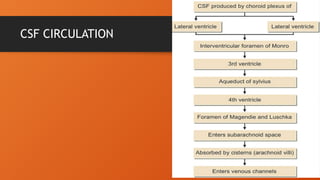
CSF CIRCULATION
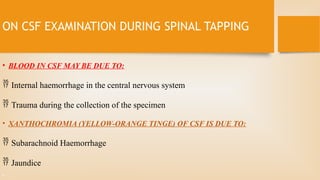
ON CSF EXAMINATION DURING SPINAL TAPPING
• BLOOD IN CSF MAY BE DUE TO:
 Internal haemorrhage in the central nervous system
 Trauma during the collection of the specimen
• XANTHOCHROMIA (YELLOW-ORANGE TINGE) OF CSF IS DUE TO:
 Subarachnoid Haemorrhage
 Jaundice
• .
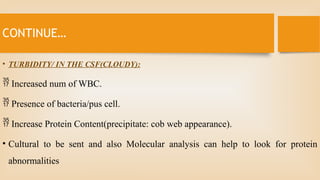
CONTINUE…
• TURBIDITY/ IN THE CSF(CLOUDY):
 Increased num of WBC.
 Presence of bacteria/pus cell.
 Increase Protein Content(precipitate: cob web appearance).
• Cultural to be sent and also Molecular analysis can help to look for protein
abnormalities
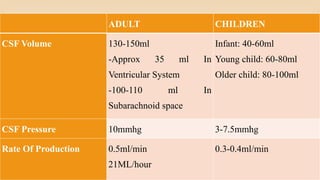
ADULT CHILDREN
CSF Volume 130-150ml
-Approx 35 ml In
Ventricular System
-100-110 ml In
Subarachnoid space
Infant: 40-60ml
Young child: 60-80ml
Older child: 80-100ml
CSF Pressure 10mmhg 3-7.5mmhg
Rate Of Production 0.5ml/min
21ML/hour
0.3-0.4ml/min
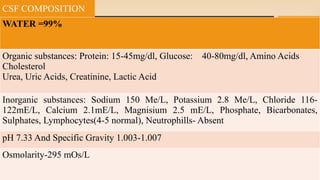
CSF COMPOSITION
WATER =99%
Organic substances: Protein: 15-45mg/dl, Glucose: 40-80mg/dl, Amino Acids
Cholesterol
Urea, Uric Acids, Creatinine, Lactic Acid
Inorganic substances: Sodium 150 Me/L, Potassium 2.8 Me/L, Chloride 116-
122mE/L, Calcium 2.1mE/L, Magnisium 2.5 mE/L, Phosphate, Bicarbonates,
Sulphates, Lymphocytes(4-5 normal), Neutrophills- Absent
pH 7.33 And Specific Gravity 1.003-1.007
Osmolarity-295 mOs/L
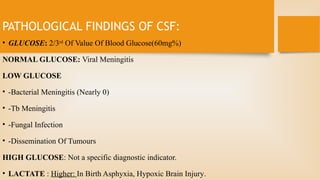
PATHOLOGICAL FINDINGS OF CSF:
• GLUCOSE: 2/3rd
Of Value Of Blood Glucose(60mg%)
NORMAL GLUCOSE: Viral Meningitis
LOW GLUCOSE
• -Bacterial Meningitis (Nearly 0)
• -Tb Meningitis
• -Fungal Infection
• -Dissemination Of Tumours
HIGH GLUCOSE: Not a specific diagnostic indicator.
• LACTATE : Higher: In Birth Asphyxia, Hypoxic Brain Injury.
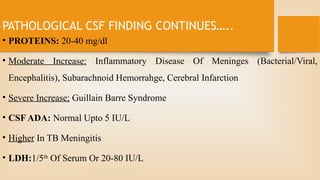
PATHOLOGICAL CSF FINDING CONTINUES…..
• PROTEINS: 20-40 mg/dl
• Moderate Increase: Inflammatory Disease Of Meninges (Bacterial/Viral,
Encephalitis), Subarachnoid Hemorrahge, Cerebral Infarction
• Severe Increase; Guillain Barre Syndrome
• CSF ADA: Normal Upto 5 IU/L
• Higher In TB Meningitis
• LDH:1/5th
Of Serum Or 20-80 IU/L
CONTINUES….
• WBC: Normal 4-5 Cells, Increased in Infection, Inflammation
• Lymphocyte =Viral Infections, Encephalitis, Syphilis, TB Meningitis.
• Neutrophil =Bacterial Infection, Acute Suppurative Meningitis.
• RBC: Normal: 4-5 Cells
• Increase=Haemorrhage-Stroke, Malignancy, Traumatic, Trauma During LP.
NOTE:
• Beta 2-transferrin is only found in CSF, ocular fluids and
perilymph.
• Presence of beta 2 transferrin in a fluid sample can be used
to confirm clinical suspicion of CSF-leak
CSF FUNCTION:
• Homeostasis: Provides Suitable Chemical Envionment For Neuronal Signalling.
• Physical Protection, Shock Absorbing Medium-Prevents Brain And Spinal Cord Bouncing Of
Bony Surfaces (Cranial Cavity/Vertebral Canal).
• Nutrient transport: Exchange Of Nutrients Between Blood And Nerve Tissue
• Immune function: it participates in the immune response within the CNS carrying immune
cells and antibodies.
• Waste removal: it clears metabolic waste products and toxins from the CNS.
• Pressure regulation: CSF pressure is regulated which is crucial for cerebral blood flow and
neurological function
T
H
A
N
K
Y
O
U

CEREBROSPINAL FLUID PHYSIOLOGY AND PATHOLOGY

  • 1.
    CEREBROSPINAL FLUID CSF DRMEENA SINGH PROFESSOR NEUROANAESTHESIA NSCB MEDICAL COLLEGE, JABALPUR(MP)
  • 2.
    INTRODUCTION • It Isclear, colorless, odourless fluid, found in intracranial cavity, central canal, and in subarachnoid space in the CNS. It is formed in lateral ventricles, third ventricle and in forth ventricle by choroid plexus. • Choroid plexus: are secretory unit, which consist of telachoroidae and ependymal cells. Ependymal cells form CSF by filtration process from blood plasma.
  • 3.
    There Are 4CSF Filled Cavities/Ventricles In Brain:  Lateral Ventricle (One In Each Cerebral Hemisphere). Lateral Ventricles Are Separated By Septum Pellucidum.  Third Ventricle  Forth Ventricle
  • 4.
    CSF PRODUCTION • Dependson function of Na+K+ATPase pump. The movement of Na+ from ependymal cells to the cavity is accompanied by Cl- and HCO3- ions and water because of osmotic gradient. The water transport is distributed from blood system to ventricular system through aquaporin-1(aqp1) water channels. • CSF examination : sample of CSF can be taken by lumbar puncture below L2 by spinal tap.
  • 5.
  • 6.
    ON CSF EXAMINATIONDURING SPINAL TAPPING • BLOOD IN CSF MAY BE DUE TO:  Internal haemorrhage in the central nervous system  Trauma during the collection of the specimen • XANTHOCHROMIA (YELLOW-ORANGE TINGE) OF CSF IS DUE TO:  Subarachnoid Haemorrhage  Jaundice • .
  • 7.
    CONTINUE… • TURBIDITY/ INTHE CSF(CLOUDY):  Increased num of WBC.  Presence of bacteria/pus cell.  Increase Protein Content(precipitate: cob web appearance). • Cultural to be sent and also Molecular analysis can help to look for protein abnormalities
  • 8.
    ADULT CHILDREN CSF Volume130-150ml -Approx 35 ml In Ventricular System -100-110 ml In Subarachnoid space Infant: 40-60ml Young child: 60-80ml Older child: 80-100ml CSF Pressure 10mmhg 3-7.5mmhg Rate Of Production 0.5ml/min 21ML/hour 0.3-0.4ml/min
  • 9.
    CSF COMPOSITION WATER =99% Organicsubstances: Protein: 15-45mg/dl, Glucose: 40-80mg/dl, Amino Acids Cholesterol Urea, Uric Acids, Creatinine, Lactic Acid Inorganic substances: Sodium 150 Me/L, Potassium 2.8 Me/L, Chloride 116- 122mE/L, Calcium 2.1mE/L, Magnisium 2.5 mE/L, Phosphate, Bicarbonates, Sulphates, Lymphocytes(4-5 normal), Neutrophills- Absent pH 7.33 And Specific Gravity 1.003-1.007 Osmolarity-295 mOs/L
  • 10.
    PATHOLOGICAL FINDINGS OFCSF: • GLUCOSE: 2/3rd Of Value Of Blood Glucose(60mg%) NORMAL GLUCOSE: Viral Meningitis LOW GLUCOSE • -Bacterial Meningitis (Nearly 0) • -Tb Meningitis • -Fungal Infection • -Dissemination Of Tumours HIGH GLUCOSE: Not a specific diagnostic indicator. • LACTATE : Higher: In Birth Asphyxia, Hypoxic Brain Injury.
  • 11.
    PATHOLOGICAL CSF FINDINGCONTINUES….. • PROTEINS: 20-40 mg/dl • Moderate Increase: Inflammatory Disease Of Meninges (Bacterial/Viral, Encephalitis), Subarachnoid Hemorrahge, Cerebral Infarction • Severe Increase; Guillain Barre Syndrome • CSF ADA: Normal Upto 5 IU/L • Higher In TB Meningitis • LDH:1/5th Of Serum Or 20-80 IU/L
  • 12.
    CONTINUES…. • WBC: Normal4-5 Cells, Increased in Infection, Inflammation • Lymphocyte =Viral Infections, Encephalitis, Syphilis, TB Meningitis. • Neutrophil =Bacterial Infection, Acute Suppurative Meningitis. • RBC: Normal: 4-5 Cells • Increase=Haemorrhage-Stroke, Malignancy, Traumatic, Trauma During LP.
  • 13.
    NOTE: • Beta 2-transferrinis only found in CSF, ocular fluids and perilymph. • Presence of beta 2 transferrin in a fluid sample can be used to confirm clinical suspicion of CSF-leak
  • 14.
    CSF FUNCTION: • Homeostasis:Provides Suitable Chemical Envionment For Neuronal Signalling. • Physical Protection, Shock Absorbing Medium-Prevents Brain And Spinal Cord Bouncing Of Bony Surfaces (Cranial Cavity/Vertebral Canal). • Nutrient transport: Exchange Of Nutrients Between Blood And Nerve Tissue • Immune function: it participates in the immune response within the CNS carrying immune cells and antibodies. • Waste removal: it clears metabolic waste products and toxins from the CNS. • Pressure regulation: CSF pressure is regulated which is crucial for cerebral blood flow and neurological function
  • 15.