By
Dr KHALED ALGARIRI
CAMS- QASSIM UNIVERSITY
APRIL 2023
Saliva
Saliva is a clear, watery fluid, secreted into mouth by
major and minor salivary glands & oral mucous gland
that function in testing, chewing and swallowing by
moistening and softening food.
In general, healthy adults produce 1000–1500 mL of
saliva per day, at a rate of approximately 0.5 mL/min
Major salivary gland: 93% of
saliva by volume is secreted by
major salivary glands, these are:
1. Parotid
2. Submandibular
3. Sublingual glands
Minor salivary glands:
Contributes to remaining 7% of salivary vol.
These minor glands are typically located in
the submucosa and have short ducts
opening directly onto the mucosal surface
SALIVARY GLANDS
•Salivary glands are made up of secretory acini and ducts.
•The basic secretory units of salivary glands are clusters
of cells called an acini .
•There are two types of secretions - serous and mucous.
•The acini can either be serous, mucous, or a mixture of
serous and mucous.
FORMATION OF SALIVA
The formation of saliva takes place in two stages
 First stage, the secretory acini produces an isotonic primary
saliva with ionic composition is similar to that of plasma.
 Second stage, the primary saliva is modified as it passes
through the duct system by selective reabsorption of Na+
and Cl- (but not water) and some secretion of K+ and HCO3-
• The final saliva is secreted into the mouth. Thus, it becomes
hypotonic with salt concentration below that of primary
saliva.
The Functions of Saliva
(1) lubrication and protection,
(2) buffering action and clearance,
(3) maintenance of tooth integrity,
(4) antibacterial activity
(5) taste and digestion
(1) Lubrication and Protection
 As a seromucous coating, saliva lubricates and protects oral tissues,
acting as a barrier against irritants.
 These irritants include,proteolytic and hydrolytic enzymes produced in
plaque,potential carcinogens from smoking and exogenous
chemicals, and desiccation from mouth breathing.
 The best lubricating components of saliva are Mucins that are
excreted from minor salivary glands..
 Mastication, speech, and swallowing all are aided by the lubricating
effects of mucins.
Salive helps to neutralize the acids produced by plaque
(bacterial biofilm) and also washes out dead cells that
accumulate on the tongue, gums, and cheeks. When
these cells stay for long, they might decompose and lead
to halitosis.
(1) Lubrication and Protection
2- Buffering action and Clearance
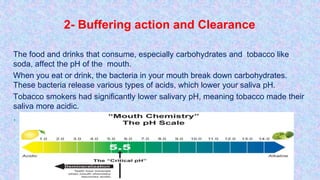
The food and drinks that consume, especially carbohydrates and tobacco like
soda, affect the pH of the mouth.
When you eat or drink, the bacteria in your mouth break down carbohydrates.
These bacteria release various types of acids, which lower your saliva pH.
Tobacco smokers had significantly lower salivary pH, meaning tobacco made their
saliva more acidic.
.
The salivary pH can have serious implications for
the dental health. While tooth enamel is the
hardest substance in the body, it can be damaged
by acidic saliva. When the pH of the saliva drops
below 5.5, the tooth enamel starts to break down.
 If acids have eroded the enamel, the teeth might
be sensitive.it could also notice discomfort when
you drink hot, cold, or sweet beverages. A
yellowish discoloration is another warning sign of
enamel erosion
2- Buffering action and Clearance
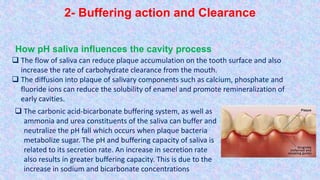
How pH saliva influences the cavity process
 The flow of saliva can reduce plaque accumulation on the tooth surface and also
increase the rate of carbohydrate clearance from the mouth.
 The diffusion into plaque of salivary components such as calcium, phosphate and
fluoride ions can reduce the solubility of enamel and promote remineralization of
early cavities.
2- Buffering action and Clearance
 The carbonic acid-bicarbonate buffering system, as well as
ammonia and urea constituents of the saliva can buffer and
neutralize the pH fall which occurs when plaque bacteria
metabolize sugar. The pH and buffering capacity of saliva is
related to its secretion rate. An increase in secretion rate
also results in greater buffering capacity. This is due to the
increase in sodium and bicarbonate concentrations
2-Buffering action and clearance
• Buffering action and clearance of saliva through the following
components: bicarbonate, phosphate, urea, and amphoteric
proteins and enzymes.
• Bicarbonate is the most important buffering system. It diffuses
into plaque and acts as a buffer by neutralizing acids.
• Moreover, it generates ammonia to form amines, which also
serve as a buffer by neutralizing acids.
• Urea, another buffer present in saliva, releases ammonia
after being metabolized by plaque and thus increases plaque
pH.
Thus, salivary buffering, clearance, and flow rate work in
concert to influence intraoral pH. So flow can be
augmented by the stimulus of chewing as well as by the
muscular activity of the lips and tongue. • With stimulated
additional flow, chewing products (such as gum) that
contain no fermentable carbohydrates can aid in the
modulation of plaque pH
2- Buffering action and Clearance
Avoid or limit soft drinks and other acidic beverages.
Avoid swishing acidic beverages around your mouth.
Rinse your mouth with water after you eat or drink.
Chew sugarless gum to increase your saliva flow and wash away
acids.
Drink milk or eat foods that contain calcium, like cheese, which
neutralize acids
Tips to Restore Your Saliva's pH
2- Buffering action and Clearance
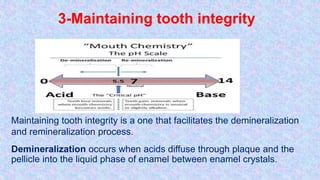
3-Maintaining tooth integrity
Maintaining tooth integrity is a one that facilitates the demineralization
and remineralization process.
Demineralization occurs when acids diffuse through plaque and the
pellicle into the liquid phase of enamel between enamel crystals.
• Resulting crystalline dissolution
occurs at a pH of 5 to 5.5, which is
the critical pH range for the
Development of caries.
• Remineralization is the process of
replacing lost minerals through the
organic matrix of the enamel to the
crystals.
Supersaturation of minerals in saliva is critical
to this process. The high salivary concentrations of
calcium and phosphate, which are maintained by
salivary proteins, may account for the maturation
and remineralization of enamel.
Statherin, a salivary peptide, contributes to the
stabilization of calcium and phosphate salts
solution,serves as a lubricant to protect the tooth
from wear.
The presence of fluoride in saliva
speeds up Crystal precipitation,
forming a fluorapatite-like coatingmore
resistant to caries than the original
tooth structure.
Fluoride in salivary solution
works to inhibit dissolution of
apatite crystals.
Antibacterial activity
 Salivary glands are exocrine glands, and, as such, secrete fluid containing
immunologic and nonimmunologic agents for the protection of teeth and
mucosal surfaces.
 Immunologic contents of saliva include secretory IgA, IgG, and IgM.
 Secretory IgA, the largest immunologic component of saliva, is an
immunoglobulin produced by plasma cells in connective tissues and translocated
through the duct cells of major and minor salivary glands.
 IgA, while active on mucosal surfaces, also acts to neutralize viruses,serves as
an antibody to bacterial antigens, and works to aggregate or clump bacteria, thus
inhibiting bacterial attachment to host tissues.
• Nonimmunologic antibacterial salivary contents such as
proteins, mucins, peptides, and enzymes
(lactoferrin,lysozyme, and peroxidase), all products of
acinar gland cells, help protect teeth against physical,
chemical, and microbial insults.
The Functions of Saliva
ROLE OF SALIVARY ENZYMES
Salivary enzymes can be produced by salivary glands
• 1. aspartate and alanine aminotransferases (AST and ALT)
• 2. lactate dehydrogenase (LDH)
• 3. gamma-glutamyl transferase (GGT)
• 4. creatine kinase (CK)
• 5. alkaline phosphatase (ALP)
• 6. acidic phosphatase (ACP)
Major Enzymes in Saliva
•Salivary amylase (also known as ptyalin) breaks down
starches into smaller, simpler sugars.
•Salivary kallikrein helps produce a vasodilator to dilate blood
vessels.
•Lingual lipase helps to break down triglycerides into fatty
acids and glycerides.
Salivary Amylase
Salivary amylase is the primary enzyme in saliva. Salivary amylase breaks down
carbohydrates into smaller molecules, like sugars. Breaking down the large
macromolecules into simpler components helps the body to digest starchy foods,
like potatoes, rice, or pasta.
During this process, larger carbohydrates, called amylopectin and amylose, are
broken down into maltose. Maltose is a sugar that is composed of individual
subunits of glucose, the human body's key source of energy.
Salivary amylase also has a function in our dental health. It helps to prevent
starches from accumulating on our teeth. In addition to salivary amylase, humans
also produce pancreatic amylase, which further breaks down starches later in the
digestive process.
Salivary Kallikrein
As a group, kallikreins are enzymes that take high molecular
weight (HMW) compounds, like kininogen, and cleave them to
smaller units. Salivary kallikrein breaks down kininogen
into bradykinin, a vasodilator. Bradykinin helps to control
blood pressure in the body. It causes blood vessels to dilate or
expand and causes blood pressure to be lowered. Typically,
only trace amounts of salivary kallikrein are found in saliva.
Lingual Lipase
 Lingual lipase is an enzyme that breaks down triglycerides into
glycerides and fatty acid components, thus catalysing the digestion of
lipids. The process begins in the mouth where it breaks down the
triglycerides into diglycerides. Unlike salivary amylase, which
functions best in non-acidic environments, lingual lipase can operate
at lower pH values, so its action continues into the stomach.
 Lingual lipase helps infants digest the fats in their mother's milk. As
we get older, the relative proportion of lingual lipase in saliva
decreases as other parts of our digestive system help with fat
digestion.
• Other Minor Salivary Enzymes
• Saliva contains other minor enzymes, like salivary acid
phosphatase, which frees up attached phosphoryl groups from
other molecules. Like amylase, it helps with the digestion
process.
• Saliva also contains lysozymes. Lysozymes are enzymes that
help to kill bacteria, viruses and other foreign agents in the
body. These enzymes thus perform antimicrobial functions.
SALIVA FLUID.pptx

SALIVA FLUID.pptx

  • 1.
    By Dr KHALED ALGARIRI CAMS-QASSIM UNIVERSITY APRIL 2023
  • 2.
    Saliva Saliva is aclear, watery fluid, secreted into mouth by major and minor salivary glands & oral mucous gland that function in testing, chewing and swallowing by moistening and softening food. In general, healthy adults produce 1000–1500 mL of saliva per day, at a rate of approximately 0.5 mL/min
  • 4.
    Major salivary gland:93% of saliva by volume is secreted by major salivary glands, these are: 1. Parotid 2. Submandibular 3. Sublingual glands Minor salivary glands: Contributes to remaining 7% of salivary vol. These minor glands are typically located in the submucosa and have short ducts opening directly onto the mucosal surface
  • 5.
    SALIVARY GLANDS •Salivary glandsare made up of secretory acini and ducts. •The basic secretory units of salivary glands are clusters of cells called an acini . •There are two types of secretions - serous and mucous. •The acini can either be serous, mucous, or a mixture of serous and mucous.
  • 6.
    FORMATION OF SALIVA Theformation of saliva takes place in two stages  First stage, the secretory acini produces an isotonic primary saliva with ionic composition is similar to that of plasma.  Second stage, the primary saliva is modified as it passes through the duct system by selective reabsorption of Na+ and Cl- (but not water) and some secretion of K+ and HCO3-
  • 7.
    • The finalsaliva is secreted into the mouth. Thus, it becomes hypotonic with salt concentration below that of primary saliva.
  • 9.
    The Functions ofSaliva (1) lubrication and protection, (2) buffering action and clearance, (3) maintenance of tooth integrity, (4) antibacterial activity (5) taste and digestion
  • 10.
    (1) Lubrication andProtection  As a seromucous coating, saliva lubricates and protects oral tissues, acting as a barrier against irritants.  These irritants include,proteolytic and hydrolytic enzymes produced in plaque,potential carcinogens from smoking and exogenous chemicals, and desiccation from mouth breathing.  The best lubricating components of saliva are Mucins that are excreted from minor salivary glands..  Mastication, speech, and swallowing all are aided by the lubricating effects of mucins.
  • 11.
    Salive helps toneutralize the acids produced by plaque (bacterial biofilm) and also washes out dead cells that accumulate on the tongue, gums, and cheeks. When these cells stay for long, they might decompose and lead to halitosis. (1) Lubrication and Protection
  • 12.
    2- Buffering actionand Clearance The food and drinks that consume, especially carbohydrates and tobacco like soda, affect the pH of the mouth. When you eat or drink, the bacteria in your mouth break down carbohydrates. These bacteria release various types of acids, which lower your saliva pH. Tobacco smokers had significantly lower salivary pH, meaning tobacco made their saliva more acidic. .
  • 13.
    The salivary pHcan have serious implications for the dental health. While tooth enamel is the hardest substance in the body, it can be damaged by acidic saliva. When the pH of the saliva drops below 5.5, the tooth enamel starts to break down.  If acids have eroded the enamel, the teeth might be sensitive.it could also notice discomfort when you drink hot, cold, or sweet beverages. A yellowish discoloration is another warning sign of enamel erosion 2- Buffering action and Clearance
  • 14.
    How pH salivainfluences the cavity process  The flow of saliva can reduce plaque accumulation on the tooth surface and also increase the rate of carbohydrate clearance from the mouth.  The diffusion into plaque of salivary components such as calcium, phosphate and fluoride ions can reduce the solubility of enamel and promote remineralization of early cavities. 2- Buffering action and Clearance  The carbonic acid-bicarbonate buffering system, as well as ammonia and urea constituents of the saliva can buffer and neutralize the pH fall which occurs when plaque bacteria metabolize sugar. The pH and buffering capacity of saliva is related to its secretion rate. An increase in secretion rate also results in greater buffering capacity. This is due to the increase in sodium and bicarbonate concentrations
  • 15.
    2-Buffering action andclearance • Buffering action and clearance of saliva through the following components: bicarbonate, phosphate, urea, and amphoteric proteins and enzymes. • Bicarbonate is the most important buffering system. It diffuses into plaque and acts as a buffer by neutralizing acids. • Moreover, it generates ammonia to form amines, which also serve as a buffer by neutralizing acids. • Urea, another buffer present in saliva, releases ammonia after being metabolized by plaque and thus increases plaque pH.
  • 16.
    Thus, salivary buffering,clearance, and flow rate work in concert to influence intraoral pH. So flow can be augmented by the stimulus of chewing as well as by the muscular activity of the lips and tongue. • With stimulated additional flow, chewing products (such as gum) that contain no fermentable carbohydrates can aid in the modulation of plaque pH 2- Buffering action and Clearance
  • 17.
    Avoid or limitsoft drinks and other acidic beverages. Avoid swishing acidic beverages around your mouth. Rinse your mouth with water after you eat or drink. Chew sugarless gum to increase your saliva flow and wash away acids. Drink milk or eat foods that contain calcium, like cheese, which neutralize acids Tips to Restore Your Saliva's pH 2- Buffering action and Clearance
  • 18.
    3-Maintaining tooth integrity Maintainingtooth integrity is a one that facilitates the demineralization and remineralization process. Demineralization occurs when acids diffuse through plaque and the pellicle into the liquid phase of enamel between enamel crystals.
  • 19.
    • Resulting crystallinedissolution occurs at a pH of 5 to 5.5, which is the critical pH range for the Development of caries. • Remineralization is the process of replacing lost minerals through the organic matrix of the enamel to the crystals.
  • 20.
    Supersaturation of mineralsin saliva is critical to this process. The high salivary concentrations of calcium and phosphate, which are maintained by salivary proteins, may account for the maturation and remineralization of enamel. Statherin, a salivary peptide, contributes to the stabilization of calcium and phosphate salts solution,serves as a lubricant to protect the tooth from wear. The presence of fluoride in saliva speeds up Crystal precipitation, forming a fluorapatite-like coatingmore resistant to caries than the original tooth structure. Fluoride in salivary solution works to inhibit dissolution of apatite crystals.
  • 21.
    Antibacterial activity  Salivaryglands are exocrine glands, and, as such, secrete fluid containing immunologic and nonimmunologic agents for the protection of teeth and mucosal surfaces.  Immunologic contents of saliva include secretory IgA, IgG, and IgM.  Secretory IgA, the largest immunologic component of saliva, is an immunoglobulin produced by plasma cells in connective tissues and translocated through the duct cells of major and minor salivary glands.  IgA, while active on mucosal surfaces, also acts to neutralize viruses,serves as an antibody to bacterial antigens, and works to aggregate or clump bacteria, thus inhibiting bacterial attachment to host tissues.
  • 22.
    • Nonimmunologic antibacterialsalivary contents such as proteins, mucins, peptides, and enzymes (lactoferrin,lysozyme, and peroxidase), all products of acinar gland cells, help protect teeth against physical, chemical, and microbial insults.
  • 24.
  • 25.
  • 26.
    ROLE OF SALIVARYENZYMES Salivary enzymes can be produced by salivary glands • 1. aspartate and alanine aminotransferases (AST and ALT) • 2. lactate dehydrogenase (LDH) • 3. gamma-glutamyl transferase (GGT) • 4. creatine kinase (CK) • 5. alkaline phosphatase (ALP) • 6. acidic phosphatase (ACP)
  • 27.
    Major Enzymes inSaliva •Salivary amylase (also known as ptyalin) breaks down starches into smaller, simpler sugars. •Salivary kallikrein helps produce a vasodilator to dilate blood vessels. •Lingual lipase helps to break down triglycerides into fatty acids and glycerides.
  • 28.
    Salivary Amylase Salivary amylaseis the primary enzyme in saliva. Salivary amylase breaks down carbohydrates into smaller molecules, like sugars. Breaking down the large macromolecules into simpler components helps the body to digest starchy foods, like potatoes, rice, or pasta. During this process, larger carbohydrates, called amylopectin and amylose, are broken down into maltose. Maltose is a sugar that is composed of individual subunits of glucose, the human body's key source of energy. Salivary amylase also has a function in our dental health. It helps to prevent starches from accumulating on our teeth. In addition to salivary amylase, humans also produce pancreatic amylase, which further breaks down starches later in the digestive process.
  • 29.
    Salivary Kallikrein As agroup, kallikreins are enzymes that take high molecular weight (HMW) compounds, like kininogen, and cleave them to smaller units. Salivary kallikrein breaks down kininogen into bradykinin, a vasodilator. Bradykinin helps to control blood pressure in the body. It causes blood vessels to dilate or expand and causes blood pressure to be lowered. Typically, only trace amounts of salivary kallikrein are found in saliva.
  • 30.
    Lingual Lipase  Linguallipase is an enzyme that breaks down triglycerides into glycerides and fatty acid components, thus catalysing the digestion of lipids. The process begins in the mouth where it breaks down the triglycerides into diglycerides. Unlike salivary amylase, which functions best in non-acidic environments, lingual lipase can operate at lower pH values, so its action continues into the stomach.  Lingual lipase helps infants digest the fats in their mother's milk. As we get older, the relative proportion of lingual lipase in saliva decreases as other parts of our digestive system help with fat digestion.
  • 31.
    • Other MinorSalivary Enzymes • Saliva contains other minor enzymes, like salivary acid phosphatase, which frees up attached phosphoryl groups from other molecules. Like amylase, it helps with the digestion process. • Saliva also contains lysozymes. Lysozymes are enzymes that help to kill bacteria, viruses and other foreign agents in the body. These enzymes thus perform antimicrobial functions.