By
Dr KHALED ALGARIRI
CAMS- Qassim University
September 2020
INTRODUCTION
 Ocean water is a solution in which many
different substances are dissolved.
 A solution is a homogeneous mixture of two or more substances with each
substance retaining its own chemical identity.
 A solvent is the component of a solution that is present in the greatest
amount. A solvent can be thought of as the medium in which the other
substances present are dissolved.
 A solute is a component of a solution that is present in a lesser amount
relative to that of the solvent.
Characteristics of Solutions
1. A solution contains two or more components: a solvent (the substance
present in the greatest amount) and one or more solutes.
2. A solution has a variable composition; that is, the ratio of solute to
solvent may be varied.
3. The properties of a solution change as the ratio of solute to solvent is
changed.
4. The solutes remain uniformly distributed throughout the solution and will not
settle out with time. Every part of a solution has exactly the same properties and
composition as every other part.
Characteristics of Solutions
5. The solute(s) generally can be separated from the solvent by physical
means such as evaporation, distillation and chromatography.
6. Most solutes are more soluble in hot solvent than in cold solvent.
7. Solutions are almost always transparent. They may be colorless or
colored, but we can usually see through them. Solid solutions are
exceptions
Types of Solutions
A saturated solution is a solution that contains the maximum amount of solute that
can be dissolved under the conditions at which the solution exists.
Consider the process of adding table sugar (sucrose) to a container of water. Initially,
the added sugar dissolves as the solution is stirred. Finally, as we add more sugar, we
reach a point where no amount of stirring will cause the added sugar to dissolve. The
last-added sugar remains as a solid on the bottom of the container; the solution is
saturated.
A supersaturated solution is an unstable solution that temporarily contains
more dissolved solute than that present in a saturated solution. A supersaturated
solution will produce crystals rapidly, if it is slightly disturbed or if it is “seeded” with
a tiny crystal of solute.
An unsaturated solution is a solution that contains less than the maximum
amount of solute that can be dissolved under the conditions at which the solution
exists.
A concentrated solution is a solution that contains
a large amount of solute relative to the amount
that could dissolve. A concentrated solution does
not have to be a saturated solution .
A dilute solution is a solution that contains a small
amount of solute relative to the amount that could
dissolve.
Aqueous and Nonaqueous Solutions
An aqueous solution is a solution in which water is the solvent. The
presence of water is not a prerequisite for a solution.
A nonaqueous solution is a solution in which a substance other than
water is the solvent.
Solubility
Solubility is the maximum amount of solute that will
dissolve in a given amount of solvent under a given set
of conditions
Factors Affect Solubility
1. Type of solvent / solute (“like dissolves like.”)
• Polar solvents dissolve polar & ionic solutes
• Non-polar solvents dissolve non-polar & covalent
solutes
For example, the liquids benzene (C6H6) and carbon tetrachloride (CCl4) are
nonpolar compounds. They dissolve in each other, and other nonpolar materials,
such as gasoline, dissolve in them.
In contrast, ionic compounds such as sodium chloride (NaCl) and polar compounds
such as table sugar (C12H22O11) are insoluble in these solvents. The most
important polar solvent is water.
Factors Affect Solubility
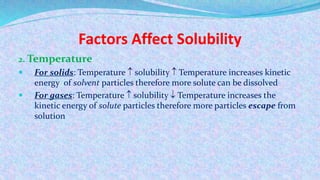
2. Temperature
 For solids: Temperature  solubility  Temperature increases kinetic
energy of solvent particles therefore more solute can be dissolved
 For gases: Temperature  solubility  Temperature increases the
kinetic energy of solute particles therefore more particles escape from
solution
Factors Affect Solubility
3. Pressure (Gasses Only)
 Increasing pressure forces more gas into solution
 Pressure  solubility 
 Pressure  solubility 
Henry’s law states that the amount of gas that will dissolve in a liquid at a
given temperature is directly proportional to the partial pressure of the gas
above the liquid. In other words, as the pressure of a gas above a liquid
increases, the solubility of the gas increases; conversely, as the pressure of
the gas decreases, its solubility decreases.
(a) A gas sample in a liquid under pressure in a closed container. (b ) The pressure
is increased at constant temperature, causing more gas to dissolve.
Factors that affect the rate of solubility
1. Temperature:
• T rate
• T rate
• Increasing temperature increases kinetic energy =
increased motion = increased diffusion
Factors that affect the rate of solubility
2. Surface Area (particle size):
• S.A.  (particle size ) rate 
• S.A.  (particle size ) rate 
• Increasing surface area increases opportunity
for interaction between solute and solvent
Factors that affect the rate of solubility
3. Stirring:
stirring  rate 
stirring rate 
Stirring increases particle motion so more particles
can be dissolved at the surface of the solid
Most Common Units for Concentration?
A- Percent Concentration as mass- volume
 Mass–volume percent is the mass of solute in a solution (in grams) divided by the
total volume of solution (in milliliters), multiplied by 100.
2-Percent Weight of solute per weight of solution (w/w):
Percent by mass is the mass of solute in a solution divided by the total mass of
solution, multiplied by 100 (to put the value in terms of percentage).
3- Percent concentration as volume of solute per volume of solution
(v/v) percent
 Percent by volume is the volume of solute in a solution divided by the
total volume of solution, multiplied by 100.
B. Molarity
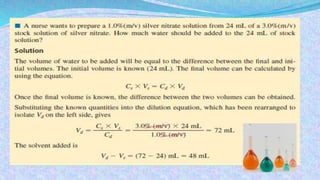
C- Dilution
It is the process in which more solvent is added to a solution
in order to lower its concentration. The same amount of
solute is present, but it is now distributed in a larger amount
of solvent (the original solvent plus the added solvent).
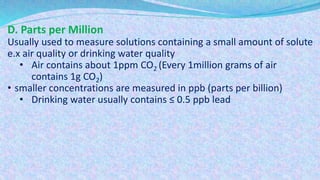
D. Parts per Million
Usually used to measure solutions containing a small amount of solute
e.x air quality or drinking water quality
• Air contains about 1ppm CO2 (Every 1million grams of air
contains 1g CO2)
• smaller concentrations are measured in ppb (parts per billion)
• Drinking water usually contains ≤ 0.5 ppb lead
REFERENCES
chemical Solutions2020

chemical Solutions2020

  • 1.
    By Dr KHALED ALGARIRI CAMS-Qassim University September 2020
  • 2.
    INTRODUCTION  Ocean wateris a solution in which many different substances are dissolved.  A solution is a homogeneous mixture of two or more substances with each substance retaining its own chemical identity.  A solvent is the component of a solution that is present in the greatest amount. A solvent can be thought of as the medium in which the other substances present are dissolved.  A solute is a component of a solution that is present in a lesser amount relative to that of the solvent.
  • 3.
    Characteristics of Solutions 1.A solution contains two or more components: a solvent (the substance present in the greatest amount) and one or more solutes. 2. A solution has a variable composition; that is, the ratio of solute to solvent may be varied. 3. The properties of a solution change as the ratio of solute to solvent is changed. 4. The solutes remain uniformly distributed throughout the solution and will not settle out with time. Every part of a solution has exactly the same properties and composition as every other part.
  • 4.
    Characteristics of Solutions 5.The solute(s) generally can be separated from the solvent by physical means such as evaporation, distillation and chromatography. 6. Most solutes are more soluble in hot solvent than in cold solvent. 7. Solutions are almost always transparent. They may be colorless or colored, but we can usually see through them. Solid solutions are exceptions
  • 5.
    Types of Solutions Asaturated solution is a solution that contains the maximum amount of solute that can be dissolved under the conditions at which the solution exists. Consider the process of adding table sugar (sucrose) to a container of water. Initially, the added sugar dissolves as the solution is stirred. Finally, as we add more sugar, we reach a point where no amount of stirring will cause the added sugar to dissolve. The last-added sugar remains as a solid on the bottom of the container; the solution is saturated. A supersaturated solution is an unstable solution that temporarily contains more dissolved solute than that present in a saturated solution. A supersaturated solution will produce crystals rapidly, if it is slightly disturbed or if it is “seeded” with a tiny crystal of solute. An unsaturated solution is a solution that contains less than the maximum amount of solute that can be dissolved under the conditions at which the solution exists.
  • 6.
    A concentrated solutionis a solution that contains a large amount of solute relative to the amount that could dissolve. A concentrated solution does not have to be a saturated solution . A dilute solution is a solution that contains a small amount of solute relative to the amount that could dissolve. Aqueous and Nonaqueous Solutions An aqueous solution is a solution in which water is the solvent. The presence of water is not a prerequisite for a solution. A nonaqueous solution is a solution in which a substance other than water is the solvent.
  • 7.
    Solubility Solubility is themaximum amount of solute that will dissolve in a given amount of solvent under a given set of conditions
  • 8.
    Factors Affect Solubility 1.Type of solvent / solute (“like dissolves like.”) • Polar solvents dissolve polar & ionic solutes • Non-polar solvents dissolve non-polar & covalent solutes For example, the liquids benzene (C6H6) and carbon tetrachloride (CCl4) are nonpolar compounds. They dissolve in each other, and other nonpolar materials, such as gasoline, dissolve in them. In contrast, ionic compounds such as sodium chloride (NaCl) and polar compounds such as table sugar (C12H22O11) are insoluble in these solvents. The most important polar solvent is water.
  • 9.
    Factors Affect Solubility 2.Temperature  For solids: Temperature  solubility  Temperature increases kinetic energy of solvent particles therefore more solute can be dissolved  For gases: Temperature  solubility  Temperature increases the kinetic energy of solute particles therefore more particles escape from solution
  • 10.
    Factors Affect Solubility 3.Pressure (Gasses Only)  Increasing pressure forces more gas into solution  Pressure  solubility   Pressure  solubility  Henry’s law states that the amount of gas that will dissolve in a liquid at a given temperature is directly proportional to the partial pressure of the gas above the liquid. In other words, as the pressure of a gas above a liquid increases, the solubility of the gas increases; conversely, as the pressure of the gas decreases, its solubility decreases.
  • 11.
    (a) A gassample in a liquid under pressure in a closed container. (b ) The pressure is increased at constant temperature, causing more gas to dissolve.
  • 12.
    Factors that affectthe rate of solubility 1. Temperature: • T rate • T rate • Increasing temperature increases kinetic energy = increased motion = increased diffusion
  • 13.
    Factors that affectthe rate of solubility 2. Surface Area (particle size): • S.A.  (particle size ) rate  • S.A.  (particle size ) rate  • Increasing surface area increases opportunity for interaction between solute and solvent
  • 14.
    Factors that affectthe rate of solubility 3. Stirring: stirring  rate  stirring rate  Stirring increases particle motion so more particles can be dissolved at the surface of the solid
  • 15.
    Most Common Unitsfor Concentration? A- Percent Concentration as mass- volume  Mass–volume percent is the mass of solute in a solution (in grams) divided by the total volume of solution (in milliliters), multiplied by 100.
  • 16.
    2-Percent Weight ofsolute per weight of solution (w/w): Percent by mass is the mass of solute in a solution divided by the total mass of solution, multiplied by 100 (to put the value in terms of percentage).
  • 17.
    3- Percent concentrationas volume of solute per volume of solution (v/v) percent  Percent by volume is the volume of solute in a solution divided by the total volume of solution, multiplied by 100.
  • 18.
  • 21.
    C- Dilution It isthe process in which more solvent is added to a solution in order to lower its concentration. The same amount of solute is present, but it is now distributed in a larger amount of solvent (the original solvent plus the added solvent).
  • 25.
    D. Parts perMillion Usually used to measure solutions containing a small amount of solute e.x air quality or drinking water quality • Air contains about 1ppm CO2 (Every 1million grams of air contains 1g CO2) • smaller concentrations are measured in ppb (parts per billion) • Drinking water usually contains ≤ 0.5 ppb lead
  • 26.