Cerebral Spinal Fluid
&
Clinical Importance
CEREBROSPINAL FLUID
CEREBROSPINAL FLUID
CEREBROSPINAL FLUID[CSF]
The cerebrospinal Fluid is a clear, colorless
transparent, tissue fluid present in the
cerebral ventricles, spinal canal, and
subarachnoid spaces.
Cerebrospinal Fluid (CSF)
• Blood Brain Barrier
• Occurs due to tight fitting endothelial cells
that prevent filtration of larger molecules.
• Controls / restricts / filters bloodcomponents
• Restricts entry of large molecules, cells,etc.
• Therefore CSF composition is unlike blood’
Cerebrospinal Fluid (CSF)
• Blood Brain Barrier
• Essential to protect the brain
• Blocks chemicals, harmful substances
• Antibodies and medications also blocked
• Tests for those substances normally
blocked can indicate level of disruption by
diseases: ie meningitis and multiple
sclerosis.
CEREBROSPINAL FLUID [FORMATION]
CSF is largely formed by the choroid plexus of the lateral
ventricle and remainder in the third and fourth ventricles.
About 30% of the CSF is also formed from the ependymal
cells lining the ventricles and other brain capillaries.
The choroid plexus of the ventricles actively secrete
cerebrospinal fluid.
The choroid plexuses are highly vascular tufts covered by
ependyma.
MECHANISM OF FORMATION OF CSF
CSF is formed primarily by secretion and also by filtration from
the net works of capillaries and ependymal cells in the ventricles
called choroid plexus.
Various components of the choroid plexus from a blood-
cerebrospinal fluid barrier that permits certain substances to enter
the fluid, but prohibits others.
Such a barrier protects the brain and spinal cord from harmful
substances.
MECHANISM OF FORMATION OF CSF
CSF is formed at a rate of about 550 milliliters each day,. About
two thirds or more of this fluid originates as secretion from the
choroid plexuses in the four ventricles, mainly in the two lateral
ventricles.
The entire cerebral cavity enclosing the brain and spinal cord
has a capacity of about 1600 to 1700 milliliters
About 150 milliliters of this capacity is occupied by
cerebrospinal fluid and the remainder by the brain and cord.
MECHANISM OF FORMATION
Less important transport processes move small amount of glucose
into the cerebrospinal fluid and both potassium and bicarbonate
ions out of the cerebrospinal fluid into the capillaries.
The resulting characteristics of the CSF are:
Osmotic pressure approximately equal to that of plasma sodium
ion concentration
Approximately equal to that of plasma chloride ion
About 15 per cent greater than in plasma potassium ion
approximately 40 per cent less glucose
MECHANISM OF FORMATION OF CSF
Rate of formation:
About 20-25 ml/hour
550 ml/day in adults. Turns over 3.7 times a day
Total quantity: 150 ml:
30-40 ml within the ventricles
About 110-120 ml in the subarachnoid space [of which
75-80 ml in spinal part and 25-30 ml in the cranial part].
Cerebrospinal Fluid (CSF)
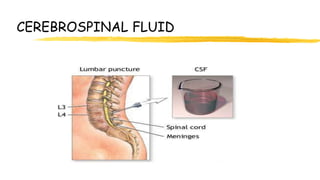
 Specimen collection and handling
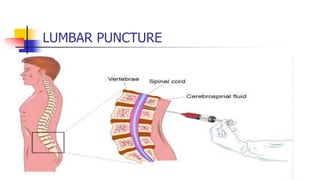
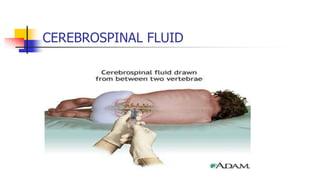
 Routinely collected via lumbar puncture between 3rd & 4th,
or 4th & 5th lumbar vertebrae under sterile conditions
 Intracranial pressure measurement taken before fluid is
withdrawn.
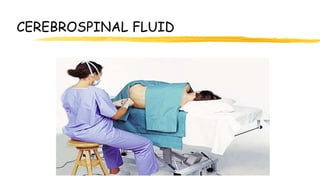
LUMBAR PUNCTURE
CEREBROSPINAL FLUID
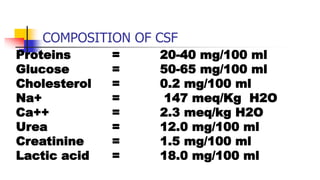
COMPOSITION OF CSF
Proteins = 20-40 mg/100 ml
Glucose = 50-65 mg/100 ml
Cholesterol = 0.2 mg/100 ml
Na+ = 147 meq/Kg H2O
Ca++ = 2.3 meq/kg H2O
Urea = 12.0 mg/100 ml
Creatinine = 1.5 mg/100 ml
Lactic acid = 18.0 mg/100 ml
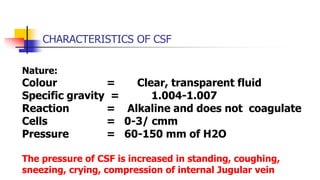
CHARACTERISTICS OF CSF
Nature:
Colour = Clear, transparent fluid
Specific gravity = 1.004-1.007
Reaction = Alkaline and does not coagulate
Cells = 0-3/ cmm
Pressure = 60-150 mm of H2O
The pressure of CSF is increased in standing, coughing,
sneezing, crying, compression of internal Jugular vein
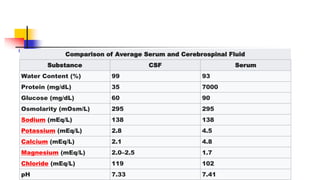
Comparison of Average Serum and Cerebrospinal Fluid
Substance CSF Serum
Water Content (%) 99 93
Protein (mg/dL) 35 7000
Glucose (mg/dL) 60 90
Osmolarity (mOsm/L) 295 295
Sodium (mEq/L) 138 138
Potassium (mEq/L) 2.8 4.5
Calcium (mEq/L) 2.1 4.8
Magnesium (mEq/L) 2.0–2.5 1.7
Chloride (mEq/L) 119 102
pH 7.33 7.41
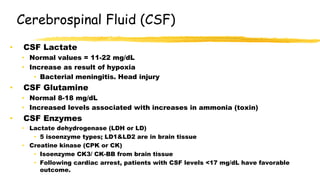
Cerebrospinal Fluid (CSF)
• CSF Lactate
• Normal values = 11-22 mg/dL
• Increase as result of hypoxia
• Bacterial meningitis. Head injury
• CSF Glutamine
• Normal 8-18 mg/dL
• Increased levels associated with increases in ammonia (toxin)
• CSF Enzymes
• Lactate dehydrogenase (LDH or LD)
• 5 isoenzyme types; LD1&LD2 are in brain tissue
• Creatine kinase (CPK or CK)
• Isoenzyme CK3/ CK-BB from brain tissue
• Following cardiac arrest, patients with CSF levels <17 mg/dL have favorable
outcome.
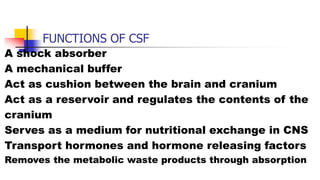
FUNCTIONS OF CSF
A shock absorber
A mechanical buffer
Act as cushion between the brain and cranium
Act as a reservoir and regulates the contents of the
cranium
Serves as a medium for nutritional exchange in CNS
Transport hormones and hormone releasing factors
Removes the metabolic waste products through absorption
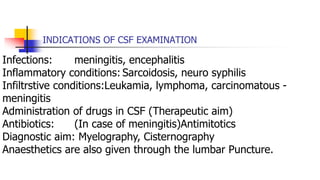
INDICATIONS OF CSF EXAMINATION
Infections: meningitis, encephalitis
Inflammatory conditions: Sarcoidosis, neuro syphilis
Infiltrstive conditions:Leukamia, lymphoma, carcinomatous -
meningitis
Administration of drugs in CSF (Therapeutic aim)
Antibiotics: (In case of meningitis)Antimitotics
Diagnostic aim: Myelography, Cisternography
Anaesthetics are also given through the lumbar Puncture.
Cerebrospinal Fluid (CSF)
• Indications for analysis
• To confirm diagnosis of meningitis
• Evaluate for intracranial hemorrhage
• Diagnose malignancies, leukemia
• Investigate central nervous system disorders
Cerebrospinal Fluid (CSF)
• Four major categories of disease
• Meningeal infections
• Subarachnoid hemorrhage
• CNS malignancy
• Demyelinating disease
CSF AND INFLAMMATION
Increased inflammatory cells [pleocytosis] may be caused
by infectious and noninfectious processes.
Polymorphonuclear pleocytosis indicates acute suppurative
meningitis.
Mononuclear cells are seen in viral infections
(meningoencephalitis, aseptic meningitis), syphilis,
neuroborreliosis, tuberculous meningitis, multiple sclerosis,
brain abscess and brain tumors.
CSF & LOW GLUCOSE
Low glucose in CSF:
This condition is seen in suppurative tuberculosis
Fungal infections
Sarcoidosis
Meningeal dissemination of tumors.
Glucose is consumed by leukocytes and tumor cells.
CSF AND PROTEINS
Increased protein: CSF protein may rise to 500 mg/dl in
bacterial meningitis.
A more moderate increase (150-200 mg/dl) occurs in
inflammatory diseases of meninges (meningitis, encephalitis),
intracranial tumors, subarachnoid hemorrhage, and cerebral
infarction.
A more severe increase occurs in the Guillain-Barré syndrome
and acoustic and spinal schwannoma.
CSF AND PROTEINS
Multiple sclerosis: CSF protein is normal or mildly
increased.
Increased IgG in CSF, but not in serum [IgG/albumin index
normally 10:1].
90% of MS patients have oligoclonal IgG bands in the CSF.
Oligoclonal bands occur in the CSF only not in the serum.
The CSF in MS often contains myelin fragments and myelin
basic protein (MBP).
MBP can be detected by radioimmunoassay. MBP is not specific for
MS. It can appear in any condition causing brain necrosis, including
infarcts.
BLOOD IN CSF
Blood: Blood may be spilled into the CSF by accidental
puncture of a leptomeningeal vein during entry of the LP needle.
Such blood stains the fluid that is drawn initially and clears
gradually. If it does not clear, blood indicates subarachnoid
hemorrhage.
Erythrocytes from subarachnoid hemorrhage are cleared in 3 to
7 days. A few neutrophils and mononuclear cells may also be
present as a result of meningeal irritation.
CSF AND TUMOUR CELLS
Tumor cells indicate dissemination of metastatic or
primary brain tumors in the subarachnoid space.
The most common among the latter is
medulloblastoma.
They can be best detected by cytological
examination.
A mononuclear inflammatory reaction is often seen in
CSF AND XZNTHOCHROMIA
Xanthochromia [blonde color] of the CSF
following subarachnoid hemorrhage is due to
oxyhemoglobin which appears in 4 to 6 hours and
bilirubin which appears in two days.
Xanthochromia may also be seen with hemorrhagic
infarcts, brain tumors, and jaundice.
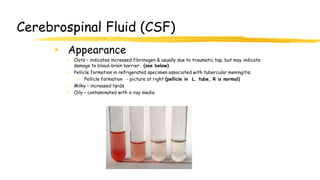
Cerebrospinal Fluid (CSF)
• Appearance
• Clots – indicates increased fibrinogen & usually due to traumatic tap, but may indicate
damage to blood-brain barrier. (see below)
• Pellicle formation in refrigerated specimen associated with tubercular meningitis.
• Pellicle formation - picture at right (pellicle in L. tube, R is normal)
• Milky – increased lipids
• Oily – contaminated with x-ray media
LUMBAR PUNCTURE
Place the patient in the lateral decubitus position lying on
the edge of the bed and facing away from operator.
Place the patient in a knee-chest position with the neck
flexed.
The patient's head should rest on a pillow, so that the
entire cranio-spinal axis is parallel to the bed.
Sitting position is the second choice because there may be
a greater risk of herniation and CSF pressure cannot be
measured
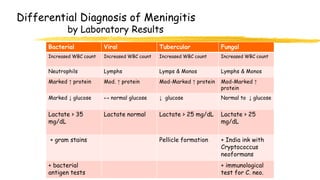
Differential Diagnosis of Meningitis
by Laboratory Results
Bacterial Viral Tubercular Fungal
Increased WBC count Increased WBC count Increased WBC count Increased WBC count
Neutrophils Lymphs Lymps & Monos Lymphs & Monos
Marked ↑ protein Mod. ↑ protein Mod-Marked ↑ protein Mod-Marked ↑
protein
Marked ↓ glucose ↔ normal glucose ↓ glucose Normal to ↓ glucose
Lactate > 35
mg/dL
Lactate normal Lactate > 25 mg/dL Lactate > 25
mg/dL
+ gram stains Pellicle formation + India ink with
Cryptococcus
neoformans
+ bacterial
antigen tests
+ immunological
test for C. neo.

Cerebral Spinal Fluid.pptx

  • 2.
  • 3.
  • 4.
  • 5.
    CEREBROSPINAL FLUID[CSF] The cerebrospinalFluid is a clear, colorless transparent, tissue fluid present in the cerebral ventricles, spinal canal, and subarachnoid spaces.
  • 6.
    Cerebrospinal Fluid (CSF) •Blood Brain Barrier • Occurs due to tight fitting endothelial cells that prevent filtration of larger molecules. • Controls / restricts / filters bloodcomponents • Restricts entry of large molecules, cells,etc. • Therefore CSF composition is unlike blood’
  • 7.
    Cerebrospinal Fluid (CSF) •Blood Brain Barrier • Essential to protect the brain • Blocks chemicals, harmful substances • Antibodies and medications also blocked • Tests for those substances normally blocked can indicate level of disruption by diseases: ie meningitis and multiple sclerosis.
  • 8.
    CEREBROSPINAL FLUID [FORMATION] CSFis largely formed by the choroid plexus of the lateral ventricle and remainder in the third and fourth ventricles. About 30% of the CSF is also formed from the ependymal cells lining the ventricles and other brain capillaries. The choroid plexus of the ventricles actively secrete cerebrospinal fluid. The choroid plexuses are highly vascular tufts covered by ependyma.
  • 9.
    MECHANISM OF FORMATIONOF CSF CSF is formed primarily by secretion and also by filtration from the net works of capillaries and ependymal cells in the ventricles called choroid plexus. Various components of the choroid plexus from a blood- cerebrospinal fluid barrier that permits certain substances to enter the fluid, but prohibits others. Such a barrier protects the brain and spinal cord from harmful substances.
  • 10.
    MECHANISM OF FORMATIONOF CSF CSF is formed at a rate of about 550 milliliters each day,. About two thirds or more of this fluid originates as secretion from the choroid plexuses in the four ventricles, mainly in the two lateral ventricles. The entire cerebral cavity enclosing the brain and spinal cord has a capacity of about 1600 to 1700 milliliters About 150 milliliters of this capacity is occupied by cerebrospinal fluid and the remainder by the brain and cord.
  • 11.
    MECHANISM OF FORMATION Lessimportant transport processes move small amount of glucose into the cerebrospinal fluid and both potassium and bicarbonate ions out of the cerebrospinal fluid into the capillaries. The resulting characteristics of the CSF are: Osmotic pressure approximately equal to that of plasma sodium ion concentration Approximately equal to that of plasma chloride ion About 15 per cent greater than in plasma potassium ion approximately 40 per cent less glucose
  • 12.
    MECHANISM OF FORMATIONOF CSF Rate of formation: About 20-25 ml/hour 550 ml/day in adults. Turns over 3.7 times a day Total quantity: 150 ml: 30-40 ml within the ventricles About 110-120 ml in the subarachnoid space [of which 75-80 ml in spinal part and 25-30 ml in the cranial part].
  • 13.
    Cerebrospinal Fluid (CSF) Specimen collection and handling  Routinely collected via lumbar puncture between 3rd & 4th, or 4th & 5th lumbar vertebrae under sterile conditions  Intracranial pressure measurement taken before fluid is withdrawn.
  • 14.
  • 15.
  • 16.
    COMPOSITION OF CSF Proteins= 20-40 mg/100 ml Glucose = 50-65 mg/100 ml Cholesterol = 0.2 mg/100 ml Na+ = 147 meq/Kg H2O Ca++ = 2.3 meq/kg H2O Urea = 12.0 mg/100 ml Creatinine = 1.5 mg/100 ml Lactic acid = 18.0 mg/100 ml
  • 17.
    CHARACTERISTICS OF CSF Nature: Colour= Clear, transparent fluid Specific gravity = 1.004-1.007 Reaction = Alkaline and does not coagulate Cells = 0-3/ cmm Pressure = 60-150 mm of H2O The pressure of CSF is increased in standing, coughing, sneezing, crying, compression of internal Jugular vein
  • 18.
    Comparison of AverageSerum and Cerebrospinal Fluid Substance CSF Serum Water Content (%) 99 93 Protein (mg/dL) 35 7000 Glucose (mg/dL) 60 90 Osmolarity (mOsm/L) 295 295 Sodium (mEq/L) 138 138 Potassium (mEq/L) 2.8 4.5 Calcium (mEq/L) 2.1 4.8 Magnesium (mEq/L) 2.0–2.5 1.7 Chloride (mEq/L) 119 102 pH 7.33 7.41
  • 19.
    Cerebrospinal Fluid (CSF) •CSF Lactate • Normal values = 11-22 mg/dL • Increase as result of hypoxia • Bacterial meningitis. Head injury • CSF Glutamine • Normal 8-18 mg/dL • Increased levels associated with increases in ammonia (toxin) • CSF Enzymes • Lactate dehydrogenase (LDH or LD) • 5 isoenzyme types; LD1&LD2 are in brain tissue • Creatine kinase (CPK or CK) • Isoenzyme CK3/ CK-BB from brain tissue • Following cardiac arrest, patients with CSF levels <17 mg/dL have favorable outcome.
  • 20.
    FUNCTIONS OF CSF Ashock absorber A mechanical buffer Act as cushion between the brain and cranium Act as a reservoir and regulates the contents of the cranium Serves as a medium for nutritional exchange in CNS Transport hormones and hormone releasing factors Removes the metabolic waste products through absorption
  • 21.
    INDICATIONS OF CSFEXAMINATION Infections: meningitis, encephalitis Inflammatory conditions: Sarcoidosis, neuro syphilis Infiltrstive conditions:Leukamia, lymphoma, carcinomatous - meningitis Administration of drugs in CSF (Therapeutic aim) Antibiotics: (In case of meningitis)Antimitotics Diagnostic aim: Myelography, Cisternography Anaesthetics are also given through the lumbar Puncture.
  • 22.
    Cerebrospinal Fluid (CSF) •Indications for analysis • To confirm diagnosis of meningitis • Evaluate for intracranial hemorrhage • Diagnose malignancies, leukemia • Investigate central nervous system disorders
  • 23.
    Cerebrospinal Fluid (CSF) •Four major categories of disease • Meningeal infections • Subarachnoid hemorrhage • CNS malignancy • Demyelinating disease
  • 24.
    CSF AND INFLAMMATION Increasedinflammatory cells [pleocytosis] may be caused by infectious and noninfectious processes. Polymorphonuclear pleocytosis indicates acute suppurative meningitis. Mononuclear cells are seen in viral infections (meningoencephalitis, aseptic meningitis), syphilis, neuroborreliosis, tuberculous meningitis, multiple sclerosis, brain abscess and brain tumors.
  • 25.
    CSF & LOWGLUCOSE Low glucose in CSF: This condition is seen in suppurative tuberculosis Fungal infections Sarcoidosis Meningeal dissemination of tumors. Glucose is consumed by leukocytes and tumor cells.
  • 26.
    CSF AND PROTEINS Increasedprotein: CSF protein may rise to 500 mg/dl in bacterial meningitis. A more moderate increase (150-200 mg/dl) occurs in inflammatory diseases of meninges (meningitis, encephalitis), intracranial tumors, subarachnoid hemorrhage, and cerebral infarction. A more severe increase occurs in the Guillain-Barré syndrome and acoustic and spinal schwannoma.
  • 27.
    CSF AND PROTEINS Multiplesclerosis: CSF protein is normal or mildly increased. Increased IgG in CSF, but not in serum [IgG/albumin index normally 10:1]. 90% of MS patients have oligoclonal IgG bands in the CSF. Oligoclonal bands occur in the CSF only not in the serum. The CSF in MS often contains myelin fragments and myelin basic protein (MBP). MBP can be detected by radioimmunoassay. MBP is not specific for MS. It can appear in any condition causing brain necrosis, including infarcts.
  • 28.
    BLOOD IN CSF Blood:Blood may be spilled into the CSF by accidental puncture of a leptomeningeal vein during entry of the LP needle. Such blood stains the fluid that is drawn initially and clears gradually. If it does not clear, blood indicates subarachnoid hemorrhage. Erythrocytes from subarachnoid hemorrhage are cleared in 3 to 7 days. A few neutrophils and mononuclear cells may also be present as a result of meningeal irritation.
  • 29.
    CSF AND TUMOURCELLS Tumor cells indicate dissemination of metastatic or primary brain tumors in the subarachnoid space. The most common among the latter is medulloblastoma. They can be best detected by cytological examination. A mononuclear inflammatory reaction is often seen in
  • 30.
    CSF AND XZNTHOCHROMIA Xanthochromia[blonde color] of the CSF following subarachnoid hemorrhage is due to oxyhemoglobin which appears in 4 to 6 hours and bilirubin which appears in two days. Xanthochromia may also be seen with hemorrhagic infarcts, brain tumors, and jaundice.
  • 31.
    Cerebrospinal Fluid (CSF) •Appearance • Clots – indicates increased fibrinogen & usually due to traumatic tap, but may indicate damage to blood-brain barrier. (see below) • Pellicle formation in refrigerated specimen associated with tubercular meningitis. • Pellicle formation - picture at right (pellicle in L. tube, R is normal) • Milky – increased lipids • Oily – contaminated with x-ray media
  • 32.
    LUMBAR PUNCTURE Place thepatient in the lateral decubitus position lying on the edge of the bed and facing away from operator. Place the patient in a knee-chest position with the neck flexed. The patient's head should rest on a pillow, so that the entire cranio-spinal axis is parallel to the bed. Sitting position is the second choice because there may be a greater risk of herniation and CSF pressure cannot be measured
  • 33.
    Differential Diagnosis ofMeningitis by Laboratory Results Bacterial Viral Tubercular Fungal Increased WBC count Increased WBC count Increased WBC count Increased WBC count Neutrophils Lymphs Lymps & Monos Lymphs & Monos Marked ↑ protein Mod. ↑ protein Mod-Marked ↑ protein Mod-Marked ↑ protein Marked ↓ glucose ↔ normal glucose ↓ glucose Normal to ↓ glucose Lactate > 35 mg/dL Lactate normal Lactate > 25 mg/dL Lactate > 25 mg/dL + gram stains Pellicle formation + India ink with Cryptococcus neoformans + bacterial antigen tests + immunological test for C. neo.