CEREBRO SPINAL FLUID 
ANALYSIS 
Dr Anvesh Narimeti 
Unit 1
HISTORY 
 The technique for needle lumbar puncture was introduced 
by the German physician Heinrich Quincke 
• He was perhaps the first to 
recognise angioedema whic 
h is often referred to as 
"Quincke's edema 
"Quincke's pulse“ in AR
CSF PRODUCTION AND CIRCULATION
1. Normal blood brain barrier is important for the normal chemistry 
results of CSF 
2. Mechanism of formation: 
1. Selective ultrafiltration of plasma 
2. Active secretion by epithelial membrane 
PRESSURE OF CSF DEPENDS ON DRAINAGE SYSTEM 
TOTAL PRODUCTION OF CSF PER DAY=500-600 ml per day 
TOTAL VOLUME OF CSF IN ADULT IS = 140 ml 
THE RATE OF ABSORPTION CORRELATES WITH THE CSF 
PRESSURE
LUMBAR PUNCTURE 
lumbar puncture should be carried out if some specific piece of 
information is likely to come from csf examination that would 
substantially contribute towards 
 Diagnosis 
 Treatment 
 Assesment of progress of disease 
WE PERFORM CT SCAN IN SUSPECTED MENINGITIS BEFORE LP IF 
ONE OR MORE RISK FACTORS ARE PRESENT 
 ALTERED MENTATION 
 FOCAL NEUROLOGICAL SIGNS 
 PAPILLEDEMA 
 SEIZURES WITH IN PREVIOUS WEEK 
 IMPAIRED CELLULAR IMMUNITY
CONTRAINDICATIONS 
ABSOLUTE 
• LOCAL SEPSIS 
• SPACE 
OCCUPYING 
LESION WITH 
RAISED ICT 
RELATIVE 
• PAPILLEDEMA 
• BLEEDING 
DIATHESIS 
PLATELTS LESS 
THAN 50000 
SEVERE 
PULMONARY 
AND 
RESPIRATORY 
DIFFICULTY
TECHNIQUE OF LUMBAR PUNCTURE
COMPLICATIONS OF LP 
 POST LP HEAD ACHE 
 INFECTION 
 BLEEDING 
 CEREBRAL HERNIATION 
 MINOR NEUROLOGICAL SYMPTOMS LIKE RADICULAR PAIN AND NUMBNESS 
 BACK PAIN 
 DIPLOPIA 
SUSPECT HERNIATION? 
DETERIORATION OF CONSCIOUSNESS IMMEDIATELY OR WITH IN 12 HRS 
NECK STIFFNESS 
DILATED PUPILS 
BRADYCARDIA
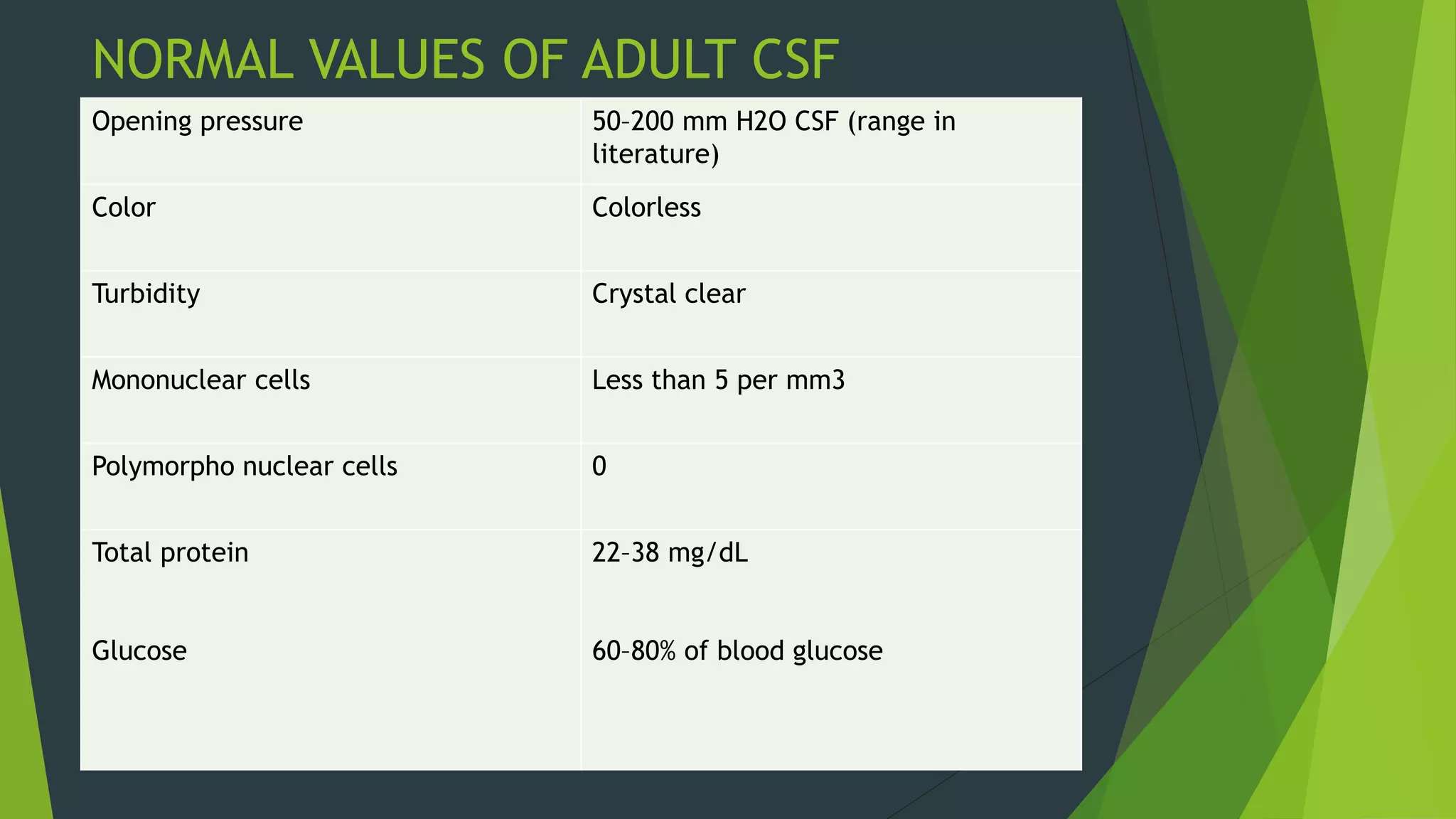
NORMAL VALUES OF ADULT CSF 
Opening pressure 50–200 mm H2O CSF (range in 
literature) 
Color Colorless 
Turbidity Crystal clear 
Mononuclear cells Less than 5 per mm3 
Polymorpho nuclear cells 0 
Total protein 
Glucose 
22–38 mg/dL 
60–80% of blood glucose
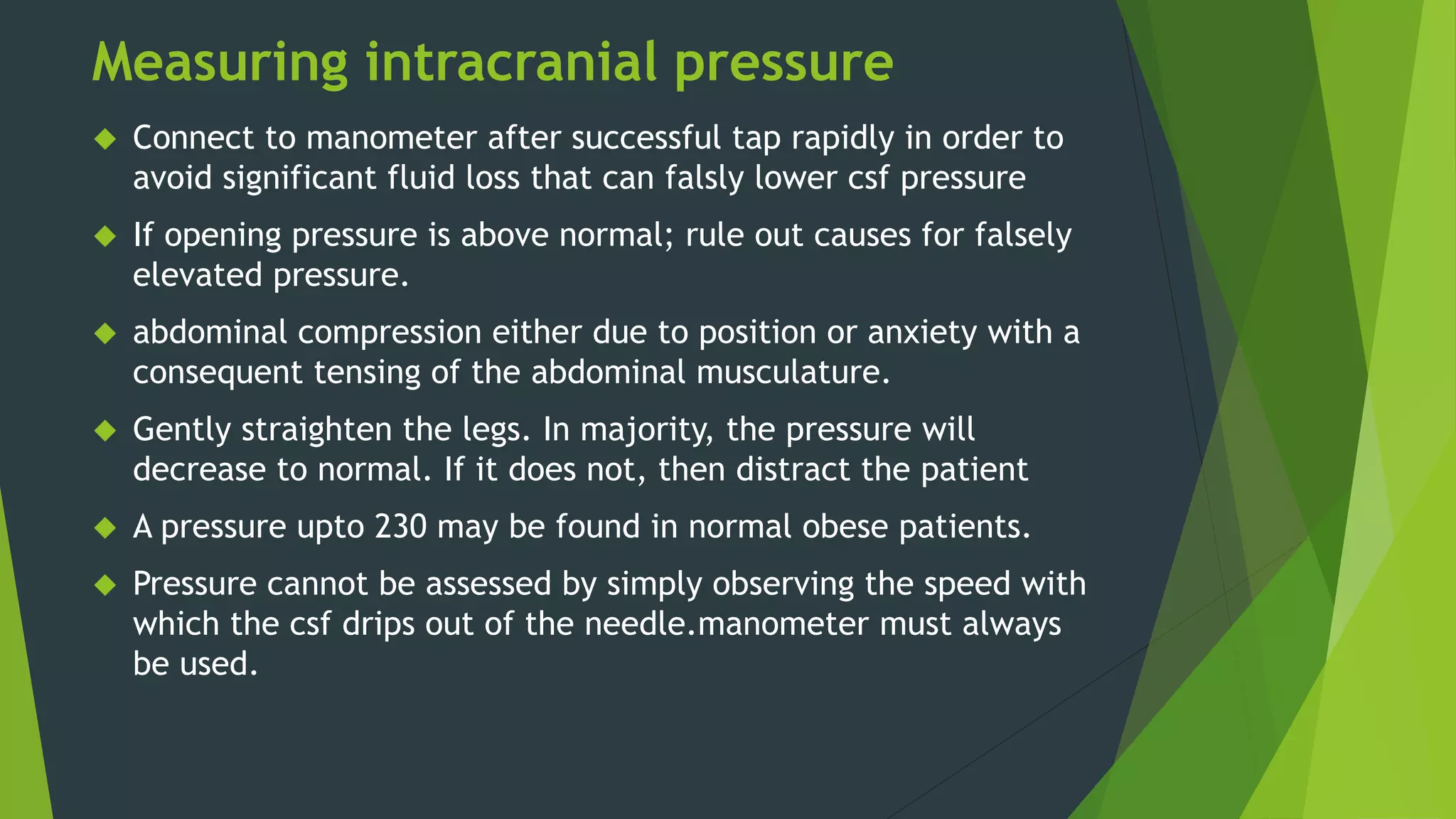
Measuring intracranial pressure 
 Connect to manometer after successful tap rapidly in order to 
avoid significant fluid loss that can falsly lower csf pressure 
 If opening pressure is above normal; rule out causes for falsely 
elevated pressure. 
 abdominal compression either due to position or anxiety with a 
consequent tensing of the abdominal musculature. 
 Gently straighten the legs. In majority, the pressure will 
decrease to normal. If it does not, then distract the patient 
 A pressure upto 230 may be found in normal obese patients. 
 Pressure cannot be assessed by simply observing the speed with 
which the csf drips out of the needle.manometer must always 
be used.
High pressure csf 
Intra cranial neoplasms 
Meningitis 
Sub arachanoid haemorrhage 
Low pressure csf 
• Faulty placement of needle in which abdominal 
compression cause no rise 
• Below the level of complete spinal block
Examination of fluid 
 Hold the container first upto the light and then 
against a white surface. 
 Normal CSF: Clear & colorless 
 Viscosity : Equal to water 
 Turbid CSF- Bacteria, WBCs cells or pus cells: 
suggestive of a CNS infection (menigitis or 
encephalitis) 
 Blood : suggestive of hemorrhage: subarachnoid or 
artifactual traumatic tap: DIFFERNTIATE?
 Yellow colour 
1- Jaundice (bilirubin in CSF) 
2- Xanthochromia: CSF suggests that a subarachnoid 
hemorrhage has recently occurred (at least within 6 
hours prior to tapping). 
The yellow color is due to bilirubin generated in the 
CNS by the breakdown of hemoglobin released from 
RBC's. (so jaundice should be excluded). 
3- rarely highly proteinaceous fluid
Cells 
 An infection of the nervous system produces three basic CSF types 
Type A 
• WBC-500–20,000,90% neutrophils, 
• low CSF sugar, 
• protein elevated to 100–500 mg/dL. 
Type B 
• 25–500 WBC,mononuclear cells (but may be PMLs early in the 
course of disease) 
• low or occasionally normal CSF sugar 
• protein of 50–500 mg/dL,characteristic of tuberculosis and 
other granulomatous meningitides 
Type C 
• 5–1,000 WBC/mm3,mononuclear pleocytosis (may be PMLs 
early) 
• normal glucose(rarely quite low) 
• protein less than 100 mg/dL.
Type A 
Bacterial meningitis 
Primary amoebic meningoencephalitis: rare 
condition caused by free-living amebas. The classic 
epidemiology,absence of organisms on gram stain and eventually 
on culture, hemorrhagic component to the fluid should promptly 
suggest the diagnosis, which can be confirmed by wet mounts of 
the CSF revealing motile trophozoites 
Ruptured brain abscess : diagnosed by a gram stain 
showing 
multiple types of organisms, an extremely high protein 
level 
and isolation of multiple organisms including 
anaerobes.
TYPE B 
Tuberculosis 
Fungal meningitis: produced by a variety of fungi; the 
most common are cryptococci, histoplasma, coccidioides and 
candida.seen in immuno-suppressed 
Sarcoidosis :often has meningeal involvement. Te 
characteristic picture is a mild to moderate pleocytosis that is 
almost mononuclear, in the range of 10–300 WBC/mm3, mild 
to moderate protein elevation (between 50 mg/dL and 200 
Meningeal carcinomatosis : crux of the diagnosis is the 
demonstration of neoplastic cells in the CSF. Te most common 
primary tumors reported to cause meningeal carcinomatosis are 
breast carcinoma, lymphomas, lung carcinoma and pancreatic carcinoma. 
Csf protein is markedly elevated.
Type c fluid 
Parameningeal infections 
Listeria monocytogenes meningitis is peculiar gram-positive 
rod with characteristic “tumbling motility” 
Secondary syphilis 
Toxoplasmosis 
Herpes simplex virus 1 (HSV-1) meningoencephalitis, 
Viral meningitis enteroviruses account for over 50% of 
cases. Other agents include flaviviruses, mumps, herpes 
simplex, lymphocytic choriomeningitis (LCM) and the 
human immunodeficiency virus (HIV). 
Human immunodeficiency virus
CSF Glucose 
- Normal CSF glucose: 50-80 mg/dl 
- The actual CSF glucose concentration may be: 
1- Falsely low in the presence of hypoglycemia 
2- Incorrectly interpreted as normal when the patient is hyperglycemic 
-Accordingly, CSF glucose should always be compared with a 
simultaneous 
plasma glucose that is drawn prior to lumbar puncture. 
Normal CSF glucose/ plasma glucose ratio is approximately 0.6-0.7 
(N.B. Ratio is decreased if plasma glucose is more than 500 mg/dl 
due to saturation of the glucose carrier system to CSF
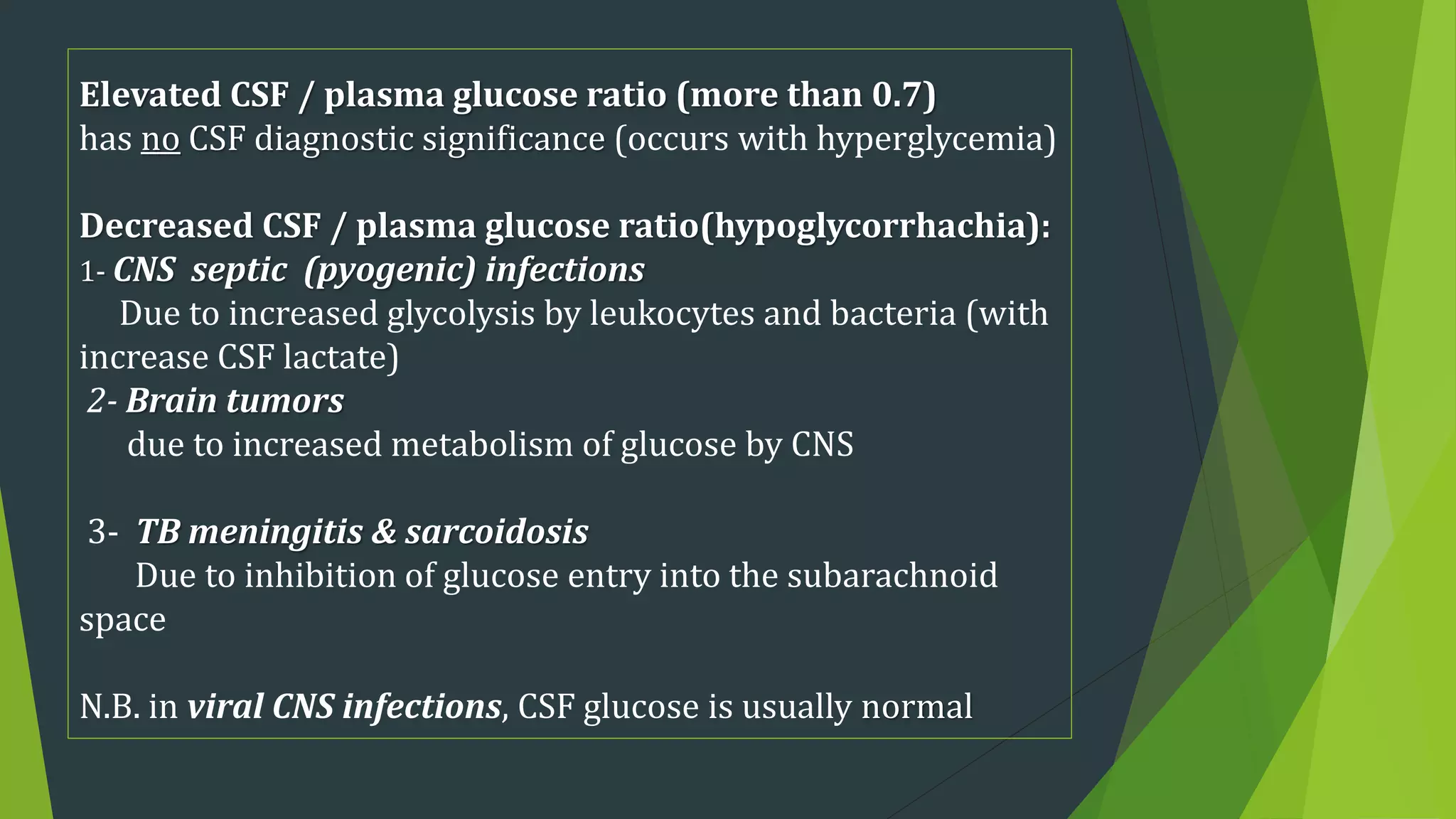
Elevated CSF / plasma glucose ratio (more than 0.7) 
has no CSF diagnostic significance (occurs with hyperglycemia) 
Decreased CSF / plasma glucose ratio(hypoglycorrhachia): 
1- CNS septic (pyogenic) infections 
Due to increased glycolysis by leukocytes and bacteria (with 
increase CSF lactate) 
2- Brain tumors 
due to increased metabolism of glucose by CNS 
3- TB meningitis & sarcoidosis 
Due to inhibition of glucose entry into the subarachnoid 
space 
N.B. in viral CNS infections, CSF glucose is usually normal
CSF PROTEINS 
 Cerebrospinal fluid proteins are derived from serum 
proteins with the exception of trace proteins and 
some beta globulins. 
 Certain proteins arise within the intrathecal 
compartment: 
1- Immunoglobulins produced by CNS lymphocytes 
2- Transthyretin (produced by choroid plexus) 
3- Various structural proteins found in brain tissue
Three conditions can cause abnormalities of 
the CSF proteins: 
Increased entry of plasma proteins due to 
increased permeability of blood-brain 
barrier 
 Local synthesis of proteins within the CNS 
 Impaired resorption of CSF proteins.
Decreased CSF protein: 
Leak of CSF from a tear in the dura due to 
severe trauma 
 Otorrohea: leak of CSF from ear 
Rhinorrohea: leak of CSF from nose
Increased CSF protein: 
 Lysis of contaminant blood from traumatic tap (each 
1,000 rbc/mm3 raise the csf protein 1.5mg/dl) 
 Increased permeability of epithelial membrane (blood-brain 
barrier) 
- CNS bacterial or fungal infections 
- Cerebral hemorrhages 
 Increased production by CNS tissue as in cases of: 
- Multiple sclerosis (MS) 
- Subacute sclerosing panencephalitis (SSPE) 
 Obstruction as in cases of : 
- Tumors or abscess
Analysis of protein fractions: (Albumin & IgG) 
 1- Albumin of CSF 
is obtained from blood by means of blood-brain barrier (as it is 
produced solely by the liver) 
In cases of increased permeability of BBB, albumin is increased in 
CSF 
 2- IgG of CSF can be obtained: 
from blood (By BBB) : increase in cases of increase permeability of BBB 
& by local synthesis from plasma cells within CSF (increased in cases of 
MS) 
So, it is essential to determine the source of IgG
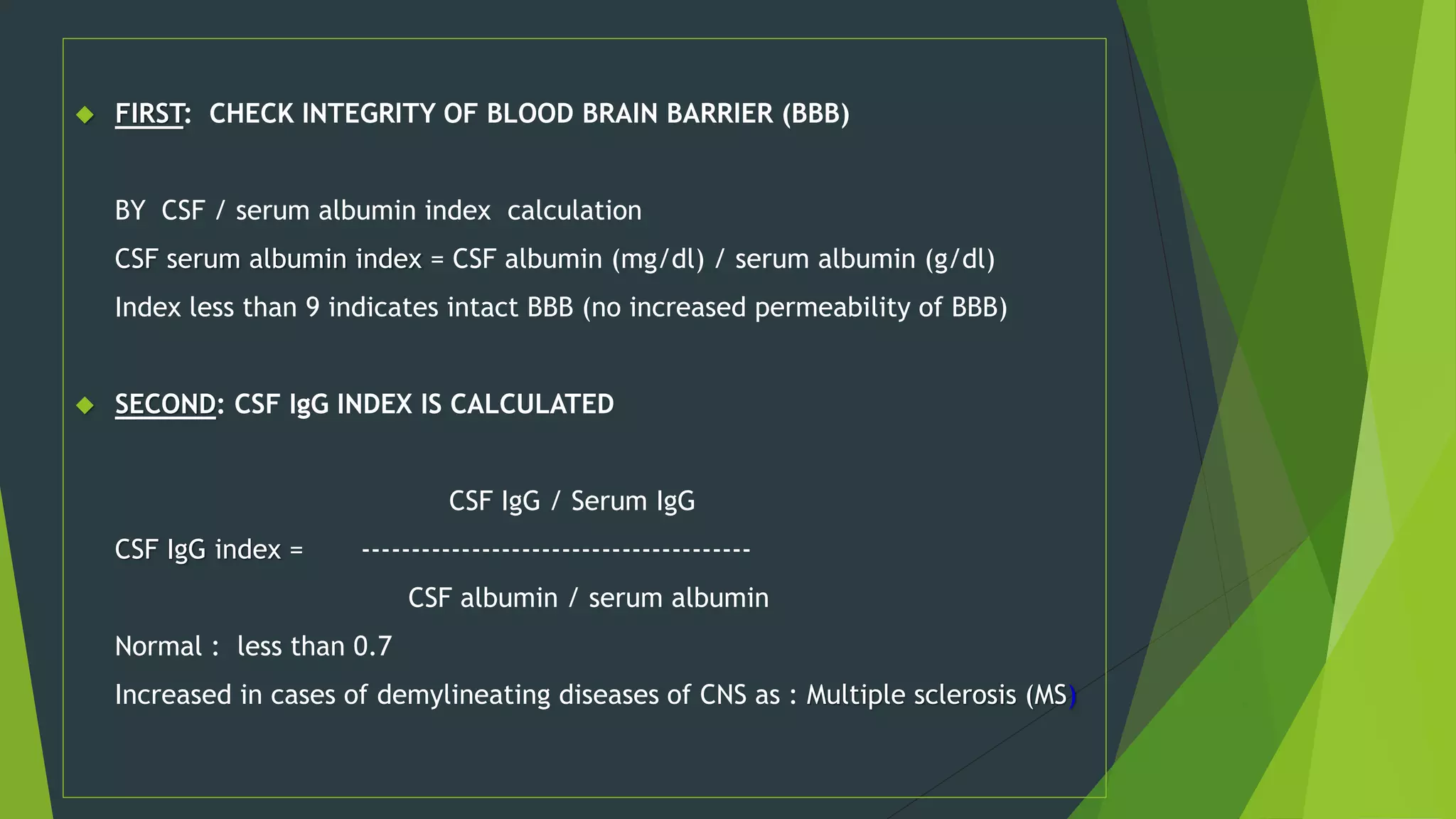
 FIRST: CHECK INTEGRITY OF BLOOD BRAIN BARRIER (BBB) 
BY CSF / serum albumin index calculation 
CSF serum albumin index = CSF albumin (mg/dl) / serum albumin (g/dl) 
Index less than 9 indicates intact BBB (no increased permeability of BBB) 
 SECOND: CSF IgG INDEX IS CALCULATED 
CSF IgG / Serum IgG 
CSF IgG index = --------------------------------------- 
CSF albumin / serum albumin 
Normal : less than 0.7 
Increased in cases of demylineating diseases of CNS as : Multiple sclerosis (MS)
CSF Immunoglobulin 
CSF IgG/Serum IgG 
CSF serum /Albumin index 
 CSF IgG can arise: 
1)from plasma cells within CSF 
2) from the blood through BBB 
CSF IgG index: 
Normally: < 0.7 
= 
 ↑CSF [IgG] without concomitant ↑ in CSF [Alb] suggests local 
production of IgG: 
 multiple sclerosis (MS) 
 subacute sclerosing panencephalitis (SPEE)
CSF Electrophoresis: Oligoclonal Banding
CSF lactate 
CSF lactate is increased in cases of bacterial 
meningitis (due to increased glycolysis by bacteria & 
inflamatory cells)
CSF glutamine 
The level of CSF glutamine reflects level of ammonia 
in that is normally removed in the CNS by formation of 
glutamine (amino acid glutamate + ammonia). 
Glutamine synthesis helps to protect the CNS from the 
toxic effects of increased ammonia. 
Ammonia production is increase dramatically in 
patients with liver failure. 
Accordingly, CSF glutamine production is increased in 
cases of hepatic encephalopathy
Enzymes in the CSF 
CSF lactate dehydrogenase (LDH) may be 
elevated in bacterial meningitis. 
CSF adenosine deaminase (ADA) 
elevations can occur in tuberculous 
meningitis.
Other Chemical Components of 
CSF 
 CSF [Calcium], [Potassium] & [Phosphates] are lower 
than their levels in the blood 
 CSF [Chloride] & [Magnesium] are higher than their 
levels in the blood 
 Abnormal CSF [Chloride] 
 marked  in acute bacterial meningitis 
 slight  in viral meningitis & brain tumors
Interpretations of Results of CSF 
Chemical Analysis 
Bacterial 
Meningitis 
Viral 
Meningitis 
Tuberculous 
Meningitis 
Brain Tumor 
Protei 
n 
Increased Normal Increased Increased 
Glucose Decreased 
Normal 
or 
slightly 
affected 
Decreased Decreased
THANK YOU

cerebro spinal fluid analysis

  • 1.
    CEREBRO SPINAL FLUID ANALYSIS Dr Anvesh Narimeti Unit 1
  • 2.
    HISTORY  Thetechnique for needle lumbar puncture was introduced by the German physician Heinrich Quincke • He was perhaps the first to recognise angioedema whic h is often referred to as "Quincke's edema "Quincke's pulse“ in AR
  • 3.
    CSF PRODUCTION ANDCIRCULATION
  • 4.
    1. Normal bloodbrain barrier is important for the normal chemistry results of CSF 2. Mechanism of formation: 1. Selective ultrafiltration of plasma 2. Active secretion by epithelial membrane PRESSURE OF CSF DEPENDS ON DRAINAGE SYSTEM TOTAL PRODUCTION OF CSF PER DAY=500-600 ml per day TOTAL VOLUME OF CSF IN ADULT IS = 140 ml THE RATE OF ABSORPTION CORRELATES WITH THE CSF PRESSURE
  • 5.
    LUMBAR PUNCTURE lumbarpuncture should be carried out if some specific piece of information is likely to come from csf examination that would substantially contribute towards  Diagnosis  Treatment  Assesment of progress of disease WE PERFORM CT SCAN IN SUSPECTED MENINGITIS BEFORE LP IF ONE OR MORE RISK FACTORS ARE PRESENT  ALTERED MENTATION  FOCAL NEUROLOGICAL SIGNS  PAPILLEDEMA  SEIZURES WITH IN PREVIOUS WEEK  IMPAIRED CELLULAR IMMUNITY
  • 6.
    CONTRAINDICATIONS ABSOLUTE •LOCAL SEPSIS • SPACE OCCUPYING LESION WITH RAISED ICT RELATIVE • PAPILLEDEMA • BLEEDING DIATHESIS PLATELTS LESS THAN 50000 SEVERE PULMONARY AND RESPIRATORY DIFFICULTY
  • 7.
  • 9.
    COMPLICATIONS OF LP  POST LP HEAD ACHE  INFECTION  BLEEDING  CEREBRAL HERNIATION  MINOR NEUROLOGICAL SYMPTOMS LIKE RADICULAR PAIN AND NUMBNESS  BACK PAIN  DIPLOPIA SUSPECT HERNIATION? DETERIORATION OF CONSCIOUSNESS IMMEDIATELY OR WITH IN 12 HRS NECK STIFFNESS DILATED PUPILS BRADYCARDIA
  • 10.
    NORMAL VALUES OFADULT CSF Opening pressure 50–200 mm H2O CSF (range in literature) Color Colorless Turbidity Crystal clear Mononuclear cells Less than 5 per mm3 Polymorpho nuclear cells 0 Total protein Glucose 22–38 mg/dL 60–80% of blood glucose
  • 11.
    Measuring intracranial pressure  Connect to manometer after successful tap rapidly in order to avoid significant fluid loss that can falsly lower csf pressure  If opening pressure is above normal; rule out causes for falsely elevated pressure.  abdominal compression either due to position or anxiety with a consequent tensing of the abdominal musculature.  Gently straighten the legs. In majority, the pressure will decrease to normal. If it does not, then distract the patient  A pressure upto 230 may be found in normal obese patients.  Pressure cannot be assessed by simply observing the speed with which the csf drips out of the needle.manometer must always be used.
  • 12.
    High pressure csf Intra cranial neoplasms Meningitis Sub arachanoid haemorrhage Low pressure csf • Faulty placement of needle in which abdominal compression cause no rise • Below the level of complete spinal block
  • 13.
    Examination of fluid  Hold the container first upto the light and then against a white surface.  Normal CSF: Clear & colorless  Viscosity : Equal to water  Turbid CSF- Bacteria, WBCs cells or pus cells: suggestive of a CNS infection (menigitis or encephalitis)  Blood : suggestive of hemorrhage: subarachnoid or artifactual traumatic tap: DIFFERNTIATE?
  • 14.
     Yellow colour 1- Jaundice (bilirubin in CSF) 2- Xanthochromia: CSF suggests that a subarachnoid hemorrhage has recently occurred (at least within 6 hours prior to tapping). The yellow color is due to bilirubin generated in the CNS by the breakdown of hemoglobin released from RBC's. (so jaundice should be excluded). 3- rarely highly proteinaceous fluid
  • 15.
    Cells  Aninfection of the nervous system produces three basic CSF types Type A • WBC-500–20,000,90% neutrophils, • low CSF sugar, • protein elevated to 100–500 mg/dL. Type B • 25–500 WBC,mononuclear cells (but may be PMLs early in the course of disease) • low or occasionally normal CSF sugar • protein of 50–500 mg/dL,characteristic of tuberculosis and other granulomatous meningitides Type C • 5–1,000 WBC/mm3,mononuclear pleocytosis (may be PMLs early) • normal glucose(rarely quite low) • protein less than 100 mg/dL.
  • 16.
    Type A Bacterialmeningitis Primary amoebic meningoencephalitis: rare condition caused by free-living amebas. The classic epidemiology,absence of organisms on gram stain and eventually on culture, hemorrhagic component to the fluid should promptly suggest the diagnosis, which can be confirmed by wet mounts of the CSF revealing motile trophozoites Ruptured brain abscess : diagnosed by a gram stain showing multiple types of organisms, an extremely high protein level and isolation of multiple organisms including anaerobes.
  • 17.
    TYPE B Tuberculosis Fungal meningitis: produced by a variety of fungi; the most common are cryptococci, histoplasma, coccidioides and candida.seen in immuno-suppressed Sarcoidosis :often has meningeal involvement. Te characteristic picture is a mild to moderate pleocytosis that is almost mononuclear, in the range of 10–300 WBC/mm3, mild to moderate protein elevation (between 50 mg/dL and 200 Meningeal carcinomatosis : crux of the diagnosis is the demonstration of neoplastic cells in the CSF. Te most common primary tumors reported to cause meningeal carcinomatosis are breast carcinoma, lymphomas, lung carcinoma and pancreatic carcinoma. Csf protein is markedly elevated.
  • 18.
    Type c fluid Parameningeal infections Listeria monocytogenes meningitis is peculiar gram-positive rod with characteristic “tumbling motility” Secondary syphilis Toxoplasmosis Herpes simplex virus 1 (HSV-1) meningoencephalitis, Viral meningitis enteroviruses account for over 50% of cases. Other agents include flaviviruses, mumps, herpes simplex, lymphocytic choriomeningitis (LCM) and the human immunodeficiency virus (HIV). Human immunodeficiency virus
  • 19.
    CSF Glucose -Normal CSF glucose: 50-80 mg/dl - The actual CSF glucose concentration may be: 1- Falsely low in the presence of hypoglycemia 2- Incorrectly interpreted as normal when the patient is hyperglycemic -Accordingly, CSF glucose should always be compared with a simultaneous plasma glucose that is drawn prior to lumbar puncture. Normal CSF glucose/ plasma glucose ratio is approximately 0.6-0.7 (N.B. Ratio is decreased if plasma glucose is more than 500 mg/dl due to saturation of the glucose carrier system to CSF
  • 20.
    Elevated CSF /plasma glucose ratio (more than 0.7) has no CSF diagnostic significance (occurs with hyperglycemia) Decreased CSF / plasma glucose ratio(hypoglycorrhachia): 1- CNS septic (pyogenic) infections Due to increased glycolysis by leukocytes and bacteria (with increase CSF lactate) 2- Brain tumors due to increased metabolism of glucose by CNS 3- TB meningitis & sarcoidosis Due to inhibition of glucose entry into the subarachnoid space N.B. in viral CNS infections, CSF glucose is usually normal
  • 21.
    CSF PROTEINS Cerebrospinal fluid proteins are derived from serum proteins with the exception of trace proteins and some beta globulins.  Certain proteins arise within the intrathecal compartment: 1- Immunoglobulins produced by CNS lymphocytes 2- Transthyretin (produced by choroid plexus) 3- Various structural proteins found in brain tissue
  • 22.
    Three conditions cancause abnormalities of the CSF proteins: Increased entry of plasma proteins due to increased permeability of blood-brain barrier  Local synthesis of proteins within the CNS  Impaired resorption of CSF proteins.
  • 23.
    Decreased CSF protein: Leak of CSF from a tear in the dura due to severe trauma  Otorrohea: leak of CSF from ear Rhinorrohea: leak of CSF from nose
  • 24.
    Increased CSF protein:  Lysis of contaminant blood from traumatic tap (each 1,000 rbc/mm3 raise the csf protein 1.5mg/dl)  Increased permeability of epithelial membrane (blood-brain barrier) - CNS bacterial or fungal infections - Cerebral hemorrhages  Increased production by CNS tissue as in cases of: - Multiple sclerosis (MS) - Subacute sclerosing panencephalitis (SSPE)  Obstruction as in cases of : - Tumors or abscess
  • 25.
    Analysis of proteinfractions: (Albumin & IgG)  1- Albumin of CSF is obtained from blood by means of blood-brain barrier (as it is produced solely by the liver) In cases of increased permeability of BBB, albumin is increased in CSF  2- IgG of CSF can be obtained: from blood (By BBB) : increase in cases of increase permeability of BBB & by local synthesis from plasma cells within CSF (increased in cases of MS) So, it is essential to determine the source of IgG
  • 26.
     FIRST: CHECKINTEGRITY OF BLOOD BRAIN BARRIER (BBB) BY CSF / serum albumin index calculation CSF serum albumin index = CSF albumin (mg/dl) / serum albumin (g/dl) Index less than 9 indicates intact BBB (no increased permeability of BBB)  SECOND: CSF IgG INDEX IS CALCULATED CSF IgG / Serum IgG CSF IgG index = --------------------------------------- CSF albumin / serum albumin Normal : less than 0.7 Increased in cases of demylineating diseases of CNS as : Multiple sclerosis (MS)
  • 27.
    CSF Immunoglobulin CSFIgG/Serum IgG CSF serum /Albumin index  CSF IgG can arise: 1)from plasma cells within CSF 2) from the blood through BBB CSF IgG index: Normally: < 0.7 =  ↑CSF [IgG] without concomitant ↑ in CSF [Alb] suggests local production of IgG:  multiple sclerosis (MS)  subacute sclerosing panencephalitis (SPEE)
  • 28.
  • 29.
    CSF lactate CSFlactate is increased in cases of bacterial meningitis (due to increased glycolysis by bacteria & inflamatory cells)
  • 30.
    CSF glutamine Thelevel of CSF glutamine reflects level of ammonia in that is normally removed in the CNS by formation of glutamine (amino acid glutamate + ammonia). Glutamine synthesis helps to protect the CNS from the toxic effects of increased ammonia. Ammonia production is increase dramatically in patients with liver failure. Accordingly, CSF glutamine production is increased in cases of hepatic encephalopathy
  • 31.
    Enzymes in theCSF CSF lactate dehydrogenase (LDH) may be elevated in bacterial meningitis. CSF adenosine deaminase (ADA) elevations can occur in tuberculous meningitis.
  • 32.
    Other Chemical Componentsof CSF  CSF [Calcium], [Potassium] & [Phosphates] are lower than their levels in the blood  CSF [Chloride] & [Magnesium] are higher than their levels in the blood  Abnormal CSF [Chloride]  marked  in acute bacterial meningitis  slight  in viral meningitis & brain tumors
  • 33.
    Interpretations of Resultsof CSF Chemical Analysis Bacterial Meningitis Viral Meningitis Tuberculous Meningitis Brain Tumor Protei n Increased Normal Increased Increased Glucose Decreased Normal or slightly affected Decreased Decreased
  • 34.