Coagulation Profile
Dr. Anand T. More
Department of Physiology
D. Y. Patil Medical College, Kolhapur
Introduction
• This tests are determined to assess the integrity of haemostatic
mechanism.
HAEMOSTASIS –
Spontaneous arrest or prevention of bleeding by
physiological process is called haemostasis.
Series of events involved in haemostasis
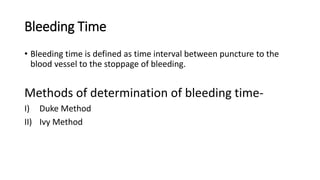
Bleeding Time
• Bleeding time is defined as time interval between puncture to the
blood vessel to the stoppage of bleeding.
Methods of determination of bleeding time-
I) Duke Method
II) Ivy Method
Duke Method
[ 30 sec interval ]
5 blots (4 blood blots+ 1 blank blot) x 30 sec = 2mins 30 sec
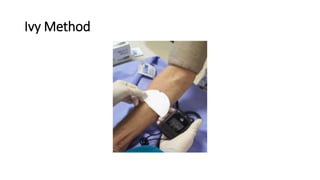
Ivy Method
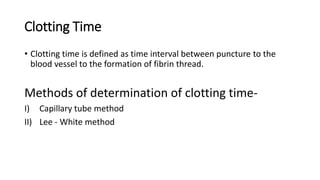
Clotting Time
• Clotting time is defined as time interval between puncture to the
blood vessel to the formation of fibrin thread.
Methods of determination of clotting time-
I) Capillary tube method
II) Lee - White method
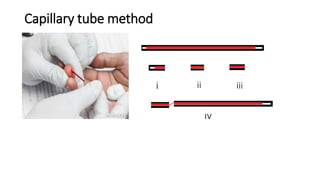
Capillary tube method
iv
i ii iii
Lee - White method
Principle
Venous blood is collected in clean glass tube without any anticoagulant.
The time taken by blood to clot at 37 degree Celsius is noted as clotting
time.
Normal Value – 5 to 12 minutes
Conditions where BT & CT are altered
Bleeding time is prolonged in :
i) Thrombocytopenia - ↓ in platelet count
ii) Thrombasthenia – Platelet count is normal but they are functionally
abnormal
iii) Von Willebrand disease – Platelet defect combined with factor VIII
deficiency.
iv) Purpura – It is a condition with various manifestation & different
causes, characterized by capillary abnormality resulting in
haemorrhages into the skin, mucous membrane, internal organ &
other tissues.
Clotting time is prolonged in :
i) Classical Haemophilia (Haemophilia A)
ii) Vitamin K deficiency (Factor II, VII, IX & X)
iii) Christmas disease (Factor IX)
iv) Liver diseases – Hepatitis, cirrhosis
v) Anticoagulant overdose
Clinical significance of determining BT & CT
It is very important to know BT & CT in the following conditions :
i) Before surgery (Fitness test)
ii) Before any biopsy (especially liver or bone marrow biopsy)
iii) Before putting any patient on anticoagulant therapy
iv) Aspirin or any other NSAID (Inhibit enzyme cyclooxygenase which
leads to inhibition of platelet aggregation)
Other tests for bleeding disorders
Capillary Fragility Test
Principle
This test measures the ability of the capillaries to withstand increased
stress.
Petechiae appear in the forearm of the subject when the blood
pressure cuff in the arm is inflated to a maximum pressure of 100mm
Hg for about 5 minutes.
Platelet Aggregation Test
Principle
An aggregating agent is added to a suspension of platelets in plasma
and the response is measured turbidometrically as a change in the
transmission of light by an instrument called the aggregometer.
Platelet Adhesiveness Test
Principle
This test measures the ability of platelets to adhere to a glass surface.
When anticoagulated blood is allowed to pass at a constant rate
through a plastic tube containing glass beads, some platelets adhere to
the glass beads.
The percentage difference of the platelet count prior to & after passing
through the glass bead column indicates the functional status of
platelets.
Clot Retraction Time
Principle
Blood clots when collected in a glass tube without any anticoagulant.
The clot begins to retract (after blood has clotted) within 30 seconds, &
about 50% at the end of 1 hour.
At the end 18-24 hours the clot should have retracted completely.
Clot Lysis Time
Principle
The clot is lysed due to fibrinolysis, which is a natural process.
Due to lysis the clot becomes fluid & red cells sink to the bottom of the
test tube.
Prothrombin Consumption Test
Principle
This test determines the amount of prothrombin present in the serum
after clot formation.
Prothrombin Time (PT)
Principle
A preparation of rabbit brain emulsion (which contains tissue
thromboplastin) is added to plasma in the presence of calcium. This, in
the presence of factor VII triggers stage 2 of the coagulation
mechanism, & the clotting time is recorded after the addition of
calcified thromboplastin to the plasma
Normal Value - 12-16 seconds
Partial Thromboplastin Time (PTT)
Principle
The platelet substitute, in the form of partial thromboplastin, is
prepared from rabbit brain as chloroform extract. When mixed with
test plasma containing excess of calcium, it leads to clot formation.
Normal Value - 60 to 80 seconds
Activated Partial Thromboplastin Time (aPTT)
Principle
The platelet substitute, in the form of partial thromboplastin is
prepared from rabbit brain. This is incubated with a contacting agent
(kaolin) to provide optimal activation of the intrinsic coagulation
factors. The clotting time is determined after the addition of excess of
calcium.
Normal Value – 25 to 40 seconds
Thrombin Time (TT)
Principle
Thrombin (commercially available) is added to the plasma along with
calcium & the clotting time is determined.
Normal Value – 15-20 seconds
Plasma Recalcification Time (PRT)
Principle
When excess of calcium is added to the citrated plasma, clotting
occurs. Because platelet factor III is also involved in clotting through the
intrinsic pathway of coagulation, the clotting occurs in a shorter time in
platelet rich plasma than in platelet poor plasma.
Normal Value –
Platelet rich plasma - 100 to 150 seconds
Platelet poor plasma – 135 to 240 seconds
Source
• G. K. Pal Textbook of practical physiology
• A. K. Jain Manual of Practical physiology
• Net source
Thank You

Coagulation profile

  • 1.
    Coagulation Profile Dr. AnandT. More Department of Physiology D. Y. Patil Medical College, Kolhapur
  • 2.
    Introduction • This testsare determined to assess the integrity of haemostatic mechanism. HAEMOSTASIS – Spontaneous arrest or prevention of bleeding by physiological process is called haemostasis.
  • 3.
    Series of eventsinvolved in haemostasis
  • 4.
    Bleeding Time • Bleedingtime is defined as time interval between puncture to the blood vessel to the stoppage of bleeding. Methods of determination of bleeding time- I) Duke Method II) Ivy Method
  • 5.
    Duke Method [ 30sec interval ] 5 blots (4 blood blots+ 1 blank blot) x 30 sec = 2mins 30 sec
  • 6.
  • 7.
    Clotting Time • Clottingtime is defined as time interval between puncture to the blood vessel to the formation of fibrin thread. Methods of determination of clotting time- I) Capillary tube method II) Lee - White method
  • 8.
  • 10.
    Lee - Whitemethod Principle Venous blood is collected in clean glass tube without any anticoagulant. The time taken by blood to clot at 37 degree Celsius is noted as clotting time. Normal Value – 5 to 12 minutes
  • 11.
    Conditions where BT& CT are altered Bleeding time is prolonged in : i) Thrombocytopenia - ↓ in platelet count ii) Thrombasthenia – Platelet count is normal but they are functionally abnormal iii) Von Willebrand disease – Platelet defect combined with factor VIII deficiency. iv) Purpura – It is a condition with various manifestation & different causes, characterized by capillary abnormality resulting in haemorrhages into the skin, mucous membrane, internal organ & other tissues.
  • 12.
    Clotting time isprolonged in : i) Classical Haemophilia (Haemophilia A) ii) Vitamin K deficiency (Factor II, VII, IX & X) iii) Christmas disease (Factor IX) iv) Liver diseases – Hepatitis, cirrhosis v) Anticoagulant overdose
  • 13.
    Clinical significance ofdetermining BT & CT It is very important to know BT & CT in the following conditions : i) Before surgery (Fitness test) ii) Before any biopsy (especially liver or bone marrow biopsy) iii) Before putting any patient on anticoagulant therapy iv) Aspirin or any other NSAID (Inhibit enzyme cyclooxygenase which leads to inhibition of platelet aggregation)
  • 14.
    Other tests forbleeding disorders Capillary Fragility Test Principle This test measures the ability of the capillaries to withstand increased stress. Petechiae appear in the forearm of the subject when the blood pressure cuff in the arm is inflated to a maximum pressure of 100mm Hg for about 5 minutes.
  • 15.
    Platelet Aggregation Test Principle Anaggregating agent is added to a suspension of platelets in plasma and the response is measured turbidometrically as a change in the transmission of light by an instrument called the aggregometer.
  • 16.
    Platelet Adhesiveness Test Principle Thistest measures the ability of platelets to adhere to a glass surface. When anticoagulated blood is allowed to pass at a constant rate through a plastic tube containing glass beads, some platelets adhere to the glass beads. The percentage difference of the platelet count prior to & after passing through the glass bead column indicates the functional status of platelets.
  • 17.
    Clot Retraction Time Principle Bloodclots when collected in a glass tube without any anticoagulant. The clot begins to retract (after blood has clotted) within 30 seconds, & about 50% at the end of 1 hour. At the end 18-24 hours the clot should have retracted completely.
  • 18.
    Clot Lysis Time Principle Theclot is lysed due to fibrinolysis, which is a natural process. Due to lysis the clot becomes fluid & red cells sink to the bottom of the test tube.
  • 19.
    Prothrombin Consumption Test Principle Thistest determines the amount of prothrombin present in the serum after clot formation.
  • 20.
    Prothrombin Time (PT) Principle Apreparation of rabbit brain emulsion (which contains tissue thromboplastin) is added to plasma in the presence of calcium. This, in the presence of factor VII triggers stage 2 of the coagulation mechanism, & the clotting time is recorded after the addition of calcified thromboplastin to the plasma Normal Value - 12-16 seconds
  • 21.
    Partial Thromboplastin Time(PTT) Principle The platelet substitute, in the form of partial thromboplastin, is prepared from rabbit brain as chloroform extract. When mixed with test plasma containing excess of calcium, it leads to clot formation. Normal Value - 60 to 80 seconds
  • 22.
    Activated Partial ThromboplastinTime (aPTT) Principle The platelet substitute, in the form of partial thromboplastin is prepared from rabbit brain. This is incubated with a contacting agent (kaolin) to provide optimal activation of the intrinsic coagulation factors. The clotting time is determined after the addition of excess of calcium. Normal Value – 25 to 40 seconds
  • 23.
    Thrombin Time (TT) Principle Thrombin(commercially available) is added to the plasma along with calcium & the clotting time is determined. Normal Value – 15-20 seconds
  • 24.
    Plasma Recalcification Time(PRT) Principle When excess of calcium is added to the citrated plasma, clotting occurs. Because platelet factor III is also involved in clotting through the intrinsic pathway of coagulation, the clotting occurs in a shorter time in platelet rich plasma than in platelet poor plasma. Normal Value – Platelet rich plasma - 100 to 150 seconds Platelet poor plasma – 135 to 240 seconds
  • 25.
    Source • G. K.Pal Textbook of practical physiology • A. K. Jain Manual of Practical physiology • Net source
  • 26.