RETICULOCYTE COUNT
SUNIL KUMAR.P
DEPARTMENT OF CLINICAL PATHOLOGY
ST.JOHN’S MEDICAL COLLEGE
BANGALORE
13-10-2018 1SUNIL KUMAR. P
INTRODUCTION:
Reticulocytes are :-
→ Immature Red blood cells.
→Larger than RBC’s .

→Non-nucleated.
→Cytoplasm contains ribosomal RNA
→ Contain other cytoplasmic organelles, such as
mitocondria, remnants of the Golgi appartus,
Centrioles, Ferritin molecules etc.
→They are stainable with basic dyes like Brilliant cresyl
blue and new methylene blue.
13-10-2018 2SUNIL KUMAR. P
Gilmer and Koepke defined reticulocyte in 1976:
DEFINATION:
ā€˜A reticulocyte is a non-nucleated red blood cell, which
consists of at least two or more particles (ā€˜dots’) of blue-
stained basophilic polyribosomal material in the cytoplasm
after staining with new methylene blue. The dots should be at
a clear distance from the cell wall to avoid being mistaken for
Heinz bodies. Cells with clear, blue cytoplasmic granulae,
which can be seen without fine focussing, are to be regarded
as reticulocytes of maturation stage IV’.
13-10-2018 3SUNIL KUMAR. P
STAGES OF MATURATION
Identified by their morphological features:-
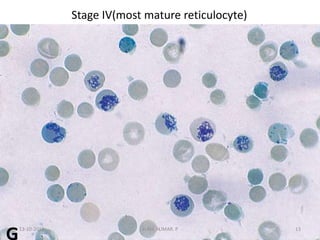
1.Most immature Reticulocytes → Large clumps of
reticulin.
2.Most mature Reticulocyte → Few granules of
reticulin.
13-10-2018 4SUNIL KUMAR. P
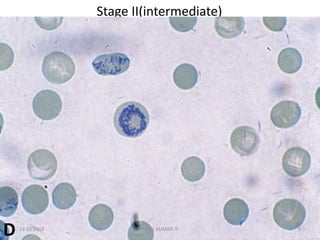
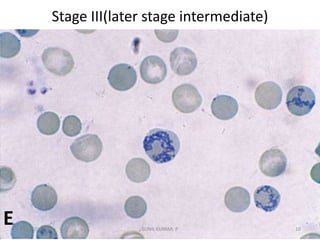
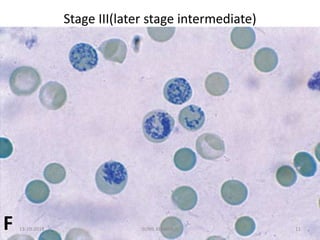
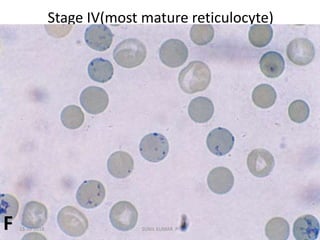
Classification of maturation stages by Heilmeyer-1932
Maturation Morphological Description
Stage
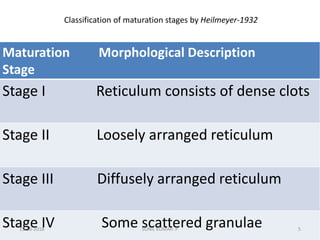
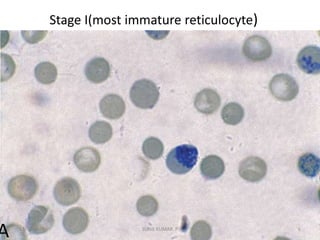
Stage I Reticulum consists of dense clots
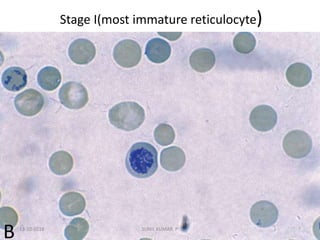
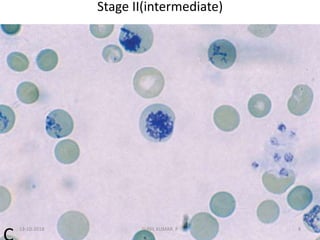
Stage II Loosely arranged reticulum
Stage III Diffusely arranged reticulum
Stage IV Some scattered granulae13-10-2018 5SUNIL KUMAR. P
Stage I(most immature reticulocyte)
A 13-10-2018 6SUNIL KUMAR. P
Stage I(most immature reticulocyte)
B 13-10-2018 7SUNIL KUMAR. P
Stage II(intermediate)
13-10-2018 8SUNIL KUMAR. P
Stage II(intermediate)
D 13-10-2018 9SUNIL KUMAR. P
Stage III(later stage intermediate)
E 13-10-2018 10SUNIL KUMAR. P
Stage III(later stage intermediate)
F 13-10-2018 11SUNIL KUMAR. P
Stage IV(most mature reticulocyte)
F 13-10-2018 12SUNIL KUMAR. P
Stage IV(most mature reticulocyte)
G13-10-2018 13SUNIL KUMAR. P
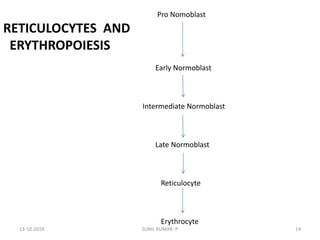
Pro Nomoblast
RETICULOCYTES AND
ERYTHROPOIESIS
Early Normoblast
Intermediate Normoblast
Late Normoblast
Reticulocyte
Erythrocyte
13-10-2018 14SUNIL KUMAR. P
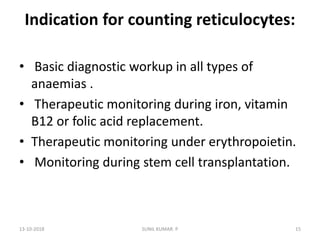
Indication for counting reticulocytes:
• Basic diagnostic workup in all types of
anaemias .
• Therapeutic monitoring during iron, vitamin
B12 or folic acid replacement.
• Therapeutic monitoring under erythropoietin.
• Monitoring during stem cell transplantation.
13-10-2018 15SUNIL KUMAR. P
Reticulocyte count
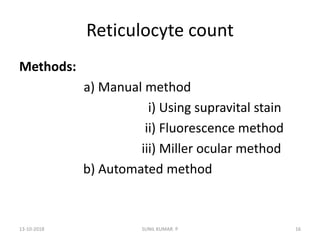
Methods:
a) Manual method
i) Using supravital stain
ii) Fluorescence method
iii) Miller ocular method
b) Automated method
13-10-2018 16SUNIL KUMAR. P
a)MANUAL METHOD
PRINCIPLE:
Supravital stain is used for reticulocyte
count. Blood is mixed with the stain and stain
enters the cell in living condition .Reticulocyte
contains ribosoms and RNA which stain with
supravital stain and appears as blue filamentous
or granular material.
13-10-2018 17SUNIL KUMAR. P
STAINS:
I) Brilliant cresyl blue- An oxazine dye
II) New Methylene blue-An thiazine dye
III) Azure B
13-10-2018 18SUNIL KUMAR. P
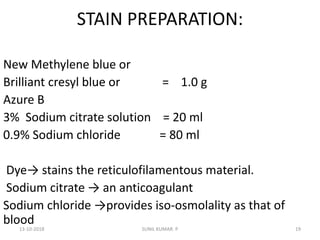
STAIN PREPARATION:
New Methylene blue or
Brilliant cresyl blue or = 1.0 g
Azure B
3% Sodium citrate solution = 20 ml
0.9% Sodium chloride = 80 ml
Dye→ stains the reticulofilamentous material.
Sodium citrate → an anticoagulant
Sodium chloride →provides iso-osmolality as that of
blood
13-10-2018 19SUNIL KUMAR. P
SPECIMEN: EDTA –anticoagulated blood .
PROCEDURE:
1) Take 2-3 drops of dye solution into a small test
tube.
2) Add 2-3 drops of patients EDTA-blood and mix.
3) Incubate at 37⁰C in a waterbath for 15-20
minutes .
4) Mix and prepare smear.
5) Air dry and observe under microscope.
13-10-2018 20SUNIL KUMAR. P
COUNTING
ā— By using oil immersion objective choose an area of
film where the cells are undistorted & staining is good.
ā— In the counting area of the film, cells should not
overlap.
ā— Very large numbers of cells have to be surveyed if a
reasonably precise count is to be obtained when only
small numbers of reticulocytes are present.
13-10-2018 21SUNIL KUMAR. P
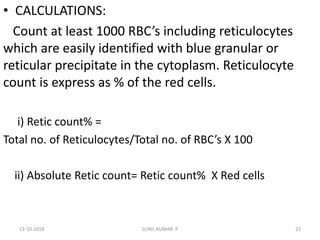
• CALCULATIONS:
Count at least 1000 RBC’s including reticulocytes
which are easily identified with blue granular or
reticular precipitate in the cytoplasm. Reticulocyte
count is express as % of the red cells.
i) Retic count% =
Total no. of Reticulocytes/Total no. of RBC’s X 100
ii) Absolute Retic count= Retic count% X Red cells
13-10-2018 22SUNIL KUMAR. P
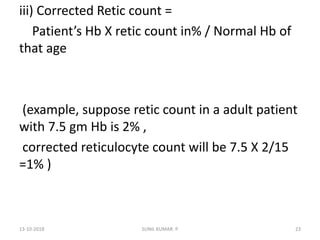
iii) Corrected Retic count =
Patient’s Hb X retic count in% / Normal Hb of
that age
(example, suppose retic count in a adult patient
with 7.5 gm Hb is 2% ,
corrected reticulocyte count will be 7.5 X 2/15
=1% )
13-10-2018 23SUNIL KUMAR. P
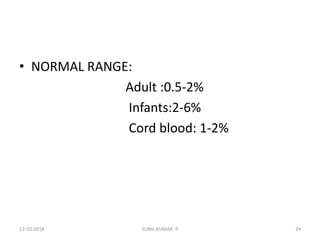
• NORMAL RANGE:
Adult :0.5-2%
Infants:2-6%
Cord blood: 1-2%
13-10-2018 24SUNIL KUMAR. P
Other red cell inclusions can be seen in the brilliant cresyl
blue/new methylene blue smears:
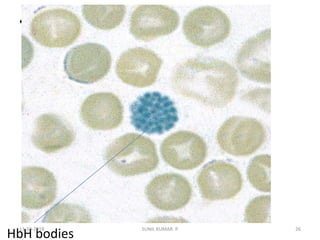
a) HbH bodies:
ā— Round inclusion bodies which stain greenish-blue.
ā— They are found in alpha thalassaemia or Haemoglobin
H disease.
b) Heinz bodies:
ā— Seen as blue granules ,variable in size, lying to one side
of the cell near the membrane.
ā— They are found in G6PD deficiency
13-10-2018 25SUNIL KUMAR. P
• H
HbH bodies
13-10-2018 26SUNIL KUMAR. P
• Hei
Heinz Bodies13-10-2018 27SUNIL KUMAR. P
FLOURESCENT METHOD
PROCEDURE:
1. Add 1 volume of Acridine orange solution with 1
volume of blood.
2. Mix for 2 minutes.
3. Make a film.
4. Dry and observe under Flourescent microscope.
Observation:
RNA gives an orange- red flourescence.
Other nuclear material(DNA)- Yellow flourescence.
13-10-2018 28SUNIL KUMAR. P
AUTOMATION IN RETICULOCYTE COUNT
Example of automated instruments:
i) Sysmex XE-5000,
ii) XT-4000i,
iii) XE-2100,
iv) XT-2000i
Method of Detection:Flourescence(Forward light
scatter & side fluorescent emission)
Reagent used:
Diluent:-Tricine buffer
Dye : Polymethine Dye
with Methanol in Ethylene glycol13-10-2018 29SUNIL KUMAR. P
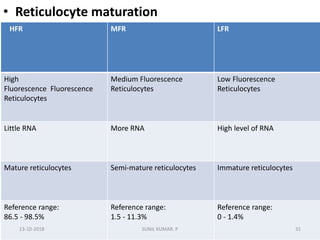
• PRINCIPLE:
Nucleic acids remaining in immature
erythrocytes are stained with a fluorescent
dye RET Search (II), Reticulocytes are
measured based on the principle of flow
cytometry. The fluorescence-stained
reticulocytes are divided into 3 fractions by
the intensity of fluorescence:
13-10-2018 30SUNIL KUMAR. P
• Reticulocyte maturation
HFR MFR LFR
High
Fluorescence Fluorescence
Reticulocytes
Medium Fluorescence
Reticulocytes
Low Fluorescence
Reticulocytes
Little RNA More RNA High level of RNA
Mature reticulocytes Semi-mature reticulocytes Immature reticulocytes
Reference range:
86.5 - 98.5%
Reference range:
1.5 - 11.3%
Reference range:
0 - 1.4%
13-10-2018 31SUNIL KUMAR. P
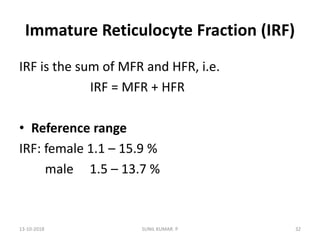
Immature Reticulocyte Fraction (IRF)
IRF is the sum of MFR and HFR, i.e.
IRF = MFR + HFR
• Reference range
IRF: female 1.1 – 15.9 %
male 1.5 – 13.7 %
13-10-2018 32SUNIL KUMAR. P
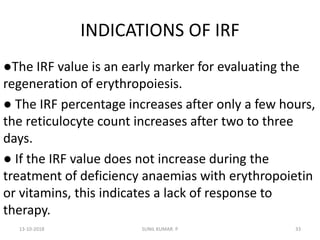
INDICATIONS OF IRF
ā—The IRF value is an early marker for evaluating the
regeneration of erythropoiesis.
ā— The IRF percentage increases after only a few hours,
the reticulocyte count increases after two to three
days.
ā— If the IRF value does not increase during the
treatment of deficiency anaemias with erythropoietin
or vitamins, this indicates a lack of response to
therapy.
13-10-2018 33SUNIL KUMAR. P
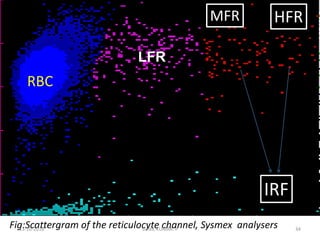
RBC
LL LFhhhhhh
LFR
MFR HFR
I
IRF
Fig:Scattergram of the reticulocyte channel, Sysmex analysers13-10-2018 34SUNIL KUMAR. P
Advantage of automated count:
ā— only 100µl sample required.
ā—More precise
Disadvantage:
ā—Costly
ā—Hawel jolley bodies, giant platelets are counted
as reticulocytes.
Sources of errors:
ā—Fibrin microclots in sample.
ā—Presence of dust particles in the diluent.
13-10-2018 35SUNIL KUMAR. P
CLINICAL SIGNIFICANCE
Abnormal findings:
INCREASED count in-
ā— Acute blood loss
ā— Hemolytic anaemia
ā—Therapy of iron deficiency
ā— Megaloblastic anaemia
ā—Response to specific therapy for megaloblastic
anaemia
ā—Sickle cell anaemia13-10-2018 36SUNIL KUMAR. P
DECREASED count in –
ā—Aplastic anaemia
ā—Anaemia of chronic disease
ā—Iron deficiency anaemia
ā—Deficient Red cell production
ā—Thalassaemia
ā—Sideroblastic anaemia
ā—Anaemia with chronic renal failure
ā—Acute leukaemia
13-10-2018 37SUNIL KUMAR. P
REFERENCES
ā–ŗPractical Haematology-Sir John V Dacie & SM Lewis.
ā–ŗEssentials of Haematology-Shirish M.Kawphalwar.
ā–ŗAdvance Laboratory Methods in Haematology-R.Martin
Rowan & F.Eric Preston.
ā–ŗTextbook of Medical Laboratory Technology-Ramnic Sood.
ā–ŗPractical Pathology-Dr.K.Uma Chaturvedi,
Dr.Tejinder Singh
ā–ŗManual of basic Techniques for a health Laboratory-WHO
ā–ŗ Sysmex xtra online lAugust 2010 l Reticulocytes and their
significance.
13-10-2018 38SUNIL KUMAR. P
13-10-2018 39SUNIL KUMAR. P
13-10-2018 40SUNIL KUMAR. P
13-10-2018 41SUNIL KUMAR. P
13-10-2018 42SUNIL KUMAR. P
13-10-2018 43SUNIL KUMAR. P
13-10-2018 44SUNIL KUMAR. P
13-10-2018 45SUNIL KUMAR. P
13-10-2018 46SUNIL KUMAR. P

Reticulocyte count

  • 1.
    RETICULOCYTE COUNT SUNIL KUMAR.P DEPARTMENTOF CLINICAL PATHOLOGY ST.JOHN’S MEDICAL COLLEGE BANGALORE 13-10-2018 1SUNIL KUMAR. P
  • 2.
    INTRODUCTION: Reticulocytes are :- →Immature Red blood cells. →Larger than RBC’s . →Non-nucleated. →Cytoplasm contains ribosomal RNA → Contain other cytoplasmic organelles, such as mitocondria, remnants of the Golgi appartus, Centrioles, Ferritin molecules etc. →They are stainable with basic dyes like Brilliant cresyl blue and new methylene blue. 13-10-2018 2SUNIL KUMAR. P
  • 3.
    Gilmer and Koepkedefined reticulocyte in 1976: DEFINATION: ā€˜A reticulocyte is a non-nucleated red blood cell, which consists of at least two or more particles (ā€˜dots’) of blue- stained basophilic polyribosomal material in the cytoplasm after staining with new methylene blue. The dots should be at a clear distance from the cell wall to avoid being mistaken for Heinz bodies. Cells with clear, blue cytoplasmic granulae, which can be seen without fine focussing, are to be regarded as reticulocytes of maturation stage IV’. 13-10-2018 3SUNIL KUMAR. P
  • 4.
    STAGES OF MATURATION Identifiedby their morphological features:- 1.Most immature Reticulocytes → Large clumps of reticulin. 2.Most mature Reticulocyte → Few granules of reticulin. 13-10-2018 4SUNIL KUMAR. P
  • 5.
    Classification of maturationstages by Heilmeyer-1932 Maturation Morphological Description Stage Stage I Reticulum consists of dense clots Stage II Loosely arranged reticulum Stage III Diffusely arranged reticulum Stage IV Some scattered granulae13-10-2018 5SUNIL KUMAR. P
  • 6.
    Stage I(most immaturereticulocyte) A 13-10-2018 6SUNIL KUMAR. P
  • 7.
    Stage I(most immaturereticulocyte) B 13-10-2018 7SUNIL KUMAR. P
  • 8.
  • 9.
  • 10.
    Stage III(later stageintermediate) E 13-10-2018 10SUNIL KUMAR. P
  • 11.
    Stage III(later stageintermediate) F 13-10-2018 11SUNIL KUMAR. P
  • 12.
    Stage IV(most maturereticulocyte) F 13-10-2018 12SUNIL KUMAR. P
  • 13.
    Stage IV(most maturereticulocyte) G13-10-2018 13SUNIL KUMAR. P
  • 14.
    Pro Nomoblast RETICULOCYTES AND ERYTHROPOIESIS EarlyNormoblast Intermediate Normoblast Late Normoblast Reticulocyte Erythrocyte 13-10-2018 14SUNIL KUMAR. P
  • 15.
    Indication for countingreticulocytes: • Basic diagnostic workup in all types of anaemias . • Therapeutic monitoring during iron, vitamin B12 or folic acid replacement. • Therapeutic monitoring under erythropoietin. • Monitoring during stem cell transplantation. 13-10-2018 15SUNIL KUMAR. P
  • 16.
    Reticulocyte count Methods: a) Manualmethod i) Using supravital stain ii) Fluorescence method iii) Miller ocular method b) Automated method 13-10-2018 16SUNIL KUMAR. P
  • 17.
    a)MANUAL METHOD PRINCIPLE: Supravital stainis used for reticulocyte count. Blood is mixed with the stain and stain enters the cell in living condition .Reticulocyte contains ribosoms and RNA which stain with supravital stain and appears as blue filamentous or granular material. 13-10-2018 17SUNIL KUMAR. P
  • 18.
    STAINS: I) Brilliant cresylblue- An oxazine dye II) New Methylene blue-An thiazine dye III) Azure B 13-10-2018 18SUNIL KUMAR. P
  • 19.
    STAIN PREPARATION: New Methyleneblue or Brilliant cresyl blue or = 1.0 g Azure B 3% Sodium citrate solution = 20 ml 0.9% Sodium chloride = 80 ml Dye→ stains the reticulofilamentous material. Sodium citrate → an anticoagulant Sodium chloride →provides iso-osmolality as that of blood 13-10-2018 19SUNIL KUMAR. P
  • 20.
    SPECIMEN: EDTA –anticoagulatedblood . PROCEDURE: 1) Take 2-3 drops of dye solution into a small test tube. 2) Add 2-3 drops of patients EDTA-blood and mix. 3) Incubate at 37⁰C in a waterbath for 15-20 minutes . 4) Mix and prepare smear. 5) Air dry and observe under microscope. 13-10-2018 20SUNIL KUMAR. P
  • 21.
    COUNTING ā— By usingoil immersion objective choose an area of film where the cells are undistorted & staining is good. ā— In the counting area of the film, cells should not overlap. ā— Very large numbers of cells have to be surveyed if a reasonably precise count is to be obtained when only small numbers of reticulocytes are present. 13-10-2018 21SUNIL KUMAR. P
  • 22.
    • CALCULATIONS: Count atleast 1000 RBC’s including reticulocytes which are easily identified with blue granular or reticular precipitate in the cytoplasm. Reticulocyte count is express as % of the red cells. i) Retic count% = Total no. of Reticulocytes/Total no. of RBC’s X 100 ii) Absolute Retic count= Retic count% X Red cells 13-10-2018 22SUNIL KUMAR. P
  • 23.
    iii) Corrected Reticcount = Patient’s Hb X retic count in% / Normal Hb of that age (example, suppose retic count in a adult patient with 7.5 gm Hb is 2% , corrected reticulocyte count will be 7.5 X 2/15 =1% ) 13-10-2018 23SUNIL KUMAR. P
  • 24.
    • NORMAL RANGE: Adult:0.5-2% Infants:2-6% Cord blood: 1-2% 13-10-2018 24SUNIL KUMAR. P
  • 25.
    Other red cellinclusions can be seen in the brilliant cresyl blue/new methylene blue smears: a) HbH bodies: ā— Round inclusion bodies which stain greenish-blue. ā— They are found in alpha thalassaemia or Haemoglobin H disease. b) Heinz bodies: ā— Seen as blue granules ,variable in size, lying to one side of the cell near the membrane. ā— They are found in G6PD deficiency 13-10-2018 25SUNIL KUMAR. P
  • 26.
  • 27.
  • 28.
    FLOURESCENT METHOD PROCEDURE: 1. Add1 volume of Acridine orange solution with 1 volume of blood. 2. Mix for 2 minutes. 3. Make a film. 4. Dry and observe under Flourescent microscope. Observation: RNA gives an orange- red flourescence. Other nuclear material(DNA)- Yellow flourescence. 13-10-2018 28SUNIL KUMAR. P
  • 29.
    AUTOMATION IN RETICULOCYTECOUNT Example of automated instruments: i) Sysmex XE-5000, ii) XT-4000i, iii) XE-2100, iv) XT-2000i Method of Detection:Flourescence(Forward light scatter & side fluorescent emission) Reagent used: Diluent:-Tricine buffer Dye : Polymethine Dye with Methanol in Ethylene glycol13-10-2018 29SUNIL KUMAR. P
  • 30.
    • PRINCIPLE: Nucleic acidsremaining in immature erythrocytes are stained with a fluorescent dye RET Search (II), Reticulocytes are measured based on the principle of flow cytometry. The fluorescence-stained reticulocytes are divided into 3 fractions by the intensity of fluorescence: 13-10-2018 30SUNIL KUMAR. P
  • 31.
    • Reticulocyte maturation HFRMFR LFR High Fluorescence Fluorescence Reticulocytes Medium Fluorescence Reticulocytes Low Fluorescence Reticulocytes Little RNA More RNA High level of RNA Mature reticulocytes Semi-mature reticulocytes Immature reticulocytes Reference range: 86.5 - 98.5% Reference range: 1.5 - 11.3% Reference range: 0 - 1.4% 13-10-2018 31SUNIL KUMAR. P
  • 32.
    Immature Reticulocyte Fraction(IRF) IRF is the sum of MFR and HFR, i.e. IRF = MFR + HFR • Reference range IRF: female 1.1 – 15.9 % male 1.5 – 13.7 % 13-10-2018 32SUNIL KUMAR. P
  • 33.
    INDICATIONS OF IRF ā—TheIRF value is an early marker for evaluating the regeneration of erythropoiesis. ā— The IRF percentage increases after only a few hours, the reticulocyte count increases after two to three days. ā— If the IRF value does not increase during the treatment of deficiency anaemias with erythropoietin or vitamins, this indicates a lack of response to therapy. 13-10-2018 33SUNIL KUMAR. P
  • 34.
    RBC LL LFhhhhhh LFR MFR HFR I IRF Fig:Scattergramof the reticulocyte channel, Sysmex analysers13-10-2018 34SUNIL KUMAR. P
  • 35.
    Advantage of automatedcount: ā— only 100µl sample required. ā—More precise Disadvantage: ā—Costly ā—Hawel jolley bodies, giant platelets are counted as reticulocytes. Sources of errors: ā—Fibrin microclots in sample. ā—Presence of dust particles in the diluent. 13-10-2018 35SUNIL KUMAR. P
  • 36.
    CLINICAL SIGNIFICANCE Abnormal findings: INCREASEDcount in- ā— Acute blood loss ā— Hemolytic anaemia ā—Therapy of iron deficiency ā— Megaloblastic anaemia ā—Response to specific therapy for megaloblastic anaemia ā—Sickle cell anaemia13-10-2018 36SUNIL KUMAR. P
  • 37.
    DECREASED count in– ā—Aplastic anaemia ā—Anaemia of chronic disease ā—Iron deficiency anaemia ā—Deficient Red cell production ā—Thalassaemia ā—Sideroblastic anaemia ā—Anaemia with chronic renal failure ā—Acute leukaemia 13-10-2018 37SUNIL KUMAR. P
  • 38.
    REFERENCES ā–ŗPractical Haematology-Sir JohnV Dacie & SM Lewis. ā–ŗEssentials of Haematology-Shirish M.Kawphalwar. ā–ŗAdvance Laboratory Methods in Haematology-R.Martin Rowan & F.Eric Preston. ā–ŗTextbook of Medical Laboratory Technology-Ramnic Sood. ā–ŗPractical Pathology-Dr.K.Uma Chaturvedi, Dr.Tejinder Singh ā–ŗManual of basic Techniques for a health Laboratory-WHO ā–ŗ Sysmex xtra online lAugust 2010 l Reticulocytes and their significance. 13-10-2018 38SUNIL KUMAR. P
  • 39.
  • 40.
  • 41.
  • 42.
  • 43.
  • 44.
  • 45.
  • 46.