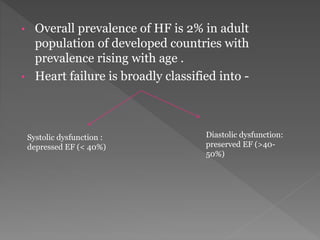
• Overall prevalence of HF is 2% in adult 
population of developed countries with 
prevalence rising with age . 
• Heart failure is broadly classified into - 
Systolic dysfunction : 
depressed EF (< 40%) 
Diastolic dysfunction: 
preserved EF (>40- 
50%)
• Any condition leading to alteration in LV structure 
/function. 
Causes for systolic dysfunction - 
 Coronary artery disease – myocardial ischemia and 
infarction . 
 Chr. Pressure overload – hypertension . 
 Chr. Volume overload – (i)regurgitating valvular 
diseases (ii)intracardiac shunting . 
 Dilated cardiomyopathies . 
 Dysarrhythmias –chr . Brady and tachy 
arrhythmias. 
 Toxic induced
Causes of diastolic failure – 
 Hypertrophic cardiomyopathy . 
 Hypertension . 
 Aging . 
 Restrictive cardiomyopathy –(i)infiltrative 
disorders. 
 Fibrosis 
Other causes – 
 Pulmonary heart disease –cor pulmonale ,pul. 
Vasular disorders . 
 High output states –thyrotoxicosis,beriberi 
,anaemia ,AV shunting .
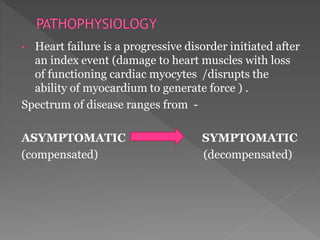
• Heart failure is a progressive disorder initiated after 
an index event (damage to heart muscles with loss 
of functioning cardiac myocytes /disrupts the 
ability of myocardium to generate force ) . 
Spectrum of disease ranges from - 
ASYMPTOMATIC SYMPTOMATIC 
(compensated) (decompensated)
• SYMPTOMS – 
1. Fatigue . 
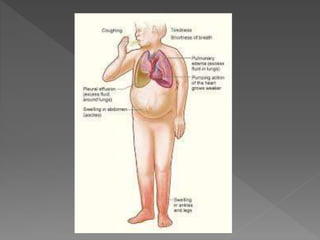
2. Dyspnoea (rapid, shallow breathing ) 
3. Orthopnoea . 
4. Paroxysmal nocturnal dyspnoea . 
5. Cheyn –stroke breathing . 
Other symptoms – 
› GI symptoms –anorexia , nausea ,early satiety . 
› Right upper quadrant pain . 
› Cerebral symptoms –sleep & mood disturbances 
,confusion ,disorientation . 
› Nocturia .
• General appearance and vitals – 
• Decreased systolic blood pressure , decreased pulse 
pressure . 
• Sinus tachycardia . 
• Cool peripheries with cyanosis of lips and nail beds . 
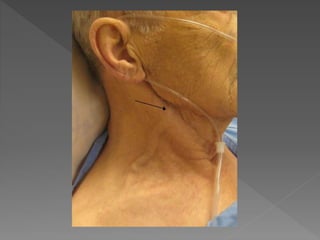
• Raised JVP 
Pulmonary examination – 
• Pulmonary crackles are heard widely over both lung fields 
. 
• Pleural effusion occurs in biventricular failure .
• Cardiac examination – 
• Apex -is displaced below the 5th ICS lateral to mid-clavicular 
line ,palpated in two ICS and sustained . 
• left Parasternal heave –in case of RV hypertrophy . 
• S3 in cases with volume overload . 
Per abdomen – 
• Tender hepatomegaly . 
• Ascitis and jaundice . 
• Peripheral edema (dependent ,pitting type ) . 
Cardiac cachexia .
• Routine laboratory tests –CBP ,serum 
electrolytes ,serum creatinine ,liver function test 
,urinanalysis . 
• ECG – for cardiac rhythm , LV hypertrophy 
,prior MI . 
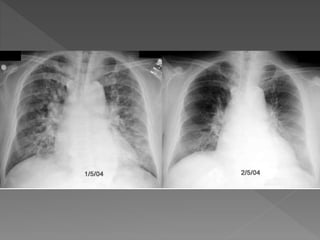
• Chest x-ray –cardiac size and state of 
pulmonary vasculature . 
• Assesment of LV function – 
• 2d echo/doppler –LV size and function ,regional wall 
motion abnormalities ,valvular abnormalities . 
• Ejection fraction(EF) –stroke vol /end diastolic vol .
• MRI – it is the gold standard investigation for 
assesing left ventricular mass and volume . And is 
also emerging useful to determine the cause of HF . 
• Biomarkers – 
1. B type natriuretic peptide & N –terminal pro-BNP are 
released from failing heart and are elevated in heart 
failure . 
2. Troponine T and I 
3. C reactive protein .
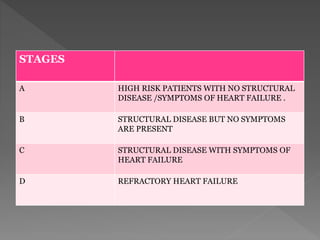
STAGES 
A HIGH RISK PATIENTS WITH NO STRUCTURAL 
DISEASE /SYMPTOMS OF HEART FAILURE . 
B STRUCTURAL DISEASE BUT NO SYMPTOMS 
ARE PRESENT 
C STRUCTURAL DISEASE WITH SYMPTOMS OF 
HEART FAILURE 
D REFRACTORY HEART FAILURE
 Correction of systemic factors(thyroid dysfunction 
uncontrolled dm, infections )and other co morbidities 
like COPD and sleep apnea . 
 Lifestyle modifications – 
 Cessation of smoking . 
 Restriction of alcohol consumption . 
 Salt restriction (~2 to 3 g/day ) 
 Fluid restriction (<2 L/day ) . 
 Weight reduction . 
 Moderate exercise . 
 Pneumococcal and influenza vaccination annually 
 Treatment of cause of heart disease . 
 Pharmacological therapy 
 ICD and CRT . 
 Cardiac transplantation .
Goals of therapy include to – 
• Improve symptoms 
• Slow or reverse deterioration in myocardial 
functions . 
• Reduce mortality .
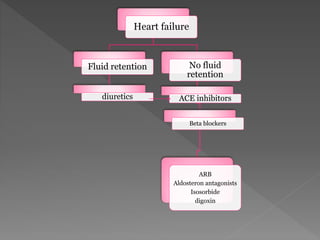
Heart failure 
Fluid retention 
diuretics 
No fluid 
retention 
ACE inhibitors 
Beta blockers 
ARB 
Aldosteron antagonists 
Isosorbide 
digoxin
Goal is relief of signs and symptoms of dyspnea and 
peripheral edema . 
Symptoms relieve within hours to days . 
• Loop diuretics –furosemide (20 -40 mg/qd ) ,torsemide 
(10-20 mg /qd ) initial dose . 
• Subsequent doses are dependent on diuretic response 
(wt loss of 1 kg /day ) or until the dry weight of the 
patient is reached . 
• Thiazide diuretics may be added along with loop 
diuretics if fluid retention persists even after high doses 
of loop diuretics (25 mg /od or bd )
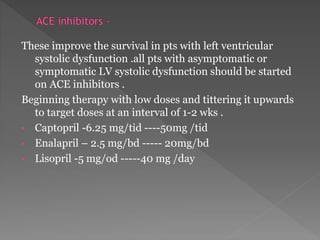
These improve the survival in pts with left ventricular 
systolic dysfunction .all pts with asymptomatic or 
symptomatic LV systolic dysfunction should be started 
on ACE inhibitors . 
Beginning therapy with low doses and tittering it upwards 
to target doses at an interval of 1-2 wks . 
• Captopril -6.25 mg/tid ----50mg /tid 
• Enalapril – 2.5 mg/bd ----- 20mg/bd 
• Lisopril -5 mg/od -----40 mg /day
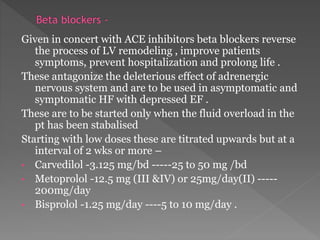
Given in concert with ACE inhibitors beta blockers reverse 
the process of LV remodeling , improve patients 
symptoms, prevent hospitalization and prolong life . 
These antagonize the deleterious effect of adrenergic 
nervous system and are to be used in asymptomatic and 
symptomatic HF with depressed EF . 
These are to be started only when the fluid overload in the 
pt has been stabalised 
Starting with low doses these are titrated upwards but at a 
interval of 2 wks or more – 
• Carvedilol -3.125 mg/bd -----25 to 50 mg /bd 
• Metoprolol -12.5 mg (III &IV) or 25mg/day(II) ----- 
200mg/day 
• Bisprolol -1.25 mg/day ----5 to 10 mg/day .
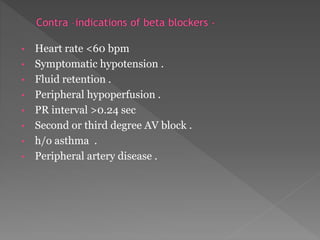
• Heart rate <60 bpm 
• Symptomatic hypotension . 
• Fluid retention . 
• Peripheral hypoperfusion . 
• PR interval >0.24 sec 
• Second or third degree AV block . 
• h/o asthma . 
• Peripheral artery disease .
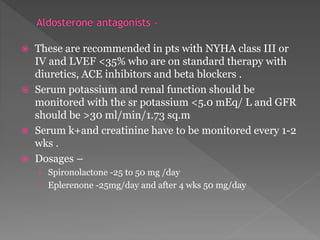
 These are recommended in pts with NYHA class III or 
IV and LVEF <35% who are on standard therapy with 
diuretics, ACE inhibitors and beta blockers . 
 Serum potassium and renal function should be 
monitored with the sr potassium <5.0 mEq/ L and GFR 
should be >30 ml/min/1.73 sq.m 
 Serum k+and creatinine have to be monitored every 1-2 
wks . 
 Dosages – 
› Spironolactone -25 to 50 mg /day 
› Eplerenone -25mg/day and after 4 wks 50 mg/day
 These are used in patients who cannot tolerate ACE 
inhibitors 
 These are slightly less efficacious than ACE inhibitors . 
Hydralizine pluse nitrate – 
This combination is suggested in patients who are unable 
to take ACE inhibitors and ARB due to intolerance 
,hypotension or renal insufficiencies . 
 Dosage – 
› Hydralizine -25 mg/tid +isosorbide dinitrate – 20 mg/tid 
› Target dose -75 mg/tid for hydralizine and 40 mg /tid for 
isosorbide .up titration to be done every 2 to 4 wks .
Given to pts with HF and systolic dysfunction to control 
symptoms like fatigue ,dyspnea ,exercise intolerance 
and in pts with AF . 
Dosage is to be adjusted so that the serum digoxin 
concentration is in the range of 0.5 -0.8 ng/mL . 
It is not recommended as primary therapy for stabilization 
of patient but is used after initial treatment for HF is 
given and pt is stabilized .
 Statins –no benefit from statins has been demonstrated 
in moderate to severe HF due to systolic dysfunction 
with or without CAD but statins may be useful in cases 
of HF with diastolic dysfunction. 
 Calcium channel blockers –these have no direct role in 
treatment of HF. But can be used in pts with other 
indications like angina or hypertension .(amlodipine )
Some pts do not improve or have rapid recurrence with the 
standard treatment for heart failure . 
These pts are to be managed with specialized strategies 
including – 
• Continuous I.V positive inotropic therapy 
• Cardiac resynchronization therapy . 
• Extracorporeal ultrafiltration via heamofiltration . 
• Mechanical circulatory support . 
• Cardiac transplantation .

Heart failure

  • 3.
    • Overall prevalenceof HF is 2% in adult population of developed countries with prevalence rising with age . • Heart failure is broadly classified into - Systolic dysfunction : depressed EF (< 40%) Diastolic dysfunction: preserved EF (>40- 50%)
  • 4.
    • Any conditionleading to alteration in LV structure /function. Causes for systolic dysfunction -  Coronary artery disease – myocardial ischemia and infarction .  Chr. Pressure overload – hypertension .  Chr. Volume overload – (i)regurgitating valvular diseases (ii)intracardiac shunting .  Dilated cardiomyopathies .  Dysarrhythmias –chr . Brady and tachy arrhythmias.  Toxic induced
  • 5.
    Causes of diastolicfailure –  Hypertrophic cardiomyopathy .  Hypertension .  Aging .  Restrictive cardiomyopathy –(i)infiltrative disorders.  Fibrosis Other causes –  Pulmonary heart disease –cor pulmonale ,pul. Vasular disorders .  High output states –thyrotoxicosis,beriberi ,anaemia ,AV shunting .
  • 7.
    • Heart failureis a progressive disorder initiated after an index event (damage to heart muscles with loss of functioning cardiac myocytes /disrupts the ability of myocardium to generate force ) . Spectrum of disease ranges from - ASYMPTOMATIC SYMPTOMATIC (compensated) (decompensated)
  • 10.
    • SYMPTOMS – 1. Fatigue . 2. Dyspnoea (rapid, shallow breathing ) 3. Orthopnoea . 4. Paroxysmal nocturnal dyspnoea . 5. Cheyn –stroke breathing . Other symptoms – › GI symptoms –anorexia , nausea ,early satiety . › Right upper quadrant pain . › Cerebral symptoms –sleep & mood disturbances ,confusion ,disorientation . › Nocturia .
  • 11.
    • General appearanceand vitals – • Decreased systolic blood pressure , decreased pulse pressure . • Sinus tachycardia . • Cool peripheries with cyanosis of lips and nail beds . • Raised JVP Pulmonary examination – • Pulmonary crackles are heard widely over both lung fields . • Pleural effusion occurs in biventricular failure .
  • 12.
    • Cardiac examination– • Apex -is displaced below the 5th ICS lateral to mid-clavicular line ,palpated in two ICS and sustained . • left Parasternal heave –in case of RV hypertrophy . • S3 in cases with volume overload . Per abdomen – • Tender hepatomegaly . • Ascitis and jaundice . • Peripheral edema (dependent ,pitting type ) . Cardiac cachexia .
  • 14.
    • Routine laboratorytests –CBP ,serum electrolytes ,serum creatinine ,liver function test ,urinanalysis . • ECG – for cardiac rhythm , LV hypertrophy ,prior MI . • Chest x-ray –cardiac size and state of pulmonary vasculature . • Assesment of LV function – • 2d echo/doppler –LV size and function ,regional wall motion abnormalities ,valvular abnormalities . • Ejection fraction(EF) –stroke vol /end diastolic vol .
  • 15.
    • MRI –it is the gold standard investigation for assesing left ventricular mass and volume . And is also emerging useful to determine the cause of HF . • Biomarkers – 1. B type natriuretic peptide & N –terminal pro-BNP are released from failing heart and are elevated in heart failure . 2. Troponine T and I 3. C reactive protein .
  • 19.
    STAGES A HIGHRISK PATIENTS WITH NO STRUCTURAL DISEASE /SYMPTOMS OF HEART FAILURE . B STRUCTURAL DISEASE BUT NO SYMPTOMS ARE PRESENT C STRUCTURAL DISEASE WITH SYMPTOMS OF HEART FAILURE D REFRACTORY HEART FAILURE
  • 22.
     Correction ofsystemic factors(thyroid dysfunction uncontrolled dm, infections )and other co morbidities like COPD and sleep apnea .  Lifestyle modifications –  Cessation of smoking .  Restriction of alcohol consumption .  Salt restriction (~2 to 3 g/day )  Fluid restriction (<2 L/day ) .  Weight reduction .  Moderate exercise .  Pneumococcal and influenza vaccination annually  Treatment of cause of heart disease .  Pharmacological therapy  ICD and CRT .  Cardiac transplantation .
  • 23.
    Goals of therapyinclude to – • Improve symptoms • Slow or reverse deterioration in myocardial functions . • Reduce mortality .
  • 24.
    Heart failure Fluidretention diuretics No fluid retention ACE inhibitors Beta blockers ARB Aldosteron antagonists Isosorbide digoxin
  • 25.
    Goal is reliefof signs and symptoms of dyspnea and peripheral edema . Symptoms relieve within hours to days . • Loop diuretics –furosemide (20 -40 mg/qd ) ,torsemide (10-20 mg /qd ) initial dose . • Subsequent doses are dependent on diuretic response (wt loss of 1 kg /day ) or until the dry weight of the patient is reached . • Thiazide diuretics may be added along with loop diuretics if fluid retention persists even after high doses of loop diuretics (25 mg /od or bd )
  • 26.
    These improve thesurvival in pts with left ventricular systolic dysfunction .all pts with asymptomatic or symptomatic LV systolic dysfunction should be started on ACE inhibitors . Beginning therapy with low doses and tittering it upwards to target doses at an interval of 1-2 wks . • Captopril -6.25 mg/tid ----50mg /tid • Enalapril – 2.5 mg/bd ----- 20mg/bd • Lisopril -5 mg/od -----40 mg /day
  • 27.
    Given in concertwith ACE inhibitors beta blockers reverse the process of LV remodeling , improve patients symptoms, prevent hospitalization and prolong life . These antagonize the deleterious effect of adrenergic nervous system and are to be used in asymptomatic and symptomatic HF with depressed EF . These are to be started only when the fluid overload in the pt has been stabalised Starting with low doses these are titrated upwards but at a interval of 2 wks or more – • Carvedilol -3.125 mg/bd -----25 to 50 mg /bd • Metoprolol -12.5 mg (III &IV) or 25mg/day(II) ----- 200mg/day • Bisprolol -1.25 mg/day ----5 to 10 mg/day .
  • 28.
    • Heart rate<60 bpm • Symptomatic hypotension . • Fluid retention . • Peripheral hypoperfusion . • PR interval >0.24 sec • Second or third degree AV block . • h/o asthma . • Peripheral artery disease .
  • 29.
     These arerecommended in pts with NYHA class III or IV and LVEF <35% who are on standard therapy with diuretics, ACE inhibitors and beta blockers .  Serum potassium and renal function should be monitored with the sr potassium <5.0 mEq/ L and GFR should be >30 ml/min/1.73 sq.m  Serum k+and creatinine have to be monitored every 1-2 wks .  Dosages – › Spironolactone -25 to 50 mg /day › Eplerenone -25mg/day and after 4 wks 50 mg/day
  • 30.
     These areused in patients who cannot tolerate ACE inhibitors  These are slightly less efficacious than ACE inhibitors . Hydralizine pluse nitrate – This combination is suggested in patients who are unable to take ACE inhibitors and ARB due to intolerance ,hypotension or renal insufficiencies .  Dosage – › Hydralizine -25 mg/tid +isosorbide dinitrate – 20 mg/tid › Target dose -75 mg/tid for hydralizine and 40 mg /tid for isosorbide .up titration to be done every 2 to 4 wks .
  • 31.
    Given to ptswith HF and systolic dysfunction to control symptoms like fatigue ,dyspnea ,exercise intolerance and in pts with AF . Dosage is to be adjusted so that the serum digoxin concentration is in the range of 0.5 -0.8 ng/mL . It is not recommended as primary therapy for stabilization of patient but is used after initial treatment for HF is given and pt is stabilized .
  • 32.
     Statins –nobenefit from statins has been demonstrated in moderate to severe HF due to systolic dysfunction with or without CAD but statins may be useful in cases of HF with diastolic dysfunction.  Calcium channel blockers –these have no direct role in treatment of HF. But can be used in pts with other indications like angina or hypertension .(amlodipine )
  • 33.
    Some pts donot improve or have rapid recurrence with the standard treatment for heart failure . These pts are to be managed with specialized strategies including – • Continuous I.V positive inotropic therapy • Cardiac resynchronization therapy . • Extracorporeal ultrafiltration via heamofiltration . • Mechanical circulatory support . • Cardiac transplantation .