by Dr. Saitejreddy
 Thoracentesis is a percutaneous procedure during which a needle is 
inserted into the pleural space and pleural fluid is removed either through 
the needle or a small bore catheter. 
 "Diagnostic thoracentesis" refers to removal of a small volume of pleural 
fluid for analysis, while "therapeutic thoracentesis" refers to removal of a 
large volume of pleural fluid for relief of symptoms.
 INDICATIONS 
1. Pleural effusion-Most patients who have a pleural effusion should 
undergo diagnostic thoracentesis to determine the nature of the effusion 
(ie, transudate, exudate) and to identify potential causes (eg, malignancy, 
infection). 
2. Atypical features that should prompt consideration of diagnostic 
thoracentesis in a patient with HF include: 
• Bilateral effusions that are of markedly disparate sizes 
• Pleurisy 
• Fever 
• Absence of cardiomegaly on chest radiograph 
• An echocardiogram that is inconsistent with HF 
• B-type brain natriuretic peptide (BNP) levels that are inconsistent with HF 
• An alveolar-arterial oxygen gradient that is larger than expected for HF 
• The effusion does not resolve with HF therapy
CONTRAINDICATIONS — There are no absolute contraindications to 
thoracentesis. 
1. Anticoagulation or a bleeding diathesis, with a PT or PTT greater than 
twice the midpoint of the normal range, a platelet count less than 50,000 
platelets/mm3, or a serum creatinine concentration greater than 6 
mg/dL. 
2. very small free-flowing pleural effusions, with less than 1 cm distance 
from the pleural fluid line to the chest wall on a decubitus chest 
radiograph. 
3. Patients receiving mechanical ventilation with or without positive end-expiratory 
pressure (PEEP) 
4. Active skin infection at the point of needle insertion.
• TECHNIQUE 
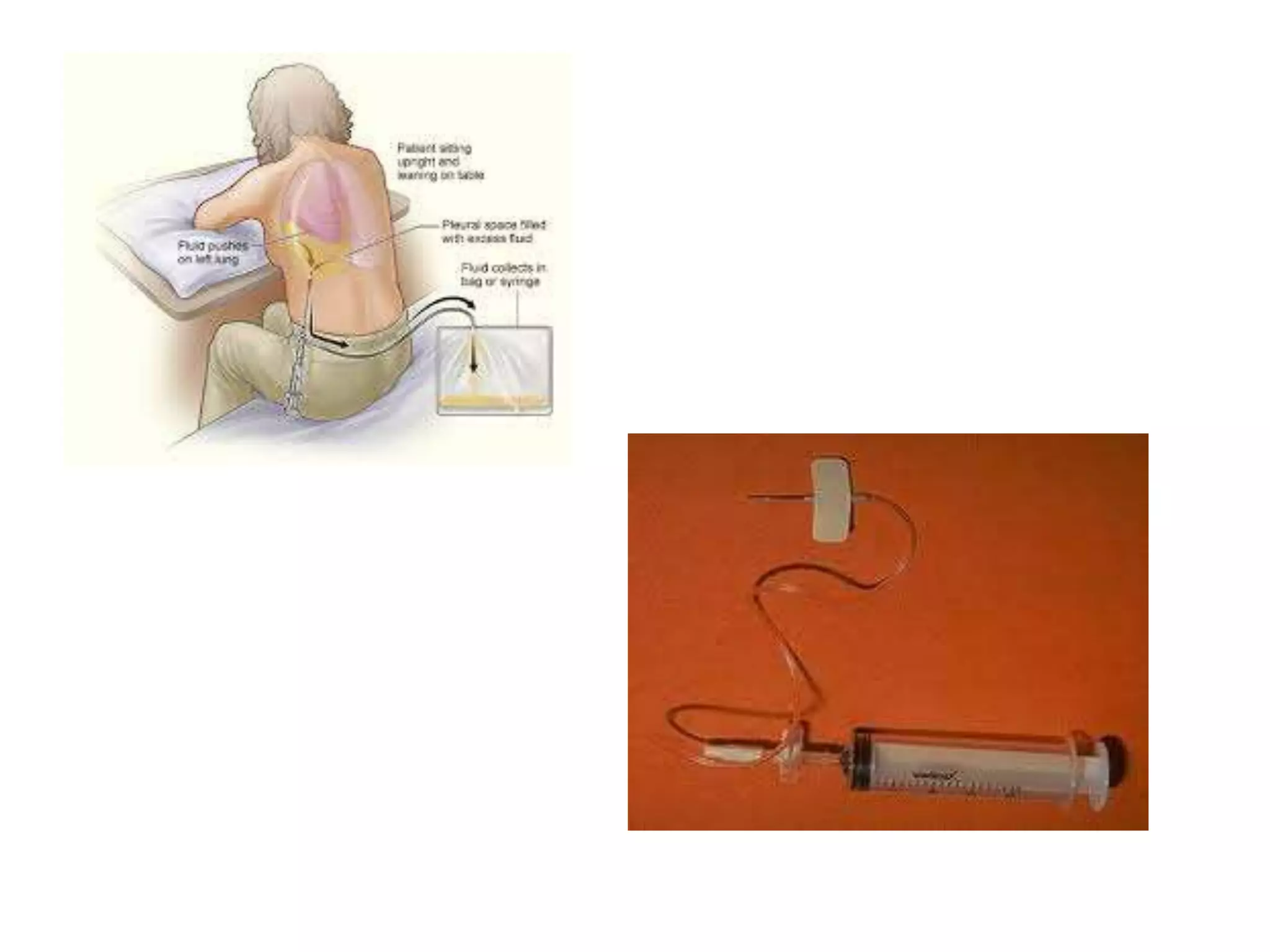
 Once the procedure has been explained to the patient and 
informed consent obtained, the patient is positioned for the 
procedure. Thoracentesis is usually performed with the 
patient in a sitting position, sitting upright with his or her 
arms resting on a surface, such as a bedside table. The lateral 
recumbent position can be used if the patient is unable to sit 
upright.
Selection of site- 
 Ultrasound localization is performed with the patient in the same 
position that he or she will be in during the thoracentesis, especially 
if it is being used for a loculated effusion 
 By the physical examination to select the puncture site, using the 
following landmarks- 
• One to two interspaces below the level at which breath sounds 
decrease or disappear on auscultation, percussion becomes dull, 
and fremitus disappears 
• Above the ninth rib, to avoid subdiaphragmatic puncture 
• Midway between the spine and the posterior axillary line, because 
the ribs are easily palpated in this location.
• Avoidance of intercostal arteries —when performing a 
thoracentesis on an elderly patient, it is prudent to choose a 
puncture site 9 to 10 cm lateral to the spine, assuming that 
the fluid collection will be equally accessible. 
• Site preparation and local anesthesia — Thoracentesis is a 
sterile procedure. A wide area surrounding the puncture site 
should be sterilized with 0.05 percent chlorhexidine or 10 
percent povidone-iodine solution, prior to placement of 
sterile drapes around the puncture site. 
• Once the puncture site and surrounding skin is sterilized, local 
anesthetic (eg, 1 or 2 percent lidocaine) should be 
administered. The epidermis is initially infiltrated with 
anesthetic using a syringe and 25-gauge needle. Next, a 
syringe with a 22-gauge needle is inserted, advanced toward 
the rib, and then "walked" over the superior edge of the rib.
• As the needle is advanced, aspiration should be attempted by 
intermittently pulling back on the plunger of the syringe. 
Anesthetic is injected if there is no return of blood or pleural 
fluid into the syringe. 
• Intermittent aspiration serves two purposes. First, blood 
return indicates that the needle is intravascular and prevents 
the operator from injecting anesthetic intravascularly. Second, 
pleural fluid return indicates that the needle has entered the 
pleural space.
• Additional anesthetic should be injected to anesthetize 
pleural nerve endings and then the needle should be 
withdrawn. This technique infiltrates the skin, rib periosteum, 
and parietal pleura with local anesthetic, thereby minimizing 
pain and rendering the discomfort of the procedure similar to 
that of venipuncture. 
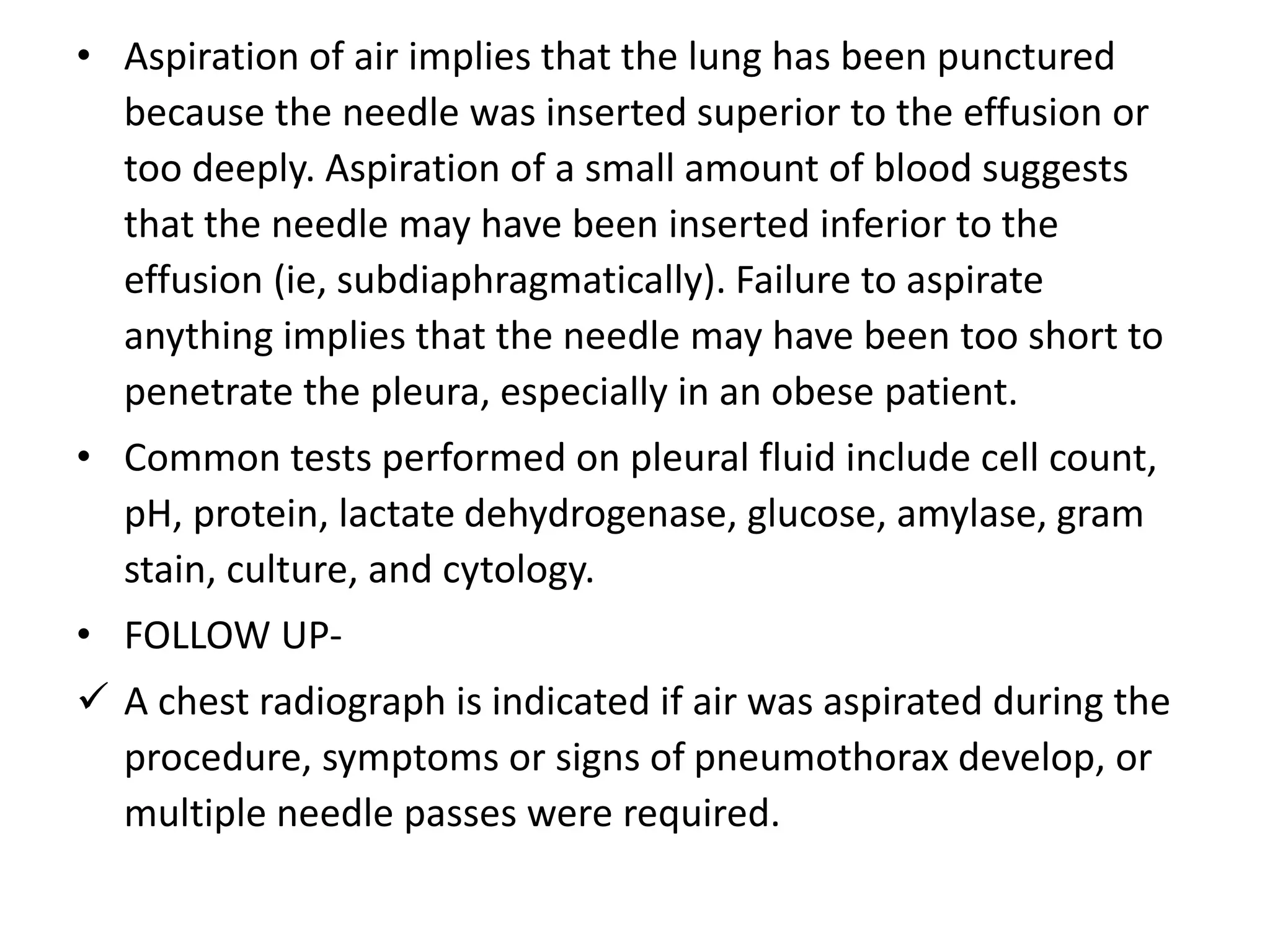
• Fluid removal — A 50 mL syringe is attached to a 22-gauge 
needle that is 1.5 inches in length. A longer needle is selected 
for markedly obese patients. Adding 1 mL of 1:1000 heparin 
to the 50 mL syringe prevents clotting of hemorrhagic or 
highly proteinaceous fluid and improves the quality of the 
cytologic examination of the pleural fluid. With continuous 
negative pressure applied to the syringe by gently pulling back 
on the plunger, the needle is advanced through the 
anesthetized tract until pleural fluid returns. Approximately 30 
to 75 mL of pleural fluid should be withdrawn for analysis, and 
then the needle removed.
• Aspiration of air implies that the lung has been punctured 
because the needle was inserted superior to the effusion or 
too deeply. Aspiration of a small amount of blood suggests 
that the needle may have been inserted inferior to the 
effusion (ie, subdiaphragmatically). Failure to aspirate 
anything implies that the needle may have been too short to 
penetrate the pleura, especially in an obese patient. 
• Common tests performed on pleural fluid include cell count, 
pH, protein, lactate dehydrogenase, glucose, amylase, gram 
stain, culture, and cytology. 
• FOLLOW UP- 
 A chest radiograph is indicated if air was aspirated during the 
procedure, symptoms or signs of pneumothorax develop, or 
multiple needle passes were required.
• COMPLICATIONS — Potential complications of thoracentesis 
include pain at the puncture site, bleeding (eg, hematoma, 
hemothorax, or hemoperitoneum), pneumothorax, empyema, 
soft tissue infection, spleen or liver puncture, vasovagal 
events, seeding the needle tract with tumor, and adverse 
reactions to the anesthetic or topical antiseptic solutions. 
 Pneumothorax is the most common complication that is 
clinically important. 
 When a pneumothorax occurs, it is usually small although up 
to one third of patients require tube thoracostomy drainage. 
Tube thoracostomy should be considered if the 
pneumothorax is large, progressive, the patient is 
symptomatic, or the patient is mechanically ventilated.
Thank You

Thoracocentesis

  • 1.
  • 2.
     Thoracentesis isa percutaneous procedure during which a needle is inserted into the pleural space and pleural fluid is removed either through the needle or a small bore catheter.  "Diagnostic thoracentesis" refers to removal of a small volume of pleural fluid for analysis, while "therapeutic thoracentesis" refers to removal of a large volume of pleural fluid for relief of symptoms.
  • 3.
     INDICATIONS 1.Pleural effusion-Most patients who have a pleural effusion should undergo diagnostic thoracentesis to determine the nature of the effusion (ie, transudate, exudate) and to identify potential causes (eg, malignancy, infection). 2. Atypical features that should prompt consideration of diagnostic thoracentesis in a patient with HF include: • Bilateral effusions that are of markedly disparate sizes • Pleurisy • Fever • Absence of cardiomegaly on chest radiograph • An echocardiogram that is inconsistent with HF • B-type brain natriuretic peptide (BNP) levels that are inconsistent with HF • An alveolar-arterial oxygen gradient that is larger than expected for HF • The effusion does not resolve with HF therapy
  • 4.
    CONTRAINDICATIONS — Thereare no absolute contraindications to thoracentesis. 1. Anticoagulation or a bleeding diathesis, with a PT or PTT greater than twice the midpoint of the normal range, a platelet count less than 50,000 platelets/mm3, or a serum creatinine concentration greater than 6 mg/dL. 2. very small free-flowing pleural effusions, with less than 1 cm distance from the pleural fluid line to the chest wall on a decubitus chest radiograph. 3. Patients receiving mechanical ventilation with or without positive end-expiratory pressure (PEEP) 4. Active skin infection at the point of needle insertion.
  • 5.
    • TECHNIQUE Once the procedure has been explained to the patient and informed consent obtained, the patient is positioned for the procedure. Thoracentesis is usually performed with the patient in a sitting position, sitting upright with his or her arms resting on a surface, such as a bedside table. The lateral recumbent position can be used if the patient is unable to sit upright.
  • 6.
    Selection of site-  Ultrasound localization is performed with the patient in the same position that he or she will be in during the thoracentesis, especially if it is being used for a loculated effusion  By the physical examination to select the puncture site, using the following landmarks- • One to two interspaces below the level at which breath sounds decrease or disappear on auscultation, percussion becomes dull, and fremitus disappears • Above the ninth rib, to avoid subdiaphragmatic puncture • Midway between the spine and the posterior axillary line, because the ribs are easily palpated in this location.
  • 7.
    • Avoidance ofintercostal arteries —when performing a thoracentesis on an elderly patient, it is prudent to choose a puncture site 9 to 10 cm lateral to the spine, assuming that the fluid collection will be equally accessible. • Site preparation and local anesthesia — Thoracentesis is a sterile procedure. A wide area surrounding the puncture site should be sterilized with 0.05 percent chlorhexidine or 10 percent povidone-iodine solution, prior to placement of sterile drapes around the puncture site. • Once the puncture site and surrounding skin is sterilized, local anesthetic (eg, 1 or 2 percent lidocaine) should be administered. The epidermis is initially infiltrated with anesthetic using a syringe and 25-gauge needle. Next, a syringe with a 22-gauge needle is inserted, advanced toward the rib, and then "walked" over the superior edge of the rib.
  • 8.
    • As theneedle is advanced, aspiration should be attempted by intermittently pulling back on the plunger of the syringe. Anesthetic is injected if there is no return of blood or pleural fluid into the syringe. • Intermittent aspiration serves two purposes. First, blood return indicates that the needle is intravascular and prevents the operator from injecting anesthetic intravascularly. Second, pleural fluid return indicates that the needle has entered the pleural space.
  • 9.
    • Additional anestheticshould be injected to anesthetize pleural nerve endings and then the needle should be withdrawn. This technique infiltrates the skin, rib periosteum, and parietal pleura with local anesthetic, thereby minimizing pain and rendering the discomfort of the procedure similar to that of venipuncture. • Fluid removal — A 50 mL syringe is attached to a 22-gauge needle that is 1.5 inches in length. A longer needle is selected for markedly obese patients. Adding 1 mL of 1:1000 heparin to the 50 mL syringe prevents clotting of hemorrhagic or highly proteinaceous fluid and improves the quality of the cytologic examination of the pleural fluid. With continuous negative pressure applied to the syringe by gently pulling back on the plunger, the needle is advanced through the anesthetized tract until pleural fluid returns. Approximately 30 to 75 mL of pleural fluid should be withdrawn for analysis, and then the needle removed.
  • 11.
    • Aspiration ofair implies that the lung has been punctured because the needle was inserted superior to the effusion or too deeply. Aspiration of a small amount of blood suggests that the needle may have been inserted inferior to the effusion (ie, subdiaphragmatically). Failure to aspirate anything implies that the needle may have been too short to penetrate the pleura, especially in an obese patient. • Common tests performed on pleural fluid include cell count, pH, protein, lactate dehydrogenase, glucose, amylase, gram stain, culture, and cytology. • FOLLOW UP-  A chest radiograph is indicated if air was aspirated during the procedure, symptoms or signs of pneumothorax develop, or multiple needle passes were required.
  • 12.
    • COMPLICATIONS —Potential complications of thoracentesis include pain at the puncture site, bleeding (eg, hematoma, hemothorax, or hemoperitoneum), pneumothorax, empyema, soft tissue infection, spleen or liver puncture, vasovagal events, seeding the needle tract with tumor, and adverse reactions to the anesthetic or topical antiseptic solutions.  Pneumothorax is the most common complication that is clinically important.  When a pneumothorax occurs, it is usually small although up to one third of patients require tube thoracostomy drainage. Tube thoracostomy should be considered if the pneumothorax is large, progressive, the patient is symptomatic, or the patient is mechanically ventilated.
  • 13.