MECHANICAL VENTILATION 
Dr ANVESH NARIMETI 
UNIT 1 
INTERNAL MEDICINE
• Mechanical ventilation is a therapeutic 
method that is used to assist or replace 
spontaneous breathing 
• Objectives- understand the concept of 
negative pressure and positive pressure 
ventilation 
• Mechanical ventilation is any means in which 
physical devices or machines are used to 
either assist or replace spotaneous respiration
Indications 
• Four major indications 
a)Need for high levels of inspired oxygen(hypoxic 
respiratory failure) 
b)Need for assisted ventilation (hypercapnic respiratory 
failure or surgical procedures) 
c)Protection of airways against aspiration 
d)Relief from upper airway obstruction 
TYPES 
2 types of ventilation 
a)Negative pressure ventilation 
b)Positive pressure ventilation
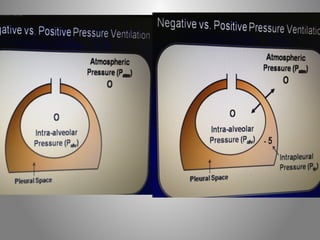
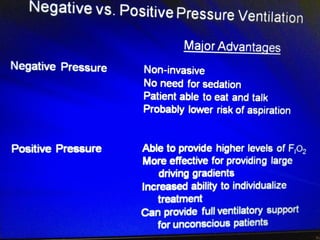
• a)Negative pressure ventilation-Pressure 
lower than atmospheric pressures is applied 
to extra thoracic space during the inspiration 
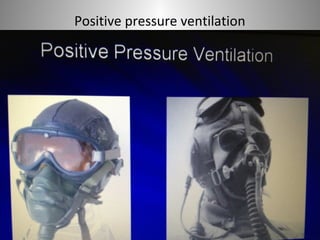
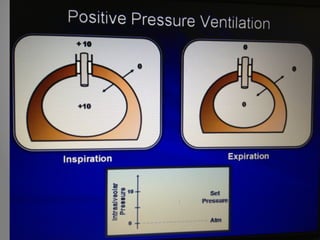
• b)Positive pressure ventilation-pressure 
higher than atmospheric pressures is applied 
to the intra alveolar space during inspiration
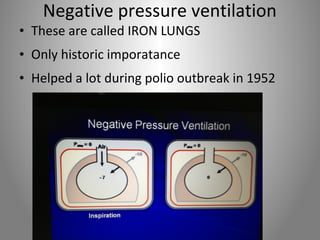
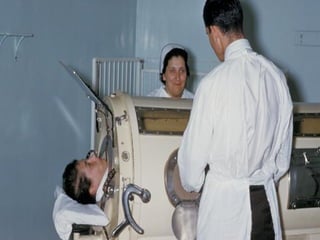
Negative pressure ventilation 
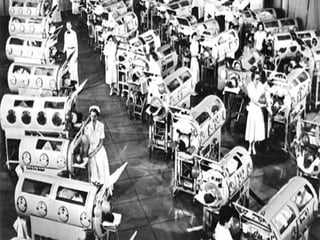
• These are called IRON LUNGS 
• Only historic imporatance 
• Helped a lot during polio outbreak in 1952
Positive pressure ventilation
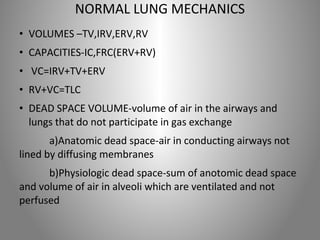
NORMAL LUNG MECHANICS 
• VOLUMES –TV,IRV,ERV,RV 
• CAPACITIES-IC,FRC(ERV+RV) 
• VC=IRV+TV+ERV 
• RV+VC=TLC 
• DEAD SPACE VOLUME-volume of air in the airways and 
lungs that do not participate in gas exchange 
a)Anatomic dead space-air in conducting airways not 
lined by diffusing membranes 
b)Physiologic dead space-sum of anotomic dead space 
and volume of air in alveoli which are ventilated and not 
perfused
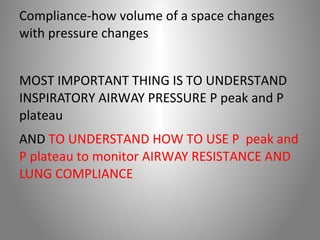
Compliance-how volume of a space changes 
with pressure changes 
MOST IMPORTANT THING IS TO UNDERSTAND 
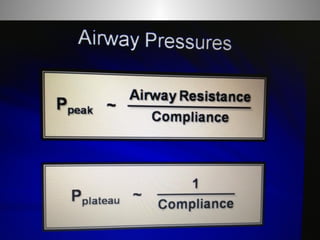
INSPIRATORY AIRWAY PRESSURE P peak and P 
plateau 
AND TO UNDERSTAND HOW TO USE P peak and 
P plateau to monitor AIRWAY RESISTANCE AND 
LUNG COMPLIANCE
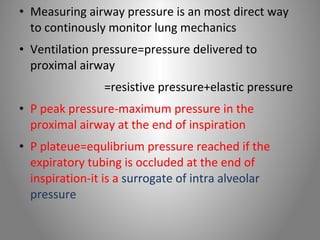
• Measuring airway pressure is an most direct way 
to continously monitor lung mechanics 
• Ventilation pressure=pressure delivered to 
proximal airway 
=resistive pressure+elastic pressure 
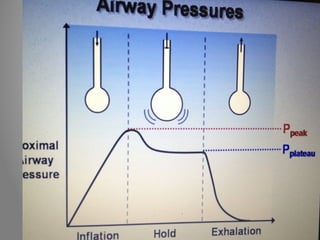
• P peak pressure-maximum pressure in the 
proximal airway at the end of inspiration 
• P plateue=equlibrium pressure reached if the 
expiratory tubing is occluded at the end of 
inspiration-it is a surrogate of intra alveolar 
pressure
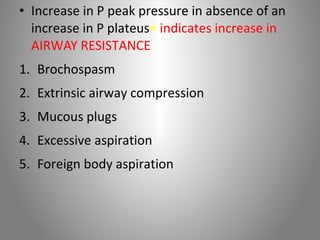
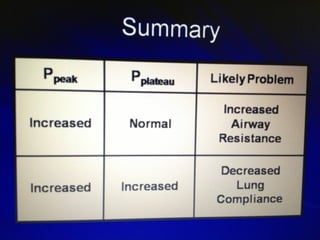
• Increase in P peak pressure in absence of an 
increase in P plateus= indicates increase in 
AIRWAY RESISTANCE 
1. Brochospasm 
2. Extrinsic airway compression 
3. Mucous plugs 
4. Excessive aspiration 
5. Foreign body aspiration
Monitoring compliance 
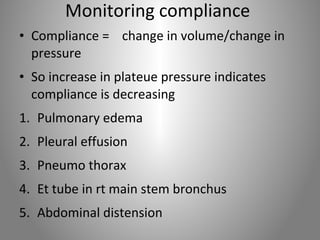
• Compliance = change in volume/change in 
pressure 
• So increase in plateue pressure indicates 
compliance is decreasing 
1. Pulmonary edema 
2. Pleural effusion 
3. Pneumo thorax 
4. Et tube in rt main stem bronchus 
5. Abdominal distension
Normal gas exchange 
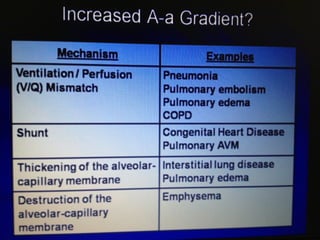
• Most important is to calculate (A-a)gradient 
• It measure how effectively oxygen moves 
from the alveoli into pulmonary vasculature 
• Normal (A-a)gradient=[age/4]+4 
• When there is increase in(A-a)gradient the 
possible causes
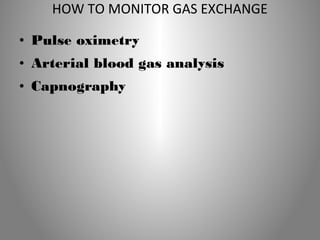
HOW TO MONITOR GAS EXCHANGE 
• Pulse oximetry 
• Arterial blood gas analysis 
• Capnography
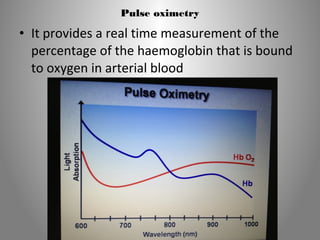
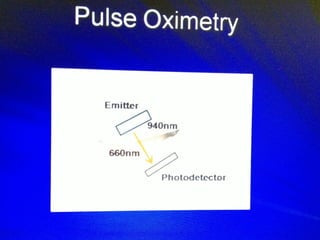
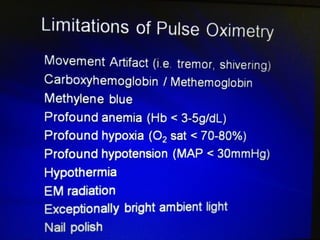
Pulse oximetry 
• It provides a real time measurement of the 
percentage of the haemoglobin that is bound 
to oxygen in arterial blood
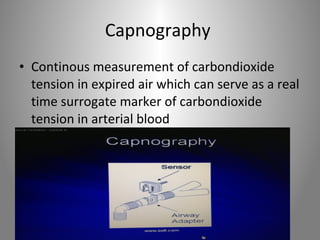
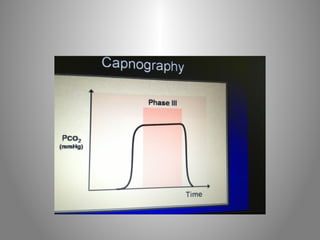
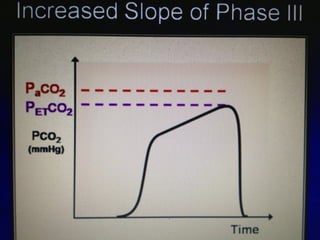
Capnography 
• Continous measurement of carbondioxide 
tension in expired air which can serve as a real 
time surrogate marker of carbondioxide 
tension in arterial blood
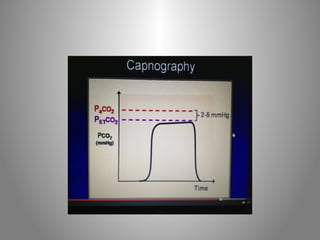
• If Paco2-Pet co2= if more than 5 
1. Low cardiac output 
2. Copd 
3. Pulmonary embolism 
4. Advanced age
NON INVASIVE POSITIVE PRESSURE VENTILATION 
NPPV- means to support the failing respiratory function by delivering oxygen 
enriched gas under pressure without requiring endotracheal intubation 
• It is best used as short term strategy to buy time 
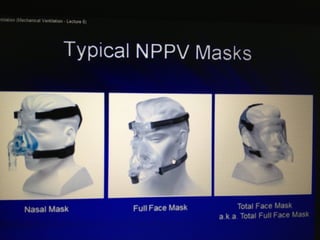
• Noninvasive ventilation usually is provided by using a tight-fitting face mask or 
nasal mask similar to the masks traditionally used for treatment of sleep apnea. 
• Noninvasive ventilation has proved highly effective in patients with respiratory 
failure from acute exacerbations of chronic obstructive pulmonary disease and is 
most frequently implemented by using bilevel positive airway pressure 
ventilation or pressure support ventilation.
• The major limitation to its widespread application 
has been patient intolerance because the tight-fitting 
mask required for NIV can cause both 
physical and emotional discomfort 
• Benefits of NPPV 
1. Avoids trauma secondary to intubation 
2. Avoids the need of sedation 
3. Ability to communicate 
4. Aloows intermittent drinking eating if aspiration 
risk is felt low 
5. Avoids ventilator associated pneumonia
Contraindications to NPPV 
1. Cardio pulmonary arrest 
2. Haemodynamic instability 
3. Fascial trauma and deformity 
4. Severe upper gastrointestinal bleed 
5. Severe encephalopathy 
6. Inability to cooperate and protect airway 
7. Inability to clear secretions 
8. Upper airway obstructions 
9. High risk for aspiration
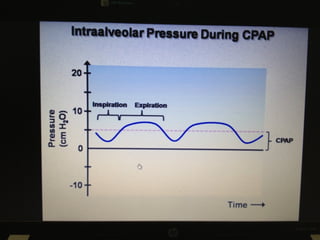
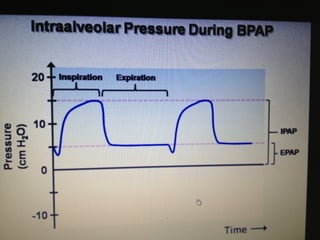
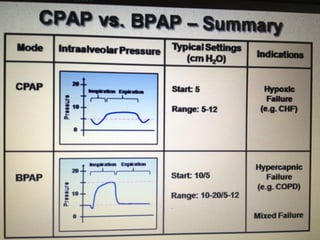
• NPPV has two options 
CPAP- Continous Positive Airway Pressure 
BPAP- Bilevel Positive Airway Pressure 
• In both of these modes, a preset positive 
pressure is applied during inspiration and a 
lower pressure is applied during expiration at 
the mask
Other indications of NPPV 
• Obstructive sleep apnoea 
• Neuro muscular disease 
• Fascilitating weaning from ventilator 
• In immunocompramised states
VENTILATOR MODES 
• We should know three variables that 
determine and define a ventilator 
mode 
• We should know most commonly 
used ventilator modes
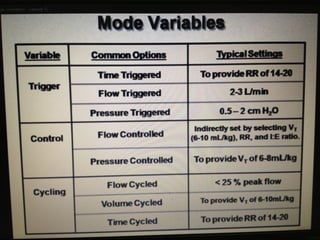
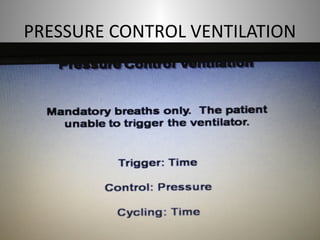
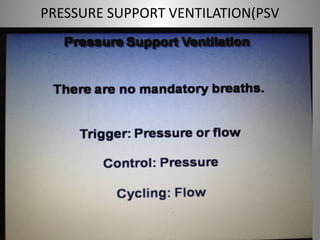
3 Variables 
1. Trigger variable 
2. Control variable 
3. Cycling variable
Trigger variable 
• It defines how the ventilator determines when to intiate a 
machine driven breath 
• Common options 
1. Time triggered(no spontaneous breathing) 
2. Pressure triggered(spontaneous breathing) 
3. Flow triggered 
•. un common options 
1. Volume,chest wall electrical impedence and motion
Control variable 
• It defines what aspect of inspiration is the 
primary variable controlled by the ventilator 
during inspiration 
• Options 
1. Presssure controlled 
2. Flow controlled
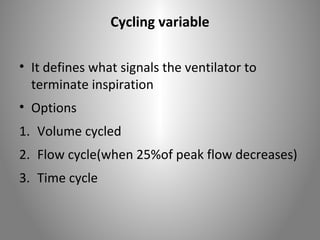
Cycling variable 
• It defines what signals the ventilator to 
terminate inspiration 
• Options 
1. Volume cycled 
2. Flow cycle(when 25%of peak flow decreases) 
3. Time cycle
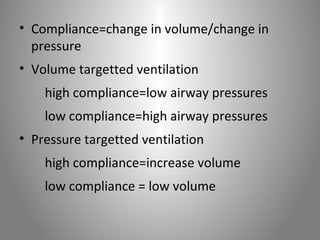
• Compliance=change in volume/change in 
pressure 
• Volume targetted ventilation 
high compliance=low airway pressures 
low compliance=high airway pressures 
• Pressure targetted ventilation 
high compliance=increase volume 
low compliance = low volume
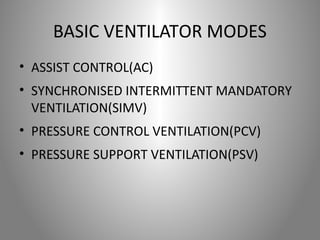
BASIC VENTILATOR MODES 
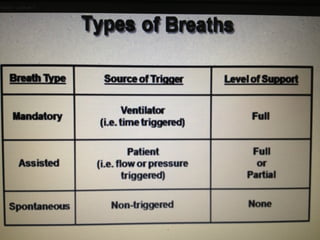
• ASSIST CONTROL(AC) 
• SYNCHRONISED INTERMITTENT MANDATORY 
VENTILATION(SIMV) 
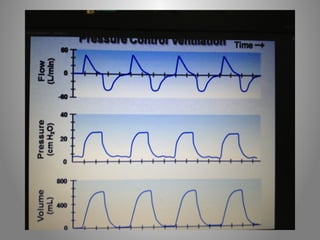
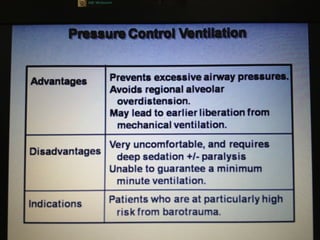
• PRESSURE CONTROL VENTILATION(PCV) 
• PRESSURE SUPPORT VENTILATION(PSV)
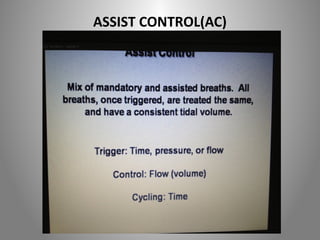
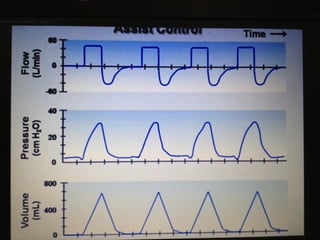
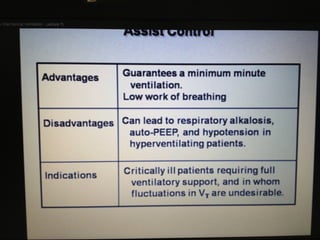
ASSIST CONTROL(AC)
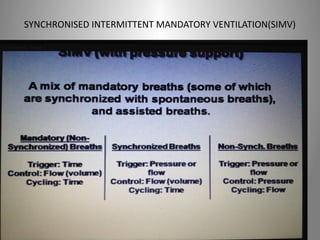
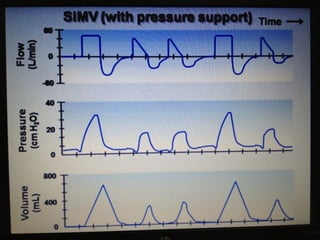
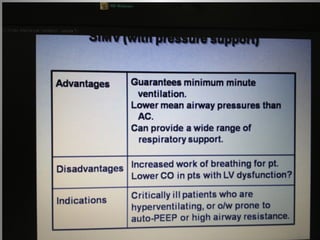
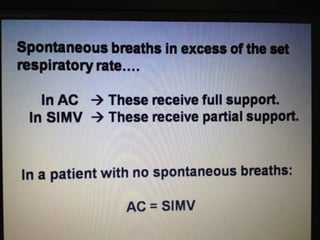
SYNCHRONISED INTERMITTENT MANDATORY VENTILATION(SIMV)
PRESSURE CONTROL VENTILATION
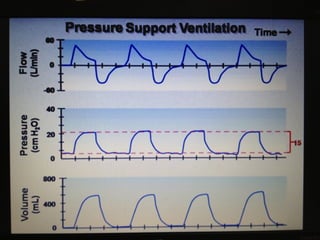
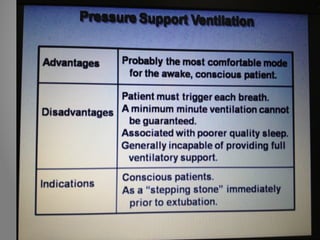
PRESSURE SUPPORT VENTILATION(PSV
DUAL CONTROLLED MODES 
• Uses instantaneous feed back to control the 
aspects of lung volume and airway pressure 
simultaneously 
• PRVC-Pressure Regulated Volume Control 
• Volume support 
• Volume Assured Pressure Support
VENTILATOR OPTIONS 
• We should understand basic options used during 
mechanical ventilation 
• OPTIONS 
1. MODE 
2. FiO2 
3. TIDAL VOLUME 
4. RESPIRATORY RATE 
5. PEEP 
6. PRESSURE SUPPORT 
7. FLOW SHAPE/CONTOUR 
8. I:E RATIO
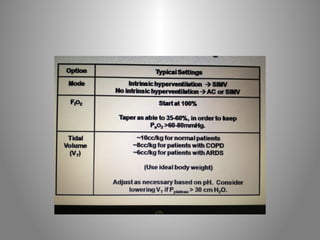
FiO2 
• Applicable to all modes 
• Should be titrated to lowest possible level at the same 
time maintaining adequate oxygenatiom 
• First set at 100% and then titrate down over several 
hours indicated by pulse oximeter or serial ABG 
• FiO2 >60% is toxic to lungs 
• If adequate oxygenation requires FiO2 >60% then 
additional strategies like 
1. Increasing PEEP 
2. Recruitment manuever 
3. Trial of another mode
TIDAL VOLUME 
• Mostly applicable to volume cycled 
modes(SIMV,AC) 
• WEIGHT BASED 
1. Healthy lungs-10ml/kg 
2. COPD -8ml/kg 
3. ARDS -6ml/kg 
•. High tidal volume-lower Paco2,high ph,high 
Pplateue 
•. Low tidal volume-high Paco2,low ph,low P 
plateue
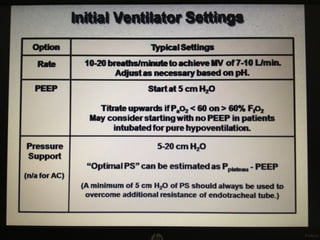
RESPIRATORY RATE 
• For time triggered mode and SIMV 
• TYPICAL-10-20 breaths/min 
• High respiratory rate- low paco2,high ph,high 
risk of auto peep 
• Low respiratory rate- high paco2,low ph,low 
risk of auto peep
POSITIVE END EXPIRATORY PRESSURE(PEEP) 
• Continous positive pressure present through out all phase of 
ventilation 
• Used in almost all pateints 
• Physiological effects- 
1. Increase alveolar recruitment,and alveolar surface area– so 
improves oxygenation 
2. Decrease preload and LV after load-increase cardiac out put 
in congestive cardiac failure 
3. Increase right ventricular load- increase right to left shunt 
•. SET PEEP TO LOWEST POSSIBLE VALUE TO ALLOW FiO2 <60% 
WITH MINIMUM OF 5 CM OF H2O
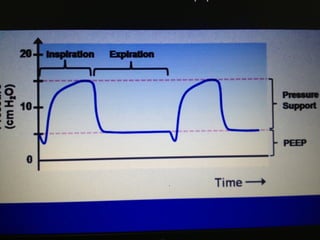
Pressure support 
• Amount of additional positive pressure 
beyond PEEP that is provided during the 
inspiration 
• An integral parameter used in pressure 
support ventilation and BPAP, SIMV
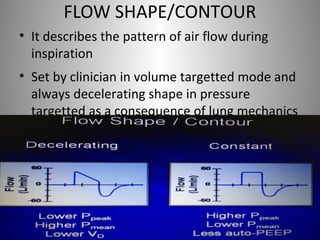
FLOW SHAPE/CONTOUR 
• It describes the pattern of air flow during 
inspiration 
• Set by clinician in volume targetted mode and 
always decelerating shape in pressure 
targetted as a consequence of lung mechanics
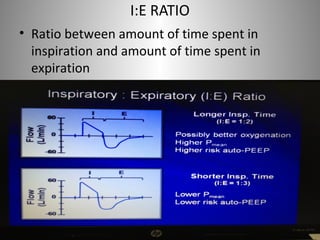
I:E RATIO 
• Ratio between amount of time spent in 
inspiration and amount of time spent in 
expiration
VENTILATOR ASSOCIATED LUNG INJURY 
• It can occur in any lungs but most commonly in 
ARDS/ALI 
• FOUR TYPES 
1. BARO TRAUMA 
2. VOLUM TRAUMA 
3. BIO TRAUMA 
4. CYCLIC ATELECTASIS
PROTECTIVE LUNG VENTILATION 
• Target tidal volume close to 6 mL/kg of ideal 
body weight. 
• Prevent plateau pressure over 30 cmH2O. 
• Lowest possible fraction of inspired oxygen 
(FIO2) to keep SaO2 90%. 
• Adjust the PEEP to maintain alveolar patency 
while preventing overdistention and 
closure/reopening
General support during mechanical ventilation 
• Sedation and analgesia 
• DVT propylaxis 
• Bed sores prevention 
• Ulcer prophylaxis 
• Nutrition 
• Delayed gastric emptying is common responds 
to promotility agents such as metoclopramide
Tracheostomy 
• It is generally agreed that if a 
patient is in need of MV for more 
than 10–14 days, a tracheostomy is 
indicated and should be planned 
under optimal conditions
THANK YOU

Mechanical ventilation.ppt

  • 1.
    MECHANICAL VENTILATION DrANVESH NARIMETI UNIT 1 INTERNAL MEDICINE
  • 2.
    • Mechanical ventilationis a therapeutic method that is used to assist or replace spontaneous breathing • Objectives- understand the concept of negative pressure and positive pressure ventilation • Mechanical ventilation is any means in which physical devices or machines are used to either assist or replace spotaneous respiration
  • 3.
    Indications • Fourmajor indications a)Need for high levels of inspired oxygen(hypoxic respiratory failure) b)Need for assisted ventilation (hypercapnic respiratory failure or surgical procedures) c)Protection of airways against aspiration d)Relief from upper airway obstruction TYPES 2 types of ventilation a)Negative pressure ventilation b)Positive pressure ventilation
  • 4.
    • a)Negative pressureventilation-Pressure lower than atmospheric pressures is applied to extra thoracic space during the inspiration • b)Positive pressure ventilation-pressure higher than atmospheric pressures is applied to the intra alveolar space during inspiration
  • 6.
    Negative pressure ventilation • These are called IRON LUNGS • Only historic imporatance • Helped a lot during polio outbreak in 1952
  • 10.
  • 13.
    NORMAL LUNG MECHANICS • VOLUMES –TV,IRV,ERV,RV • CAPACITIES-IC,FRC(ERV+RV) • VC=IRV+TV+ERV • RV+VC=TLC • DEAD SPACE VOLUME-volume of air in the airways and lungs that do not participate in gas exchange a)Anatomic dead space-air in conducting airways not lined by diffusing membranes b)Physiologic dead space-sum of anotomic dead space and volume of air in alveoli which are ventilated and not perfused
  • 14.
    Compliance-how volume ofa space changes with pressure changes MOST IMPORTANT THING IS TO UNDERSTAND INSPIRATORY AIRWAY PRESSURE P peak and P plateau AND TO UNDERSTAND HOW TO USE P peak and P plateau to monitor AIRWAY RESISTANCE AND LUNG COMPLIANCE
  • 15.
    • Measuring airwaypressure is an most direct way to continously monitor lung mechanics • Ventilation pressure=pressure delivered to proximal airway =resistive pressure+elastic pressure • P peak pressure-maximum pressure in the proximal airway at the end of inspiration • P plateue=equlibrium pressure reached if the expiratory tubing is occluded at the end of inspiration-it is a surrogate of intra alveolar pressure
  • 18.
    • Increase inP peak pressure in absence of an increase in P plateus= indicates increase in AIRWAY RESISTANCE 1. Brochospasm 2. Extrinsic airway compression 3. Mucous plugs 4. Excessive aspiration 5. Foreign body aspiration
  • 19.
    Monitoring compliance •Compliance = change in volume/change in pressure • So increase in plateue pressure indicates compliance is decreasing 1. Pulmonary edema 2. Pleural effusion 3. Pneumo thorax 4. Et tube in rt main stem bronchus 5. Abdominal distension
  • 21.
    Normal gas exchange • Most important is to calculate (A-a)gradient • It measure how effectively oxygen moves from the alveoli into pulmonary vasculature • Normal (A-a)gradient=[age/4]+4 • When there is increase in(A-a)gradient the possible causes
  • 23.
    HOW TO MONITORGAS EXCHANGE • Pulse oximetry • Arterial blood gas analysis • Capnography
  • 24.
    Pulse oximetry •It provides a real time measurement of the percentage of the haemoglobin that is bound to oxygen in arterial blood
  • 27.
    Capnography • Continousmeasurement of carbondioxide tension in expired air which can serve as a real time surrogate marker of carbondioxide tension in arterial blood
  • 30.
    • If Paco2-Petco2= if more than 5 1. Low cardiac output 2. Copd 3. Pulmonary embolism 4. Advanced age
  • 32.
    NON INVASIVE POSITIVEPRESSURE VENTILATION NPPV- means to support the failing respiratory function by delivering oxygen enriched gas under pressure without requiring endotracheal intubation • It is best used as short term strategy to buy time • Noninvasive ventilation usually is provided by using a tight-fitting face mask or nasal mask similar to the masks traditionally used for treatment of sleep apnea. • Noninvasive ventilation has proved highly effective in patients with respiratory failure from acute exacerbations of chronic obstructive pulmonary disease and is most frequently implemented by using bilevel positive airway pressure ventilation or pressure support ventilation.
  • 34.
    • The majorlimitation to its widespread application has been patient intolerance because the tight-fitting mask required for NIV can cause both physical and emotional discomfort • Benefits of NPPV 1. Avoids trauma secondary to intubation 2. Avoids the need of sedation 3. Ability to communicate 4. Aloows intermittent drinking eating if aspiration risk is felt low 5. Avoids ventilator associated pneumonia
  • 35.
    Contraindications to NPPV 1. Cardio pulmonary arrest 2. Haemodynamic instability 3. Fascial trauma and deformity 4. Severe upper gastrointestinal bleed 5. Severe encephalopathy 6. Inability to cooperate and protect airway 7. Inability to clear secretions 8. Upper airway obstructions 9. High risk for aspiration
  • 36.
    • NPPV hastwo options CPAP- Continous Positive Airway Pressure BPAP- Bilevel Positive Airway Pressure • In both of these modes, a preset positive pressure is applied during inspiration and a lower pressure is applied during expiration at the mask
  • 41.
    Other indications ofNPPV • Obstructive sleep apnoea • Neuro muscular disease • Fascilitating weaning from ventilator • In immunocompramised states
  • 42.
    VENTILATOR MODES •We should know three variables that determine and define a ventilator mode • We should know most commonly used ventilator modes
  • 43.
    3 Variables 1.Trigger variable 2. Control variable 3. Cycling variable
  • 44.
    Trigger variable •It defines how the ventilator determines when to intiate a machine driven breath • Common options 1. Time triggered(no spontaneous breathing) 2. Pressure triggered(spontaneous breathing) 3. Flow triggered •. un common options 1. Volume,chest wall electrical impedence and motion
  • 45.
    Control variable •It defines what aspect of inspiration is the primary variable controlled by the ventilator during inspiration • Options 1. Presssure controlled 2. Flow controlled
  • 46.
    Cycling variable •It defines what signals the ventilator to terminate inspiration • Options 1. Volume cycled 2. Flow cycle(when 25%of peak flow decreases) 3. Time cycle
  • 48.
    • Compliance=change involume/change in pressure • Volume targetted ventilation high compliance=low airway pressures low compliance=high airway pressures • Pressure targetted ventilation high compliance=increase volume low compliance = low volume
  • 50.
    BASIC VENTILATOR MODES • ASSIST CONTROL(AC) • SYNCHRONISED INTERMITTENT MANDATORY VENTILATION(SIMV) • PRESSURE CONTROL VENTILATION(PCV) • PRESSURE SUPPORT VENTILATION(PSV)
  • 51.
  • 54.
  • 58.
  • 61.
  • 64.
    DUAL CONTROLLED MODES • Uses instantaneous feed back to control the aspects of lung volume and airway pressure simultaneously • PRVC-Pressure Regulated Volume Control • Volume support • Volume Assured Pressure Support
  • 65.
    VENTILATOR OPTIONS •We should understand basic options used during mechanical ventilation • OPTIONS 1. MODE 2. FiO2 3. TIDAL VOLUME 4. RESPIRATORY RATE 5. PEEP 6. PRESSURE SUPPORT 7. FLOW SHAPE/CONTOUR 8. I:E RATIO
  • 66.
    FiO2 • Applicableto all modes • Should be titrated to lowest possible level at the same time maintaining adequate oxygenatiom • First set at 100% and then titrate down over several hours indicated by pulse oximeter or serial ABG • FiO2 >60% is toxic to lungs • If adequate oxygenation requires FiO2 >60% then additional strategies like 1. Increasing PEEP 2. Recruitment manuever 3. Trial of another mode
  • 67.
    TIDAL VOLUME •Mostly applicable to volume cycled modes(SIMV,AC) • WEIGHT BASED 1. Healthy lungs-10ml/kg 2. COPD -8ml/kg 3. ARDS -6ml/kg •. High tidal volume-lower Paco2,high ph,high Pplateue •. Low tidal volume-high Paco2,low ph,low P plateue
  • 68.
    RESPIRATORY RATE •For time triggered mode and SIMV • TYPICAL-10-20 breaths/min • High respiratory rate- low paco2,high ph,high risk of auto peep • Low respiratory rate- high paco2,low ph,low risk of auto peep
  • 69.
    POSITIVE END EXPIRATORYPRESSURE(PEEP) • Continous positive pressure present through out all phase of ventilation • Used in almost all pateints • Physiological effects- 1. Increase alveolar recruitment,and alveolar surface area– so improves oxygenation 2. Decrease preload and LV after load-increase cardiac out put in congestive cardiac failure 3. Increase right ventricular load- increase right to left shunt •. SET PEEP TO LOWEST POSSIBLE VALUE TO ALLOW FiO2 <60% WITH MINIMUM OF 5 CM OF H2O
  • 71.
    Pressure support •Amount of additional positive pressure beyond PEEP that is provided during the inspiration • An integral parameter used in pressure support ventilation and BPAP, SIMV
  • 72.
    FLOW SHAPE/CONTOUR •It describes the pattern of air flow during inspiration • Set by clinician in volume targetted mode and always decelerating shape in pressure targetted as a consequence of lung mechanics
  • 73.
    I:E RATIO •Ratio between amount of time spent in inspiration and amount of time spent in expiration
  • 76.
    VENTILATOR ASSOCIATED LUNGINJURY • It can occur in any lungs but most commonly in ARDS/ALI • FOUR TYPES 1. BARO TRAUMA 2. VOLUM TRAUMA 3. BIO TRAUMA 4. CYCLIC ATELECTASIS
  • 77.
    PROTECTIVE LUNG VENTILATION • Target tidal volume close to 6 mL/kg of ideal body weight. • Prevent plateau pressure over 30 cmH2O. • Lowest possible fraction of inspired oxygen (FIO2) to keep SaO2 90%. • Adjust the PEEP to maintain alveolar patency while preventing overdistention and closure/reopening
  • 78.
    General support duringmechanical ventilation • Sedation and analgesia • DVT propylaxis • Bed sores prevention • Ulcer prophylaxis • Nutrition • Delayed gastric emptying is common responds to promotility agents such as metoclopramide
  • 79.
    Tracheostomy • Itis generally agreed that if a patient is in need of MV for more than 10–14 days, a tracheostomy is indicated and should be planned under optimal conditions
  • 80.