Automation in Clinical Chemistry
Tapeshwar Yadav
(Lecturer)
BMLT, DNHE,
M.Sc. Medical Biochemistry
What is Automation
Use of laboratory instruments and specimen processing
equipment to perform clinical laboratory assays with only
minimal involvement of technologist .
 Automation in clinical laboratory is a process by which
analytical instruments perform many tests with the least
involvement of an analyst.
 The International Union of Pure and Applied Chemistry
(IUPAC) define automation as "The replacement of human
manipulative effort and facilities in the performance of a given
process by mechanical and instrumental devices that are
regulated by feedback of information so that an apparatus is
self-monitoring or self adjusting”.
History
 Began-1950
 Escalation of Demand for test.
 Larger work loads :
-Increase in 15 % /Annual
-Doubling- 5 Yrs.
How to handle ?
 Increase in Staff
 Improvement in Methods
 Use of Automation.
Shortage of trained technicians- Work simplification
Manual- Machine (Various stages of Analytical Procedures)
Evolution
 Fixed Automation-repetitive task by itself
 Programmable Automation-Variety of different tasks.
 Intelligent Automation-Self monitoring and appropriate
response to changing condition.
Historical Overview: Incremental – over 50 year
Key to success:
 Incorporation of
 continuous flow
 Discrete processing step
 Development:
 LIS
 Robotics
 Concept of total and modular automation
Automations Extending:
 Processing and transport of specimens
 Loading in to analyze
 Assessing the results
Processes used in Automation
 Continuous flow
 Discrete Processing
Continuous flow analysis:
By:Leonard skeggs in 1950
• Pioneered device
 Single-channel
 Continuous flow
 Batch analyzer
Throughput: 40-60 specimen/hour
One result /analyte for each specimen
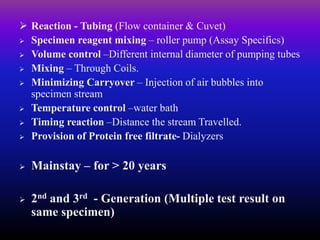
 Reaction - Tubing (Flow container & Cuvet)
 Specimen reagent mixing – roller pump (Assay Specifics)
 Volume control –Different internal diameter of pumping tubes
 Mixing – Through Coils.
 Minimizing Carryover – Injection of air bubbles into
specimen stream
 Temperature control –water bath
 Timing reaction –Distance the stream Travelled.
 Provision of Protein free filtrate- Dialyzers
 Mainstay – for > 20 years
 2nd and 3rd - Generation (Multiple test result on
same specimen)
Discrete analysis: (1970)
Widely used
 Each specimen in a batch –
“Separate from every other specimens”
Discrete processing is used by-
 Centrifugal
 Random access Analyzer
Centrifugal Analyzers:
 1970 –Norman Anderson
 Oak Ridge National laboratory-US
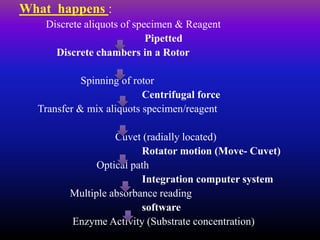
What happens :
Discrete aliquots of specimen & Reagent
Pipetted
Discrete chambers in a Rotor
Spinning of rotor
Centrifugal force
Transfer & mix aliquots specimen/reagent
Cuvet (radially located)
Rotator motion (Move- Cuvet)
Optical path
Integration computer system
Multiple absorbance reading
software
Enzyme Activity (Substrate concentration)
Early analyzers:
 Analysis of Multiple specimens for single analyte in
parallel.
Later: (Selection of Different wave length)
 Several analysis in parallels at different wave length
 Rotor: - Specimens of several tests at same time.
-Scheduled of appropriate tests
(keyboard entry bar coded label).
Random access analyzer:
 Sequential Analysis on Batch of specimens.
(Each specimen different tests.)
 Measurement of Variable No. and varieties of
Analytes in each specimen.
(Profiles of Groups of Test)
Tests are defined:
 Keyboard
 LIS with conjunction with Barcode
Selection of Appropriate Reagent Packs
Absorbance Measurement- Computer Incorporation-
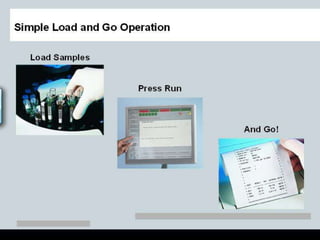
“ Walk away “- Instruments can be left for a brief period.
 Software programming.
(Single Technician – can operate more than one analyzer
at a time.)
 Most current chemistry and Immunoassay
analyzers are Random access.
Steady Improvement
-Mechanical reliability.
-Software technology
Easy Operation
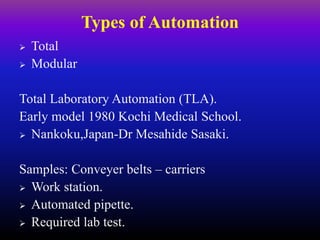
Types of Automation
 Total
 Modular
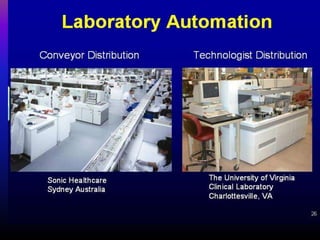
Total Laboratory Automation (TLA).
Early model 1980 Kochi Medical School.
 Nankoku,Japan-Dr Mesahide Sasaki.
Samples: Conveyer belts – carriers
 Work station.
 Automated pipette.
 Required lab test.
 Total Lab Automation:
 Large lab
 Large scale -very expensive.
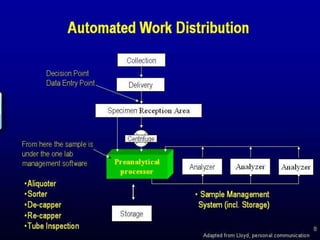
Pre-analytical automation functions.
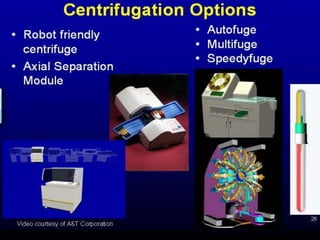
 Centrifugation.
 Aspiration of serum.
 De-capping of tubes.
 Splitting of specimen
 Barcode of aliquot tubes.
 Sorting of tubes.
Transport system.
 Conveyor belt
Tube recapping machine
Storage system.
Modular Automation (1990)
 Selected Modules
-Analyzers
-ISE
 Marketed successfully
 LAS (Laboratory Automation System).
 TLA
Require extensive software
 Module.
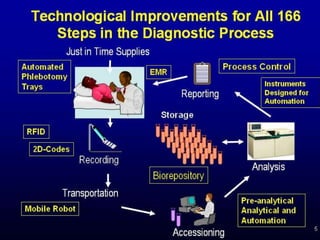
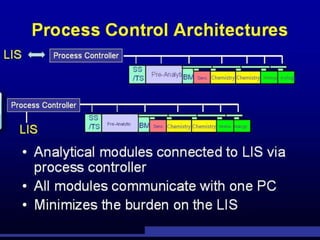
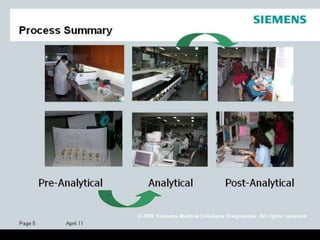
Steps in Analytical Processes
 Individual steps – “Unit operations”
 Specimen acquisition
 Specimen Identification.
 Specimen delivery to lab.
 Specimen preparation.
 Specimen Loading and aspiration.
 On – analyzer specimen delivery.
 Reagent handling and storage.
 Reagent delivery.
 Chemical reaction Phase.
 Measurement approaches.
 Signal processing , data handling and process control.
 In most – Sequential.
 In some – Combined & Parallel.
Specimen Acquisition.
 Sample collection-
Automation
(In process of Development)
 Zivonovic and Davis –Robotic System.
-Flat headed probe – location of vein.
-Automatic needle withdrawal.
Specimen Identification
 Identifying link
 Maintained throughout
-Transport
-Analysis
-Reporting.
 Technology:
Labeling , Bar-coding ,Optical character
recognition.
Magnetic stripe, Radio frequency identification.
Touch screen, Optical Mark Reader, Etc.
 Bar-coding – Technology of choice.
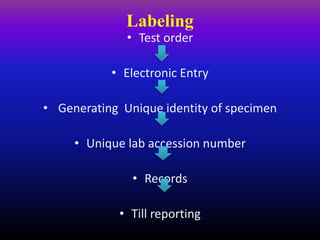
Labeling
• Test order
• Electronic Entry
• Generating Unique identity of specimen
• Unique lab accession number
• Records
• Till reporting
• Labeling of tubes
• Critical for processing
• Log in procedures
• Technical handling
• Secondary labeling (If needed)
Bar-coding
• Major automation of specimen identification
• LIS
• Bar-coded label
• Specimen container
• Read-Barcode reader
• Identification information (By software)
Advantages
• Elimination of work list on the system.
• Prevention of mixed-up of tubes placements.
• Analysis of specimen in defined sequences.
• Avoiding tube mix-up –in case of serum transfer
• Auto discrimination
• Operator intervention is less.
• Ensures- integrity of the specimen identity.
Specimen delivery to lab
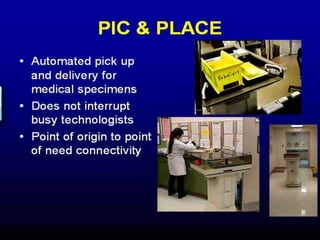
• Courier
• Pneumatic tube system
• Electric track vehicles
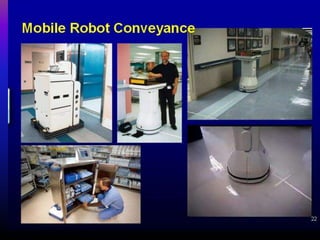
• Mobile robots
COURIER:
• Human courier
• Batch process
• Specified timings
• Delay in Services
• Specimen loss . Etc..
Pneumatic- Tube system
• Rapid transport
• Reliable
• Point to point services
• Mechanical problem
• Damage of specimen
• Limited carrying capacity
• Cost effective
Electric track vehicle:
• Larger capacity
• No specimen damages
• Larger stations
• ?Rapid specimen transport
Mobile Robots:
• Studies- Establish usefulness
• Delays
• Batched pick up. etc,
• Cost effective
Specimen Preparation
• Clotting of blood
• Centrifugation (Serum) Time Consuming -
Delays
• Secondary tube
Developments- Note worthing
• Use of whole blood
1.Assay system-Analyzer whole blood
• Specimen preparation time-Elimination
Eg. ISE- with in minutes
2.Application of whole blood to dry reagent films.
• Visual
• Instrumental observation (Quantitative)
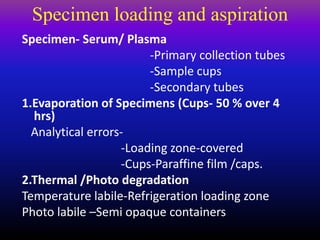
Specimen loading and aspiration
Specimen- Serum/ Plasma
-Primary collection tubes
-Sample cups
-Secondary tubes
1.Evaporation of Specimens (Cups- 50 % over 4
hrs)
Analytical errors-
-Loading zone-covered
-Cups-Paraffine film /caps.
2.Thermal /Photo degradation
Temperature labile-Refrigeration loading zone
Photo labile –Semi opaque containers
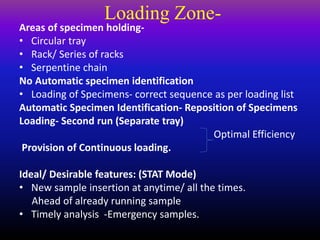
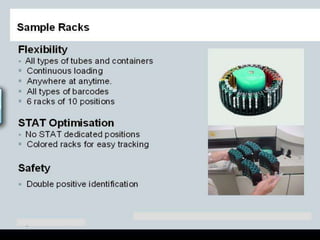
Loading Zone-
Areas of specimen holding-
• Circular tray
• Rack/ Series of racks
• Serpentine chain
No Automatic specimen identification
• Loading of Specimens- correct sequence as per loading list
Automatic Specimen Identification- Reposition of Specimens
Loading- Second run (Separate tray)
Optimal Efficiency
Provision of Continuous loading.
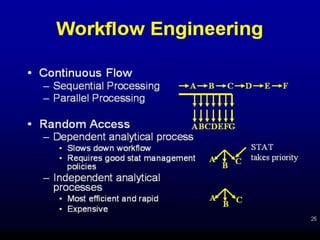
Ideal/ Desirable features: (STAT Mode)
• New sample insertion at anytime/ all the times.
Ahead of already running sample
• Timely analysis -Emergency samples.
Transmission of Infections Disease
• Common concern
1.Splatter-Acquisilion by Specimen probes
Prevention -Level Sensors
-Restriction of Penetration
-Smother motion control
2.Aerosols-
-Potential for contamination
-Specimen Transfer
-Spillages
• Prevention- Closed Container
-Sampling system.
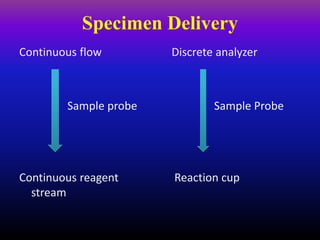
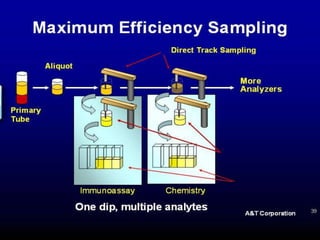
Specimen Delivery
Continuous flow
Sample probe
Continuous reagent
stream
Discrete analyzer
Sample Probe
Reaction cup
Discrete Pipetting
• Positive –Liquid-Displacement pipette
• Specimens/Calibration/Controls
Operational Modes:
1. To dispense only aspirates specimen in to
reaction receptacle.
2. To flush out specimen together with diluents.
3. Plastic or glass syringe with plunges (Teflon)
Displacement Medium
Liquid-(Diluents or reagent)
-Highly reproducible measurement.
Air: Less accuracy (Viscous fluid)
Lipaemia/ Hyper protinemia.
Categorization: -Fixed
-Variable
-Selectable- Predetermined volumes
widely used in systems.
Inaccuracy/ Imprecision-Not >1 %(Specimen and Reagent)
Periodic Verification of Accuracy & reproducibility.
Delivery of Specimens- Built -in Conveyor Track or Specimen
Carrier (Robotic)
Carry over-
”Unintended transfer of a quantity of analyze or
reagent by an analytical system from one reaction
into sub sequent one”
“ Error in analysis”
Protocols to minimize
• Adequate flush to specimen ratio-4: 1 (Wash station
/Sample probe) .
• Choice of sample probe materials .
• Surface conditions
• Flushing internal/ External surface of sample probe.
• Wiping of outside.
• Disposable sample probe tips for the Pipetic Systems
• Stringent requirement- For Immunoassays.
-Additional washes /devices.
-Additional rinsing function
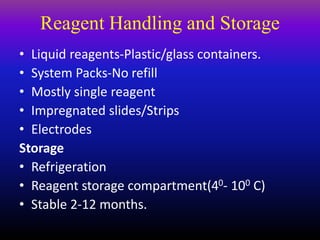
Reagent Handling and Storage
• Liquid reagents-Plastic/glass containers.
• System Packs-No refill
• Mostly single reagent
• Impregnated slides/Strips
• Electrodes
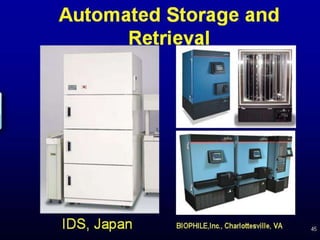
Storage
• Refrigeration
• Reagent storage compartment(40- 100 C)
• Stable 2-12 months.
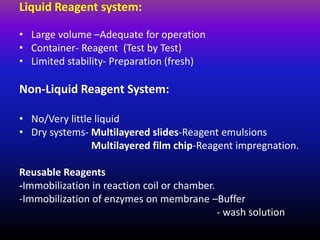
Liquid Reagent system:
• Large volume –Adequate for operation
• Container- Reagent (Test by Test)
• Limited stability- Preparation (fresh)
Non-Liquid Reagent System:
• No/Very little liquid
• Dry systems- Multilayered slides-Reagent emulsions
Multilayered film chip-Reagent impregnation.
Reusable Reagents
-Immobilization in reaction coil or chamber.
-Immobilization of enzymes on membrane –Buffer
- wash solution
Reagent Identification
Labels-
Reagent Name
• Volume
• No. of tests
• Expiry Date
• Lot No.
Barcodes:
1.Facilitation of inventory management
2.Insertion of reagent container in random sequence.
3.Automatically dispense a particular volume of liquid
reagent.
• In immunoassay system- Key information –Calibrators.
Open Vs Closed Systems
Open- Reagent from variety of Suppliers
• Flexibility
• Ready adaptation
• Less expensive
• Longer open stability
Closed:
• Reagent –Unique container
• Formats by manufacturer
• Hidden cost advantage
• Avoidance of variability arising from reconstitution of
reagent.
• Open variable stability short.
Most Immunoassay system -Closed
Reagent Delivery
Liquid Reagent
Pumps (Through tubes)
+ ve displacement syringes devises.
Mixing and reaction chambers
Pumps:
• Peristaltic pumps -Compressing and releasing of reagent tubes.
-Deliver the fluids.
-Determination of the proportion of
reagent to specimen.
• Syringes Devices- Reagent and Specimen common
+ ve displacement.
Volumes –Programmable.
Reproducible ±1 %
• Washing and Flushing facility.
Chemical Reaction Phase
• Chemical Reaction=Specimen + Reagent
Issues of concern in designing Analyzer.
1.Vessel- Reaction occurs,
-Cuvet- reaction monitored.
2.Timing of reaction
3.Mixing and transport of reactants .
4.Thermal conditioning of fluids.
Types of reaction vessels and cuvet:
• Continuous flow systems- Tube- Flow container
- Cuvet
• Discrete Systems
Discrete System
• Each specimen- Separate Physical
- Chemical space
1. Individual (Dispensable/Reusable) Reaction vessels.
-Transported
2. Stationary reaction chamber
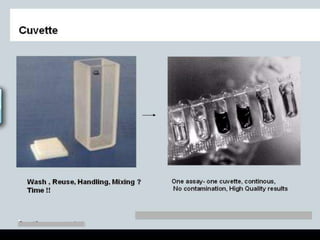
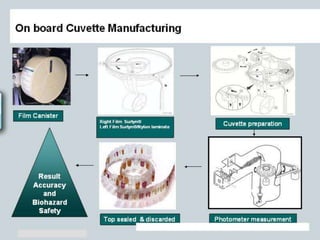
Cuvets –
Reusable /
Disposable
-Simplification
-Avoid carry over
-Superior plastic (Acrylic & polyvinyl chloride)
Requirement
• Large scale production
• Excellent dimensional tolerance
• Must be transparent in spectral range.
Reusable reaction Vessels
• B &C Synchron
• Abott
• Olympus
Periodic replacement –Composition
• 1 month- Plastic
• 2 yrs- Std glass
• If Physically Damaged–Pyrex glass
Cleaning Cuvets
Wash station –Aspiration of reaction mixture
• Detergent –Alkaline
-acid wash
• Repeated Dispension/Aspiration
• Rinsing- Deionizer.
• Drying –Vacuum , Pressurized Air.
Optical Clarity is verified
• Unsatisfacting -Flagging
- Replacement
Reusable Cuvets:
Economical Increased complexity
Requirement of cleaning liquids
Centaur- Individual cuvet 200-1000 can be loaded.
Dimensions- Manufacturer by instrument surlyn clear plastic.
Timing of Reaction
Rate of Transport-Measurement station
• Timed events of reagent additive or activation.
Discrete systems
• Addition of specimen & reagents at timed sequence.
Absorbance at intervals
Timings- Defined by Manufacturer
Mixing of Reactants
• Forceful dispensing
• Magnetic stirring
• Rotating paddle
• Use of ultrasonic energy
Mixing –Difficult to automate.
Thermal Regulation 370 C
• Controlled –Temperature Environment
• Close contract to reaction container
• Efficient heat transfer environment- Reaction
mixture.
• Air Baths
• Water Baths
• Cooling plate
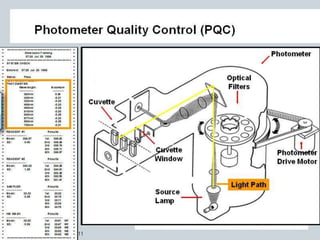
Measurement Approaches
Chemistry Analyzer-
- Photometers
-Spectrophotometer
Alternative Approaches-
- Reflectance Photometry
-Fluorometry
Immunoassay:
-Florescence
-Chemilluminiscence
-Electro chemilluminiscence
Electrolytes:
• ISE- Electrochemical
Signal Processing, Data Handling and
Process Control
Computers-Integral Components
-Analysis
-Reporting Process
-Control of Data inputs
-Monitoring
-Data Reporting
• Work Station- Integration
Interphasing of individual Analyzer.
Acquisition
• Processing of Analytical Data
• Software (Sophisticated)
1.Command and Phase the electromechanical operations
• Transfer of Solution
• Placement of proper filter
• Regulation of speed of rotation
2.Operational features:
• Calculation of results
• Increase Reproducibility
3.Acquire, assess, process and store operational data
Communication integrations between analyzer & operator
• Replenish reagents
• Empty waste container
• Warn operating problems
• Status of every specimen
Flagging
• Exceeding of Linearity
• Sub strata exhaustion
• Absorbance problem
4. Interfacing Facility
5.Computers incorporated into instruments- Special Capability.
QC Calibration curves.
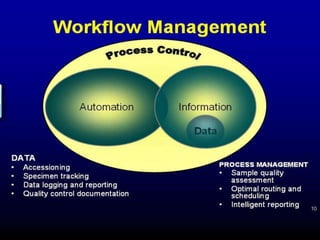
Computer Work station
• Monitoring & Integration
• Accept test order,
• Monitoring of testing process
• Assisting with process quality
• Review and verification of results.
• Display of L J Chart.
• Troubleshoot monitoring
• Auto verification of results.
Questions in our Mind
 Increase in our work load ?
 Tackling increase work load ?
 Quality Result Reporting ?
 Error Prevention ?
 Complete control ?
 Improve TAT ?
 Adding new assays ?
 Stream lining the processes ?
 Improving Services ?
 Over coming shortage of trained technicians ?
Single Answer is -Automation
Benefits:
 Reduction - variability of results
-Errors of analysis
 Avoidance-
-Manual- boredom or inattention
Improved reproducibility-Quality
improvement
 Skill fully designed automated instrument
 Good analytical methods
 Effective QA program
 Cost Effectiveness
Ten Reasons why Automation Fails to Meet
Expectations
• Incomplete understanding of current
environment, processes, cost, customer
expectation.
• Loss in flexibility because of fixed process and
limited throughput
• Unrealistic Expectations of system-Cost
reduction, throughput returns on investment.
• Unplanned and poorly developed “work around”
require to interfere automation with manual
processes.
• Unclear expectation s of system functionality.
• Over build and Unnecessarily complicated
system design.
• Inadequate technical support
• Credible and realistic impact analysis never
conducted.
• Hidden costs-Labor, supplies, maintenance
• Failure to optimize current processes before
automation (Never automate a poor process)
“Let us Thank All the Brains
Behind Automation “
For Making Our job
Easy and Pleasurable and
our life Peaceful ……

Automation

  • 1.
    Automation in ClinicalChemistry Tapeshwar Yadav (Lecturer) BMLT, DNHE, M.Sc. Medical Biochemistry
  • 2.
    What is Automation Useof laboratory instruments and specimen processing equipment to perform clinical laboratory assays with only minimal involvement of technologist .  Automation in clinical laboratory is a process by which analytical instruments perform many tests with the least involvement of an analyst.  The International Union of Pure and Applied Chemistry (IUPAC) define automation as "The replacement of human manipulative effort and facilities in the performance of a given process by mechanical and instrumental devices that are regulated by feedback of information so that an apparatus is self-monitoring or self adjusting”.
  • 3.
    History  Began-1950  Escalationof Demand for test.  Larger work loads : -Increase in 15 % /Annual -Doubling- 5 Yrs. How to handle ?  Increase in Staff  Improvement in Methods  Use of Automation. Shortage of trained technicians- Work simplification Manual- Machine (Various stages of Analytical Procedures)
  • 5.
    Evolution  Fixed Automation-repetitivetask by itself  Programmable Automation-Variety of different tasks.  Intelligent Automation-Self monitoring and appropriate response to changing condition. Historical Overview: Incremental – over 50 year Key to success:  Incorporation of  continuous flow  Discrete processing step  Development:  LIS  Robotics  Concept of total and modular automation
  • 7.
    Automations Extending:  Processingand transport of specimens  Loading in to analyze  Assessing the results
  • 8.
    Processes used inAutomation  Continuous flow  Discrete Processing
  • 9.
    Continuous flow analysis: By:Leonardskeggs in 1950 • Pioneered device  Single-channel  Continuous flow  Batch analyzer Throughput: 40-60 specimen/hour One result /analyte for each specimen
  • 10.
     Reaction -Tubing (Flow container & Cuvet)  Specimen reagent mixing – roller pump (Assay Specifics)  Volume control –Different internal diameter of pumping tubes  Mixing – Through Coils.  Minimizing Carryover – Injection of air bubbles into specimen stream  Temperature control –water bath  Timing reaction –Distance the stream Travelled.  Provision of Protein free filtrate- Dialyzers  Mainstay – for > 20 years  2nd and 3rd - Generation (Multiple test result on same specimen)
  • 11.
    Discrete analysis: (1970) Widelyused  Each specimen in a batch – “Separate from every other specimens” Discrete processing is used by-  Centrifugal  Random access Analyzer
  • 12.
    Centrifugal Analyzers:  1970–Norman Anderson  Oak Ridge National laboratory-US
  • 13.
    What happens : Discretealiquots of specimen & Reagent Pipetted Discrete chambers in a Rotor Spinning of rotor Centrifugal force Transfer & mix aliquots specimen/reagent Cuvet (radially located) Rotator motion (Move- Cuvet) Optical path Integration computer system Multiple absorbance reading software Enzyme Activity (Substrate concentration)
  • 14.
    Early analyzers:  Analysisof Multiple specimens for single analyte in parallel. Later: (Selection of Different wave length)  Several analysis in parallels at different wave length  Rotor: - Specimens of several tests at same time. -Scheduled of appropriate tests (keyboard entry bar coded label).
  • 15.
    Random access analyzer: Sequential Analysis on Batch of specimens. (Each specimen different tests.)  Measurement of Variable No. and varieties of Analytes in each specimen. (Profiles of Groups of Test)
  • 16.
    Tests are defined: Keyboard  LIS with conjunction with Barcode Selection of Appropriate Reagent Packs Absorbance Measurement- Computer Incorporation- “ Walk away “- Instruments can be left for a brief period.  Software programming. (Single Technician – can operate more than one analyzer at a time.)
  • 17.
     Most currentchemistry and Immunoassay analyzers are Random access. Steady Improvement -Mechanical reliability. -Software technology Easy Operation
  • 19.
    Types of Automation Total  Modular Total Laboratory Automation (TLA). Early model 1980 Kochi Medical School.  Nankoku,Japan-Dr Mesahide Sasaki. Samples: Conveyer belts – carriers  Work station.  Automated pipette.  Required lab test.
  • 20.
     Total LabAutomation:  Large lab  Large scale -very expensive. Pre-analytical automation functions.  Centrifugation.  Aspiration of serum.  De-capping of tubes.  Splitting of specimen  Barcode of aliquot tubes.  Sorting of tubes. Transport system.  Conveyor belt Tube recapping machine Storage system.
  • 21.
    Modular Automation (1990) Selected Modules -Analyzers -ISE  Marketed successfully  LAS (Laboratory Automation System).  TLA Require extensive software  Module.
  • 22.
    Steps in AnalyticalProcesses  Individual steps – “Unit operations”  Specimen acquisition  Specimen Identification.  Specimen delivery to lab.  Specimen preparation.  Specimen Loading and aspiration.  On – analyzer specimen delivery.  Reagent handling and storage.  Reagent delivery.  Chemical reaction Phase.  Measurement approaches.  Signal processing , data handling and process control.  In most – Sequential.  In some – Combined & Parallel.
  • 23.
    Specimen Acquisition.  Samplecollection- Automation (In process of Development)  Zivonovic and Davis –Robotic System. -Flat headed probe – location of vein. -Automatic needle withdrawal.
  • 25.
    Specimen Identification  Identifyinglink  Maintained throughout -Transport -Analysis -Reporting.  Technology: Labeling , Bar-coding ,Optical character recognition. Magnetic stripe, Radio frequency identification. Touch screen, Optical Mark Reader, Etc.  Bar-coding – Technology of choice.
  • 26.
    Labeling • Test order •Electronic Entry • Generating Unique identity of specimen • Unique lab accession number • Records • Till reporting
  • 27.
    • Labeling oftubes • Critical for processing • Log in procedures • Technical handling • Secondary labeling (If needed)
  • 29.
    Bar-coding • Major automationof specimen identification • LIS • Bar-coded label • Specimen container • Read-Barcode reader • Identification information (By software)
  • 31.
    Advantages • Elimination ofwork list on the system. • Prevention of mixed-up of tubes placements. • Analysis of specimen in defined sequences. • Avoiding tube mix-up –in case of serum transfer • Auto discrimination • Operator intervention is less. • Ensures- integrity of the specimen identity.
  • 33.
    Specimen delivery tolab • Courier • Pneumatic tube system • Electric track vehicles • Mobile robots COURIER: • Human courier • Batch process • Specified timings • Delay in Services • Specimen loss . Etc..
  • 34.
    Pneumatic- Tube system •Rapid transport • Reliable • Point to point services • Mechanical problem • Damage of specimen • Limited carrying capacity • Cost effective Electric track vehicle: • Larger capacity • No specimen damages • Larger stations • ?Rapid specimen transport Mobile Robots: • Studies- Establish usefulness • Delays • Batched pick up. etc, • Cost effective
  • 37.
    Specimen Preparation • Clottingof blood • Centrifugation (Serum) Time Consuming - Delays • Secondary tube Developments- Note worthing • Use of whole blood 1.Assay system-Analyzer whole blood • Specimen preparation time-Elimination Eg. ISE- with in minutes 2.Application of whole blood to dry reagent films. • Visual • Instrumental observation (Quantitative)
  • 39.
    Specimen loading andaspiration Specimen- Serum/ Plasma -Primary collection tubes -Sample cups -Secondary tubes 1.Evaporation of Specimens (Cups- 50 % over 4 hrs) Analytical errors- -Loading zone-covered -Cups-Paraffine film /caps. 2.Thermal /Photo degradation Temperature labile-Refrigeration loading zone Photo labile –Semi opaque containers
  • 40.
    Loading Zone- Areas ofspecimen holding- • Circular tray • Rack/ Series of racks • Serpentine chain No Automatic specimen identification • Loading of Specimens- correct sequence as per loading list Automatic Specimen Identification- Reposition of Specimens Loading- Second run (Separate tray) Optimal Efficiency Provision of Continuous loading. Ideal/ Desirable features: (STAT Mode) • New sample insertion at anytime/ all the times. Ahead of already running sample • Timely analysis -Emergency samples.
  • 41.
    Transmission of InfectionsDisease • Common concern 1.Splatter-Acquisilion by Specimen probes Prevention -Level Sensors -Restriction of Penetration -Smother motion control 2.Aerosols- -Potential for contamination -Specimen Transfer -Spillages • Prevention- Closed Container -Sampling system.
  • 42.
    Specimen Delivery Continuous flow Sampleprobe Continuous reagent stream Discrete analyzer Sample Probe Reaction cup
  • 43.
    Discrete Pipetting • Positive–Liquid-Displacement pipette • Specimens/Calibration/Controls Operational Modes: 1. To dispense only aspirates specimen in to reaction receptacle. 2. To flush out specimen together with diluents. 3. Plastic or glass syringe with plunges (Teflon)
  • 44.
    Displacement Medium Liquid-(Diluents orreagent) -Highly reproducible measurement. Air: Less accuracy (Viscous fluid) Lipaemia/ Hyper protinemia. Categorization: -Fixed -Variable -Selectable- Predetermined volumes widely used in systems. Inaccuracy/ Imprecision-Not >1 %(Specimen and Reagent) Periodic Verification of Accuracy & reproducibility. Delivery of Specimens- Built -in Conveyor Track or Specimen Carrier (Robotic)
  • 45.
    Carry over- ”Unintended transferof a quantity of analyze or reagent by an analytical system from one reaction into sub sequent one” “ Error in analysis” Protocols to minimize • Adequate flush to specimen ratio-4: 1 (Wash station /Sample probe) . • Choice of sample probe materials . • Surface conditions • Flushing internal/ External surface of sample probe. • Wiping of outside. • Disposable sample probe tips for the Pipetic Systems • Stringent requirement- For Immunoassays. -Additional washes /devices. -Additional rinsing function
  • 46.
    Reagent Handling andStorage • Liquid reagents-Plastic/glass containers. • System Packs-No refill • Mostly single reagent • Impregnated slides/Strips • Electrodes Storage • Refrigeration • Reagent storage compartment(40- 100 C) • Stable 2-12 months.
  • 48.
    Liquid Reagent system: •Large volume –Adequate for operation • Container- Reagent (Test by Test) • Limited stability- Preparation (fresh) Non-Liquid Reagent System: • No/Very little liquid • Dry systems- Multilayered slides-Reagent emulsions Multilayered film chip-Reagent impregnation. Reusable Reagents -Immobilization in reaction coil or chamber. -Immobilization of enzymes on membrane –Buffer - wash solution
  • 50.
    Reagent Identification Labels- Reagent Name •Volume • No. of tests • Expiry Date • Lot No. Barcodes: 1.Facilitation of inventory management 2.Insertion of reagent container in random sequence. 3.Automatically dispense a particular volume of liquid reagent. • In immunoassay system- Key information –Calibrators.
  • 51.
    Open Vs ClosedSystems Open- Reagent from variety of Suppliers • Flexibility • Ready adaptation • Less expensive • Longer open stability Closed: • Reagent –Unique container • Formats by manufacturer • Hidden cost advantage • Avoidance of variability arising from reconstitution of reagent. • Open variable stability short. Most Immunoassay system -Closed
  • 52.
    Reagent Delivery Liquid Reagent Pumps(Through tubes) + ve displacement syringes devises. Mixing and reaction chambers Pumps: • Peristaltic pumps -Compressing and releasing of reagent tubes. -Deliver the fluids. -Determination of the proportion of reagent to specimen. • Syringes Devices- Reagent and Specimen common + ve displacement. Volumes –Programmable. Reproducible ±1 % • Washing and Flushing facility.
  • 53.
    Chemical Reaction Phase •Chemical Reaction=Specimen + Reagent Issues of concern in designing Analyzer. 1.Vessel- Reaction occurs, -Cuvet- reaction monitored. 2.Timing of reaction 3.Mixing and transport of reactants . 4.Thermal conditioning of fluids. Types of reaction vessels and cuvet: • Continuous flow systems- Tube- Flow container - Cuvet • Discrete Systems
  • 54.
    Discrete System • Eachspecimen- Separate Physical - Chemical space 1. Individual (Dispensable/Reusable) Reaction vessels. -Transported 2. Stationary reaction chamber Cuvets – Reusable / Disposable -Simplification -Avoid carry over -Superior plastic (Acrylic & polyvinyl chloride)
  • 57.
    Requirement • Large scaleproduction • Excellent dimensional tolerance • Must be transparent in spectral range. Reusable reaction Vessels • B &C Synchron • Abott • Olympus Periodic replacement –Composition • 1 month- Plastic • 2 yrs- Std glass • If Physically Damaged–Pyrex glass
  • 58.
    Cleaning Cuvets Wash station–Aspiration of reaction mixture • Detergent –Alkaline -acid wash • Repeated Dispension/Aspiration • Rinsing- Deionizer. • Drying –Vacuum , Pressurized Air. Optical Clarity is verified • Unsatisfacting -Flagging - Replacement Reusable Cuvets: Economical Increased complexity Requirement of cleaning liquids Centaur- Individual cuvet 200-1000 can be loaded. Dimensions- Manufacturer by instrument surlyn clear plastic.
  • 59.
    Timing of Reaction Rateof Transport-Measurement station • Timed events of reagent additive or activation. Discrete systems • Addition of specimen & reagents at timed sequence. Absorbance at intervals Timings- Defined by Manufacturer Mixing of Reactants • Forceful dispensing • Magnetic stirring • Rotating paddle • Use of ultrasonic energy Mixing –Difficult to automate.
  • 60.
    Thermal Regulation 370C • Controlled –Temperature Environment • Close contract to reaction container • Efficient heat transfer environment- Reaction mixture. • Air Baths • Water Baths • Cooling plate
  • 61.
    Measurement Approaches Chemistry Analyzer- -Photometers -Spectrophotometer Alternative Approaches- - Reflectance Photometry -Fluorometry Immunoassay: -Florescence -Chemilluminiscence -Electro chemilluminiscence Electrolytes: • ISE- Electrochemical
  • 63.
    Signal Processing, DataHandling and Process Control Computers-Integral Components -Analysis -Reporting Process -Control of Data inputs -Monitoring -Data Reporting • Work Station- Integration Interphasing of individual Analyzer. Acquisition • Processing of Analytical Data • Software (Sophisticated)
  • 64.
    1.Command and Phasethe electromechanical operations • Transfer of Solution • Placement of proper filter • Regulation of speed of rotation 2.Operational features: • Calculation of results • Increase Reproducibility 3.Acquire, assess, process and store operational data Communication integrations between analyzer & operator • Replenish reagents • Empty waste container • Warn operating problems • Status of every specimen Flagging • Exceeding of Linearity • Sub strata exhaustion • Absorbance problem 4. Interfacing Facility 5.Computers incorporated into instruments- Special Capability. QC Calibration curves.
  • 65.
    Computer Work station •Monitoring & Integration • Accept test order, • Monitoring of testing process • Assisting with process quality • Review and verification of results. • Display of L J Chart. • Troubleshoot monitoring • Auto verification of results.
  • 70.
    Questions in ourMind  Increase in our work load ?  Tackling increase work load ?  Quality Result Reporting ?  Error Prevention ?  Complete control ?  Improve TAT ?  Adding new assays ?  Stream lining the processes ?  Improving Services ?  Over coming shortage of trained technicians ? Single Answer is -Automation
  • 71.
    Benefits:  Reduction -variability of results -Errors of analysis  Avoidance- -Manual- boredom or inattention Improved reproducibility-Quality improvement  Skill fully designed automated instrument  Good analytical methods  Effective QA program  Cost Effectiveness
  • 73.
    Ten Reasons whyAutomation Fails to Meet Expectations • Incomplete understanding of current environment, processes, cost, customer expectation. • Loss in flexibility because of fixed process and limited throughput • Unrealistic Expectations of system-Cost reduction, throughput returns on investment. • Unplanned and poorly developed “work around” require to interfere automation with manual processes. • Unclear expectation s of system functionality.
  • 74.
    • Over buildand Unnecessarily complicated system design. • Inadequate technical support • Credible and realistic impact analysis never conducted. • Hidden costs-Labor, supplies, maintenance • Failure to optimize current processes before automation (Never automate a poor process)
  • 78.
    “Let us ThankAll the Brains Behind Automation “ For Making Our job Easy and Pleasurable and our life Peaceful ……