 Acute infection of pulmonary parenchyma in pts 
who has acquired infection in community
 Commonly caused by : streptococcus pneumoniae 
Other organisms : hemophilus influenzae 
Atypical bacteria ( Mycoplasma 
pneumoniae, Chlymadophila pneumoniae ,legionella ) 
Respiratory viruses 
Gram negetive bacteria( 
enteobacteriaceae , pseudomonas aeruginosa) 
Rarely mycobacterium tuberculosis, 
C.psittaci, C. burnetii,endemic fungi 
Recently increased incidence of 
S.aureus is noted (methicillin resistant strains)
 Clinical evaluation 
Chest radiography { with or without 
microbiological testing}
 Cough 
 Fever 
 Pleuritic chest pain(30%) 
 Dyspnea 
 Sputum production 
 GI symptoms-nausea,vomiting,diarrhoea 
 Mental status changes 
 Chills & Rigors
 Pt is febrile 
 Respiratory rate :- > 24 cpm 
 Auscultation :- rales are present 
 1/3 rd pts present with signs of 
consolidation 
 Blood examination :- leucocytosis ( 
15,000 – 30,000/mm3) 
 Leucopenia – poor prognosis.
 Infiltrates on plain chest x-ray – gold standard 
for diagnosing pneumonia 
 Radiological appearances CAP : 
lobar consolidation(typical bacteria) 
interstitial infiltrates(pneumocystis carinii 
& viruses) 
CT scan – higher sensitivity for CAP
 Treatment is best when it is pathogen-directed 
 Includes:- blood - culture & sensitivity. 
 sputum – Gram staining & culture. 
 urinary antigen tests (legionella & 
pneumococcus) 
 Newer tests :- PCR
 Based on severity of disease 
 Other features – ability to maintain oral intake 
 likelihood of compliance 
 h/o substance abuse 
 cognitive impairement 
 living situation 
 functional status of pt.
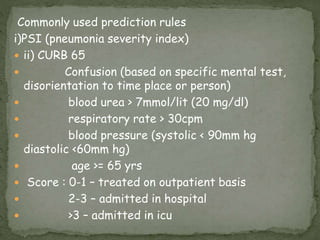
Commonly used prediction rules 
i)PSI (pneumonia severity index) 
 ii) CURB 65 
 Confusion (based on specific mental test, 
disorientation to time place or person) 
 blood urea > 7mmol/lit (20 mg/dl) 
 respiratory rate > 30cpm 
 blood pressure (systolic < 90mm hg 
diastolic <60mm hg) 
 age >= 65 yrs 
 Score : 0-1 – treated on outpatient basis 
 2-3 – admitted in hospital 
 >3 – admitted in icu
 Choice of initial treatment complicated by 
emergence of antibiotic resistance of S. pneumoniae 
 Antibiotic therapy started on empiric basis since 
causative organism is not identified in proportinate 
no. of pts.
 In pts without risk factors or microbiological 
eveidence of pseudomonas aeruginosa or MRSA : 
 Combination of I.V. beta lactam { ceftrioxone 
:1-2 gms daily cefotaxim : 1-2 gms every 8th hrly or 
ampicillin :1.5-3 gms 6th hrly.} 
PLUS 
 Either Macrolide {azithromycin 500mg daily} or 
fluoroquinolone {levofloxicin 750 mg daily or 
moxifloxicin 400mg daily}
 In pts who may be infected with pseudomonas 
aeruginosa or other resistant pathogens ( those with 
COPD or Bronchiectasis or frequent antimicrobial or 
glucocorticoid use) combination therapy with beta 
lactam and fluoroquinolones is used : 
 Piperacillin-Tazobactam(4.5 gms every 6 hrs) or 
 Imipenem (500mg every 6 hours) or 
 Meropenam (1 gm every 8 hrs) or 
 Cefipime ( 2gms every 8 hrs) or 
 Ceftazidime (2gms every 8 hrs) 
PLUS 
Ciprofloxacin (400mg every 8 hrs) or 
Levofloxacin( 750 mg daily)
 In pts allergic to penicillin by skin testing 
cephalosporins can be continued ( 3rd generation) 
 In cases of mild reaction ( not IgE mediated) 
initially 1/10 of dose is given observed for 1 hr, then 
remaining 9/10 dose is given & observed for 
another hr. 
 In pts with past allergic reaction to cephalosporins, 
Aztreonam (2mg I.V every 6-8 hrs) can be 
given.(exception to those allergic to ceftazidime)
 Empirical treatment to CA-MRSA should be given to 
hospitalised pts with severe CAP. 
 It includes addition of vancomycin (15mg/kg I.V 
every 12 hrs). In severly ill pts loading dose of 25- 
30 mg/kg is given . 
 OR 
 Linezolid (600mg I.V every 12 hrs) 
 Clindamycin (600mg I.V/oral 3 times daily) can be 
given if pathogen is susceptable. 
 If sputum culture reveals meticillin suscptible 
staphylococcus therapy can be changed to nafcillin 
(2gm I.V every 4hrs) or oxacillin (2gm I.V every 4 
hrs)
 Switch to oral therapy – initially hospitalized pts 
are treated intravenously. Oral treatment can be 
syarted once pt is hemodynamically stable,improving 
clinically,able to take oral medicines & have 
normally functioning GIT.
 Pts treated with intravenous betalactam & 
macrolides have high risk of developing drug 
resistant s. pneumoniae(DRSP). 
 High dose of amoxicillin ( 1gm orally 3 times daily) 
is given instead of I.V beta lactams 
 An alternative to pts without risk of DRSP, is to 
give macrolide or doxycyclin alone to complete 
course. 
 Doses for macrolides and doxycyclin is: 
Azithromycin : 500mg once daily 
Clarithromycin :500mg once daily 
Clarithromycin XL :500mg two tablets once daily 
Doxycyclin : 100mg twice daily
 Duration of therapy :- recommended duration for pts 
with good response in first 2-3 days is 5-7 days. 
 Before stopping therapy- pt should be afebrile for 48- 
72 hrs , breathing without supplement oxygen ,and have 
no more than one clinical instability factor (i.e PR > 
100bpm RR > 24cpm , systolic BP < 90mmhg) 
 Longer treatment is required in cases of : 
initial treatment not efficient against subsequent 
isolated pathogen 
in extrapulmonary infection (meningitis or 
endocarditis) 
if pt has empyema or lung abscess 
pneumonia caused by P.aeruginosa S.aureus legionella 
or other unusual pathogens
 Procalcitonin can be evaluated for guiding decision 
of stopping antibiotic treatment as its level 
correlate with likelihood of bacterial infection. 
 Follow up chest radiography- x-ray findings clear 
more slowly than clinical features.pts responding 
clinically do not require follow up x-ray. 
 Follow up x-ray is adviced for pts > 50 yrs , males , 
smokers. 7- 12 wks following treatment
Treatment failure:-may be due to 
 delayed host response despite appropiate 
treatment 
 infection with organism not covered in initial 
antibiotic regimen 
 drug resistant organisms 
 pt related factors – neoplasia ,aspiration 
pneumonia severity of illness, neurologic disease 
etc. 
 infectious complications – lung abscess, empyema
 Further evaluation : 
 repeat histroy, x-ray , blood cultures , sputum 
cultures , 
 Chest CT 
 Broncoscopy 
 Lung biopsy
 Adjuvant therapy :- 
 Glucocorticoids 
 Tissue factor pathway inhibitors (Tifacogin – 
systemic inhibitor of coagulation) 
 Statins – antiinflammatory 
 Vaccination - against influenza & pnemococcal 
infections. 
 Smoking cessation

Community acquired pneumonia

  • 2.
     Acute infectionof pulmonary parenchyma in pts who has acquired infection in community
  • 3.
     Commonly causedby : streptococcus pneumoniae Other organisms : hemophilus influenzae Atypical bacteria ( Mycoplasma pneumoniae, Chlymadophila pneumoniae ,legionella ) Respiratory viruses Gram negetive bacteria( enteobacteriaceae , pseudomonas aeruginosa) Rarely mycobacterium tuberculosis, C.psittaci, C. burnetii,endemic fungi Recently increased incidence of S.aureus is noted (methicillin resistant strains)
  • 4.
     Clinical evaluation Chest radiography { with or without microbiological testing}
  • 5.
     Cough Fever  Pleuritic chest pain(30%)  Dyspnea  Sputum production  GI symptoms-nausea,vomiting,diarrhoea  Mental status changes  Chills & Rigors
  • 6.
     Pt isfebrile  Respiratory rate :- > 24 cpm  Auscultation :- rales are present  1/3 rd pts present with signs of consolidation  Blood examination :- leucocytosis ( 15,000 – 30,000/mm3)  Leucopenia – poor prognosis.
  • 7.
     Infiltrates onplain chest x-ray – gold standard for diagnosing pneumonia  Radiological appearances CAP : lobar consolidation(typical bacteria) interstitial infiltrates(pneumocystis carinii & viruses) CT scan – higher sensitivity for CAP
  • 10.
     Treatment isbest when it is pathogen-directed  Includes:- blood - culture & sensitivity.  sputum – Gram staining & culture.  urinary antigen tests (legionella & pneumococcus)  Newer tests :- PCR
  • 11.
     Based onseverity of disease  Other features – ability to maintain oral intake  likelihood of compliance  h/o substance abuse  cognitive impairement  living situation  functional status of pt.
  • 12.
    Commonly used predictionrules i)PSI (pneumonia severity index)  ii) CURB 65  Confusion (based on specific mental test, disorientation to time place or person)  blood urea > 7mmol/lit (20 mg/dl)  respiratory rate > 30cpm  blood pressure (systolic < 90mm hg diastolic <60mm hg)  age >= 65 yrs  Score : 0-1 – treated on outpatient basis  2-3 – admitted in hospital  >3 – admitted in icu
  • 13.
     Choice ofinitial treatment complicated by emergence of antibiotic resistance of S. pneumoniae  Antibiotic therapy started on empiric basis since causative organism is not identified in proportinate no. of pts.
  • 14.
     In ptswithout risk factors or microbiological eveidence of pseudomonas aeruginosa or MRSA :  Combination of I.V. beta lactam { ceftrioxone :1-2 gms daily cefotaxim : 1-2 gms every 8th hrly or ampicillin :1.5-3 gms 6th hrly.} PLUS  Either Macrolide {azithromycin 500mg daily} or fluoroquinolone {levofloxicin 750 mg daily or moxifloxicin 400mg daily}
  • 15.
     In ptswho may be infected with pseudomonas aeruginosa or other resistant pathogens ( those with COPD or Bronchiectasis or frequent antimicrobial or glucocorticoid use) combination therapy with beta lactam and fluoroquinolones is used :  Piperacillin-Tazobactam(4.5 gms every 6 hrs) or  Imipenem (500mg every 6 hours) or  Meropenam (1 gm every 8 hrs) or  Cefipime ( 2gms every 8 hrs) or  Ceftazidime (2gms every 8 hrs) PLUS Ciprofloxacin (400mg every 8 hrs) or Levofloxacin( 750 mg daily)
  • 16.
     In ptsallergic to penicillin by skin testing cephalosporins can be continued ( 3rd generation)  In cases of mild reaction ( not IgE mediated) initially 1/10 of dose is given observed for 1 hr, then remaining 9/10 dose is given & observed for another hr.  In pts with past allergic reaction to cephalosporins, Aztreonam (2mg I.V every 6-8 hrs) can be given.(exception to those allergic to ceftazidime)
  • 17.
     Empirical treatmentto CA-MRSA should be given to hospitalised pts with severe CAP.  It includes addition of vancomycin (15mg/kg I.V every 12 hrs). In severly ill pts loading dose of 25- 30 mg/kg is given .  OR  Linezolid (600mg I.V every 12 hrs)  Clindamycin (600mg I.V/oral 3 times daily) can be given if pathogen is susceptable.  If sputum culture reveals meticillin suscptible staphylococcus therapy can be changed to nafcillin (2gm I.V every 4hrs) or oxacillin (2gm I.V every 4 hrs)
  • 18.
     Switch tooral therapy – initially hospitalized pts are treated intravenously. Oral treatment can be syarted once pt is hemodynamically stable,improving clinically,able to take oral medicines & have normally functioning GIT.
  • 19.
     Pts treatedwith intravenous betalactam & macrolides have high risk of developing drug resistant s. pneumoniae(DRSP).  High dose of amoxicillin ( 1gm orally 3 times daily) is given instead of I.V beta lactams  An alternative to pts without risk of DRSP, is to give macrolide or doxycyclin alone to complete course.  Doses for macrolides and doxycyclin is: Azithromycin : 500mg once daily Clarithromycin :500mg once daily Clarithromycin XL :500mg two tablets once daily Doxycyclin : 100mg twice daily
  • 20.
     Duration oftherapy :- recommended duration for pts with good response in first 2-3 days is 5-7 days.  Before stopping therapy- pt should be afebrile for 48- 72 hrs , breathing without supplement oxygen ,and have no more than one clinical instability factor (i.e PR > 100bpm RR > 24cpm , systolic BP < 90mmhg)  Longer treatment is required in cases of : initial treatment not efficient against subsequent isolated pathogen in extrapulmonary infection (meningitis or endocarditis) if pt has empyema or lung abscess pneumonia caused by P.aeruginosa S.aureus legionella or other unusual pathogens
  • 21.
     Procalcitonin canbe evaluated for guiding decision of stopping antibiotic treatment as its level correlate with likelihood of bacterial infection.  Follow up chest radiography- x-ray findings clear more slowly than clinical features.pts responding clinically do not require follow up x-ray.  Follow up x-ray is adviced for pts > 50 yrs , males , smokers. 7- 12 wks following treatment
  • 22.
    Treatment failure:-may bedue to  delayed host response despite appropiate treatment  infection with organism not covered in initial antibiotic regimen  drug resistant organisms  pt related factors – neoplasia ,aspiration pneumonia severity of illness, neurologic disease etc.  infectious complications – lung abscess, empyema
  • 23.
     Further evaluation:  repeat histroy, x-ray , blood cultures , sputum cultures ,  Chest CT  Broncoscopy  Lung biopsy
  • 24.
     Adjuvant therapy:-  Glucocorticoids  Tissue factor pathway inhibitors (Tifacogin – systemic inhibitor of coagulation)  Statins – antiinflammatory  Vaccination - against influenza & pnemococcal infections.  Smoking cessation